
Binding, Activation, and Transformation of Carbon Dioxide
Mediated by Anionic Metal Complexes
by
MASSACHUSETTS INOF TECHNOLO(
Jared S. Silvia
JUN 0 7 20
B.S. Chemistry, B.S. Biochemistry
LIBRARIE
University of Washington, 2005
MPhil Chemistry
University of Cambridge, 2007
ARCHIVES
Submitted to the Department of Chemistry in partial fulfillment for the requirements for
the degree of
DOCTOR OF PHILOSOPHY
at the
MASSACHUSETTS INSITITUTE OF TECHNOLOGY
June 2011
© Massachusetts Institute of Technology 2011. All rights reserved.
Author ...
Certified by ...
Accepted by ...
Department of Chemistry
May
5,
2011
Christopher C. Cummins
Professor of Chemistry
Thesis Supervisor
Robert W. Field
Chairman, Department Committee on Graduate Studies
S
This Doctoral Thesis has been examined by a Committee of the Department of Chemistry as
follows:
Professor Richard R. Schrock...-.W
...Frederick G. Keyes Professor of Chemistry
Chairman
Professor Christopher C. Cummins...
Professor of Chemistry
Thesis Supervisor
Professor Daniel G. Nocera... #...
Henry Dreyfus Professruf-Pnergy and Pofessor of Chemistry
Committee Member
Binding, Activation, and Transformation of Carbon Dioxide
Mediated by Anionic Metal Complexes
by
Jared
S.
Silvia
Submitted to the Department of Chemistry on May 5, 2011, in partial fulfillment of the requirements for the degree of Doctor of Philosophy in Inorganic Chemistry
Abstract
The vanadium nitride complex [Na][NV(N['Bu]Ar)3] reacts with CO to produce the
vanadium tris-anilide complex V(N['Bu]Ar)3 and NaNCO. This is the first example of complete
denitrogenation of a termainal nitride complex with generation of a lower coordinate metal complex. This reactivity contrasts sharply with the reactivity of the niobium analogue, where the nitride anion complex [Na][NNb(N['Bu]Ar)3] is synthesized from the reductive decarbonylation
of the niobium(IV) isocyanate complex (OCN)Nb(N['Bu]Ar)3. Electrochemical studies of the
niobium(IV) and vanadium(IV) isocyanate (OCN)V(N['Bu]Ar)3 complexes are presented.
The reactivity of the vanadium carbamate complex [(THF)2Na][O2CNV(N['Bu]Ar)3] with
electrophilic reagents is presented. The carbamate complex reacts readily with silylation and alkylation reagents to form the carbamate ester complexes of the type ROC(O)NV(N['Bu]Ar)3.
The vanadium carbamate complex reacts with SO2 via a decarboxylation pathway to produce the sulforyl imido complex [Na][O2SNV(N['Bu]Ar)3], the solid-state structure of which is presented.
The reactivity of the vanadium carbamate complex with typical dehydrating reagents, e.g organic acid anhydrides, is shown to proceed cleanly when cobaltocene, acting as an in situ reductant, is present to form the vanadium(IV) isocyanate complex (OCN)V(N['Bu]Ar)3. The synthesis and
structure of the bimetallic complex (TPP)MnOC(O)NV(N['Bu]Ar)3 (TPP = tetraphenylporphyrin)
is presented. Although thermally stable, the complex undergoes a photochemical transformation that forms the vanadium isocyanate complex and putative OMn(TPP), which reacts with triphenylphosphine in the reaction mixture to produce triphenylphosphine oxide.
The synthesis the niobium carbamate complex [Na][O2CNNb(N['Bu]Ar)3] from the reaction
of [Na][NNb(N[Bu]Ar)3] with CO2 is presented. Its solid-state structure in the form of the
ion-pair [(12-crown-4)2Na][O2CNNb(N['Bu]Ar)3] has been determined. Reaction of the niobium
carbamate complex with organic acid anhydrides results in the production of five-coordinate carboxylate, acetate complexes (RC(O)O)(OCN)Nb(N['Bu]Ar)3. The reduction of these
complexes by two electrons results in the regeneration of the niobium nitride complex (60-80% yield) with concomitant release of CO (30-60% yield). This three-step process represents a highly controlled conversion of CO2 to CO via a ligand-based strategy.
The reactivity of CO2 with anionic complexes featuring terminal multiply bonded ligands is extended to the oxo anion complex [(Et2O)2Li][OTi(N['Bu]Ar)3] resulting in the formation of the
carbonate complex ([Li][O2COTi(N['Bu]Ar)3])6. The binding of CO2 to the oxo complex is
reversible when 12-crown-4 is bound to the lithium countercation or if the complex is dissolved in THF. The thermodynamic parameters for the C0 2 binding equilibrium have been measured.
Exchanging the lithium countercation for sodium or potassium results in a significant weakening of the CO2binding ability of the oxo complex.
Thesis Supervisor: Christopher C. Cummins Title: Professor of Chemistry
Acknowledgments
This thesis would not exist without the help of many people.
Brandi has been the sunshine of my life. Her calming words and embraces gave me the power to keep moving forward when the skies were dark. The love and devotion she has shown me cannot be adequately acknowledged here.
My Parents have been a patient and supportive pair throughout the last five years. They have been a constant source of inspiration, and although a great physical distance has separated us, I knew that they would always be there to pick me up if I fell.
Kit invited me to join his lab to me at a time when there was already a large contingent of graduate students under his supervision. I will always be glad he did. Kit has pushed me to my limits as a result of his demanding style and insatiable curiosity. It has made me a more rigorous professional and I am eternally grateful for this.
I thank the members of the Cummins Group, past and present, who worked with me. Cutting straight to it, I was cantankerous on my good days and completely intolerable on my bad days. The other members of the Cummins group are saints for how understanding and supportive they have been.
Glen is a great friend who possesses an unheralded brilliance. His commentary on life and chemistry throughout my time at MIT brought welcomed levity to the everyday drudgery. He is the fantastic sounding board for ideas and thoughts, which is great resource to have when one is working on a thesis. I feel like the best is yet to come for our friendship.
mANiS, a.k.a. Christopher R. Clough, has a heart that is too big for one man. His loyalty and generosity are unmatched. At many times in the last few months, his presence calmed me in moments of frustration.
Fox introduced me to the Cummins group, and showed me the ropes. He played a pivotal role in helping me hit the ground running, and for this I thank him.
Curley, and his vast knowledge of the literature, was a great resource for when I had a crazy idea or was having trouble with an experiment.
Piro was a calm voice of reason. His level-headedness and thoughtfulness saved me many headaches.
Manuel gave the lab a unique, thoughtful, and fresh perspective. He was a pleasure to work with and a great person to have a coffee with.
The postdocs - Heather, Ivo, Montag, Rankin, Anthony, and Nazario - brought in new ideas from across the discipline. They were always a great source of knowledge and helpful experience. Tofan, Alexandra, and Hieu, as younger group members, never let me forget that I still have so much to learn and that I should not take anything for granted. I wish them the best of luck with the rest of their graduate journeys.
Allison has been indispensable. She is one of the most effective people I have ever worked with. The group should always be grateful for her contributions. She is a true rock star.
The other professors of the inorganic chemistry division - Prof. Schrock, Prof. Nocera, Prof. Lippard, Prof. Sadighi, Prof. Peters, and Prof. Dinca - are a special group who never let a question go unanswered. They set a high bar for the students, which is why I came to MIT. It has been a pleasure to interact with every one of them.
Prof. Carl Hoff and Prof. Elena Rybak-Akimova have been wonderful collaborators throughout my time at MIT. They are passionate scientists who have made my understanding of chemistry even richer.
Peter MUller, the crystallography wizard, deserves so much credit. He wanted to not just teach you how to perform crystallographic experiments, but he wanted you to understand crystallography. He is a great resource and a wonderfully interesting person.
The DCIF Staff - Jeff, Anne, Deb, and Bob - kept the spectroscopic engine humming. They do a great job down there in the subbasement of building 18.
My cohort of classmates, who joined the department at the same time as me, has been a valuable resource for both inspiration and support.
Brian became one of my best friends; our discussions and debates ranging from philosophy to politics to science (and not in that order) were always a welcome diversion from lab.
Marshak is the most creative chemist I have ever met. He always reminded me to think outside the box, way outside the box.
Lee-Ping is brilliant. Sharing chemistry with him was like opening a treasure chest of understanding.
Yogi was always a great person to go to when I needed a critical perspective. His ability to cut through speculation and assumptions was greatly appreciated.
The MIT GSSPC was a wonderful, horizon broadening experience. Everyone on the team was stellar. It was a pleasure to work with every one of you.
Table of Contents
Chapter 1.
Denitrogenation of a Vanadium Nitride by CO ...
25
1.1.
Introduction
...
25
1.1.1. Metal-ligand Multiple Bond Cleavage with CO ... 25
1.1.2. Previously Observed Reactivity of [Na][NV(NrBu]Ar).]... 26
1.2. Synthesis and Characterization of a Vanadium Isocyanate Complex ... 26
1.2.1. One-electron Oxidation of V(N(Bu]Ar), to Produce XV(N['Bu]Ar)3 Species...27
1.2.2. Solid-State Structure of (OCN)V(N[rBu]Ar)3 .....-- ... . . . . ...29
1.2.3. Reduction of (O C N)V(N{Bu]Ar)3... ... ...30
1.2.4. Electrochemical Studies of (OCN)V(N['Bu]Ar)3 and (OCN)Nb(N['Bu]Ar)3... . . 30
1.3. Denitrogenation of the Vanadium Nitride Anion with CO... 32
1.3.1. Reaction of CO with NaNV(N['Bu]Ar)3 in THF... 32
1.3.2. Quantification of OCN- Production Through Gravimetric Analysis...34
1.3.3. 13C Labeling Study of Reaction between CO and NaNV(NrBu]Ar)3... ...35
1.3.4. Reversible Binding of CO to V(N{Bu]Ar)3 . . . 36
1.4. Conclusions... 36
1.5. Experimental Section ... 37
1.5.1. G eneral C onsiderations. ... . 37
1.5.2. Synthesis of TfOV(NrBu]Ar)3 (7) ... 37
1.5.3. Synthesis of (OCN)V(N['Bu]Ar)3 (6)...38
1.5.4. Reduction of (OCN)V(NrBu]Ar)3 with Na/Hg ... 38
1.5.5. Reduction of (OCN)V(NrBu]Ar)3 with KC, ... ... . . 39
1.5.6. Reaction of CO with NaNV(N[rBu]Ar)3... ... . . 39
1.5.7. Synthesis of [(1 2-crown-4)2Na][NV(N['Bu]Ar)] (9). ... 40
1.5.8. X-ray Crystallographic Structure Determination... 40
1.5.9. Electrochemical Measurements ... 43
1.6. References ... 43
Chapter 2.
Reactivity of a Vanadium Carbamate Complex... 45
2.1.
Introduction
...
45
2.1.1. Activation of C02 with Nitrogenous Nucleophiles ... 45
2.1.2. Solid-state Structure of [(15-crown-5)Na]O 2CNV(N['Bu]Ar)3]... 45
2.2. Reaction with Electrophiles... 47
2.2.1. Silylation and Alkylation Reactions ... 47
2.2.2. Additional Salt Elimination Reactions ... 49
2.2.3. Sulfur Dioxide Displacement of CO2-.--- ... . . . .. . .. .. . ....50
2.3. Synthesis of Isocyanate Complex via in situ Acylation ... 53
2.3.1. Reaction with Dehydrating Reagents ... 53
2.3.2. Acylation Reactions in the Presence of a Reducing Agent ... 54
2.3.3. Low Temperature IR and NMR studies of Acetylation Reactions...55
2.3.4. Reaction with Carbon-free Dehydrating Reagents ... 57
2.4. Photochemical Deoxygenation of Carbamate Complex... 58
2.4.1. Synthesis and Structure of (TPP)MnOC(O)NV(N[Bu]Ar)3... ... . . 58
2.4.2. Photochem ical Reactivity... 61
2.5. Conclusions... 63
2.6.1. General Considerations. ... ... 64
2.6.2. Synthesis of [(1 5-crown-5)Na][O 2CNV(N['Bu]Ar)j] (10)... 64
2.6.3. Synthesis of Me3SiOC(O)NV(N['Bu]Ar)3 (11)... ... ... 65
2.6.4. Synthesis of MeOC(O)NV(N[Bu]Ar)3 (12)... 65
2.6.5. Synthesis of [(15-crown-5)Na][O 2SNV(NrBu]Ar)] (14). ... 66
2.6.6. Synthesis of OCNV(N[Bu]Ar)3 using Dehydrating Reagents and Cobaltocene. ... 66
2.6.7. Synthesis of (TPP)MnOC(O)NV(N[Bu]Ar)3 (15) ... 67
2.6.8. Irradiation of (TPP)MnOC(O)NV(N['Bu]Ar)3 (15)... 68
2.6.9. Crystallographic Details ... 68
2.7. References ... 72
Chapter 3.
Ligand-based Conversion of C02
to CO... 75
3.1.
Introduction ...
75
3.1.1. Reduction of C0 2 to CO Using Metal Complexes ... 75
3.1.2. Synthesis of [Na][NNb(N['Bu]Ar)] ...-... ... 76
3.2. Niobium Carbamate Complex...
77
3.2.1. Synthesis and Spectral Properties ... 77
3.2.2. Solid-State Structure of Niobium Carbamate Complex ... 78
3.3. Deoxygenation of Carbamate Functionality via Acylation ... 79
3.3.1. Synthesis and Spectral Properties of Five-Coordinate Niobium Complexes ... 79
3.3.2. Solid-state Structures of Five-Coordinate Complexes ... 82
3.4. Reduction Chemistry of Five-Coordinate Niobium Complexes... 84
3.4.1. Electrochemical Studies of (RC(O)O)(OCN)Nb(NrBu]Ar)3 ... ... . . 84
3.4.2. One-electron Reduction with Sm12...--... ...87
3.4.3. Two-electron Reduction with Na/Hg Amalgam ... 87
3.4.4. Quantification of CO Production ... 88
3.5. Summarizing the Cycle ... 89
3.6. Related Chemistry of the Carbamate Complex ... 91
3.7. Conclusions... 94
3.8. Experimental Section ... 94
3.8.1. General Considerations. ... ... .. ... ... 94
3.8.2. Synthesis of [Na][O2CNNb(N[Bu]Ar)j (18). ... ...95
3.8.3. Thermal Stability of 18... 96
3.8.4. Synthesis of (AcO)(OCN)Nb(N[Bu]Ar)3 (21). . ... ... 96
3.8.5. Synthesis of (F3CC(O)O)(OCN)Nb(N['Bu]Ar)3 (22)... ... ... 97
3.8.6. Synthesis of ('BuC(0)O)(OCN)Nb(N[Bu]Ar)3 (23). ... 97
3.8.7. Monitoring the Reaction between Acetic Anhydride and [Na][O2CNNb(N[Bu]Ar)] (18) at Low Temperature via NMR Spectroscopy. ... 98
3.8.8. Reduction of 21 with Sm12... ... ... ...99
3.8.9. Reduction of 21 with Na/Hg... 99
3.8.10. Spectroscopic yield of 17 from the Reduction of 21 with Na/Hg... 99
3.8.11. Spectroscopic Yield of 17 from the reduction of 22 with Na/Hg...100
3.8.12. Quantification of CO Produced from Reaction of 21 with Na/Hg via Chemical Trapping with Cp*RuC(PCy3
)...100
3.8.13. Quantification of CO Produced from Reaction of 22 with Na/Hg via Chemical Trapping with Cp*RuC(PCy3
).
... 1013.8.14. Synthesis of Me3SiOC(O)NNb(N['Bu]Ar)3 (24). ... 101
3.8.15. Electrochemical Measurements. ... ... ... 102
3.8.16. Crystallographic Details. ... 102
Chapter 4.
Binding of
C02to a Titanium Oxo-anion... 109
4.1. Introduction
...
109
4.1.1. C0 2 Activation by Metal Oxides ... 109
4.1.2. Synthesis of the Oxo complex [(Et20)2Li][OTi(NrBu]Ar)] ... 109
4.2. A Titanium Carbonate Com plex... 111
4.2.1. Carboxylation of [(Et20)2Li][OTi(NrBu]Ar)] ... 111
4.2.2. Solid-State Structure of ([Li][02COTi(NrBu]Ar)])6 ... .... ....112
4.2.3. Solution-Phase Structure...115
4.2.4. Functionalization Reactions ... 117
4.3. Solvent Effects on the Binding of CO2 to Oxo Anion. ... 120
4.3.1. Affecting Loss of C0 2 with Addition of 12-crown-4...121
4.3.2. Determination of Thermodynamic Parameters for C0 2 Binding ... 122
4.4. Countercation Effects on the Binding of CO2 . . . . . . . .. 124
4.4.1. Synthesis and Spectral Properties of [Na][OTi(N['Bu]Ar)3] and [K][OTi(NrBu]Ar)] .... 125
4.4.2. C0 2 Binding to [Na][OTi(N['Bu]Ar)j and [KIOTi(N[Bu]Ar)] ... 126
4.4.3. Synthesis, Solid-State Structure, and Reactivity with C02 of [(2,2,2-crypt)K [O Ti(N [B u]A r)j]...129
4.5. DFT Calculations on CO2 Binding ... 132
4.5.1. Cation Effect on Bonding Geometries and Bonding Energy ... 132
4.6. Additional Oxo System s... 134
4.7. Conclusions... 135
4.8. Experimental Section ... 135
4.8.1. General Considerations...135
4.8.2. Computational Studies. ... 136
4.8.3. 1H DOSY NMR Spectroscopy...137
4.8.4. Synthesis of ([Li][02COTi(N[Bu]Ar)3])6 (28)...137
4.8.5. Synthesis of Me3SiOC(O)OTi(N['Bu]Ar)3 (30)...137
4.8.6. Reaction of 'BuC(O)C with 28...138
4.8.7. Synthesis of [(12-crown-4)Li][O Ti(N['Bu]Ar),] (29) ... 139
4.8.8. Synthesis of [(THF)Na][OTi(NrBu]Ar)3 (33) ... 139 4.8.9. Synthesis of [K][OTi(N['Bu)Ar)] (34)... ... ... 139 4.8.10. Synthesis of [(2,2,2-crypt)K][OTi(N[Bu]Ar)]...140 4.8.11. CO2 Binding Studies...140 4.8.12. Synthesis of V(02CNrBu]Ar)3 (32) ... 141 4.8.13. Crystallographic Details ... 141 4.9. References ... 146
Appendix A. Synthesis of Vanadium Nitrile Complexes ...
149
A.1. Introduction ... 149
A.2. (r11-RCN)V(N[tBu]Ar)3 com plexes... 149
A.2.1. Synthesis and Structure ... ... 149
A.2.2. Reactivity of r-nitrile Complexes ... 152
A.3. Experimental Details ... 154
A.3.1. General Considerations. ... 154
A.3.2. Synthesis of PhCNV(N[Bu]Ar)3 (38). ... 154
A.3.3. Synthesis of 2,6-F2C6H3CNV(N[Bu]Ar)3 (39). ... 155
A.3.4. Synthesis of Me2NCNV(NftBu]Ar)3 (40)... .- . ... 155
A.3.5. Synthesis of [PhCNV(NrBu]Ar)J[B(3,5-(CF ) 2C6H)4] (41). ... 156
A.4. References...160
Appendix B. Preparative Synthesis of Ti(N[
tBu]3,5-Me
2CH
3)
3...
.. .... ...161
B.1.
Introduction...
161
B.2. Procedure ... 161
B.3. Properties. ... 162
Appendix C. Structurally Characterized Bidentate Anilide Complexes of
Niobium
163
C.1. Introduction ... 163C.2. Synthesis and Structure ... 163
C.2.1. (Ph2C2)Nb(N[R]ArC 2 ... ...163
C.2.2. (Ph2C2)Nb(N[R]Ar)(ODipp)C...164
C.2.3. (Et2C2)Nb(N[R]Ar3(ODipp)N3 ... ... ... ...165
C.2.4. [NNb(N[R]ArD(ODipp)]2 ... ...166
C .2 .5 . C 2N b (N [R ]A rD 2... ...16 8 C.3. Experim ental Details ... 169
C.3.1. General Considerations...169
C.3.2. Synthesis of (Ph2C2)Nb(N[R]Ar3Cl2 (42)...169
C.3.3. Synthesis of (Et2C2)Nb(N[R]Ar3Cl2 (43)...169
C.3.4. Synthesis of (Ph2C2)Nb(N[R]Ar0(ODipp)C (44)...170
C.3.5. Synthesis of (Et2C2)Nb(N[R]Ar3(ODipp)CI (45)...171
C.3.6. Synthesis of (Et2C2)Nb(N[R]ArO(ODipp)N3 (46)...172
C.3.7. Synthesis of [NNb(N[R]Ar)(ODipp)]2 (47). ... ... ... 173
C.3.8. Synthesis of Cl2Nb(N[R]ArD2 (48)... ... ... 173
C.3.9. Crystallographic Details...174
C.4. References... 179
List of Figures
Figure 1.1. IR spectrum of (OCN)V(N[Bu]Ar)
3(6)...
28
Figure 1.2. EPR Spectrum of (OCN)V(NrBu]Ar)
3(6)...
28
Figure 1.3. Solid-state structure of (OCN)V(NrBu]Ar)
3(6).
...
29
Figure 1.4. CV of complex (OCN)V(N[Bu]Ar)
3(6)...
31
Figure 1.5. CV of complex (OCN)Nb(N[Bu]Ar)
3(8).
...
32
Figure 1.6. Solid-state structure of [(1 2-crown-4)
2Na][NV(N[Bu]Ar)] (9).
...
34
Figure 1.7.
13CNMR spectrum of NaN
13COproduced in the reaction of
13COand
[N a][N V (N[
tB u]A r)
3] (2). ...
. . 35
Figure 2.1. Solid-state structure of [(1 5-crown-5)Na]O
2CNV(N['Bu]Ar)]
(10)- ...
46
Figure 2.2. Solid-state structure of Me
3SiOC(O)NV(NrBu]Ar)
3(11) ...
--...
48
Figure 2.3. Solid-state structure of [(1 5-crown-5)Na][O
2SNV(N'Bu]Ar)] (14).
...
52
Figure 2.4. IR spectra of the product of the reaction of [(THF)
2Na][O
2CNV(N['Bu]Ar)
3] with
acetyl chloride at -56
0Cover the course of 50 mi
...
56
Figure 2.5. UVNis Spectrum of (TPP)MnOC(O)NV(N['Bu]Ar)
3(15).
...
60
Figure 2.6.
51V NMR Spectrum of (TPP)MnOC(O)NV(N['Bu]Ar)
3(15).
...
60
Figure 2.7. Solid-state structure of (TPP)MnOC(O)NV(N['Bu]Ar)
3(15).
...
61
Figure 3.1. Solid-state structure of [(1 2-crown-4)
2Na][O
2CNNb(N[Bu]Ar)
3] (18).
...
79
Figure 3.2. IR Spectrum of (AcO)(OCN)Nb(N[Bu]Ar)
3(21).
...
80
Figure 3.3. In situ
13CNMR spectrum from the treatment of [Na][O
213CNNb(NrBu]Ar)
3] (18)
w ith A c
20...
8 1
Figure 3.4. IR spectra of
"C
labeled and unlabeled (AcO)(OCN)Nb(N[Bu]Ar)
3(21).
...
82
Figure 3.5. Solid-state structure of (AcO)(OCN)Nb(N['Bu]Ar)
3(21).
...
83
Figure 3.6. Solid-state structure of
(BuC(O)O)(OCN)Nb(N[Bu)Ar)
3(23)...84
Figure 3.7.
CVs
of complexes (RC(O)O)(OCN)Nb(NrBu]Ar)
3...
... . .86
Figure 3.8. Photograph of CO quantification apparatus...89
Figure 4.1.
1H NMR spectrum of ([Li][O
2COTi(N[Bu]Ar)])
6(28).
...
112
Figure 4.2. Solid-state structure of the asymmetric unit of ([Li][O
2COTi(N[Bu]Ar)])
6(28).. 114
Figure 4.3. Solid state structure of ([Li][O
2COTi(NrBu]Ar)])6
(28)... 115
Figure 4.5. Solid-state structure of Me
3SiOC(O)OTi(N[Bu]Ar)
3(30). ...
118
Figure 4.6. Solid-state structure of V(02CN['Bu]Ar)
3(32).
...
120
Figure 4.7. Variable temperature
1H NMR spectra for the reaction of excess
CO2with
[(Et
20)
2Li][OTi(N[rBu]Ar)
3] (27)...123
Figure 4.8. Variable temperature
1H NMR spectra for the reaction of excess
C02
with
[(12-crown-4)Li][OTi(NrBu]Ar)] (29)... 123
Figure 4.9. Van't Hoff plot for the oxo:carbonate equilibrium.
...
124
Figure 4.10. Solid-state structure of [K][OTi(N[Bu]Ar)
3] (34)... 126
Figure 4.11. Variable temperature
1H NMR spectra of the treatment of [Na][OTi(N['Bu]Ar)
3]
(3 3) w ith 13C O 2. .... ... ... 12 8Figure 4.12. Variable temperature
1H NMR spectra of the treatment of [K][OTi(N['Bu]Ar)
3]
w ith
3C0O
2--...
1 2 8
Figure 4.13. Solid-state structure of [(2,2,2-crypt)K[OTi(N[Bu]Ar)] (37)... 130
Figure 4.14.
1H NMR spectrum for the treatment of [(2,2,2-crypt)K][OTi(N['Bu]Ar)] (37) with
13C O
2....
1 3 1
Figure 4.15.
13CNMR spectrum for the treatment of [(2,2,2-crypt)K][OTi(N['Bu]Ar)] (37) with
13
C
0
2. ----.. ---...
---...
... 1 3 1
Figure 4.16. Optimized geometry of [Li][O
2COTi(N[Bu]Ar)j]...
133
Figure 4.17. Optimized geometry of [O
2COTi(NrBu]Ar)a]~- ...
134
Figure A 1. Solid-state structure of (2,6-F
2C
6H
3CN)V(N['Bu]Ar)
3(39)... 151
Figure A 2. Solid-state structure of (Me
2NCN)V(N[Bu]Ar)
3(40).
...
152
Figure A 3. Solid-state structure of [PhCNV(N['Bu]Ar][BArCF
3 4] (41).
...
153
Figure
C 1. Solid-state structure of (Ph
2C
2)Nb(N[R]Ar3Cl
2(42).
...
164
Figure
C
2. Solid-state structure of (Ph
2C2
)Nb(N[R]Ar3(ODipp)CI (44)... 165
Figure
C 3. Solid-state structure of (Et
2C
2)Nb(N[R]Ar3(ODipp)N
3(46).
...
166
Figure
C
4. Solid-state structure of [NNb(N[R)Ar)(ODipp)]
2(47).
...
167
Figure
C
5. Solid-state structure of
Cl
2Nb(N[R]Ar
2(48)... 168
Figure
C
6.
1H NMR Spectrum of (Ph
2C2
)Nb(N[R]ArJ(ODipp)CI (44).
...
171
Figure
C 7.
1H NMR spectrum of (Et
2C
2)Nb(N[R]Arj(ODipp)C (45)... 172
List of Schemes
Scheme 1.1. Reactivity of [Na][NV(N{'Bu]Ar)
3] (2) with CE
2molecules... 26
Scheme 1.2. Synthesis of complexes XV(N[Bu]Ar)
3... ... . .27
Scheme 1.3. Reduction of (OCN)V(N[Bu]Ar)
3(6) with Na/Hg amalgam in THF... 30
Scheme 1.4. Reaction of
CO
with [Na][NV(N['Bu]Ar)
3] (2).
...
33
Scheme 2.1. Synthesis of Me
3SiOC(O)NV(N[Bu]Ar)
3(11) and MeOC(O)NV(N['Bu]Ar)
3(12). 48
Scheme 2.2. Reaction of SO
2with [(THF)
2Na][O
2CNV(N[BuAr)
3] (4)... 51
Scheme 2.3. Proposed pathway for reaction of SO
2with [(THF)
2Na][O
2CNV(NrBu]Ar)] (4).
...
5 3
Scheme 2.4. Proposed strategy for deoxygenation of [(THF)
2Na][O
2CNV(N['Bu]Ar)
3}(4). ... 53
Scheme 2.5. Reaction of [(THF)
2Na][O
2CNV(N['BuAr)
3] (4) with pivalic anhydride and
cobaltocene.
...
. . 55
Scheme 2.6. Proposed pathway for the reaction of [(THF)
2Na][O
2CNV(N['Bu]Ar)
3] (4) with
acetic anhyd ride
...
. 57
Scheme 2.7. Reactivity of [(THF)
2Na][O
2CNV(N['Bu]Ar)
3] (4) with OPCl
3and
OSC12in the
presence of cobaltocene
...
58
Scheme 2.8. Synthesis of (TPP)MnOC(O)NV(NrBu]Ar)
3(15)... 59
Scheme 2.9. Proposed pathway for photolysis of (TPP)MnOC(O)NV(N{Bu]Ar)
3in benzene in
the presence of PPh
3....
.. ... . .62
Scheme 3.1. Synthesis of [Na][NN b(N['Bu]Ar)] (17).
...
76
Scheme 3.2. Synthesis of [Na][O
2CNNb(N['Bu]Ar)
3] (18)... 77
Scheme 3.3. Thermal conversion of [Na][0
2CNNb(N[Bu]Ar)
3] (18) to ONb(N[Bu]Ar)
3(19).. 78
Scheme 3.4. Synthesis of (AcO)(OCN)Nb(NrBu]Ar)
3(21)...80
Scheme 3.5. Proposed pathway for formation of (AcO)(OCN)Nb(N[rBu]Ar)
3(21).
...
81
Scheme 3.6. Proposed reduction pathway for complexes (RC(O)O)(OCN)Nb(N[Bu]Ar)
3. .. 87
Scheme 3.7. Reduction of (AcO)(OCN)Nb(N['Bu]Ar)
3(21) with
Sm12. . ..
...----
... 87Scheme 3.8. Reduction of (AcO)(OCN)Nb(N['Bu]Ar)
3(21) with Na/Hg amalgam... 88
Scheme 3.9. Reduction of (F
3CC(O)O)(OCN)Nb(NrBu]Ar)3
(22) with Na/Hg amalgam.
...
88
Scheme 3.10. Overal
C02
to CO cycle.
...
90
Scheme 3.11. Proposed pathway for the reaction of [Na][O
2CNNb(NrBu]Ar)] (18) with
C02.
...
9 2
Scheme 3.12. Reaction of [Na][O
2CNNb(NrBu]Ar)] (18) with SO
2.--... ... . .93
Scheme 3.13. Synthesis of Me
3SiOC(O)NNb(N['Bu]Ar)
3(24) and thermal conversion to
O N b(NrB u]A r)
3(19)...
. 93
Scheme 3.14. Reaction of [K][O
2CNNb(NrBu]Ar)
3] (18) with
OPC13in the presence of
C P
2Co ...
9 4
Scheme 4.1. Synthesis of [(Et
20)
2Li][OTi(N[Bu]Ar)
3] (27)... 110
Scheme 4.2. Intramolecular rearrangements of terminal carbamate (top) and carbonate
(botto m ) frag m ents...111
Scheme 4.3. Synthesis of ([Li][O
2C0Ti(N['Bu]Ar)])
6(28).
...
112
Scheme 4.4. Functionalization of ([Li][O
2COTi(N['Bu]Ar)])6
(28) with Me.SiOTf and
'BuC(O)Cl.
...
1 1 9
Scheme 4.5. Synthesis of [(1 2-crown-4)Li][OTi(N['Bu]Ar)] (29) from ([Li][O
2C0Ti(N['Bu]Ar)])
6(28) via lo ss of C
0 2...
12 1
Scheme 4.6. Synthesis of [(THF)Na][OTi(NrBu]Ar)
3] (33) and [K][OTi(NrBu]Ar)
3] (34).
...
125
Scheme A 1. Synthesis of nitrile complexes (i
1-RCN)V(N['Bu]Ar)...
... ..150
Scheme C 1. Synthesis of (Ph
2C
2)Nb(N[R]ArDCl
2(42).
...
164
Scheme C 2. Synthesis of (R
2C
2)Nb(N[R]Ar3(ODipp)CI (44 and 45)... 165
Scheme C 3. Synthesis of (Et
2C
2)Nb(N[R]Ar3(ODipp)N
3(46).
...
166
List of Tables
Table 1.1. Crystal Data for (OCN)V(N['Bu]Ar)
3(6) and [(1 2-crown-4)
2Na][NV(NrBu]Ar)] (9). 42
Table
2.1.
Crystal
Data
for
[(1 5-crown-5)Na][O
2CNV(N{BuAr)]
(10)
and
Me
3SiOC(O)NV(N(Bu]Ar)
3(11)...
70
Table
2.2.
Crystal
Data
for
[(1 5-crown-5)Na][O
2SNV(N[Bu]Ar)]
(14)
and
(TPP)MnOC(O)NV(NrBu]Ar)
3(15)
...
71
Table
3.1.
Crystal
Data
for
[(1 2-crown-4)
2Na][O
2CNNb(N(Bu]Ar)]
(20)
and
(AcO )(O C N)N b(N
{Bu]A
r)
3(21)...104
Table 3.2. Crystal Data for ('BuC(O)O)(OCN)Nb(NrBu]Ar)
3(23)... 105
Table 4.1. Calculated Chemical Shielding Constant and Corrected Chemical Shift for CO
2a n d 2 8
. ...
1 3 2
Table 4.2. Optimized metrics for the complex [MI[O
2COTi(N[Bu]Ar)
3]... 133
Table 4.3. Calculated AE (kcal/mol) values for the association reaction:... 134
Table 4.4. Crystal data for ([Li][O
2COTi(NrBu]Ar)]), (28) and Me
3SiOC(O)OTi(NrBu]Ar)
3(30).
...
1 4 3
Table 4.5. Crystal data for [K][OTi(NrBu]Ar)
3] (34) and [(2,2,2-crypt)K][OTi(N{'Bu]Ar)] (37).
...
1 4 4
Table 4.6. Crystal data for V(O
2CNrBu]Ar)
3(32). ...
145
Table A. 1. Crystal data for (2,6-F
2CH
3CN)V(N[Bu]Ar)
3(39) and (Me
2NCN)V(N[BuAr)
3(40).
...
1 5 8
Table A. 2. Crystal data for [(PhCN]V(N[Bu]Ar)][BArCF
34]... 159
Table C. 1. Crystal data for (Ph
2C
2)Nb(N[R]Ar3C
2(42) and (Ph
2C
2)Nb(N[R]Ard(ODipp)CI (44).
...
1 7 6
Table
C. 2. Crystal
data
for
and
(Et
2C
2)Nb(N[R]Ar3(ODipp)N
3(46) and
[NNb(N[R]Arj(ODipp)]
2(47)...
...
177
List of Compounds
1 V(N['Bu]Ar)3 2 [Na][NV(N['Bu]Ar)3] 3 [(THF)2Na][S2CNV(N['Bu]Ar)3] 4 [(THF)2Na][O2CNV(N['Bu]Ar)3] 5 OV(N['Bu]Ar)3 6 (OCN)V(N[tBu]Ar) 3 7 TfOV(N['Bu]Ar)3 8 (OCN)Nb(N[tBu]Ar)3 9 [(12-crown-4)2Na][NV(N['Bu]Ar)3] 10 [(15-crown-5)Na][O2CNV(N['Bu]Ar)3] 11 Me3SiOC(O)NV(N['Bu]Ar)3 12 MeOC(O)NV(N['Bu]Ar)3 13 [Na][O2SNV(N[tBu]Ar)3] 14 [(15-crown-5)Na][O2SNV(N['Bu]Ar)3] 15 (TPP)MnOC(O)NV(N[Bu]Ar)3 16 HNV(N['Bu]Ar)3 17 [Na][NNb(N[tBu]Ar) 3] 18 [Na][O2CNNb(N['Bu]Ar)3] 19 ONb(N[tBu]Ar)320 [(12-crown-4)2Na][O2CNNb(N[Bu]Ar)3]
21 (AcO)(OCN)Nb(N['Bu]Ar)3 22 (F3CC(O)O)(OCN)Nb(N[tBu]Ar)3 23 ('BuC(O)O)(OCN)Nb(N[Bu]Ar)3 24 Me3SiOC(O)NNb(N[tBu]Ar)3 25 Ti(N['Bu]Ar)3 26 HC(O)OTi(N[tBu]Ar) 3 27 [(Et2O)2Li][OTi(N['Bu]Ar)3]
28 ([Li][O2COTi(N[tBu]Ar)3])6
29 [(12-crown-4)Li][OTi(N[Bu]Ar) 3] 30 Me3SiOC(O)OTi(N[tBu]Ar)3 31 tBuC(O)OTi(N['Bu]Ar)3 32 V(O2CN[tBu]Ar)3 33 [(THF)Na][OTi(N[tBu]Ar)3] 34 [K][OTi(N[tBu]Ar)3]
35 [Na][O2COTi(N[tBu]Ar)3]
36 [K][O2COTi(N['Bu]Ar)3]
38 (PhCN)V(N[tBu]Ar)3 39 (2,6-F2C6H3CN)V(N[tBu]Ar)3 40 (Me2NCN)V(N['Bu]Ar)3 41 I(PhCN)V(N[Bu]Ar)3[BAr CF3 4] 42 (Ph2C2)Nb(N[R]ArL)C 2 43 (Et2C2)Nb(N[R]ArL)C 2 44 (Ph2C2)Nb(N[R]ArL)(ODipp)C1 45 (Et2C2)Nb(N[R]ArL)(ODipp)C1 46 (Et2C2)Nb(N[R]ArL)(ODipp)N3 47 [NNb(NIIR]ArL)(ODipp)]2 48 C12Nb(N[R]ArL)2
Preface
The goal: convert CO2 to CO. The method: a ligand-based approach with an anionic nitride
complex serving as the mediating platform. This was the starting point of the dissertation described herein.
The key pieces of inspiration for the proposed CO2 to CO cycle were two reports from the
Cummins group. First, the reaction of CO2 with the vanadium nitride anion complex
[Na][NV(N['Bu]Ar)3] to form the N-bound carbamate complex
[(THF)2Na][O2CNV(N['Bu]Ar)3].* Second, the formation of the niobium nitride anion complex
[Na][NNb(N['Bu]Ar)3] from the reductive decarbonylation of the isocyanate complex
(OCN)Nb(N['Bu]Ar)3.t
Thus, a three step cycle was proposed. In the first step, a nitride anion complex binds and activates CO2 to form an N-bound carbamate complex (A). Subsequently, the carbamate complex
is deoxygenated to form an isocyanate complex (B). Finally, the isocyanate undergoes a decarbonylation reaction upon one-electron reduction to regenerate the starting nitride anion complex (C).
As will be shown herein, the cycle has been closed. Of course, in the pursuit, new light has been shone on several areas of inorganic chemistry beyond the original scope of the original proposal. M =V, Nb Ar = 3,5-Me2C6 H3 t
Bu
'Bu M. N/ 1V"IN-Ar |NA tBu Ar ArCO
2 0, -o (A) C -NIII
'Bu
t Bu M.7 Nr N-Ar I N.'Bu Ar 0 C NI
'Bu M / N-Ar N. Bu E= Oxygen Accepting Substrate* Brask, J. K.; Duri-Vili, V.; Diaconescu, P. L.; Cummins, C. C. Chem. Commun. 2002, 902-903.
i
Fickes, M. G.; Odom, A. L.; Cummins, C. C. Chem. Commun. 1997, 1993-1994. 'BuChapter 1.
Denitrogenation of a
Vanadium Nitride by CO*
1.1.
Introduction
1.1.1.
Metal-ligand Multiple Bond Cleavage with CO
The reaction of CO with a metal-ligand multiple bond that results in the formal two-electron reduction of the metal center is not uncommon and is typically observed in high-valent metal complexes. The multiply bonded ligands are typically nitridos, imidos, or oxos. One of the earliest reports of the reduction of a high-valent metal complex came from Herrmann and co-workers. It was observed that when rhenium oxo complexes of the type Cp*Re(O)( 2-02CCR2) or
Cp*Re(O)(K2-O(NR')CO) were treated with 1 atm of CO, the carbonyl complexes Cp*Re(CO)2(K2-02CCR2) and Cp*Re(CO)2(K
2-O(NR')CO) would form with concomitant
formation of CO2.1 Recently a number of groups have shown similar reactivity where terminal
imido complexes (LxM=N-R) are found to react with CO to release the corresponding isocyanate (OCN-R) and form the metal carbonyl complex.2 4 In some cases, the reaction of terminal imido complexes with CO would result in formation of an isocyanate ligand bound to the metal (LxM-NCO) and release of the R group.''6 Similar reactivity has also been observed with hydrazido complexes (LxM=N-NR2) to give isocyanato, amido complexes (LxM(NCO)(NR2)), but the
metal center does not undergo a two-electron reduction in these cases.7 Very recently, Mindiola and co-workers discovered a terminal vanadium(V) nitride complex (nacnac)V=N(Ntol 2) that
reacts with CO to produce the vanadium(III) isocyanate complex (nacnac)V(NCO)(Ntol 2). In
most of the aforementioned cases, the complexes can be considered to be electrophilic as a result of the high valency of the metal center, and therefore, the reactions are often believed to proceed via a nucleophilic attack by CO on the n* orbital of the metal-ligand multiple bond, in a manner analogous to the reaction of electrophilic nitrides with phosphines as originally reported by Griffith et al.9
1.1.2. Previously Observed Reactivity of [Na][NV(N[Bu]Ar)
3]The three-coordinate vanadium complex V(N['Bu]Ar)3 (1) is readily synthesized via salt-metathesis from VCl3(THF)3 and three equivalents of (Et2O)LiN['Bu]Ar in Et20.10 While in the
Cummins group, Fickes showed that complex 1 is reacts with two-electron oxidants such as organic azides and N-oxides to give the vanadium(V) complexes.10 Expanding upon this
reactivity motif, it was later shown that the terminal nitride complex [Na][NV(N['Bu]Ar)3] (2)
could be synthesized by treating 1 with excess NaN3 in THF with concomitant extrusion of N2.'1
The negative charge on the complex endowed significant nucleophilicity to the terminal nitride moiety. This property allowed for the synthesis of a variety of imido complexes via salt-metathesis reactions including an iminophosphine-imido variant.'2 In addition to salt-elimination reactions, Brask et al. observed that complex 2 reacted readily with the neutral electrophiles CS2
and CO2 to give the N-bound dithiocarbamato complex [(THF)2Na][S2CNV(N['Bu]Ar)3] (3) and
the N-bound carbamato complex [(THF)2Na][O2CNV(N['Bu]Ar)3] (4, Scheme 1.1).13 It was
observed that complex 3 underwent an intramolecular rearrangement at elevated temperatures to generate the vanadium sulfide complex SV(N['Bu]Ar)3 and NaNCS (Scheme 1.1). In contrast, complex 4 did not undergo the analogous rearrangement to give OV(N['Bu]Ar)3 (5) and NaNCO. In conjunction with DFT calculations, it was hypothesized that the observed difference in reactivity is the result of both a greater thermodynamic driving force for thiocyanate extrusion and a larger kinetic barrier for complex 4 to form the requisite four-membered metallacyclic intermediate.
Na®
Na® E , E
7
'Bu 'Bu CE2 N A 'Bus y'1 , N Bu
'Bu
CBE
N V .AN % N'-A r tBu ) N
i
'N-'Bu E=O,S 'BuN V -NaSCN N-'Bu
Ar
/
N N-Ar Ar/
Ar I N-'Bu Ar
Ar
/
ArScheme 1.1. Reactivity of [Na][NV(N['Bu]Ar)3] (2) with CE2 molecules.
1.2.
Synthesis and Characterization of a Vanadium Isocyanate
1.2.1.
One-electron Oxidation of V(N[qBu]Ar)
3to Produce XV(N['Bu]Ar)3 Species
An unanswered question relevant to the goal of performing the proposed ligand-based reduction of CO2 to CO was whether the yet to be synthesized complex (OCN)V(N['Bu]Ar)3 (6)was capable of undergoing the requisite reductive decarbonylation of the isocyanate ligand as was observed in the case of the niobium congener. To address this question, a method for synthesizing complex 6 from 1 was pursued. In this pursuit, it was discovered that 1 reacts readily with outer-sphere, one-electron oxidants to give vanadium(IV) complexes of the type XV(N['Bu]Ar)3 (Scheme 1.2). For example, treatment of 1 with AgOTf in THF results in a color
change from dark teal to black in a matter of minutes. Following a simple workup of the reaction mixture to remove precipitated Ago, TfOV(N['Bu]Ar)3 (7) is crystallized from n-pentane in 66%
yield as black crystals. Complex 7 displays the expected physical properties for a vanadium(IV) complex: an intense, eight-line pattern in the EPR spectrum arising from the unpaired electron coupling to the vanadium nucleus, a magnetic moment of 2.0 pB in solution, and a paramagnetically broadened 'H NMR spectrum.
'Bu AgX X
'Bu
/
THFI
'Bu
N-V NAr 23*C 'Bu N V .'N r
N -- N'Bu -Ago I N-'Bu
Ar X = -OTf, 66% Ar A
Ar X = -NCO, 67% Ar
Scheme 1.2. Synthesis of complexes XV(N('Bu]Ar)s.
Using this approach, the isocyanate complex 6 is synthesized from the reaction of 1 with AgNCO in THF. Similar to the synthesis of 7, the color of the reaction mixture changes from green to black as the reaction proceeds, and following a standard workup to remove Ago, complex 6 is crystallized from n-pentane in 67% yield. Complex 6 has several distinct spectroscopic and physical features: a strong band in the IR attributed to VNCO at 2207 cm (Figure 1.1), an eight
line pattern in the EPR spectrum (20 *C, benzene solution) that results from hyperfine coupling to the I= 7/2 vanadium nucleus (g = 1.97, a = 6.44 x 10- cm'-, Figure 1.2), an effective magnetic moment of 2.0 pB (20 'C, benzene solution), and two broad electronic transitions centered at 490 (s = 3200) and 600 nm (s = 2600) that span the visible region of the electromagnetic spectrum.
3000 2500 2000 1500
Wavenumbers (cm1)
Figure 1.1. IR spectrum of (OCN)V(N[tBu]Ar) 3 (6).
Thin film, KBr plates.
I I
3400
3600
3800
4000
Field (G)
Figure 1.2. EPR Spectrum of (OCN)V(N[tBu]Ar) 3 (6). Benzene solution, 20 *C. 40 35- 30--4000 3500 1000
3200
i i a1.2.2. Solid-State Structure of (OCN)V(N[Bu]Ar)
3The solid-state structure of complex 6 was determined using single-crystal X-ray diffraction studies with crystals grown from concentrated n-pentane solutions of 6 at -35 *C (Figure 1.3). In the solid state, 6 adopts a C, symmetric structure with the vanadium center in a pseudo-tetrahedral coordination environment. One of the anilide ligands twists ~90* about the V-N bond relative to the other anilides, which is attributed to a Jahn-Teller distortion to remove the degeneracy of the d., and d, orbitals (if the z-axis is projected along the V bond).' The refinement of the crystallographic model supports the assignment of the cyanate ligand as being N-bound. The refinement statistics for the N-bound model (wR2 = 0.100) are significantly better
than those of the 0-bound case (wR2 = 0.125). The V-N interatomic distance of the isocyanate
ligand (1.955(1)
A)
is longer than the V-N interatomic distance of the anilide ligands (1.886(1) A avg.). The isocyanate ligand adopts a non-linear coordination mode with a V-N-C angle of150.6(1)0, on par with other isocyanate complexes. 6
0411 C41 0411 - C41 1.189(2)
A
N4 C41 - N4 1.182(2)A
N4-V1
1.955(2)
A
V1-N1
1.870(l)
A
3
V1-N2
1.882(1)
A
V1-N3
1.906(1)
A
N1 V1 NC41 - 04 - Til 150.6(1)0P2
1/c
Z=4
R(F) = 0.0378R,(F2)
=0.0913
Figure 1.3. Solid-state structure of (OCN)V(N['Bu]Ar)3 (6).
1.2.3. Reduction of (OCN)V(N[Bu]Ar)3
Having successfully synthesized and characterized 6, the redox chemistry of the complex was investigated. When the isocyanate complex 6 is treated with 0.5% Na/Hg amalgam in THF, the reaction mixture changes from black to dark teal over the course of 1 h at 22 'C. As assayed by H NMR spectroscopy, the reaction mixture is free of the nitride complex 2. If the decarbonylation reaction had taken place, complex 2 would be the anticipated product. Instead, reduction of 6 results in dissociation of the cyanate anion with generation of the vanadium(III) complex 1 and NaNCO (Scheme 1.3). When Na/Hg amalgam is replaced with other reducing agents, such as KC8 or (THF)3Mg(C14Hi0), similar results are observed. In the case of KC8, the
yield of the KNCO product was measured (73%) using gravimetric analysis. Given the synthetic viability of 1 and the pseudo-halide nature of NCO-, this result was not entirely unexpected. However, it does indicate that the vanadium system is incapable of performing the requisite reductive decarbonylation of cyanate for the envisioned CO2 to CO cycle.
0
C
Na/Hg 'Bu THF BuB N 1 h, 23 *C \ I Bu N -V N'Ar 'Bu V 74% N Bu N-Bu -NaNCO Ar Ar/
Ar ArScheme 1.3. Reduction of (OCN)V(N['Bu]Ar)3 (6) with Na/Hg amalgam in THF.
1.2.4. Electrochemical Studies of (OCN)V(N[qBu]Ar)3 and (OCN)Nb(N[qBu]Ar)3
The electrochemical properties of complexes 6 and (OCN)Nb(N['Bu]Ar)3 (8) were probed using cyclic voltammetric methods to understand if differences in reduction potentials between the complexes were partially responsible for the observed differences in reactivity. The cyclic voltammogram (CV) of 6 contains two electrochemical events (Figure 1.4). One event is assigned to the V5*/V4
* couple with an E12 = -0.11 V vs. Fc/Fc' (Fc = (C5H5)2Fe). This event displays
quasireversible behavior with the iC/iA ratio dependent on the scan rate of the CV. The fate of the presumably generated [6]* complex was not investigated in the course of these studies. Attempts to oxidize complex 6 with outer-sphere oxidants (e.g. AgOTf, FcBArF4, etc) yielded an intractable
mixture of products. The other event in the CV is assigned to the V4*/V3+ couple. This event appears reversible at scan rates between 10 and 300 mV/s with E/2 = -1.56 V vs. Fc/Fc. The
reversibility of this event is attributed to the rate of cyanate ion dissociation being slower than the rate of diffusion of the complex away from the electrode surface. This seems very likely since
there are no alkali metal cations present to precipitate with the cyanate ion (["Bu 4N][NCO] is soluble in THF).
I20
pA
1c IA //"' 0.5 0.0 -0.5 -1.0 Potential (V) vs -1.5 -2.0 -2.5 Fc/Fc'Figure 1.4. CV of complex (OCN)V(N['Bu]Ar)3 (6).
THF, 0.2 M ["Bu4][BArF 41, 100 mV/s scan rate.
In comparison, the CV of the niobium analogue 8 contains two electrochemical events as well, but at very different potentials (Figure 1.5). The first event has an E1 /2 = -1.1 V vs. Fc/Fc and is assigned the Nb5/Nb 4
' redox couple. As was observed with 6, this anodic event is
quasireversible. The second event is centered at -2.9 V vs. Fc/Fc and is completely irreversible. Assigned to the formal Nb4*/Nb3+couple, this irreversible event is consistent with the one-electron reduction resulting in the rapid decarbonylation of the isocyanate linkage to generate [NNb(N['Bu]Ar)3]~.
I120
pA
Nb
5*/Nb4+
0.0
-0.5
-1.0
-1.5
-2.0
-2.5
-3.0
-3.5
Potential (V) vs Fc/Fc+
Figure 1.5. CV of complex (OCN)Nb(N[Bu]Ar)3 (8). THF, 0.2 M [nBu4][BArF4], 300 mV/s scan rate.
1.3. Denitrogenation of the Vanadium Nitride Anion with CO
1.3.1. Reaction of CO with NaNV(N[Bu]Ar)3 in THF
The clear preference for cyanate dissociation from the isocyanate complex 1 gave rise to the question of whether CO could effect the denitrogenation of the nitride complex 2 with formal two-electron reduction of the vanadium metal center. As mentioned earlier, the two-electron reduction of high-valent metal complexes with CO is a well-documented phenomenon, but to the best of the author's knowledge, full denitrogenation had never been observed. When a solution of 2 in THF is treated with 1 atm of CO at 23 'C, no immediate change is observed. However, over the course of 24 h, the color of the solution changes from bright yellow to deep teal-green. Removal of the volatile components from the reaction mixture under reduced pressure leaves behind dark green-brown solids. Extracting the solids into a minimal volume of n-hexane, filtering the extract through a sintered glass frit, and storing the solution at -35 'C gave dark crystals of 1 in 71% yield (Scheme 1.4).
Na . CO 'Bu THF 'Bu 'Bu /'Bu 23 *C, 24 h \ .N 'A N V NAr N- N--V Bu rNBu -NaOCN
/
N Ar/
77%Ar Ar ArScheme 1.4. Reaction of CO with [Na][NV(N[tBu]Ar)3] (2).
The product was identified as the vanadium(III) complex 1 using NMR and IR spectroscopy. Interestingly, there was no evidence of CO binding to the low-coordinate vanadium center in the isolated material. Thus, the vanadium center is coordinatively unsaturated and available to participate in further chemistry, leaving the door open for potential catalytic applications. It should be noted that recent work has revealed that CO does bind, albeit very weakly, to 1 in solution (vide infra). Monitoring the reaction by 'H and 51V NMR spectroscopy using flame-sealed NMR tubes filled with 1 atm of CO revealed that the reaction goes to completion in the course of 24 h, and no intermediates are observed. Surprisingly, complex 2 does not react with 'BuNC under very similar conditions (3 d, THF, 23 'C). Two explanations for this observation are either that the formation of t and NaNCO is more favorable thermodynamically than formation of 1 and NaNCN'Bu, or the reaction of 'BuNC with 2 is much slower.
To determine if the sodium cation interaction with the nitrido ligand is playing a role in the denitrogenation reaction, [(12-crown-4)2Na][NV(N['Bu]Ar)3] (9) was synthesized, and the
solid-state structure was determined (Figure 1.6). As expected, the molecules of 12-crown-4 fully sequester the sodium cation and the nitrido ligand interacts only with the vanadium metal center. The vanadium-nitrogen distance in 9 is very short (1.597(3) A), as would be expected for a vanadium-nitrogen triple bond. When the reaction with CO is performed using the 12-crown-4 sequestered species, the formation of 1 occurs at qualitatively comparable rates, as assayed by 'H NMR spectroscopy, providing evidence that the sodium cation interaction is not critical for the reaction to occur.
N4-V1 1.597(3)
A
V1 -Naniide
avg.
1.945(4)
A
N4P2 1 212Z=4
R(F) = 0.0564R,(F
2)
=0.1 360
N3
Figure 1.6. Solid-state structure of [(1 2-crown-4)2Na][NV(N[Bu]Ar)3] (9).
Thermal ellipsoids are drawn at 50% probability, and hydrogen atoms have been omitted for clarity.
Given the well-documented nucleophilicity of anionic terminal nitrides," the proposed mechanism for the reaction involves nucleophilic attack by the nitrido ligand on the n* orbitals of CO. Although it cannot be definitively ruled out, a first step involving the binding of CO to the vanadium center is considered unlikely due to the steric demands of the anilide ligands and formal do electron count of the vanadium center.
1.3.2.
Quantification of OCN- Production Through Gravimetric Analysis
To confirm and quantify the formation of NaNCO in the reaction, gravimetric analysis of the NCO~ ion through formation of AgNCO was pursued. In the course of the reaction, NaNCO precipitates from the THF solution, but to insure that no NaNCO remains dissolved in solution, the reaction mixture was taken to dryness and subsequently extracted using n-hexane. Filtering the extraction mixture through a sintered glass frit allows for the isolation of an off-white powder, presumably crude NaNCO. This powder was readily soluble in water, and when the aqueous
solution was treated with excess AgNO3, a white powder precipitated immediately. Isolation of
this powder on a tared, sintered glass frit followed by thorough drying using vacuum desiccation allowed for its quantification (77% yield). This yield is in good agreement with the 71% yield measured for the isolation of 1. The chemical identity of this material as AgNCO was confirmed using IR spectroscopy.
1.3.3.
13CLabeling Study of Reaction between
CO and NaNV(N[IBu]Ar)
3A final confirmation for the formation of NaNCO from the reaction of CO with 2 came from performing a 13C labeling study. The treatment of 2 with 13CO was carried out in a similar manner as the treatment with natural abundance CO, but the CO was delivered via a break-seal flask. Analysis of the isolated, crude NaNCO from the reaction via 13C NMR spectroscopy in H
20
confirmed the identity of the 13C containing product as being cyanate ion (Figure 1.7). The signal
from the cyanate ion (129 ppm) is the only observable signal in the spectrum and agrees well with the reported chemical shift of cyanate.17
00
135 125 115 105 95 85
(ppm)
75 65 55 45
Figure 1.7. 13C NMR spectrum of NaN13
CO produced in the reaction of 13C0 and [Na][NV(N[tBu]Ar)3] (2). H20, 100 MHz, 20 *C. MeOH was added as internal reference (49 ppm).
1.3.4. Reversible Binding of CO to V(N['Bu]Ar)
3Recently, in collaboration with Prof. Carl Hoff of the University of Miami, we began studying the binding of neutral donors to three-coordinate vanadium complex 1, with initial work focused on the binding of nitriles (See Appendix A). In conjunction with measuring the thermodynamic parameters of nitrile binding to the vanadium(III) complex 1 in solution via in
situ IR spectroscopy, Prof. Hoff treated 1 with CO in toluene at ambient conditions. From his
measurements, a carbonyl complex forms in solution with a distinct band in the IR spectrum at 2032 and 1990 cm. The CO binding is hypothesized to be dynamic in this system, with a very rapid on-off process. In the reaction of the nitride complex 2 with CO in THF, it is proposed that the carbonyl complex is not observed either as a result of competition for the open coordination site with the solvent THF, or as a result of evacuating the reaction vessel and shifting the equilibrium to favor formation of 1.
1.4. Conclusions
The discovery of the denitrogenation of a terminal nitride complex to give a reduced, carbonyl free vanadium complex is intriguing. Previous examples of CO reduction of terminal ligands resulted in either the formation of bound isocyanate ligands or coordination of carbonyl ligands. Thus, the metal center in these cases remained coordinatively saturated. In contrast, the generation of 1 leaves the door open for 1 to participate in further chemistry, a characteristic that may be useful for catalytic transformations. This type of regeneration step is common in heterogeneous, metal-based oxidation systems where CO serves as the terminal reducing agent.18
In addition, this transformation may shed light onto the process of isocyanate formation observed in reaction of CO with NH3 over transition-metal surfaces.19,
20
An attractive target for future work would be to develop a system where the denitrogenated nitride is derived from the scission of N2. The tris-anilide complex 1 displays no reactivity with
N2, so alternative platforms would need to be explored if such an advance were to be realized.
The molybdenum tris-anilide complex Mo(N['Bu]Ar)3 is capable of splitting N2 to form the
nitride complex NMo(N['Bu]Ar)3. The author has observed that the molybdenum(IV) isocyanate complex (OCN)Mo(N['Bu]Ar)3 can be synthesized from the reaction of AgNCO with Mo(N['Bu]Ar)3, and the formed isocyanate complex does not spontaneously eject CO to form the
nitride. Thus, it is possible for the isocyanate complex to be the thermodynamic minimum in the reaction. However, the question of whether this stability is manifested as a result of the thermodynamic properties of the products and reactants or the kinetics barriers to decarbonylation were not addressed in my studies. Recently, Dr. Anthony Cozzolino, a postdoctoral scientist in the Cummins group, has begun to explore this idea in more detail, and his work has provided
several important insights into the chemistry of isocyanate ligands on early-transition-metal fragments.
1.5. Experimental Section
1.5.1.
General Considerations.
All manipulations were carried out either in a Vacuum Atmospheres model MO-40M glove box under an atmosphere of N2 or using standard Schlenk techniques. All solvents except for
THF were degassed and dried using the method of Grubbs.21 THF was dried initially using an
MBraun SPS and dried further by stirring with Na metal for 24 h followed by filtration through Celite and alumina to remove NaOH. After purification, all solvents were stored under an atmosphere of N2 over 4 A molecular sieves. Deuterated benzene (Cambridge Isotope Labs) was
dried by stirring over CaH2 for 24 h and was subsequently vacuum-transferred onto 4 A
molecular sieves. KC8 was prepared by melting potassium over graphite at 200 'C under an
atmosphere of argon.22 Complex 2 was prepared according to literature procedures." Tetra(n-butyl)ammonium tetrakis(pentafluorophenyl)borate was synthesized using modified literature methods. All other reagents were used as supplied by the vendor without further purification. Celite 435 (EMD Chemicals), alumina (Aldrich) and 4
A
molecular sieves (Aldrich) were dried prior to use by heating at 200 *C for 48 h under dynamic vacuum. All glassware was oven dried at 220 'C prior to use. NMR spectra were obtained on either a Bruker 400-AVANCE spectrometer equipped with a Magnex Scientific superconducting magnet or a Varian Mercury 300 spectrometer equipped with an Oxford Instruments Ltd. superconducting magnet. EPR Spectra were collected on a Bruker EMX spectrometer with an ER 4199HS cavity and a Gunn diode microwave source producing X-band (8-10 GHz) radiation. UV/Vis spectra were collected on a HP8453 spectrophotometer using 1 cm quartz cells manufactured by Starna. 'H NMR spectra were internally referenced to residual C6D5H (7.16 ppm).24 '3C NMR spectra werereferenced internally to the natural abundance signal from solvent. IR spectra were collected on a Perkin-Elmer 2000 FT-IR spectrophotometer. Elemental analysis was performed by Midwest Microlab, Indianapolis, IN.
1.5.2. Synthesis of TfOV(N[qBu]Ar)
3(7)
A solution of 1 (0.893 g, 1.56 mmol) in THF (15 mL) was frozen. A solution of AgOTf (0.402 g, 1.56 mmol) in THF (10 mL) was prepared and frozen. The two mixtures were allowed to thaw and were subsequently combined. The reaction mixture was allowed to warm to 23 'C while stirring. After four hours of stirring at ambient conditions, the color of the reaction mixture had changed from green to black. The reaction mixture was filtered through a bed of Celite on a
![Figure 1.7. 13 C NMR spectrum of NaN1 3 CO produced in the reaction of 13C0 and [Na][NV(N[ t Bu]Ar) 3 ] (2).](https://thumb-eu.123doks.com/thumbv2/123doknet/14159856.473099/35.918.160.781.500.932/figure-nmr-spectrum-nan-produced-reaction-na-nv.webp)
![Table 1.1. Crystal Data for (OCN)V(N[tBu]Ar) 3 (6) and [(12-crown-4) 2 Na][NV(N[Bu]Ar) 3 ] (9)](https://thumb-eu.123doks.com/thumbv2/123doknet/14159856.473099/42.918.138.745.169.1013/table-crystal-data-ocn-tbu-ar-crown-na.webp)
![Figure 2.1. Solid-state structure of [(15-crown-5)Na][O 2 CNV(N(Bu]Ar) 3 ] (10).](https://thumb-eu.123doks.com/thumbv2/123doknet/14159856.473099/46.918.154.770.308.779/figure-solid-state-structure-crown-na-cnv-bu.webp)
![Figure 2.3. Solid-state structure of [(1 5-crown-5)Na][O 2 SNV(NrBu]Ar) 3 ] (14).](https://thumb-eu.123doks.com/thumbv2/123doknet/14159856.473099/52.918.159.755.165.661/figure-solid-state-structure-crown-na-snv-nrbu.webp)
![Figure 2.4. IR spectra of the product of the reaction of [(THF) 2 Na][O 2 CNV(N[Bu]Ar) 3 ] with acetyl chloride at -56 *C over the course of 50 min.](https://thumb-eu.123doks.com/thumbv2/123doknet/14159856.473099/56.918.166.774.245.586/figure-spectra-product-reaction-thf-acetyl-chloride-course.webp)
![Figure 3.1. Solid-state structure of [(12-crown-4) 2 Na][O 2 CNNb(N['Bu]Ar) 3 ] (18).](https://thumb-eu.123doks.com/thumbv2/123doknet/14159856.473099/79.918.166.777.171.549/figure-solid-state-structure-crown-na-cnnb-bu.webp)
![Figure 3.3. In situ 1C NMR spectrum from the treatment of [Na][021 3 CNNb(N['Bu]Ar) 3 ] (18) with Ac 2 0.](https://thumb-eu.123doks.com/thumbv2/123doknet/14159856.473099/81.918.159.786.228.412/figure-situ-nmr-spectrum-treatment-na-cnnb-bu.webp)
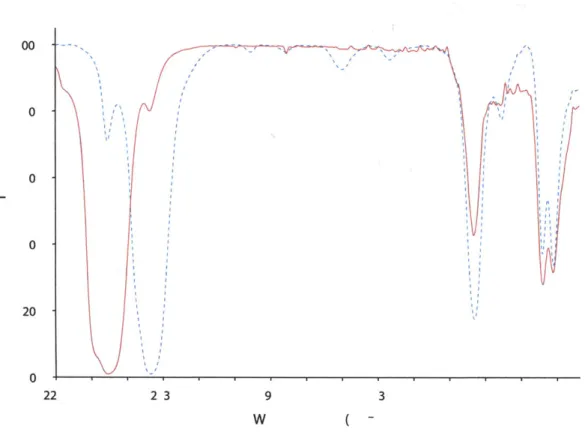
![Figure 3.5. Solid-state structure of (AcO)(OCN)Nb(N[Bu]Ar) 3 (21).](https://thumb-eu.123doks.com/thumbv2/123doknet/14159856.473099/83.918.162.766.176.595/figure-solid-state-structure-aco-ocn-nb-bu.webp)
![Figure 3.6. Solid-state structure of ('BuC(0)0)(OCN)Nb(N[Bu]Ar) 3 (23).](https://thumb-eu.123doks.com/thumbv2/123doknet/14159856.473099/84.918.160.742.159.601/figure-solid-state-structure-buc-ocn-nb-bu.webp)
