Publisher’s version / Version de l'éditeur: Technical Report, 2012-11-01
READ THESE TERMS AND CONDITIONS CAREFULLY BEFORE USING THIS WEBSITE. https://nrc-publications.canada.ca/eng/copyright
Vous avez des questions? Nous pouvons vous aider. Pour communiquer directement avec un auteur, consultez la première page de la revue dans laquelle son article a été publié afin de trouver ses coordonnées. Si vous n’arrivez pas à les repérer, communiquez avec nous à [email protected].
Questions? Contact the NRC Publications Archive team at
[email protected]. If you wish to email the authors directly, please see the first page of the publication for their contact information.
NRC Publications Archive
Archives des publications du CNRC
For the publisher’s version, please access the DOI link below./ Pour consulter la version de l’éditeur, utilisez le lien DOI ci-dessous.
https://doi.org/10.4224/21263083
Access and use of this website and the material on it are subject to the Terms and Conditions set forth at
Modeling and simulation of ship manoeuvring with Azimuthing Podded Propulsion Systems: a summary report
Lau, Michael
https://publications-cnrc.canada.ca/fra/droits
L’accès à ce site Web et l’utilisation de son contenu sont assujettis aux conditions présentées dans le site LISEZ CES CONDITIONS ATTENTIVEMENT AVANT D’UTILISER CE SITE WEB.
NRC Publications Record / Notice d'Archives des publications de CNRC:
https://nrc-publications.canada.ca/eng/view/object/?id=9c6bfdb1-7bcb-46c5-aad0-5992615995be https://publications-cnrc.canada.ca/fra/voir/objet/?id=9c6bfdb1-7bcb-46c5-aad0-5992615995be
Report Documentation Page REPORT NUMBER OCRE-TR-2012-24 PROJECT NUMBER 42_2409_26 DATE November 2012 REPORT SECURITY CLASSIFICATION
Unclassified
DISTRIBUTION Unlimited TITLE
MODELING AND SIMULATION OF SHIP MANOEUVRING WITH AZIMUTHING PODDED PROPULSION SYSTEMS: A SUMMARY REPORT
AUTHOR(S) Michael Lau
CORPORATE AUTHOR(S)/PERFORMING AGENCY(S)
NRC Ocean, Coastal and River Engineering – St. John’s, NL PUBLICATION
SPONSORING AGENCY(S)
Transport Canada; Centre for Marine Simulation, Marine Institute; and Maritime and Ocean Engineering Research Institute, Korea
RAW DATA STORAGE LOCATION(S) PEER REVIEWED
MODEL # PROP # EMBARGO PERIOD
PROJECT 2409 GROUP Research PROGRAM Arctic Operations FACILITY Ice Tank KEY WORDS
OSIS, manoeuvring, ice, simulation, pod, pressure
PAGES iv, 29 FIGS. 18 TABLES 1 SUMMARY
This report summarizes the results obtained in the three-year collaborative project between the NRC’ Ocean, Coastal and River Engineering (NRC-OCRE, formerly the Institute for Ocean Technology), the Memorial University of Newfoundland’s Centre for Marine Simulation (CMS) and the Korean Maritime and Ocean Engineering Research Institute (MOERI) under its “Modeling and Simulation of Ship Maneuvering with Azimuthing Podded Propulsion Systems Project.” The project is funded by Transport Canada of the Government of Canada through its Marine Safety Program. The work elements are described and the important results are
highlighted. This report also provides a brief summary of the accompanying reports and papers generated for this project.
ADDRESSES:
NRC - Ocean, Coastal and River Engineering St. John's
Arctic Avenue, P. O. Box 12093, St. John's, NL A1B 3T5 Tel.: (709) 772-5185, Fax: (709) 772-2462
Ottawa
1200 Montreal Road, Building M-32 Ottawa, Ontario K1A 0R6 Tel.: (613) 991-0301, Fax: (613) 952-7679
National Research Council Canada
Ocean, Coastal and River Engineering
Conseil national de recherches Canada
Génie océanique, côtier et fluvial
MODELING AND SIMULATION OF SHIP MANOEUVRING WITH
AZIMUTHING PODDED PROPULSION SYSTEMS:
A SUMMARY REPORT
OCRE-TR-2012-24
Michael Lau
ABSTRACT
This report summarizes the results obtained in the three-year collaborative project between the NRC Ocean, Coastal and River Engineering (NRC-OCRE, formerly the Institute for Ocean Technology), the Memorial University of Newfoundland’s Centre for Marine Simulation (CMS) and the Korean Maritime and Ocean Engineering Research Institute (MOERI) under its “Modeling and Simulation of Ship Maneuvering
with Azimuthing Podded Propulsion Systems Project.” The project spans three years
with the objectives of improving safety in offshore and Arctic operations of vessels with azimuthing podded propulsion systems through the development of a new suite of tools and services for ship design and simulation of maritime environments, and to generate a knowledge base that can be used in developing and improving regulations and designs of ships using azimuthing podded propellers. The project is funded by Transport Canada of the Government of Canada through its Marine Safety Program. The work elements are described and the important results are highlighted. This report also provides a brief summary of the accompanying reports and papers generated for this project.
ACKNOWLEDGMENTS
The investigations presented in this report were funded by Transport Canada. The Maritime and Ocean Engineering Research Institute (MOERI) of Korea provided the Araon model for testing. The Marine Institute’s Centre for Marine Simulation provided access to its simulator for model implementation and validation.
The author wishes to sincerely thank Mr. Victor Santos-Pedro, Past Director of Design Equipment and Boating Safety of Transport Canada Marine Safety, and Mr. Donald Roussel, the Director General of Transport Canada Marine Safety, for funding this work. Dr. Ayhan Akinturk provided general assistance in model test and advised on the development and implementation of the propulsion model. Their support is gratefully acknowledged.
TABLE OF CONTENTS ABSTRACT ... I ACKNOWLEDGMENTS ... II LIST OF FIGURES ... IV LIST OF TABLES ... IV 1 INTRODUCTION ... 1 2 WORK PLAN ... 2
3 COMPLETED TASKS AND RESULTS ... 4
3.1 Work Element 1: Literature Review and Database Development ... 4
3.2 Work Element 2: Model Tests of the Icebreaker Araon ... 4
Task 2.1: Model design and fabrication ... 5
Task 2.2: Model testing – Series 1 ... 8
Task 2.3: Model testing – Series 2 ... 9
3.3 Work Element 3: Pod Model Development ... 10
Task 3.1: Preliminary pod model ... 10
Task 3.1.1: Analysis of USCGC Mackinaw model test pod data ... 10
Task 3.1.2: Mathematical model development ... 11
Task 3.1.3: Model integration to OSIS and Polaris and its validation ... 14
Task 3.2: Refinement of mathematic model ... 16
Task 3.2.1: Propulsive performance testing of Araon podded propellers ... 16
Task 3.2.2: Pod model refinement ... 17
3.4 Work Element 4: Preliminary Pressure Model for OSIS Integration ... 19
3.5 Work Element 5: Refinement, Verification and Packaging of OSIS-IHI for User Validation ... 21
Task 5.1: Bridge version for simulator applications ... 21
Task 5.2: Stand-alone version for ship design applications ... 23
4 LIST OF REPORTS AND PUBLICATIONS ... 25
LIST OF FIGURES
Figure 1. Bow view of the model Araon (NRC-OCRE Model 850) ... 5
Figure 2. The pods installed on the model ... 6
Figure 3. The inner structure of the model pod ... 7
Figure 4. The global load measuring assembly ... 7
Figure 5. Turning circle run in level ice ... 8
Figure 6: Turning circle run in pack ice ... 9
Figure 7. Experimental set-up of the USCGC Mackinaw model in the NRC-OCRE ice tank . 11 Figure 8: Comparison of predictions from OSIS and Polaris simulations for turning in open water: (a) Turning diameter (b) Steady speed (OSIS with NRC-OCRE Pod at 130.5 rpm and Polaris with Mackinaw pod at 180 rpm) ... 13
Figure 9: Turning diameters simulated by Polaris and OSIS using NRC-OCRE pod model ... 15
Figure 10: Steady speed of turning motion simulated by Polaris and OSIS using NRC-OCRE pod model ... 15
Figure 11: Model stern for NRC-OCRE pod model tests ... 16
Figure 12: Dynamic data KFxP for a constant advance coefficient but varying azimuth angle . 18 Figure 13: Performance surface as a function of advance coefficient and azimuth angle ... 18
Figure 14: Model Araon mounted to PMM beneath carriage ... 19
Figure 15 Calculated pressure-area relation with the simple model (with 100 random numbers) ... 20
Figure 16 A turning circle manoeuvre simulated at CMS’s marine simulator ... 22
Figure 17 Ice Load computed by IHI software ... 22
Figure 18 Traditional Screw/Rudder arrangements available in OSIS-IHI ... 23
LIST OF TABLES Table 1. Summary of work activities ... 3
MODELING AND SIMULATION OF SHIP MANOEUVRING WITH AZIMUTHING PODDED PROPULSION SYSTEMS:
A SUMMARY REPORT 1 INTRODUCTION
Increasing marine traffic in the Arctic from tourism, resource exploitation and other commerce is bringing demands for safer and more efficient travel. Meanwhile, the Canadian government has initiated a series of fleet renewal programs for its aging fleets of icebreakers and ice patrol vessels to meet the ever-growing challenges to national sovereignty and marine services. Novel ship design and operational concepts have left a huge knowledge gap and an increasing demand for better modeling of ship performance and ice load on ship hulls.
Podded propellers have become widely accepted in the marine industry over the past decade due to their superior manoeuvring over conventional screw-driven systems particularly in ice-covered waters; new Canadian icebreakers and other new Canadian Coast Guard ships will likely be pod-driven.
This rapid adoption has outpaced the understanding of pod-driven ship manoeuvring performance. Specifically, the higher turning rate with podded propulsion results in a very different load profile and pressure distribution on the hull compared to conventional propulsion, as found by SafeIce1. This technology gap may result in unsafe operations and hull loading conditions, since most personnel training, ship design and marine regulation paradigms precede the emergence of pod propulsion.
With the rapid advance of numerical techniques and computation hardware, numerical modeling has become a powerful simulation tool for complementing experimental work in ship design and personnel training. The National Research of Canada`s Ocean, Coastal and River Engineering (NRC-OCRE, formerly the Institute for Ocean Technology) has been conducting model tests and developing mathematical models for performance evaluation and simulations with its partners to meet the demand of the simulator and ship design communities. Of note is the NRC-OCRE software for ships manoeuvring in ice, OSIS-IHI (Ocean Structure Interaction Simulation/Ice-Hull Interaction) (Lau and Ni, 2009 and Lau, 2011).
The NRC-OCRE, the Marine Institute’s Centre for Marine Simulation2 (CMS) and the Korean Maritime and Ocean Engineering Research Institute (MOERI) all have requirements for advanced numerical modeling. The three organizations undertook a collaborative project, “Modeling and Simulation of Ship Maneuvering with Azimuthing
Podded Propulsion Systems”. The NRC portion of the project was funded by Transport
Canada of the Government of Canada through its Marine Safety Program.
1
SafeIce is the international program on “Increasing the Safety of Icebound Shipping”, of which the National Research Council of Canada is the Canadian partner.
2
This report summarizes the results of this collaboration. Section 2 briefly summarizes the work plan. Sections 3 gives a detailed description of individual work components from each phase and the associated results. Section 4 lists the reports and papers associated with this project. Further references are provided in Section 5.
2 WORK PLAN
The objectives of the project are:
to improve safety in offshore and Arctic operations of vessels with azimuthing podded propulsion systems through the development of a new suite of tools and services for ship design and simulation of maritime environments, and
to generate a knowledge base that can be used in developing and improving regulations and designs of ships using azimuthing podded propellers aiming at improving the safety of shipping and the protection of life, property and the marine environment.
The project spans three years and is divided into three phases.
Phase 1 (Fiscal Year 2009-2010) focused on the preparation of the model test and development of the pod numerical models compatible with OSIS-IHI software. It included the following tasks:
literature review and database development related to manoeuvring performance in ice
preliminary free run manoeuvring tests of the icebreaker model Araon with focuses on the pressure measurement technique and the performance of twin propulsion preliminary development of the pod numerical model and software including
developing a semi-empirical pod performance model based on analysis of existing pod model data obtained from USCGC Mackinaw and
preliminary integration of the pod model into the NRC OSIS-IHI and CMS Polaris simulators
Phase 2 (Fiscal Year 2010-2011) focused on the development of the local pressure model, integration of the pod model into OSIS-IHI, model testing and software validation, including the following tasks:
free run manoeuvring tests of the MOERI model icebreaker Araon to collect further data for OSIS-IHI verification
development of the local pressure numerical model and software integration of the pod model into OSIS-IHI
Preliminary OSIS-IHI validation with test data
Phase 3 (Fiscal Year 2011-2012) focused on the application of the OSIS-IHI software to marine simulator and ship design applications. It consists of the following tasks:
completion of the OSIS-IHI integration to the CMS bridge simulator and its validation completion of OSIS-IHI validation and packaging
March 2012 marked the end of the whole project. Table 1 summarizes the activities completed all Phases.
Table 1. Summary of work activities Work Element Description
WE1.0 Literature review and database development WE2.0 Model tests of the icebreaker Araon
Task 2.1 Model design and fabrication Task 2.2 Model testing - Series 1 Task 2.3 Model testing - Series 2
WE3.0 Pod model development Task 3.1 Preliminary mathematical model
Task 3.1.1 Analysis of pod data from USCGS Mackinaw model test Task 3.1.2 Pod model development
Task 3.1.3 Pod model integration to OSIS and Polaris and its validation Task 3.2 Refinement of mathematical model
Task 3.2.1 Performance test of Araon pods Task 3.2.2 Pod model refinement
WE4.0 Preliminary pressure model for OSIS integration
WE5.0 Refinement, verification and packaging of OSIS-IHI for user validation
Task 5.1 Bridge version for simulator applications
3 COMPLETED TASKS AND RESULTS
The following subsections detail the tasks completed and highlight the key results.
3.1 Work Element 1: Literature Review and Database Development
To assist in model development, a comprehensive database was constructed of publicly available full- and model-scale ice manoeuvring test data. The database facilitated the validation of the numerical models developed in this project by greatly improving access to the required experimental data. This effort results in the current version of the “Ship Manoeuvring Performance in Ice Database v1.0”3.
A literature review on state-of-the-art of ship manoeuvring in ice was performed with focus given to current designs and practices. The influence of various ship design parameters on manoeuvring performance was identified. Over 120 reports and papers were reviewed and test data were extracted to populate a new database containing full- and model-scale ice manoeuvring test data. Post-1995 test data was taken directly from published reports; pre-1995 test data was taken from an existing database “Ship in Ice
Performance Database Version 1.0” (TDC, 1995) available at the Transportation
Development Centre of Transport Canada. The database was documented in Lau (2010a), which details the data contained in the new database and provides example analyses. The database has been created in spreadsheet form (Microsoft Excel) because this format facilitates basic analysis and the information can be easily converted to another format if required. The database is attached to the report as Appendix A.
Much care was taken to ensure accurate data reproduction during the creation of this database, however it is recommended that the data from “Ship in Ice Performance
Database Version 1.0” be verified, understanding that it may not be possible to identify
all the sources.
Maintenance of this database on a regular interval is also recommended by adding additional test data, when they become available.
3.2 Work Element 2: Model Tests of the Icebreaker Araon
The majority of the resources in Phase 1 were devoted to model testing. This work includes fabrication of the Araon model with additional funding from the Maritime and Ocean Engineering Research Institute (MOERI), part of the Korean Ocean Research and Development Institute (KORDI).
3
Task 2.1: Model design and fabrication
The Araon is the new Korean icebreaker built and delivered by Hanjin Heavy Industry at the end of 2009 to its owner, KORDI. Under the auspices of KORDI, MOERI is collaborating with NRC-OCRE to assess the performance of Araon in ice, which complements this project. MOERI agreed to loan the Araon model for this test on the manoeuvring performance of pod-drive ships in ice.
The Araon is a 6,950-ton icebreaker designed for operation in 1-m thick multi-year ice conditions with continuous ice breaking capability at 3 knots. It is equipped with twin azimuth propulsion units driven by a diesel-electric propulsion plant. The model, shown in Figure 1, was constructed to a scale of 1:20. Similar to the ship, the model hull is fitted with an ice knife and bow thruster tunnels. It is finished and marked to NRC-OCRE (ITTC) standards.
Figure 1. Bow view of the model Araon (NRC-OCRE Model 850)
To keep the cost to an acceptable level, NRC-OCRE was providing free use of its current model pod propellers for these tests. The Araon model was fitted with twin propellers, although it was agreed that exact duplication of the pod geometry is not necessary. Nevertheless, the shells of the pods were designed and fabricated as closely as feasible to the Araon pod geometry provided by MOERI. The next three figures show the pods installed on the model, the inner structure of the pod and its global load measuring assembly.
Figure 3. The inner structure of the model pod
Figure 4. The global load measuring assembly
Task 2.2: Model testing – Series 1
Free running tests of the scale model Araon were conducted in a series of propulsion and manoeuvring runs in open water, level ice and pack ice. The main focus of these tests was the performance of the podded propulsors and their influence on ice-hull load distribution during ship manoeuvres. The manoeuvres included straight, zigzagging, and circular runs with control over propeller shaft speed and pod deflection angle. Figure 5 shows a typical turning circle run.
Throughout testing, the model position, pod performance characteristics and ice-hull pressures were monitored. A relationship between propeller speed, pod angle setting and model motion was determined. Level ice turning circles and zigzag channels were measured, and qualitative pressure distribution observations were made.
The results indicated significant ice-hull loading over the model bow and outside stern during turning circles; high loading was experienced at the bow during straight runs. Very low ice-hull loading was observed at the model stern during straight runs. Comparison between loading on inside and outside turning surfaces was limited, as few sensors were mounted on the inside turning surface of the model.
The results also showed that greater turning radii resulted from increasing propeller speed or ice thickness and reducing the azimuth angle.
It is recommended that future testing consider additional sensors on the inside model hull surface, in situ sensor calibration, wireless instrumentation, and a model-braking method that is less disruptive to collected data.
The model test was documented in Lau and Akinturk (2010).
Task 2.3: Model testing – Series 2
The majority of the resources in Phase 2 were also devoted to model testing. This work included additional model testing of the Araon model extended from the Phase 1 work with additional funding from MOERI.
Extensive free running tests of the scale model Araon were conducted in open water, level ice and pack ice. These tests focused on the propulsion and manoeuvring performances of the Araon in order to collect further data on the performance of podded propulsors and their influence on ice-hull load distribution during manoeuvres for validation of OSIS-IHI. The experiment set-up was the same as for the previous test series. The manoeuvres included straight, zigzagging and circular runs with control over propeller shaft speed and pod deflection angle. Figure 6 shows a typical pack ice run.
Throughout testing, the model position, pod performance characteristics and ice-hull pressures were also monitored. The result was in agreement with the finding from the preliminary test series, The important feature of this test was the extensive propulsion and manoeuvring data obtained in various ice conditions. This allowed comprehensive evaluation of the OSIS-IHI software that was planned for Fiscal Year 2011-2012.
The model test was documented in Lau and Akinturk (2011a).
3.3 Work Element 3: Pod Model Development Task 3.1: Preliminary pod model
The propulsion forces and moments due to pods can be simulated numerically based on an empirical model developed from model test data. Ship simulators such as the Polaris system used at the Centre for Marine Simulation (CMS) require such a model to simulate pod-driven ships. At the NRC-OCRE, a semi-empirical pod model had been developed and incorporated into its in-house simulation software for ships manoeuvring in ice, OSIS-IHI, based on the experimental data of the USCGC4 Mackinaw (Akinturk and Lau, 2010). This model was also implemented in the CMS simulators.
This work element focused on the development of a semi-empirical pod model that could be implemented in OSIS and Polaris. This included the following sub-tasks:
Task 3.1.1: Analysis of pod data obtained from USCGC Mackinaw model test Task 3.1.2: Mathematical model development
Task 3.1.3: Model Integration to OSIS and Polaris
Task 3.1.1: Analysis of USCGC Mackinaw model test pod data
A semi-empirical model was developed based on the USCGC Mackinaw pod test data (Akinturk and Lau, 2010). This data set was used for preliminary development of the model since the Araon data were not available at the time of model development.
The propellers for the twin pods were tested in their typical operational configuration, i.e., the tractor mode, on a 1:15.62 scale model of the USCGS icebreaker Mackinaw. The model was towed straight ahead at various speeds while the azimuth angle of one of the twin pods steered in the range of 0 to 180 degrees.
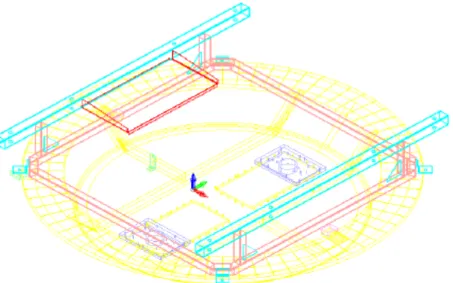
Two conditions were simulated for the pods during the experiments: static tests, in which the azimuth angle of the one of the pods was fixed at a certain azimuth angle for the duration of a run; dynamic tests, in which one of the pods was continuously steered from 0 to 360 degrees azimuth. Figure 7 shows a typical test set up.
4
Figure 7. Experimental set-up of the USCGC Mackinaw model in the NRC-OCRE ice tank
The thrust T and torque Q on the propeller shaft and the longitudinal force Fx and
transverse force Fy generated on the model ship hull by the pods were measured;
regressions on the test data converted these to non-dimensionalized coefficients, which were functions of advance coefficient J u
nD
and steering angle R.
The thrust coefficient Kt was defined as follows:
Kt (J,R)=T / 0.5 n2 D4 (1)
where ρ was the water density, n the propeller speed, and D the propeller diameter. The torque coefficient Kq was defined as follows:
2 5
( , ) / 0.5
q R
K J Q n D (2)
Finally, the non-dimensional force coefficients KFx and KFy were defined as:
2 4 ( , ) / 0.5 Fx R x K J F n D and 2 4 ( , ) / 0.5 Fy R y K J F n D (3) These coefficients were used in the subsequent model development.
Task 3.1.2: Mathematical model development
The experiment was conducted in straight-ahead motion with the pod azimuth angle steered in a range from 0 to 180 degrees. Regression on test data was performed to describe the pod performance. The semi-empirical model was extended to cover a pod
Towing Carriage Model
azimuth angle θ from 0 to 360o and advance coefficient J as well as accounting for the different wake effects during turning.
The test data were measured only in straight forward ship motion and the pod forces could be quite different at the same θ and J when the ship turns; therefore, the influences of hull-pod interaction, wake fraction, flow rectification coefficient and thrust deduction were investigated and incorporated into the model treatment.
These analyses resulted in a semi-empirical model that was capable of modeling pod performance for arbitrary ship manoeuvres. The model was further incorporated into NRC-OCRE OSIS ship manoeuvring software for validation and to study the manoeuvring performance of the USCGC Mackinaw (Lau and Ni, 2010a).
The validation exercise was conducted by comparing the OSIS simulation results with those obtained from a CMS Polaris simulation under identical test conditions. The simulation at CMS was conducted using its existing pod model developed for the Mackinaw, while the OSIS simulation was run with the NRC-OCRE pod model.
Since the propellers used in the NRC-OCRE and CMS Mackinaw models were different, and thus generate different thrust at the same propeller speed, the validation was conducted at the same propeller power outputs, which corresponded to 130.5 rpm and 180 rpm for the NRC-OCRE and CMS models, respectively.
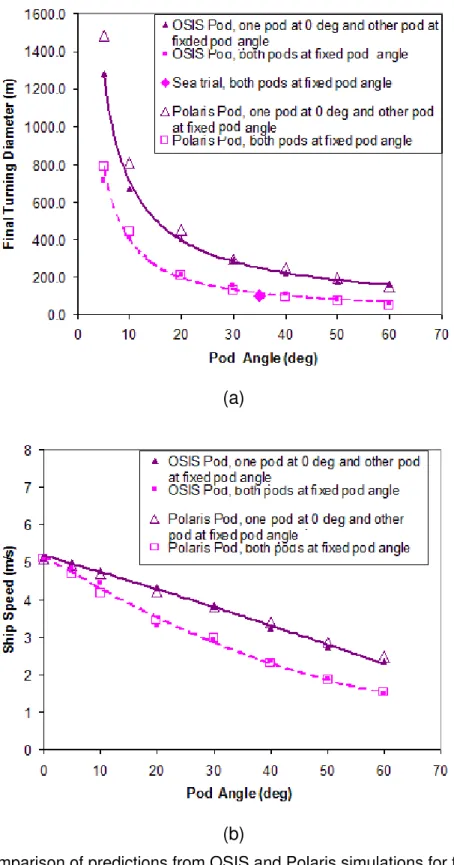
A range of pod angles from 0 to 60o was imposed and the corresponding turning motion was simulated using OSIS and Polaris. The results are summarized in Figure 8 for turning diameter and advance speed. The turning diameter obtained from sea trials of the Mackinaw with rudders set to 35° is also given in Figure 8(a). Figure 8 shows good agreement among the OSIS simulation, Polaris simulation and limited sea trial data.
(a)
(b)
Figure 8: Comparison of predictions from OSIS and Polaris simulations for turning in open water: (a) Turning diameter (b) Steady speed (OSIS with NRC-OCRE Pod at 130.5 rpm and
Task 3.1.3: Model integration to OSIS and Polaris and its validation
As part of this collaboration, CMS provided access to its Polaris simulation environment for mission rehearsal and training, including a unique capability to simulate operations in harsh environments. This NRC-OCRE pod model enabled improvement of CMS full mission bridge rehearsal of new operations and training for operations in harsh environments with pod-driven vessels.
This task was scheduled to start on Fiscal-Year 2010-2011; however, CMS was ready to provide access to its simulator for model implementation and validation ahead of schedule and their ship simulators, such as the Polaris system, were then in need of an improved model to simulate pod-driven ships.
We had completed a preliminary implementation of the semi-empirical pod model and its on-site validation at CMS and the result was documented in Lau and Ni (2010b).
As the requirement of integration with Polaris, the NRC-OCRE pod model was converted and re-formatted into a series of lookup tables useable by the Polaris software. The conversion procedure was presented in the report Lau and Ni (2010b).
A validation exercise was conducted by comparing the OSIS simulation results with those obtained from CMS Polaris simulation under identical test conditions.
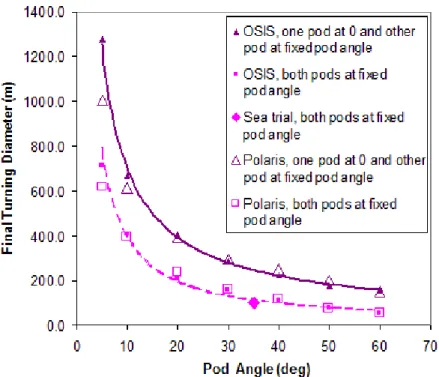
For this validation, we performed identical turning motion simulations of the Mackinaw using OSIS and Polaris, both with the NRC-OCRE pod model. A range of pod angles from 0 to 60o was imposed at a propeller speed of 180 rpm and the corresponding turning motion was simulated using OSIS and Polaris. The pods were either steered by deflecting one pod to an angle with the other at zero degrees or deflecting both pods to the same angle. The results are summarized in Figure 9 for turning diameter and Figure 10 for advance speed. The turning diameter obtained from sea trials of the Mackinaw with both pods at 35 degrees pod angle is also given in Figure 9.
Figure 9 shows good agreement between the final turning diameter prediction and the sea trial data, which indicates that the pod model was correctly implemented in Polaris. Furthermore, the limited sea trial data agreed well with simulation from both OSIS and Polaris. However, there were increasing discrepancies between the OSIS and Polaris results at smaller pod angles, i.e., less than 5 degrees, with OSIS predicting higher turning diameters than Polaris.
Figure 10 shows the ship speed generated by OSIS and Polaris for identical simulation conditions. Speed predictions for larger pod rudder angles agreed well; however, again, there were increasing discrepancies between the OSIS and Polaris results at the smaller pod angles, with OSIS predicting higher ship speeds. A possible source of this discrepancy was identified.
The reason for these discrepancies might be the different dynamic systems used by OSIS and Polaris to simulate ship manoeuvring. Further discussion were given in Lau and Ni (2010b).
Figure 9: Turning diameters simulated by Polaris and OSIS using NRC-OCRE pod model
Figure 10: Steady speed of turning motion simulated by Polaris and OSIS using NRC-OCRE pod model
Task 3.2: Refinement of the mathematical model
In this phase, the model was further refined and a model developed for the Araon pods in preparation of the validation of OSIS-IHI for simulation of manoeuvring of pod-driven ships in ice based on the Araon’s model test and full scale data. This work element focused on the development of a semi-empirical pod model for Araon that can be implemented in OSIS. This includes the following sub-tasks:
Task 3.2.1: Propulsive performance testing of Araon podded propellers Task 3.2.2: Pod model refinement
Task 3.2.3: Araon pod model implementation in OSIS and its validation
Task 3.2.1: Propulsive performance testing of Araon podded propellers
As part of the development effort to improve the mathematical model for the performance of a podded propulsor, pod model “opens” tests of the Araon’s pod propulsors were conducted at the NRC-OCRE. In pod opens tests, pod performance was studied without the effects of the hull by mounting the pod and its instrumentation system onto a modified model stern only (see Figure 11). This minimized the influence of the hull on flow conditions around the podded propellers.
Figure 11: Model stern for NRC-OCRE pod model tests
The test system included instruments to measure forces and moments acting on the propeller and pod, including unit (i.e., pod) thrust (Tunit), propeller thrust at the hub (T),
propeller torque (Q) and propulsive forces on the model along the three coordinate axes.
Traditionally, during propeller opens tests, either propeller speed or carriage velocity is kept constant while the other parameter is modified to determine the appropriate advance coefficient J. This leads to performance characteristics as functions of J alone. With the podded propulsor, however, the azimuth angle must also be accounted for. In this case,
nD v
J (4)
where v = model speed n = propeller speed D = propeller diameter
In this test, the opens model was towed straight ahead at various speeds while the azimuth angle of the twin pods was set to various orientations. Two conditions were simulated for the pods during the experiments: in static tests the azimuth angles of both pods were fixed at a certain azimuth angle for the duration of a run, while in dynamic tests one of the pods was continuously steered from 0 to 360 degrees azimuth. The previous studies Akinturk and Lau (2010) on the subject showed that performance coefficients such as for thrust and torque obtained from pod static tests compare well with the performance coefficients at the same azimuth angle sampled from pod dynamic tests. This has helped to reduce the test matrix: one pod dynamic test at a given carriage velocity and propeller rotational speed replaced many pod static tests.
The test and data analysis procedures developed for these tests was documented in Lau and Akinturk (2011b, 2011c) and Lau and Smith (2011).
Task 3.2.2: Pod model refinement
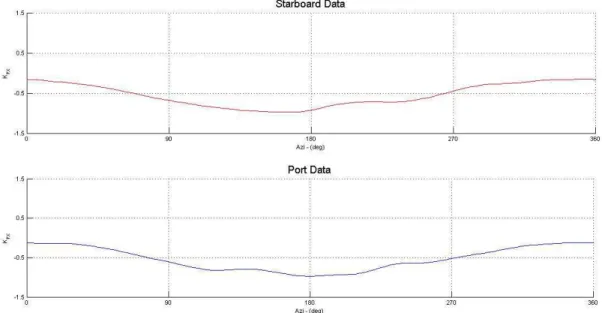
Revised methods were introduced for the reduction of the raw data to generate performance curves and surfaces representing performance of the pods. Figures 12 and 13 are plots generated from the dynamic test results. The curves in Figure 12 are for a constant advance coefficient but varying azimuth angle. When combined with similar curves for different advance coefficients, these represent a surface as shown in Figure 13.
New software was developed for users to edit the performance surfaces (Lau and Smith, 2011; and Smith and Lau, 2011). Furthermore, implementing a batch processing option reduced the data processing effort. Suggestions for further processing of current and future data were provided.
Figure 12: Dynamic data KFxP for a constant advance coefficient but varying azimuth angle
Figure 13: Performance surface as a function of advance coefficient and azimuth angle
MOERI and NRC-OCRE have performed a parallel series of model tests in captive mode using a Planar Motion Mechanism (PMM) to further assess the performance of
Araon as part of their ice program. This test provided a unique data set to assess the
influence of the Araon ship hull on the performance of the pod propulsion units under various manoeuvres in open water and ice. Figure 14 is a photo of the hull, propulsion units and PMM apparatus during this test series.
Figure 14: Model Araon mounted to PMM beneath carriage
Propulsion, resistance and thrust deduction and wake fractions were determined and the method to calculate the thrust deduction and wake fraction values was documented in Lau and Akinturk (2011c). Calculations of nominal thrust deduction factor and wake fraction showed promising results in applying the developed method to azimuthing podded propulsors.
As well, the assumptions of independent performance between a port and starboard pod were verified. The method for producing a performance curve from dynamic tests data was examined and the results showed good agreement with the data from static tests.
The average thrust deduction factor obtained from this test series for an azimuth angle of zero degrees with the pods operating in tractor mode was 0.058. The low thrust deduction factor was explained by noting the pod units where operating in tractor mode (propellers ahead the pod units). One would expect the thrust deduction to be quite low as the propeller was in a condition in which the inflow to the propeller disk should be close to the conditions found in the open pods tests (Lau and Akinturk, 2011b).
3.4 Work Element 4: Preliminary Pressure Model for OSIS Integration
In this work component, pressure-area relations were reviewed with several published data and compared them with CSA/API5 and ISO 199066. Since the ISO 19906 curve did not include ship impact data, it could be proper to be adopted in IHI to consider a local ice pressure for a ship transiting in level ice. The ISO 19906 curve showed the
5
Canadian Standard Association and American Petroleum Institute 6
International Organization for Standardization standard “Petroleum and natural gas industries – Arctic offshore structures”
local design value and was composed of mean pressure value plus three times the standard deviation.
A preliminary pressure model was developed based on simple high-pressure zone pressure model in Dempsey et al. (2001) and Palmer et al. (2009). Using this model, a reasonable pressure-area curve with size effect could be presented. For example, 10 m2 of the nominal area would give abundant tiny areas (less than 0.1 m2) that caused problem when considering an appropriate local pressure. In Fig 15, 100 random numbers were used to show the pressure-area relation.
Figure 15 Calculated pressure-area relation with the simple model (with 100 random numbers)
When IHI calculated the nominal area and force, nominal pressure was assessed. Local pressure could be evaluated based on the local area from the pressure-area curve. It was noted that IHI assumes a nominal area of approximately 10 m2.
This model constitutes the first step to consider a local pressure associated with the IHI module.
3.5 Work Element 5: Refinement, Verification and Packaging of OSIS-IHI for User Validation
This work element focuses on the verification and final packaging of the OSIS-IHI software to marine simulator and ship design applications. It consists of the following tasks:
Completion of OSIS-IHI integration to the CMS bridge simulator and its validation Completion of OSIS-IHI refinement, validation and packaging of stand-alone version
for ship design applications
Task 5.1: Bridge version for simulator applications
Since the pod propulsion module was envisioned as part of the bridge version of OSIS-IHI software, in FY1011 an effort was started to integrate OSIS-OSIS-IHI directly with the Polaris software to allow this new module to communicate with Polaris via OSIS-IHI. This interface allows computation of ice force as well as pod propulsive forces to be transferred to Polaris for its ship motion simulation.
A report (Lau and Lau, 2011) documented the theoretical basis and implementation of the Polaris-IHI interface software. A validation exercise was conducted by benchmarking the interface version with the OSIS-IHI stand-alone version under identical test conditions. The preliminary validation demonstrated the accuracy of this software in calculating simulated ship’s motion and ice force values.
A series of on-site tests of the IHI software with its communication were then conducted in CMS to further verify its fidelity prior to commissioning. The on-site testing includes straight, circle and random runs in different ice thickness under several propulsion power conditions, which indicated that this software was ready for deployment in the bridge simulator in CMS. Figure 17 shows a simulation of the turning circle manoeuvre conducted at CMS’s simulator, and Figure 18 shows the load computed by IHI software. The result of this on-site validation was summarized in Cao and Lau (2012).
Figure 16 A turning circle manoeuvre simulated at CMS’s marine simulator
Task 5.2: Stand-alone version for ship design applications
In addition to the refinement of pod propulsion as described in Section 3.2.2, the current version also contains an upgrade to the conventional propulsion module to allow detailed treatment of the interaction between individualized propeller and rudder in the propulsion computation, i.e., propeller force, rudder force, wake fraction and thrust deduction, using actual experimental data for a single screw/single rudder system. This treatment extended OSIS functionality to encompass the common multi-screw/multi-rudder configurations in use as shown in Figure 19. The theoretical treatment used in the upgrade was detailed in Lau (2012a).
Figure 18 Traditional Screw/Rudder arrangements available in OSIS-IHI
Extensive testing of OSIS-IHI’s functionality and accuracy in this stand-alone version was performed prior to its release. The verification process includes verifying:
accuracy of propulsion model upgrade operational of all buttons
operational of all simulation options
The result of this pre-leased software verification was documented in Lau and Xu (2012).
A software package including the OSIS-IHI software, installation software, release notes, demonstration video and example runs were prepared and delivered to our project partner MOERI for further user’s validation. The user’s manual (Lau, 2012b) describes in details the installation and use of the program, in addition to building videos. It also incorporates all upgrades associated with this project.
Training material was also developed and an on-site training course was delivered at MOERI to assist MOERI’s validation of the software. This training material was documented in Lau (2011c).
4 LIST OF REPORTS AND PUBLICATIONS
The following is a list of publications generated for this project:
Task 1.0: Literature review and database development
Lau, M., 2010a, Ship Manoeuvring Performance In Ice Database V1.0, NRC-OCRE report LM- 2010-07, Ocean, Coastal and River Engineering, National Research Council of Canada, St. John’s, Newfoundland and Labrador.
Task 2.2: Model tests of the icebreaker Araon - Series 1
Lau, M and Akinturk, A, 2010. Free Propulsion and Maneuvering Tests of Korean Icebreaker
Araon in Ice, NRC-OCRE report LM-2010-10, Ocean, Coastal and River Engineering, National
Research Council of Canada, St. John’s, Newfoundland and Labrador.
Task 2.3: Model tests of the icebreaker Araon – Series 2
Lau, M and Akinturk, A, 2011a. Free Propulsion and Maneuvering Tests of Korean Icebreaker
Araon in Ice – Phase II, NRC-OCRE report, Ocean, Coastal and River Engineering, National
Research Council Canada, St. John’s, Newfoundland and Labrador.
Task 3.1.1: Analysis of pod data obtained from USCGC Mackinaw model test
Akinturk, A and Lau, M, 2010. On The Performance of Podded Propulsors, NRC-OCRE report LM-2010-05, Ocean, Coastal and River Engineering, National Research Council of Canada, St. John’s, Newfoundland and Labrador.
Task 3.1.2: Preliminary pod model development
Lau, M., and Ni, S.Y., 2010a, A Semi-Empirical Pod Model for USCG Icebreaker Mackinaw, NRC-OCRE report LM- 2010-06, Ocean, Coastal and River Engineering, National Research Council of Canada, St. John’s, Newfoundland and Labrador.
Tasks 3.1.3: Software integration to NRC-OCRE OSIS and CMS Polaris and validation
Lau, M., and Ni, S.Y., 2010b, Implementation of a Semi-Empirical Pod Model in The
Centre for Marine Simulation’s Marine Simulator, NRC-OCRE report LM- 2010-08, Ocean, Coastal and River Engineering, National Research Council of Canada, St. John’s, Newfoundland and Labrador.
Task 3.2.1: : Performance tests of the Araon Podded Propulsor
Lau, M and Akinturk, A, 2011b. Performance of KORDI Icebreaker "Araon" Podded
Propulsors, NRC-OCRE report LM-2011-02, Ocean, Coastal and River Engineering,
Task 3.2.2: Mathematic model for Araon podded propulsor
Lau, M and Akinturk, A, 2011b. Performance of KORDI Icebreaker "Araon" Podded
Propulsors, NRC-OCRE report LM-2011-02, Ocean, Coastal and River Engineering,
National Research Council Canada, St. John’s, Newfoundland and Labrador.
Lau, M. and Smith, N. 2011. Tools for Podded Propulsion Analysis, NRC-OCRE report, Ocean, Coastal and River Engineering, National Research Council Canada, St. John’s, Newfoundland and Labrador.
Smith, N. and Lau, M., 2011. User Manual for Dynamic Test Batch Processor , NRC-OCRE report LM-2011-01, Ocean, Coastal and River Engineering, National Research Council Canada, St. John’s, Newfoundland and Labrador.
Lau, M and Akinturk, A, 2011c. Performance of "Araon" Podded Propulsors During
Planar Motion Tests, NRC-OCRE report LM-2011-03, Ocean, Coastal and River
Engineering, National Research Council Canada, St. John’s, Newfoundland and Labrador.
Tasks 4.0: Development of a preliminary pressure model for OSIS-IHI integration Wang, J.Y. and Lau, M., 2011, Preliminary Development of a Local Pressure Model for
OSIS-IHI, NRC-OCRE report, Ocean, Coastal and River Engineering, National
Research Council Canada, St. John’s, Newfoundland and Labrador.
Tasks 5.1: Refinement, preliminary validation and packaging of bridge version for simulator applications
Lau, M. and Lau, G., 2011. Communication Interface IHI-POLARIS TCP V1.0 for the Ice
Hull Interaction Module, NRC-OCRE report, Ocean, Coastal and River Engineering,
National Research Council Canada, St. John’s, Newfoundland and
Cao, B.Y. and Lau, M., 2012. Validation of IHI Bridge Version 2.0 for Simulator
Applications at the Centre for Marine Simulation, NRC-OCRE report, Ocean, Coastal
and River Engineering, National Research Council Canada, St. John’s, Newfoundland and Labrador.
Tasks 5.2: Refinement, preliminary validation and packaging of stand-alone version for ship design applications
Lau, M., 2012a. Performance of Propeller/Rudder Interaction in OSIS-IHI, NRC-OCRE report, Ocean, Coastal and River Engineering, National Research Council Canada, St. John’s, Newfoundland and Labrador.
Lau, M, 2012b. User’s Manual for OSIS-IHI (Ocean-Structure Interactions Simulator –
Ice-Hull Interaction V1.01, NRC-OCRE report, Ocean, Coastal and River Engineering,
Lau, M., 2012c. Work Elements Related to the Preparation of OSIS-IHI User’s
Validation under PJ2409: An Interim Report for February 2012, NRC-OCRE report
OCRE-LM-2012-03, Ocean, Coastal and River Engineering, National Research Council Canada, St. John’s, Newfoundland and Labrador.
Lau, M. and Xu, J., 2012. Validation of OSIS-IHI V1.01 for External Release, NRC-OCRE report, Ocean, Coastal and River Engineering, National Research Council Canada, St. John’s, Newfoundland and Labrador.
Lau, M., 2011. Ship Manoeuvring-In-Ice Modeling Software OSIS-IHI, Paper POAC11-138, Proceedings of the 21st International Conference on Port and Ocean Engineering under Arctic Conditions, July 10-14, 2011, Montréal, Canada.
5 REFERENCES
Akinturk, A. and Lau, M., 2010. On the Performance of Podded Propulsors, NRC-OCRE report LM-2010-05, Ocean, Coastal and River Engineering, National Research Council of Canada, St. John’s, Newfoundland and Labrador.
Cao, B.Y. and Lau, M., 2012. Validation of IHI Bridge Version 2.0 for Simulator Applications at
the Centre for Marine Simulation, NRC-OCRE report, Ocean, Coastal and River Engineering,
National Research Council Canada, St. John’s, Newfoundland and Labrador.
Dempsey, J.P., Palmer, A.C. and Sodhi, D.S., 2001. High Pressure Zone Formation during
Compressive Ice Failure, Engineering Fracture Mechanics, Vol. 68, pp.1961-1974.
Lau, M., 2012a. Performance of Propeller/Rudder interaction in OSIS-IHI, NRC-OCRE report, Ocean, Coastal and River Engineering, National Research Council Canada, St. John’s, Newfoundland and Labrador.
Lau, M, 2012b. User’s Manual for OSIS-IHI (Ocean-Structure Interactions Simulator – Ice-Hull
Interaction V1.01, NRC-OCRE report, Ocean, Coastal and River Engineering, National
Research Council Canada, St. John’s, Newfoundland and Labrador.
Lau, M., 2012c. Work Elements Related to the Preparation of OSIS-IHI User’s Validation under
PJ2409: An Interim Report for February 2012, NRC-OCRE report OCRE-LM-2012-03, Ocean,
Coastal and River Engineering, National Research Council Canada, St. John’s, Newfoundland and Labrador.
Lau, M., 2011. Ship Manoeuvring-In-Ice Modeling Software OSIS-IHI, Paper POAC11-138, Proceedings of the 21st International Conference on Port and Ocean Engineering under Arctic Conditions, July 10-14, 2011, Montréal, Canada.
Lau, M., 2010a. Ship Manoeuvring Performance in Ice Database V1.0, NRC-OCRE report, LM- 2010-07, Ocean, Coastal and River Engineering, National Research Council of Canada, St. John’s, Newfoundland and Labrador.
Lau, M., 2010b. Araon Model Test Phase I: Model Design and Fabrication, NRC-OCRE report, LM- 2010-04, Ocean, Coastal and River Engineering, National Research Council of Canada, St. John’s, Newfoundland and Labrador.
Lau, M. and Akinturk, A., 2011a. Free Propulsion and Maneuvering Tests of Korean Icebreaker
Araon in Ice – Phase II, NRC-OCRE report , Ocean, Coastal and River Engineering, National
Research Council Canada, St. John’s, Newfoundland and Labrador.
Lau, M. and Akinturk, A., 2011b. Performance of KOPRI Icebreaker "Araon" Podded Propulsors, NRC-OCRE report, LM-2011-02, Ocean, Coastal and River Engineering, National Research Council Canada, St. John’s, Newfoundland and Labrador.
Lau, M. and Akinturk, A., 2011c. Performance of "Araon" Podded Propulsors during Planar
Motion Tests, NRC-OCRE report, LM-2011-03, Ocean, Coastal and River Engineering, National
Research Council Canada, St. John’s, Newfoundland and Labrador.
Lau, M and Akinturk, A, 2010. Free Propulsion and Maneuvering Tests of Korean Icebreaker
Araon in Ice, NRC-OCRE report, LM-2010-10, Ocean, Coastal and River Engineering, National
Research Council of Canada, St. John’s, Newfoundland and Labrador.
Lau, M.. and Lau, G., 2011. Communication Interface IHI-POLARIS TCP V1.0 for the Ice Hull
Interaction Module, NRC-OCRE report, Ocean, Coastal and River Engineering, National
Research Council Canada, St. John’s, Newfoundland and Labrador.
Lau, M. and Ni, S.Y., 2010a. A Semi-Empirical Pod Model for USCG Icebreaker Mackinaw, NRC-OCRE report LM-2010-06, Ocean, Coastal and River Engineering, National Research Council of Canada, St. John’s, Newfoundland and Labrador.
Lau, M. and Ni, S.Y., 2010b. Implementation of a Semi-Empirical Pod Model in the
Centre for Marine Simulation’s Marine Simulator, NRC-OCRE report LM-2010-08, Ocean,
Coastal and River Engineering, National Research Council of Canada, St. John’s, Newfoundland and Labrador.
Lau, M and Ni, S.Y., 2009. Ship Manoeuvring in Ice Simulation Software OSIS-IHI, NRC-OCRE report LM-2009-02, Ocean, Coastal and River Engineering, National Research Council of Canada, St. John’s, Newfoundland.
Lau, M. and Smith, N., 2011, Tools for Podded Propulsion Analysis, NRC-OCRE report, Ocean, Coastal and River Engineering, National Research Council Canada, St. John’s, Newfoundland and Labrador.
Lau, M. and Xu, J., 2012. Validation of OSIS-IHI V1.01 for External Release, NRC-OCRE report, Ocean, Coastal and River Engineering, National Research Council Canada, St. John’s, Newfoundland and Labrador.
Palmer, A.C., Dempsey, J.P. and Masterson, D.M., 2009. A Revised Ice Pressure-Area Curve
and a Fracture Mechanics Explanation, Cold Regions Science and Technology, Vol. 56,
pp.73-76.
Smith, N. and Lau, M., 2011. User Manual for Dynamic Test Batch Processor , NRC-OCRE report LM-2011-01, Ocean, Coastal and River Engineering, National Research Council Canada,
St. John’s, Newfoundland and Labrador.
Transportation Development Centre, 1995. Ship/Ice Interaction Database Version 1.0 User’s
Manual, Transportation Development Centre.
Wang, J.Y. and Lau, M., 2011. Preliminary Development of a Local Pressure Model for
OSIS-IHI, NRC-OCRE report, Ocean, Coastal and River Engineering, National Research Council