
Publisher’s version / Version de l'éditeur:
Physics Letters B, 761, pp. 281-286, 2016-08-24
READ THESE TERMS AND CONDITIONS CAREFULLY BEFORE USING THIS WEBSITE.
https://nrc-publications.canada.ca/eng/copyright
Vous avez des questions? Nous pouvons vous aider. Pour communiquer directement avec un auteur, consultez la première page de la revue dans laquelle son article a été publié afin de trouver ses coordonnées. Si vous n’arrivez pas à les repérer, communiquez avec nous à [email protected].
Questions? Contact the NRC Publications Archive team at
[email protected]. If you wish to email the authors directly, please see the first page of the publication for their contact information.
NRC Publications Archive
Archives des publications du CNRC
This publication could be one of several versions: author’s original, accepted manuscript or the publisher’s version. / La version de cette publication peut être l’une des suivantes : la version prépublication de l’auteur, la version acceptée du manuscrit ou la version de l’éditeur.
For the publisher’s version, please access the DOI link below./ Pour consulter la version de l’éditeur, utilisez le lien DOI ci-dessous.
https://doi.org/10.1016/j.physletb.2016.08.038
Access and use of this website and the material on it are subject to the Terms and Conditions set forth at
Evidence against solar influence on nuclear decay constants
Pommé, S.; Stroh, H.; Paepen, J.; Van Ammel, R.; Marouli, M.; Altzitzoglou,
T.; Hult, M.; Kossert, K.; Nähle, O.; Schrader, H.; Juget, F.; Bailat, C.;
Nedjadi, Y.; Bochud, F.; Buchillier, T.; Michotte, C.; Courte, S.; Van Rooy, M.
W.; Van Staden, M. J.; Lubbe, J.; Simpson, B. R. S.; Fazio, A.; De Felice, P.;
Jackson, T. W.; Van Wyngaardt, W. M.; Reinhard, M. I.; Golya, J.; Bourke,
S.; Roy, T.; Galea, R.; Keightley, J. D.; Ferreira, K. M.; Collins, S. M.;
Ceccatelli, A.; Unterweger, M.; Fitzgerald, R.; Bergeron, D. E.; Pibida, L.;
Verheyen, L.; Bruggeman, M.; Vodenik, B.; Korun, M.; Chisté, V.; Amiot,
M.-N.
https://publications-cnrc.canada.ca/fra/droits
L’accès à ce site Web et l’utilisation de son contenu sont assujettis aux conditions présentées dans le site LISEZ CES CONDITIONS ATTENTIVEMENT AVANT D’UTILISER CE SITE WEB.
NRC Publications Record / Notice d'Archives des publications de CNRC:
https://nrc-publications.canada.ca/eng/view/object/?id=a9e38814-cd50-42da-a089-5c63e0688e09
https://publications-cnrc.canada.ca/fra/voir/objet/?id=a9e38814-cd50-42da-a089-5c63e0688e09
Contents lists available atScienceDirect
Physics
Letters
B
www.elsevier.com/locate/physletb
Evidence
against
solar
influence
on
nuclear
decay
constants
S. Pommé
a,
∗
,
1,
H. Stroh
a,
J. Paepen
a,
R. Van Ammel
a,
M. Marouli
a,
T. Altzitzoglou
a,
M. Hult
a,
K. Kossert
b,
O. Nähle
b,
H. Schrader
b,
F. Juget
c,
C. Bailat
c,
Y. Nedjadi
c,
F. Bochud
c,
T. Buchillier
c,
C. Michotte
d,
S. Courte
d,
M.W. van Rooy
e,
M.J. van Staden
e,
J. Lubbe
e,
B.R.S. Simpson
e,
A. Fazio
f,
P. De Felice
f,
T.W. Jackson
g,
W.M. Van Wyngaardt
g,
M.I. Reinhard
g,
J. Golya
g,
S. Bourke
g,
T. Roy
h,
R. Galea
h,
J.D. Keightley
i,
K.M. Ferreira
i,
S.M. Collins
i,
A. Ceccatelli
j,
M. Unterweger
k,
R. Fitzgerald
k,
D.E. Bergeron
k,
L. Pibida
k,
L. Verheyen
l,
M. Bruggeman
l,
B. Vodenik
m,
M. Korun
m,
V. Chisté
n,
M.-N. Amiot
naEuropeanCommission,JointResearchCentre(JRC),Retieseweg111,B-2440 Geel,Belgium bPhysikalisch-TechnischeBundesanstalt(PTB),Bundesallee100,38116 Braunschweig,Germany cInstitutdeRadiophysique,Lausanne(IRA),Switzerland
dBureauInternationaldesPoidsetMesures(BIPM),PavillondeBreteuil,92310 Sèvres,France
eRadioactivityStandardsLaboratory(NMISA),15LowerHopeRoad,Rosebank 7700,CapeTown,SouthAfrica
fNationalInstituteofIonizingRadiationMetrology(ENEA),CasacciaResearchCentre,ViaAnguillarese,301—S.M.GaleriaI-00060Roma,C.P.2400,I-00100
Roma A.D.,Italy
gAustralianNuclearScienceandTechnologyOrganisation(ANSTO),LockedBag2001,Kirrawee,NSW 2232,Australia hNationalResearchCouncilofCanada(NRC),1200MontrealRoad,Ottawa,ON,K1A0R6,Canada
iNationalPhysicalLaboratory(NPL),HamptonRoad,Teddington,Middlesex TW11 OLW,UK
jTerrestrialEnvironmentLaboratory,IAEAEnvironmentLaboratories,DepartmentofNuclearSciencesandApplications,InternationalAtomicEnergyAgency
(IAEA),ViennaInternationalCentre,POBox100,1400Vienna,Austria
kPhysicalMeasurementLaboratory,NationalInstituteofStandardsandTechnology(NIST),100BureauDr.,Gaithersburg,MD 20899-8462,USA lBelgianNuclearResearchCentre(SCK
·CEN),Boeretang 200,B-2400 Mol,Belgium mJožefStefanInstitute(JSI),Jamova 39,1000 Ljubljana,Slovenia
nCEA,LIST,LaboratoireNationalHenriBecquerel(LNHB),Bât.602PC111,CEA-Saclay91191 Gif-sur-Yvettecedex,France
a
r
t
i
c
l
e
i
n
f
o
a
b
s
t
r
a
c
t
Articlehistory:
Received1July2016
Receivedinrevisedform18August2016 Accepted19August2016
Availableonline24August2016 Editor:V.Metag Keywords: Half-life Decayconstant Uncertainty Radioactivity Sun Neutrino
ThehypothesisthatproximitytotheSuncausesvariationofdecayconstantsatpermillelevelhasbeen tested and disproved. Repeatedactivity measurements of mono-radionuclide sources wereperformed overperiodsfrom200daysuptofourdecadesat14laboratoriesacrosstheglobe.Residualsfromthe exponentialnucleardecaycurves wereinspectedforannualoscillations.Systematicdeviations froma purelyexponentialdecaycurvedifferfromonedatasettoanotherandare attributabletoinstabilities inthe instrumentationand measurementconditions.The moststableactivitymeasurements ofalpha, beta-minus, electroncapture,and beta-plusdecayingsourcesset anupper limitof0.0006% to0.008% to the amplitude of annual oscillations in the decay rate. Oscillations in phase with Earth’s orbital distance tothe Suncould not be observedwithin a10−6 to 10−5 range ofprecision.There are also
noapparent modulations overperiods ofweeks ormonths. Consequently,there isno indicationofa naturalimpedimentagainstsub-permilleaccuracyinhalf-lifedeterminations,renormalisationofactivity toadistantreferencedate,applicationofnucleardatingforarchaeology,geo- andcosmochronology,nor inestablishingtheSIunitbecquerelandseekinginternationalequivalenceofactivitystandards.
2016TheAuthors.PublishedbyElsevierB.V.ThisisanopenaccessarticleundertheCCBYlicense (http://creativecommons.org/licenses/by/4.0/).FundedbySCOAP3.
*
Correspondingauthor.E-mailaddress:[email protected](S. Pommé).
1 Fax:+32(0)14571864.
1. Introduction
The exponential-decay law is one of the most famous laws of physics, already carvedin stone since the pioneering work of Ernest Rutherford [1], Maria Skłodowska-Curie [2] and others.It has withstood numerous tests [3–5] demonstrating that the
de-http://dx.doi.org/10.1016/j.physletb.2016.08.038
0370-2693/2016TheAuthors.PublishedbyElsevierB.V.ThisisanopenaccessarticleundertheCCBYlicense(http://creativecommons.org/licenses/by/4.0/).Fundedby SCOAP3.
282 S. Pommé et al. / Physics Letters B 761 (2016) 281–286
cayofaradionuclidecanbecharacterisedsolelybyasingle decay constant – or equivalently by the half-life – which is invariable in spaceandtime. However, observations ofperiodic oscillations inmeasured decay ratesof radioactivesources [6–13] have been heavily debated in the last decade [6–25]. Controversy arose at two levels: (i) atthe observational level, withexperimental data setsshowingsignificantdifferencesinstabilityofdecayrateswith time,and(ii)attheinterpretationallevel,eitherascribingthe ob-servedmodulationstoinstabilitiesinthedetectionsystem,or ad-vocatingnewphysicstoexplainvariabilityinthedecayconstants. As much as the instability claims attract interest as inspira-tionfornewphysicaltheoriesandapplications[14,15],iftruethey wouldhavemajor implicationsontraceability andequivalencein thecommonmeasurementsystemofradioactivesubstances. Vari-ability of decay constants at permille level would limit the pre-cision by whicha half-life value could be assignedto a radionu-clide,aswellastheaccuracybywhichtheSI-unitbecquerelcould be established throughprimary standardisation [26] and interna-tionalequivalencedemonstratedthroughkeycomparisonsandthe Système International de Référence (SIR) [27]. The implications atmetrological levelwouldeventually affect sciencebuilt onthe decay laws, from renormalisation of activity to a reference date fornucleardosimetry toprecise nucleardating forgeo- and cos-mochronology.
At the heart of this controversy are the metrological difficul-ties inherent to the measurement of half-lives [28–30]. From a metrologicalpointofview,itisobviousthatinstruments, electron-ics,geometryandbackgroundmayvaryduetoexternalinfluences suchastemperature,pressure,humidityandnaturalorman-made sources of radioactivity. Claims of variability of half-lives on the basis ofdeviations from an exponential decaycurve can only be consideredwhentheinstrumentaleffectshavebeenfully compen-sated and/or accountedfor in the uncertainty budget. Jenkins et al. [9] claim to have done so before proposing their hypothesis thatpermillesizedseasonalvariationsofdecayratesof226Raand 36Clarecausedbysolarinfluencesontheirdecayconstants[6–8].
Evidencehasbeencollectedtodemonstrateinstabilitiesinthe de-cayofotherradionuclides[10,11]andbymeansoftime-frequency analysisperiodicity at shorterand longer termthan 1 year have beenclaimed[11–13]. However, thisinterpretationis being chal-lengedbythepublicationofdatasetsconfirmingacloseadherence toexponentialdecaywithresidualsinthe10−5range[16,18,20,21,
23].
Authors of both convictions expressedthe need for collecting evidence for different radionuclides measured with different de-tectiontechniques[7,11,13,18,23].Atnationalmetrologyinstitutes (NMIs) taking responsibility for establishing the unit becquerel, mono-radionuclide sources are kept and regularly measured for standardisation purposes aswell as fordetermining half-lives.In addition, gamma-ray spectrometry laboratories keep records of quality control measurements on their spectrometerswhich pro-vide usefulinformation onlong-termtrends in activity measure-mentsofareferencesource.Inthiswork,thehypothesis that de-cayconstantsvarythroughsolarinfluenceinphasewithEarth–Sun orbital distancehasbeentestedthrough theanalysisofa unique collectionofactivity measurements repeatedover periodsof 200 daysup to fourdecades at14 laboratoriesdistributedacross the globe.
2. Measurements&analysis
Preciseactivity measurementseries were performedforalpha decay (209Po, 226Ra series, 228Th, 230U, 241Am), beta minus de-cay(3H,14C,60Co,85Kr,90Sr, 124Sb,134Cs,137Cs),electroncapture (54Mn,55Fe,57Co,82,85Sr,109Cd,133Ba),amixtureofelectron
cap-tureandpositrondecay(22Na,65Zn,207Bi),andamixtureof elec-troncaptureandbetaminus/plusdecay(152Eu).Morethan60data sets were collected, some of which were performedover several decades.Some datasets excelinprecision, othersreveal vulnera-bilityofdifferentmeasurementtechniquesto externalconditions. CharacteristicsofthedatasetsaresummarisedinTable 1.
The measurement techniques employed are as follows: ioni-sation current measurements in a re-entrantionisation chamber (IC)orahospitalcalibrator(HIC)[31,32],netarea analysisof full-energy
γ
-ray peaks (and integral spectrum counting) byγ
-ray spectrometry with a HPGe detector (HPGe) [33], particle count-ing in a planar silicon detector in quasi-2π
configuration (PIPS) [34],X-raycountingatasmalldefinedsolidanglewithagas-filled proportionalcounter(PC)[35,36],live-timedβ
–γ
anti-coincidence counting(LTAC)[37],triple-to-doublecoincidencecountingwitha liquid scintillationvial andthreephotodetectors (TDCR)[38], liq-uidscintillation counting(LSC)[38],particleandphotoncounting inasandwichCsI(Tl)spectrometer(CsI)[39],internalgascounting (IGC) [40],andα
-particlecountingatasmalldefinedsolid angle withalargeplanarsilicondetector(α
DSA)[35,36].Anoverviewof standardisationtechniquesandtheirsourcesoferrorcanbefound inthespecialissues44(4)and52(3)ofMetrologia[41,42]and ref-erencesin[25,28].Exponentialdecaycurveswerefittedtothedataandthe resid-uals were inspected forannual modulations. The data sets were firstcompensatedfor(1)thepresenceofoccasionaloutliervalues, (2)abruptsystematicchangesinthedetectorresponse,e.g.dueto replacementoftheelectronicsorrecalibrationsoftheinstrument, and (3) systematic drift extending over periods of more than 1 year,e.g. duetogas lossfroman ionisationchamber, uncompen-sated count loss through pulsepileup in a spectrometer, activity build-upfromdecayproducts inasource,etc.Theresiduals were binned into 8-day periods of the year andaveraged to obtain a reduced set of (maximum) 46 residuals evenly distributed over the calendar year. To the averaged residuals, a sinusoidal shape Asin
(
2π
(
t+
a)/
365)
hasbeenfittedinwhich A istheamplitude, t istheelapsednumberofdayssinceNewYear,anda isthephase shift expressed in days.The fittedamplitude values can be con-sideredinsignificantiftheyare ofcomparablemagnitudeastheir estimatedstandarduncertainty(seeTable 1).3. Discussion
The controversy started with the interpretation [7,8] of A
≈
0.
15% modulations in the decay rate measurements of a sealed226RareferencesourceinanICatthePTBbetween1983and1998.
The averagedresiduals,showninFig. 1A,havea sinusoidalshape withamplitude A
=
0.
083 (2)% andphasea=
59 days.An expla-nation through solar influence on the alpha or beta decay con-stants ofnuclidesin the226Radecayseries seems unlikely,sincethe residuals are out of phase with the annual variation of the inverse square of the Sun–Earth distance, 1
/
R2 (renormalised to0.15%amplitudeintheFigs. 1–2ofthiswork).Therealcauseisof instrumental nature, since the modulations were significantly re-duced afterchanging theelectrometer ofthe IC [22,25].There is a remarkable correlation withaverage seasonalchanges of radon concentrationinair( A
=
16 (2)%,a=
57 days)measuredinsidethe laboratoryfrom2010to2016,butcausalityhasnotbeenproven.At other institutes, annual modulations of smaller amplitude anddifferentphase havebeen observed,whichdemonstrates the localcharacterofthenon-exponentialbehaviour.Thedatasetsfor
226Ra show a different level of instrumental instability, but the
most stable 226Ra measurements prove invariability of its decay
Table 1
Characteristicsofthedecayratemeasurementsetsanalysed.Themethodacronymsareexplainedinthetext.Theperiodindicatesthefirstandlastyearinwhichdatawere collected.Thestandarddeviationisanindicationoftheuncertaintyontheannualaverageddata(maximum46data,covering8-dayperiods),derivedfromthespreadof theinputdataandtheinversesquarerootofthenumberofvaluesineachdatagroup.Theamplitudeandphasearetheresultofthefitofasinusoidalfunctiontothe averageddata.Inboldaretheamplitudesat10−6–10−5level.Theestimatedstandarduncertaintyontheamplitudeisindicatedbetweenparentheses,itsorderofmagnitude
correspondingtothatofthelastdigitofthevalueofA.
Decay mode(s)
Nuclide Laboratory Method Period (year) #Data Rel.std devin% AmplitudeA in% Phaseshifta indays α 209Po JRC PIPS 2013–2016 1539 0.024 0.006 (5) 6 α+β− 226Ra PTB IC 1983–1998 1973 0.011 0.083 (2) 59 α+β− 226Ra PTB IC 1999–2016 2184 0.005 0.016 (1) 194 α+β− 226Ra ENEA IC 1992–2015 161 0.025 0.043 (5) 324 α+β− 226Ra NIST IC #1 2008–2016 99 0.016 0.015 (3) 255 α+β− 226Ra NIST IC #2 2012–2016 272 0.036 0.002 (8) 8 α+β− 226Ra BIPM IC 2001–2015 136 0.015 0.004 (3) 4 α+β− 226Ra JRC IC 2005–2015 1737 0.005 0.003 (2) 363 α+β− 226Ra NPL IC #1 1993–2016 4055 0.014 0.0025 (18) 60 α+β− 226Ra NPL IC #2 1993–2016 3996 0.005 0.005 (1) 73 α+β− 226Ra NMISA IC 1992–2015 276 0.343 0.106 (60) 67 α+β− 226Ra ANSTO IC 2012–2015 700 0.015 0.005 (3) 256 α+β− 226Ra ANSTO HIC 2008–2014 1749 0.077 0.009 (18) 82 α+β− 226Ra LNHB IC #1 1998–2016 455 0.026 0.026 (6) 328 α+β− 226Ra LNHB IC #2 1998–2016 498 0.028 0.042 (7) 294 α 228Th NIST IC 1968–1978 70 0.107 0.031 (22) 327
α 230U JRC αDSA, PIPS, CsI, LSC, HPGe 2010–2011 5451 0.083 0.007 (7) 173
α 241Am JRC PC 2004–2008 245 0.022 0.101 (16) 104 α 241Am SCK HPGe #8 2008–2016 430 0.13 0.024 (28) 55 α 241Am SCK HPGe #26 2013–2016 166 0.12 0.002 (23) 304 α 241Am SCK HPGe #11 2008–2016 402 0.12 0.055 (22) 242 α 241Am SCK HPGe #16 2008–2016 382 0.13 0.079 (26) 290 α 241Am SCK HPGe #25 2011–2016 245 0.12 0.079 (22) 236 α 241Am SCK HPGe #10 2008–2016 466 0.14 0.115 (27) 259 α 241Am SCK HPGe #27 2011–2015 238 0.45 0.095 (91) 280 α 241Am SCK HPGe #13 2008–2016 434 0.12 0.167 (26) 235 α 241Am PTB LSC 2014–2016 574 0.004 0.0006 (7) 260 β− 3H JRC LSC 2002–2014 706 0.112 0.048 (24) 197 β− 3H NIST IGC 1961–1999 21 0.75 0.18 (20) 149 β− 14C JRC LSC 2002–2014 706 0.075 0.013 (16) 92 β− 14C NMISA TDCR 1994–2014 32 0.250 0.067 (80) 59 β− 60Co NIST IC 1968–2007 250 0.050 0.007 (7) 0 β− 60Co NIST LTAC+IC 2006–2014 26+7 0.036 0.007 (9) 18 β− 60Co JSI HPGe #1–6 1998–2016 15254 0.079 0.041 (14) 161 β− 85Kr NIST IC 1980–2007 98 0.035 0.036 (15) 153 β− 90Sr PTB TDCR 2013–2014 4493 0.009 0.004 (2) 362 β− 90Sr PTB IC 1989–2016 2207 0.009 0.018 (2) 26 β− 124Sb JRC IC 2007 59 0.005 0.003 (2) 241 β− 134Cs JRC IC 2010–2015 1065 0.002 0.0051 (5) 48 β− 137Cs IRA IC 1984–2012 276 0.043 0.018 (9) 342 β− 137Cs NRC IC #1–3 1995–2009 62 0.074 0.006 (22) 147 β− 137Cs PTB IC 1997–2016 2149 0.005 0.014 (1) 29 β− 137Cs NIST IC 1968–2011 254 0.034 0.004 (6) 33 β+ , EC 22Na JRC IC 2010–2016 443 0.003 0.0047 (6) 53 EC 54Mn JRC IC 2006–2009 156 0.007 0.005 (1) 28 EC 54Mn PTB IC 2010–2016 716 0.011 0.014 (2) 78 EC 55Fe JRC IC 2004–2005 595 0.007 0.004 (3) 187 EC 57Co NIST IC 1962–1966 97 0.089 0.055 (22) 324 EC,β+ 65Zn JRC IC 2002–2003 140 0.026 0.008 (4) 163 EC(, β+ ) 82Sr/82Rb+85Sr NIST IC 2007–2008 158 0.011 0.0006 (27) 240 EC(, β+ ) 82Sr/82Rb NIST HPGe 2007–2008 23 0.46 0.073 (75) 255 EC 109Cd JRC IC 2006–2010 125 0.017 0.015 (4) 18 EC 109Cd JSI HPGe #3, 4 1998–2016 5414 0.139 0.035 (24) 346 EC 109Cd NIST IC 1976–1981 167 0.058 0.013 (15) 220 EC 133Ba NIST IC 1979–2012 131 0.042 0.028 (8) 74 EC,β− ,β+ 152Eu IAEA HPGe #1, 2 2010–2016 143 0.113 0.020 (24) 162 EC,β− ,β+ 152Eu SCK HPGe #8 2008–2016 1228 0.10 0.006 (19) 242 EC,β− ,β+ 152Eu SCK HPGe #26 2013–2016 499 0.10 0.027 (23) 178 EC,β− ,β+ 152Eu SCK HPGe #11 2008–2016 1168 0.10 0.048 (21) 280 EC,β− ,β+ 152Eu SCK HPGe #16 2008–2016 1260 0.08 0.062 (18) 285 EC,β−,β+ 152Eu SCK HPGe #25 2011–2016 723 0.10 0.080 (23) 213 EC,β−,β+ 152Eu SCK HPGe #10 2008–2016 1374 0.08 0.094 (16) 206 EC,β− ,β+ 152Eu SCK HPGe #27 2011–2015 698 0.16 0.155 (34) 228 EC,β− ,β+ 152Eu SCK HPGe #13 2008–2016 1249 0.11 0.161 (24) 214 EC,β− ,β+ 152Eu NIST IC 1976–2011 96 0.040 0.021 (9) 214 EC,β− ,β+ 152Eu PTB IC 1989–2016 2199 0.007 0.018 (1) 11 EC(, β+ ) 207Bi NIST IC 1971–2011 152 0.05 0.004 (11) 23
284 S. Pommé et al. / Physics Letters B 761 (2016) 281–286
Fig. 1A. Annualaverageresidualsfromexponentialdecayfor226Raactivity
measure-mentswithanICatPTBfrom1983to1998.Thelinerepresentsrelativechangesin theinversesquare1/R2oftheEarth–Sundistance,normalisedtoanamplitudeof
0.15%.
Fig. 1B. Samefor226RaactivitymeasurementswiththeVintenICofNPLfrom1993
to2016,afterrenormalisationpercalendaryear.
exampleisshowninFig. 1B,comprising4000226Raionisation
cur-rentmeasurementsoveraperiodof22yearsattheNPL.
Stabilityisbest achievedwherethedetectorefficiencyisleast influencedbygeometricalandenvironmentalvariationsandwhere thesignaloftheradiationiseasilyseparatedfrominterfering sig-nals and electronic noise. For example, measuring 241Am decay
throughalpha-particle detectionwithclose to100% detection ef-ficiency would typically be more stable than through fractional detectionof its low-energy photon emissionsin a gas-filled pro-portionalcounter. Forthe alpha emitters, 209Po, 226Ra, 230U, and 241Am, the invariability of the decay constants was confirmed
withinthe10−5 level.
Comparablylowerstability couldbeanticipatedforbeta-minus decay.Parkhomov[10]found7datasetsofbeta-decaying radionu-clidesexhibitingperiodicvariationsof0.1%to0.3%amplitudewith a period of1 year.Fischbach etal. [8,14,15] suggestednew the-ories in which the variable flux of anti-neutrinos from the Sun wouldsignificantlymodulatetheprobabilityfor
β
−emission.Frommetrologicalpointofview,instabilityinthedetectionefficiencyfor apurebetaemittercanbeexpectedduetothecontinuousenergy distributionofthebetaparticlewhich makesthecount rate sub-ject to threshold variations at the low-energy side and possibly
Fig. 2A. Annualaverageresidualsfromexponentialdecayfor134Csactivity
measure-mentswiththeIG12ICattheJRCfrom2010to2016.
Fig. 2B. Same for22Na.
incomplete detection probability at the high-energy side. How-ever, measurements based on
γ
-ray emission subsequent to theβ
−emission–possiblythroughthedecayofashort-liveddaugh-ternuclide–canbemademorerobust.
High-quality measurement data were collected for
β
−emit-ters in Table 1, mostly obtained by IC but also with primary activity measurement techniques such as the triple-to-double coincidence ratio (TDCR) method and live-timed 4
π
β
–γ
anti-coincidence counting (LTAC). It was demonstrated for 36Cl [20],60Co(Table 1)and90Sr/90Y[23]thatprimarystandardisation
tech-niques likeTDCRandLTAC aremorestablethanroutinecounting techniques,becauseeachmeasurementprovidesinformationabout the detectionefficiencyandautomaticallycorrectsforits fluctua-tions. Some ICmeasurements show remarkablestability,too,and refute the conclusions made about variability of the decay con-stantsaswell asthehypothesisofasignificantsolarinfluenceon the decay rate. In Fig. 2A, averaged residuals for 134Cs in an IC demonstrate stability within the 10−5 range. Evidence of
stabil-itydowntothe10−5 levelwasfoundforthebetaminusemitters 60Co,90Sr,124Sb,134Csand137Cs, anddowntothe 10−4 levelfor 3H,14C,and85Kr.Theseresultsareindirectcontradictionwiththe
permilleleveloscillationsfor3H,60Co,90Sr,and137Csreportedby Parkhomov[10]andJenkinsetal.[11].
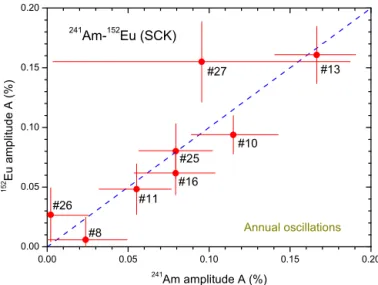
Fig. 3. Amplitudeofaverageannualoscillationsinthedecayratesof241Amand 152Eumeasuredbyγ-rayspectrometrywith8HPGedetectorsatSCKbetween2008
and2016.Theindexreferstothedetector number.Amixed241Am–152Eupoint
sourcewasmeasured166–466timesinafixedgeometryatabout11cmfromthe endcapusingthe59 keVlineof241Amandthe122 keV,779 keVand1408 keV
linesof152Eu.
Radionuclides disintegrating by electron capture (EC) and
β
+decay–22Na,54Mn,55Fe,57Co,65Zn,82Sr/82Rb
+
85Sr,109Cd,133Ba, 152Eu, and 207Bi – were investigated by the same techniques asα
andβ
− emission and, also here, stability within the 10−5 to10−4 rangewasobserved inmostcases.Anexampleisshownin
Fig. 2Bfor22NameasuredinthesameperiodwiththesameICas
134CsinFig. 2A.Thetinymodulationsintheresidualsforboth
nu-clidesarehighly correlated,whichismostlikelyaseasonaleffect ofinstrumental origin. Clear evidence ofannual modulations be-ing ofinstrumental originhasbeen found inthousands of
γ
-ray spectrometrymeasurementswith8HPGedetectorsattheSCK,as showninFig. 3:themodulationsinmeasureddecayratesforthe alphadecayof 241Am andmixedEC,β
−, andβ
+ decayof 152Euarehighly correlatedbutthe amplitudediffers fromonedetector toanother. Inother words,themodulations are linkedto the in-strument,nottothetypeofdecay.
4. Conclusions
Theexperimentaldatainthisworkaretypically50timesmore stablethanthemeasurementsonwhichrecentclaimsforsolar in-fluenceonthedecayconstantswerebased.Theobservedseasonal modulationscanbeascribedtoinstrumentalinstability,sincethey varyfrom one instrument toanother and show no communality inamplitude orphaseamong–orevenwithin–thelaboratories. TheexponentialdecaylawisimmunetochangesinEarth–Sun dis-tancewithin0.008%formostoftheinvestigated
α
,β
−,β
+andECdecayingnuclidesalike.
Owingto the invariability of decayconstants, there is no im-pediment tothe establishmentof thebecquerel through primary standardisation at 0.1% range accuracy nor to the demonstration ofequivalence of activity atinternational level over a time span of decades. It is normal for repeated activity measurements to show varying degrees ofinstability ofinstrumental and environ-mentaloriginandsuchauto-correlatedvariabilityshouldbetaken intoaccountnext tostatisticalvariations whensettingalarm lev-elsinqualitycontrolcharts.Takingintoaccount suchinstabilities andadhering to proper uncertaintypropagation, no fundamental objections need to be made against half-life measurement with sub-permilleuncertainties,noragainstapplyingexponentialdecay
formulastocalculateactivityatafutureorpastreferencetimeor toperformaccuratenucleardating.
Acknowledgements
The authors thank all past and present colleagues who con-tributeddirectlyorindirectlyto thevastdata collectionover dif-ferentperiodsspanningsixdecades.
References
[1]E.Rutherford,Aradio-activesubstanceemittedfromthoriumcompounds, Phi-los.Mag.Ser.549 (296)(1900)1–14.
[2]M.Curie,H.KamerlingOnnes,Surlerayonnementduradiumàlatempérature del’hydrogèneliquide,Radium10 (6)(1913)181–186(Englishversion:The radiationofRadiumatthetemperatureofliquidhydrogen.KNAWProceedings 15II,1912–1913,Amsterdam,(1913)1430–1441).
[3]G.T.Emery,Perturbationofnucleardecayrates,Annu.Rev.Nucl.Sci.22(1972) 165–202.
[4]H.-P.Hahn,H.-J.Born,J.Kim,Surveyontherateperturbationofnucleardecay, Radiochim.Acta23(1976)23–37.
[5]P.T.Greenland,Seekingnon-exponentialdecay,Nature335(1988)298.
[6]J.H.Jenkins,E.Fischbach,Perturbationofnucleardecayratesduringthesolar flareof2006December13,Astropart.Phys.31(2009)407–411.
[7]J.H.Jenkins,etal.,Evidenceofcorrelationsbetweennucleardecayratesand Earth–Sundistance,Astropart.Phys.32(2009)42–46.
[8]E.Fischbach,etal.,Time-dependentnucleardecayparameters:newevidence fornewforces?,SpaceSci.Rev.145(2009)285–335.
[9]J.H.Jenkins,D.W.Mundy,E.Fischbach,Analysisofenvironmentalinfluences innuclearhalf-lifemeasurementsexhibitingtime-dependentdecayrates,Nucl. Instrum.MethodsA620(2010)332–342.
[10]A.G.Parkhomov,Deviationsfrombetaradioactivityexponentialdrop,J.Mod. Phys.2(2011)1310–1317.
[11]J.H.Jenkins,E.Fischbach,D.Javorsek,R.H.Lee,P.A. Sturrock,Concerningthe timedependenceofthedecayrateof137Cs,Appl.Radiat.Isot.74(2013)50–55.
[12]P.A. Sturrock,etal.,Comparativestudyofbeta-decaydataforeightnuclides measured at the Physikalisch-TechnischeBundesanstalt, Astropart.Phys. 59 (2014)47–58.
[13]D.Javorsek,etal.,Powerspectrumanalysesofnucleardecayrates,Astropart. Phys.34(2010)173–178.
[14]J.Mullins,Isthesunreachingintoearthlyatoms?,NewSci.202 (2714)(2009) 42–45.
[15]S.Clark,Half-lifeheresy:strangegoingsonattheheartoftheatom,NewSci. 216 (2891)(2012)42–45.
[16]E.B.Norman,E.Browne,H.A.Shugart,T.H.Joshi,R.B.Firestone,Evidenceagainst correlations betweennucleardecayratesand Earth–Sundistance,Astropart. Phys.31(2009)135–137.
[17]T.M.Semkow,etal.,Oscillationsinradioactiveexponentialdecay,Phys.Lett.B 675(2009)415–419.
[18]E.Bellotti,C.Broggini,G.DiCarlo,M.Laubenstein,R.Menegazzo,Searchfor timedependenceofthe137Csdecayconstant,Phys.Lett.B710(2012)114–117.
[19]J.C. Hardy,J.R. Goodwin, V.E.Iacob,Do radioactive half-livesvary withthe Earth-to-Sundistance?,Appl.Radiat.Isot.70(2012)1931–1933.
[20]K.Kossert,O.Nähle,Long-termmeasurementsof36Cltoinvestigatepotential
solarinfluenceonthedecayrate,Astropart.Phys.55(2014)33–36.
[21]E.Bellotti,etal., Searchfortimemodulationsinthedecayrate of40Kand 232Th,Astropart.Phys.61(2015)82–87.
[22]O.Nähle,K.Kossert,Commenton“Comparativestudyofbeta-decaydatafor eight nuclidesmeasured at the Physikalisch-Technische Bundesanstalt” [As-tropart.Phys.59(2014)47–58],Astropart.Phys.66(2015)8–10.
[23]K.Kossert,O.Nähle,Disproofofsolarinfluenceonthedecayratesof90Sr/90Y,
Astropart.Phys.69(2015)18–23.
[24]E.Bellotti,C.Broggini,G.DiCarlo,M.Laubenstein,R.Menegazzo,Precise mea-surementofthe222Rnhalf-life:aprobetomonitorthestabilityofradioactivity,
Phys.Lett.B743(2015)526–530.
[25]H.Schrader,Seasonalvariationsofdecayratemeasurementdataandtheir in-terpretation,Appl.Radiat.Isot.114(2016)202–213.
[26]S. Pommé,Methods for primary standardization ofactivity, Metrologia 44 (2007)S17–S26.
[27]G. Ratel,TheSystèmeInternational deRéférenceand itsapplication inkey comparisons,Metrologia44(2007)S7–S16.
[28]S.Pommé,Theuncertaintyofthehalf-life,Metrologia52(2015)S51–S65.
[29]S.Pommé,Whenthemodeldoesn’tcoverreality:examplesfromradionuclide metrology,Metrologia53(2016)S55–S64.
[30] R.M.Lindstrom,Believablestatementsofuncertaintyandbelievablescience,J. Radioanal.Nucl.Chem.(2016),http://dx.doi.org/10.1007/s10967-016-4912-4. [31]H.Schrader,Ionizationchambers,Metrologia44(2007)S53–S66.
286 S. Pommé et al. / Physics Letters B 761 (2016) 281–286
[32]M.N.Amiot,etal.,Uncertaintyevaluationinactivitymeasurementsusing ion-izationchambers,Metrologia52(2015)S108–S122.
[33]M.-C. Lépy, A. Pearce, O. Sima, Uncertainties in gamma-ray spectrometry, Metrologia52(2015)S123–S145.
[34]S.Pommé,Typicaluncertaintiesinalpha-particlespectrometry,Metrologia52 (2015)S146–S155.
[35]S.Pommé,G.Sibbens,Alpha-particlecountingandspectrometryinaprimary standardisationlaboratory,ActaChim.Slov.55(2008)111–119.
[36]S.Pommé,Theuncertaintyofcountingatadefinedsolidangle,Metrologia52 (2015)S73–S85.
[37]R.Fitzgerald,C.Bailat,C.Bobin,J.D.Keightley,Uncertaintiesin4πβ–γ coinci-dencecounting,Metrologia52(2015)S86–S96.
[38]K. Kossert, R. Broda, P.Cassette, G. Ratel, B. Zimmerman, Uncertainty de-termination for activity measurements by means of the TDCR method and the CIEMAT/NIST efficiency tracing technique, Metrologia 52 (2015) S172–S190.
[39]C.Thiam,C.Bobin,F.J.Maringer,V.Peyres,S.Pommé,Assessmentofthe uncer-taintybudgetassociatedwith4π γcounting,Metrologia52(2015)S97–S107.
[40]M.Unterweger,L.Johansson,L.Karam,M.Rodrigues,A.Yunoki,Uncertainties ininternalgascounting,Metrologia52(2015)S156–S164.
[41]B.Simpson,S.Judge,Specialissueonradionuclidemetrology,Metrologia44 (2007)S1–S152.
[42]L.Karam,J.Keightley,J.M.LosArcos,Uncertaintiesinradionuclidemetrology, Metrologia52(2015)S1–S212.
View publication stats View publication stats

![[PDF] Formation informatique d Introduction à Matlab | Cours informatique](data:image/gif;base64,R0lGODlhAQABAIAAAP///wAAACH5BAEAAAAALAAAAAABAAEAAAICRAEAOw==)