HAL Id: hal-02508362
https://hal.archives-ouvertes.fr/hal-02508362
Submitted on 18 Mar 2020
HAL is a multi-disciplinary open access
archive for the deposit and dissemination of
sci-entific research documents, whether they are
pub-lished or not. The documents may come from
teaching and research institutions in France or
abroad, or from public or private research centers.
L’archive ouverte pluridisciplinaire HAL, est
destinée au dépôt et à la diffusion de documents
scientifiques de niveau recherche, publiés ou non,
émanant des établissements d’enseignement et de
recherche français ou étrangers, des laboratoires
publics ou privés.
Att-HACK: An Expressive Speech Database with Social
Attitudes
Clément Le Moine, Nicolas Obin
To cite this version:
Clément Le Moine, Nicolas Obin. Att-HACK: An Expressive Speech Database with Social Attitudes.
Speech Prosody, May 2020, Tokyo, Japan. �hal-02508362�
Att-HACK: An Expressive Speech Database with Social Attitudes
Cl´ement Le Moine, Nicolas Obin
STMS Lab - IRCAM, CNRS, Sorbonne Universit´e
Paris, France
Abstract
This paper presents Att-HACK, the first large database of acted speech with social attitudes. Available databases of ex-pressive speech are rare and very often restricted to the primary emotions: anger, joy, sadness, fear. This greatly limits the scope of the research on expressive speech. Besides, a fundamental aspect of speech prosody is always ignored and missing from such databases: its variety, i.e. the possibility to repeat an ut-terance while varying its prosody. This paper represents a first attempt to widen the scope of expressivity in speech, by provi-ding a database of acted speech with social attitudes: friendly, seductive, dominant, and distant. The proposed database com-prises 25 speakers interpreting 100 utterances in 4 social atti-tudes, with 3-5 repetitions each per attitude for a total of around 30 hours of speech. The Att-HACK is freely available for aca-demic research under a Creative Commons Licence.
Index Terms: expressivity, speech prosody, social attitude, speech database
1. Introduction
Though the linguistic functions of speech prosody are nowadays well documented in a large number of languages (phonology, syntax/prosody interface, etc...), its expressive or para-linguistic functions, such as speaking style or speech emotions, does not benefit from the same amount of attention from the linguistic community. Meanwhile, speech engi-neers have realized spectacular advances in the past decade
creating extremely realistic synthetic voices [1] which are
now integrated into voice interfaces that are increasingly present in our everyday lives, such as the voice assistants and conversational/virtual agents. However, these intelligible and natural voices still clearly lack expressiveness and adaptability which greatly limits the interaction between humans and
machines (see for instance [2]). Expressivity is the next
frontier of speech research at the interface of linguistics and technology, as shown by the recent increase of research in this domain [3]. Consequently, there is a clear need to better understand the expressivity of the human voice which is mainly conveyed through speech prosody. In particular, there is a growing interest of the engineering community in the statistical modelling of prosody [4,5,6,7,8,9,10], expressive speech synthesis [11,12,13], and conversion of neutral to expressive speech [14,15,16].
Nowadays, speech expressivity is generally equated to speech emotions though the scope of expressivity includes but is not restricted to the primary emotions as denoted by
Ekman [17]. This limitation is probably due to the difficulty
of converging to an agreement on the terminology used to describe the various and subtle forms of expressivity in speech.
Accordingly, the study of speech expressivity is generally limited to dedicated speech emotion databases as interpreted by actors or to audio books read by professional readers (mostly
in English, and sometimes in French or German [18]). In the
past decade, speech emotion research has mainly focused on acted emotional speech: from its original form in which an actor is asked to interpret a short text with a given emotion
[19] to more open and spontaneous forms in which two
actors freely improvise based on a given scenario and then asked to rate their own speech emotions with categories or on
valence/arousal continuous scales [20, 21]. Moreover, these
databases have been created only for the purpose of speech emotion recognition, but not for the modelling of speech prosody and neither for speech synthesis and conversion.
However, speech expressivity is not restricted to primary emotions. For instance, to deal with more subtle variation, the circumplex model, in which emotions are categorized in
a bidimensional space, was proposed by psychologists [22].
Attitude was firstly equated to the first dimension (valence) of
this model [23]. A distinction between emotion and attitude
was done in [24] by defining emotion as a speaker state and
attitude as a kind of behaviour. This distinction was later refined in [25], by defining attitude as a predictor of social behaviour. The attitudinal aspect of expressiveness of course differs from the primary emotions, and create a distinction between the propositional attitude (towards an utterance: irony, doubt, etc...
[26]) and the social attitudes (towards a person: dominant,
friendly, seductive, distant, etc...). This last dimension has been recently investigated in the study of the role of speech
prosody in neurosciences [27]. Moreover, all of the existing
speech databases miss an essential aspect of speech prosody: its variety [28]. There is always only one realization of each utterance, while any utterance can be obviously realized with many prosodies, some being functionally equivalent, some having various degrees of expressivity. There is a clear need for speech database that would tackle these issues and allow a di-versification of the research in speech prosody and expressivity, and with sufficient data to allow learning generative models.
This paper presents Att-HACK, the first large database of acted speech with social attitudes. This database comprises the recordings of 25 speakers (M/F) interpreting 100 utterances in 4 different social attitudes: friendly, seductive, dominant, dis-tant. In a given attitude, each utterance is repeated differently between 3 and 5 times in order to provide access to the inherent prosodic variety of speech. This represents a total of about 30 hours of speech, which comes with audio signals, orthographic text transcription, F0 analysis, and phonetic alignments. The
Att-HACK* is freely available for research under a Creative
Commons (BY/NC/ND) Licence. The remaining of the paper is organized as follows: in Section2we describe the conception of Att-HACK. A full description of the database is proposed in
Section3, with some illustrations of the F0 obtained in the 4
social attitudes by some of the speakers.
2. Conception of Att-HACK
In this Section, the full conception of the Att-HACK speech database of social attitudes is described, from the initial choice of social attitudes as a continuation of speech expressivity re-search and including the details of the speech database design. 2.1. Models of Emotions
The means by which humans construct representations of emotions is still an open and debated issue in the field of psy-chology and affective sciences: today, two fundamental models are used for the description of emotions. The first approach is categorial and supports the idea that emotions are discrete and relate to concepts that are essentially distinct. A discrete
emo-tion theory was developed by Ekman et al. in 1992 [17] in
which six basic emotions were proposed: anger, disgust, fear, happiness, sadness, and surprise. The second approach is di-mensional and supports that emotions are defined according to
at least one dimension. In the circumplex model [22], emotion
is defined on two dimensions: valence (positive–negative) and arousal (passive-active). A third dimension denoted dominance (submissiveness-dominance) was added to compose the PAD (Pleasure, Arousal, Dominance) three-factors model for speech emotions [29].
2.2. Definition and Choice of Social Attitudes
The choice of social attitudes is methodologically rooted with the idea of extending the study of expressivity from pri-mary emotions to more subtle forms. As initially inspired by [25], social attitudes allows to represent the attitude of a spea-ker towards its interlocutor during an interaction. Such social attitudes differ from emotions which are internal state of a spea-ker and from propositionnal attitudes which are the attitude of a speaker towards an utterance.
domineering toward the other submissive toward the other inclusive toward the other exclusive toward the other dominant seductive friendly attentive submissive insolent authoritarian distant < submissive dominant >
distant friendly seductive dominant
FIGURE1 – Social attitudes represented in a 2-D space inspi-red by Jean Julien Aucouturier’s categorization for musicians playing attitudes [30].
Following this initial definition, Jean-Julien Aucouturier
et al. [30] recently proposed an original categorization for
musicians’ playing attitudes inspired by Leary’s rose model [31]. The attitudes are described in a bidimensional space, the first dimension reflects the hostility/friendliness (alternatively, negative/positive) towards the other musician while the second dimension reflect the position of the musician in a social hierarchy (subordination/dominance). Our proposed choice of social attitudes is in the continuation of these two precursory works. In this paper, four social attitudes were defined by sampling the valence and dominance dimensions during a speech interaction: friendly, seductive, dominant and distant (figure1). This includes one negative (distant) and three posi-tives (friendly, seductive, dominant) attitudes sampled in the semi-space of neutral to high-hierarchy in the dominance space. The four attitudes are described as follows :
— friendly: you are pleasant and benevolent, you care about others’ preferences, you act towards the others in-dependently from your own situation.
— seductive: everything in your behaviour aims at char-ming the others, to make them love you, you do not care about others’ preferences but you are ready for anything to seduce them even if you have to fake benevolence. — dominant: you are self confident, sure of your own
su-periority, you do not care about others’ preferences, eve-rything in your behaviour is dedicated to make the others obey and listen to you without imposing anything expli-citly.
— distant: you (barely) do not care about the others, you are uncommunicative, you do not care about others’ pre-ferences.
FIGURE2 – Social attitudes represented with the PAD model proposed by Russel & Mehrabian [29]
An attempt to describe our four attitudes through using the Russell’s PAD model has been initiated by recomposing those attitudes with some of the 151 emotion-denoting terms
subjects were asked to rate in [29] using valence, arousal,
and dominance. Let us assume that our friendly is a mix of {friendly, humble, curious, respectful, kind}, seductive a mix of {affectionate, sexually excited, controlling}, dominant a mix of {influential, domineering, bold} and distant a mix of {timid,
bored, inhibited, uninterested, detached, shy, snobbish lonely}.
The figure2shows our four social attitudes categorized
accor-ding to the three Russel’s dimensions (by averaging of the re-sults obtained by Russel for the considered groups).
2.3. Set of sentences
The set of sentences used for the creation of the database has been designed in French as inspired by the corpus of pro-positionnal attitudes proposed by Morlec in [32]. The proposed sentences have been designed according to the following crite-ria: 1) to avoid introducing a bias due to the expressive content of the text, the sentences were designed to be as neutral as pos-sible ; 2) to reduce the prosodic variability due to the text struc-ture, the sentences were designed with a limited and controlled linguistic complexity, by using simple syntactic structures and short sentences ; 3) Finally, the sentences were designed in a way they remain plausible in each social attitude.
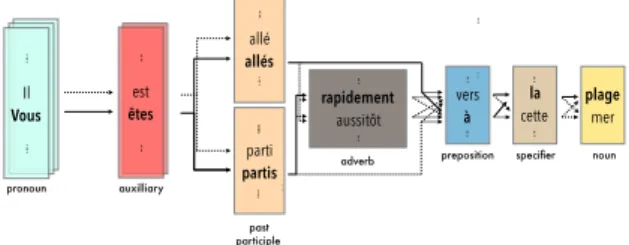
est êtes Il Vous parti partis allé allés pronoun auxilliary past participle rapidement aussitôt adverb vers à la
cette plage mer
noun preposition specifier
FIGURE3 – Phrase generator functioning for the above quoted phrases, chosen words are in bold, dotted lines represent pos-sible choices for the algorithm
Accordingly, we constructed a set of 100 sentences (from 2 to 8 syllables) corresponding to simple everyday life si-tuations (classic sisi-tuations in classic socialization places like home, restaurant, workplace, ...). For this purpose, we designed a phrase generator that builds phrases from semantic nucleus ({pronoun/noun + verb} or {pronoun/noun + auxilliary}) by randomly picking words in dictionaries in order to guarantee the phrases are always conceived the same way. We randomly kept 100 phrases among the 10000 generated ones to build our set of sentences, a sample of 10 sentences is listed below.
Oui Bonjour C’est vrai A demain Paul Bonne journ´ee Marie
Il est tard `a Londres Vous ˆetes all´es `a la plage Vous ˆetes partis rapidement Impossible, attendons un peu C’est vrai, allons prendre un caf´e
Figure3depicts the functioning of the automatic sentence
generator considering the example of two sentences created from the nucleus “Vous ˆetes ...” (“You are ...”).
3. Description of Att-HACK
3.1. Audio recordings
To feed this database, twenty-five actors were recorded in professional studios at Ircam. It consisted of 4 hours sessions during which one actor had to play 100 sentences in the four
different social attitudes, proposing from 3 to 6 different versions of each sentence in each attitude. At the beginning of each session, the four attitudes were shortly described as stipulated above. Those descriptions have been used as acting options, actors were told to act the way they felt regarding each attitude denomination and not necessary in regards to those descriptions. The actors were told to be as natural as possible, no other information was given during the session.
For the recording, we used a Neumann U87 static micro-phone plugged into a RME fireface interface synchronized with the ProTools software. All audio recordings were made with a sampling rate frequency of 44.1 kHz and quantization of 16 bits per sample. The recording were made in two different stu-dios depending on their availability. A patch implemented with
the Max for Live software†was used to provide a visual
inter-face to the actor, displaying on a screen in front of the actor the sentence to be read and the expected attitude, this display being monitored by a sound engineer. The patch also allowed to store the time codes corresponding to each sentence, which were used after the session to segment and name automatically the continuous recording made with the ProTools software. At the end of a session, we had at least 2500 audio files for each actor. This amount of recordings has been manually sorted to remove corrupted files and utterances that were judged as being not natural enough or badly acted. At the time of writing, the Att-HACK database is composed of more than 22,000 expres-sive utterances, which will be completed in the months to come to reach around 50,000 utterances and 30 hours of speech. 3.2. Speech to text alignment
Speech-to-text alignment was performed by using the
ir-camAlign software [33] which is based on the HTK toolbox
and the Lia phon French phonetizer and learned on the BREF French database of read speech. Phonetic alignment is first pro-cessed by ircamAlign and followed by rule-based syllable seg-mentation and a simple phrase segseg-mentation. The resulting ali-gnment are stored in dedicated lab files, a text format indicating at each line the starting time, ending time, and label correspon-ding to the text sentence and audio recorcorrespon-ding.
FIGURE4 – Syllable segmentation (above) and F0 values as estimated on voiced frames (below)
†.https://www.ableton.com/en/live/ max-for-live/
3.3. F0 estimation
The fundamental frequency of the speakers was estimated
by using the SWIPEP algorithm [34] with a minimum pitch
va-lue of 75 Hz, a maximum pitch vava-lue of 450 Hz, and a hop size of 5 ms, without any post-processing for correcting or smoo-thing the raw pitch values. The voiced/unvoiced decision was computed from the pitch strength associated with the pitch va-lue estimate with a threshold of 0.25 (the pitch strength being a value between 0 and 1 corresponding to the periodicity of the speech frame).
Figure4presents the phonetic segmentation of the speech
waveform (above) in syllables and the corresponding F0 values (below) for the sentence ”Attendons un peu” using the Audios-culpt software‡.
4. Preliminary investigation
A preliminary investigation was conducted to illustrate the content of the Att-HACK speech database of social attitudes. 4.1. Extraction of F0 contours
A F0 contour was extracted for each syllable in order to illustrate the F0 patterns realized by the actors for the different social attitudes. The F0 contour of a syllable was identified as the one corresponding the longest sequence of F0 values consi-dered as voiced over the syllable, i.e. the longest F0 segment for which each F0 value corresponds to a pitch strength value which is above a given threshold (in this paper, 0.3).
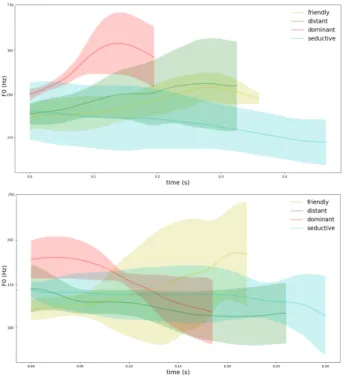
FIGURE5 – F0 contours mean (solid line) and standard devia-tion (filled with color) for the phrase ”Oui” for a female speaker (above) and a male speaker (below)
‡. https://forum.ircam.fr/projects/detail/ audiosculpt/
gender Friendly Seductive Dominant Distant Mean Std Mean Std Mean Std Mean Std female 208 11 186 12 207 10 186 10 male 112 8 113 10 119 8 104 7 global 160 10 150 11 163 9 145 9
TABLE1 – Syllable F0 contours means and standard deviations
(in Hz) for female and male speakers of Att-HACK
gender Friendly Seductive Dominant Distant Mean Std Mean Std Mean Std Mean Std female 404 151 426 141 399 143 440 169 male 410 133 440 145 413 137 471 177 global 407 144 431 142 405 141 452 172
TABLE2 – Syllable durations means and standard deviations (in
ms) for female and male speakers of Att-HACK
4.2. F0 Statistics vs Attitudes
A preliminary investigation was conducted to compare the F0 statistics of the actors across the social attitudes. We computed mean and standard deviation statistics on F0 segments extracted as stipulated above, for each speaker and
attitude. These statistics are reported in Table 2, including
global statistics (female, male and mixed-gender). It is to be noted that only the first part of the recordings has yet been post processed at the time of writing.
Figure5illustrates F0 pattern distributions obtained for a given sentence with the four attitudes, each attitude being presented by a dedicated color. In each color, the solid line re-presents the F0 pattern obtained by averaging the variations rea-lized by the actor, the area filled with color represents the cor-responding standard deviation, and the length of the pattern the corresponding mean duration. This illustration reveals that dis-tinctive F0 patterns are associated with the social attitudes, and also highlights the diversity of strategies employed by actors to communicate a social attitude.
5. Conclusion
This paper presents Att-HACK, a first attempt to widen the scope of expressivity in speech, by providing a database of ac-ted speech with social attitudes: friendly, seductive, dominant, and distant. The proposed database comprises 25 speakers inter-preting 100 utterances in 4 social attitudes, with 3-5 repetitions each per attitude proving a great prosodic variety for a total of around 28 hours of expressive speech. The Att-HACK is freely available for academic research under Creative Commons Li-cence.
6. Acknowledgements
This research has been supported by the French Ph2D/IDF MoVE project on MOdelling of speech attitudes and application to an expressive conversationnal agent and funded by the Ile-De-France region and by the French ANR project TheVoice: ANR-17-CE23-0025.
7. References
[1] Y. Wang, R. Skerry-Ryan, D. Stanton, Y. Wu, R. J. Weiss, N. Jaitly, Z. Yang, Y. Xiao, Z. Chen, S. Bengio, Q. Le, Y. Agiomyrgiannakis, R. Clark, and R. A. Saurous, “Ta-cotron: Towards end-to-end speech synthesis,” 2017.
[2] C. P. P. W. M. G. Castellano, M. Mancini, “Expressive copying behavior for social agents: a perceptual analysis,” IEEE Trans Syst, Man Cybern, vol. 42, no. 3, 2012. [3] Y. Wang, D. Stanton, Y. Zhang, R. Skerry-Ryan, E.
Bat-tenberg, J. Shor, Y. Xiao, F. Ren, Y. Jia, and R. A. Saurous, “Style tokens: Unsupervised style modeling, control and transfer in end-to-end speech synthesis,” 2018.
[4] J. Latorre and M. Akamine, “Multilevel parametric-base F0 model for speech synthesis,” in Interspeech, Brisbane, Australia, 2008, pp. 2274–2277.
[5] N. Obin, A. Lacheret, and X. Rodet, “Stylization and Tra-jectory Modelling of Short and Long Term Speech Pro-sody Variations,” in Interspeech, Florence, Italy, 2011, pp. 2029–2032.
[6] X. Yin, M. Lei, Y. Qian, F. K. Soong, L. He, Z.-H. Ling, and L.-R. Dai, “Modeling F0 trajectories in hierarchi-cally structured deep neural networks,” Speech Commu-nication, vol. 76, pp. 82–92, 2016.
[7] X. Wang, S. Takaki, and J. Yamagishi, “An RNN-Based Quantized F0 Model with Multi-Tier Feedback Links for Text-to-Speech Synthesis,” in Interspeech, 2017, pp. 1059–1063.
[8] Z. Luo, J. Chen, T. Takiguchi, and Y. Ariki, “Emotio-nal voice conversion using neural networks with arbitrary scales F0 based on wavelet transform,” EURASIP Journal on Audio, Speech, and Music Processing, vol. 2017, no. 1, 2017.
[9] N. Obin and J. Beli˜ao, “Sparse coding of pitch contours with deep auto-encoders,” in International Conference on Speech Prosody, 2018, pp. 799–803.
[10] G. Branislav, G. Bailly, O. Mohammed, Y. Xu, and P. N. Garner, “A variational prosody model for the decomposition and synthesis of speech prosody,” in ArXiv
e-prints, 2018. [Online]. Available: arxiv.org/abs/1806.
08685
[11] N. Obin, “MeLos: Analysis and Modelling of Speech Pro-sody and Speaking Style,” PhD. Thesis, IRCAM - UPMC, 2011.
[12] F. Eyben, S. Buchholz, N. Braunschweiler, J. Latorre, V. Wan, M. Gales, and K. Knill, “Unsupervised clustering of emotion and voice styles for expressive tts,” 03 2012. [13] K. Akuzawa, Y. Iwasawa, and Y. Matsuo, “Expressive
Speech Synthesis via Modeling Expressions with Varia-tional Autoencoder,” arXiv e-prints, p. arXiv:1804.02135, Apr 2018.
[14] C. Veaux and X. Rodet, “Intonation conversion from neu-tral to expressive speech,” in Interspeech, Jan. 2011, pp. 2765–2768.
[15] C. Robinson, N. Obin, and A. Roebel, “Sequence-to-sequence modelling of f0 for speech emotion conversion,” in ICASSP 2019 - 2019 IEEE International Conference on Acoustics, Speech and Signal Processing (ICASSP), May 2019, pp. 6830–6834.
[16] Z. Luo, J. Chen, T. Takiguchi, and Y. Ariki, “emotional voice conversion using dual supervised adversarial net-works with continuous wavelet transform f0 features,” IEEE/ACM Transactions on Audio, Speech, and Language Processing.
[17] P. Ekman, “An argument for basic emotions,” Cognition and Emotion, vol. 6, no. 3-4, pp. 169–200, 1992. [Online].
Available:https://doi.org/10.1080/02699939208411068
[18] L. Chen, N. Braunschweiler, and M. Gales, “Speaker and expression factorization for audiobook data: Expressive-ness and transplantation,” Audio, Speech, and Language Processing, IEEE/ACM Transactions on, vol. 23, pp. 605– 618, 04 2015.
[19] F. Burkhardt, A. Paeschke, M. Rolfes, W. Sendlmeier, and B. Weiss, “A Database of German Emotional Speech,” in Interspeech, Lisbon, Portugal, 2005.
[20] C. Busso, M. Bulut, C. Lee, A. Kazemzadeh, E. Mower, S. Kim, J. Chang, S. Lee, and S. Narayanan, “IEMOCAP: Interactive Emotional Dyadic Motion Capture Database,” Journal of Language Resources and Evaluation, vol. 42, no. 4, pp. 335–359, 2008.
[21] G. McKeown, M. Valstar, M. Pantic, and R. Cowie, “The SEMAINE Corpus of Emotionally Coloured Character In-teractions,” in IEEE International Conference on Multi-media and Expo (ICME), 2010.
[22] J. Russell, “A circumplex model of affect,” Journal of Per-sonality and Social Psychology, vol. 39, pp. 1161–1178, 12 1980.
[23] I. Ajzen and M. Fishbein, Understanding attitudes and predicting social behaviour. Englewood Cliffs, New Jer-sey: Prentice-Hall, 1980.
[24] E. Couper-Kuhlen, An Introduction to English Prosody, 1986.
[25] A. Wichmann, “The attitudinal effects of prosody, and how they relate to emotion,” in ITRW on Speech and Pro-sody, Newcastle, UK, 2000.
[26] G. Leech, Principles of Pragmatics. London: Sage Long-man, 1983.
[27] E. Ponsot, J. J. Burred, P. Belin, and J.-J. Aucouturier, “Cracking the social code of speech prosody using re-verse correlation,” Proceedings of the National Academy of Sciences, pp. 3972–3977, 2018.
[28] N. Obin, C. Veaux, and P. Lanchantin, “Making Sense of Variations: Introducing Alternatives in Speech Synthesis,” in Speech Prosody, Shanghai, China, 2012.
[29] J. Russell and A. Mehrabian, “Evidence for a three-factor theory of emotions,” Journal of Research in Personality, vol. 11, pp. 273–294, 09 1977.
[30] J.-J. Aucouturier and C. Canonne, “Musical friends and foes: The social cognition of affiliation and control in im-provised interactions,” Cognition, vol. 161, pp. 94–108, 04 2017.
[31] T. Leary, Interpersonal diagnosis of personality, 1957. [32] Y. Morlec, “G´en´eration multiparam´etrique de la prosodie
du franc¸ais par apprentissage automatique,” PhD. Thesis, Institut de la Communication Parl´ee, Grenoble, 1997. [33] P. Lanchantin, A. Morris, X. Rodet, and C. Veaux,
“Au-tomatic Phoneme Segmentation with Relaxed Textual Constraints,” in International Conference on Language Resources and Evaluation, Marrakech, Morroco, 2008, pp. 2403–2407.
[34] A. Camacho, “SWIPE: A Sawtooth Waveform Inspired Pitch Estimator for Speech and Music,” PhD. Thesis,
University of Florida, 2007. [Online]. Available: http: