Publisher’s version / Version de l'éditeur:
Proceedings of the XIV Machine Translation Summit (Nice, September 2–6,
2013), pp. 183-190, 2013
READ THESE TERMS AND CONDITIONS CAREFULLY BEFORE USING THIS WEBSITE.
https://nrc-publications.canada.ca/eng/copyright
Vous avez des questions? Nous pouvons vous aider. Pour communiquer directement avec un auteur, consultez la
première page de la revue dans laquelle son article a été publié afin de trouver ses coordonnées. Si vous n’arrivez pas à les repérer, communiquez avec nous à [email protected].
Questions? Contact the NRC Publications Archive team at
[email protected]. If you wish to email the authors directly, please see the first page of the publication for their contact information.
NRC Publications Archive
Archives des publications du CNRC
This publication could be one of several versions: author’s original, accepted manuscript or the publisher’s version. / La version de cette publication peut être l’une des suivantes : la version prépublication de l’auteur, la version acceptée du manuscrit ou la version de l’éditeur.
Access and use of this website and the material on it are subject to the Terms and Conditions set forth at
Simulating discriminative training for linear mixture adaptation in
statistical machine translation
Foster, George; Chen, Boxing; Kuhn, Roland
https://publications-cnrc.canada.ca/fra/droits
L’accès à ce site Web et l’utilisation de son contenu sont assujettis aux conditions présentées dans le site LISEZ CES CONDITIONS ATTENTIVEMENT AVANT D’UTILISER CE SITE WEB.
NRC Publications Record / Notice d'Archives des publications de CNRC:
https://nrc-publications.canada.ca/eng/view/object/?id=bd605672-6e33-4b5e-b0d2-24cb16087955 https://publications-cnrc.canada.ca/fra/voir/objet/?id=bd605672-6e33-4b5e-b0d2-24cb16087955
Simulating Discriminative Training for Linear Mixture Adaptation
in Statistical Machine Translation
George Foster, Boxing Chen, and Roland Kuhn National Research Council Canada
Abstract
Linear mixture models are a simple and effective technique for performing domain adaptation of translation models in statis-tical MT. In this paper, we identify and correct two weaknesses of this method. First, we show that standard maximum-likelihood weights are biased toward large corpora, and that a straightforward pre-processing step that down-samples phrase tables can be used to counter this bias. Second, we show that features inspired by prototypical linear mixtures can be used to loosely simulate discriminative training for mixture models, with results that are almost certainly superior to true discrimi-native training. Taken together, these en-hancements yield BLEU gains of approx-imately 1.5 over existing linear mixture techniques for translation model adapta-tion.
1 Introduction
SMT systems, like other statistical NLP systems, experience difficulties when the domain in which they must operate is different from the one on which they were trained. Domain adaptation techniques intended to address this problem have attracted significant research attention in recent years. One simple and popular approach is mix-ture adaptation, in which models trained on various sub-corpora are weighted according to their rele-vance for the current domain. Mixture adaptation is most effective when there are many heteroge-neous sub-corpora, at least some of which are not
too different from the test domain.1 It typically requires only a small in-domain sample—a devel-opment or test set—in order to obtain weights, and has been shown to work well with all major SMT model types: language (Foster and Kuhn, 2007), translation (Koehn and Schroeder, 2007; Foster et al., 2010; Sennrich, 2012b), and reordering (Chen et al., 2013).
There are two main types of mixture model: lin-ear mixtures, which combine weighted probabili-ties from component models additively; and log-linear mixtures, which combine multiplicatively. Linear mixtures frequently perform better (Foster et al., 2010), especially when there are a relatively large number of sub-corpora, and when the mod-els derived from them are not smooth. This is likely due to the “veto power” that any compo-nent model exercises within a log-linear combina-tion: it can suppress hypotheses by assigning them low probabilities. To avoid the complete suppres-sion of in-domain hypotheses by weaker models, the only option is to effectively turn these mod-els off by downweighting them severely, thereby discarding whatever useful information they might possess.
Although linear mixtures are attractive for adap-tation, they have the potential disadvantage that it is difficult to tune mixture weights directly for an SMT error metric such as BLEU. This is because, in order to allow for decoder factoring, models must be mixed at the local level, ie over ngrams or phrase/rule pairs. Thus the linear mixtures
oc-1The assumption that train and test domains are fairly similar
is shared by most current work on SMT domain adaptation, which focusses on modifying scores. Haddow and Koehn (2012) show that coverage problems dominate scoring prob-lems when train and test are more distant.
cur inside the normal log probabilities that are as-signed to these entities, making mixture weights inaccessible to standard tuning algorithms. No-tice that log-linear mixtures do not suffer from this problem, since component probabilities can be in-corporated as features directly into the standard SMT model.
The usual solution to the problem of setting lin-ear mixture weights is to sidestep it by optimizing some other criterion, typically dev-set likelihood (Sennrich, 2012b), instead of BLEU. This achieves good empirical results, but leaves open the ques-tion of whether tuning linear weights directly for BLEU would work better, as one might naturally expect. This question—which to our knowledge has not yet been answered in the literature—is the one we address in this paper.
Modifying standard tuning algorithms to ac-commodate local linear mixtures presents a chal-lenge that varies with the algorithm. In MERT (Och, 2003) for instance, one could replace ex-act line maximization within Powell’s algorithm with a general-purpose line optimizer capable of handling local linear mixtures at the same time as the usual log-linear weights. For expected BLEU methods (Rosti et al., 2011), handling local weights would require computing gradient infor-mation for them. For MIRA (Chiang et al., 2008), the required modifications are somewhat less obvi-ous.
Rather than tackling the problem directly by at-tempting to modify our tuning algorithm, we opted for a simpler indirect approach in which features are used to simulate a discriminatively-trained lin-ear mixture, relying on the ability of MIRA to han-dle large feature sets. Our aim in doing so is not to achieve a close mathematical approximation, but rather to use features to capture the kinds of in-formation we expect to be inherent in linear mix-tures. We apply this approach to translation model (TM) adaptation and show that it outperforms stan-dard linear mixtures trained for dev-set likelihood. We also give strong evidence that it would outper-form linear mixtures trained directly to maximize BLEU. As an additional contribution, we identify a problem with standard likelihood estimation for mixtures that use unsmoothed component models from unbalanced corpora, and provide a simple so-lution that significantly improves performance.
2 Linear Mixture Adaptation for TMs
We now describe the adaptation methods used in this paper. We begin with standard maximum-likelihood mixtures, then describe the enhance-ment for dealing with unbalanced corpora, and finally present our method for simulating discriminatively-trained mixtures. All techniques are applied to TM adaptation; for brevity we de-scribe them in terms of target-conditioned esti-mates only.
2.1 Maximum Likelihood Mixtures
Given a set of training sub-corpora, letpi(s|t) be
the conditional probability for phrase pair s, t in a phrase table extracted from the ith sub-corpus. The resulting mixture model is:
p(s|t) =X
i
wipi(s|t). (1)
To set the weightsw, we extract a bag of phrase pairs from an in-domain development set using standard techniques. This yields a joint distribu-tion p(s, t), which we use to define a maximum˜ likelihood objective: ˆ w = argmax w X s,t ˜ p(s, t) logX i wipi(s|t).
This maximization can be performed in a straight-forward and efficient way using the EM algorithm. 2.2 Correcting for Large-Corpus Bias
A naive implementation of the method in the pre-vious section would extract a separate phrase table from each sub-corpus and assignpi(s|t) = 0 to all
pairss, t not in the ith table.2 This creates a bias
in favour of large sub-corpora, which will tend to contain a greater number of phrase pairs from the development set than smaller sub-corpora. To see why, consider the expected count credited to the ith model for phrase pair s, t during the E-step of the EM algorithm:
wipi(s|t)
P
jwjpj(s|t)
.
Clearly, if the ith model is the only one that as-signs non-0 probability tos, t, then its count incre-ment for this pair will be 1, regardless of how small
2In cases where t also does not exist in the ith table, this
makes the resulting distribution pi(∗|t) , and hence the
over-all mixture, non-normalized. This is not a concern per se, but rather a symptom of the problem we identify in this section.
a (non-0) probability it actually assigns. Since weights are set to normalized expected counts in the M-step, this implies that sub-corpora with higher dev-set coverage will tend to get assigned higher weights.
One might argue that weights tuned for BLEU could be expected to exhibit the same bias, in which case it would obviously not be harmful. However, note that the above analysis applies also to large out-of-domain sub-corpora. Even though models from such corpora may assign very small pi(s|t) to phrase pairs from the dev set, they will
still get a large EM bonus for pairs that are covered by few or no other models. However, domain mis-match means that there will likely be other pairs s, t′ for whichp
i(s|t′) ≫ pi(s|t). At translation
time, such pairs will be detrimental to BLEU score ifwiis high.
One way to solve this problem would be to jointly smooth models across sub-corpora, for in-stance using a hierarchical MAP approach (Amin-zadeh et al., 2012). We experimented with simple add-epsilon smoothing, but found that a more ef-fective approach was to sample sub-corpora in or-der to remove size discrepancies. More precisely, before running EM, we randomly selectri phrase
pairs from theith phrase table according to ˜p(s, t), their joint probability in the dev set distribution,3 and considerpi(s|t) to be 0 for all other pairs. We
set ri = sinmin/ni, where si is the number of
pairs in tablei for which ˜p(s, t) > 0, niis the total
number of pairs in that table, andnmin= mini ni.
This approach gave slightly better results than sub-sampling corpora prior to phrase extraction, and was easier to implement with our existing mixture-model infrastructure. After obtaining weights with EM, the full sub-corpus phrase tables are mixed as usual.
2.3 Simulating Discriminative Training Discriminative training applied to a mixture model (1) will yield a particular set of weightsw and a resulting feature value:
gw(s, t) = log m
X
i=1
wipi(s|t).
Our aim is to find a set of phrase-pair fea-turesfj[p1(s|t), . . . , pm(s|t)] that can be suitably
3Note that this discards pairs that weren’t extracted from the
dev set, for whichp(s, t) = 0.˜
weighted to approximategw(s, t) for any arbitrary
value ofw. Formally, for any w, there should exist a set of log-linear weightsλ such that:
gw(s, t) ≈
X
j
λjlog fj[p1(s|t), . . . , pm(s|t)]. (2)
Notice that this property does not guarantee that optimizing λ will yield a combination P
jλjlog fj[· · · ] that can be interpreted (even
ap-proximately) as gw(s, t) for some set of linear
weights w. In other words, the space defined by weighted combinations of features log fj[· · · ]
might strictly contain the space of linear mixtures gw(s, t). This does not pose a problem, however,
because our aim is not to carry out an exact sim-ulation of discriminatively-trained linear mixtures but rather a loose simulation that captures the es-sential properties of these mixtures for adaptation. Furthermore, if an assignment to λ does result in a combination that is outside the space of linear mixtures, it will be because that assignment is bet-ter, in the sense of yielding a higher training BLEU score, than any linear mixture.
A set of functions that trivially satisfies (2) is one that includes a feature fw for every set of
weightsw: fw[p1(s|t), . . . , pm(s|t)] = m X i=1 wipi(s|t),
where equality in (2) is achieved by settingλw = 1
andλw′ = 0, ∀w′ 6= w. Although this solution
is clearly impractical, it motivates our choice of features, which are intended to capture or approxi-mate various prototypical weightings. Our hypoth-esis is that a precise setting of linear weights is less important than being close to an appropriate proto-type.
We now turn to a description of our features, which are as follows:
• EM. Under the hypothesis that maximum-likelihood weights may sometimes be iden-tical to maximum-BLEU weights, we define one feature to be the weighted combination Pm
i=1wˆipi(s|t) returned by EM.4
• Avg. This feature captures the case when all component models are equally valuable: Pm
i=1pi(s|t)/m
4We tried sharpened and flattened versions of these weights,
ˆ
• Avgnz. To approximate mixtures that down-weight models which frequently assign 0 probabilities, and weight other models uni-formly, this feature takes the average over non-zero probabilities: Pmi=1pi(s|t)/mnz,
wheremnz =
Pm
i=1[pi(s|t) 6= 0]
• Support. This is a version of Avgnz in which non-zero probabilities are mapped to 1:mnz/m.
• Max. Mixtures which contain fairly uniform weights can be roughly approximated by the component model that assigns highest proba-bility to the current phrase pair (ie, the Viterbi approximation):maxm
i=1pi(s|t).
• Onevsall(w). This feature captures mixtures in which the ith model is weighted by w and all other models are weighted uniformly: w pi(s|t) + m1−w−1
P
j6=ipj(s|t). We used one
Onevsall feature for each component model, all parameterized by the same weight w ∈ [0, 1].
In addition to the above dense features, we also ex-perimented with sparse boolean features intended to capture the rank of a given model’s probability assignment for the current phrase pair:
• SparseRank(c). Among all models for which p(s|t) > c, fire if the rank of pi(s|t) is in
[b, e]. We defined one instance of this feature for each sub-modeli and each rank range in [1, 1], [2, 3], [4, 8], and [9, ∞).
3 Experiments
We carried out experiments with a phrase-based SMT system on two different language pairs, us-ing a heterogeneous mix of trainus-ing sub-corpora. 3.1 Data
Data for all our experiments was made available as part of NIST Open MT 2012.5 Our first setting
uses data from the Chinese to English constrained track, comprising approximately 10M sentence pairs. We manually grouped 14 sub-corpora on the basis of genres and origins. Table 1 summarizes the statistics and genres of all training and test ma-terial. Our development set was taken from the
5http://www.nist.gov/itl/iad/mig/openmt12.cfm
corpus # segs # en tok % genre
fbis 250K 10.5M 3.7 nw financial 90K 2.5M 0.9 fin gale bc 79K 1.3M 0.5 bc gale bn 75K 1.8M 0.6 bn ng gale nw 25K 696K 0.2 nw gale wl 24K 596K 0.2 wl hkh 1.3M 39.5M 14.0 hans hkl 400K 9.3M 3.3 law hkn 702K 16.6M 5.9 nw isi 558K 18.0M 6.4 nw lex&ne 1.3M 2.0M 0.7 lex others nw 146K 5.2M 1.8 nw sinorama 282K 10.0M 3.5 nw un 5.0M 164M 58.2 un TOTAL 10.1M 283M 100.0 (all) devtest dev 1,506 161K nw wl NIST06 1,664 189K nw bn ng NIST08 1,357 164K nw wl
Table 1: NIST Chinese-English data. In the genre column: nw=newswire, fin=financial, bc=broadcast conversation, bn=broadcast news, ng=newsgroup, wl=weblog, hans=Hansard, law=legal, lex=lexica, un=United Nations pro-ceedings.
NIST 2005 evaluation set, augmented with some web-genre material reserved from other NIST cor-pora.
The second setting uses NIST 2012 Arabic to English data, but excluding the UN data. There are about 1.5M English running words in these train-ing data. We manually grouped the traintrain-ing data into 7 groups according to genre and origin. Table 2 summarizes the statistics and genres of all the training corpora and the development and test sets. We use the evaluation sets from NIST 2006, 2008, and 2009 as our development set and two test sets, respectively.
3.2 System
Experiments were carried out with a phrase-based system similar to Moses (Koehn et al., 2007). The corpus was word-aligned using IBM2, HMM, and IBM4 models, and the phrase table was the union of phrase pairs extracted from these sepa-rate alignments, with a length limit of 7.
Con-corpus # segs # en toks % genre gale bc 57K 1.6M 3.3 bc gale bn 45K 1.2M 2.5 bn gale ng 21K 491K 1.0 ng gale nw 17K 659K 1.4 nw gale wl 24K 590K 1.2 wl isi 1.1M 34.7M 72.6 nw other nw 224K 8.7M 18.2 nw TOTAL 1.5M 47.8M 100.0 (all) devtest NIST06 1,664 202K nw wl NIST08 1,360 205K nw wl NIST09 1,313 187K nw wl
Table 2: NIST Arabic-English data. The genre la-bels are the same as for Chinese.
method Arabic Chinese
baseline 46.79 31.72
mixtm-ml 47.39 32.73
mixtm-uni 48.02 33.29
mixtm-samp 48.13 34.01
Table 3: Mixture TM Adaptation.
ditional phrase pair estimates in both directions were obtained using Kneser-Ney smoothing (Chen et al., 2011), and were weighted (each directional estimate separately) for adaptation. We also used lexical estimates in both directions which were not weighted (no sub-corpus-specific values were available). Additional features included a hierar-chical lexical reordering model (Galley and Man-ning, 2008) (6 features), standard distortion and word penalties (2 features), a 4-gram LM trained on the target side of the parallel data, and a 6-gram English Gigaword LM (14 features total). The de-coder used a distortion limit of 7, and at most 30 translations for each source phrase. The system was tuned with batch lattice MIRA (Cherry and Foster, 2012).
3.3 Results
Our first experiment compares a non-adapted base-line, trained on all available corpora, with standard maximum likelihood (ML) mixture TM adaptation as described in section 2.1 and the sampled variant described in section 2.2. The results are presented in table 3, in the form of BLEU scores averaged over both test sets for each language pair. ML
mix-corpus PT size weights
(# pairs) mixtm-ml mixtm-samp
financial 4.4M 0.033 0.142 gale bc 3.6M 0.022 0.091 gale bn 4.6M 0.059 0.126 gale nw 1.8M 0.082 0.279 gale wl 1.4M 0.017 0.176 hkh 62.2M 0.120 0.008 hkl 8.2M 0.002 0.024 hkn 26.6M 0.035 0.021 isi 26.1M 0.045 0.011 ne lex 1.9M 0.003 0.030 others nw 7.8M 0.050 0.042 fbis 19.6M 0.142 0.026 sinorama 17.0M 0.053 0.020 unv2 360.1M 0.341 0.005
Table 4: Comparison of weights assigned to Chi-nese sub-corpora by standard and sampled ML mixture models.
ture adaptation (mixtm-ml) yields significant gains of 0.6 and 0.9 for Arabic and Chinese over the adapted model. However, in our setting, this un-derperforms assigning uniform weights to all com-ponent models (mixtm-uni). Equal-size sampling of the phrase tables (mixtm-samp) performs best, improving over the plain ML method by 0.7 and 1.3 BLEU.
Table 4 shows the weights assigned to the Chi-nese component models by these two strategies, and gives some insight into their behaviour. The bias of mixtm-ml in favour of large corpora is very evident, particularly in its assignment of by far the largest weight to the highly out-of-domain UN cor-pus. This trend is reversed by mixtm-samp, which assigns a suitably low weight to UN, and the high-est weight to the small but very relevant gale nw corpus.
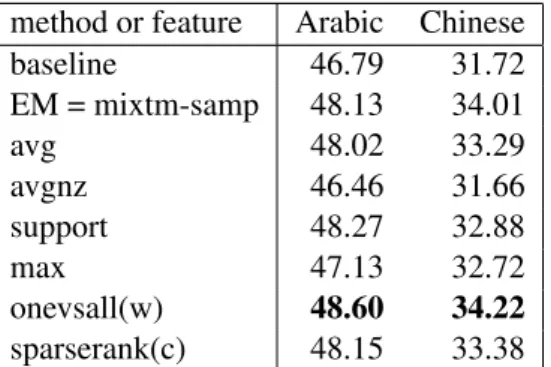
We now evaluate the features intended to allow for simulating discriminative training described in section 2.3. Table 5 contains results (average BLEU scores, as before) for each feature on its own. The w and c parameters for the onevsall and sparserank features were optimized for dev-set BLEU separately for Arabic and Chinese, with resulting values w = 0.9 and 0.5; and c = 0.05 and 0.005 respectively. All but one of the fea-tures (avgnz) outperform the baseline, probably because all incorporate some mechanism for
im-method or feature Arabic Chinese baseline 46.79 31.72 EM = mixtm-samp 48.13 34.01 avg 48.02 33.29 avgnz 46.46 31.66 support 48.27 32.88 max 47.13 32.72 onevsall(w) 48.60 34.22 sparserank(c) 48.15 33.38
Table 5: Performance of features for simulating discriminative training.
method or feature Arabic Chinese
baseline 46.79 31.72
mixtm-samp 48.13 34.01
onevsall(w) 48.60 34.22
all features 48.48 34.20
onevsall(09)
+ avgnz + support + max 48.84 ——
onevsall(05)
+ avg + max + EM —— 34.37
Table 6: Feature combinations.
plicitly countering the harmful effects of large out-of-domain corpora such as the UN. Avgnz does not have this property because it will emphasize non-zero probabilities without connecting them to a particular component. Although some features ap-pear to be competitive with EM, the only one that clearly outperforms it on both language pairs is onevsall. This is not particularly surprising, since ovevsall generates multiple values (one per sub-corpus) unlike all other features except sparser-ank (4 potential boolean features per sub-corpus). However, it is interesting to note that onevsall is es-sentially a log-linear mixture in which component models are heavily smoothed by linear interpola-tion.
Table 6 shows the combination of all features from table 5. Disappointingly, this does somewhat worse than onevsall on its own. To determine the cause, we compared the dev-set BLEU scores for onevsall with those for the full model. On Ara-bic these are 48.81 versus 49.00; and on Chinese they are 29.13 versus 29.46. Hence we conclude that MIRA is mildly overfitting on the full feature sets. This is not quite the whole story, however. To see if we could improve on onevsall, we used
method Arabic Chinese
dev test dev test
mixtm-samp 48.10 48.13 28.65 34.01
simplex 48.62 48.28 28.76 34.06
onevsall(w) 48.81 48.60 29.13 34.22
best 49.05 48.84 29.28 34.37
Table 7: Comparison of direct optimization for lin-ear weights with feature simulation.
a greedy feature selection strategy, hillclimbing on dev-set score, and stopping when we reached a lo-cal maximum. The (language-pair-specific) results are shown in table 6. These improve over the full models and give small gains over onevsall. The corresponding dev-set scores are 49.05 and 29.28, which indicates that, at least for Arabic, MIRA was both overfitting and failing to properly opti-mize the full model.
Our final experiment is an attempt to determine how our loose simulation of discriminative training for linear mixtures compares with true discrimina-tive training. Lacking a sophisticated implemen-tation of the latter, we used a brute force down-hill simplex search (Press et al., 2002). We first ran MIRA with mixtm-samp linear weights, then performed 200 simplex iterations to optimize lin-ear weights with log-linlin-ear weights held constant, then ran MIRA to re-optimize log-linear weights. The results are shown in table 7. The simplex search was mildly successful in its attempt to im-prove dev-set BLEU scores, gaining 0.52 and 0.11 over the mixtm-samp baseline for Arabic and Chi-nese respectively. Since, unlike MIRA, it makes no provision for generalization beyond the dev set, it is not fair to compare its test scores to those of mixtm-samp; indeed, we note that its test per-formance is poor relative to dev. What is signif-icant is that the feature-based methods—onevsall and best—do much better on the dev set than sim-plex. We conclude that it is very unlikely that a more sophisticated optimizer working with a bet-ter objective than raw BLEU would be able to find a set of linear weights that outperform the test re-sults of our features.6
6As noted above, however, it almost certainly does not
ac-complish this feat while remaining within the space of linear combinations.
4 Related Work
Domain adaptation for SMT is currently a very active topic, encompassing a wide variety of ap-proaches. TM linear mixture models of the kind we study here were first proposed by Foster et al (2010), and have been refined by (Sennrich, 2012b), who applied them to multiple sub-corpora and investigated alternative techniques such as count weighting to capture the amount of sub-corpus-internal evidence for each phrase pair. Sen-nrich (2012a) reports interesting results using clus-tering to automate the identification of coherent sub-corpora. (Aminzadeh et al., 2012) examine the interaction between adaptation and MAP smooth-ing, and compare different combining techniques. Other ways of combining various component mod-els have also been proposed, including “fill-up” with a predefined preference order (Bisazza et al., 2011), using multiple decoder paths (Koehn and Schroeder, 2007), and ensemble combination of complete models in the decoder (Razmara et al., 2012). Mixture approaches have also been used for LM adaptation (Foster and Kuhn, 2007). Finally, data selection approaches (Axelrod et al., 2011) can be seen as an extreme form of mixture mod-eling in which weights are either 0 or 1.
5 Conclusion
Our main aim in this paper has been to inves-tigate whether SMT features inspired by various prototypical linear mixtures can be used to simu-late discriminative training of linear mixture mod-els for TM adaptation. Because of the fact that linear mixtures occur within the log-probabilities assigned to phrase pairs, they are not accessible to standard tuning algorithms without non-trivial modification, and hence are usually trained non-discriminatively for maximum likelihood.
Our simulation is loose in the sense that its fea-tures are not strictly limited to the space avail-able to linear mixtures; they can and do “cheat” by leaving that space in order to improve perfor-mance. We find that we can improve significantly on linear mixtures trained using maximum likeli-hood, by 0.7 BLEU on an Arabic to English task, and by 0.4 BLEU on a Chinese to English task. Most of the gain is achieved by a single set of features (onevsall), parameterized by a combining weight, in which there is one instance per
compo-nent model which assigns that model the combin-ing weight and interpolates it with a uniform com-bination of all other models. The onevsall features achieve higher BLEU score on a development set than does a linear mixture optimized directly using downhill simplex. We consider this to be strong evidence in favour of a conclusion that our ap-proach would outperform true discriminative train-ing for linear mixtures.
We have also proposed an enhancement to max-imum likelihood training of linear mixtures that involves sampling input phrase tables in order to balance their size. This counters a strong bias in favour of large sub-corpora with unsmoothed component models that is especially harmful when these corpora are highly out-of-domain. Although our results above improve on the performance of linear mixtures, we believe that EM-trained linear mixtures still offer a simple and effective way to perform domain adaptation (we also note that one of our best sub-sets of adaptation features includes a maximum-likelihood combination).
References
Aminzadeh, A Ryan, Jennifer Drexler, Timothy An-derson, and Wade Shen. 2012. Improved phrase translation modeling using MAP adaptation. In Text, Speech and Dialogue. Springer.
Axelrod, Amittai, Xiaodong He, and Jianfeng Gao. 2011. Domain adaptation via pseudo in-domain data selection. In EMNLP 2011.
Bisazza, A., N. Ruiz, and M. Federico. 2011. Fill-up versus interpolation methods for phrase-based SMT adaptation. In IWSLT 2011.
Chen, Boxing, Roland Kuhn, George Foster, and Howard Johnson. 2011. Unpacking and transform-ing feature functions: New ways to smooth phrase tables. In MT Summit 2011.
Chen, Boxing, George Foster, and Roland Kuhn. 2013. Adaptation of reordering models for statistical ma-chine translation. In NAACL 2013.
Cherry, Colin and George Foster. 2012. Batch tun-ing strategies for statistical machine translation. In NAACL 2012.
Chiang, David, Yuval Marton, and Philip Resnik. 2008. Online large-margin training of syntactic and struc-tural translation features. In EMNLP 2008.
Foster, George and Roland Kuhn. 2007.
Foster, George, Cyril Goutte, and Roland Kuhn. 2010. Discriminative instance weighting for domain adap-tation in statistical machine translation. In EMNLP 2010.
Galley, Michel and C. D. Manning. 2008. A simple and effective hierarchical phrase reordering model. In EMNLP 2008, pages 848–856, Hawaii, October. Haddow, Barry and Philipp Koehn. 2012. Analysing
the effect of out-of-domain data on smt systems. In WMT 2012.
Koehn, Philipp and Josh Schroeder. 2007.
Experi-ments in domain adaptation for statistical machine translation. In Proceedings of the Second Workshop on Statistical Machine Translation, pages 224–227, Prague, Czech Republic, June. Association for Com-putational Linguistics.
Koehn, P., H. Hoang, A. Birch, C. Callison-Burch, M. Federico, N. Bertoldi, B. Cowan, W. Shen, C. Moran, R. Zens, C. Dyer, O. Bojar, A. Constantin, and E. Herbst. 2007. Moses: Open source toolkit for statistical machine translation. In ACL 2007, Demonstration Session.
Och, Franz Josef. 2003. Minimum error rate training for statistical machine translation. In Proceedings of the 41th Annual Meeting of the Association for Com-putational Linguistics (ACL), Sapporo, July. ACL. Press, William H., Saul A. Teukolsky, William T.
Vet-terling, and Brian P. Flannery. 2002. Numerical Recipes in C++. Cambridge University Press, Cam-bridge, UK.
Razmara, Majid, George Foster, Baskaran Sankaran, and Anoop Sarkar. 2012. Mixing multiple trans-lation models in statistical machine transtrans-lation. In ACL 2012.
Rosti, Antti-Veikko, Bing Zhang, Spyros Matsoukas, and Richard Schwartz. 2011. Expected BLEU train-ing for graphs: BBN system description for WMT11 system combination task. In WMT 2011.
Sennrich, Rico. 2012a. Mixture-modeling with unsu-pervised clusters for domain adaptation in statistical machine translation. In EAMT 2012.
Sennrich, Rico. 2012b. Perplexity minimization for translation model domain adaptation in statistical machine translation. In EACL 2012.