HAL Id: hal-01690327
https://hal.archives-ouvertes.fr/hal-01690327
Submitted on 22 Jan 2018HAL is a multi-disciplinary open access archive for the deposit and dissemination of sci-entific research documents, whether they are pub-lished or not. The documents may come from teaching and research institutions in France or abroad, or from public or private research centers.
L’archive ouverte pluridisciplinaire HAL, est destinée au dépôt et à la diffusion de documents scientifiques de niveau recherche, publiés ou non, émanant des établissements d’enseignement et de recherche français ou étrangers, des laboratoires publics ou privés.
Alain Billand, Julien Demenois, Claude Garcia, Guillaume Lescuyer,
Bramasamdura Rangana Ramesh, V. Pal Singh, Joëlle Smadja, Sanjay
Upadhyay, Louis Verchot
To cite this version:
Alain Billand, Julien Demenois, Claude Garcia, Guillaume Lescuyer, Bramasamdura Rangana Ramesh, et al.. Assam project on forestry and biodiversity conservation: Feasibility report. Final Version. [Research Report] Agence française du développement; CIRAD. 2010. �hal-01690327�
Assam project on forestry and
biodiversity conservation
Feasibility report
Final Version
December, 2010
Department of
Environment & Forests
Assam project on forestry and biodiversity conservation Feasibility report
This report was financed by Agence France de Développement and prepared from 1st to 12th February 2010 by Cirad, with the contributions of:
Alain Billand, General coordination, Report layout, Budget Julien Demenois, Forester, Capacity Building
Claude Garcia, Socio-ecologist
Guillaume Lescuyer, environmental economist Ramesh B. R. Landscape ecologist
V. Pal Singh, Agroforester Joëlle Smadja, Geographer Sanjay Upadhyay, Lawyer
Table of Content
GLOSSARY...6
1. PROJECT AREA DESCRIPTION ...7
1.1 GEOGRAPHICAL AND ENVIRONMENTAL CONDITIONS OF PROJECT AREA, ... 7
1.1.1 Location and description ... 7
1.1.2 Natural features ... 7
1.1.3 Landscape and production units... 7
1.2 DESCRIPTION OF THE LIVELIHOODS AND SOCIO-ECONOMIC SITUATION... 7
1.2.1 Population ... 7 1.2.2 Gender Issues: ... 8 1.2.3 Economy ... 8 1.2.4 Infrastructures, transportation... 8 1.2.5 Agricultural systems ... 9 1.2.6 Other activities ... 10 1.2.7 Political setup: ... 10
1.3
F
ORESTRY AND FOREST DEVELOPMENT SITUATION IN THEP
ROJECT AREA... 101.3.1 Recorded Forest Area ... 11
1.3.2 Protected Areas ... 11
1.3.3 Forest Cover... 11
1.3.4 Forest villages and Encroachments ... 12
1.3.5 Forestry Operations and Working Plans... 12
1.3.6 Participatory Forest Management ... 13
1.4 RELEVANT LOCAL GOVERNANCE STRUCTURES IN THE PROPOSED AREA... 14
1.4.1 Ministry of Environment and Forests ... 14
1.4.2 Assam Forest Department and Revenue Department... 14
1.4.3 Panchayati Raj Institutions and the Gram Sabah... 15
1.4.4 Autonomous Councils and the Gaonburah... 15
1.4.5 Joint Forest Management Committees and Eco-Development Committees... 16
1.4.6 Forest Development Agencies ... 18
1.5 NATIONAL AND LOCAL POLICIES THAT AFFECT THE MANAGEMENT OF FORESTS... 19
1.5.1 Assam Forest Regulation , 1891 ... 19
1.5.2 Karbi Anglong (Mikir) Hills District Forest Act, 1957 ... 19
1.5.3 Assam (Control of Felling and Removal of Trees from Non-Forest Lands) Rules, 2002 ... 20
1.5.4 Jhum (Swidden) Cultivation ... 20
1.5.5 Other Law and Policy Concerns on Forestry ... 20
1.5.6 Assam Forest Policy, 2004 ... 20
1.5.7 Forest Rights Act, 2006... 21
2 PROJECT ANALYSIS AND JUSTIFICATION ...22
2.1 PROBLEMS HIGHLIGHTED AND OVERALL JUSTIFICATION FOR THE PROJECT... 22
2.2 SELECTION OF THE TARGET AREAS AND TARGET GROUPS... 24
2.3 PROJECT APPROACH AND PRINCIPLES... 25
2.4 PRINCIPLES AND INTERACTIONS WITH EXISTING POLICY FRAMEWORK... 25
2.5 SYNERGIES AND OVERLAPPING WITH OTHER EXTERNAL PROJECTS... 27
3 PROJECT CONCEPT...27
3.1 DETAILED SPECIFIC OBJECTIVES AND EXPECTED RESULTS... 27
3.2 ACTIVITIES BY COMPONENT... 28
3.2.1 Forest Department Institutional Strengthening ... 28
3.2.2 Multi-level Strategic Planning ... 35
3.2.3 Sustainable Forest management... 42
3.2.4 Adding value and opening markets/opportunities for forests and biodiversity goods and services53 3.2.5 Project management... 58
3.3.1 Project log frame ... 63
3.3.2 Project expected outputs... 66
3.4 TECHNICAL ASSISTANCE THROUGH CONSULTANT SERVICES FUNDED EITHER FROM LIMITED GRANT OR PROJECT BUDGET69 4 PROJECT IMPLEMENTATION ARRANGEMENTS ...70
4.1 ADDITIONALITY AND INSTITUTIONALIZATION... 70
4.2 PROJECT GOVERNANCE STRUCTURE... 70
4.2.1 Governing body ... 70
4.2.2 Project Management Unit... 70
4.2.3 Hired staff... 72
4.2.4 Supporting staff... 72
4.2.5 Field Implementation Units ... 72
4.3 PROJECT DURATION AND PHASES... 73
4.4 PROJECT INSTITUTIONAL ARRANGEMENT... 73
4.5 PROJECT FUND FLOWS... 74
5 INSTITUTIONAL ROLES AND RESPONSIBILITIES ...75
6 PROJECT COSTS AND FINANCING PLAN ...75
7 LONG TERM SUSTAINABILITY OF THE PROJECT ...78
8 PROJECT MONITORING...79
9 RISKS ASSESSMENT...80
9.1 INSURGENCY... 80
9.2 FLOODS AND OTHER NATURAL HAZARDS... 80
9.3 ACTIVITIES OVERLAPPING WITH THE IMPLEMENTATION OF THE FOREST RIGHTS ACT,2006 ... 81
9.4 INTERNAL ORGANISATIONAL FACTORS... 81
9.5 LOCAL FACTORS... 82
10 ECONOMIC ANALYSIS ...82
10.1 PRELIMINARY ASSUMPTIONS... 82
10.2 UNIT QUANTITIES FOR ECONOMIC ESTIMATIONS... 84
10.3 TIMBER LOGGING... 84
10.4 CARBON SEQUESTRATION... 85
10.5 FUEL-WOOD... 87
10.6 AGRO-FORESTRY... 87
10.7 IMPROVEMENT OF JHUMMING PRACTICES... 88
10.8 FINANCIAL PROFITABILITY OF THE PROJECT... 90
11 OPPORTUNITIES OFFERED BY CARBON FINANCE: REDD+ AND CDM ...91
11.1 REDD+ AND CDM OPTIONS... 91
11.2 INITIAL AND BASELINE STUDIES... 91
11.3 ESTIMATED EMISSIONS... 93
11.4 CARBON SEQUESTRATION... 94
12 ENVIRONMENTAL & SOCIAL IMPACT ASSESSMENT ASPECTS...96
12.1 INSTITUTIONAL STRENGTHENING... 96
12.2 SUSTAINABLE FORESTRY... 97
12.3 PARTICIPATORY DEVELOPMENT AND INCOME GENERATING ACTIVITIES... 98
13 OPERATING MANUAL OF THE PROJECT/IMPLEMENTATION ARRANGEMENTS...99
13.1 FIELD IMPLEMENTATION... 99
13.2 FINANCIAL MANAGEMENT AND DISBURSEMENT ARRANGEMENTS... 101
13.2.1 Country Issues ... 101
13.2.2 Fund Flow ... 101
13.2.3 Staffing ... 102
13.2.4 Training on Financial Management ... 102
13.3 ACCOUNTING POLICIES AND PROCEDURE... 103
13.3.1 Audit ... 103
13.3.2 Reporting and Monitoring... 104
13.3.3 Information Systems... 104
13.3.4 Disbursement Arrangements... 104
13.4 PROCUREMENT ARRANGEMENTS... 104
13.4.1 Procurement Guidelines/ Bidding Documents... 105
13.4.3 Methods of Procurement for Works and Goods will include:... 105
13.4.4 Proposed Procedures for National Competitive Bidding [NCB] ... 107
14 REFERENCES ...107
15 ANNEXES ...109
15.1 ANNEX I–MOEFWORKING PLAN GUIDELINES... 109
15.2 ANNEX II–SUPREME COURT RULING 1996 ... 109
15.3 ANNEX III–ORGANIZATION CHART OF THE ASSAM FOREST DEPARTMENT... 109
15.4 ANNEX IV–FOREST RIGHTS ACT 2006 ... 109
15.5 ANNEX V–NAPREVISED OPERATIONAL GUIDELINES 2009... 109
15.6 ANNEX VI–NARMILGUIDELINES 2009... 109
15.7 ANNEX VII–ASSAM JOINT (PEOPLE’S PARTICIPATION)FORESTRY MANAGEMENT RULES (1998)... 109
15.8 ANNEX VIII–ASSAM (CONTROL OF FELLING AND REMOVAL OF TREES FROM NON-FOREST LANDS)RULES,2002 ... 109
Table of Figures Figure 1 Forest Cover Map of Assam, 2007. ... 12
Figure 2 Noapara JFMC PRA 22 April 2008 (source: Kamrup West Forest Division, Assam) ... 17
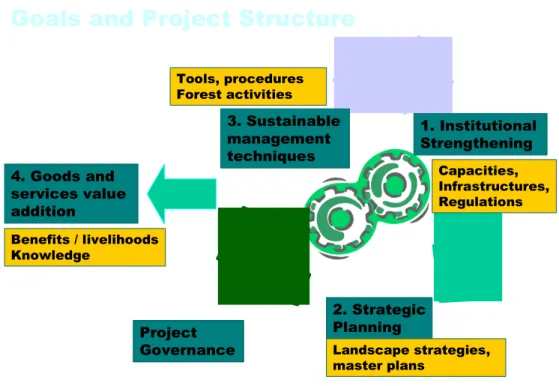
Figure 3 Project Components ... 28
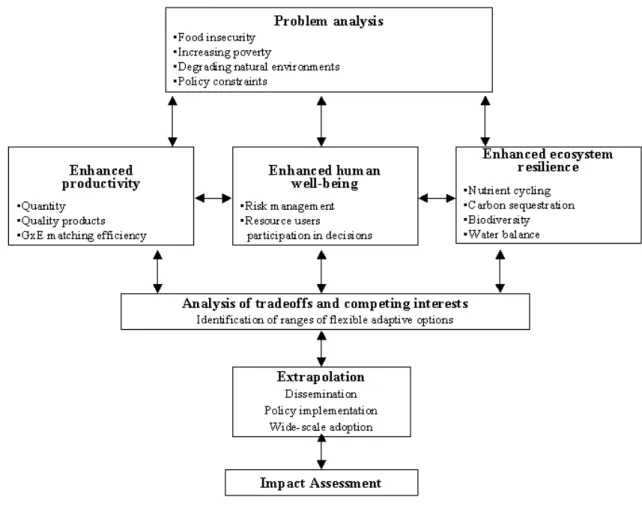
Figure 4 Integrated Natural Resources Management Framework ... 46
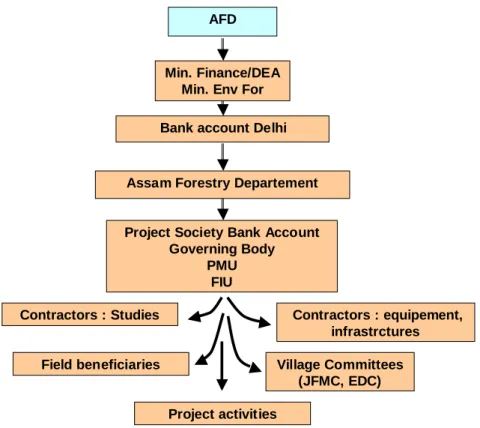
Figure 5 Fund flows from central level to field activities... 75
Figure 6 Forest lost (and carbon emissions) per year in Assam from 1989 to 2007 ... 93
Figure 7 60 years evolution in net carbon stocks in teak model plantation... 95
Figure 8 60 years evolution in net carbon stocks in agroforestry model plantation... 96
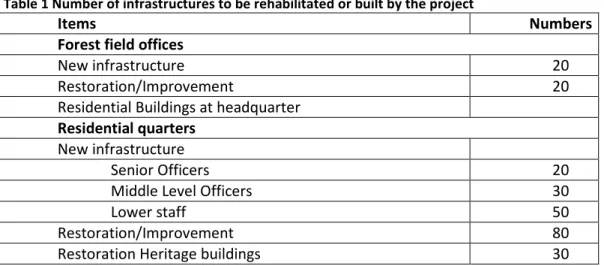
Table of tables Table 1 Number of infrastructures to be rehabilitated or built by the project ... 30
Table 2 Vehicles to be purchased by the project... 30
Table 3 Equipment to be purchased by the project ... 31
Table 4 Number of hectares involved in afforestation and rehabilitation ... 44
Table 5 Rehabilitation of degraded critical habitats... 48
Table 6 Project log frame... 63
Table 7 Project expected outputs... 66
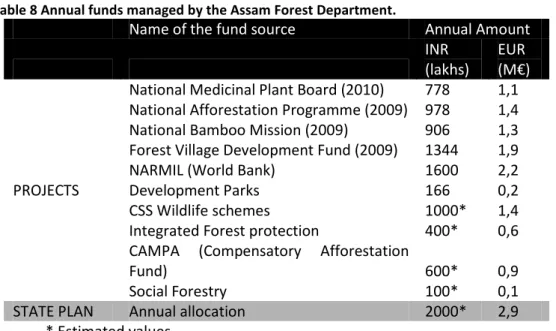
Table 8 Annual funds managed by the Assam Forest Department. ... 74
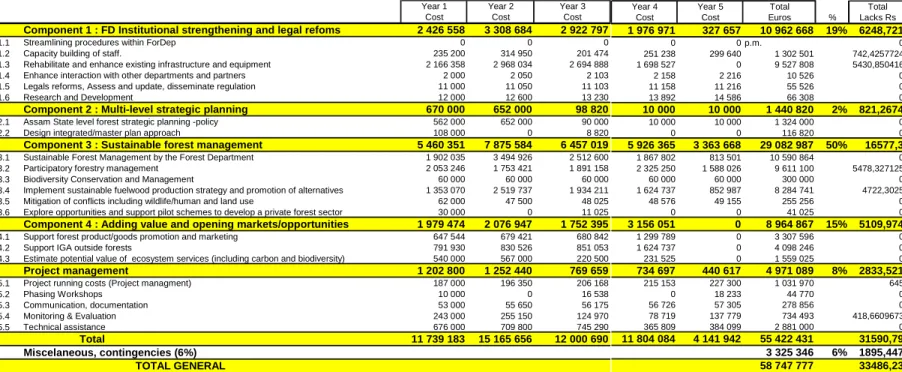
Table 9 Budget ... 77
Table 10 Unit quantities for economic estimations... 84
Table 11 Estimated revenues from timber logging ... 85
Table 12 Carbon revenues from 2 models : teak plantations and agroforestry ... 86
Table 13 Expected income from fuelwood plantation ... 87
Table 14 Revenues from agroforestry ... 88
Table 15 Expected income from Jhum improvement... 89
Glossary
Agroforestry: the practice of integrating trees into agriculturally productive landscapes to ensure sustainable delivery of the benefits, products and services, they can provide. Among these are fertilizer trees for land regeneration, soil health and food security; fruit trees for nutrition; fodder trees that improve smallholder livestock production; timber and fuel wood trees for shelter and energy; medicinal trees to combat disease; and trees that produce gums, resins or latex products. Many of these trees are multipurpose, providing a range of benefits.
Forest Area: The area recorded as forest in the Government records.
Forest Cover: All lands, more than one hectare in area, with a tree canopy density of more than 10% irrespective of ownership and legal status. Such lands may not necessarily be recorded forest area. It also includes orchards, bamboo and palm (Forest Survey of India, 2009).
Proposed Reserved Forests (PRF): An area that has been proposed for demarcation and notification as Reserved Forest. The claims for rights of the local communities need to be assessed before the process can be completed. Some PRFs in Assam are still to be notified as Reserved Forests Protected Area(PA): Means a National Park, asanctuary,a conservation reserve or a community reserve notifiedunder sections 18,35,36C of the Wild Life (Protection) Act,1972
Recorded Forest Area: Same as Forest area, i.e. geographic areas recorded as forests in Government records.
Reserved Forests (RF): An area so constituted under the provisions of the Assam Forest Regulation (1891), having full degree of protection. In Reserved Forests all activities are prohibited unless permitted.
Scheduled Castes (SC): Article 341 of the Indian constitution allows the government to compile a schedule (list) of castes, races, or tribes or parts of groups within castes, races, or tribes that are economically and socially disadvantaged and are therefore entitled to protection and specified benefits under the constitution.
Scheduled Tribes (ST): The Constitution of India does not define Scheduled Tribes as such. According to Article 342 of the Constitution, the Scheduled Tribes are the tribes or tribal communities or part of or groups within these tribes and tribal communities which have been declared as such by the President through a public notification. The fifth schedule (list) contains the list of tribes or tribal communities that are economically and socially disadvantaged and are entitled to specified benefits. Scheduled Tribes are spread mainly in forest and hilly region.
Trees Outside Forests: Trees growing outside recorded forest areas
Unclassed State Forests: An area recorded as forest but not included in reserved or proposed reserved forest category. Ownership status of such forests varies and may be vested in the State, Autonomous councils or it may even be community owned.
1.
Project area description
1.1
Geographical and environmental conditions of project area,
1.1.1 Location and description
Situated between 90° and 96° east longitude and 24° and 28° north latitude, Assam State is bounded by the States of Nagaland, Manipur, Mizoram and Tripura in the south ; Bhutan and the State of Arunachal Pradesh in the north and northeast ; Myanmar in the east ; the States of Meghalaya in the southwest and west Bengal in the west. With 78 438 km2, Assam is the second largest of the northeastern states of India. Its landscape is dominated by the floodplains of the Brahmaputra valley that covers 72 percent of the state’s total area, and the smaller Barak valley in the south. These two valleys are bisected by the hills of Karbi Anglong and North Cachar hills, granite remnants of the old Gondwana shield.
1.1.2 Natural features
Assam is a zone of high seismicity. The 1897 Shillong earthquake and the 1950 Assam earthquake (both above 8,5 on the Richter scale, and counted among the 10 most severe events ever recorded on the planet) have deeply modified the topography and economy of the region. Since the Assam earthquake, the number and extension of floods in the Brahmaputra plain have increased.
The climate is dominated by the subtropical monsoon. The annual rainfall ranges from 1800 mm in the central Kamrup district to 3000 mm in the Barak Valley. Three quarter of the rains fall during the monsoon between June and September. The plains are flooded and the Brahmaputra becomes an inner sea. Autumn and winter are dry seasons and during spring, storms linked to cyclones in the Bengal Gulf occur occasionally.
Assam is part of the Eastern Himalaya biodiversity hotspot, and is home to flagship species such as the Great Indian One Horned Rhinoceros (Rhinoceros unicornis) which is the symbol of the State, and the tiger (Panthera tigris). The state’s forests are among the most biodiversity rich in South Asia.
1.1.3 Landscape and production units
There are two main production systems in Assam. The first one, located in the flood plains is dominated by the Brahmaputra and its vagaries. The principal elements of the landscape mosaic are the bed of the braided Brahmaputra River with its shifting, ephemeral islands called chapori, the irrigated paddy fields, the beels (water bodies) devoted to fishing and the household gardens around the habitations. The tea gardens, that produce the famed Assam tea, are located on higher grounds, together with remnants of forest. The second production system is located in the hills, where jhum (shifting cultivation) is prevalent. Bamboos, fallows, forest remnants and temporary clearings dot the landscape.
1.2
Description of the livelihoods and socio-economic situation
1.2.1 Population
The total population of Assam is 27 millions of inhabitants (Census of India, 2001). The population density is 340 inhab/km2, with high variability between the hills (40 inhab/km2 and 80 inhab/km2 in the two hill districts) and the plains (600 inhab/km2). Eighty eight percent (88%) of the population lives in rural areas. The schedules tribes constitute 12% of the total population. It is the only states of the North East where tribals are a minority.
Assam has a large human diversity, with Indo-Aryan, Tibeto-Burmese and Tai language groups being represented. The main group is the « Assamese », traditionally hindu and following the caste system. There are nine plain tribes (Boro, Deori, etc.) and fourteen hill tribes (Karbi, Garo, Dimasa etc.). Other sources mention up to 56 different tribes or sub tribes in the hill districts. Other groups include either Indian or foreign nationals settled in waves since the middle of the 19th century: the tea workers (the so-called tea tribes), brought by the British and coming mainly from the states of Orissa (Santal, Munda), Bihar, West Bengal, Madhya Pradesh and Andhra Pradesh; Nepalese; Biharis; Bengalis; Marwaris from Rajasthan. There is also a high diversity of religious practices: Hindus (65% of the total population), Muslims (31%), Christians (4%) are the three major religious groups, but there are also Buddhists and Animists. The literacy rate of Assam is slightly ahead of the national average (Assam: 64%, India: 61%) as is the female literacy rate (Assam: 55%, India: 54 %).
1.2.2 Gender Issues:
The women life expectancy in Assam is 56.6 years, 5.2 years less than their counterparts in the rest of the country. Both men and women in rural Assam can expect to live almost 10 years less than in urban areas. The literacy rates are 25% lower in rural areas than in urban areas. In case of the females, the gaps widens to 30%. The Female Workforce Participation Rate of 20.8 is lower than the national average of 25.7% .Most of them belong to the unskilled labour category. Recently, the Government of Assam has enacted legislation reserving 30% of the government jobs for women.
1.2.3 Economy
The percentage of poor in Assam is the highest among the states of the North East. Around 36% of the population lives below poverty line, against a national average of 26%. Poverty is concentrated in rural areas: four out of ten people in rural Assam are likely to live below poverty line, whereas in the cities, this proportion falls to less than one in ten.
The income and its rate of growth in Assam are both below national standards, and the trend has been increasing over the last thirty years. Assam’s per capita income was 27% lower than the Indian average in 1980. It was 46% lower in 1999.
The primary sector is the largest contributor to the Net State Domestic Product (NSDP). But its share has decreased over time, and it now represents around 40% of the NSDP. However, this sector provides employment to 69% of the total workforce. The highest growth has been exhibited by the tertiary sector.
Assam is a major producer of oil and natural gas. Most of the oilfields are located in the Upper Assam region of the Brahmaputra Valley. Assam has four oil refineries with a total capacity of 7 MMTPA (Million Metric Tonnes per annum). Other industries worth mentioning are a chemical fertiliser plant, petrochemical industries, three paper mills, sugar mills and a cement plant. Small scale industries such as saw mills, plywood and veneer mills, jute mill, textile and yarn mills and silk mills can also be found.
Half the male population is engaged in work as per the 2001 Census, whereas less than one fifth of the female population is doing so. Both rates are lower than the Indian average. Unemployment, measured as a percentage of the labour force, is increasing. The rate moved from 2.2% in 1983 to 4.6% in 2000, when the national average stagnated between 2.0% to 2.3%.
1.2.4 Infrastructures, transportation
Assam is landlocked and is linked to the mainland of India by a narrow corridor. There are five civil airports, and one international capable airport (Guwahati), although limited international connection exists as of today (weekly once to Bangkok).The Brahmaputra though suitable for navigation does not have sufficient infrastructure for international trade and is dependent on the diplomatic and trade relationships with Bangladesh. There are two road cum rail bridges, and one road bridge over the Brahmaputra. Construction of two more bridges is in progress.
Assam has a total of 69,000 km of road networks. The National Highway crossing Assam from west to east is being transformed into a four-way. In addition, the opening of Kahao pass (1400m) between Arunachal Pradesh and China, and the construction of roads linking Assam to Yunnan and to Kham, and thus India to South-East Asia should change drastically the situation and have indeed already impacted the economy. It can provide a better access to market to Assam products but may also trigger a flood of foreign goods saturating the local markets.
Mobile telephone services are available throughout the state, and the telecommunication network is growing faster than in other parts of India.
The Assam State Electricity Board (ASEB) has a capacity of 574 MW against a peak demand of 621 MW. Additional projects sponsored by the State are expected to improve the power supply position.
1.2.5 Agricultural systems
The plains are mainly devoted to rice cultivation, with additional revenue from fishing in rivers, beels and water tanks, and products from nearby forests. Cattle is used for land tilling and milk production. However small their productivity, the hardy local breeds, with their low upkeep costs, act as safety nets for the households and also play a significant social role, giving their owner status. Livestock population is 14 M heads (Livestock Census 2003), and had decreased by 14% since 1992.
Some groups such as the Nepalese inhabitants are specialized in cattle breeding especially buffaloes for milk production. These breeders used to drive their herds from the chaporis (islands on the Brahmaputra) to the hills. Finding grazing grounds has become difficult and they often drive their herds in reserve forests and protected areas.
The lack of irrigation facilities explain that there is generally only one crop of rice, based on the monsoon. Mustard is then generally planted off season. However, motor pumps for irrigation are being introduced, enabling farmers to have multiple crops a year.
Home gardens are frequent and contain a variety of products that supplement the household needs. Plots are devoted to horticulture and arboriculture where different kinds of palms, bananas, mangos, bamboos, etc. are planted. Forest trees are also maintained such as Simul (Bombax ceiba). Many of these products are sold to the nearby market.
Intensive tea cultivation in “tea gardens” was initiated by the British. The tea gardens now represent one third of the revenues coming from agriculture. There were 49,102 tea gardens in Assam in 2005, employing 6,20,000 workers. They produce 50% of India’s tea and 15% of the world’s total tea production. Guwahati is the largest tea auction market in India. The processing plants in Assam use coal and other energy sources for drying the tea leaves. It takes between 1 and 1.5 kg of coal to produce 1 kg of made tea. The sector is facing difficulties, and tea is becoming less profitable. There is a definite push to diversify the production and reduce costs. Tea workers no more employed in the Tea gardens are among the poorest of the poor in Assam.
The other main crops of Assam, besides rice and tea, are wheat, potato, cotton, maize, jute (one of the biggest producer of India), oilseeds and more recently coffee, rubber and ramie. The state is also an important producer of silk. Around 10 000 villages are involved in sericulture. Handicrafts are produced using local cane and bamboo.
In the hills of Assam, tribal agriculturists engage in jhum¸ or shifting cultivation. All their economic and cultural practices have traditionally revolved around this. The rotation cycles have come down from 20 years to 5-10 years on account of the increased population pressure. In the jhum, they plant rainfed rice, with a variety of other crops: mustard, millets, pulses, vegetables, tubers, chillies etc. The plots are neither ploughed nor manured. Cattle are therefore much less important than in other parts of the state.
Energy needs of local communities are mostly met with firewood, in the plains as in the hills. Community surveys suggest that households relied on firewood for about 80 % of their energy needs, primarily for cooking. An estimated 60% percent of rural households obtain their wood from home grown sources or collection in forests and chaporis.
1.2.6 Other activities
Besides agriculture, villagers are often involved in cottage industry particularly cane and bamboo crafts, carpentry etc. The products of the cottage industries can be sold in local markets but they don’t fetch a good price. Due to low returns from agriculture, acting as hired labour forms an important additional source of income for many farmers. Forest Department, Oil companies and stone quarries are the main sources of employment. The minimum wages has been fixed by the State Government and the rate in May 2010 is Rs.114/day for unskilled labour. Rate of minimum wages payable to labourers is revised periodically. In addition, during February, March and April some men from landless households migrate to nearby urban areas, in order to work as daily wage labourers.
Tourism activities are progressively increasing and communities located in the vicinity of PAs have begun to set up eco-villages or to run lodges and hotels. In Assam, the revenue earned from tourist lodges was 60 lakhs INR (0.1 M€) in 2004-05 and 95 lakhs INR (0.15 M€) in 2007-08. In 2005, Assam received 2.3 M tourists, among which 2.29 M were Indians and 7,300 foreigners. Among them, 12 000 Indians and 500 foreigners went to Kaziranga. Until 2005, Manas National Park was closed for tourists due to insurgency problems. In 2005, 14,000 Indians and 72 foreigners went there.
1.2.7 Political setup:
The State of Assam is witnessing socio-political stability in administration of governance. Till few years back Assam was plagued with the problem of insurgency. But of late, this problem is on decline and the law and order situation has improved to a great extent. Moreover, insurgency has not been a factor in implementation of developmental activities in the State for the reason that developmental activities benefit the common masses. A case in point is the World Bank assisted NaRMIL Project which made a modest beginning in the year 2006 covering only two districts but has now been extended to seven more. In addition, quite a few centrally sponsored schemes are being implemented by the State Forest Department successfully.
For governance in the tribal dominated areas there exits a separate constitutional provision for devolution of executive and legislative powers to the local communities. The sixth schedule of the Constitution of India created special provisions for the administration of the tribal areas in the states of Assam, Maghalaya, Tripura and Mizoram. In the case of Assam, three regions have benefited from this status: Dima Hasao (North Cachar Hills), Karbi Anglong and Bodoland and have autonomous administrative setup- the Karbi Anglong Autonomous Council, the Dima Hasao (NC Hills) Autonomous Council and the Bodoland Territorial Area Districts respectively (see § 0). This arrangement has empowered the tribal people in decision making and implementation of developmental schemes.
1.3
Forestry and forest development situation in the Project area
Assam is part of the Eastern Himalaya Biodiversity hotspot and is home to flagship species such as the Great Indian One Horned Rhinoceros (Rhinoceros unicornis) and the tiger (Panthera tigris). The Kaziranga National Park has recorded highest density of tigers (32/100 sq.km) in the world in a survey conducted recently. Protected areas(PAs) represent 5% and forests cover 35% of the total geographical area of the State, both categories overlapping. The main timber species are Hollong (Dipterocarpus macrocarpus), Hollock (Terminalia myriocarpa), Mekai (Shorea assamica),
Teak (Tectona grandis) and Sal (Shorea robusta). Another major product of the forest is bamboo ,the poor man’s timber, which has now become the raw material for a variety of commercial products. Timber is used by the wood based industries including plywood and bamboos are consumed in large measures by the paper industries.
1.3.1 Recorded Forest Area
The Recorded Forests Area (RFA) of Assam is 26, 748 km² (35% of the total geographical area). It includes Reserved Forests (312 RFs, 13,870 km², 52% of the RFA), Proposed Reserved Forests (145 PRFs, 3,103 km², 12% of the RFA), Protected Areas (3,925 km², 15% of the RFA) and Unclassed State Forests (5,865 km², 33% of the RFA).
1.3.2 Protected Areas
Assam has 5 National Parks and 18 Wildlife sanctuaries. Together they cover 3,925 km² and 5% of the total geographical area of the State. In addition, some of these are also Tiger Reserves e.g. Kaziranga, Manas and Nameri. Manas and Dibru-Saikhowa NPs with an area of 2,837 km²and 765 km2 respectively are also Biosphere Reserves. Both Kaziranga National Park and Manas National Park are UNESCO World Heritage Sites.
1.3.3 Forest Cover
India uses a forest classification scheme developed by Champion and Seth. According to this scheme, the State has 16 forest sub-types which belong to 5 forest types viz. Tropical Wet Evergreen, Tropical Semi Evergreen, Tropical Moist Deciduous, Tropical Dry Deciduous, and subtropical Pine Forests.
Based on satellite data from 2006-2007, the Forest Survey of India (FSI) has identified the forest cover of the State of Assam. The total forest cover in Assam is 27,645 km² (2.7 M ha). In terms of canopy density, the State has 1, 461 km² of very dense forests (canopy cover above 70%), 11, 558 km² of moderately dense forest (canopy cover between 40% and 70%) and 14, 673 km² of open forests (Canopy cover between 10% and 40%). Between 2004 and 2006, there is a recorded loss of 66 km² of forest cover, half of it concentrated in the open forest component. This loss is attributed by the FSI to encroachment in insurgency affected areas and to shifting cultivation in the hill districts.
Forest cover does not necessarily overlap with the Recorded Forest Areas. Approximately 900 km² of forest cover is not recorded and half of the recorded forest shows a canopy cover below 40%.
Figure: 1. Forest Cover Map of Assam, 2007.
Source : http://assamforest.in/forestGlance/images/forestDistribution.jpg (accessed on February 2010)
A total of 1,04, 342 ha have been planted under various schemes since 1992 to 2007. The effective rate of forest cover of the recent plantations is not known.
1.3.4 Forest villages and Encroachments
Forest Villages are hamlets established under the provision of the Assam Forest Regulations (VII) of 1891, to meet requirements of labour for various forestry works. The workers and their families were settled inside the area of the Reserve Forest. The inhabitants of the Forest Villages, though formally allotted forest land by the Forest Department for dwelling and cultivation purposes, have no legal land tenure over the allotted land. With the decline in timber harvesting centered forestry operations following the enactment of the Forest Conservation Act (1980) and the Supreme Court’s order (1996), these villagers have lost their main source of livelihood. And lack of legal property right over forest land allotted to them was the main impediment in accessing credits and loans from commercial institutions. There are altogether 499 such forest villages recognised by the Forest Department of Assam. Both the national policy and legislation now mandates that such forest villagers be given patt or title deed for the forest land in their possession.
In addition, the Forest Department refers to as encroachers all conversions from forest to agricultural land carried out inside the boundaries of the Reserved Forests These can happen piecemeal as a result of individual initiatives by farmers in search of land, or be large scale, involving the resettlement of entire villages. The Forest Department estimates that there are around 3,500 km² of encroachments in Reserved Forests, involving about 70, 000 households (data from 2003).
1.3.5 Forestry Operations and Working Plans
Assam Sate Forest Department is the custodian of the forests in the State. It controls and administers the areas notified as Reserved Forests and Protected Areas. The Unclassed State Forests (USFs) remain under the control of the Revenue Department. The Assam State Forest Department is currently enforcing conservation oriented forest management including Working Plan prescribed timber harvesting.
There are no management prescriptions for the USFs. The Reserve Forests are managed through working plan prescriptions executed by the territorial division concerned. A Working Plan (WP) is a document for medium term (10 years) management of forestry resources at the scale of a forest division. They are prepared as per the working plan code approved by the Government of India (Annex I – MoEF Working Plan Guidelines). The Protected Areas are managed through a Management Plan, under the control of the Wildlife division concerned.
Under the working plan, RF areas are divided into blocks and compartments (lower most management unit) using the natural features, fire lines and roads. These units are administratively under the charge of the foresters and guards (lower most rung of forest administrative staff). The field staff maintains a ‘compartment history’, which includes activities, fire incidents, encroachments, felling, plantations, diseases, weeds etc. Blocks and compartments are grouped into thematic ‘working circles’ (fire protection circle, bamboo extraction circle, NWFP collection, felling series, plantation etc.), which prescribe requisite silvicultural treatments and works to be undertaken during the working plan period.
Working plans were prepared using traditional method of field surveys and quantitative assessment of resources. However, the lastest working plans and also those under preparation are based on Remote Sensing data are prepared using limited GIS facility available with the department. Based on this, a stock map (1:15,000 scale) for each compartment is prepared to highlight the resources, status, including age and species. Working plan document gives details about the prescriptions for each circle, interventions, rules, infrastructure and revenue and expenditure projection.
The Supreme Court Order dated 12/12/1996 passed on the Public Interest Litigation W.P.(C) No202/95 T. N Godavarman Thirumulpad Vs Union of India MoEF Working Plan Guidelines
Annex II – Supreme Court Ruling 1996Supreme Court Ruling 1996 suspended the felling of trees in all forests except in accordance with the working plans prepared by the State Forest Department and as approved by the Central Government. Such approved Working Plans have therefore a legal value and are the mainstay of forest management.
The WPs are prepared by the Working Plan Division and the existing 4 Divisions are burdened with task of writing/revising Working Plans for 32 Territorial Divisions in Assam. As of today, only 5 working plans are approved and operational for obvious reasons.
1.3.6 Participatory Forest Management
India has adopted Joint Forest Management (JFM) as its primary vehicle for participatory forest management. Joint Forest Management (JFM) is a concept of developing partnerships between forest user groups and the Forest Department (FD) on the basis of mutual trust and jointly defined roles and responsibilities with regard to forest protection and development. In JFM, the user (local communities) and the owner (Government) manage the resource and share the benefits. The rules for sharing the benefits are the key element of the JFM rules and condition to a great extent the success or failure of the process.
The Assam Forest Policy (2004) states that JFM practices would form the basis of forest management in the State. In order to implement this policy, Joint Forest Management Committees (JFMCs) are created at the village level. The guidelines for the creation of the committees follow the guidelines of the National Afforestation Program (NAP, see Annex V – NAP Revised Operational Guidelines 2009). Each constituted JFMC prepares a microplan with the support of a frontline forest department officer (generally a forester acting as the secretary to the JFMC). Cooperation of line departments is taken for inclusion of all such activities in the micro-plan for implementation of which assistance of those departments is called for. This way the JFMCs also implement developmental activities of other line departments. The microplan, based on a Participatory Rural
Appraisal (PRA), lists and prioritises the developmental activities including forest activities that a JFM committee will undertake in the following 5 years, as well as proposed entry-point activities planned to gain the adhesion of the village community to the objectives of forest conservation. The forest related activities contemplated in the microplan essentially deal with plantations, assisted natural regeneration, fuel wood and bamboo and NTFP plantations.
The roles of the members of the JFMC are generally restricted to the implementation of the forestry and other developmental works, and there is limited decision power bestowed to them. The Assam Forest Policy (2004) mentions “the abundant potential of people living in rural and forest areas [that] would be taped for sound participatory forest management”. A working plan (1999-2011) mentions that the chief aim of the PRA exercise is “to make [the forest dweller] understand the importance of forestry and allow him to actively/passively participate in forest protection”. In areas where jhum cultivation is present, the objective of the PRA is to “win over the villagers away from jhuming and rehabilitate the forest and carry out capacity building of the forest dweller”.
The Assam Forest Policy (2004) has recognized the increased emphasis put on greater involvement of the communities in forest management. It proposes to gradually shift to a model of Community Forest Management (CFM), without developing further the concept.
The Assam Forest Department has created around 1,300 JFMCs, out of which 550 are involved in the implementation of the National Afforestation Program. These represent a population of over four lakh beneficiaries (http://assamforest.in/forestGlance/assamForest_glance.php; accessed Feb. 2010). A pilot project (Natural Resource Management & Integrated Livelihood Project, NaRMIL) led by the World Bank, currently being implemented in 9 divisions with 10, 000 beneficiaries, has proposed revised guidelines for the JFMC (Annex VI – NaRMIL Guidelines 2009).
1.4
Relevant local governance structures in the proposed area.
There are different governance structures that are involved in the forest and forest resources management, both at local and state level.
The Ministry of Environment and Forests,GOI The Assam Forest Department
The Assam Revenue Department
The Panchayati Raj Institutions and the Gram Sabha
The Autonomous Councils, the Gaonburah and other traditional institutions The State and district Forest Development Agencies
The Joint Forest Management Committees and the Eco-Development Committees
1.4.1 Ministry of Environment and Forests
The Ministry of Environment and Forests (MoEF) under the Governemnt of India is the lead agency for forestry and wildlife management. It frames rules and issues guidelines that will then be translated by the State Governments. It delivers central and external financial assistance to the states and communities through specific programs like the National Afforestation Programme.
1.4.2 Assam Forest Department and Revenue Department
The Assam Forest Department is proposed to act as the implementing agency of this project. It has a Principal Chief Conservator of Forests and Head of Forest Force (PCCF &HFF) at its head who reports to the State Government. The Forest Department is organised in wings each having a distinct task. The major wings are (i) territorial, (ii) wildlife), (iii) social forestry and (iv) research, education and planning, each headed by an officer in the rank of Chief Conservator of Forests (CCF) with the exclusion of the Wildlife wing whose head has the rank of PCCF. Conservators of Forests (CFs) and Divisional Forest Officers (DFOs) are the senior officers operating at the circle
(CF) and division (DFO) levels respectively. All officers from PCCF to CF belong to the Indian Forest Service (IFS), Assam- Meghalaya cadre. The DFOs and Assistant Conservator of Forests (ACFs) are both from IFS and State Forest Service (SFS). Below the DFO, the frontline staff are the Rangers, Foresters and Guards. These are the officers that have a day-today contact with the field and the public. The organisational chart of the Forest Department is provided in Annex III – Organization Chart of the Assam Forest Department.
The Revenue Department has authority over the land in the Unclassed State Forests and is responsible for the notification process that leads to the reservation of a forest.
1.4.3 Panchayati Raj Institutions and the Gram Sabah
The Panchayati Raj Institutions are the grass-root units of local self-government in India. In Assam, the Assam Panchayat Act 1994 introduces a three-tier system – Gaon Panchayat (village), Anchalik Panchayat (several villages) and Zilla Parishad (district). Elections are held every five years, with reservation of seats for Scheduled Castes, Scheduled Tribes and Women (73rd Amendment of the Constitution, 1992). The Gaon Panchayat prepares the annual development plans for the villages, mobilizes reliefs iduring natural calamities, is responsible for removal of encroachments on public properties, organizes voluntary labour and contribution for community works and maintains village statistics. The Anchalik Panchayat and the Zilla Parishad aggregate the plans of the Gaon Panchayat and ensure the coordinated implementation of such plans.
The Gram Sabha means a body consisting of all persons registered in the electoral rolls of a village comprised within the area of a Gaon Panchayat. It is the institution where villagers discuss developmental issues, initiate development programmes, mobilize voluntary labour and contributions in kind and cash for the community welfare programmes and select beneficiaries for the schemes. The Gram Sabha and other village level institutions in areas where they are holders of any forest rights under the Forest Rights Act (2006) have been endowed with responsibility to protect wildlife, forest and biodiversity, prevent destructive practices affecting their cultural and natural heritage and regulate access to community forest resources. The Gram Sabha has also the authority to initiate the process for determining the nature and extent of individual and community forest rights within the local limits of its jurisdiction (see Annex IV – Forest Rights Act 2006).
1.4.4 Autonomous Councils and the Gaonburah
There are three Autonomous Councils in Assam, created under the sixth schedule of the Constitution:the Bodoland Territorial Area Districts,the Dima Hasao (North Cachar Hills) Autonomous Council and the Karbi Anglong Autonomous Council. The article (244) of the constitution provides for a separate scheme of administration for the tribal areas designated as “autonomous districts”. The Panchayati Raj Institutions do not extend to these areas. These councils have certain legislative and executive functions vested in them. They are empowered to legislate upon all the subjects transferred which interalia included the allotment, occupation and use of land; the management of forests other than reserve forests; the use of canals and watercourses for agriculture, and the regulation of the practice of jhum or other forms of shifting cultivation. In the field of forestry, they are in charge of the human resources, financial management, and implementation of the forestry sector development programmes. The revenue from forestry operations accrues to them, and is afterwards reflected in the State budget. They can constitute District Council Reserve Forest (DCRF). The Conservator of Forest (CF) and Divisional Forest Officers (DFO) under the Council’s authority are borrowed from the Assam Forest Department.
The Gaonburah (village headman) and other traditional institutions reflect the varied customs and traditions of the North East. The tribes of the North East, and more specifically of Assam, are not homogeneous. They differ with respect to the languages they speak, the geographical terrain they inhabit and their livelihoods. Assam has representatives of the Bodo, Kachari, Rabha, Dimasa, Karbi, Mising, Koch, Rajbonshi, Tiwa, Garo, Gangte, Hmar, Hajong and
Khasi-pnars and the list is not exhaustive. Each tribe has its own traditional institutions and land ownership practices (Nongkynrih, 2008).
In their traditions, Karbi villages shift according to the availability of jhum sites. Cultivable land is divided among the households by the village council (Me) at the first settlement of a village in a new locality. Land is mostly community owned. Most villages were named after the headman. The title of headman conferred honour to the person in social, religious and cultural transactions in the village. The village council settles social disputes by a majority decision.
The Bodos practice private ownership of land on annual or periodic patta (title deed) basis. All lands are owned and managed privately, except for the grazing ground, playground, place of worship and school that is owned by the village community.
The Dimasa have a dual system of parallel matrilineal and patrilineal clans, with brothers and sisters sharing common property. The basis of land ownership is the community, controlled by the village council, all of whose members are men. But they are now moving to individual land ownership, partially through the influence of schemes encouraging perennial cash crops (coffee and tea) based on loans and subsidies offered to individual owners.
These examples highlight the diversity of practices and local governance institutions that play a role in the management of the natural resources in an area. However, many of these are gradually getting undermined by the new administrative set up. Decision power on granting individual ownership of land is vested in the Autonomous Councils. Similarly, the Gaonburah does not have much of a role in the new administration (Bathari, 2008).
In practice, the traditional political institutions continue to function as political bodies of the tribes. But they lack access to and control over funding, and no longer have the authority they may have had. There are exceptions though. Villages under customary law have been successful in protecting and preserving the forest areas near their community, outside the recent framework of JFM. One such example is Upparthala in Golpara District. These successful institutions have often been formally recognized to become JFMC under the NAP program.
1.4.5 Joint Forest Management Committees and Eco-Development Committees
The Joint Forest Management Committees are the local institutions that channel the current mode of participatory forest management. Their composition and modus operandi are defined by the Assam Joint (people’s participation) Forestry Management Rules (1998), and the Guidelines of the National Afforestation Program (2009) (Annex VII – Assam Joint (people’s participation) Forestry Management Rules (1998); Annex V – NAP Revised Operational Guidelines 2009). The JFMCs are also used to channel funds from centrally sponsored schemes to the villages located in remote areas.
The JFMCs are constituted in villages. All adult villagers are eligible to become members of the General Body (generally membership of a household given to a female and a male). NGOs and Voluntary Associations are associated as facilitators. There is an Executive Body comprising the Gaonburah or a representative of the Panchayat, 10 (including at least 3 women) members elected from the General Body, and one forest personnel in the rank not less than of Forester grade- I, as member secretary of the executive body.
The MoEF guidelines 2000 suggest registering JFMCs under the Societies Registration Act, (1860), giving them legal existence. At present, they are only recognized by a Memorandum of Understanding (MoU) signed with the Forest Department. This MoU is not legally binding, and disputes can only be settled through criminal litigations. There is currently no possibility for a civil arbitration.
The areas that can be targeted by the activities of the JFMC are degraded and peripherial areas of the Reserved Forests, and areas outside the RF. A JFMC is not expected to manage more than 5 ha land per beneficiaries for natural regeneration and 2 ha for intensive planting.
The duties and responsibilities of the JFMCs are to ensure protection of forests and plantations, to ensure execution of forestry works (plantations, thinning, removal of dead trees, fire line maintenance, gully plugging, etc.), to prevent trespass, encroachment, grazing, fire, theft or damage or use of the land for agricultural purpose and to apprehend or assist the forest personnel in apprehension of persons committing any of these offences.
The benefits include collection of NTFP, dead and fallen leaves and wood, use of the usufructs of thinning and felling for their own consumption in accordance with rules in force and guidelines, if any and a share (50% for thinning, 25% for felling) of the sale value of the surplus of thinning and felling minus the direct cost of harvest.
The activities to be undertaken by a JFMCs are detailed in a microplan prepared by the field Forest Officer and the General Body through Participatory Rural Appraisal (Figure 1). It contains detailed information on the socio-economic condition of the village and also contemplates Entry Point Activities such as: construction of community halls, ring well for potable water, improvement of village roads, village infrastructure improvement). Other line departments extend their co-operation in designing the microplan, as the topics covered may not necessarily match the skills and responsibilities of the forester involved in drafting. The microplan is approved by the Chairman of the Forest Development Agency (The Conservator of Forests of the given circle) to which the JFMC belongs. The microplans are supposed to be integrated in the Working Plan of the division where they are located, but this does not seem to always happen, partially because only five of the WPs are operational at present.
In terms of fund flow, JFMCs can maintain several bank accounts, jointly operated by the president and the member secretary. Each account is used to manage the specific funds of a given scheme. Under the World Bank assisted NaRMIL project, an additional, community account was created. This community account is operated jointly by the president and the treasurer, without interference from the Forest Department (see Annex VI – NaRMIL Guidelines 2009).
Figure 1 Noapara JFMC PRA 22 April 2008 (source:Kamrup West Forest Division, Assam)
According to the Assam State Forest Department, there are today 1,300 Joint Forest Management Committees (JFMCs), covering 76, 327 households and managing around 30, 000 ha of forests in Assam. Many of them however are not functional, for lack of funds.
The Eco-Development Committees (EDC) are similar in many ways to the JMFCs. The main distinction is that EDCs are created around Protected Areas (National Parks and Wildlife Sanctuaries), where no provision for extracting resources or sharing benefits from forest products is contemplated. The main focus here is on conservation and the entry point and other livelihood activities are considered as an opportunity to generate income outside the forest, to reduce the pressure on the protected area. EDCs generally follow the same guidelines in terms of structure and operation as the JFMCs. They interact essentially with the wildlife wing of the Forest Department.
1.4.6 Forest Development Agencies
The Forest Development Agency (FDA) is an association of JFMCs at the Division level. FDAs have been constituted after following issuance of guidelines from the National Afforestation and Eco-Development Board (MoEF, GoI) for the implementation of the National Afforestation Program (NAP) (See Annex V – NAP Revised Operational Guidelines 2009). Their scope was later expanded to encompass other projects. FDAs are registered under the Societies Registration Act (1860). This empowers them to directly receive funds from the Central and State Governments and other government agencies (Foreign funds need to be channeled through the GoI). The Conservator of Forests of the concerned Circle is the Chairperson of the FDA, and the DFO is the CEO and secretary. The Executive Body of the FDA, has besides Forest Officers, representatives from other line departments including that of the Deputy Commissioner together with members of the Zila Parishad. Other members are the presidents and secretaries (Forester) of all the JFMCs within the Division.
The FDA has an annual work program that needs to be approved by its Executive Body which meets once in 6 moths, and if a deviation in the implementation is required, the exec body is required to give its consent. The FDA annual work program is a clubbing of the JFMC’s annual work programmes. The FDA receives funds from the projects and transfers them to the JFMCs after CEO’s approval. The FDA also monitors the implementation of the projects undertaken by the JFMCs, and can suggest corrections to the JFMC microplan (technical support). The FDAs organise training programs for JFMC members.
State Forest Development Agency is envisaged to be constituted as per the National Afforestation and Eco-development Board’s revised Operational Guidelines 2009 under NAP (Annex V – NAP Revised Operational Guidelines 2009). It is the State Level apex confederation of the FDAs, for effectively coordinating implementation of schemes under the NAP and other projects. It has not yet been created in Assam but will be constituted soon.
It will be a registered society and will function as a federation of the FDAs in the State. It will have a Governing Body and an Executive Council. The PCCF &HFF acts as Chairperson and the two bodies will have members including the chairpersons of the FDAs, representatives of the State Revenue, the Tribal,the Rural Development, Panchayati Raj Departments and co-opted members who can be from amongst the JFMCs. Its objective is to support and coordinate implementation of schemes aimed at eco-restoration, sustainable use and management of forest resources in collaboration with forest dependent communities and enhancement of their livelihood support system. SFDA can receive funds from the state and the Central Governments and other Government agencies and disburse it to the FDAs as per work schedule of the constituting JFMCs. The SFDA will accord approval to the Annual Work Programme and may do amendments, reformulation either directly or by issuing directives and monitor and evaluate works being implemented.
JFMCs, FDAs and SFDA constitute a pyramid of institutions to channel funds for participatory forest management to the village level, and coordinate the activities of the JFMCs. However, the representativeness of the local communities is reduced at the higher levels of integration, and the Forest Department’s role increases. There are 10 to 12 members of the village communities for 1 forest official in the JFMC. In the FDA, there are 50% + 2 representatives of the Forest Department (the secretaries of the JFMCs plus the Chairman and CEO) against 50%-2 (The presidents of the
JFMC) representatives of the villages. In the SFDA, any direct representation of the villages is only in the form of co-opted members.
1.5
National and local policies that affect the management of forests
1.5.1 Assam Forest Regulation , 1891
The State of Assam has a unique legal framework on forests within which it operates. The Assam Forest Regulation (1891) is the operative law rather the Indian Forest Act (1927). Thus the applicable state forest law is enacted after the 1878 Forest Act rather than the consolidation Act of 1927.
Under the Assam Forest Regulation (1891), forests may exist in at least four categories: Reserved Forests, Village Forests, Unclassed State Forests and those forests and wasteland which are not the property of the government. The term “unsettled tracts” has also been used in the Regulation and the state government has been empowered to reserve trees in such unsettled tracts. It is the AFR (1891) that describes the process of settlement of rights in the process of reserving forests. It also provides for the establishment and the control of forest villages. It vests the control of all timber and other forest produce in transit in the State and empowers it to make rules to regulate their transit. These include rules prescribing the routes by which timber or other forest produce may be imported, exported or moved in the State, procedure for issuance of passes required for the export, import or movement of forest produce, establishment of revenue stations in the state, penalties imposed for contravening the above-mentioned conditions, etc.
1.5.2 Karbi Anglong (Mikir) Hills District Forest Act, 1957
There are striking similarities between the AFR (1891) and the Karbi Anglong (Mikir) Hills District Forest Act, enacted by the District Council, blurring the distinction between state control and community control of forests. Under the Karbi Anglong Forest Act, the Executive Committee of the District Council is empowered to constitute any land at the disposal of the District Council into a “Village Forest” for the collective benefit of the village community1. It can also enact rules regulating the management of village forests. Further it can prescribe the conditions under which the village community for whose collective benefit the village forest is constituted may be provided with forest produce or with pasture or their duties with respect to the protection and improvement of such forests.
Another statute relevant to the Karbi Anglong District, having implications on forestry, is the Mikir Hills District (Transfer of Land) Act of 1959.2 This Act provides for the regulation and control of transfer of land in the Mikir Hills District with a view to promote the interest of the inhabitants. Such protective legislation ensures a continuity of title within the tribal community. The above Act can provide a good policy environment to promote participatory forestry in the lands, which have forests and are owned privately by tribals.
The decision of the GOI to adopt a different approach to local government and resource management in northeastern States such as Assam reflects recognition of the unique historical and cultural context of the region, and awareness that local community resource management systems require special recognition and support. More remote areas with strong tribal controls were generally given greater autonomy, while lowland regions with valuable and accessible timber were generally designated as state controlled reserved and unclassed forest.
1 Note that this village forest is different from the one that is envisaged under the Assam Forest Regulation (1891) or the Indian Forest Act, 1927.
2 passed under Notification No.TAD/R/84/56dated the 15th June ,1959,in pursuance of Paragraph II of the Sixth Schedule to the Constitution of India.
1.5.3 Assam (Control of Felling and Removal of Trees from Non-Forest Lands) Rules, 2002
These rules prescribe how tree plantations raised in non recorded forest areas by individuals or institutions are to be governed. They specify which plantations need to be registered, which tree species do not require felling permission, what process is to be followed in order to fell trees outside non recorded forest areas, how is the transit of timber originating from non recorded forest areas regulated and how an why timber can be confiscated to the Government. These rules will condition the success of any agro-forestry or energy plantation initiative proposed by the project on private or revenue lands (see Annex VIII – Assam (Control of Felling and Removal of Trees from Non-Forest Lands) Rules, 2002
1.5.4 Jhum (Swidden) Cultivation
The Assam policy like the National Policy regards shifting cultivation as detrimental to the environment but at the same time also recognizes its significance as an “emotional and cultural heritage with the Hill tribes3.” The state policy therefore advocates “an Integrated Area Development Programme with due respect towards tradition and culture,” to tackle the problems related to jhumming. The policy envisages rehabilitation of the lands through “innovative community based afforestation/agro-forestry schemes, with the forest department as the nodal agency to ensure primacy of conservation.
While the present Policy statements envision jhum in the negative, traditionally there has been recognition to this practice and there has been a constant struggle to balance conservation priorities with livelihood needs even through legal instruments.
1.5.5 Other Law and Policy Concerns on Forestry
There are a number of other laws that has a bearing on forestry development and management. These include the Assam Forest Protection Act (1986), the Assam Panchayat Act (1994) where there may be overlaps in the roles of statutory bodies like the Panchayati Raj Institutions with JFMCs; role of Tribal Autonomous Councils other than the three Autonomous District Councils in the context of forestry management needs to be clarified, and the Mahal Rules where the rights under the said rules and the usufructs under the JFM may compete for the same resource.
Then there are judicially influenced Executive Policies such as Removal of Trees from Non-Forest Lands, Royalty on Timber and Non-Forest Produce, Revolving Fund, Movement of timber through railways and Estate for Wood Based Industries. This plethora of laws and how they overlap and whether they are impeding or advancing needs to be thoroughly examined. Legal reforms may be necessary. Thus for example Agarwood (Aquilaria agallocha) may be very profitable economically but may attract International law provisions such as CITES. These aspects need a careful examination and review.
1.5.6 Assam Forest Policy, 2004
In 2004 the Assam Forest Policy was drafted, keeping in mind the provisions of the National forest policy and the special needs of the state.
The Assam Forest Policy (2004) was drafted because the State perceived it had been losing its biodiversity and forest cover for a variety of reasons:
• the displacements of thousands of people and their cattle due to the changes in river flow dynamics happening in the aftermath of the 1950 earthquake
• the massive population increase and organized settlements in the reserved forests,
• the grazing and poaching in the protected areas
• the inadequacy in addressing the needs of the people, leading to the development of informal practices threatening the sustainability of the forest resources
The Assam Forest Policy (2004) framework is progressive and detailed, covering various aspects of forestry development, marketing, research and extension. It defines itself as environment and peoples friendly. Its objectives are (i) to maintain environmental stability, (ii) to conserve the natural heritage of the state, (iii) to provide livelihood support and alternatives to forest fringe dwellers, (iv) to increase the tree cover of the State, (v) to meet the livelihood needs of rural poor and tribes in fuel wood and NTFP, (vi) to demarcate all forest lands, irrespective of ownership, (vi) to promote research on forest related topics and (vii) to encourage the conservation of the genetic diversity and the traditional ecological knowledge of Assam. The policy proposes to enroll people’s participation to achieve these objectives.
JFM is contemplated all through the policy document as the means to involve local communities. It is presented as the basis of forest management in the State. It also hints towards the need to evolve from Joint Forest Management to Community Forest Management, without defining what is understood as CFM.
The Assam Forest Policy (2004) contemplates many of the elements that have also been discussed while preparing the Assam Project on Biodiversity and Forest Conservation. The issues listed in the AFP (2004) have also been listed in the problem assessment phase. The objectives and many of the components of the Assam Project on Forest and Biodiversity Conservation also match those discussed of the Assam Forest Policy. In that respect, it seems that the project is understood as a means for the Assam Forest Department to achieve the policy it framed in 2004.
1.5.7 Forest Rights Act, 2006
The Scheduled Tribes and Other Traditional Forest Dwellers (Recognition of Forest Rights) Act ,2006 (FRA 2006) recognizes and vests the forest rights including occupation of forest lands in forest dwelling Scheduled Tribes and other traditional forest dwellers who have been residing in such forest for generations but whose tight could not be recorded. It provides a framework for recording these rights. This text seeks to undo a historic injustice done to the tribal communities and other forest dwellers whose rights were not recorded during the forest reservation processes, during the colonial period and in independent India.
The FRA 2006 defines the possible beneficiaries as the “forest dwelling Scheduled Tribes” primarily residing in and who depend on the forest or forest land for bona fide livelihood. It also includes “other traditional forest dwellers”, members of non Scheduled Tribes that have been primarily residing in and depending on the forest or forest land for at least three generations prior to 13th December 2005.
The FRA identifies 13 different rights that can be claimed by the beneficiaries, including among others:
• the right to hold and live in the forest land under the individual or common occupation, for habitation or for self-cultivation;
• the right of conversion of any title deed issued on forest lands by local authorities or State governments into titles;
• the right to protect, regenerate or conserve or manage any community forest resource
which they have been protecting and conserving for sustainable use
• the right of settlement and conversion of forest villages, whether recorded, notified or not into revenue villages
• and the right of access to biodiversity and community rights to intellectual property and traditional knowledge related to biodiversity and cultural diversity
These rights can be claimed in any “forest land” defined by the Act as land of any description falling within any forest area and including unclassified forests, undemarcated forests, existing or deemed forests, protected forests, reserved forests, Sanctuaries and even National Parks. These rights will be heritable but not alienable or transferable.
The text empowers the holders of the rights, including the Gram Sabah or other village level institutions to protect the wildlife, forest and biodiversity, to ensure their habitat is preserved from destructive practices and regulate and control access to community forest resources.
The Gram Sabha is the authority to initiate the process for determining the rights, be they individual or community based. Once recorded, verified and consolidated, the claims are transferred to a Sub-Divisional Committee where they can be opposed by any person aggrieved by the resolution of the Gram Sabha .A District Level Committee has the final decision on the claim, with a second window for petitions being opened at this level. The different committees involved are composed by officers of the department of Revenue, Forest and Tribal Affaires, as well as members of the Panchayati Raj Institutions (at least two of them being Scheduled Tribes and one a woman).
This text therefore proposes a framework to recognize individual rights over forest land, but also enables the exercise of community forest rights and acknowledges the existence of community forest resources. At present the discussions and claims have focused on the individual rights, but the other components of the act need to be explored. The text will have a major impact on the balance of functions and responsibilities vis-à-vis conservation and sustainable use of forest resources between the local communities and the Forest Department. The role of the Forest Department in Community Forest Areas needs more clarity, especially on the issues of sustainable use, management of forest and conservation of forest resources and biodiversity. The FRA 2006 calls for a stronger collaboration between the Forest Department and the Tribal Affairs Department in the areas where claims will be made. Monitoring mechanisms and support schemes for the newly recognized rights and their implementation will need to be developed (see Annex IV – Forest Rights Act 2006).
Till April,2010 14,397 claims were accepted and rights over 13,880 ha. Of forest land were granted to the claimants.
2
Project analysis and justification
2.1
Problems highlighted and overall justification for the Project
The analysis highlights that the forests of Assam are not being managed sustainably. This is acknowledged in the Assam Forest Policy 2004. Forests in Assam play a crucial role in the livelihood of the local populations. They are a source of timber, fuel wood, bamboo and a wide array of non-timber forest products. They deliver a variety of ecosystem services, fixing river banks, and contributing to soil and water conservation. They can play a vital role in mitigating the impact of climate change, acting as carbon sinks. They also act as safety nets, and contribute substantially to the incomes of the communities living in and around the forest areas, generally tribal households and some of the most vulnerable segments in society. Conservation of Assam’s forests is thus extremely important for the State and its people.
Poverty, unemployment, demographic pressure etc. are exerting considerable adverse impact on the forests and its biodiversity, endangering the sustainability of the system. The management itself is facing challenges, both internally to the Assam Forest Department and in its relationship with other stakeholders and more specifically the communities.