
HAL Id: hal-00498161
https://hal.archives-ouvertes.fr/hal-00498161
Submitted on 6 Jul 2010
HAL is a multi-disciplinary open access
archive for the deposit and dissemination of
sci-entific research documents, whether they are
pub-lished or not. The documents may come from
teaching and research institutions in France or
abroad, or from public or private research centers.
L’archive ouverte pluridisciplinaire HAL, est
destinée au dépôt et à la diffusion de documents
scientifiques de niveau recherche, publiés ou non,
émanant des établissements d’enseignement et de
recherche français ou étrangers, des laboratoires
publics ou privés.
Doppler Estimation and Data detection for Underwater
Acoustic ZF-OFDM Receiver
Alain Kibangou, Laurent Ros, Cyrille Siclet
To cite this version:
Alain Kibangou, Laurent Ros, Cyrille Siclet. Doppler Estimation and Data detection for Underwater
Acoustic ZF-OFDM Receiver. ISWCS 2010 - 7th International Symposium on Wireless
Communica-tion Systems, Sep 2010, York, United Kingdom. pp.n.c. �hal-00498161�
Doppler Estimation and Data detection for
Underwater Acoustic ZF-OFDM Receiver
Alain Y. Kibangou
∗1, Laurent Ros
#2, Cyrille Siclet
#3∗Control Systems Department, GIPSA-Lab, University Joseph Fourier, CNRS BP 46, F-38402 Grenoble Cedex, France
#Image and Signal Department, GIPSA-Lab, University Joseph Fourier, Grenoble-INP
BP 46, F-38402 Grenoble Cedex, France
2[email protected] 3[email protected]
Abstract—A new scheme for Doppler estimation and data
detection for OFDM underwater acoustic communications is derived in this paper. We design the OFDM symbol as a concatenation of two sub-blocks. The first one is shorter and carries out few data with few subcarriers whereas the second one contains both informative and pilot symbols. The first sub-block serves to estimate the Doppler scaling factor while the pilots in the second sub-block are used for estimating the equivalent channel. Both estimation approaches are based on high resolution methods for solving harmonic retrieval problems in time and frequency domains respectively. Each sub-block contains a cyclic suffix, which allows having more data to be processed. The effectiveness of the proposed scheme is evaluated by means of simulation results.
I. INTRODUCTION
Underwater acoustic channels are typically wideband in nature due to the small ratio of carrier frequency to the signal bandwidth, which introduces frequency-dependent Doppler shifts [1]. They also exhibit several propagation paths, so that the received signal is equivalent to the sum of several signals with different amplitude and time delays. Multipath delay and Doppler effects constitute the main obstacles to robust under-water acoustic communication. One common approximation is to treat the channel as having a common Doppler scaling factor on all propagation paths.
Orthogonal Frequency Division Multiplexed (OFDM) sig-nals are particularly attractive because they lead to relatively simple channel estimation and data detection algorithms. Indeed, since subcarrier only experiences flat fading, com-plex time-domain equalizers are not necessary [2]. However, OFDM signals are particularly vulnerable to Doppler effects that destroy the orthogonality between subcarriers and thus induce intercarrier interference (ICI). In order to adequately recover the transmitted information, algorithms at the receiver must include estimation and compensation of the Doppler scaling factor, channel estimation, and information symbols estimation.
For estimating the Doppler scaling factor, several ap-proaches have been suggested in the literature (see [3] for example). In the OFDM case, they are based on the use of preamble and postamble of a packet consisting of multiple
OFDM blocks [1] or by exploiting correlation induced by the cyclic prefix [4]. Then, the received signal is resampled by using a sampling period related to the estimated Doppler scaling factor. Recently, the authors introduced a new scheme for estimating both Doppler and channel parameters by solving harmonic retrieval problems [5]. In this paper, we propose an improved version of the previous algorithm with a better use of the bandwidth and without explicitly estimating the paths gain and delay. Indeed, the lack of robustness to noise of the channel parameter estimators was a major drawback of the approach in [5], [6]. Herein, instead of using a zero padding scheme, we introduce a cyclic suffix in the OFDM signal design. As in [5], the received data are processed block-by-block. The advantage of the proposed scheme is to avoid data resampling and residual CFO estimation and compensation.
II. SYSTEM MODEL
We consider an OFDM transmission system where each OFDM block is constituted with two sub-blocks of respective length 𝑇𝑢 and 𝑇𝑑, with 𝑇𝑑/𝑇𝑢 ∈ ℕ, as depicted in Fig. 1. Each sub-block is followed by a cyclic suffix (CS) of duration 𝑇𝑔. Therefore, the overall OFDM block duration is
𝑇 = 𝑇𝑢+ 𝑇𝑑+ 2𝑇𝑔.
Data CS Data and pilots CS
Tu Tg Td Tg
Fig. 1. Structure of the OFDM block
We denote by 𝑐𝑞 the data symbols in the first sub-block. They are all informative and thus unknown to the receiver. In the second sub-block, all data symbols𝑑𝑘 are not informative; some of them are known to the receiver and will serve to estimate the equivalent channel parameters. In baseband, the signal𝑠(.) to be transmitted can be viewed as a mixture of two signals 𝑠𝑢(.) and 𝑠𝑑(.), each one corresponding respectively
to the first and to the second sub-blocks:
with 𝑠𝑢(𝑡) = 𝜂 ∑ 𝑞∈𝒦𝑢 𝑐𝑞𝑒𝑗2𝜋𝑞𝑄Δ𝑓𝑡Π𝑇𝑢+𝑇𝑔(𝑡) 𝑠𝑑(𝑡) = ∑ 𝑘∈𝒦𝑑 𝑑𝑘𝑒𝑗2𝜋𝑘Δ𝑓𝑡Π𝑇𝑑+𝑇𝑔(𝑡 − 𝑇𝑢− 𝑇𝑔)
where Δ𝑓 = 1/𝑇𝑑 denotes the minimal frequency spacing between consecutive subcarriers, Π𝑇 allows taking the CS operation into account, i.e. Π𝑇(𝑡) = 1, 𝑡 ∈ [0, 𝑇 ], and Π𝑇(𝑡) = 0, otherwise, 𝜂 allows controlling the power of the
first sub-block so that both sub-blocks have the same power,
𝑄 is an integer that allows increasing the frequency spacing
between the subcarriers in 𝑠𝑢(.), 𝒦𝑢 (resp. 𝒦𝑑) the set of subcarriers in the first (resp. second) sub-block.
In the sequel, we consider that 𝒦𝑢 ⊂ 𝒦𝑑, meaning that some of the subcarriers of the second sub-block are reused in the first sub-block. By denoting 𝐾𝑢 (resp. 𝐾𝑑) the cardi-nality of 𝒦𝑢 (resp. 𝒦𝑑), i.e. the number of used subcarriers, we get 𝐾𝑢 < 𝐾𝑑, 𝒦𝑑 = {−𝐾𝑑/2, ⋅ ⋅ ⋅ , 𝐾𝑑/2 + 1}, and
𝒦𝑢= {𝑞0, ⋅ ⋅ ⋅ , 𝑞0+ 𝐾𝑢− 1}, for a given integer 𝑞0.
In passband, the analytical representation of the signal to be transmitted is 𝑥(𝑡) = 𝑠𝑢(𝑡)𝑒𝑗2𝜋𝑓𝑐𝑡+ 𝑠
𝑑(𝑡)𝑒𝑗2𝜋𝑓𝑐𝑡,𝑡 ∈ [0, 𝑇 ],
with𝑓𝑐 the central carrier frequency. This signal is transmit-ted through a multipath underwater channel whose impulse response is given by:
ℎ(𝑡, 𝜏) =∑𝑃 𝑝=1
𝐴𝑝(𝑡)𝛿(𝜏 − 𝜏𝑝(𝑡)),
where𝐴𝑝(𝑡) and 𝜏𝑝(𝑡) are respectively the gain and the delay associated with the 𝑝th path. The following assumptions are adopted:
∙ All paths are affected by a similar Doppler scaling factor
𝑎 such that 𝜏𝑝(𝑡) = 𝜏𝑝− 𝑎𝑡.
∙ The path delays𝜏𝑝, the gains𝐴𝑝, and the Doppler scaling factor𝑎 are constant over the block duration 𝑇 .
∙ The guard interval𝑇𝑔is chosen so that𝑇𝑔> max{𝜏𝑝} = 𝜏𝑚𝑎𝑥.
Therefore, the received signal results on a mixture of scaled, dilated or compressed, and delayed versions of the original OFDM block as shown in Fig. 2. Hence, we can define two
Data CS Data and pilots CS
Tu/λ Tg/λ Td/λ Tg/λ
Data CS Data and pilots CS
Tu/λ Tg/λ Td/λ Tg/λ
τmax/λ
I1 I2
Fig. 2. Multipath and Doppler effect on the OFDM block
time windows 𝐼1 and 𝐼2 where the received signal strictly depends on the first and second sub-blocks respectively. These time windows are defined by: 𝐼1=
[ 𝜏𝑚𝑎𝑥 𝜆 ,𝑇𝑢+𝑇𝑔𝜆+𝜏𝑚𝑖𝑛 ] and 𝐼2= [ 𝑇𝑢+𝑇𝑔+𝜏𝑚𝑎𝑥 𝜆 ,𝑇 +𝜏𝜆𝑚𝑖𝑛 ] , where𝜏𝑚𝑖𝑛 ≤ 𝜏𝑝≤ 𝜏𝑚𝑎𝑥, 𝑝 = 1, ⋅ ⋅ ⋅ , 𝑃 , and 𝜆 = 1 + 𝑎.
In 𝐼1 and 𝐼2, the analytical representation of the received signal is respectively given as follows:
𝑦(𝑡) = 𝜂 𝐾𝑢∑+𝑞0−1 𝑞=𝑞0 𝐵𝑞𝑐𝑞𝑒𝑗2𝜋(1+𝑎)𝜑𝑞𝑡+ 𝑤(𝑡), 𝑡 ∈ 𝐼1(2) 𝑦(𝑡) = 𝐾𝑑∑/2−1 𝑘=−𝐾𝑑/2 𝐵𝑘𝑑𝑘𝑒𝑗2𝜋(1+𝑎)𝑓𝑘𝑡+ 𝑤(𝑡), 𝑡 ∈ 𝐼2 (3)
where 𝜑𝑞 = 𝑓𝑐+ 𝑞𝑄Δ𝑓, 𝑓𝑘 = 𝑓𝑐+ 𝑘Δ𝑓, 𝑤(𝑡) denoting the additive noise, 𝐵𝑞 = 𝑃 ∑ 𝑝=1𝐴𝑝𝑒 −𝑗2𝜋𝜑𝑞𝜏𝑝, and 𝐵𝑘= 𝑃 ∑ 𝑝=1 𝐴𝑝𝑒−𝑗2𝜋𝑓𝑘𝜏𝑝. (4) In both 𝐼1 and 𝐼2, the received signal 𝑦(.) can be respec-tively viewed as a mixture of 𝐾𝑢 and 𝐾𝑑 harmonics with constant magnitudes. In the sequel, we intend to solve the problem of Doppler scale factor estimation as a Harmonic retrieval one. We make use of these two time windows for first estimating the Doppler scaling factor and then recovering the informative symbols contained in the OFDM block. Since the time windows involved in the estimation process depend on
𝜆, we assume that 𝜆 is bounded, such that 𝜆𝑚𝑖𝑛 ≤ 𝜆 ≤ 𝜆𝑚𝑎𝑥.
One can note that𝜆𝑚𝑎𝑥 and𝜆𝑚𝑖𝑛 are related to the maximal and minimal velocities of the underwater vehicles, which can be a priori known. In addition, we assume that𝜏𝑚𝑎𝑥is known and 𝜏𝑚𝑖𝑛 = 0. Therefore the involved time windows are
modified as follows 𝐼1= [ 𝜏𝑚𝑎𝑥 𝜆𝑚𝑖𝑛, 𝑇𝑢+ 𝑇𝑔 𝜆𝑚𝑎𝑥 ] 𝐼2= [ 𝑇𝑢+ 𝑇𝑔+ 𝜏𝑚𝑎𝑥 𝜆𝑚𝑖𝑛 , 𝑇 𝜆𝑚𝑎𝑥 ] . (5) Owing to the CS, the time windows to be used are larger than those obtained when using a ZP scheme as in [6]. Obviously, with more observations, an improvement of the resulting estimation method is expected.
III. DOPPLER ESTIMATION
The harmonic retrieval problem has been extensively studied in the literature (see [7], [8], [9], [10] for example). In general the magnitude are assumed to be constant as in the case for
𝑦(.) in 𝐼1 and 𝐼2. For solving (2) as a harmonic retrieval
problem, we make use of the high resolution method called HTLS (Hankel Total Least Squares) [11]. This algorithm can be viewed as a special case of the ESPRIT algorithm [9] and also as a Total Least Squares variant of Kung et al.’s algorithm [12]. Resorting to a high resolution method is mandatory since the Doppler is to be estimated from a very slight deviation of the actual subcarrier frequencies. A search
on discretized space of frequencies could need a very short step of discretization, implying a huge complexity. In other hand, FFT based methods have a lower bound of resolution incompatible in such a situation.
In the noiseless case, we consider the 𝑁 samples 𝑦𝑛,𝑛 =
𝑛0, ⋅ ⋅ ⋅ , 𝑁 + 𝑛0− 1, of the first portion (2) of the received
signal: 𝑦𝑛= 𝜂 𝐾𝑢∑+𝑞0−1 𝑞=𝑞0 𝑐𝑞𝐵𝑞𝑒𝑗2𝜋𝜑𝑞(1+𝑎)𝑛𝑇𝑒= 𝜂 𝐾𝑢∑+𝑞0−1 𝑞=𝑞0 𝑐𝑞𝐵𝑞𝜙𝑛𝑞, (6)
𝑇𝑠being the sampling period. In a harmonic retrieval problem, we aim to estimate both the poles𝜙𝑞 = 𝑒𝑗2𝜋𝜑𝑞(1+𝑎)𝑇𝑠 and the magnitudes𝜂𝑐𝑞𝐵𝑞 of the𝐾𝑢 harmonics.
For this purpose, let us first build with the samples𝑦𝑛 the following𝐿 × 𝑀 Hankel matrix
Y = ⎛ ⎜ ⎜ ⎜ ⎜ ⎜ ⎜ ⎜ ⎝ 𝑦𝑛0 𝑦𝑛0+1 𝑦𝑛0+2 ⋅ ⋅ ⋅ 𝑦𝑛0+𝑀−1 𝑦𝑛0+1 𝑦𝑛0+2 ... ⋅ ⋅ ⋅ 𝑦𝑛0+𝑀 𝑦𝑛0+2 ... ... ⋅ ⋅ ⋅ 𝑦𝑛0+𝑀+1 ... ... ... ... ... 𝑦𝑛0+𝐿−1 𝑦𝑛0+𝐿 ⋅ ⋅ ⋅ ⋅ ⋅ ⋅ 𝑦𝑛0+𝑁−1 ⎞ ⎟ ⎟ ⎟ ⎟ ⎟ ⎟ ⎟ ⎠ ,
with 𝑁 = 𝐿 + 𝑀 − 1, 𝐿 > 𝐾𝑢, 𝑀 ≥ 𝐾𝑢. It admits the Vandermonde decomposition:
Y = S1𝑑𝑖𝑎𝑔(𝛼𝛼𝛼)T𝑇1, (7)
where S1 andT1 are two Vandermonde matrices with𝜙𝑞 as generators: S1= ⎛ ⎜ ⎜ ⎜ ⎝ 1 ⋅ ⋅ ⋅ 1 𝜙𝑞0 ⋅ ⋅ ⋅ 𝜙𝐾𝑢+𝑞0−1 ... ... ... 𝜙𝐿−1 𝑞0 ⋅ ⋅ ⋅ 𝜙 𝐿−1 𝐾𝑢+𝑞0−1 ⎞ ⎟ ⎟ ⎟ ⎠∈ ℂ𝐿×𝐾𝑢 T1= ⎛ ⎜ ⎜ ⎜ ⎝ 1 ⋅ ⋅ ⋅ 1 𝜙𝑞0 ⋅ ⋅ ⋅ 𝜙𝐾𝑢+𝑞0−1 ... ... ... 𝜙𝑀−1 𝑞0 ⋅ ⋅ ⋅ 𝜙 𝑀−1 𝐾𝑢+𝑞0−1 ⎞ ⎟ ⎟ ⎟ ⎠∈ ℂ𝑀×𝐾𝑢,
while𝛼𝛼𝛼 contains the complex magnitudes of the 𝐾𝑢 harmon-ics:
𝛼𝛼𝛼 = 𝜂( 𝑐𝑞0𝐵𝑞0𝜙𝑛𝑞00 ⋅ ⋅ ⋅ 𝑐𝐾𝑢+𝑞0−1𝐵𝐾𝑢+𝑞0−1𝜙𝑛𝐾0𝑢+𝑞0−1
)𝑇
We intend to estimate the Doppler scaling factor from the angle of the generators 𝜙𝑞. In order to avoid any ambiguity since angles are obtained up to 2𝜋, the sampling period can be selected such that the angle of the generators belongs to [−𝜋, 𝜋]. For this purpose, it is enough to select 𝑇𝑠 such that:
𝑇𝑠≤2𝜆 1
𝑚𝑎𝑥max{𝜑𝑞}. (8)
It should be noted that this condition corresponds precisely to the Nyquist-Shannon sampling theorem condition applied to the Doppler scaled spectrum of the received signal. We can also derive the following proposition:
Proposition 1: If the sampling period is such that 𝑇𝑠 ≤
1
2𝜆𝑚𝑎𝑥max{𝜑𝑞}, the Vandermonde matricesS1 ∈ ℂ
𝐿×𝐾𝑢 and T1 ∈ ℂ𝑀×𝐾𝑢,𝐿 > 𝐾𝑢,𝑀 ≥ 𝐾𝑢, with𝜙𝑞 = 𝑒𝑗2𝜋𝜑𝑞(1+𝑎)𝑇𝑠
as generators are full column rank.
Proof: The Vandermonde matrices loose their rank if at
least two generators have the same angle modulo 2𝜋. Owing to condition (8) on the sampling period we know that the angles of the generators belong to [0, 𝜋]. Therefore, the angle of the generator are all distinct modulo2𝜋. Thus, the resulting Vandermonde matrices are full column rank.
Let us denote by ˆ𝜙𝑞 the poles estimated with the HTLS method (see [5] for details). If the sampling period 𝑇𝑠 is chosen according to (8), then the angle of ˆ𝜙𝑞, denoted ∠ ˆ𝜙𝑞, belongs to[−𝜋, 𝜋]. We deduce the following estimator for the Doppler scaling factor:
ˆ𝑎 = −1 +𝐾1 𝑢 𝐾𝑢∑+𝑞0−1 𝑞=𝑞0 ∠ ˆ𝜙𝑞 2𝜋𝜑𝑞𝑇𝑒. (9)
One can note that such a Doppler scaling factor estimator is completely blind. However, since it is a SVD-based estimator, the computation load becomes significant when increasing𝐾𝑢. So, we suggest to use few active subcarriers 𝐾𝑢. The choice of the optimal number is still an open question. Moreover, when dealing with subspace-based methods, the dimension of the initial matrix is very important. When applying HTLS, it has been shown that very good results are obtained for 𝐿 ×
𝑁 − 𝐿 + 1 matrices where 𝐿 ∈ [𝑁/3, 2𝑁/3] [13].
IV. DATA DETECTION
Now, for recovering the transmitted information symbols, we assume that some pilot symbols have been inserted in the second OFDM sub-block. We first estimates channel parameters using pilot symbols before recovering the infor-mative symbols. Recall that the symbols 𝑐𝑞 are informative whereas only some of 𝑑𝑘 are also informative. The samples corresponding to the time interval 𝐼2 are given by:
𝑦𝑛 = 𝑦(𝑡)∣𝑡=𝑛𝑇𝑒=
𝐾𝑑∑/2−1
𝑘=−𝐾𝑑/2
𝑑𝑘𝐵𝑘𝑒𝑗2𝜋(1+𝑎)𝑓𝑘𝑛𝑇𝑒.
In matrix form, we get:
y = Hb, (10) with y = ( 𝑦𝑛1 ⋅ ⋅ ⋅ 𝑦𝑛1+𝑁1−1 )𝑇, b = ( 𝑏−𝐾𝑑/2 ⋅ ⋅ ⋅ 𝑏𝐾𝑑/2−1 )𝑇 , 𝑏𝑘 = 𝑑𝑘𝐵𝑘, ˆ𝜙𝑘 = 𝑒𝑗2𝜋(1+ˆ𝑎)𝑓𝑘𝑇𝑒, and H = ⎛ ⎜ ⎜ ⎝ ˆ𝜙𝑛1 −𝐾𝑑/2 ⋅ ⋅ ⋅ ˆ𝜙 𝑛1 𝐾𝑑/2−1 ... ... ... ˆ𝜙𝑛1+𝑁1−1 −𝐾𝑑/2 ⋅ ⋅ ⋅ ˆ𝜙 𝑛1+𝑁1−1 𝐾𝑑/2−1 ⎞ ⎟ ⎟ ⎠ ∈ ℂ𝑁1×𝐾𝑑.
It is straightforward to check that H is a full column rank matrix if 𝑁1 > 𝐾𝑑 and 𝑇𝑠 ≤ 2𝜆 1
consequence, we can compute the least squares (LS) solution of (10) as:
ˆb = H†y (11)
where H† denotes the pseudo-inverse operator of the matrix
H. Since the entries of ˆb result on the product of a symbol
𝑑𝑘 and the equivalent channel parameters 𝐵𝑘, without lack
of generality, by assuming that the subcarriers numbered𝑘 = 0, 1, ⋅ ⋅ ⋅ , 𝐾𝑝− 1, 𝐾𝑝 < 𝐾𝑑/2, are devoted to pilot symbols,
i.e. 𝑑𝑘,𝑘 = 0, 1, ⋅ ⋅ ⋅ , 𝐾𝑝− 1, are known to the receiver, we get:
ˆ
𝐵𝑘= ˆ𝑏𝑘/𝑑𝑘. (12)
Now, the question is: how constructing ˆ𝐵𝑘 associated with the information symbols from those estimated using the 𝐾𝑝 pilots?
First, we can note that (4) can also be written as
𝐵𝑘= 𝑃 ∑ 𝑝=1 𝛾𝑝𝜁𝑝𝑘, 𝛾𝑝= 𝐴𝑝𝑒−𝑗2𝜋𝑓𝑐𝜏𝑝, 𝜁𝑝 = 𝑒−𝑗2𝜋Δ𝑓𝜏𝑝. (13) The expression above is particularly meaningful. Indeed, 𝐵𝑘 can be viewed as a mixture of exponentials in the frequency domain. We can therefore obtain both𝛾𝑝 and𝜁𝑝 by solving a harmonic retrieval problem.
Assuming that the number of significative paths𝑃 is known and provided𝐾𝑝≥ 2𝑃 , we make use of the HTLS method for solving the problem (13) where𝐵𝑘 is replaced by its estimated value ˆ𝐵𝑘. For this purpose, we build an𝐿×𝑀 Hankel matrix
B, with 𝐾𝑝 = 𝐿 + 𝑀 − 1, 𝐿 > 𝑃 , 𝑀 ≥ 𝑃 , which admits the
following Vandermonde decomposition:
B = S2𝑑𝑖𝑎𝑔(𝛾𝛾𝛾)T𝑇2. (14)
with S2 and T2 some Vandermonde matrices having 𝜁𝑝 as generators, and𝛾𝛾𝛾 the vector with 𝛾𝑝 as entries.
Let us denote ˆ𝜁𝑝 the estimated poles. By replacing the poles by their estimated values in S2 and T2, we can solve the following equation:
𝑣𝑒𝑐(B) = (T2⊙ S2)𝛾𝛾𝛾, (15)
𝑣𝑒𝑐(.) denoting the vectorization operator whereas ⊙ stands
for the Khatri-Rao product, i.e. a columnwise Kronecker product.
The entries of the least squares solution of (15), denotedˆ𝛾, can be used for computing ˆ𝐵𝑘 for any value of 𝑘 as ˆ𝐵𝑘 =
𝑃
∑
𝑝=1ˆ𝛾𝑝ˆ𝜁 𝑘
𝑝. Therefore, we can deduce the information symbols
in the second sub-block as: ˆ 𝑑𝑘= ∑𝑃ˆ𝑏𝑘 𝑝=1ˆ𝛾𝑝ˆ𝜁 𝑘 𝑝 . (16)
while those of the first sub-block can be obtained as ˆ𝑐𝑞 = ˆ𝛼𝑞 𝜂𝑒𝑗2𝜋𝜑𝑞(1+ˆ𝑎)𝑛0𝑇𝑠 ∑𝑃 𝑝=1ˆ𝛾𝑝ˆ𝜁 𝑞 𝑝 . (17)
ˆ𝛼𝑞 being the corresponding entry of the least squares solution of the vectorized version of equation (7), i.e. 𝑣𝑒𝑐(Y) = (T1⊙ S1)𝛼𝛼𝛼.
V. SIMULATION RESULTS
In these simulations, the range of frequency used by the underwater vehicles was [16𝑘𝐻𝑧 − 27𝑘𝐻𝑧]. The Doppler scaling factor was set to 𝑎 = 8 × 10⁻⁴. We assume that
∣𝑎𝑚𝑎𝑥∣ = 10−3, meaning that the maximal relative speed
is 1.5 m/s. The carrier frequency was set equal to 𝑓𝑐 = 21 kHz, whereas the guard interval was 𝑇𝑔 = 10 ms. We used
𝐾𝑑 = 256 subcarriers for the second OFDM sub-block. The
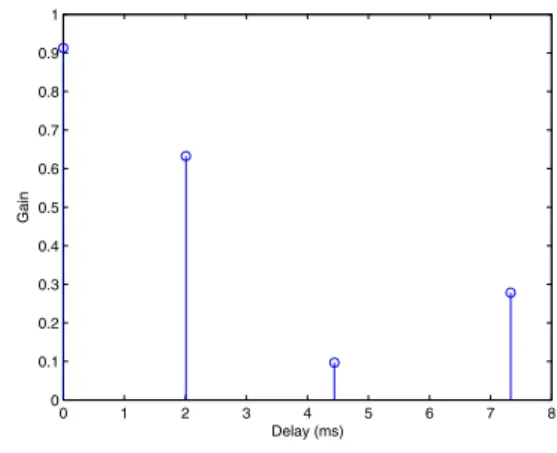
duration of this sub-block is 𝑇𝑑 = 𝐾𝑑/𝐵, with 𝐵 = 11 kHz, whereas that of the first sub-block is 𝑇𝑢 = 𝑇𝑑/10. Hence, the duration of one OFDM block is45.6 ms. The data was modulated using a QPSK constellation. All the results presented below are averaged values over 100 independent Monte Carlo runs. The channel impulse response used for the simulation is depicted in figure 3. The additive noise was a complex valued white Gaussian noise.
0 1 2 3 4 5 6 7 8 0 0.1 0.2 0.3 0.4 0.5 0.6 0.7 0.8 0.9 1 Gain Delay (ms)
Fig. 3. Impulse response of the simulated channel
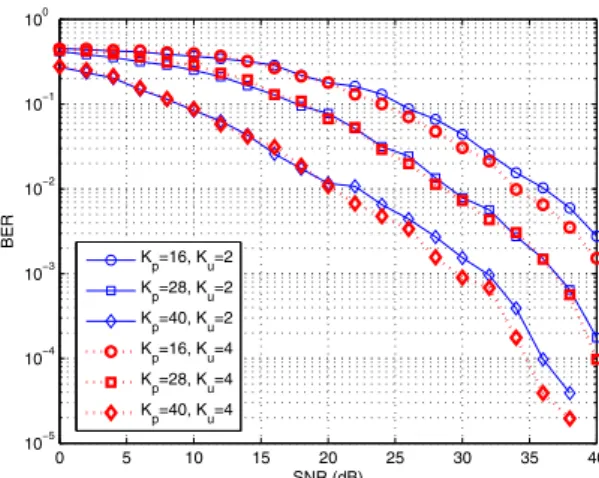
We evaluate the performance of the proposed scheme by computing the mean square error between the estimated and the actual values of the Doppler scaling factor. The data detection method is evaluated by means of the bit-error-rate (BER).
Fig. 4 depicts the mean value of the estimated Doppler scaling factor whereas the mean square error on the estimation of this factor is depicted in Fig. 5.
We can note the effectiveness of the Doppler estimation scheme. However, the performance is degraded when decreas-ing the SNR. The degradation is more accentuated when increasing the number of subcarriers in the first sub-block of the OFDM symbol. Indeed, by increasing 𝐾𝑢, the frequency spacing of the subcarriers is reduced. Therefore, the harmonic retrieval problem needs higher resolution and precision. Such a precision is difficult to obtain when the SNR decreases. Increasing𝐾𝑢seems to be relevant only for high SNR values. This observation is directly related to the behaviour of HTLS in noisy cases.
0 5 10 15 20 25 30 35 40 1 2 3 4 5 6 7 8 9 10x 10 −4 SNR (dB)
Estimated Doppler scaling factor
Ku=2 K
u=4 Ku=8 Actual value
Fig. 4. Estimated value of the Doppler scaling factor.
0 5 10 15 20 25 30 35 40 10−11 10−10 10−9 10−8 10−7 10−6 SNR
Mean square error
Ku=2 Ku=4 K
u=8
Fig. 5. Mean Square Error for the estimation of the Doppler scaling factor.
In Fig. 6, we depict the BER for three numbers𝐾𝑝of pilots and two values for𝐾𝑢. Increasing the number of pilot allows improving the BER.
From these simulations, we can conclude that increasing the number of pilots has a positive effect on the performance of the receiver while increasing the number of subcarriers 𝐾𝑢
has a contrary effect.
VI. CONCLUSION
In this paper, we have presented a new scheme for both estimating the Doppler scaling factor and detecting the infor-mative data. In the proposed scheme, each OFDM symbol is divided in two parts. The first one is shorter and carries out few data with few subcarriers whereas the second one contains both informative and pilot symbols. The first sub-block serves to estimate the Doppler scaling factor while the pilots in the second sub-block are used for estimating the equivalent channel. Both estimation methods are based on high resolution methods for solving harmonic retrieval problems in time and frequency domains respectively. The proposed scheme is particularly efficient for moderate to high SNR. Robustness to noise, for lower levels of SNR, and extension to the
multi-0 5 10 15 20 25 30 35 40 10−5 10−4 10−3 10−2 10−1 100 SNR (dB) BER Kp=16, Ku=2 K p=28, Ku=2 Kp=40, Ku=2 Kp=16, Ku=4 Kp=28, Ku=4 K p=40, Ku=4
Fig. 6. BER for different number of pilots and two numbers of subcarriers in the first sub-block (𝐾𝑑= 256)
user case will be investigated. In addition, effectiveness of the proposed approach using experimental data is to be considered in future works.
ACKNOWLEDGMENT
This work was supported by the EU project FeedNetBack and the ANR project CONNECT.
REFERENCES
[1] B. Li, S. Zhou, M. Stojanovic, L. Freitag, and P. Willett, “Multicarrier communication over underwater acoustic channels with nonuniform doppler shifts,” IEEE Journal of Oceanic Engineering, vol. 33, no. 2, pp. 198–209, 2008.
[2] A. Bahai and B. Saltzberg, Multi-carrier digital communications: theory and applications of OFDM. Springer, 1999.
[3] B. Sharif, J. Neasham, O. Hinton, and A. Adams, “A computationally ef-ficient doppler compensation for underwater acoustic communications,” IEEE Journal of oceanic engineering, vol. 25, no. 1, pp. 52–61, January 2000.
[4] B.-C. Kim and I.-T. Lu, “Parameter study of OFDM underwater com-munications system,” in Proc. of OCEANS 2000 MTS/IEEE Conference and Exhibition, vol. 2, September 11-14 2000, pp. 1251–1255. [5] A. Kibangou, C. Siclet, and L. Ros, “Joint channel and doppler
esti-mation for multicarrier underwater communications,” in Proc. of IEEE Int. Conf. on Acoustics, Speech, and Signal Processing (ICASSP) 2010, Dallas, Tx, USA, March 14-19 2010, pp. 5630–5633.
[6] ——, “ZF OFDM receiver for underwater communications,” in Proc. of Int. Symp. on Comm., Control and Signal Process. (ISCCSP) 2010, Limassol, Cyprus, March 3-5 2010.
[7] S. Kay, Modern spectral estimation, Theory and Application. Engle-wood Cliffs, New Jersey, USA: Prentice-Hall, 1988.
[8] P. Stoica and R. Moses, Introduction to spectral analysis. Englewood Cliffs, New Jersey, USA: Prentice-Hall, 1997.
[9] R. Roy and T. Kailath, “ESPRIT-Estimation of signal parameters via rotational invariance techniques,” IEEE Trans. on Signal Proc., vol. 37, no. 7, pp. 984–995, July 1989.
[10] J. Papy, L. De Lathauwer, and S. Van Huffel, “Exponential data fitting using multilinear algebra: The single-channel and multi-channel case,” Numer. Linear Algebra Appl., vol. 12, pp. 809–826, 2005.
[11] S. Van Huffel, “Enhanced resolution based on minimum variance estimation and exponential data modeling,” Signal Processing, vol. 33, no. 3, pp. 333–355, 1993.
[12] S. Kung, K. Arun, and D. Bhaskar Rao, “State-space and singular value decomposition-based approximation methods for harmonic re-trieval problem,” Journal of the Optical Society of America, vol. 73, no. 12, pp. 1799–1811, 1983.
[13] S. Van Huffel, H. Chen, C. Decanniere, and P. Van Hecke, “Algorithm for time-domain NMR data fitting based on total least squares,” Journal of Magnetic Resonance, vol. 110, no. series A, pp. 228–237, 1994.

![[PDF] Cours d'informatique en ligne gratuit](data:image/gif;base64,R0lGODlhAQABAIAAAP///wAAACH5BAEAAAAALAAAAAABAAEAAAICRAEAOw==)