HAL Id: inserm-01570610
https://www.hal.inserm.fr/inserm-01570610
Submitted on 31 Jul 2017HAL is a multi-disciplinary open access
archive for the deposit and dissemination of sci-entific research documents, whether they are pub-lished or not. The documents may come from teaching and research institutions in France or abroad, or from public or private research centers.
L’archive ouverte pluridisciplinaire HAL, est destinée au dépôt et à la diffusion de documents scientifiques de niveau recherche, publiés ou non, émanant des établissements d’enseignement et de recherche français ou étrangers, des laboratoires publics ou privés.
Viewing FSL results with SPM and vice versa
Thomas Maullin-Sapey , Peter Williams, Guillaume Flandin , Thomas Nichols ,
Camille Maumet
To cite this version:
Thomas Maullin-Sapey , Peter Williams, Guillaume Flandin , Thomas Nichols , Camille Maumet. View-ing FSL results with SPM and vice versa. 2017 Annual meetView-ing of the Organisation of Human Brain Mapping (OHBM 2017), Jun 2017, Vancouver, Canada. �inserm-01570610�
Viewing FSL results with SPM and vice versa
Thomas Maullin-Sapey1, Peter Williams2, Guillaume Flandin3, Thomas E. Nichols1,4, Camille Maumet4
1 Department of Statistics, University of Warwick, Coventry, UK 2 Department of Mathematics, University of Warwick, Coventry, UK 3 Wellcome Trust Centre for Neuroimaging, UCL Institute of Neurology, London, UK.
4 WMG, University of Warwick, Coventry, UK
Introduction
A growing number of efforts are emerging in the neuroimaging community to increase reproducibility of research
findings (e.g. [1,2]). In an attempt to facilitate publishing of neuroimaging data and metadata, the NeuroImaging
Data Model (NIDM) defines a set of specifications based on semantic web technologies.
The NIDM-Results specification was recently introduced, providing a machine-readable representation of mass
univariate statistical results, including extensive metadata and key images summarising the findings[3]. The main
motivation for NIDM-Results was to make publishing of neuroimaging results data and metadata as effortless as
possible and hence facilitate compliance with statistical guidelines (e.g. [4]), increase reproducibility and enable
image-based meta-analyses.
An NIDM-Results pack is a ZIP archive containing a Resource Description Framework (RDF) metadata file, which
stores provenance information, alongside several NIfTI images and CSV files. NIDM-Results packs can be
generated via NIDM-Results exporters, which are available for Statistical Parametric Mapping (SPM) [5] and the
FMRIB Software Library (FSL)[6]. However few tools exist to read and display NIDM-Results. This is hindering the
distribution and acceptance of NIDM within the neuroimaging community.
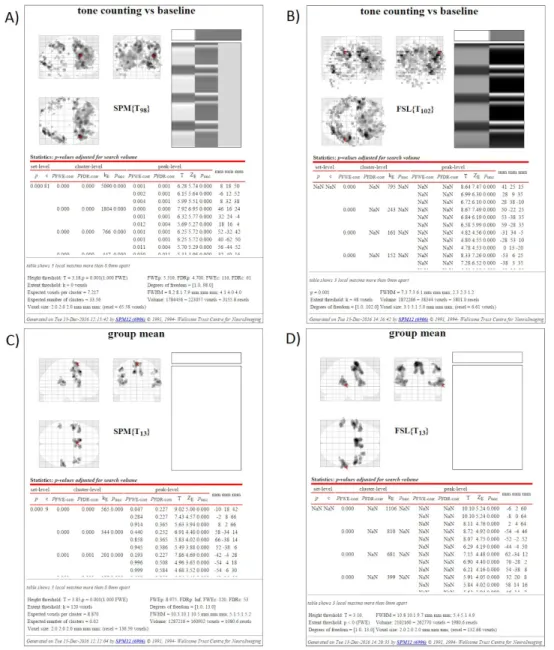
Here, we introduce two NIDM-Results viewers, one each oriented for users accustomed to SPM and FSL, two of
the most widely-used neuroimaging analysis softwares [7].
Methods
The SPM and FSL viewers were written in programming languages already in use in each of the neuroimaging
software packages, namely MATLAB and Python, respectively. Each viewer, provides an HTML display of
NIDM-Results packs formatted according to the layout of the respective results page. The Matlab-based viewer
reads a json-ld version of the RDF metadata (as presently there is no Matlab SPARQL query engine), while the
Python-based viewer uses RDFlib [9] to directly query the metadata.
Both applications were tested on a set of publicly available NIDM-Results packs generated with SPM and FSL
(http://neurovault.org/collections/1692/)[9] and designed to cover the main use-cases of fMRI analyses [10].
Results
The SPM and FSL viewers are publically available at https://github.com/incf-nidash/nidmresults-spmhtml and
https://github.com/incf-nidash/nidmresults-fslhtml. Fig. 1 presents sample results page for an example FSL and
SPM study respectively. HTML versions of these results can be found here: http://bit.ly/2hQHQhz.
Conclusions
We hope that the viewer will facilitate the adoption of the NIDM-Result format for sharing of statistical results in the
neuroimaging community as well as interoperability across software packages. For example, it will make it easy to
share results with a collaborator using different a different software package. Another important use for
NIDM-Results is sharing of findings for meta-analyses, ensuring all vital metadata is retained.
This work is part of a growing ecosystem of tools for NIDM and it is our intention to develop more applications to
further to increase the practical utility of NIDM-Results. Future work will include development of NIDM-Results
packs exporter from other neuroimaging software packages such as AFNI, as well as the creation of a software
independent Javascript viewer for NIDM-Results which may be embedded in HTML or run locally. Other projects
also include the creation tools for meta-analysis of neuroimaging data.
Acknowledgments
We acknowledge the work of all INCF task force members as well as the Wellcome Trust for support of CM and
Fig. 1. Examples of SPM HTML display for (A) SPM subject-level analysis, (B) FSL subject-level analysis, (C) SPM
group-level analysis and (D) FSL group-level analysis .
References
1. Gorgolewski KJ, Varoquaux G, Rivera G, Schwarz Y, Ghosh SS, Maumet C, et al. NeuroVault.org: a
web-based repository for collecting and sharing unthresholded statistical maps of the human brain. Front
Neuroinform. Frontiers; 2015;9. doi:10.3389/fninf.2015.00008
2. Poldrack RA, Barch DM, Mitchell JP, Wager TD, Wagner AD, Devlin JT, et al. Toward open sharing of
task-based fMRI data: the OpenfMRI project. Front Neuroinform. 2013;7: 12–12.
3. Maumet C, Auer T, Bowring A, Chen G, Das S, Flandin G, et al. Sharing brain mapping statistical results with
the neuroimaging data model. Scientific Data. Nature Publishing Group; 2016;3. doi:10.1038/sdata.2016.102
4. SAMPL guidelines for statistical reporting | The EQUATOR Network [Internet]. [cited 7 Jul 2016]. Available:
http://www.equator-network.org/2013/02/11/sampl-guidelines-for-statistical-reporting/
5. Penny WD, Friston KJ, Ashburner JT, Kiebel SJ, Nichols TE. Statistical parametric mapping: the analysis of
functional brain images: the analysis of functional brain images. Academic press; 2011.
6. Jenkinson M, Beckmann CF, Behrens TEJ, Woolrich MW, Smith SM. FSL. Neuroimage. 2012;62: 782–790.
7. Carp J. The secret lives of experiments: methods reporting in the fMRI literature. Neuroimage. Elsevier Inc.;
2012;63: 289–300.
8. rdflib 4.2.2-dev — rdflib 4.2.2-dev documentation [Internet]. [cited 12 Dec 2016]. Available:
https://rdflib.readthedocs.io/
9. NIDM-Results 1.3.0 examples [Internet]. [cited 11 Nov 2016]. Available: http://neurovault.org/collections/1692/
10. Pauli R, Bowring A, Reynolds R, Chen G, Nichols TE, Maumet C. Exploring fMRI Results Space: 31 Variants