HAL Id: halshs-02417117
https://halshs.archives-ouvertes.fr/halshs-02417117
Submitted on 18 Dec 2019HAL is a multi-disciplinary open access archive for the deposit and dissemination of sci-entific research documents, whether they are pub-lished or not. The documents may come from teaching and research institutions in France or abroad, or from public or private research centers.
L’archive ouverte pluridisciplinaire HAL, est destinée au dépôt et à la diffusion de documents scientifiques de niveau recherche, publiés ou non, émanant des établissements d’enseignement et de recherche français ou étrangers, des laboratoires publics ou privés.
Nashta grammatical sketch with examples linked to
online corpus
Evangelia Adamou
To cite this version:
Evangelia Adamou. Nashta grammatical sketch with examples linked to online corpus. Slavis-che MikrospraSlavis-chen im absoluten Sprachkontakt, Harrassowitz, 2020, �10.24397/pangloss-0000305�. �halshs-02417117�
1 Nashta grammatical sketch with examples linked to online corpus
Evangelia Adamou CNRS
Background on Nashta
The Nashta variety, literally ‘our (language)’, is part of the group of South Slavic spoken in the Balkans and represented in the area by two official languages, that is, Literary Bulgarian (ISO 639-3: bul) and Literary Macedonian (ISO 639-3: mkd). Unlike these languages, however, the speakers of the Nashta variety have been in contact with Greek at least for the past century during which the shift to Greek took place. In the scale of endangerment elaborated by Krauss (2006), Nashta can be considered as a critically endangered variety (D).
Recordings and annotation
The texts in Nashta were recorded in the small town of Liti (approx. 2,000 inhabitants), which is located 10 km from the city of Thessaloniki in Greece. The recordings were made in the years 2000 among three fluent speakers, two female and one male, in their 70s at the moment of the recordings, and one younger female semi-speaker. They all use Nashta very rarely, their everyday language being Greek. The recordings took place at home, bringing together acquaintances who were asked to speak Nashta although Greek would have been the language used in these circumstances. Interviews with the researcher completed the corpus.
The texts in this corpus were transcribed in broad phonetics using the International Phonetic Alphabet (IPA). Glosses follow the Leipzig Glossing rules. Historical background
Liti, where the Balkan Slavic Nashta variety has been recorded, was known as Aivati or Aivatovo during the Ottoman period; see Map in Figure 1. The Tabula Imperii Romani K 3 (1976: 78) attests to the existence of a ‘demos of Liti’ in 117 BC, whose inhabitants appear to be of Thracian origin. The presence of Slavic agricultural populations in Liti is noted in a seventh-century Byzantine source, entitled The miracles of Saint Demetrius. The relevant excerpt is presented below:
On put alors voir nos concitoyens, [semblables par l’effet de la famine à] des morts et des fugitifs, se rendre avec femmes et enfants aux habitations [sklavènes] des environs de Lite et autres lieux voisins, en ramener du blé et des légumes secs…
2 [We could then see our fellow citizens, [who because of the famine looked] dead and like fugitives, with their women and children, going to the [Slavic] inhabitants around Lite and other neighbouring localities, to get wheat and fruits…]
(Lemerle 1979: 207. My translation from French).
It describes the rush of the people of Salonica to the countryside following the end of one of the city’s sieges.
Figure 1. Map from 19031 indicating the village of Ajvati (nowadays Liti) nearby
the city of Saloniki (nowadays Thessaloniki)
In the beginning of the twentieth century, the Hilmi Pasha census (1904) reports 1,395 so-called Greeks in the village, a term which is more adequately understood as Christian Orthodox. Indeed, during the Ottoman era the people of Liti were part of the Greek millet, a grouping based on religious belief. In 1912‒1913 Liti was integrated in the Greek state together with part of the geographical region of Macedonia. The new socio-political setting triggered the shift of the Slavic speakers to Greek.
Consonants, vowels, and stress
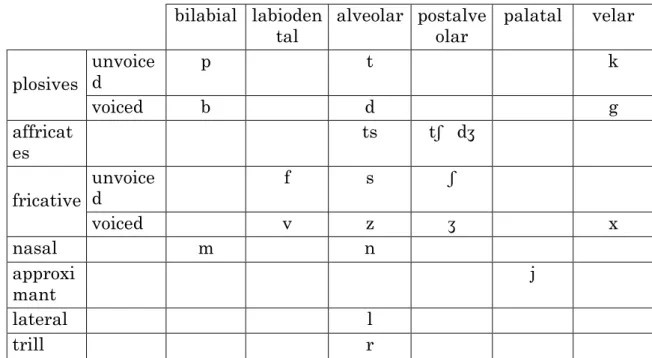
Nashta has voiced and voiceless plosives, voiced and voiceless fricatives, nasals, laterals, a palatal approximant and a short alveolar trill. Voiced plosives and fricatives become devoiced word-finally, e.g., [ˈnoʒ-et] ‘knife-ART’ but [noʃ] ‘knife’ in sentence 21, Text https://doi.org/10.24397/pangloss-0000305. See Table 1 and Table 2. Nashta also has affricates, e.g., [tʃ], [dʒ], [ts]. We note that [sʲ] realizations do not only occur in front of back vowels [i, e], as in contact varieties of Northern Greek, but also in front of [a, æ], as in sentence 3, making its phonological status unclear. Indeed, Nashta has two phonemes, /s/ and /ʃ/, while
1Published by Artaria and Co. Landkartenhandlung. Reproduced with the kind authorisation of the
3 Northern Greek, has one phoneme /s/ realized [sj] in front of the vowels /i/, /e/,
(see https://doi.org/10.24397/pangloss-0000317, sentences 55, 56 aθaˈnasʲios, 69 δimopraˈsʲia) and [s] in front of vowels [a], [o], [u]. In the Nashta corpus we observe the realizations [s], [sj] and [ʃ] but their distribution is not the direct
outcome of the combination of the Nashta and the Northern Greek systems. For example, [sj] can be realized in front of [a], and can also alter the realization of
inherited phonemes as in ‘village’, realized [ʃelo] or [sjelo] while in other Slavic
dialects and languages of the area it is [selo]; see https://doi.org/10.24397/pangloss-0000317 sentences 84 ˈsʲel-to, 86, 87. Also of interest is the status of syllabic /r/ in Nashta; see ‘church’ in https://doi.org/10.24397/pangloss-0000317, sentences 6, 23, 58, 61, 100 ˈtsrkvə-ta. Table 1. Consonants
bilabial labioden
tal alveolar postalveolar palatal velar plosives unvoice d p t k voiced b d g affricat es ts tʃ dʒ fricative unvoice d f s ʃ voiced v z ʒ x nasal m n approxi mant j lateral l trill r
Table 2. Consonants in initial, medial, and final position
INITIAL MEDIAL FINAL
p pop ‘priest’ ˈklepem ‘I wink’ sərp ‘sickle’
b ˈbraʃno ‘flour’ raˈbota ‘work’ -
t ˈtæjko ‘father’ ˈkotka ‘cat’ iˈvurt ‘yoghurt’
d ˈdætsa ‘children’ iˈdno ‘one.SG.N’ -
k ˈkamen ‘stone’ ˈkotka ‘cat’ luk ‘garlic’
g ˈgozba ‘dinner’ ˈdruga ‘other.SG.F’ -
f ˈfurna ‘oven’ məˈrafka ‘ant’ krəf ‘blood’
v ˈvəlna ‘wool’ tʃuˈvʲæk ‘man’ -
s ˈsetne ‘after’ ˈmeso ‘meat’ nos ‘nose’
z zet ‘groom’ viˈzaɲe ‘embroidered’ -
ʃ ʃuˈkaj ‘scarf’ ˈniʃto ‘nothing’ noʃ ‘knife’
ʒ ˈʒena ‘woman’ ˈkaʒem ‘I say’ -
x ˈxubo ‘good’ saˈxat ‘time/hour’ prax ‘dust’
m ˈmajka ‘mother’ ˈvræme ‘time’ tam ‘there’
n nos ‘nose’ ˈʒena ‘woman’ ˈkamen ‘stone’
4
l ˈlisto ‘leaf’ ˈxabalka ‘apple’ ˈdaskal ‘teacher’
j ˈjagne ‘lamb’ ˈlajno ‘dung’ ʃuˈkaj ‘scarf’
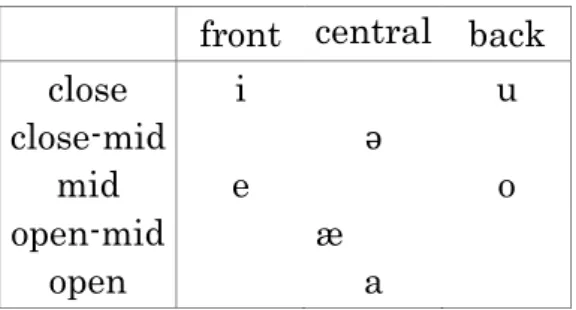
Nashta has six vowels, see Table 3. [æ] appears in the corpus but its status as a phoneme is problematic.
Table 3. Vowels
front central back
close i u
close-mid ә
mid e o
open-mid æ
open a
Table 4. Vowels, stressed and unstressed
STRESSED UNSTRESSED
i ˈlisto ‘leaf’ iˈdno ‘one.SG.N’
e ˈmeso ‘meat’ ˈsirne ‘cheese’
ә ˈvəlna ‘wool’ məˈrafka ‘ant’
æ ˈdætsa ‘children’
a ˈxabalka ‘apple’ ˈʒena ‘woman’
o ˈkotka ‘cat’ ˈmeso ‘meat’
u ˈfurna ‘oven’ ʃuˈkaj ‘scarf’
Nashta has stress, that is, stressed syllables are longer than unstressed syllables and have differences in vowel quality. Stress falls mainly, although not exclusively, on the penultimate in the native parts of its vocabulary.
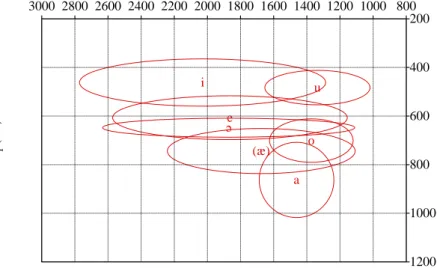
Most vowels present substantial variation in pronunciation, within individual speakers and between speakers. The phonetic variation in the realization of the vowels is captured by a pilot phonetic study of this text based on a digital speech analysis software. Semi-automatic alignment was run with EasyAlign by phonetician Martine Toda.2 It was then possible to run a semi-automatic script in
Praat with the “log file 4” and “triangle vocalique” scripts.3 Figure 2 illustrates
the mean F1 and F2 for the stressed (in grey) and unstressed (in black) vowels based on 455 tokens produced by a female speaker in Text https://doi.org/10.24397/pangloss-0000305. It can be seen that the mid vowels /e/ and /o/ are not raised to [i] and [u] as is the case in the contact-varieties of Northern Greek. Figure 3 shows the variability of F1 and F2 values of stressed vowels and Figure 4 of unstressed vowels. It can be seen that unstressed /a/ and /e/ are realized in a very similar area. We also note a significant overlap for /a/ and the non-phonological [æ], (see Text
2 EasyAlign is developed by Jean-Philippe Goldman, University of Geneva. 3 Developed by Cédric Gendrot, see http://gendrot.ilpga.fr/scripts.htm
5 0000305, sentences 1 ˈvræme, 3 ˈtæjko, 12 ˈsfætixa, 14 ˈbæʃe, 16 tsæ, among many others), as well as for /e/ and /ə/. In contrast, there is no overlap between /o/ and /u/ as well as between /i/ and /e/.
Figure 2. Mean F1 and F2 for the Balkan Slavic Nashta stressed (in grey) and unstressed (in black) vowels based on 455 tokens produced in the spontaneous speech of a female speaker (Adamou 2016)
Figure 3. Variability of F1 and F2 values of stressed vowels in Nashta produced in the spontaneous speech of a female speaker (Adamou 2016)
a e i o u 800 1000 1200 1400 1600 1800 2000 2200 400 600 800 1000 F1 ( H z) F2 (Hz) (æ) a e i o u ǝ 800 1000 1200 1400 1600 1800 2000 2200 400 600 800 1000 F1 ( H z) F2 (Hz) (æ) a e i o u ǝ 800 1000 1200 1400 1600 1800 2000 2200 2400 2600 2800 3000 200 400 600 800 1000 1200 F1 ( H z) F2 (Hz)
6 Figure 4. Variability of F1 and F2 values of unstressed vowels in Nashta produced in the spontaneous speech of a female speaker (Adamou 2016)
Noun phrase Gender
Nashta has grammatical gender, that is, we find different agreements on the verb, adjective, numeral, and definite article, depending on the gender of the noun (Corbett 2013, WALS 30). Anaphoric pronouns also agree with the gender of their antecedent. Nashta has three grammatical genders: feminine, masculine, and neutral.
Number
Nashta marks plural on the nominals. Interestingly, we note several instances of the old collective -je. See an example in Text https://doi.org/10.24397/pangloss-0000305, sentences 1, 2, 4, ˈʎomperje translated as ‘ghosts’ by our consultants. However, as collective is no longer in use, we gloss it as a mere plural marker. We note in sentence 32 of the same text the use of the old collective with an article in singular form, ˈʎomperje-to.
Case marking
In Nashta, we can observe the loss of case marking, similar to Bulgarian and Macedonian, but with the exception of several Rhodope and Macedonian varieties that have retained various case markers. In the Nashta corpus we can observe some traces of the vocative; see https://doi.org/10.24397/pangloss-0000341, sentences 24, 26, 27 ˈbabo ‘grandmother’, but in nominative ˈbaba. We note the use of the same word in Northern Greek dialects, ˈvavo.
Demonstratives
Nashta has a three-way contrast for distance in demonstratives: mid t-, distal –n-, and proximal v-, which is relatively rare in the corpus. Demonstratives in Nashta inflect for gender and number; see Table 5. In Nashta, the demonstrative precedes the noun as commonly found in most languages of Eurasia (Dryer 2013, WALS 88). For examples see Text https://doi.org/10.24397/pangloss-0000305
a e i o u 800 1000 1200 1400 1600 1800 2000 2200 2400 2600 2800 3000 200 400 600 800 1000 1200 F1 ( H z) F2 (Hz)
7 sentence 1 uˈno ˈvræme. The t- forms in sentences 30, 38, 40, the n- forms in sentences 1, 17, 25, 28, and the v- forms in sentences 7, 15, 45.
Table 5. Demonstratives
Singular Plural
masculine neutral feminine
proximal vo vo va -
mid to to ta tie
distal on uˈno ˈona ˈoni/uˈnie
Definite article
Most languages of Europe have definite articles or affixes (Dryer 2013, WALS 37). However, only a few Slavic languages have grammaticalized definite articles: this is the case for South Slavic. The grammaticalization of postposed articles in South Slavic results from both internal and contact-induced factors, as it coincides with a similar development in the Romance languages of the area (Romanian, Aromanian, and Meglenoromanian) and Albanian. Definite articles in South Slavic were grammaticalized from demonstratives, a cross-linguistically common development. Written sources show that the postposed demonstratives attested in Old Church Slavonic documents (between the ninth and eleventh centuries) were grammaticalized into clitic demonstratives and then into clitic articles. Literary Bulgarian has a single definite article but Literary Macedonian and the Rhodope varieties have three definite articles.
Nashta has a single definite article, based on the -t form, inflecting for gender and number; see Table 6. The analysis of the corpus shows that 83% of all the nouns in the corpus are determined by a definite article, a high percentage indicating that definite articles are probably fully grammaticalized in Nashta. Greek influence can be seen in the use of the Nashta definite articles with proper nouns, impossible in most Slavic languages of the area; e.g., Text https://doi.org/10.24397/pangloss-0000321, sentences 4, 5, 6.
Table 6. Definite article in Nashta Singular Masculine -et
Feminine -ta Neutral -to
Plural -te
Indefinite article
Nashta has an indefinite article inflecting for gender and number; see Table 7. The definite article has grammaticalized from the numeral ‘one’ (Dryer 2013, WALS 38: demonstrative word same as ‘one’). In a quantitative perspective, the analysis of the Nashta corpus reveals that 15% of all the nouns are determined by the numeral iˈdin ‘one’. A qualitative analysis of the examples indicates the use of ‘one’ either as a numeral, which can combine with the definite article iˈdin-at as in sentence 12, https://doi.org/10.24397/pangloss-0000301, or with referential nouns, e.g., iˈdin aˈndroʝino ‘a couple’ in sentence 1, https://doi.org/10.24397/pangloss-0000301, but not with non-referential and generic nouns. We note 2% of bare plural or singular nouns with an indefinite value. However, we do find occurrences of an indefinite article in plural (see
8 https://doi.org/10.24397/pangloss-0000299, sentence 30; iˈdni ˈʒene ‘some women’; https://doi.org/10.24397/pangloss-0000313, sentence 13 iˈdni kuˈtie ‘some boxes’). Table 7. Indefinite article in Nashta
Singular Masculine iˈdin Feminine iˈdna Neutral iˈdno
Plural iˈdni
Numerals
Numerals in Nashta precede nouns (NUM-N). We note that distributive numerals are marked by a preceding word, po/pu, see sentence 31, https://doi.org/10.24397/pangloss-0000317 po sto ˈfraŋga; sentence 15, Text https://doi.org/10.24397/pangloss-0000305 ˈʝimaʃe pu iˈdin ˈkamen.
Degree words
In Nashta, the order of a degree word, e.g., ˈmnogo ‘very’, po ‘more’ (see sentences 28, 29 for ‘very’ and 4, 9, 16 for ‘more’, https://doi.org/10.24397/pangloss-0000317), and the adjective it modifies is DEG-ADJ, where the degree word precedes the adjective. This is another common feature among the languages of Eurasia (Dryer 2013, WALS 91).
Prepositions
Nashta has prepositions, similar to most languages in Europe (Dryer 2013, WALS 85). See Tables 8 and 9 for the temporal-spatial prepositions. See examples in Text https://doi.org/10.24397/pangloss-0000321: u ‘locative, punctual’, sentences 2, 18, 27, 33, na ‘allative, durative’, ut ‘ablative’, sentences 25, 27, 32, 38, dur ‘limitative’, sentence 17.
Table 8. Prepositions formed with the locative/punctual u
adverb adposition adposition meaning
uˈpret + u = uˈpret ˈu ‘in front’
uˈdgore + u = uˈdgore ˈu ‘on’
ˈnetre + u =ˈnetre ˈu ‘in’ Table 9. Prepositions formed with the allative/durative ut
adverb adposition adposition meaning
uˈdgore + ut = uˈdgore ˈut ‘above’
uˈdol +ut = uˈdol ˈut
(spatial) ‘below’
uˈpret + ut = uˈpret ˈut ‘in front of’
ˈsetna + ut = ˈsetna ˈut ‘after’ Possessor NP
The order of a possessor noun phrase in relation to the head noun is POSS-N, the
possessor preceding the noun it modifies (see text
9 kateˈrin-ta ˈnejn-ət peθeˈros, and ownership, sentence 11 xadʒiˈɟorɟeve-te ˈkəʃce). The locus of marking in the possessive noun phrases is on the dependent (possessor) and not on the head of the phrase (possessed noun). Possessors in the genitive case agree with the possessed in number and gender.
Adjectives
In Nashta adjectives, expressing a descriptive property such as ‘big’, ‘good’, or ‘red’, precede nouns (AdjN). This order is widespread among the languages of Eurasia, with the exception of Western Europe (Dryer 2013, WALS 87). Adjectives in Nashta inflect for gender and number.
Predicative adjectives
Predicative adjectives in Nashta have nonverbal encoding as typical of languages spoken in the geographical area of Eurasia (Stassen 2013, WALS 118 Predicative adjectives). A verbal copula is typically used although zero copula constructions are allowed (see https://doi.org/10.24397/pangloss-0000303, sentence 4 tajˈfa guˈʎama ‘(it was a) big family’ with inversion of the order of the adjective and the noun from AdjN to NAdj). Nominal and locational predications are encoded through the same devices, as frequently encountered in languages of Eurasia (Stassen 2013, WALS 119 Nominal and locational predications: Identical). Linear order
Nashta has a dominant verb-object order (VO). The order of the object with respect to the verb can be associated to a number of other typological features. Nashta has prepositions and VO order, two features that correlate in the following way: “if a language is OV then it is usually postpositional and if a language is postpositional then it is usually OV” (Dryer 2011, WALS 95). Nashta has an AdjN order, the adjective preceding the noun. According to Dryer (2013, WALS 97), there is no correlation between the order of object and verb and the order of adjective and noun. In intransitive clauses there is no clear dominant order (Dryer 2013, WALS 82, Order of S and V), but in transitive clauses, the order is generally SVO.
Pronouns
Alignment of verbal person marking
Nashta has subject suffixes on the verb (Dryer 2013, WALS 101: Expression of pronominal subjects: Subject affixes on verb). It shows accusative alignment in indexing, where the unique argument of intransitive verbs (S) and the agent-like argument of transitive verbs (A) are indexed on the verb through a single set of suffixes; see Table 10. Notice that third person is zero (Siewierska 2013, WALS 100: Alignment of verbal person marking).
10 Table 10. Person suffixes
Person Subject/Agen t 1SG -m 2SG -ʃ 3SG.M/F/ N Ø 1PL -me 2PL -te 3PL -t
Free person pronouns
Nashta is a pro-drop language, i.e., the free pronouns are not obligatory but appear in marked contexts; see Text https://doi.org/10.24397/pangloss-0000305 sentences 5 ˈʎomperje ʝa na ˈʎomper ʝa ci gu uˈbija, 7 ʝa vo ˈvetʃer ci ˈpoʝa ˈvoŋka, 45 arˈtlik ˈela da ti ˈkaʒe ʃo tʃiˈnix ʝa vo ˈvetʃer, 50 ʝa ˈveʎe pak za ˈʎomper ˈveʎe gu (ud)vəˈrvjax. Table 11 shows the forms of the free person pronouns.
Table 11. Free person pronouns Person Subject/Agent
(NOM)
Indirect object following a preposition (DAT) 1SG ja ˈmene 2SG ti ˈtebe 3SG.M/ N 3SG.F to ta ˈnego ˈneja 1PL ni nas 2PL vi vas 3PL ˈtie nix
Person clitics and clitic doubling
Nashta has two series of person clitics, one for direct objects (glossed ACC) and one for indirect objects (glossed DAT); see Table 12. Both series precede the verb, including clause initially. When the two clitics co-occur, the indirect object clitic always precedes the direct object clitic. We note some variation in the forms of the clitics for first and second person. The person clitics can cross-reference a noun when the noun is determined by a definite article or a possessive pronoun; this is the so-called “clitic doubling”. See examples in Text https://doi.org/10.24397/pangloss-0000305, sentences 5, 10, 30, 43, 46, 47. See https://doi.org/10.24397/pangloss-0000319, sentence 78 for a case of co-occurrence of the free person pronoun and the clitics; na nix mu=ˈdavaxa ‘they gave to them’.
11 Table 12. Person clitics
Person Direct object (ACC) Indirect object (DAT) 1SG (=)me= mi= 2SG (=)te= ti= 3SG.M/N 3SG.F (=)gu= (=)a= mu= a= 1PL (=)ne= ni= 2PL (=)ve= vi= 3PL (=)gi= mu=
Differential object marking
Based on the Nashta data, Adamou (2006) was the first scholar to suggest an analysis of the Balkan Slavic marking of direct objects through the adposition na as a case of differential object marking (Bossong 1985; Lazard 2001). Differential object marking can be seen in the Nashta texts for human objects (see https://doi.org/10.24397/pangloss-0000309, sentence 1 e u ˈgledam tsæ na to sə
ˈbere ˈprisʲiŋɟe), or in Text https://doi.org/10.24397/pangloss-0000305 for
human-like objects, as in sentence 46 for the ‘ghost’ ʃo tʃiˈni gu provaˈʎix na ˈʎomper-ət. The analysis of the Balkan Slavic data in the light of the differential object marking frame allowed to establish a link between this phenomenon in contemporary varieties and genitive-accusative in Old Church Slavonic (Adamou 2009). This approach also weakened the claim that the Slavic data developed under Romanian and Arumanian or Greek influence (Adamou 2009), a hypothesis that is dominant in the literature (Koneski, Vidoeski & Jašar-Nasteva 1968; Cyxun 1981; Topolinjska 1995; Markovik 2007; Sobolev 2008). Possessive pronouns
Possession is expressed by a series of free possessive pronouns, that inflect for gender and number, and are generally formed with the definite article, ˈmojet ‘my’, although indefinite forms are possible, e.g., moj ‘my’, ˈnegof ‘his’. Possessive pronouns precede nouns. See examples in Text https://doi.org/10.24397/pangloss-0000305, sentences 3, 13, 37. The series of indirect object person clitics presented in Table 12, also serves to express possession. In that case the clitics follow the noun; see examples in Text https://doi.org/10.24397/pangloss-0000305, sentences 3 and 23ˈmajka=mu, 14 ˈkəʃce-te=mo, 16 ˈmajciʃi=ne.
12 Verb
Tense, mood, aspect markers
Although the Nashta corpus has few contact words (less than 5%), it shows significant convergence with Greek at the level of the verbal system; see Table 13. This convergence results both from century-long processes within the Balkan Sprachbund and very quick changes within the shifting process to Greek.
Nashta distinguishes between a perfective and an imperfective verbal aspect, the latter being marked through the suffix –uva. We note that some verbs are lexically perfective or imperfective. Preverbs, which are well known for Slavic languages, are not very productive in Nashta. We note the use of preverbs such as na-, iz-.
The past is generally marked through the suffix –x, and in combination with the aspect it is glossed as either “aorist” (AOR) or (IPRF) “imperfect”. For example, in https://doi.org/10.24397/pangloss-0000311, sentence 1, the verb ‘to watch’ is inherently imperfective and thus the –x suffix is glossed as “imperfect”,
ˈgledaxme. However, in sentence 8 of the same text –x combines with a verb that
is lexically perfective ‘to see’ and thus –x is glossed as an “aorist”, viˈdʲaxa. The third person for imperfect has a specific form, -ʃe, as can be seen in sentence 1,
ˈbereʃe, and it can combine with the imperfective suffix –uva-, as in sentence 2, sa
kaˈtʃuvaʃe.
Nashta has a volitive future formed with the particle ki, an optative with da, and an exhortative with neka, all used with finite verbs. These particles can combine with the perfect and the imperfect forms of the verb, but they are mutually exclusive. The rise of a future based on the volitive ‘want’ is among the most well-known Balkan features: a ‘want’-future is found in Greek, Tosk Albanian, Rumanian, Macedonian, Bulgarian, Serbian and Croatian, and Romani. The use of an optative particle follows the loss of the infinitive which characterizes the languages of the Balkans in general.
Nashta — unlike Bulgarian but like Literary Macedonian — has developed a fully grammaticalized ‘have’-perfect (Adamou 2012). It is characterized by an invariable verbal form based on the neuter past participle and ending in –no/–to. Sentence 14 in https://doi.org/10.24397/pangloss-0000311 illustrates the use of the ‘have’-past perfect with a transitive verb, sa ˈimaʃe ˈzeto. Unpublished data also show its use with intransitive verbs such as the verb ‘to die’, e.g., jima umrjiano ʻhe has diedʼ. Several scholars consider the ‘have’-perfect as a Balkan feature, either under Romance influence or under Greek influence, but these analyses remain controversial.
The grammaticalization of a ‘have’-perfect with the past passive participle in Nashta probably led to the loss of the former Slavic ‘be’-perfect as well as to the even more remarkable loss of all the -l verb forms based on the active participle. Greek was probably a catalyst for the loss of the -l verbal forms; this loss being a unique feature within the Slavic branch. The gradual loss of the -l forms has also been reported for other Balkan Slavic varieties in contact with Greek and is most probably a side-effect of the grammaticalization of the ‘have’-perfect. Indeed, in most Macedonian varieties which have no contact with Greek, the rise of the ‘have’-perfect led to the use of the -l forms to express evidentiality. The evidential uses of the –l forms are lacking in Nashta, probably because there is no
13 grammaticalized evidential in Greek. Indeed, under Greek influence, Nashta speakers consistently use the aorist or the narrative present for tales as can be observed in this corpus.
Table 13. Verb morphology in Balkan Slavic Nashta and Greek (Adamou 2016)
Nashta Greek
volitive ki θa
optative da na
exhortative neka as
imperfective -uva-
or stress stem morphology
‘have’ perfect imam Vinv(-no) exo Vinv. Reflexive, reciprocal, middle
Nashta has an uninflected reflexive, sa, which is also used as a reciprocal, e.g., https://doi.org/10.24397/pangloss-0000301, in sentences 1 sa ˈkaraxa, 3, 4, and as a middle, e.g., in sentences 15 sa stənaxoˈresa, 16 ci sa iˈstemne, 19 sa varˈna. It always precedes the verb, including clause initially. Also see https://doi.org/10.24397/pangloss-0000307 sentences 4 sa ˈklavaxme, 18 sa ˈimaʃe for more examples. The reflexive, reciprocal, and middle always precedes the verb, including clause initially. Table 14 summarizes all the possible uses.
Table 14. Reflexive, reciprocal, and middle
Form Construction Use
sa intransitive intransitive Middle Naturally reciprocal transitive,
attributive Reflexive
Syntax
Relative clauses
Nashta has externally-headed relative clauses where the relative clauses follow the head nouns (NRel).
Subordinators
Adverbial subordinators, such as ‘because’, ‘when’, ‘if’, are found in the initial position of the subordinating clause.
Borrowings and codeswitching
For the annotation of this corpus, the morphologically and phonologically integrated, single words were considered as borrowings. When borrowings come from the current-contact language they were tagged and appear in italics. When borrowings come from a past-contact language they are followed in parentheses by the code of the language from which they come, e.g., tur for Turkish and rup for Arumanian. Some words can be found in the current contact-language, Greek, and in the past contact-language, Turkish. For example, in https://doi.org/10.24397/pangloss-0000317 in sentences 20, 21, 22, 24, and 26 among others, the word paˈri ‘money’ comes from Turkish and is most likely a
14 borrowing that took place during the Ottoman era since it can also be found in all the Balkan languages. In Modern Greek, this borrowing from Turkish is integrated with a plural suffix, as paraðes, or in singular as paras, and co-exists with the words lefta and xrimata, ‘money’. In this case, borrowings were tagged as ‘multiple’ (mult) to indicate that although the origin may be a past contact-language, the same word is found in the present contact-language in a similar form.
We considered as codeswitching, the phonologically and morphologically non-integrated or multi-word insertions from the current-contact languages. For example, the Greek insertion in https://doi.org/10.24397/pangloss-0000317, sentence 55, ˈaɟos aθaˈnasʲios, is followed in sentence 58 by its equivalent with native material, sfiˈti ataˈnas. In sentence 55, the first occurrence of the cluster ‘Saint-Athanasius’, ˈaɟos aθaˈnasʲios, shows partly phonological adaptation with [ɟ], immediately followed in the repetition by the Greek [j] in sentence 56 ˈajos aθaˈnasʲios. The Greek [θ] is kept in both cases as opposed to the integrated form seen in sentences 58 and 64 as sfiˈti ataˈnas, with [t]. In sentence 55, the Greek insertion of the cluster ‘Saint-Athanasius’ is not integrated into Slavic as it keeps
the Greek nominative case. Also see sentence 2,
https://doi.org/10.24397/pangloss-0000315 for similar variation between the
Greek form, with the genitive case, and the Slavic equivalent, aˈʝiu aθanaˈsiu sfiˈtij taˈnas. We note that word order is identical in the two languages, i.e., adjective-noun.
The Balkan Slavic Nashta corpus, shows less than 5% Greek words from all word classes. Very few word classes from Greek are concerned, namely nouns (33% of all nouns) and a small number of verbs. Tokens from other word classes may occur but in a peripheral way (Adamou et al. 2016).
Noun borrowings from Greek
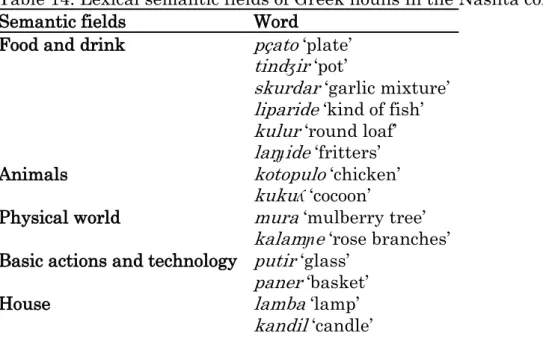
The Nashta corpus shows a variety of nouns in lexical domains which are generally known to be affected by contact. Table 14 illustrates the Greek nouns found in this corpus following an organization by lexical semantic fields.
Table 14. Lexical semantic fields of Greek nouns in the Nashta corpus
Semantic fields Word
Food and drink pçato ‘plate’
tindʒir ‘pot’
skurdar ‘garlic mixture’ liparide ‘kind of fish’ kulur ‘round loaf’ laŋɟide ‘fritters’
Animals kotopulo ‘chicken’
kukuʎ ‘cocoon’
Physical world mura ‘mulberry tree’
kalamɲe ‘rose branches’ Basic actions and technology putir ‘glass’
paner ‘basket’
House lamba ‘lamp’
15 porta ‘door’
skala ‘ladder’
kalmotie ‘rose tree mat’ disko ‘tray’
Time april ‘April’
avɣusto ‘August’
Clothing fustan ‘woman’s dress’
mandil ‘headband’ peto ‘lapel’
sakaki ‘jacket’ kordjele ‘ribbons’ Religion and beliefs prika ‘trousseau’
stefano ‘wedding crown’
Cognition sxoʎo ‘school’
daskal ‘teacher’ matima ‘class’ Social and political relations kratos ‘state’
ðimoprasia ‘bidding’ sklovac ‘little slave’
Law ðikastire ‘court’
Possession foros ‘tax’
ispraktor ‘collector’ Modern world culture aftocinta ‘cars’
tinikie ‘tin jerry cans’ fortoti ‘shipper’
raceta ‘racket’
Quantity çilde ‘a thousand’
Location, buildings cendra ‘clubs’ Spatial relations bala ‘ball’
Kinship andronjino ‘couple’
Body ijia ‘health’
Sense and perception kroto ‘crack’ Verb borrowings
Greek verbs are integrated in Nashta with the Greek aorist marker -s-. In Nashta, however, the -s- aorist marker does not keep the initial aoristic value as it can combine with an imperfective; see sentence 8 in https://doi.org/10.24397/pangloss-0000299 ci plaˈkosaxme and compare with the Greek imperfective form plakoname. Moreover, as can be seen in https://doi.org/10.24397/pangloss-0000343#S10, for the verb ‘to finish’, bitiˈsax, the Greek -s- is used to accommodate Turkish verbs. It is therefore considered as a loan verb marker (glossed LVM).
Borrowability of conjunctions
We note that the adversative ˈama ‘but’ from Turkish is totally absent from the Nashta corpus unlike in most Slavic varieties of the area (Adamou 2016). Indeed, Nashta uses the Greek adversative aˈla, as in sentence 25,
16 https://doi.org/10.24397/pangloss-0000317 aˈla i ˈdʲatsa-ta. We note the use of a different ˈama, from Greek, with a temporal and conditional meaning, as can be seen in sentences 7 ˈama ˈʝide buˈʒik, 25 ˈama ci sa ˈʒenixa, 28 ˈama ci ˈbʲaxa
ˈmnogo iˈsnaf, in https://doi.org/10.24397/pangloss-0000317. The replacement of
the adversative from the current contact-language indicates its high degree of borrowability as suggested in Matras (2007: 54). This is rendered as a borrowability hierarchy: but > or > and. We note, in sentence 22, https://doi.org/10.24397/pangloss-0000317 ˈisʲkaʃ da ti ˈkupime i ˈisʲkaʃ da ti
ˈdaime paˈri, the use of the Greek i ‘or’, and in sentence 21 the homophonous
native i ‘and’, ˈsʲakoj iˈdin ˈberət paˈri i mu ˈdavat (note that the Greek coordinator ke ‘and’ is not borrowed).
Borrowability of numerals
In Nashta, numerals below 5 are native and we also note that this is the case for 100; see sentence 34 in Text https://doi.org/10.24397/pangloss-0000321, sto
ˈfraŋga. The years are generally in Greek; see sentences 8, naˈpret ut
triandaˈeksʲi, and 31, to ksʲinda oˈkto eksʲinda eˈɲa, both in Text https://doi.org/10.24397/pangloss-0000321.
Reduplication
Reduplicated forms in Nashta can be used in order to express intensity; see Text https://doi.org/10.24397/pangloss-0000305, sentence 48, e.g.,ˈrano ˈrano ‘very early’.
Lexical semantics
One of the goals of this project was to give access to the original recordings and their annotations. More specifically, the data elicited through visual stimuli allow to unambiguously interpret lexical meanings which may otherwise be misinterpreted by speakers of closely-related languages. For example, in Adamou (2006: 88) the word dəp/dəb-at was glossed and translated as ‘tree’/‘the tree’. In their citation of this example, however, Asenova and Aleksova (2008: 11) based on their knowledge of Bulgarian changed the translation of the word to chêne ‘oak’, as can be seen in the examples below.
Asenova and Aleksova (2008: 11)
На вичеро_т иле_нчето хо_дише, гу ли_жише на дъ_бат, гу чи_нише о_ште по
гул’а_м. (А 88 Ajvatovo, région de Thessalonique)
« Le soir venait le petit cerf, il le léchait, le chêne, ça le rendait encore plus grand. »
На вичеро_т, но_шке кава_ бе_ше, ути_де пак, гу лиза_ уно_ Ø дъ_бат, са чини_
о_ште по гул’ам. (А 88 Ajvatovo, région de Thessalonique)
« Le soir, pendant qu’il faisait nuit, il vint à nouveau, il le lécha, le chêne, il devint encore plus grand. »4
4 We also note the change of the original transcription into Bulgarian script, the absence of the original glosses as well as the absence of
17 Text https://doi.org/10.24397/pangloss-0000309, based on the video stimuli Pear Story, clearly reveals the mistake of the Bulgarian scholars, as it would be rather amusing that the speaker refers to the ‘pears’ in the video as being collected from an ‘oak tree’; ɟi ˈbere ˈprisʲiŋɟi-te ɟi ˈklava ut ˈfut-ta ɟi ˈklava u ˈkoʃnətsə-ta. ˈskal-ta tam
ˈstoi u ˈdəb-at udˈgore. Indeed, it is common in several Balkan Slavic dialects that
the specialized meaning for ‘oak’ has been extended to the more generic meaning ‘tree’.
References
Adamou, E. (2006). Le Nashta. Description d’un parler slave de Grèce en voie de disparition. Munich: Lincom.
Adamou, E. (2009). Le marquage différentiel de l’objet en nashta et en pomaque (Grèce). Retour sur l’hypothèse du contact, Bulletin de la Société de Linguistique de Paris, 104/1: 383-410.
Adamou, E. (2012). Le parfait avec ‘avoir’ dans l’aire balkanique : approche multifactorielle et diversifiée d’un balkanisme. Chamoreau, C. & Goury, L. (eds), Conséquences linguistiques du contact de langues et changements linguistiques. Tendances dans le domaine de la prédication, 101–119. Paris: CNRS éditions.
Adamou, E. (2013). Nashta corpus. doi |doi | doi| doi | doi| doi| doi| doi| doi| doi|
doi| doi| doi | doi| doi
Adamou, E. (2016). A corpus-driven approach to language contact: Endangered languages in a comparative perspective. Berlin & New York: Mouton de Gruyter.
Adamou, E., Breu, W., Scholze, L. & Shen, R. X. (2016). Borrowing and contact intensity: A corpus-driven approach from four Slavic minority languages. Journal of Language Contact 9/3: 515-544.
Asenova, P., & Aleksova, V. (2008). L’aspect balkanique de la nota accusativi personalis. Zeitschrift für Balkanologie 44/1: 1-23.
Bossong, G. (1985). Empirische Universalienforschung. Differentielle Objektmarkierung in den neuiranischen Sprachen. Tübingen: Gunter Narr. Cyxun, G. A. (1981). Tipologičeskie problemy balkanoslavjanskogo jazykovogo
areala. Minsk: Nauka i texnika.
Corbett, G. G. (2013). Number of Genders. In: Dryer, M. S. & Haspelmath, M. (eds.) The World Atlas of Language Structures Online. Leipzig: Max Planck
Institute for Evolutionary Anthropology.
(Available online at http://wals.info/chapter/30, Accessed on 2017-07-25.) Dryer, M. S. (2013). Definite Articles. In: Dryer, M. S. & Haspelmath, M.
(eds.) The World Atlas of Language Structures Online. Leipzig: Max Planck
Institute for Evolutionary Anthropology.
(Available online at http://wals.info/chapter/37, Accessed on 2017-07-25.) Dryer, M. S. (2013). Indefinite Articles. In: Dryer, M. S. & Haspelmath, M.
(eds.) The World Atlas of Language Structures Online. Leipzig: Max Planck
Institute for Evolutionary Anthropology.
(Available online at http://wals.info/chapter/38, Accessed on 2017-07-25.) Dryer, M. S. (2013). Order of Subject and Verb. In: Dryer, M. S. & Haspelmath,
18
Planck Institute for Evolutionary Anthropology.
(Available online at http://wals.info/chapter/82, Accessed on 2017-07-25.) Dryer, M. S. (2013). Order of Adposition and Noun Phrase. In: Dryer, M. S. &
Haspelmath, M. (eds.) The World Atlas of Language Structures Online. Leipzig: Max Planck Institute for Evolutionary Anthropology. (Available online at http://wals.info/chapter/85, Accessed on 2017-07-25.) Dryer, M. S. (2013). Order of Adjective and Noun. In: Dryer, M. S. & Haspelmath,
M. (eds.) The World Atlas of Language Structures Online. Leipzig: Max
Planck Institute for Evolutionary Anthropology.
(Available online at http://wals.info/chapter/87, Accessed on 2017-07-25.) Dryer, M. S. (2013). Order of Demonstrative and Noun. In: Dryer, M. S. &
Haspelmath, M. (eds.) The World Atlas of Language Structures Online. Leipzig: Max Planck Institute for Evolutionary Anthropology. (Available online at http://wals.info/chapter/88, Accessed on 2017-07-25.) Dryer, M. S. (2013). Order of Degree Word and Adjective. In: Dryer, M. S. &
Haspelmath, M. (eds.) The World Atlas of Language Structures Online. Leipzig: Max Planck Institute for Evolutionary Anthropology. (Available online at http://wals.info/chapter/91, Accessed on 2017-07-25.) Dryer, M. S. (2013). Relationship between the Order of Object and Verb and the
Order of Adposition and Noun Phrase. In: Dryer, M. S. & Haspelmath, M. (eds.) The World Atlas of Language Structures Online. Leipzig: Max Planck
Institute for Evolutionary Anthropology.
(Available online at http://wals.info/chapter/95, Accessed on 2017-07-25.) Dryer, M. S. (2013). Relationship between the Order of Object and Verb and the
Order of Adjective and Noun. In: Dryer, M. S. & Haspelmath, M. (eds.) The World Atlas of Language Structures Online. Leipzig: Max Planck Institute for
Evolutionary Anthropology.
(Available online at http://wals.info/chapter/97, Accessed on 2017-07-25.) Dryer, M. S. (2013). Expression of Pronominal Subjects. In: Dryer, M. S. &
Haspelmath, M. (eds.) The World Atlas of Language Structures Online. Leipzig: Max Planck Institute for Evolutionary Anthropology. (Available online at http://wals.info/chapter/101, Accessed on 2017-07-25.) Koneski, B., Vidoeski, B., & Jašar-Nasteva, O. (1968). Distribution des
balkanismes en macédonien. In Actes du premier congrès international des études balkaniques et sud-est européennes, 1966, 517-546. Sofia.
Krauss, M. (2006). Classification and terminology for degrees of languages
endangerment. In M. Brenzinger (ed.), Language Diversity Endangered, 1-8. Berlin: Mouton de Gruyter.
Lazard, G. (2001). Le marquage différentiel de l’objet. In Haspelmath M., König E., & Oesterreicher W., Language Typology and Language Universals, vol. 2, 873-885. Berlin & New York: Mouton de Gruyter.
Lemerle, P. (1979 t. 1, 1981 t. 2). Les plus anciens recueils des miracles de Saint Démétrius. Paris: CNRS éditions.
Markovik, M. (2007). Aromanskiot i makedonskiot govor od ohridsko-strushkiot region. Skopje: MANY.
Matras, Y. (2007). The borrowability of structural categories. In Y. Matras, & J. Sakel, Grammatical borrowing in cross-linguistic survey, 31–73. Berlin & New York: Mouton de Gruyter.
19 Siewierska, A. (2013). Alignment of Verbal Person Marking. In: Dryer, Matthew S. & Haspelmath, Martin (eds.) The World Atlas of Language Structures Online. Leipzig: Max Planck Institute for Evolutionary Anthropology. (Available online at http://wals.info/chapter/100, Accessed on 2017-07-25.) Sobolev, A. (2008). On some Aromanian grammatical patterns in the Balkan
Slavonic dialects. In The Romance Balkans, Collection of papers presented at the International Conference The Romance Balkans, 113-121. Belgrad.
Topolinjska, Z. (1995). Makedonskite dijalekti vo Egejska makedonja. Skopje: Makedonska akademija na naukite i umetnostite.
Stassen, L. (2013). Predicative Adjectives. In: Dryer, M. S. & Haspelmath, M. (eds.) The World Atlas of Language Structures Online. Leipzig: Max Planck
Institute for Evolutionary Anthropology.
(Available online at http://wals.info/chapter/118, Accessed on 2017-07-25.) Stassen, L. (2013). Nominal and Locational Predication. In: Dryer, M. S. &
Haspelmath, M. (eds.) The World Atlas of Language Structures Online. Leipzig: Max Planck Institute for Evolutionary Anthropology. (Available online at http://wals.info/chapter/119, Accessed on 2017-07-25.) Tabula Imperii Romani K 34. (1976). Slovenska: Union académique