C.2
C^?jy
WORKING
PAPER
ALFRED
P.SLOAN
SCHOOL
OF
MANAGEMENT
BURNOUT
THE EFFECT OF JUNGIAN TYPE
by Anna-Maria Garden WP 1588-84
MASSACHUSETTS
INSTITUTE
OF
TECHNOLOGY
50MEMORIAL
DRIVE
CAMBRIDGE,
MASSACHUSETTS
02139by
Anna-Maria Garden WP 1588-8A
CONTENTS
Page
-Introduction 2
-What is Burnout? 4
-Resolving the Definitional Confusion 6
-Analysis of the Effect of the Two Underlying Assumptions
(a) Burnout is Primarily Associated With "People Professions" 9
(b) Burnout is What You Observe It to Be 15
-Overall Conceptual Framework 19
-Methodology 21
(a) Tools of Analysis
(i) The Depletion Index 21
(ii)The Personality Indicator 25
(b) Research Design
(i) The Sample 30
(ii)Data Collection 32
-Empirical Results
Finding Depersonalization 34
The Nature of the Various Reactions to People 37
Interpretation of the Different Reactions to People 40
Role of Individual Type 43
Explanation of Reversion 52 Summary of Results 53 -Conclusion 55 -Bibliography 57 -Appendices A. The Questionnaire 62
B. The MBTI and Jungian Theory 64
C. Construction of the Depletion Index 68
INTRODUCTION
This paper is concerned with a phenomenon which has recently received
enormous attention from the public, the media, people professions and certain
sections of academia in the United States.
A
word, "burnout", which wasbarely known at the beginning of the 70's, at least in its association with
people at work, has become part of the common lexicon within a decade. To
some this is simply an indication of the seriousness and pervasiveness of a
real problem; to others such sudden popularity suggests it is merely the latest media-created fashionable neurosis. The working assumption underlying
this paper, and my belief, is that burnout is a real and distressing problem and is not simply an old ill with a new label. Whatever one chooses to
believe, it is clear that the popularity, if not faddishness, of the topic has had a strong influence on the field, and whilst the term itself is commonly
known, it is variously and usually inaccurately understood.
Not all the blame however, can be attributed to the concept's popularity for even within the academic or empirical arena, the research and writing has
neither been directed towards, nor has achieved, a clear grounded view of what
burnout is all about. For example, most of the research has focused on correlating a specific, postulated measure of burnout with other variables,
[e.g. Pines et al., 1981; Berkeley Planning Associates, 1977; Gann, 1979.], rather than on whether or not that particular measure of burnout really Is
referring to burnout and nothing else. The various measures and definitions used in this way in the field are quite different from each other, although each purports to relate to "the" burnout syndrome or "the" burnout process.
Another influence on the "state of the art " In the field is that, for
those who "believe in it", burnout is a "real world" problem and as such draws the involvement of practitioners as well as academics. This has led to the
conflict between the need to do something about the problem immediately (to
create an inventory to measure burnout, for example), and the need to know
more exactly what it is we are "doing something about" (to make sure the
inventory really is measuring burnout, for example).
Thus both the popularity of the topic as well as the pragmatic immediacy of the orientation have influenced the development of the field. In addition, the very youth of the field means that the available literature is still small
and there has been very little empirical research. For all these reasons the
field remains one which is still beset with many unresolved definitional and
methodological issues, and there exists considerable uncertainty about the
characteristics, causes and consequences of burnout. Those who are considered the "leaders of the field" have themselved been "critical of much that has
been said and done in the name of burnout" (Maslach,1982,p30). Perlman and
Hartman in a 1980 review article concluded "It cannot be overemphasised that thus far burnout has been primarily, if not entirely, a descriptive term yielding little insight into explaining its causes, prevention and cures"
(Perlman and Hartman, 1980, p. 302).
Perhaps the most serious issue, within this overall state of confusion,
is the fact that nobody actually knows what burnout is. This lack of a
precise understanding about the true nature of this phenomenon is
acknowledged. As Maslach has stated "to understand burnout, we need to know
first what it is. Herein lies the major source of confusion and controversy about the concept" (Maslach, 1982, p. 30). Paine, the editor of a review book on burnout, cited "identification of burnout to be one of the major goals for
the field to adopt In the future" (Paine, 1982, p. 19). "Until this confusion
over definitions is dispelled, little progress can be made in identifying
causes and cures". The present paper attempts to make some headway in
dispelling such confusion.
WHAT IS BURNOUT?
Burnout is both a metaphor and label, sign and symbol, but it is its
evocative quality which registers. Freudenberger, who first applied the term
to the occupational setting in the early 70's, has described the way he hit
upon the term for the phenomenon he observed and himself experienced. "In talking to some of these people...1 began to use the term
"Bum
Out" and each time I did, I got a profound reaction. Immediate identification."(Freudenberger, 1980, p. xvii).
Whilst this evocative quality enables a reasonable "ball park"
understanding of what is being referred to, this same quality can create
considerable difficulty when attempting to create a definition or to
operationalize the concept. It is in the very nature of a metaphor to convey
different interpretations to different people.
As Maslach has pointed out in a review article on the definitions of
burnout "for some authors burnout is an internal 'fire' that consumes the person, leaving them burnt out, while for other authors the fire is external to the individual and the person is like a pot being heated up" (Maslach,
1982, p. 37). Many authors rely only on the evocative image created rather
than precisely "nailing down" what is being described. Some writers rely solely on the general meaning conveyed by a dictionary. Others, like
Freudenberger, use a dictionary definition although he also puts forward his
one's physical and mental resources. To wear oneself out by excessively
striving to reach some unrealistic expectation imposed by one's self or by the values of society" (Freudenberger, 1980, p. 17).
Some of the other "main" definitions in the field are that of Berkeley Planning Associates (1977) who define burnout as "estrangement from clients
co-workers, job and agency," sounding very like job alienation. Pines et al. (1981, p. 3) define It as "a state of mind which frequently afflicts
individuals who work with other people... and who pour in much more than they
get back from their clients, supervisors and colleagues", and also as a state of "physical, emotional and mental exhaustion" (p. 15). Veninga and Spradley include behavioural symptoms in their definition: "a debilitating
psychological condition brought about by unrelieved work stress which results
in:
(1) depleted energy reserves.
(2) lowered resistance to Illness.
(3) increased dissatisfaction and pessimism.
(4) increased absenteeism and inefficiency."
(Veninga and Spradley, 1981, p. 6)
Chemiss,
in one definition, states it is "a process in which a previouslycommitted professional disengages from his or her work in response to stress
and strain experienced in the job" (1980, p. 18).
The above definitions illustrate the variation which exists in terms of
breadth, the level of the phenomenon being referred to, reference to
behaviours or purely to a psychological state, whether It is a process or a
syndrome, etc. It is clear, also, that some definitions are making
fundamental assumptions about burnout intrinsic to their definition without empirically testing those assumptions.
Chemiss,
for example, appears todefinition,
bum
out. Similarly, he presumes burnout is caused by stress, and that it is located within the work-sphere. One could not, according to thisdefinition,
bum
out from a relationship or "way of life" as Freudenberger asserts.Some of these definitions illustrate more clearly than others the degree to which they have been derived from the particular setting in which
observations have been made (e.g.. Pines, et al. and the Berkeley Planning Associates). Since
Chemiss,
Maslach and the Berkeley Planning Associateshave focused primarily if not exclusively on human service workers as they
perform their jobs, it is not surprising that their definitions reflect that setting. Freudenberger, as a practising psychoanalyst, observes his subjects away from the work sphere and has not, therefore, restricted his definition
in the same way.
It should be noted that, while the definitions within the field are
varied there is more commonality in the descriptions. There the reader can
sense the "sameness" in the quality of the experience being described.
Indeed, without the description, it is often very difficult to get an idea of
what exactly is being referred to. From the definition alone of Berkeley
Planning Associates, for example, one would not necessarily infer that burnout
was the phenomenon in question.
RESOLVING THE DEFINITIONAL CONFUSION
The above brief overview of how burnout is presently defined has
illustrated some of the issues in formulating a clear precise view of what this nebulous phenomenon is all about.
There have been a number of approaches suggested to resolve these basic
acceptance of a single standard definition. Perlman and Hartman (1980, p. 292), who attribute the confusion to overly simple data analysis techniques, encourage the use of more sophisticated statistical techniques, and also try to resolve the definitional confusion by performing a content analysis on all the existing definitions in order to derive an overall one for the field to
adopt. Others (e.g. Shlnn, 1982, p. 38) suggest the adoption of a rigorous
model to guide research, using an existing definition/measure.
The approach taken in this paper, directed towards the same goal of
bringing order out of the definitional confusion, is different from any of those suggested above. My view of what is the ultimate cause of the
definitional problems is the existence in the field of pervasive underlying
and untested assumptions about what burnout is. Because these assumptions are
questionable and In need of validation, approaches based on the use of existing definitions or measures, on more sophisticated statistical
techniques, or on content analysis of existing definitions will still be beset
with problems since they each presume the correctness of those underlying
assumptions.
Two of these underlying assumptions commonly held within the field are
focused on in this paper. These are:
(a) burnout is a phenomenon primarily if not exclusively associated
with "people professions."
(b) burnout is what you observe it to be.
It should be emphasized that each of the above is an assumption. They
have not been empirically tested yet almost all writing and research in the
field derives from them; and each of these assumptions Influences the
description and definition of what burnout i^. The first assumption has
second has arisen from confusion over levels of analysis and over levels of the burnout phenomenon Itself. The issue here is primarily that of construct
validity.
The definition I have chosen to test those assumptions and issues with,
and to examine its validity as a generic definition, is that of Maslach. She defines burnout as "a syndrome of: (a) emotional exhaustion, (b)
depersonalisation, and (c) lowered productivity" (Maslach, 1982, p. 3). These
three defining dimensions are the same as those used to measure burnout in the Maslach Burnout Inventory (Maslach and Jackson, 1981) . The latter is now the
most widely used measure of burnout (Shinn, 1982, p. 64), and her definition
is widely used and quoted by other authors, (e.g. Gann, 1979) as the basis for
their own research and writing. Apart from its use and acceptance in its own right, one major review article (Perlman and Hartman, 1980) proposes a
definition for the field to adopt which appears to derive primarily from
Maslach's own. In the light of its obvious influence in the field it is a
definition which warrants examination.
The dimension of her definition which seems most entwined in these
assumptions is that of "depersonalisation". Thus it is this "second aspect
of the burnout syndrome" on which I concentrate to answer the immediate
research question: is depersonalisation an intrinsic and generic dimension of
burnout? The answer to this question should itself shed light on what burnout really is, this being the overarching question which the research is directed
towards
In what follows I shall first outline the effect which these two
assumptions have had on the understanding of what burnout is, focusing in particular on Maslach's definition. This will provide the context for the
subsequent discussion of the conceptual and methodological framework I use to
examine the assumptions empirically.
ANALYSIS OF THE EFFECT OF THE TWO UNDERLYING ASSUMPTIONS
(a) Burnout Is primarily, If not exclusively, associated with people
professions, i.e. the "human services."
Maslach states that "at first burnout was considered a problem that was
found primarily (if not exclusively) within the helping professions" (1982, p.
33), and appears to criticize subsequent researchers who have "expanded" the
concept to other occupations. In fact, however, burnout, as it was applied to
the occupational sphere, was first associated with the fields of professional
athletics and the performing arts in the 1930's (Paine 1982, p. 12), and has continued to be associated with them (see William Safire NYT, 23 May, 1982).
It has only been in the 1970's that the concept has been "restricted" to the "helping professions.
The majority of work done in the field in the 70's has limited Itself to
this occupational sphere, that of "people professions", or the "human
services." Most of this work has concentrated on health-care. At the same
time that most observation has been carried out in the human ser-vlces, there
has developed the notion that burnout itself is primarily to be found in this
sphere; that such jobs are more prone to burnout than others. Carroll and White, for example, state "Burnout Is especially common and severe among professionals who deliver direct care and assistance to emotionally
distressed, indigent clients in public institutions or agencies " (Carroll and
White, 1982, p. 46). Veninga and Spradley (1982, p. 13) call the helping professions "high risk" occupations.
However there is, as yet, no empirical evidence or convincing logical argument to support this frequent assertion. Only one study has attempted any comparative occupational analysis and the results of this did not support the
assumption (Pines et al. 1981, p. 172 ). Are there logical a priori reasons
to expect the assumption to be true, then? This is difficult to ascertain for
the assertion that it is the case is not usually accompanied by a supporting
argument with which one might validate the logical deduction behind the
claim. The justifications which have been put forward are not convincing,
however, and are themselves fraught with numerous questionable assumptions.
For example, the notion that human service work is "particulary stressful"
(Veninga and Spradley, 1981, p. 223) and, as a result, more likely to induce burnout, is conditioned on two further untested assumptions. First, the
assumption that burnout is a stress response is highly questionable and in
need of justification. Secondly, the implicit assumption that human service
work is more stressful than other occupations is a moot point. As Shinn (1982, p. 72) states, "several authors have described the special stresses of
human service work,...other workers like air traffic controllers and bomb
squad members, also experience high levels of stress."
Thus, just because burnout has primarily been found in the human
services does not prove that these occupations are more prone to burnout. All It reflects so far is that that is where most people have looked for it.
Interestingly, if one looks at the work of those few authors outside the human
seirvices field, one finds that they too think "their" area is particularly prone to burnout. Levinson, for example, states "many contemporary managerial
situations provide the perfect breeding ground for cases of burnout." (Levinson, 1981, p. 77)
primarily to do with generalizability. For the present purposes, the
important point is the effect of this assumption on the conventional wisdom
about what burnout is. What is claimed to be "the burnout syndrome" or "the burnout process" may have been fundamentally influenced by particular and
specific variables salient only to that observational setting. For example, "working with people" has come to be seen as intrinsic to burnout because most
authors have only looked at those situations where the work requires "working
with people." But in addition to the association with "people" which has
arisen from concentration on this one occupational sphere, the fact that the
function in this sphere is to respond to people's needs, people's problems, "emotional demands", and involves a "social interaction" with people has led
to burnout being defined or described as being intrinsically associated with
or caused by emotional demands (rather than, say, mental demands), and the need to help or give (rather than, say, the need to create or to achieve). Because burnout has been defined along these dimensions, it is then assumed that in applying the concept of burnout to other arenas one still identifies burnout by these same dimensions. However, Ginsburg (1974, p. 599) in
discussing the process of burnout in the "burned out executive" identifies burnout in very different ways than "emotional demands", "working with people"
or the "social interaction" between two people. Instead, the precursors are described as "the crawl or climb to the top has been...so tough,
tension-filled and debilitating, that once there, the base has been firmly laid for a good case of being Burned Out. Also, when finally at the top, the
pressures to prove that one is the best man for the office; to put one's
individual stamp as quickly as possible on the organization; to be strong, dynamic, decisive, innovative and right-all serve to produce additional tensions which in time bring on the Burned Out syndrome." Indeed, the
description of the process of burnout in executives is so markedly different
one would have a very different conventional wisdom of what burnout is if the
majority of research had been concentrated in that sphere. Thus, the type of
"situation" i.e., human services, can be expected to have influenced the understanding of what burnout itself is. To ignore the role of the
"situation" in influencing what one "sees" burnout to be, is to ignore the
elementary need to establish generalisabiltity. As a consequence, what it has
been assumed to be may be not transferable to other work settings, and may
also be incorrect as a picture of the true dimensions of burnout.
A
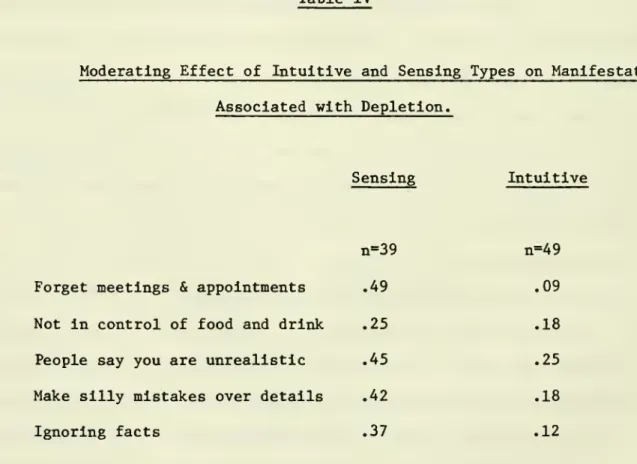
related issue, arising from the predominance of research in this onefield, is that there is evidence to suggest that one type of individual is over-represented in the human services. There is a considerable amount of
evidence to support the notion that different occupations attract different
types of people (Keen 1981, p. 6). This is so for the psychological types described by the typology of Carl Jung (Jung 1921), as operationalised by the
Myers Briggs Type Indicator (MBTI). McCaulley, in her review article (1982,
p. 327) stated "It is known... that the humanistic, enthusiastic, and 2
Insightful NFs are significantly attracted to the humanities, counselling, psychology and psychiatry (Barberousse, 1975; Conary, 1965; McCaulley, 1973,
1978). The sympathetic and friendly SF types tend to be attracted to
^ The means of mapping personality attributes is the Jungian typology which
is operationalised by the MBTI. Appendix B provides more detail on both.
2 An NF is an intuitive feeling type and an SF Is a sensing feeling type as per the MBTI.
elementary school teaching (Cage and Austin, 1979; Carlyn, 1976; McCaulley, 1973) and to bedside nursing, general practice, and patient care at
professional and para-professional levels" (McCaulley, 1977, 1978). There have been numerous tests of the intercorrelations between the MBTI dimensions and other personality inventories. Of interest here, the feeling dimension of
the MBTI is associated with being "tender minded on the 16PF; in terms of
career it is associated with the social services, the ministry, teaching and
consulting" (Carskadon 1979b).
In other words, based on previous studies, the feeling dimension as opposed to the thinking dimension is associated with those human service
workers studied in the burnout field. Although the role of personality
factors in burnout is a seriously neglected issue in the field, it is
acknowledged by some authors that individual "personality" factors will affect
the degree of burnout reaction, and coping response (Welch et al., 1982,
Chemiss,
1980). The predominance of one psychological type of individual inone's sample, therefore, may influence the manifestations and dimensions of
burnout seen and inferred as well as one's predisposition to
bum
out. Again,this raises questions about the generalizability of results to other spheres,
when those notions have been derived from a setting with a concentration of
one 'type' of person.
Both Maslach's definition and the instrument used to measure
bum
out,the Maslach Burnout Inventory, provide good examples of the issues involved.
It is clear that the observations and investigations which led to these
formulations of burnout were solely from the human services arena. The
Inclusion of depersonalization was based on a factor analysis performed on
questionnaire data administered to workers in the human services. The point to note is that the items originally chosen for that factor analysis which
determined the dimensions of the definition were Items directly related to
human services work. These ultimately, then, prescribed and proscribed the
resultant definition of burnout. To the extent that those items (and the
preceding observations) are sltuationally-specific and not transferable outside the human services, then so also must the resultant definition be.
Testing of the dimensionality of the MBI outside the human services has
not, however, been carried out. An interesting attempt to assess its
generalisability was conducted by Golemblewski (1983) in an R&D setting. This
study provides a good example of the effect of the untested Implicit
assumptions discussed earlier, on burnout research. Thus, whilst the wording
of the MBI questions was altered from referring to "clients", to "work
colleagues", the assumption that the relevant dimensions by which to measure
burnout are still people-oriented is based on the questionable premise that it
Is Indeed people-related reactions which are salient to burnout in such work
settings as an R&D organisation. Moreover, this research did not provide a
test of the generalisability of the MBI dimensions since, by using the MBI, it
assumed the salience of these three dimensions in an R&D setting without directly testing their relative Importance.
A
valid test of the MBIdimensionality in other work settings would require a similar factor analysis
procedure of a range of items, to see if the same three factors emerged.
All in all, then, there are a number of reasons to question whether or
in what way the human services setting has Influenced the understanding of
what burnout is, whether Maslach's definition and measurement index are
generalizable and if they are not what does that imply about their accuracy
b) Burnout Is what you observe It to be.
This assumption is usually left implicit rather than being made
explicit. It refers to the tendency to eqtiate what burnout "is" either with
what it is seen or felt to be in overt behaviour, or with what can be directly
inferred from such behaviour. To illustrate, even though Maslach has stated
(1982, p. 32) that it is generally acknowledged that burnout is an internal psychological experience, behaviours and outcomes are included in various definitions, including Maslach's own, (i.e. lowered productivity). Even an affective dimension like depersonalization is primarily interpreted in terms
of its behavioural manifestations. On a priori grounds, burnout may not be what it is observed to be for the simple reason that the "actual thing" may not itself be observable. The issue at stake is one of being clear about what level of reality or level of sensation one is assuming burnout to be and, more
simply, recognizing that one is assuming a particular level. Even as an intra-psychic process, dealing solely in terms of cognitive or affective
states, one also needs to distinguish between levels of reality. For example,
whilst it is relatively easy to see that physiological changes such as
lingering colds, gastrointestinal disturbances, may be "symptoms" of burnout,
it is normally assumed that an affective or cognitive change l£ burnout,
rather than that they might themselves be "symptoms" of burnout. In Maslach's
definition, it is easy to question "lowered productivity" as a definitional component purely on the grounds that it is a behavioural outcome and not
itself an "internal psychological experience". However, what of the other two dimensions: "emotional exhaustion" and "depersonalization". Might these not also be outcomes or symptoms of burnout?
If we look at other definitions, for example, is burnout intrinsically "estrangement from clients, etc." (Berkeley Planning Associates) or
Intrinsically "disengagement" from work
(Chemlss)
or are these too, likedepersonalization and exhaustion, merely outcomes of a deeper, underlying
process or condition? Can one claim that the essence of burnout Is at this
level of reality? We need to be sure not only of what burnout Is, but where
it is. One of the few authors to be mindful of this issue is Meyer (1979)
whose doctoral dissertation takes a phenomenological approach in trying to
understand the "what" and "where" of burnout. What emerges from his research
is a view of burnout as a "two-stage process". It was during the
data-collection process that he first noticed the distinction between burnout
as something beginning "inside" but manifested as a "felt experience of
burnout" (p. 63). What is common to all his interviewees is that their
explanations of what burnout means to them are "only descriptive observable symptoms of burnout. These responses do not fully address the meaning of the
concept, its causes, or the developmental course of the phenomenon."
Thus most professionals, when viewing burnout, are only aware of their
own reactions: "feeling overwhelmed", "anxious" or "fatigued" (p. 101).
However, what is also clear is a stage preceding these reactions. This first
stage, termed an "incubation period", is unconscious. Meyer asserts that it
consists of a re-socialization process or an interaction between the
individual's personality and the organizaton. The correctness or otherwise of
the substantive nature of this incubation period does not matter here so much
as the very existence of some such process. (The substantive nature Meyer
attributes to it may have been influenced by the characteristics of his own
sample, who were all human service workers, and his apparent assumption that
burnout is a job-focused phenomenon.) This unconscious incubation period, involving a form of inner psychic conflict, then results in a "reaction", the
second stage of the burnout process. This is an awareness stage, "when the
worker is consciously aware that "something is going on." This something is
manifested by the symptoms referred to by the individuals throughout this study as burnout" (p. 101).
The overwhelming majority of authors in the field have defined and
described burnout solely in terms of Meyer's "reaction stage", as the previous section on definitions in the field illustrates. His research suggests the
need to examine further whether this stage is indeed preceded by an
unconscious stage or, even further, whether burnout is only that preceding
stage. In the present study this means that any affective sensation, such as depersonalisation, cannot a priori be taken as being a dimension of burnout without examining if there is anything going on underneath or preceding that
sensation.
Leaving aside the question of whether burnout is partly or even wholly
something underlying the affective, cognitive and physiological reactions, there remains another major source of confusion in the literature arising from
the lack of distinction being made between the level of measurement and the
level of the phenomenon.
Consider the methodology used to establish depersonalization as a
"definitional" component of burnout. Depersonalization emerged as one of
three factors with an eigen value greater than one from a factor analysis
performed on 47 items. These three factors were then taken to be the
dimensions with which to measure burnout with the MBI and also the defining
dimensions of the burnout syndome.
A
number of points need to be made aboutthis methodology.
The form of factor analysis used by Maslach is an exploratory device,
It is not in the power of factor analysis to do so. At best, it is a means of ordering items into statistically-related categories. These categories are
not necessarily in the same order or level of reality as the phenomenon
Itself; they may simply be a way of ordering at the symptom level. The
factors which emerged are constrained to the nature or level of the phenomenon
addressed by the original questions. Whether this really is the level at
which burnout "is", is an empirical question, and one not solvable solely by a
methodology of factor analysis. This is illustrated further by considering
the use of a cut-off point of an eigen value greater than one. One wonders what the scree test (Gorush 1974), an alternative criterion, would have
indicated; that there should have been only two factors and, hence, there
would only be two "key" dimensions of burnout not three? The point is that
either criterion is arbitrary and that what emerges from using either cannot
be treated as proven or factual.
Thus, both the arbitrary nature of the data analysis technique and the original inclusion of items, precludes assuming the definitiveness of what emerges. In addition, care must be taken in claiming support for what burnout is by support for a measurement index of burnout, such as the MBI. For
example, the use of dimensions of emotional exhaustion, depersonalization and lowered productivity may be able (statistically) to indicate who is more or
less burnt out. This does not mean those same dimensions necessarily
OVIRALL CONCEPTUAL FRAMEWORK.
The above discussion has indicated the way in which the two assumptions
have influenced the understanding of what burnout is, particularly with
reference to Maslach's definition. To the extent that they are invalid, then the derived understanding of burnout may also be. On logical a priori grounds
I have tried to establish that there are sound reasons for suspecting their validity, and in the process of doing so, raised a number of questions which
need to be answered. In the light of the preceding arguments, it would seem inappropriate to mount a study of burnout using any of the existing measures or definitions of burnout which are based on the above questionable premises.
What I have chosen to do, instead, is begin with a heuristic tool
through which burnout can be gauged. There is no presumption that I know, at
the outset, what burnout itself really is. The point is, instead, to use this
indicator of burnout as an exploratory tool to find out more about what It
really is. Since for reasons elaborated in the next section, this tool enables identification of burnout in any sample, it is possible to use it to
assess whether other postulated manifestations or symptoms of burnout are
present in my own sample, thus testing the generalisability of those
postulated dimensions or symptoms. In particular, it will enable testing of
Maslach's claim that depersonalisation is a defining dimension of burnout. The
concept of depersonalisation is, in turn, being used as another heuristic
device with which to examine the assumptions common to the whole burnout
literature.
The means by which I test the generalisability of depersonalisation is
operationalises that theory, the Myers Brlggs Type Indicator. With this
Indicator, a sample of respondents who are measured on burnout can be divided into different Jungian types to see if depersonalisation is equally relevant
across types. In order to do this it was decided to choose a sample which
would differ from the human services both in terms of the 'situation', and the
predominant Jungian type. The sample chosen, mid-career MBA's, were clearly
not working in a human services or "helping" environment; they were not
concerned with helping people in need, nor was there any social interaction
with "recipients". Further, as business school students they were expected to
be, and proved to be, predominantly 'thinking' types rather than 'feeling'
types, in terms of the MBTI (80% of the sample were 'thinking' types; roughly the same as in the MBA population as a whole). Thus the difference in
'situation' and the different concentration of psychological types enables
examination of issues of generalisability.
This in turn enables examination of the assumption concerning the level
at which the burnout phenomenon is supposed to be. A dimension or
manifestation of burnout which pertains to all individuals irrespective of
their type will say something very different about the phenomenon than a manifestation which varies depending on the type of individual experiencing
burnout, for the latter is more likely to be a response whose nature is mediated by qualities within the individual, rather than being intrinsic to
burnout. The aim of this part of the research is key. It is to edge more closely to the common essence of burnout by examining whether supposedly
intrinsic dimensions are simply symptoms applying to some individuals and not others
Overall, then, this research takes an exploratory approach to uncovering what burnout really is. The necessary limitations in scope of the present
paper has meant that it has only been possible, thus far, to concentrate on what burnout can not be stated to be rather than what it can be stated to be.
In view of the need to go back to basics and begin again, this can be seen as
a necessary first step.
METHODOLOGY
(a)Tools of Analysis
(i)The Depletion Index.
The heuristic tool mentioned above, which will be used to gauge burnout,
is an index of the most generally agreed element of burnout, i.e. the
sensation of depletion of energy, chronic exhaustion or fatigue. It does not
matter at this stage whether we consider this energy depletion to be an intrinsic core of burnout, a means of measuring it or a symptom of something
deeper. The point is that this element can be used as a key indicator of
burnout and thereby enables us to test for a number of supposed other elements of burnout. The reasons why this depletion of energy can serve this function
are:
(a) the dimension of burnout for which there is most definitional
agreement is this energy depletion. (1). Irrespective of the adequacy of these definitions as "definitions", it is still important that most refer to the exhaustion/depletion as a key component (see Khalsa (1978),
Collins (1977), Freudenberger (1980), Pines et al. (1981), Mitchell (1977).
(b) Aside from definitions, I know of no author who has described
burnout without mention of this feature of depletion or exhaustion,
which may be termed "inability to mobilise" oneself as per Potter
(1979), or something similar. Maslach (1982, p.32) states that the
exhaustion is also described as wearing out, loss of energy, depletion,
debilitation and fatigue. Although sometimes this exhaustion is a
physical one, more often a psychological or emotional exhaustion is described as central to burnout.
(c) Most important, authors outside the human services field include
energy depletion as a key dimension in their discussion. (Collins
(1977), Mitchell (1977), Freudenberger (1974, 1980), Veninga and
Spradley (1981).
(d) It is my experience that the key term which will identify to people
the state of burnout is to Indicate the depletion/exhaustion.
(e) Other "key" characteristics of burnout are derived directly from the
notion of energy depletion. In this I would Include the common notion
of it being a "struggle to get through the day".
(f It is also usually cited as the first or best indication.
Freudenberger states "one of the surest ways you can tell if you're
burning out is to look at your energy level. If it is noticeably lower than it used to be something is wrong." (Freudenberger, 1980, p.43).
Veninga and Spradley (1981) also cite "depleted energy reserves" as one of the first consequences of burnout.
In sum, to describe someone as "burnt out" is to describe that person
additional characteristic or attribute which may also be included. In the
delightful words of the Tubesings (1982, p.156) burnout is a "personal energy crisis". Indeed this notion of burnout underpins their whole approach,
leading them to consider "energy conservation or replenishment" and "personal energy spending patterns" as ways to understand the phenomenon.
At the experiential level, then, what appears to be the most crucial element, irrespective of situation or type of person, is this personal energy crisis. My belief, and working assumption, is that this is burnout's key trademark which, if not present, means we do not have a case of burnout. It is a necessary condition to identify someone as burned out (or burning out)
and it may turn out to be a sufficient condition. This is not to assume that
it is a defining element; it may or may not be. (Note that in Maslach's schema, depersonalisation follows from what is termed "emotional exhaustion".
Thus even within her schema only, an index of energy depletion or exhaustion
would represent a necessary condition.
Let us look a little closer at the notion of energy depletion, however, for it is of a particular nature and it is chronic, and unless the exhaustion being referred to is chronic then, again, we are not looking at burnout but ordinary fatigue or temporary "acute" fatigue.
Potter (1979, p.9) describes someone who is burnt out as follows, "the person cannot muster enough energy to participate in life...The vital driving force has become a whimper•••The cycle rarely stops by Itself." Freudenberger
(1980, p.13 and p.45) describes burnout as a "depletion of the individual's resources, an attrition of his vitality, energy and ability to function",
"that exhaustion seems to follow you and affect everything you touch. You go to sleep with it, you wake up with it." Veninga and Spradley (1981, p7)
exhaustion, weariness, loss of enthusiasm. They feel tired when they go to
bed and also when they wake up". One final Illustration: Welch et al. (1982,
p. 6) state "one of the first symptoms of burnout Is fatigue, a general
all-round tiredness which carries over from work to home." This burnout-type
of energy depletion is, then, chronic and all-encompassing.
What we have described above is not an ordinary type of physical fatigue
which might arise from, say, too little sleep or too much physical activity.
On the contrary many authors (e.g., Freudenberger (1980), Welch et al. (1982)
cite vigorous physical activity as a key relief for the distress of burnout in
order to physically exhaust the person. Nor can this depletion of energy be thought of as simply depression and the fact that a separate and distinct
Depletion factor as well as a Depression factor emerged from the data supports
this. (Refer to Appendix C. Note that the key component of the Depression
factor is the idea of imprisonment, and helplessness, themes which are not
contained in, or allied with, the themes implicit in the Depletion factor.) Furthermore, remedies which might normally be used to cope with ordinary
fatigue, such as sleep, rest or a vacation do not work. (Welch et al, 1982,
p. 9). What is sometimes deemed necessary to "cure" burnout is a "life change,
an altered direction." (Tubeslng et al. 1980, p.156).
Why should a "depletion of energy" or "chronic exhaustion" usually
require the fundamental re-structuring of attitudes or life-patterns so often
advocated? Clearly we are dealing with something more than what is usually
understood as "fatigue". Not only is there a depletion of energy, but this
persists and, moreover, persists in spite of attempts to re-charge the batteries through rest. In other words, the peculiar type of depletion of energy associated with burnout is peculiar not just because it is chronic but
relieve the fatigue? It is necessary to emphasise the non-renewal aspect of the depletion of energy for it is this which makes the depletion chronic and
is the main way of distinguishing it from other phenomena. (In this regard it
is interesting to note one recent doctoral dissertation (Metz 1981) was based
on the notion that burnout and renewal are two ends of a continuum and her
measure (self-report) of degree of burnout /renewal was this continuum).
To operationalise this notion of depletion, a Depletion Index was
constructed. This reflected the themes of exhaustion and non-renewal of
energy and can, therefore, be taken as an index of the peculiar chronic fatigue of burnout. The items contained in the Depletion index were "degree of exhaustion experienced", "degree to which rest or vacation relieved any
tiredness", "severe energy fluctuations", and "degree of exhaustion upon waking". The index provided a raw score between 4 and 20, which was rescaled
to a range of 1 to 5. The mean for the sample was 2.64, and the standard
deviation .965. Construction of the index is discussed more fully in Appendix
C. This Depletion Index was then applied in the data analysis which will be
discussed in subsequent sections,
ii) Personality Indicator.
The MBTI, and the Jungian theory of Psychological Types from which it
was derived, is a means of describing an individual and of distinguishing between individuals. As an operationalisation of that theory, the MBTI was
developed in the 1940's through the 1960's by Isabel Myers and has been
continuously refined since then.
A
vast literature is associated with it, anda data base of 75,000 subjects was built up from 1970-1976. The MBTI is a
self-report questionnaire consisting of 166 forced-choice questions. Results are reported in terms of preference scores for one of each of the following pairs; either extraversion or introversion; either intuition or sensing;
either thinking or feeling; and either judging or perceiving (refer to
Appendix B for a description of these functions and attitudes)
The strength of the preference is shown by the numeric score between 1
and 67 corresponding to that Item-pair, the stronger the preference the higher the score. Thus, one may be scored as, say, an Introvert, or I (the "letter" part of the score) with a score of 59 (Indicating a strong preference for
Introversion relative to extraverslon). Note that Intuition Is referred to by
the letter N, to distinguish It from Introversion.
In general, the MBTI has adequate reliability and validity, and the type theory has adequate phenomenologlcal evidence, to support the use of the
instrument as both a means of description and a means of distinguishing
between individuals. (These issues are discussed more fully in Appendix B).
In contrast to assessment of a single trait (e.g., "authoritarianism" or "flexibility") which provide only a limited understanding of the psyche, the
MBTI provides a much richer and broader profile of the whole psyche by mapping
a complex and dynamic interwoven set of qualities. Further, whilst other standard personality test inventories such as the MMPI or CPI provide
information on more than one trait, configural analysis of profiles has no
theoretical base and is still largely an individual subjective art. The MBTI, however, is based on a theoretically strong conceptual framework; that
provided by Carl Jung whose theory was itself derived from 20 years of
clinical experience. It has been described by authors applying the theory to
organizations, as "the most comprehensive and fruitful description and system of personality types that we know of" and as "a landmark in the history of
man's attempt to understand himself" (Mitroff and Mason, 1980,p.6).
Phenomenologlcal evidence for the existence of types as postulated by Jung has been provided by a number of authors (Gorlow et al. (1966); Ball (1968);
It is important In a field such as this to gauge psychic (or
personality) factors which are pre-dispositional and not those which may be
merely a reflection of, or a product of, the burnout experience. Also, in
view of the sensitivity apparent in the literature to attributing burnout to
be the "fault" of the individual, or something associated with "bad people",
it was desirable to have a non-evaluative indicator. This sensitivity seems
to have precluded serious study of the role of individual factors, or what the individual brings to the burnout experience, and the presumption has been that situational factors will be the paramount, if not the sole, cause. In spite of claims that "research" suggests that the "situation" is more important than the "person" (Maslach 1982,p.10), research of this issue has been negligible and inconclusive.
The MBTI categories are both non-evaluative and map pre-dispositions.
To deal with the former, the MBTI and the Jungian type theory are seductive in
their emphasis on valuing each type or quality, rather than either implicitly or explicitly attaching negative and positive connotations to compare the
personality dimensions discussed. "Each person is classed in positive terms,
by what he likes, not what he lacks. The theory attaches no prior value judgement to one preference as compared with another but considers each one
valuable and at times indispensable in its own field" (Myers 1962, p. 3). The only study I am aware of concentrating on the role of personality factors in burnout (Gann 1979) used Loevinger's ego-development scale, which has
implicitly and explicitly an evaluative quality to it (and could also be
criticised for being ethnocentric). The highest ego levels have the implicit
connotation of being "better" and are usually interpreted explicitly as being
better and/or a sign of "mature development". In Jung's typology, no type, no function, and no attitude is either explicitly or implicitly "better" than any
other. There is no notion that people "should" be a particular quality, only
(perhaps) that they "should" be their own quality, whatever that may be.
The other feature of the MBTI is, to me, the most important. This is
that it maps pre-dispositional attributes and not those which would be the
outcome of the burnout process. Both attitudes and functions are considered "universal" (i.e., not culturally-bound or situationally-bound), and were chosen by Jung for precisely that quality, i.e., "a form of psychic activity
that remains theoretically the same under varying circumstances" (Jung 1971,
p. 547). The extraversion and introversion attitudes are often considered,
and were by Jung, to be in some sense "innate" and rarely changed. The functions are considered to be basic psychic functions in the same way that
digestion and breathing are basic physiological functions. They are,
theoretically, independent of contingent events. Support for the idea that one's most developed attitude and functions change little even under extreme
circumstances is provided by McCaulley (1982, p. 318). As far as the
Cranfield MBA is concerned Chilmeran (1981) found that from the beginning to
the end of the MBA, there was no significant change in either the preference or the strength of that preference (with the exception of the
Judging- Perceiving axis). In any event, the MBTI was administered to the students in November 1981, whilst the burnout data were collected in
July-August 1982. There is, therefore, sufficient support for the assumption
that Jungian type remained unchanged during this period, and that scores on the MBTI could not be seen as a product of the burnout experience but,
instead, were either predispositional or, at least, antecedent.
Gann's study (1979) using Loevinger's ego-development scale and an
Adjective check list, provided a personality profile with dimensions described
interpreted as meaning that lower ego-level subjects would be more prone to
burnout. Further, Maslach uses Gann's results to describe a burnout-prone individual, i.e "a portrait of the provider who is almost predestined for problems, emerges from these research results" (Maslach, 1982, p.62). To
illustrate: a burnout-prone individual based on Gann's results, is one who
is, amongst other things, "fearful of involvement". However, in describing
how burnout occurs, Maslach also states "a person gets overly involved, over
extends him or herself...(the) response to this situation (and thus one aspect of burnout) is emotional exhaustion.. .the result being that individuals detach
themselves psychologically from any meaningful involvement with others"
(Maslach 1982, p. 3) (my emphasis). Thus, there is some question whether the
personality indicators used in Gann's study are not simply mapping characteristics of the individual which are an outcome of the burnout
experience and, hence, cannot be used to illustrate the role of personality factors in the burnout process.
A
further illustration is Maslach'description of the burnout-prone individual, again based on Gann's study,
which depicts such an individual as one likely to treat clients in
"depersonalized and derogatory ways". Further, the individual "does not feel a sense of personal accomplishment and effectiveness" (Maslach 1982, p. 63).
These two, depersonalization and a reduced sense of personal accomplishment
are, however, two of the defining dimensions of burnout which follow on from
emotional exhaustion. Yet they are here being used to describe personality factors which precede the burnout experience. Not only are the results of
this difficult to interpret but, on balance, such personality profiles cannot be seen as indicating characteristics which are brought to burnout. The MBTI
(b) Research Design
(1) (a) The Sample
The sample chosen was the 1981/1982 intake of MBA students at Cranfield
School of Management, England. The MBA is an intensive twelve-month one (held
in four terms of eleven weeks interspersed with holidays of a fortnight's
duration). It attempts to cover 80% of the two-year Harvard MBA and is
closely modeled on the latter system, and is renowned, and advertised, to be a
demanding if not gruelling experience. This is due to the long and
concentrated study required as well as intensive interaction with others.
Some of the responses to a question asking for a description of the MBA with
three words, illustrate the typical felt experience of my sample: "an assault course;" "a workaholic's dream"; "bloody hard work"; "hell, enjoyable,
rewarding"; "intensive, pressurized, grinding"; "compression of experience"; "expensive, time-consuming, purgatory"; "gruelling, self-revealing";
"demanding, a slog, useful". I had completed the MBA in the previous year and
had observed persons I would describe as "burnt out", if not at the point of collapse, and expected that the situation the year after would allow, if not Insist on, developing some burnout victims for me to study.
The programme is structured so that everyone must take the same courses,
with no exceptions, in the first half of the year (September to March). In
the second half of the year a little more variation is allowed through a
mixture of compulsory and elective courses. To a large extent, then, the
objective situation as far as the organization and the job are concerned, is
the same for each student. Two sources of variation do occur, however.
First, the intake is divided into three "streams" which exist as that stream
study groups of six members. The latter Is probably the more important for the study group is a "survival kit" with which, by allocating assignments, one
endures the MBA. The performance and socio-emotional atmosphere of the study groups do vary although the demands and requirements on each group are the
same.
One other factor needs to be mentioned. This concerns the "totality" of
the MBA experience for the individual. This is not due solely to the long
hours of study and preparation, a lot of which is done in interaction with
others, but also to the nature of the Cranfield environment. The business school is located within the Cranfield Institute of Technology (although there
is very little interaction with the rest of the Institute). The small village
nearest to the campus is three miles away; the nearest city nine miles away. The majority of students have to shift temporarily to the area for the year and most of these reside in halls or houses on campus. As a result they not only work closely together but, for the most part, also live closely
together. Given the demands of the MBA, there is also very little time to get away from that environment even in the weekends, particularly in the first two terms.
The ages of the sample ranged from 25 to 46, with an average of 31
years. Most of the sample were single (55%) and most had no children (65%).
A
third were married, the remainder were either divorced/separated or in a"living-with" relationship. The majority were men (86), with only 10 women.
This was similar to the proportion in the whole intake. Average year's work
experience was 11 years, and for the majority (72%) this had consisted of some
supervisory or managerial experience. (Over half had had at least nine
(il) Data Collection
The main period of data collection was in July /August 1982, and occurred
in two stages. The first stage consisted of administration of a 210 item
questionnaire which was given out to all 139 MBA's, through the school's usual
"pigeon-hole" system of distributing material. The questionnaire was
accompanied by a letter from me indicating that the research was about stress
(they were not told that the research was on burnout), and seeking their
cooperation in filling out the questionnaire. Space was provided to indicate
willingness to be interviewed.
A
letter from one of the Cranfield facultyauthorizing the study as being associated with the Organizational Behavior
Group and encouraging responses, also accompanied the questionnaire. It was
emphasised that the responses to the questionnaire would, however, be
available only to myself. Items included ranged from the usual demographic data and work experience, a wide range (130 items) of affective, attitudinal
and behavioural reactions experienced whilst on the MBA, reactions to the MBA
itself, their activities and allocation of time, and the Holmes and Rahe
measure of life change units. (Refer Appendix A). Of the 139 questionnaires
sent out, 96 were returned, a response rate of 75% . (One follow-up notice
had been sent ten days after distribution of the questionnaire, at which time
the response rate was 60%).
The second stage consisted of interviews of 2-4 hours duration with 22
respondents. The questionnaire results enabled me to choose, on the basis of a quick assessment, those who had a high level of what was called "stress",
and those with a low level. Thus, I chose 10 with "high" responses, 8 with
^ One of the flaws in most of the existing studies on burnout is
potential response and/or self-selection bias. Some e.g., Gann (1980) have
low response rates (i.e., 25%) but the problem for most is self-selection through voluntary workshop participation.
low responses, and 4 with "medltim" responses. These numbers were chosen in
order to concentrate on the high and low scores, rather than medium scores, and also reflect logistical difficulties in arranging for equal numbers of those high and low scores. This does not correspond accurately with those who
could be considered, on the measure I used, more or less burnt out, for my measurement index was not constructed until later. Those at the extremes did not, however, change out of being either "high" or "low" on the Depletion
Index.
Two other sources of data were elicited. Exam results for those who had completed the questionnaire were provided by the Cranfleld administration
after consultation with the student representatives. Those results cover each
of the four terms. The other major source of data was responses to the Myers Briggs Typological Indicator (MBTI) which has been discussed in previous
sections. The MBTI had already been given to all students in November of the previous year and I had access to this data on an anonymous and confidential basis. Even if this data were not available, it would still have been chosen
as the preferred instrument to map personality factors, for the reasons outlined previously.
EMPIRICAL RESULTS
The first aspect of the data analysis In this research is to see how the
Depletion Index relates to other dimensions of burnout postulated by Maslach. In particular we are concerned with its relationship with
depersonalization. In the current study it is impossible to use her
client-based understanding and description of depersonalization. The focus
will instead be on a wider people-based description. The concern is, then,
description of depersonalisation.
Before looking at the relationship between Depletion and
Depersonalization in the current data, we need to determine first of all a
depersonalization index or, at least, some means of identifying and measuring
depersonalization.
Finding "Depersonalization"
This raises the question of whether there 1^ a "depersonalization"
concept implicit in the data at all. There were a number of items in the
questionnaire which should have reflected this concept: "concern for others'
problems", "distancing oneself from others", "finding fault with others",
etc. The first step was to perform a factor analysis of a multitude of
2
items (76) in the Bame manner as Maslach's factor analysis, which revealed
for her data the three factors relating to burnout. No clear factor emerged
which could be called "depersonalization". Whilst it may be argued that the
number of items in the factor analysis were too many, note that an exhaustion factor and another factor relating to worries about one's performance, the two
other dimensions of Maslach definition, did emerge as clear factors. (See
Table I). Furthermore, the original choice of items was based primarily on those characteristics or reactions I had found described in the literature prior to the study. Every type of reaction described in that literature I had included and, as noted above, this included items which were almost
word-for-word descriptions of Maslach's concept of depersonalization.
Oblique (direct oblimin with Kaiser normalisation) rotation was used and
the scree test was employed as the cut-off criterion. This method was used throughout
2
TABLE I
Items loading highly and clearly on the "Exhaustion" and "Worries about Performance" Factors emerging from the Factor Analysis on all 76 items.
Item
Energy Fluctuations
Struggle to Get Through Each Day
Exhausted Upon Waking Feeling Exhausted
Neck and Shoulder Tension
Exhaustion .50 .53 .65 .77 .78
Rest or Vacation did not Relieve Tiredness .83
Item
Can't See the Wood for The Trees
Feel That You Are Working Harder but
Accomplishing Less
Performance Not Up to Scratch Not as Quick Mentally as Before
Brain Giving Out On You
Performance .54 .54 .56 .67 .73
The range of items was then narrowed in two separate ways,
(i) First, items relating only to Maslach's three dimensions were
two dimensions were present. Most of the remaining factors each had as their focal theme study or performance related items, with items relating to people
distributed over these other factors. The only "affective" factors related to
depression, and another to anxiety.
(ii) The second narrowed-down factor analysis excluded the exhaustion
and performance factors and concentrated more on purely affective reactions including those items relating to dealing with people. Five factors emerged,
only four of which provided some "clean" items. (These factors could be
understood as: Depression, Boredom-Cynicism, Being Unrealistic, Positive View
of Life.) The fifth factor (which would have been eliminated on the scree test) related to negative attitudes towards people, such as "lack of concern for others problems", "irritability with others". However, it had no single
item loading above .5, and no single item which was not also moderately loaded
on another factor. It was basically an "unusable" factor. (A rough
depersonalisation index was constructed with the cleanest items using the same
methodology as that for the Depletion Index. The correlation between the
depersonalisation index and the Depletion Index was not significant (r=.l4)
The fact that no single coherent depersonalization factor could be
derived raises the question whether it is a sufficiently salient issue for the
MBA students (compared with human service workers). If it were salient and
relevant to burnout, one would have expected more evidence of it even from using a technique such as factor analysis. It suggests that the situation from which data are derived may influence which "factors" emerge and, hence,
which dimensions are seen to be relevant to the burnout experience. Using
Maslach's methodology, one would have obtained a different definition of
burnout from my sample. In particular one would not have found
The Nature of the Various Reactions to People
None of this yet sheds much light on how depersonalization relates to
burnout, as measured by the Depletion Index, for I have been using the same
methodological logic as Maslach primarily to Illustrate a point. Instead of
trying to see if depersonalization emerged from the data (and, hence. Its
salience as a part of burnout), obviously I was going to have to go and look for It. To do this, analysis of the data concentrated on only those Items
which specifically dealt with reactions to, and feelings towards, other
people. In this way, even if depersonalization did not have relative salience
vis-a-vis other symptoms for this sample, by looking only at these items it would be possible to ascertain the nature of the various reactions to and
feelings towards people. Was there, eimongst all the various reactions, that
which could be encompassed by the term depersonalization? If not, then the
nature of those reactions could at least be laid out. Another factor analysis
was performed and four clear factors emerged each of which had two clean
high-loading items which were chosen to "represent" the factor. Recall that
the previous description of what depersonalization is revealed several facets
of what was conceived of as a uni-dimenslonal construct. Strictly speaking,
its meaning is that of not treating or thinking of a person as a person, but as a thing or object. However, as it is described by Maslach, it also
^Items "representing" each factor were as follows. First factor:
"Distancing Self from Others" and "It is best to understand that people are all the same rather than different." Second factor: "Finding Fatilt with
Others" and "Striking Back at Others". Third Factor: "Lack of Ctoncem for Others Problems" and "Not Aware of Minor Changes in Others Appearance"; Fourth
Factor: "Not Wanting to Speak to People", and "Not Caring Whether Others Like You". Item-factor loadings and intercorrelations are given in Appendix D.
includes as primary dimensions detachment, feeling negative towards, and
unconcerned about, others. Each factor related to part of what Maslach
described as depersonalization. The four factors were: (l)Dlstanclng, which
corresponded with detachment In Maslach's discussion; (2)Ho8tlllty, which
corresponded with negative reactions towards others; (3)Unconcem, which
corresponded with lack of concern for other's needs, and (4)Rejectlon, which
corresponded with a lack of Interest In others.
Whether or not these factors really do relate to what
depersonalization really Is, the fact remains that they reflect those
qualities of depersonalization discussed by Maslach. According to her
elaboration of the process and. Indeed, a common view (see
Chemlss
1980, p.19) these reactions towards others follow from the exhaustion experienced.
Irrespective of causality, depersonalization Is nevertheless considered to be
associated with exhaustion.
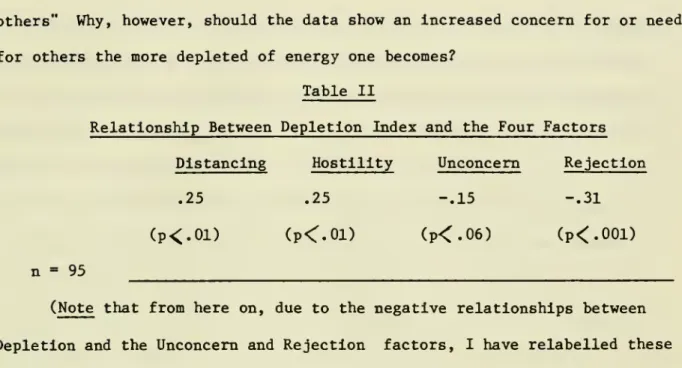
Is this the case In the present sample? Table II sets out this
association for the four factors. Two features of these results need to be
discussed; first, the diversity of the associations and secondly, the size of the associations.
(1) Contrary to the conventional wisdom, only two of the four factors are positively (and significantly) associated with the Depletion Index, I.e.
Distancing and Hostility. The remaining two factors. Rejection and Unconcern,
have a low or moderate negative association. In the context of the Depletion
of Energy, then, the last two factors are more in the nature of
"personalization" factors, not "depersonalization" factors. This was, incidentally, supported by the interview data I obtained where it was clear that, for some, their "personal energy crisis" had resulted in "greater