HAL Id: hal-00301817
https://hal.archives-ouvertes.fr/hal-00301817
Submitted on 21 Jul 2008HAL is a multi-disciplinary open access archive for the deposit and dissemination of sci-entific research documents, whether they are pub-lished or not. The documents may come from
L’archive ouverte pluridisciplinaire HAL, est destinée au dépôt et à la diffusion de documents scientifiques de niveau recherche, publiés ou non, émanant des établissements d’enseignement et de
Another Co*cryption Method
Bruno Martin
To cite this version:
Bruno Martin. Another Co*cryption Method. International Conference on Science and Technology (JICT), Mar 2007, Malaga, Spain. pp.CD-ROM. �hal-00301817�
Another Co*cryption Method
Bruno Martin
∗Universit´e de Nice Sophia-Antipolis, Laboratoire I3S, Projet Recif, UMR CNRS 6070, 930 Route des Colles, BP 145, F–06903 Sophia–Antipolis Cedex, France.
Abstract
We consider the enciphering of a data stream while being compressed by a LZ algorithm. This has to be compared to the classical en-cryption after compression methods used in security protocols. Actually, most cryptanal-ysis techniques exploit patterns found in the plaintext to crack the cipher; compression techniques reduce these attacks. Our scheme is based on a LZ compression in which a Ver-nam cipher has been added. We make some security remarks by trying to measure its ran-domness with statistical tests. Such a scheme could be employed to increase the speed of security protocols and to decrease the com-puting power for mobile devices.
Cryptography, compression, pseudo-random sequences, security.
Introduction
Information security is currently one of the main challenges in computer networks. In the emergent communication paradigm where
wireless and wired networks are interoperat-ing, security issues become crucial. Tradi-tional technologies are every day more inad-equate and existing standards should be im-proved for use in resource restricted environ-ments. We aim to develop a secure algorithm for confidentiality, but cheaper in terms of size and computing power.
In many security protocols, a compres-sion algorithm is run prior encrypting the data to increase the security and the band-width. These algorithms are run on the orig-inal stream. They all stem from research by J. Ziv and A. Lempel who have designed two compression algorithms: LZ77 and LZ78 [5]. After compression, if the speed of computa-tion is taken into account, the compressed data is enciphered with the use of a stream cipher like RC4 (let us recall that RC4 is 15 times quicker than a 3DES and is used in pro-tocols like WEP and SSL [4]).
In the present paper, we propose to scram-ble (encipher) a data stream while it is be-ing compressed. We assume the reader fa-miliar with classical compression algorithms and with secret key cryptography for which a good introduction is [6]. The paper is
orga-nized as follows: section 1 presents the basis of our idea, while section 2 recalls the related results. In section 3 we illustrate our idea with a “toy” implementation which uses a compression algorithm from the Lempel-Ziv family. Some statistical tests have been made and are presented in section 4.
1
The idea
Our idea is to encipher the data stream while it is being compressed by a lossless dictionary algorithm. The basic idea which motivates this proposition is that a com-pressed stream is already almost random and a good candidate to be scrambled by a sim-ple Vernam cipher. This comes from the no-tion of incompressibility introduced with Kol-mogorov complexity. A.N. KolKol-mogorov [2] has proposed a complexity which speaks about objects rather than the usual classes of languages addressed by classical complex-ity. Informally, Kolmogorov complexity cor-responds to the size of the smallest program p which can print out on its standard out-put the object x. If ♯p < ♯x, we say that x is compressible, otherwise incompressible. It provides a modern notion of randomness dealing with the quantity of information in individual objects which says that an object x is random if it cannot be represented by a shorter program p whose output is x or, in other words, if x is incompressible [5]. From this point of view, the output of any com-pression algorithm is an approximation of a random sequence, although highly reversible. Our idea is to scramble the output of a
com-pression algorithm by a Vernam cipher and to do this while the data stream is being pressed in order to avoid to pass the com-pressed data stream to another encryption process. From the above discussion, the out-put of our scheme should be almost random.
2
Related work
Actually, there are two methods sharing the same idea but in a slightly different way. The first one is called concryption and has been patented by Security Dynamics (US Patent #5479512). It is a method for the inte-grated compression and encryption (concryp-tion) of clear data. For concryption, the clear data and an encryption key are obtained, at least one compression step is performed and at least one encryption step is performed utilizing the encryption key. The encryp-tion step is preferably performed on the fi-nal or intermediate results of a compression step, with compression being a multistep op-eration. The second method is called com-pryption [1] and is due to R. E. Crandall when he was Apple’s Chief Cryptographer. Roughly, his idea is to index a great number of entropy compression algorithms by a se-cret key. He then gets a holistic (one-pass) compress/encrypt algorithm. This method is currently used for enciphering the passwords in the keychain application starting with Mac OS 9 and still used in Mac OS X from Apple. It is recorded under US Patent #6154542, “Method and apparatus for simultaneously encrypting and compressing data”.
3
The proposed scheme
We use the mode of operation of LZ 78 which uses a growing dictionary [5]. It starts with 29
= 512 entries (with the first 256 entries already filled up, eventually after an initial permutation). While this dictionary is in use, 9 bit pointers are written onto the out-put stream after encryption by a Vernam ci-pher. When the original dictionary is filled up, its size is doubled to 1024 entries and 10 bit pointers are then used (and encrypted as well) until the pointer size reaches a maxi-mum value set by the user. When the large dictionary is filled up, the program contin-ues without changes to the dictionary but with monitoring the compression ratio. If this ratio falls down a predefined threshold, the dictionary is deleted and a new 512 en-tries dictionary is started. The algorithm be-low presents the scheme. In the sequel, we denote by PRBS a pseudo-random Boolean sequence.
Index = 256; Length = 9; Word = null; Limit = 12;
Initialise 256 inputs in Dictionary //(eventually after a permutation) //(a+b stands for concatenation) REPEAT
read S
//(Read a symbol from the stream) IF Word+S is in Dictionary
THEN
Word = Word+S; Emit = false ELSE
Output(index of Word) XOR (PRBS) // Vernam cipher
Index of (Word+S) = Index; Index++ IF Length = Limit THEN Re-initialise Dictionary ENDIF IF Index = 2Length THEN Length++ ENDIF
Word = S; Emit = true ENDIF
UNTIL no data found IF Emit = false THEN
Output the (index of Word) XOR (PRBS) // Vernam cipher
ENDIF
The implementation was just made as a proof-of-concept in C++ and using the LEDA library 1
which provides a sizable collection of data types and algorithms in a form which allows them to be used by non-experts.
The difference with concryption is that we use a single pass compression algorithm while they require the compression to be a multi-step operation, and it is not based on an en-tropy compression algorithm used in the cryption method, although an entropy com-pression algorithm could be added to shorten the mostly used pointers which are returned by the algorithm.
4
Analysis
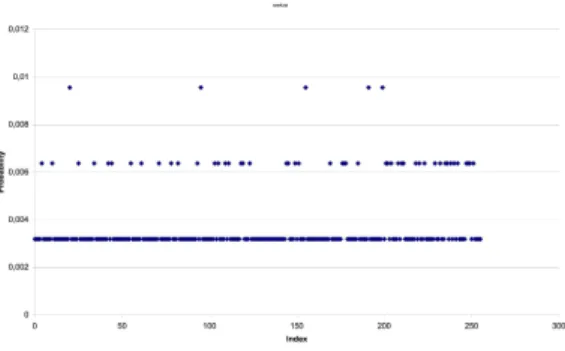
Though a plot of the output (see figure 1) is rather encouraging, we were deceived while testing outputs with a χ2
test for which the
Figure 1: Probabilities of the output. results were a little bit too weak. This may be explained by the rather bad choice of a “toy” linear feedback shift register for generating the PRBS. We expect the result to be im-proved with the use of good pseudo-random generators like RC4, or even with so-called “perfect” PRBS generators.
Further testing should be made according to [3] which requires a PRG to pass a num-ber of statistical tests or the Marsaglia tests, a set of 23 very strong tests of randomness implemented in the Diehard program2
.
5
Discussion
Although not truly pseudo-random (but this is also not a pseudo-random generator), the output of our compression and encryption scheme is encouraging if we look at the typ-ical output depicted by figure 1. Further study should be made with the help of a good pseudo-random generator with classical tests and a fine tuning of all the parameters.
2Avaible from http://diehard.darwinports.com.
The use of compression and encryption mixed together should increase the band-width, decrease the latency as well as it also might decrease the energy consumption re-quired for the same purpose when using en-cryption after compression for mobile devices or RFID.
References
[1] R.E. Crandall. Comcryption. In RSA Data Security Conference, 1998.
[2] A.N. Kolmogorov. Three approaches to the quantitative definition of information. Problemy Pederachi Informatsii, 1:3–11, 1965.
[3] National Institute of Standards Technol-ogy. FIPS publication 140-2, security requirements for cryptographic modules. US Gov. Printing Office, Washington, 1997.
[4] E. Rescorla. SSL and TLS: Designing and Building Secure Systems. Addison-Wesley, Reading MA, 2001.
[5] D. Salomon. Data compression, the com-plete reference. Springer Verlag, 1998. [6] W. Stallings. Cryptography and
Net-work Security. Prentice-Hall, 4th. edition, 2006.