HAL Id: cea-02338744
https://hal-cea.archives-ouvertes.fr/cea-02338744
Submitted on 25 Feb 2020
HAL is a multi-disciplinary open access
archive for the deposit and dissemination of
sci-entific research documents, whether they are
pub-lished or not. The documents may come from
teaching and research institutions in France or
abroad, or from public or private research centers.
L’archive ouverte pluridisciplinaire HAL, est
destinée au dépôt et à la diffusion de documents
scientifiques de niveau recherche, publiés ou non,
émanant des établissements d’enseignement et de
recherche français ou étrangers, des laboratoires
publics ou privés.
Accumulation of nuclear material in nuclear facilities an
iterative approach in order to develop measuring stations
L. Loubet, P-G. Allinei, M. Maulin
To cite this version:
L. Loubet, P-G. Allinei, M. Maulin. Accumulation of nuclear material in nuclear facilities an
itera-tive approach in order to develop measuring stations. HotLab 2018 - 55th Annual Meeting on Hot
Laboratories and Remote Handling Working Group, Sep 2018, Helsinki, Finland. �cea-02338744�
Accumulation of nuclear material in nuclear facilities:
an iterative approach in order to develop measuring
stations
Laurent LOUBET1,Pierre Guy ALLINEI1, Maeva MAULIN2 1CEA, DEN
CadaracheF-13108 Saint-Paul-Lez-Durance, France
2Université Clermont Auvergne, Département de Physique
F-63171 Aubière, France
1. Abstract
Measuring the deposits of nuclear material accumulated during processes in nuclear facilities is a major challenge in terms of safety and criticality. The characterization of the nuclear material, “holdup”, has to be taken into account since the design of new facilities, but also during their operation, and finally for the dismantling of historic equipment and facilities. Considering the diversity of encountered configurations, the holdup measurement is specific to each case. In this context, the Nuclear Measurement Laboratory of CEA Cadarache is specialized in developing and implementing gamma and neutron measuring stations, based on preliminary design and performance assessment by numerical simulation, then on iterative calculations taking into account the feedback of field measurements. In this paper, we illustrate this approach on differ-ent case studies, such as glove boxes in hot labs, covering the design, exploitation and dismantling phas-es of nuclear equipment and facilitiphas-es.
2. Context and need
French and international safety authorities require that facilities using sensitive nuclear material (U, Pu, Th) guard against the risks of loss, theft and diversion of these nuclear materials [1].
Many solutions such as weighing, measurement, physical monitoring can meet this absolute need in oper-ation. However, over time, the deposits of low amounts of nuclear materials that accumulate during pro-cesses in nuclear facilities, hot labs, hot cells, and glove boxes can lead to the retention of significant quantities of nuclear materials. This “holdup” has to be taken into account both in old installations, in order to dismantle them properly, in installations currently in operation, and preventively in installations under construction.
Therefore, measuring low amount of deposits of nuclear material is a major challenge. Today, the possibili-ties offered by non-destructive nuclear measurement provide solutions for many installations [2].
3. Contribution of the Nuclear Measurement Laboratory of CEA Cadarache on
hold-up measurements
3.1 Analysis context and methodology
The Nuclear Measurements Laboratory (LMN) of CEA Cadarache is specialized in developing and imple-menting gamma and neutron measuring stations, based on preliminary design and performance assess-ment by numerical simulation, then on iterative calculations taking into account the feedback of field meas-urements.
In our methodology, the first step in designing such measuring stations, in a glove box or in a hot cell for example, is to establish the list of radiations emitted by the studied nuclear material in order to select the more suitable nuclear measurement.
This makes then possible to choose the sensor and the detection chain whose performances are the most adapted for a given configuration. For this, the laboratory relies on its long experience in nuclear gamma and neutron measurements, and photon imaging as well.
Finally, numerical modelling of the selected detector in its operating environment is carried out in order to determine, after several iterations, the optimal measurement configuration (type, size and position of the detector) and to define the sensitivity of the measurement (to different parameters such as the type, mass and distribution of nuclear materials).
3.2 Recent examples of measuring stations design by the LMN
Our lab is solicited for different studies ranging from the simplest case of new installations, where the de-sign of the measurement system is open, to the most difficult case of historic installations, where it is nec-essary to adapt to existing implementation constraints, and to more or less known history leading in some instance to poor knowledge on nuclear materials.
The two examples below illustrate both cases.
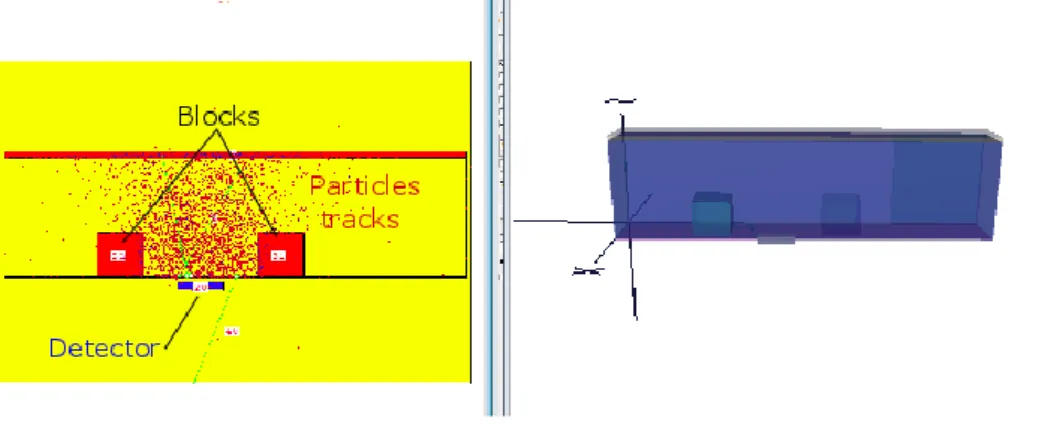
The first situation is concerning a hot cell under construction where nuclear material will be recondi-tioned. The nuclear material is well known, the geometry of the equipment is still modifiable. The choice and the position of the detector can be optimized by successive numerical modelling comforted by experi-mental campaigns.
Figure 1. Numerical modelling of a holdup measuring station for a reconditioning glove box.
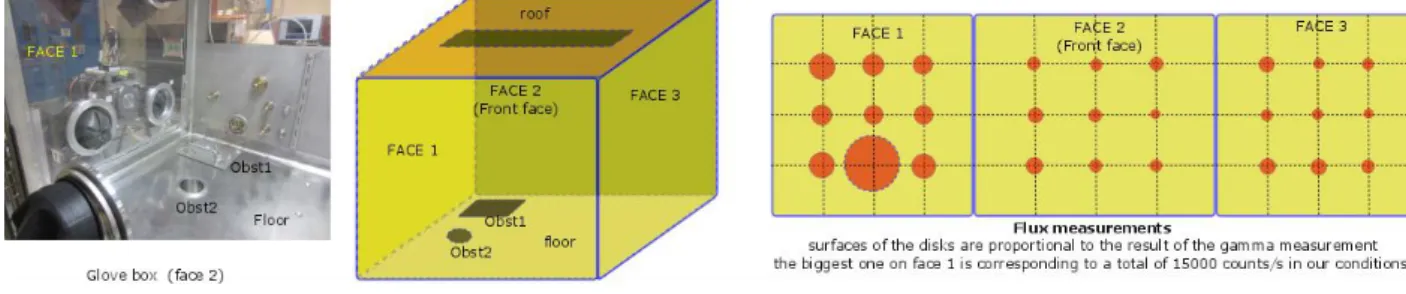
The second case concerns an old equipment used to characterize nuclear materials. This equipment had to be moved in a safe way. In this case, numerical simulation has been used in order to select the best measurement configurations. Then experimental results have been interpreted using numerical simulation to obtain quantitative results on the nuclear material hold-up.
Figure 2. Measurements and quantitative results for holdup in an equipment in view of its transport.
The methodology used by our lab for those cases can easily been applied to other situations.
References
1. ”Passive Nondestructive Assay of Nuclear Materials” - United States Nuclear Regulatory Commission 2. “Nuclear safeguards, security, and non proliferation“ - Los Alamos National Laboratory