HAL Id: hal-01764957
https://hal-amu.archives-ouvertes.fr/hal-01764957
Submitted on 12 Apr 2018
HAL is a multi-disciplinary open access
archive for the deposit and dissemination of
sci-entific research documents, whether they are
pub-lished or not. The documents may come from
teaching and research institutions in France or
abroad, or from public or private research centers.
L’archive ouverte pluridisciplinaire HAL, est
destinée au dépôt et à la diffusion de documents
scientifiques de niveau recherche, publiés ou non,
émanant des établissements d’enseignement et de
recherche français ou étrangers, des laboratoires
publics ou privés.
Temporal effects of prescribed burning on terpene
production in Mediterranean pines
Teresa Valor, Elena Ormeño, Pere Casals
To cite this version:
Teresa Valor, Elena Ormeño, Pere Casals. Temporal effects of prescribed burning on terpene
pro-duction in Mediterranean pines. Tree Physiology, Oxford University Press (OUP): Policy B - Oxford
Open Option B, 2017, 37 (12), pp.1622-1636. �10.1093/treephys/tpx069�. �hal-01764957�
Temporal
effects of prescribed burning on terpene production
in
Mediterranean pines
Teresa Valor
1,3, Elena Ormeño
2and Pere Casals
11Forest Sciences Centre of Catalonia, CEMFOR-CTFC, Ctra St Llorenç de Morunys, km 2, 25280 Solsona, Spain; 2Aix Marseille Univ, Univ Avignon, CNRS, IRD, IMBE, Marseille, France; 3Corresponding author ([email protected])
Prescribed burning is used to reduce fuel hazard but underburning can damage standing trees. The effect of burning on needle terpene storage, a proxy for secondary metabolism, infire-damaged pines is poorly understood despite the protection terpenes confer against biotic and abiotic stressors. We investigated variation in needle terpene storage after burning in three Mediterranean pine species featuring different adaptations to fire regimes. In two pure-stands of Pinus halepensis Mill. and two mixed-stands of Pinus sylvestris L. and Pinus nigra ssp. salzmanni (Dunal) Franco, we compared 24 h and 1 year post-burning con-centrations with pre-burning concon-centrations in 20 trees per species, and evaluated the relative contribution of treefire severity and physiological condition (δ13C and N concentration) on temporal terpene dynamics (for mono- sesqui- and diterpenes). Twenty-four hours post-burning, monoterpene concentrations were slightly higher in P. halepensis than at pre-burning, while values were similar in P. sylvestris. Differently, in the more fire-resistant P. nigra monoterpene concentrations were lower at 24 h, compared with pre-burning. One year post-burning, concentrations were always lower compared with pre- or 24 h post-burning, regardless of the terpene group. Mono- and sesquiterpene variations were negatively related to pre-burningδ13C, while diter-pene variations were associated with fire-induced changes in needle δ13C and N concentration. At both post-burning times, mono- and diterpene concentrations increased significantly with crown scorch volume in all species. Differences in post-burning terpene contents as a function of the pine species’ sensitivity to fire suggest that terpenic metabolites could have adaptive importance in fire-prone ecosystems in terms of flammability or defence against biotic agents burning. One year post-burning, our results suggest that in a context of fire-induced resource availability, pines likely prioritize primary rather than secondary metabolism. Overall, this study contributes to the assessment of the direct and indirect effects of fire on pine terpene storage, providing valuable information about their vulnerability to biotic and abiotic stressors throughout time.
Keywords: conifers, fire ecology, Pinus halepensis, Pinus nigra, Pinus sylvestris, plant volatiles, prescribed fire, secondary metabolism.
Introduction
Prescribed burning (PB) is the planned use of fire under mild weather conditions to meet defined management objectives (Wade et al. 1989). Prescribed burning is executed mostly for fire risk reduction, but also for forest management, restoring habitats or improving grazing. Generally, prescribed burns are low intensityfires, but certain management objectives require a higher burning intensity to effectively achieve specific goals,
such as significantly removing understory or slash. In this case, PB can partially damage trees and affect their vitality in the short-term. Some studies have analysed the effects of PB on post-burning growth (Battipaglia et al. 2014,Valor et al. 2015) and tree vitality (seeWoolley et al. 2012for review). Less attention has been dedicated to understanding the effect of PB on second-ary metabolites produced by pines (Lavoir et al. 2013), despite the protection they confer against biotic and abiotic stressors,
and their potential to increase plantflammability (Ormeño et al. 2009,Loreto and Schnitzler 2010).
The quantity and composition of terpenes produced against a stressor can be constrained by the plant’s physiological status (Sampedro et al. 2011) and genetics (Pausas et al. 2016), but also by the nature and severity of the stress, and the species affected. The main secondary metabolites biosynthesized in coni-fers are terpenes and phenols (Langenheim 2003). In Pinus spe-cies, oleoresin is a mixture of terpenes including monoterpenes (volatile metabolites), sesquiterpenes (metabolites with intermedi-ate volatility) and diterpenes (semi-volatile compounds), which are stored in resin ducts of woody and needle tissues (Phillips and Croteau 1999). Upon stress, plants follow a constitutive or induced strategy to defend themselves from a stressor. Although most Pinus spp. favour the production of constitutive terpenes under stress conditions, they can also synthesize new induced defences (Phillips and Croteau 1999). The induction timing may be different depending on the chemical groups of terpenes, type of stress, and the species or tissue attacked (Lewinsohn et al. 1991, Achotegui-Castells et al. 2015).
Direct effects of fire such as rising temperatures or heat-induced needle damage can alter terpene production. Increases in air and leaf temperature trigger the emission of volatile ter-penes (Alessio et al. 2004) but their synthesis can also be sti-mulated if the optimal temperature of enzymes is not exceeded (Loreto and Schnitzler 2010). Benefits of such stimulation include thermoprotection against heat, since terpene volatiles neutralize the oxidation pressure encountered by chloroplasts under thermal stress (Vickers et al. 2009). As the emission of volatile terpenes in several Mediterranean pines cease 24 h after fire (Alessio et al. 2004) or wounding (Pasqua et al. 2002), we hypothesized that the accumulation of monoterpenes will be higher 24 h post-burning, than before PB.
Indirect effects of fire can affect terpene concentrations by means of increasing resource availability (Certini 2005). In turn, terpene variations induced byfire could change needle flammability (Ormeño et al. 2009) and susceptibility to insects (Hood et al. 2015). The ‘growth differentiation balance hypothesis’ (GDBH) (Herms and Mattson 1992, Stamp 2003) predicts that under poor water and nutrient availabilities, growth is more limited than photosynthesis. Since carbon assimilation is maintained, the excess of carbohydrates favours the synthesis of carbon-based secondary metabolites. On the contrary, when resource availability is high, the growth of plants is not expected to be limited and plants allocate a greater proportion of assimilates to growth rather than to defence traits (Herms and Mattson 1992, Stamp 2003). Accordingly, a short-term response following PB should be an increasing demand on the plant for chemical defence if trees are damaged, but with time, if trees heal, increased fertilization and reduced water compe-tition induced by PB (Feeney et al. 1998) could favour carbon allo-cation to growth rather than chemical defences.
Time-course terpene responses of the direct and indirect effects of PB could differ between tree species depending on theirfire resistance strategies. In this study, we used pines with contrasting tolerance to surface fires: Pinus halepensis, a fire sensitive species, Pinus sylvestris, moderatelyfire-resistant and thefire-resister Pinus nigra, which is supposed to be less vulner-able tofire tissue damage due to its pyro-resistant traits (e.g. thicker bark, higher crown base height) (Fernandes et al. 2008). In agreement with these strategies, we previously found that radial growth was reduced the year of PB in the most fire-sensitive species and unaffected in P. nigra, while 1 year post-burning, growth was augmented in P. nigra and P. halepensis, and reduced in P. sylvestris (Valor et al. 2015). In consequence, we hypothesized that 1 year post-burning, the concentration of terpenes would be, as a whole, lower than before PB, if fire induces a decrease in nutrient and water competition; this reduc-tion would be lower on damaged trees and in pines defined as having lowerfire resistance (e.g., P. halepensis and P. sylvestris). The objectives of this study were to evaluate the effects of relatively high-intensity PB (enough to remove understory and ladder fuels) on mono-, sesqui- and diterpene storage in Pinus spp., comparing 24 h and 1 year post-burning concentrations with pre-burning concentrations. We modelled the relative change of terpene concentrations at two sampling times: (i) 24 h post-burning, as a function offire severity and pre-burning physiological condition and (ii) 1 year post-burning, as a func-tion of fire severity and PB-induced changes in pine physio-logical conditions. Additionally, we aimed to identify the most representative terpenes of each sampling time since burning.
Materials
and methods
The study was established in three sites situated in the NE Iberian Peninsula (Catalonia, Spain): two plots in mixed-stands of P. nigra ssp. salzmanni (Dunal) Franco and P. sylvestris L. at Miravé and Lloreda localities, situated in the foothills of the Pyrenees; and two other plots in a pure-stand of P. halepensis Mill. at El Perelló locality, in the Southern part of Catalonia. The P. halepensis stand is located in areas of dry Mediterranean cli-mate while the mixed-stands of P. nigra and P. sylvestris are situ-ated in temperate cold sub-Mediterranean climate with milder summers and colder winters (Table1). In the sub-Mediterranean sites, soils are developed from calcareous colluviums (0.5–1 m deep) and thus classified as Calcaric cambisols (FAO 2006); in the Mediterranean site, they are developed from limestones (0.4–0.5 m deep) and classified as Leptic Regosol (FAO 2006). The understory is dominated by Buxus sempervirens L. and Viburnum lantana L., in the P. nigra and P. sylvestris mixed-stands, and by Pistacia lentiscus L. and Quercus coccifera L. in the P. halepensis stand.
Experimental design: tree selection and prescribed burning
A total of four plots (30× 30 m) were set up: one in each of the mixed-stand of P. nigra and P. sylvestris, and two in the pure P. halepensis stand. Each plot was burnt in spring 2013 (Table2). Prescribed burns were conducted by the Forest Actions Support Group (GRAF) of the Autonomous Government (Generalitat de Catalunya) using a strip headfire ignition pattern. Prescribed burn-ing aimed to decrease fuel hazard by reducburn-ing surface and ladder fuel loads. Between 90% and 100% of the surface fuel load was consumed in all plots. Needle terpene concentration, fire features and tree physiological condition were studied in 9/10 dominant or co-dominant pines per species in each plot. Each tree was sampled on three occasions for analysing terpene concentration: 24 h before PB (pre-burning), 24 h and 1 year after PB (24 h post-burning and 1 year post-burning, respectively).δ13C and N concentrations of 1-year-old needles were also analysed as a proxy of physio-logical condition in pre-burning and 1 year post-burning samples.
Before PB, selected trees were identified with a metal tag. Their diameter at breast height (DBH), total height and height to live crown base were measured. Duringfires, the fire residence time (minutes) above 60°C and the maximum temperature at the base of the trunk were measured for the selected trees with K-thermocouples (4 mm) connected to dataloggers (Testo 175), packed with afireproof blanket and buried into the soil. Temperatures were recorded every 10 s. The maximum tem-peratures registered at the soil surface occurred in the P. nigra and P. sylvestris plots, while the highest residence time above 60°C was recorded in the P. halepensis plots (Table2). One week after PB, the crown volume scorched was visually esti-mated to the nearest 5% as an indicator offire severity. Foliage scorch was defined as a change in needle colour resulting from direct foliage ignition or indirect heating (Catry et al. 2010).
Needle sampling
In each plot, we cut an unscorched branch from the top of the south-facing crown in the 9/10 trees selected per species for each sampling time studied: pre-burning, 24 h and 1 year post-burning. Five twigs with unscorched healthy needles were cut immediately, covered with aluminium paper and stored in a port-able refrigerator at 4°C until being stored at −20 °C in the laboratory for terpene analysis. The time period between the field and the laboratory did not exceed 2 h. Additionally, about
five twigs were transported to the laboratory, dried at 60 °C and stored in tins beforeδ13C and N concentration analysis.
Needle terpene concentration
In the studied pine species, needles reached up to 3 years old. Before terpene extraction, we collected the 1-year-old needles from each twig to control for the effect of age for each sampling time. Needles were cut in small parts (~5 mm) and placed in well-filled, tightly closed amber glass vials to avoid exposure to light and oxygen (Guenther 1949, in Farhat et al. 2001). The extraction method consisted in dissolving 1 g of cut 1-year-old unscorched green needles in 5 ml of organic solvent (cyclohex-ane + dichloromethane, 1:9), containing a constant amount of undecane, a volatile internal standard to quantify terpene concen-trations which was not naturally stored in the needles. Extraction occurred for 20 min, under constant shaking at room temperature, similar to extractions shown inOrmeño et al. (2007). The extract was stored at −20 °C and then analysed within the following 3 weeks. Analyses were performed on a gas chromatograph (GS-Agilent 7890B, (GS-Agilent Technologies, Les Ulis, France) coupled to a mass selective detector (MSD 5977A, Agilent Technologies, Les Ulis, France). Compound separation was achieved on an HP-5MS (Agilent Technologies, Les Ulis, France) capillary column with helium as the carrier gas. After sample injection (1μl), the start temperature (40°C for 5 min) was ramped up to 245 °C at a rate of 3°C min−1, and then until 300°C a rate of 7 °C min−1. Terpene identifications were based on the comparison of terpene retention times and mass spectra with those obtained from authentic reference samples (Sigma-Aldrich®, Sigma-Aldrich, Saint-Quentin-Fallavier, France) when available, or from databases (NIST2008, Adams 2007) when samples were unavailable. Also, we calculated the Kovats retention index and compared it with bibliographical data. Terpenes were quantified based on the internal standard undecane (36.6 ngμl−1 of injected solution). Thus, based on calibrations of terpene standards of high purity (97–99%), also prepared using undecane as internal standard, chromatographic peak areas of an extracted terpene where con-verted into terpene masses based on the relative response factor of each calibrated terpene. Results were expressed on a needle dry mass (DM) basis. The identified terpenes were grouped in mono-, sesqui- and diterpenes. At each post-burning time, we cal-culated the relative change of terpene concentration as the
Table 1. Topographical and climate characteristics of the study localities.
Study sites Topography Climate1
Localities Lat. (°) Long. (°) Aspect Slope (%) Elevation (m.a.s.l.) Annual rainfall (mm) Mean annual temperature (°C) Lloreda 1.5706 42.0569 N 30 715 731.6 11.7 Miravé 1.4494 41.9515 NE 25 723 677.3 11.5 El Perelló 0.6816 40.9068 NW 10 244 609.9 15.5 1
difference between the pre- and post-burning concentration of each terpene group expressed as percentage.
Tree physiological condition: δ13C and N analysis
δ13C and N analysis were carried out on 1-year-old unscorched
needles in pre-burning and 1 year post-burning samples. Forδ13C and N, needles were oven-dried at 60°C for 48 h, ground and analysed at the Stable Isotope Facility of the University of California at Davis (USA) using an ANCA interfaced to a 20–20 Europa® isotope ratio mass spectrometer (Sercon Ltd, Cheshire, UK).
Climatic data before and during sampling years
Monthly precipitation (P) and temperature (T) from March 2012 to August 2014 were downloaded from the three nearest meteorological stations to the sub-Mediterranean and the Mediterranean plots. Monthly potential evapotranspiration (PET) was estimated using the Thornthwaite (1948) method. For each sampling year (t), 2013 and 2014, accumulated values of P and PET of different periods were calculated for each meteorological station. Seven periods of accumulated climate data were com-piled: annual, from June before the sampling year (t− 1) to May of the sampling year (t); spring, summer, fall and winter before the sampling year (t− 1); spring and summer of the sampling year (t). For each period, we calculated the difference between P and PET (P− PET) for each meteorological station and sampling year.
Linear mixed models (LMM), considering plot as a random fac-tor, were used to:
(i) Analyse potential differences in pre-burning tree physio-logical condition andfire parameters among pine species. (ii) Test for differences in total terpene and terpene group
con-centrations (expressed in a needle mass basis and as the percentage of the terpene group from the total) between times since burning for each pine species.
(iii) Model 24 h and 1 year impact of PB on the relative concen-tration change of mono-, sesqui- and diterpenes with respect to pre-burning concentration. The 24 h and 1 year post-burning models considered pine species as a fixed factor, needleδ13C and N concentration pre-burning, and the proportion of crown scorched and fire residence time above 60°C as covariables. In addition, in the 1 year post-burning model, δ13C and N concentration changes were also included (1 year post-burning minus pre-burning levels ofδ13C and N concentration). Second interactions of pine species with each co-variable were included.
Terpene concentrations were log-transformed to accomplish normal distribution requirement. When the relative concentration change of terpenes was modelled, 100 was summed as a constant before taking the logarithm. Therefore, log-transformed data higher than 2 indicate higher terpene concentrations than pre-burning,
Table 2. Characteristics of prescribed burnings and forest experimental units (mean ± std). Experimental unit Meteorological conditions PB characteristics Forest characteristics 3 Burning date (day/month/year) Air temp. (° C) Rel. humidity (%) Wind speed 1 (km h − 1 )
Burn surf. (ha)
Tmax 2 (° C) RT60 2 (min) Soil water content (%)
Bole scorched height
(cm) Sp. Phyto-volume (m 3 ha − 1 ) DBH (cm)
Density (number trees
ha − 1 ) Basal area (m 2 ha − 1 ) Perelló1 13/05/2013 19.5 ± 1.6 49.2 ± 2.9 2.5 ± 1.0 1.0 65 –750 2 –89 7.5 ± 0.5 84.2 ± 57.1 Ph 597 20.6 ± 3.5 533 18.4 Perelló2 13/05/2013 19.9 ± 1.6 66.7 ± 7.7 4.0 ± 0.5 0.7 127 –561 7 –241 7.5 ± 0.5 50.6 ± 30.5 Ph 611 18.5 ± 5.9 922 27.6 Miravé 12/06/2013 25.8 ± 2.1 54.9 ± 4.4 17.6 ± 3.6 0.9 60 –718 6 –28 30.3 ± 12.0 71.2 ± 53.3 Pn/Ps 1637 14.1 ± 5.1 1711 30.3 Lloreda 5/06/2013 21.8 ± 1.4 60.4 ± 4.9 6.75 ± 5.9 1.1 107 –834 7 –30 34.3 ± 10.3 65.1 ± 48.2 Pn/Ps 949 12.4 ± 3.1 2411 30.9 1 Wind speed was measured outside the forest. 2 Range of maximum temperatures (Tma x) and residence time above 60 °C (RT60) in 10 trees in each of the Perelló experimental units and in 20 trees in Miravé and Lloreda. 3 Ph ,Pinus halepensis ;Pn/Ps ,P. nigra and P. sylvestris ;phytovolume calculated using the cover and height of the understory shrubs; diameter at breast height (DBH), density and basal area of trees with DBH ≥ 7.5 cm.
while values lower than 2 mean lower terpene concentrations. Residuals presented no pattern and highly correlated explanatory variables were avoided. The variance explained for the fixed effects was obtained by comparing the final model with the null model (containing only the random structure). A Tukey post-hoc test was used for multiple comparisons when needed.
For each pine species, terpene profiles were evaluated using a principal component analysis to show potential qualitative and quantitative variation in needle terpene within and between plots and time since burning. Terpene concentrations were centred and the variance–covariance matrix used to understand how terpene profiles varied. Moreover, for each pine species, we used a multi-level sparse partial least squares discriminant analysis (sPLS-DA) to select the terpenes that best separated each time since burning in terms of their concentration. The sPLS-DA is a supervised tech-nique that takes the class of the sample into account, in this case time since burning, and tries to reduce the dimension while maxi-mizing the separation between classes. To conduct the analysis, we selected those compounds that were present in at least 75% of the sampled trees, resulting in a total of 48, 37 and 35 com-pounds in P. halepensis, P. nigra and P. sylvestris, respectively. We used the multilevel approach to account for the repeated measures on each tree to highlight the PB effects within trees separately from the biological variation between trees. The clas-sification error rate was estimated with leave-one-out cross val-idation with respect to the number of selected terpenes on each dimension. Lastly, differences in P − PET between sampling years were tested by a Student’s t-test for the Mediterranean and sub-Mediterranean plots. All analyses were conducted with the soft-ware R (v. 3.2.1, The R Foundation for Statistical Computing, Vienna, Austria) using the package nlme for linear mixed-effects modelling and the package mixOmics for the sPLS-DA analysis. The model variances explained byfixed effects (marginal R2) and
by bothfixed and random effects (conditional R2) are provided (Nakagawa and Schielzeth 2013).
Results
Tree, fire and climate characteristics
The proportion of crown scorched was significantly higher in P. halepensis than in the other species despite the fact that the three pine species presented similar height to live crown base (Table 3). By contrast, no differences in fire residence time above 60°C were encountered among species (Table 3). Needleδ13C decreased significantly 1 year post-burning in the three species while N concentration was similar (Table3).
This decrease inδ13C contrasted with the drier conditions found 1 year post-burning (P− PET = 200 mm and = 135 mm in Mediter-ranean and sub-MediterMediter-ranean plots, respectively) in comparison with pre-burning (P− PET = 481 mm and = 290 mm in Mediterra-nean and sub-MediterraMediterra-nean plots, respectively; see Figure S1 avail-able as Supplementary Data at Tree Physiology Online).
A total of 56, 59 and 49 terpenes were identified and quantified in P. halepensis, P. nigra and P. sylvestris, respectively (see Table S1 available as Supplementary Data at Tree Physiology Online). Pre-burning, P. nigra showed the highest terpene concentration (65.6± 7.1 mg gDM−1) followed by P. halepensis and P. sylvestris (41.2±
5.8 mg gDM−1and 21.4 ± 2.6 mg gDM−1, respectively). Before
PB, more than 45% of total terpene concentration was repre-sented by diterpenes in P. halepensis while sesquiterpenes represented about 59% in P. nigra and monoterpenes represented 83% in P. sylvestris (see Table S2 available as Supplementary Data at Tree Physiology Online). Considering all sampling times,
Table 3. Studied pine trees andfire characteristics (mean ± std) before and after prescribed burnings grouped by species.
Tree andfire characteristics P. halepensis P. nigra P. sylvestris
n (trees) 20 19 191
DBH (cm) 20.0± 6.9a 13.6± 5.5b 12.7± 5.3b
Total height (m) 9.1± 2.4a 8.3± 2.4a 8.6± 1.9a
Height to live crown base (m) 5.2± 1.0a 4.8± 1.3a 6.6± 13.2b
Crown scorched (%) 44.0± 32.1a 6.6± 13.2b 5.5± 9.5b
Fire residence time>60 °C (min) 38.2± 54.1a 16.6± 6.9a 15.2± 6.4a
Needleδ13C (‰)
Pre-burning −25.8 ± 0.5Aa −26.6 ± 1.0 Ab −26.5 ± 0.6Ab
1 year post-burning −27.6 ± 0.9Ba −28.5 ± 1.4Ba −28.0 ± 0.8Ba
Needle N content (mg gDM−1)
Pre-burning 14.8± 1.9Aa 10.1± 0.8Ab 12.3± 1.6Ac
1 year post-burning 14.9± 3.2Aa 9.1± 2.7Ab 11.0± 3.1Aa
1
Sample size is 18 for 1 year post-burning data because of death of one tree.
Different small letters within a row indicate statistical significant differences (P < 0.05) among pine species using LME (where fixed factor = species, random factor= plot) followed by Tukey post-hoc test. Different capital letters within a column indicate statistical significant differences (P < 0.05) between pre-burning and 1 year post-burning for each pine species using LMM (wherefixed factor = time since burning, random factor = plot) followed by Tukey post-hoc test.
the diterpene thunbergol in P. halepensis, the sesquiterpene β-caryophyllene in P. nigra and the monoterpene α-pinene in P. sylvestris were the major compounds found, representing an average of 22%, 22% and 40% of the total terpene concentration, respectively (see Figure S2 available as Supplementary Data at Tree Physiology Online). Terpene concentration and composition strongly varied within plots in all species, with no clear differences in terpene composition among plots (see Figures S3a, S4a and S5a available as Supplementary Data at Tree Physiology Online). The variation in terpene concentrations was high within pre- and 24 h post-burning samples, while variation for 1 year post-burning concentrations was much lower (see Figures S3b, S4b and S5b available as Supplementary Data at Tree Physiology Online). In all species, the quantity of dominant compounds in pre- and 24 h post-burning samples were clearly different from those of 1 year post-burning samples (see Figures S3b, S4b and S5b available as Supplementary Data at Tree Physiology Online). For instance, the quantity of α-pinene was higher in pre- and 24 h post-burning times in all pine species in opposition with 1 year post-burning samples. Limonene was characteristic 24 h post-burning in the needles of P. halepensis and P. nigra, while the quantity of cam-phene and myrcene was higher in pre- and 24 h post-burning needles samples of P. sylvestris.
Differences in total terpene concentration between pre- and 24 h post-burning were only detected in P. nigra, which decreased ∼39% (Figure1a). When analysing terpene groups, the 24 h
post-burning needle concentration of both mono- and sesquiterpenes were, in comparison with pre-burning, slightly higher in P. halepensis, lower in P. nigra and similar in P. sylvestris (Figure1b and c). No differences were detected in the diterpene concentration between pre- and 24 h post-burning times (Figure1d).
One year after burning, total terpene concentration was lower compared with the levels observed pre- and 24 h post-burning in the three species (Figure1a). In P. halepensis this reduction was similar for each terpene group while, in the two sub-Mediterranean species, it was mostly due to a decrease in the proportion of monoterpenes (see Table S2 available as Supplementary Data at Tree Physiology Online). In contrast, an increase in the relative contribution of the sesquiterpene group to the total terpenes was found 1 year post-burning in both sub-Mediterranean species.
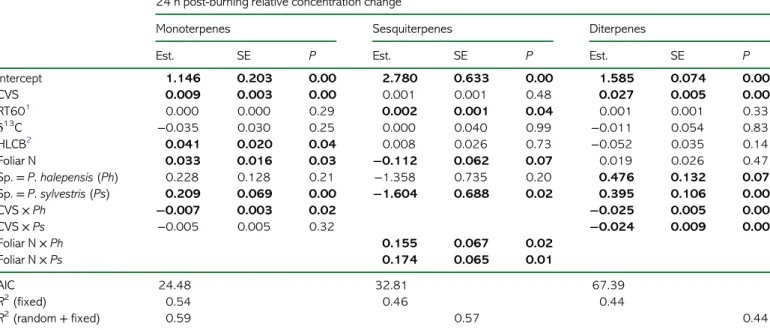
The relative changes of mono- and diterpene concentrations 24 h post-burning were directly related to the proportion of crown scorched (Table 4). However, crown scorch volume interacted with pine species to explain the relative changes in mono- and diterpene concentrations (Table4). Thus, in both P. halepensis and P. sylvestris, the 24 h post-burning concen-tration of monoterpenes was higher than pre-burning and increased with crown scorched (Figure2a.1 and a.3); only indi-vidual pines with low proportion of the crown scorched ( <15–-20%) showed similar or lower concentration than pre-burning. In
Figure 1. Concentration (mean± SE) of total terpene (a), monoterpenes (b), sesquiterpenes (c) and diterpenes (d) across time since burning (TSB) for each pine species (P. halepensis, n= 20; P. sylvestris, n = 19; P. nigra, n = 19 and n = 18 in 1 year-post-burning). Differences in the concentration between TSB within each pine species were tested using LMM considering plot as a random factor. Within each pine species, different letters indicate differences between TSB using a Tukey post-hoc, where regular letters indicate significant differences at P < 0.05; italic letters represent a marginal sig-nificant difference (0.05 < P < 0.1).
contrast, the relative change of monoterpene concentration in P. nigra was generally lower than pre-burning, at least in the range of crown scorch measured (0–50%) (Figure2a.2). The relation-ship between the relative concentration change in diterpenes and crown scorch followed a similar trend as in monoterpenes for P. halepensis and P. sylvestris (Figure 2b.1 and b.2), while in P. nigra, the ratio of change in crown scorch was higher and shifted from lower to higher concentrations than pre-burning in the middle of the measured crown scorch range (Figure2b.3).
The relative concentration change of monoterpene was also dir-ectly related to the needle N concentration and the height to live crown base (Table 4). In the case of sesquiterpenes, needle N concentration interacted with pine species (Table4, Figure2). Thus, the relative concentration change of sesquiterpenes 24 h post-burning was higher in P. halepensis and P. sylvestris, and augmented as needle N concentration increased (Figure2c.1 and c.3), whereas it was always lower in P. nigra, decreasing inversely with increasing needle N concentration (Figure2c.2). Finally,fire residence time above 60°C directly affected the relative change of sesquiterpene concentration in all species (Table4).
One year after PB, the relative change of mono- and sesquiter-pene concentrations were always lower than pre-burning and inversely related with δ13C of pre-burning needles (Table 5, Figure3a.1). The 1 year post-burning relative change concen-tration of diterpenes were also lower than pre-burning, but
variations were associated with changes inδ13C or N concentra-tion of needles (Figures3a.2 and a.3).
Similar to 24 h post-burning, the proportion of crown scorched had a direct effect on the relative concentration change of all terpene groups, although marginally significant in mono- and sesquiterpene models (Table5). This variable interacted with pine species in the case of diterpenes (Figure3b) and showed that as crown scorch increased, the relative concentration change in P. nigra was more acute than in the other species (Table5, Figure3b.2).
Discriminant terpenes across time since burning for each pine species
The multilevel sPLS-DA in P. halepensis led to optimal selection of six and one terpenes on thefirst two dimensions with a classifica-tion error rate of 0.26 and 0.06, respectively, reflecting a clear separation between times since burning (Figure4). Among com-pounds, terpinen-4-ol separated pre-burning (Cluster 2) from both post-burning times; whereas E-β-ocimene and α-thujene dis-criminated the 24 h post-burning sampling time from the others (Cluster 1). Four sesquiterpenes characterized the 1 year post-burning needle samples (Cluster 3).
In P. nigra, we chose three dimensions and the corresponding terpenes selected for each were four, one and one (Figure5). The classification error rates were 0.35, 0.33 and 0.18, respectively, for the first three dimensions. Two clusters were differentiated: pre-burning was discriminated, mainly, by three sesquiterpenes (Cluster 1) and bornyl acetate andβ-springene represented, post-burning samplings (Cluster 2) (Figure5).
Table 4. Summary of the models characterizing the impact of prescribed burning and tree vitality on the 24 h post-burning relative concentration change of mono-, sesqui- and diterpenes, calculated as the standardized difference between 24 h post-burning and pre-burning concentration expressed as percentage (logarithmically transformed). Only the significant interaction terms are shown. Bold characters indicate significant effects (P < 0.05).
24 h post-burning relative concentration change
Monoterpenes Sesquiterpenes Diterpenes
Est. SE P Est. SE P Est. SE P
Intercept 1.146 0.203 0.00 2.780 0.633 0.00 1.585 0.074 0.00 CVS 0.009 0.003 0.00 0.001 0.001 0.48 0.027 0.005 0.00 RT601 0.000 0.000 0.29 0.002 0.001 0.04 0.001 0.001 0.33 δ13 C −0.035 0.030 0.25 0.000 0.040 0.99 −0.011 0.054 0.83 HLCB2 0.041 0.020 0.04 0.008 0.026 0.73 −0.052 0.035 0.14 Foliar N 0.033 0.016 0.03 −0.112 0.062 0.07 0.019 0.026 0.47 Sp.= P. halepensis (Ph) 0.228 0.128 0.21 −1.358 0.735 0.20 0.476 0.132 0.07 Sp.= P. sylvestris (Ps) 0.209 0.069 0.00 −1.604 0.688 0.02 0.395 0.106 0.00 CVS× Ph −0.007 0.003 0.02 −0.025 0.005 0.00 CVS× Ps −0.005 0.005 0.32 −0.024 0.009 0.00 Foliar N× Ph 0.155 0.067 0.02 Foliar N× Ps 0.174 0.065 0.01 AIC 24.48 32.81 67.39 R2(fixed) 0.54 0.46 0.44 R2(random+ fixed) 0.59 0.57 0.44
CVS, crown volume scorched (%).
1RT60,fire residence time above 60 °C (min). 2
Finally, two dimensions were selected for P. sylvestris (Figure6) with 11 terpenes on each component. The classi fi-cation error rates were 0.66 and 0.33. As in P. nigra, two clusters were distinguished: sesquiterpenes characterized the pre-burning sampling time, whereas both post-burning times were characterized mainly by mono- and sesquiterpenes (Figure6).
Discussion
Pinus nigra is a species considered to be resistant to medium-lowfire intensities, P. sylvestris a moderately fire-resistant spe-cies and P. halepensis a fire-sensitive species (Agee 1998, Fernandes et al. 2008). While the concentration of the
semi-Figure 2. Measured and predicted (line) relative concentration change (log-transformed) using 24 h post-burning models (see Table4) of monoter-penes and ditermonoter-penes against crown scorched (a and b) and for sesquitermonoter-penes against needle N (c). Before the log-transformation, 100 was summed. The dashed line indicates no changes between pre- and post-burning terpene concentrations: higher values indicate a higher terpene concentration than those of pre-burning, while the opposite is indicated by lower values.
volatile diterpenes was not affected 24 h post-burning, the concen-tration of mono- and sesquiterpenes seems to decrease in P. nigra, was sustained in P. sylvestris and tended to increase in P. halepen-sis. Although massive needle terpene emissions have been reported at ambient temperatures often reached during PB (Alessio et al. 2004, Loreto and Schnitzler 2010, Zhao et al. 2012), various explanations may justify the different terpene con-tents observed 24 h post-burning between species. For instance, terpenes stored in needle resin ducts are likely to encounter di ffer-ent resistance to volatilization due to differences in the specific characteristics of the epistomatal chambers which are, respectively, unsealed, sealed and buried in needles of P. nigra, P. sylvestris and P. halepensis (Hanover and Reicosky 1971, Boddi et al. 2002, Kim et al. 2011). These differences in needle morphology may contribute to explaining the reduction of terpenes observed 24 h post-burning in P. nigra. Another reason for variable ter-pene contents may be different respiration sensitivity between species. As the consumption of assimilates increases relative to the photosynthetic production at high temperatures (Farrar and Williams 1991), this could bring about a decrease in the weight of carbohydrates and, thus, an apparent increase in needle ter-pene concentrations. If the respiration sensitivity to increas-ing temperature is higher in P. halepensis than in the other two species, this may explain the slight increase in terpene concentration in this species 24 h post-burning. Alternatively, the increase in monoterpene concentration in unscorched
needles of P. halepensis 24 h post-burning may partly reflect systemic induced resistance, triggered by burning needles from lower parts of the canopy, although no data was found in literature to support this hypothesis. Finally, although we carefully selected only 1-year-old unscorched needles and from the same part of the crown, we cannot fully exclude that terpene variation between pre-and post-burning are reflecting differences in light availability between the sampled needles.
Terpene dynamics within the species were modulated byfire severity. Thus, relative concentration changes of mono- and diterpenes increased with the proportion of crown scorched 24 h post-burning. This trend was evident 1 year post-burning, suggesting that the damaged pines were still investing in chem-ical defences. According to the GDBH (Herms and Mattson 1992,Stamp 2003) and the reduction in radial growth detected in P. halepensis and P. sylvestris (Valor et al. 2015), we hypothe-sized that the increase in monoterpenes by P. halepensis and, to a lesser extent, in P. sylvestris, may constrain primary metabol-ism. Although the rate of increase in diterpenes post-burning was greater in P. nigra than in the other two species, P. nigra required a greater proportion of scorched crown in order to achieve higher concentrations than those observed pre-burning. Therefore, trees with a greater proportion of scorched crown could be investing in secondary metabolism rather than primary metabolism, although this potential trade-off on carbon invest-ment deserves further research.
Table 5. Summary of the models characterizing the impact of prescribed burning and tree vitality on the 1 year post-burning relative concentration change of mono-, sesqui- and diterpenes, calculated as the standardized difference between 1 year post-burning and pre-burning content expressed as percentage (logarithmic transformed). Only the significant interaction terms are shown. Bold characters indicate significant effects (P < 0.05).
1 year post-burning relative concentration change
Monoterpenes Sesquiterpenes Diterpenes
Est. SE P Est. SE P Est. SE P
Intercept −1.879 0.812 0.05 −2.699 0.907 0.00 0.812 0.107 0.00 CVS 0.002 0.001 0.07 0.002 0.001 0.06 0.035 0.005 0.00 RT601 −0.000 0.000 0.50 −0.000 0.000 0.53 −0.000 0.001 0.80 δ13 C −0.103 0.030 0.00 −0.144 0.034 0.00 −0.065 0.063 0.30 Foliar N 0.019 0.017 0.26 0.012 0.019 0.53 0.001 0.029 0.96 HLCB2 −0.003 0.020 0.86 0.001 0.023 0.94 −0.058 0.035 0.11 Sp= P. halepensis (Ph) 0.603 0.073 0.01 0.611 0.067 0.01 0.696 0.150 0.04 Sp= P. sylvestris (Ps) 0.351 0.056 0.00 0.647 0.063 0.00 0.847 0.110 0.00 Changeδ13C3 −0.029 0.030 0.33 0.101 0.041 0.01 Change N4 0.009 0.013 0.47 −0.062 0.021 0.00 CVS× Ph −0.031 0.006 0.00 CVS× Ps −0.029 0.009 0.00 AIC 0.87 −0.30 81.79 R2(fixed) 0.70 0.69 0.67 R2(random+fixed) 0.70 0.69 0.67
CVS, crown volume scorched (%).
1RT60,fire residence time above 60 °C (min). 2
HLCB, height to live crown base (m).
3
Changeδ13C, change inδ13C (difference between 1 year post-burning and pre-burning δ13C).
Needle N concentration was positively associated with the rela-tive concentration change of monoterpenes in the three species and of sesquiterpenes in the case of P. halepensis and P. sylves-tris. As resin canal ducts are limited by N (Björkman et al. 1998), these positive relationships may be explained by an increase in the number and size of the ducts in needles with higher N con-tent. In contrast, we did not detect any effect of pre-burning water status, as estimated byδ13C, for 24 h post-burning ter-pene concentration change in individual pines.
According to our study, tree-to-tree variation in terpene concen-tration is known to be naturally high, even over short spatial distances, or when plants grow in the same soil in the same geo-graphic area (Ormeño et al. 2008, Kännaste et al. 2013). Our study reveals, however, that this variation is reduced 1 year post-burning within and between plots. One year post-post-burning, the ter-pene concentration was lower than pre-burning, while an increase could be expected given the drier meteorological conditions during the year after burning (Loreto and Schnitzler 2010). In
contrast, lower needleδ13C values, compared with pre-burning, suggest a decrease in water competition 1 year post-burning, an increase in the photosynthetic rate or stomatal conductance (Battipaglia et al. 2014), or an improvement in water conditions in the remaining needles of highly scorched trees (Wallin et al. 2003). A lower terpene concentration 1 year after burning differs from other studies (Cannac et al. 2009,Lavoir et al. 2013) com-paring burned versus unburned plots. These studies concluded that needle terpene concentration returns to normal values 1 year after fire. They suggested that short-term increases in nutrient availability had minor effects on terpene concentration. The dis-crepancies with our investigation may be explained by the higher burning intensity in our study, which impacted water availability as indicated byδ13C values. In agreement with the GDBH (Herms and Mattson 1992, Stamp 2003), our results showed that the relative concentration change of diterpenes was lower in trees that had an improvement in their physiological condition 1 year post-burning, as suggested by needleδ13C change and changes in needle N concentration. Despite the fact that no relationships
Figure 3. Measured and predicted (line) relative concentration change (log-transformed) using 1 year post-burning models (see Table5) for monoter-penes againstδ13C (a.1), for diterpenes against change inδ13C (a.2), change in needles N (a.3), and the interaction between species and crown scorch (b). Before the log-transformation, 100 was summed. The dashed line indicates no changes between pre- and post-burning terpene concentra-tions: higher values indicate a higher terpene concentration than those of pre-burning while the opposite is indicated by lower values.
were found between mono- or sesquiterpenes regarding the change inδ13C or N, the direct relationship between the relative terpene concentration change and the pre-burning δ13C sug-gested that the decrease in both terpene groups occurred in pines that were more stressed pre-burning.
The ecological functions of many mono-, sesqui- and diterpene compounds are still not well understood, although in recent years significant achievements have been made via genetic engineering (Cheng et al. 2007, Loreto and Schnitzler 2010). Likewise, research on terpenes andflammability is generally scarce, though there are some studies that have shown a correlation between both variables (Owens et al. 1998,Alessio et al. 2004,Ormeño et al. 2009). The reduction in terpene concentration 24 h post-burning in thefire-resister P. nigra could imply a reduction of nee-dle flammability with respect to pre-burning, strengthened by a reduction in the highlyflammable α-caryophyllene (also known as α-humulene) and the increase in bornyl acetate, which is inversely related toflammability (Owens et al. 1998). By contrast, increases of mono- and sesquiterpene concentrations in P. halepensis may involve greaterflammability, which would favour fire reaching the canopy to effectively open the serotinous cones. Specifically, the sPLS-DA showed E-β-ocimene, which is correlated with
flammability (Page et al. 2012), as representative of 24 h post-burning samples. In P. sylvestris, the poor terpene discrimination in relation to time since burning limits the interpretation of any com-pound in terms offlammability.
Fire-damaged trees are more vulnerable to insects, especially bark beetles, and infections by root fungus, which contribute to trees susceptibility to beetle attack (Sullivan et al. 2003,Parker et al. 2006). The accumulation of high amounts of monoter-penes 24 h post-burning in the lower fire resistant species (P. halepensis and P. sylvestris) whenfire partially scorches the crowns, might accomplish several functions, such as effective transport of diterpenes to the affected tissues (Phillips and Croteau 1999), better protection of the photosynthetic appar-atus (Vickers et al. 2009) or ensuring the needs for chemical defence against pathogens (Phillips and Croteau 1999). According with this last function, E-β-ocimene and α-thujene with antifungal activity (Bajpai et al. 2007,Deba et al. 2008) appear to correctly classify 24 h post-burning needle samples of P. halepensis. Although the discriminant analysis in P. sylvestris showed poor classification power, the presence of E-β-ocimene and ϒ-terpinene also suggests that trees possess a higher resistance to fungus compared with pre-burning ( Espinosa-García et al. 1993). In the case of thefire-resistant P. nigra, the pre-burning concentration of monoterpenes may be sufficient to
Figure 4. Hierarchical clustering for P. halepensis of the seven terpenes selected with multilevel sPLS-DA using terpene content. Samples are represented in columns and terpenes in rows. MHT, monoterpene hydrocarbon; SHT, sesquiterpene hydrocarbon; O, oxygenated compounds; der, derivative compounds.
cope with biotic stresses related with medium intensity fires. Nonetheless, bornyl acetate seems to represent 24 h post-burning samples conferring resistance to defoliators immediately afterfire (Zou and Cates 1995). The high accumulation of diterpenes 24 h post-burning in P. nigra as the proportion of the scorched crown increases in respect to the other species, and possibly indicates a better chemical protection against xylophagus insects (LaFever et al. 1994). In P. nigra and P. sylvestris, the fact that the percent-age of sesquiterpenes was augmented significantly 1 year post-burning with respect to pre-post-burning, together with the increase in the relative concentration change as crown scorch augmented, might indicate the importance of sesquiterpenes as indirect defences to a wide range of biotic stressors (Phillips and Croteau 1999, Schnee et al. 2006) and, as reported in Lavoir et al. (2013), were representative in repeatedly burned plots. Similarly, our classification found the sesquiterpenes guaiol, α-muurolene and δ-elemene as being characteristic in 1 year post-burning P. halepensis needle samples. These compounds might have defen-sive roles in defoliated trees against insects (Wallis et al. 2008, Liu et al. 2013).
Afterfire, bark beetles pose a significant threat to trees, espe-cially when a significant amount of the crown has been scorched (Lombardero et al. 2006). Several volatile terpenes such as α-pinene, camphene and myrcene can be released during PB
and facilitate the attack of bark beetles (Coyne and Lott 1976). Twenty-four hour post-burning P. sylvestris tended to present higher amounts of these terpene compounds, suggesting higher susceptibility to bark beetle attack with respect to the other spe-cies. Finally, limonene, which is highly toxic for several types of beetle (Raffa et al. 2005), was present in higher amounts in P. nigra and P. halepensis, suggesting a higher resistance to bark beetle attack for both species 24 h post-burning.
The concentration of mono- and sesquiterpenes 24 h post-burning was similar to the pre-burning ones in the morefire-sensitive spe-cies (P. halepensis and P. sylvestris) and lower in thefire-resistant P. nigra species. Terpene dynamics were modulated within the spe-cies byfire severity, as indicated by the direct relation between the proportion of scorched crown and the concentration of terpenes 24 h post-burning. As discussed, a combination of morphological and physiological mechanisms may be operating during and in the short-term after PB, but no clear conclusions may be stated. However, differences in terpene contents as a function of the pine species sensitivity tofire suggest that terpenic metabolites could have adaptive importance in fire-prone ecosystems, in terms offlammability and defence against biotic agents short-term
Figure 5. Hierarchical clustering for P. nigra of the six terpenes selected with multilevel sPLS-DA using terpene content. Samples are represented in col-umns and terpenes in rows. MT, monoterpene hydrocarbon; SHT, sesquiterpene hydrocarbon; DHT, diterpene hydrocarbon; der, derivative compounds; others, compounds other than terpenes.
after fire. In agreement with the GDBH (Herms and Mattson 1992, Stamp 2003) trees may be allocating assimilates to growth rather than to defence, as suggested by the remarkable decrease in terpene concentration and the negative relation between terpene concentration and the change in needleδ13C. This decrease in terpene concentration, in turn, could imply a higher susceptibility tofire-related pathogens and insects.
Acknowledgments
We wish to thank GRAF (Bombers, Generalitat de Catalunya) who kindly executed the PB; the EPAF team, Dani Estruch, Ana I. Ríos and Alba Mora for their technical assistance in thefield, and Carol Lecareux and Amelie Saunier for their help in the labora-tory. Finally, we would like to thank Miquel De Cáceres for his invaluable comments.
Con
flict of interest
None declared.
Funding
Ministerio de Economía, Industria y Competitividad (projects AGL2012-40098-CO3, AGL2015 70425R; EEBB I 15 09703 and BES 2013 065031 to T.V.; RYC2011 09489 to P.C.). CERCA Programme/Generalitat de Catalunya.
References
Achotegui-Castells A, Danti R, Llusià J, Della Rocca G, Barberini S, Peñuelas J (2015) Strong induction of minor terpenes in Italian Cypress, Cupressus sempervirens, in response to infection by the fun-gus Seiridium cardinale. J Chem Ecol 41:224–243.
Agee JK (1998) Fire and pine ecosystems. In: Richardson DM (ed) Ecology and biogeography of pinus. Cambridge University Press, Cambridge, pp 193–218.
Alessio GA, De Lillis M, Fanelli M, Pinelli P, Loreto F (2004) Direct and indirect impacts offire on isoprenoid emissions from Mediterranean vegetation. Funct Ecol 18:357–364.
Bajpai VK, Rahman A, Kang SC (2007) Chemical composition and anti-fungal properties of the essential oil and crude extracts of Metasequoia glyptostroboides Miki ex Hu. Ind Crop Prod 26:28–35. Battipaglia G, Strumia S, Esposito A, Giuditta E, Sirignano C, Altieri S,
Rutigliano FA (2014) The effects of prescribed burning on Pinus hale-pensis Mill. as revealed by dendrochronological and isotopic analyses. For Ecol Manage 334:201–208.
Björkman C, Kytö M, Larsson S, Niemelä P (1998) Different responses of two carbon-based defences in Scots pine needles to nitrogen fertil-ization. Ecoscience 4:502–507.
Boddi S, Bonzi LM, Calamassi R (2002) Structure and ultrastructure of Pinus halepensis primary needles. Flora 197:10–23.
Figure 6. Hierarchical clustering for P. sylvestris of the 22 terpenes selected with multilevel sPLS-DA using terpene content. Samples are represented in columns and terpenes in rows. MHT, monoterpene hydrocarbon; SHT, sesquiterpene hydrocarbon; DHT, diterpene hydrocarbon; O, oxygenated com-pounds; MTder, derivative monoterpenes.
Cannac M, Pasqualini V, Barboni T, Morandini F, Ferrat L (2009) Phenolic compounds of Pinus laricio needles: a bioindicator of the effects of prescribed burning in function of season. Sci Total Environ 407:4542–4548.
Catry F, Rego F, Moreira F, Fernandes PM, Pausas J (2010) Post-fire tree mortality in mixed forests of central Portugal. For Ecol Manage 260:1184–1192.
Certini G (2005) Effects of fire on properties of forest soils: a review. Oecologia 143:1–10.
Cheng AX, Lou YG, Mao YB, Lu S, Wang LJ, Chen XY (2007) Plant terpe-noids: biosynthesis and ecological functions. J Integr Plant Biol 49: 179–186.
Coyne JF, Lott LH (1976) Toxicity of substances in pine oleoresin to southern pine beetles. J Georgia Entomol Soc 11:301–305.
Deba F, Xuan TD, Yasuda M, Tawata S (2008) Chemical composition and antioxidant, antibacterial and antifungal activities of the essential oils from Bidens pilosa Linn. var. radiata. Food Control 19:346–352. Espinosa-García FJ, Saldívar-García P, Langenheim JH (1993)
Dose-dependent effects in vitro of essential oils on the growth of two endophytic fungi in coastal redwood leaves. Biochem Syst Ecol 21:185–194.
FAO (2006) Working Group WRB. World reference base for soil resources. FAO, Rome.
Farhat G, Affara N, Gali-Muhtasib H (2001) Seasonal changes in the composition of the essential oil extract of East Mediterranean sage (Salvia libanotica) and its toxicity in mice. Toxicon 39:1601–1605. Farrar JF, Williams ML (1991) The effects of increased atmospheric
car-bon dioxide and temperature on carcar-bon partitioning, source–sink rela-tions and respiration. Plant Cell Environ 14:819–830.
Feeney SR, Kolb TE, Covington WW, Wagner MR (1998) Influence of thin-ning and burthin-ning restoration treatments on presettlement ponderosa pines at the Gus Pearson Natural Area. Can J For Res 28:1295–1306. Fernandes PM, Vega JA, Jiménez E, Rigolot E (2008) Fire resistance of
European pines. For Ecol Manage 256:246–255.
Hanover JW, Reicosky DA (1971) Surface wax deposits on foliage of Picea pungens and other conifers. Am J Bot 58:681–687.
Herms DA, Mattson WJ (1992) The dilemma of plants: to grow or defend. Q Rev Biol 67:283–335.
Hood S, Sala A, Heyerdahl EK, Boutin M (2015) Low-severityfire increases tree defense against bark beetle attacks. Ecology 96:1846–1855. Kännaste A, Pazouki L, Suhhorutšenko M, Copolovici L, Niinemets Ü
(2013) Highly variable chemical signatures over short spatial dis-tances among Scots pine (Pinus sylvestris) populations. Tree Physiol 33:374–387.
Kim KW, Lee IJ, Kim CS, Lee DK, Park EW (2011) Micromorphology of epicuticular waxes and epistomatal chambers of pine species by elec-tron microscopy and white light scanning interferometry. Microsc Microanal 17:118–124.
LaFever RE, Vogel BS, Croteau R (1994) Diterpenoid resin acid biosyn-thesis in conifers: enzymatic cyclization of geranylgeranyl pyrophos-phate to abietadiene, the precursor of abietic acid. Arch Biochem Biophys 313:139–149.
Langenheim JH (2003) Plant resins: chemistry, evolution, ecology and ethnobotany. Timber Press, Portland, OR.
Lavoir AV, Ormeno E, Pasqualini V, Ferrat L, Greff S, Lecareux C, Vila B, Mevy JP, Fernandez C (2013) Does prescribed burning affect leaf secondary metabolites in pine stands? J Chem Ecol 39:398–412. Lewinsohn E, Gijzen M, Croteau R (1991) Defense mechanisms of
coni-fers differences in constitutive and wound-induced monoterpene bio-synthesis among species. Plant Physiol 96:44–49.
Liu T, Wang CJ, Xie HQ, Mu Q (2013) Guaiol-a naturally occurring insecticidal sesquiterpene. Nat Prod Commun 8:1353–1354.
Lombardero MJ, Ayres BD, Ayres MP (2006) Effects of fire and mechan-ical wounding on Pinus resinosa resin defenses, beetle attacks, and pathogens. For Ecol Manage 225:349–358.
Loreto F, Schnitzler JP (2010) Abiotic stresses and induced BVOCs. Trends Plant Sci 15:154–166.
Nakagawa S, Schielzeth H (2013) A general and simple method for obtaining R2 from generalized linear mixed-effects models. Methods Ecol Evol 4:133–142.
Ninyerola M, Pons X, Roure JM (2000) A methodological approach of cli-matological modelling of air temperature and precipitation through GIS techniques. Int J Climatol 20:1823–1841.
Ormeño E, Fernandez C, Mévy JP (2007) Plant coexistence alters ter-pene emission and concentration of Mediterranean species. Phyto-chemistry 68:840–852.
Ormeño E, Baldy V, Ballini C, Fernandez C (2008) Production and diver-sity of volatile terpenes from plants on Calcareous and Siliceous soils: effect of soil nutrients. J Chem Ecol 34:1219–1229.
Ormeño E, Cespedes B, Sanchez IA, Velasco-García A, Moreno JM, Fernandez C, Baldy V (2009) The relationship between terpenes and flammability of leaf litter. For Ecol Manage 257:471–482.
Owens MK, Lin CD, Taylor CA Jr, Whisenant SG (1998) Seasonal pat-terns of plant flammability and monoterpenoid concentration in Juniperus ashei. J Chem Ecol 24:2115–2129.
Page WG, Jenkins MJ, Runyon JB (2012) Mountain pine beetle attack alters the chemistry andflammability of lodgepole pine foliage. Can J For Res 42:1631–1647.
Parker TJ, Clancy KM, Mathiasen RL (2006) Interactions among fire, insects, and pathogens in coniferous forests of the interior western United States and Canada. Agric For Entomol 8:167–189.
Pasqua G, Monacelli B, Manfredini C, Loreto F, Perez G (2002) The role of isoprenoid accumulation and oxidation in sealing wounded needles of Mediterranean pines. Plant Sci 163:355–359.
Pausas J, Alessio G, Moreira B, Segarra-Moragues J (2016) Secondary compounds enhanceflammability in a Mediterranean plant. Oecologia 180:103–110.
Phillips MA, Croteau RB (1999) Resin-based defenses in conifers. Trends Plant Sci 4:184–190.
Raffa KF, Aukema BH, Erbilgin N, Klepzig KD, Wallin KF (2005) Interactions among conifer terpenoids and bark beetles across mul-tiple levels of scale: an attempt to understand links between population patterns and physiological processes. In: Romeo JT (ed) Recent advances in phytochemistry. Elsevier, London, pp 79–118.
Sampedro L, Moreira X, Zas R (2011) Costs of constitutive and herbivore-induced chemical defences in pine trees emerge only under low nutrient availability. J Ecol 99:818–827.
Schnee C, Köllner TG, Held M, Turting TCJ, Gershenzon J, Degenhardt J (2006) The products of a single maze sesquiterpene synthase form a volatile defense signal that attracts natural enemies of maize herbi-vores. Proc Natl Acad Sci USA 103:1129–1134.
Stamp N (2003) Out of the quagmire of plant defense hypotheses. Q Rev Biol 78:23–55.
Sullivan BT, Fettig CJ, Otrosina WJ, Dalusky MJ, Berisford CW (2003) Association between severity of prescribed burns and subsequent activity of conifer-infesting beetles in stands of longleaf pine. For Ecol Manage 185:327–340.
Valor T, González-Olabarria JR, Piqué M (2015) Assessing the impact of prescribed burning on the growth of European pines. For Ecol Manage 343:101–109.
Vickers CE, Possell M, Cojocariu CI, Velikova VB, Laothawornkitkul J, Ryan A, Mullineaux PM, Hewitt CN (2009) Isoprene synthesis protects transgenic tobacco plants from oxidative stress. Plant Cell Environ 32: 520–531.
Wade DD, Lunsford JD, Dixon MJ, Mobley HE (1989) A guide for pre-scribedfire in southern forests. Technical publication R8-TP, USDA Forest Service, Southern Region, Atlanta, GA.
Wallin KF, Kolb TE, Skov KR, Wagner MR (2003) Effects of crown scorch on ponderosa pine resistance to bark beetles in Northern Arizona. Environ Entomol 32:652–661.
Wallis C, Eyles A, Chorbadjian R, Gardener BM, Hansen R, Cipollini D, Herms D, Bonello P (2008) Systemic induction of phloem secondary metabolism and its relationship to resistance to a canker pathogen in Austrian pine. New Phytol 177:767–778.
Woolley T, Shaw DC, Ganio LM, Fitzgerald S (2012) A review of logistic regression models used to predict post-fire tree mortality of western North American conifers. Int J Wildland Fire 21:1–35.
Zhao FJ, Shu LF, Wang QH (2012) Terpenoid emissions from heated needles of Pinus sylvestris and their potential influences on forest fires. Acta Ecol Sin 32:33–37.
Zou J, Cates RG (1995) Foliage constituents of Douglasfir (Pseudotsuga menziesii (Mirb.) Franco): their seasonal variation and potential role in Douglasfir resistance and silviculture management. J Chem Ecol 21: 387–402.