HAL Id: hal-01227595
https://hal.inria.fr/hal-01227595
Submitted on 11 Nov 2015
HAL is a multi-disciplinary open access
archive for the deposit and dissemination of
sci-entific research documents, whether they are
pub-lished or not. The documents may come from
teaching and research institutions in France or
abroad, or from public or private research centers.
L’archive ouverte pluridisciplinaire HAL, est
destinée au dépôt et à la diffusion de documents
scientifiques de niveau recherche, publiés ou non,
émanant des établissements d’enseignement et de
recherche français ou étrangers, des laboratoires
publics ou privés.
SUNNY for Algorithm Selection: A Preliminary Study
Roberto Amadini, Fabio Biselli, Maurizio Gabbrielli, Tong Liu, Jacopo Mauro
To cite this version:
Roberto Amadini, Fabio Biselli, Maurizio Gabbrielli, Tong Liu, Jacopo Mauro. SUNNY for Algorithm
Selection: A Preliminary Study. CILC, Jul 2015, Genova, Italy. �hal-01227595�
SUNNY for Algorithm Selection: A Preliminary Study
Roberto Amadini, Fabio Biselli, Maurizio Gabbrielli, Tong Liu, and Jacopo Mauro
Department of Computer Science and Engineering University of Bologna, Italy.
Abstract. Given a collection of algorithms, the Algorithm Selection (AS) prob-lem consists in identifying which of them is the best one for solving a given problem. In this paper we show how we adapted the algorithm selector SUNNY, originally tailored for constraint solving, to deal with general AS problems. Pre-liminary investigations based on the AS Library benchmarks already show some promising results: for some scenarios SUNNY is able to outperform AS state-of-the-art approaches.
1
Introduction
Given a collection of algorithms, the Algorithm Selection (AS) problem basically con-sists in identifying which of them is the best one for solving a given problem. Initially proposed by Rice in 1976 [9], in the last decade AS has attracted some attention [7, 10]. In particular, the original notion of AS has been extended by the definition of Algorithm Portfolio(AP) [6]. In a nutshell, AP approaches exploit a portfolio {A1, . . . , Am} of
different algorithms to get a globally better algorithm. They go beyond the original no-tion of AS introduced by Rice since APs perform the algorithm selecno-tion case-by-case instead of in advance. When a new, unseen problem p comes, an AP approach tries to predict which is (or which are) the best constituent algorithm(s) Ai1, Ai2, . . . , Aik, with
1 ≤ ij ≤ m, for solving p and then runs such algorithm(s) on p. Scheduling k > 1
al-gorithms can reduce the risk of selecting only one algorithm —maybe the wrong one— and possibly enables the knowledge sharing between the scheduled algorithms. How-ever, note that the boundary between AS and AP is fuzzy: these two related problems are often considered as equivalent. For this reason, with a little abuse of notation, in the following we will only use the AS notation for indicating both AS and AP problems.
SUNNY is an algorithm selector tailored for Constraint Programming (CP), where the algorithms to be selected correspond to different constraint solvers. Originally con-ceived for solving Constraint Satisfaction Problems (CSPs) only [1], it has been later on adapted for dealing with Constraint Optimisation Problems (COPs) [3]. SUNNY is also the algorithm that underpins sunny-cp [4], a constraint solver exploiting a portfolio of different constituent solvers for solving both CSPs and COPs.
In this paper we present a preliminary evaluation of SUNNY on different AS bench-marks taken from the Algorithm Selection library (ASlib) [5]. We show that SUNNY can be applied also outside the CP domain, reaching promising performance in different fields such as Answer-Set Programming (ASP), Quantified Boolean Formula (QBF), or the Container Pre-marshalling Problem. Conversely, for the Boolean Satisfiability (SAT) problems of ASlib there is still a performance gap with the best AS approaches.
2
SUNNY
The SUNNY [1] algorithm was originally introduced for constraint solving. Fixed a solving timeout τ and a portfolio A of algorithms, SUNNY exploits instances similarity to produce a sequential schedule σ = [(A1, t1), . . . , (Ah, th)] where algorithm Ai∈ A
has to run for tiseconds andP h
i=1ti= τ . For any input problem x, SUNNY uses a
k-Nearest Neighbours(k-NN) algorithm to select from a training set of known instances the subset N (x, k) of the k instances closer to the feature vector of x according to the Euclidean distance. Basically, the feature vector of x is a collection F (x) ∈ Rdof
nu-merical attributes that characterise x (e.g., statistics over the variables or the constraints of x). Starting from the N (x, k) instances SUNNY relies on three heuristics to compute the schedule σ: Hsel, for selecting the most promising algorithms {A1, . . . , Ah} ⊆ A
to run; Hall, for allocating to each Ai ∈ A a certain runtime ti∈ [0, τ ] for i = 1, . . . , h;
Hsch, for scheduling the sequential execution of the algorithms according to their
pre-sumed speed. The heuristics Hsel, Hall, and Hschdepends on the application domain.
For CSPs, Hselselects the smallest sub-portfolio S ⊆ A that solves the most instances
in N (x, k), by using the runtime for breaking ties. Hall allocates to each Ai ∈ S a
time ti proportional to the instances that S can solve in N (x, k), by using a special
backup solverfor covering the instances of N (x, k) not solvable by any solver. Finally, Hschsorts the solvers by increasing solving time in N (x, k). For COPs the approach is
similar, but different evaluation metrics are used. We conclude the section by showing an example of how SUNNY works on a given CSP; for more details about SUNNY we refer the interested reader to [1, 3].
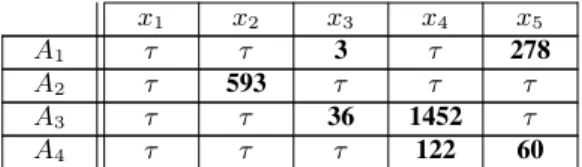
Example 1 Let x be a CSP, A = {A1, A2, A3, A4} a portfolio, A3the backup solver,
τ = 1800 seconds the solving timeout, N (x, k) = {x1, ..., x5} the k = 5 neighbours
ofx, and the runtimes of solver Ai on problemxj defined as in Table 1. In this case,
the smallest sub-portfolios that solve the most instances (4 to be precise) inN (x, k) are {A1, A2, A3}, {A1, A2, A4}, and {A2, A3, A4}. The heuristic Hsel selectsS =
{A1, A2, A4} because these solvers are faster in solving the instances in N (x, k). Since
A1andA4solve 2 instances,A2solves 1 instance andx1is not solved by any solver,
the time window[0, τ ] is partitioned in 2 + 2 + 1 + 1 = 6 slots: 2 assigned to A1
and A4, 1 slot toA2, and 1 to the backup solverA3. Finally,Hschsorts the solvers
by increasing solving time. The final schedule produced by SUNNY is therefore σ = [(A4, 600), (A1, 600), (A3, 300), (A2, 300)]. x1 x2 x3 x4 x5 A1 τ τ 3 τ 278 A2 τ 593 τ τ τ A3 τ τ 36 1452 τ A4 τ τ τ 122 60
Scenario m n d τ Domain
ASP 11 1294 138 600 Answer-Set Programming
CSP 2 2024 86 5000 Constraint Satisfaction Problem
MAXSAT 6 876 37 2100 Maximum Satisfiability Problem
PREMARSH 4 527 16 3600 Container Pre-marshalling Problem PROTEUS 22 4021 198 3600 CSP, with possible encoding into SAT
QBF 5 1368 46 3600 Quantified Boolean Formula
SAT11-HAND 15 296 115 5000 SAT 2011 Competition – Handcrafted problems SAT11-INDU 18 300 115 5000 SAT 2011 Competition – Industrial problems SAT11-RAND 9 600 115 5000 SAT 2011 Competition – Random problems
SAT12-ALL 31 1614 115 1200 SAT Challenge 2012 – All problems SAT12-HAND 31 767 115 1200 SAT Challenge 2012 – Handcrafted problems
SAT12-INDU 31 1167 115 1200 SAT Challenge 2012 – Industrial problems SAT12-RAND 31 1362 115 1200 SAT Challenge 2012 – Random problems
Table 2. ASlib Scenarios.
3
Evaluation
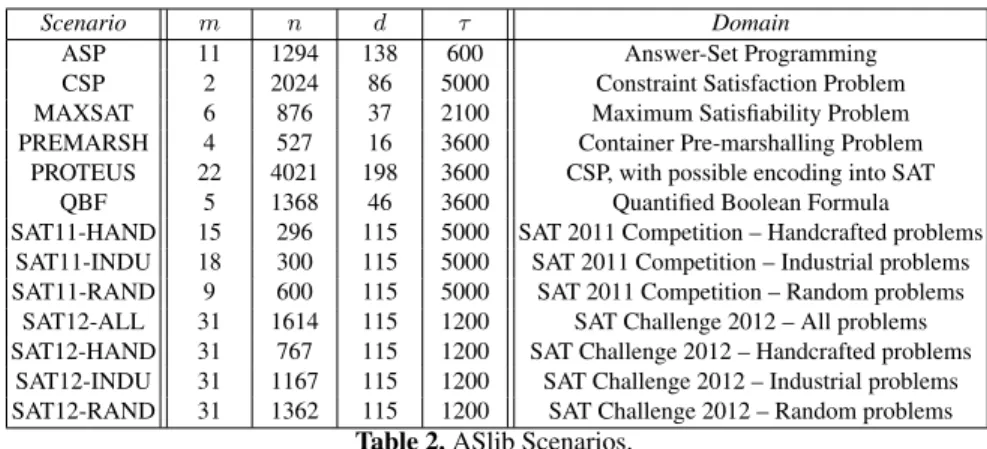
To evaluate SUNNY on different scenarios we exploited the Algorithm Selection library (ASlib). ASlib provides standardised format and data for representing AS scenarios al-lowing the comparison of different AS approaches. Each ASlib scenario contains: an algorithm space A = {A1, . . . , Am}; a problem space X = {x1, . . . , xn}; a feature
space Fd = {F1, . . . , Fn} where Fj ∈ Rd is the feature vector of the problem xj; a
performance space Pτ = {P1,1, . . . , Pm,n} where Pi,j ∈ R measures the performance
of algorithm Aion problem xjwithin a timeout of τ seconds. ASlib contains 13
het-erogeneous scenarios1 as summarised in Table 2. The scenarios differ in the number
of algorithms m, problems n, features d, and in the time limits τ . For every scenario, the runtime is used as performance measure: if algorithm A solves problem x in t < τ seconds the runtime RunTime(A, x) of A on x is t. Otherwise, RunTime(A, x) = τ . Each scenario of the ASlib is evaluated with a 10-fold cross validation: X is partitioned in 10 subsets X1, . . . , X10called folds, treating in turn a fold Xias the test set and the
unionS
j6=iXjof the other folds as the training set.
Adapting SUNNY to ASlib scenarios was rather straightforward. Fixed a training set Xtr ⊆ X and a corresponding feature space Ftr, we normalised the feature vectors
by removing all the constant features of Ftr and scaling them in the range [−1, 1].
Then, for each unknown problem x /∈ Xtr, SUNNY computes the neighbourhood
N (x, k) ⊆ Xtr and the resulting schedule σ = [(a1, t1), . . . , (ah, th)] exactly as
ex-plained in Section 2. Following the methodology of [4], we set k = p|Xtr| and the
backup solver as the algorithm of A having the lower average RunTime in Xtr.
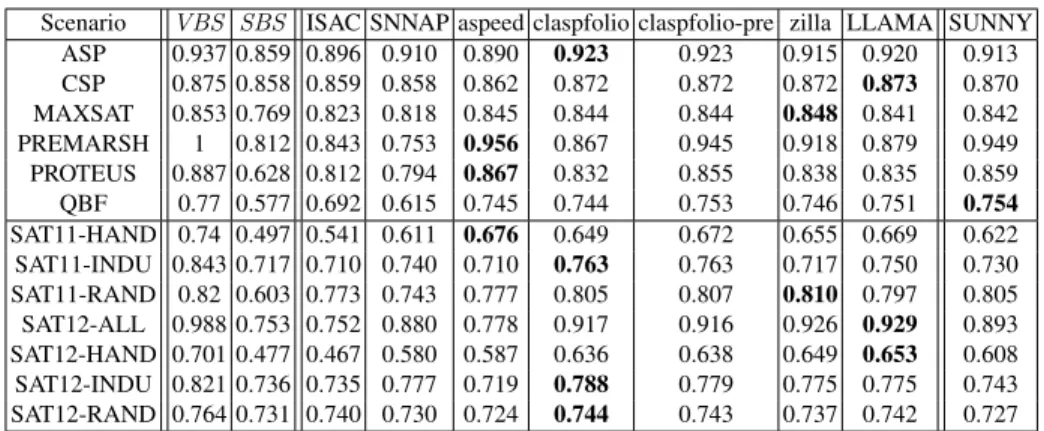
Table 3 shows for each scenario the Fraction of Solved Instances (FSI) of SUNNY. As the name underlines, the FSI of an AS approach is the ratio between the number of instances it solves and all the instances of the scenario. SUNNY is compared against the state-of-the-art AS approaches reported in [5] (viz., ISAC, SNNAP, aspeed, claspfolio, claspfolio-pre, zilla, and LLAMA) and two additional baselines: the Single Best Solver (SBS ), i.e., the algorithm in A with highest FSI, and the Virtual Best Solver (VBS ), i.e., the oracle approach that for every x ∈ X always select the algorithm A ∈ A for
Scenario VBS SBS ISAC SNNAP aspeed claspfolio claspfolio-pre zilla LLAMA SUNNY ASP 0.937 0.859 0.896 0.910 0.890 0.923 0.923 0.915 0.920 0.913 CSP 0.875 0.858 0.859 0.858 0.862 0.872 0.872 0.872 0.873 0.870 MAXSAT 0.853 0.769 0.823 0.818 0.845 0.844 0.844 0.848 0.841 0.842 PREMARSH 1 0.812 0.843 0.753 0.956 0.867 0.945 0.918 0.879 0.949 PROTEUS 0.887 0.628 0.812 0.794 0.867 0.832 0.855 0.838 0.835 0.859 QBF 0.77 0.577 0.692 0.615 0.745 0.744 0.753 0.746 0.751 0.754 SAT11-HAND 0.74 0.497 0.541 0.611 0.676 0.649 0.672 0.655 0.669 0.622 SAT11-INDU 0.843 0.717 0.710 0.740 0.710 0.763 0.763 0.717 0.750 0.730 SAT11-RAND 0.82 0.603 0.773 0.743 0.777 0.805 0.807 0.810 0.797 0.805 SAT12-ALL 0.988 0.753 0.752 0.880 0.778 0.917 0.916 0.926 0.929 0.893 SAT12-HAND 0.701 0.477 0.467 0.580 0.587 0.636 0.638 0.649 0.653 0.608 SAT12-INDU 0.821 0.736 0.735 0.777 0.719 0.788 0.779 0.775 0.775 0.743 SAT12-RAND 0.764 0.731 0.740 0.730 0.724 0.744 0.743 0.737 0.742 0.727
Table 3. Fraction of Solved Instances.
which RunTime(A, x) is minimal. We can see that SUNNY is the best approach for the QBF scenario, and that for all the non-SAT scenarios it is rather close to the best performance. Conversely, for the SAT benchmarks its performance is quite poor.
The FSI metric is commonly used for comparing different AS approaches due to its simplicity and significance. However, it does not take into account the time needed to solve a problem. To capture also the timing aspects of the resolution, the Penalised Average Runtime(PAR) measure is often used. PARkrepresents the average time taken
to solve the problems by giving a penalisation of k × τ seconds for the instances not solved within the timeout τ .
Table 4 shows the results considering the average PAR10 score. In this case the
SBS is the single algorithm having the lower PAR10score. Not surprisingly, PAR10is
strongly anti-correlated to FSI and the results of 4 somehow reflect what observed in Table 3. However, some differences arise. For instance, in addition to QBF, by consider-ing PAR10SUNNY is the best approach also for the PROTEUS scenarios. This means
that in this scenario aspeed solves few instances more than SUNNY, but SUNNY is on-average faster.
Scenario VBS SBS ISAC SNNAP aspeed claspfolio claspfolio-pre zilla LLAMA SUNNY ASP 400.2 880.5 653.6 571.2 711.2 487.2 496.0 539.5 509.1 549.0 CSP 6344.3 7201.6 7148.6 7201.6 7163.0 6511.2 6521.4 6491.5 6466.7 6617.8 MAXSAT 3127.2 4893.1 3763.1 3855.7 3748.4 3320.4 3629.3 3234.7 3367.6 3354.9 PREMARSH 227.6 7002.9 5880.8 9042.1 1964.1 5025.0 2395.7 3179.1 4634.2 2221.5 PROTEUS 4105.9 13443.4 6782.5 7430.3 5363.4 6075.1 5525.0 5900.4 6066.6 5254.4 QBF 8337.1 15330.2 11201.3 13954.0 9714.3 9333.6 9089.8 9222.5 9075.0 9064.8 SAT11-HAND 13360.7 25649.1 23325.1 19820.4 16688.4 17975.7 16897.8 17602.4 16906.5 19308.5 SAT11-INDU 8187.5 14605.9 14968.9 13426.8 15008.2 12322.7 12383.9 14621.2 12996.6 14014.9 SAT11-RAND 9186.4 19916.4 11575.1 12984.4 11589.0 9982.4 9936.2 9719.6 10341.2 9960.262 SAT12-ALL 241.3 3079.9 3101.0 1558.6 2810.2 1113.0 1163.2 1014.7 980.3 1429.8 SAT12-HAND 3662.2 6338.9 6466.3 5112.3 5071.9 4450.4 4459.4 4306.3 4252.9 4808.3 SAT12-INDU 2221.5 3266.0 3306.2 2796.8 3499.9 2653.5 2800.2 2838.4 2837.4 3211.891 SAT12-RAND 2872.8 3271.1 3168.8 3289.9 3382.1 3119.6 3161.9 3207.6 3149.6 3327.9
4
Conclusions
In this work we presented an evaluation of SUNNY algorithm on different Algorithm Selection (AS) scenarios coming from the Algorithm Selection library (ASlib). Despite SUNNY is tailored for constraint solving, its adaptation to AS appears to be promising also in other fields such as Answer-Set Programming (ASP), Quantified Boolean For-mula (QBF), or the Container Pre-marshalling Problem. Conversely, for the Boolean Satisfiability (SAT) problems there is still a performance gap with the best approaches. We would like to remark that in this evaluation we used the default SUNNY ap-proach without leveraging its settings to fit the different scenarios. As a future work we would like to try to improve the performance of SUNNY by using well-known tech-niques like pre-solving, parameters tuning, and feature selection. It would be interesting to consider also different scenarios, like optimisation and planning problems. Indeed, the ASlib currently contains a limited number of scenarios for which the only metric is the runtime. It would be nice also to perform a deeper study to better understand the SUNNY performance (and in particular why SUNNY is not so good for the SAT benchmarks).
We strongly encourage the submission of new scenarios and new algorithm selectors to the ASlib in order to foster the study and the comparison of new and better AS approaches. For instance, since SUNNY turns out to be the best approach for QBF, it would be interesting to consider a comparison with the multi-engine solver AQME [8]. We are currently implementing SUNNY as an automated algorithm selector for ASlib scenarios, with the aim of enrolling it to the next ICON Challenge on Algorithm Selection. Moreover, we are also interested in studying how SUNNY can be optimally parallelised to run its algorithms simultaneously on multiple cores. A preliminary in-vestigation on the SUNNY parallelisation for CSPs and COPs is presented in [2].
References
1. R. Amadini, M. Gabbrielli, and J. Mauro. SUNNY: a Lazy Portfolio Approach for Constraint Solving. TPLP, 14(4-5):509–524, 2014.
2. R. Amadini, M. Gabbrielli, and J. Mauro. A Multicore Tool for Constraint Solving. In IJCAI, 2015. Pre-print available at: http://arxiv.org/abs/1502.03986.
3. R. Amadini, M. Gabbrielli, and J. Mauro. Portfolio approaches for constraint optimization problems. AMAI, pages 1–18, 2015.
4. R. Amadini, M. Gabbrielli, and J. Mauro. SUNNY-CP: a Sequential CP Portfolio Solver. In SAC, 2015. Available at http://www.cs.unibo.it/˜amadini/sac_2015.pdf. 5. Algorithm Selection Library - coseal. https://code.google.com/p/coseal/
wiki/AlgorithmSelectionLibrary.
6. C. P. Gomes and B. Selman. Algorithm portfolios. Artif. Intell., 126(1-2):43–62, 2001. 7. L. Kotthoff. Algorithm selection for combinatorial search problems: A survey. AI Magazine,
35(3):48–60, 2014.
8. L. Pulina and A. Tacchella. A self-adaptive multi-engine solver for quantified boolean for-mulas. Constraints, 14(1):80–116, 2009.
9. J. R. Rice. The Algorithm Selection Problem. Advances in Computers, 15:65–118, 1976. 10. K. A. Smith-Miles. Towards insightful algorithm selection for optimisation using