HAL Id: hal-01872656
https://hal.archives-ouvertes.fr/hal-01872656
Submitted on 21 Apr 2021
HAL is a multi-disciplinary open access archive for the deposit and dissemination of sci-entific research documents, whether they are pub-lished or not. The documents may come from teaching and research institutions in France or abroad, or from public or private research centers.
L’archive ouverte pluridisciplinaire HAL, est destinée au dépôt et à la diffusion de documents scientifiques de niveau recherche, publiés ou non, émanant des établissements d’enseignement et de recherche français ou étrangers, des laboratoires publics ou privés.
Returning to Dakar: A Mixed Methods Analysis of the
Role of Migration Experience for Occupational Status
Cora Leonie Mezger Kveder, Marie-Laurence Flahaux
To cite this version:
Cora Leonie Mezger Kveder, Marie-Laurence Flahaux. Returning to Dakar: A Mixed Methods Anal-ysis of the Role of Migration Experience for Occupational Status. World Development, Elsevier, 2013, 45, pp.223 - 238. �10.1016/j.worlddev.2012.11.009�. �hal-01872656�
1
Returning to Dakar:
A Mixed Methods Analysis of the Role of Migration Experience for Occupational Status
Cora Mezker Kveder Marie-Laurence Flahaux
MEZGER KVEDER C., FLAHAUX M.-L. (2013). “Returning to Dakar: A Mixed Methods Analysis of the Role of Migration Experience for Occupational Status”, World Development, 45, 223-238.
Abstract:
This paper applies mixed methods to contrast the professional situation of Senegalese return migrants and non-migrants in Dakar, and to explore the heterogeneity among return migrants due to differential migration experiences. Quantitative data from the MAFE-Senegal survey (2008) and qualitative semi-structured interviews with return migrants are used. The results suggest that returnees are able to join the labor market after their return. While overrepresented in self-employed jobs, self-employment is not necessarily associated with positive migratory experiences. Rather than a choice, self-employment appears as a “last resort” for individuals who were not able to accumulate capital or prepare their return.
2 1. INTRODUCTION AND RESEARCH OBJECTIVES
The role of return migration and circular migration for development has been of increasing interest to policy makers in both origin and destination countries. Return migrants may have acquired new know-how, skills and ideas, financial capital and social contacts during their stay abroad, all of which could be helpful in setting up a business, finding a job and bringing the new resources to use. However, migration may also have disruptive effects on the labor market reintegration. The financial resources may be insufficient to start a business activity, social ties at the origin may be weakened, and, if the employment taken up during migration is below a migrant’s qualification, little or no human capital may have been acquired. Moreover, depending on the migration and return motives as well as the economic and social context in which the return takes place, returnees may also not participate in the labor market, may retire or decide to depart again for another stay abroad. A considerable amount of empirical research has investigated the occupational status of returnees, in particular with regard to their involvement in business activities, for countries and regions such as Egypt (McCormick and Wahba, 2001; Wahba and Zenou, 2009), Albania (Kilic et al., 2007; Piracha and Vadean, 2010), Moldova (Borodak and Piracha, 2011), Pakistan (Ilahi, 1999), the Maghreb (Mesnard, 2004; Tani and Mahuteau, 2008; Gubert and Nordman, 2011) and Mexico (Lindstrom, 1996). However, little evidence exists on return migration and returnees’ labor market reinsertion in the context of Sub-Saharan Africa. Moreover, most authors have focused on the role of return migrants in promoting business activities, but analyzing wage-employment and the fact of being out of the labor force may provide insights into alternative strategies of return migrants. The objective of this paper is thus to contribute evidence on the labor market conditions of Senegalese return migrants in the region of Dakar, the capital city.
Senegal has a long, dynamic migration history and migration plays an important role in Senegalese society. Early Senegalese migration targeted mainly neighboring countries as well as the colonial power France (Guilmoto, 1998; Traore, 1994). However, in the context of the 1973 oil shock, France stopped its active recruitment policy. Migration to the traditional African destination countries was also hampered by increasing political instability (Robin et al., 1999). At the same time, a period of economic crisis and increasing poverty started in Senegal, following several droughts and a decline in the groundnut sector in the 1970s and the implementation of structural adjustment programs in the 1980s (Tall, 2002). As traditional destinations were less accessible, migration destinations diversified. Migration became increasingly directed towards countries outside of West and Central Africa as well as countries without any colonial or linguistic links, in particular Italy, Spain and the United States (Ndione and Broekhuis, 2006). Nowadays, over 630,000 Senegalese live abroad (4.9% of the population; “Bilateral Migration matrix 2010”, World Bank). Dakar, on which this analysis focuses, is the major departure and return region (2002 census), destination for internal migrants (ANSD, 2009) and represents the favorite target for migrant investments (Tall, 2009). Senegalese migration is rather diverse in terms of destination countries, education levels or migration motives. Concerning the region of Dakar, the 2002 census reveals that a large share of migrants left the country for economic reasons (68%), but also to study (18%) or for a family motive (10%). The profile of Senegalese return migrants is similarly diversified, which can have an impact on the occupational status after return, with some more likely to be wage-employed (skilled or not) or self-employed, whereas others are rather expected to stay out of the labor market. Returns to the home country are not an exception in the Senegalese context, as every second migrant returns within 10 years (Flahaux et al., 2010). In European destination countries and, to a lesser extent in Senegal, return migration is met by an increasing policy interest in the potential role of Senegalese return migrants in promoting development. Several European destination countries introduced programs which aim to provide financial support for the start of economic activities. However, the success has been limited, as only few returnees have benefited from such measures and reintegration measures focused on self-employment and neglected access to salaried employment (Diatta and Mbow, 1999; Flahaux and Kabbanji, 2010).
The specific research objectives of this paper are twofold. Firstly, we aim to assess to what extent the fact of being a return migrant is related to occupational outcomes in the context of the Dakar labor market. The region of Dakar is characterized by persistent unemployment and underemployment (Ministère de l’Economie et des Finances, 2004b), and job creation is concentrated in the informal sector, predominantly in low-productivity activities (World Bank, 2007). The trend towards further
3
informalisation is also reflected in the figures on the distribution of workers across sectors. While in 2001/2002 the informal sector provided work for 77% of the working population (1-2-3 survey, DPS, 2004), its share went up to 83% in 2008 (EDMC, ANSD, 2010). Within the informal sector, self-employment represents around half of all self-employment. Moreover, businesses in the informal sector are very small. Only one out of five informal sector jobs are in businesses with six to 20 employees, the rest is constituted by workers in microenterprises and self-employment (1-2-3 survey, DPS 2004). The large majority in the informal labor market works at very low levels of income (at a median value of 34,000FCFA (52€) per month, World Bank, 2007) mirroring low productivity and education levels. However, some individuals in the informal market reach income levels that are equivalent to or even higher than those in the public sector. For this group, participation in the informal sector may be opportunity-driven rather than survivalist, as they may face lower bureaucratic hurdles and tax burdens than in the formal sector (World Bank, 2007). In addition, highly qualified jobs are rare, particularly because the public sector employment share has decreased steadily since the beginning of the 1980s (Ministère de l’Economie et des Finances, 2004a). It employs now only seven percent of the working population (EDMC, ANSD, 2010).
The second objective is to explore in how far differential migration experience is reflected in heterogeneous occupational attainment outcomes. What is the role of capital accumulated during the stay abroad, and does the context of return matter, in particular the return motive? Quantitative analyses using new biographic survey data on African migration (Migration between AFrica and Europe, MAFE)1 explore whether returnees’ labor market behavior differs from that of non-migrants at the time of the survey, and introduce selected migration and return characteristics. The latter question will be further investigated through complementary qualitative analysis based on interviews with return migrants in the region of Dakar. The interviews capture in a more comprehensive way how returnees experienced their stay abroad, the return and the time they have spent back in Dakar.
2. A BRIEF REVIEW OF THE LITERATURE ON RETURNEES’ PROFESSIONAL REINTEGRATION
(a) Theoretical framework
Theoretical predictions regarding the process of labor market reintegration and the occupational attainment after return have been advanced by various bodies of migration theory.2
In static neoclassical migration models, the migration decision is based on a cost-benefit analysis by the potential migrant (Sjaastad, 1962; Harris and Todaro, 1970). Under the assumption of sustained wage differentials, migration is considered to be a permanent event. Return migration can be explained by a failed migration project. It is likely that the returnee faces difficulties in the context of a “failed” migration. No financial, human or social capital is accumulated abroad, and the migration episode interrupts the work experience in the home country. One can expect that returnees remain, at least temporarily, out of the labor market. They may also take up work with low entry-level barriers, representing a “last resort” option. Another explanation of return is that human capital accumulated in the host country is transferable and achieves higher relative returns at home than at the destination. Foreign education obtained abroad, for example, could situate the migrant at the middle of the host country distribution, but among the educational elite in the origin country (Dustmann, 2000). In this case, we would expect a smooth reintegration after return, in particular into skilled positions.
According to the New Economics of Labor Migration (NELM) literature, migration which takes place in a context of credit market imperfections in the origin country may serve to accumulate sufficient savings for investment at home. Having achieved the “target-level” of savings, migrants return to their home countries (Stark, 1991; Mesnard, 2004; Yang, 2006). If savings are accumulated with the expectation of starting a business activity, one should observe an over-representation of returnees among the self-employed and entrepreneurs. A further reason for return migration is a higher purchasing power of the host country currency in the home country (Stark et al., 1997). Under such conditions, one would expect to observe retirement return migration, whereby the migrant returns after the end of the
4
working life in order to spend savings in the country of origin. In both cases, migration duration and activity after return may be decided simultaneously – target savers stay only as long as needed to accumulate the resources, while retirement returnees remain until the end of their working life abroad (Dustmann and Kirchkamp, 2002).
The structural approach views the process of reintegration after return in a rather pessimistic light (Gmelch, 1980; Colton, 1993): returnees may not be able to reintegrate if the “gulf” between norms and values at origin and their own is too large and decide to depart again. Alternatively, they may also respond to pressure from their origin household and spent their savings on consumption rather than productively. The structuralist approach to return migration suggests that returnees are in the short term rather inactive and that they take up less productive activities when participating in the labor market. Moreover, the sample of return migrants observed at origin may be self-selected if “frustrated” returnees decide to re-migrate.
Social ties between origin and destination during the migration period and after return are at the heart of both transnationalist theory and social network theory (Cassarino, 2004). Migrants maintain regular contact with the origin community, for example through visits and transfers. These links allow for a better preparation of the return and a smooth reintegration after return. Transnationalists focus on networks defined on the basis of kinship and common origin, while the social network theory emphasizes “built” relationships such as associations in the host country, groups with common aims and whose members include migrants as well as non-migrants. The existence of links to socio-economic networks abroad after return may facilitate “cross-border” activities, such as import-export businesses, but also skilled employment in international companies or institutions.
Finally, Cassarino (2004, 2008) emphasizes willingness to return and preparation of the return as elements which determine the success of the reintegration after return. Combining elements of the previous theories, he highlights that returnees are better or worse prepared for the time after return depending on their capacity to acquire social, financial and human resources, both before and during migration. If the return is decided by others or by external circumstances, such as the death of a family member or worsened political conditions in the host country, the returnee may have insufficient information about opportunities and may not have accumulated sufficient resources for a successful reinsertion at home. Returnees who have been able to mobilize various types of resources and who decide themselves whether and when to return, should therefore encounter less problems.
(b) Empirical evidence on return and professional reintegration from the literature
There is a sizeable empirical work on the occupational status of return migrants.3 However, most studies do not compare return migrants with non-migrants, or are examining country contexts which are very different from the Sub-Saharan African case in general, and from the Senegalese in particular. This summary concentrates therefore mostly to studies on return to African countries.
Both descriptive and multivariate analyses including non-migrant as well as return migrant samples suggest that the proportion of entrepreneurs is higher among return migrants than non-migrants, and point towards the role of capital mobilization (e.g. McCormick and Wahba, 2001 and Wahba and Zenou, 2009 on Egypt; Mesnard, 2004 on Tunisia). For example, Wahba and Zenou (2009), who define Egyptian entrepreneurs as individuals who are employers or own a non-farm economic unit, find that returnees are more likely to become entrepreneurs than non-migrants. According to the authors, this finding suggests that the migration experience compensates for the loss of social networks during migration. Studies in the African context have so far been limited to the study of entrepreneurship, without distinguishing wage-employment statuses or inactivity as alternatives. However, for Albania, Piracha and Vadean (2010) find that return migrants are less likely to be wage-employed and more likely to be out of the labor market. The distinction between own-account workers and entrepreneurs indicates that returnees overrepresented in the latter group, but not in the former.
Several papers restrict their analysis to return migrants to examine in more detail the role of migration experience, focusing on determinants of business investments (e.g. Black and Castaldo (2009); Mesnard (2004); Gubert and Nordman, 2011). For the African countries studied, the findings match the
5
theoretical predictions regarding the role of capital mobilization. Financial capital accumulated during migration and remitted or transferred back at the end of the migration period appears to be a particularly strong predictor of entrepreneurship after return. However, also human capital in the form of work experience acquired has a positive effect. Formal education acquired abroad does not seem to matter for self-employment, but raises the probability of wage employment and reduces the probability of unemployment, according to findings by Tani and Mahuteau (2008) on returnees to the Maghreb countries. In a study based on the 1-2-3 survey conducted in 2001 and 2002 in seven major cities in the West African Economic and Monetary Union (WAEMU), including Dakar, De Vreyer et al. (2010) show that destination region matters as only individuals who returned from an OECD country are more likely to be an entrepreneur. The authors suggest as possible explanation the better opportunities for capital accumulation or for acquisition of “specific knowledge” valued in the sectors they are targeting. Independently of the migration destination, returnees appear to be less likely to be in public wage-employment than non-migrants. Previous studies’ results with regard to the effect of migration duration, a proxy for capital accumulation, are more conflicting. While McCormick and Wahba (2001) find a positive effect of duration on returnees’ entrepreneurship in Egypt, and Black and Castaldo (2009) similarly for returnees in Ghana and Cote d’Ivoire, migration duration has no effect in the findings of Gubert and Nordman (2011) on returnees in Algeria and Morocco.
With regard to factors facilitating or constraining the preparation of the return, Gubert and Nordman (2011) find that if the return was “forced” (no documents or deportation) entrepreneurship after return becomes less likely. Moreover, the positive effect of transfers may also reflect their role in maintaining links to the origin country which are essential for preparing the return. Similarly, Black and Castaldo (2009) find that social capital kept and maintained through short visits and membership in migrant associations increases the chances of becoming entrepreneur.
Qualitative studies focus on the subjective experience of the life after the return. Davids & van Houte (2008) argue that a qualitative perspective is indispensable in studies aiming to understand the “embeddedness” of return migrants, as they did in the case of their study about migrants (from Angola and Guinea) returned from the Netherlands. They highlight that a better anticipated and prepared return leads to improved “embeddedness” back in the home country. Besides, qualitative analyses from life stories help to grasp the motivation of the elite among returnees to Ghana and Cote d’Ivoire who wish to apply know-how acquired abroad when starting a business, but also to give the floor to returnees who face difficulties trying to find employment (Ammassari, 2005). Carling (2004) studies the reintegration experience of returnees in Cape Verde. He emphasizes that the wage-employed tend to feel frustrated. Rigid hierarchies prevent them from progressing in their career and they end up being supervised by people who are less qualified than them. A qualitative study on Malian return migrants highlights that those who lived in precarious conditions in France could not conceive a sustainable return project, even if they had benefited from financial assistance (Linares, 2009). Chappart (2008), who collected stories of deported Cameroonians, shows how these returnees are marginalized, struggle to reintegrate into society and want to leave again. Sinatti (2011) concluded in her qualitative study of Senegalese returnees that migrants’ self-perception of a successful return is still largely associated with permanent return. (c) Research hypotheses
The theoretical and empirical literature suggests hypotheses with regard to the relationship between return migration and occupational status. The common hypothesis in the empirical literature is that return migrants are overrepresented among entrepreneurs. However, this association is likely to vary depending on the characteristics of the return and the migration experience.
(i) Willingness and links to origin
The return motive variable reflects the concept of “willingness to return” proposed by Cassarino (2004). Individuals who take the return decision themselves are likely to be better prepared for their return and the life back in Senegal than those who did not, because another person decided for them, because return was triggered by external events or because return was due to a “failed” migration experience as proposed by the neoclassical literature. Our hypothesis is that individuals who decide themselves if and when to return are more likely to find a job, in general, and a job of higher skill-content in particular,
6
than non-migrants. The relationship with self-employment status is ambiguous. If entrepreneurship refers to sustainable and higher-level business activities, the fact that the return was involuntary is expected to be negatively correlated with self-employment status. If self-employment occurs mainly in the informal sector, which has at least a subsector with relatively low entry barriers, it may constitute the second-best option when (skilled) wage employment is not accessible. In this case, we would rather expect that ill-prepared returnees become employed. The ambiguity in the correlation with self-employment is also present for other variables reflecting the preparedness of the returnee and the degree of capital accumulation at the time of return.
The fact of having sent remittances during the stay abroad can be interpreted in several ways. Transfers can reflect that migrants maintain links with the family members at origin, what would help them gather information about labor market conditions and facilitate their reintegration after their return (transnationalist/social network theory). While being rather active in the labor market, one cannot provide a concrete hypothesis on the type of activity. Moreover, target savers could aim to accumulate part of the capital at origin, in particular in light of an investment in business activities (New Economics of Labor Migration). However, transfers may also reflect the dependency of the origin household on the migrant’s support, a hypothesis which is supported by qualitative analyses (Linares, 2009). In this case, the returnee is forced to quickly find a replacement for remittance transfers, once back in the home country. If self-employment work presents the lowest entry barriers, the return migrant is likely to become self-employed, rather than to spend time on searching a salaried job.
(ii) Conditions for capital accumulation abroad
A third interpretation of the role of remittances would imply that target savers accumulate part of the capital at origin (New Economics of Labor Migration). In this case we should also observe more involvement in self-employment, but in activities demanding higher starting capital. However, given that money is fungible and the control of the capital is in the hands of the household, it is rather unlikely that savings are accumulated and re-transferred to the migrant after the return.
The process of capital accumulation beyond financial capital is further captured by measures of migration duration4, brain waste, the acquisition of education while abroad, and the fact of having
gained work experience during the migration. The literature generally suggests that longer migrations should be positively associated with self-employment, as more capital and know-how may be accumulated. However, due to the fact that the category of self-employment is likely to include mainly low-level activities, we expect shorter rather than longer durations to be positively related to self-employment. If returnees worked in the host country in activities below their level of qualification, skills and know-how may have not increased or even been lost over this period (“brain waste”). In this case we would expect migrants to experience difficulties in the reintegration process, in particular to be less likely to take up skilled jobs. Individuals who gained education abroad should have better opportunities in skilled wage-employment than non-migrants, under the assumption that the knowledge acquired abroad is transferrable to the Dakar labor market and that it is more highly valued than education acquired in Senegal. Foreign work experience should also increase the level of (work-related) human capital and know-how and help in finding a job after return. However, one cannot provide a prediction about the skill-level of the activity after return, which depends on the skill-level of the previous work experience. Individuals who were mainly inactive during migration may also be more likely to remain without income generating activity after return.
The period of departure and the destination region of the last migration may encompass institutional and network effects, but may also proxy for the opportunities and conditions for capital mobilization. Early migrations from Senegal were facing less legal and economic hurdles and are expected to coincide with larger opportunities for capital accumulation.5 This is the case for destinations in Africa before the structural adjustment programs were implemented in the 1980s and Europe before the enhancement of immigration restrictions in the same period. However, as both the access to education and the labor market abroad posed less barriers, early return migrants may have benefited in terms of reintegration into a skilled job or better business opportunities. Moreover, returnees from a destination in Africa should face fewer difficulties to reintegrate, in particular in self-employment occupations if this sector is characterized by relatively low entry-barriers. They come back from a context which is not very
7
different from the Senegalese one, and may have kept closer ties to their family at home. At the same time, they may not have accumulated large amounts of capital. Returnees from Europe may first face more problems in readjusting to life in Senegal, but may also have acquired more capital which can facilitate the reinsertion in productive entrepreneurship or skilled jobs in the long-run.
(iii) Context of the return experience
Finally, we distinguish by the period of return to explore to some extent the context of the return experience, which was highlighted in particular by the structural literature. The economic and political conditions at origin at the time of return are likely to influence the occupational status of return migrants as compared to non-migrants, who did not interrupt their working life in Senegal. We expect to find higher probabilities of self-employment since the start of the structural adjustment program in the mid 1980s, a period in which access to formal sector jobs became increasingly difficult. Despite a more positive overall economic situation in recent years (in terms of GDP growth), unemployment and underemployment have rather been on the increase, in particular in the urban labor market of Dakar. Self-employment and inactivity may therefore be the dominant types of occupation for returnees who came back after 1997.
3. DATA AND METHODS
This work combines quantitative and qualitative methods to study the occupational reinsertion of return migrants. Quantitative methods allow for a numerical assessment of the occupational status of return migrants and non-migrants in the Dakar region. Qualitative methods, on the contrary, can supply more detailed information about the context in which return and reinsertion take place, as well as about the subjective assessment of the work situation, by covering questions which are not included in the quantitative survey questionnaire. The qualitative analyses, which concentrate on returnees only and describe the reintegration experience since return, are thus regarded as a complement to the quantitative results. Mixing the two methods can facilitate the mutual validation of findings and produce a more coherent and complete picture of the role of migration and migration experience for occupational reintegration. During spring 2009 and summer 2010, 46 qualitative interviews were carried out with return migrants living in the region of Dakar. Due to reasons of confidentiality, return migrants interviewed in the context of the quantitative survey (MAFE) could not be re-contacted. The sampling of respondents, which took mainly place in public spaces such as on public transport or in the street, intended to include returnees with diverse characteristics and migration experiences. Individual characteristics of interviewees as well as their occupational status are summarized in Table 1. The reference to formality or informality of the status is self-reported. Makhete (44 years), for instance, explains that formalizing his business activity entails risks he is not willing to take for the time being. “Then you have to pay taxes, that‘s normal, but I know many people who had to close down because of the taxes.”
8
Table 1: Sample of respondents of qualitative interviews
Variables Categories Number of respondents
Gender Men 34
Women 12
Destination Africa 21
Europe 16
Africa and Europe 7
North America 2
Level of education Low 22
High 24
Migration motive Work 26
Studies 6
Studies and work 6
Follow a family member abroad 8 Occupational status Unemployed and housewives 8 Students and trainees 2 Skilled wage-employed 6 Unskilled wage-employed 3 Employers and self-employed (formal labor
market)
10 Employers and self-employed (informal
labor market)
17
Total n= 46
The interviews were semi-structured, following a comprehensive interviewing guide in order to streamline the reporting and recording of the narratives. The emphasis was placed on the migratory experience of the interviewees, on the resources they had acquired abroad (social capital, human capital and financial capital), and on the process of professional reinsertion after their return in Senegal.6 The quantitative analyses performed in this paper use recent biographic survey data collected in the Dakar region in the framework of the MAFE-Senegal project (Migration between Africa and Europe). The region with its four administrative departments Dakar, Pikine, Guédiawaye and Rufisque accounts for approximately one quarter of the national population. In a first step, National Census data from 2002 was used as a sampling frame to group census districts into 10 strata of equal size based on the migration prevalence. Six districts were randomly drawn out of each stratum and a micro-census was conducted in the sampled districts to update the list of households. Stratified into non-migrant and migrant households, 1320 households were sampled as secondary units. Household surveys were conducted in early 2008, and individuals within households were sampled for the subsequent biographic interviews. The eligibility criteria for the individual questionnaire established that individuals had to be between 25 and 75 years of age, born in Senegal and of present or past Senegalese nationality. Interviews were conducted with 1063 individuals, out of which 870 are non-migrants and 193 are return migrants, defined as individuals who had spent at least one year abroad and were at the time of the survey members of the household. The sample is representative of the Dakar region, and inference to the population characteristics is thus only valid at the regional and not at the national level.7 The sampling design is taken into account in both descriptive and multivariate analyses by using the Stata survey commands. The individual questionnaire recorded retrospective information at annual intervals about the respondent’s life. Data hence cover the time from birth till the survey date, for both non-migrants and return migrants. In addition to more common life histories such as housing, family formation and activity histories, the survey collected data on many migration-specific histories (e.g. migrations and return
9
migrations lasting at least one year, migration of network members, short returns, remittances, residence and work permits).
The main quantitative variable of interest is the self-reported occupational status in 2008, distinguishing between skilled and unskilled wage-employed, self-employed and “no income earners”. Due to the relatively low number of observations, certain types of occupations have been conflated. The “self-employed” category also contains the few individuals who declared to be employers (17 persons), and the data do not permit to further differentiate this category in order to account for productivity, size, and formality of the activity. This is unfortunate, given the theoretical and empirical suggestions regarding the heterogeneity of self-employment activities in a developing country context. The self-employment category is thus likely to contain more heterogeneous types of activities and attract heterogeneous types of returnees. The description of activities reported by self-employed in the MAFE survey illustrate the breadth, diversity and quality of the type of work performed. While, for instance, a large number of individuals report activities in the trade sector, activities range from street vendors to shop owners and wholesale. Similarly, one finds tailors who work from home, and tailors with a workshop and sales shop, or electricians who work alone whereas others declare to have employees. Although constituting a smaller number, there also appear to be examples of highly educated self-employed, (e.g. an accountant, a translator, or a doctor). The “no income earner” category also conflates different types of individuals, as those who work as a family help (14 individuals) or apprentice/intern/in training (50) are grouped together with those who declare that they are retired (40), unemployed (49) or inactive (275) into a group of “no income earners”. The group shares the trait of not performing regularly a remunerated labor market activity.
Other variables examined descriptively include two internationally standardized continuous occupational rankings, Ganzeboom et al.'s International Socioeconomic Index of Occupations (ISEI) and Treiman's Standard International Occupational Prestige Scale (SIOPS). An income variable refers to revenues from all types of sources, in the last month of the given employment episode. The absolute and relative deprivation variables are subjective well-being measures at household level.
The aim of the analysis is to provide descriptive evidence of the relationship between return migrant status and occupational outcomes, rather than to report causal effects. In addition to cross-tabulations and mean tests, we estimate the association between return migrant status and occupational status at the time of the survey and controlling for a set of individual characteristics. The outcomes are estimated in the form of a multinomial logit model which is expressed as:
where y represents the j (=1,2,3,4) outcomes in which the individual may be attached to the labor market. The j=4 category (no income earner) is used as base category.8 We repeat the estimation for each variable discussed in the hypotheses section above, changing the definition of the return migrant status RMi,, our variable of interest. The first estimation uses a simple indicator variable (non-migrant/return migrant), and dummies distinguishing return migrant subgroups are included in subsequent estimations in order to examine the role of migration and return experiences. For instance, we split the return migrants into those who had returned voluntarily and those who returned involuntarily. The reference category remains “to have no migration experience”. In all estimations we control for the same set of individual and family-level characteristics (Xi). These include sex; educational attainment; age; household head status; marital status; number of dependent children between zero and sixteen years; and a variable that measures occupational status at age 25 or before first departure in case departure took place before the age of 25. This definition ensures an identical measure for the two groups whenever possible, while ensuring that occupation is measured pre-migration. In controlling for previous occupational status, we follow several papers in the literature, such as Wahba and Zenou (2009) or Gubert and Nordman (2011). If individuals have throughout their lifetime a higher probability of attachment to a specific occupational category, for instance to self-employment, controlling for occupational status early in life may help to net out the role of migration experience.9
, 1 ,2 ,3,4 ] exp[ ] exp[ Prob 4 0
j RM X RM X j y k i k i k j i j i j j i 10
Several limitations of the quantitative approach and the choice of variables should be noted. In this approach, which is pooling migrants and non-migrants, we are not able to control for all relevant return characteristics at once, since sample size limits the possibility of introducing multiple interactions with the return status, which would also be difficult to interpret. We are also not able to estimate separate models for non-migrants and return migrants in a second step and include in this way all relevant migration and return characteristics. Similarly, sample size limitations prevent us from estimating models separately for men and women, or to test interactions of the return migrant status with other socio-demographic characteristics.
The analysis, providing descriptive rather than causal evidence, does not account for possible biases due to endogeneity of the return migrant variables. Migration behavior is usually characterized by self-selection, both in terms of observable and unobservable characteristics. If observable, but omitted variables, or if unobserved characteristics, such as motivation, ability or risk aversion, are correlated with the return migrant status as well as with the outcome variable, the estimated effect of return migrant status will be biased. Three types of selection processes are at work in the context of this analysis. Individuals first select into migration and then into return. Moreover, returnees who remain in Dakar may be self-selected if those who are unsuccessful in reintegrating back home leave again. However, previous studies have focused on the joint effect and have found either no evidence to support endogeneity of the return migrant status (e.g. Démurger and Xu, 2011; Borodak and Piracha, 2011; Piracha and Vadean, 2010; Barrett and O’Connell, 2001; Co et al., 2000 (men)), or results pointed towards a negative relationship between migration and occupation-related outcome variables, at least in terms of entrepreneurship and earnings (e.g. Wahba and Zenou, 2009; Kilic et al., 2007; Co et al., 2000 (women); De Vreyer et al., 2010). Overall, the literature suggests that estimates without correcting for endogeneity tend to be underestimated. There is less evidence on the direction of the bias with regard to different wage-employment statuses.10 Endogeneity of certain return migrant dummies accounting for migration characteristics can furthermore be caused by the fact that decisions with regard to migration/return and the envisaged occupation back in Senegal are taken simultaneously. This is potentially the case for variables distinguishing by migration duration, acquisition of education while abroad or the return motivation if a job is found before returning. These limitations have to be kept in mind in the subsequent discussion of results.
4. RESULTS
(a) Descriptive statistics
Before examining the occupational variables of interest, we briefly compare return migrants and non-migrants with regard to key socio-demographic characteristics (Table 2). Return non-migrants in our sample are, on average, four years older than non-migrants, males are overrepresented and return migrants are more likely to be household heads. However, return migrants and non-migrants report a very similar profile in terms of educational attainment and family variables. This suggests that differences in education do not seem to be at the bottom of possible differences in occupational status variables and well-being indicators. Migration experience may indeed play a role on its own. Turning now to the occupational outcomes, one observes that return migrants are underrepresented among the group of non income earners (Table 2). This suggests that individuals with past migration experience are in general able to enter the labor market after their return to Dakar, and that they may benefit from capital accumulated abroad when searching for an occupation. The lower percentage of “no income earners” among return migrants could, however, also be related to the higher share of men and household heads. Also the distribution across occupational status categories suggests that labor market reinsertion is rather successful. While differences are not statistically significant, a larger share of returnees than of non-migrants seem find a job in skilled wage-employment, while the latter are more involved in unskilled jobs. The largest differential, however, can be observed in the category of the self-employed. 45% of all return migrants start their own business activity, against 29% of non-migrants, a result in agreement with findings from other countries and regions. This relative ease of returnees to become self-employed may be due to the starting capital and know-how accumulated during the migration. An alternative
11
interpretation is that self-employment after return represents an “easy entry” into the labor market for returnees who do not access salaried employment, but need to work to continue supporting their families.
Table 2: Descriptive statistics of occupational and well-being characteristics by return migrant status All Non-migrants Return migrants Mean/ median test non-migrant vs. returnee INDIVIDUAL CHARACTERISTICS Age 40.3 39.9 43.7 ** Female 0.54 0.57 0.36 *** Education No education 0.30 0.31 0.23 n.s. Primary 0.37 0.37 0.37 n.s. Secondary 0.23 0.23 0.28 n.s. Tertiary + 0.09 0.09 0.12 n.s. Household head 0.19 0.17 0.32 *** In partnership 0.67 0.67 0.72 n.s. At least one child aged 0-16 years 0.59 0.58 0.60 n.s.
OCCUPATION AND WELFARE CHARACTERISTICS
Occupations and occupational scores
No income earner 0.42 0.44 0.27 ***
Skilled wage-employed 0.13 0.13 0.19 n.s. Unskilled wage-employed 0.14 0.14 0.09 n.s. Self-employed/employer 0.31 0.29 0.45 *** ISEI score (all) - means 37.5 36.8 42.2 *** ISEI score skilled wage-employed 44.2 43.1 50.5 n.s. ISEI score unskilled wage-employed 27.9 27.5 32.0 n.s. ISEI score self-employed/employer 38.7 38.1 41.1 n.s. SIOPS score (all) - means 34.6 33.8 39.4 *** SIOPS score skilled wage-employed 41.9 40.5 49.5 ** SIOPS score unskilled wage-employed 26.7 26.4 30.3 n.s.
SIOPS score self-employed/employer 34.4 33.7 37.4 * Sector of activity/qualification
Primary sector & basic tasks 0.09 0.09 0.04 * Service sector (excl. salesmen) 0.20 0.21 0.12 *
Salesmen 0.33 0.32 0.41 n.s.
Craft/Industry 0.22 0.21 0.30 n.s.
Higher-level jobs 0.16 0.16 0.14 n.s.
Income
Average monthly income (€), in 2008 180€ 169€ 338€ *** Less than 3 years migration experience - - 206€
3-7 years migration experience - - 348€ 8 and more years migration experience - - 476€
Median monthly income (€), in 2008 106.7€ 107€ 152€ * Absolute subjective deprivation
Barely sufficient or insufficient financial resources to purchase basic goods
0.41 0.42 0.30 **
Sufficient resources 0.59 0.58 0.70 ** Relative subjective deprivation
Better relative living conditions 0.19 0.18 0.24 n.s. Similar living conditions 0.65 0.66 0.57 n.s. Worse living conditions 0.16 0.16 0.19 n.s.
Sample size 1063 870 193
Source: authors’ elaboration based on MAFE-Senegal (2008)
Notes: The mean test column indicates the significance level of mean differences between return migrants and non-migrants. The median test on median monthly income is a non-parametric K-sample test on the equality of medians.
Statistical significance: *** at 1%; ** at 5%; * at 10%; n.s. = not significant
12
We use the International Socioeconomic Index of Occupations (ISEI) and Standard International Occupational Prestige Scale (SIOPS) scores to obtain some insights into the socio-economic status and prestige of jobs and business activities performed by non-migrants and returnees. Overall, return migrants appear to perform occupations of higher socio-economic status and prestige. Once one distinguishes by occupational status, it appears that the main gain from migration experience relates to accessing more prestigious skilled salaried but also self-employed jobs. Independently of the migration status, the scores also provide information regarding the ranking of self-employed versus wage-employment in the labor market context of Dakar. Self-employed activities are, at the average, ranked higher than unskilled jobs, but lower than skilled jobs. Further insights regarding the type of work are gained from the information provided on tasks and duties carried out on the job. Returnees seem to prefer activities as traders and craftsmen, sectors which are most characterized by self-employment, though the differences are not statistically significant. A relatively larger proportion of non-migrants works in other service occupations and carries out basic manual tasks. There does not seem to be a large difference with regard to “higher-level” jobs, which group the occupational groups of clerks, professionals and executives.
The success of the reintegration should also be reflected in wealth and well-being indicators. According to a measure of total monthly income at the time of the survey, return migrants are at the average considerably better off than non-migrants. However, one can observe that the migration duration matters. Returnees with longer migration durations reap considerably higher incomes than returnees who stayed abroad for a short period, and one does not observe a disadvantage of individuals who stayed abroad for a relatively long duration. Yet, even returnees who spent a relatively short time abroad still achieve a higher average total income than individuals without any migration experience.
The subjective measure of absolute well-being provides a similar picture. Return migrants report less often than non-migrants that their households possess insufficient or barely sufficient financial resources to provide for basic goods. Interestingly, returnees do not perceive the living conditions of their household as superior to the situation of other households they compare themselves with. While the share reporting better living conditions is slightly higher in the return migrant group, the same is the case for those reporting worse conditions, and the differences between return migrants and non-migrants are not statistically significant. One possible explanation is that the reference group of returnees is different from that of non-migrants (higher up in the wealth distribution). Moreover, qualitative research on returnees in Dakar suggests that returnees need to present themselves as particularly “modest” in order to be reaccepted in their community (Flahaux, 2009).
The results from the basic descriptive statistics are in line with evidence from other country contexts, and suggest that there is a positive association between being a return migrant in the region of Dakar and access to work. The migration experience does not seem to represent a disruptive factor. Moreover, returnees appear to be more likely to work in self-employment than non-migrants. However, the descriptive analysis does not control for other personal characteristics, such as sex, age and education, which affect occupational status and are also likely to be correlated with the return migrant status. Moreover, since all returnees are grouped together, the results do not account for any differences in their respective migration and return experiences. We will therefore turn to the discussion of findings from several multivariate models, in which we vary the nature and definition of the return migrant variable, and discuss those findings in the light of the qualitative analysis.
(b) Results from the occupational status models (i) Control variables
All models include the same set of control variables (sex, education, age, household head status, marital status, occupational status at age 25 for non-migrants/before first departure before returnees and the number of children under age 16). Table 3 presents the results in terms of probability point changes in the respective occupational outcome based on discrete change from the base level for categorical variables and average marginal effects for the number of children, the only continuous control variable.11
13
Table 3: Multinomial logit estimates of occupational status in 2008 (with return migrant dummy; average marginal effects)
Variable Category Skilled wage employed Low-skilled wage employed Self-employed No income earner
Age Below 30 (ref) (ref) (ref) (ref)
31 to 40 0.007 0.044 0.076 -0.127 [0.031] [0.028] [0.042]* [0.046]*** 41 to 55 0.042 0.008 0.119 -0.168 [0.040] [0.028] [0.047]** [0.050]*** 56 or older -0.097 -0.056 0.043 0.111 [0.026]*** [0.041] [0.060] [0.073]*
Sex Male (ref) (ref) (ref) (ref)
Female -0.107 -0.044 -0.037 0.188 [0.030]*** [0.029] [0.040] [0.044]*** Education No education (ref) (ref) (ref) (ref)
Primary -0.008 0.041 -0.059 0.026 [0.032] [0.031] [0.047] [0.050] Secondary 0.044 -0.001 -0.121 0.078 [0.038] [0.034] [0.047]** [0.050] Tertiary+ 0.231 -0.099 -0.150 0.018 [0.064]*** [0.032]*** [0.082]* [0.073] Early professional
experience Skilled wage employed (ref) (ref) (ref) (ref) Unskilled wage employed -0.423 0.513 -0.036 -0.054
[0.078]*** [0.062]*** [0.066] [0.088] Self-employed -0.454 0.027 0.614 -0.187
[0.073]*** [0.026] [0.064]*** [0.071]** No income earner -0.442 0.041 0.063 0.338
[0.072]*** [0.023]* [0.057] [0.072]*** Status in HH Not HH head (ref) (ref) (ref) (ref)
Household head 0.011 0.013 0.005 -0.029 [0.031] [0.032] [0.047] [0.049] Marital status Single (ref) (ref) (ref) (ref)
In partnership -0.015 -0.074 0.014 0.075 [0.029] [0.030]** [0.041] [0.044]* Children # of children 0-16 -0.002 0.009 -0.008 0.001
[0.007] [0.006] [0.010] [0.011] Migrant status Non-migrant (ref) (ref) (ref) (ref)
Return migrant 0.065 -0.055 0.156 -0.166 [0.045] [0.036] [0.054]*** [0.048]***
Source: authors’ elaboration based on MAFE-Senegal (2008)
Notes: N=1062; standard errors in brackets; Statistical significance: *** at 1%; ** at 5%; * at 10%
The estimates for the control variables are in accordance with expected associations. The results indicate that there is strong persistence in the occupational status. Being in a skilled job, unskilled job, self-employed or without income-generating work at the age of 25 or before the first departure increases considerably the probability of being in the same occupational group at the time of the survey. Women are more likely to be inactive or to perform an activity which generates no income and are less likely to be in skilled wage-employment than men. However, there is no statistically significant difference with regard to unskilled jobs and self-employment. The better educated access more easily skilled jobs and individuals without any education are the most likely to become self-employed, suggesting that the predominant type of business activity does not require high levels of (formal) human capital. Being in the mid-age range increases the probability of self-employment and lowers the probability of not earning any income. Finally, married individuals are less likely to be unskilled wage-employed than singles with the same characteristics. The household head status and the number of children do not appear to have
14
any statistically significant association with the occupational status, once other characteristics are controlled for.
(ii) Heterogeneous migration and return experiences
We now turn to the discussion of results on the main variable of interest, the return migrant status, to shed some light on the correlation of heterogeneous migration experiences with occupational outcomes. Interpretation of quantitative results is supported by findings from qualitative interviews which provide indications regarding the situations lived through during migration and after the return to Dakar. Table 4 summarizes the percentage point change in the probability of being skilled wage-employed, low-skilled wage-employed, self-employed or no income earner in the region of Dakar in 2008 associated with different return migrant characteristics with respect to no migration experience.12
Table 4: The role of return migration experience for occupational status (average marginal effects)
Variable Category % of returnees Skilled wage employed Low-skilled wage employed Self-employed No income earner 1. Migration experience Non-migrant (ref) ref ref ref ref
Return migrant 100% 0.065 -0.055 0.156 -0.166 [0.045] [0.036] [0.054]*** [0.048]***
2. Return motive Non-migrant (ref) ref ref ref ref
Voluntary return 49% 0.162 -0.097 0.111 -0.176 [0.074]** [0.038]*** [0.077] [0.067]*** Involuntary return 51% -0.010 -0.024 0.185 -0.151
[0.046] [0.044] [0.072]** [0.063]**
3. Links to origin HH Non-migrant (ref) ref ref ref ref
Transfers 29% -0.009 -0.014 0.283 -0.260 [0.042] [0.067] [0.097]*** [0.071]*** No transfers 71% 0.092 -0.070 0.118 -0.140
[0.053]* [0.039]* [0.061]* [0.054]**
4. Migration duration Non-migrant (ref) ref ref ref ref
1-2 years 29% -0.001 -0.023 0.188 -0.165 [0.036] [0.055] [0.093]** [0.082]** 3-7 years 41% 0.084 -0.107 0.211 -0.188 [0.063] [0.029]*** [0.073]*** [0.063]*** 8 yrs or more 30% 0.090 0.041 0.005 -0.135 [0.081] [0.077] [0.088] [0.075]
5. Brain waste Non-migrant (ref) ref ref ref ref
Brain waste 20% -0.028 -0.110 0.304 -0.166 [0.040] [0.030]*** [0.116]*** [0.117] No brain waste 80% 0.095 -0.050 0.125 -0.169
[0.051]* [0.039] [0.057]** [0.049]***
6. Foreign education Non-migrant (ref) ref ref ref ref
Studied abroad 20% 0.102 0.076 -0.016 -0.162 [0.062] [0.083] [0.092] [0.087]* No study abroad 80% 0.050 -0.065 0.183 -0.168
[0.052] [0.036] [0.060]*** [0.053]***
7. Work abroad Non-migrant (ref) ref ref ref ref
Worked mainly 64% 0.061 -0.058 0.221 -0.224 [0.058] [0.040] [0.068]*** [0.060]*** Mainly inactive 36% 0.084 -0.028 0.044 -0.100
[0.052] [0.053] [0.082] [0.064]
8. Destination region Non-migrant (ref) ref ref ref ref
Europe/North 34% 0.086 -0.028 0.086 -0.144 [0.063] [0.038] [0.077] [0.071]* Africa/South 66% 0.058 -0.059 0.174 -0.173
15
[0.052] [0.040] [0.062]*** [0.054]***
9. Period of departure Non-migrant (ref) ref ref ref ref
<=1975 24% 0.128 -0.143 0.105 -0.090 [0.100] [0.019]*** [0.101] [0.088] 1976 to 1995 51% 0.076 -0.065 0.151 -0.162 [0.064] [0.047] [0.067]** [0.061]*** >1995 24% 0.020 -0.031 0.218 -0.207 [0.039] [0.049] [0.105]** [0.088]**
10. Period of return Non-migrant (ref) ref ref ref ref
<= 1985 21% 0.038 0.083 -0.080 -0.041 [0.066] [0.092] [0.069] [0.085] 1986 to 1997 37% 0.057 -0.059 0.264 -0.262 [0.059] [0.035]* [0.073]*** [0.058]*** 1998+ 41% 0.070 -0.075 0.139 -0.134 [0.061] [0.039]* [0.085] [0.075]*
Source: authors’ elaboration based on MAFE-Senegal (2008)
Notes: N=1062; except for Model 2 (Return motive) where N=1053) Statistical significance: *** at 1%; ** at 5%; * at 10%
Migration experience
Without further distinction of migration characteristics, one observes that migration experience does not seem to influence access to skilled wage-employment, which may be due to a lack of skill transferability from abroad to the origin labor market context. Moreover, the average returnee is less likely to be without an income generating job than a non-migrant and has a higher probability to be self-employed. This finding corresponds to results from other empirical studies in very diverse country contexts, supporting the hypothesis that returnees bring back skills and resources which can be used to set up a business activity. Nonetheless, returnees may constitute a heterogeneous group and this relationship may not be the same for all types of returnees.
Return motive
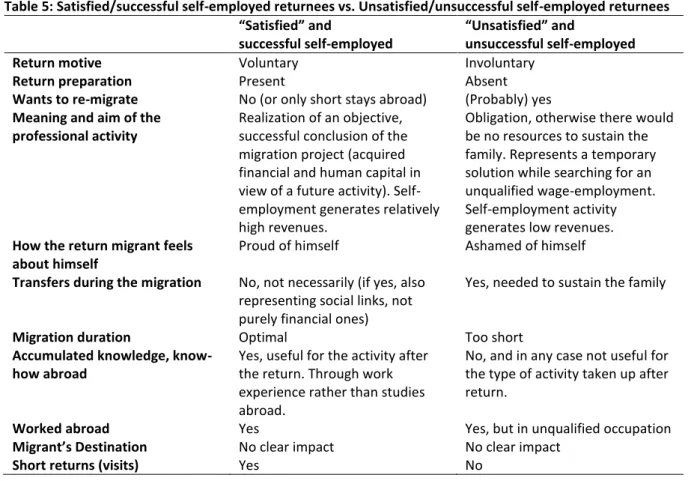
When distinguishing between returnees who decided about the return themselves and those who were forced into the return or in whose case the decision was taken by somebody else13, the quantitative estimates suggest that the association with occupational status varies considerably relative to individuals who never migrated. Involuntary returnees are less likely to be without an income generating job. While this suggests at first sight a positive correlation with labor market integration, the results show as well that the only category which seems to be available to involuntary return migrants is self-employment. Self-employment in form of “last-resort” activities in the informal sector entail little capital investment and exhibit low entry-barriers and may therefore require less “preparation”.
The qualitative analyses provide support to this interpretation. Sam (37 years) wanted to migrate to Europe to improve his economic conditions, but he got ripped off by intermediaries and his journey ended in Cape Verde. He decided to return to Senegal after having been away for two years. He now works as cab driver in Dakar and comes often home empty-handed. He explains that he would rather be employed, for instance, as janitor. Although the salary is very low, it would at least guarantee him a regular income. Mustapha (39 years) also stresses how difficult it is to find a “good job” in Dakar. He spent six years in Guinea-Bissau and returned following his father’s death: “In those days, nobody was around. My brothers were in Europe. It was only me who was there, so I went back”. He trained as an electrician in Guinea-Bissau and would like to continue this work in Senegal. However, he cannot find employment and does not have enough money to set up his own business. Instead, he started working as a fisherman in the informal sector, a very precarious and unstable work, and is thinking about migrating again. Finally, Astou (36 years), self-employed hairdresser and mother of three children, had decided to migrate to Italy to improve her living conditions and to help her mother, but she had to return: “My husband asked me to return to Senegal, although he initially agreed that I left. But in Senegal, there are social problems ... When your wife leaves, people say: 'But why did you let your wife go alone ...?'”. The money she had earned in Italy allowed her to re-open her hair salon which she had owned before
16
leaving. However, her return experience is not straightforward either: “It's not like before because some customers have found other hairdressers... I had to start over from scratch”. Overall, the findings suggest that those who returned involuntarily to Senegal, as diverse as the underlying reasons may be, tend to face problems when attempting to reintegrate into the Senegalese labor market.
For the case of “voluntary returnees” the quantitative findings indicate that they benefitted from their migration experience and were able to prepare their return. They are less likely to be in a low-skilled job than non-migrants and more likely to be in skilled employment. There is no statistically significant positive association with self-employment, as one would expect if voluntary returnees were mainly target-savers planning a business investment since the start of the migration project. While those may also exist, the predominant case seems to be the one of returnees who become self-employed without having carefully planned their activity in advance. The case of Bouba (34 years) is an example for self-employment following a voluntary return. He worked as vendor on Italian markets and returned with the aim to become rap artist. Having saved some money to prepare his return, he opened a grocer’s store and hired several employees. Bouba plans to finance his first rap album with the revenues generated from the store and aims to start a business for video clip recordings in the longer-run, after having made money with the sale of his album. The different steps following his return are thus planned in advance.
Links to origin household
The quantitative results on remittance behavior do not allow for a differentiation between return migrant types with regard to their occupational status. Keeping links to the family by means of transferring money does not improve the chances on the labor market compared to the non-remitters.
The qualitative analysis suggests that returnees who had been remitting may take up self-employed work out of the necessity to provide continuous support to the family. The case of Babacar’s (29 years) migration experience illustrates this idea. Babacar spent one year in Spain, but was expelled to Dakar. He explains his role as the supporter for his family: “The money I earned there, it was for the family, to feed them. I sent them 200,000 CFA per month”. After his return and without having made additional savings, he was obliged to work again as artisanal fisherman. “A fisherman, he gains nothing. It is not even a job (...). I’d like to have a real job. The sea it is not good now (...). I’d like to leave again because I have to help my parents”. While he is not able to earn as much money as during his migration, he still needs to provide continuous support to his family. Working as a fisherman is the only option he has.
Migration duration
The estimates from Model 4 highlight that individuals who stayed abroad for short to medium length durations are more likely to be self-employed and less likely to be without income generating work than non-migrants. This result may point to the two types of returnees – those who return after a very short period and enter the informal market as own account workers and those who may have acquired some transferrable financial or human capital abroad. Return migrants with medium-length migration spells seem also less likely to be in unskilled employment than non-migrants. Migrants with rather long migration spells may have had a too long interruption in their Senegalese labor market experience to benefit from their migration. Their occupational status does not differ from the situation of non-migrants. The results with regard to migration duration should however be treated with caution, as decisions regarding occupation and migration duration may be taken simultaneously.
The analysis of the qualitative interviews illustrates the role of migration duration and places the discussion in the context of other migration characteristics. Return migrants with very short migration experiences tend to regret their early return and intend to leave again, especially if they migrated with a specific goal and failed to reach it. Yézidou (30 years), for example, explains his reason to migrate to Spain: “I have my family, I have two children and a wife, life is hard, so I decided to leave. But since I came back, the situation hasn’t changed”. In fact, he was expelled and could not achieve his goal: "Me, I wanted to leave, to have at least a little cash to invest. I wanted to get money and to come back. Even today, I want to go there (...) to work”. Longer stays could provide him with an opportunity to improve his status from the current position as traditional fisherman: "What I want is to buy a house, to build, to put my family in the house, to buy a boat and to become a fishmonger”. This unattained goal fuels his
17
wish to migrate again. Mountaga (34 years), dressmaker, spent only one year in Guinea-Bissau. He wanted to work and improve his living conditions, but found that the situation in Guinea-Bissau was even more difficult than back in Senegal: "I wanted more money, succeed with my life. I thought it would get better, but in Senegal it is better than there (...). I came back because I haven’t achieved what I wanted. People there are looking for something to eat instead of going to get a boubou14 made". At present, his situation is difficult. Without a sewing machine and a workshop, he has to borrow a friend’s sewing machine when he has customers.
A very long absence from Senegal can also have negative impacts on reintegrating into the labor market. Bara (50 years), a chef who spent 26 years abroad (in Cote d’Ivoire, Gabon, Burkina Faso and Mali) explains the following about his return: “I don’t regret having returned. What I regret is not having returned earlier. I regretted this even more...when I saw my schoolmates, who had worked with me in 1990 in the largest hotel in Senegal. During my absence, friends have climbed the ladder to the point that one of them even became the director of the hotel. He had learned catering like me. They had the patience to stay. And when I returned, they were more successful than me...”
Brain waste
The following return status definition examines the role of working in a job below the level of qualification while abroad, a situation of “brain waste”. Returnees with such experiences are, according to the quantitative estimates, less likely to be in unskilled wage-employment. An explanation may be that, given their educational level, they are not willing to accept once again a job below their level of qualification after their return to Senegal. At the same time, return migrants who have not gained any or even lost human capital are more likely to be self-employed than non-migrants, indicating that the average business activity can be performed without further gains in human capital. Returnees who experienced brain waste may start a low-scale business activity as they are not able to access wage positions corresponding to their formal level of education, given the strong competition for salaried jobs. However, also individuals who worked abroad at a level corresponding or even exceeding their qualification are more likely to start businesses than non-migrants, if they do not enter skilled wage jobs, the other category in which they are overrepresented. While we are not able to test the hypothesis, the findings suggest that there are two types of return entrepreneurs.
Qualitative findings indicate that migration experience can still play a positive role for labor market status after return, even if the migrant worked below the level of qualification. Khar (42 years) graduated in Law from the University of Dakar, but when she was in Italy she worked on the assembly line for more than five years. She benefited from a type of human capital that is not taken into account by the variable "brain waste" which focuses exclusively on occupational status: the acquisition of the Italian language. Upon her return to Senegal she was employed as executive assistant by Italian investors.
Foreign education
Foreign education does not seem to be easily transferrable to Senegal, as the multinomial logit estimates show that those who acquired formal education abroad have no better chances of finding a skilled job than non-migrants. Returning students do thus not appear to contribute to significant “brain gain”. The qualitative analysis illustrates the case of individuals who have studied abroad and face difficulties in finding a job that corresponds to their qualifications after having returned to Dakar. Saliou (23 years) studied for two years engineering in Morocco before returning to Senegal because he was homesick. Ever since his return, he has been actively searching for a job: “I came back from Morocco more than one year ago, and since my return I have been looking for a job but I haven’t found one yet (...). It is difficult, especially in my field of work. There are not many positions in the field. And more and more people are looking for work. There are many among us fighting for the same jobs”. He decided to continue his training as an engineer, while still searching for jobs in parallel. Bashir’s (39 years) experience demonstrates that the professional reinsertion may take a long time. Bashir left Senegal after completing a Masters degree at the University of Dakar to continue his studies in France, where he lived for more than six years. He studied development, demography and computer science. Due to money problems, he decided to return. It took him four years to find a job: “I could not find employment. I did