Laboratory and Field Assessments of Prey-Mediated Effects of
Transgenic Bt Rice on Ummeliata insecticeps (Araneida: Linyphiidae)
J. C. TIAN,1Z. C. LIU,2M. CHEN,3Y. CHEN,1X. X. CHEN,1Y. F. PENG,4C. HU,1ANDG. Y. YE1,5
Environ. Entomol. 39(4): 1369Ð1377 (2010); DOI: 10.1603/EN10003
ABSTRACT One major concern regarding the release of Bt rice is its potential impact through tritrophic interactions on nontarget arthropods, especially natural enemies. We studied the effects of two Bt transgenic rice varieties, TT9-3 and KMD1, expressing Cry1Ab/Cry1Ac and Cry1Ab, respec-tively, on a predatory ground spider [Ummeliata insecticeps (Bo¨senberg et Strand)] supplied with Bt rice-fed brown planthopper [Nilaparvata lugens (Stål)] nymphs. Although immunoassays conÞrmed that U. insecticeps ingested Bt insecticidal protein when supplied with Bt riceÐfed N. lugens, no negative effects were found on its survival and development. Furthermore, the fecundity of U. insecticeps fed prey reared on Bt rice was not signiÞcantly different from that of those fed prey reared on non-Bt rice. A 3-yr Þeld trial indicated that Bt rice did not signiÞcantly affect the population density of U. insecticeps in comparison with non-Bt rice. In conclusion, the Bt rice lines tested in this study had no adverse effects on the survival, developmental time, or fecundity of U. insecticeps in the laboratory or on population dynamics in the Þeld.
KEY WORDS Bacillus thuringiensis, Bt rice, nontarget effect, tritrophic interactions, Ummeliata insecticeps
The growing area of genetically modiÞed crops ex-pressing Cry proteins derived from the soil bacterium Bacillus thuringiensisBerliner (Bt) has risen rapidly since the Þrst Bt crops were released commercially in the United States in 1996. Since then, Bt crops have been grown in several countries on a steadily increas-ing acreage, from 1.1 million ha in 1996 to 42 million ha in 2008 (James 2008). However, the effects of Bt crops on the environment and human health have been long debated. The potential deleterious effects of Bt crops on agro-ecosystems need to be evaluated cautiously and systematically before commercializa-tion (Dale et al. 2002, Conner et al. 2003, Nap et al. 2003, Craig et al. 2008, Romeis et al. 2008).
Rice, Oryza sativa L., is one of the most important food staples in the world. More than 50% of the world population (or⬎3 billion people) depend on rice for their daily lives (FAO 2008). Genetic improvement of rice varieties through modern biotechnology to in-crease tolerance or resistance to biotic and abiotic stresses is one solution to meet the demands of the
growing global populations, especially in developing countries. Since 1993, many transgenic rice lines with insecticidal Bt genes (referred to as Bt rice hereafter) have been developed to control lepidopteran cater-pillar pests, most notably the striped stem borer, Chilo suppressalis(Walker) (Lepidoptera: Crambidae), the yellow stem borer, Scirpophaga incertulas (Walker) (Lepidoptera: Pyralidae), and the leaffolder, Cnapha-locrocis medinalis(Guene´e) (Lepidoptera: Pyralidae) (High et al. 2004, Chen et al. 2006a, Wang and Johnston 2007), which cause 3Ð10% annual losses in yield, despite the intense use of insecticides (Sheng et al. 2003). The Þrst Þeld trials of Bt rice were conducted in China in 1998 (Shu et al. 2000; Tu et al. 2000; Ye et al. 2001a, b, 2003), and larger Þeld trials of several Bt rice lines were continued (Chen et al. 2006a, Wang and Johnston 2007). In a study of farmerÕs Þelds in China, the quantity and expenditure of pesticides used for non-genetically modiÞed (GM) rice production was 8 and 10 times higher, respectively, as those used for insect-resistant GM rice, whereas the yields of GM rice varieties were shown to be 6 Ð9% higher than those of non-GM varieties (Huang et al. 2005). To date, most Bt rice lines still have not been approved for commercial release in China, although a Bt rice variety (Huahui1) and its hybrid line (Shanyou63) have been granted the biosafety certiÞcates and approved for limited release in farmerÕs Þelds in Hubei Province from 2009 to 2014 (MAPCR 2009). One major reason for the cautious release of GM rice seems to be con-cerns about the potential impact on nontarget arthro-pods, especially natural enemies through tritrophic
1State Key Laboratory of Rice Biology, Ministry of Agriculture Key
Laboratory of Molecular Biology of Crop Pathogens and Insects, Institute of Insect Sciences, Zhejiang University, Hangzhou 310029, China.
2School of Agriculture and Biology, Shanghai Jiaotong University,
Shanghai 200240, China.
3Department of Entomology, Cornell University, New York State
Agricultural Experiment Station, Geneva, NY 14456.
4State Key Laboratory for Biology of Plant Diseases and Insect
Pests, Institute of Plant Protection, Chinese Academy of Agricultural Sciences, Beijing 100094, China.
5Corresponding author, e-mail: [email protected].
interactions. A growing number of studies on the ef-fects of Bt crops on natural enemies have been carried out under laboratory and Þeld conditions (Romeis et al. 2008, Wolfenbarger et al. 2008, Naranjo 2009). However, few studies have been conducted on natural enemies in Bt rice, especially under Þeld conditions (Chen et al. 2006a).
Spiders, as a group of generalist predators, are the most abundant invertebrate predators in many agro-ecosystems and play an important role in pest con-trol in many crops including rice (Marc et al. 1999, Symondson et al. 2002). Ummeliata insecticeps (Bo¨senberg et Strand) (Araneida: Linyphiidae) is a small spider (length, 2.5Ð3.5 mm) and is one of the dominant spider species in rice Þeld in China (Zhang et al. 1995). It can make small webs at the bottom of rice plants and is one of the major natural enemies of the brown planthopper, Nilaparvata lu-gens(Stål) (Homoptera: Delphacidae), which pre-fer to stay at the bottom of rice plants if undisturbed (Zhang et al. 1999, Zhao et al. 2004). Previous stud-ies have examined the effects of Bt rice on the population dynamics of Þve common spider species and the predation rate of the wolf spider, Pirata subpiraticusBo¨esenberg and Strand (Araneida: Ly-cosidae) (Liu et al. 2002, 2003). In this study, we report on prey-mediated effect of Bt rice on the survivorship, development, and fecundity of U. in-secticepsand a 3-yr Þeld study conducted at two sites of Zhejiang Province of China to evaluate the po-tential impacts of Bt rice on U. insecticeps popula-tions.
Materials and Methods
Plant Materials. Transgenic rice line TT9-3 was
developed using a biolistic method. It contains a fused cry1Ab/cry1Ac gene under the control of the rice actin1 promoter, which is expressed every-where (Tu et al. 1998). The untransformed parental indicarice cultivar (IR72) was used as control. The line is effective against rice stem borers and leaf-folders under laboratory (Tu et al. 1998) and Þeld conditions (Ye et al. 2001b). Transgenic rice line KMD1 was developed using an Agrobacterium-me-diated method to transfer a cry1Ab gene under the control of the maize ubiquitin promoter, which was expressed everywhere. The untransformed parental commercial cultivar (Xiushui 11) was used as con-trol. The line, selected through nine generations, was homozygous for the transgenes (cry1Ab, gus, npt) (Shu et al. 1998).
Insects. A U. insecticeps colony was established in
April 2005 from the Experimental Farm of Zhejiang University. Forty pairs of spiders were collected from the Þelds and subsequently maintained in the laboratory. U. insecticeps second-instar spiderlings were used in the experiments. A laboratory colony of N. lugens was provided by the China National Rice Research Institute. The females and males of N. lugenswere paired and placed on a rice plant planted in a plastic pot and covered with a
trans-parent plastic cylindrical cage (height 40 cm and diameter 11 cm) with a pair of nylon mesh window (diameter 6 cm) in the middle side of the cage and a top nylon mesh window (diameter 11 cm) for ventilation. Nymphs of the second or third instar fed on four genotypes of rice (i.e., KMD1, Xiushui11, TT9-3, and IR72) were fed to the spiders. Both colonies of U. insecticeps and N. lugens were con-tinuously reared in a controlled temperature room (25⫾ 2⬚C, 14:10-h L:D photoperiod).
Laboratory Experiments. For each of four
treat-ments, 200 individuals of second-instar U. insecticeps were separately kept in small glass tubes (length 12 cm and diameter 2 cm). The opening of each tube was covered with a cotton ball. The bottom of each tube was Þlled with a piece of moist sponge to maintain humidity. The tubes were kept in a controlled tem-perature room (25⫾ 2⬚C, 14:10-h L:D photoperiod). Spiders were supplied with either KMD1-, Xiushui11-, TT9-3-, or IR72-fed second- or third-instar N. lugens nymphs every day and checked daily until maturation or death. The day when spiders molted or died in each group was recorded, and the tubes were cleaned as needed. Spiders (males and females) were paired within each group when they reached the adult stage and kept under the same conditions as described above until the female adults laid their Þrst egg sacs. The number of juveniles hatching from the Þrst egg sac of each female in each group was recorded, as well as the number of unhatched eggs in the sac, because successive egg sacs contain fewer and fewer eggs (Zhao and Liu 1987).
Cry1Ab Insecticidal Protein Analyses. Another 40
second-instar U. insecticeps for each treatment were reared as describe in laboratory experiments. After all spiders reached the adults stage, rice stems, N. lugens nymphs, and U. inseciceps adults were col-lected individually, transferred into 1.5-ml Eppen-dorf tubes, and frozen at⫺70⬚C. The Cry1Ab level in the samples was assayed using a double sandwich ELISA kit for Bt-Cry1Ab/1Ac protein (Agdia, Elkhart, IN). For each treatment, samples (Þve for rice stems and N. lugens nymphs [100 mg as one replicate], three for U. insecticeps adults [two spi-ders as one replicate]) were weighed, homoge-nized, and diluted (⫻500 mg/l for rice stems; ⫻5 mg/l for N. lugens and U. insecticeps) in phosphate-buffered saline solution in Tween20. The solution was mixed for 1 min on a vortex mixer, centrifuged for 5 min at 12,000g, and loaded at 100l per test well. After dispensing 100l enzyme conjugate per well and incubating 2 h in a humid box at room temperature, 100l of the 3,3⬘,5,5⬘-tetramethylben-zidine (TMB) substrate solution was added for color development. At the end of the 15-min incubation with TMB substrate, 50l of 3 M sulfuric acid was added to each well. Spectrophotometric measure-ments were taken using a multidetection microplate reader (Synergy HT; Bio-Tek, Winooski, VT) at 450 nm. PuriÞed Cry1Ab (EnviroLogix, Portland, ME) toxin at concentrations of 0, 0.3125, 0.625, 1.25, 2.5, 5, 10, and 20 ng/ml was used as calibrators.
Field Planting. The experiments were conducted
during 2005Ð2007 at the Experimental Farm of Zhe-jiang University at Hangzhou (120.12⬚ E, 30.13⬚ N) and the local experimental Þeld in Anji County (119.35⬚ E, 30.88⬚ N). Each year, rice seeds of KMD1 and Xiushui 11 were sown on 20 June, and the seedlings were transplanted on 20 July; rice seeds of TT9-3 and IR72 were sown on 30 March, and the seedlings weretrans-planted on 1 May. Four months after transplantation, the rice reached full maturity. At both test locations, two separate Þelds were set up for the experiments with two pairs of Bt rice versus its corresponding non-Bt control rice. Each Þeld was divided into six experimental plots in a 2 (treatments, Bt versus non-Bt)⫻ 3 (replications) completely randomized design. Each experimental plot measured 20 by 25 m and was bordered on all sides by a 50-cm-wide unplanted walk-way. Seedlings were hand transplanted at one seedling per hill spaced 16.5 by 16.5 cm apart, and the entire experimental Þeld was surrounded by Þve border rows of nontransgenic control plants. Normal cultural prac-tices, such as fertilization and irrigation, for growing rice were followed during the course of the experi-ment, except that no insecticide was applied after sowing and transplanting.
Sampling Method. A vacuum-suction machine was
used to evaluate the seasonal patterns of U. insecticeps populations in Bt and non-Bt plots as described in our previous studies (Chen et al. 2006b, 2009). Samples (0.25 m2/sample) were taken in all plots on a 15⫾ 1-d schedule beginning 36 d after transplanting and con-tinuing until the rice reached full maturity. There were Þve sampling dates at both the Anji site and Hangzhou site each year. On each sampling date, Þve samples were taken per plot at random along the diagonal of each plot at both test locations. Arthropods in each sample collected by the vacuum-suction ma-chine were ßushed into a labeled glass vial containing 75% ethanol and returned to the laboratory for sorting and counting.
Data Analyses. ELISA data were analyzed using
one-way analysis of variance (ANOVA) and TukeyÕs multiple-range test. Survival analyses of U. insecti-cepsfed on Bt and non-Bt riceÐreared N. lugens were conducted using the Wilcoxon test for homogene-ity. Data on the developmental time and reproduc-tion of U. insecticeps fed on Bt and non-Bt riceÐ reared N. lugens were analyzed using StudentÕs t-test. Densities (seasonal means) of U. insecticeps in Bt and non-Bt plots in different years at two sites were analyzed using three-way ANOVA and TukeyÕs multiple-range test. The means on each sampling date compared were conducted using StudentÕs t-test. All statistical calculations were performed with SAS ver-sion 9.1 package (SAS Institute 2001). For all tests,␣ ⫽ 0.05.
Results
Cry1Ab Detection in N. lugens and U. insecticeps.
Cry1Ab was detected from the tested Bt rice lines TT9-3 and KMD1 (Bt⫹) (Fig. 1). The average Cry1Ab
concentration in TT9-3 riceÐreared N. lugens nymphs (10.47⫾ 1.58 ng/g ßesh weight [FW]) was signiÞ-cantly higher than those in U. insecticeps adults fed on TT9-3 riceÐreared N. lugens nymphs (2.04⫾ 0.29 ng/g FW). However, the concentrations of the insecticidal protein detected in arthropods were signiÞcantly lower than those in TT9-3 rice stems (0.578⫾ 0.05 g/g of FW; F ⫽ 639.76; df ⫽ 2,10; P ⬍ 0.001). Like-wise, in KMD1 rice stems, high concentration of Cry1Ab was detected (2.02⫾ 0.17g/g FW); how-ever, Cry1Ab concentrations in KMD1 riceÐreared N. lugensnymphs (11.67⫾ 1.45 ng/g FW) and U. insec-ticeps adults fed on KMD1 riceÐreared N. lugens nymphs (2.29 ⫾ 0.29 ng/g FW) were signiÞcantly lower. Cry1Ab concentration in prey was signiÞcantly higher than those in predators (F⫽ 1188.87; df ⫽ 2,10; P⬍ 0.001). As expected, no Cry1Ab was detected in non-Bt controls (IR72 and Xiushui 11).
Survival of U. insecticeps. The survival probability
of U. insecticeps was not signiÞcantly affected when the spiders were supplied with Bt riceÐreared (TT9-3 and KMD1) N. lugens compared with non-Bt riceÐreared (IR72 and Xiushui11) N. lugens over a period of 100 d (TT9-3 and IR72:2⫽ 0.0021; df ⫽ 1; P⫽ 0.99; KMD1 and Xiushui11:2⫽ 0.1272; df ⫽ 1; P⫽ 0.72; Fig. 2).
Developmental Time of U. insecticeps. After
prey-ing on Bt rice-fed or non-Bt riceÐfed N. lugens, U. insecticeps second-instar spiderlings had four molts before they reached the adult stage. The larval devel-opment time (from second instars to adult stage) of U. insecticepsfed on TT9-3 (Bt⫹) rice-reared N. lugens was not signiÞcantly different from that fed on IR72 (Bt⫺) rice-reared N. lugens (t ⫽ 0.2504; df ⫽ 73; P ⫽ 0.8107; Table 1). However, the duration of the third
Fig. 1. Levels of Cry1Ab protein (mean⫾ SE) detected from Bt rice and Bt riceÐreared N. lugens nymphs, and U.
insecticepsadults fed on Bt riceÐfed N. lugens larvae using ELISA. (A) TT9-3, (B) KMD1. n⫽ 5 for Bt rice and N. lugens nymphs; n⫽ 3 for U. insecticeps adults. Means denoted with different lowercase letters were signiÞcantly different (one-way ANOVA, P⬍ 0.05).
instar was signiÞcantly shorter in KMD1 (Bt⫹) than in Xiushui11 (Bt⫺) (t ⫽ 3.4029; df ⫽ 87; P ⫽ 0.0059), at 10.1 and 14.2 d, respectively. The development time of other instars was not signiÞcantly different. Overall, there was no difference in the developmental time for the entire juvenile stage (t ⫽ 0.8310; df ⫽ 38; P ⫽ 0.4669; Table 1).
Fecundity of U. insecticeps. After adult U. insecticeps
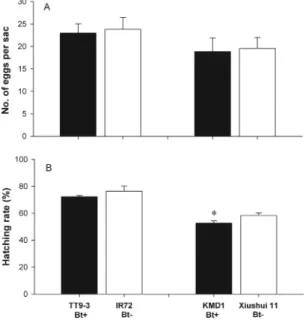
were assigned to breeding pairs and fed either Bt riceÐfed or non-Bt riceÐfed N. lugens, the number of eggs in the Þrst egg sac of U. insecticeps was not sig-niÞcantly different between Bt rice and non-Bt rice, whereas the difference in egg hatching rate between Bt and non-Bt rice was dependent on tested Bt rice lines (Fig. 3). U. insecticeps females supplied with TT9-3 (Bt⫹)-fed N. lugens laid 23.0 ⫾ 2.0 eggs per sac and 72.3⫾ 0.9% eggs hatched, whereas females from the IR72 treatment (Bt⫺) laid 23.8 ⫾ 2.6 eggs per sac and 76.4⫾ 3.9% eggs hatched (number of eggs: t ⫽ 0.2309; df ⫽ 36; P ⫽ 0.8203; egg hatching rate: t ⫽ 1.0119; df⫽ 36; P ⫽ 0.3355). Likewise, U. insecticeps females supplied with KMD1 (Bt⫹)-fed N. lugens laid
18.9⫾ 3.0 eggs, which was not signiÞcantly from that (19.6⫾ 2.4 eggs per sac) laid by females in the Xi-ushui11 (Bt⫺) treatment (t ⫽ 0.1852; df ⫽ 20; P ⫽ 0.8561). However, the egg hatching rate in the KMD1 (Bt⫹) treatment was 52.7 ⫾ 1.9%, which was signiÞ-cantly lower than that (58.4⫾ 1.8%) in the Xiushui11 (Bt⫺) treatment (t ⫽ 2.1758; df ⫽ 20; P ⫽ 0.0503).
Ummeliata insecticeps Population Dynamics in Bt
and Non-Bt Rice Fields. In 2005, 2006, and 2007, U.
insecticepswas found in Bt and non-Bt plots using vacuum-suction at Anji and Hangzhou. U. insecticeps densities (seasonal means) in TT9-3 (Bt⫹) and IR72 (Bt⫺) plots were signiÞcantly affected by test site (F⫽ 12.50; df ⫽ 1,35; P ⫽ 0.0009). However, rice type (F⫽ 0.01; df ⫽ 1,35; P ⫽ 0.9067), year (F ⫽ 1.51; df ⫽ 2,35; P⫽ 0.2313), the interaction between rice type and test site (F⫽ 0.00; df ⫽ 1,35; P ⫽ 1.0000), the interaction between rice type and year (F⫽ 0.01; df ⫽ 2,35; P⫽ 0.9896), the interaction between test site and
Fig. 2. Survival of U. insecticeps over a 100-d period when fed either Bt riceÐfed or non-Bt riceÐfed N. lugens nymphs. There was no signiÞcant difference between Bt rice and control treatment, based on Wilcoxon test. n⫽ 200 for TT9-3 and 200 for IR72; n⫽ 200 for KMD1 and 200 for Xiushui 11.
Table 1. Developmental time (meanⴞ SE) of U. insecticeps from second instars to adult emergence when fed either Bt rice-fed (TT9-3, KMD1, Btⴙ) or non-Bt rice-fed (IR72, Xiushui11, Btⴚ) N. lugens
Rice varieties Developmental time (d)
Second instar Third instar Fourth instar Fifth instar JuvenilesÐadult Group 1 TT9-3, Bt⫹ 7.7⫾ 2.0 (167) 10.8⫾ 1.1 (133) 12.0⫾ 2.0 (75) 18.5⫾ 2.6 (33) 56.3⫾ 3.7 (33) IR72, Bt⫺ 8.8⫾ 1.5 (183) 8.8⫾ 1.6 (108) 8.6⫾ 1.5 (58) 19.2⫾ 2.7 (42) 53.5⫾ 10.3 (42) Group 2 KMD1, Bt⫹ 8.8⫾ 1.1 (100) 10.1⫾ 0.8 (46)a 12.2⫾ 2.9 (39) 25.3⫾ 4.6 (21) 53.5⫾ 4.5 (21) Xiushui 11, Bt⫺ 5.8⫾ 1.1 (77) 14.2⫾ 0.9 (43) 19.0⫾ 0.6 (35) 21.3⫾ 1.9 (19) 58.7⫾ 4.1 (19) a
SigniÞcantly different from the control non-Bt rice treatment (P⬍ 0.05; Student t-test).
n,no. of individuals at each development stage.
Fig. 3. Effect of Bt rice on egg production (A) and egg hatching rate (B) of U. insecticeps when fed either Bt riceÐfed or non-Bt riceÐfed N. lugens nymphs. n⫽ 36 for TT9-3 and IR72; n⫽ 20 for KMD1 and Xiushui 11. *SigniÞcantly dif-ferent from the control non-Bt rice treatment (P⬍ 0.05; Student t-test).
year (F⫽ 1.76; df ⫽ 2,35; P ⫽ 0.1829), and the inter-action between rice type, test site, and year (F⫽ 0.11; df⫽ 2,35; P ⫽ 0.9002) did not signiÞcantly affect U. insecticepsdensities (Table 2). In KMD1 (Bt⫹) and Xiushui11 (Bt⫺) Þelds, test site (F ⫽ 5.75; df ⫽ 1,35; P⫽ 0.0204) signiÞcantly inßuenced the density of U. insecticepsbut not rice treatment (F⫽ 2.16; df ⫽ 1,35; P⫽ 0.1480), year (F ⫽ 0.02; df ⫽ 2,35; P ⫽ 0.9807), the interaction between rice type and test site (F⫽ 1.35; df⫽ 1,35; P ⫽ 0.2515), the interaction between rice type and year (F⫽ 0.20; df ⫽ 2,35; P ⫽ 0.8201), the interaction between test site and year (F⫽ 0.50; df ⫽ 2,35; P⫽ 0.6123), and the interaction between rice type, test site, and year (F⫽ 0.06; df ⫽ 2,35; P ⫽ 0.9434) (Table 2).
Population dynamics (means of each sampling date) of U. insecticeps at Hangzhou and at Anji are presented in Figs. 4 and 5. Only at one sampling date was a signiÞcant difference found in population den-sities of U. insecticeps between Bt and non-Bt plots.
Discussion
Because Bt rice is on the verge of being commer-cially released in China (Cohen et al. 2008), data on its potential effects through tritrophic interactions on nontarget arthropods, especially insect natural ene-mies, are timely. In this study, our data indicated that Bt insecticidal protein can be transferred from lower trophic levels to higher trophic levels in the rice
sys-Table 2. Seasonal densities (meanⴞ SE) of U. insecticeps in TT9-3 (Btⴙ), IR72 (Btⴚ), KMD1 (Btⴙ), and Xiushui11 (Btⴚ) plots detected using vacuum-suction sampling at two sites in China in 2005–2007
Rice varieties Anji Hangzhou
2005 2006 2007 2005 2006 2007 Group 1 TT9-3, Bt⫹ 2.28⫾ 0.51 2.84⫾ 0.56 3.00⫾ 0.60 1.84⫾ 2.09 0.68⫾ 0.39 2.00⫾ 1.70 IR72, Bt⫺ 2.16⫾ 0.37 2.68⫾ 0.69 3.16⫾ 0.77 1.76⫾ 1.13 0.88⫾ 0.30 1.76⫾ 1.11 Group 2 KMD1, Bt⫹ 1.08⫾ 0.31 1.36⫾ 0.29 1.24⫾ 0.33 0.60⫾ 0.57 0.56⫾ 0.50 0.68⫾ 0.46 Xiushui11, Bt⫺ 1.20⫾ 0.47 1.32⫾ 0.26 1.32⫾ 0.29 1.28⫾ 1.08 0.88⫾ 0.23 1.04⫾ 0.26
n⫽ 3 at both sites in 2005, 2006, and 2007. There were no signiÞcant differences between Bt rice and control plots, based on three-way ANOVA. Seasonal density, an average density of U. insecticeps over all sampling dates.
Fig. 4. Mean (⫾SE) number of U. insecticeps in TT9-3 and IR72 (left) and KMD1 and Xiushui11 (right) detected using vacuum-suction at Anji, China, in 2005Ð2007. n⫽ 3 in 2005, 2006, and 2007. There was no signiÞcant difference between Bt rice and control plots, based on StudentÕs t-test.
tem through tritrophic interactions (Fig. 1). However, the level of Cry1Ab protein detected in the predator U. insecticepssupplied with Bt riceÐfed prey N. lugens was ⬇5 times lower than that in the prey, which implies that no bioaccumulation of Cry1Ab protein occurred in this food chain. Our results are consistent with previous studies. For example, Torres and Ru-berson (2008) showed that, although the Bt insecti-cidal protein detected in herbivores [the twospotted spider mite, Tetranychus urticae Koch (Acari: Tet-ranychidae)] was highly concentrated, the amount conveyed to their predators [the big-eye bug, Geocoris punctipes (Say) (Heteroptera: Lygaeldae), and the damsel bug, Nabis roseipennis Reuter (Hemiptera: Na-bidae)] was only 4 and 14% in the Bt cotton system. Alvarez-Alfageme et al. (2008) also reported that a signiÞcantly lower concentration of Bt insecticidal protein was detected in the predator Stethorus punc-tillumWeise (Coleoptera: Coccinellidae) compared with the prey T. urticae in Bt maize system under Þeld conditions.
Although U. insecticeps ingested measurable amounts of Cry1Ab protein when it was supplied with Bt riceÐfed N. lugens, Bt rice lines (TT9-3 and KMD1) did not have negative effects on the developmental time and fecundity of U. insecticeps. Liu et al. (2006) reported that Bt cotton expressing Cry1Ac protein had no adverse prey-mediated effects on the larvae and
adults of two spiders, Hylyphantes graminicola (Sun-devall) (Araneae: Linyphiidae) and Coleosoma oc-tomaculatum (Bo¨esenberg et Strand) (Araneae: Theridiidae), which are commonly found in cotton Þelds. Similarly, Cry1Ab protein expressed in Bt maize pollen had no negative effects on the weight increase, survival, molt frequency, reaction time, and various web variables of the garden spider, Araneus diadema-tus Korsedderkop (Araneae: Araneidae), in maize Þelds (Ludy and Lang 2006a). Meissle and Romeis (2009) also showed that no difference in mortality, weight development, or offspring production of the web-building spider, Theridion impressum L. Koch (Araneae: Theridiidae) was observed between spiders provided with food containing or not containing Cry3Bb1.
Although U. insecticeps had a relatively high mor-tality in our laboratory experiments, there was no difference in survival between Bt and control prey-fed spiders in the 100-d feeding experiment (Fig. 2). Chen et al. (2009) reported that Cry1Ab protein did not have binding receptors on the brush border membrane vesicles (BBMVs) of the wolf spider P. subpiraticus(one of the most important predators of rice insect pests), whereas several proteins on BBMVs in the midgut of the rice leaf folder C. medinalis(one of the target insect of Bt rice) were found to bind Cry1Ab using Western blot analysis.
Fig. 5. Mean (⫾SE) number of U. insecticeps in TT9-3 and IR72 (left) and KMD1 and Xiushui11 (right) detected using vacuum-suction at Hangzhou, China, in 2005Ð2007. n⫽ 3 in 2005, 2006, and 2007. Control plot marked * was signiÞcantly different from Bt rice plot (P⬍ 0.05); otherwise, there were no signiÞcantly differences between Bt rice and control plots, base on StudentÕs t-test.
The high mortality of U. insecticeps in this study might be because of the monotonous diet of only one prey species, which might have been subopti-mal for spiders (Miyashita 1968, Uetz et al. 1992, Li 2002). We also noticed that the mortality in the laboratory experiments was different in the two groups of rice varieties tested, which might result from the different nutrition of prey fed on the two different groups of rice varieties. Many studies re-ported that the type and quality of the diet could affect the survival of the target organism (Riddick 2009). Burgess et al. (2009) also showd that an exclusive diet of tobacco-reared Spodoptera litura (Fabricius) (Lepidoptera: Noctuidae) had a nega-tive impact on the survival of the male predator, Ctenognathus novaezelandiae (Fairmaire) (Co-leoptera: Carabidae). In a number of studies, pollen, silk, and leaf tissue from plants was supplemented with prey to improve the predator survival (Romeis et al. 2006).
Our 3-yr Þeld trials at Anji and Hangzhou indicated that the U. insecticeps population density did not differ between Bt and non-Bt rice plots (Table 2), which corroborated our laboratory results. Previous studies that investigated the impact of Bt rice on the abun-dance of spider communities showed similar results (Liu et al. 2002, Li et al. 2007). Furthermore, Bt maize expressing Cry1Ab protein did not impact spider com-munities negatively in the Czech Republic (Rˇeza´cˇ et al. 2006), Germany (Volkmar and Freier 2003, Meissle and Lang 2005, Ludy and Lang 2006b, Toschki et al. 2007), Spain (Farinos et al. 2008), and the United States (Rose and Dively 2007). When comparing the spider populations in Bt cotton, expressing Cry1Ac protein, and non-Bt cotton Þelds, no signiÞcant dif-ferences were detected by Head et al. (2005) or Torres and Ruberson (2005) in the United States, whereas a slight drop in some spider taxa were observed in Aus-tralia (Whitehouse et al. 2005) and the United States (Naranjo 2005).
In conclusion, the Bt rice lines tested in this study, TT9-3 and KMD1, had no adverse effects on the sur-vival, developmental time, and fecundity of U. insec-ticepsin the laboratory or on population dynamics in the Þeld. These results, together with the published literature, suggest that spiders are not likely to be harmed by the cultivation of Bt rice.
Acknowledgments
This work was supported by the National Program on Key Basic Research Projects (973 Program, 2007CB109202), the Ministry of Science and Technology of China, the National Natural Science Foundation of China (30671377), and the Special Research Projects for Developing Transgenic Plants (2008ZX08011-01). We thank Prof. Q. Y. Shu (Zhejiang Uni-versity, Zhejiang, China) and Prof. I. Altosaar (University of Ottawa, Ottawa, Canada) for providing the original seeds of Bt rice lines, and a statistical scientist, Prof. Q. Y. Tang (Zhejiang University, Zhejiang, China) for helping with our data analysis.
References Cited
Alvarez-Alfageme, F., N. Ferry, P. Castanera, F. Ortego, and A.M.R. Gatehouse. 2008. Prey mediated effects of Bt
maize on Þtness and digestive physiology of the red spider mite predator Stethorus punctillum Weise (Coleoptera: Coccinellidae). Transgenic Res. 17: 943Ð954.
Burgess, E.P.J., B. A. Philip, E. I. Barraclough, R. K. Marshall, and J. T. Christeller. 2009. Impacts on the predatory
carabid beetle Ctenognathus novaezelandiae of pure and mixed diets of natural Þeld-collected prey and Spodoptera
liturafed control or transgenic avidin tobacco. Biol. Con-trol 48: 55Ð 62.
Chen, M., J. Z. Zhao, G. Y. Ye, Q. Fu, and A. M. Shelton. 2006a. Impact of insect-resistant transgenic rice on target
insect pests and non-target arthropods in China. Insect Sci. 13: 409 Ð 420.
Chen, M., G. Y. Ye, Z. C. Liu, H. W. Yao, X. X. Chen, S. Z. Shen, C. Hu, and S. K. Datta. 2006b. Field assessment of
the effects of transgenic rice expressing a fused gene of
cry1Aband cry1Ac from Bacillus thuringiensis Berliner on nontarget planthopper and leafhopper populations. En-viron. Entomol. 35: 127Ð134.
Chen, M., G. Y. Ye, Z. C. Liu, Q. Fang, C. Hu, Y. F. Peng, and A. M. Shelton. 2009. Analysis of Cry1Ab toxin
bioaccu-mulation in a food chain of Bt rice, an herbivore and a predator. Ecotoxicology 18: 230 Ð238.
Cohen, M., M. Chen, J. S. Bentur, K. L. Heong, and G. Y. Ye. 2008. Bt rice in Asia: potential beneÞts, impact, and
sus-tainability, pp. 223Ð248. In J. Romeis, A. M. Shelton, and G. G. Kennedy (eds.), Integration of insect-resistant GM crops within IPM programs. Springer, Dordrecht, The Netherlands.
Conner, A. J., T. R. Glare, and J. P. Nap. 2003. The release
of genetically modiÞed crops into the environmentÑpart II. Overview of ecological risk assessment. Plant J. 33: 19 Ð 46.
Craig, W., M. Tepfer, G. Degrassi, and D. Ripandelli. 2008.
An overview of general features of risk assessments of genetically modiÞed crops. Euphytica 164: 853Ð 880.
Dale, P. J., B. Clarke, and E.M.G. Fontes. 2002. Potential for
the environmental impact of transgenic crops. Nat. Bio-technol. 20: 567Ð574.
[FAO] Food and Agriculture Organization of the United Nations. 2008. FAO and sustainable intensiÞcation of
rice production for food security. (ftp://ext-ftp.fao.org/ Radio/Scripts/2008/Rice-Prod.pdf).
Farinos, G. P., M. de la Poza, P. Hernandez-Crespo, F. Or-tego, and P. Castanera. 2008. Diversity and seasonal
phe-nology of aboveground arthropods in conventional and transgenic maize crops in Central Spain. Biol. Control 44: 362Ð371.
Head, G., M. Moar, M. Eubanks, B. Freeman, J. Ruberson, A. Hagerty, and S. Turnipseed. 2005. A multiyear,
large-scale comparison of arthropod populations on commer-cially managed Bt and non-Bt cotton Þelds. Environ. En-tomol. 34: 1257Ð1266.
High, S. M., M. B. Cohen, Q. Y. Shu, and I. Altosaar. 2004.
Achieving successful deployment of Bt rice. Trends Plant Sci. 9: 286 Ð292.
Huang, J. K., R. F. Hu, S. Rozelle, and C. Pray. 2005.
Insect-resistant GM rice in farmersÕ Þelds: assessing productivity and health effects in China. Science 308: 688 Ð 690.
James, C. 2008. Global status of commercialized
bio-tech/GM crops: 2008. ISAAA Brief No. 39. ISAAA, Ithaca, NY.
Li, D. Q. 2002. The combined effects of temperature and
Mi-sumenops tricuspidatus(Fabricius) (Araneae: Thomisi-dae). J. Therm. Biol. 27: 83Ð93.
Li, F. F., G. Y. Ye, Q. Wu, Y. F. Peng, and X. X. Chen. 2007.
Arthropod abundance and diversity in Bt and non-Bt rice Þelds. Environ. Entomol. 36: 646 Ð 654.
Liu, J., J. Chen, and M. Li. 2006. Bt cotton impacts on the
growth and predation behavior of spiders. Acta Ecol. Sin. 26: 945Ð949.
Liu, Z. C., G. Y. Ye, C. Hu, and S. K. Datta. 2002. Effects of Bttransgenic rice on population dynamics of main non-target insect pests and dominant spider species in rice paddies. Acta Phytophyl. Sin. 29: 138 Ð144.
Liu, Z. C., G. Y. Ye, Q. Fu, Z. T. Zhang, and C. Hu. 2003.
Indirect impact assessment of transgenic rice with cry1Ab gene in predation by the wolf spider, Pirata subpiraticus. Chinese J. Rice Res. 17: 175Ð178.
Ludy, C., and A. Lang. 2006a. Bt maize pollen exposure and
impact on the garden spider, Araneus diadematus. Ento-mol. Exp. Appl. 118: 145Ð156.
Ludy, C., and A. Lang. 2006b. A 3-year Þeld-scale
monitor-ing of foliage-dwellmonitor-ing spiders (Araneae) in transgenic Bt maize Þelds and adjacent Þeld margins. Biol. Control 38: 314 Ð324.
[MAPRC] Ministry of Agriculture of the People’s Repub-lic of China. 2009. The second list of approval
agri-cultural genetically modiÞed organismsÕ safety certiÞ-cates in 2009. (http://www.stee.agri.gov.cn/biosafety/ spxx/P020091127591594596689.pdf).
Marc, P., A. Canard, and F. Ysnel. 1999. Spiders (Araneae)
useful for pest limitation and bioindication. Agric. Eco-syst. Environ. 74: 229 Ð273.
Meissle, M., and A. Lang. 2005. Comparing methods to
eval-uate the effects of Bt maize and insecticide on spider assemblages. Agric. Ecosyst. Environ. 107: 359 Ð370.
Meissle, M., and J. Romeis. 2009. The web-building spider Theridion impressum(Araneae: Theridiidae) is not ad-versely affected by Bt maize resistant to corn rootworms. Plant Biotechnol. J. 7: 645Ð 656.
Miyashita, K. 1968. Growth and development of Lycosa tin-signitaBoes. et Str. (Araneae: Lycosidae) under different feeding conditions. Appl. Entomol. Zool. 3: 81Ð 88.
Nap, J. P., P.L.J. Metz, M. Escaler, and A. J. Conner. 2003.
The release of genetically modiÞed crops into the envi-ronmentÑpart I. Overview of current status and regula-tions. Plant J. 33: 1Ð18.
Naranjo, S. E. 2005. Long-term assessment of the effects of
transgenic Bt cotton on the abundance of non-target arthropod natural enemies. Environ. Entomol. 34: 1193Ð 1210.
Naranjo, S. E. 2009. Impacts of Bt crops on non-target
in-vertebrates and insecticide use patterns. CAB Rev. Per-spect. Agric. Vet. Sci. Nutr. Nat. Resources 4: No. 23. (http://www.cababstractsplus.org/cabreviews).
Rˇ eza´cˇ, M., S. Peka´r, and F. Kocourek. 2006. Effect of
Bt-maize on epigeic spiders (Araneae) and harvestmen (Opiliones). Plant Protect. Sci. 107: 359 Ð370.
Riddick, E. W. 2009. BeneÞts and limitations of factitious
prey and artiÞcial diets on life parameters of predatory beetles, bugs, and lacewings: a mini-review. Biocontrol 54: 325Ð339.
Romeis, J., M. Meissle, and F. Bigler. 2006. Transgenic crops
expressing Bacillus thuringiensis toxins and biological control. Nat. Biotechnol. 24: 63Ð71.
Romeis, J., D. Bartsch, F. Bigler, M. P. Candolfi, M.M.C. Gielkens, S. E. Hartley, R. L. Hellmich, J. E. Huesing, P. C. Jepson, R. Layton, et al. 2008. Assessment of risk of
insect-resistant transgenic crops to nontarget arthropods. Nat. Biotechnol. 26: 203Ð208.
Rose, R., and G. P. Dively. 2007. Effects of
insecticide-treated and lepidopteran-active Bt transgenic sweet corn on the abundance and diversity of arthropods. Environ. Entomol. 36: 1254 Ð1268.
SAS Institute. 2001. PROC userÕs manual, version 6th ed.
SAS Institute, Cary, NC.
Sheng, C. F., H. T. Wang, L. D. Gao, and J. W. Xuan. 2003. The
occurrence status, damage cost estimate and control strat-egies of stem borers in China. Plant Protect. 29: 37Ð39.
Shu, Q. Y., G. Y. Ye, H. Cui, Y. B. Xiang, and M. Gao. 1998.
Development of transgenic Bacillus thuringiensis rice re-sistant to rice stem borers and leaf folders. J. Zhejiang Agric. Univ. 24: 579 Ð580.
Shu, Q. Y., G. Y. Ye, H. R. Cui, X. Y. Cheng, Y. B. Xiang, D. X. Wu, M. W. Gao, Y. W. Xia, C. Hu, R. Sardana, et al. 2000. Transgenic rice plants with a synthetic cry1Ab gene from Bacillus thuringiensis were highly resistant to eight lepidopteran rice pest species. Molec. Breeding 6: 433Ð 439.
Symondson, W.O.C., K. D. Sunderland, and M. H. Green-stone. 2002. Can generalist predators be effective
bio-control agents? Annu. Rev. Entomol. 47: 561Ð594.
Torres, J. B., and J. R. Ruberson. 2005. Canopy- and
ground-dwelling predatory arthropods in commercial Bt and non-Bt cotton Þelds: patterns and mechanisms. Environ. Entomol. 34: 1242Ð1256.
Torres, J. B., and J. R. Ruberson. 2008. Interactions of Ba-cillus thuringiensis Cry1Ac toxin in genetically engi-neered cotton with predatory heteropterans. Transgenic Res. 17: 345Ð354.
Toschki, A., L. A. Hothorn, and M. Ross-Nickoll. 2007.
Ef-fects of cultivation of genetically modiÞed Bt maize on epigeic arthropods (Araneae: Carabidae). Environ. En-tomol. 36: 967Ð981.
Tu, J., K. Datta, M. F. Alam, Y. Fan, G. S. Khush, and S. K. Datta. 1998. Expression and function of a hybrid Bt toxin
gene in transgenic rice conferring resistance to insect pests. Plant Biotechnol. 15: 195Ð203.
Tu, J. M., G. A. Zhang, K. Datta, C. G. Xu, Y. Q. He, Q. F. Zhang, G. S. Khush, and S. K. Datta. 2000. Field
perfor-mance of transgenic elite commercial hybrid rice express-ing Bacillus thurexpress-ingiensis␦-endotoxin. Nat. Biotechnol. 18: 1101Ð1104.
Uetz, G. W., J. Bischoff, and J. Raver. 1992. Survivorship of
wolf spiders (Lycosidae) reared on different diets. J. Arachnol. 20: 207Ð211.
Volkmar, C., and B. Freier. 2003. Spider communities in Bt
maize and not genetically modiÞed maize Þelds. J. Plant Dis. Protect. 110: 572Ð582.
Wang, Y., and S. Johnston. 2007. The status of GM rice R&D
in China. Nat. Biotechnol. 25: 717Ð718.
Whitehouse, M.E.A., L. J. Wilson, and G. P. Fitt. 2005. A
comparison of arthropod communities in transgenic Bt and conventional cotton in Australia. Environ. Entomol. 34: 1224 Ð1241.
Wolfenbarger, L. L., S. E. Naranjo, J. G. Lundgren, R. J. Bitzer, and L. S. Watrud. 2008. Bt crop effects on
func-tional guilds of non-target arthropods: a meta-analysis. PLoS ONE 3: e2118.
Ye, G. Y., Q. Y. Shu, H. W. Yao, H. R. Cui, X. Y. Cheng, C. Hu, Y. W. Xia, M. W. Gao, and I. Altosaar. 2001a. Field
evaluation of resistance of transgenic rice containing a synthetic cry1Ab gene from Bacillus thuringiensis Ber-liner to two stem borers. J. Econ. Entomol. 94: 271Ð276.
Ye, G. Y., J. Tu, H. Cui, K. Datta, and S. K. Datta. 2001b.
Transgenic IR72 with fused Bt gene cry1Ab/cry1Ac from
Bacillus thuringiensisis resistant against four lepidopteran species under Þeld conditions. Plant Biotechnol. 18: 125Ð133.
Ye, G. Y., H. W. Yao, Q. Y. Shu, X. Y. Cheng, C. Hu, Y. W. Xia, M. W. Gao, and I. Altosaar. 2003. High levels of stable
resistance in transgenic rice with a synthetic cry1Ab gene from Bacillus thuringiensis Berliner to rice leaffolder,
Cnaphalocrocis medinalis(Guene´e) under Þeld condi-tions. Crop Protect. 22: 171Ð178.
Zhang, G. R., W. Q. Zhang, and D. X. Gu. 1995. The
structure and dynamics of main arthropod predator community in paddy Þeld. Suppl. J. Sun Yatsen Univ. 2: 33Ð 40.
Zhang, G. R., W. Q. Zhang, and D. X. Gu. 1999. Quantifying
predation by Ummeliata insecticeps Boes et Str. (Araneae:
Linyphiidae) on rice planthoppers using ELISA. Ento-mol. Sin. 6: 77Ð 82.
Zhao, J. Z., and F. X. Liu. 1987. On the life history of Um-meliata (formerly Oedothorax) insecticeps (Araneae: Linyphiidae). Acta Zool. Sin. 32: 152Ð158.
Zhao, W. C., J. A. Cheng, and Z. X. Chen. 2004.
Develop-ment of a monoclonal antibody to detect predation of the brown planthopper Nilaparvata lugens (Stål). Int. J. Pest Manage. 50: 317Ð321.