Vol. 30 no. 21 2014, pages 3131–3133
BIOINFORMATICS
APPLICATIONS NOTE
doi:10.1093/bioinformatics/btu425Structural bioinformatics
Advance Access publication July 10, 2014GlycoDigest: a tool for the targeted use of exoglycosidase
digestions in glycan structure determination
Lou Gotz
1, Jodie L. Abrahams
2, Julien Mariethoz
1, Pauline M. Rudd
3, Niclas G. Karlsson
4,
Nicolle H. Packer
2, Matthew P. Campbell
2,* and Frederique Lisacek
1,5,*
1
Proteome Informatics Group, Swiss Institute of Bioinformatics, 1211 Geneva, Switzerland,2Biomolecular Frontiers Research Centre, Macquarie University, North Ryde, NSW 2109, Australia,3National Institute for Bioprocessing Research and Training, GlycoScience Group, Dublin, Ireland,4Department of Medical Biochemistry and Cell Biology, University of Gothenburg, 40530 Gothenburg, Sweden and5Section of Biology, University of Geneva, 1211 Geneva, Switzerland
Associate Editor: Janet Kelso
ABSTRACT
Summary: Sequencing oligosaccharides by exoglycosidases, either sequentially or in an array format, is a powerful tool to unambiguously determine the structure of complex N- and O-link glycans. Here, we introduce GlycoDigest, a tool that simulates exoglycosidase digestion, based on controlled rules acquired from expert knowledge and ex-perimental evidence available in GlycoBase. The tool allows the tar-geted design of glycosidase enzyme mixtures by allowing researchers to model the action of exoglycosidases, thereby validating and im-proving the efficiency and accuracy of glycan analysis.
Availability and implementation: http://www.glycodigest.org. Contact: [email protected] or
Received on February 17, 2014; revised on April 29, 2014; accepted on June 25, 2014
1 INTRODUCTION
Protein glycosylation plays a key role in a wide range of biolo-gical processes. Advances in glycansequencing technology show that glycoproteins and glycolipids exist in many glycosylated variants, or glycoforms, which can differ substantially in their biochemical properties and functions. Glycans are structurally diverse, incorporating a wide range of monosaccharide residues and glycosidic linkages. Given that protein glycosylation is involved in numerous cellular processes and is implicated in dis-ease progression, the ability to accurately characterize glycan structures and substructures and the determination of the func-tion of these modificafunc-tions, is increasingly important. However, the difficulty associated with oligosaccharide sequencing has re-sulted in researchers using only their knowledge of the biosyn-thetic pathways for protein glycosylation to report proposed glycan structures.
Various analytical platforms are available for the sensitive and efficient analysis of N- and O-glycans. Such strategies include chromatographic and electrophoretic separations (with fluores-cence detection), mass spectrometry (MS) and a combination of both. However, each particular methodology has its strengths and weaknesses, especially in terms of the information content
(structural features) that can be readily measured. For example, limitations in material, the lack of fragments and resolution/ separation of peaks may yield only partial structures whereby the linkage, the identity or sequence of residue(s) cannot be fully identified. The use of orthogonal methodologies for struc-tural and functional glycomics overcomes these constraints but often necessitates the integration of results from multiple com-plementary tools.
1.1 Exoglycosidase digestions of oligosaccharides
One of the most commonly used methods for determining the sequence and structure of oligosaccharides is the enzymatic ana-lysis of oligosaccharides using highly specific exoglycosidases, either sequentially or in array form. Enzymatic methods have the ability to determine, in many cases unambiguously, full and accurate sequence and linkage information. As described by (Kobata, 1979), they are highly specific to anomeric config-uration and often to monosaccharide type and linkage. Some are also specific to other structural features, such as local and distant saccharide branching. This approach has been extensively re-ported for analysis of fluorescently labeled N-linked oligosac-charides (and to a lesser degree for O-links) in which treatment with known enzymatic specificities, followed by chromato-graphic separation and observation of shifts in retention time, is used to validate individual glycan structural features (Guile et al., 1996). Furthermore, exoglycosidases combined with MS have been demonstrated to be effective for yielding structural information (Ali et al., 2012).
GlycoDigest is a tool that simulates the action of these en-zymes on released oligosaccharides. It has been developed to assist glycobiologists design mixtures of exoglycosidases that can be used to guide the precise determination of glycan structures.
2 DESIGN AND IMPLEMENTATION
GlycoDigest is available in three formats: (i) stand-alone Java application, (ii) web-based Java applet (http://glycodigest.org/ digest.html) and (iii) an integrated feature of UniCarbKB (http://unicarbkb.org/glycodigest) and GlycoBase databases; links are provided for each fully defined structure. The applica-tion is written in Java 7.0, and the source code is available at *To whom correspondence should be addressed.
https://bitbucket.org/sib-pig. The stand-alone version is a Swing-based application built with the MigLayout layout manager, which can be run on all operating systems. GlycoDigest is avail-able as a Java library that is integrated with UniCarbKB, allow-ing users to theoretically digest N- and O-linked glycan structures stored in this curated database. GlycanBuilder (Damerell et al., 2012) acts as the interface for all GlycoDigest variants, allowing users to create structures by sequentially adding monosacchar-ides, modifications or reducing-end markers. The application in-tegrates libraries developed by EUROCarbDB and GlycomeDB including universal formats for encoding of glycan structures (Campbell et al., 2014a).
3 EXOGLYCOSIDASE KNOWLEDGEBASE
Careful preparation and formulation of exoglycosidase arrays is critical to accurate glycan structural assignments, and strategies for designing digestions are detailed (Royle et al., 2006). Because of the structural complexity of glycans, i.e. degree of branching and steric hindrance, the sequencing of particular motifs is often dependent upon the correct combination of exoglycosidases. For example, the Fuc( 1-3) residue of the Lewis x epitope can only be cleaved after treatment with -galactosidase. Knowledge of exoglycosidase reactions has been acquired by extensive analytical experience and the creation of suitable experimental databases. GlycoBase is an High Performance Liquid Chromatography (HPLC) retention time database of experimen-tally characterized glycan structures, which provides comprehen-sive information on known exoglycosidase digestions (Campbell et al., 2008). This wealth of information builds upon the methods used by the reagent array analysis method (Prime and Merry, 1998). From this base, the rules included in GlycoDigest are experimental observations on the behavior and mode of action of exoglycosidases.
4 USING GLYCODIGEST
4.1 GlycoDigest desktop application
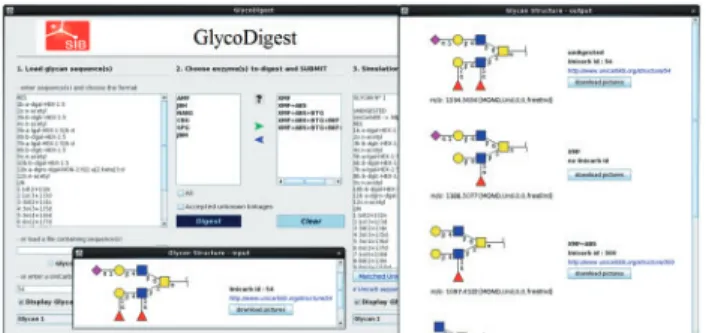
The stand-alone release offers a user-friendly interface consisting of three components: (i) glycan sequences can be directly entered into the ‘load’ panel in genuine or Consortium for Functional Glycomics (CFG) modified, International Union of Pure and Applied Chemistry (IUPAC) condensed or GlycoCT format, or built using the embedded version of GlycanBuilder; (ii) a combination of exoglycosidase enzymes can be selected from the middle panel, and the input structure is processed in silico using the rules explained above; (iii) the theoretical results of the enzymatic digestion are returned in GlycoCT format and dis-played in the ‘Simulation Results’ panel (Fig. 1). Graphical rep-resentations of the glycan structures can be displayed using the image rendering Application Programming Interface (API), which are linked to UniCarbKB entries.
4.2 GlycoDigest web version
A Java applet version of GlycoDigest uses the same functionality and interface described above. However, the structure encoding entries in Panels 1 and 3 are displayed in the same page as
opposed to being displayed in new windows. As the stand-alone version, known structures are linked to UniCarbKB entries.
4.3 Integrating GlycoDigest with UniCarbKB
UniCarbKB offers public access to a growing, curated database of information on the glycan structures on glycoproteins. For each N- and O-link glycan structure with defined linkage infor-mation, a ‘GlycoDigest’ link provides users the option to select a combination of enzymes for simulating exoglycosidase treat-ment(s). Proposed structures for each undigested and digested glycan resulting from the action of the exoglycosidases can be searched in UniCarbKB (Campbell et al., 2014b) for associated published and experimental information, and for combined exo-glycosidase-MS/MS characterization of oligosaccharides (Ali et al., 2012) using UniCarb-DB spectra (Hayes et al., 2011). Alternatively, digestions can be run on structures built using GlycanBuilder.
5 CONCLUSIONS
GlycoDigest fills the need for a robust and intuitive means for glycobiologists to simulate and design mixtures of exoglycosi-dases with which to experimentally validate proposed glycan structures. The tool minimizes any chance of user bias in inter-preting what may be ambiguous results and ensures that all structures compatible with the experimental data are considered. The availability of the GlycoDigest Java library will allow bioin-formaticians the option of integrating this tool for managing the input and output of exoglycosidase-treated glycan structures. Funding: Swiss National Science Foundation (31003A_141215); Macquarie University Research Excellence Scheme Postgraduate Scholarship; The Australian National eResearch Collaboration Tools and Resources project (RT016).
Conflict of interest: none declared.
REFERENCES
Ali,L. et al. (2012) Structural identification of O-linked oligosaccharides using exo-glycosidases and MSn together with UniCarb-DB fragment spectra comparison. Metabolites, 2, 648–666.
Campbell,M.P. et al. (2008) GlycoBase and autoGU: tools for HPLC-based glycan analysis. Bioinformatics 2008, 24, 1214–1216.
Fig. 1. Interface for the desktop version of GlycoDigest with examples of input/output glycan structures displayed in the essentials of Glycobiology/CFG format
3132 L.Gotz et al.
Campbell,M.P. et al. (2014a) Toolboxes for a standardised and systematic study of glycans. BMC Bioinformatics, 15 (Suppl 1), S9.
Campbell,M.P. et al. (2014b) UniCarbKB: building a knowledge platform for gly-coproteomics. Nucleic Acids Res, 42, D215–D221.
Damerell,D. et al. (2012) The GlycanBuilder and GlycoWorkbench glycoinfor-matics tools: updates and new developments. Biol. Chem., 393, 1357–1362. Guile,G.R. et al. (1996) A rapid high-resolution high-performance liquid
chroma-tographic method for separating glycan mixtures and analyzing oligosaccharide profiles. Anal Biochem, 240, 210–226.
Hayes,C.A. et al. (2011) UniCarb-DB: a database resource for glycomic discovery. Bioinformatics, 27, 1343–1344.
Kobata,A. (1979) Use of endo- and exoglycosidases for structural studies of glyco-conjugates. Anal. Biochem., 100, 1–14.
Prime,S. and Merry,T. (1998) Exoglycosidase sequencing of N-linked glycans by the reagent array analysis method (RAAM). Methods Mol. Biol., 76, 53–69. Royle,L. et al. (2006) Detailed structural analysis of N-glycans released from
glyco-proteins in SDS-PAGE gel bands using HPLC combined with exoglycosidase array digestions. Methods Mol. Biol., 347, 125–143.
3133 GlycoDigest