HAL Id: hal-01954816
https://hal.archives-ouvertes.fr/hal-01954816
Submitted on 20 Feb 2019HAL is a multi-disciplinary open access
archive for the deposit and dissemination of sci-entific research documents, whether they are pub-lished or not. The documents may come from teaching and research institutions in France or abroad, or from public or private research centers.
L’archive ouverte pluridisciplinaire HAL, est destinée au dépôt et à la diffusion de documents scientifiques de niveau recherche, publiés ou non, émanant des établissements d’enseignement et de recherche français ou étrangers, des laboratoires publics ou privés.
To cite this version:
Denis Bailly, Rémi Mongruel, Emmanuelle Quillérou. Ecosystem services and marine conservation. Scientific Notes of the Ocean & Climate Platform, 2015. �hal-01954816�
Healthy marine and land ecosystems provide a wide range of benefits to society such as food, materials, recreation, carbon regulation etc. Marine ecosystems are changing fast under increased and increasing pressures and impacts from climate change and increasing human populations with expanding needs. Sea level rise, ocean acidification, eutrophication, change in water temperature and coastal weather patterns directly impact, often negatively, wild fish stocks and aquaculture production, coastal infrastructures generating maintenance, and recreational activities
(Ocean and Climate, 2015). Expanding needs of increasing human populations is one of the drivers of unsustainable levels of exploitation of marine ecosystems, and their many fish stock overfished. The ocean supports increasingly diverse needs, with competition for access to marine resources and use of the marine space for recreation and tourism, shipping, deep sea mining, renewable marine energies (e.g., offshore wind turbines), in addition to subsistence and commercial fishing, The benefits provided by marine ecosystems are shrinking fast in places under such pressures.
Marine and land ecosystems provide many benefits to society. Marine ecosystems are under increased pressure because of climate change, expanding human populations and needs. Increased pressures and associated impacts on ecosystems often render current management and conservation policies inappropriate to mitigate or regulate such pressures and maintain the level of ecosystem benefits provided. Integrated approaches centred on ecosystems can help assess synergies and trade offs for delivery of benefits provided by ecosystems for management options with different levels of usage and conservation. The ecosystem service framework can help structure the production of comprehensive assessments drawing from multi-disciplinary academic knowledge and management experience. Interaction and dialogue with stakeholders structured by a step-wise iterative ‘triage’ process can help ensure ecosystem assessment outputs are meaningful, salient (reflecting the interests of those involved), useful to management and policy concerns, needs and projects, and feasible under available knowledge and resources. The ecosystem service framework needs to be applied at regular intervals to gain an idea of how the benefits derived from ecosystems evolve in time. Using the ecosystem service framework in combination with the DPSIR framework to identify Drivers, Pressures, States, Impact, Response can provide very rich insights to discussions for establishment of management plans and policies for marine conservation, especially those aiming to mitigate or adapt to climate change pressure, for delivery of healthy ecosystems and associated human well-being.
Ecosystem
Services
and Marine
Conservation
Denis Bailly,
Rémi Mongruel,
Emmanuelle Quillérou
Management decisions and ecosystem conservation policies are very often not designed in a flexible enough way to allow for appropriate adaptation to changing circumstances such as changing ecosystems, pressures, and human needs and impacts. Changing pressures and needs consequently render current management and conservation policies inappropriate to effectively mitigate or regulate such pressures and maintain the level of benefits provided by healthy ecosystems. Tensions and conflicts arising between ecosystem users are generally more acute for higher levels of competition to satisfy human needs and impacts. They can be exacerbated by inappropriate management decisions and policies. Management decisions and policies, on the other hand, have the potential to conciliate tensions and conflicts to certain extent. Management decisions and policies are social constructs that not only influence tensions and conflicts but their design is also influenced by such tensions and conflicts.
Healthy ecosystems are often a necessary condition to achieving sustainable development,
i.e. “development that meets the needs of present
generations without compromising the ability of future generations to meet their own needs” (Bruntland, 1987). The challenge we are facing now is to ensure conservation of healthy marine ecosystems in a highly dynamic environment so as to meet future as well as current needs. Establishment of marine protected areas is one possible option to help protect rich and healthy ecosystems, which could be complemented by other instruments to effectively mitigate drivers and pressures. ‘Blue growth’ and the ‘blue economy’ - mirroring ‘green growth’ and the ‘green economy’ - are seen as possible ways to foster sustainable development of human activities related to the marine environment. ‘Blue businesses’ have the potential to advance human well-being with job and value-added creation, and investment into maintaining healthy marine ecosystems or restoring degraded marine ecosystems. The concept of ‘blue economy’ goes beyond the value creation by businesses (blue growth) to include non market benefits derived from recreation in marine ecosystems, from bequeathing healthy
marine ecosystems to our children for their own enjoyment, or simply from knowing that healthy marine ecosystems simply exist.
A range of scientific methods and approaches has been established in the literature to help assess different management options and provide a basis for managers and policy-makers to make informed decisions. Operational application of such methods and approaches for marine ecosystem can be based on a common ecosystem approach for establishment of structured ecosystem assessment outputs using the comprehensive ecosystem service framework. A ‘triage process’ structuring interaction and dialogue between researchers and managers can ensure provision of information pertinent to decisions involving trade offs between ecosystems and human needs or between different types of human needs.
ECOSYSTEM APPROACH FOR
CROSS-SECTORAL ASSESSMENT
OF ECOSYSTEMS
The ecosystem approach has become very popular over the past decade as a harmonised way to conceptualise management problems that involve natural ecosystems. The International Council for the Exploration of the Sea (ICES) defines the ecosystem approach for application to marine ecosystems as “the comprehensive integrated management of human activities based on best available scientific knowledge about the ecosystem and its dynamics, in order to identify and take action on influences which are critical to the health of the marine ecosystems, thereby achieving sustainable use of ecosystem goods and services and maintenance of ecosystem integrity” (ICES, 2005, emphasis added). Previous management approaches were mostly sectoral with human activities considered independently. Such sectoral approaches however proved inappropriate when dealing with global cross-sector phenomena such as climate change and fail to capture trade offs between different
human activities competing for resources from or access to the same ecosystem. The ecosystem approach considers together ecosystems and the associated human activities and trade offs, and is therefore suited to comprehensive integrated assessment of ecosystems for different management and policy options for input into decision-making processes.
The ecosystem approach was first elaborated by ecologists concerned by critical environmental problems and was formalised in the 1970s for the purpose of political advising (Mongruel and Beaumont, 2015). It is established at the junction of ecology and economics with human activities linked to ‘energy flows’ within and between ecosystems (thermodynamics). The ecosystem approach is at the heart of a relatively recent sub-branch of economics, ecological economics, which conceptualises the economy as a sub-component of ecosystems, in contrast to previous economic conceptualisations (Biely, 2014). Natural scientists and economists have joined their efforts in order to estimate the (socio-economic) “value” of ecosystems (Gómez-Baggethun et
al., 2010). The most representative example of
such collaboration is possibly the paper entitled “The value of the world’s ecosystem services and natural capital” (Costanza et al., 1997). Estimates of socio-economic values of several ecosystems have been recently updated (Costanza et al., 2014). The estimated value of marine ecosystems, inclusive of open oceans and coastal areas, is USD 796/ha/yr1 in 1997
and USD 1,368/ha/yr in 2011 (Costanza et al., 2014). Total socio-economic value of marine ecosystems is estimated to USD 49.7 trillion/yr in 2011, i.e. about 2/3 of the global gross national product (around USD 75.2 trillion/yr).
Such global studies and numbers have had a great role and impact for raising awareness of decision-makers and policy-makers of the need to include non-market benefits of ecosystems and adopt a broader perspective than short-term financial interests. Such non-market
1 All numbers from Costanza et al. (2014) are expressed in 2007 USD.
benefits include the value societies allocate to knowing healthy ecosystems exist (existence value), to bequeathing healthy ecosystems to future generations (bequest value) or to good ‘stewardship’ of ecosystems (stewardship value). This forms part of what economists call the ‘Total Economic Value” which encompasses both market and non-market components to capture the ‘true’ value of ecosystems to society through increased welfare and not just increased profits.
Estimation of such ‘inclusive’ numbers through economic valuation methods, however, tends to be highly time- and effort-consuming and requires a lot of specific skills and capacity. Such ‘global’ numbers aggregate a lot of different elements together using money as a ‘common measuring rod’. This limits their ability to inform management actions, especially at the more local level where finer detail is often needed than one single number. Depending on the specific context, alternative more flexible methods may be more suited for local-level assessment. For example, multi-criteria analysis allows for combination of quantitative and qualitative information, measured in monetary values and physical units, over a range of different academic disciplines and ‘on-the-ground’ experience. Such a method can be used as a way to integrate different kinds of knowledge and usually matches well the way people themselves integrate knowledge and take decisions.
THE ECOSYSTEM SERVICE
FRAMEWORK AS A
COMPREHENSIVE ‘COMMON
LANGUAGE’ TO STRUCTURE
ECOSYSTEM ASSESSMENTS
The ecosystem approach is associated with an operational framework, the ecosystem service framework. The framework was popularised and formally established within the decision-making sphere by the Millennium Ecosystem Assessment (2005). The framework provides a
non-Operationalising the ecosystem service framework and ‘triage process’: VALMER project as an example
(adapted from Mongruel and Beaumont, 2015)
“The VALMER framework for the operational assessment of marine and coastal ecosystem services provides a structure to guide practitioners in undertaking comprehensive, transparent and appropriate marine ecosys-tem services assessments. It does not, however, provide a set of rigid and prescriptive rules that are applicable in their entirety to all circumstances. Marine ecosystem service assessments are context dependent, as the needs of managers and stakeholders, the services about which they are concerned, and the resources available for the assessment are highly variable. This necessitates a flexible guidance framework.”
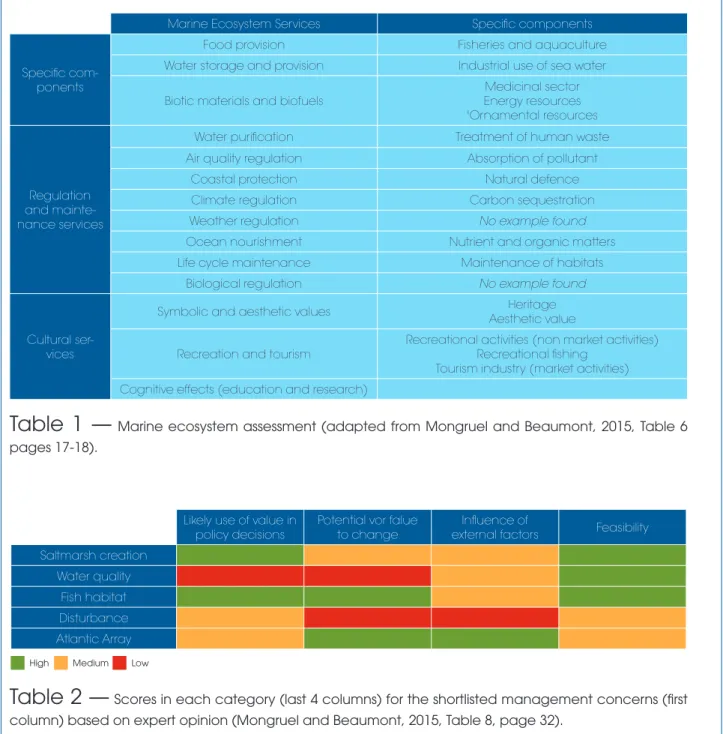
Table 1 details some of the ecosystem services that were identified as part of the project to facilitate their as-sessment and valuation in economic terms. Table 2 shows an example of asas-sessment based on expert opinion structured along different ecosystem services.
Marine Ecosystem Services Specific components
Specific com-ponents
Food provision Fisheries and aquaculture Water storage and provision Industrial use of sea water Biotic materials and biofuels Energy resources Medicinal sector
'Ornamental resources
Regulation and mainte-nance services
Water purification Treatment of human waste Air quality regulation Absorption of pollutant
Coastal protection Natural defence Climate regulation Carbon sequestration Weather regulation No example found
Ocean nourishment Nutrient and organic matters Life cycle maintenance Maintenance of habitats
Biological regulation No example found
Cultural ser-vices
Symbolic and aesthetic values Aesthetic valueHeritage
Recreation and tourism Recreational activities (non market activities)Recreational fishing Tourism industry (market activities) Cognitive effects (education and research)
Table 1 —
Marine ecosystem assessment (adapted from Mongruel and Beaumont, 2015, Table 6 pages 17-18).Likely use of value in
policy decisions Potential vor falue to change external factorsInfluence of Feasibility Saltmarsh creation
Water quality Fish habitat Disturbance Atlantic Array
High Medium Low
Table 2 —
Scores in each category (last 4 columns) for the shortlisted management concerns (first column) based on expert opinion (Mongruel and Beaumont, 2015, Table 8, page 32).prescriptive basis to establish a comprehensive ecosystem assessment based on the services ecosystems provide. It divides ecosystem services into four mutually exclusive categories: provisioning services, regulating services, cultural services and supporting services. Provisioning services refer to the provision by ecosystems of food, water, fibre, timber, fuel, minerals, building materials and shelter, and biodiversity and genetic resources for medicines or food additives. Regulating services refer to the benefits derived from regulation of processes such as climatic events (storm protection), carbon storage and sequestration, water flows (floods and droughts), water purification, pollution and waste treatment, soil erosion, nutrient cycling, regulation of human diseases, and biological control. Cultural services include aesthetic, spiritual, educational, and recreational aspects and are mainly experienced through tourism or religious practices. Supporting services include primary production, soil formation, and nutrient cycling. The first three types of services are more directly linked to financial flows. Supporting services tend to be captured in other ecosystem services (e.g., high fish stocks depend in part on good nutrient cycling). Contrary to the other types of services, supporting services are often not valued in economic terms when necessary for supply of other ecosystem services, which could lead to count the same economic value twice (as a supporting service, and as a part of another type of ecosystem service).
These ecosystem services collectively provide the basis of human well-being. As such, all these types of ecosystem services have an economic value, more or less well captured by market prices and considered with varying degrees in individual or collective decision-making processes. Such a framework helps identify services that are not – or not fully – valued in economic or social terms, which creates incentives for overexploitation or degradation of ecosystems.
Climate change affects the level and nature of provision of these ecosystem services, while regulating ecosystem services such as carbon storage and sequestration can help
regulate climate variation. The ecosystem service frameworks allows for explicit trade offs between different processes underlying ecosystem services. Mangrove forests in a coastal ecosystem have been in some cases removed to allow for increased shrimp farming and production, at the cost of a lower level of protection against coastal erosion and extreme weather events, such as storm winds and floods, as well as tsunamis – i.e. an increase in provisioning service at the cost of a reduction in regulating service (Barbier and Cox, 2003).
The advantage of the ecosystem service framework is that it is comprehensive, generic and flexible enough for customisation to specific assessment contexts. The different categories of ecosystem services can easily be replaced by context-specific examples and vocabulary adapted to different audiences, especially those not used to working with the framework (Table 1). It is necessary to link identification of ecosystem services to ecosystems functions, building up from ecological knowledge and allowing integration of a social science perspective identifying well-being variations stemming from changes in the functioning or structure of ecosystems. The ecosystem service framework can provide a useful framework for researchers and practitioners to build up an ecosystem assessment. Such ecosystem assessment can be used as part of informed decision-making processes to balance ecosystem conservation with economic development according to society’s preferences.
MAKING ECOSYSTEM ASSESSMENT
MEANINGFUL, SALIENT, USEFUL,
AND FEASIBLE USING A
STEP-WISE ITERATIVE APPROACH
OR ‘TRIAGE PROCESS’
Assessment processes that involve stakeholders or decision-makers can help ensure ecosystem assessment is conducted so as to be meaningful, salient (reflecting the interests of those involved), useful to management
and policy concerns, needs and projects, and feasible under available knowledge and resources, thereby ensuring output relevance to discussions around ecosystem management and policy. Involvement of decision-makers and stakeholders in ecosystem assessment processes tend to increase likelihood that the outputs from such assessments will be actually used.
There are several models for structuring ecosystem assessment processes, all built around the same three stages, with variations between models and their application stemming from the range of possible choices at each stage. A ‘triage process’ encompassing three transparent and successive stages has been developed to support operational marine management as part of the “Valuing ecosystem services in the western Channel (VALMER)” project funded by the European Union (http://www.valmer.eu) (Pendleton et al., forthcoming):
i. idefining the aims and scope of the assessment, often overlooked, to ensure it is meaningful and salient;
ii. selecting the ecosystem services to be assessed based on three criteria (perceptions of current trends, influence of management intervention, and influence of other factors), with clear identification of synergies and trade-offs between ecosystem services provided, to ensure assessment is useful; and
iii. choosing the assessment method (e.g., measures of ecological output, economic impact, total economic value etc.). Because of the decomposition of an ecosystem into different ecosystem services, the ecosystem service framework can help at the third stage of the ‘triage process’ with different assessment methods used for different ecosystem services.
The ‘triage process’ takes a strategic decision-making approach with decisions at each stage made after discussions between researchers, decision-makers, practitioners and/ or stakeholders. Its implementation can assist in identifying methodologies, scale and scope for
co-construction of ecosystem assessment that is deemed relevant and appropriate.
The ‘triage process’ can be combined with the ecosystem service framework at each of the three stages. Such a ‘triage process’ for structuring assessment processes can be applied in a flexible and iterative way, sometimes requiring a highly skilled facilitator for the discussions. Such an approach allows for data gaps and uncertainty, which can be reduced through dialogue with stakeholders. Such an approach helps foster collaboration between scientists from different disciplinary background and identify the ‘best expert for the job’ depending on the issue at stake – ecologists having a greater weight in conducting the assessment when the issue is linked to supply of ecosystem services whereas social scientists stepping in mainly for issues linked to demand for ecosystem services.
CONCLUSION
Ecosystem service framework and ‘triage process’ can be combined for meaningful, salient, useful and feasible ecosystem assessment. Assessment format is adapted to needs from managers and decision-makers and integrates very different types of knowledge as well as knowledge from very different disciplines, reflecting the way managers and policy-makers function. Such knowledge-based integrated participatory ecosystem assessment requires a high level of collaboration between academic disciplines, especially environmental sciences and social sciences and building strong partnerships with managers and decision-makers.
The ecosystem service framework needs to be applied at regular intervals to gain an idea of how the benefits derived from ecosystems evolve in time. This goes back to the idea that we need iterative processes in line with a changing environment, changing drivers and changing pressures. Mitigation and regulation management and policies target drivers and pressures of change, which are not the specific
focus of the ecosystem service framework. Using the ecosystem service framework and ‘triage process’ in combination with the DPSIR framework based on identification of Drivers, Pressures, States, Impact, Response and how they relate together can provide very rich insights to discussions. Iterative assessment capturing evolutions and changes can provide a basis to inform the establishment of new management
plans and policies for marine conservation, or adaptation of current management practices and policies. Keeping management choices and policies flexible and allowing for integration of lessons learnt over time by design is key for successful delivery of healthy ecosystems and associated human well-being in a changing environment, and even more importantly at the global level under climate change.
REFERENCES
• BARBIER E. and COX M., 2003 – Does Economic Development Lead to Mangrove Loss ? A Cross Country Analysis. Contemporary economic policy, 21 (4), 418-432.
• BIELY, K., 2014 – Environmental And Ecological Economics : Two Approaches in Dealing With Economy-Environment
Interrelations and the Example of the Economics of Land Degradation Initiative. Masters thesis. University of
Vienna, http://ubdata.univie.ac.at/AC11451272, 272 pages.
• BRUNTLAND, G. (ed), 1987 – Our Common Future. Report of the World Commission on Environment and Development. Oxford, UK : Oxford University Press.
• COSTANZA R., D’ARGE R., de GROOT R., FARBER S., GRASSO M., HANNON B., LIMBURG K., NAEEM S., O’NEIL R., PARUELO J., RASKIN R., SUTTON P. and VAN DEN BELT M., 1997 – The Value of the World’s Ecosystem Services and
Natural Capital, Nature, 387, 253-260.
• COSTANZA R., de GROOT R., SUTTON P., VAN DER PLOEG S., ANDERSON S.J., KUBISZEWSKI I., FARBER S. and TURNER R.K., 2014 – Changes in the Global Value of Ecosystem Services. Global Environmental Change, 26 : 152-158. • GÓMEZ-BAGGETHUN E., DE GROOT R., LOMAS P.L. and MONTES C., 2010 – The History of Ecosystem Services in
Economic Theory and Practice : from Early Notions to Markets and Payment Schemes. Ecological Economics.
69 : 1209-1218.
• ICES, 2005 – Guidance on the Application of the Ecosystem Approach to Management of Human Activities in
the European Marine Environment. ICES Cooperative Research Report no. 273, 22 pages.
• MILLENNIUM ECOSYSTEM ASSESSMENT, 2005 – Ecosystems and Human Well-Being. Geneva, Switzerland : World Health Organization.
• MONGRUEL R. and BEAUMONT N. (coordinators), 2015 – A Framework for the Operational Assessment of Marine
Ecosystem Services. Contributors : HOOPER T. LEVREL H., SOMERFIELD P., THIÉBAUT É., LANGMEAD O. and CHARLES
M., March 2015, www.valmer.eu/wp-content/uploads/2015/03/A-framework-for-the-operational-assessment-of-marine-ecosystem-services.pdf, 80 pages.
• OCÉAN ET CLIMAT, 2015 – Fiches scientifiques. www. ocean-climate. org.
• PENDLETON, L., MONGRUEL, R., BEAUMONT, N., HOOPER, T. and CHARLES, M. – A Triage Approach to Improve
Launched at UNESCO in June 2014, the Ocean and Climate platform is a multi-stakeholder structure including members of the scientific community, non-profit organizations and business organizations that are all concerned about the ocean. It aims to place the ocean at the heart of international climate change debates, particularly at the Paris
Climate 2015 conference.
The Scientific Committee of the Platform is comprised of world-renowned scientists in the fields of oceanography, biodiversity and ecology of the marine environment, but also from social and economic sciences related to the ocean. The texts included here represent an initial synthesis on the key points of ocean and climate issues. They form an essential scientific basis for all, from citizens to decision makers who are implicated in the negotiations and decisions taken within the United Nations Framework Convention on Climate Change, particularly during the COP 21 in Paris in December 2015.
Platform
Involving the Ocean in the debate on Climate Change
Document pr inted on CyclusPr int / 100% r ec ycled pa per