HAL Id: tel-00697022
https://tel.archives-ouvertes.fr/tel-00697022
Submitted on 14 May 2012
HAL is a multi-disciplinary open access archive for the deposit and dissemination of sci-entific research documents, whether they are pub-lished or not. The documents may come from teaching and research institutions in France or abroad, or from public or private research centers.
L’archive ouverte pluridisciplinaire HAL, est destinée au dépôt et à la diffusion de documents scientifiques de niveau recherche, publiés ou non, émanant des établissements d’enseignement et de recherche français ou étrangers, des laboratoires publics ou privés.
secondaires
Julien Boulon
To cite this version:
Julien Boulon. Approche multi-échelle de la formation des particules secondaires. Sciences de la Terre. Université Blaise Pascal - Clermont-Ferrand II, 2011. Français. �NNT : 2011CLF22159�. �tel-00697022�
UNIVERSIT´
E BLAISE PASCAL
CLERMONT-FERRAND
GRADUATE SCHOOL OF FUNDAMENTAL SCIENCES
PhD. Thesis
in partial fulfillment of the requirements for the degree of
Doctor of Philosophy
of the Universit´e Blaise Pascal
Speciality: Atmospheric Physics
Submitted and presented by
Julien Boulon
Multi-scale approach of the
atmospheric new secondary particle
formation
defended the 20th of september 2011
PhD. Committee:
Chair:
Pr. Alfons Schwarzenboeck, LaMP CNRS, Clermont-Ferrand
PhD. Examinators: Pr. Markku Kulmala, University of Helsinki
Dr. Ernest Weingartner, Paul Scherrer Institut, Villigen
PhD. Reviewers:
Pr. Stephane Alfaro, LISA, CNRS, Paris
Dr. Abdelwahid Mellouki, ICARE CNRS, Orl´eans
PhD. Supervisors:
Dr. Karine Sellegri, LaMP CNRS, Clermont-Ferrand
Acknowledgements
First of all... STOP !!
Maintenant, place `a ma langue maternelle. D´ej`a que personne ne va plus loin que ces quelques pages... En plus, ¸ca permettra `a ma famille de lire au moins une de mes productions sans utiliser de dictionnaire ou ”Google translate”...
LES PR ´ELUDES
Eh bien ¸ca y est ! L’heure est `a la gratitude et `a la r´edaction de la partie la plus lue d’une th`ese. Section parfois larmoyante mais souvent d’un int´erˆet ethnologique majeur pour le futur th´esard pr´eparant son entr´ee dans un laboratoire, la c´el`ebre rubrique des ”Re...”.
Par o`u commencer... Ce qui a rendu cette ´epop´ee possible... Une recherche internet :
plutˆot vague et un peu impersonnelle. Retour en 2008, cit´e mondiale du vin, Bordeaux. Premi`ere rencontre avec un de mes directeurs de th`ese : Paolo Laj. Quelques slides des travaux d’Herv´e Venzac, futur coll`egue et initiateur au traitement des donn´ees
instrumentales. ¸Ca parle d’Everest et de feux rouges, de pollution et de particules. Je
repars convaincu, une encyclop´edie sous le bras droit et un aspirateur dans l’autre : il est fort ce Paolo. Savoir donner autant d’entrain et de sympathie en moins de cinq minutes n’est pas donn´e `a tout le monde, c’est une des nombreuses (je pr´esume) qualit´es de Monsieur Laj.
Le marketing `a l’italienne ayant fait son œuvre, deuxi`eme rendez-vous. Cette fois c’est `a Toulouse durant les AEI M´et´eo France que je rencontre Karine, celle qui allait encadrer jour apr`es jour ce travail. J’aurai l’occasion de parler d’elle plus tard.
L’INTRODUCTION
Une th`ese c’est aussi l’entr´ee dans un nouveau laboratoire avec ses acteurs, ses traditions et son histoire. Ici ce sont les acteurs auxquels je pense. Les premiers sont ceux qui m’ont permis d’atterrir sereinement dans le bureau 8220 du bˆatiment B8, j’ai nomm´e Wolfram Wobrock et Andrea Flossmann. Sans eux cet atterrissage n’aurait pu s’ˆetre fait dans de si bonnes conditions. Pour ¸ca ils m´eritent enti`erement leur place dans cet ´etalage aux souvenirs ”avec sourire en coin”. Si leur consentement fut pour moi le deuxi`eme top d´epart de cette course de fond doctorale, mes coll`egues et amis du laboratoire ont construit cette course, l’ont nourrit jour apr`es jour. Dans un premier lieu, les ”anciens” pas tant par l’age – je mets un point d’honneur `a confirmer ma nature de sage devant ces jeunes freluquets – mais parce que maintenant on les appelle ”Dr.” : Herv´e, Vincent et Guillaume. Entre deux vannes sur Matlab, Python et autres ”geekeries”, ils leur arrivaient de ne pas parler de football et c’est dans ces moments-l`a que leur humanit´e me permettait de me sentir soutenu au sein d’une ´equipe. C’est une
composante essentielle du bonheur que j’ai pu ´eprouver durant les premiers mois de ce travail et leur contribution est loin d’ˆetre n´egligeable. Aussi par ce texte, qu’ils trouvent l’expression de mon amiti´e et de ma sinc`ere gratitude.
D ´ECORS & ANALYSE FAUNISTIQUE
Comprendre ici le d´ecor comme l’ensemble des ´el´ements formant un cadre `a l’action de la th`ese. Ces ´el´ements peuvent donc ˆetre organiques ou inorganiques.
Le ”8220” a petit `a petit ´et´e colonis´e par la ”nouvelle vague”, je veux dire la nouvelle g´en´eration dont je fais partie. Nous nous sommes rapidement appropri´e l’espace : Boris `a ma gauche un peu en arri`ere, Emmanuel juste en face de moi avec `a sa droite Maxime lui-mˆeme `a gauche de Boris. Ces deux derniers ´etant orient´es au Nord, perpendiculairement `a mon orientation qui, vous l’aurez devin´e se situe sur l’axe Est-Ouest. Cet ˆılot constitue la zone masculine de bureau. Dans le coin fenˆetre oppos´e au mien, la sage Elise poursuit son travail.
En dehors de ce hˆavre, le laboratoire est peupl´e d’autres gens (il paraˆıt mˆeme qu’il y a un autre bˆatiment !), des gens qui ont un poste, souvent, un post-doc, parfois. Ces gens sont dou´es de comp´etences dont le th´esard est d´epourvu. Alors ces gens, d’une patience remarquable, nous aident pour ainsi dire tout le temps. Pour ma part, cette aide s’est ´etendue du relev´e de donn´ees `a la r´eparation d’instruments sauvages, des questionnements intimes sur la nature de la chimie aux bases de l’electronique, en passant par la r´eponse `a ma question favorite : ”Dans quel sens on tourne pour d´evisser d´ej`a ?”. Quelle patience ! Tout ces gens, David, Micka¨el, Jean-Marc, Christophe, Aur´elie, Lætitia, Christian, C´ecile (sans qui mes nombreuses missions du Mt. Fuji `a San Francisco n’auraient pus ˆetre possibles), lui, elle et aussi les autres, j’esp`ere bien pouvoir vous rendre la pareille. Sachez que sans vous je serais peut-ˆetre mort ´electrocut´e vingt fois ou de d´esespoir `a force de visser sans fin, que de nombreuses donn´ees et r´esultats n’auraient pu ´emerger de mon ordinateur et que le plaisir que j’ai eu `a travailler ici n’aurait pas pu ˆetre aussi complet. Votre pr´esence et votre accueil `a chacune de mes apparitions en chaussettes dans votre bureau resteront bien grav´es dans mon exp´erience de th´esard. J’esp`ere que ces quelques mots vous feront comprendre que je vous exprime, `a ma mani`ere et encore en chaussettes, ma plus profonde reconaissance. Il y a aussi mes amis ”sportifs” et festifs. Comment les oublier ? Nous avons tellement souffert ensemble, gladiateur du soccer en lutte pour la survie. Les d´ecompressions amicales qu’ils m’ont offertes ont largement contribu´ees `a mon ´equilibre durant ces trois ans. Une heure de soccer contre deux heures de bla-bla et de glou-glou. Je garderai un souvenir ´emu de mes nombreuses victoires (et pan ! ici j’ai le dernier mot !!). Alors Olivier, Fred, Yahya, Guillaume et tous les autres, je vous dis ”bien jou´e !” et on peut dire que ce que vous m’avez apport´e, c’est une belle victoire (une fois n’est pas coutume...).
iii LES CERISES
Chaque partie du tout est essentielle dans une th`ese. La forme impacte directement sur le fond. Aussi certaines personnes ont occup´e une place tout `a fait sp´eciale durant ces
trois ann´ees. Bien sˆur mes amis, mes bons vieux potes qui `a l’occasion d’un coup de
fil, d’un mariage, d’une naissance ou je ne sais quels autres ´ev`enements ont toujours su me t´emoigner un soutient inconditionnel moral quand je venais m’´etendre sur leurs
´epaules comme un vison mort autour du coup d’une bourgeoise du XIXe si`ecle. Quand
je venais m’´etendre disais-je, pour leurs raconter mes doutes et mes peurs laissant de cˆot´e la science car qui comprend quelque chose `a la nucl´eation de nos jours. Ces amis-l`a, j’ai la chance d’en avoir et je souhaite qu’ils trouvent ici une embrassade chaleureuse et ´emue. Alors Seb, Hugues, Panda, J´er´emy, Paco ne vous d´eplaise vous devez lire cette th`ese pour comprendre `a quel point vous m’avez ´et´e essentiels pour en arriver `a bout. Mais il n’y a pas que les vieux de la vieille. Cette exp´erience clermontoise m’a aussi donn´ee l’occasion de rencontrer des gens exceptionnels qui par leur pr´esence au quotidien m’ont permis de surmonter mes ´echecs et de continuer
d’avancer. Boris, ´Elodie, Laura, Marie, Antoine, Yaurick, Baptiste, mon barman
Andr´e, mes colocs’ Gab (le maraicher du temps libre) et Seb (l’exquis, le chercheur du bon), je vous adresse sur ces pages l’expression de mes bi`eres distingu´ees et me permets de vous dire que vous comptez beaucoup pour moi. J’esp`ere que l’avenir vien-dra consolider notre amiti´e et que le chemin parcouru ne sera qu’enrichi par nos ´echanges.
Maintenant vient le temps des caract`eres sp´eciaux.
En trois ans, elle n’a pas montr´e un seul signe de faiblesse. Elle n’a rien lˆach´e. Toujours pr´esente, les week-ends, le soir, le matin, le jour, en vacances, en cong´es maternit´e, en mission. Bref, toujours. Sa patience et sa constance, sa bonne humeur et sa sympathie ainsi que son imbattable volont´e pour fˆeter nos articles ont fait que rien au monde n’aurait pu se substituer `a elle dans l’accomplissement de ce travail. Vous l’aurez devin´e, il s’agit de ma directrice de th`ese, Karine. Si j’ai pu apprendre quoi que ce soit sur l’a´erosol durant ces trois ans, c’est grˆace `a toi et `a la p´edagogie dont tu as fait preuve pour m’expliquer les fondamentaux et d´eveloppements de cette science que tu affectionnes. J’esp`ere exprimer ici l’estime profonde que j’ai `a ton ´egard.
Enfin, il y a ma famille. Incroyable, unique, d’une richesse sans pareil. Ma soeur et
J´er´emy ´evidemment, et bien sˆur Igor le petit filou, dernier n´e du clan. Tout les trois
vous avez toujours r´epondu pr´esent quand je d´ebarquais chez vous avec un petit sac contenant une brosse `a dents, parfois, mon ordinateur, tout le temps, et de l’aspirine pour faire face aux soir´ees bordelaises. Par chance Igor tu ne lis pas encore l’anglais mais mon heure viendra... Puis dans une famille il y a les parents. Et c’est `a mes parents que je d´edie ce manuscrit, bien maigre compensation au regard de ce que vous m’avez
apport´e durant ces 30 ans. Malgr´e les difficult´es `a me fixer, je passe les 50 sports que
j’ai dˆu essayer dans ma jeunesse ainsi que les ´etudes `a rallonges (”Je serai virologue”...
”Je serai pal´eo-antropologue”... ”Je serai medecin”... ”Je serai physicien”... Bon je serai ´etudiant quoi !), votre soutient n’a jamais fait d´efaut. Nous en avons travers´e des choses et sachez, vous deux, que notre relation constitue ma plus grande fiert´e.
Il faut bien s’arrˆeter. Alors je termine par un clin d’œil `a cette fille que j’ai ”crois´e”,
”recrois´e” durant ces cinq derni`eres ann´ees. Une affaire de trajectoire donc. Une
trajectoire de Bordeaux au Middle West. Minneapolis. Affaire `a suivre. P.S.: Je ne l’ai pas dit, na !
Contents
1 Introduction 1
1.1 A brief history of aerosol science . . . 2
1.1.1 The first considerations. . . 2
1.1.2 The experimental period . . . 3
1.1.3 The contemporary period: the birth of the climate change preoc-cupation . . . 5
1.1.4 From 1978 to present days: the explosion of organics in climate sciences . . . 6
1.2 Atmospheric aerosols and their role in the ”climate factory”. . . 8
1.2.1 The direct radiative effect . . . 8
1.2.2 The indirect radiative effect: the aerosol-cloud interactions . . . . 9
1.3 The aerosol sources: primary versus secondary . . . 10
1.3.1 The primary sources . . . 10
1.3.2 The secondary sources . . . 11
1.4 Aim of this doctoral thesis . . . 12
2 Theoretical approaches of the nucleation and growth of new particles 15 2.1 Homogeneous nucleation . . . 16
2.1.1 The unary system model . . . 16
2.1.2 The H2SO4−H2O binary system . . . 18
2.1.3 The H2SO4−NH3−H2O ternary system . . . 21
2.2 Heterogeneous nucleation. . . 22
2.2.1 The condensation process . . . 22
2.2.2 The nano-K¨ohler theory of the new particle formation. . . 25
2.3 The ion-induced nucleation. . . 26
2.4 Formulations of nucleation parametrizations . . . 27
3 Tools for the new particle formation event detection and analysis 29 3.1 Particle size distribution measurement devices . . . 30
3.1.1 The Air Ion Spectrometer family . . . 30
3.1.2 The Scanning Mobility Particle Sizer . . . 31
3.1.3 Instrument calibrations and intercomparison . . . 32
3.2 LIDAR measurements . . . 33
3.3 Data processing for nucleation event characterization . . . 34
3.3.1 Nucleation rates calculations . . . 35
3.3.2 Characterization of atmospheric layers . . . 38
3.4.1 All roads lead to Rome... . . 39
3.4.2 Adaptation of an existing code for new particle formation purpose: From M7 to M4-NPF . . . 40
4 Field studies of new particle formation events at different altitude sta-tions 45 4.1 New particle formation at high altitude locations: Study at a high alpine site in Switzerland . . . 45
4.1.1 Measurements . . . 46
4.1.2 Air mass analysis . . . 47
4.1.3 Results . . . 47
4.1.4 Summary of this study . . . 60
4.2 The vertical extent of nucleation events . . . 62
4.2.1 Measurement sites . . . 64
4.2.2 Instrumentation . . . 64
4.2.3 Results . . . 66
4.2.4 Summarize and concluding remarks . . . 82
4.3 A case study of an extreme event: The spring 2010 Eyjafjallajokull volcano eruption . . . 84
4.3.1 Volcanic induced new particle formation events . . . 86
4.3.2 Modelling the volcanic induced nucleation at the puy de Dˆome station 89 4.4 Concluding remarks. . . 92
5 Laboratory experiments: probing the nucleation process 95 5.1 Combustion reactor experiments: the PIREP project . . . 95
5.1.1 Experimental set-up . . . 96
5.1.2 Results . . . 98
5.2 Nucleation from the ozonolysis of biogenic terpenes in a simulation chamber102 5.2.1 Experimental set-up . . . 102
5.2.2 Results . . . 104
5.2.3 Discussion . . . 111
6 Conclusions and perspectives 119 A Annexes 125 A.1 Characterization of the neutral cluster mode measurement of the NAIS: the filtering experiment results . . . 125
A.2 Smog chamber experiments in CESAM . . . 126
A.3 Intercomparison of 11 air ion spectrometers . . . 126
Chapter 1
Introduction
Contents
1.1 A brief history of aerosol science . . . 2
1.1.1 The first considerations . . . 2
1.1.2 The experimental period. . . 3
1.1.3 The contemporary period: the birth of the climate change preoc-cupation . . . 5
1.1.4 From 1978 to present days: the explosion of organics in climate sciences . . . 6
1.2 Atmospheric aerosols and their role in the ”climate factory” . 8 1.2.1 The direct radiative effect . . . 8
1.2.2 The indirect radiative effect: the aerosol-cloud interactions . . . . 9
1.3 The aerosol sources: primary versus secondary . . . 10
1.3.1 The primary sources . . . 10
1.3.2 The secondary sources . . . 11
1.4 Aim of this doctoral thesis . . . 12
Aerosols, although not always named as such, have been the subject of many re-searches for centuries. To all aerosol scientists, the investigations of J. Aitken on con-densation nuclei in the 1880s, are well known. But in the early seventeenth century,
Rafinesque (1819) already postulated that ”dusty particles may be formed in the great chemical laboratory of our atmosphere”. Both Aitken and Rafinesque used the term ”dust” for aerosol particles. But this nomenclature is even much older: in 1666, the french astronomer Adrien Auzout argued in a discussion to Abbe Charles in the scientific
journal ”Le Journal des Savants” (Auzout,1666) that the bigger telescopes are not much
better than the small ones since ”[...] they magnify the vapors, the dust, and the other small objects, of which the air is always full. [...]”. Besides being a completely correct statement this shows that the scientists even more than 300 years ago i- were aware of the existence of aerosol particles and ii- they had at least some information on their effects. But it still was a long way to go to systematic aerosol research. In this introductory chap-ter, I will present the birth and the evolution of aerosol sciences, contemporary issues and future directions of this very active research field of atmospheric sciences.
1.1
A brief history of aerosol science
1.1.1
The first considerations
Atmospheric aerosol science history is closely related to air pollution issues. The existence of unpleasant and harmful particles in outdoor and indoor atmospheres was mentioned in the very early literature. For example, the Romans complained of the foul air in ancient Rome. Serious particulate air pollution led to the prohibition of coal burning in London in 1273, followed by a Royal Proclamation by Edward I in 1306 which definitely banned coal burning in England. In 1661, John Evelyn submitted the first major tract regarding particulate air pollution to Charles II. Despite those preoccupations, the birth of aerosol science and aerosol measurement methodology did not occur until the second half of the nineteenth century.
Atmospheric aerosol science (i.e. the explanations of the origin, pattern and properties of atmospheric particulate matter) has emerged in a theoretically point of view in the
age of Enlightenment (1700− 1800) in parallel with the rapid growth natural sciences in
general. The main issue addressed by the pioneers of modern atmospheric aerosol science was the origin of atmospheric aerosols. Theories on the origin of regional atmospheric aerosols could be grouped into six categories: busts of vapor emission from the Earth during earthquakes, formation from electrical discharges during thunderstorms, produc-tion from meteoric burns up in the upper atmosphere, volcanic emissions, windblown dust and combustion process (a detailed description of those theories can be found in
Husar, 2000). One major paper during this early period is the one from Rafinesque
(1819) published in the American Journal of Science called ”Thoughts on atmospheric
dust”. In this dissertation, Rafinesque postulated that ”Dust exists even on the tops of the highest mountains” and he also states that atmospheric particles are mixed along the whole lower layer of the atmospheric column and intuits the roles of dry and wet removal processes: ”It settles slowly in clear weather but is quickly washed down by rain and snow”. Furthermore, he also discussed two mechanisms of formation, distinguish-ing primary and secondary emissions: ”Some dust is from the pulverization of road and filed surface” and ”A portion is formed chemically in the atmosphere by combination of gases and elementary particles dissolved in air”. But all of those assumptions are theoretical and the end of the nineteenth century will be the period of transition from theory-driven to observation-based atmospheric aerosol sciences. The application of sim-ple physico-chemical princisim-ples allowed for the consolidation or the rejection of theories. In particular, earthquakes, lightnings and meteoritic origins of atmospheric particles were eliminated as significant contributors.
1.1. A brief history of aerosol science 3
1.1.2
The experimental period
The first experimental aerosol research efforts were closely associated with initial
devel-opments in colloid chemistry (Spurny, 1998). The first observations were made on fine
particles dispersed in the atmosphere, and some early experiments were performed in the
laboratory. According to McMurry’s review (2000), as early as 1841, J. P. Espy built a
”nephelescope” with which he was able to observe cloud water formation under laboratory conditions. But he was not aware that condensation occurred on the particles. According
Figure 1.1: Experimental device used by Coulier for the detection of the condensation activity
of dust particles. A. Transparent flask; B. Burette; C. Connection; D. Rubber ball; V. Valve.
to Podzimek’s review (1989), in 1847, H. Becquerel hypothesized about the existence of
fine particles in the air, now called condensation nuclei. Their existence was confirmed about 30 years later with the experiments of Coulier (1875), who was the first to publish a work showing that when air is expanded adiabatically, condensation occurs more readily in unfiltered air than in filtered air. The apparatus of Coulier was in principle the first
condensation nuclei detector (Fig. 1.1). It consisted of a transparent flask (A) with a
rubber bulb (D) for compressing the air in the flask. By opening the valve (V) the air could expand and condensation on aerosol particles could occur, which was qualitatively determined by the turbidity within the chamber. The same year Coulier published his results on the condensation activity, John Aitken began his research on condensation.
First results were obtained five years later (Aitken, 1880a,b) and then he developed and
used the first portable instruments for counting dust particles in the atmosphere (Aitken,
1889,1891a) which allowed him to published the first paper reporting i- the condensation activity in the real atmosphere and ii- the number concentration of airborne particles in a
given environment (Aitken (1888); the original scheme of the first portable condensation
particle counter is reported figure 1.2). Based on his experiments he concluded: ”(1)
when water vapor condenses in the atmosphere, it always does so on some solid nucleus; (2) the dust particles in the air form the nuclei on which it condenses; (3) if there was no
Figure 1.2: Schematic representation of the Aitken portable ”dust counter” adapted fromBaron
and Willeke (2001). A. Air-pump; B. Receiver; S. Stopcock; M. Apparatus for measuring air
to be tested; F. filter; T. Head of tripod; N. nut; B. Metal support; D. End of tube. The air being tested was drawn through pipe A and passed into receiver R, where it was mixed with a certain quantity of dustless air and saturated with water. The air in R was then expanded by the pump, which produced a shower of rain. The number of drops that fell on a measured area were then counted.
dust in the air there would be no fogs, no clouds, no mists, and probably no rain.” Using this new instrument, Aitken provided the first experimental verification of Rafinesque’s theories on secondary atmospheric aerosol formation, eighty years later its formulation.
In a long series of studies, John Aitken (e.g. Aitken, 1885, 1888, 1891b) has observed
that on cloudy days the nuclei count remained low. The nuclei number concentration has increased in proportion to the sunshine. Aitken concluded that ”sunshine may produce some change in the (photochemically active) constituents of the atmosphere which gives rise to nuclei formation in saturated air”. He also observed that the high nuclei days were not hazy which suggested to him that the nuclei were of ”molecular dimensions”, below the visible size range. In fact, John Aitken had formulated the precept of the first new particle formation theory. It was more than one hundred years ago.
From the work of Aitken, the aerosol science entered in a new period (the ”classical period”) characterized by the use and exploitation of measurements and experimental
1.1. A brief history of aerosol science 5 techniques. The classical period of aerosol science research lasted approximately until the middle of the twentieth century and ended with the publication of Mechanics of
Aerosols byFuchs(1964). No lasers, no computers, and no spectroscopic analytical tools
were available during this period.
The term aerosol was first used at this time and is attributed to the physical chemist E. G. Donnan in about 1918 and then introduced into the meteorological literature in 1920 by A. Schmauss, the director of the Meteorological Central Station in Munich,
Ger-many (see references in Baron and Willeke, 2001). Schmauss worked on the comparison
between the colloidal chemical processes and the processes in a cloudy atmosphere and found that those two distinct topics present strong similarities. Hence, by analogy to the term hydrosol (from the Greek word combination ”water particle”) used in atmospheric sciences, he used the term aerosol to describe clouds of particles and droplets dispersed in air. The broader development of aerosol measurement methods and equipment occurred after 1900, and primarily after 1920. During this period, the negative health effects of industrial aerosols and dusts were recognized.
1.1.3
The contemporary period: the birth of the climate change
preoccupation
In 1965, when the U.S. President Lyndon Johnson asked the members of his Pres-ident’s Science Advisory Committee (PSAC) to report on the potential problems of environmental pollution, climate change was not yet a priority. The polluting effects of detergents and municipal sewage, the chronic problems associated with urban air pollution, and the risks associated with pesticides dominated public discourse about humanity’s impact on the environment. However, in a 23-page appendix, which today appears prescient, the committee’s Environmental Pollution Panel proposed carefully the following scenario: emissions of carbon dioxide from the burning of fossil fuels could
rapidly reshape Earth’s climate (see references in Peterson et al., 2008). Using new
data, the first up-to-date global temperature reconstructions and carbon dioxide data that Charles David Keeling and his colleagues had been collecting since 1957 on Mauna
Loa, Hawaii, and in Antarctica (Pales and Keeling,1965; Brown and Keeling, 1965), the
panel concluded that atmospheric carbon was ”clearly and conclusively” rising as a result of fossil fuel burning. From this report, numerous studies and efforts were conducted to characterize the actual and past climates and their changes through the study of physical and chemical properties of the atmosphere including particulate matter in suspension in the atmosphere.
From the publication of the report of the PSAC, the effect of atmospheric aerosols was the subject of strong controversies since it was found that aerosols could have the
opposite effect than CO2: according to the paper of McCormick and Ludwig published
In December 1968, a group of scientists convened in Dallas, Texas, for a ”Symposium on Global Effects of Environmental Pollution”. The goal of this meeting was to analyze the potential impact of an increasing of greenhouse gases and atmospheric aerosols amount on the climatic system. If the warming role of greenhouse gases was clearly established
since the work ofPales and Keelingand (Brown and Keeling,1965), the effect of aerosols
on the Earth’s radiative balance was unclear. Unfortunately, no satisfying answers were pointed out during this symposium. But the problem was submitted and fed a strong debate during 10 years: what is/are the impact(s) of aerosols on the Earth’s radiative balance and the global climate ?
During this period many studies were conducted to answer this fundamental question. Some authors suggest that aerosols, through their radiative properties could cool the
climate enough to overtake the warming caused by the greenhouse gases (e.g. Mitchell,
1970; Rasool and Schneider, 1971) but critics quickly pointed out some errors on
radiative effect estimations both on aerosols and greenhouse gases (Charlson et al.,1972;
Rasool and Schneider, 1972; Schneider and Mass, 1975). Adding to this confusion some
authors advanced that aerosols may have a warming effect (Reck,1975; Idso and Brazel,
1977, 1978). It was Hansen et al. (1978) and his colleagues who found what seemed
to be the right balance between the two competing forces by modelling the aerosols emitted during the Mount Agung eruption in Bali in 1963. By 1978, the question of the relative role of aerosol cooling and greenhouse warming had been sorted out. Greenhouse
warming, the researchers concluded, had become the dominant forcing (Hansen et al.,
1978).
The aerosol cooling effect could be separated into two distinct phenomena. One of the
most famous paper of this prolific period was the discovery of Twomey(1974). He found
that aerosols, by acting as cloud condensation nuclei, could increase the number of cloud droplets ”which will have higher cross-sectional areas typically hundred thousand times that of the nucleating particles”. The resulting effect is the formation of numerous cloud droplets which in fact consist, in a way, in ”a great magnification of the light scattering power” of the cloud condensation nuclei, leading to an increase of the albedo and thus a global cooling effect. This phenomenon is commonly named the aerosol indirect effect.
The other component of the cooling effect was found few years later by Charlson et al.
in 1991 who showed that sulfate aerosols could have a direct radiative forcing because they scatter and absorb solar and infrared radiation in the atmosphere.
1.1.4
From 1978 to present days: the explosion of organics in
climate sciences
From the intensive period that was the 70’s, aerosol research efforts started an exponen-tial growth. The need to link aerosol to both chemical and physical processes is clearly
1.1. A brief history of aerosol science 7
announced in theProspero et al.’s review in 1983 ”[...] our ability to assess these possible
impacts [Aerosols impacts on climate but also health, author’s note] is constrained by our limited knowledge of the physical and chemical properties of aerosols, both anthropogenic and natural”. In his review he also pointed out the necessity to better understand the role
of atmospheric condensable vapors such as H2SO4 or NH3 but also organics in aerosol
properties and secondary formation. Almost one hundred years after Aitken’s pioneer works, the gas-to-particle conversion was re-introduced in the scientific debate. At the end of the 80’s, a major event changed definitely the face of atmospheric sciences. Under the supervision of the World Meteorological Organization and the United Nations Envi-ronment Program, the Intergovernmental Panel on Climate Change (IPCC) was created in 1988 as an effort by the United Nations to provide the governments of the world with a clear scientific view of what is happening to the world’s climate. The initial task for the IPCC was ”to prepare a comprehensive review and recommendations with respect to the state of knowledge of the science of climate change; social and economic impact of climate change, possible response strategies and elements for inclusion in a possible fu-ture international convention on climate” (complete informations and references could be
found athttp://www.ipcc.ch/index.htm). The creation of such international instance
led to an increase of the research effort in all environmental sciences and of course in atmospheric and aerosol sciences.
Ten years after the creation of the IPCC, i.e. the creation of a world wide preoccupation,
the review on organic atmospheric aerosols made by Jacobson et al. (1998) give the first
state-of-the-art of science on organic aerosols. What were at the state of projects in the
work of Prospero et al. in 1983, was (partly !) explored fifteen years later and reported
in theJacobson et al.’s review. The main purpose of his review was ”[...] not to
quantita-tively describe the importance of organic aerosols in environmental issues, but rather to present a basis for defining what data are needed.” and of course what have been done. A relevant way to provide some information on environmental and geophysical effects of a given object (e.g. a type of aerosol, a particular gas-phase transformation, an integrated process, etc...) could be a bottom-up approach defined as follow:
• To isolate from observations what we consider as the main object and study its properties.
• To quantify the amount of this object in the natural medium and its spatial vari-ability.
• To create/feed a model based either on processes or on empirical data, able to reproduce observations.
• To connect this object to another one and restart the process of study described above.
The object of the Jacobson et al.’s review is defined: the organic aerosol. Properties of such aerosols arisen from isolated research groups looking for specific compounds or class of compounds for specific reasons, e.g. carcinogenic compounds to study human
health effects (see for example Brushby et al., 1993) but considering the high diversity
of such aerosols, data are still very sparse in 1998.
After this rapid historic introduction to aerosol science, I will present a state-of-the-art of the current knowledge on aerosols, their effect on the global climate and their formation processes.
1.2
Atmospheric aerosols and their role in the
”cli-mate factory”
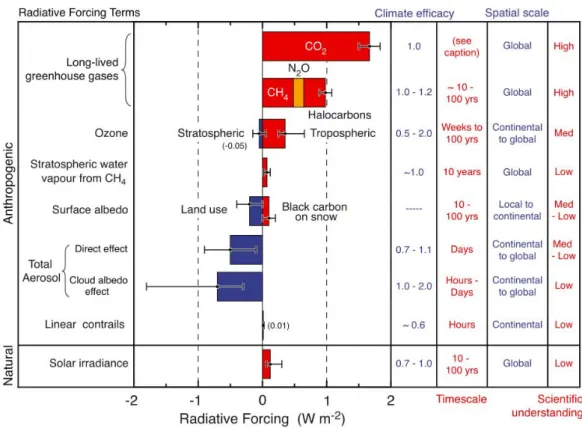
As previously seen, aerosols have a direct radiative effect because they scatter and absorb solar and infrared radiations in the atmosphere. Aerosols also alter the formation and precipitation efficiency of liquid-water, ice and mixed-phase clouds, thereby causing an indirect radiative effect associated with these changes in cloud properties. The quantifi-cation of aerosol radiative forcings is more complex than the quantifiquantifi-cation of radiative forcing by greenhouse gases because aerosol mass and particle number concentrations are highly variable in space and time. This variability is largely due to the much shorter
atmospheric lifetime of aerosols compared to greenhouse gases (Fig.1.3). Spatially and
temporally resolved information on the atmospheric burden and radiative properties of aerosols are needed to estimate radiative forcings. Important parameters are size distri-bution, change in size with relative humidity (i.e. hygroscopic properties) and aerosols chemical properties (related to complex refractive index and solubility).
1.2.1
The direct radiative effect
This effect discovered byCharlson et al.(1991) is based on the absorption-emission
pro-cesses of the aerosol particle. Knowledge of a set of four quantities as a function of wavelength is necessary to translate aerosol burdens into i- aerosol optical depths, and ii-a rii-adiii-ative perturbii-ation: the mii-ass light-scii-attering efficiency, the functionii-al dependence of light-scattering on relative humidity, the single-scattering albedo, and the asymmetry
parameter (see inCharlson et al.,1992). All of those variables are functions of the
chem-ical properties of the particle. Furthermore, radiative properties can change depending on whether different chemicals are in the same particles (internal mixtures) or different particles (external mixtures). In the last report of the IPCC, the estimation of the total
1.2. Atmospheric aerosols and their role in the ”climate factory” 9
Figure 1.3: Global mean radiative forcings grouped by agent types (fromIPCC,2007). No CO2
time scale is given, as its removal from the atmosphere involves a range of processes that can span long time scales, and thus cannot be expressed accurately with a narrow range of lifetime values.
1.2.2
The indirect radiative effect: the aerosol-cloud
interac-tions
Indirect forcing by aerosols is roughly defined as the overall process by which aerosols perturb the Earth-atmosphere radiation balance by modulating the cloud albedo and cloud cover amount. It can be decomposed in a series of processes linking various intermediate variables such as the aerosol mass, the cloud condensation nuclei (CCN) concentration, the ice nuclei (IN) concentration, the water phase partitioning, the cloud optical depth, and many others, which connect emissions of aerosols (or their precursors) to the top of the atmosphere radiative forcing due to clouds.
The effectiveness of an aerosol particle to act as a CCN depends i- on its size and ii- on its hygroscopic properties. This last property is strongly linked to the chemical composition of the particle. CCN activity of insoluble aerosol such as dusts is still not well understood and quantified yet but it has been shown that particles with some water-soluble species
contribute significantly for the indirect forcing (e.g. Kulmala et al., 1996; Eichel et al.,
1996). However, there are many water-soluble compounds in the atmospheric aerosol
with widely varying degrees of solubility. Accumulation mode aerosols, i.e. particles
with a diameter between 0.1 and 1 µm, form the majority of CCN. The more the CCN
different but related effects are identified. The first one is that the increase of the cloud droplet number associated to the decrease of their geometric diameter modify the cloud
albedo: this is the ”first indirect effect” discovered by Twomey (1974). Moreover, as
the cloud droplet sizes decrease for a given water vapor amount, the cloud precipitation
potential decrease as well. This process, highlighted by Albrecht (1989) and defined as
the ”second” or ”semi-indirect effect”, prolongates the cloud lifetime and thus enhances
the radiative effect due to the cloud (Twomey,1974). The last estimation of the indirect
radiative effect was found to be between in the range of [−1.1; +0.4] with a mean of
−0.70 W.m−2 (IPCC,2007).
Those two radiative effects, direct and indirect, are largely linked to the size of the particle but also to the chemical composition of the aerosol. For example, mineral dusts do not have the same radiative effect than soot. Those latter particles belong to the wide family of the carbonaceous aerosols composed by two main class of materials: the elemen-tal carbon which is emitted from the incomplete combustion of fossil fuels and biomass (i.e. soot) and organic carbon. The organic class is the most important carbonaceous species in term of abundance but also the class which present the higher diversity in term of compositions and sizes. The impact of the organic composition of particulate matter on its radiative properties is not well documented and given the ubiquity of carbonaceous aerosols, the understanding of the radiative impact of aerosols on climate is certainly in-complete. Understanding how aerosols are formed and how their size and composition evolve in the atmosphere is necessary to better constrain models and thus better simulate their impact on the Earth radiative budget.
1.3
The aerosol sources: primary versus secondary
Aerosols result from both natural and anthropogenic sources and several different clas-sifications exist according to either their origin (anthropogenic, biogenic, marine or vol-canic), or their production mechanism opposing primary versus secondary aerosols. This latter classification seems to be the most appropriate since understanding how particles are formed is understanding from what they are formed which is strongly linked to the origin.
1.3.1
The primary sources
Primary particles are defined as particles that are emitted in the atmosphere directly in a solid or liquid phase. Examples are soot particles produced from uncomplete combustion processes, primary organic aerosols emitted by plant or dust particles generated by the erosion of surface soils by the wind or sea spray issued from wave breaking over the oceans. Primary particles are generated through a momentum transfer thus their emission is
1.3. The aerosol sources: primary versus secondary 11
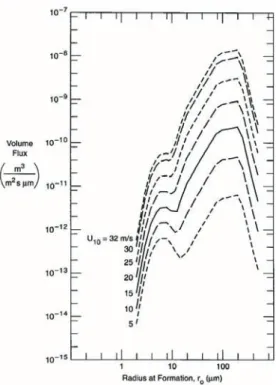
Figure 1.4: A sea spray generation function linking the size distribution of generated particles
to the wind speed (fromAndreas,1998).
directly linked to the intensity of this momentum transfer. For example Andreas (1998)
have developed a sea-spray generation function which is dependent of the wind speed (Fig. 1.4).
1.3.2
The secondary sources
The secondary particles are generated i- from the conversion of gases to particles and ii- the condensation of gases on pre-existing particles. The first process leads to the formation of new particles thus increasing the total number of particles and the second process leads will increase the mass of the total particle but with number conservation. In the following we will focus on the new particle formation through the nucleation process. Mechanisms which lead to the new secondary particles are complex and different
theories are developed in the chapter2of this thesis. However, the formation of secondary
atmospheric aerosols could be split into two different main steps:
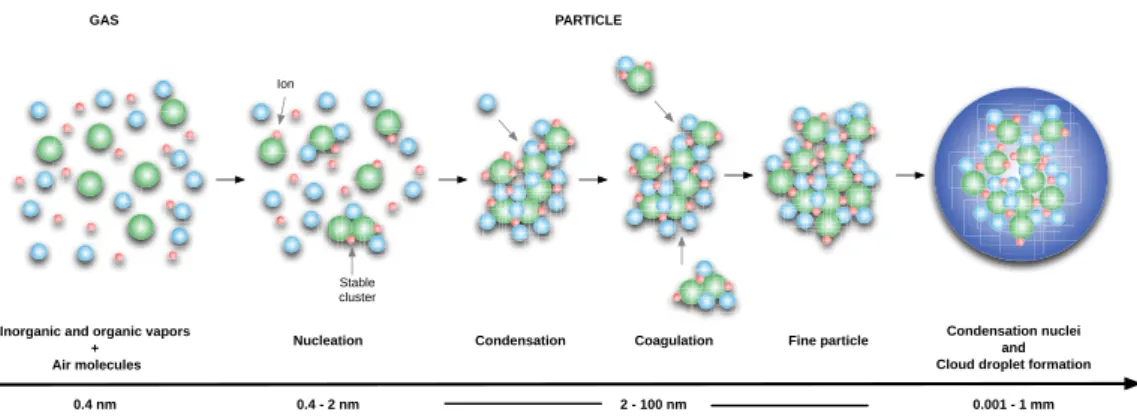
1. The formation of thermodynamically stable ”clusters” (i.e. an aggregate of
molecules). This first phase is the nucleation phase (Fig. 1.5).
2. The growth of those clusters by i- condensation of organic and/or inorganic vapors
and ii- coagulation. (Fig.1.5).
It is important to note that during the first steps of aerosol growth, condensation and coagulation are antagonist processes. If large particles exist prior the onset of the new particle formation and growth then the vapors will condense on the larger surface
available i.e. on pre-existing particles rather than contribute to the formation and growth of new particles. Knowledge on the exact processes governing atmospheric new particle formation and the vapors participating in them is the key to quantify the global aerosol number source issued from secondary formation.
Nucleation Inorganic and organic vapors
+ Air molecules
Condensation Coagulation Fine particle Condensation nucleiand Cloud droplet formation
0.4 - 2 nm 0.4 nm 2 - 100 nm 0.001 - 1 mm GAS PARTICLE Ion Stable cluster
Figure 1.5: Secondary aerosol formation and growth, from nucleation to the cloud droplet
formation.
1.4
Aim of this doctoral thesis
One of the actual challenges in aerosol science is to describe accurately how new particles are formed from gaseous precursors. The formation of secondary new particles have now been studied for several decades, but the degree of our knowledge on the theoretical mechanism (gas – particle conversion) is not sufficient to accurately predict where, when and with which intensity new secondary aerosol generation will take place in the atmosphere. New particle formation events have been observed in various environments
(see for a reviewKulmala et al.,2004b) from polluted area (H¨ameri et al.,1996;Harrison
et al., 2000; Woo et al., 2001; Stanier et al., 2004; Dunn et al., 2004) to clean or rural
sites (Weber et al., 1997; M¨akel¨a et al., 1997; O’Dowd et al., 1998; Suni et al., 2008),
polar areas (Weber et al., 2003; Asmi et al., 2010) and high altitude sites (Weber et al.,
1995; Venzac et al., 2007; Shaw, 2007; Nishita et al., 2008; Rodriguez et al., 2009). Most recently, it has been proposed by researcher of our group that nucleation may be
promoted at high altitudes (Venzac et al.,2009). This hypothesis was a suggestion based
on a few examples of measurements performed simultaneously at different altitudes,
but it potentially has important implications for the atmospheric science. Indeed,
the vertical extend of nucleation has only been studied episodically during airborne measurements, while models need statistically reliable information on the occurrence of nucleation over the whole atmospheric column. In this thesis, I have analyzed continuous measurements over long time periods (more than a year) for two European high altitude
sites (Jungfraujoch, Switzerland, Puy de Dˆome France) (see chapter 4). For the puy de
1.4. Aim of this doctoral thesis 13 which nucleation is promoted at high altitudes. These studies allowed the investigation of i- the nucleation process in clean environment (frequency, condensable vapors, role of ions...), ii- the vertical extent of the new secondary aerosol formation. Results of this
work are reported chapter 4. Furthermore, during the Eyjafjallajokull volcanic crisis,
in spring 2010, the volcanic plume was detected at the puy de Dˆome research station providing a unique chance to characterized aerosol processes within a volcanic plume. The first observation of a nucleation of new particles in such plume is also reported
chapter 4.
In a more process-based approach, some authors investigated the phenomenon under controlled conditions in smog chambers in order to identify key parameters or chemical
species involved in the nucleation (Griffin et al., 1999; Koch et al., 2000; Bonn et al.,
2002; Bonn and Moortgat, 2002; Rohr et al., 2003; Hao et al., 2009; Metzger et al.,
2010; Duplissy et al., 2010). However, the mechanisms involved in the formation of a new particle are numerous, extremely rapid and complex. One major difficulty to understand them is linked to the size of the new particles when they are formed. When nucleation occurs, clusters of the nanometer scale have intermediate properties between gases and particles, and observations are difficult due to instrumental limitation. Hence, the process-based modelling is necessary to test some hypothesis. Many models have been built to simulate the nucleation and growth processes observed in the atmosphere
and to predict the climatic impact of such aerosols. The first ones only consider
the formation of new sulfuric acid-water droplets under atmospheric conditions (e.g.
Kulmala et al., 1995) but authors rapidly improved these models by adding more
processes. For example, the AEROFOR model (Pirjola et al., 1999), includes gas-phase
chemistry, nucleation (binary homogeneous nucleation of the sulfuric acid-water system), condensation and coagulation growth and dry deposition of large particles. The main limitation of such models is that ions-induced nucleation, ternary and nano-K¨ohler theories are not taken into account. This gap in the processes representation is filled
in by the last generation of models (e.g. Tammet and Kulmala, 2005; Korhonen et al.,
2004;Lepp¨a et al.,2009). Consequently, understanding the nucleation process implicates that the first steps of cluster formation and growth are adequately detected. Lately, instruments that allow to detect clusters down to less than 1 nm and to follow their growth to higher sizes were introduced in the aerosol research field. The first one is the Air Ion Spectrometers series which allow the detection of atmospheric ions (AIS)
and total particles (NAIS) in the mobility range 3.16 to 0.0013 cm2.V−1.s−1 (See
chap. 3). The use of this novel instrumentation, completed with a Scanning Mobility
Particle Sizer (SMPS) which allow the measurement of particle from 15 nm to 800 nm, we were able to conduct many smog chamber experiments in collaboration with the ”Laboratoire des Syst`emes Atmosph´eriques” of Cr´eteil for atmospheric relevant studies and with the ”Institut de Recherche sur la Catalyse et l’Environement” of Lyon within
the PIREP project for studies of new particle formation associated with diesel engine processes. Combining results obtained from those experimental works and numerical simulations using a simple model of aerosol growth, we provide a new parametrization of the organic nucleation and highlight the role of the chemical structure of the father
organic compound on the first steps of the new particle formation process (See chapter5).
This doctoral thesis was conducted within the frame of different European and french projects (EUCAARI, EUSAAR, PIREP, LEFE-Chat, LEFE-Aerosol) and its main ob-jective was to provide a multi-scale approach of the nucleation process form the field
to the laboratory. Some parts of the work presented in the chapter 4 has been already
published in the journal Atmospheric Chemistry and Physics and many results of the
Chapter 2
Theoretical approaches of the
nucleation and growth of new
particles
Contents
2.1 Homogeneous nucleation . . . 16
2.1.1 The unary system model. . . 16
2.1.2 The H2SO4−H2O binary system . . . 18
2.1.3 The H2SO4−NH3−H2O ternary system . . . 21
2.2 Heterogeneous nucleation . . . 22
2.2.1 The condensation process . . . 22
2.2.2 The nano-K¨ohler theory of the new particle formation . . . 25
2.3 The ion-induced nucleation . . . 26
2.4 Formulations of nucleation parametrizations . . . 27
Atmospheric new particle formation consists in a complicated set of processes that includes the production of nanometer-size clusters from gaseous vapors, the growth of these clusters to detectable sizes, in competition with their simultaneous removal by co-agulation with the pre-existing aerosol particle population. While new particle formation
was found to be ubiquitous in various environments (Kulmala et al., 2004b, see for a
review of observations) several gaps in our understanding of this phenomenon still exist especially on the basic process-level of the new particle formation. To introduce the com-plexity of the nucleation, the most relevant theories of the nucleation will be presented in this chapter. This will constitute a basis for the analysis of various nucleation events
in the chapters4 and 5.
As already mentioned above, the anatomy of a nucleation events could be described in two steps: 1- The formation of the thermodynamically stable clusters and 2- The growth of those clusters. In the following, I will present the different theories that have been developed to explain the new particle formation events and then those theories will be discussed through a comparison to field measurements.
thorough the system, i.e., it takes place inside of an uniform medium) or heterogeneous (when the probability of nucleation is much higher around some foreign substance or surface such an ion or a solid particle than in the rest of the system). Furthermore, the nucleation process can involve only one chemical species (homomolecular nucleation) or more (heteromolecular nucleation). The combination of all those possible mechanism lead to at least four different nucleation processes:
• Homogeneous - homomolecular nucleation such as the nucleation of pure water, • Homogeneous - heteromolecular nucleation such as the nucleation of the
H2SO4−H2O binary system or the H2SO4−NH3−H2O ternary system,
• Heterogeneous - homomolecular nucleation such as the nucleation of sulfuric acid on a sulfuric acid pre-existing seed,
• Heterogeneous - heteromolecular nucleation such as the nucleation of organic vapors on a sulfuric acid pre-existing seed.
2.1
Homogeneous nucleation
2.1.1
The unary system model
Homogeneous - homomolecular nucleation (HHN) is strongly dependent on the vapor saturation ratio which is defined as follow:
S = PX
Psat,X(T )
(2.1)
where PX is partial pressure of the species X and Psat,X(T ) the saturation vapor pressure
of X in equilibrium with its liquid phase at temperature T . S < 1 for unsaturated vapor, S = 1 for saturated vapor and S > 1 for supersaturated vapor.
Furthermore, from the thermodynamical point of view, the change in the Gibbs free energy budget∆ G must be negative to allow the droplet formation, meaning that the energy is minimized when forming a droplet of a radius r. The variation of the Gibbs
free energy is defined by Eq.2.2:
∆G = 4πr
3 3vdrop. × (g
drop.− gvap.) + 4πσr2 (2.2)
where 4πr3
3vdrop. is the number of molecule X in the droplet (r is the droplet radius and vdrop.
is the volume of a molecule X in the droplet), gvap. and gdrop. are respectively the Gibbs
free energy for a molecule X is the gas phase and in the droplet. The term 4πσr2 is the
free energy associated with an interface with radius of curvature r and surface tension σ (Seinfeld and Pandis,1998).
2.1. Homogeneous nucleation 17
The term (gdrop.−gvap.) is linked to the surface formation and can be expressed as follows:
(gdrop.− gvap.) =−kbT ln(S) (2.3)
where kb is the Boltzman constant, T is the absolute temperature and S the saturation
ratio (Eq. 2.1). By combining Eq. 2.2 and Eq. 2.3, the Gibbs free energy change can be
expressed as follows: ∆G = 4πσr2− 4π 3 × kbT ln(S) vdrop r3 (2.4)
As an example, the variation of∆ G as a function of the radius of the droplet for pure
water and for different values of the saturation ratio S is reported on the figure 2.1.
Figure 2.1: Pure water homogeneous nucleation computations for different saturation ratios
(T = 293 K).
The critical radius r� is the radius for which the condensation of any additional
molecule will lead to a larger diameter which has a lower δG which in turn will lead to
the condensation of more molecules and hence a spontaneous growth. r� is defined by
Eq. 2.5: r� for ∂(∆G) ∂r = 0 ⇐⇒ r � = 2σvdrop. kbT ln(S) (2.5)
The number of monomer contained in the critical cluster i� and the nucleation rate
J can be determined from the kinetic approach of the homogeneous - homomolecular
Table 2.1: Homogeneous nucleation calculation of pure water at T = 293 K. vdrop. = 2.989× 10⁻²⁹ m3, σ = 73× 10−03 N.m−1 and P sat,H2O= 2336, 96 Pa. S [∅] r� [nm] i� [#] N1 [#.m−3] J [cm−3.s−1] 0.5 – – 2.88× 10+23 0.0 0.75 – – 4.33× 10+23 0.0 1.0 ∞ ∞ 5.78 × 10+23 0.0 1.5 2.66 2639 8.66× 10+23 7.9× 10−208 2 1.56 528 1.15× 10+24 7.63× 10−55 3 0.98 133 1.73× 10+24 8.31× 10−07 i� = 32π 3 × v2 drop.σ3 (kbT )3ln(S)3 (2.6) J = � 2σ πmdrop. vdrop.N12 S × exp � −i�ln(S) 2 � (2.7)
An example of homogeneous calculation for pure water is reported on table 2.1.
Those calculations show that the HHN requires a high degree of supersaturation to be triggered. Moreover, the HHN rates of the unary water system are still low even for 300% of saturation (S = 3).
Those results suggest that the HHN mechanism can not be predominant in the atmo-sphere and can only occur in very specific conditions. For example, strong turbulence could enhance the formation of highly supersaturated zones where the HHN could be triggered or during a brutal cooling of an organic vapor.
The homogeneous - homomolecular nucleation theory had been extend to describe the case when two or more different species are engaged hence building a new theory: the homogeneous - heteromolecular (HHeN) nucleation theory. In the following, two main HHeN of interest in atmospheric aerosol science will be presented, the homogeneous -
het-eromolecular nucleation of the H2SO4−H2O binary system and of the H2SO4−NH3−H2O
ternary system.
2.1.2
The H
2SO
4−H
2O binary system
The heteromolecular nucleation process was first studied by Flood but its atmospheric implications was introduced by Doyle in 1961 who computed the nucleation rate of sulfate
particles (see references in Kulmala and Laaksonen, 1990). This mechanism appears to
be the most important binary homogeneous nucleation (BHN) system in the atmosphere. Contrarily to the HHN, in the BHN theory none of the vapor species must be
2.1. Homogeneous nucleation 19 Laaksonen, 1990).
In the H2SO4−H2O binary system, the variation of the Gibbs free energy during the
for-mation of a mixed cluster of sulfuric acid (A) and water (W) is described by the following equation:
∆G = nA(µA,drop.− µA,vap.) + nW(µW,drop.− µW,vap.) + 4πσr2 (2.8)
where r is the radius of the droplet, and µA,drop., µW,drop. and µA,vap., µW,vap. are the
chemical potentials of each species respectively in the mixed droplet (drop.) and the gas phase(vap.). For a given chemical species, the variation of the chemical potential from
liquid to gas phase is described by the Eq. 2.9:
µdrop.− µvap. =−kbT ln � p psol. � (2.9) where p is the partial pressure of the considered chemical species if the gas phase and
psol. is the vapor pressure of the considered component over a flat solution of the same
composition as the droplet. If we consider that i- in the droplet, water is the solvent (i.e.
[H2O] >> [H2SO4]), and that ii- in the gas phase, the total pressure due to all species
is low compared to the pressure of the system then chemical activities of a given species for each phase could be defined as follow:
ai,vap. = pi Psat,i ≡ Si and ai,drop. = psol.,i Psat,i
Hence, from Eq. 2.8 and Eq. 2.9, ∆G can be expressed as
∆G = 4πσr2− kbT � nAln � SA aA,drop � +nWln � SW aW,drop �� (2.10)
In this expression of the Gibbs free energy, the radius of the droplet do not appear
except in the positive term due to the surface formation 4πσr2. The radius r is given by
the relation 2.11:
4 3πr
3ρ
drop.= nAmA+ nWmW (2.11)
∆G is now a function of two variables nA and nW. The energy barrier∆ G� is defined
by the solution of the system. On the energy surface defined by the space (nA,nW), the
∆G� is characterized by a saddle point.
∂∆G ∂nA � � � � � nW = ∂∆G ∂nW � � � � � nA = 0 (2.12)
An example of the∆ G calculation in case of the sulphuric acid - water binary system
is shown figure2.2. The calculation was made from the paper ofKulmala and Laaksonen
•
•
•
•
•
Figure 2.2: Evolution of∆ G according to the number of H2O and H2SO4 in the cluster. Partial
pressure for each species are pA = 153.3× 10⁻¹¹ Pa and pW = 2× 10⁴ Pa (from Seinfeld and
Pandis,1998). The black dots represent local minima of the Gibbs free energy surface and the
star represents a saddle point∆ G�(n�A, n�W) (n�A= 77 and n�W = 132).
is much more complicated than in the case of the HHN theory and requires numerous thermodynamic data. But since the J is strongly linearly dependent to the relative
humidity and to the temperature, some authors developed an empirical relation (Eq.2.13)
to estimate the critical sulfuric acid concentration that produces a nucleation rate of 1 cm−3.s−1 (Jaecker-Voirol and Mirabel (1989) and Wexler et al. (1994) in Seinfeld and
Pandis (1998)).
Ccrit. = 0.16 exp[0.1T − 3. × 10−2RH− 27.7] (2.13)
where T is the absolute temperature, RH is the relative humidity and Ccrit. is expressed
inµg.m−3. This simple relation provides a way to check if the BHN involving the sulfuric
acid - water system can occur in a given set of (T, RH) conditions.
The evolution of Ccrit. according to T and RH is plotted on figure 2.3. From this
graphic, we can deduce that this nucleation mechanism can not describe accurately nucle-ation in low tropospheric conditions since the sulfuric acid critical concentrnucle-ations required to nucleation at typical temperatures is quite elevated. However, this mechanism could occur in higher atmospheric layers where temperature are much lower than in the low troposphere. The fact the binary nucleation scheme is not adapted to nucleation in the low troposphere is confirmed by several observations. Many studies of nucleation events report higher values of the particle formation rates than the ones expected on the basis
2.1. Homogeneous nucleation 21
Figure 2.3: Evolution of the Ccrit. for different temperature and relative humidity conditions.
Iso-contours are log(Ccrit.) values with concentration in [molec.cm−3].
et al.(1994) for marine boundary layer, O’Dowd et al.(1999) for coastal environment or
Kulmala et al. (2001b) for boreal forest. Several explanations were proposed to explain the enhanced observed particle production. The following sections will present the most relevant theories: the participation of a third chemical compound (formation of a ternary system), the contribution of ions to stabilize the cluster (ion-induced nucleation) and the heterogeneous nucleation.
2.1.3
The H
2SO
4−NH
3−H
2O ternary system
The equations and physics that describe the ternary homogeneous nucleation (THN) are the same than the ones used for the BHN except that three species are involved in the
cluster formation. The first classical ternary theory of nucleation was built by Korhonen
et al. (1999) using the H2SO4−NH3−H2O system based on the fact that i- ammonia,
NH3, is ubiquitous in the atmosphere and ii- this species reduce the vapor pressure of
the sulfuric acid above the solution (pA,sol. in the term aA,drop of the Eq. 2.10) hence
enhancing the cluster formation (see references in Korhonen et al., 1999). As for the
BHN, nucleation rate parameterizations were developed (Napari et al., 2002; Merikanto
et al.,2007) but only few studies have confronted the model predictions to laboratory of field measurements.
In 2002, during an intensive coastal environment field campaign at Mace Head,Kulmala
et al. have shown that the i- measured sulfuric acid and ammonia concentrations were sufficiently high to onset THN and ii- the classical BHN theory could not explain the observed particle formation rate. Authors concluded that the detected particle formation events could be initiated by the homogeneous nucleation of the ternary system formed
by H2SO4−NH3−H2O. But if the nucleation of new particles could be explained by this nucleation mechanism, the growth to detectable sizes (> 3 nm) could not be explained by the low concentration of sulfuric acid and other condensable vapors had to be involve at least in the growth process.
Homogeneous nucleation theories provide a first description of the nucleation process. These theories assume that the system is only composed of gases. The introduction of pre-existing particles in the system lead to the scavenging of monomers and growing clusters because of the lower energy barrier needed to condense or coagulate on particles than form a new one. Therefore, if the pre-existing particle (or cluster) concentration is high enough, the homogeneous nucleation can be quenched. Those processes are described by the heterogenous nucleation theory.
2.2
Heterogeneous nucleation
An important characteristic of the atmosphere is the ubiquitous presence of particles. This implies that seed are permanently available for the onset of heterogeneous nucleation. On the other hand, those pre-exiting particles provide surface area on which vapors can condense leading to a depletion of condensable species that are necessary for the homogeneous nucleation processes. The condensation of vapors on such pre-existing clusters previously formed by homogeneous nucleation could help to cross the nucleation barrier of energy to reach the critical cluster size, hence onset the growth process. Such a phenomenon is called an activation process and was described for atmospheric binary
system byLazaridis et al.(1992). Later, Kulmala et al.(2004a) have adapted the results
obtained byLazaridis et al. to build the ”nano-K¨ohler” theory of nucleation to explain the
formation of organic aerosol. Since the main process of this theory is the condensation of vapor on pre-existing seeds, I will first introduce the condensation phenomenon before going further in the nano-K¨ohler theory and its implications for aerosol formations.
2.2.1
The condensation process
The condensation is the phase change of a given vapor into a condensed phase. As previously seen, when the phenomenon occurs in a system strictly composed by a gas phase, it leads to the formation of new particles through homogeneous nucleation process. If particles are introduced in the system, vapors can condense on them instead of forming new particles. When a vapor condenses on a particle population, the particle diameters increase, n(dp, t), while the total concentration remains the same.
2.2. Heterogeneous nucleation 23 distributions (Eq 2.14): n(dp, t) = n � i=1 Ni log(σ)√2π × exp � − � log(dp)− log( ¯dpi) �2 2 log2(σ) � (2.14)
where Ni is the aerosol number concentration, ¯dpi is the mean diameter and σi is the
standard deviation of the ith log-normal mode.
The condensation growth rate GRcond. is defined as the rate at which the volume v (or
diameter) of a particle increases. For particles composed of only one species i, in a
homogenous gaseous system, GRcond.,i is defined by Eq.2.15(Seinfeld and Pandis,1998):
GRcond.,i = dv dt = 2π2/3(6v)1/3D iMi ρpart.RT × f(Kn, α, β,γ )(pi− peq. ) (2.15)
or for the particle diameter variation: GRcond.,i = d dp dt = 4DiMi RT dpρ part. × f(Kn, α, β,γ )(pi− peq. ) (2.16)
where Di is the diffusion coefficient of the vapor, Mi the molecular weight of the vapor
and f (Kn, α, β,γ ) is the correction due to non continuum effects and imperfect surface
accommodation and (pi − peq.) represents the difference between the partial pressure of
the species i far from the particle (pi) and the equilibrium vapor pressure (peq.). This
latter term is the driving parameter for of the condensation process. f (Kn, α, β,γ ) is defined by the following relations:
Kn(r) = λ r f (Kn, α, β,γ ) = 1 + Kn(r) � α + β exp � − γ Kn(r) ��
where α, β and γ are empirical parameters. For Kn(r) << 1, the system is in the continuum regime, in free molecular regime for Kn(r) >> 1 and in slip regime for 0.4 < Kn(r) < 20. In the particular case of nucleation studies, it is commonly assumed that the system is in the free molecular regime, i.e. particles are affected by the motion of individual gas molecules. Particles larger than 100 nm are treated as being submersed in a continuous gaseous medium characterized by a Knudson number Kn(r) > 1, then f (Kn, α, β,γ ) is assumed to be equal to the unity.
If we assume an excess of the saturated vapor, the first result of the equation2.16 is that
the condensation growth rate is inversely proportional to the diameter (Eq. 2.17).
GRcond. = A
dp =⇒ GRcond. ∝ 1
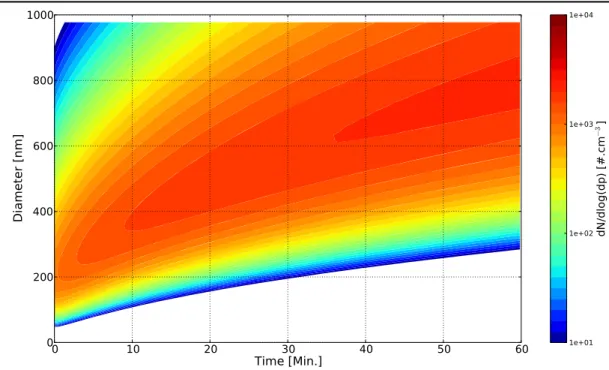
Figure 2.4: Evolution of sulfate particle size distribution in an homogeneous gaseous system. Conditions are T = 298 K, P = 1013.25 hPa and 1 ppbv of sulfuric acid.
where A is a constant equal to 4DiMi
ρpart. (pi− peq.).
It is now possible to estimate the PSD modification by the condensation process. For an
initial monodisperse aerosol population n0(dp0, t = 0) (Eq.2.14with n=1), the new PSD
n(dp, t) is given by the equation2.18.
n(dp, t) = � dp dp2− 2At × n0 �� dp2− 2At � (2.18) An example of the evolution of a sulfate aerosol size distribution in a gaseous media is
represented on figure 2.4. As seen on figure 2.4, the condensation process can strongly
impact the aerosol size distribution. For nucleation studies, pre-existing particles act as a sink for the condensable vapors, hence quenching the new particle formation process. The potential for gazes to condense on pre-existing particles can be characterized by a parameter defined as the condensation sink (CS) which is equivalent to a velocity. This parameter determines how rapidly molecules of a given species (usually sulfuric acid) will condense onto pre-existing aerosols. The CS strongly depends on the shape of the PSD
and is defined by the Eq.2.19 (Pirjola et al., 1999).
CS = 4πDvap.
� ∞
0
rβM(r)N (r)dr (2.19)
where βM(r) is the transitional correction factor, r the radius of the particle and N (r)
the particle concentration of radius r. The transitional correction factor was introduced byFuchs and Sutugin(1971) to take into account the difference between the kinetic, free molecular and slip regimes defined by the Knudsen number (see above). This factor is
2.2. Heterogeneous nucleation 25
defined by the equation 2.20:
βM(r) = 1 + Kn(r) 1 + ( 4 3α+ 0.337)Kn(r) + 4 3αKn(r)2 (2.20) where α is the sticking coefficient usually assumed to equal to the unity. Consequently,
in the free molecular regim (Kn(r) >> 1), the CS ∝ r2 while in the continuum regime
(Kn(r) << 1), CS ∝ r. In a more general point of view, condensation sink for
tropo-spheric aerosol is CS ∝ ra, where 1 < a < 2.
Another process can significantly change the PSD shape: coagulation. The aerosol particles form a dynamic system, hence each particle is animated by a motion due to the temperature (Brownian motion) and external forces, leading to collisions between particles. Some of those collisions can lead to the formation of a ”new” particle composed by the two parent particles. In case of heterogeneous nucleation, the parent particles have the same size (intra-modal coagulation) but can have different compositions. The growth of nucleated particles induced by coagulation was found to be anecdotic in the
atmosphere: for a growth rate of 1 nm.h−1, the concentration of parent particles with a
diameter lower than 5 nm should be around 1× 10+06 #/cm−3 (Kulmala et al., 2004a).
However, inter-modal coagulation of small particles onto larger particles can strongly impact the PSD, shifting the mean diameter to larger sizes and inducing a decrease of the total particle number concentration. Large pre-existing particle will act as a sink of small particles and can therefore interrupt the nucleation process. The coagulation sink (CoagS) determines how rapidly nm-size aerosols are removed through coagulation process, it is consequently equivalent to a velocity. For a particle of a diameter i, CoagS
can be calculated using the relation 2.21 (Kulmala et al., 2001a):
CoagSi =
� j
KijN j (2.21)
where Kij is the coagulation coefficient between particles of the diameter i and j (Fuchs
and Sutugin,1971) and Nj is the particle number concentration of diameter j.
2.2.2
The nano-K¨
ohler theory of the new particle formation
The traditional K¨ohler theory (K¨ohler, 1936) describes the nucleation of cloud drops on
water soluble aerosol nuclei. However, in contrast to the traditional K¨ohler theory, the nano-K¨ohler theory describes a thermodynamic equilibrium between a nanometer-size
cluster, water and an organic compound that is fully soluble in water (Laaksonen et al.,
1998), i.e., it does not form a separate solid phase but is totally dissolved into the mixed
solution. A complete description of the theory can be found in Kulmala et al. (2004a,
2006).