
Pépite | Modélisation de la formation des particules de suies issues des procédés de combustion
450
0
0
Texte intégral
(2) Thèse de Mamady Keita, Lille 1, 2017. 2 © 2017 Tous droits réservés.. lilliad.univ-lille.fr.
(3) Thèse de Mamady Keita, Lille 1, 2017. Acknowledgements Firstly, I would to express my deepest gratitude to my advisors Dr. André Nicolle (ENSTA Paritech, former IFPEN) and Pr. Abderrahman El Bakali (Professor at the University of Lille 1) for the excellent guidance in preparing this thesis and the continuous support of my Ph.D study and related research, for their availability, motivation and immense knowledge. I had a great opportunity not only to explore many research fields and develop skills that can help me to conduct a research but also, skills related to written and verbal communications and Human skills (teamwork, relational skills and curiosity). I could not have imagined having better advisors and mentors for my Ph.D study. I express my deepest appreciation to Dr. Damien Aubagnac-Karkar (Researcher at IFPEN) for his great support in using his soot model and for his advices and suggestions in writing this thesis. I would like to thank my thesis committee members: Pr. Guillaume Dayma (Professor at the University of Orléans), Pr. Alexander Konnov (Professor at the University of Lund), Dr. Benedetta Franzelli (Research Coordinator at CNRS, University of Paris-Saclay), Dr. Pascale Desgroux (Research Director at CNRS, University of Lille 1) and Dr. Olivier Colin (Research Coordinator at IFPEN), for their availability and for agreeing to assess my work. I thank Dr. Antonio Pires Da Cruz (Program Manager at IFPEN) and Dr. Christian Angelberger (Expert at IFPEN) for accepting me as the right candidate to take part of this project in the engines and vehicles modeling department of IFPEN. My thoughts also go to all the staff of this division, especially to Stephane Henriot (Head of engine and vehicle systems division at IFPEN). I thank all the staff of PC2A laboratory, Dr. Pascale Desgroux (Research Director at CNRS), Dr. Laurent Gasnot (Head of PC2A laboratory), Dr. Xavier Mercier (Research Coordinator at CNRS) and Christopher Betrancourt (Ph.D candidate at PC2A) for accepting me in their Lab and for providing experimental data in the framework of the ASMAPE (Advanced Soot Model for Aeronautics and Piston Engines) project. My sincere thanks also go to Dr. Christophe Dujardin (Director of Studies at ENSCL) who provided me an opportunity to join IFPEN first as intern and for his recommendation and advice to accept this Ph.D position. Without his precious support, it would not be possible to conduct this research. I thank my office colleagues of IFPEN and all the Ph.D candidates of IFPEN for the stimulating discussions and for all the fun we have had in the last three years. I also thank my colleagues of PC2A Laboratory for their kind invitations for lunch and for having diner together. Last but not the least, I would like to thank my family: my parents, my wife and my brothers and sisters for their unconditional support throughout writing this thesis and my life in general.. 3 © 2017 Tous droits réservés.. lilliad.univ-lille.fr.
(4) Thèse de Mamady Keita, Lille 1, 2017. 4 © 2017 Tous droits réservés.. lilliad.univ-lille.fr.
(5) Thèse de Mamady Keita, Lille 1, 2017. Abstract. To better control soot particles emission and minimize their health and environmental effects, it is crucial to better understand their formation mechanisms in particularly combustion processes. The first step of these particulates matter formation is their precursors PAH (Polycyclic Aromatic Hydrocarbons) formation, followed by the nucleation process which links the gas-phase (PAH chemistry) and solid-phase (particles). In the first part of this work, we developed a new detailed chemical kinetic mechanism describing accurately both low and high-temperature ignition and combustion of a wide range of liquid transportation and laboratory fuels as well as the formation of PAH up to coronene, suspected to be major soot precursors. Surrogate mixtures containing n-decane, iso-octane and n-propylbenzene were selected to represent liquid transportation fuels based on their cetane numbers (CN) and threshold sooting index (TSI). Including new reactions paths from recent studies resulted in the improvement of mechanism predictivity (ignition delay times, laminar flame speeds and species mole fractions) over a wide range of experimental conditions (shock tubes, jet stirred reactor, burner stabilized premixed flames, and freely propagating premixed flames). Then, this mechanism was utilized to analyze some key intermediate species as well as PAHs formation pathways for a variety of fuels. In the second part of this work, a sectional soot model is used with the developed kinetic mechanism in order to investigate soot particles nucleation mechanisms in reproducing experimental data tendencies (soot volume fractions and particles diameters). This model accounts for soot particle inception, condensation, surface growth, coagulation and oxidation processes and directly predicts the Soot Volume Fraction (SVF) and the Soot Number Density Function (SNDF) at each time and location. This couple of kinetic and soot models is run on the detailed kinetic solver Cantera in order to solve both the gas and disperse solid phases in steady laminar flame conditions. The soot model used with the developed detailed kinetic mechanism is validated over premixed laminar methane, ethylene and n-butane flames at various equivalence ratios. Homomolecular and Heteromolecular dimerizations of modest size of PAHs from pyrene to coronene (mass of monomer ranging from 200 to 300 amu) have been considered for particle nucleation modeling. Keywords: Soot, Nucleation, Kinetic Mechanism, PAH, Modeling, Sectional Method, Flames. 5 © 2017 Tous droits réservés.. lilliad.univ-lille.fr.
(6) Thèse de Mamady Keita, Lille 1, 2017. 6 © 2017 Tous droits réservés.. lilliad.univ-lille.fr.
(7) Thèse de Mamady Keita, Lille 1, 2017. Résumé. Pour mieux contrôler l’émission des particules de suies et minimiser leurs impacts sur l’environnement et la santé publique, il est crucial de mieux comprendre leurs mécanismes de formation, en particulier dans les processus de combustion des hydrocarbures. La première étape de formation de ces matières carbonées est la formation de leurs précurseurs appelés HAP (Hydrocarbures Aromatiques Polycycliques), suivie de l’étape de nucléation qui fait le lien entre la phase gaz où les HAP sont formés et la phase solide qui correspond à la formation des particules de suies. La première partie de ce travail de recherche est focalisée sur le développement d’un nouveau schéma cinétique détaillé, décrivant avec précision non seulement l’auto-inflammation et la combustion basse et haute températures des carburants liquides de transport et ceux du laboratoire, mais aussi la formation des HAP jusqu’au coronène car ces HAP sont suspectés d’être les principaux précurseurs de suies. Des mélanges de carburants modèles contenant le n-décane, l’iso-octane et le n-propylbenzène ont été sélectionnés pour représenter les carburants liquides de transport (Essence, Kérosène et Diesel), en se basant sur leurs nombres de cétane (CN) et leurs indices de suies (TSI). L’ajout de nouvelles voies de reactions issues des études récentes a permis l’amélioration de la prédictivité (délais d’autoinflammation, vitesses de flamme et fractions molaires des espèces) sur une large gamme de conditions expérimentales (tubes à chocs, réacteurs parfaitement agités, flammes stabilisées sur un brûleur). Ensuite, ce schéma cinétqiue détaillé a été utilisé pour analyser les voies de formation de quelques espèces intermédiaries clés ainsi que les HAP lors de la combustion d’une grande variété de carburants. Dans la deuxième partie de ce travail, un modèle sectionnel de suies est utulisé avec le présent schéma cinétique afin d’investiguer les mécanismes de formation des particules de suies en reproduisant les tendences des données expérimentales (fractions volumiques de suies, diamètres des particules). Ce modèle de suies décrit la nucleation, la condensation, la croissance en surface, la coagulation et l’oxydation des particules de suies. Les calculs sur les suies ont été effectués sur un solveur cinétique Cantera afin de résoudre la phase gaz et la phase solide disperse dans des conditions de flammes laminaires stationnaires. Le couple “schéma cinétique-modèle sectionnel de suies” a été validé sur les flammes prémélangées laminaires de methane, d’éthylène et de n-butane à différentes richesses. Les dimérisations homomoléculaire et hétéromoléculaire des HAP de taille modérée (du pyrène au coronène) ont été considérées pour la modélisation de la nucleation des particules de suies. Mots clés: Suies, Nucléation, Schéma Cinétique, HAP, Modélisation, Méthode Sectionnelle, Flammes. 7 © 2017 Tous droits réservés.. lilliad.univ-lille.fr.
(8) Thèse de Mamady Keita, Lille 1, 2017. 8 © 2017 Tous droits réservés.. lilliad.univ-lille.fr.
(9) Thèse de Mamady Keita, Lille 1, 2017. Table of Contents. Acknowledgements ................................................................................................................... 3 Abstract ..................................................................................................................................... 5 Résumé ...................................................................................................................................... 7 Table of Contents ..................................................................................................................... 9 Chapter 1: Introduction ........................................................................................................ 13 1.1.. General context ............................................................................................................ 13. 1.1.1. 1.2.. Soot formation process ............................................................................................ 16 Outline of the thesis ..................................................................................................... 17. Chapter 2: Literature Review ............................................................................................... 19 2.1.. Proposed PAHs molecule for nucleation ................................................................... 19. 2.2.. Main PAH formation pathways ................................................................................. 26. 2.2.1.. HACA mechanism ................................................................................................... 26. 2.2.2.. HAVA (Hydrogen Abstraction and Vinyl Addition) mechanism ....................... 31. 2.2.3.. Phenyl Addition and Cyclization (PAC) pathway:............................................... 33. 2.3.. Soot formation mechanism ......................................................................................... 35. 2.3.1.. Gaseous precursors of soot particles...................................................................... 37. 2.3.2.. Soot particles nucleation ......................................................................................... 38. 2.3.3.. Mass growth of soot particles ................................................................................. 38. 2.3.4.. Oxidation of PAHs and soot particles .................................................................... 39. 2.3.5.. Aggregation of soot particles .................................................................................. 39. 2.4.. Soot nucleation mechanisms ....................................................................................... 39. 2.5.. Soot models .................................................................................................................. 42. 2.5.1.. Empirical models ..................................................................................................... 42. 2.5.2.. Kinetic models .......................................................................................................... 43. 2.5.2.1.. Method of moments ............................................................................................. 44. 2.5.2.2.. Sectional method .................................................................................................. 44. 2.6.. Conclusions .................................................................................................................. 44. Chapter 3: Modeling Tools and Methods ............................................................................ 47 3.1.. One dimensional premixed laminar flames: governing equations ......................... 47. 3.2.. The 1D premixed flame code ...................................................................................... 48. 3.3.. Sensitivity analysis ...................................................................................................... 50 9. © 2017 Tous droits réservés.. lilliad.univ-lille.fr.
(10) Thèse de Mamady Keita, Lille 1, 2017. 3.4.. Rate of production analysis ........................................................................................ 50. 3.5.. Sectional Soot Method ................................................................................................ 51. 3.5.1.. Governing equations and variables in the model ................................................. 51. 3.5.2.. Volume discretization .............................................................................................. 52. 3.5.3.. Soot particles volume number in a section 𝒊 ......................................................... 53. 3.5.4.. Collisional source terms .......................................................................................... 54. 3.5.5.. Inception and condensation .................................................................................... 55. 3.5.6.. Surface chemistry .................................................................................................... 56. 3.5.7.. Surface growth ......................................................................................................... 57. 3.5.8.. Oxidation .................................................................................................................. 57. 3.5.9.. Parameter α: fraction of soot surface radical sites available for reactions........ 58. Chapter 4: Gas-phase Chemistry.......................................................................................... 61 4.1.. Objective ...................................................................................................................... 61. 4.2.. Surrogate fuels formulation ....................................................................................... 61. 4.3.. Development of a detailed chemical kinetic mechanism.......................................... 66. 4.4.. Mechanism Validation Results and Discussions....................................................... 70. 4.4.1.. Premixed laminar flames configuration ................................................................ 72. 4.4.1.1.. Saturated aliphatic hydrocarbon flames ........................................................... 72. 4.4.1.1.1.. Methane flame .................................................................................................. 72. 4.4.1.1.2.. N-butane flames ................................................................................................ 76. 4.4.1.1.3.. n-butane doped with n-propylbenzene flames ............................................... 94. 4.4.1.1.4.. Iso-octane flame .............................................................................................. 103. 4.4.1.1.5.. n-decane flame ................................................................................................ 111. 4.4.1.2.. Unsaturated aliphatic hydrocarbon flames ..................................................... 117. 4.4.1.2.1. 4.4.1.3.. Ethylene flames ............................................................................................... 117 Benzene and monoalkyles aromatic flames ..................................................... 129. 4.4.1.3.1.. Benzene flame ................................................................................................. 129. 4.4.1.3.2.. n-propylbenzene flame................................................................................... 138. 4.4.1.4.. Liquid transportation fuel flames .................................................................... 145. 4.4.1.4.1.. Jet fuel flame ................................................................................................... 146. 4.4.1.4.2.. Gasoline flame ................................................................................................ 153. 4.4.2.. Jet Stirred Reactor (JSR) Configuration ............................................................ 158. 4.4.2.1.. Jet fuel combustion ............................................................................................ 158. 4.4.2.2.. Diesel fuel ............................................................................................................ 160 10. © 2017 Tous droits réservés.. lilliad.univ-lille.fr.
(11) Thèse de Mamady Keita, Lille 1, 2017. 4.4.3.. Ignition delay times and laminar flame speeds ................................................... 162. 4.4.3.1.. Gasoline............................................................................................................... 162. 4.4.3.2.. Jet fuel ................................................................................................................. 164. 4.4.3.3.. Diesel fuel ............................................................................................................ 166. 4.5.. Conclusions ................................................................................................................ 169. Chapter 5: Solid phase: Soot particles Nucleation Modeling........................................... 171 5.1.. Objective .................................................................................................................... 171. 5.2.. Nucleation modeling: soot precursors considered.................................................. 171. 5.3.. Collision efficiency..................................................................................................... 173. 5.4.. Results and Discussions ............................................................................................ 181. 5.4.1.. Methane flame ....................................................................................................... 182. 5.4.2.. Ethylene flame ....................................................................................................... 189. 5.4.3.. n-butane flames ...................................................................................................... 195. 5.5.. Comparison between investigated flames ............................................................... 209. 5.6.. Conclusions ................................................................................................................ 211. Chapter 6: Conclusions and Future Work ........................................................................ 213 References ............................................................................................................................. 217 Appendices ............................................................................................................................ 237. 11 © 2017 Tous droits réservés.. lilliad.univ-lille.fr.
(12) Thèse de Mamady Keita, Lille 1, 2017. 12 © 2017 Tous droits réservés.. lilliad.univ-lille.fr.
(13) Thèse de Mamady Keita, Lille 1, 2017. Chapter 1: Introduction. 1.1. General context Combustion is an old technology of mankind that has been used for several years. Most of the worldwide energy support (about 90%) in traffic, heating, or electric power generation is provided by combustion [1]. Following the continuous growth in demand of energy and the need of reduction of pollutants emitted to produce energy, the formation of pollutants from combustion processes has become one of the key topics for researchers. In automotive sector for example, pollutants emission mitigation is really important not only for fuel engine efficiency, but also for the human health and environment. Given the upcoming of new regulations in terms of pollutants emissions into the environment, there is a worthwhile cause to study properly this process.. -. Norms in automotive sector. The current pollutants under European regulations are the following: carbon monoxide (CO), nitrogen oxides (NOx), unburned hydrocarbons and particulate matter (PM). These pollutants are products of an incomplete combustion process and have a huge impact on the air quality. Carbon dioxide (CO2) is also of the main combustion products that is not currently under regulation, but is known to cause a global warming as a greenhouse gas. Figure 1 shows the evolution of regulations on pollutant emissions for land cars in Europe, United States of America and Japan [2].. Figure 1 : Exhaust emissions regulations around the world for nitrogen oxides (NOx) and for particulate matter (PM) [2].. 13 © 2017 Tous droits réservés.. lilliad.univ-lille.fr.
(14) Thèse de Mamady Keita, Lille 1, 2017. It can be seen that the amount of exhaust emissions has drastically decreased from 1998 to 2014 for all the regulations. For example, within the EU regulation, a reduction factor of 20 for PM and a factor of 11 for NOx have been achieved. The amount of PM decreased from 0.10 to 0.005 g/km, while that of NOx is decreased from 0.9 to 0.08 g/km. The development of advanced technologies including advanced combustion devices and advanced aftertreatment systems has allowed reaching such goals. The amount of the other pollutants according to the EURO 6 regulation is presented as follows in Table 1: Norm [mg/km]. Euro 6 Gasoline. Euro 6 Diesel. Nitrogen oxides (NOx). 60. 80. Carbon monoxide. 1000. 500. Unburned hydrocarbons. 100. -. Unburned non-methane hydrocarbons. 68. -. Unburned hydrocarbons + NOx. -. 170. Particulate matter (PM). 4.5. 5. Number of particulate matter [#/km]. 6 x10¹². 6 x10¹¹. Table 1 : Pollutants emissions under EURO 6 regulation.. Both technologies: gasoline and diesel fuel engines are presented. A particular attention is given to diesel engines regarding NOx formation since these systems operate at lean condition (φ<1), where a great amount of NOx can be formed through oxygen combination with nitrogen at high temperature (> 2300 K) [2]. Gasoline engines operate at stoichiometric condition (φ=1). The specific mass of CO allowed for spark ignition (SI) engines is two times higher than that of diesel engines. There is no regulation on unburned hydrocarbons for diesel engines, while gasoline engines are limited to 100 mg/km for unburned hydrocarbons and 68 mg/km for unburned non-methane hydrocarbons. However, the amount of unburned hydrocarbons + NOx for diesel engines is limited to 170 mg/km. Regarding particulate matter, SI engines are allowed to emit ten times more particles than diesel engines. In the latter case, the amount and the number of particulate matter is important due to the non-premixed 14 © 2017 Tous droits réservés.. lilliad.univ-lille.fr.
(15) Thèse de Mamady Keita, Lille 1, 2017. combustion that take place, the local equivalence ratio in diesel engines can be very high. As a result, soot particles which are one form of particulate matter can be formed in these conditions, where the concentration of oxygen is very low. Pischinger et al. [3] proposed a diagram that explains the formation of soot and NOx as a function of relative molar air/fuel ratio as depicted in Figure 2.. Local temperature Formation of CO. Formation of NOx. Formation of soot 2300 K at high temperature 1700 K Unburned hydrocarbons and CO. Rich. λ=1. Lean. Figure 2 : Formation of pollutants according to Pischinger diagram [3]. λ represents the relative air fuel ratio.. It can be seen from this diagram that NOx formation is favored at lean condition and at temperature above 2300 K. Soot and CO are formed at rich condition and at temperature above 1700 K. The formation of unburned hydrocarbons and CO below 1700 K is a phenomenon controlled by the kinetics [2]. Despite the severity of current regulations on pollutant emissions, there is still need to avoid their production from combustion processes not only for human health, but also for the global warming and the technical damages to devices. On one hand, even if gasoline engines emit less PM than diesel ones, both technologies produce PM. On the other hand, the constantly growing number of diesel engines particularly in Europe pleads for the intensification of particulate matter emissions. New regulations for the future will require more limitations on pollutants emissions and new pollutants such as aldehydes can also be regulated. Aldehydes are already under regulation for gasoline engines in California, since they are found to play an important role in photo-oxidation pollution [2]. While 15 © 2017 Tous droits réservés.. lilliad.univ-lille.fr.
(16) Thèse de Mamady Keita, Lille 1, 2017. motivations for pollutants mitigation are provided, the understanding of their formation process as well as scientific tools are required to model all the processes involved. With this in mind, the present work focuses on both soot particles and their gaseous precursors formation mechanism since their harmfulness has been clearly demonstrated.. 1.1.1. Soot formation process Soot is one form of particulate matter that is formed from incomplete combustion processes. In the transportation field, soot is mainly produced from diesel engines (up to 87 % mass of cases in transportation field) [4]. Non negligible contribution also comes from spark engines and in aeronautics field. There are several reasons to better understand and control soot particles formation. Among these reasons, one can put forward: . The fine particle toxicity: fine particle can easily penetrate into human body to cause heart and lung diseases [5].. . The significant contribution to climate change (contribution to radiative forcing).. . The radiative impact and interaction with turbine blades: technical damage in industries.. . The formation of contrail related to cloud albedo: in aircraft’s wake.. Soot particles can be classified as fine particles (diameter < 2.5 μm). In epidemiological studies, fine particles are found to increase mortality due to serious health attack such as heart and lung diseases. In United States for example, the fine particles may cause up to 60,000 deaths per year [6]. Soot particles are associated with Poly Aromatic Hydrocarbons (PAH), which are adsorbed onto their surface. These PAH are found to be mutagenic or tumorigenic. For example, benzo[a]pyrene (5 aromatic rings) causes lung cancer [7]. Soot particles are also found to be suspended in the atmosphere as aerosols (air pollutants), forming brown cloud that causes regional warming. Soot deposition might be responsible for 95% of the polar ice melting [8]. It may cause several technical damages in industries such as the coating of combustion chambers and their interaction with turbine blades (gas turbines damages in power generation). Figure 3 shows a general overview of soot particles formation from homogeneous gaseous mixtures.. 16 © 2017 Tous droits réservés.. lilliad.univ-lille.fr.
(17) Thèse de Mamady Keita, Lille 1, 2017. Nucleation. Figure 3 : Soot particles formation process in premixed flames [9]. PCAH stands for PeriCondensed Aromatic Hydrocarbon and AALH denotes Aromatic Aliphatic Linked Hydrocarbon. The term AALH is related to the proposed nucleation mechanism where PAHs are linked by σ bonds.. Soot and PAH formation have been investigated for decades by numerous research groups [8,10–13]. Their formation still remains poorly understood, mainly the nucleation step. It is widely accepted within combustion community that the gaseous species known as Polycyclic Aromatic Hydrocarbons (PAH) are precursors of soot particles as shown on the caption above. Therefore, reliable detailed kinetic mechanisms that describe accurately PAH formation is required to account for soot particles formation modeling. The gas-phase chemistry is a crucial part of the modeling study and need to be carefully elaborate in order to develop robust soot models. Soot formation and their emission must be controlled to cleanup environment and reduce human health attack and also to promote efficient utilization of petroleum based fuels and biofuels. Combustion processes must be well understood for developing cleaner and more economic combustion equipment. For that, physical and chemical processes involved in combustion process have to be better understood.. 1.2. Outline of the thesis As stated in the previous section, soot particles nucleation modeling from gaseous species (PAHs) must be carefully investigated. The present work focuses on the chemical understanding of precursor formation including PAHs and nascent soot formation mechanism. The elucidation of chemical 17 © 2017 Tous droits réservés.. lilliad.univ-lille.fr.
(18) Thèse de Mamady Keita, Lille 1, 2017. reactions network is required for predicting the soot particles formation and for improving our knowledge on chemical processes involved in combustion. For that, two principal components are investigated: (1) Gas-phase chemistry: development of a detailed chemical kinetic mechanism that describes accurately liquid transportation as well as laboratory fuels combustion. Determining of a large set of gas-phase species and reactions. (2) Computational modeling of soot nucleation from gaseous species: investigating the role of PAHs widely involved in the nucleation process. One dimensional premixed laminar flames are considered for soot particles nucleation modeling. In practical systems such as SI engines, combustion is turbulent. In premixed turbulent flames, combustion is a more-dimensional phenomenon and may as such not be treated as a one-dimensional problem. However, both premixed and turbulent premixed flames have the same physical processes and many turbulent flame theories are based on underlying laminar flame structure. A brief description of each chapter is presented as follows: In chapter 2, general information concerning soot gaseous precursors (PAHs) used in the previous works, different proposed soot nucleation mechanisms and PAHs formation pathways as a function of fuels are presented. In chapter 3, modeling tools and methods used to develop a detailed chemical kinetic mechanism and to investigate soot nucleation mechanism are presented. In chapter 4, the precursor gas-phase chemistry is mainly discussed. A methodology describing commercial surrogate fuels formulation as well as the development of a detailed chemical kinetic mechanism for both commercial and laboratory (single component) fuels combustion modeling. The modeling results for the mechanism validation are presented. In chapter 5, the particle nucleation modeling (solid phase) is presented. A description of nucleation modeling methodology as well as the investigation of the chosen PAH molecules for soot particles inception are discussed. Finally, results obtained for particles nucleation modeling are presented and discussed. In chapter 6, the summary of the present study and future work are presented. 18 © 2017 Tous droits réservés.. lilliad.univ-lille.fr.
(19) Thèse de Mamady Keita, Lille 1, 2017. Chapter 2: Literature Review. 2.1. Proposed PAHs molecule for nucleation While PAHs are considered by many research groups as soot precursors, the nature of those involved in the nucleation process remains ambiguous and very difficult to determine. This question has been a topic of research for decades. Due to experimental findings limitations, numerical simulations [14–17] are widely used for such investigations. Frenklach et al. [18,19] concluded that the dimerization of pyrene was necessary to reproduce soot particle size distributions. Miller et al. [20] claimed that the soot nucleation process is most likely if the PAH size is at least four times larger than pyrene. These results are based on the computed lifetimes of dimers under flame conditions. Subsequently, Frenklach et al. [21] performed molecular dynamics calculations and concluded that aromatic dimers of species as small as pyrene can survive long enough to evolve into soot nuclei. From these results, pyrene dimerization was widely used as the key of soot nucleation step but no definitive experimental findings support this assumption. Sabbah et al. [22] presented an experimental and theoretical study of pyrene dimerization at temperatures ranging from 60 to 470 K. Figure 4 shows the results obtained from this study. In Figure 4 (b) (at 120 K), the signal first increases linearly with the increase of pyrene concentration. Above a certain pyrene concentration value, a sudden decrease of pyrene monomer signal is observed. The authors explained this loss of monomer signal by the onset of nucleation and proposed that at these higher degrees of supersaturation, pyrene dimers may be considered as critical nuclei within the framework of classical nucleation theory [23]. In Figure 4 (a) (at 235 K), an excellent linearity is observed between pyrene monomer signal and pyrene monomer concentration, indicating the absence of nuclei formation.. 19 © 2017 Tous droits réservés.. lilliad.univ-lille.fr.
(20) Thèse de Mamady Keita, Lille 1, 2017. Figure 4 : Plots of the pyrene monomer signal (σpy) as a function of the nominal density (pyrene concentration at each flow temperature employed). The upper panel (a) demonstrates the absence of significant nucleation at 235 K at pyrene densities up to 4.1014 molecules cm-3 for reaction times of 143 µs at a total density of 2.06 1016 molecules cm-3. In the lower panel (b), nucleation at a temperature of 120 K is evidenced by the collapse of the pyrene monomer signal above a nominal pyrene density of 1.7 1014 molecules cm-3 for a reaction time of 118 µs and a total density of 1.96 1016 molecules cm-3.. According to their predictions, dimerization occurs at 235 K if the pyrene partial pressure is in the range of 0.8-3.9 x10⁻⁵ bar which is in good agreement with their experimental findings. Further, the partial pressure at which 10% conversion to the pyrene dimer may occur at high temperature (up to 1500 K) is in excess of 40 bar. Such high value of partial pressure of pyrene can clearly not be reached in flames conditions or any other combustion environment. Violi and Elvati [15] conducted a thermodynamic analysis of the physical growth of poly-aromatic hydrocarbons using atomistic molecular dynamics simulations that take into account the entropic contributions that can effect dimerization or trimerization of PAHs. These results clearly showed that even at 1000 K, only the formation of dimers of species such as ovalene or heavier are favored over their corresponding free monomers, ruling out the dimerization of pyrene as the only step for soot formation. These results are consistent with Wang’s [8] thermodynamic calculations demonstrating that dimerization of a PAH molecule as big as coronene (C24H12) is not feasible beyond 1000 K.. 20 © 2017 Tous droits réservés.. lilliad.univ-lille.fr.
(21) Thèse de Mamady Keita, Lille 1, 2017. From these calculations, only the dimerization of PAH molecules at least as heavy as circumcoronene (C54H18) is probable at 2300 K. Teini et al. [24] determined the PAH molecules that would most likely contribute in soot production by measuring their fringe length which is a function of the number of carbon atoms in the molecule, the fuel composition and the temperature history. They investigated acetylene pyrolysis in a rapid compression machine at 10 atm over the temperature range of 16002000 K. The mean fringe length of the soot forming PAH clusters was 0.65 nm corresponding to a PAH molecule with 20 carbon atoms and the size of PAH did not change considerably within the soot particles, showing that neither temperature history nor residence time had a significant impact on the distribution of these molecules. Additionally, PAH molecules deposited on both nascent and aged soot particles were shown to have a constant size distribution. Moreover, Dobbins et al. [25] investigated experimentally the chemical evolution and the PAH components of soot particles extracted from the centerline of a laminar ethylene diffusion flame. They found that the thermodynamically stable PAH species also called stabilomers with a mass ranging between 202 amu (C16H10) and 374 amu (C30H14) are the constituents of the soot precursors particles. However, PAH species C20H12, C22H12 and C24H12 with atomic mass units of 252, 276 and 300 respectively had the highest concentrations. In a recent investigation, Saffaripour et al. [26] have improved their soot models for jet fuel (jet A-1) diffusion flames by implementing some changes in their models such as the nature of soot particle precursors (PAH molecules). They replaced pyrene (C16H10) by benzopyrene (C20H12) in their models according to results from the above-mentioned study by Teini et al. [24]. This modification of their model resulted in an improvement related to physical soot formation prediction, notably the chemical composition of soot particles. This improvement is observed by comparing the soot concentration on the flame wings, at lower flame heights, for the pyrene based model (for which the overprediction was more important) and benzopyrene based model. They attributed this improvement to the slower formation of benzopyrene compared to pyrene. The same observations have been performed in the flame centerline region (at intermediate flame heights) where the concentration of Benzo(a)pyrene is higher than that of pyrene, allowing a better prediction of soot volume fraction in that flame region. However, despite the improvement brought to the model (good prediction of soot particle size and structure), an underprediction by up to a factor of 5 in soot concentration in the flame centerline region 21 © 2017 Tous droits réservés.. lilliad.univ-lille.fr.
(22) Thèse de Mamady Keita, Lille 1, 2017. is still observed. Chung [27] investigated the dimerization of PAH molecules and their collision efficiency by numerical simulations. He calculated accurate rates for pyrene dimerization and also the dimerization of larger PAH molecules with different sizes and morphologies. He defined nucleation rate through dimerization in terms of the collision efficiency and collision frequency of two molecules. The nucleation rate 𝑟 𝑟. is expressed as follows:. ∑∞ ∑∞ 𝛽 𝑁 𝑁. =. Equation 1. Where 𝑁 is the Avogadro number and 𝑁 , 𝑁 are respectively the number density of 𝑖 and 𝑗 species, 𝛽 is the collision frequency. Assuming a free-molecular regime, 𝛽 is expressed as follows: 𝛽 = 𝛽. 𝜎. Equation 2. Where 𝛽 is the collision efficiency, 𝜎 is the reaction cross section between species 𝑖 and 𝑗 and 𝜇 is the reduced mass of species 𝑖 and 𝑗. It is worth noting that 𝛽 is not a constant and depends considerably on temperature. The expression of the collision efficiency 𝛽 given by the authors depends on the PAH mass (number of aromatic rings) and the temperature: 𝛽 = 𝑒𝑥𝑝(𝑝0 + 𝑝1 × 𝐴𝑅 + 𝑝2 × 𝑇 + 𝑝3 × 𝑇 × 𝐴𝑅 + 𝑝4 × 𝐴𝑅 + 𝑝5 × 𝑇 + 𝑝6 × 𝑇 × 𝐴𝑅 + 𝑝7 × 𝑇 × 𝐴𝑅 + 𝑝8 × 𝐴𝑅 ) Where AR denotes the number of aromatic rings, T is the temperature and 𝑝0 to 𝑝7 are the fitting parameters. If the colliding species are the same, the nucleation rate can be written as:. 𝑟. = 𝛽. 𝑁 𝑑. Where 𝑑. .. [𝑃𝐴𝐻]. Equation 3. is the diameter of the PAH molecule, 𝑚. is the mass of the PAH molecule and. [𝑃𝐴𝐻] is the PAH concentration. Figure 5 below shows the collision efficiency for three PCAH molecules. The effect on molecular mass and temperature are clearly observed. One can note that there is a difference in the magnitude of variation depending on molecular mass of PCAH. In the case of molecule III0, the collision efficiency drops from 0.400 at 500 K to 0.050 at 1500 K. In the case of molecule I0, the collision efficiency drops considerably from 0.10 at 500 K to 2.5x10⁻⁴ at 1500 K. Since soot zone 22 © 2017 Tous droits réservés.. lilliad.univ-lille.fr.
(23) Thèse de Mamady Keita, Lille 1, 2017. is within this range of temperature, the pyrene (molecule I0) dimerization route depends highly on flame conditions, while molecule III0 dimerization route is likely to occur at various temperature conditions.. Figure 5 : Collision efficiency for 3 peri-condensed aromatic hydrocarbon I0 : Pyrene ; II0 : Coronene ; III0 : circumcoronene [27].. Other authors such as D’anna et al. [28], Vander Wal et al. [29] and Franklin et al. [30] have focused their research on morphology, chemical evolution and internal structure of particles formed in flames. D’Anna et al. [28] focused on the morphology and number of molecules in the clusters at particle inception and they have computed by sectional method, the mass of particles, H content and internal structure. Their model was able to distinguish clearly between single high molecular mass molecules, clusters of molecules and aggregates of clusters. On the one hand, the above authors indicated that ordered and disordered aromatics coexist in incipient soot particles. The ordered ones are formed from planar (stacked) PAH, corresponding to PAH with only sixmembered rings, while the disordered ones are formed from non-planar PAH and/or randomly oriented [30]. They argued that particles with ordered structures are formed preferably at higher temperature and for long residence time in flame, while particles with disordered structures are favored at lower temperature and for short residence time. Moreover, they provided detailed information on the nature of PAH as shown in Figure 6 below: PCAH that contain only π bonds. 23 © 2017 Tous droits réservés.. lilliad.univ-lille.fr.
(24) Thèse de Mamady Keita, Lille 1, 2017. between C atoms (low H/C ratio) and incompletely condensed aromatics that contain π and σ bonds (high H/C ratio).. Figure 6 : Representation of aromatic compounds for C24-C250. Lines represent the limits of oligomers of benzene [28].. On the other hand, D’Anna et al. have examined the number of molecules in the clusters at different heights above the burner. They found that at particle inception, clusters comprise 2 to 8 molecules, in agreement with experimental data from HR-TEM (High Resolution Transmission Electronic Mircroscope).. They also mentioned that at particle inception, three mass peaks are observed:. molecules of aromatic compounds having masses up to 1000 amu, their clusters (nanoparticles) with masses up to 5000 amu and isolated particles (first single particles). However, they did not precise the nature of PAHs at particle inception step. -. Heteromolecular dimerization. Most of soot models only account for homomolecular dimerization, meaning that the two colliding species are assumed to have the same chemical structure. The heteromolecular dimerization, which assumes that two or more reactants that have different chemical structure is rarely considered. This assumption is found to be an interesting route for soot nucleation comprehension. Indeed, experiments showed that several PAHs have been detected and quantified and collisions between these PAHs can potentially lead to soot particles inception, instead of considering only one PAH physical agglomeration. 24 © 2017 Tous droits réservés.. lilliad.univ-lille.fr.
(25) Thèse de Mamady Keita, Lille 1, 2017. Chung and Violi [31] investigated soot mass concentration prediction in a plug flow reactor. Figure 7 shows results obtained by considering collision between two molecules of pyrene and collision between pyrene and coronene molecules.. Figure 7 : Heteromolecular dimerization compared to homomolecular dimerization for soot mass concentration prediction in a plug flow reactor configuration [32]. P denotes pyrene and C denotes coronene.. The results clearly show that including the heteromolecular dimerization (reaction between pyrene and coronene molecules) results in a much better prediction of soot mass concentration than the homomolecular dimerization alone (reaction between two molecules of pyrene). This is probably due to the collision efficiency effect (5x10⁻⁴ for the homomelcular dimerization against 3x10⁻³ for the heteromolecular pyrene/coronene dimerization at T=1500 K), which increases with the molar mass [27]. Since the mean molar mass of coronene and pyrene is higher than that of pyrene only, one should expect to get higher collision efficiency in the coronene and pyrene case. However, one should not omit the effect of the mass action law that can significantly impact results even the collision efficiency is higher. Results obtained from Chung and Violi are also compared to those of Raj et al. [33] in term of collision efficiency between PAHs. One can notice that the collision efficiency obtained by Raj et al. [33] leads to an overprediction of the soot mass concentration. Moreover, no significant difference is observed by comparing homomolecular to heteromolecular dimerization. These results clearly show the significant influence of precursors on soot formation. Consequently, investigation on the 25 © 2017 Tous droits réservés.. lilliad.univ-lille.fr.
(26) Thèse de Mamady Keita, Lille 1, 2017. dimerization of a large pool of reactive PAH molecules (multi-precursors nucleation) is necessary to better understand the soot formation mechanism.. 2.2. Main PAH formation pathways 2.2.1.. HACA mechanism. The nature of PAHs molecules widely involved in nucleation process raises many questions within combustion community as the mechanism involved is poorly understood because of experiment findings, which are very limited. From the previous reviews, PAHs molecules with moderate size (not larger than 300 amu) are found to be soot precursors [34]. However, understanding PAHs chemistry (gas-phase chemistry) is a key step in soot formation modeling as their respective contributions vary from one fuel structure to another, which influence nucleation in a complex way. Starting from the first aromatic ring (benzene), PAH chemistry has been investigated by many researchers [11,35,36] during the last decades. Pathways leading to their formation remain controversial. It was reported that C3 species combination plays a dominant role in benzene formation for the combustion of acetylene, C3 fuels (propene, propane), n-heptane and n-decane flames [35], ethylene [36] and methane flames [37]. In C4 fuels such as but-1,3-diene [35] or n-butane [38], ethylene [11,39,40] and iso-octane [35,40]: C3 species combination and C4 species reaction with acetylene seem to be dominant pathways leading to benzene production. In cyclohexane flame [35] benzene is mainly produced via the sequential dehydrogenation of the initial fuel. In the hexadiene doped methane diffusion flame [37] authors reported that benzene is mainly produced via cyclopentadienyl radical combination with methyl radical, while in the corresponding non doped methane diffusion flame, propargyl radicals combination is the dominant benzene production pathway. A large amount of cyclopentadiene in this doped flame has been observed, leading to cyclopentadienyl radical creation. In toluene flame [40] benzene is directly produced via fuel decomposition, which is faster than C3 species combination or C4 species and acetylene reaction. Beyond benzene formation, several pathways leading to two-ring aromatic hydrocarbon (naphthalene) production have been proposed. Among them, the well-known HACA mechanism (H-abstractionC2H2-addition) [10] has received much attention. Castaldi et al. [36] reported that cyclopentadienyl 26 © 2017 Tous droits réservés.. lilliad.univ-lille.fr.
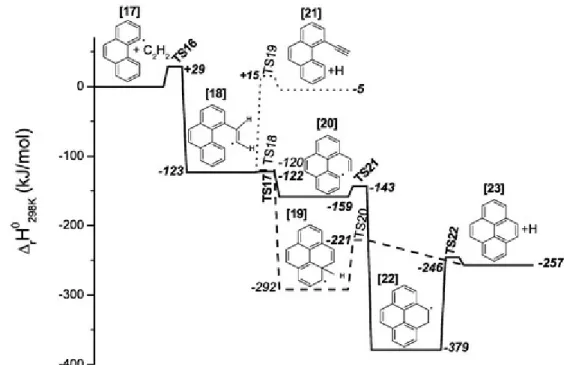
(27) Thèse de Mamady Keita, Lille 1, 2017. radicals combination might play a key role for naphthalene formation in ethylene flames. Colket et al. [41] and McEnally et al. [12] focused their investigation on benzyl radical route, indicating that benzyl radical reacts with propargyl radical to create directly naphthalene [41] or benzyl radical reacts with acetylene to form indene, which is subsequently converted into naphthalene by methyl radical addition [12]. Anderson et al. [42] have evaluated both routes (HACA and benzyl radical) in their investigation and suggested that the importance of HACA route in naphthalene formation is proportional or related to the maximum phenylacetylene concentration in flame, while that of benzyl route is proportional to the maximum toluene concentration. Moreover, authors suggested that both routes constitute the main naphthalene production pathways in the flames studied. Recent investigations carried out by Slavinskaya et al. [39] and Appel et al. [11] involved C4 species reaction with phenyl radical (or benzene) besides HACA route (with phenylacetylene) and cyclopentadienyl radicals combination route. Wang et al. [40] studied different fuel structures: ethylene, n-heptane, iso-octane, benzene and toluene, and postulated that major pathways leading to naphthalene are C4 species (i-C4H5 ; C4H3) reaction with phenyl radical or benzene and cyclopentadienyl radicals combination. Regarding larger PAH formation (up to pyrene), the HACA mechanism is widely used. Castaldi et al. [36], Appel et al. [11] and Marinov et al. [43] have considered solely phenanthryl reaction with acetylene as the main pathway leading to pyrene in their kinetic mechanism. However, they observed that pyrene concentration was underpredicted and concluded that additional pathways beyond HACA mechanism might contribute to pyrene production as well. Slavinskaya et al. [39] proposed that species such as acetylene, diacetylene (C4H2), cyclopendienyl radical, phenyl radical and phenylacetylene might play a crucial role in PAH growth process, starting from the first aromatic ring. For example, for pyrene production, authors reported that acenaphthylene with diacetylene combination, phenanthryl radical with acetylene combination and phenylacetylene radical with phenylacetylene combination appear as the major pyrene production pathways. In recent investigations on different fuel structures: ethylene, n-heptane, iso-octane, benzene and toluene, Wang et al. [40] suggested that naphthyl radical with naphthalene combination might also play a role in pyrene production. An overview of aromatics formation pathways can be depicted as in Figure 8.. 27 © 2017 Tous droits réservés.. lilliad.univ-lille.fr.
(28) Thèse de Mamady Keita, Lille 1, 2017. Figure 8 : Overview of different aromatics (up to Pyrene) formation pathways.. Computational studies (DFT) shows that the gaseous acetylene molecule plays a key role in PAHs growth process. The reaction mechanism of PAHs from acenaphthylene (C12H8) to Pyrene (C6H10) have been examined by Unterreiner et al. [44]. Authors brought to light the role of acetylene as a key species and considered the Hydrogen-Abstraction-Acetylene-Addition mechanism as one of the major paths in PAHs production. Results obtained from their work are presented as follows: -. Acenaphthylene formation: C10H7 [1] + C2H2 → C12H8 [6] + H. Figure 9 shows the reaction enthalpies at 298 K for the acetylene addition to naphthyl radical [1] to yield acenaphthylene [6] and hydrogen. The reaction is exothermic by 163 kJ.mol−1. The highest barrier of the total reaction path (relative to the educts) is 19 kJ.mol−1. The reaction begins with the formation of [2] which proceeds to either [3] via hydrogen migration or to [4] under hydrogen atom loss. At B3LYP level the way to [3] shows a barrier of 26 kJ.mol−1, significantly lower than the one to [4] of 150 kJ.mol−1. The barrier of the ring cyclization of [3] to [5] is 42 kJ.mol−1. Forming [6] under hydrogen loss has an activation barrier of 192 kJ.mol−1, the transition state is 2 kJ.mol−1 above the energy of the final product.. 28 © 2017 Tous droits réservés.. lilliad.univ-lille.fr.
(29) Thèse de Mamady Keita, Lille 1, 2017. Figure 9 : Potential energy diagram of the reaction napthyl [1] + acetylene → acenaphthylene [6] + H. The dashed line is a second reaction path. The reaction enthalpies are calculated from harmonic frequencies at 298 K and 0.1 MPa on B3LYP/SV(P) level [44]. The number indicated in the bracket stands for molecule identification as shown in the caption.. -. Phenanthryl formation pathway : C12H7 [6a] + C2H2 → C14H9 [17]. Figure 10 shows the reaction enthalpies at 298 K for the acetylene addition to acenaphthylenyl to yield phenanthryl radical.. Figure 10 : B3LYP/SV(P) potential energy diagram of the reaction acenaphthylenyl [6a] + acetylene → phenanthryl [17]. The solid line is the most probable reaction pathway, the dashed and dotted lines are other pathways [44]. The number indicated in the bracket stands for molecule identification as shown in the caption.. This reaction is a transformation reaction from a five to six-membered ring. The reaction is exothermic by 312 kJ.mol−1. The HACA mechanism proceeds through formation of [11] and [16], respectively and the highest barrier of the reaction path is found to be 227 kJ.mol−1 for the formation of [11].. 29 © 2017 Tous droits réservés.. lilliad.univ-lille.fr.
(30) Thèse de Mamady Keita, Lille 1, 2017. -. Pyrene formation pathway: C14H9 [17] + C2H2 → C16H10 [23] + H. Figure 11 shows the reaction enthalpies at 298 K for the acetylene addition to phenanthryl to form pyrene.. Figure 11 : Potential energy diagram of the reaction phenanthryl [17] + acetylene → pyrene [23] + H. Values calculated at B3LYP/SV(P) level. The solid, dashed and dotted lines are three different pathways [44]. The number indicated in the bracket stands for molecule identification as shown in the caption.. This reaction is six-membered ring cyclization with an exothermic reaction of 257 kJ.mol−1. The highest barrier of the total path is calculated to be 29 kJ.mol−1. Starting after the formation of [18] the radical has three possibilities to react. For the first way, molecule [21] is obtained under hydrogen loss. The second way leads to [19] via ring cyclization and the last way is a H-migration from the C2H2 group to the six-membered ring [20] followed by ring cyclization [22]. Both radicals, [19] and [22], decompose to pyrene [23]. -. Fluoranthene formation pathway: C6H6 [1] + C10H7 [2a] → C16H10 [8] + H2 + H.. Figure 12 shows the reaction enthalpies at 298 K for the benzene addition to naphthyl radical to form fluoranthene.. 30 © 2017 Tous droits réservés.. lilliad.univ-lille.fr.
(31) Thèse de Mamady Keita, Lille 1, 2017. Figure 12 : Potential energy diagram of the aromatic condensation reaction benzene [1] + naphthyl [2a] → fluoranthene [8] + H + H2. Calculated at B3LYP/SV(P) level. The dashed line is the reaction pathway for phenyl [1a] + naphthalene [2] [44].. This reaction shows the aromatic condensation of benzene [1] with a naphthyl radical [2a]. The reaction is endothermic by 24 kJ.mol−1 and the highest barrier of the reaction path, relative to the educts, is obtained to be 85 kJ.mol−1. The analogous reaction of phenyl [1a] and naphthalene [2] is also calculated (dashed line). [3] is lower in energy than [4] by 39 kJ.mol−1. This is due to the stabilization of the radical through the π-system. The next step is the separation of a hydrogen atom leading to [5]. The energy of the barrier from [3] to [5] is found to be 132 kJ.mol−1 and from [4] to [5] it is 104 kJ.mol−1. The following step is a hydrogen abstraction under formation of H2 and [6] with a barrier of 51 kJ.mol−1. The barrier of the ring cyclization forming a fluoranthenyl radical [7] has been computed to be 52 kJ.mol−1. The final step is the decomposition to fluoranthene [8], through a barrier of 113 kJ.mol−1. Some alternative mechanisms that may compete with the HACA based mechanism and all the possible reactions quoted above are proposed. A brief description of these alternative mechanisms is given as follows: 2.2.2.. HAVA (Hydrogen Abstraction and Vinyl Addition) mechanism. A nouvel route for PAH growth in HACA based mechanisms was proposed by Shukla et al. [45] in investigating acetylene and ethylene pyrolysis , where small aliphatic hydrocarbon products to large 31 © 2017 Tous droits réservés.. lilliad.univ-lille.fr.
(32) Thèse de Mamady Keita, Lille 1, 2017. PAHs (up to 324 uma) were observed. They showed that PAH growth take place by addition of any C2Hx species (radical or neutral) such as C2H2/C2H (ethyne/ethynyl) and C2H4/C2H3 (ethene/ethenyl), since they are produced in significant concentrations and they further accelerate the formation of a wide range of products including PAHs. Moreover, they suggest that production of naphthalene from benzene via HACA mechanism is less probable, assuming that HAVA mechanism seems to be more promising for producing PAHs during aliphatic hydrocarbon pyrolysis. Experimental evidence supports the HAVA mechanism as shown on the following reaction sequence (Figure 13) during ethylene pyrolysis:. Figure 13 : PAH growth process via vinyl radical addition from ethylene pyrolysis [45].. The time of flight mass spectrometer (TOFMS) experiments shows that from naphthalene to fluoranthene, a repetitive addition of C2H3 radical is observed with regular mass number intervals of 26. Similarly, from fluoranthene to corannulene, a repetitive addition of C2H3 radical is also observed. In the case of acetylene pyrolysis, HACA mechanism is proposed for the PAHs growth as shown in Figure 14:. Figure 14 : PAH growth process ethynyl radical addition from acetylene pyrolysis [45].. 32 © 2017 Tous droits réservés.. lilliad.univ-lille.fr.
(33) Thèse de Mamady Keita, Lille 1, 2017. As for ethylene pyrolysis, C2H2/C2H ratio has a major impact on PAH growth from naphthalene to corannulene, where a regular mass number interval of 24 is observed. Therefore, the nature of species involved in the growth process depends considerably on fuel structure and operating conditions. The formation of cyclopentaring fused-PAHs (fluoranthene to corannulene) is possible and might be preferred over currently accepted reaction that forms benzenoid-PAHs (PCAHs) (pyrene to coronene) especially in aliphatic hydrocarbon pyrolysis/oxidation. Moreover, these authors reinforce the validity of HACA/HAVA mechanism for PAHs growth from naphthalene to large PAHs (up to corannulene) even if kinetic data for HAVA mechanism are not yet available. 2.2.3.. Phenyl Addition and Cyclization (PAC) pathway:. Shukla and Koshi [45] have investigated the role of phenyl radical during benzene pyrolysis with or without addition of acetylene in a flow tube reactor conditions. They detected PAHs such as polyphenyl-PAHs, cyclopentafused-PAHs and larger PAHs up to C36H22 (454 amu). They observed an appearance of mass peaks at regular mass number intervals of 76, corresponding to phenyl radical addition followed by hydrogen elimination. Since HACA mechanism is only found efficient for producing symmetrical PAHs by filling a triple fusing site, the PAC pathway is found to be efficient to continue the endless growth of PAHs. The authors proposed the following sequence of reactions at low temperature region (< 1300 K) that clearly shows PAH growth by phenyl radical addition (Figure 15), where the number in the bracket represent atomic mass of the corresponding species.. Figure 15 : PAH growth process via phenyl radical addition from benzene pyrolysis [45].. The mass peaks at regular intervals of mass number 76 from benzene to quaterphenyl are produced by successive phenyl radical addition at each step. However, the mass spectra analysis cannot provide the preference sites of addition leading to isomers of terphenyl (o-; m- p- terphenyl), and isomers of quaterphenyl. (1, 1’:2’,1’’-terphenyl, 4’-phenyl; 1,1’: 3’1’’-terphenyl, 5’-phenyl; o-quaterphenyl; 33. © 2017 Tous droits réservés.. lilliad.univ-lille.fr.
(34) Thèse de Mamady Keita, Lille 1, 2017. m-quaterphenyl; p-quaterphenyl). Mass peaks are found diminishing with appearance of -2 mass number peaks with increasing temperatures as shown in Figure 16:. Figure 16 : Ring closure by hydrogen loss under the effect of temperature [45].. o-Terphenyl (m/z=230) is dehydrogenated/dehydrocylized to yield terphenylene (m/z=228). That is probably due to the thermal conversion (effect of tempereature) and is not expected in the case of mor p-terphenyl. Similarly, two new species can be produced from o-quaterphenyl (m/z= 306) by increasing temperature as shown in Figure 17:. Figure 17 : Effect of temperature in more condensed PAH formation [45].. Only o-quaterphenyl can efficiently produce these two new species: o-phenylterphenylene (m/z=304) and dibenzo (fg, op) naphthacene (m/z= 302). In the high temperature region (> 1300 K), phenyl addition sequence starting from naphthalene (m/z= 178) to produce larger PAHs such as phenylnaphthalene (m/z= 204) and phenylfluoranthene (m/z= 278) can be observed as shown in Figure 18:. Figure 18 : Cyclopentafused PAHs growth process via phenyl addition/H abstraction [45].. Phenyl addition products are accompanied by stable dehydrocyclized ones, which are most probably fluoranthene and indeno [3,2,1,7, defg] chrysene. 34 © 2017 Tous droits réservés.. lilliad.univ-lille.fr.
(35) Thèse de Mamady Keita, Lille 1, 2017. Norinaga et al. [46] have investigated benzene pyrolysis in a flow reactor at atmospheric pressure and at temperature ranging from 1123 to 1223 K, residence time up to 4s. They found that benzene oligomers such as biphenyl (C12H10, terphenyl (C18H14), quaterphenyl (C24H18) and quinquephenyl (C30H22) were primarily products and important intermediates of carbonaceous particles in benzene pyrolysis. Therefore, they found necessary to include reactions leading to these benzene oligomer formations in their chemical kinetic mechanism. All the above results indicate that the PAC route might be an efficient route for PAH growth since it increases the mass by 74 with respect to 24 and 26 in respectively the HACA and HAVA cases. PAC pathway is found efficient for ring growth from any fusing site of a PAH since it generates two new sites at each step and can continue the endless growth. However, it is inefficient to produce symmetrical PAHs, while HACA is only efficient for the ring growth from a triple fusing site of a PAH to generate symmetrical PAHs such as coronene or corannulene. Despite the separate advantages of both routes (PAC and HAVA), PAC or HAVA alone cannot explain the fast growth of PAHs and consequently soot particles formation process. By combining the contribution of all possible routes to PAHs production, one should expect to account for PAHs growth rate and to better predict their formation.. 2.3. Soot formation mechanism The soot particles formation process is a complex process that is not fully known. Soot particles are formed from hydrocarbon fuels conversion at higher temperature and their concentration is increased by increasing the fuel equivalence ratio (relative fuel-air ratio with respect to stoichiometry). The least understood step is probably the particles nucleation step that makes the link between the gas-phase and the solid-phase. Figure 19 illustrates the entire soot formation mechanism.. 35 © 2017 Tous droits réservés.. lilliad.univ-lille.fr.
(36) Thèse de Mamady Keita, Lille 1, 2017. Figure 19 : Soot particles formation mechanism from hydrocarbon combustion.. The blue part of this caption shows the flame zone where PAHs are formed. The production of particulate matter induces a change in flame color changes from blue to yellow. Despite the misunderstanding of all process of soot formation, experimental investigations namely in laminar premixed or non-premixed flames of several hydrocarbon allowed to identify the main steps of this complex process. The PAHs formation mechanisms have been presented in the previous section as well as the potential chemical species involved. The identified processes involved in soot formation mechanism can be summarized as follows: (1) Soot gaseous precursors formation: such as C2H2, PAHs (2) Nucleation: the smallest particles formation from gaseous species (3) Condensation (4) Coagulation (5) Particles surface growth (6) Particles oxidation (7) Particles aggregation. 36 © 2017 Tous droits réservés.. lilliad.univ-lille.fr.
(37) Thèse de Mamady Keita, Lille 1, 2017. The above-mentioned processes can be discussed as follows: 2.3.1.. Gaseous precursors of soot particles. It is suspected that PAHs with size of 500-1000 amu are molecular precursors of soot particles [47]. The chemical growth of light aromatics (1 or 2 aromatics ring) to heavy PAHs (4 to 7 and more) is described by the addition of C2, C3 and other small units to the light PAHs. Among these growth processes, the Hydrogen-Abstraction-Acetylene-Addition mechanism (HACA) has received much attention. The term HACA was introduced by Frenklach and Wang [18]. HACA implied a repetitive reaction sequence of two successive steps: (1) abstraction of hydrogen atom from the reacting hydrocarbon by a gaseous hydrogen atom: Ai-H + H → Ai° + H2. Equation 4. Where Ai-H represents the hydrocarbon and Ai° the hydrocarbon radical (2) Addition of a gaseous acetylene (C2H2) molecule to the radical site formed: Ai° + C2H2 = products. Equation 5. However, the inability of the HACA mechanism to be an effective way to ring formation for PAHs formation beyond naphthalene has come under scrutiny by Parker et al. [48]. This compelling study performed under 300 Torr and 1200 K shows that HACA mechanism is unable to form tricyclic PAHs (phenanthrene or anthracene) from naphthyl radical reacting with acetylene. In fact, naphthyl radical reaction with acetylene would form predominantly acenaphthylene (C12H8) which is a precursor to nonplanar PAHs (or PAHs containing a five-membered ring) such as corannulene and probably fullerene. Naphthyl radical reaction with one acetylene molecule forms an intermediate (C12H9) that turns by cyclization to acenaphthylene (C12H8). Mebel et al. [49] showed that this cyclization is much faster than the second addition of acetylene molecule to the intermediate C12H9 leading to C14H11 followed by H atom abstraction to yield a third aromatic ring (anthracene or phenanthrene). These findings suggest that the HACA mechanism is not the most significant mechanism in mass growth to heavy PAHs. Acetylene is not the only species that can be envisioned to propagate the growth of aromatic rings. Several alternate pathways have been put forward such as methyl, propargyl (C3), vinylacetylene (C4) addition, cyclopentadienyl (C5) radicals and phenyl (C6) radicals addition and 37 © 2017 Tous droits réservés.. lilliad.univ-lille.fr.
(38) Thèse de Mamady Keita, Lille 1, 2017. cyclization [36,41,50–53]. These proposals are based on the resonantly stabilized structure of the reacting radicals, assuming that hydrocarbons with conjugated structures and their derivatives are critical intermediates to soot nucleation [54]. It is found that the pool of species involved in PAH formation growth process depends considerably on fuel structure [55]. For example, in aromatic flames such as benzene, phenyl radicals which exist in high concentration, accelerate PAHs growth and formation. In acetylene flame, acetylene and other small species such as vinyl radicals (C2H3) exist in high concentration and can contribute significantly to PAHs formation process. 2.3.2.. Soot particles nucleation. The soot particles inception step is probably the least understood of all as the transition from gas-phase to solid phase still remains unclear. It could be defined as the transition from gaseous hydrocarbons to macromolecular building blocks [56] (nanoparticles with a mass around 1000-2000 uma and an effective diameter of about 1.5 nm) that turn probably into soot. The combustion conditions (high temperatures and large pools of radicals) make this process very complex. Stein and Fahr [57] have found that heavy PAHs are stable enough at flame temperatures, and the majority consensus on soot particle inception is that the soot particle form via PAHs dimerization. Base on thermodynamic consideration, Wang [8] suggested that PAHs as big as coronene (C24H12) dimer cannot be stable in flame at temperature higher than 700 K, since the entropic contribution to free energy tears the dimer apart. From his assumptions, only PAHs as big as circumcoronene (C54H18) dimer might remain stable but not at temperature higher than 1600 K. However, since flame temperature can reach 2000 K or more, the nature or the exact stable structures involved in the soot nucleation mechanism remain unclear. The present work aims to discuss the PAHs molecules that could potentially be involved in this process. 2.3.3.. Mass growth of soot particles. The mass of nascent soot is increased via the addition of gas phase species such as acetylene (C2H2+soot contributes to surface growth) and PAHs (PAH+soot contributes to condensation) and the collisions between solid particles (soot+soot contributes to coagulation) which significantly increase the particles size and decrease particles number as they merge. For the surface growth, H-atom abstraction from soot surface leads to an active site creation (radical site), which further reacts with a 38 © 2017 Tous droits réservés.. lilliad.univ-lille.fr.
(39) Thèse de Mamady Keita, Lille 1, 2017. gaseous species such as acetylene. Soot surface activity decreases when H-atom concentration decreases (limiting active sites production) or due to surface defects causing active sites deactivation [58,59]. By considering soot particles as spherical before and after coagulation, equations governing soot mass growth such as Smoluchowski equation [60] are implemented in most of soot models. 2.3.4.. Oxidation of PAHs and soot particles. The oxidation of PAHs and soot leads to mass loss by elimination of CO and CO2 molecules. This process may compete with the formation of PAH and soot. The main oxidation reactants are found to be OH, O and O2. In fuel-rich conditions, OH is the main oxidation reactant while O2 is the main reactant in the case of fuel-lean conditions. However, due to the low temperature effect, the rate of oxidation process is not sufficient to lead to the consumption of all soot particles. 2.3.5.. Aggregation of soot particles. Soot particles agglomeration starts when their growth is finished. The resulting particles called mature soot, agglomerate to form a long chain structure. Soot formation process has received much attention from several research groups and many studies have been performed to better understand the inception step. A lot of operating parameters (fuel type, global and local equivalence ratio, temperature and pressure) have to be taken into account to get a full insight about soot inception. Thus, the good understanding of chemical reactions network in fuel combustion could be a crucial way to increase our knowledge on soot and PAHs formation and to predict soot properties (reactivity) from parent fuel. This support can be offered by computational simulation which allows a critical testing of chemical reaction networks.. 2.4. Soot nucleation mechanisms Soot nucleation mechanism remains poorly understood due to its very fast reaction rate constant and the lack of detailed experimental data. However, three nucleation pathways have been postulated in the literature but they are still much debated. Figure 20 shows a representation of the proposed nucleation mechanisms, indicating the ratio carbon to hydrogen (C/H), the nucleation mechanism type (A, B or C) and the proponent of the mechanism. In addition, all these three different conceptual pathways consider PAHs molecules as soot particle precursors, which is a common point of view within combustion chemistry community. 39 © 2017 Tous droits réservés.. lilliad.univ-lille.fr.
(40) Thèse de Mamady Keita, Lille 1, 2017. Figure 20 : Postulated soot nucleation mechanisms.. As depicted in Figure 20, paths A, B and C are described as follows: Path A: proposed by Homann [61], it is represented by the growth of two-dimensional PAHs into fullerene-like structures (curved). This soot particle nucleation mechanism type is ruled out since it leads to a mono-modal particle distribution function while experimental findings showed a bimodal particle distribution function, as depicted in Figure 21. Moreover, it seems too slow to account for rates observed for soot nucleation. Consequently, this mechanism may not be a plausible pathway since experimental data are not reproduced by this mechanism alone.. Figure 21 : Detailed particle Distribution Function in ethylene flame (C2H4/O2/Ar φ =2.1) [8], where Hp is the height above the burner.. Path B: proposed by Frenklach and coworkers [62], this mechanism involves the physical coalescence of PAH molecules into stacked clusters. However, the nature of PAHs molecules that are widely involved in the soot nucleation process remains unclear. Moreover, the binding energies and number of stacked PAH molecules that could lead to soot particle are poorly understood. Path B seems to be 40 © 2017 Tous droits réservés.. lilliad.univ-lille.fr.
Figure
![Figure 1 : Exhaust emissions regulations around the world for nitrogen oxides (NOx) and for particulate matter (PM) [2]](https://thumb-eu.123doks.com/thumbv2/123doknet/3658697.108090/13.892.184.712.814.1114/figure-exhaust-emissions-regulations-nitrogen-oxides-particulate-matter.webp)
![Figure 2 : Formation of pollutants according to Pischinger diagram [3]. λ represents the relative air fuel ratio](https://thumb-eu.123doks.com/thumbv2/123doknet/3658697.108090/15.892.150.699.286.638/figure-formation-pollutants-according-pischinger-diagram-represents-relative.webp)
![Figure 5 : Collision efficiency for 3 peri-condensed aromatic hydrocarbon I 0 : Pyrene ; II 0 : Coronene ; III 0 : circumcoronene [27]](https://thumb-eu.123doks.com/thumbv2/123doknet/3658697.108090/23.892.239.647.233.589/figure-collision-efficiency-condensed-aromatic-hydrocarbon-coronene-circumcoronene.webp)
![Figure 6 : Representation of aromatic compounds for C 24 -C 250 . Lines represent the limits of oligomers of benzene [28]](https://thumb-eu.123doks.com/thumbv2/123doknet/3658697.108090/24.892.221.658.198.528/figure-representation-aromatic-compounds-lines-represent-oligomers-benzene.webp)
+7

![Figure 14 : PAH growth process ethynyl radical addition from acetylene pyrolysis [45]](https://thumb-eu.123doks.com/thumbv2/123doknet/3658697.108090/32.892.188.699.885.1086/figure-growth-process-ethynyl-radical-addition-acetylene-pyrolysis.webp)
![Figure 24 : Soot particles formation and evolution process in the model [75].](https://thumb-eu.123doks.com/thumbv2/123doknet/3658697.108090/52.892.202.694.326.596/figure-soot-particles-formation-evolution-process-model.webp)
Documents relatifs