Adaptive Type-Partitioned Garbage Collection
by
Christopher Henry Rohrs
Submitted to the Department of Electrical Engineering and Computer Science
in partial fulfillment of the requirements for the degree of
Master of Engineering in Computer Science and Engineering
at the
MASSACHUSETTS INSTITUTE OF TECHNOLOGY
June 2000
@ Christopher Henry Rohrs, MM. All rights reserved.
The author hereby grants to MIT permission to reproduce and distribute publicly paper
and electronic copies of this thesis document in whole or in part.
A uthor ...
Department of Electrical Engineering and Computer Science
May 18, 2000
Certified by...
...
Barbara Liskov
Ford Professor of Engineering
Thesis Supervisor
Accepted by ...
.
Arthur C. Smith
Chairman, Department Committee on Graduate Students
ASSACHUSETTS INSTITUTE OF TECHNOLOGY
Adaptive Type-Partitioned Garbage Collection
byChristopher Henry Rohrs
Submitted to the Department of Electrical Engineering and Computer Science on May 18, 2000, in partial fulfillment of the
requirements for the degree of
Master of Engineering in Computer Science and Engineering
Abstract
A novel type-based garbage collector is presented that partitions objects by type and collects only
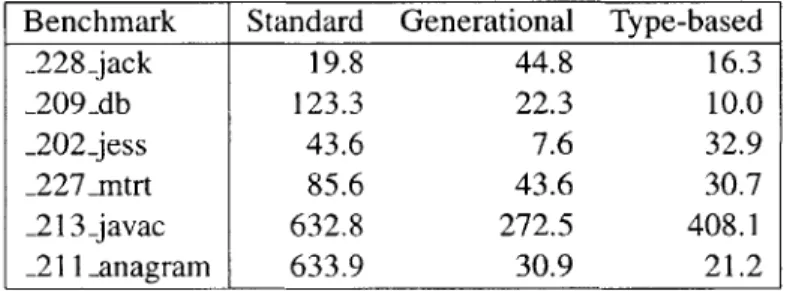
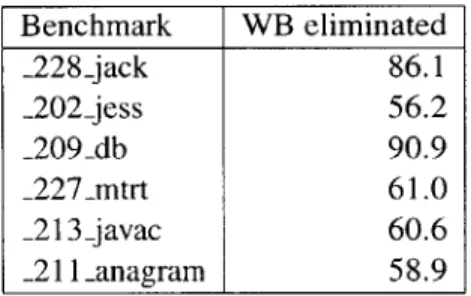
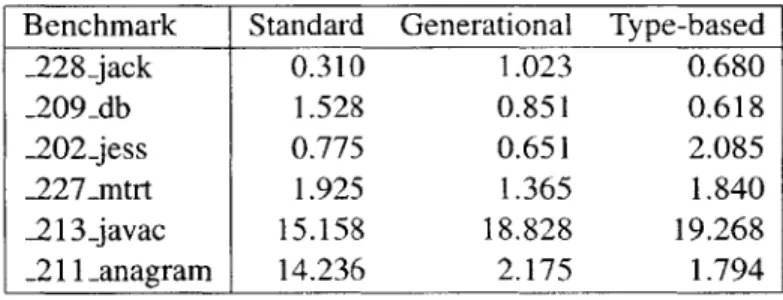
those objects most likely to be garbage. Unlike a classic generational collector, the partition is adaptively chosen at runtime to maximize collector efficiency and minimize intergenerational pointers. By using type information, the collector and compiler can eliminate up to 90% of all write barriers. An implementation for a commercial JavaTMVirtual Machine consistently copies less data than a standard collector, and up to 2.2 times less data than an age-based generational collector. However, the cost of tracking intergenerational pointers sometimes outweighs the reduction in copying. In the best case, the modified virtual machine runs 49% faster than the original; in the worst case, it runs 23% slower.
Thesis Supervisor: Barbara Liskov Title: Ford Professor of Engineering
Acknowledgments
I wish to thank Compaq Computer Corporation for supporting me through the MIT VI-A internship
program, and Bruce Foster for initially bringing me to Compaq. I am especially grateful to Bill McKeeman for mentorship during that time, and interesting me in adaptive garbage collection. I also thank my thesis supervisors, Bob Morgan and Prof. Barbara Liskov. In addition, I am indebted to many members of the JFEX team past and present, especially Chris Gillett, Richard Critz, Sanjay Ghemawat, Keith Kimball, and Rich Phillips.
Contents
1 Introduction 8
2 A Garbage Collection Taxonomy 10
2.1 Definitions . . . . 10 2.2 Basic Techniques . . . . 10 2.2.1 Reference Counting . . . . 11 2.2.2 Mark-Sweep Collection . . . . 12 2.2.3 Copying Collection . . . . 12 2.3 Advanced Techniques . . . . 14 2.4 Discussion . . . . 15 3 Generational Collection 16 3.1 Design Considerations . . . . 17 3.2 W rite Barriers . . . . 17
3.3 Rethinking Generational Assumptions . . . . 19
4 Type-Based Collection 21 4.1 Motivation . . . . 21 4.2 Basic Scheme . . . . 22 4.3 Type Partitioning . . . . 24 4.3.1 Theoretical Efficiency . . . . 24 4.3.2 Algorithm I . . . . 25 4.3.3 Algorithm II . . . . 27 4.3.4 Optimal Algorithms . . . . 29 4.4 Discussion . . . . 32 4.4.1 Adaptation . . . . 33
5 Implementation
5.1 Original Collector . . . .
5.2 Basic Changes . . . .
5.2.1 Representing Hot and Cold Sets
5.2.2 Allocation and Promotion . . .
5.2.3 Recomputing the Hotlist . . . . 5.3 Forcing Major Collections . . . . 5.4 Eliminating Write Barriers . . . .
5.4.1 Original Card Marking... 5.4.2 putfield . . . . 5.4.3 aastore . . . . 5.4.4 JVMArrayCopy . . . . 5.4.5 JVM.Clone . . . . 5.5 Discussion . . . . 6 Performance Results 6.1 M ethod . . . . 6.2 Collection Efficiency . . . . 6.3 Card Marking and Scanning 6.4 Collection Time . . . . 6.5 Benchmark Time . . . . 6.6 Discussion . . . . 6.6.1 Type Partitioning . . 6.6.2 Write Barriers . . . 6.6.3 Cache Benefits . . . 7 Conclusions 7.1 Types or Age? . . . . 7.2 Future Work . . . . References
A Example Runtime Class Graphs
35 35 37 37 38 39 40 40 41 42 43 43 46 46 47 47 48 49 50 51 51 51 53 54 55 55 56 57 60 . . . . . . . . . . . . . . . .
List of Figures
2-1 Reference counting pseudocode . . . . 11
2-2 Cheney algorithm for depth-first copying from oldspace to newspace. . . . . 13
3-1 Example Java constructors . . . . 19
4-1 Illustration of a minor collection . . . . 25
4-2 A lgorithm I . . . . 26
4-3 Relationship between class graph, runtime class graph, and object graph . . . . . 28
4-4 Algorithm II: main loop . . . . 30
4-5 Algorithm II: helper functions . . . . 31
5-1 Algorithm for eliminating put f ield write barriers . . . . 44
5-2 Storing a reference into an array . . . . 45
A-I Runtime class graph of _202_jess . . . . 61
A-2 Runtime class graph of _228-jack . . . . 61
A-3 Runtime class graph of _209_db . . . . 62
A-4 Runtime class graph of .227_mtrt . . . . 62
A-5 Runtime class graph of _213_javac . . . . 63
List of Tables
4.1 Example mortality rates in ..209-db . . . . 22
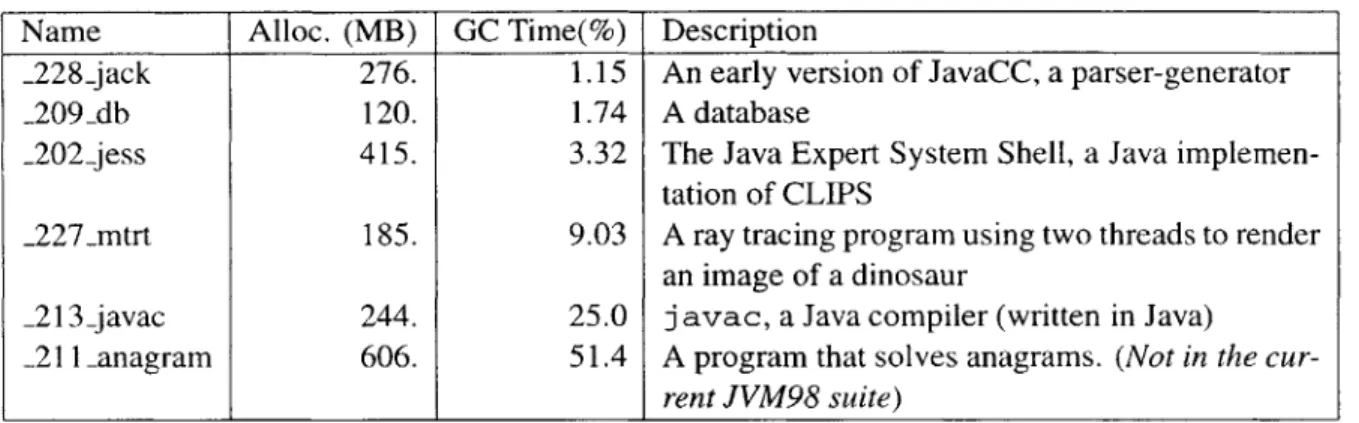
6.1 Benchmark descriptions . . . . 48
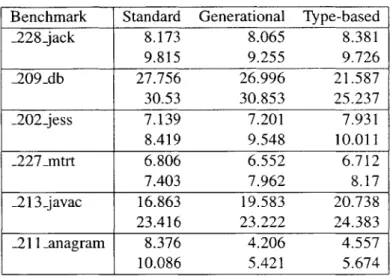
6.2 MB copied during collection . . . . 49
6.3 Static percentage of put f ield WBs eliminated at compile-time . . . . 50
6.4 Number of cards marked and requiring scanning. . . . . 50
6.5 Collection time (seconds) . . . . 51
6.6 Overall benchmark time (seconds) . . . . 52
6.7 Cycles spent per GC routine for _227_mtrt . . . . 52
6.8 The number of cycles, D-cache misses, and TLB misses for two critical routines of _209_db, when using standard and type-based collection. . . . . 54
Chapter 1
Introduction
Traditional programming languages such as C and C++ require the programmer to explicitly free dynamically allocated memory. This is the cause of numerous programming errors. In one case, the programmer forgets to free unused memory, resulting in a memory leak. Even worse, the programmer may refer to objects that have been freed. Such dangling references can cause undefined behavior (e.g., crashes) later on.
Garbage collection (GC)-also known as automatic storage reclamation-eliminates such errors and simplifies program development by automatically reclaiming unneeded memory. When a program runs out of memory, the garbage collector traverses all pointers reachable from the call stack and registers. Objects encountered during this traversal are considered live. Objects not encountered are considered garbage and are reclaimed for future allocations. Reachable objects that are no longer used by the program may be retained. Many high-level languages use garbage collection, including JavaTM, LISP, Smalltalk, and ML. In addition, GC can be used with languages that are not designed to be garbage collected, such as C and C++, provided the programmer obeys certain rules [BW88].
Unfortunately, garbage collection comes at a cost. While it is hard to generalize for a large number of languages and programs, most garbage collectors consume from a few percent to 20 percent of overall program execution time [Jon96]. Wilson estimates that a well-designed garbage collector might consume no more than 10 percent of program execution time [Wil94]. Our own measurements of a production-quality Java virtual machine show that the garbage collector usually consumes under 5 percent of program execution, but occasionally consumes as much as 50 percent of program execution on standard performance benchmarks. (See Chapter 6 for details.) Another
problem is that collection pauses may disrupt many applications. However, this thesis is not concerned with reducing worst-case pause time; rather, the goal of this thesis is to reduce the overall cost of garbage collection.
The most popular and successful technique for improving garbage collection performance is age-based generational collection. These collectors are age-based on the weak generational hypothesis, the commonly-held assumption that young objects die faster than old objects. Generational collectors segregate objects by age and collect only the youngest objects. By concentrating on those objects most likely to be garbage, a generational collector may outperform standard techniques. While generational techniques have proven successful for functional languages such as LISP and ML, they may not be appropriate for Java. Java encourages an imperative style of programming and the frequent update of long-lived objects. With a generational collector, this may result in excess copying. In fact, our experience shows that generational techniques often degrade the performance
of a Java Virtual Machine. (See Chapter 6 for details.)
However, age is not necessarily the only indicator of object mortality. In Java programs, we have found a strong correlation between an object's type and its expected lifetime. For any given program, instances of some classes tend to be long-lived, while instances of others tend to be short lived. We expect similar behavior in other strongly-typed languages. Based on this observation, we propose a novel garbage collector that segregates objects by type-not age-and collects only the objects most likely to be garbage. A key feature of this collector is that the type partition is chosen at runtime to adapt to the program at hand. In addition, type information is used to eliminate many write barriers. We find that the type-based collector usually copies less data than a generational collector, but overhead from write barriers and intergenerational pointers are still significant.
This thesis is organized as follows. Chapter 2 reviews standard garbage collection techniques. Chapter 3 describes classic age-based generational techniques in greater detail. Chapter 4 presents the type-based collector and discusses some of the design options. Chapter 5 describes the imple-mentation details for a Java Virtual Machine. Chapter 6 compares the performance of the type-based collector with a non-generational and a generational collector.
Chapter 2
A Garbage Collection Taxonomy
This section presents a brief taxonomy of collection techniques. Readers familiar with garbage collection basics may skip this section. Those seeking a more detailed presentation should consult references by Wilson [Wil94] or Jones and Lins [Jon96].
2.1
Definitions
The heap is storage where allocation and deallocation follow no specific order. An object is any structure stored contiguously on the heap. Every object has a header, a few words of memory adjacent to the object's data. The header is invisible to the program and might be used by the runtime system to store the size of the object, the type of the object, whether the object is garbage, etc.
The root set of a program at some time consists of all objects that are pointed-to by some pointer
on the stack frame or some pointer in a register. An object is defined to be reachable if it is either a member of the root set or pointed-to by a reachable object. Note that the set of reachable objects forms a directed graph. An object is garbage if it is no longer needed by a program. As is common practice, we ignore liveness and restrict this definition to refer only to those objects that are no longer reachable. A garbage collector reclaims garbage for the memory allocator.
2.2 Basic Techniques
There are three commonly-used GC techniques:
2. mark-sweep collection
3. copying collection
These techniques form the foundation for almost all advanced garbage collectors. The last two techniques are considered tracing techniques since they trace the graph of reachable objects using depth-first or breadth-first search. In their simplest form, tracing collectors run when there is insufficient memory to satisfy allocation. In contrast, reference counting is interleaved with the program's execution.
2.2.1 Reference Counting
Reference counting is the simplest of all automatic storage reclamation techniques. The reference count for each object is equal to the number of pointers pointing to it. If the reference count of an object is zero, the object is garbage. Reference counting schemes typically maintain the reference count of each object in its header. Pseudocode for maintaining reference counts is shown in Figure 2-1.
decrement (x)
#Decrements the reference count of x.
#Reclaims x's storage (and that of children) if garbage. 1. Decrement the reference count of x by 1.
2. If x's reference count is zero
a) Recursively call decrement on all of x's children. b) Reclaim the storage of x.
store(a,b):
#Stores a pointer from object a to object b
Let b' be the object (if any) that a currently points to. 1. Call decrement(b')
2. Store pointer from a to b.
3. Increment the reference count of b.
Figure 2-1: Reference counting pseudocode. This code is not thread-safe.
There are two problems with reference counting. First, it cannot reclaim cycles of garbage. Hence a mark-sweep collector is often used in conjunction with reference counting. Secondly, the cost of reference counting is proportional to the number of pointer stores. This is likely to be significant.
A deferred reference counting scheme elides reference count adjustment when storing pointers
from stack or register locations. As a consequence, an object cannot be reclaimed when its reference count drops to zero. Instead, the reference counts must be periodically reconciled by scanning the stack and incrementing the counts of any pointed-to objects. Now, objects with reference counts of zero may be reclaimed. The savings in pointer stores generally outweighs the cost of reconciliation. Reference counting is generally considered inferior to tracing techniques. However, reference counting is simple to implement and has been used in numerous language implementations, including Modula-2+, Perl, and Python [vROO]. It is also frequently used ad hoc by programmers of languages such as C++ that do not support automatic storage reclamation.
2.2.2 Mark-Sweep Collection
Mark-sweep collectors operate in two stages. First, they mark reachable objects. This usually involves setting a bit in each reachable object through depth-first search from the root set. Secondly, they "sweep" through the heap and check the mark bit of each object. Those whose mark bits are not set are added to a doubly-linked free list. Subsequently, objects are allocated by searching the free list.
The mark stage is usually implemented with a stack to perform the depth-first search. In this case, the collector must be able to handle the rare case of stack overflow. The usual treatment is to clear the stack, scan the heap for marked objects with pointers to unmarked objects, place them on the stack, and resume scanning. Alternatively, marking can be done with no extra space by using pointer reversal techniques. Generally, pointer reversal is considerably more expensive than using
a stack.
A few optimizations can be done to the sweep stage. First, mark bits can be stored in large bit
vectors instead of in each object. This enables the collector to "sweep" large areas of garbage in a few instructions. Also, the sweep stage is often done "lazily" by interleaving it with allocation.
2.2.3 Copying Collection
Copying collectors partition the heap into two contiguous areas, fromspace and tospace. During program execution, all live objects are found in fromspace. New objects are allocated at the end of fromspace. When fromspace is full, reachable objects are copied from fromspace to tospace. The roles of oldspace and newspace are then reversed.
external stack; instead, tospace is used as a queue for breadth-first search. Two pointers S and F are maintained in tospace. Objects at S are scanned, and their children are copied to F. To prevent objects from being copied more than once, aforwarding pointer is left in oldspace after an object is copied. Pseudocode is shown in Figure 2-2.
copyall():
#Precondition: no objects in fromspace contain forwarding # pointers
#Postcondition: all reachable objects in fromspace are in # tospace and the graph of reachable objects is isomorphic # to that before the call
S=start of tospace F=S
for each r in the root set: r=copy(r)
while S<F:
Let n be the size of the object at S for each child pointer p of the object:
p=copy (p) S=S+n
copy(p):
#Precondition: p points to the start of an object in fromspace #Postcondition: a unique copy of the object exists in
# tospace and p contains a forwarding pointer to this object. if p contains a forwarding pointer p' to newspace:
Return p' else
Let n be the size of object at p. Copy object to F.
F=F+n
Return F - n
Figure 2-2: Cheney algorithm for depth-first copying from oldspace to newspace.
The cost of copying large objects can be prohibitively expensive. Accordingly, many collectors treat large objects specially [Ung84]. More generally, some copying collectors partition the heap and collect these partitions independently. Such collectors, including age-based generational collectors,
2.3 Advanced Techniques
Collection pauses may disrupt programs with strong or weak real-time constraints, including in-teractive applications and programs that interact with a network. Incremental collectors perform a small amount of work at a time, making the pauses in a garbage collected program less noticeable. Real-time collectors are incremental collectors that provide hard guarantees on the amount of time taken for any collection. Concurrent collectors run at the same time as the program (often called the mutator). Concurrent collectors are almost always straightforward extensions of incremental collectors. Most incremental algorithms require significant synchronization overhead between the collector and the program. Classic incremental collectors are based on mark-sweep algorithms
[DLM+78], but other algorithms can be used with sufficient engineering.
Parallel collectors use multiple threads to speed up the garbage collector itself. Parallel and concurrent collection are often confused in the literature, but they are orthogonal; a parallel collector may or may not be concurrent. Parallel collectors have not been widely studied in the literature. Both copying and mark-sweep collectors can be parallelized [ETY97, IT93].
Conservative collectors are designed for use with uncooperative languages such as C and C++. Such collectors scan the stack and registers conservatively, treating any value that could be a pointer as a pointer. Both copying and mark-sweep collectors can be conservative [Bar88, BW88]. Conservative copying collection is discussed in detail in Section 3.3 since our experimental collector is based upon it.
Partitioned garbage collectors divide the heap into separate regions and collect each region separately. This includes a wide range of collectors. The proposed type-based collector is a partitioned collector. Other examples:
" Peter Bishop proposed dividing a large address space into areas, and collecting each area
independently of the others [Bis77]. Bishop's system maintains inter-area links and automat-ically moves objects between areas. By collecting small areas, the garbage collector avoids excessive paging.
" Generational collectors segregate objects by age and usually collect the youngest objects.
They are of significant interest and are discussed in detail in the next chapter.
" More recently, partitioned garbage collection has been studied in the context of object
accesses. In this domain, it is generally acknowledged that object age is not a good indicator of mortality, so other partition selection schemes are used. Cook, Wolf, and Zorn examine the effects of selection policy on garbage collection performance [CWZ94].
2.4 Discussion
Numerous studies have been done on the efficiency of copying and mark-sweep collectors. In theory, copying collectors are more efficient, since their collection time is proportional to the volume of reachable objects. On the other hand, a mark-sweep collection takes time proportional to the volume of the heap. However, a copy collector is not necessarily faster, since implementation details can have a significant impact on performance.
Collectors frequently combine the techniques described above. Most collectors usually pick one basic algorithm (e.g., copying collection) and a number of advanced techniques (e.g., conservative generational collection). This thesis presents a novel technique for improving collection efficiency that could be used with most basic algorithms, or in combination with other advanced techniques. However, we will consider type-based techniques primarily with copying, non-incremental collec-tion.
Chapter 3
Generational Collection
It has long been observed that most objects are short-lived, while a few objects tend to live for a long time. Generational collectors segregate objects by age and collect only the youngest objects.
By doing so, they avoid repeatedly copying these long-lived objects. Section 3.3 gives a formal
justification for generational collection.
In the simplest case, the heap is partitioned into newspace and oldspace. All objects are allocated into newspace. When newspace is full, a minor collection occurs, and live objects in newspace are copied to oldspace. When a minor collection does not free enough memory, a major collection
occurs, and both newspace and oldspace are collected and copied into oldspace. Minor collections are much more common than major collections.
Generational collectors have three advantages, at least if the weak generational hypothesis holds [Bak93]:
" The amortized cost of a generational collector is less than that of a non-generational collector,
since fewer objects are copied.
" Because minor collections collect a smaller region, they are presumed to have better cache
locality.
" Since most collections are minor, pause times are less noticeable. Hence generational
3.1
Design Considerations
Generational collectors can be implemented in a wide variety of ways, but copying techniques are most commonly used. In the above example, oldspace might be divided into fromspace and tospace, providing a place to copy survivors of major collections. On the other hand, major collections could be implemented with a mark-compact algorithm, preventing the need for such complications.
Regardless of the underlying collection technique, the following considerations must be made:
" How many generations? Most generational collectors have two generations, but commercial
collectors have been built with up to seven generations [CWB86].
" Are generation sizesfixed? Generally a larger newspace results in less overall copying, since
objects are given more time to die. On the other hand, a larger newspace could result in larger pause times, since minor collections are less frequent. Again, this thesis is not directly concerned with pause times.
" When are objects promoted? In the above example, minor collections copy all survivors of
newspace to oldspace. To prevent the most recently allocated objects from being "prematurely tenured", some collectors only copy objects into oldspace after they survive n collections. The disadvantage is that additional information must be stored in each object. Also, it generally requires dividing newspace into two spaces to provide a place for survivors of a minor collection.
There has been some research on adaptive generational collectors, mainly to reduce pause times. Ungar and Jackson dynamically adjust the tenuring policy based on object demographics [UJ92]. Barret and Zorn use a "dynamic threatening boundary" to reclaim tenured garbage [BZ93].
Numerous authors have suggested special treatment of large objects. Ungar and Jackson, for example, recommend segregating large strings and bitmaps [UJ92]. Their collector benefits from this scheme because large objects are not copied repeatedly; the authors do not find that large objects have different lifetimes than smaller objects.
3.2 Write Barriers
During a minor collection, all pointers into newspace must be considered part of the root set, or reachable objects may be reclaimed. Since scanning all of oldspace for pointers to newspace is
generally too expensive, write barriers are used to record the location of every intergenerational pointer. Write barriers can be implemented with software or hardware, and a variety of data
structures can be used for recording pointers.
In the case of a software write barrier, the compiler emits instructions at every pointer store to record the location of store. (In an interpreted language, the interpreter does this work.) The details of the recording are discussed below. In the case of a hardware write-barrier, virtual memory is used to write-protect oldspace. When a pointer is written in oldspace, the fault handler records the pointer store. Hardware-based write barriers have the advantage that they can be used without compiler cooperation, but they are generally slower because of the excessive cost of handling faults [Zor9O]. Both software and hardware-based write barriers may check whether a trapped pointer is indeed intergenerational before storing it.
The most popular ways of recording intergenerational pointers are remembered sets and card marking. A remembered set is an array of all objects in oldspace with pointers to newspace. The write barrier simply adds the address of the stored-into object to the end of this array. In a card marking scheme, the heap is divided into fixed-sized "cards". Each card has a corresponding entry in a bitmap. If some object on a card has a pointer from oldspace to newspace, the bit for that card is set. The write barrier simply right shifts the address of the stored-into object and marks the corresponding card. Remembered sets are more precise than cards, but cards are usually simpler and avoid duplicates. Almost all hardware-based write barriers use card marking, with each card corresponding to one virtual memory page.
For a software write-barrier, the compiler need not emit write barriers for a pointer store if the target object is known to be older than the source object. For example, no write barrier is needed for the LISP expression (cons A B), since it cannot create intergenerational pointers. This eliminates the need for write barriers at most pointer stores. However, the situation is complicated in languages that do not separate object allocation and initialization. In Java, for example, arguments to a constructor are not necessarily older than the object being constructed. Figure 3-1 gives an example. As a result, Java programs may incur a much higher write barrier overhead than other programs.
Write barriers can be a serious performance problem in a generational collector. There is overhead in both recording pointers during the program execution and scanning these pointers at collection time. If the reduction in copying does not outweigh the write barrier overhead, performance suffers.
public class A { Object f; public A(Object x) { f=x; } public A() { this(new Object()); } }
public class B extends A { public B() {
super(new Object();
}
Figure 3-1: Example Java constructors. Argument x to the first constructor of class A is not necessarily older than the object being constructed, because it could have been instantiated in the
second constructor of A, or in the subclass B.
3.3
Rethinking Generational Assumptions
Generational collectors make two assumptions:
1. Most pointers are from young to old objects.
2. Young objects have higher mortality rates than older objects. (weak generational hypothesis)
If the first assumption is not met, the cost of tracking intergenerational pointers will be prohibitively
high. In addition, young objects may be needlessly copied because of pointers from dead objects in oldspace. (This is referred to as nepotism.) If the second assumption is not met, minor collections will not be more efficient than major collections, so generational collection will be no more efficient than standard collection.
The first assumption has been proven correct for a wide variety of functional languages such as ML and LISP. However, it is not immediately obvious that it holds in imperative languages such as Java and C++, where programmers frequently create long-lived data (such as an array) and
modify it during the course of the program. In fact, Stefanovi6 found that neither old-to-young nor
young-to-old pointers dominate in Smalltalk and Java programs [Ste99]. However, he found that most pointer stores occurred in the youngest objects. Hence few pointers required recording.
The second assumption is generally correct, at least for functional languages [Ste93]. However, numerous papers have erroneously claimed to prove this by instead showing that most objects die young. These statements are not equivalent. The first statement concerns the survivor function s(t), the fraction of objects still live t time units after they were allocated. The survivor function is a monotonically decreasing, non-negative function for which s(O) = 1. (Note that the probability distribution function (PDF) of object lifetimes is given by the negative time derivative -s'(t) [Cox84].) The second statement concerns the mortality function m(t), the fraction of objects still live at time t that die in the next instant. The mortality function is related to the survivor function
by m(t) = -9 .1 The mortality function is generally not smooth nor decreasing.
Baker gives an example where most objects die young but mortality is independent of age [Bak93]. Imagine that object lifetimes for some program are described by an exponential distribu-tion, so s(t) = e-t/T. It follows from the above definition that the mortality rate is m(t) = . In
other words, an object's chance of dying in the next instant is independent of its age. It follows that a generational collector will always copy the same number of objects as a standard collector.
While the above example is purely hypothetical, it suggests the possibility of other collection schemes. Clinger and Hansen present a "non-predictive" collector for the above example[CH97]. This collector considers only the oldest objects. Survivors are "renewed" by placing them with the youngest objects. Stefanovi6, McKinley, and Moss describe alternative age based schemes [Ste99, SMM99]. In particular, they find that an oldest-first collector with a sliding collection window can outperform a classic youngest-first collector. It is based on the observation that the older half of a region of recently allocated data is more likely to be garbage than the younger half, since the survivor function is monotonically decreasing. This collector seems to perform well because it often finds a "sweet spot" where objects have the least probability of surviving.
More generally, any garbage collector that concentrates its efforts on those objects most likely to be garbage will outperform a standard collector, at least if the cost of tracking intergenerational pointers is low. In the next section, we present a collector that uses type-not age-to predict an object's mortality.
'Let T be a random variable equal to the time after allocation that some object dies. Informally, rn(t) = Pr(t + A >
TIT > t) for an infinitely small value of A. By the definition of conditional probability, it follows that m(t) =
Pr(+A>T>t). Note that the top value of this fraction is equal to the PDF of T evaluated at t, i.e., -s'(t), while the bottom
P(Tt)
Chapter 4
Type-Based Collection
This chapter presents a novel collector that uses type to predict an object's mortality. The proposed collector segregates objects by type and collects only those objects most likely to be garbage. To our knowledge, this is the first description of type-based collection, although the idea had been hinted at by Dieckmann and Holze [DH99].
Section 4.1 provides motivation for our collector by demonstrating a correlation between Java classes and mortality. Section 4.2 gives the basic collection algorithm and describes some of its design parameters. Section 4.3 discusses in detail how to choose the collection region. Finally,
Section 4.4 compares type-based collection with generational collection.
4.1
Motivation
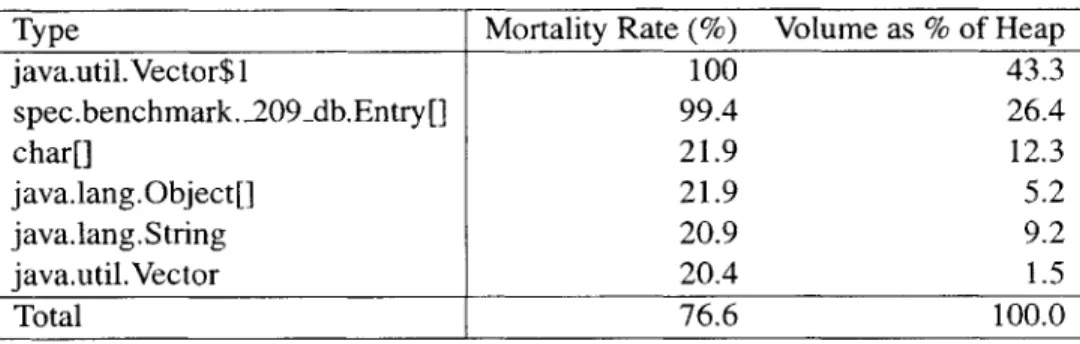
In typed languages, age is not necessarily the only indicator of mortality. We found a strong correlation between the type of an object and its probability of surviving the next collection. Table 4.1 shows the approximate average mortalities of selected classes in _209_db, a database written in Java from the SPEC JVM98 benchmark suite [Cor]. (See Section 6.1.) These mortalities were estimated by counting the number of bytes of each type immediately before and after a collection.
In this example, instances of Vector$1 and Entry [ ] have high mortality rates. The remain-ing types, includremain-ing Strremain-ing and char [ ] have low mortality rates. This is readily explained. Vector$1, for example, is an inner class used to iterate through the elements of a Vector. Instances of this class are only live for the duration of the iteration. On the other hand, strings (an instance of string coupled with an instance of char [ ]) are mainly used in this benchmark as fields of database records. Instances of these classes are live for the duration of the benchmark.
Type Mortality Rate (%) Volume as % of Heap java.util.Vector$1 100 43.3 spec.benchmark.-209_db.Entry[] 99.4 26.4 char[] 21.9 12.3 java.lang.Object[] 21.9 5.2 java.lang.String 20.9 9.2 java.util.Vector 20.4 1.5 Total 76.6 100.0
Table 4.1: Example mortality rates in _209-db. Fully-qualified class names (i.e., including the class' package) are shown.
Hence, it makes sense to avoid repeatedly copying strings.
Ideally we would measure the distribution of object lifetimes for each type, but we do not have the appropriate infrastructure. Dieckmann and H61ze provide this data for certain categories of types (e.g., all arrays of references) for the JVM98 benchmark suite [DH99]. Their results also show that objects of different types have substantially different mortalities and lifetimes.
4.2 Basic Scheme
Based on the above observation, we propose segregating objects by type and concentrating collection efforts on instances of those types most likely to be garbage. In the simplest case, the heap is partitioned into two spaces: hotspace and coldspace. These spaces are analogous to newspace and oldspace in an age-based generational scheme. Initially, all objects are allocated into hotspace. At the first collection, the collector measures the number of bytes by type before and after collection. If instances of some type occupy b bytes of the heap before collection and a bytes after collection, the average survival rate of the type is a/b. The average mortality rate is 1 - a/b = (b - a)/b. Now, all types are partitioned into two sets, cold and hot. Hot objects (i.e., instances of a hot class) have high mortalities; cold objects have low mortalities. The next section discusses the details of partitioning.
Subsequently, all hot objects are allocated in hotspace, while cold objects are allocated directly to coldspace. When memory is exhausted, a minor collection occurs. A minor collection in this scheme considers only objects in hotspace, much as a minor collection in a generational scheme considers only objects in newspace. When a minor collection cannot free enough memory, a major collection occurs. A major collection considers all objects.
Because type-based collection is similar in structure to age-based generational collection, the considerations listed in Section 3.1 still apply. The most important question is where to to place the survivors of a collection. In a purely type-based collector (i.e., one devoid of any age-based benefits), the collector always copies hot objects to hotspace and cold objects to coldspace. (In the terminology of Section 3.1, the number of times an object is copied before promotion, n, is infinite.) This can be difficult to implement, as the collector must maintain two "NEXT" pointers. As a compromise, we propose copying survivors of minor collections to hotspace, and survivors of major collections-hot or cold-to coldspace. However, it may make sense to copy all survivors to coldspace for the following reasons:
" If there is a correlation between age and mortality-as well as type and mortality-this will
result in less copying for the usual generational reasons. In other words, it may benefit a collector to consider both object type and age.
" If a cold object references a hot object 0, moving 0 (and all its children) to coldspace may
reduce the number of intergenerational pointers.
Another key question is when to recompute the type partition. For programs whose behavior does not vary much with time, the partition need only be computed once. For more complicated programs, the collector may need a mechanism to detect when the partition is inefficient and recompute it as necessary. In this case, the collector could consider the time-averaged mortality of each type. By doing so, the collector prevents unusual or inaccurate samples from causing a bad partition. We have not investigated such mechanisms.
Finally, object mortality could be measured in other ways. First, instead of considering every object, the collector might choose to randomly sample the heap. (This is discussed more in Section
5.2.3.) Secondly, one might gather mortality statistics during a trial run of the benchmark, compute
the type partition offline, and feed this partition to the collector during subsequent runs. This feedback model admits more time-consuming partitioning algorithms that examine how mortalities change with time. Finally, it may even be possible to estimate mortalities of each type at compile-time, though this is likely to be difficult.
4.3
Type Partitioning
At the core of the type-based collector is a means of partitioning types into hot and cold sets so that the mortality rate of hot types is significantly higher than the overall mortality rate. This section describes the issues involved in the partitioning process. First, we establish a theoretical estimate of the efficiency of a type-based collector. Efficiency is measured by the "mark/cons" ratio, the number of bytes copied during garbage collection divided by the number of bytes allocated. (This name is historical; in early LISP systems, new objects were created by the cons procedure.) The lower the mark/cons ratio, the more efficient the collector. Using this result, we give a partitioning algorithm that optimizes the mark/cons ratio in the absence of intergenerational pointers. Next we provide a more refined algorithm that accounts for intergenerational pointers. We conclude with a discussion of optimal partitioning algorithms.
4.3.1 Theoretical Efficiency
Assume for simplicity that survivors of a collection (major or minor) are always placed in coldspace. Assume we have partitioned all classes into sets C and H, for "cold" and "hot", respectively. Let n be the size of the heap. Let x be the fraction of allocated object in H. Note that 1 - x is the fraction of allocated objects in C. Let
f
be the fraction of instances of H surviving a minor collection. Letf' be the fraction of instances of C U H surviving a major collection. Assume that
f
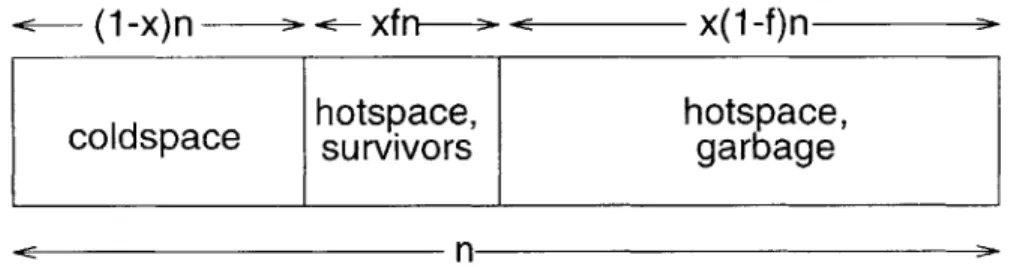
and f' are constant. (This means there are no age-based benefits.) For simplicity, also assume the absence of intergenerational pointers. In Section 4.3.3, we will consider their effects.Now consider a series of minor collections preceding a major collection. Before the first minor collection, n bytes of objects can be allocated on the heap. Of these objects, xn bytes will be hot. Now a minor collection occurs. Of the hot objects, f xn bytes will survive and (I - f)xn bytes will be freed. (All cold objects survive since they are uncollected.) This is illustrated in Figure 4-1.
Let T(n) be the volume of objects (in bytes, for concreteness) allocated on a heap of size n before the major collection. T(n) can be described by the following recurrence:
T(n) = n + T((] - f)xn)
T(O) = 0
(1 -x)n
33 <-xfn
<
x(1-f)n
hotspace,
hotspace,
coldspace
survivors
garbage
n
Figure 4-1: Illustration of a minor collection
collection, the fxn bytes of hot objects that survive must be copied. Thus G(n) can be described
by the following recurrence:
G(n) = f xn + G((1 - f)xn)
G(O) = 0
It can be shown by induction that
T (n) =T~)=1 - z + f x
xrif G (n) = 1 n
- x + f x
Now following the minor collections, one major occurs. f'n bytes must be copied during this collection. So given {C, H}, the mark/cons ratio for the sequence of minor collections followed by one major collection is
MCH-G(n) + f'n ' f
MC,H =
= xf
-f-(1 -x xf) T(n)4.3.2 Algorithm I
Algorithm I partitions types into {C, H} so that the mark/cons ratio MC,H is maximized, assuming the absence of intergenerational pointers. The basic idea is that the mortality rate of the collected region should be maximized, but the collected region should be large enough so that (expensive) major collections are infrequent.
Let H be a set of hot classes and U be the set of all classes. For any class u, let b(u) and a(u) be the volume of objects of type u immediately before and after a major collection. Let x(Y) denote
ZyCy x(y). b(U) and a(U) are the total number of bytes before and after the major collection.
Pseudocode for Algorithm I is shown in Figure 4-2. Note that Algorithm I runs in linear time with respect to the number of classes.
for each class i:
if [a(U) + b(U)]a(i) - a(U)b(i) < 0:
H = H U
{i}
#Place i in hotspace else:C= CU{i}#Place i in coldspace
Figure 4-2: Algorithm I. H is the set of hot types and C is the set of cold types.
The justification of Algorithm I follows. The values for x,
f,
andf'
described in the previous section can be approximated byb(H) b(U) _a(H) b(H) f a(U) b(U)
Hence the mark/cons ratio MC,H is
MC,H
b(H) a(H) a(U) b(H) b(H) a(H)
= b(U) b(H) b(U) b(U) b(U) b(H)
= k1(k2a(H) - k3b(H) + k4) = k1k4 + k1 (k2a(h) - k3b(h))
hcH
where
k2 = a(U) + b(U)
k3
=
a(U)k4 = a(U)b(U)
It follows that MC,H is minimized when
H = {h~k2a(h) - k3b(h) < O}
Remember, however, that Algorithm I assumes no intergenerational pointers. If the partition were to result in many pointers between coldspace and hotspace, there would be a high overhead from scanning intergenerational pointers.
4.3.3 Algorithm II
Algorithm II considers intergenerational pointers when partitioning types. It has two conflict-ing goals: maximize the mark/cons ratio while also minimizconflict-ing the number of intergenerational pointers. Algorithm II uses a heuristic to group related classes into pseudocomponents. These pseudocomponents are then partitioned into cold and hot sets using Algorithm I.
First, some terminology is in order. Let a runtime class graph G be a weighted directed graph so that
1. Each vertex of G represents a class loaded by the program
2. If G contains an edge with weight w from A to B, the program contains w references from instances of A to instances of B.
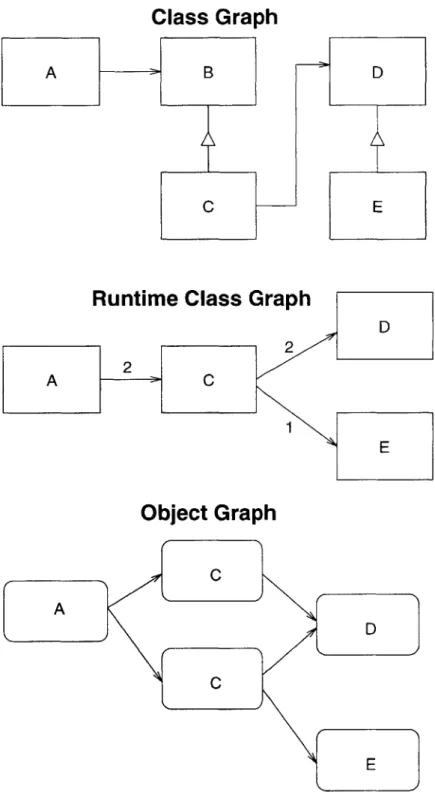
The runtime class graph changes during the program's execution. In particular, the fact that there is no edge between A and B does not imply that there could not be in the future. Figure 4-3 shows an example runtime class graph and its relationship to the so-called class graph and object graph. Appendix A shows example runtime class graphs for several benchmarks.
We say that a class A is a pseudopredecessor of a class B if the intergenerational pointers from placing A in coldspace and B in hotspace would be prohibitively expensive. In this case, the edge from A to B in the runtime class graph is said to be signficant. This is intentionally vague and might be defined several possible ways:
Class Graph
A > B
C
Runtime Class Graph
D 22
A
--- ->
C
EObject Graph
C
A C= EFigure 4-3: Relationship between class graph, runtime class graph, and graph is the only graph that show inheritance relationships.
object graph. The class
D
" There are more than k references between instances of A and B for some empirically determined k, i.e., w > k. This avoids intergenerational pointers. (Recall that w is the
number pointers between A and B.)
" The expected number of references between dead instances of A and (live or dead) instances of
B exceeds k, i.e.: b(A)-a(A) b(A) xw> X k. This avoids wasted copying because of intergenerational
pointers. (Recall that b approximates the probability that an instance of A is dead.) We define the pseudocomponents of a program to be the smallest partition
{S,
S2, ...}
ofthe set of all classes so that no Si contains a pseudopredecessor of Sj, for i # j. That is, the pseudocomponents are the components of the runtime class graph with all insignificant edges removed.
Algorithm II takes a snapshot of the runtime class graph (or its transpose) as input. This can be computed with relatively little overhead during the first major collection by recording the types of all pointers encountered. For example, when the collector traverses a pointer from a class A to a class B, it increments the edge from A to B in the runtime class graph. Then, the algorithm finds the pseudopredecessors of the program using modified depth-first search on the transposed runtime class graph. (Alternatively, one could remove the insignificant edges and then perform standard depth-first search.) Each pseudocomponent is treated exactly like a normal class in Algorithm I; it is added to hotspace if doing so will increase the overall mark/cons ratio. This is shown in Figures 4-4 and 4-5.
4.3.4 Optimal Algorithms
Clearly the choice of partitioning algorithm is crucial. Unfortunately, it is impossible to estimate the cost of intergenerational pointers from the runtime class graph alone (or the static class graph, for that matter). Consider, for example, the program illustrated in Figure 4-3. Here, an instance of type
A points to two distinct instances of type C, while the instances of C point to a single instance of
type D. If all classes but D were placed in hotspace, it would appear from the runtime class graph that each minor collection would have to copy two objects because of intergenerational pointers. However, the object graph reveals that a minor collection would only have to copy one object. The fundamental problem is that one cannot extract the object graph from the runtime class graph.
We can simplify the problem somewhat by assuming a fixed penalty p[A, B] of putting class
algorithm2(G):
#Precondition: G is a runtime class graph (V,E), where
# -V is the set of all classes loaded by the program
# -E is a set of weighted edges. The presence of an edge (v1, v2, w)
# means that w references were found between instances of class v1 and
# class v2. Of course v1 and v2 must be elements of V.
#Postcondition: returns a the set of cold classes C and hot classes H as
# a pair of sets (C,H), so that C+H=V. C and H are chosen in a way that
# maximizes the expected efficiency of the collector and minimizes the
# number of intergenerational pointers.
(V,E)=G C={} H={} for each v in V: unmark v for each vI in V: if vI is unmarked:
#1. Find members of pseudocomponent with depth-first search
stack=[vi] #stack used for search
S={vl} #the classes found in this component
mark v1
while stack =] vl=stack.pop()
for each child v2 of v1:
w=weight of edge between v1 and v2
#Note that we only examine significant edges
if v2 is unmarked and significant(vl,v2,w):
stack.push(v2)
S=S+{v2}
mark v2
#2. Looking at entire pseudocomponent, decide whether to place # in depth coldspace or hotspace.
if profitable(S)
H=H+S else:
C=C+S
return (C,H)
profitable(S):
#Precondition: S is a set of classes
#Postcondition: returns true if all members of S should be placed in # hotspace, or false if they should be placed in coldspace, assuming
# NO intergenerational pointers.
before=0 after=O
#Calculate byte counts of all classes in S. b(C) and a(C) are the #number of bytes of C before and after the last collection, as
#defined in Section 4.3.1.
for all classes C in S: before=before+b(C)
after=after+a(C)
#Now compute the profitability, as in Algorithm I (Section 4.3.2)
profit= [a (U) +b (U) ] after-a (U) before
return profit < 0
significant(vl,v2,w):
#Precondition: vl and v2 are classes, and w is the number of
# intergenational pointers between them.
#Postcondition: returns true iff placing v1 in hotspace and v2 in
# coldspace will cause an unacceptable overhead from
# intergenerational pointers. There are many possible
# heuristics; the simplest one is shown. return w>k
coldspace. In other words, this assumes the cost of intergenerational pointers from A to B is dominated by copying dead instances of B (i.e.: nepotism from A to B), and not the copying of objects pointed-to by B. We will not specify exactly how this penalty is determined. In addition, each class A has an associated value s[A] equal to the savings in copying-positive or negative-by putting that class in hotspace, as determined in Section 4.3.2. Hence the goal is of the partitioning algorithm is to find the partition {C, H} that maximizes
f (C, H) = s[h] -
Z
p[c,
h]hEH c,hEE
We do not know of a polynomial time algorithm to optimize this function. We do not even know of a polynomial time algorithm to verify a partition is optimal. The partitioning problem has similarities to other graph problems, but we have not proved or disproved that it is NP-hard. However, we suspect that Algorithm II is good enough for most programs, if tuned properly.
4.4 Discussion
A type-based collector will only perform well if it can find a type partition meeting the following
criteria:
1. Instances of hot classes have significantly shorter lifetimes than instances of cold classes
2. There are few pointers between cold and hot objects, and very few pointers between dead cold and dead hot objects
If the first condition is not met, the type-based collector will not be more efficient than a standard
collector. If the second condition is not met, the type-based collector will incur a high overhead from scanning intergenerational pointers and copying dead objects. Preliminary evidence for several benchmarks suggests that such partitions do exist, but it remains to see whether a broad range of programs meet these criteria.
If these conditions are met, a type-based collector has all the potential advantages of a
gen-erational collector: increased copying efficiency, better cache locality, and shorter average pause times. Again, this thesis is concerned only with those factors that affect the overall cost of garbage collection: efficiency and (to a lesser extent) cache locality.
In addition, the type-based collector has several advantages over generational schemes. First, an age-based collector copies each long-lived object at least once, when it is promoted from newspace
to oldspace. On the other hand, a type-based collector may never copy such objects; they are placed directly in oldspace. More importantly, the type-based collector may better adapt to programs and eliminate more write barriers than an age-based collector. These two points are discussed below.
4.4.1 Adaptation
We were initially drawn to alternative garbage collection techniques because we observed that different programs placed very different demands on the collector. For example, some programs had many long-lived objects, while others had few such objects. This led us to believe that any high-performance collector must be adaptive; no program should exhibit its worst-case performance. There has been little work in this area. (See Section 3.1.) Unfortunately, we found it difficult to fashion adaptive age-based collectors. It seems that statistics about object lifetimes are difficult to measure at runtime.
In contrast, it is easy for a type-based collector to adapt to the program. Statistics about object types are readily and cheaply measured. While it is possible to make a type-based collector that is not adaptable-one might decide a priori to place all arrays in coldspace, for example-there seems no good reason to do so. Ultimately we feel the ability to adapt gives type-based collection an advantage over generational techniques.
4.4.2 Write Barrier Elimination
Recall from Section 3.2 that a generational collector cannot statically eliminate most write barriers in languages such as Java that separate object allocation and initialization. This does not necessarily mean more cards will be marked, as each write barrier may check whether a pointer is indeed intergenerational. However, it does mean that every pointer store will require some overhead.
In contrast, a type-based collector can disable many write barriers using type information; a store from type A to B only needs a write barrier if A is cold and B is hot. In the example from Section 4.1, the collector can disable all write barriers for stores from String to char [ ]. This increases overall performance in two ways; the mutator is faster since fewer pointer stores have
write barriers, and the garbage collector is faster since fewer cards are spuriously marked.
The details of write barrier elimination are highly dependent on the programming language and its implementation. For example, if the type partition changes after it is initially computed, certain write barriers might require re-enabling. Also, the number of write barriers that can be eliminated will depend on the amount of type information available at compile time, and on the language's
treatment of subtyping. Section 5.4 explains in detail how our collector for a Java Virtual Machine eliminates (and "un-eliminates") write barriers.
Chapter
5
Implementation
We have implemented the type-based collector for JFEX, a high-performance Java Virtual Machine
(JVM) in development at Compaq for Alpha workstations running Tru64 UNIX. JFEX features a
Just-in-Time Compiler (JIT) that dynamically compiles frequently used methods to Alpha machine code. Other methods are interpreted to avoid the overhead of compilation. Compilation is done lazily, i.e, when a method is called.
Implementing a collector for a large and (necessarily) complicated virtual machine is potentially time-consuming. Alternatively, we could have simulated the collector using program traces [DH99], but it is our experience that implementation details can dramatically affect overall performance. Likewise, implementing the collector for a research virtual machine might artificially mitigate the cost of garbage collection if the compiled code were slower. Fortunately, we were able to base our implementation on the original JFEX collector. This saved us from rewriting much tedious code
such as root scanning.
This chapter describes the details of that implementation. Section 5.1 describes the original
JFEX collector. Section 5.2 describes several changes we made to enable type-based collection.
Finally, Sections 5.3 and 5.4 describe two optimizations that proved critical for good performance:
(1) triggering major collections and (2) eliminating write barriers.
5.1
Original Collector
JFEX originally used Bartlett's mostly-copying collector [Bar88], a conservative extension of the
basic Cheney algorithm. (See Chapter 2). Bartlett developed this collector for use in uncooperative environments such as C and C++. Hence it requires no knowledge of the layout of registers or the
stack.
In this scheme, the heap is divided into contiguous blocks of memory called pages. (Here, "page" has nothing to do with virtual memory pages.) Pages in tospace are labelled with an odd identifier; pages in fromspace are labelled with an even identifier. Hence fromspace and tospace are no longer contiguous. Objects may be moved to tospace in one of two ways: by physically copying the object to a tospace page in the usual fashion, or by relabeling the page on which the object resides. Allocation is now a two-step process; first, find a page with free space. (This is generally the page used for the last allocation.) Then, return a pointer to the beginning of free memory in that page. Large objects may span multiple pages. We shall call the location used for the next allocation the allocation point.
Garbage collection now works as follows: first, the registers and stack are conservatively scanned for potential pointers to the heap. For each possible pointer, the page on which the pointed-to object resides is promoted pointed-to pointed-tospace by relabeling its space identifier, and the page is queued. Note that no register or stack locations are modified. Now, each page on the queue is scanned in the same way that the Cheney algorithm scanned tospace. All pointed-to objects in fromspace are copied to the location NEXT in tospace. The only major difference is how the NEXT pointer is computed; whereas the Cheney algorithm simply increments NEXT, Bartlett's algorithm calculates
NEXT with the two-step allocation process described above. It follows that when a new page is
allocated during collection, it must be added to the queue.
Conservative collection was required in Java 1.0 since native methods could contain pointers to the heap. In Java 1.1 and 1.2, native methods must register heap references so a copying collector can be used [Sun97]. Neverthless, JFEX uses Bartlett's collector for several reasons:
" In our experience, conservative stack scanning is much faster than precise stack unwinding
and results in negligible excess retention.
" Large objects can be collected by simply promoting the pages on which they reside. This
dramatically reduces copying cost.
" There is little need for cooperation between the compiler and the garbage collector, so development is greatly simplified.
JFEX also supports generational collection. When generational collection is enabled, pages