Computational Tools for Including Specificity in
Protein Design
by
Daniel J. Park
Submitted to the Department of Electrical Engineering and Computer
Science
in partial fulfillment of the requirements for the degree of
Master of Engineering in Electrical Engineering and Computer Science
at the
MASSACHUSETTS INSTITUTE OF TECHNOLOGY
May 2002
©
Daniel J. Park, MMII. All rights reserved.
The author hereby grants to MIT permission to reproduce and
distribute publicly paper and electronic copies of this thesis document
in whole or in part.
Author .
... . ., .El .P.l. .n.g.i... nd Department of El orcaLngineering andCertified by
.
-
,-...
. ...
Computer Science May 24, 2002
...
Amy E. Keating
Assistant Professor of Biology
Th sis 8upervisor
A ccepted by ...
...
...
Arthur C. Smith
Chairman, Department Committee on Graduate Students
MASSACHUSETTS WSTITUTE OF TECHNOLOGY
JUL
3 12002
LIBRARIES
M Libraries
Document Services Room 14-0551 77 Massachusetts Avenue Cambridge, MA 02139 Ph: 617.253.2800 Email: [email protected] http://libraries.mit.edu/docsDISCLAIM ER
MISSING PAGE(S)The Archives thesis is missing pages
37-40. This is the best copy available.
3
Computational Tools for Including Specificity in Protein
Design
by
Daniel J. Park
Submitted to the Department of Electrical Engineering and Computer Science on May 24, 2002, in partial fulfillment of the
requirements for the degree of
Master of Engineering in Electrical Engineering and Computer Science
Abstract
Research in computational protein design has produced a number of algorithms that are empirically effective for selecting amino acid sequences that fold to desired protein structures. In comparison, the problem of designing proteins for desired functionality (e.g. binding specificity) has not been as well explored. This M. Eng. thesis aims to develop software for this purpose. Algorithms for sequence selection have been adapted from known algorithms for designing fold stability. The result of the thesis is a computational toolkit for biologists who wish to reengineer the structure and properties of protein folds or interfaces.
Thesis Supervisor: Amy E. Keating Title: Assistant Professor of Biology
4
Acknowledgments
Several individuals have contributed greatly to the work of this thesis:
" Amy Keating provided the motivation, guidance, funding, and relevant
back-ground material for this project, as well as feedback for this written document.
" Jiangang Chen provided the computational chemistry work and produced
and refined the energy function data sets that served as program input. Any biological applicability of this software is a result of his efforts.
Contents
1 Introduction 9
1.1 Thesis Structure. . . . . 10
1.2 Problem Introduction . . . . 10
1.2.1 Protein Design Difficulties . . . . 10
1.2.2 A Framework for Computational Protein Design . . . . 11
1.2.3 Modeling Assumptions . . . . 12 1.2.4 Energy Function . . . . 14 1.2.5 Objective Function . . . . 14 1.2.6 Search Algorithms . . . . 17 1.3 Past W ork . . . . 21 1.4 Problem Specification . . . . 21 1.4.1 Problem Statement . . . . 21
1.4.2 Exploring Objective Functions . . . . 23
1.4.3 Adapting Search Algorithms . . . . 25
1.5 Summary . . . . 27
2 Software Design 29 2.1 Design . . . . 29
2.1.1 Formalized Program Specification . . . . 29
2.1.2 Program Control Flow . . . . 31
2.1.3 Parallelization . . . . 32
2.1.4 Data Objects and Relationships . . . . 34
2.1.5 Code Modules and Structure . . . . 36
2.1.6 Portability Concerns . . . . 38
2.2 Algorithm Details . . . . 39
2.2.1 Monte Carlo Pseudocode . . . . 39
2.2.2 DEE Pseudocode . . . . 41
2.2.3 A* Pseudocode . . . . 42
2.3 Implementation Methodology . . . . 44
2.4 Current Status . . . . 44
CONTENTS
3 Validation
3.1 Background: Coiled Coils ... 3.2 Test Case 1: Side-Chain Packing . ...
3.2.1 Inputs . . . .
3.2.2 Expected Results . . . .
3.2.3 Actual Results . . . .
3.3 Test Case 2: Stability Design and Search 3.3.1 Inputs . . . .
3.3.2 Expected Results . . . .
3.3.3 Actual Results . . . . 3.3.4 Analysis . . . . 3.4 Test Case 3: Specificity Design . . . . . 3.4.1 Test Problems . . . . 3.4.2 Expected Results . . . . 3.4.3 Inputs . . . . 3.4.4 Actual Results . . . . 3.4.5 Analysis . . . . 3.5 Conclusion . . . . A File examples
A.1 Example input files A.1.1 control file . . . A.1.2 aa-input file A.1.3 pos-xlate file.
A.2 Example output . . . .
A.2.1 out-main file . .
Algorithm 45 45 47 47 49 49 49 50 51 52 53 54 54 55 55 57 60 61 63 63 63 68 68 69 69 6
List of Figures
1-1 Zinc finger design. Left: wild-type (PDB code: 1ZAA). Ball depicts
Zn2+ at core. Right: redesigned protein. . . . . 12
1-2 Example energy landscape for a given amino acid sequence . . . . 15
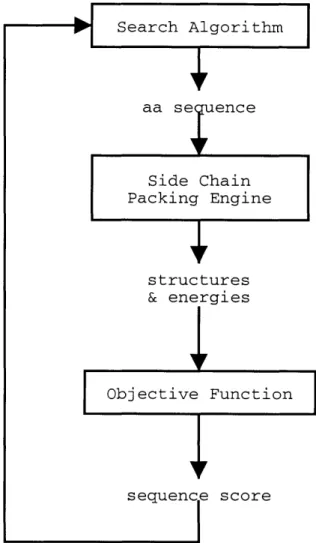
2-1 Program flow chart . . . . 32
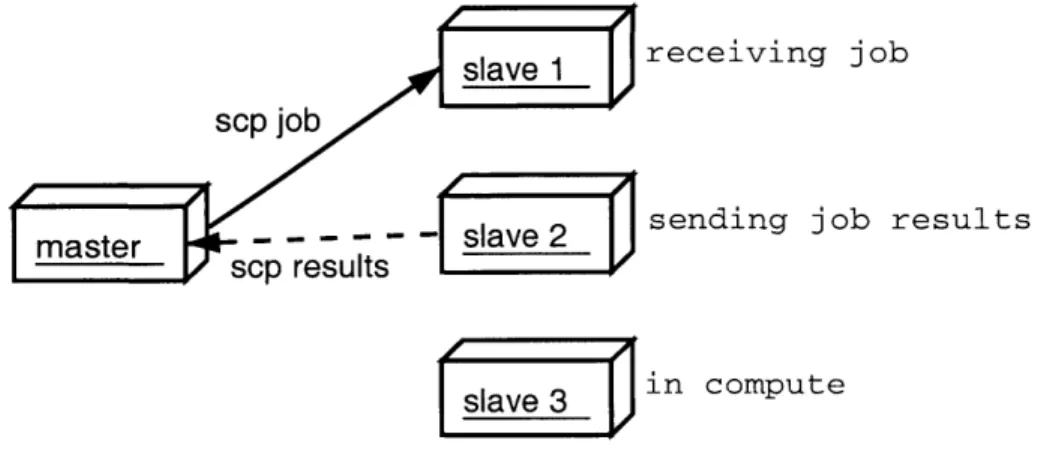
2-2 Parallel job distribution . . . . 33
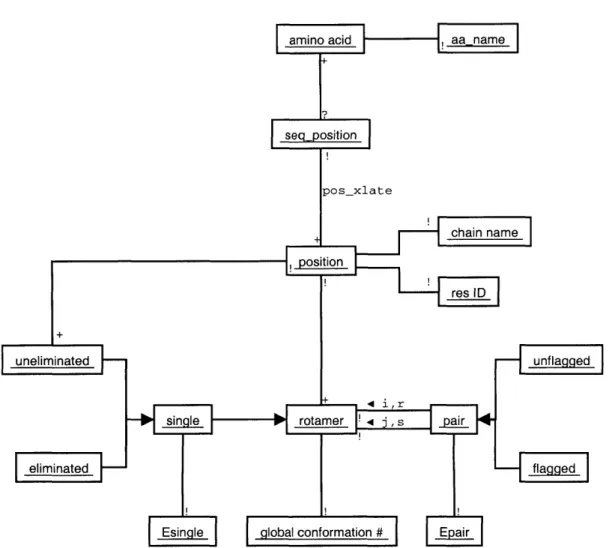
2-3 Program object model: state data . . . . 35
2-4 Module dependency diagram . . . . 37
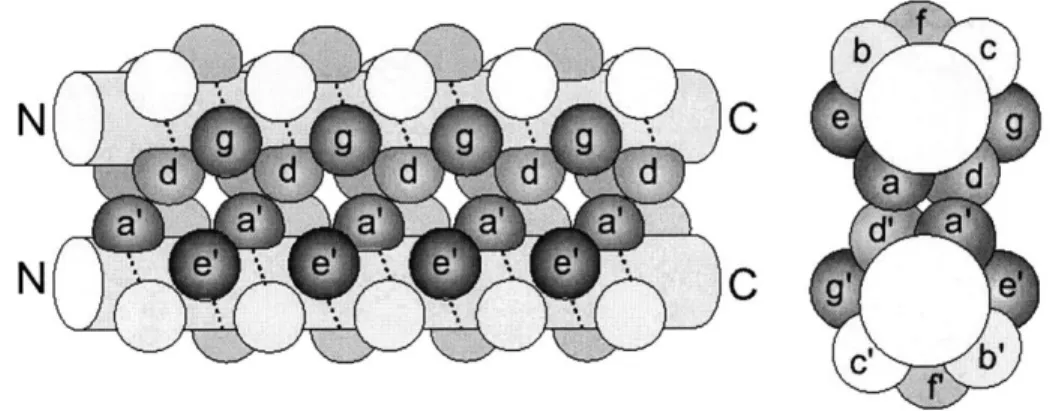
3-1 A typical coiled-coil dimer. Left: lengthwise view. Right: axial view. Each cylinder corresponds to one a-helix. The superhelical twist is omitted for clarity. Graphic taken from [39]. . . . . 46
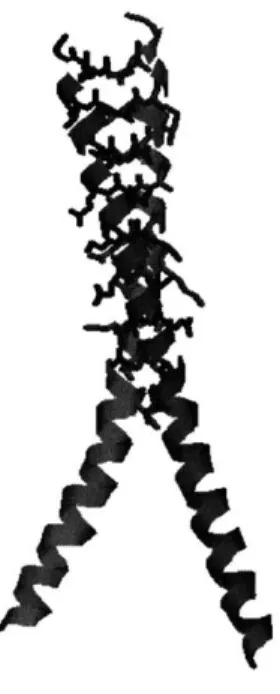
3-2 Fos-Jun heterodimer (1A02). The a-helix backbones (ribbons) form a supercoiled bundle. Side chains (sticks) are shown for the residues being repacked or redesigned in Test Cases 1 and 2. . . . . 48
3-3 Energy contour of the amino acid search space . . . . 53
3-4 GCN4-pl homodimer (2ZTA, left) and GCN4-pII homotrimer (IGCM, right). Side chains are shown for the a and d positions being redesigned. 56
Chapter 1
Introduction
Proteins are functional molecular units in biological organisms [2, 5]. They man-ufacture other proteins, regulate and replicate DNA, transport objects within and between cells, selectively catalyze biochemical reactions, convert various forms of en-ergy, and perform other complicated tasks. They are the focus of much research in biology.
Proteins are composed of amino acid residues, of which there are twenty different kinds. All amino acids contain a backbone component and a variable "side chain". The backbone component is the same in every amino acid. At the simplest level, a protein is just a strand of connected amino acids and can be uniquely identified by the sequence of the side-chain identities.
However, proteins are never linear in nature. Instead, the strand packs into a three dimensional structure that is energetically more stable in a process called protein folding. Both the backbone and side-chain groups have conformational flexibility. Folded structures can combine with other structures to form larger complexes. For a fixed environment, the folded structure is entirely a function of the sequence of amino acid side chains in the original strand [1]. A change in the original sequence often
CHAPTER 1. INTRODUCTION
results in a structural and/or functional change. Depending on the mutation, the change may be insignificant or drastic.
The "protein folding problem," predicting what structure a given sequence will fold to, is computationally difficult because of the sheer number of possible three dimensional structures. The reverse problem, the "protein design problem," is also computationally hard. This is the problem of selecting amino acid sequences that fold to desired proteins. This thesis explores and extends the research that has been done on the protein design problem.
The protein design problem is both theoretically interesting and biologically ap-plicable. Reengineering proteins can potentially allow researchers to alter the binding properties, and thus, the functionality, of gene regulators, antibodies, cell receptors and inhibitors. Consequently, protein design has the potential to aid the discovery of new therapeutics as well.
1.1
Thesis Structure
This chapter will cover background on the computational protein design problem, discuss issues related to specificity design and state the motivation for this thesis.
Chapter 2 discusses the design and implementation of the software. Chapter 3 discusses testing and validation.
1.2
Problem Introduction
1.2.1
Protein Design Difficulties
The goal in protein design is to select an amino acid identity and side-chain conforma-tion at each posiconforma-tion of the protein. This specifies both the sequence and the structure 10
1.2. PROBLEM INTRODUCTION
of the design. The protein design problem is difficult for a number of reasons:
" Many possible sequences - algorithms tend to scale poorly, as the search space of amino acid combinations scales exponentially.
" Many possible folds - the fold of a protein is determined by the backbone conformation. The number of possible three dimensional folds for a given se-quence is infinite. The calculation must identify a sese-quence that favors one desired fold over all others.
" Many possible side-chain conformations - amino acids contain flexible side chains that can pack into many different conformations. We must account for these conformations when attempting to calculate energies, but again, this increases the combinatorial size of the problem.
* Energy functions -our calculation of the energies of structures is approximate.
* Folding kinetics not well understood -our understanding of the biophysics
behind the process by which a protein folds is imperfect.
" Objective function - it is not entirely clear what we want to optimize, quan-titatively. For naturally occuring proteins, evolution optimizes a very complex function (one that includes stability, biological function, lack of biological harm-fulness, etc).
1.2.2
A Framework for Computational Protein Design
To make computational protein design tractable, it is common to simplify the problem in a number of ways. If we use a fixed backbone fold and select amino acids and side-chain conformations to optimize the energy of this single target structure, we no longer have to worry about issues of alternate folds, folding kinetics or complicated 11
CHAPTER 1. INTRODUCTION
objective functions. This simplified problem is more computationally manageable and has produced successful designs in recent years.
Figure 1-1: Zinc finger design. Left: wild-type (PDB code: 1ZAA). Ball at core. Right: redesigned protein.
depicts Zn 2+
A now-classic example of this approach involves the redesign of a small zinc
finger.[7] This is a protein that does not fold in the absence of zinc. Dahiyat & Mayo selected and packed a new sequence of amino acids onto to the original protein backbone. The newly designed protein had a structure very similar to that of the original target, as determined by NMR spectroscopy, even in the absence of zinc.
The "side-chain packing" problem emerges as a special case of protein design. In addition to assuming a fixed backbone fold, we also assume a fixed amino acid sequence. The problem that remains is determining the side-chain conformations-a subproblem of the protein design problem thconformations-at corresponds to protein side-chconformations-ain structure prediction.
1.2.3
Modeling Assumptions
Some additional assumptions we typically make: 12
1.2. PROBLEM INTRODUCTION
Water molecules removed - in nature, proteins exist in some environment that affects their folding. Most often that environment is mostly water. Because modeling hundreds or thousands of small water molecules in highly variable positions is computationally expensive, we cannot include them explicitly in the model.
Rotamers - the torsion angles between atoms in the amino acid side chains can be used to specify side-chain geometry. These are allowed to have any value. Since searching an infinite continuum of torsion angles is computationally infeasible, we restrict the torsion angles to a small number of discrete values, resulting in a finite number of side-chain conformations at any position. Each of these conformations is called a "rotamer." In nature, torsion angles are found to be biased towards a small number of finite angles
[35].
These are the angles we choose for our "rotamer library."Linear and pairwise energy functions - Many search algorithms heavily exploit the ability to decompose an energy function describing the protein in a lin-ear and pairwise manner. Define Ek(a1,... , an) as the energy of the sequence
a1,... , an on backbone k. We would like to decompose it in this way:
Ek(a,, . . . , an) = Ek +h &k()-+ E k(jrjs) (1.1)
where &k is the energy between backbone atoms and fixed residues that are not being designed, Ek(ir) is the interaction energy between a selected rotamer ri at position i with the backbone atoms and fixed residues, and ek(ir,
js)
is the interaction energy between two selected rotamers at distinct positions i and j.All these assumptions and approximations serve to make the problem more tractable
computationally.
CHAPTER 1. INTRODUCTION
1.2.4 Energy Function
We must choose a representation of the potential energy of a particular state, given all of the selected amino acids and side chain positions. Energy functions that
accu-rately model the physical system typically include contributions from van der Waals interactions, electrostatic forces, torsion angles, bond lengths and bond angles. This becomes further complicated when corrections need to be made for various modeling
assumptions. In particular, in order to accurately describe electrostatics in a polar solvent without modeling each water molecule, approximate solvation energy terms must be introduced. Also, some energy terms cannot be easily decomposed in a linear
or pairwise manner and doing so would itself be an approximation [14].
The Keating Lab and others are developing effective energy functions that correct
for the modeling assumptions. However, research in this area is not within the scope of this thesis.
1.2.5 Objective Function
What exactly do we want to optimize and how do we want to quantify it? If we assume
that a single target state is being designed for, then we want to select the amino acids
that maximize the probability of occupying the target state. A 2-D representation of the rough energy surface that characterizes protein fold space is shown in Figure 1-2.
The most physically justifiable objective function to maximize is Pko, the
proba-bility of occupying the desired state ko given the selected sequence. This probaproba-bility
can be computed from the energy function via the Boltzman relation:
e-BEko
max Po, Pk = (1.2)
Zk eiEk 14
1.2. PROBLEM INTRODUCTION 15
- - - -- -- - - - - - - - -- -- - - - - - --iE- - - --
--E kI E ko
Possible folded states
Figure 1-2: Example energy landscape for a given amino acid sequence
where the summation occurs over the set of all possible states. This summation is dominated by two major components:
* A small number of low energy states - the exponential exaggerates energy dif-ferences to the extent that the terms corresponding to low energy states are much larger than those corresponding to high energy states.
* A large number of high energy (unfolded) states - since there are many more high energy states, the sum of these states contributes to the summation as well.
The non-linearity of the objective function in (1.2) can present problems. We can try to make it appear more linear by optimizing the negative log:
min(- log P0 )/, (- log Pk)/f = Eko + logE e-#Ek (1.3)
CHAPTER 1. INTRODUCTION
for some search algorithms. Even worse, it requires an enumeration through all pos-sible states. Saven reviews a number of metrics [36] that simplify this function:
1. min Ek = the potential energy of the desired state. Advantages: easy to
com-pute and results in a linear and pairwise objective function. Justification: se-quences with low E, often have high energies on other backbones. However, this sacrifices the ability to design against undesired states and does not take into account energy differences between different sequences in the unfolded state.
2. max A0,1 = Ek, - Eo= energy gap between minimum energy fold (ko) and "sec-ond best" energy fold (ki). Justification: Ek e-lEk in (1.3) will be dominated
by the lowest energy Ek aside from ko, which is Eki. This reduces the entire expression to the minimization of Ek - Ek, alternatively the maximization of
Ek1 - Eo. However, E, is still difficult to find because k, is difficult to find and it still ignores the unfolded states.
3. maxA = (Ek)kEU - Eo= difference between the energy of the target fold (Eko)
and the mean energy of all unfolded states ((Ek)). Justification: expand the sum in I log Ek e-Ek in (1.3) as described in [36, p. 3122]. The largest term is (Ek)kU. Difficulty: U is large and hard to define. Variations: average over a
small number of user-specified unfolded states or a single representative state. Justification: the user may know which unfolded states are of design interest.
4. min AG = AH - TAS = free energy of folding, which includes both potential energy and entropy (S). Justification: this is equivalent to the original objec-tive function, max Pko. Difficulty: entropy term makes function non-linear and cumbersome to calculate. Also, since this is ultimately a difference in free ener-gies between the target and unfolded state, it requires a model for the unfolded state.
1.2. PROBLEM INTRODUCTION
Decisions: most researchers have chosen to optimize for folding stability, specifically the appoximation of A, where only a crude approximation of a single, representa-tive unfolded state is used to model (Ek)kEU. Developing algorithms that explicitly account for more undesired states will require exploration of some of these alternate quantifications of max Pko.
1.2.6
Search Algorithms
Some choices we must make in the design of the algorithm:
" Speed/runtime - we want our algorithms to run in a reasonable amount of time.
* Optimality -is our algorithm guaranteed to find the optimal solution(s)? What
guarantees can we prove about the output of the algorithm?
" Theoretical basis - how sound is the algorithm theoretically? Can we prove anything about its output, its worst case run time, its average runtime or any invariants? Or is the algorithm supported by purely empirical results and test-ing?
* Physical basis - how sound is the algorithm physically? Is it optimizing phys-ically or chemphys-ically meaningful values (energies, probabilities, etc) or, again, is it supported only empirically?
The above factors may vary for different design problems, thus, for side-chain packing purposes, we chose to implement a variety of algorithms described in litera-ture and make all of them available.
CHAPTER 1. INTRODUCTION
Randomized Algorithms
Monte Carlo is a stochastic algorithm that randomly initializes points in the search space and then repeatedly tests small random modifications to improve the objective function [19, 27]. The Monte Carlo main loop consists of two basic steps: 1) random walk and 2) decision to accept or reject. The decision criteria is as follows: if the random walk results in an energetically favorable change, accept it. Otherwise, accept the move with a certain probability. The probability is a function of the energy difference and a temperature factor. The Simulated Annealing approach is similar, but adds a gradual decay to the temperature factor [38]. This allows the algorithm to make higher risk moves early in the cycle and conservative ones towards the end.
The Monte Carlo algorithm does not guarantee optimality of its results, but longer runs of Monte Carlo will increase the likelihood that low energy solutions will be found (optimal or close to optimal). Various tricks, such as the quench technique, can improve the energy of the final side-chain pack configuration [40].
Genetic Algorithms perform a similar search, but run on populations of configura-tions, instead of single configurations [8]. Configurations also replicate and compete with each other in a processes intended to mimic Darwinian natural selection. The best configurations at any given time during the search will occasionally swap seg-ments in a meiosis-like fashion in order to gather favorable subsets of rotamers into the same configuration.
Genetic Algorithms, though straightforward to implement, have not been included in our software as a side-chain packing algorithm. Comparisons have shown that, for the side-chain packing problem, the optimality of results generated by Genetic
Algorithms do not differ significantly from those generated by Monte Carlo [40]. 18
1.2. PROBLEM INTRODUCTION
Dead End Elimination
Dead end elimination algorithms act to prune poor rotamers from the search space. They do so by examining a particular rotamer at a position on the backbone and determining whether any other rotamers at that position are always more favorable, regardless of the configuration of the remainder of the protein
[9].
E(i,) - E(i,) + 1 min [E(ir, jt) - E(is, j)] > 0 (1.4)
Equation 1.4 describes the elimination criterion for the first order singles DEE method [13]. If an i, and i, exist that satisfy this equation, we say i, has been
eliminated by is by the DEE criterion and remove i, from the search space.
There are many variations of DEE algorithms, from the original Desmet formu-lation to more rigorous criteria. In particular, we have implemented: zeroth order singles [9], first order singles [13], singles with conformational splitting [34, 29], "magic bullet" pairs [15], and first order pairs [23] with coefficient of extrema speedups [15].
All of these implementations provide a guarantee: no rotamer in the global
mini-mum energy conformation (GMEC) will ever be eliminated. DEE is not guaranteed to significantly reduce the search space, and it is not guaranteed to terminate quickly, but DEE will never eliminate the GMEC. Hence, it provide a means for an exact search for small problems.
DEE is effective at reducing the size of the search space by many orders of
mag-nitude, but often does not reduce it to a single solution. For this reason, it is often paired with a branch and bound algorithm to complete the rest of the search.
CHAPTER 1. INTRODUCTION
Branch and Bound
A* is a branch and bound search algorithm that attempts to descend through a
search tree in an intelligent search order [25]. It relies on effective ways to estimate the optimal energy with a lower bound. The closer this estimator is to the optimal energy, the less steps the A* algorithm takes to complete. However, highly accurate estimator functions are slow and increase the amount of time spent on each step of the A* algorithm.
A* is one of the few algorithms that is guaranteed to find the GMEC. However,
it is not guaranteed to terminate in a reasonable amount of time. Its runtime can scale exponentially for larger problems. Even worse, its memory consumption can also scale exponentially. For this reason, A* is generally only used on smaller, more tractable problems.
Self-Consistent Mean Field
These methods are based on constructing a probability matrix as a function of en-ergies, and an energy matrix as a function of probabilities as shown in equation 1.6
[21, 26, 22].
P'(ir) = eEi, /kT (1.5)
E'(ir) = E(ir) + E E P(js)E(Zr, js) (1.6)
j s
These two conditions can be iteratively run to convergence to compute final energies. This formulation assumes a pairwise independence of probabilities that is not realistic. As a results, SCMF methods are not guaranteed to find optimal solutions. Runtime is extremely fast, however, scaling effectively linearly, even for large problems.
1.3. PAST WORK
Semidefinite/Linear Programming
Very recently, the protein design problem has been formulated as an integer program
[10] and as a semidefinite program [4]. These programs are general theoretical models
for optimization problems and various algorithms exist for solving or approximating such programs.
1.3
Past Work
Though significant successes have been achieved in designing protein stability (e.g. Mayo [7]), a number of design problems point to the need for an approach that ac-counts for specificity. Sharma et al. designed a peptide to preferentially heterodimer-ize with a target protein [37]. It was important in this design process to explicitly disfavor competing states such as the peptide homodimer. In another project, De-Grado et al. designed a peptide receptor for calcineurin [11, 28]. This work also required a way to disfavor competing undesired states. More generally, the need for negative design becomes apparent whenever one is considering competing states that have high structural similarity to the target state.
Research in the area of specificity design has mostly progressed using simplified lattice models of proteins [20]. Approaches to pursuing specificity in the all-atom context that is relevant to the design of real proteins are comparatively unexplored.
1.4
Problem Specification
1.4.1
Problem Statement
We will develop algorithms for the computational design of proteins that output a set of selected amino acids chosen to optimize for a number of desired folds and against
CHAPTER 1. INTRODUCTION
a number of undesired folds. The algorithms take as input the backbone structures of each desired and undesired fold. By including bound protein-protein complexes as folds, one can use such algorithms to redesign a particular protein for desired interactions and against undesired interactions. Some notes about our new problem formulation and how it relates to the stability problem:
" The list of undesired folds must be finite and small. Our algorithms will not
search the infinite continuum of unfolded states for each amino acid sequence. This assumes that the user can characterize all of the "particularly important" undesired folds.
" This differs from the folding stability objective function in that multiple desired
and undesired states are explicitly described. Since most stability algorithms design for only a desired state, the binding specificity problem can be seen as a generalization of the folding stability problem.
" The search space of the new objective function differs from the old one. Folding
stability algorithms often search the space of rotamer possibilities (see section
1.2.3). However, rotamers have no universal meaning among different backbone
conformations. Thus, binding specificity algorithms search the space of amino
acid possibilities at each position.
" Side-chain placement is a subproblem of the binding specificity problem. During
the search, the algorithms will compare energies of selected amino acid sequences on given backbones. This energy greatly depends on the packing of the side chains of each amino acid. The energy of the sequence will be the energy of the best side-chain packing of that sequence. Fortunately, the side-chain placement problem is a special case of the the well-researched folding stability problem. Thus, established algorithms we have used for optimizing folding stability can 22
1.4. PROBLEM SPECIFICATION
be used to solve the subproblem of side-chain placement within our specificity algorithms.
1.4.2
Exploring Objective Functions
Ultimately, the choice of objective function will depend on what the user wants to optimize. The choice of objective function also affects the choice of search algorithm. This section will explore a few suggested mathematical representations of objective functions.
First, define "state" as a way to arrange a given number of residues with a fixed stoichiometry. Define U as the set of all undesired states and D as the set of all desired states. Ek is the energy of state k and is computed as described in section 1.2.4. What follows are some suggestions for linear and pairwise objective functions:
1. Maximize the energy gap between the probability weighted average of the
de-sired states and the average of the undede-sired states. This is a parallel of function
3 in section 1.2.5 (A). We can quantify it in the following way:
maxf, f = 1 ckEk -
>3
ckEk (1.7)kcU kcD
where EkCUUD Ck = 1. The most sensible coefficients to assign are the Boltzman
probabilities :
e--Ek
ck = Pk - (
Unfortunately, the Pk are not constant with respect to Ek, so our objective function is no longer linear. Instead we can choose arbitrary constants {ck}, but it is not clear how to choose these values in a meaningful, non-empirical way.
CHAPTER 1. INTRODUCTION
2. Maximize the probability of occupying desired states. This parallels function 4 in section 1.2.5 (Pfld). For example: if a heterodimeric binding between proteins A and B is desirable, but homodimeric bindings are undesirable, then the desired state can be specified as AB and the undesired states as AA and
BB. This can be captured in the equilibrium equation
AA+BB V AB+ AB
To maximize the probability of occupying the right half side of the equilibrium, we maximize PAB where
e-2EAB
AB e-EAA-EBB ± e- 2
EAB e2EAB-EAA-EBB + 1
To maximize PAB, we need to drive the exponent towards -oo. This gives us the following function:
max f, f = EAA + EBB - 2EAB
Or more generally:
max f, f = ckEk -
Z
ckEk (1.9)kEU kED
Where the {Ck} correspond to the weights in the balanced equation. This ob-jective function is equivalent to maximizing the difference in stabilities of the two competing states under the assumption that they are equal in energy when unfolded (a commonly made assumption). It becomes more difficult to quan-tify, however, when all of the desired binding properties of a protein cannot be captured in a single equilibrium equation. For example, if the input included an undesired unfolded state UA + UB, we might have multiple equilibrium equa-24
25
1.4. PROBLEM SPECIFICATION
tions:
AA+ BB AB+ AB
UA +UB # AB
This would give us multiple functions to maximize:
f1 = EAA + EBB - 2EAB
f2 = EuA + EUB - EAB
Which roughly corresponds to:
fi
: optimize for specificityf2 : optimize for stability
As before, any method for unifying these criteria into a single objective function seems arbitrary:
maxf, f =Alf,+ A2f2 +...+ Anfn (1.10)
1.4.3
Adapting Search Algorithms
We must choose at least one algorithm for selecting sequences for specificity design. This section details the considerations made in determining which of the algorithms used in stability design (see section 1.2.6) to adapt to the specificity problem.
Randomized Algorithms
Monte Carlo and genetic algorithms are a natural choice and can be adapted easily to the new problem. Irbick et al. have explored a Monte Carlo approach to the
CHAPTER 1. INTRODUCTION
specificity problem using a lattice model [20]. These algorithms can optimize almost
any objective function that can be stated mathematically, and therefore don't require a linearization of Pko. However, these functions give us no guarantees on the opti-mality of the output. This may be one of the most promising leads, however, as the
larger search space size of the specificity problem may make most other algorithms
impractical.
Self Consistent Mean Field
The literature on applying self-consistent mean field (SCMF) algorithms to the bind-ing specificity problem is very recent and deals with adaptbind-ing these statistical me-chanics algorithms. Harbury proposes an SCMF approach to optimize a sequence
for a single desired state and against a number of undesired states [18]. Saven also explores a self-consistent approach using a lattice model [42]. As before, the SCMF formulation should provide a quick solution, but suffers from the assumption that the probabilities are pairwise independent and thus provides no guarantees on the
optimality of the output. Empirical testing would be necessary to determine its
use-fulness.
Dead End Elimination
DEE is an algorithm that works surprisingly well in the stability problem, but in designing for specificity, there are reasons to think it may not work well at the amino acid level. Using DEE at this level would require the elimination of all conformations of an amino acid on all given backbones as opposed to single rotamers on a single
backbone. The latter problem is more tightly constrained and leads to a significant number of eliminated rotamers. The specificity problem has fewer constraints and
may lead to fewer eliminations. However, since DEE is an empirically-justified algo-26
1.5. SUMMARY
rithm, the only way to know is to test its performance. The challenge: we need to determine a pairwise formulation of the energy functions.
Branch and Bound
Since this algorithm doesn't scale very well, it is uncertain how it will handle the larger search space for the specificity problem. Its success, as before, will depend on whether we can write good energy estimators. Also, branching at the amino acid,
rather than rotamer, level complicates the search.
Semidefinite/Linear Programming
Modeling the problem this way is challenging. Some questions to consider: can we linearize the energy function? Will we attempt to find an approximation algorithm [12] or attempt to find an exact solution in a theoretically unbounded amount of time
[10]? Is an approximation algorithm even possible [4]? Since we haven't dealt with
this algorithm before, we will not initially implement it for sequence selection.
Algorithm choices
Only the Monte Carlo algorithm will be implemented at first. Future search algo-rithms can be added later.
1.5
Summary
Algorithms for effective in silico protein design have undergone most of their develop-ment in recent years. A number of empirically effective algorithms exist for identifying amino acid sequences that fold to desired states.
28 CHAPTER 1. INTRODUCTION
With respect to the folding stability problem, designing proteins for binding speci-ficity is comparatively uncharted. There are a number of design problems that can most effectively be addressed with a specificity design approach. This thesis aims to implement software that can address these.
The purpose of this thesis is to develop a computational toolkit for biologists who wish to reengineer the binding behavior of proteins or protein interfaces.
Chapter 2
Software Design
This chapter details the design and implementation of the protein design software. The documentation is current as of version 1.0.1.
2.1
Design
2.1.1
Formalized Program Specification
This program will provide a user with a number of algorithms to search the amino acid solution space for certain protein design problems. The user will be allowed to specify several parameters of the search without recompiling the program. These parameters include, but are not limited to:
1. different protein energy data sets.
2. algorithm(s) to use for amino-acid sequence selection and any associated op-tions.
3. algorithm(s) to use for side-chain packing (rotamer selection) and any associated
options.
CHAPTER 2. SOFTWARE DESIGN
4. a user definable objective function to maximize during the search.
The guarantees and limitations of the program will correspond to the guarantees and limitations of the various algorithms used (expected runtimes, guarantees on con-vergence or global minimum energy, etc). All required energy data will be provided
by the user. Program output will include a human and machine readable
represen-tation of the solutions found. The program will run non-interactively (stdin is not touched) and make use of parallel computing hardware.
Input files: control file
All user parameters are read through the control file. The control file is read line by
line. Valid end of line markers are CR (0x13), LF (OxlO) and '#' (hash). Blank lines are ignored. Any contiguous string of whitespace (space, tab) is treated as a single space.
The control file must contain several blocks that may be placed in any order. These blocks are: options, objective-function, spec-sequence, dee-sequence, and one or more backbone blocks. See Appendix A.1.1 for an example control file.
Input files: energy files
For each backbone there must be a corrseponding energy file. The file is binary and contains an 8-byte Intel-endian double for each rotamer at each position, followed by a double for each pair of rotamers. The order of entries is as follows. Self energies:
30
2.1. DESIGN
Where the number of positions is p and the number of rotamers at any given position
i is ni. This is immediately followed by pairwise interaction energies as follows:
E ((I1, 1), (2, 1)), E ((1,1 1),7 (2, 2)), ... ., E ((1,7 1), (2 , n2)), ... , E((1, 1), (p, nP)) . I E ((1,7 2), (2, 1)), E ((1,1 2), (2, 2)), . .., E ((1,1 2), (2, n2)), .... , E(( 1, 2), (p, np)), . E ((I1, ni) , (2, 1)), E ((I1, ni) , (2,7 2)), . .. ,E((1, ni), (2, n2)), ..., E ((I, ni1), (p, np))
,
. E ((2, 1), (3, 1)), E ((2, 1),1 (3, 2)), 1. .., E ((2, 1), (3, n3)), ... , E((2, 1),7 (p, np))
,
. E((p - 1, np_1), (p, np))
Output files
The program produces several similar output files. The main output file (specified
by the main-out-file command in the options block of the control file) contains the
rank ordered list of top scoring solutions. Each line contains the score followed by the amino acids selected at each design site. The first line is the highest scoring solution found and the nth line is the nth highest scoring solution.
The program produces a backbone output file for each defined backbone (specified
by the output command in the backbone block). Each line contains the energy, amino
acid and rotamer choices for the sequence in the corresponding line of the main output file. An example main output file is provided in Appendix A.2.1.
2.1.2
Program Control Flow
The program control flow is depicted in Figure 2-1. The search algorithm generates an amino acid sequence that ultimately results in a score; the algorithm uses the score in informing its next sequence choice. This score is generated by a user-defined objective function that depends on the energies of the amino acid sequence on each desired and undesired backbone state. Determining these energies requires the use of 31
SOFTWARE DESIGN
user specifiable side-chain packing algorithms.
-H,
Search Algorithm aa se4uence Side Chain Packing Engine structures & energies Objective Function sequenc e scoreFigure 2-1: Program flow chart
2.1.3
Parallelization
The protein design problem is broken into two separate subproblems: the amino acid sequence search and the side-chain packing problem (see section 1.4.1). Similarly, the software can be thought of as divided into two major pieces: the sequence search
32 CHAPTER 2.
2.1. DESIGN 33
engine and the side-chain packing engine.
slave 1 receiving job
scp job
slave 2 sending job results
master t
scp results
sIav e 3 in compute
Figure 2-2: Parallel job distribution
Since the sequence optimization algorithms call side-chain packing functions, the speed of sequence optimization is directly dependent on the speed of side-chain pack-ing. Thus, the most straightforward way to exploit a parallel computing environment is to run multiple side-chain packing engines. The division of labor is depicted in Figure 2-2. For N nodes in a computing cluster, there will be one node dedicated to amino acid search algorithms and N - 1 nodes acting as side-chain packing engines.
The master node sends a full sequence string for a given backbone to a free slave node. The slave node then computes the optimal side-chain conformations and returns the lowest energy and associated structure.
Inter-node communication occurs only between the master node and its slave nodes. During sequence selection, communication is slave node initiated. The hand-shake is as follows:
1. (master) Waits for any slave requests
2. (slave) Initiates data exchange (DXCHG) request. If slave has recently
CHAPTER 2. SOFTWARE DESIGN
to follow.
3. (slave) If results are available, send it.
4. (master) If data was received, it is saved on the master.
5. (master) If a new job is available, send job to slave, otherwise, send a WAIT
command. If the search algorithm is complete, send a SHUTDOWN command.
6. (slave) If job received, compute the side-chain pack. If WAIT received, pause
briefly and repeat from top. If SHUTDOWN received, exit program.
2.1.4
Data Objects and Relationships
Figure 2-3 contains a UML representation of the relationships between objects that the program needs to track. Boxes indicate a set of objects, lines represent relations between members of two sets. The punctuation markings indicate the multiplicty of the relation, where '?' indicates "at most one" (0 or 1), '!' indicates "exactly one"
(1), '+' indicates "at least one" (1 or more), and the absence of punctuation indicates any multiplicity (0 or more). Thus, we see that every amino acid is related to at most one seq-position, and that every seq-position is related to at least one amino acid. And since every position is related to exactly one seq-postion, we can also infer that every position must be associated with at least one amino acid (through seq-position) and that each of those amino acids has exactly one aa-name. Furthermore, since this is a description of software design, we can also infer that the program contains a bug if we ever find that a position is associated with no amino acids during runtime.
Some relations have names (ie, posixlate relates the sets seq-position and position), but most do not. Some names are directional. For example, every pair is related to exactly two rotamers, one called i,r and the other j,s. The name "i,r" is directional in that it refers to the rotamer, not the pair, in the relation.
2.1. DESIGN
res I
uneliminated - unflaqed
_single rotamer A j pair
eliminated -- flagged
Esingle global conformation # _Epir_
Figure 2-3: Program object model: state data
35
amino acid - aa name
?
seq positio
pos-xlate
chain name
CHAPTER 2. SOFTWARE DESIGN
Lines with solid triangles have a special meaning. They indicate a partition rela-tionship. The figure indicates that uneliminated and eliminated are subsets of single and completely partition it. This means that all elements of single are either elements of uneliminated or eliminated, but not both. This also means that single is the same set-or another name for-rotamer. Notice that the following assertion can be made from this model: a position is required to be associated with at least one rotamer,
some of which may be eliminated, but at least one of which must be uneliminated. If there is ever any position that has no uneliminated rotamers during runtime, there is a bug in the program.
2.1.5
Code Modules and Structure
The module dependency diagram (MDD) details the overall structure of the code and can be seen in Figure 2-4. Its purpose is to describe the intended relationships of the modules and submodules of code. These relationships are part of the module specifications. To change dependencies in this diagram is to change the overall design and the specifications of the functions in the affected modules.
Arrows denote a dependency of the implementation of one module on the
specifi-cations (not implementations) of another-a spec change to a function in one module
may require implementation changes in all modules that point to it. Note that every module within the side-chain packing package is dependent on the specifications of the data module in the backbone package.
To add new side-chain packing algorithms to the program, one creates a new function and adds it to an existing module (e.g. dee-pairs) or creates a new module, if appropriate. This new function may use the data module functions (if it uses functions from any other existing module, it represents a significant program design change). The scp-ctl module must then be modified to incorporate the new function: 36
M9L
ibries
Document Services Room 14-0551 77 Massachusetts Avenue Cambridge, MA 02139 Ph: 617.253.2800 Email: [email protected] http://libraries.mit.edu/docsDISCLAIMER
MISSING PAGE(S),The Archival copy of this thesis is missing
pages 37-40. This is the most complete version
available.
2.2. ALGORITHM DETAILS
side-chain packing engine.
1. Random initialization. If C is the specified number of cycles, Generate C
ran-domly initialized sequences and enqueue for scoring. Create a temperature array of size C and seed with initial temperatures.
2. Wait for result. Wait for a sequence to finish scoring.
3. Decision. If the returned score is higher than the previous score for this cycle,
or if this is the first score computed for this cycle, accept the new sequence. Otherwise, accept the new sequence with probability P = exp -AE/kT.
4. Random walk. At a random position, a residue is replaced with a new, randomly chosen amino acid. Unless the number of steps for this cycle have completed, enqueue the new sequence for scoring. Anneal temperature by a small amount.
5. Repeat from step 2. This loop repeats until the job queue empties.
2.2.2
DEE Pseudocode
DEE is a pruning algorithm for side-chain packing. There are many variants described
in the literature, with widely varying runtimes. This section will not describe every variant of the DEE algorithm, but will illustrate the most commonly used form we call "first order singles." It is first described in [13].
Let i and j be positions on the backbone, r and u be rotamers at these positions respectively, and t be a rotamer on i that attempts to eliminate r. The first order singles algorithms is as follows.
for all positions i
for all uneliminated rotamers r on i
for all uneliminated rotamers t on i where r != t
CHAPTER 2. SOFTWARE DESIGN
X = E(i,r) - E(it)
for all positions j where j != i
D = +inf
for all uneliminated rotamers u on
j
d = E((i,r),(j,u)) - E((i,t),(j,u))
D = min(d, D) end-for u
X = X + D
end-for
j
if X > Ecut, eliminate rotamer r on i
end-for t
end-for r
end-for i
User-specifiable options include: the variant of DEE being executed, whether to repeat the algorithm to convergence, and the number of splits (for conformational
splitting only).
2.2.3
A* Pseudocode
A* is a branch and bound algorithm that is described in [25]. Partial solutions, that
is, solutions with some fixed rotamers and some undefined, are stored in a heap along with two quantities: g and h. g is the energy of all fixed elements in the partial
solution. h is an estimate of the energy of the undefined elements. There is one requirement for h: it must never overestimate the energy of the undefined elements.
That is, the energy of any possible combination of unassigned rotamers must be greater than or equal to h. The estimated total energy of a partial solution is then
f =g+h.
2.2. ALGORITHM DETAILS
A* operates by extracting the partial solution with minimum f from the heap.
It then selects one of the undefined positions and expands it by placing each allowed rotamer successively in that position. Each of the new partial solutions generated this way has exactly one more fixed rotamer than before, and the entire set of new partial solutions with estimated energies is inserted back into the heap. This cycle then repeats until a complete solution (a solution with no undefined rotamers) is extracted. The algorithm is illustrated below:
insert a node with no fixed rotamers into heap while no complete solutions have been found
node = extract min node from heap
i = the first undefined position in node
for all valid rotamers r on i create newnode where
newnode.fixedrots = union of node.fixedrots and (i,r)
newnode.g = node.g + E(i,r) + sum E((i,r), node.fixedrots)
newnode.h = energy estimate of remaining undefined positions
insert newnode into heap end-for r
end-while
Since the energy estimator implementation can have a problem-dependent effect on runtime, we allow the user to specify one of two energy estimator functions: the Leach & Lemon estimator [25] or the Mayo estimator [16].
The order in which positions are expanded has also been shown to have an effect on runtime. The user may specify one of two ordering heuristics: Leach & Lemon ordering [25] or Mayo ordering [16].
CHAPTER 2. SOFTWARE DESIGN
2.3
Implementation Methodology
After the software was designed, implementation proceeded from bottom to top. Each step of the way, modules were tested to ensure they met their specifications. Debug-ging of C pointer problems was accomplished with the dmalloc debugDebug-ging library (dmalloc .com). Higher level or "holistic" tests of the software are outlined in the next chapter.
2.4
Current Status
The software continues to be maintained at the Keating Lab in the MIT Biology department.
Chapter 3
Validation
The remainder of this document aims to validate the software and establish whether it achieves its intended purpose. This chapter details a number of tests we have constructed and what we can determine from the results of those tests.
Though empirical testing of software cannot prove its correctness, we can gain a greater confidence in its functionality and, in particular, its biological utility from the results.
3.1
Background: Coiled Coils
All of the following tests involve modeling coiled coil proteins. The coiled coil is
the simplest and probably most common protein-protein interaction motif [30, 3]. Because a considerable amount is known about coiled coils
[6],
they provide an ideal case for testing computational models against established biochemical properties.A coiled coil consists of a number of a-helices supercoiled around one another
giving a superhelical bundle. Coiled coils have been shown to exist as dimers, trimers, tetramers and pentamers. The amino acid sequence can be easily mapped to the
CHAPTER 3. VALIDATION
coiled coil's three dimensional helical fold: every seven residues maps to two turns of the helix. Because of this pattern, researchers often label each residue based on its
position in the heptad with a letter a through g (see Figure 3-1).
U f
NC
NC
Sb'
Figure 3-1: A typical coiled-coil dimer. Left: lengthwise view. Right: axial view. Each cylinder corresponds to one a-helix. The superhelical twist is omitted for clarity. Graphic taken from [39].
It has been well established that the a and d positions greatly influence how coiled coils interact with each other. In particular, the residues at these positions have been shown to influence the oligomerization state (the number of a-helices in the bundle), helix orientation (parallel vs. antiparallel) and homo- vs. heterooligomerization [17,
31, 33].
Coiled coils present a particular need for specificity design. Because most coiled coils bear a structural resemblance to each other, designing for a desired interaction may inadvertently make a competing interaction more favorable. For example, when designing to stabilize a coiled coil dimer, the undesired trimeric form may be stabi-lized as well. Ultimately, we would like to test our program's ability to address this problem.
3.2. TEST CASE 1: SIDE-CHAIN PACKING
3.2
Test Case 1: Side-Chain Packing
Our first aim was to validate the side-chain packing engine. All of the code used in our side-chain packing engine was ported from a previous program we had written to design proteins for stability. Since the old software has already been tested, we need to verify that the new software produces the same structures and energies when run under the same conditions.
If we construct a test case that involves a fixed amino acid sequence (no sequence selection), protein design is reduced to the side-chain packing problem. Since there are no amino acids to select, the only task remaining to either program is finding the side-chain conformations that minimize energy.
3.2.1 Inputs
The specificity design program and the old stability design program were both run with the same backbone data, the same amino acid sequence, and the same packing algorithms. The only variable was the program itself.
Backbone data
We chose to repack residues at the interface of a heterodimeric coiled coil complex of interest to our lab (Fos-Jun, Protein Data Bank code: 1A02), pictured in Figure 3-2. The following a and d residues were repacked. Fos: 23, 26, 27, 29, 30, 33, 34, 36, 37, 40, 41, 43, 44, 47, 48, 50, 51. Jun: 21, 24, 25, 27, 28, 31, 32, 34, 35, 38, 39, 41, 42, 45, 46, 48, 49.
CHAPTER 3. VALIDATION
Figure 3-2: Fos-Jun heterodimer (1A02). The a-helix backbones (ribbons) form a supercoiled bundle. Side chains (sticks) are shown for the residues being repacked or redesigned in Test Cases 1 and 2.
Amino acid sequence
Both programs performed side-chain packing only-the amino acid sequence was fixed to the wild type sequence. Since there is only one amino acid sequence in the search space, a search algorithm for sequence selection need not be specified.
Packing algorithms
In each series of tests, we used the same side-chain packing algorithms. Only deter-ministic algorithms (A* with DEE, SCMF) were tested, so identical results can be expected from both programs.
3.3. TEST CASE 2: STABILITY DESIGN AND SEARCH ALGORITHM
3.2.2
Expected Results
Both programs should produce identical structures and energies when the same pack-ing algorithm is used.
3.2.3
Actual Results
For each side-chain packing algorithm tested, both programs produced the same struc-tures and energies. The resulting energies are listed below. Note that the DEE/A* solution is guaranteed to be the optimal solution.
Search Algorithm
DEE and A* SCMF, init flat SCMF, init zero
energy (kcal/mol) new program old program
-53.2102 -53.2102 +56.2674 +56.2674 -52.4571 -52.4571
This verifies the DEE/A* and SCMF components of the new side-chain packing engine.
3.3
Test Case 2: Stability Design and Search
Al-gorithm
Our next aim was to validate the ability of the new software to design proteins for stability. Since the side-chain packing engine was validated by the previous test case, this is effectively a test of the new software's search algorithm for sequence selection. Since most interesting problems in specificity design involve an extremely large search space, our primary sequence selection algorithm is Monte Carlo, a randomized 49
CHAPTER 3. VALIDATION
algorithm that has no guarantees on the optimality of its solutions. We want to es-tablish that Monte Carlo can minimally find a set of good (close to optimal) solutions on a small problem.
Since the old design software is only used to address the stability design problem a comparitively smaller search problem, it is equipped with slower, but exact, search algorithms such as the A* algorithm. Though this algorithm does not scale well, it is guaranteed to provide the optimal solutions for small problems. This output can be used to measure the effectiveness of our Monte Carlo sequence selection algorithm.
The test case we construct must be small enough for the old design program to fully explore so it can provide a list of the most optimal sequences in the search space (using the A* algorithm). Comparing the results to our Monte Carlo selection output should validate the effectiveness of the search algorithm and, equivalently, the ability of the new software to design proteins for stability.
3.3.1
Inputs
Backbone data
The same Fos-Jun interface will be used as in the previous test case. The same residues will be repacked, and in addition, the following residues will be redesigned: Fos: 40, 41, 43, 44. Jun: 38, 39, 41, 42. These positions comprise the a, d, e and g positions of one heptad on each side of the Fos-Jun interface.
Amino acid search space
Because the search space must be small enough for A* to search, amino acids with a large number of side-chain conformations (e.g. LYS, ARG, GLU, GLN) were excluded. The exception is at Fos positoins 41 and 43, where the wild type sequence includes
GLU and GLN residues. The search alphabet was restricted to the following: 50