HAL Id: hal-01065588
https://hal-sciencespo.archives-ouvertes.fr/hal-01065588
Preprint submitted on 18 Sep 2014
HAL is a multi-disciplinary open access archive for the deposit and dissemination of sci-entific research documents, whether they are pub-lished or not. The documents may come from teaching and research institutions in France or abroad, or from public or private research centers.
L’archive ouverte pluridisciplinaire HAL, est destinée au dépôt et à la diffusion de documents scientifiques de niveau recherche, publiés ou non, émanant des établissements d’enseignement et de recherche français ou étrangers, des laboratoires publics ou privés.
relocation and their impacts on employment
Guillaume Daudin, Jean-Luc Gaffard, Sandrine Levasseur, Catherine Mathieu,
Georges Pujals, Michel Quéré, Henri Sterdyniak
To cite this version:
Guillaume Daudin, Jean-Luc Gaffard, Sandrine Levasseur, Catherine Mathieu, Georges Pujals, et al.. Competition from emerging countries, international relocation and their impacts on employment. 2005. �hal-01065588�
C
OMPETITION FROME
MERGINGC
OUNTRIES,
I
NTERNATIONALR
ELOCATION AND THEIRI
MPACTS ONE
MPLOYMENTN° 2005-09
Juin 2005
Guillaume
Daudin*
Jean-Luc
Gaffard**
Sandrine
Levasseur*
Catherine
Mathieu*
Georges
Pujals*
Michel
Quéré***
Henri
Sterdyniak*
*OFCE** University of Nice Sophia Antipolis, Institut Universitaire de France, and OFCE-DRIC *** CNRS-GREDEG and OFCE-DRIC
Abstract
International relocation has become a topical issue in recent months, in France as elsewhere in Europe. This working paper is a set of four articles. Guillaume Daudin and Sandrine Levasseur provide an assessment of the impact of international relocation on French employment. Georges Pujals deals with offshore outsourcing in the financial sector from a European perspective. Catherine Mathieu and Henri Sterdyniak focus on policy measures taken or to be taken in face of job losses in the French economy. Jean-Luc Gaffard and Michel Quéré show that free competition alone is not optimal for European economies and that a combination of structural and growth oriented macroeconomic policies is needed.
Keywords: trade, competition, relocation, employment, emerging economies, industrial
economies
Contents
Foreword………p. 4
I. Offshore Relocations and Emerging Countries’ Competition:
Measuring the Effect on French Employment………p. 5
II. Offshore Outsourcing in the EU Financial Services Industry………… p. 27
III. International Relocation and Deindustrialisation:
some French Perspectives ……… p. 50
IV. Relocation: What Matters? Competition or/and a New Policy Mix……p. 62
Foreword
International relocation has become a topical issue in recent months, in France as elsewhere in Europe. Many economists think that the relocation process is not an issue Europe should worry about: the free-market will lead to an optimal situation; any protectionist measure would be an attempt to halt the emergence of developing economies. However, some economists think that the relocation process raises a number of issues in terms of economic growth and employment. Can European economies live without production industries? What should be done in face of unskilled job losses?
This working paper is a set of four papers initially prepared for the EUROFRAME-EFN Spring 2005 Report, a project funded by the European Commission, DG-ECFIN. The papers are available as Appendices of the Report at http://www.euroframe.org. Revised versions are also available in French in ‘Dossier : Concurrence des pays émergents, délocalisations et emploi’, Revue de l’OFCE, n° 94, July 2005.
COMPETITION
:
MEASURING THE EFFECT ONF
RENCH EMPLOYMENTGuillaume Daudin and Sandrine Levasseur*
From 1980 to 2002, French industry lost 1,450,000 jobs. The growth of imports from emerging countries suggests that trade with them might be the culprit. First, however, one must correct the raw employment loss number from the effect of the rise of temporary work and domestic outsourcing: thus corrected, the industrial job loss is reduced to 1,095,000. Offshore relocations to emerging countries are not well measured. They have entailed only 45,000 job losses between 1995 and 2001. Second, the paper reviews the evaluations of job losses linked to trade with emerging countries in general. Three methods have been used: the job content of trade, econometric studies and macro-economic models. None is fully satisfying. They indicate that there would be between 150,000 and 300,000 additional industrial jobs in France but for the rise of trade with emerging countries.
Introduction
As in many other developed countries, international relocations are currently a very hot topic in France. This can be readily concluded from the number of articles devoted by the French newspapers to this subject in 2004, compared to the preceding years (table 1). A heated debate already took place in the early 1990s, culminating with the reports of Arthuis and Devedjian in 19931. Recently, the new enlargement of the European Union to Central and
Eastern European countries (CEECs hereafter) and the suppression of quotas on textile imports, especially from China, have resumed fears about international relocations, which are assumed causing both employment losses and deindustrialisation of the French economy2.
* OFCE. [email protected]; [email protected]. The authors thank
George Gelauff, Catherine Mathieu and Henri Sterdyniak for their comments and advices.
1 Devedjian (1993) and Arthuis (1993).
2 Fears about international relocations, and more generally about trade with emerging countries, have resulted in
Table 1: Number of articles treating of international relocations in the French newspapers Research terms 2000 2003 2004 “Délocalisations” 215 879 4144 Of which “headlines” 10 53 453 “Délocalisations” + “chômage” 33 208 859 “Délocalisations” + “35 heures” 20 57 500 “Délocalisations” + “salaires” 30 138 709
“Délocalisations” + “chômage” + “salaires” 9 51 224
“Délocalisations” + “chômage” and/or “salaires” 54 295 1344
Translations: “Délocalisations” for international relocations, “Chômage” for unemployment, “35 heures” for the 35 hour working week and “salaires” for wages.
Source: Lexis-Nexis.
In this respect — at least up to recent months — the consequences of international relocations on labour force were viewed differently in France than in the United Kingdom or the United States. In these two latter countries, no strong labour market regulations prevent the divergence between skilled and unskilled wages3. Hence, international relocations are seen as exercising downward pressures on unskilled wages. In France, it is the growing unemployment of the unskilled labour force over the two last decades4 that is perceived by many citizens as resulting from French enterprises realising an increasing share of their activities in (or with) countries where labour costs are lower. However, this distinction is currently narrowing, as the public debate in the United States has been recently framed in terms of job losses and some French cases have received a huge amount of attention in the media and political circles about the possible adverse effects of international relocations on existing regulations. In the case of Bosch, the public was shocked to learn that an industrial firm was able to convince its workers of lengthening the 35-hour work week without any wage compensation, otherwise international relocation would occur. The current right-wing government is using the same argument to increase the support for structural reforms on the labour market.
While the debate is heated again, the underlying empirical data used by protagonists are mainly anecdotic evidence of very rough measures5. The goal of the present paper is to
3 For a comparison between France and the U.S., see Lefranc (1997).
4 The unemployment rate for males with low education (and then assumed "unskilled") rose from 5.4 % in 1981
to 13.5 % in 1994. By contrast, the unemployment rate for males with high education (and then assumed "skilled") increased from 3 % in 1981 to "only" 5.9 % in 1994. The gap for female unemployment rates by education level is even larger: see Strauss-Kahn (2003).
5 For example, Direction Générale du Trésor et de la Politique Économique (2004) simply states that 3.4 % of all
discuss and provide some empirical insights on the subject. First, we propose data on job losses in industrial sectors, corrected by temporary employment (interim) and domestic outsourcing. Second, we draw a review of empirical studies measuring the effects of international openness (including international relocations) on French employment.
Part 1: Development of industrial French employment over 1970-2002
1.1.What sectors are suspected of having suffered from international relocations?
Three types of development are needed to isolate the sectors that might have suffered from international relocations: for a given sector, imports and the trade deficit must grow faster than domestic demand while its share in the total employment must decrease. In the INSEE classification, five sectors correspond to that description from 1978 to 2002: clothing and leather products, fuel production, household equipment, electric and electronic equipment, and textile6. Leaving aside fuel production, the rise of imports in these “unskilled
labour intensive sectors from developing countries is impressive, as can be seen in figure 3.
Figure 1: French manufactured imports from ‘emerging industrial’ countries as a percentage of French GDP 0,0 0,5 1,0 1,5 2,0 2,5 3,0 67 69 71 73 75 77 79 81 83 85 87 89 91 93 95 97 99 01 Tunisie et Maroc
Turquie, Bulgarie et Roumanie PECO (UE-25)
Asie émergente
Figure 2: French manufactured exports to ‘emerging industrial’ countries as a percentage of French GDP 0,0 0,5 1,0 1,5 2,0 2,5 3,0 67 69 71 73 75 77 79 81 83 85 87 89 91 93 95 97 99 01 Tunisie et Maroc
Turquie, Bulgarie et Roumanie PECO (UE-25)
Asie émergente
Figure 3: French selected imports* from ‘emerging industrial’ countries as a percentage of French GDP 0,0 0,2 0,4 0,6 0,8 1,0 1,2 1,4 67 69 71 73 75 77 79 81 83 85 87 89 91 93 95 97 99 01 T unisie et Maroc
T urquie, Bulgarie et Roumanie PECO (UE-25)
Asie émergente
Notes: Emerging Asia (Asia outside Japan). CEEC (Central and Eastern European Countries: 8 new member states, including Poland, Slovenia, Hungary, Czech Republic, Slovakia, Estonia, Latvia, Lithuania)
Selected imports: roughly, clothing and leather products, household equipment, electric and electronic equipment, and textile. Exactly: FP
Electroménager; FQ Matériel électrique; Fr Fournitures électriques; Fm Electronique grand public; Gh Articles en plastique; Gi Articles en caoutchouc; DA Fils et tissus; DB Vêtements de confection; DC Vêtements de bonneterie; DE Cuirs; EA Ouvrages en bois; FL Composants électroniques.
1.2. A first measure of industrial job losses: taking into account temporary work
Here, we will not explore deeper the trade data. Our focus will be on the employment data. A change in the INSEE classification of manufacturing makes it difficult to measure the job losses in these sectors from 1970 to 2002. To do that, we have to use an OECD database, STAN.
In France, while the growth rate of total employment was 18 % over 1970-2002, industrial employment declined by 30 % (table 2). Put differently, the French economy created roughly 4 millions of jobs during 1970-2002, but the manufacturing sector as a whole lost nearly 2 millions of jobs. On a relatively high level of aggregation, all manufacturing sectors (except food industries) lost employment, with traditional sectors showing the most important losses. Especially, the "textiles and leather" sectors lost 670,000 jobs over 1970-20027.
7 To a lower level of aggregation, a few manufacturing sectors show an increase of employment over 1987-2002
(figures not reported in Table 2): "pharmaceuticals (+11.5 %), "offices, computing and accounting" (+11.4 %), "rubber and plastic products" (10.1 %), "building and repairing of ships and boats" (+3.7 %).
Table 2: French employment by sectors (thousand of employed) 1970 1975 1980 1985 1990 1995 2000 2002 1970-2002 1985-2002 1970-2002 1985-2002 Grand total 21,051 21,563 22,191 21,845 22,851 22,682 24,308 24,887 +18% +14% +3,837 3,042
Agriculture, hunting, forestry
and fishing 2,946 2,301 1,948 1,634 1,348 1,112 1,034 1,015 -66% -38% -1,931 -620
Total manufacturing 5,365 5,501 5,231 4,610 4,396 3,874 3,811 3,789 -29% -18% -1,576 -821
Food products, beverages and tobacco 613 613 621 626 613 597 632 641 +4% +2% +27 +15
Textiles, textile products, leather
and footwear 904 808 680 545 444 333 260 234 -74% -57% -670 -310
Wood and products of wood and cork 144 144 140 112 114 100 90 91 -37% -19% -53 -21
Pulp, paper, paper products, printing
and publishing 355 363 357 344 366 332 326 320 -10% -7% -35 -24
Chemical, rubber, plastics
and fuel products 555 600 587 539 529 475 461 466 -16% -13% -88 -73
Other non-metallic mineral products 320 299 272 219 210 184 171 170 -47% -22% -151 -49
Basic metals and fabricated metal
products 848 874 795 649 633 547 553 553 -35% -15% -295 -96
Machinery and equipment 864 964 931 843 818 735 742 731 -15% -13% -133 -113
Transport equipment 521 575 572 499 440 373 379 385 -26% -23% -136 -114
Manufacturing nec; recycling 240 261 275 234 230 199 199 199 -17% -15% -41 -36
Electricity, gas and water supply 153 159 175 198 192 191 192 192 +25% -3% +38 -6
Construction 2,070 1,970 1,917 1,590 1,663 1,433 1,430 1,493 -28% -6% -578 -97
Wholesale and retail trade; restaurants
and hotels 3,281 3,409 3,587 3,628 3,913 3,819 4,142 4,312 +31% +19% +1,031 +685
Transport and storage and
communication 1,115 1,179 1,256 1,291 1,328 1,334 1,480 1,545 +39% +20% +430 +254
Finance, insurance, real estate
and business services 1,574 1,934 2,283 2,497 3,097 3,275 3,995 4,193 +166% +68% +2,619 +1,696
Community social and
personal services 4,546 5,110 5,792 6,399 6,913 7,644 8,224 8,350 +84% +30% +3,804 +1,951
Total services 10,517 11,632 12,919 13,814 15,251 16,073 17,841 18,400 +75% +33% +7,883 +4,586
Source: OECD, STAN.
As a result of the so-called "deindustrialisation" of the French economy, the share of manufacturing employment in total employment decreased from 25.5 % in 1970 to 15.2 % in 2002, that is by 10 percent points in three decades (table 3). The "textiles and leather" sectors moved from 4.3% of total French jobs in the 1970s to less than 1% now. This development in manufacturing sectors sharply contrasts with the one in service sectors.
Table 3: French employment by sectors (in % of total employment)
1970 1975 1980 1985 1990 1995 2000 2002
1970-2002
1985-2002
Agriculture, hunting, forestry and fishing 14,0 14,0 8,8 7,5 5,9 4,9 4,3 4,1 -71% -46%
Total manufacturing 25,5 25,5 23,6 21,1 19,2 17,1 15,7 15,2 -40% -28%
Food products, beverages and tobacco 2,9 2,9 2,8 2,9 2,7 2,6 2,6 2,6 -12% -10%
Textiles, textile products, leather and footwear 4,3 4,3 3,1 2,5 1,9 1,5 1,1 0,9 -78% -62%
Wood and products of wood and cork 0,7 0,7 0,6 0,5 0,5 0,4 0,4 0,4 -47% -29%
Pulp, paper, paper products, printing
and publishing 1,7 1,7 1,6 1,6 1,6 1,5 1,3 1,3 -24% -18%
Chemical, rubber, plastics and fuel products 2,6 2,6 2,6 2,5 2,3 2,1 1,9 1,9 -29% -24%
Other non-metallic mineral products 1,5 1,5 1,2 1,0 0,9 0,8 0,7 0,7 -55% -32%
Basic metals and fabricated metal products 4,0 4,0 3,6 3,0 2,8 2,4 2,3 2,2 -45% -25%
Machinery and equipment 4,1 4,1 4,2 3,9 3,6 3,2 3,1 2,9 -28% -24%
Transport equipment 2,5 2,5 2,6 2,3 1,9 1,6 1,6 1,5 -38% -32%
Manufacturing nec; recycling 1,1 1,1 1,2 1,1 1,0 0,9 0,8 0,8 -30% -26%
Electricity, gas and water supply 0,7 0,7 0,8 0,9 0,8 0,8 0,8 0,8 6% -15%
Construction 9,8 9,8 8,6 7,3 7,3 6,3 5,9 6,0 -39% -18%
Wholesale and retail trade; restaurants and
hotels 15,6 15,6 16,2 16,6 17,1 16,8 17,0 17,3 11% 4%
Transport and storage and communication 5,3 5,3 5,7 5,9 5,8 5,9 6,1 6,2 17% 5% Finance, insurance, real estate
and business services 7,5 7,5 10,3 11,4 13,6 14,4 16,4 16,8 125% 47%
Community social and personal services 21,6 21,6 26,1 29,3 30,3 33,7 33,8 33,6 55% 15%
Total services 50,0 50,0 58,2 63,2 66,7 70,9 73,4 73,9 48% 17%
Sources: OECD, STAN.
1.3. A better measure of industrial job losses: taking into account domestic outsourcing
At least a part of the industrial job losses is due to changes in the employment structure of industry, with the rise of temporary employment (interim) and of domestic outsourcing. Then, from a statistical viewpoint, an increasing number of jobs are classified in services sectors.
A first breakdown of temporary workers by sectors gives interesting insights. Temporary employment developed strongly in France, especially during the second part of 1990s characterised by a strong economic recovery: the number of temporary workers has increased from 232,000 in 1990 to 290,700 in 1996 to reach 554,900 in 2003, after culminating to 604,300 in 2000. Moreover, over this period, between 45 and 55 % of temporary workers were working in manufacturing sectors and 20 % in construction. The temporary rate — that is the share of temporary employment in total employment — was, on average, 6.9 % for all manufacturing sectors in 2003 against 4.0 % in 1995 (when evaluated
in full-time equivalents as in table 4). Sectors with the largest temporary rate are the automobile industry (11 % in 2003), chemical sectors (8.5 %) and electric and electronic components (7 %). The wearing apparels and leather products sectors, in which international relocations are suspected quite large, have the lowest temporary rate (1.8 % in 2003).
As reported in table 4, the use of temporary rates dampens the losses of jobs in the manufacturing sector (including energy) from 169,400 jobs between 1995 and 2003 to “only” 57,300 jobs. The picture of French deindustrialisation is then overstated by 112,100 jobs when temporary employment is not taken into account (by 110,100 jobs when energy sectors are excluded). Even job losses in the textile and leather sectors, with small temporary rates, are overstated by 2,200 jobs over 1995-2002: they would be “only” 91,6008. Surely, while the
sector of household equipment recorded also substantial job losses (-13,660 jobs over 1995-2002), other sectors intensive in low-skilled labour and currently suspected of international relocations have created jobs: mechanical equipment (+6,700 jobs), electronic and electric equipment or components (+22,500 jobs), metal products (+24,700 jobs). Note that French employment in automobile sectors has gained near 28,900 jobs between 1995 and 2003 (with more than 1,000 jobs between 2002 and 2003) at a time when international relocations in CEECs were perceived as growing fast.
8 This figure derives from 68,100 job losses in sectors of wearing and leather products, plus 23,500 in textile
Table 4: Overestimation of industrial employment losses due to temporary work (salary employment, full-time equivalent, in thousands)
Employment Temporary rate
(in %)*
Total employment (including temporary workers)
Overestimation due to temporary workers 1995 2002 2003 1995-2002 1995-2003 19952002 2003 1995 2002 2003 1995-2002 1995-2003 1995-2002 1995-2003 Food industries 501.7 540.0 540.2 38.3 38.5 4.2 7.2 6.7 523.7 581.6 581.6 57.9 57.9 19.6 19.4 Consumption goods 723.4 635.8 615.3 -87.6 -108.1 2.7 5 4.8 743.6 669 648.1 -74.5 -95.5 13.1 12.6
Wearing and leather
products 185.5 116.9 .. -68.6 .. 0.8 1.7 1.8 187 118.9 -68.1 0.5 Printing and publishing 214.8 210.0 .. -4.8 .. 1.5 2.5 2.4 218 215.5 -2.5 2.3 Chemicals and chemical products 112.3 116.2 .. 3.9 .. 4.9 9.1 7.1 118.1 127.9 9.8 5.9 Household equipment 210.8 192.7 .. -18.1 .. 4.4 6.8 6.9 220.4 206.8 -13.7 4.4 Automobile industry 250.6 260.7 258.4 10.1 7.8 5.5 11.0 11.0 265.2 293.0 294.0 27.8 28.8 17.7 21.0 Good equipment 724.4 732.3 711.5 7.9 -12.9 4.7 6.4 5.7 760.2 782.2 758.9 22 -1.3 14.1 11.6
Ship. aircraft and
railroad equipment 116.3 117.8 .. 1.5 .. 2.9 5.9 4.6 119.8 125.2 5.4 3.9
Mechanical equipment 414.6 413.4 .. -1.2 .. 5.4 7.1 6.6 438.3 445.0 6.7 7.9
Electric and electronic
equipment 193.5 201.1 .. 7.6 .. 4.3 5.2 4.6 202.2 212.1 9.9 2.3
Intermediate
industries 1365.1 1332.1 1295.7 -33 -69.4 4.4 7.7 7.2 1427.31443.51 403.3 16.2 -24.0 49.2 45.4
Mineral products 173.5 159.8 .. -13.7 .. 3.6 6.5 6.3 180 170.8 -9.2 4.5
Textile industry 127.4 102.2 .. -25.2 .. 2.3 4.4 4.2 130.3 106.9 -23.5 1.7
Wood and paper 180.6 167.0 .. -13.6 .. 3.8 7.2 6.6 187.6 180 -7.6 6
Chemicals. rubber
and plastics 306 308.5 .. 2.5 .. 5 9.6 8.5 322 341.2 19.1 16.6
Basic metals and metal
products 408.1 419.0 .. 10.9 .. 5.1 9.9 7.4 430.1 454.8 24.8 13.9
Electric and electronic
components 169.5 175.6 .. 6.1 .. 4.3 7.5 7.0 177.2 189.8 12.6 6.5 Industry (excluding energy) 3565.2 3500.9 3421.1 -64.3 -144.1 4.2 7.1 7.2 3720 3769.43 686.0 49.3 -34.0 113.6 110.1 Energy 235 213.4 209.7 -21.6 -25.3 1.5 2.6 2.2 238.7 219.1 215.4 -19.6 2.0 Energy producing materials 46.3 31.4 -14.9 1.7 3.8 2.9 47.1 32.6 -14.5 0.4
Electricity. gas and
water 188.7 182 -6.7 1.5 2.4 2.1 191.6 186.4 -5.1 1.6
Industry
(including energy) 3800.2 3714.3 3630.8 -85.9 -169.4 4 6.9 6.9 3958.73988.53 901.4 29.8 -57.3 115.7 112.1
Temporary workers divided by total salaries workers (including temporary workers, both in full time equivalents).
Sources: INSEE and DARES databases. and authors’ computations. See also Fontagné and Lorenzi (2005, p.36), Gonzales (2002) and
Mihoubi (2002).
However, the resort to temporary workers is largely linked to the general dynamism of the economy as illustrated by the end of 1990s. Moreover, no data is available to measure temporary employment before 1995.
To get a longer-term view, we have to look into outsourcing of services in general — including temporary workers. Many activities previously realised by employees of industrial firms are currently realised by services firms: cleaning, logistic, retail, R&D activities etc.9
This results in an artificial decrease of the employment share of manufacturing. The importance of this phenomenon is confirmed by the rise of the ratio between the value added of different sectors and the value of intermediate consumption from the business services (see table 5). The growth of externalisation was particularly impressive in the 1990s, reaching up 50% in some sectors.
9 Note that growing externalisation by sectors not belonging to manufacturing sectors (e.g. construction)
contributes also to the bias in favour of employment in services sectors (or "tertiarisation" of the French economy).
Table 5: Domestic outsourcing from industry
In % of value added of each sector In % of the whole business service
production 1980 1995 2002 Changes between 1995 and 2002 1980 1995 2002 Food industries 14.1 34.9 42.1 21% 4.0 4.5 4.1 Consumption goods .. 33.8 45.4 34% 2.8 5.8 5.2
Wearing and leather products .. 23.2 32.2 39%
Printing and publishing .. 25.9 34.1 32%
Chemicals and chemical
products 24.4 47.7 59.3 24%
Household equipment 29.1 35.8 47.6 33%
Automobile industry 11.9 49.8 46.8 -6% 2.1 3.0 2.9
Equipment goods 21.0 37.8 47.1 25% 10.2 6.5 5.9
Ship, aircraft and railroad
equipment 24.0 37.4 47.4 27%
Mechanical equipment 26.2 34.7 43.2 24%
Electric and electronic
equipment 14.8 42.6 52.8 24%
Intermediate industries 15.6 20.8 28.0 34% 10.7 7.0 6.5
Mineral products 13.5 15.4 19.2 25%
Textile industry .. 26.1 30.9 18%
Wood and paper .. 10.1 12.3 22%
Chemicals, rubber
and plastics 11.1 31.8 41.8 31%
Basic metals and metal products .. 12.8 18.1 41%
Electric and electronic
components .. 30.9 48.1 56% Industry (excluding energy) .. 30.8 39.0 26% 29.8 26.6 24.6 Energy .. 23.6 26.9 14% 3.6 3.2 2.5 Industry (including energy) .. 29/8 37.7 7.6% 33.4 29.8 27.1
For information, salary employment in the business
service sector 1,521,500 2,272,900 3,124,600 39% 1,521,500 2,272,900 3,124,600
Source: INSEE national accounts.
In first approximation, such a bias in favour of services can be corrected by measuring the development of employment in the business services sector. According to the INSEE, it has increased from 1,500,000 in 1980 to 3,367,000 in 200210. However, the national accounts
do not give a readily way of dispatching the jobs of the business service sector in its consuming sectors, as the Input-Output table only exist in terms of consumption, not value-added or jobs. In 1980, 29.8% of the production of the business service sector were intermediate production for industry excluding energy (33.4% including energy). We can use
this ratio as a proxy of the ratio of outsourced industrial employment among total employment in the business service sector. As total employment in the business service sector was 1,521,500 full-time equivalent, we can estimate that 453,000 jobs were outsourced by industry, excluding energy (508,000 including energy). The same computation can be made for 1995 and 2002, leading to the following table.
Table 6: Estimation of outsourced salary employment from industry into the business service sector
1980 1995 2002
Excluding energy 453,000 600,000 769,000
Including energy 508,000 672,000 847,000
Source: INSEE national accounts.
These numbers suggests that industrial salary employment losses, including energy, are overestimated by 316,000 jobs over 1980-2002 and 169,000 over 1995-2002 (respectively 339,000 and 175,000 including energy). This overestimation represents 22,5% of the total (1,400,000 from 1980 to 2002). This is probably an underestimation of the effect of outsourcing, as the rise of temporary employment by itself, simply between 1995 and 2002 was 115,000: that suggests that only 78,000 jobs were outsourced beside temporary employment. The “true” manufacturing job losses from 1980 to 2000 were probably less than 77,5% of the directly measured ones, or less than 1,085,000
This is still a sizeable number, but it is certain that not all losses were linked to international relocation — or even, more generally, to trade. Technical progress and shifts in demands are other obvious suspects. The next part will present the studies that have tried to compare the responsibility of these different effects.
Part 2: A survey of empirical studies measuring the effects of international
openness on French employment
First, it must be underlined that it is not possible to measure the effects of international relocation per se. The data available are very recent, and they do not allow to isolate the whole phenomenon. The European Monitoring Centre on Change (EMCC) — which analyses the causes of enterprises restructurings in Europe since 2002 — indicates, international relocations account for a small part of (actual or planned) employment losses: 6.3 % for
France and 9 % for Europe as a whole. By contrast, internal restructuring and bankruptcy (and closure) are the main sources of employment losses (more than 85 % for both France and Europe)11. Of course, one would like to know how many bankruptcies have been caused by
international competition… which brings the subject of the study on the whole effect of international trade.
Second, North-North trade has different effects than North-South trade, and we would like to isolate the latter. However, that is difficult since part of the evolution of North-north trade is caused by North-South trade between third parties.
Hence, most of the studies we present try to measure the effect of international trade, as a whole, on French employment, even if we will try to isolate what they have to say on the effect of North-South trade whenever possible. Three types of studies exist and will be studied in turn:
studies on the job content of trade; econometric studies;
general equilibrium models.
To our knowledge, no study is based on micro-data survey over a long time period — in contrast with what exists for Germany12. Furthermore, most studies focus on the effect of
trade on employment rather than wages because of the assumed notion that the French labour market is regulated in such a way that competitive pressures should have quantity effects rather than price effects.
2.1. Job content of trade
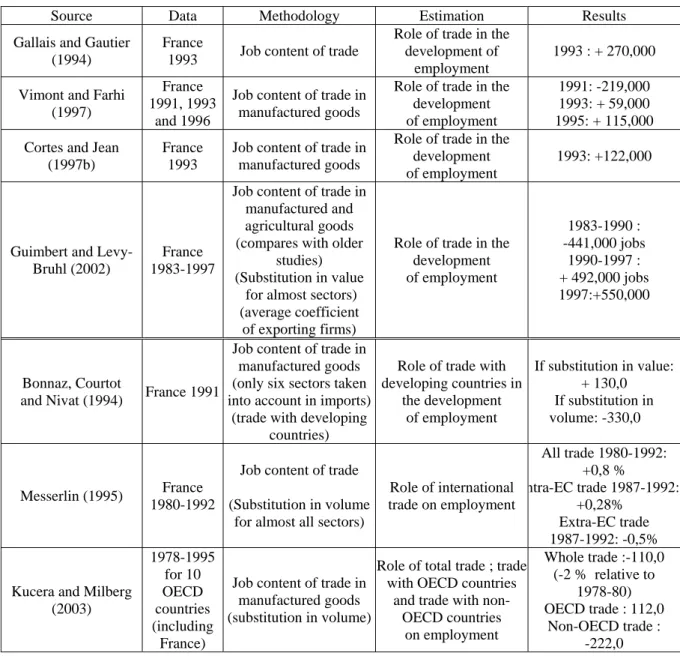
The "job content of trade" is by far the most widely used method for evaluating the impact of international trade on French employment. The basic idea is that exports constitute additional production for the domestic economy, and hence induce job creation, while imports are substitutes to domestic production and hence induce job losses. The difference between "job creation" and "job losses" is then attributed to international trade. Empirical estimates consist thus in computing the average “job content” — i.e. labour requirement of production
in the domestic country — of both exports and imports. For exports, most studies not only
consider direct employment embodied in production but also indirect employment embodied in the production of intermediate inputs.
11 European Monitoring Centre on Change (2005). 12 Marin (2004).
For imports, the usual assumption is that of a substitution between domestic and foreign production in value — i.e. one euro of imports substitutes to one euro of domestic production — rather than in volume13 — i.e. a pair of foreign shoes substitutes to a pair of domestic
shoes. The assumption of substitution in value is not really restrictive as long as international trade of France is predominantly oriented towards developed countries: in that case, the unitary price and quality of goods imported from abroad and produced domestically is roughly similar. As, in 1997, developed countries accounted for 79 % of French imports (75 % of French exports), with figures reaching 90 % in many sectors, the value hypothesis is not too much of a problem the measure the global effect of international trade. However, the value hypothesis is much more a problem when one tries to measure the effect of French trade with developing countries. Due to price differentials, substitution in volume is much more plausible. Insofar as we are looking primarily into these effects, one should favour this latter hypothesis.
There are other difficulties. The results are strongly influenced by the sign of the trade balance. As a result, trade balance disequilibria are sometimes corrected to compute only the structural effect of external trade on domestic employment. When this is the case, estimates are based on theoretical balanced trade flows. Finally, the counterfactual situation used for comparison is "autarky". The definition of autarky is very restrictive: it is assumed to have no impact on the nature of goods produced, prices, wages, productivity and consumption. To sum up, while this method has the advantage of simplicity, its drawbacks are numerous: lack of strong theoretical grounds, strong assumptions related to the counterfactual situation, assumption of homogeneity between foreign and domestic goods, use of an average coefficient rather than a marginal coefficient etc14.
13 This opposition between value and volume is different from the usual one which takes into account the
evolution of prices through time.
Table 7: Studies using the “job content of trade” method
Source Data Methodology Estimation Results
Gallais and Gautier (1994)
France
1993 Job content of trade
Role of trade in the development of
employment
1993 : + 270,000 Vimont and Farhi
(1997)
France 1991, 1993
and 1996
Job content of trade in manufactured goods
Role of trade in the development of employment
1991: -219,000 1993: + 59,000 1995: + 115,000 Cortes and Jean
(1997b)
France 1993
Job content of trade in manufactured goods
Role of trade in the development of employment
1993: +122,000
Guimbert and Levy-Bruhl (2002)
France 1983-1997
Job content of trade in manufactured and agricultural goods (compares with older
studies) (Substitution in value
for almost sectors) (average coefficient
of exporting firms)
Role of trade in the development of employment 1983-1990 : -441,000 jobs 1990-1997 : + 492,000 jobs 1997:+550,000 Bonnaz, Courtot
and Nivat (1994) France 1991
Job content of trade in manufactured goods (only six sectors taken into account in imports)
(trade with developing countries)
Role of trade with developing countries in the development of employment If substitution in value: + 130,0 If substitution in volume: -330,0 Messerlin (1995) France 1980-1992
Job content of trade (Substitution in volume
for almost all sectors)
Role of international trade on employment All trade 1980-1992: +0,8 % ntra-EC trade 1987-1992: +0,28% Extra-EC trade 1987-1992: -0,5%
Kucera and Milberg (2003) 1978-1995 for 10 OECD countries (including France)
Job content of trade in manufactured goods (substitution in volume)
Role of total trade ; trade with OECD countries
and trade with non-OECD countries on employment Whole trade :-110,0 (-2 % relative to 1978-80) OECD trade : 112,0 Non-OECD trade : -222,0
The seven empirical studies based on "job content of trade" method as reported in table 6 differ in terms of sample (period, total versus manufactured trade, all versus developing partners) and methodology (substitution in value versus volume, treatment of trade balance disequilibrium etc.). Nevertheless, it is possible to summarize their main results as follows. First, in all cases, the estimated net impact of international trade on total French employment is modest and, on average, positive. That is, international trade tends to be a net creator of jobs over a long time period, even if the net creation of jobs accounts for less than 1 % of total employment. Second, the negative net impact of international trade on jobs is generally concentrated on the end of 1980s/beginning of 1990s and due to trade with developing countries. After 1992, all the studies agree to indicate the positive impact of trade on French
employment. Third, different sectors are unevenly affected by international trade. Most losses are concentrated in traditional industries (shoes and hosiery) and some in natural-resources intensive industries. That seems to suggest that, even if the net impact of international trade on French labour is positive in the long-run, temporary job losses can occur following an "openness" shock with developing countries, as in 198715.
Only three studies compute the specific effect of trade with developing countries — with different definitions of these countries. They suggest this trade caused 150,000 to 330,000 job losses. However, these results need to be confirmed by more robust methods. This can be done either in a empirical way or a theoretical way.
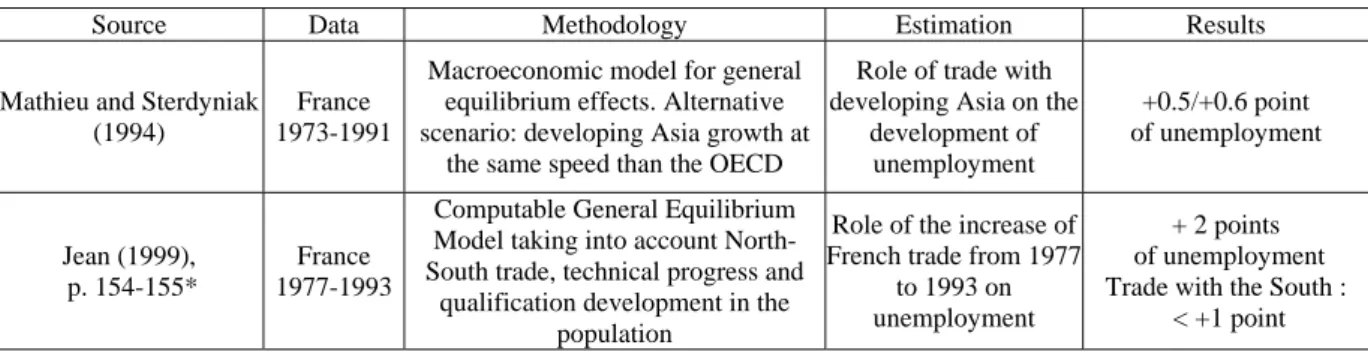
2.2.Theoretical models
It is possible to build models taking into account all the different effects that make a simple job content evaluation unreliable. We know of two examples in the case of France, reported in table 7.
Table 8: Studies using models
Source Data Methodology Estimation Results
Mathieu and Sterdyniak (1994)
France 1973-1991
Macroeconomic model for general equilibrium effects. Alternative scenario: developing Asia growth at
the same speed than the OECD
Role of trade with developing Asia on the
development of unemployment +0.5/+0.6 point of unemployment Jean (1999), p. 154-155* France 1977-1993
Computable General Equilibrium Model taking into account North-South trade, technical progress and
qualification development in the population
Role of the increase of French trade from 1977
to 1993 on unemployment
+ 2 points of unemployment Trade with the South :
< +1 point
* See also : Jean (2001), p. 13, Jean and Bontout (1999), Cortes and Jean (1997a), Jean (2002).
It is worth mentioning that, despite the differences in methods, both studies find similar orders of magnitude for the effect of trade with developing countries on unemployment: a rise of at least 150,000 and probably at most 300,000.
2.3. Econometric studies
Another approach is mainly empirical16. Three main factors can explain employment changes — either the decrease of the share of industrial production in total employment or of the share of unskilled workers in total employment — in developed countries: (1) the technical progress; (2) changes in demand and (3) international trade. Econometrical studies presented in table 8 try to isolate the true impact of international trade, including outsourcing activities, on employment. To analyse the different causes, the assumptions are that technological progress explains the shifts of labour demand towards skilled workers within industries; changes in domestic demand explain the shifts of labour demand towards skilled workers between industries; and finally, international trade is assumed to be detrimental to unskilled workers as soon as France imports from developing countries, where labour costs are lower. Controlling for internal factors allows for more accurate estimates of the true impact of external factors on French employment.
Table 9: Studies using an econometric method
Source Data Methodology Estimation Results
Bazen and Cardebat (2001) France 1985,
1989 and 1992
Econometric study per sector
Role of international trade (measured as relative import prices) on relative
unskilled employment
1985-1989: Trade => Decline in relative unskilled employment, not
wages
1989-1992: Trade => Decline in relative unskilled wages, not
employment
Strauss-Kahn (2003)
France,
1977-1993. Econometric study per
sector
Role of international vertical specialization
(defined as the share of imported inputs in production) in the decline
of unskilled workers (in total manufacturing
employment)
Share of imported inputs in production: from 9 % (in 1977) to
14 % (in 1993)
Shift away from unskilled labour : 0.65-0.7 percentage points/year (0.5-0.6 for manufacturing sectors) Contribution of international vertical
specialisation in the decline of unskilled workers in manufacturing
employment : 11-15 % over 1977-1985 and 25 % over 1977-1985-1993. Boulhol (2004) 1970-2002 for 16 OECD countries (including France) Econometric study, including GDP/head; (GDP/head)^2; Investment/GDP; Industrial trade balance; firms’ outsourcing rates. Role of emerging countries’ industrial imports in the change of the industrial share
of employment
No break in the data. FMI method (Rowthorn and Ramaswamy (1999)): 10 % for France
(15 % for the average OECD countries) New method (correction of autocorrelation): 1.9 % for France
(3.4 % for the average OECD countries)
16 We only mention here macro-econometric studies. To our knowledge, the only microeconometric study that
does compute a microeconomic, firm-level, effect of international trade on employment: Biscourp and Kramarz (2003).
Bazen and Cardebat (2001) show that the effect of trade with low-cost partners (proxied by the changes of relative import prices) changed in the late 1980s: from a job-destroying influence to a wage-depressing one. However, they do not provide enough elements to estimate the total effect of trade on the unskilled share of employment and relative wages.
Strauss-Kahn (2003) tests econometrically the extent to which international vertical specialisation explains the decline in the relative demand for unskilled labour in the French manufacturing sector over 1977-1993. Vertical specialisation is the completion of the different production stages of a good in different countries. Strauss-Khan measures it as the value of directly imported inputs embodied in goods produced, using data from input-output tables. As she uses French statistical aggregates, she has to divide workers in the French manufacturing sector following occupation rather than education. This produces a division between skilled and unskilled workers that is roughly equivalent to the US white-collar/blue collar division. She finds that, while international vertical specialisation has increased from 9 % in 1977 to 14 % in 1993, its contribution to the observed decline in the relative demand of unskilled workers was relatively low. Nevertheless, this contribution increases over the time sample, from 11-15 % in 1977-1985 to 25 % in 1985-199317.
The Fontagné and Lorenzi report18 has given a lot of publicity to the results of Boulhol (2004). He tests econometrically the extent to which (industrial) imports from emerging countries contribute to "deindustrialisation" (that is, changes of industrial employment in total employment) for 16 OECD countries over 1970-2002. Moreover, he is interested in testing if the acceleration of imports from emerging countries observed since 1987 has changed the value of estimated parameters. Following Rowthorn and Ramaswamy (1999), the dependent variable is the variation of the share of industrial production in total employment. The explanatory variables are GDP per capita, the square of GDP per capita, industrial imports from emerging countries in percentage of GDP, investment in percentage of GDP, the trade balance for industrial goods and the rate of externalisation by firms measured as the share of inputs in production. In a first application of this method, he shows that the imports from emerging countries contribute to 15 % of the decline in industrial employment for OECD sample, and to only 10 % for France. Correcting for autocorrelation yields even smaller estimates: respectively 3.4 % and 1.9 %. Moreover, the coefficient of imports is constant
17 This result is consistent with Goux and Maurin (2000) who find that around 2/3 of the decline of the unskilled
labour is due to changes in the industry composition of domestic demand for goods and services and that international trade (and technical progress) have played only a minor role.
between the pre-1987 period and the post-1987 period. However, due to the acceleration of imports from developing countries in 1987, the losses of industrial employment caused by imports are larger after 1987 than before 1987. Finally, he concludes that the decline of industrial employment in France is mainly due to internal factors, e.g. the low rate of investment in France compared to the United States.
Rowther and Ramaswamy (1999) explain 150,000 manufacturing job losses by trade with developing countries. If Boulhol is right, these losses only numbered 30,000. This is the lowest estimation we have found so far. Without going into the precise examination of the econometrics, it is possible that part of the decline in French investment is due to international relocation outsourcing.
Conclusion
One difficulty in drawing conclusions from this review is that few estimates are based on recent data. Most of studies do not cover the ten last years. That makes drawing robust conclusions and extracting insights for future developments of the French labour markets difficult. Estimation of the job losses due to trade with developing countries vary between 150,000 and 300,000, with an outlier at only 30,000. That represents only between 10 and 20% of the total industrial job losses since thirty years (between 15 and 30% if one excludes domestic outsourcing and temporary employment).
However, trade with a group of countries cannot be taken in isolation: trade between the developed and developing countries in general can have an impact on trade between France and other developed countries and should hence be taken into account. The review suggests that most French employment developments were not related to international trade as a whole — including international relocations and trade with developing countries — but had domestic causes: low investment, skill-biased technological process and demand shifts. Hence, technical progress and internal factors explain the bulk of the decrease in industrial production and employment that frightens the public so much.
This does not mean that trade cannot have a temporarily negative effect on employment, as happened in the late 1980s. It does not mean either than some categories do not suffer particularly because of trade, as did unskilled workers. Nevertheless, if we assume that the contribution of international trade to French employment developments over the 1980-95 period is representative of effects of a growing openness to trade, the following prospective features emerge: first, even the temporary adverse effect in the future of deeper integration
with CEECs, including vertical foreign direct investment, will be limited since both European Association Agreements and foreign direct investment liberalisation in the 1990s have already induced most of the adjustments. However, stronger trade flows with emerging countries (China, India, etc.) will probably have an adverse impact on French labour market in the next few years, especially for unskilled workers in specific sectors. The traditional sectors, like textiles, are already much reduced compared to what they were in the 1970s, and they will probably not disappear completely as some niche markets can be developed: other sectors may be threatened. There will be individual, sectoral and territorial net losses that warrant cushioning from the community, maybe as a redistribution of part of the sizeable gains offered by trade for consumers.
REFERENCES
Arthuis J. (1993): Rapport d'information sur l'incidence économique et fiscale des
délocalisations hors du territoire national des activités industrielles et de service, Sénat,
231 p.
Bazen S., and J.-M. Cardebat (2001): "The Impact of Trade on the Relative Wages and Employment of Low Skill Workers in France", Applied Economics, vol. 33. n° 6. p. 801. Biscourp P., and F. Kramarz (2003): "Internationalisation des entreprises industrielles et
emploi: une analyse sur la période 1986-1992", Économie et Statistique, n° 363-364-365. p. 69-95.
Bonnaz H., N. Courtot, and D. Nivat (1994): "Le contenu en emplois des échanges industriels de la France avec les pays en développement", Économie et Statistique, n° 279-280.
Boulhol H. (2004): "What is the impact of international trade on deindustrialisation in OECD countries?", Flash CDC IXIS Capital markets, p. 1-23.
Cortes O., and S. Jean (1997a): "Progrès technique. Commerce international et inégalités. (Technological Progress. International Trade and Inequalities. With English summary.)",
Économie Internationale, vol. 0. n° 71. p. 169-81.
Cortes O., and S. Jean (1997b): Quel est l'impact du commerce extérieur sur la productivité et
l'emploi?, CEPII research center, Working Papers, 1997.
Devedjian P. (1993): Le libre-échange : une chance pour la France, n° 774, Assemblée Nationale.
Direction Générale du Trésor et de la Politique Économique (2004): "Les délocalisations d'activités tertiaires dans le monde et en France", DP - Analyses Économiques, n° 55. p. 1-9. Drumetz F. (2004): "La délocalisation", Bulletin de la Banque de France, n° 132. p. 27-42.
European Monitoring Centre on Change (2005): European Restructuring Monitor à:
http://www.emcc.eurofound.eu.int/erm/.
Fontagné L., and J.-H. Lorenzi (2005): Désindustrialisation et délocalisations, Conseil d'Analyse Économique, 127 p.
Gallais and Gautier (1994): Échanges internationaux. Délocalisations. Emploi. Notes Bleues de Bercy.
Gonzales L. (2002): "L'incidence du recours à l'intérim sur la mesure de la productivité du travail des branches industrielles", Économie et Statistiques, n° 357-358, p. 103-133. Goux D., and E. Maurin (2000): "The Decline in Demand for Unskilled Labor: An Empirical
Analysis Method and Its Application to France", Review of Economics and Statistics, vol. 82 n° 4. p. 596-607.
Guimbert S., and F. Levy-Bruhl (2002): "La situation de l'emploi en France face aux echanges internationaux. (The Employment Situation in France in Relation to International Trade. With English summary)", Économie et Prévision, vol. 0, n° 152-153. p. 189-206.
Jean S. (1999): Commerce international et marché du travail, PhD Thesis, University Paris-I. Jean S. (2001): The Impact of Globalisation on Employment in Industrialised Countries: a
Survey. n° DSTI/EAS/IND/SWP(20001)7. Direction de la Sciences, de la Technologie et
de l'industrie; Comité de l'industrie et de l'environnement de l'entreprise; OECD. 1-23 p. Jean S. (2002): "L'impact du commerce international sur l'élasticite-prix de la demande de
travail. (The Impact of International Trade on Price-Elasticity of Demand for Labour. With English summary.)", Économie et Prévision, vol. 0, n° 152-153. p. 17-28.
Jean S., and O. Bontout (1999): "Sensibilité des salaires relatifs aux chocs de commerce international et de progrès technique: Une évaluation d'équilibre général. (Sensitivity of Relative Wages to International Trade and Technical Progress Shocks: A General Equilibrium Assessment. With English summary.)", Revue d'Économie Politique, vol. 109. n° 2. p. 241.
Kucera D., and W. Milberg (2003): "Deindustrialization and Changes in Manufacturing Trade: Factor Content Calculations for 1978-1995", Review of World
Economics/Weltwirtschaftliches Archiv, vol. 139, n° 4. p. 601.
Lefranc A., (1997): "Salaires relatifs et chômage: Une analyse comparative France/États-Unis. (Unemployment and Relative Wages: A France-US Comparison. With English summary)", Revue Économique, vol. 48, n° 5, p. 1041.
Marin D. (2004): "A Nation of Poets and Thinkers. Less so with Eastern Enlargement?
Austria and Germany", CEPR Discussion Paper, n° 4358.
Mathieu C., and H. Sterdyniak (1994): "L'émergence de l'Asie en développement menace-t-elle l'emploi en France?", Revue de l'OFCE, n° 48, p. 55-106.
Messerlin P. A. (1995): "The Impact of Trade and Capital Movements on Labour: Evidence on the French Case", OECD Economic Studies, vol. 0, n° 24, p. 89-124.
Mihoubi F. (2002): "Intérim, travail externalisé et mesure de la productivité du travail dans l'industrie", Économie et Statistiques, n° 357-358, p. 134-137.
Rowthorn R., and R. Ramaswamy (1999): "Growth Trade and Deindustrialization", IMF Staff
Papers, vol. 46, n° 1. p. 18-41.
Strauss-Kahn V. (2003): The Role of Globalization in the Within-Industry Shift Away from
Unskilled Workers in France, National Bureau of Economic Research. Inc. NBER
Working Papers: 9716. 2003.
Vimont C., and F. Farhi (1997): Concurrence internationale et balance en emplois: les
27
II.
O
FFSHORE OUTSOURCING IN THEEU
FINANCIAL SERVICESINDUSTRY
Georges Pujals*
The main objective of this paper is to investigate and to establish what are the facts and implications about offshoring and outsourcing in the financial sector. Offshoring of services has received an enormous amount of attention in the political circles in recent times. Let alone its consequences, offshoring does not appear to be widely understood. Therefore, we thought it would be useful to examine this phenomenon to distinguish facts from exaggerated claims.
Given the attractiveness of the phenomenon and the potential implications for competitiveness, there is a need for more analysis on the corporate strategies underlying this trend. In that way, our study will describe the offshoring phenomenon from the financial sector point of view. Why this sector? Although offshoring is a trend across all sectors, several consulting studies have shown that offshoring and outsourcing scenes are currently dominated by banks.
Introduction
International relocation of services has received an enormous amount of attention in the media and political circles in recent times. In just five months, between January and May 2004, there were 2634 reports in US newspaper on service offshoring, mostly focusing on the fear of job losses. Firms have been accused of “exporting jobs” to developing countries. These concerns are not limited to the United States. The debate is equally vigorous in Europe where the threat of competition from Eastern Europe and China is raising intense anxieties. For example, 380 reports on international relocation appeared in UK newspapers during the same period1.
All this media hype would lead one to believe that offshoring is some new phenomenon that has exploded. What is new about offshoring today is that it is increasingly in services. The growing relocation of services in industrial countries is a reflection of the benefits from greater division of labour and trade that have been described for manufactured goods since the
* OFCE. E-mail: [email protected] ; Comments are welcome.
1 According to a report by Roland Berger Strategy Consultants and UNCTAD (2004), UK companies represent
time of Adam Smith and David Ricardo. In the past, the service sector was largely considered impervious to international competition. With improvements in communication technologies, such as the Internet, services can now cross national borders. Although service offshoring still remains a small fraction of individual countries’ GDP (Amiti M. and S.J. Wei, 2004a), it is without a doubt the newest chapter in the globalisation debate.
But offshoring, let alone its consequences, does not appear to be widely understood. Some people interpret it to mean outside the firm, and others outside the country. Media and political attention seems firmly focused on offshore outsourcing, even though domestic outsourcing is also common. So, the nations still have much to learn about offshoring, and existing data is not adequate to the task. There are currently no reliable statistical indicators of the extent or the nature of offshoring. Besides management consultant reports2, there is indeed
very little empirical economic research on service offshoring. Most of the studies carried out so far have been in the United States. Therefore, we thought it would be useful to examine this phenomenon to distinguish facts from exaggerated claims.
Drawing on the experiences of the United States, we can say that, in the aggregate, job losses in one industry often are offset by jobs created in other growing industries (Amiti M. and S.J. Wei, 2004b; Brainard L. and R. Litan, 2004; Schultz C., 2004). Moreover, American economists argued that international relocation contributes to lower inflation and higher productivity, meaning that the overall economy will grow faster (Mann C., 2004; Council of economic advisors, 2004). Catherine Mann (Institute for International Economics) has estimated that US GDP growth would have been lower by 0.3 percent a year between 1995 and 20023 without international relocation of jobs in information technology (Mann C., 2003).
on the offshoring strategies of leading European companies (polled a representative sample covering more than 20 percent of total revenues of Europe’s top 500 companies).
2 Looking forward, perhaps the best-know projection is by Forrester Research (2004), an information technology consulting firm, which expects the number of US jobs outsourced to grow from about 400.000 in 2004 to 3.3 million by 2015. If this estimate turns out to be accurate, then offshoring could result in roughly 250.000 layoffs a year. Goldman Sachs has estimated that offshoring has accounted for roughly half a million layoffs in the past three years. According to the McKinsey Global Institute (2003), for every dollar of US services activity offshored, a net gain of 12 to 14 cents is generated. Another Forrester Research report states that offshore service spending in Western Europe will grow from 1.1 billion in 2004 to 3.6 billion euros in 2009, with the United Kingdom accounting for 76 percent at that point. The IT consultancy firm, Gartner (2003), estimates an ultimate growth of 40% in offshore outsourcing in Europe. Gartner also predicts that almost a third of leading European businesses will include an offshore element in their IT plans by 2005. As a result of this shift of IT services overseas, up to 25 percent of EU and US IT jobs could go to the emerging markets by 2010. But Gartner predicts that the new European countries will become popular for “nearshore” outsourcing of some operations.
3 Indeed, lower inflation and higher productivity have allowed the Federal Reserve to run a more
Concerning Europe, the European Monitoring Centre on Change (EMCC) has published data4 for major European company restructuring since the beginning of 2002.
Results from January 2002 to December 2004 are presented in Table 1. As in the case in the US economy, “Relocation” is directly responsible for only a very minor part – 3.6 percent – of large-scale job losses in European countries, although like in the US, offshoring may be included in other categories such as “Outsourcing” or “Internal restructuring”. Considering the extent of political tension regarding international relocation, it is remarkable that these data – with their significant caveats and limitations – indicate that the phenomenon has a relatively small effect on both US and European labour markets, relative to other sources of job losses. Although the significance and implications of this finding may be restricted, the finding demonstrates that the political storm from offshoring has little to do with the sheer number of job losses.
Table 1. Job losses associated with major European firm restructuring
Type of restructuring5 Planned job reductions
% planned job reductions
Number of cases % of cases
Internal restructuring 832.345 78.4 1.068 60.7 Bankruptcy/Closure 129.133 12.1 371 21.0 Relocation 38.471 3.6 122 7.0 M&A 52.686 5.0 65 3.7 Outsourcing 8.636 0.8 26 1.5 Other 850 0.1 5 0.3 Total 1.062.121 100 1.657 100
Source: European Restructuring Monitor (2005).
The current offshoring debate is highly charged, both emotionally and politically. Yet the discrepancy between the public perception and actual magnitude of this issue is quite considerable, calling for a more objective approach to the subject. While service offshoring has become established practice and has already been addressed by various studies for the US, it has only recently attracted public attention in Europe. Given the attractiveness of the
4 These data include restructuring that affect at least one EU country and entail an announced or actual reduction
of at least 100 jobs. Cases are identified through a press review of daily newspapers and business press in the 15 old EU Member States. Almost 80 percent of the total volume of services jobs offshored is involving less than 300 jobs per project (Roland Berger and UNCTAD, 2004).
5 Types of restructuring: Relocation, where the activity is relocated to another country of the European Union of
phenomenon6 and the potential implications for competitiveness at all levels of development
in Europe, there is a need for more analysis on the corporate strategies underlying this trend. In that way, our study will describe the offshoring phenomenon from the European financial services industry point of view. Why this sector? Although international relocation is a trend across all sectors, several consulting studies have shown that the offshoring scene is currently dominated by banks and other financial services firms (see Chart 1).
Chart 1. Offshore market distribution by sector
Source: Deloitte Research (2004).
In the financial services industry, outsourcing has been in use for quite some time. For example, since the 1970s, financial institutions have used outside firms for such clerical activities as printing customer financial statements and storing records. As Information Technologies (IT) evolved during the 1980s and 1990s, financial services firms began to outsource a great variety of IT activities as means of lowering their costs and gaining faster access to up-to-date technology. Currently, more strategic areas are also becoming subject to outsourcing. As attention turned increasingly to efficiency and the need to focus on core businesses and as transaction costs started to drop (i.e., outsourcing service providers were
be located within the European Union; Internal restructuring, where the company undertakes a job-cutting plan in order to cut costs and remain competitive.
6 According to Roland Berger and UNCTAD report (2004), more than 40 percent of companies polled have relocated services in the past. Regarding future activities, almost half of all companies are planning to offshore (further) services within the next years. Companies that have offshored in the past are generally the ones that are also planning to offshore in the future.
Manufacturing 15%
Transport & leisure 5% Retail trade 7% Financial services 35% Others 13% Telecom/techno 25%
able to reduce costs), financial institutions started to outsource a growing share of their activities7.
The financial services firms have several common features that might predispose them toward using a large degree of outsourcing. Specifically, in the course of their businesses, they handle large volumes of information, in both paper and electronic form, and they typically provide customers with a wide variety of related services. The sheer volume and breadth of these activities present compelling reasons for outsourcing particularly to technology service providers that have developed expertise in specific business applications. Moreover, the high potential to “industrialize” is one of the main reasons for outsourcing in financial services. Banks tend to be much stronger vertically integrated than the manufacturing sector. German banks, for example, create 80 percent of their products and services themselves, compared with 25 percent in the automotive sector (see Chart 2). Concentrating on core competencies not only helps to cut costs but also to gain strategic advantages.
Chart 2. Vertical integration of different sectors in Germany
Source: Deutsche Bank Research (2004).
Financial institutions are under constant pressure to cut cost while simultaneously increasing revenue in a context of increasing competition. In response, many are shifting
7 See McKinsey Global Institute (2002), for a review of the outsourcing behaviour of over 30 institutions in
Western Europe for 11 specific ICT-related. The study find the market for outsourcing in European banking is large and rapidly expanding.
80 20 25 75 20 80 0 20 40 60 80 100 Banks Automotive industry Electronics industry Proprietary production Outside production
more and more business processes to countries like India and China with dramatically lower wage rates. This practice, known as “offshoring”, is fundamentally changing the way financial institutions do business. In 2003, Deloitte Research (2004) estimated the number of offshore jobs in financial services had increased by a factor of five. More important, offshoring has created a truly global operating model for financial services, unleashing a new and potent competitive dynamic that is changing the rules of the game for the entire industry.
The main objective of this paper is to investigate and to establish what are the facts and implications about outsourcing and offshoring in the EU financial services industry. Section 1 defines briefly the various concepts. Section 2 describes a set of recent stylised facts in the financial services industry. Section 3 first depicts business models used and activities subject to outsourcing, and then proposes the corresponding motives cited by the European banking sector. Finally, section 4 expresses EU banks’ opinions on the risks of outsourcing and what regulators do to mitigate these risks. These two sections are mainly founded on a March-April 2004 survey of 82 individual banks8 from nineteen EU countries and the aggregated answers
from 24 European supervisory authorities.
Section 1. Definition: What’s in a name?
Before we explore the magnitude of the international relocation trend in the EU financial services industry, it is useful to distinguish between two different terms frequently used interchangeably in the debate: Outsourcing vs offshoring. A common misperception exists (see Table 2).
“Outsourcing” – the legal dimension – refers to firms purchasing services from outside specialist providers. It is, in other words, “subcontracting”. Conversely, the word “Insourcing” refers to the production of something inside a company. This type of activity is as old as at least the industrial revolution, and basically refers to firms specialising in what they do best and leaving the rest to others. It is a crucial process in which firms engage to remain cost-competitive and raise productivity. A specific feature of outsourcing is that the direct control over these operations is shifted to an external service provider, which can be an intra-group company or an independent third party. However, in the current context of rapid organisational change, determining what is “internal” and “external” is increasingly difficult.
8 This survey was conducted by the authorities represented in the BSC (ECB, 2004). Each Member State was
asked to survey a maximum of five banks. Banks were selected to reflect both large and small banks, without prejudice to the importance and role of outsourcing in their organisation.
“Offshoring” – the geographical dimension – is in vogue and refers to relocation of activities beyond national borders9. Often these activities are carried out by outside providers
located to lower-cost countries (offshore outsourcing), but this organisational distinction need not necessarily be the case. They can also be provided from within the company itself (“captive” offshoring), for instance by subsidiaries or company units abroad, or by joint ventures and strategic alliances. The growth of services offshoring is linked to the availability of reliable and affordable communication infrastructures. Offshoring is part of a country’s imports (good and services).
Table 2. Relocation of activities according to geographic and legal boundaries
Within a country (domestic) Between countries (abroad)
Within a firm (inside) Insourcing “Captive” offshoring
Between firms (outside) Outsourcing Offshore outsourcing
Source: Euroframe (2005).
While outsourcing has occurred for many years, offshoring is a relatively recent phenomenon. At least four factors have driven the recent rapid rise in offshoring: Technological innovation, free trade, possible cost savings and access to a large pool of skilled English speaking labour abroad.
We found it useful to differentiate the potential benefits of outsourcing and offshoring. Each of these models, which can be applied independently or combined, has distinct advantages in specific situations and provides different sets of benefits. For example, “captive” offshoring is likely to be more attractive where the issues of control and confidentiality matter. But, firms more focused on general cost-cutting are likely to make more widespread use of external agents (outsourcing or offshore outsourcing strategies).