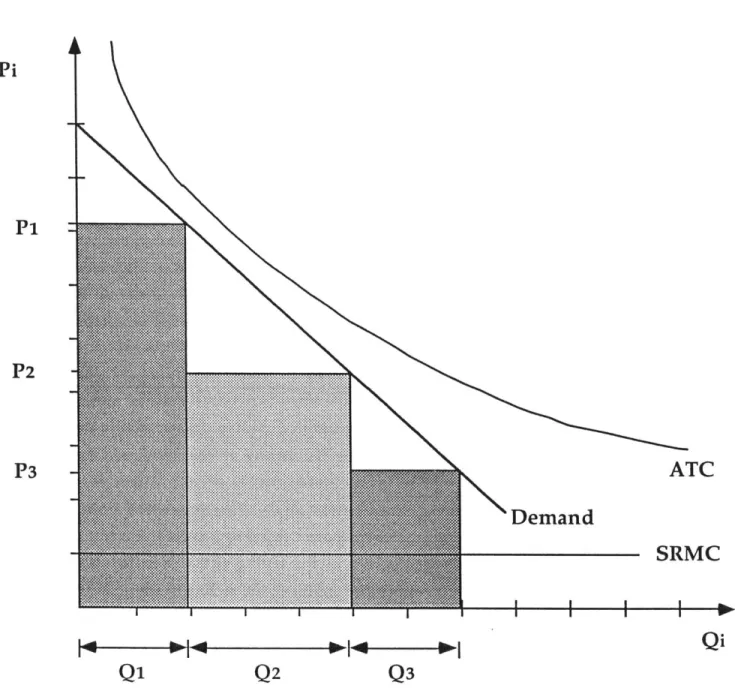
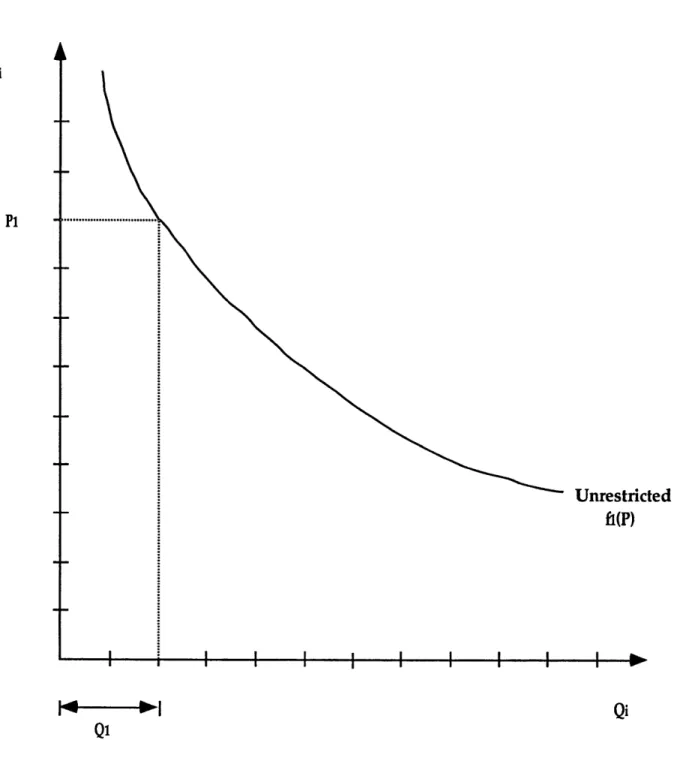
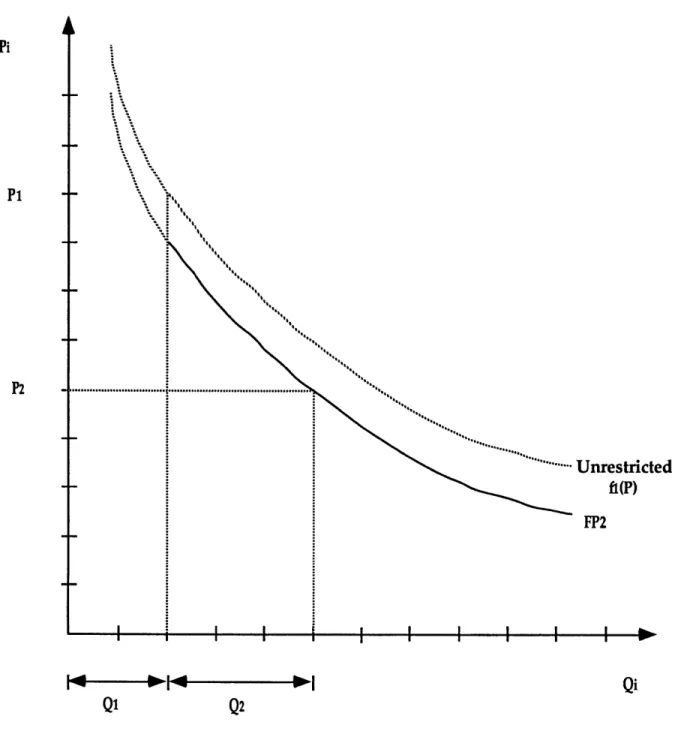
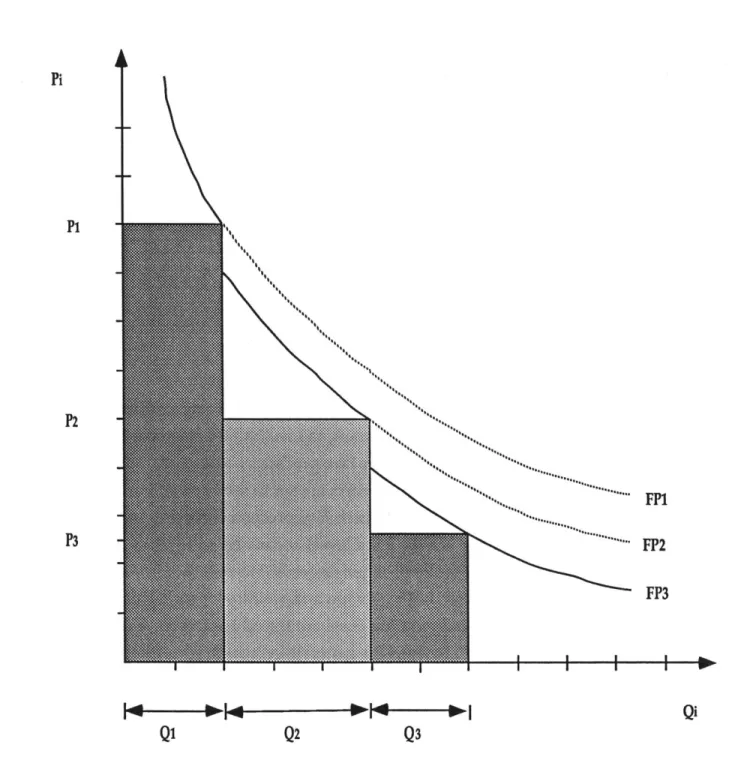
II p72/
II
r&
/
~
DEPARTMENT OF
AERONAUTICS
AND
ASTRONAUTICS
MASSACHUSETTS INSTITUTE OF TECHNOLOGY
AIRLINE PRICING AND FARE PRODUCT DIFFERENTIATION
by
THEODORE CHARLES BOTIMER
Submitted to the Department of Civil and Environmental Engineering on October 20, 1993 in partial fulfillment
of the requirements for the Degree of
Doctor of Philosophy in Transportation Economics
ABSTRACT
Airlines offer combinations of price level and purchase restrictions, or fare products, designed to best maximize revenues on their flights. This dissertation provides the first comprehensive examination of the differentiated fare product structure on the market today in terms of passenger demand, airline revenue, and societal welfare. The role of pricing in the airline revenue management function is established first. The types of price discrimination currently practiced
by airlines, as defined in the economics literature, are then identified. Although
the terms airline product differentiation and price discrimination have
previously been used interchangeably, the two practices are shown to differ and exist simultaneously in the current industry environment.
Next, airline revenue management techniques and, in particular, fare product differentiation are examined from the standpoint of economic efficiency. This dissertation concludes that both efficiency in exchange and Pareto optimality are unattainable under the current structure of airline fare product differentiation as a result of the costs incurred by passengers due to applied purchase restrictions. It is found, however, that a differentiated fare product structure with a wide range of price levels coupled with effective revenue management techniques can provide airline seats to those consumers who value them most when demand exceeds supply. Efficiency in allocation can thus be achieved in the current industry environment.
Virtually every existing yield management seat allocation model assumes that consumers view differentiated airline fare products as separate products with
uncorrelated demands that compete for space on a fixed capacity aircraft. Such formulations ignore the dependence of the demand for a given fare product on the price levels and characteristics of the other available (competing) fare products. In this dissertation, a model of product differentiation that considers the interrelationships of the available airline fare products as well as the cost incurred by consumers of accepting more restricted (and less flexible) products is presented. This generalized cost model of airline fare product differentiation explicitly incorporates the techniques of fare product differentiation and price discrimination currently used by airlines.
The generalized cost model is extended to incorporate the "buy down" or
diversion of passengers to lower-priced fare products as a result of their ability to meet the additional purchase restrictions imposed by airlines. Moreover,
diverting passengers may be induced to "sell up" to higher-priced fare products when booking limits are applied to the lower-priced products. The generalized cost model contributes the first behavioral motivation of both passenger
diversion and sell up. The dissertation demonstrates the use of booking limits as devices to control and limit the revenue dilution effects of passenger diversion.
The effects of pricing and other fare product design decisions are quantified for any set of OD market conditions using the generalized cost model. The model provides insight into the underlying effects of the tradeoffs made by airlines when making pricing and marketing planning decisions. In summary, this research provides the first cohesive look at the relationships between price level, purchase restrictions, demand, and revenue in the context of airline product differentiation and yield management.
Thesis supervisor: Peter P. Belobaba
Title: Assistant Professor of Aeronautics and Astronautics rF -_ I
Table of Contents
List of Figures ... 10
List of Tables ... 12
Chapter 1 Airline Fare Product Differentiation and Revenue Management ...13
1.1 Differentiated Airline Fare Products ... 15
1.1.1 Historical Perspective: Surplus Seat Sale...16
1.1.2 Market Segmentation Through Fare Product D ifferentiation... 17
1.1.3 Pitfalls of Pricing Demand Management...20
1.1.4 Fare Product Structure ... 21
1.2 Airline Revenue Management...25
1.2.1 A irline Pricing... 26
1.2.2 Airline Seat Inventory Control...27
1.2.3 Cooperation Between Seat Inventory Control and Pricing ... 28
1.3 Current Practice: Airline Pricing Departments...29
1.3.1 Airline Tariff Publishing Corporation...29
1.3.2 Price Signaling ... 31
1.3.3 Functions of an Airline Pricing Department ... 32
1.3.4 Competitive Pricing Strategies ... 34
1.3.5 Monitoring Fare Changes : Practical Considerations ... 36
1.4 The Nature of Airline Pricing Decisions ... 37
1.4.1 Fare Product Equilibria: Price Levels and Restrictions...38
1.4.2 Hub and Spoke Network Effects on Pricing Decisions ... 39
1.5 Outline of the Dissertation...44
1.6 Chapter Summary ... 45
Chapter 2 Airline Fare Product Differentiation Literature Review ... 47
2.1 The Nature of Price Discrimination in Airline Markets ... 48
2.1.1 First Degree Price Discrimination...49
2.1.2 Second Degree Price Discrimination...49
2.1.3 Third Degree Price Discrimination...50
2.1.4 Second and Third Degree Price Discrimination Techniques in Practice ... 52
2.2 Previous Justifications of Price Discrimination in A irline M arkets... 54
2.3 Efficiency, Yield Management, and Airline Fare Products...58
2.3.1 Exchange Efficiency ... 59
2.3.2 Allocative Efficiency: Perhaps What is Really Desired ... 64
2.3.3 Using Yield Management Techniques to Achieve Allocative Efficiency ... 70
2.3.5 Efficiency Summary ... 78
2.4 Monopolistic Competition Models of Price Discrimination...79
2.5 Monopoly Models of Airline Fare Product Differentiation ... 83
2.6 Review of Product Differentiation in the Yield Management Literature ... 86
2.7 Chapter Summary ... 87
Chapter 3 Incorporating Price Levels and Restrictions into the Current Framework of Airline Yield Management ... 88
3.1 Major Factors Influencing Air Travel Demand...88
3.1.1 Factors Affecting Demand for Air Travel Overall...89
3.1.2 Factors Affecting the Market Share Between Carriers...91
3.1.3 Factors Affecting the Demand for Individual Fare Products... 93
3.1.4 Limitations of Airline Control -Over Prices and Restrictions ... 95
3.1.5 Passengers Book at Different Times Prior to Departure...97
3.2 Current Practice of Airline Yield Management Demand Models ...99
3.2.1 Yield Management Model Theoretical Assumptions ... 99
3.2.2 Yield Management Input Data Available: Practical C onsiderations...105
3.2.3 Correction of Factors Affecting Demand to Im prove Forecasts ... 109
3.2.4 Major Factors Influencing Demand Not Corrected ... 110
3.2.5 Importance of Demand Forecasting Improvements ... 112,
3.3 Formulation of Demand Distributions Conditionally Dependent on Price...112
3.3.1 Demand Distributions Conditional on All Price Levels...113
3.3.2 Demand Distributions Conditional on Own Price Levels .114 3.3.3 Data Requirem ents...114
3.3.4 Price Level M easures ... 115
3.4 Chapter Sum m ary ... 118
Chapter 4 A Generalized Cost Model of Airline Fare Product D ifferentiation ... ..119
4.1 Modeling Notation and Scope of the Problem ... 119
4.2 Modeling the Demand for More-Restricted Fare Products in Isolation ...- 119
4.3 Basic Airline Fare Product Differentiation Model Framework ... 121
4.3.1 Three Fare Product Model ... 123
4.3.2 General N Fare Product Model...134
4.3.3 Review of the Basic Model Assumptions ... 137
4.4 Differences in Demand Functions: Incorporating G eneralized C osts ... 138
0
4.4.1 Generalized Cost Model: Joint Price Level
Optimization Formulation...140
4.4.2 Limiting Cases of the Genrealized Cost Model...141
4.4.3 Pareto Optimality and the Generalized Cost Model...143
4.5 Specifying a Form for the Generalized Costs...145
4.5.1 Constant Cost Model ... 146
4.5.2 Increasing Cost Model...149
4.5.3 Constant and Increasing Cost Model...151
4.6 Modeling Passenger Diversion ... 151
4.6.1 Passenger Diversion Motivation...152
4.6.2 Passenger Diversion Literature Review...154
4.6.3 Modeling Passenger Diversion in the Generalized Cost Fram ew ork ... 156
4.6.4 Impacts of Passenger Diversion ... 163
4.6.5 Limiting Cases of Passenger Diversion Formulations...164
4.7 Application of Booking Limits to the Generalized Cost Model ....169
4.7.1 Booking Limits Motivation ... 170
4.7.2 Booking Limits Applied to the Model ... 171
4.7.3 Booking Limits Summary ... 176
4.8 Chapter Sum m ary ... 177
Chapter 5 Model Investigations Using the Generalized Cost Model of Airline Fare Product Differentiation...178
5.1 Analytical and Numerical Analysis Using the Generalized C ost M odel ... 180
5.1.1 Inputs to the M odel...182
5.1.2 Exogenous Price Level Determination...185
5.1.3 Price Level Determination by Joint Price Level O ptim ization ... 185
5.1.4 O utputs of the M odel ... 187
5.2 Constant Cost Model with Linear Demands...188
5.2.1 Capacity Unconstrained Case ... 189
5.2.2 Capacity Contained Case ... 190
5.2.3 Numerical Demonstration of the Base Case Linear Constant Cost M odel ... 192
5.2.4 Varying the Aircraft Capacity ... 194
5.2.5 Varying the Degradation Costs Facing Consumers...197
5.2.6 Variations of the OD Market Demand Levels...203
5.2.7 Benefits of Introducing More Fare Products ... 203
5.2.8 Effects of Degradation Costs on Fare Product Introductions...208
5.3 Constant Cost Model with Linear Demands Allowing Passenger D iversion...210
5.3.1 Basic Impacts of Passenger Diversion...212
5.3.2 Varying the Degradation Costs Associated with Fare Products ... 223
5.3.3 Tradeoff Between Degradation Costs and Passenger
Diversion... 233
5.3.4 Admitting that Passenger Diversion Exists May Improve Results... 235
5.3.5 Effects of Passenger Diversion on Introducing More Fare Products... 238
5.4 Linear Constant Cost Model with Diversion: Applying Booking Limits... 240
5.4.1 Measurement of Passenger Diversion Recovery Potential ... 240
5.4.2 Passenger Switching Behavior in the Presence of Booking Limits ... 243
5.4.3 Recovery of Diversion Losses Using Booking Limits...245
5.4.4 Passenger Bookings in Increasing Order of Willingness to Pay ... 246
5.4.5 Passenger Bookings in Decreasing Order of Willingness to Pay ... 249
5.4.6 Booking Limits Summary... 252
5.5 Applications of the Generalized Cost Model... 252
5.5.1 Aircraft Configuration Application... 252
5.5.2 Proposed Fare Product Introductions and Modifications... 261
5.6 Conclusions of the Modeling Analysis and Chapter Summary ... 267
Chapter 6 Conclusions and Future Research Directions ... 268
6.1 Research Conclusions and Contributions ... 268
6.1.1 Conclusions of Airline Fare Product Differentiation R eview ... 269
6.1.2 Conclusions of the Generalized Cost Model ... 272
6.2 Future Research Directions...276
6.2.1 Extension of the Generalized Cost Model to the D ynam ic Cts ... 276
6.2.2 Introducing Stochasticity to the Generalized Cost M odel... ... 277
6.2.3 Estimation of Demand Functions ... 278
6.2.4 Expanding the Scope of the Generalized Cost Model...280
6.3 Final Conclusions.. ... ... 280
Bibliography... ... 282
C
List of Figures
Figure 1.1 Figure 1.2 Figure 1.3 Figure 1.4 Figure 2.1 Figure 4.1 Figure 4.2 Figure 4.3 Figure 4.4 Figure 4.5 Figure 4.6 Figure 4.7 Figure 4.8 Figure 4.9 Figure 4.10 Figure 4.11 Figure 4.12 Figure 4.13 Figure 4.14 Figure 4.15 Figure 5.1 Figure 5.2 Figure 5.3 Figure 5.4 Figure 5.5 Figure 5.6N ested Seat Allocation ... 24
Overview of an Automated Airline Pricing System ... 33
Point-to-point Airline Route Network ... 40
Hub and Spoke Airline Route Network ... 41
Monopoly Price Discrimination -Three Fare Product Exam ple ... 84
Isolated Demand for the Unrestricted Fare Product...124
Demand for Fare Product Two ... 126
Demand for Fare Product Three ... 127
Representation of OD Market Demand -Three Fare Product Exam ple ... 130
Generalized Cost Model Three Fare Product Example -Consumer Surplus Calculation ... 131
Generalized Cost Model Three Fare Product Example -Welfare Implications...133
Generalized Cost Model With No Degradation Costs - Three Fare Product Example ... 142
Constant Cost Model for More-Restricted Fare Products ... 147
Generalized Cost Model With Diversion -Three Fare Product Example -Consumer Surplus and Welfare Changes...160
Generalized Cost Model With Diversion at 100% from Fare Product 1 to Fare Product 2...165
Generalized Cost Model With Diversion -Welfare Loss w ith Ineffective Fences ... 167
Generalized Cost Model With Diversion -Single Fare Product Com parison...168
Generalized Cost Model With Diversion -Three Fare Product Exam ple ... 173
Generalized Cost Model With Diversion -Three Fare Product Example: Booking Limits Application With Bookings in Decreasing Order of Willingness to Pay...174
Generalized Cost Model With Diversion -Three Fare Product Example: Booking Limits Application With Bookings in Increasing Order of Willingness to Pay ... 175
Base Case Varying Capacity -Prices by Fare Product...195
Base Case Varying Capacity -Passengers by Fare Product...196
Base Case Varying Capacity -Total Revenue ... 198
Base Case Varying Capacity -Percent of Traffic by Fare P rod uct...199
Varying the Number of Fare Products -Percent of Revenue Potential ... 209
Base Case Varying Number of Fare Products -Total R evenu e ... 211
Figure 5.7 Figure 5.8 Figure 5.9 Figure 5.10 Figure 5.11 Figure 5.12 Figure 5.13 Figure 5.14 Figure 5.15 Figure 5.16 Figure 5.17 Figure 5.18 Figure 5.19 Figure 5.20 Figure 5.21 Figure 5.22 Figure 5.23 Figure 5.24 Figure 5.25 Figure 5.26 Figure 5.27
Base Case Varying d12 -Total Revenue ... 213
Base Case Varying d13 -Total Revenue ... 215
Base Case Varying d12 -Percent of Revenue by Fare Product ...216
Base Case Varying d12 -Revenue by Fare Product...217
Base Case Varying d12 -Prices by Fare Product...218
Base Case Varying d12 -Passengers by Fare Product...219
Base Case Varying d12 -Total Passengers ... 220
Base Case Varying Diversion Type -Total Revenue...222
Base Case Varying Degradation Costs -Total Revenue...225
Base Case Varying Degradation Costs -Total Welfare ... 226
Base Case Varying Degradation Costs -FP2 Passengers C arried ... 227
Base Case Varying Degradation Costs -FP1 Passengers C arried ... 228
Base Case Varying Degradation Costs -FP3 Passengers C arried ... 229
Base Case Varying Degradation Costs -Total Passengers...230
Base Case Varying Degradation Costs -FP1 Price Level ... 231
Base Case Varying Degradation Costs -FP2 Price Level ... 232
Base Case Varying Degradation Costs -FP3 Price Level ... 234
Base Case Varying d12 -Total Revenue: Admitting vs. Ignoring Diversion... .. 237
Base Case Varying d12 -Consumer Surplus : Admitting vs. Ignoring Diversion... 239
Generalized Cost Model With d12 Diversion at 50% -Three Fare Product Example: Booking Limits Application With Bookings in Increasing Order of Willingness to Pay ... 248
Generalized Cost Model With d12 Diversion at 50% -Three Fare Product Example: Booking Limits Application With Bookings in Decreasing Order of Willingness to Pay...250
List of Tables
Table 1.1 PWM-DFW Summer Fare Structure -Early June, 1993...23
Table 1.2 PWM-DFW Summer Fare Structure -Mid-June, 1993...23
Table 2.1 Flight Booking Limit Application Example ... 67
Table 5.1 Three Fare Product Base Case ... 194
Table 5.2 Effects of Ignoring and Admitting Diversion on the Base Case with 95% Diversion between Fare Product 1 and Fare Product 2...236
Table 5.3 Comparison of Perfect Booking Limit Applications : Passengers Book in Increasing Order of Willingness to Pay...247
Table 5.4 Comparison of Perfect Booking Limit Applications : Passengers Book in Decreasing Order of Willingness to Pay ... 251
Table 5.5 Three Cabin Class Base Case ... 255
Table 5.6 Fixed Cost Service Improvement...257
Table 5.7 Variable Cost Service Improvement...258
Table 5.8 Comparison of United Airlines 747-200 Aircraft Configurations .260 Table 5.9 Effects of Introducing Non-Excursion Fare Products ... 264
Chapter One
Airline Fare Product Differentiation and Revenue Management
The travel options that are available to consumers contemplating the purchase of
airline services have grown extensively following the Airline Deregulation Act of
1978 which gave U.S. carriers complete control over the pricing and supply of
domestic air transportation services sold. Similar to the U.S. domestic trend, the number of air travel options available to consumers around the world has also grown. The trend in international markets has been less dramatic, in general, since fare changes require bilateral government approval.
The large number of carrier choices in each market complicates matters further when combined with the many service choices. Increases in carrier choices have been fueled by the development of large hub and spoke route structures which enable airlines to offer service in more numerous origin to destination (OD) markets. In addition to the plethora of published fares that exist in the computer reservations systems (CRS) of the airlines for immediate sale to the public, all airlines are willing to negotiate different price levels with important consumers or volume buyers such as group tour operators, increasing the number of air travel options further.
The increases in air travel options have not come without cost since the vast array of choices available to the traveling public and the ability of airlines to change the structure of the services that they offer has lead to confusion among many consumers. This confusion stems from the large number of options available and the difficulties that most passengers have in obtaining up-to-date travel information, even with the assistance of travel agents. In the eyes of many, the primary result of the service provision flexibility given to airlines has been an overcomplication of available air travel service offerings. In fact, the pricing structure that exists in the airline industry today has routinely been characterized as unfair, complicated, and incomprehensible.
The U.S. domestic industry provides an illustrative example of how complicated the air travel service structure has become. Pricing by United States domestic airlines has changed dramatically as a result of the Airline Deregulation Act of
1978. Within the coach class cabin, airline product choices have increased from a
single type of service to the multiplicity of service options that are available on the market today. The complexity has increased rapidly over the fifteen years of
deregulation, considering the relative stability and simplicity of airline fare setting policy during regulation.
The services purchased by the public are for travel in a specific origin to destination or OD market. The travel services available can be for one way or round trip travel within the OD market. While many consumers purchase air travel services through special negotiated deals with the airlines, the majority of consumers purchase the bundles of price level and purchase restrictions, or fare products, from the published fares listed on the CRS systems. The published fares are, in general, for scheduled airline services since the impact of charter flights in the U.S. market has declined to relative insignificance. The focus of this dissertation is the effect on air travel demand and revenue of the airline fare product structure and, in specific, the fare products offered for sale to consumers contained within the computer reservations systems. The pricing and restriction setting policies engaged in by airlines are explained and suggestions for their improvement are made.
With the new differentiated structure of airline fare products and the fixed
capacity that characterizes all airline services, techniques of capacity control have been introduced to best utilize the scarce resource of available seats. The
dissertation shows that the current structure of service offerings can be justified in the presence of correct capacity control. Moreover, the structure may even benefit the majority of consumers. In any case, the changes in the nature of airline services require a new way of looking at airline pricing in the face of product differentiation and yield management. From the perspective of the airline, analysis of the fare product structure requires a method of measuring the effects of the price levels and restriction setting policies on revenues and
demand. In this vein, airlines are interested in knowing how to best set price levels to maximize revenue. This dissertation focuses on the characterization of pricing differentiated airline fare products in the current industry environment.
This chapter examines the evolution of airline service offerings from regulation in the U.S. to the current deregulated environment. Product differentiation as practiced by airlines is described. Next, the airline (managerial) functions that
attempt to manage demand are described. An in depth look at how pricing is done at airlines is then undertaken. Finally, an outline of the dissertation is presented to provide a foundation for the further exploration of airline pricing and product differentiation.
1.1 Differentiated Airline Fare Products
During the greater part of U.S. airline regulation, the vast majority of traffic was carried at a single fare set by the governing board of commercial aviation, the Civil Aeronautics Board (CAB). A single type of reservation was required (and a
single fare paid) for travel in the coach class cabin. In essence, the airline provided a service guarantee to the consumer. Fares were set according to a mileage-based formula that was developed by the CAB. The formula sought to
provide airlines with a reasonable rate of return on investment for providing air transportation service in the markets designated by the CAB. Note that the term "market", in this case and throughout the dissertation, refers to a single origin to destination (OD) market. The unit of sale in the airline industry is the individual seat in an origin to destination market. All transactions made by consumers and airlines happen at the OD market level making it the relevant reference. Prior to
1979, exclusively carriers licensed by the CAB provided service in interstate U.S.
air transportation markets thus ensuring conformity to the single fare pricing structure.
The CAB fare formula guaranteed a return of over 10% on investment for all carriers, given standard industry load factors and flight operations. The fare levels received by the airlines were increased annually to cover costs. The dramatic improvement in aircraft efficiency that occurred during the course of regulation was not entirely transferred to the passenger population in the form of reduced fare levels but rather through greater service levels. Some might argue the efficiency gains were translated into airline employee benefits. Since airlines were not allowed to compete on price and were virtually guaranteed a return on investment, non-price competition resulted. Airlines offered increased service levels to passengers. In-flight amenities, frequency of service, and other passenger inducements increased under regulation while unit costs and fare levels did not.
There was incentive for CAB licensed carriers to increase capacity since there was little risk of not recovering costs and passengers were sensitive to frequency of service. The simplest solution to the problem of not rejecting demand was to increase aircraft size and frequency of flights. The excess capacity resulting from this form of non-price competition presented a challenge to the industry
--finding passengers to purchase the unused seats. Under regulation, however, the methods available to carriers to stimulate passenger demand were quite limited, although some attempts were made.
1.1.1 Historical Perspective: Surplus Seat Sale
Discount fares were offered to people in an attempt to fill empty or "surplus" seats with passengers willing to pay significantly less than the unrestricted fare. The targeted passenger populations of the lower-priced fare products were not willing to pay the full fare but would choose to purchase air travel, at the right price. The airlines attempted to fill their excess capacity by developing products
that appealed to the price-sensitive travelers while not decreasing revenues received from those willing to pay the unrestricted fare.
To stimulate demand among the non-traveling population, the price of airline travel needed to be reduced. Early attempts at stimulating demand on low load factor flights in regulation included "night coach" fares which were offered on late night flights operated primarily for repositioning aircraft due to schedule inefficiencies. First introduced in the fifties, the night coach fares sought to recover at least some revenue from the repositioning flights to contribute to fixed costs since little full-fare demand existed late at night. To stimulate deimand
-further, student fares with 50% off on a stand-by basis or 20% off on a reservation basis were introduced in the mid-sixties. Fare discounting sought to stimulate incremental demand, increase load factors, and fill excess capacity.
In 1977, near the end of U.S. airline regulation, more wide-ranging fares aimed at stimulating leisure demand were introduced to the market. The "Supersaver" offered by American Airlines was aimed at stimulating demand in the price-sensitive segments of the markets. The Supersaver fares provided a 45%
discount but required a 30 day advance purchase, round trip travel and an
minimum stay of seven days. The Supersaver fares were similar to the "Peanuts" discount fares, originally offered by the Texas intrastate carrier Texas Air
International, provided a 50% discount off of the unrestricted fare on a flight-specific basis in five low demand markets.
Travel and purchase restrictions were attached to the air travel services to prevent full-fare passengers from purchasing the discounted services. The
discounted fare products with attached purchase restrictions enabled the airlines to stimulate traffic on their routes from passengers less sensitive to service
convenience and travel flexibility without diluting the revenues earned by the airline from the more price-insensitive members of the consumer population. The intention of the fare discounting practiced during regulation was to sell off the surplus seats to make contributions to fixed costs.
Drawbacks of Discounts
The discount fare offerings were not, however, without their drawbacks. The student stand-by fares resulted in operational problems for the airlines when the students learned the system and flooded certain flights with bogus bookings to create stand-by space for themselves. This resulted in lost revenue for the airlines and decreased level of service for the full-fare passengers (Kahn, 1970).
Another problem facing airline managers was the coincidence of preferred travel times for the full-fare and discount travel markets. Many flight departures popular with full-fare passengers were also quite popular with the discount travelers. Because of capacity constraints on the peak utilization flights, the airlines were required to impose limits on the number of discount fare products sold. For example, Supersaver sales were limited to 35% of the aircraft capacity, an early application of booking limits to prevent revenue dilution. In fact, any discount passenger accepted on a flight in lieu of a full-fare passenger on the same itinerary would have a negative revenue impact for the airline. Thus, stimulation of traffic without displacement of full-fare passengers was the true goal of the airline industry.
1.1.2 Market Segmentation Through Fare Product Differentiation
The surplus seat concept has been modified somewhat during deregulation. Instead of viewing the offer of discount seats to consumers as selling off the excess capacity, airlines now view the different combinations of price levels and
restriction bundles, or fare products, as separate travel options to be marketed to different segments of the population. Airlines attempt to segment the market by offering fare products designed to identify the population by their willingness to pay for air travel.
The segmentation centers on the belief that passengers who place a higher value on air travel tend to value flexibility and guaranteed availability more than price level. Passengers placing lower values on air travel are assumed more sensitive to price level and less so to flexibility and availability. An entire spectrum of passenger types ranging from the least price-sensitive/most service-sensitive passengers to the most price-sensitive/least service-sensitive exists. To approximate the desired segmentation of demand, airlines have imposed purchase restrictions and other devices. The purchase restrictions are expected to act as "fences" to prevent passengers with higher values of willingness to pay for air travel from purchasing discount fare products. Common industry fare restrictions include:
1) advance purchase requirements
2) required Saturday night stay-over
3) blackout periods
4) peak vs. off-peak travel requirements
5) weekday vs. weekend travel requirements
6) flight validity restrictions (good for travel between...) 7) ticketing purchase restrictions (purchase tickets by...) 8) required round trip travel
The above devices have been found effective by airlines in preventing
passengers with high values of willingness to pay from purchasing lower-priced fare products using traveler sensitivity to season, day of week, time of day, and trip purpose. These flexibility-based "fences" attempt to exploit the relative sensitivity of passengers to convenience and convertibility of airline travel services.
The different fare products are developed to appeal to a certain type of air traveler. For instance, the full-fare unrestricted fare products are aimed at
appealing to customers who value the flexibility of an itinerary and are willing to pay a higher fare to insure ticket changeability. The deepest discount fares, on
the other hand, are targeted to consumers who are willing to plan their trip far in advance, make an extended stay in a location, and sacrifice departure time to secure the lowest available fare. The discount fare products offer reduced price levels in exchange for the acceptance of flight restrictions. The lower the price level, the more severe the restrictions.
In the ideal, airlines hope to target the passengers falling into the same range of willingness to pay and entice them to buy air travel at the highest possible fare level. In the presence of "perfect fences", the value differential between the higher-priced and lower-priced fare products is assumed to be equal to the value that the passenger places on the higher-priced fare product. In other words, the lower-priced fare products are intended to be effectively useless to the perfectly fenced passenger. If not, the passenger might have incentive to "buy down" and purchase the lower-priced fare product.
Restrictions: Purely Bad or Not?
Under fare product differentiation, any two passengers seated next to each other on an aircraft are likely to have purchased completely different fare products with different price levels and purchase restrictions. At first glance, the
restrictions placed on airline fare products targeted to portions of the population with low values of willingness to pay are unambiguously negative. A closer examination will reveal, however, that this is not exclusively the case. Even though all discount fare products are less valuable than the unrestricted (in all attributes except price level), some of the discount fare products offered by airlines do provide some degree of added benefit to consumers.
The advance purchase and stay requirements can be viewed as devices used purely to segment the population by their willingness to pay with no outward benefits provided to consumers. The airlines are, in fact, making their fare products less valuable to consumers by artificially reducing the travel flexibility of all passengers who purchase the more restricted products. In the most
favorable scenario, the advance purchase and minimum stay requirements can be seen as neutral to the value placed on travel by a consumer. The restrictions limiting the flexibility of purchase and travel decrease product quality.
The absence of refundability penalties, on the other hand, can be viewed as a bonus to consumers since most sellers of goods and services do not allow full
refundability for the cancellation of a reservation. Airlines allow full-fare and most non-excursion (e.g. not requiring a minimum stay) fare product passengers to arrive after the aircraft has departed and provide them with a full refund regardless of whether the seat that they reserved resulted in lost revenue or not.
A similar deal is not found for theatrical and sporting events which offer no
refunds whatsoever or for hotels which require, in general, at least several hours cancellation notice to receive a refund. Complete refundability is quite a
generous offer for a seller with such a highly perishable product. Hence, there is value added to every refundable ticket issued by an airline demonstrating true product differentiation rather than just product degradation.
Finally, an attribute of the differentiated airline fare product that can be either beneficial or detrimental to passengers is availability. Availability limits are beneficial to the higher-fare passengers to the detriment of discount travelers. Applying booking limits to the fare products on a high demand flight can ensure that higher-fare passengers receive a seat instead of having the demand filled by low fare passengers. In the absence of booking limits, higher-priced fare product
0
passengers would have a lower probability of securing a seat on the mostpopular flight departures. In addition to providing a superior level of service to the higher-fare passengers, this use of availability has economically efficient properties in terms of the resource allocation, which is formalized in the next chapter of this dissertation.
1.1.3 Pitfalls of Pricing Demand Management
A perfect passenger demand segmentation would be achieved at no cost to the
airline and would have no effect on the demand for air travel in the lower-priced fare classes. The achievement of perfect fences as they are referred to in the industry is not an attainable goal for any airline because of the inherent imperfections in the passenger identification and segmentation process. The flexibility-based fences that prevail in the industry are imperfect in two main ways, through their inability to prevent passenger diversion to lower-priced fare products and in the decreased value of the lower-priced fare products resulting from the purchase restrictions.
C
The most often talked about departure from the perfect fence is the problem of passenger diversion from the higher-priced fare products to the lower-priced. Passenger diversion exists when passengers who would be willing to purchase higher-priced fare products purchase lower-priced fare products because they are able to meet the restrictions associated with the discount products.
Passengers have incentive to divert from higher-priced fare products to lower-priced fare products when their value differential becomes less than the price differential between the two fare products. Fences that are unable to prevent passengers from diverting to lower-priced fare products are the fear of every airline and cause revenue dilution. For instance, American Airlines has estimated that only 6% of all air travelers purchased full-fare tickets in 1991 down from 35.6% ten years previous (WSJ, 1992).
The other problem encountered with the application of travel and purchase restrictions to the purchase of the discount fare products is the cost imposed by the segmentation mechanism. If the cost associated with accepting the increased bundle of purchase restrictions is greater than the utility associated with
traveling on the flight departure at the targeted fare product level, an individual will opt not to travel. Airlines may circumvent the desired effect of demand stimulation if the cost perceived by consumers of the applied purchase restriction is too great. Considering the potential departures from perfect fences, the need for well designed fare products is apparent.
1.1.4 Fare Product Structure
Although there are countless airline fare products sold in many OD markets, a relatively small number of fare product types, or "selling fares", make up the
greatest volume of sales. Among the primary selling fares there exists a hierarchy of airline fare products. In this hierarchy, the purchase restrictions facing consumers have travel and purchase requirements of increasing severity. The increasingly restricted fare products have progressively lower price levels, to
avoid the case of a simple dominance of attributes. The more restricted fare products are also subject to increasingly reduced availability as a result of the seat inventory control techniques practiced.
The "value pricing" structure proposed by American Airlines in Spring of 1992 offered an example of an inferiority hierarchy of fare products. The only three
types of coach cabin fares available under the value pricing structure were the unrestricted fare product along with the seven and fourteen day excursion fares
(E7NR and E14NR fare products, respectively). Fare products that require a
minimum stay at the destination are called excursion fares. Today, most excursion fares are also non-refundable and have an advance purchase
requirement. In this example, the unrestricted fare product clearly dominates either of the excursion fare products in all attributes except for price level since there are virtually no additional requirements for its purchase. In a similar fashion, the seven day advance purchase excursion fare product is preferable to the fourteen day. All product attributes of the seven and fourteen day excursion fares are identical except for the advance purchase requirement, fare level, and availability. The fourteen day excursion fare product is required to be lower in price level or face domination due to its inherent inferiority in other attributes.
Other non-excursion fares that have been offered in the past have been the three and seven day advance purchase fare products that require no Saturday night or other minimum stay. The seven day non-refundable excursion fare product has been sold previously with a fifty percent refundability penalty attached. The value pricing initiative sought to remove these fare products from the market to simplify the purchase and sale of fare products to consumers. The attempt failed, however, and American no longer attempted to defend the price levels in early October 1992. Even with the addition of the above fares, an unambiguous
ordering of fare products by attributes can be achieved. The inferiority hierarchy of attributes and decreasing fare levels can be used to characterize the majority of fares sold in the market.
An example of the fare product structure existing in the market today is taken from the Portland, Maine to Dallas-Fort Worth, Texas (PWM-DFW) market. The selling fares in that market for travel on July 23, 1993, are listed in Table 1.1 as they appeared in the computer reservation system in early June. The fare
product inferiority hierarchy is maintained in this example since the unrestricted fare product is the superior product on the market (independent of price level) followed in descending order of quality by the three, seven, and fourteen day excursion fares, respectively.
Fare Product Price
Unrestricted $1,120
E3NR $600
E7NR $530
E14NR $470
Table 1.1: PWM -DFW Summer Fare Product Structure - Early June, 1993
Table 1.2 shows the changes in the fare product structure with the introduction of a 30% off sale by Northwest Airlines in mid-June. The new seven day advance purchase fare made the earlier fourteen day and seven day excursion fares obsolete. The old $530 and $470 dollar fares are no longer selling fares in the PWM-DFW market because they are dominated by the new seven day excursion fare product. The new fourteen day advance purchase off-peak fare, valid for travel only on Tuesday, Wednesday, and Saturday, offers the new most highly restricted fare product on the market. It should be noted that the inferiority hierarchy is still maintained with the products ranking in descending order of non-price attribute quality from the unrestricted product to the three, seven, and fourteen day excursion fares, respectively.
Fare Product Price
Unrestricted $1,120 E3NR $600 E7NR $530 E14NR $470 New E7NR $353 Off-Peak E14N $329
Table 1.2: PWM -DFW Summer Fare Product Structure -Mid-June, 1993
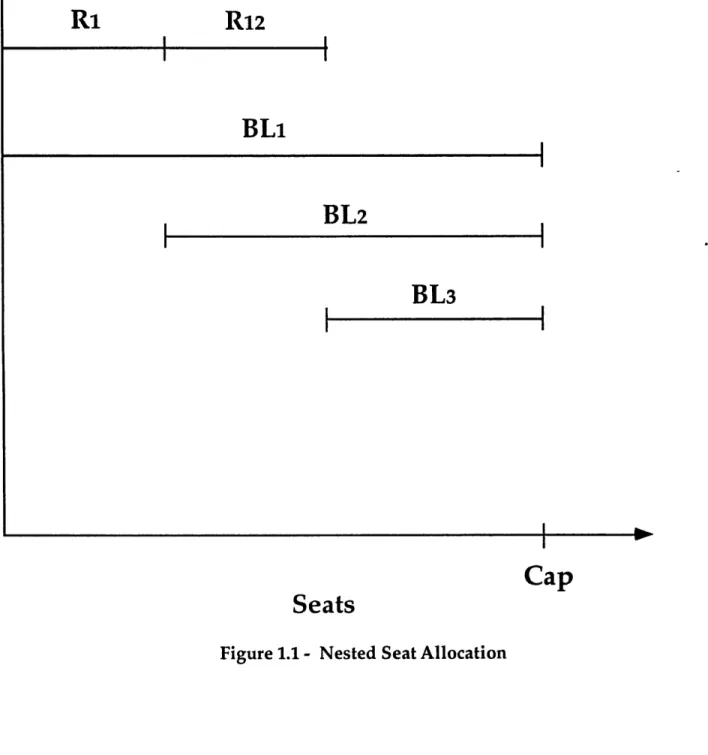
The availability of fare product purchases reinforces the fare product inferiority hierarchy. To demonstrate the increasing benefit of booking limits to the higher-priced fare products, the concept of a nested seat allocation is presented. A nested allocation scheme appears in Figure 1.1 for a three fare product example.
Nested Seat Allocation
R12
BL1
IBL2
I
BL3
Cap
Seats
Figure 1.1 - Nested Seat Allocation
C
Ri
The fare products are decreasing in fare level and increasing in restrictions from fare product 1 to fare product 3. In the example, fare product 1 passengers have access to the entire aircraft capacity as their booking limits or BL1 = CAP. Since
fare product 1 passengers are paying the top price of anyone on the aircraft, the effect on revenue would be negative if a fare product 1 passenger requesting a seat were rejected (if one was available).
There are R1 seats protected for fare product 1 passengers and the rest of the
seats (CAP -R1) are available to fare product 2 passengers. R12 seats are
protected for the use of either fare product 1 or fare product 2 passengers.
Finally, fare product 3 passengers have BL3 = (CAP -R1 -R12) seats which they
are eligible to purchase. The seats reserved for fare product 3 passengers, however, can always be purchased by passengers from fare products 1 and 2 who value the service more (and are willing to pay for it). The nesting ensures that any unfilled seat is more likely to be available to the less-restricted fare products than the more-restricted thus reinforcing the inferiority hierarchy. The implementation of seat allocations that draw from a nested inventory dominate industry seat allocation structures.
1.2 Airline Revenue Management
The revenue management function within an airline controls much of the marketing of individual airline seats to consumers. The two major functions of the revenue management responsibility within an airline are pricing and seat inventory control (or yield management). The pricing department controls the airline fare product offerings and price levels in the market. The seat inventory control department allocates the seats given the fare levels and purchase
restrictions set by the pricing department. All revenue management functions are undertaken assuming a fixed schedule and capacity provision in each market. The primary goal of revenue management is to manage the airline demand and revenue given the fixed provision decisions. A brief description of the revenue management functions appears in this section.
1.2.1 Airline Pricing
Pricing departments at airlines seek to provide airline fare products that stimulate demand where it is needed without unnecessarily diluting revenue from passengers placing greater value on air travel. In addition, the price levels and restriction bundles offered on the market must enable the seat inventory control department to best manage revenues given the fixed fare product structure. The published fare product structure for any airline must be flexible enough to manage demand under varying conditions, yet simple enough to be understood by travelers and ticketing agents. All of this must be achieved while remaining competitive with the fare product structures of rival carriers. In most cases, airlines offer identical fare product structures to their competitors as a result of the underlying market forces.
Other areas involved in the pricing function are the negotiated group pricing division and the negotiated contracts pricing division. The negotiated group pricing division bargains with tour contractors and representatives of large travel groups. The group negotiations are, in general, for a single flight or short term event. The negotiated contracts pricing function attempts to secure the exclusive business of a large client by offering a special deal for all employees or business
trips on a long term contractual basis. The contract guarantees that allbusiness from the single large client comes to the airline rather than going to other carriers. The contract, in general, fixes a corporate rate for a large purchaser of air travel that is guaranteed for the duration of the agreement. It should be noted that the negotiated group and contract pricing decisions must both be made while competing for seat availability with passengers traveling on published fares.
The focus of this dissertation is the establishment of price levels and fare
products that enable an airline to maximize revenues. It is therefore logical that the focus of the discussion of an airline pricing department be the published fares and fare products. A detailed description of the daily published pricing function appears later in the chapter.
C
1.2.2 Airline Seat Inventory Control
The airline seat inventory control function within an airline seeks to maximize revenue given the fixed capacity flying between city pairs, the fixed price levels and restrictions facing them (set by the pricing department) by forecasting passenger demand and correctly allocating the available seats. To this end, airline seat inventory management seeks to reduce revenue dilution and prevent unnecessary decreases in revenue and yield. Analysts control the availability of seats using the inventory controls available to them in the computer reservation system (CRS).
Computer reservations systems allow airlines to control their seat inventories virtually in real-time by recording and communicating passenger bookings on the large computer network. The inventory control ability has enabled the airlines to increase their revenues given the prevailing fare levels and demand forecasts using the techniques of yield management. The three main areas of yield management are demand forecasting to predict traffic volumes, booking limit applications that attempt to maximize expected revenues, and flight overbooking to correct for the problem of passenger "no shows". The
sophistication of airline yield management modeling has been implementable because of the CRS network.
The seat inventory management department applies booking limits to the available fare products to maximize the expected revenue of the airline. The application of booking limits is the function most closely associated with the seat inventory management department. To maximize expected revenues on the flight departures, booking limits are set using the techniques of yield
management such as the Expected Marginal Seat Revenue (EMSR) heuristic (Belobaba, 1987). Yield management systems use demand forecasts as inputs to maximize expected revenues.
Demand forecasts must be made by the seat inventory management department to predict the number of passengers that are expected to make fare product bookings on a given flight departure. The passenger traffic predictions are a
primary input to the yield management systems which enable the airline to best allocate the available seat inventory to maximize expected revenues. Without knowledge of the number of passengers expected to book on a given flight
departure, the airline would have no idea how many seats to protect for the high revenue passengers. Thus, the ability to apply sophisticated demand
management techniques hinges upon the ability to correctly forecast demand.
Finally, not all passengers who make bookings on a flight departure actually show up and depart on the flight. The result of the passengers who do not show up is the departure of the aircraft with empty seats. If there is excess demand on a given flight, allowing a passenger to book a flight and then cancel results in lost revenue for the airline as well as a wasted resource. The seat inventory control department overbooks flights, accepts more bookings than the aircraft capacity, to prevent seats from departing unfilled. Setting overbooking factors for flights is another primary function of the seat inventory management department. The overbooking factors set for a flight also impact the seat allocation decisions returned by the yield management system.
1.2.3 Cooperation Between Seat Inventory Control and Pricing
Although there is a dependency relationship between pricing and seat inventory control, the policies set by pricing must be made first. The pricing department
C
sets price levels and the accompanying restrictions to the fares offered in eachOD market. Seat inventory control takes the fare levels and restrictions
established by pricing and attempts to maximize revenue. All actions taken by seat inventory control are contingent upon the price levels and fare restrictions dictated by pricing. It is the responsibility of pricing to provide the price levels and fare products required by seat inventory control to correctly manage demand and revenue.
Within the pricing department, the correct price levels and fare restrictions must be combined to offer a competitive mix of fare products. Seat inventory control is responsible for managing revenue and does so by protecting seats for higher-fare passengers booking near departure and limiting availability of discount seats. When pricing must issue a competitive price filing to match a newly introduced lower fare, seat inventory control is responsible for applying booking limits to the number of fare products that may be reserved by consumers at the published price. A miscommunication between pricing and seat inventory control could result in too many discount fares to be sold on a given flight leaving the profitability of the flight diluted. Proper communication between
pricing and seat inventory control can help to prevent unnecessary revenue loss for the airline.
Drastic changes in price levels may impact the seat inventory control function in predictable ways. The demand forecasts may become biased with large shifts in price levels. For example, during a fare war, the number of bookings in the lowest discount class are expected to balloon as a result of the low fares being published. The seat inventory control analyst would be better equipped to anticipate demand spikes with proper communication with pricing. Any decisions made by pricing and inventory management should consider the possible effects that the pending decision might have on the revenue dilution encountered when high-revenue passengers are displaced by low-revenue passengers. Although generally regarded as separate within airlines, the pricing and seat inventory control functions work to achieve the same goals of demand and revenue management. The ultimate aim of the revenue management
function within an airline would be a complete integration of the pricing and seat inventory control functions.
1.3 Current Practice: Airline Pricing Departments
The primary functions of airline pricing departments are to develop the
differentiated fare products, set their price levels, and report this information to the relevant systems. This section seeks to characterize the daily functions and requirements of the published fares portion of an airline pricing department. A
description of the communication of price levels between airlines begins the discussion.
1.3.1 Airline Tariff Publishing Corporation
In the U.S. airline industry, each airline knows the complete fare structure of all other carriers in every OD market. Domestically, the fare product information is contained in a data base published by the Airline Tariff Publishing Corporation
(ATPCO). Airline fare product changes are sent at least daily from the individual
carriers to the ATPCO. The Airline Tariff Publishing Corporation serves as a clearinghouse for the fare product changes that are posted by the carriers.
The information concerning fare products available in any OD market that is held by the ATPCO data base includes:
1) Fare level
2) Fare basis (a code representing restrictions)
3) Effective dates
4) Acceptable routings
5) Special footnotes
6) Specific rules applicable 7) Airline quoting the fare
The fare level posted with the ATPCO is simply the cost to consumers of
purchasing the fare product. The fare basis is a code representing the restrictions associated with a fare product and the fare class in which it is published. For example, a QE14NR fare basis code identifies a fare product booked in
Q
class for an Excursion fare that must be purchased at least 14 days in advance ofdeparture and is Non-Refundable. The effective dates comprise the first and last dates that the fare is available for purchase by the traveling public. Any specific restrictions on the flights for which a given fare product is valid are contained in
the acceptable routings category. Special footnotes and rules clarify any non-standard restrictions placed on the fare product or its sale not evident in the fare basis code or the routing restrictions. Changes can be posted with the ATPCO by
the carriers to any of the above information fields, not just price level. From the
ATPCO data base, the current airline fare product structure for all carriers in all
markets is known for the present and near future to all subscribing carriers.
The fare levels and products listed with ATPCO that are currently valid (effective) are also listed in the computer reservations systems that provide information about the inventory of seats for sale to the public. The fare level changes are also reported to the CRS network on a frequent (at least daily) basis. The fares listed are the only ones that can be sold through the CRS. As
previously stated, the unpublished negotiated and contract fares must be
handled separately by the airline and do not appear within the ATPCO data base or any CRS. The primary differences between the CRS and ATPCO data bases are that the CRS contains seat availability information while the ATPCO contains a greater volume of information about fares not currently available for sale to
The fare changes that have been registered with the ATPCO data base in the last 24 hours are published daily in a report made available to all subscribing airlines. Using the data base, responses to price and fare product changes can be
registered and disseminated within 24 hours. In this framework, discontent with a fare change can be made known to another airline within one day. As would be expected, the ATPCO data base has been used by the airlines as a method to engage in potentially collusive pricing practices, most notably price signaling.
1.3.2 Price Signaling
The practice of price signaling using the ATPCO published fares data base is one technique available to the airline pricing analyst. Price signaling is the method
by which airlines show discontent with the price changes of other carriers. The
airlines test the competitive reaction to proposed fare initiatives before they go on the market using the ATPCO clearinghouse. Carriers "signal" their intention to introduce a fare product change or price reduction onto the market in advance, to see the competitive response of the rival carriers before actually putting the fare product on sale. When price signaling is used, consumers need not receive the benefits of low fare quotes that are not accepted by the other carriers since the changes need never reach the market. The acceptability to the competing carriers is often the force that drives the actual introduction onto (or withdrawal from) the market of a fare initiative.
For exposition, consider the example of a fare decrease in the Chicago to Dallas-Fort Worth market posted by United Airlines to take effect in one week. If American Airlines disapproved of the pricing action by United, American might propose a fare increase in the same market identifying United in the fare basis
code with effective dates for the fare identical to United's proposed fare reduction. From this signal, United would understand that American
disapproved of the price reduction in the market. A more severe reaction to United's fare cut by American might be to publish an extremely low fare in the Chicago to Denver market (which is very important to United) effective for only one day. This would indicated extreme displeasure to the fare change by
American. It would be up to the discretion of United whether or not to withdraw the initial fare decrease, but that decision would be aided by the information about the competitive reaction of American as shown through its price signals.
The message sent by a carrier can vary in severity from a minor fare modification in a low revenue market to a large fare cut in an important hub market. If a carrier views the price level in a certain market to be below a level at which a profit can be made, the carrier may send pricing signals in an attempt to raise the
prices up to an acceptable level. To be most effective, this process must be done gradually and in systematically timed increments so that the signals can be clearly interpreted by the competitors (Elkins, 1986). To effectively price signal, the other carriers must know your intentions. Regardless of the method of implementation, however, the practice of price signaling pervades the industry.
Legal and ethical issues surround the current practice of pricing in the airline industry. Among the volatile issues facing airline management is the legality of the practice of price signaling. One of the major concerns facing the United States Department of Justice regarding the commercial airline industry is the legality of price signaling and when signaling becomes a violation of anti-trust legislation. The U.S. government has disagreed with the testing of fares before they go to market. A lawsuit has been filed by the U.S. government against eight major U.S. carriers in an attempt to curb price signaling. The carriers were found
guilty of anti-trust violations and ordered to desist from the practice of price signaling. As a result of a settlement, two major carriers, United and USAir, have signed an affidavit preventing them from practicing fare testing using the
ATPCO clearinghouse for the period of ten years (WSJ, 1993). 1.3.3 Functions of an Airline Pricing Department
Airline pricing departments are made up of analysts who make the daily pricing decisions and managers who approve the decisions and handle more
far-reaching pricing issues. Analysts are assigned several OD markets for which they are responsible. Primary in the duties of the analyst is addressing the fare actions of other carriers in their markets. Fare initiatives also must be registered
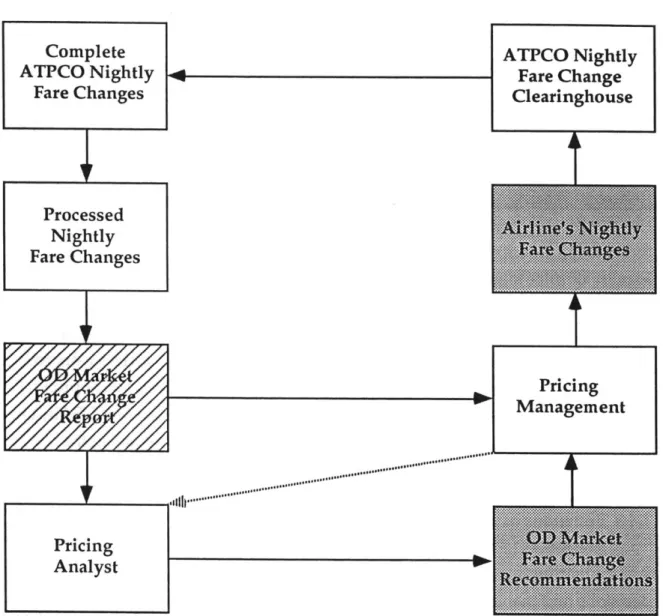
by the analysts at the request of pricing management. Figure 1.2 represents the
flow of information within the pricing department and out to the ATPCO that occurs daily in all OD markets where fare change actions take place. Changes to restrictions and other fare product attributes also take place in the ATPCO
clearinghouse. These changes are quite similar in nature, however, and thus, the discussion will focus on fare changes.
Overview of an Automated Airline Pricing System
Each day the ATPCO returns a list of the fare changes that were posted the previous day by all of the participating carriers. In Figure 1.2, the cross-hatched box represents the information provided to the analyst about his OD markets. The lists of changes are processed by the carriers and provided to pricing
analysts in the form of market reports. In the past, the reports had been
distributed to analysts in the form of computer printouts on their markets. Many major carriers now process this information and provide it to analysts on menu-driven screens. An efficient information processing function can expedite a thorough market analysis for the pricing analyst.
Analysts access fare changes in the markets for which they are responsible to monitor the activity that has taken place over the past day. The shaded boxes in Figure 1.2 represent the changes made by the analysts for submission to the
ATPCO clearinghouse. It is the responsibility of each analyst to respond to the
fare changes posted by rival carriers in his markets. The fare change responses or initiatives that are proposed by analysts are then transferred to pricing
management for approval or revisions. Upon approval, the pricing decisions that have been made in all markets are sent to the ATPCO data base for listing in the fare change report provided to all carriers the following day. It should be noted that communication between the airline pricing departments and ATPCO may take place more often than once per day but for ease of exposition, a daily interaction has been assumed.
1.3.4 Competitive Pricing Strategies
When a fare change is registered by an airline, a competitive response is expected from the other airlines offering service in the OD market. This is true whether or not price signaling is permissible. The discussion of competitive responses to fare changes is presented here with respect to a decrease in fare level although the result can be generalized to any change in fare levels or purchase restrictions. Three main types of price quoting strategies are used to respond to a fare change when registered by a competing carrier:
1) matching strategy
2) non-matching strategy
3) partial matching strategy
If the responding carrier agrees with the price change or is unwilling or unable to combat the fare change, a matching strategy can be adopted. A matching
strategy consists of matching the price level offered by the carrier posting the fare change under the same conditions on all flights in that market. The expected results of a matching strategy are the retention of market share and
competitiveness in the market. A negative effect resulting from a matching strategy (in this case) is a loss in the average revenue paid per passenger in the market because of the reduced price levels.
In contrast to the matching strategy, a carrier can adopt a non-matching strategy in which the carrier retains his current price levels on all flights. This strategy would result in the maintenance of yield but risk the adverse effects of a possible loss in market share and competitiveness in the market. In addition, customer goodwill may be lowered in the market if the carrier is perceived as being insensitive to the traveling population by not matching, for example, a heavily advertised fare cut. When both the matching and non-matching strategies offer unacceptable alternatives, any of several partial matching strategies which call for selective matching of fare changes can be employed.
A spectrum of partial matching strategies lie between the matching and
non-matching strategies which may help in retaining market share and reducing the loss of yield. A partial matching strategy may result in a price match on certain off-peak flights or on flights with a specific routing. For example, one partial matching strategy calls for the matching of fares on the less popular, off-peak flights while maintaining current fare levels on the more popular peak flights. Another partial matching strategy calls for routing restrictions on the discount fare products in an attempt to reduce the pressure put on high load factor flight legs entering and leaving hubs burdened with too much rejected demand.
The exact form of the strategy adopted by the carrier should depend on the nature of the OD market and the relative strength of the carrier in that market as well as the size of the fare change. The ramifications of adopting a partial
matching strategy must be considered when choosing the best fare-matching response strategy. The competitor offering the lower fare is likely to offer that fare on all flights (peak and off-peak) in that OD market. The pricing analyst must be confident enough in the market demand level at peak hours to become