Publisher’s version / Version de l'éditeur:
Organized by MiraLab, University of Geneva and 3ème Cycle Romand
d'Informatique (cuso), 2002
READ THESE TERMS AND CONDITIONS CAREFULLY BEFORE USING THIS WEBSITE. https://nrc-publications.canada.ca/eng/copyright
Vous avez des questions? Nous pouvons vous aider. Pour communiquer directement avec un auteur, consultez la première page de la revue dans laquelle son article a été publié afin de trouver ses coordonnées. Si vous n’arrivez pas à les repérer, communiquez avec nous à [email protected].
Questions? Contact the NRC Publications Archive team at
[email protected]. If you wish to email the authors directly, please see the first page of the publication for their contact information.
NRC Publications Archive
Archives des publications du CNRC
This publication could be one of several versions: author’s original, accepted manuscript or the publisher’s version. / La version de cette publication peut être l’une des suivantes : la version prépublication de l’auteur, la version acceptée du manuscrit ou la version de l’éditeur.
Access and use of this website and the material on it are subject to the Terms and Conditions set forth at
NRC 3D Imaging Technology for Museums & Heritage
Taylor, John; Beraldin, Jean-Angelo; Godin, Guy; Cournoyer, Luc; Rioux,
Marc; Domey, Jacques
https://publications-cnrc.canada.ca/fra/droits
L’accès à ce site Web et l’utilisation de son contenu sont assujettis aux conditions présentées dans le site LISEZ CES CONDITIONS ATTENTIVEMENT AVANT D’UTILISER CE SITE WEB.
NRC Publications Record / Notice d'Archives des publications de CNRC:
https://nrc-publications.canada.ca/eng/view/object/?id=0bacb91e-18f4-4a0a-959b-9649c2851c12 https://publications-cnrc.canada.ca/fra/voir/objet/?id=0bacb91e-18f4-4a0a-959b-9649c2851c12National Research Council Canada Institute for Information Technology Conseil national de recherches Canada Institut de technologie de l’information
NRC 3D Imaging Technology for Museums &
Heritage *
Taylor, J., Beraldin, J_A, Godin, G., Cournoyer, L., Rioux, M.,
and Domey, J.
October 2002
* published in Proceedings of The First International Workshop on 3D Virtual Heritage, October 2-3, 2002, Geneva, Switzerland, organized by MiraLab, University of Geneva and 3ème Cycle Romand d'Informatique (cuso), pp. 70-75. NRC 44966.
Copyright 2002 by
National Research Council of Canada
Permission is granted to quote short excerpts and to reproduce figures and tables from this report, provided that the source of such material is fully acknowledged.
NRC 3D Imaging Technology for Museums & Heritage
J. Taylor, J-A Beraldin, G. Godin, L. Cournoyer, M. Rioux & J. Domey Visual Information Technology
Institute for Information Technology National Research Council of Canada
Ottawa, Canada, K1A OR6 (http://www.vit.iit.nrc.ca)
The National Research Council of Canada (NRC) has developed and patented three high resolution 3D imaging systems which have been applied to several museum and heritage recording applications. Each system is designed for different imaging applications and, in collaboration with several national and international museums and cultural agencies, has been used to scan a wide variety of objects and sites. The objective of this paper is to present a summary of the 3D technology and a few of it s heritage applications. 1. Introduction:
The Visual Information Technology Group of the National Research Council of Canada (NRC), has developed and patented three high resolution 3D digital or “laser scanner” imaging systems which have been applied to a variety of heritage recording projects. These projects have been undertaken in
collaboration with several Canadian museums including the Canadian Conservation Institute, the Canadian Museum of Civilization and the National Gallery of Canada. In addition, we have also collaborated on several international demonstration projects with institutions including the British Museum, the Centre de recherche et de restauration des musées de France, the Peabody Museum, the Israel Antiquities Authority, the State Administration of Cultural Heritage in China and in Italy with the Universites of Padova, Ferrara, Stanford and Florence.
One of the systems, the High Resolution Color Laser Scanner, has been used for scanning typical museum and art gallery collections. Two monochrome systems, the Biris 3D Laser Camera and the Large Volume Laser Scanner, have been used in the field to digitize archaeological site features, architectural elements on historic buildings and large sculptures.
The purpose of this paper is to pres ent an overview of the imaging systems and some of the heritage recording applications demonstrated to date.
2. NRC 3D Imaging Technology for Museum & Heritage Recording Applications:
The three laser scanner systems developed at NRC use triangulation based scanning and detection systems and are designed for different types of objects and imaging applications. Typically, to digitize a museum object or a heritage site feature, the systems scan sequential overlapping images from multiple points of view over the complete object or site surface. This is accomplished by moving the scanner (mounted on a tripod or on a three-axis translation system) around the object or by rotating the object on a rotating table in front of a stationary scanner.
Once scanned, data modeling and display software is used to merge or integrate the multiple view data sets into a seamless archival quality high-resolution 3D digital model of the object. We have collaborated with InnovMetric Software Inc. (http://www.innovmetric.com) on the development of the suite of PolyWorks™ software tools. Using PolyWorks, the multiple view data sets recorded by the scanner are merged into a seamless high-resolution 3D digital model of the object. PolyWorks also contains editing and data compression tools and a module, which enables the creation of texture maps for reduced models from the color scanner. It also enables the 3D model to be transferred into different formats and used for a variety of heritage recording applications.
2.1 High Resolution Color Laser Scanner:
The High Resolution Color Laser Scanner (Figure 1, left) is based on the auto-synchronized spot scanning principle (1) and has been developed for digitizing a range of "traditional" museum objects including archaeological and ethnographic collections, paintings, small sculptures and natural history specimens in color (2-5). The scanner, mounted on a three-axis translation system, scans a small 50 – 100 micron (0.050 – 0.100 mm) low power "white light" laser spot from a RGB laser source on the object through a
synchronized laser scanning and triangulation detection system. The 3D shape and color are recorded simultaneously with high-resolution and in prefect registration. The system can also be operated on a tripod and used for high-resolution monochrome digitizing applications.
In its maximum resolution configuration, this system provides a spatial (x and y) resolution of 50 microns (0.050 mm) and a depth (z) resolution of 10 microns (0.010 mm). This resolution is sufficient to record and examine fine brush stroke details on paintings (Figure 1, center) as well as tool mark features on sculptures and archaeological objects (Figure 1, right).
On a commercial basis, NRC has licensed this technology to Arius3D (http://www.arius3d.com).
Figure 1. The High Resolution Color Laser Scanner (left) imaging the Tsimshian Stone Mask from the Canadian Museum of Civilization. In this configuration, the scan is made by rotating the mask 360° on a rotation table. The scanning mechanism projects a white laser spot (white line profile) on the mask from a RGB laser. Details of a Corot signature (center) and tool mark features on one of Michelangelo's Prisoner sculptures in Florence (right).
2.2 High Resolution Color Laser Scanner Application: 3D Virtual Museum Display
The High Resolution Color Laser Scanner technology provides unique 3D virtual museum exhibition and display applications for museums. 3D digital models of objects, digitized by the scanner, can be
interactively displayed and examined from any perspective in stereo. Museum visitors can zoom in to study features such as tool marks on archaeological collections or magnify and examine high-resolution images of miniatures or small figurines. The image data can also be transmitted to remote locations using high-speed communication networks for "virtual museum" applications.
This application was demonstrated in the exhibition The 3rd Dimension: A New Way of Seeing in
Cyberspace at the Canadian Museum of Civilization in 1997 (6). In the exhibition, 3D images of objects
from the Museum's collection were digitized (Figure 2). Two interactive display station information kiosks were used for stereo image display – one at the Museum and the second “remote site” at the Royal British Columbia Museum in Victoria Canada. Visitors in either museum could select an object from a menu, examine stereoscopic 3D images of it and access associated text information. Stereo viewing glasses were provided for viewing the images. In addition to rotating the object, visitors could zoom in and examine specific details of interest.
Figure 2. The digitizing system (left) at the Canadian Museum of Civilization scanning an object from the Museum’s collection during the exhibition The 3rd Dimension: A New Way of Seeing in Cyberspace . Stereo images were displayed in an interactive display station (right) at the Museum and at Royal British Columbia Museum in Victoria.
2.3 The Biris 3D Laser Camera:
The Biris 3D Laser Camera is a portable digital 3D imaging system based on NRC's patented BIRIS dual aperture technology (7). The camera utilizes plane-of-light triangulation combined with a dual aperture mask on the detection system. It is a compact and robust monochrome system and is ideally suited for field recording of the three-dimensional shape of an object or feature. The camera, controlled by a laptop computer, is mounted either on a conventional tripod or on a motorized linear translation stage (Figure 3). It has been used to digitize architectural building elements and sculptures in Italy, a section of a
Hieroglyphic Stairway at the Peabody Museum and archaeological sites in China.
The Biris camera has a maximum range (camera to object distance) of 2 m and an accuracy of 80 microns (0.08 mm) at a range of 0.3 m and 1.8 mm at 1 m.
NRC has licensed this technology to the ShapeGrabber Corporation (http://www.shapegrabber.com/). Innovision 3D provides a commercial scanning service using this scanner (http://www.innovision3d.com).
Figure 3. The Biris 3D Laser Camera (left) is a compact and portable monochrome imaging system and is ideally suited for field recording applications. The camera is shown (right) attached to a motorized rotation stage mounted on tripod. The cases for carrying the system and laptop computer controller are in the foreground.
2.3 Biris 3D Laser Camera Applications: Remote Recording of Archaeological and Architectural Sites
Previously, we have reported on two projects undertaken in Italy to demonstrate the Biris system for rapid response to remote archaeological and architectural site recording applications. In 1997, in collaboration
with the University of Padova, it was used to digitize the sculpture Madonna col Bambino by Pisano, two bas -reliefs by Donatello as well as deteriorating architectural elements at the Palazzo Della Ragione in Padova. In 1998, in collaboration with the University of Ferrara, it was used to digitize a number of architectural building elements on the facade of the 8th century Abbey of Pomposa, near Ferrara. Details on these projects have been reported in reference 7 as well as in the report 3D Imaging for Rapid Response on
Remote Sites on our web site (http://www.vit.iit.nrc.ca).
In addition, in 1998, one of our industrial partners, Innovision 3D, used our portable Biris system to record a section of the Mayan Hieroglyphic Stairway in the Peabody Museum of Archaeology and Ethnology at Harvard University in Boston. This section of the Stairway, which also includes a statue of a seated warrior, originated from the Maya Site of Copán in Honduras, a UNESCO World Heritage Site, and is regarded as one of the more important remaining Mayan hieroglyphic writing records. The objective was to digitize the Peabody's section of the Stairway and to prepare a 3D digital model (Figure 4).
Figure 4. The Biris 3D Laser Camera (left) is shown mounted on a linear translation stage scanning a section of the Hieroglyphic Stairway at the Peabody Museum. The Stairway measures approximately 3.4 m wide and is approximately 2.3 m at its highest point. The complete 3D model is shown in the center. The artificial shading feature of the software can be used to study the writing on any section of the model (right).
2.4 The Large Volume Laser Scanner:
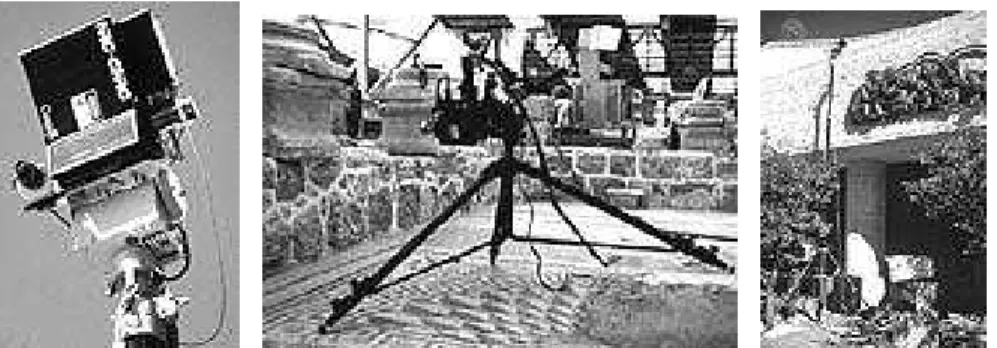
The Large Volume Laser Scanner is also based on NRC's patented auto-synchronized laser scanner technology (8). It is a research prototype system under development for high-resolution monochrome 3D digitization of large structures, which generally are larger in size than those recorded using the Biris System. The scanner can be mounted either on a conventional photographic tripod or on a custom designed telescoping tripod, which can be raised to a height of 10 m (Figure 5). The system has been used to demonstrate applications for recording archaeological sites in Israel as well as for digitizing large sculptures at the Canadian Museum of Civilization.
Figure 5. The Large Volume Laser Scanner (left) mounted on pan and tilt unit. The system includes a video camera to facilitate remote positioning of the scanner. In the center image, the Scanner is shown mounded on a conventional tripod to scan archaeological site features at Caesarea in Israel. On the right, it is shown mounted on a telescoping tripod to scan the sculpture Mythic Messengers at the Canadian Museum of Civilization. The sculpture is mounted 4 m above ground on an exterior wall and measures 9 m long x 1.2 m wide.
The system allows 3D recordings at a camera to object distance (camera standoff) which ranges from 50 cm to 10 m. At a standoff of 50 cm, it provides a resolution of 70 microns (0.07 mm), which increases as the square of the distance. For example, at a 10 m standoff, the resolution is 2 cm.
The Large Volume Laser Scanner is currently a research prototype system in our laboratory.
2.5 Large Volume Laser Scanner Applications: Recording& Display of Archaeological Sites
The Large Volume Laser Scanner has been used to demonstrate the applications for recording
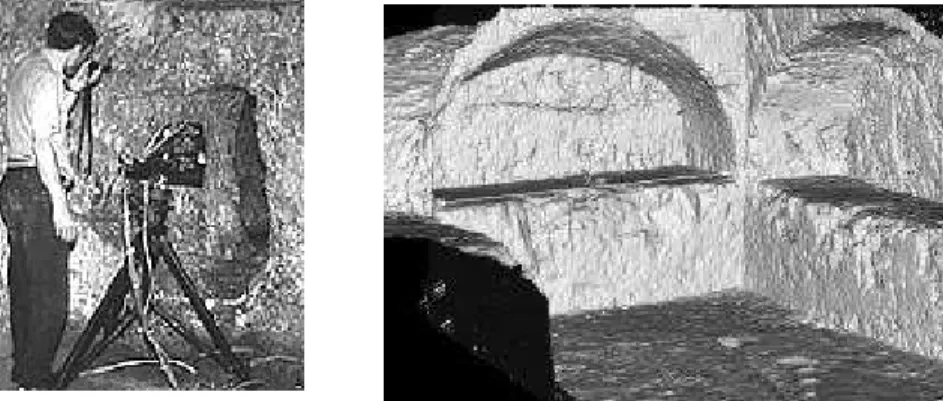
archaeological site features. In 1996, in collaboration with the Israel Antiquities Authority, a pilot project to demonstrate the heritage recording applications for heritage and conservation professionals was undertaken in Israel. The system was used to scan the Tomb of St. James in Jerusalem (Figure 6), the Holy Sepulchral Lintel in the Rockefeller Museum as well as several archaeological and architectural site features at Caesarea.
St. James Tomb measures approximately 2 m x 2 m x 1.8 m in height. Typical of a Tomb carved from the rock, its surfaces are rough and irregular in shape. In addition to recording the irregular shape details with accuracy for heritage preservation documentation, the digital model data was also displayed as part of our research into 3D Virtualized Reality display applications. The rough and irregular surface details of archaeological sites captured by the system adds considerable realism and authenticity to VR displays which is often lacking in flat synthetically modeled displays. More details on this can be found in our report Demonstration of Heritage 3-D Imaging Applications in Israel on our web site
(http://www.vit.iit.nrc.ca/).
Figure 6. The Large Volume camera is shown (left) mounted on a conventional tripod scanning the entrance of St. James’ Tomb in Jerusalem. The Tomb measures approximately 2 m x 2 m x 1.8 m in height. A section of the digital model is shown on the right. In addition to recording the irregular shape details with accuracy for heritage preservation documentation, the digital model data was also used to prepare a 3D Virtualized Reality tours for VR theatre applications. The rough and irregular surface details of archaeological sites captured by the system adds considerable realism and authenticity to VR displays which is often lacking in flat synthetically modeled displays.
3. Conclusions:
This paper has presented an overview of the imaging systems developed at NRC and some of the museums and heritage recording applications. For heritage recording, perhaps the most important aspect is that the image data obtained using the 3D imaging systems provides an accurate high resolution three-dimensional digital record of the. This "3D digital model" data can be retained as an archival quality record of the object and used for a variety of activities including display, research, conservation, replication and VR
References
1. Rioux, M., Digital 3-D imaging: theory and applications. SPIE Proceedings, Videometrics III, Boston, MA. October 31-November 4, Vol. 2350, 1994. pp. 2-15.
2. Baribeau, R., Cournoyer, L., Godin, G.and Rioux, M. “Colour Three-Dimensional Modelling of Museum Objects”, Imaging the Past, Electronic Imaging and Computer Graphics in Museum and Archaeology, British Museum, Occasional Paper Number 114, 1996, London, 199 - 209.
3. Soucy, M., Godin, G., Baribeau, R., Blais, F. and Rioux, M. “Sensors and Algorithms for the Construction of Digital 3-D Colour Models of Real Objects”, ICIP-96 Proceedings, 1996 IEEE International Conference on Image Processing, Vol. II of III, Lausanne, Switzerland, 16-19 September, 1996, 409-412.
4. Godin, G., Cournoyer, L., Domey, J. and Taylor, J., "Three-dimensional recording of objects and sites using laser range imaging", Quaderni 10, Centro di Ricerche Informatiche per i Beni Culturali, X 2000, ISSN 1126-6090, 139 - 150.
5. Baribeau, R., Rioux M. and Godin G., “Color Reflectance Modelling Using a Polychromatic Laser Range Sensor”. IEEE Trans. Pattern Anal. Machine Int., 14(2): (1992), 263-269.
6. Livingstone, F., Evans, K., Taylor, J., Rioux, M., and Arsenault -Desfossés, H.,“The 3rd Dimension: A New Way of Seeing in Cyberspace”, Electronic Imaging and the Visual Arts, EVA’97 Paris, Musée du Louvre, Conference Proceedings, 2 Septembre, 1997, 10.1 - 10.13.
7. Beraldin, J.-A.,Blais, F., Cournoyer, L., Rioux, M., Bernier, F., and Harrison, N., “Portable Digital 3-D Imaging System for Remote Sites”, 33-D 3-Data Modelling and Imaging, The 1998 IEEE International Symp. On Circuit and Systems, Monterey, CA, USA: 326-333. May 31-June 3, 1998.
8. Rioux, M., Beraldin, J.-A., Blais, F., Godin, G.and Cournoyer, L., “High Resolution Digital 3-D Imaging of Large Structures”, Three-Dimensional Image Capture, SPIE Proceedings, Volume 3023, 11 February, 1997, San Jose, CA, 109 - 118.