
Changing the Climate Sensitivity of an Atmospheric General Circulation Model through Cloud Radiative Adjustment
Texte intégral
Figure
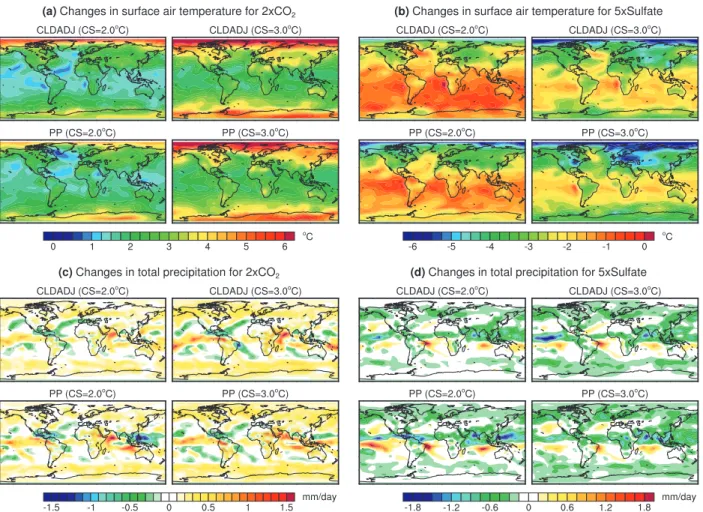
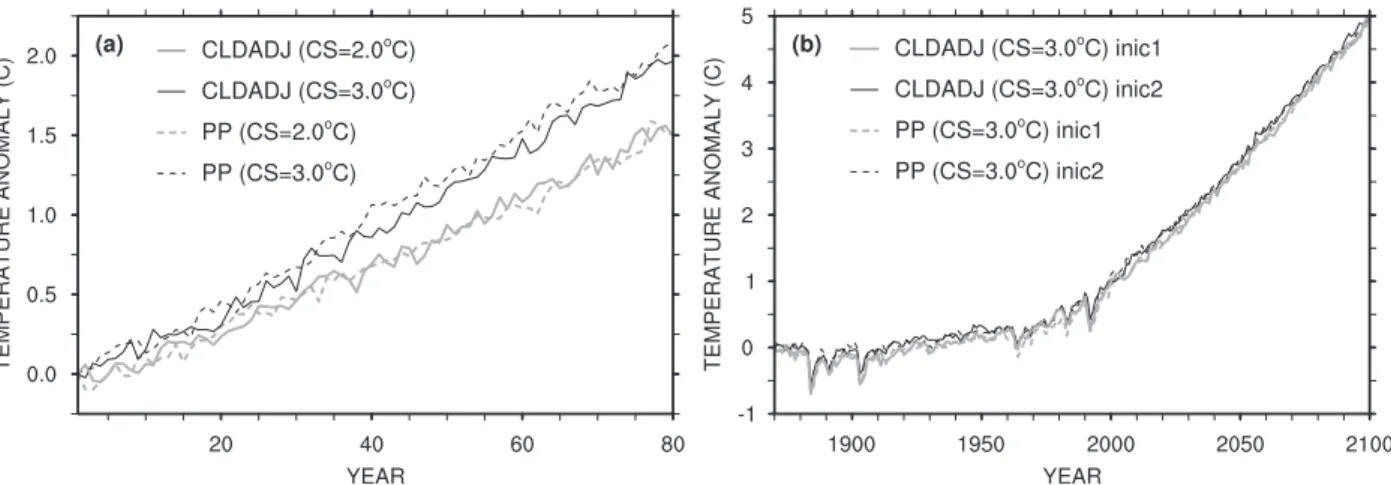
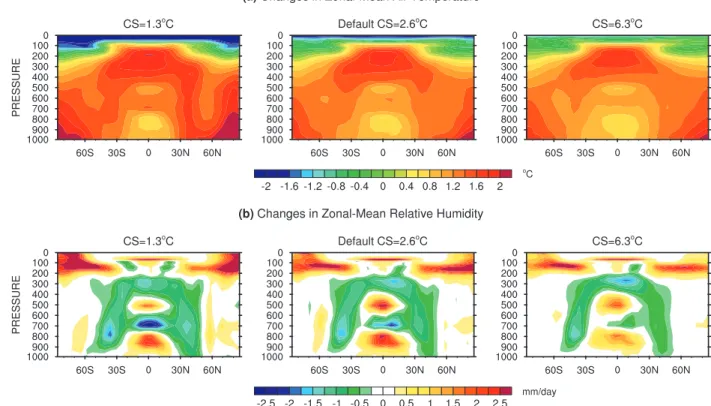
![Figure 1 shows the equilibrium climate sensitivity as a function of k for two resolutions of CAM3 [see also Table 2 for more details about the T21 spectral trunca-tion simulatrunca-tions and Sokolov and Monier (2011) for the 28 3 2.58 version]](https://thumb-eu.123doks.com/thumbv2/123doknet/14227616.484944/4.850.440.778.89.386/figure-equilibrium-sensitivity-function-resolutions-spectral-simulatrunca-sokolov.webp)
Documents relatifs
Martinez-Garcia MA, Soler-Cataluna JJ, Ejarque-Martinez L, Soriano Y, Roman-Sanchez P, Illa FB, Canal JM, Duran-Cantolla J (2009) Continuous positive airway pressure treatment
In the case of the Alps, the simulated increase of winter precipitation could offset temperature effects beyond a certain altitude, resulting in a less pronounced decrease or even
As the engrafted PDiPS cell-derived DA neurons survive in the adult rodent brain for at least 12 wk, we next transplanted differentiated S1 PDiPS cells into the dorsolateral striatum
As was initially thought in the motivation behind creating a wider diffusion fish for flow field study, it could be the case that the proximity to the side walls of
- Heargraves ET o can be used to simulate crop yields only 3 parameters needed (minimum and maximum temperatures, and extraterrestrial radiation) only mean temperatures
With respect to the Tiedtke’s scheme used in previous versions, the Emanuel’s scheme improves the representation of the Hadley-Walker circulation, with a relatively stronger and
This timing suggests (1) a very fast cli- matic response over the Arctic and Northern Eurasia, which is probably related to an atmospheric stationary wave change amplified by
This success in simulating almost no rainfall in these regions in the 6A version can be partly attributed to the modification of the thermal plume model for the representation
