Publisher’s version / Version de l'éditeur:
Nanotech 2011 : Technical Proceedings of the 2011 NSTI Nanotechnology
Conference and Expo, 1, pp. 241-242, 2011-10-13
READ THESE TERMS AND CONDITIONS CAREFULLY BEFORE USING THIS WEBSITE.
https://nrc-publications.canada.ca/eng/copyright
Vous avez des questions? Nous pouvons vous aider. Pour communiquer directement avec un auteur, consultez la
première page de la revue dans laquelle son article a été publié afin de trouver ses coordonnées. Si vous n’arrivez pas à les repérer, communiquez avec nous à [email protected].
Questions? Contact the NRC Publications Archive team at
[email protected]. If you wish to email the authors directly, please see the first page of the publication for their contact information.
NRC Publications Archive
Archives des publications du CNRC
This publication could be one of several versions: author’s original, accepted manuscript or the publisher’s version. / La version de cette publication peut être l’une des suivantes : la version prépublication de l’auteur, la version acceptée du manuscrit ou la version de l’éditeur.
Access and use of this website and the material on it are subject to the Terms and Conditions set forth at
Engineered pigment nanoparticles: bottom-up synthesis,
characterization, and performance properties
Carlini, R.; Makeiff, D. A.; Allen, C. G.; Gardner, S. J.; Paraguay-Delgado, F.;
Malac, M.; Li, P.
https://publications-cnrc.canada.ca/fra/droits
L’accès à ce site Web et l’utilisation de son contenu sont assujettis aux conditions présentées dans le site LISEZ CES CONDITIONS ATTENTIVEMENT AVANT D’UTILISER CE SITE WEB.
NRC Publications Record / Notice d'Archives des publications de CNRC:
https://nrc-publications.canada.ca/eng/view/object/?id=c043c1a4-a0d5-43e0-a7ea-255fb030bd61 https://publications-cnrc.canada.ca/fra/voir/objet/?id=c043c1a4-a0d5-43e0-a7ea-255fb030bd61
Engineered Pigment Nanoparticles: Bottom-up Synthesis, Characterization,
and Performance Properties
Rina Carlini,* Darren A. Makeiff,** C. Geoffrey Allen,* Sandra J. Gardner,*
Francisco Paraguay-Delgado,** Marek Malac,** Peng Li**
*Xerox Research Centre Canada, Mississauga, ON, Canada ;
[email protected]
**National Institute for Nanotechnology, Edmonton, AB, Canada ;
[email protected]
ABSTRACT
High performance organic nanopigments are an increasingly important class of functional nanomaterials that possess physical properties ranging between molecular and bulk materials. These nanomaterials have been utilized in a variety of important commercial applications including coatings, printing, information storage, and display technologies [1]. We will discuss our recent work in developing a bottom-up approach for preparation of 3 different classes of high-performance organic nanopigments: 1) azo-laked Pigment Red 57:1 (LAK), 2) quinacridone Pigment Red 122 (QUIN), and 3) azo-benzimidazolone (BZI) Pigments Yellow 151 and Red 175. The physical characteristics of the nanopigments were characterized by electron microscopy, dynamic light scattering (DLS), and powder X-ray diffraction (XRD), while their coloristic spectral properties, and dispersion thermal stability were investigated in various matrices. We identified relationships between pigment particle size and their coloristic as well as thermal stability properties for these nanopigments. High resolution transmission electron microscopy (HR-TEM) provided clear images of lattice fringes, and enabled us to determine the crystal orientation of the molecules packed within the QUIN and BZI pigment nanoparticles.
Keywords: nanoparticles, nanopigment, organic pigment, electron microscopy, X-ray diffraction.
INTRODUCTION
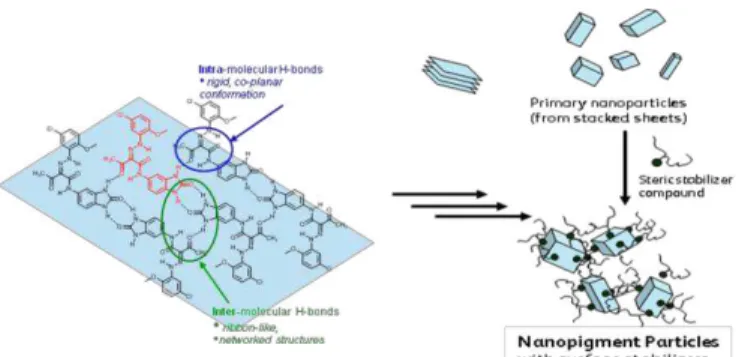
We have developed a general bottom-up synthesis approach to designing nanopigments that involve controlled assembly of building block molecules and/or pigment precursors. A key objective was to prepare the pigment nanoparticles with low aspect ratio (LxW) and also with unique surface chemistry that would ensure optimum thermal stability and dispersion performance, without altering the inherent pigment physical properties (crystal structure, thermal properties). Depicted in Figure 1, our approach involved steric stabilization and the use of pigment-affinic amphiphiles that both target and regulate the self-assembly of colorant molecules into pigment nanoparticles. This versatile design was applied to three
structurally different classes of high performance pigments that are used in coating and printing applications, including azo-laked PR 57:1, quinacridone pigment PR 122, and benzimidazolone pigments PY 151 and PR 175.
Figure 1: General approach for bottom-up assembly of organic nanopigments.
High performance pigments are so-called because they have excellent thermal and photostability and superior solvent fastness, which is the result of inter and intramolecular hydrogen (H) bonding present in the crystalline state (Fig. 2 for PY 151) [2]. Most commercial organic pigments are anisotropic particles having large LxW aspect ratios of greater than 5:1, which is often a consequence of the extensive H-bonding networks. We have obtained detailed characterization of the example BZI, QUIN and LAK pigment nanoparticles, by various electron microscopies, powder X-ray diffraction spectroscopy, CIELAB color properties, thermal stability in liquid solvent dispersions and lightfastness in dispersed polymer films.
Figure 2. Hydrogen-bonded chains of PY151 molecules from the reported crystal structure [2].
RESULTS AND DISCUSSION
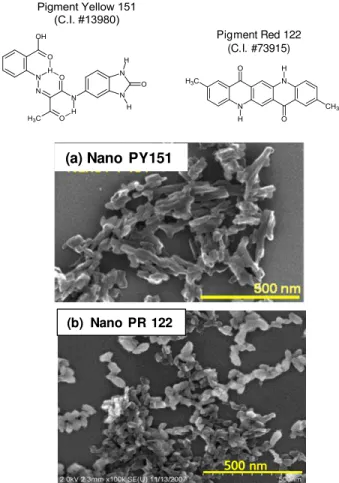
Both the LAK and BZI pigment nanoparticles were synthesized using standard diazotization-coupling reactions from appropriate starting materials, while the QUIN nanopigments were prepared by either direct synthesis or by reprecipitation of bulk commercial pigment [3, 4]. The dimensions and 3D morphologies of BZI (PY 151) and QUIN (PR 122) nanopigments were determined by DLS, SEM, HR-TEM and energy-filtered TEM (EF-TEM) methods. The imaging revealed elongated brick-shaped nanoparticles for PY 151 (Fig. 3a) with average dimensions of L=80 nm, W = 25 nm and average thickness of T = 24 nm, while for PR 122, the nanoparticles had dimensions of L = 73 ± 32 nm and W =T = 19 ± 8 nm. Both of these nanopigment examples had (LxW) aspect ratio ≈ 2-3, which represents a 2 to 3-fold reduction compared with commercial version of these pigments.
Pigment Red 122 (C.I. #73915)
(a) Nano PY151
500 nm
(b) Nano PR 122
Figure 3. SEM image of (a) PY151 nanoparticles, and (b) PR 122 pigment nanoparticles
We obtained powder XRD and HR-TEM imaging data for both PR 122 and PY 151 nanopigments, in order to elucidate molecular packing within these nanoparticles. The molecular packing within the PY 151 nanoparticles is the same polymorph as in the recently reported crystal structure for PY151 [2], which suggests that the pigment-affinic
amphiphilic additives introduced during synthesis must not significantly disrupt the crystal packing in order to reduce particle size, but rather associate weakly on the pigment particle surfaces. Fig. 4 shows an HR-TEM image of PY151 nanoparticles, whereby distinct lattice planes were observable with a d-spacing of 1.6 nm, likely corresponding to the (001) planes based on the reported PY 151 crystal structure [4]. The observed lattice planes enabled us to determine the orientation of the hydrogen-bonded chains of PY151 molecules.
Figure 4. HR-TEM image of PY 151 nanoparticles.
CONCLUSIONS
A general design and method for bottom-up assembly of pigment nanoparticles was developed for three classes of high performance organic pigments. A detailed
understanding of pigment nanoparticles structure is important in order to develop these nanomaterials with tunable performance properties.
REFERENCES
[1] Herbst, W.; Hunger, K. Industrial Organic Pigments:
Production, Properties, Applications; Wiley-VCH: Weinheim, Germany, 2004.
[2] van der Streek, J.; Ivashevskaya, S. N.; Ermrich, M.; Paulus, E. F.; Bolte, M.; Schmidt, M. U. Acta Cryst. 2009, B65, 200-211.
[3] a) US Patent Application No. 20100004360A1, Xerox Corporation and National Research Council of Canada. b) US Patent Application No. 20100037955A1; Xerox Corporation and National Research Council of Canada. c)
US Patent No. 7,503,973; 03/17/2009, Xerox Corporation.
[4] a) Xerox Corporation, US Patent No. 7,427,323; 2008; b) Xerox Corporation, US Patent No. 7,534,294; c) Xerox Corporation, US Patent No. US 7,465,348; 7,473,310.
NSTI-Nanotech 2011, www.nsti.org, ISBN 978-1-4398-7142-3 Vol. 1, 2011