AUXILIARY FIELD APPROACH
TO
EFFECTIVE POTENTIALS
ByDAPENG XU
Submitted to the Department of Physics in Partial Fulfillment of the
Requirements for the Degree of
DOCTOR OF PHILOSOPHY
at theMASSACHUSETTS INSTITUTE OF TECHNOLOGY
June, 1995@Massachusetts
Institute of Technology 1995 (All rights reserved)Signature of Author: Department of Physics May 1995 Certified by: Arthur Kerman Professor of Physics Thesis Supervisor Accepted by: MASSACHUSETTS INSTITUTE OF T_.FJIi1 ArGV George Koster Chairman Graduate Thesis Committee
JUN
2
6 1995
LIBRAFIES
Auxiliary Field Approach to
Effective Potentials By
Dapeng Xu
Submitted to the Department of Physics in partial fulfillment of the requirements for the
Degree of Doctor of Philosophy in Physics at the
Massachusetts Institute of Technology June 1995
Abstract
A non-perturbative effective potential of AO4 theory at finite temperature was ob-tained and renormalized by using the Hubbard-Stratonovich transformation (or auxil-iary field approach). This effective potential exhibits renormalization group invariance and agrees with the perturbative one-loop effective potential at the tree level. It can also recover zero-temperature non-perturbative effective potentials obtained from the Func-tional Schroedinger Picture approach and the Gaussian Effective Potential approach. A formal expression of the contribution to the partition function of AO4 theory beyond leading order saddle point contribution was also obtained. This effective potential was shown to be able to drive inflation in the new inflationary scenario of the early universe. We also calculated the effective potential of the two component AO' theory and studied its relevance to the relativistic Bose-Einstein condensation. The same method was also applied to the O(N) invariant Gross-Neveu model and the renormalization of the non-perturbative effective potential was accomplished. Attempts were also made to apply
the same method to Scalar QED.
To My Family:
My Father, My Mother
and My Two Sisters
Acknowledgments
I feel deeply grateful to Professor Arthur Kerman for teaching me and correcting me through every step of my thesis and other projects I worked on. I would also like to express my greatest gratitude to him for his patience, understanding and amicable attitude. There were many times when I asked him a question repeatedly, he explained it to me patiently once and again. His patience and approachability is extremely
in-valuable for a student fumbling in the darkness. His understanding is not limited to academic issues only, it is also exhibited on his attitude toward general issues in life. His determination and ingenious methods to solve our research problems have won my highest respect and his open-mindedness is something I will cherish forever.
I would like to thank Dr. Chiyong Lin for many useful discussions, especially on the second order calculations of the free energy of the Ao4 theory. I also benefited from
my collaboration with Dr. Senben Liao on finite temperature Blocking Transformation where he did most of the work. My gratitude to him is happily acknowledged. My thanks to them are also extended to the many pleasant hours we spent together in the Center for Theoretical Physics (CTP).
Dr. Goran Arbanas deserves a special acknowledgment. Over my years at CTP, we have had many interesting "adventures", much of which were carried out during our trip across the country to California. He had also been my constant source of help during my stay in California in the summers of 1992 and 1993. I would also like to thank my officemates Lee-peng Lee and Csaba Csa'ki for carrying out many comforting conversations with me.
I also feel indebted to Professor Bertschinger and Professor Guth for their joining my thesis committee and taking the pain of reading the drafts of my thesis. Their constructive comments and suggestions have led to substantial improvements of my thesis.
My thanks also go to CTP secretaries, especially Evan, Roger and Milda for all kinds of help.
Finally, my deepest gratitude belongs to my parents and my sisters, without whose love, care and support my thesis would not have been possible.
Table
of Contents
Chapter I: Chapter II: Chapter III: Chapter IV: Chapter V: Chapter VI: Chapter VII: A b stract ... Acknowledgments . ... Table of Contents ... Introduction...Aq4 Theory at Finite Temperature ... II.1 Free E nergy ...
11.2 Renorm alization ... 11.3 D iscussion ...
11.4 Nonuniform oo ...
Second Order Contribution to the Free Energy.. III.1 Formal Result ...
III.2 Renorm alization ... Effective Potential of XA4 Theory ... IV .1 Effective Potential ...
IV.2 Symmetry Breaking . ... Implications to Inflation . ... V .1 General Picture ... V.2 Parameters Fitting ...
Relativistic Bose-Einstein Condensation ... V I.1 Free Field Case ...
VI.2 Interacting Field Case . ... Gross-Neveu Model . ...
Chapter VIII:
VII.1 Dynamical Symmetry Breaking ... VII.2 Nonuniform ... ... Scalar Q E D ... ... .. ... Appendixes ... Appendix A ... A ppendix B ... .. ... Appendix C ... R eferences ... ... 98 105 107 114 114 116 118 124
Chapter I
Introduction
The effective potential for a field theory is a very useful tool in the studies of sponta-neous symmetry breaking since it incorporates quantum effects into the classical potential. These quantum effects may change the vacuum structure of the classical theory, as was first pointed out by Jona-Lasinio ([1]) and later by other authors ([2]). The effective potential is traditionally calculated by summing infinite series of Feynman graphs at zero momentum ([2]), or by the perturbative, loop-expansion technique. This approach is mainly confined to the one-loop calculation since higher-loop calculations are extremely difficult to accomplish, although several authors have successfully calculated two-loop or higher order effective poten-tials. However, when the relevant renormalized coupling constant in a theory becomes very large, this perturbative approach becomes questionable although it is essentially a perturba-tive expansion in terms of the product of Planck's constant and the renormalized coupling constant. Because of the widespread application of spontaneous symmetry breaking, espe-cially for its application to the finite temperature phase transition, much effort has been put into nonperturbative ways of calculating effective potential. Among them are the Gaussian Effective Potential approach ([3], [4] and [5]) and Functional Schroedinger Picture approach
([6]).
The Gaussian Effective Potential was first introduced by Stevenson ([3]). It is based on the intuitive ideas familiar in quantum mechanics. It is conceptually more straightforward than the standard generating functional approach. It is a variational approach which uses
a normalized Gaussian wave functional as the trial ground state. This trial ground state is centered around an arbitrary constant classical background field q. The trial wave functional also contains a variable mass parameter. Actually this trial wave functional is the free field vacuum with a variable mass parameter. The effective potential, for a given background field ý, is obtained by minimizing the energy of the system with respect to the variable mass parameter, where the energy is the expectation value of the Hamiltonian in the trial ground state. In evaluating this expectation value, the Hamiltonian is rewritten in terms of the usual annihilation and creation operators which obey the usual commutation relations (for bosonic case). Quantum fluctuations are incorporated into the effective potential due to the fact that these minima normally differ from their classical counterparts. With a crude approximation, finite temperature effective potential can also be obtained in this formalism by minimizing the free energy of the system rather than energy ([5]).
The idea of the Functional Schroedinger Picture approach is essentially the same as that of the Gaussian Effective Potential. The main difference is that the Functional Schroedinger Picture approach evaluates the expectation value of the Hamiltonian with the functional in-tegral method by replacing the operators of the Hamiltonian by functional differentiations. The main advantage of this approach over the Gaussian Effective Potential approach is that it is possible to extend it to the nonconstant background field case. However, it is unclear how to extend it to the finite temperature case. As a comparison, although it is possible to obtain Gaussian Effective Potential at finite temperature, the effective potential is evaluated with the real-time operators which obey the usual commutation relations. Today, this cum-bersome method is replaced to a large extent by the finite temperature field theory formulated covariantly in terms of the Feynman functional path integrals. It is in light of this that we
want to obtain a nonperturbative approach to the effective potential which can be extended to finite temperature within the functional path integral formalism.
In next chapter we will illustrate the main idea of our auxiliary field approach by cal-culating the free energy of AO4 theory at finite temperature. Keeping only the leading order saddle point contribution to the partition function, we carried out the renormalization of the free energy in a way essentially the same as the method used in the variational approach in Functional Schroedinger Picture. But we extended previous results in that temperature is easily incorporated into the formalism.
We will focus on the second order contribution to the free energy in Chapter III. A formal expression for the contribution to the partition function of AO4 theory beyond leading order saddle point contribution was obtained and its renormalizability was discussed. We will derive the finite temperature effective potential of AO4 theory in Chapter IV. This is just an extension of Chapter II to the case of nonzero background field. The potential implication of this effective potential to inflation in the new inflationary scenario will be studied in Chapter V. In Chapter VI we will calculate the effective potential of the two component A'4 theory and study relativistic Bose-Einstein condensation. The same method will also be applied to Gross-Neveu model and renormalization of the effective potential will be accomplished in Chapter VII. Finally, we made attempts to extend our auxiliary field approach to scalar QED in Chapter VIII.
Chapter II
,\4
Theory at Finite Temperature
II.1 Free Energy
We begin our investigation with the A04 theory described by the following Lagrangian
in Euclidean space: LE(?) = 21(8t)2 - V(¢)
(2.1)
=
• r )2
2 &7 2(V •)2
-
V(O)
where V(q) = M 2 + A04 (2.2) 2The partition function of a system of bosons interacting through this Lagrangian at temperature T = 1/l is (2.3)
Z =
'
1p
N
e rD [ O
] e xp
{
- f d2
2
( -2
3 L )( 2 .3
= N D[]exp {- d 1( ) + (V)2 + 2 4 where f d4xfo
' dr f d3x andN' = exp -(V
1Zln)
(2.4)
which is a dimensional, temperature dependent constant ([7]). Here V is the volume to which the system is confined.
The only troublesome term in the above Lagrangian is the A04 term, which prevents us
from doing a gaussian functional integral. In order to overcome this difficulty, we consider the two cases: (a) A < 0 and (b) A > 0 separately.
(a)
A < 0
In this case, the functional integral (2.3) is ill defined since it is manifestly divergent. In
addition, since classical potential is unbounded from below, intuition suggests that the theory
is unstable. Since we will encounter this problem again when we derive the effective potential,
we will defer our discussions on these questions to Chapter IV.
We can remove the Aq
4term by making use of the following identity:
Sdzl
...
"dxn _iA-'•+ ½ Aq Jr, j(det A)- d( 2- jn e- iA i xj+ZiJi - e2 J I (2.5)
If we regard -2A64(x - x') as Aij and 02(x) as Ji, then the A04 term can be eliminated at
the sacrifice of introducing an extra functional integral of the auxiliary field o(x).
4 1 a2 1 1
Z N = ]D[]exp dx -(x)
-
- V2 2 + m2 O(X) xo2()(2.6) with N _ N'(det A)- . Note (det A)-½ is an infinite, temperature independent constant. It merely represents an infinite multiplicity in each energy state in the partition function. This multiplicity represents a certain underlying degree of freedom of the system which has no effect on the physics of the system. Indeed, a constant multiplied with the partition function has no effect on the average energy of the system. Therefore, we can drop the (det A)-factor in front of the partition function.
Upon doing the gaussian functional integral of O(x), we obtain
Z = N' D[e- (-m-v2+M2-2(z))-b(x-')]+f d4 82 · ' (X)
(2.7)
=
N'
D[Lo]e-j•~+~-r2l
+f+m
2-+d
4 lx*)Jperi
In the last line above we switch to the operator notation which will facilitate our derivations later. Apparently, the above functional integral in a(x) is convergent since A < 0. So far we
have transformed the original partition function from a functional integral of the O(x) field into that of a new auxiliary field a(x). This new functional integral is to be evaluated with the method of saddle point integration by expanding a(x) around &o, where the exponent attains its global maximum.
Z = N'e-½r
in
p2+p2+m2-2ol]+f d 4 U 2()i D[oa]e K :2+m,2- 2&]0 4 ) )
(2.8)
eri
X tr 2+ -2 o0 +92+ n-2&o 6&++6f] + 1 d4X6o'(X)
By definition, the terms linear in 6o(x) have to vanish. We want to drop terms quadratic in 6a(x) for now, which we will deal with later. Thus, we are only left with the zeroth order term in 6S. Suppose the saddle point for o(x) field is translational invariant, then we can replace ao(x) by a constant ao. Under this assumption, the operator
l2
+ -2 + m2 - 2&0 isdiagonal in the four momentum space.
lnZ = InZo = -1 trln[p2 + +m - 2a] + d 'O4a
+
InN'2 j ZA4
- JdX d4P < xp > ln[P + p2 + 2 - 2o] < pjx >
+
dx a+lnN'
Inserting < x p >= I eip .x+iw,,r and
f
d4x = OV into the above equation, wherematsubara frequency w, = 2 and V is the volume to which the system of bosons is confined, we get
SV (2) ln[(2rn)2 + 22] + V ln3 + •- C2V0 (2.9)
n rx
where the second term is a infinite temperature dependent constant, which cancels the InN' term (see [7] and equation (2.4)). Here we have defined an effective mass 7m and its on-shell energy w by,
Notice that
ln[(27rn) 2 + 2W2] =
j
02 22 + ln[1 + (27r )2] (2.11)
where last term can be ignored since it is temperature independent. Furthermore,
c n2 + (0/27r)2 =0 2 (/2) 2 (! 2 + o (2.12)
- 1
With the help of these two identities we get the following expression for the partition function,
Z = ev (2,3 [- -4n (2.13)
The free energy density of the system easily follows from the partition function, 1
f -- nZ
f
lnZ(2.14)
ýV
(2~-)3 1 + I n(1 -
e-(27r)3
2
4
4/ o
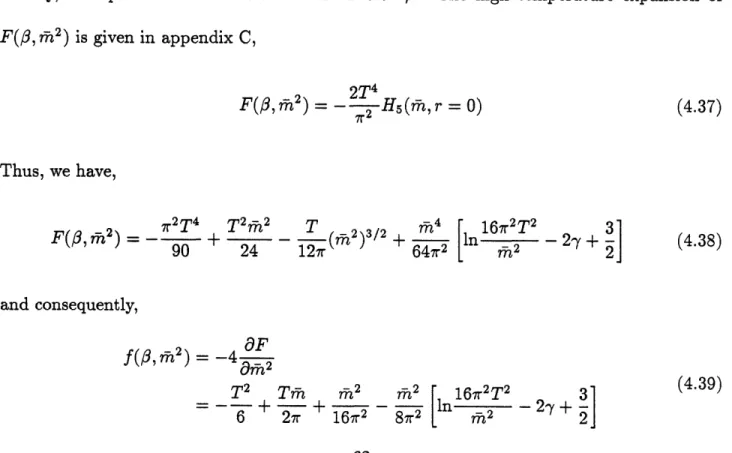
The two terms in square bracket above have exactly the same expression as the free energy density of the ideal boson gas. The first term, f 1w, is the zero-point energy. In the case of ideal boson gas, this term can be dropped since it is just a pure infinite constant. However, in our case, the zero-point energy depends on an effective mass rii, which is to be determined from the first order terms in &o in equation (2.8). Later we will see that :2 depends on temperature, which means we are not allowed to drop this zero-point energy term. Consequently, we need to deal with the infinities associated with it. This problem could be solved since the coupling constant and the mass which appear in the Lagrangian are bare. As in perturbation approach, these bare parameters are momentum- cutoff dependent. Here we make an assumption that the ao also depends on the cutoff and it approaches infinity in such a way that it cancels the infinities in bare mass rn2, leaving f 2 finite. It can be shown
later that ri2 is indeed finite. The last term in the above expression consists of bare coupling 13
constant and ao, which are both infinite, we hope this term will cancel the infinities from the zero-point energy. Note the second term in the square bracket is finite, which we call function
.F(#, m2) for convenience.
3 0 1In
(1
- e- 2 ) (2.15)Before we embark on the renormalization of the free energy density, we come back to the first order terms in 6u. The collection of the first order terms are,
A +p2 + m2 - 2o0' 2A
4
dX
x-<
x>
+-co(x)
be(x)
/
r
1 1 -J
1<
Xi
•
+
p2+
m2
- 2&o
2A
o()6(x)
d
F
1
dj p
1
1
0o(X)
ba(x)
Sd(2r)
3 n n2(27r/n) 2 + p2+
m2 -2o+
••
By definition, the sum in square bracket should be zero. After doing the sum in n, which is the same as in equation (2.12), we get,
o
J
3
2A
[+
(2.16)
(2r)3 w 2 eOw - 1
The second term above is a finite integral. Here we define a finite function f(0, fm2) for later convenience,
f(,0
2)
d3p-
1
(2.17)
(2-)3 W e, - 1
Thus we have obtained the free energy density equation (2.14), with Co being determined by equation (2.16).
In this case in order to obtain a functional integral of o(x) which is manifestly convergent, the equation (2.6) has to be replaced by
Z = N D[]D[a]exp {d4x -(x)( - m2 - ())2) 2V2+]
(2.18) with N - N'(detA)-1 and 2A64(x - x') as Aij.
Upon doing the gaussian functional integral of '(x) and expanding a(x) around the saddle point 0o(x), we obtain,
Z
=N'e-
tr1n[•+p2+m2 -2i&o]-f d 4XL 2 (X)x D[bI]e O +M2 2 -2i0 d o(z)6) (2.19)
peri
X etr o +2+ o +p2+m2
-2i&O
f
d4x 2()Looking at the linear term, we can realize that the saddle point go should be purely imaginary. If we set ao = -iar, then in terms of a', we can recover all our previous expressions in the case of A < 0 for the zeroth order and first order terms in S•. Since later it will be shown that renormalization is entirely determined by the zeroth order and first order terms, we conclude that renormalization is unaffected by the sign change of A.
The reason why a(x) can become purely imaginary is that the exponent of equation (2.18) is diagonal in a. Therefore, the functional integral can be considered as a infinite product of ordinary integrals in each a(x). Each of these integrals is an analytic function of a(x),
therefore, we can deform the contour of the integration. To be specific, we can arbitrarily deform the integration contour when Rea is finite. When Rea -+ 0oo, Ima has to be zero in order to ensure the convergence of the functional integral (2.18).
Now we embark on the task of renormalization. Since the sign change of A has no effects on renormalization, we consider the case A < 0 only. To show clearly how renormalization is accomplished, I purposely choose to be pedestrian in some parts of the derivations. we begin with the first order equation (2.16). The first term in that equation is divergent, we want to single out the divergent terms explicitly in order to perform renormalization,
J
d3p
1
(2.r)
34
1 r
A 14 11 1
(27r)3 2 2m +2
We insert the two integration limits into the above expression and expand it into powers of
ml/A, we keep explicitly only the finite and divergent terms, then we obtain,
d
d
3p
1
1
+1 n2
Ifr
+
(2.20)
(2)3 w 472 2 aA2 A2
with Ina! 21n2 - 1. Consequently, we can rewrite the first order equation (2.16) as,
r 2u j{A2 + 21n A2+ - (,2 m2 - 2ao = 2•22--, or 2 A 2 2 A 2 2 2 A- = mn + •2A + 2 ln + 21n - 2Af(#3, n2) (2.21)
272
47r 2 2 4r2 2Where we have split the logarithm ic term by introducing an arbitrary mass scale E2, this splitting is the key in our scheme of renormalization. If we collect linear terms of 7m2 into the left hand side of the equation, then we have
2 [1 A 2 2 + 2 A 2A - f(n, m2)
From this equation we can see if we define the following renormalized mass and coupling constant,
A/(2r
2)
1- A ln E2(2.22)
_ m2 + AA2/(27r2) \- InF,2 412 aA2then we can obtain the following renormalized version of the first order equation since every
variable in this equation: ip2(F2), AR( 2) and E2, is finite.
m 2(E2) + R(E2)21n 4r22R(2)f(/,rn-2) (2.23)
Finite solution(s) to fn2 can be obtained by solving this equation if they exist. We will call this equation the constraint equation later.
In the above definition of renormalized mass and coupling constant, the bare mass and
coupling constant depend on A in such a way that they make jp2(E2) and AR(E 2) finite.
The relationship between the renormalized mass and coupling constant with the bare ones are temperature independent, which is expected for a renormalizable field theory. Note the renormalized mass and coupling constant run with E2. When splitting the logarithm term in equation (2.21), we could as well have chosen E2 = - 2, then everywhere E2 will be replaced
by y2 and the equations defining the renormalized mass and coupling constant will be, SA/(27r2
)
1-2 aln2 (2.24)
2 2 + AA2/(2r 2)
The explicit appearance of p2 in the logarithm requires it to be positive. However, the renormalized coupling constant can be any real value. This set of renormalized mass and coupling constant are not running anymore and are determined "uniquely". (In practice, we
choose a set of numbers for them). With the help of equations (2.22) and (2.24), we can easily
establish the following relationship by calculating p2( 2) _ 2 and AR(E 2) - AR,
22 AR
=(2E
2
R()
1
_
(2.25)
1- f In 4 2 n- n
These set of equations tell us how t12(E2) and AR( 2) run with p2 and A as E2 changes its
value. We will later show that this extra freedom, or this group of renormalization adds no new physics to our system. Thus we will drop the explicit argument E2 in AR and P2 later. (However, we still use equation (2.22) rather than (2.24) for the renormalization.)
Now we come back to perform renormalization of the free energy density equation (2.14). As before, we first single out the divergent terms in the zero-point energy. The result is
fd
3p 1 22 1 n 2 ((2r)3 81r2
4 +
2 4In
2+O
1 (2.26)(2)
872
72
A2
with ln-y 21n2 - I. The free energy in equation (2.14) becomes
1 4n2 f =
[A
4+ A 2 4 f=1672 [1+A 2 4 72 (2.27) 1 - (mn - )2 + F(Orh 2) 16Awhere use have been made of the definition of f2 to replace the o'0 in the free energy. As
mentioned before, the last term above is finite, thus we hope the infinities associated with the bare mass and bare coupling constant will kill the explicit infinities above.
To this end we need to invert the relationship between bare parameters and renormalized parameters,
A(A) = AR/A m2(A) = 2-2 - ARA 2)/A (2.28)
where A is an infinite constant defined by
1 AR caA 2
A R In (2.29)
It is interesting to note that for any fixed renormalized mass and coupling constant, the bare coupling constant approaches 0- as A goes to infinity unless the renormalized mass is 0. Now we substitute the above expressions of A and m2 into equation (2.27),
11 [2 2 ~l_- 21
f
= 1+
A2 2 + 4ln + ?7n3, 2)(2.30)
A [rh4 - 2h2(Ly2 - ARA 2)/(27r2A) + (,2 - ARAA2)2/(47r4A2)
16 AR
The A4 term is a pure constant, which we can drop. The last term in the second square bracket also gives us an infinite constant, which is independent of ri2, thus we can also drop this term. Then
1 A22 1 4 2 42) 2
16r
264n2
TA
A rm4 rn2(p2 - ARA2)/(27r2)
16 AR 8AR
Inserting equation (2.29) into the above expression, we can see that the fn2A2 and lnA2 divergences cancel, thus we obtain the following renormalized version of the free energy.
1 4( 2 1 _1 f h2
1f '(
(
In 22 1 ( - 2r ) + '($, ) (2.32)6 4 7r2 Y 2 22 327r2AR
The explicit appearance of 1/AR in the free energy density shows that this approach is non-perturbative.
In summary, with the definition of the renormalized mass and coupling constant, equation (2.22), we accomplished renormalization of both the constraint equation (2.16) and the free energy density (2.14). The free energy density depends on temperature both explicitly through
f
and implicitly through f- 2. For a fixed pare of renormalized mass and coupling constant,the constraint equation (2.23) relates effective mass rh2 to temperature, with this relation we can obtain the relationship between the free energy density and temperature.
In the following we want to further elucidate the relationship between the constraint equation and the equation for free energy. The constraint equation is obtained by setting
6_.G = 0. Here for simplicity we denote the exponent in the partition function (2.7) as G. If we replace the variable ao by 7h2, which is just shifted from ao by a bare mass, which can be regarded as a constant under this circumstance, we get G = 0. However, in our calculation for the free energy density , we essentially kept only the leading term of G in the expansion
of
bG
G = Go + b6a Go•-= (2.33)
This Go has the same functional form of f as G does, thus we expect to regain the constraint equation if we take derivative of equation (2.32) with respect to fh2. Making use of the relationship,
(, 2
f(, 2) (2.34)
ain-2 4JfJ(,M
we can easily check that
af
-- 0 ==-1
2)
A2
+
) = 0
4 322 2 2 64 2 167r2 Ar
which is nothing but the constraint equation (2.23). Note the f above denotes free energy density, not the finite, temperature dependent function f(fl, rh2). Since the free energy density
(2.32) is an even function of fn, it always has an extremum at fn = 0. If we just keep track of the constraint equation (2.23), then we will lose the other solution Fn = 0.
Now we need to discuss whether fi is allowed to be zero. In our renormalization process, it is implicitly assumed that the rh can not be zero due to the explicit appearance of terms like
renormalization, the free energy density (2.14) and the constraint equation (2.16) become the
following equations when fh = 0:
1 4 m2
f = 'F(3, 0) - 1m
16A
2A
= f (, 0) (2.35)In order to renormalize the above two equations, we just need to define the bare mass and the bare coupling constant to be the renormalized ones. On the other hand, if we take the limit of i -+ 0, then, up to irrelevant constants, we can recover the above two equations from (2.32) and (2.23) by appropriately defining the renormalized mass and coupling constant in
(2.35). Therefore, we can safely consider the case of fm = 0 by taking the limit of fm -+ 0 in
equations (2.32) and (2.23).
Now we take up the point of the running renormalized mass and coupling constant, we want to show that this degree of freedom is illusionary by showing that E has now effect on both the free energy and the constraint equation. (or on fh2 since the purpose of the constraint equation is to solve for f2.) Quite generally, we have,
df Of Of dmn2 Of dAR Of dL"2
+
+
+
dE2 4+2 +2 d22 d02 2(236)
1 r4 O f dmz22 1 [4 ] dAR n2 d u2
64 r2 f2 + -+r d2 dE2 32[r2 3 R 2 n 2
ý2
- + 167r16 2A 2AR dE2dE2If we insert into the above equation the following identities, which can be easily established by taking derivative with respect to E2 to equation (2.25),
dAnR 1 A2 1
dýE2
R F2
d• 2 2 R(2.37)
d1 2 12 A 1
dE2 2 E2
and af = 0, all the terms in equation (2.36) cancel out and we reach the conclusion that
df
dE2
In the language of renormalization group, we have a 3 function of
O(AR) =E = A2 (2.38)
The positivity of the 3 function suggests that this theory is not an asymptotically free theory. If we take derivative with respect to E2 on both sides of the constraint equation, we obtain, 1- (1+ln2
+AR
+ 47r2
df
2) df2
2
f2)
dm2
j
2
d_2 (2 m42 dAR R2 1 F = + In - 472jf(d, F2 22 dE2 2 2 ) d 2 2 E2Inserting equations (2.37) into the above equation and making use of the constraint equation, we find the right hand side of the equation is zero, thus we proved that ri2 is invariant with
respect to E2 also:
=0
dE2 We can similarly prove the term
1 4 1
(2 ARA2)2
6474 A (RA
that we dropped in equation (2.30) when we renormalize the free energy is not only an infinite constant, but also a constant invariant under the running of E2. By inspecting the free energy density (2.32), we are tempted to add a "constant" term --t4/(327r2AR) into the
free energy density to complete the square. However, this additional term is not invariant under the running of E2 . In later discussions, unless explicitly stated, we will stick to the
renormalization (2.24), where the E2 degree of freedom is removed by setting E2 =- 2, then
we can add the -M 4/(327r 2AR) term and the free energy density becomes
m
r ln-2 - (2AR12 -- 2 + +(3,rh 2 ) (2.39) 64 2
If we want to plot it as a function of temperature T, we need to solve the constraint equation (2.23) for fr2 at various temperatures. However, the constraint equation has no real solution above a critical temperature for both AR > 0 and AR < 0. Below that temperature, it usually has two solutions to rh (This is always true in the case of AR > 0 and true for a certain interval of temperatures in the case of AR < 0. See Fig. 2.1(a) as an example, where we have two intersections from both sides of the constraint equation). For reasons explained later, we keep the bigger one of the two solutions. As an example, the solution to r as a
function of temperature T (with AR = 1 and M2 = 10) is plotted in Fig. 2.1(b). The critical
temperature in this case is T = 2.17.
We can give an explanation to this phenomenon by plotting the free energy density as a function of both T and in, namely, we ignore the constraint equation for the moment and treat T and in as independent variables. First, we list the following four properties of the
function F(0, rh2):
F(,
2)0- as
--+ oo
F(,
2)-- +-oo as
- 0
F(0, f2) finite F(0, 0) as f 2 -, 0
F(0, fn2) increases as n2 increases
Starting with the zero temperature, if we look at the free energy density, equation (2.39), we learn from the first property above that only the first two terms in the free energy density contribute. In the fh -- 0 region, the first term approaches 0. Thus, in that region, depending on the sign of AR, the free energy is either an valley or hill. In the region of large fh, the first term dominate, the free energy density goes up as r- increases.
As temperature increases, in the rh --+ 0 region, the F(3, M2) term will dominate over the other two terms, and the free energy density will form a valley eventually in this region regardless of the sign of AR according to the second property above. In the region of large rh, even at high temperature, the first term still dominates and the free energy density goes up as m increases, as before. The above analysis explains the "restoration of symmetry" as the temperature increases, as exhibited in Fig. 2.2(a)-2.2(d) for the case of AR > 0 (with AR = 1
and y2 = 10) and in Fig. 2.3(a)-2.3(d) for the case of AR < 0 (with AR = -1 and p2 = 10).
The constraint equation results from the partial derivative of the free energy density with respect to fh. Thus as soon as the free energy density has no non-zero extrema with respect to Fi, the constraint equation has no solution. Fig. 2.2(c) shows that the free energy doesn't have any non-zero extremum above T = 2.17, the critical temperature in Fig. 2.1(b). Below the critical temperature, if the constraint equation has two solutions to rT, then the smaller one corresponds to the local maximum between the minimum at Fn = 0 and the other minimum which is the bigger solution. This explains why we kept only the bigger solution when relating fr to temperature.
The above analysis suggests us that we should add up the two contributions around the two minima as we calculate free energy density, thus, we have
f
=6472
f 1 4n (InA2
12
-327nr2A
3 1 ( -2 2)2 + 2) + F(01 + F(, 0)- 0)32-72r
2AR (2.40)Note that when AR < 0, f = 0 is a maximum of the free energy density at low temperatures. Therefore the above improvement doesn't apply to this situation. In addition, the above expression is only an improvement in the temperature (or Fh) region where the constraint
equation has a solution. As soon as we fail to obtain a solution to i from the constraint equation, we can approximate the free energy density by
4
f
= F(, 0)
-
2AR(2.41)
Actually we will show in Chapter IV that even before the constraint equation stops having solution(s) to fn2, the free energy density given by rh = 0, equation (2.41), is already lower than the free energy density given by the solutions to the constraint equation. In other words, the free energy density, equation (2.41), should be deployed earlier than stated above. However, equation (2.40) is always valid unless the constraint equation has no solutions any more, under which circumstance we are left with equation (2.41) only.
0 O 0 A %o 0CD O O or
E0
Effective Mass mn
0 4 0 I-CD 'o C.. CD oi o- 02 " wo C l 0 CA 0 Ul FYFree
Energy Density f
I I ~ I I I j 0 i~T b -~ h eO. ! I IO 0 0 000 0 (30(10(71 0 C) I I O 0 CD O (31 0 (31 0 0 0 0 0 0 - w CIO CI-C-4SI
C I-.'Free Energy Density f
I I I I;~
\c o*0 Aom 0 O 0r CD l C) C,"3II
I CA' 0 0 II I I I S -I I I I - 0 0 0 0 0 0 0 o o 0 o 0 5 0 -·I c3 II i r b, ~ i i1.4 Nonuniform ao
Now we break translational invariance by assuming ao is nonuniform in space, namely,
ao = ao(x). We want to accomplish renormalization in this case.
Our derivations up to equation (2.8) are general. Thus, our first order constraint equation is
1
o
0(x) =
(-2A)
<
zx
Ix >
(2.42)
where we defined r 2 (x) m2
-
- 2co(x) and it takes over the degree of freedom represented by ao(x). We can do the trace in r (or po) as before since we break only the three dimensional, translational invariance, which has no effect on the fourth component: either 7 or po. We obtain,io(x)
= (-A) <
xl
Jx
>
+Af(P,x)
(2.43)
with
(x2)
= ;p2 + 2(x)Z
and if(,, x) -< xjl[(e-]
Ix >. Whether or not m2 is uniform, this term is always finite since it decreases exponentially as w approaches infinity in any given representation. This term corresponds to the finite function f(0, m2) in the uniform case. The first term in equation (2.43) is divergent. We want to separate it into finite and divergentparts. This can be achieved through an operator expansion around fm2 = E2, where E2 is
an arbitrary positive constant. If we secretly take the trace in three momentum space, by counting the powers of momentum, we can determined which terms are finite or divergent. In the following we write out the two divergent terms explicitly and denote the finite part of < xl1/clx > by Rf(0,x).
1 1 1
ao(x)
=
-A <
x
j
I > + < x
+
x
> -ARf(#,x) + Af(P,x) (2.44)
2 2
2A
(2
+ 2)3/2 29Making use of equation (2.20) and
< xI[
2+
E2]-3/21x>
=-2
< x
[
+
2]/
2Ix >
1 E227=2 aA
-In
+
(2.45)
1 2 1 + ln-E2 472 I+aA2we can obtain the following renormalized version for the constraint equation with the renor-malized mass and coupling constant defined exactly the same as those by equation (2.22).
2 X)= 2 + XAR(,h2(x) - 2) + 4 2ARRf((, x) - f(#, x) (2.46)
The leading term from the saddle point integral gives us the following expression for the free energy,
1 21
F
=
trln[Lp
+
p2+
f2(x)] -d
4X2(x)
(2.47)
We can evaluate the trace in the fourth component as before,
F = -tr3a& + VF(f, x) - idX(md 2 _- f 2(x))2 (2.48)
2 16A
where we defined a finite function F(#, x) - -- tr3ln (1 - e-' ), which is equivalent to the
finite function F(#, rn2
) in the uniform case. The first term in equation (2.48) is divergent, separating divergent parts from the finite part by the expansion of ri2(x) around E2, we
obtain the following expression for the free energy density,
1 1
f
=
F(,
x)
+
RF(,
x)
+
(m2
_
2)< XI[ +
2]-1/2I >
(2.49)
162
-< XI[ + E
2]
3/
2IX > -
(m
2 -rh
2(x))
2where we defined the finite part of trc^ by V - RF(f, x). We have also dropped the term3
Inserting the divergences from equations (2.20) and (2.45) and dropping irrelevant infinite constants, we arrive at 1 1 1 -2
f
= (, x) + 2RF(O, x) + 6 4 r2 (r 4(x) - 2r 2(x)) 2) + 64 m 4 (x)ln& 2 aA2 (2.50) 1 1+ 16r
2f
2(x)A
(2
-
))2
+ i6 16ANote the last three terms are very similar to the divergent terms encountered in equation (2.30) of the uniform case. If we adopt the same renormalization defined by equations (2.22) in the uniform case, we obtain the following renormalized free energy density by replacing the bare parameters by the renormalized ones.
1 1 m4(x) m2 ()2
f = (,x) + RF(, x) +
6
(4
(fi
) - 2
(
2)
2i)
•
()
(2.51)
2 6472 32r2AR 167r2AR
The renormalization group analysis applies here also. As before, if we choose E = p, then we can add an additional term to the free energy density to complete a square with the last two terms. The free energy density is still connected to the constraint equation by the partial derivative of rh2(x).
Chapter III
Second Order Contribution to the Free Energy
III.1 Formal ResultNow we embark on the calculation of the second order contribution to the free energy.
According to equation (2.8), we need to calculate,
Z2 e D[br]e [~+02+0m2-2&o
r
+I+f2-2( (3.1)The first term in the exponent can be easily seen to be,
dxd 'X x < 1 > 1 Ix > 6o(x') (3.2)
L(P)
L(P
-with L(1) 2+ -,2. Here multiplied with &o(x) and 6o(x') are two matrix elements,
< X ' x > and < x'L x >, of the same operator L( We want to convert it to one matrix element of another operator. As can be seen later, this can be accomplished by the
introduction of relative and total momentum. By inserting complete set of four momentum
states, we have
<X L ' >< 'Ix
>=
4pd 4p'(2)41
ei(p-p')(x'xz)L )L() > • (2r) L(p) L(p')
Here
f
dpo means n since po = 27rnNow let's define total momentum P = p - p' and relative momentum q = p + p'. Here we
could also define total momentum and relative momentum the other way around by calling
111.2, we choose this definition here. If we have chosen the other definition, all the arguments and derivations in 111.2 are valid as well. But they are valid in a less intuitive way. With these total and relative momenta, the above expression can be rewritten as,
J
dPd
[
1
21
1
eip(,
16 (2•r)4~ L((P + q)/2) L((P - q)/2) (3.3) 1(2r
<
xlf(P)Ix' >
with 1 f 1 1 ) 16 q L(( + q)/2) L((P - q)/2)So far we have converted the product of two matrix elements of the same operator 1 into one matrix element of the operator f((P). Thus, after the functional integral in equation
(3.1) is done, Z2 becomes,
Z2 = e-r [2
()-Finally, taking the trace in configuration space, we get,
Z2=
-
f
(
2[
(
2(3.5)
Again we want to emphasize that a four momentum integral
f
d4p means f d3p. Note in this final result we have -~- in it. From chapter II we know that A -+ O- unless AR = 0.Thus, we hope that the first term in the exponent will cancel the infinity of --. To this end we need to calculate the integral in the definition of f(P) in next section.
111.2 Renormalization
In the definition of f(P), equation (3.4), we have discrete sum due to qgo. This is sum is done is Appendix B. Thus,
1
w) + WW
f(P)
=
1- dq
+_[
+
1F
+ F
2with w+, w-, F1 and F2 defined in Appendix B and w,, = P0. Then the second order
contribution to the partition function becomes,
Z2
= exp
Z2
V3
(2)3
In
[J++
(21)3
[-W2
- (W+
+ W_)2]WW2
F1
+
F2
2A
}
(3.6) where we have rescaled q to 2q in order to absorb a 1/8 factor. In contrast to Appendix B, this rescaling changes the definitions of of w+ and w_ to,
wi -- r %+ ( - ± q)2 (3.7)
We are interested in renormalizing the argument of the logarithm. Because of the exponential terms in F1 and F2, the integrations of F1 and F2 are finite. Therefore, we are only interested
in the calculation of integration of d3q over the first term. To obtain an analytical expression
for this integration, we first need to calculate the following integral,
Int
d
3p
1
+
(3.8)
(2r)3 Q2 - (w• + w') 2 +i WW (3.8)
here we assume Q is positive. Note this integral is essentially the same as the first term in the argument of logarithm in equation (3.6) except for a sign change in front of f2 . This sign
change is introduced on purpose. With this sign change, we can separate integral (3.8) into principal part and imaginary part. It turns out that we can obtain an analytical expression
for the imaginary part. Then, with the help of dispersion relations, we can obtain both the final result for integral (3.8) and the integral in the argument of logarithm in equation (3.6), namely, the integral with correct sign. In other words, we change the sign in front of Q2 just as a means to obtain the result for the integral with the correct sign. In equation (3.8) p' plays the role of q in equation (3.6). This change is introduced for notational clarity later.
Consequently, w' are defined as (3.7) with the replacement of q by p'.
As is outlined above, we devote the rest of this section to the calculation of the afore-mentioned integrals. Making using of the following identities,
1 1
=1
P
1
- ir6(f2
_ U + W
) 2)
-Q (W + W_) 2 + ie - (WI + 1'_)2 - i6( - (+ w)2)
+ 6X 2 = 1 + (3.9)
6(x2
a2)
=
[6(x - a) +
6(x
+ a)]
we get the following expression for the imaginary part of the integral,
Im(Int)
=
-2
7
6(
- (W'
+
W_)) (2r)3 4w4w'. -(2) d3p' 6( - (w + w ))6(P' - P) (3.10) = -(2()4( d3p, d3p2 1 6(Q - (w' + w' ))6(P' - P)S
(2r)3 (27)
4w'w'._
In the second step above we introduced an three dimensional integral d3P' on purpose in
order to change w' to
W; = ZlrM2 +( + p')2
In the last step we introduced momentum p', - P'/2 + p' and P'2 - P'/2 - p'. Namely,
we "disintegrate" the total momentum P' and relative momentum p' into their "original" component and consequently wL become wL and w' respectively.
The reason why we want to introduce p'z and P'2 is that they enable us to deploy the following identity
d4p'b(p,2- _h 2)(p) = 20/p 21d3p' (3.11) 2+
to transform the three dimensional integrals in equation (3.10) to four dimensional integrals in Minkowski space. The above identity puts particle 1 and particle 2 on mass shell, namely
P1o = + P2o ' (3.12)
Now we change variables p' and p'2 back to the relative momentum p' and the total momentum P'. However, this time it is a four dimensional transformation and we introduced pO and PO for the first time. Due to equation (3.12), we can replace 6(f - (W + wl_)) by
6(f - Po), which kills the d4P' integral. Consequently, we are left with
Sd 4p' 2P
Im(Int)
= -27rf
(22r)- - rh2)6(p'2 - fn2)(p'+o)O(po 0) (27r)3 4 + P21 2 Px 6(T -
Pp' + p'- •)(
+ p)(
-
)
4
2
2 0
- d4q
P 2 -2Q_--
= ( 3 (P2q)6(+
q -m )(q + qo)O( -qo)where we change p' back to q as in equation (3.6) for notational simplicity. Here P is the four momentum (Q, P) in Minkowski space and P2 = Q2 _ p2. As far as no confusions arise, we define
Pcq
q = Iql
P -IPI
u =
Pq Then in polar coordinates we have,
Im(Int) =
(,)3J
du
q
2dq
dqo 6(Sqo - qPu)
(27)3
-1
o
-0
Q2 P2 2 OfQ x 6(q2 - q2 + 4 -+
)(-272
+ o1 qPu2
1+1 du
q
2dq 0(2
+
)(2x)O -1
2
qPu qPu 2 2 p20x
(
) 6(
- q2
+
- 2)
2 S)( 4 4 2n r2 dU o° qPu = 27r 1 du qd 0( d + (2)r-3 1- P2U22
( qP2 p2 -_ 2 2 S(q 2 P2u2 )p2U
The 6 function above kills the dq integral and we get, 72 a2 p2 2+1
du
Im(Int) = r 4 - _ m 3( (2r)3l 4 4 (1- ) 22-1 4-1-
2
U
4
2
IPu 4 4 I_ 4 4t 72 2 p2 2(
02
p 2Q 2 P2 2x
7:
V1
2-
-
+
-
2
4 4 - 2 2 F4 4 2where we have defined a new variable x = Pu
Scaling Q and P by mh, and denoting fQ/S and P/ri by f and P, we can eliminate one degree of freedom in the argument of 0 functions through the replacement of m by 1,
r2 2 p2 1 Im(Int) = 2 1 dP-(27r) 3Q 4 4 JP. (1 X2) 2
(
n 2 p2 in2 p2I xy -1 + -+ -4 4/1
- x 2 4 4 1-x2As a function of x, the argument in the first 0 function behaves as Fig. 3.1(a); and the argument of the second 0 function behaves as Fig. 3.1(b). In the figures we choose Q/2 = 10 and V 2/4 -_ 2/4 - 1 = 5. Let's look at the argument of the first 0 function. The minimum
value of x is -P/Q. However, we can show that the root of the argument as a function of x
lies below this minimum value of x. In other words, the argument is always positive and the
0 function is nothing but one. Similarly, the root of the argument of the second 0 function lies above the maximum value of x: P/fi. Therefore, the second 0 function is nothing but one again. Let's solve for the root of the first argument only. The root for the second argument can be solved similarly.
P2-4~i2-
10+5x/v'l---F-CIb10-5x/-VT-
x
0 Co1X
O O iC1The following statement,
/22 -
p2
- 4
Q
after several reversible steps, can be shown to be equivalent to the following inequality, which obviously holds.
PQ) 4
( -- )2 + = > 0
Thus our claim is proved. Now we can do the x integral and get the following answer,
272 1 Q2 p2
Im(Int(s)) - m(27)2
7(2 2 4 4
(27) 3 s + 4m2
where s f= 2 _ p2 - 4r2. In the above expressions we explicitly change P2 back to P2 to avoid confusions. Now we can calculate the real part through the following dispersion relation,
Ref(o) = P mf(x) d
7rJ-oo x -- X0
We get,
Re(Int(s)) - (2)r Pj ss s • • (3.13)
where we changed the lower integral limit to 0 since imaginary part is 0 if s' is negative, as can be seen from the 6 function in equation (3.9). The analytical form of the indefinite integral above can be easily obtained,
Sds'
s - v1ln(s' - s) +n 22 +' + s'(42
S' 4 7;2 +4+ L442 s +,s +
4m2 4In 27=
+ 2s +
27
2v
SI
+
S,
SI+'
+
44(
+
7;(3.14)
+
(3.14)
For the integral in equation (3.6), we have 2 = -- wn, thus we have s < -4m2 according to
its definition. This means we can ignore the principal value operator in equation (3.13) and plug in A,,, the cutoff of s', and 0 directly into equation (3.14) and we get,
Int(s) = Re(Int(s)) = [ln2A, - ln2fi2 + In + (
8F2
s +F
+ v's + 4 n
As,
s < -- 4r 2
(3.15)
If we renormalize the A as in chapter II (equation (2.24)
)
and make use of the following relationship A,, = (2A)2 for on energy shell s', thenf
d q
+
w_
1
(27)"3 [-W - (W+
+
_)2]W+_
J
2A
1 1 aA2Vs-21
_42
+
42 - In+
- I~2 ln-2 - ln(2A)2 L In4j72
XR+ 82
AR-2
)+ir2
87r2V;hgz
s+
4-4442
n 2
2 Vr -v+ s4-I2
-s
-2
2 1 1 _-s s + 4m2 2 S1-+
In -S In 47r2AR 8Nr2 s 4i2 + /V+
4+f•
2(3.16)
In the last step we used Ina = 21n2 - 1. Here s = -w - P2 - 4 2 . For Im(Int(s')) to exist,
we know from equation (3.9) that s' must always be on energy shell in the sense that s n2
p-P
_ 2 •) 42 =(
2 - -2 4 ~2with w' defined in equation (3.7) except for the replacement of q by p'. Then in any reference system of fixed P, we can establish the relationship between the two cutoffs above as p' approaches infinity.
Finally, after renormalization, the second order contribution becomes: