HAL Id: hal-02357783
https://hal.archives-ouvertes.fr/hal-02357783
Submitted on 10 Nov 2019HAL is a multi-disciplinary open access archive for the deposit and dissemination of sci-entific research documents, whether they are pub-lished or not. The documents may come from teaching and research institutions in France or abroad, or from public or private research centers.
L’archive ouverte pluridisciplinaire HAL, est destinée au dépôt et à la diffusion de documents scientifiques de niveau recherche, publiés ou non, émanant des établissements d’enseignement et de recherche français ou étrangers, des laboratoires publics ou privés.
A simple model for the dynamics of contact lines
freezing on a cold substrate
Rémy Herbaut, Julien Dervaux, Philippe Brunet, Laurent Royon, Laurent
Limat
To cite this version:
Rémy Herbaut, Julien Dervaux, Philippe Brunet, Laurent Royon, Laurent Limat. A simple model for the dynamics of contact lines freezing on a cold substrate. ECS 2019, European Coating Symposium, Heidelberg, September 8-11, 2019, Wilhelm Schabel, Philip Scharfer, Sep 2019, Heidelberg, Germany. pp.T-13. �hal-02357783�
Proceedings ECS 2019
Heidelberg, Germany, September 8-11, 2019
Abstract T-01
A simple model for the dynamics of contact lines freezing on a cold substrate
R. Herbaut
1,2, J. Dervaux
1, P. Brunet
1, L. Royon
2, L. Limat
11Laboratoire Matière et Systèmes Complexes (MSC), UMR 7057 of CNRS and Université Paris Diderot, Université
Sorbonne Paris Cité, 10 rue Alice Domon et Léonie Duquet, 75013 Paris, …
2Laboratoire Interdisciplinaire des Energies de Demain (LIED), UMR 8236 of CNRS and Université Paris Diderot,
Université Sorbonne Paris Cité, 10 rue Alice Domon et Léonie Duquet, 75013 Paris, France Email: [email protected]
Abstract
Starting from de Gennes model of contact line dynamics, we develop a simple, analytical, description of a four phase contact line, at which a liquid advances on a cold substrate (of infinite therml conductivity) and at the same time freezes on the solid. The key idea consists in a subtle balance between thermical and hydrodynamical divergences at contact line, heat produced by dissipation in the liquid phase limitating the solid growth. We calculate the apparent liquid contact angle and its equivalent for the solid phase as a function of the contact line velocity U and the other parameters involved, in the limit of small angles. We show that the arrest condition (U=0) implies a divergence of these angles, that are presumably reaching 90°, while the liquid film thickness vanishes, which is reminiscent of previous works of Sonin et al in the 90’s. Remarkably, at low contact line velocity, we show that a stick-slip behaviour is to be expected, which has been recently observed experimentally. The temperature dependance of the critical velocity differs from what is found in recent experiments, but this model is to our opinion a necessary first step to understand these complex behaviours.
Keywords: Contact lines, Phase Change, Wetting
1. Introduction
Contact line dynamics is still a disputed subject as classical hydrodynamical approachs are diverging near the contact line, where some cut-off needs to be introduced based on some microscopic physics that may depend on the system considered (free slip condition, molecular jumps, pinning/depinning events at small scale, etc)1,2,3.
The situation becomes even more complex when solidification of the liquid are involved at contact lines. Recents experimental studies performed in the 90’s reveals an arrest condition at which contact line motion is
blocked4,5,6,7, and more recent ones the possibility of a stick-slip advance at low velocity8. Sonin9 proposed a
model of this kind in the 90’s, but were unable to develop something analytical. In the present paper, we show that, at least theoreticaly, it is possible to build a four phase model of a freezing contact line moving on a cold « perfect
»
substrate of infinite thermal conductivity, in contact with a liquid having no delay for solidification. 2. Quadruple dynamical contact lines and thermal fields in wedgeIn our approach, we assume three distinct parts of a dynamic contact line (a nanometric-scaled region,
intermediate region, a macroscopic quasi-static region) in a total wetting in the static case (θe=0). An Approaches
of dynamical contact lines are proposed in intermediate region
which is inspired by de
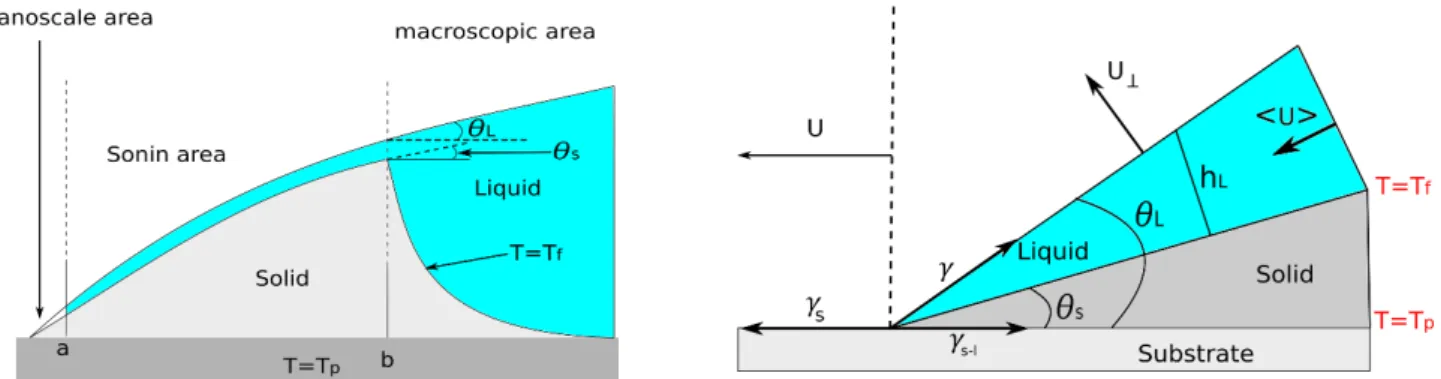
Gennes model. Let us establish the energy balance within the intermediate mesoscopic region, inspiredfrom de Gennes's model for a dynamical triple line, here adapted for our situation of a quadruple line. We assume that the liquid and solid wedges (of angles respectively equal to θL-θs and θs) are in contact with each
other and form altogether an apparent contact angle of _L, which holds until the nanometric scale, see Fig. 3. Both wedges advance at the same velocity U with respect to the substrate.
A flow is established in the liquid wedge of height hL(x), and we assume that the liquid and solid wedge are
undeformed by the flow yields. In this situation, the continuity equation can then be written as:
𝑈#cos θ(− θ* = 𝑈 𝑡𝑎𝑛(θ(− θ*)
Here, 𝑈# is the advancing velocity normal to the free-surface of the wedge, which can be expressed as: 𝑈#=U sin θ( . Under the assumption of small angles (𝑡𝑎𝑛(θ(− θ*)~θ( − θ*, sin θ(~θ(𝑎𝑛𝑑 cos θ(− θ* ~1). The
heat flux generated across the liquid-solid interface by the substrate at Tp, rules the solid angle θs within the
liquid wedge. This flux at the interface liquid/solid is determined by the heat equation, which in a steady
Proceedings ECS 2019
Heidelberg, Germany, September 8-11, 2019
Abstract T-01
flux of the solid/liquid interface inside intermediate region from the temperature field. Under the approximation of small angle and applying the Stefan condition, we estimate the angle θ*. In this case, the de Gennes's model in total wetting applied to our geometry yields give:
θ( = 𝑘∆𝑇 𝜌𝐿𝑈 𝑏 − 𝑎 log 𝑏 𝑎 = > + 6 𝐶𝑎 log 𝑏 𝑎 = >
where a and b are cut-off lengths corresponding respectively to the nanometric and micro-metric scales
delimiting the intermediate region (hence, a ~ 1nm and b ~ 1µm), Ca capillary number, k thermal conductivity, ρ density, L latent heat, T temperature.
Figure 1. Sketch of the quadruple line geometry and the quadruple contact-line in the intermediate mesoscopic
3. Results, comparison and discussion Figure 2a plots θ(versus U for various ∆𝑇,
the evolution of θ( follows a trend similar to the isothermal situation for relatively large U, with an increase of θ( with U. However, at relatively low velocity (U <
U*), θ( decrease sharply with U. This
decrease corresponds to an unstable situation for the contact-line dynamics. We assume that U* (the location of the minimum of θ( (U)) corresponds to a critical velocity which could delimitate the transition between continuous and stick-slip dynamics. The critical velocity U* defined in the previous section, is determined by the minimum of θ( (U) and combined with θ( leads to an
estimation of the arrest angle θB : θB = 3 2 EFG + 3 2 F G 6𝜂𝑘𝛥𝑇 𝛾𝜌𝐿(𝑏 − 𝑎) = G log𝑏 𝑎
which is plotted and compared to the experimental data of De Ruiter and Tavakoli6,7 in figure 2b.
6. References
1 D. Bonn, J. Eggers, J. Indekeu, J. Meunier, and E. Rolley, Reviews of modern physics 81, 739 (2009). 2 J. H. Snoeijer and B. Andreotti, Annual review of fluid mechanics 45 (2013).
3 T. D. Blake, Journal of colloid and interface science 299, 1 (2006). 4 S. Schiaffino and A. A. Sonin, Physics of Fluids 9, 3172 (1997). 5 S. Schiaffino and A. A. Sonin, Physics of Fluids 9, 2217 (1997).
6 F. Tavakoli, S. H. Davis, and H. P. Kavehpour, Langmuir 30, 10151 (2014).
7 R. De Ruiter, P. Colinet, P. Brunet, J. H. Snoeijer, and H. Gelderblom, Physical Review Fluids 2, 043602 (2017) 8 Herbaut, R., Brunet, P., Limat, L., & Royon, L. (2019). Physical Review Fluids, 4(3), 033603.
9 S. Schiaffino and A. A. Sonin, Physics of Fluids 9, 2227 (1997).
Figure 2a: Dynamical contact