Assessment of Principal Risks Related to the
Acceptance of Letters of Indemnity in Oil Trading.
Bachelor Project submitted for the obtention of the Bachelor of Science HES in Business Administration with a major in International Management
by
Khilola RUZIEVA CELIK
Bachelor Project Advisor:
Robert PILLER, Instructor of Commodity Trading Major
Geneva, 14.08.2015
Haute école de gestion de Genève (HEG-GE)
International Business Management
Declaration
This Bachelor Project is submitted as part of the final examination requirements of the Geneva School of Business Administration, for obtaining the Bachelor of Science HES-SO in Business Administration, with major in International Management.
The student accepts the terms of the confidentiality agreement if one has been signed. The use of any conclusions or recommendations made in the Bachelor Project, with no prejudice to their value, engages neither the responsibility of the author, nor the adviser to the Bachelor Project, nor the jury members nor the HEG.
“I attest that I have personally accomplished this work without using any sources other than those cited in the bibliography. Furthermore, I have sent the final version of this document for analysis by the plagiarism detection software URKUND using the address supplied by my adviser”.
Geneva, August 14th, 2015 (Sign the declaration here) Khilola RUZIEVA CELIK
Acknowledgements
Firstly, I would like to thank and express my deepest respect to my advisor Mr. Robert Piller, for his continuous support and guidance that were a great help and motivation during my studies, in general, and throughout this Bachelor project, in particular. My sincere thanks for transferring me your passion for the subject of commodity trading, for encouraging me to ask right questions and keeping me inspired during these past two semesters.
Secondly, I am particularly grateful for the assistance given by Mr. Guy Barras (Credit Suisse), Mr. Nicolas Gay Crosier (UBS), Mr. Richard Watts, (HR Maritime Shipping) and to other professionals for their invaluable contribution to this topic through personal interviews and by replying to the questionnaires.
Finally, I would like to thank my family members and my closest friends who were a moral support during my academic studies.
Executive Summary
As oil became a globally traded product traders learnt to maximize their profits by moving energy commodities around the globe. Globalisation and technological development, besides having a durable positive effect on international maritime trade often triggers enormous risks. As much as financial institutions and big trading companies are trying to reconcile national differences between sourcing and consumption countries by minimising political risks, these transactions are never entirely risk free. Traders, ship-owners and bankers often ignore the implications that could stem from their engagements in profitable but not always straightforward obligations.
Oil trading is very complex business. Usually, trading volumes are very high and require substantial financial resources and a strong logistic system that could manage potential risks. A chain of participants involved in execution of one sale contract includes numerous parties such as ship-owners, brokers, insurers, inspection specialists, port agents, financial institutions and experienced support staff.
As a result, there are a number of risks that do not appear on the surface of transactions and arise as a consequence of negligence of contractual details or general misinterpretation. Often, these errors are caused due to mismatches between multiple contracts, Charterparties, letters of credits or, simply, a result of dishonest behaviour of partners.
Traders do not work in ideal world where contract executions follow their exact mechanism, there are no last minute changes and documents always arrive on time to the discharge ports. That’s why the Letters of Indemnity are a great instrument that can remove a lot of barriers on the way of the traders. They facilitate timely delivery of cargoes to their receivers, reduce operational costs and as result, increase profit margins of traders. Hence, a Letter of Indemnity creates liabilities that fall beyond the framework of the sale contract and beyond the standard insurance coverage for ship-owners. Often, Letters of Indemnity generate liabilities under parties who might not have had an original unilateral contract. The biggest issues arise when the Letter of Indemnity is being called upon, and traders have to secure the claim of the carrier. Yet, they are used by traders on every day basis as market dynamics imposes its own rules on the entire industry.
Contents
Assessment of principal risks related to the acceptance of Letters of Indemnity
in oil trading. ... 1
Declaration ... i
Acknowledgements ... ii
Executive Summary ... iii
Contents... iv
List of Figures ... vi
List of Cases ... vi
List of International Conventions ... vii
List of Abbreviations and acronyms ... vii
1. Introduction ... 1
1.1 Oil industry overview ... 1
1.2 Importance of international seaborne trade ... 4
1.3 Evolution of transportation of seaborne crude oil. ... 5
1.4 Shipping of crude oil and petroleum products today ... 7
1.5 Structure of Brent Market: from forward to spot ... 9
2. Analysis ... 11
2.1 Issue ... 11
2.2 Research Question and Methodology ... 14
2.3 Bills of Lading ... 16
2.4 Letters of Indemnity (LOIs). ... 19
2.4.1. LOIs against Clean Bills of Lading ... 20
2.4.2. LOIs against change of destination of cargo. ... 21
2.4.3. LOIs for adding additive to the cargo/Blending cargoes. ... 22
2.4.4. LOIs for payment. ... 23
2.4.5. LOIs for discharge without presentation of original Bill of Lading at the discharge port ... 25
2.5 Legal status and enforceability of LOIs ... 27
2.6.1. Common Law ... 27
2.6.2. Civil Law ... 28
2.6.3. Hague Rules and Hague Visby Rules ... 29
2.6.4. Hamburg Rules ... 30
2.6.5. Rotterdam Rules ... 31
3. Discussion: Practical solutions for risk mitigation under discharge LOIs ... 33
3.1 Owners’ position regarding LOIs ... 33
3.1.1. Protection and Indemnity clubs position regarding LOIs. ... 33
3.1.2. Case study: Farenco Shipping Co. Ltd. v Daebo Shipping Co. Ltd. (Bremen Max) –Baillii [2008] EWHC 2755... 34
3.1.3. Case Study: Projector SA v Marubeni International Petroleum (S) Pte. Ltd (No 3) [2005] SGSA 5,2005 ... 37
3.2.1. Back to Back LOIs. ... 41
3.2.2. Case Study: Laemthong International Lines Company ltd v Abdullah Mohammed Fahem & Co. [2005] EWCA Civ 519 ... 43
3.2.3. Case study: Great Eastern Shipping v Far East Chartering Ltd [2011] EWHC 1372 ... 45
3.3 Bank’s Perspective for discharge of goods without Bills of Lading ... 48
3.3.1. LOIs countersigned by banks ... 49
3.3.2.Case study: Pacific Carriers v BNP Paribas [2004]HCA 35,218 CLR 451. High Court of Australia. ... 51
3.3.3. Case study: Trafigura Beheer B.V. v Kookmin Bank [2006]EWHC 1450 ... 53
4. Conclusion ... 55
APPENDIX 1: Major Chokepoints in the world ... 57
APPENDIX 2: Sample of LOI for Blending/Comingling Cargoes on board and substituting Bills of Lading. Source: (GARD, 2003) ... 58
APPENDIX 3: Sample of LOI submitted for payment under Letter of Credit. ... 61
APPENDIX 4: Sample of LOI for discharge of goods in the absence of original Bills of Lading ... 62
Bibliography: ... 65
Articles/ Books/ Reports: ... 65
List of Figures
Figure 1: Top 25 Crude Oil Exporting Countries and average distance to destination
countries ... 2
Figure 2: Top 25 Crude oil Importing Countries and average distance with their supplying countries ... 3
Figure 3: World Oil Production & Trade ... 7
Figure 4: World Crude Tanker Fleet ... 8
Figure 5: Transferring from forward to physical market ... 10
Figure 6: Formation of sting trading ... 12
Figure 7: Dirty Tankers Spot Freight Cost in $/T ... 34
Figure 8:Back to Back LOI under CIF Terms ... 41
List of Cases
Brown Jenkinson and Co Ltd. v Percy Dalton (London) Ltd.Farenco Shipping Co. Ltd v Daebo Shipping Co. Ltd. [2008] EWHC 2755 Great Eastern Shipping v Far East Chartering Ltd. [2011] EWHC 1372 Laemthong International Lines v Faheem & Co.[2005] EWCA Civ 519 Pacific Carriers Ltd v BNP Paribas [2004] HCA 35; 218 CLR 451 Projector SA v Marubeni International Petroleum (S) Pte Ltd. (No 3) Re Projector SA; [2008] SGHC 234
List of International Conventions
Hague and Hague Visby Rules (1968)Hamburg Rules (1978) Rotterdam Rules (2008)
Uniform Customs and Practices 600 for Documentary Credits (2007)
List of Abbreviations and Acronyms
B/L-Bill of LadingB/Ls–Bills of lading (plural)
BIMCO-Baltic International Maritime Conference CIF-Cost Insurance Freight
C&F-Cost & Freight
Dwt-Dead weight tonnage FOB-Free on Board
INCOTERMS-International Commercial Terms ICC-International Chamber of Commerce L/C-Letter of credit
LOI –Letter of Indemnity
LOIs –Letters of Indemnity (plural) MT-metric tons
1. Introduction
1.1 Oil industry overview
Multiple numbers of vessels loaded with merchandises and cargoes of commodities cross the oceans every day. Crude oil is a strategic commodity that is used as energy source as well as raw material for various manufactured goods. As supply and demand of oil are located in different geographic locations, trading companies are major actors moving oil from sourcing countries to consumption countries. Oil carried on the board of tankers accounts for nearly one third of global maritime trade. (Transporting Oil by Sea, 2015)
The oil industry is oftentimes referred to as an oligopoly with concentration of demand, supply and control in one specific region (Transporting Oil by Sea, 2015).
Middle Eastern counties: Iran, Iraq, Saudi Arabia and Kuwait have been among major suppliers of oil starting from the end of World War II. Today, Saudi Arabia is the biggest oil producer in the world with proven reserves of 260 million barrels (Royal Embassy of Saudi Arabia, 2015),which accounts for 18% of global reserves (OPEC, 2014). The OPEC’s production, besides being flat since 2003, still covered 41% of the whole crude oil market in 2014 (BP, 2014). Other emerging countries such as Russia have joined the world oil industry in 1960s with exports and later on with gas in the 1970s. Further, the collapse of the USSR forced Russia to participate the international oil trade market as a competitive player. As evidence, Russia’s exports of crude oil to China have doubled since 2010. In 2015 Russia outpaced Saudi Arabia as the first supplier of crude oil until May with exports exceeding 930,000 barrels per day (bbl. /day). After the month of May, Saudi Arabia lost the top spot and fell behind to third world exporter (the second largest supplier is Angola) with imports plummeting to 722,000 bbl. /day, which is 43% less compared to previous months. (Raval, 2015)
However, we have to discount the fact that sanctions imposed on Russia by European countries as a result of political events in Crimea in 2014 are forcing the country to look for alternative exporting markets.
Figure 1: Top 25 Crude Oil Exporting Countries and average distance to
destination countries
Source: (ITC Trade Map, 2014)
The bubble table above illustrates the largest net exporters of crude oil for 2014. As previously stated, Saudi Arabian exports were valued at USD 263,628,237,000 (350,864,917 tons) followed by the Russian Federation with exports estimated at USD 152,586,049,000 (220,694,082 tons).The total value of world exports for crude oil reached USD 1,459,090,604,000 which estimated to be equivalent of 1,857,477,366 tons. (ITC Trade Map, 2014)
This table also illustrates the average distance from exporting countries to consumption countries. For instance, the average distance from Saudi Arabia to the markets it delivers crude oil is 5’475 km. Angola and Venezuela export their crude to the furthest markets with average distance of 9’989 km and 8’856 km respectively. On the contrary, Canada is one the countries that mainly exports its crude to its neighbouring countries covering the average distance of 1’350 km (ITC Trade Map, 2014).
Figure 2: Top 25 Crude oil Importing Countries and average distance with
their supplying countries
Source: (ITC, 2014)
Almost 90 million barrels of oil are consumed daily in the world (American Petroleum Institute, 2014). Demand for crude oil comes mainly from industrialized economies, the United States of America are on top of the list with imports and many countries, such as China, are in the process of development and have imported USD 228,234,984,000 (308,367,038 tons).India is located as one of the top three net importing countries with imports valued at USD 135,826,203,000 or 189,407,403 tons or (ITC, 2014)). We can also observe that China’s sourcing markets are located the farthest (over 8’000 km). In comparison with Belgium whose sourcing market is the closest among top 25 importing countries with average distance to sourcing country 635 km. (ITC, 2014).The USA consumes 21% of total daily production of crude oil. China’s consumption grew from previous 7% in 2003 to 10% in 2013 (API, 2014).Thus, imbalances arising from these regional supply and demand shortages are managed by traders on a daily basis, through international trade. Seaborne international trade is mainly applicable to countries which do not share inland common borders. The latest data from the report of the International Energy Agency, shows that the average demand for crude oil and other liquid fuels will reach 93 million barrels per day worldwide (IEA, 2015).
1.2 Importance of international seaborne trade
The first historical sea routes were laid out by explorers from Portugal during the Middle Ages, and were then followed by other major European countries. These populations started their sea voyages with the hope of finding an ultimate sea route to Asia for precious spices. Medieval ships sailing off from European countries (mainly France, England, and Portugal) were carrying wine, salt, timber, wool, olive oil and bringing back silk, fruit and other goods.
Since the Middle Ages, ocean trade has experienced great changes and increases in volume, speed and types of goods transported by sea. Growth of world trade was triggered by several historical events such as the liberalization of China, growth of Asian markets such as India and the dissolution of the Soviet Union in 1989. These events all heavily increased the flow of goods and commodities through venues that had not been previously exploited. Seaborne trade became a strategic tool for countries with access to the sea. As proof, the 10 biggest container ports out of the 50 worldwide are located in Asian countries (World Shipping Council, 2015).
According to website Clarksons Research (Clarksons Research, 2015), the global seaborne trade grew faster than the global economy. The agency discovered that global trade grew by 3.7% in average per annum, whereas, seaborne trade grew by 4.7%. Trade volumes have also been increased by nineteen fold since 1950. Seaborne trade is responsible for the 11 billion tons of goods transported each year, which could be distributed at 1.5 tons per person in the world.
Besides transportation of merchandises or containerized trade, energy trading has a central place in ocean trading. Oil is the most strategic resource for both developing and developed countries. For example, China’s imports of crude oil that mainly arrive by sea from the Middle East reached 7.2 million barrels per day, and have outpaced imports of the Unites States by 0.2 million barrels per day for the month of April 2015 (Gronholt-Pedersen, 2015).Therefore, a disruption of oil supply in a country, which may be triggered by various factors, can cause a lot of damage to the country’s economy. This is especially relevant for countries with growing industrial infrastructure, construction and transport needs, such as China and India.
The geopolitical location of certain countries like Saudi Arabia, Iran and other Gulf countries whose economies are established on the proceeds from oil trade can disrupt global oil supply when certain political events occur. One of these conflicts is the Iran-Iraq war (1981-1987). According to the policy research project “Strait of Hormuz” of the
University of Texas at Austin, Iranian reliance on trade from oil revenue is estimated to be close to 85%. Over 90% of Iranian exports cross the Hormuz Strait, the narrowest sea passage from the Persian Gulf to the Indian Ocean. This passage is responsible for 20% to 30% of global consumption with oil tankers shipping approximately 17 million barrels of oil per day. When in 1981 Iraq announced that ships leaving Iran through the Northern part of the Persian Gulf would be attacked by air strikes, it started “The Tanker War”, an infamous naval conflict. Iraq was trying to squeeze the Iranian economy by depriving it from the funds received by the oil trade. In turn, Iran also attacked tankers of partners of Iraq. As a result, 61% of attacked ships were oil tankers, but the number of sunken oil tankers was relatively low. Only 23% (55 tankers) out of 239 tankers were actually sunk. The conflict was resolved with the involvement of the Unites States in response to Kuwait’s message for help (Robert S Strauss Centre for International Law and Security, 2008). However, this conflict did not cause much disruption on world crude oil prices, instead, it substantially increased insurance risk premiums for vessels travelling through the Persian Gulf and into Iran. This said, Iranian exports were reduced by half, and the shipping flow in the Persian Gulf was decreased by 25% (Global Security Org, 2011).
This is an example of how regional conflicts can disturb the balance of global trade balance.
1.3 Evolution of transportation of seaborne crude oil.
As whale oil became notoriously known for its properties, and mainly used in fueling engines, it was also considered as a renewable source of energy. It was assumed that whales would reproduce in accordance with the natural rebirth cycle. The usage of whale oil was very widespread, and went from machine engines to household lamps. However, over 10 000 whales were massacred in the sea in the year of 1851. The price of whale oil at the same time climbed and USD 1,200 per barrel (Chancellor, 2008).
Whale oil was very scarce and an expensive resource, which enriched a lot of whale catchers, but simultaneously was a very risky business which had a high toll on the lives of many people. There was an urgent need to develop new source of energy compatible with whale oil
The first drill well was built in 1859 in Pennsylvania, by Colonel Edwin Drake who had been working on this project for several years after having been abandoned by Seneca
Oil, his main sponsor. Persistence and efforts paid off when he discovered oil at the depth of around 21 meters. At that time the production capacity of the well was around 20 to 40 barrels of oil per day (Dav, 2008).
Drake’s invention marked the beginning of the industrial oil drilling age in the USA. In the meantime, a need for the development of commercial ties and secure ships for crude oil transportation has been growing with the expansion of oil production.
By 1876, the Nobel brothers had built a tanker called Zoroaster, which was operating in the Caspian Sea and along the Volga River. The vessel was connected to the pump of kerosene oil through a 12 km pipe that was linked to the site of production. The oil from the production site was not carried in casks but pumped to the vessel directly. This invention allowed saving space and time on transportation, as well as, improving the security of production sites and ports. Zoroaster was able to carry about 240 tons of kerosene in 21 tanks (Insight Marine, 2012).
The first fully-fledged specialized steam oil tanker was built in Britain, but was commissioned by Germany in 1886; it was called Gluckauf. The vessel was an ocean going vessel, quite opposite of the Zoroaster, which was used only at sea and for shorter voyages on rivers (Vassiliou, 2009 p. 550).The vessel contained separate tanks where oil could pump directly. This method was more expensive but also more secure because it gave more stability to the vessel. Gluckauf’s tanks could hold 4000 barrels of oil in its 7 to 9 tanks, (Global Security Org., 2007) and its length was of 300 feet or the equivalent of 91 meters. Unfortunately, it sank after catching a gale on a way to New York from Germany (Davis Park Association, 2007).
By 1891, there were 70 steam ships tank which belonged to the Standard Oil Company (Vassiliou, 2009 p. 411).They were making trips from England to the New York in 11 days and carrying up to 4000 tons of oil (Global Security Org., 2007). Bulk transportation of oil allowed to cut costs of shipping and simultaneously increased volumes carried aboard tankers.
A diesel engine was invented in 1897 which facilitated and speed up the growth of the industry. During World War I and the World War II, the oil tanker technology became more sophisticated; the ships were larger and were able to carry bigger loads of oil. However, the vessels were mainly designed to carry petroleum products and not adapted for transport of crude oil, which required a different tank design. The US Navy used these oil tankers for military purposes to mainly refuel other military battleships
while on sea. Most of the tankers were resold after the war but stayed operational until the late 1960s.
1.4 Shipping of crude oil and petroleum products today
From the end of 1960s the shipping industry went through major changes. The communication systems have been improved and the infrastructure of ports and ships has also been modernized. Today, crude oil and petroleum products are transported on large tankers crossing the major trading routes. APPENDIX 1. Almost half of produced crude oil is transported from the country of origin to buyers’ refineries: The table below shows the increase of quantities of oil transported by sea from 2001 to 2012, marking an increase of around 10% in average production and about 5% in average seaborne trade. (Yan, 2013).
Figure 3: World Oil Production & Trade
Source: (Jefferies, 2013)
The biggest share of shipping falls within dry bulk cargoes that include iron ore, coal and grains. According to the UNCTAD, total shipments of crude oil for 2013 have reached 1.8 billion tons, which is a slight increase from 2012, when the quantities of crude oil carried by sea were 1.78 billion tons.
According to UNCTAD’s Maritime Transport Review, the total world tanker fleet accounted for 28.5% of overall world fleet including dry and container fleet. It showed a decline in 2014, since 2012 marked the end of the shipbuilding era (UNCTAD, 2014). Tanker fleet is dominated by VLCCs (very large crude carriers with deadweight tonnage of over 200,000 dwt); they constitute 57% of total global fleet (est. 2013).
These tankers carry crude oil from long distances originating from the Arabian Gulf and West Africa to Asia, Europe and the USA. Suezmax crude tanker has deadweight of 120,000 to 200,000 tons, and it accounts for 27% of global fleet of crude tankers. Suezmax is built principally to fit the Suez Canal. They are medium haul tankers that travel from West Africa to the United States. Aframax has a deadweight capacity of 80,000-119,000 tons and covers medium distances carrying crude oil between Europe and the United States. Aframax vessels used to dominate the tanker fleet to their flexibility in weight range but later on were upgraded to Large and Very Large Vessels. (EIA, 2014). Nowadays over 57% of world crude tanker fleet is appropriated to the ULLCC/VLCCs. Panamax is the short haul tanker which is able to carry between 60,000 -79,000 tons of crude oil, it is destined for short term distances (Jefferies, 2013).The total global fleet of crude oil tankers reached 32,6 million tons of deadweight among 164 vessels in total, as illustrated in Figure 4.
Source: (Jefferies, 2013)
Product tankers are also called clean tankers (Handy size) they are traditionally smaller with deadweight of 5,000 tons to 80,000 tons. They cover a traditional arbitrage route of gasoline from Rotterdam to New York harbor. (Jefferies, 2013).
1.5 Structure of Brent Market: from forward to spot
Physical oil is traded on forward and spot markets. Brent market is a physical over-the-counter (OTC) market, meaning that the deals between producers, traders and refineries are carried out over the phone and the transactions are not transparent to the general public. This practice is opposite to the practices on the exchange market, where the parties are cleared through a Clearing House and the sellers and buyers do not know one another but the transactions are published on Commodity Derivative Exchange sites. The prices of Brent oil are monitored by Reporting Agencies such as “Argos Petroleum”, “Reuters” and “Platt’s” who follow up on the transactions carried out by the end of the day and publish official prices of the Dated Brent. Over 50% of global crude is benchmarked on the basis of Brent (Barret, 2012).
The physical Brent market is dominated by forward contracts. As the Dated Brent is a global benchmark for pricing oil, other traders price their oil by adding or subtracting differentials based on the quality of the underlying oil. Brent forward‘s underlying cargo are the cargoes of Forties, Oseberg or Ekofisk of 600,000 B/L of crude per cargo (Barret, 2012).Forties, Oseberg and Ekofisk are the major oil fields in the North Sea. Forward means an obligation of a seller to make a cargo available for a non-specific date in the forward month in favour of the buyer. These contracts are called forward contracts due to the uncertainty of a precise loading date in the future. Historically, before 1985 the forward Brent required a 15 business day 5 pm London time notice (Long, Supplement 1998).From the seller to the buyer advising the loading date of the contractual cargo (Barret, 2012).After 1985 the notice period was changed to 21 days and to 25 days from 2007.Therefore, if the loading is scheduled from 1st, May to 3rd,May; the seller has to notify the buyer at least on March 31st, about the loading dates. The 15-day forward Brent had a tolerance of 5 to 10% at sellers’ option, which was later reduced to 1% tolerance on weight. This created a substantial risk exposure to traders due to the uncertainty in the volumes of the cargo they had ordered. These measures, of 21 days, were taken to protect the market from the price squeezes resulting from the shrinking volumes of oil drilled in the North Sea.
After the nomination of the cargo, i.e. loading date, “paper barrels” become “wet barrels” or a physical cargo. Being known as “daisy chains”, “multiple sales”, this process is also used as hedging tool along with speculative purposes by the agents on the market. (Reuteurs, 2015).
Figure 5: Transferring from forward to physical market
1. Oil producers issue a finalized schedule for all available cargoes 15 days prior to the loading date. Until then, traders or anyone else do not know about the precise loading dates.
2. Traders have a choice of keeping the cargo or passing the cargo down the chain to another buyer as long as the nomination prior of 15 days is respected. In their turn, the buyers have to accept the cargo.
3. Once, the deadline of 15 days expires prior to loading, the cargo will turn into wet/physical spot cargo (Dated Brent). From now on, it will have an assigned loading date.
4. As soon as the loading dates become available the cargo shifts to the Spot market or Dated Brent market. Dated Brent market gives the prices for the Brent, Forties, Oseberg and Ekofisk (Brent complex BFOE). The prices will be used as references for the coming 10-25 days. This pricing is used as assessment price for cargoes loading around these dates (Barret, 2012).
1.Oil producer announces the schedule for loading
2.Refiners,producers & traders enter in contractual agreements for 15 days
3.Process of nomination of cargoes betwem producers
and sellers/buyers
4.As soon as loading date is known the forward cargo
2. Analysis
2.1 Issue
As markets dictate their rules, traders are obliged to adapt in order to maximize their profit margins by leveraging available market opportunities. The foundation of international trade is focused on moving goods over the distances, connecting buyers and sellers while complying with national regulations and contractual obligations of parties. As shipping goods is a contractual obligation which requires formalized undertakings of parties, it requires production of various documents related to the transaction. Technological advancements in the maritime shipping related to speed, communications, port infrastructure and many others help to speed up the trade but the late arrival of documents to the destination ports which is required to take the delivery of the cargo leads to delays and additional risks.
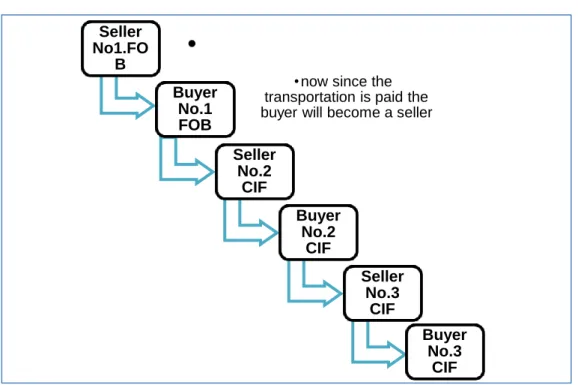
The fact that oil cargoes are resold multiple times while still on sea transit raises many issues in respect of the parties concerned. This phenomenon is also known as string trading, which is characterized by several parties dealing with the same cargo of oil. It is a type of deal where only an original shipper and the final receiver deal with the physical aspect of the cargo. A shipper at the port of shipping and the receiver at the port of destination are the only parties that will perform the loading and take the delivery of a cargo. Traders in the string chain will deal only with shipping documents and sales contracts. For example, Michael G. Bridge states that one cargo on FOB on the Brent market can be assigned up to nine times (Bridge, 2003) .One of interviewees for this paper, confirmed that he had an experience of selling one cargo of oil on FOB terms to four buyers while goods were not yet loaded on the board of the vessel. In this case the B/L is “Made to the Order” with blanc space in the place of the shipper. Financing banks have a great interest in these kind of transactions because they require opening of multiple letters of credit and earning a commission. Therefore, the name of the shipper would be the name of the last seller who would load the goods on board.
Paul Todd in “Bills of Lading and Bankers Documentary credits” mentions that: “the oil cargoes may be negotiated up to 100 times and more” (Todd, 1990 p. 236).
Besides having multiple sale contracts and multiple Letters of Credits (LC), the shipping documents will be issued in one original set and will move along the chain on the sale. The interviewed bankers pointed out that the sometimes the Bill of Lading
have no space to put a bank’s chop. For instance, when the cargo is sold and the trader has to nominate a final port of destination but they are not always ready to commit to specific delivery destination at the loading time because they might resell the cargo during the transit. Otherwise, a bulk cargo initially sold on CIF Rotterdam terms will be discharged at other destination than the initial Rotterdam port (Bridge, 2003).Figure 6 explains the formation of string sale contracts with the same cargo of oil. Multiple sale contracts will produce a multitude of transactions but the shipping documents, insurance certificate and contract of carriage will be the same. As soon as a shipper delivers the cargo on board of the vessel under FOB, the receiver/carrier can resell it to someone else on CIF terms since he has paid for the freight. The cargo is passed further down the chain of traders, who have their own commercial interests. By reselling cargoes traders are securing their profit margins, which are usually very low in oil trading.
Figure 6: Formation of sting trading
Source: (Zieger, 2013)
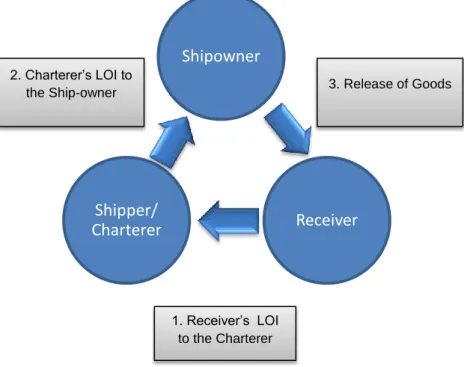
Simultaneously, as it has been mentioned earlier, tankers are taking much less time to deliver cargoes, sea trips are becoming shorter due to increased speed and progress in communication. A common tool that is used in such situation is a Letter of Indemnity (LOI), which is given to the carrier as a promise of indemnifying him against all possible claims in case such claims might arise.
Seller No1.FO B
•
Buyer No.1 FOB•now since the transportation is paid the buyer will become a seller
Seller No.2 CIF Buyer No.2 CIF Seller No.3 CIF Buyer No.3 CIF
In turn, if the carrier agrees to the terms of LOI, it will follow the instructions of the charterer. The charterer is identified with the help of underlying sales contract and INCOTERM terms. In addition, LOIs are powerful tools in preventing excessive unnecessary fees occurring as a result of late arrival of Bills of Lading at discharging ports.
Although as practice shows, traders in a pursuit of saving money on demurrage costs or avoid ship retentions use this instrument without full knowledge of consecutive risks. Moreover, the charterers who are issuing such documents are risking that LOI will be called on by the ship-owners. Carriers and ship-owners are also incurring multiple risks, for delivery against an LOI, which can be in certain cases interpreted as mis delivery or a delivery to a wrong person.
When the deals are financed under documentary letters of credit, which call for presentation of shipping documents, the documents have to go through the hands of all concerned banks and down to the receivers, which in practice takes many days. By the time the shipping documents reach the receiver, the latter would have time to sell the cargo to someone else or to send to the refinery.
In practice, the documents are dispatched with priority courier services, and are tracked by the bank. Therefore, even if the bank receives the documents the trader/receiver will not be physically present at the port of discharge. As the trader/receiver works through his appointed agents, delivering documents to the port will not always match with the arrival time of the vessel. In addition, in accordance with UPC 600, financing back is allowed to take up to five days for examining the strict conformity of documents with the clauses of the letter of credit. Many have criticized reliance of financing banks on strict compliance of documents with Letters of document which is a very impractical solution for the oil trade. In particular, B/LS in oil trade are rarely used as title document and the industry recurs to the practice of using LOIs. (Zieger, 2013).
2.2 Research Question and Methodology
Despite being a strong solution to modern international trade, LOIs can be non-enforceable in certain circumstances. Generally, LOIs imply an undertaking of an issuer of the document to indemnify the carrier and the (ship-owner), his servants and his agents to hold them harmless of any liability, loss or damage.1
Although, the practice shows that this tool can provoke situations where the party having accepted the LOI stays non-indemnified or suffers other losses in connection to the requests under an LOI. Since the LOIs are not considered as documents that provide a legal title to the cargo, the status of ownership of contractual commodity can be also uncertain.
The main objective of this research paper is to understand the consequences of using Letters of Indemnity in oil trading. Since, the LOIs are frequently used in oil trading, this research will attempt to highlight underlying risks in respect of Maritime LOIs issued in the absence of B/L’s at the discharge ports. Simultaneously, a short overview of other types of LOIs used in oil trading will be also explained as a comparison to the LOIs for discharge.
Consequently, the principal research question that is investigated in this paper is stated as follows: What are the legal and financial consequences for parties accepting LOIs
for discharge of goods in the absence of Bills of Lading at the destination ports?
In connection with the main research question, special attention will be given to the position of the financing bank through documentary letters of credit, especially, related to deals requiring countersigning of LOIs by financing banks. Consecutive risks of the ship-owners accepting LOIs will be illustrated through the analysis of legal case studies. In addition, risks related to the sellers and buyers issuing LOIs will also be included in this paper.
The scope of this work will discuss legal cases that arose in respect of the use of LOIs in international trading. Considering that there are a multitude of different LOIs, this work will mainly discuss LOIs issued to the ship-owners in the absence of B/L at the destination port. A special attention will be paid to B/Ls and their connection to LOIs. Furthermore, legal status of LOIs in different jurisdictions, in countries following Common Law doctrine and in countries following Civil Law doctrine, will also be portrayed. Simultaneously, we will look into the status of various LOIs in the
1
international conventions such as the Hague-Hague Visby, the Hamburg and the Rotterdam Rules.
The primary data will be collected through interviews with professionals working in the field of commodity trading, shipping and banking. This will bring to the research a more practical application compared to that of the legal dispositions and texts.
And the secondary data on related risks will be analyzed through a documentary research and case study analysis. An examination of several case studies that arose after issuance of LOIs related to specific LOIs for discharge of goods without production of B/L at the destination port will be carried out at the final discussion part of the research. Moreover, case studies including involvement of financing banks and owners’ claims will contribute to the discussion part of the research.
Regarding the methodology, the first part of this report will provide an overview of the oil industry and seaborne trade in the international market. Further in the text the evolution of oil transportation in the current market situation will be explained. The legal status of LOI in accordance with international conventions and regulations will also be integrated in this paper.
A general overview of different types of LOIs frequently used in oil trading will be given in the second part of this paper. Although, the core of this research will be focused on the risks of each party accepting a LOI for discharge of goods in the absence of Bs/L at the destination port.
Finally we will compare all the risks and will provide with some practical solutions that are used by various actors to secure their financial exposure and risks in deals involving LOIs.
2.3 Bills of Lading
Any commercial transactions, especially ones that related to the sourcing of commodities in large quantities, involve multiple key documents. Aside from signing sales contracts and executing payments, traders must ship the commodity from the point A to point B. The shipping documents are a crucial part of any physical transaction due to the rights and obligations they allocate to the participants of the contract. Consistent shipping documents ensure that vessels carrying cargoes to and from different countries, legislations and contractual parties can rely on standardized documents during international transactions.
B/Ls are the oldest documents used in international trade. They date back to medieval times when they were used by merchants as a receipt for the cargo. B/Ls started being used as a document of title in England in xvi century. The earliest copy comes from
1538 (Bennett, 1913 p. 9)
In trade practice the B/Ls are issued by the Master of the vessel to the shipper. Once the cargo is loaded on board of the vessel the B/Ls can be delivered to the shipper. These documents are signed by a Master with indications of a consignee who is an owner of goods until the delivery is completed and the title has been passed to the legal owner. Conditions of the transfer of the title are regulated in the sales contract and may be conditioned by the payment for the underlying cargo. Once the goods are shipped they remain in the custody of the carrier or Master who is contractually obliged to deliver them in sound condition, based on the principal charter party agreement Under English Law, Bills of Lading has three main functions: r
Receipt of goods
Contract of carriage (evidence of the contract carriage between the shipper and carrier for transportation of goods)
Document of title.
The receipt for shipped goods: As soon as the goods are loaded on board, they are under the custody of the carrier who is obliged to deliver them to the lawful holder of the B/L or persons who are entitled to the cargo. Under Hague-Visby Rules, Art. 3.3., the shipper will issue B/Ls stating the weight, quantity or number of bags, and the condition of the bags. The B/Ls must also indicate that the goods are shipped in “apparent order and good condition”. In the event that the goods are not in the condition stated in the Bs/L, or in the condition as they were received by the carrier
upon arrival to the port of discharge, the carrier will be liable for damage or deterioration of goods.
This function “of receipt of goods” requires more attention when the cargo is financed through a documentary letter of credit against a symbolic delivery, through endorsement of B/Ls to the bank. The B/Ls are pledged to the bank. If the bank discovers discrepancies between the stated contractual specifications and the text in the letter of credit, the bank will have the right to reject the Bs/L. It will also refuse to make any payment against the shipping documents (Wilson, 2010).Therefore, the shipper and the carrier both have to be diligent while entering the information related to the condition, quality and weight/quantity of goods.
The contract of carriage: This document is evidence that there is a contract of carriage for the underlying cargo. Usually, the contract of carriage between the shipper and the carrier has to be agreed before the singing of the B/L.
The contract of carriage has to be agreed upon terms and the shipper and carrier have to be aware of those terms. However, the shipper is entitled to change the terms of the contract if he does not agree with them, since the B/L serves as evidence of a contract rather than a contract of carriage itself 16 (Wilson, 2010 p. 130).
Charterparty B/L incorporates the terms of the Charterparty agreement made between the charterer of the vessel and the ship-owner. This kind of B/L is very common under FOB and CIF sales (Todd, 1990 p. 85). For instance, the B/L will indicate details about the Charterparty, such as: FREIGHT PAYBLE AS PER CHARTERPARTY, CHARTERPARTY BILL OF LADING.
It is important to distinguish between the parties to the sales contract and the parties to the Charterparty. Under CIF sales contract the party chartering the vessel would be the original party under the time or voyage Charterparty. The charterer/shipper will still need to have a B/L as acknowledgement of quantity and quantity of goods aboard. (Wilson, 2010 p. 6).
The seller will have a separate agreement with the carrier in the form of a Charterparty and the buyer will be able to use the B/L as evidence of the contract to deliver the goods (Baatz Yvonne, 2014 p. 97).In case if the goods are damaged in transit the buyer will have a right of suit against the carrier based on the B/L.
Under the FOB sales contract, when the goods are loaded free on board of the vessel, the buyer will be responsible for chartering the vessel. As a result, he will have a
Charterparty agreement with the carrier. The original contractual obligations of the buyer will be registered in the Charterparty regardless of the B/L (Baatz Yvonne, 2014 p. 97).
Document of title: A person who holds a B/L is entitled to the possession of cargo, because a B/L can be transferred during transit. For example, a voyage of a tanker from Rotterdam to Los Angeles typically takes 23 plus days. During this time, the cargo on board can be resold and the B/L has to be transferred to the new receiver (California Energy Commission, 2002). Therefore, the B/L is a negotiable and transferrable document that allows for the transfer of ownership rights for the cargo. Wilson, In Carriage of Goods by Sea, describes that a B/L obtains the status of a contract of sale when it becomes a transferable document with wording “Made to order”. In order to qualify for a resale, it is necessary that the goods are still in transit, and not yet delivered to the buyer. The person who is indorsing the B/L should have ownership rights for the goods or to have a good title. Finally, when the indorsement is accomplished, the owner should have an intention to transfer the ownership of goods. (Wilson, 2010 p. 134).
A party holding documents of title under the Common Law has a right for a constructive possession over the underlying goods. When B/Ls are transferred from the pledger to the pledgee, a pledge of goods is created. The possession of the goods will pass with the transfer of B/Ls.As a custom, the supplier or the party selling the goods (pledger) is the one who will be responsible for pledging the goods to the confirming bank under the documentary letter of credit. The buyer won’t have a right to property over the goods before the payment is done. It is important that the B/Lsbe made out to the order of the confirming bank, so that if the issuing bank does not reimburse the confirming bank for the value of the goods, the confirming bank can resell the goods. (Todd, 1990 p. 153)
In contract to negotiable B/L, a “straight B/L” will indicate a name of designated person who will be taking a delivery of cargo. In this case, the B/L will not have a transferable feature and it will not be usable for financing of the underlying cargo.
2.4 Letters of Indemnity (LOIs).
The use of LOIs in modern maritime trade has become a common practice. LOIs are intended to facilitate operations. They are specifically applicable to oil trading due to the increased number of cargoes being transported by sea. Shipping documents such as B/Lsare issued in one original. Original B/Lsis often trapped in the contractual chain of buyers and financing banks.
In a nutshell, “a LOI is contract between one party to keep the others harmless against
loss”. (Arizon, 2014 pp. location 677-679)
In the most cases neither traders nor ship-owners are willing to wait at the destination port for the arrival of the original Bs/L. Waiting time implies additional unnecessary costs such as demurrage. Waiting might also cause congestion at ports and disturb the commitments of ship-owners to other lined up contracts. So far, LOIs are the only practical solution to this problem. A LOI is considered as a request that is beyond the contractual obligation between parties. This means that the charterer will ask the carrier to perform an action that falls out of the framework of the contract of carriage. In practice, LOIs are issued in favor of a carrier by a shipper or a receiver of goods, depending who would be a charter of the vessel.
There are several types of LOI used in international maritime shipping “LOI against clean Bills of Lading” were common practice in the past.. Nowadays courts have established that issuing clean B/Ls might be classified as fraud.
The other four types of LOIs are very common for oil trading. Among them we distinguish maritime LOIs such as: “LOI against change of destination of a cargo”, “LOIs for discharge without a production of Bills of Lading”, “LOIs for comingling or blending cargo on the board of vessel”.
LOIs in oil shipping are much more straight forward. They are less formal and often made through emails. In return, LOIs for soft commodities require a formal letter written on the letterhead with the stamp from the management and relevant signatures. Several bankers have confirmed that most of their communication is based on email conversations, nowadays.
LOI for payment is a type of warranty used by traders; it is delivered by a seller in favor of the buyer in order to make a payment. This type of LOI involves the bank, contractual parties and does not include a carrier.
The terms of LOI are generally fixed by the P&I Clubs (Protection and Indemnity Insurance Clubs) and neither shippers nor receivers have the right to change them. All the claims against third parties should be settled via providing a carrier with financial support to defend the claim against other parties. (Shepherd, 2011). In other words, the claim to a third person will be settled by carrier who will be provided sufficient financial resources to respond to such a claim. P&I clubs play an important role in the shipping industry. They have the right to impose certain rules on their clients in order to protect their members. The main goal of such clubs is to “pool and share the risks” (Baatz Yvonne, 2014 p. 460).
These clubs are mainly controlled by ship owners, and were created as an instrument to make up for the shortages of the British marine insurance system. P&I clubs cover the liabilities of ship-owners towards third parties. In general terms, protection coverage is mainly provided for liabilities to the personnel and damage to the property. In cases where the personnel have been injured, needs to be repatriated or dead. The indemnity clauses cover the liabilities towards the owners of the cargo which are fixed through a contract of carriage (Baatz Yvonne, 2014 p. 458).Such liabilities might include damage to the cargo during the sea voyage, loading, carrying or handling process. Although, the risks covered by clubs vary based on their internal rules, the standard coverage is established by the Board and can be easily accessible on the websites of the P&I clubs.
P&I clubs have been extremely careful in situations where they are requested to accept LOIs. This is because they are excluded from the standard insurance coverage agreed by the Board of by P&I clubs. These rules include specific risk exceptions under LOIs. For instance, no right to recovery for any costs for:
issuing a B/L with an incorrect description/quantity of goods; issuing anti dated or post-dated B/L;
delivery of the cargo without production of B/L;
delivery to the other party than the one identified in the non-negotiable transport document; (The Standard, P&I Club, 2015 p. 9)
2.4.1. LOIs against Clean Bills of Lading
According to maritime practice, B/L are issued once the commodity passes under the responsibility of a carrier This means that the delivery has been completed and the goods are ready to be shipped in apparent condition and order.
goods are damaged, he has committed fraud. One of the conditions of obtaining a payment for goods from the bank is presenting a clean shipped B/L. The charterer will issue a LOI to the owner in return for issuing a clean B/L.
This type of LOI involves an arrangement between a charterer and the ship. Under CIF terms they should have a formalized contractual relationship through a Charterparty agreement. When the Master signs a clean B/L the shipper will eliminate a risk of discrepancies of representations of B/L to the financing bank. Thus, he can promptly receive his payment under a documentary letter of credit. As result, this transaction opens doors too many other risks that might appear if the cargo is not compliant with the contractual specifications, i.e. is damaged or contaminated.
Under the CIF terms, the cost, insurance and freight are paid by the shipper of the goods. The shipper will have a Charterparty agreement for chartering a vessel with the ship owner. Therefore, the shipper/charterer will be the party issuing a LOI for Clean B/L in the favor of the ship-owner. As the receiver has no contractual relationship with the ship-owner/carrier he will be excluded from the transaction and will not be aware of such arrangements between the Master and the shipper. This is especially true when the goods are loaded in non-apparent good condition.
When LOI against Clean B/L is issued, the buyer will not be able to claim liability for damaged goods from the shipper since the B/L would not be claused and the goods will be considered as shipped clean on board. All the parties involved in a string trade will find themselves in the situation with goods in non-compliant condition. Also the buyer will not be aware of the arrangement between the shipmaster and the seller, therefore he will have no rights to suit against the carrier since the B/L were issued for clean shipped cargo.
2.4.2. LOIs against change of destination of cargo.
Since the B/L is an evidence of contract of carriage, the carrier is obliged to deliver the goods to the port that is stated in the B/L (Arizon, 2014). The oil cargos might be resold multiple times in transit. Once the oil is loaded and the B/Ls are issued it might happen that the charterer will request a change of port of destination from the Master. Such situations are frequent in voyage Charterparties where the carrier will or will not accept to deliver cargo to a new port. Such cases require a special attention from carriers because the original set of B/Ls would have been already sent to initial port of destination, or to the initial buyer in the string of contract. The carrier will be exposed to
the risk that the original parties who will receive original B/Ls could claim the cargo from the carrier. Therefore, if the original B/Ls are not returned to the carrier, the carrier is risking reimbursing the value of the cargo and other related claims to the original holders of the Bs/L. Subsequently, he will make a call under LOI given to him by the charterer. So, the charterer will become liable under his LOI.
By changing the original destination of the cargo, the carrier will be in the breach of contract of carriage. Since the destination port is printed on the face of the B/L, the change of destination is considered as a breach of contract by the Master. As result, parties having title to the cargo can lawfully claim it at the new port of discharge.
LOIs for changes of destination of cargo are often used with LOIs for discharge of cargo without the presentation of the original B/L
2.4.3. LOIs for adding additive to the cargo/Blending cargoes.
Blending is a common practice in oil trading that allows obtaining a new product by adding additive to the cargo, or by modifying the existing cargo. This helps match a product to the market requirements and can be done on short notice on board the vessel. The reasons behind the blending could be different. One of these reasons includes the legal requirement for specific cargoes to comply with regulations of the countries or the buyer. (Skeet, 2011). In string trading traders might like to modify the existing cargo to sell it to another buyer with new contractual specifications. However, this requires substantial infrastructure on the shore such as blending and storage equipment that cannot be available to small suppliers. Blending on board of the vessel saves time for the trader if he needs to produce a specific blend. Instead of sourcing for two products from the same destination, he will be able to load one product, acquire another one from different destination and to blend them together aboard. Thus, he saves time and cost of the freight because the operation can be done while vessel is on the way to the buyer. It also optimizes the storage options because by blending, traders create only a required quantity of a specific cargo which will be shortly resold. Physical blending of cargo on the board of the vessel happens with the help of pumps and pipes and the sea movement to blend the cargo. (Guard, 2014). Although, the physical blending of cargoes during the sea is prohibited in order to preserve the marine life due to the insecurity of the operation, the blending within the limits of ports can be authorized. The P&I covers do not have coverage in case of any claims from the shipper or the receiver. (Guard, 2014).
Usually, the blending will not be allowed if it has not been previously agreed in the Charterparty. All the blending costs are done on the account of the charterer.
There are several possible operational risks and legal risks that might occur while
blending cargoes on board of the vessel
For instance, B/L at loading will contain contractual specifications of the cargo, as the blending relies on the motion of the vessel and the ships pumps, it could occur that once the cargo arrives at the destination port, it might not be compliant with contract specifications. For example, it might not have blended well and could turn out non- homogeneous. In this case, the seller will not be able to obtain the payment and the cargo will be rejected by the buyer and the financing bank. (Skeet, 2011). Another problem that might arise, is that since the cargoes are sourced from different destinations there could be a problem with dates of shipping on the Bs/L. Shipping dates on the B/Ls are crucial element for pricing of oil, as the price is usually calculated on the basis of B/L dates.
Sometimes the blending onboard of the vessel may be agreed in the sales contract between the buyer and the seller. (Skeet, 2011). This puts extra risks on the seller/charter under the CIF/CFR because he will be obliged to incur all of the risk and costs for the product that is tailor made to a specific customer. In case the seller doesn’t manage to obtain a contractual product from the blending, he will be in the breach of contractual obligation himself. It is important to obtain some type of written guarantee from a buyer, stating that he will indemnify the seller against the discrepancies in the B/L with a physical product (Skeet, 2011). Carriers and ship-owners also get LOIs from the seller, which state that in case of unsuccessful blending the seller will indemnify them against any claims and costs that will arise in connection to this cargo. However, a LOI from a buyer doesn’t protect a seller if the buyer becomes insolvent. The shipper will have to incur all the costs for blending and maybe sell his cargo at discounted price.
2.4.4. LOIs for payment.
It is important to point out that the LOI for payment is not a maritime LOI. It is tool that facilitates the payment in case the B/Ls are not available at the bank and the payment to the seller is due. The main difference of such LOI from the rest described above is that this LOI is issued by a seller in favor of buyer and not in favor of the ship-owner. In such cases payments are executed by the bank against the seller’s commercial invoice and the LOI for payment, on behalf of the seller. The text of documentary letter of credit
has to include a provision for such LOI. It is important to note that such document would not replace a B/L and would not serve as collateral for the bank, either.
This is a relatively new instrument and it is extensively used by all commodity trading banks in Geneva. Being delivered to the buyer, the text of LOI for payment states that the seller has “a marketable title free and clear of any lien or encumbrance to the oil“. When the B/Ls become available, the seller has an obligation to surrender the original B/Ls to the buyer as soon as possible. Bankers consider this LOI as relatively safe instrument for payment, especially in deals concluded under the FOB terms when the cargo has been under the control of the buyer on the vessel chartered by him for several days. It gives the bank more security that the cargo will not be delivered to the wrong person. In such cases the LOI for payment is a secure instrument of payment. The text of LOI for payment can be found in the APPENDIX 3.
The topic of risks stemming from accepting LOI for payment under letters of credit could be another research topic, but to review the complexity of such transactions please refer to the legal case in the last part of the project: ”Trafigura v Kookmin Bank”
2.4.5. LOIs for discharge without presentation of original Bill of Lading at
the discharge port
LOIs issued for discharge of cargoes without presentation of original B/L are the most widespread documents in the oil trading For this reason, this project will concentrate on the analysis of this type of indemnity. As it has been mentioned earlier, one of the principal features of B/L, is that it is a document of title that should be transferred to the lawful holder of the good. The Master, therefore, is obliged to deliver the goods to the holder of B/L. Although, when the B/Ls are not in the possession of the person taking a delivery of goods, the traders often arrange with a carrier to accept a LOI to allow the discharge of goods to the receiver at the destination port. Depending on the terms of the sales contract either a shipper or a final receiver will emit a LOI to the carrier. The carrier will agree to accept the LOI and allow a discharge of the cargo. In case if the cargo was delivered to the wrong party, the original holder of B/Ls will have a legitimate claim against the carrier under the Common Law. Then, the carrier will make a call under charterer’s LOI.
Discharge of cargo without presentation of B/L, in the first place concerns the problem of ownership for the underlying cargo. By issuing a LOI traders, in principle, override the presentation rule under the document of title.
Risks: It is generally suggested that before issuing any LOI a trader has to be confident that he will be paid. There were situations where the bank found discrepancies in documents which prevented effecting a payment. (Shepherd, 2011). In this situation, the seller will have to look for another buyer while incurring additional costs or selling the cargo for a lower price. When the cargo is financed by a documentary letter of credit, the bank will have an interest in securing its financial exposure. LOIs do not have attributes of a B/L as of document of title. In fact, they are not considered as document of title and not accepted by banks as collateral. The buyer in turn might have other contractual obligations for the cargo, such as agreements with refineries, or selling it further down to another country which is not accessible by sea.
When B/Ls are pledged as collateral under the documentary letter of credit, a bank has the right to retain them if it finds out that its clients is not able to reimburse the credit for the underlying transaction. Since the cargo perhaps was already resold by the receiver, the bank will not be physically able to seize the cargo. In this case, the bank has a right to go to claim a delivery under the B/L from the ship-owner. Besides, having received a payment for the cargo, the seller will be accountable for entering in separate agreement with the carrier under LOI: (Shepherd, 2011).
As INCOTERMS regulate the terms of sales contracts, the FOB and CIF contracts have different contractual instructions for each party.
CIF terms foresee the payment of cost insurance and freight by the shipper who, simultaneously will be the charterer of the vessel. The LOI will be delivered to the ship-owner with instructions to discharge the cargo to the designated receiver by the charterer in the text of the LOI.
Regarding the FOB contracts, the shipper will release the goods free on board of the vessel. Under these terms the buyer of the cargo will contract the vessel on his charge. His contractual relation will be formally identified in a Charterparty. In FOB contracts the buyer will be the one issuing and delivering an LOI to the Master of the vessel. The seller will have no role in this transaction. In this case issuing LOI by a receiver would be considered less risky because the goods would be already under the control of the receiver or his agents. The risk of misdelivery of the cargo will be minimized.
2.5 Legal status and enforceability of LOIs
2.6.1. Common Law
Countries following doctrine of Common Law, such as Great Britain and its former colonies, are known for having based their legal systems on uncodified legislative decisions, known as precedents. In recent years, the England and Wales High Court have heard a variety of cases related to the enforceability and effects of LOIs. England’s and Wales High Commercial Court Decisions Database “Bailii” returns over 500 search results of judicial cases containing key words “Letter of Indemnity”. Several of the cases will be analyzed in the “Discussion” part of the project.
Often, LOIs at discharge are called “letters of guarantee” (Tetley, 2004) but English courts refer to such letters as to “Letters of Indemnity”. The format of LOIs is standardized, and they usually contain a provision under which they will be governed and constructed under English Law.
The term of “Contract of Indemnity” in English law is seen as:
“A primary obligation of one party is to make good for loss suffered by another
party. That obligation may not be the consequence of a contract at all, but may instead be based on some other legal principle and arise by operation of law. For these purposes, a contract of indemnity is a contract between a promisor (the indemnifier) and a creditor who is owed money by a third party (the principal debtor)”. (Bamford, 2015 pp. 6962-6963)
The LOIs are issued as a promise to indemnify the creditor, in the contrary to the contracts of guarantee, which are the contracts that promise the creditor to be responsible for the future performance of the principal debtor (Bamford, 2015 pp. 6981-6984).
As it has been mentioned earlier, the delivery of cargo without a presentation of B/Ls is considered as a breach of contract under the English law based on “Bill of Lading Act 1855” which was later replaced by “Carriage of Goods by Sea Act 1992”:
“The master is justified in delivering the goods to the consignee named in the bill of lading on production of it, or to the first person who presents a properly indorsed bill of lading, provided the master has no notice of dealings with other sets” (Ivamy, 1989 p. 164)
Regarding enforceability of LOI under the English Law, it is clearly stated that that if the Master is asked to sign a B/L which represents different statements then the actual description of the condition of cargo, this situation would be considered as third party