Control of Human Induced Floor Vibrations
bySean Manuel Homem
Bachelor of Science in Civil Engineering Merrimack College, 2006
Submitted to the Department of Civil and Environmental Engineering in Partial Fulfillment of the Requirements for the Degree of
MASTER OF ENGINEERING in Civil and Environmental Engineering
at the
MASSACHUSETTS INSTITUTE OF TECHNOLOGY
June, 2007
@ 2007 Sean Manuel Homem. All rights reserved.
The author hereby grants to MIT permission to reproduce and to distribute publicly paper and electronic copies of this thesis document in whole or in part
in any medium known or hereafter created.
Signature of Author:
Department of Civil and Environmental Engineering May 21, 2007
Certified by:
P/ofessor Jerome J. Connor Department of Civil an nvironmental Engineering Thesis Supervisor
Accepted by:
Professor Daniele Veneziano Chairman, Departmental Committee for Graduate Students MASSACHUSETTS INS E
OF TECHNOLOGY
Control of Human Induced Floor Vibrations
bySean Manuel Homem
Submitted to the Department of Civil and Environmental Engineering on May 21, 2007 in partial fulfillment of the requirements for the Degree of Master of Engineering in Civil and
Environmental Engineering.
ABSTRACT
With the growing demand for open, column-free floor spaces and the advances in material strength, floor vibration serviceability criterion has been of growing importance within the past
20-30 years. All floor systems are flexible and when introduced to a dynamic loading respond in
a vibratory manner. The issues with floor serviceability arise when the floor vibrates in an uncomfortable way when exposed to everyday loading, for example human footfall in an office building. Vibrating floors have been divided into 4 categories based on the perceptibility by humans: (a) vibration, though present, is not perceived by the occupants; (b) vibration is perceived but it does not annoy the occupant; (c) vibration annoys and disturbs; (d) vibration is so severe that it makes people sick. This thesis is focused on the control of human induced floor vibrations. In order to provide the reader with practical insight on the subject, a case study of an existing steel framed office building that experienced excessive and annoying floor vibrations will be discussed and analyzed. As a result of this case study, it has been determined that the Alan and Rainer scale, along with the Modified Reiher Meister scale and the Wiss and Paremelee scale, accurately describe the human response criteria. Also determined was that the American Institute of Steel Construction Floor Vibrations Due to Human Activity (Design Guide 11) has extremely conservative acceleration criteria that basically aim to make the vibration not noticeable at all.
Thesis Supervisor: Jerome J. Connor
Acknowledgements
I would like to take this opportunity to thank the Department of Civil and Environmental
Engineering staff for making my experience here unforgettable.
To the MEng. Class of 2007, you are a wonderful group of intelligent and sincere people. I am extremely sad that we will part ways, but I am honored to have shared these memories with you and look forward to our continued network of personal and professional relationships.
Special thanks to the core crew that always had time for a little fun once the work was done. Alejandro, Bahjat, Andres, and loannis we had an amazing time this year, seriously.
Thanks to the steel bridge crew, I learned so much from you all and I feel privileged to have worked with you this year.
Gavin, Steve, Luca, and the rest of the crews, you are the best and thanks for bearing with my absence this year.
I want to thank Professor Connor for his support and kindness. You are truly a brilliant and
insightful person to whom I am extremely grateful.
To Professor Anthony Deluzio, I could not have done this without you. I am extremely grateful for all that you have taught both in and out of the classroom. Thank you for your continued support, generosity, and shared wealth of knowledge.
Sabrina, thank you for your support and patience throughout this entire year. You are absolutely breathtaking and I am blessed to have you in my life. I love you.
To my family I dedicate this thesis to you. To my father, Manuel, mother, Bonnie, and sister, Ashley, I am the luckiest person in the world to have such an amazing family. I love you all.
1. Introduction and Scope... 4
2. The Nature of Human Induced Vibration ... 6
2.1. Basic Principles of Structural Dynamics... 6
2.2. Properties of Continuous Beams ... 11
2.3. Dynamic Loading... 13
2.4. Response to Periodic Excitation... 14
2.5. Human Induced Loading and the Consequent Response ... 20
3. Design Aids and Suggestions...24
3.1. Human Response Criteria... 25
3.1.1. Modified Reiher and Meister Scale... 25
3.1.2. W iss and Parmelee ... 27
3.1.3. Canadian Standards Association Scale ... 28
3.1.4. Murray Criterion ... 29
3.1.5. International Organization for Standardization Scale ... 30
3.2. Vibration Design Criteria for Steel Beam-Concrete Slab Construction ... 30
4. Floor Vibration Case Study: Bank in Massachusetts ... 32
4.1. Background Information and Introduction to Vibration Problem... 32
4.2. Data Collection (1988 Testing), Analysis, and Consequent Retrofit... 33
4.2.1. Data Collection and Analysis...33
4.2.2. Consequent Retrofit... 40
4.3. Current Status of Floor System ... 43
4.4. Past Data Present Data ... 54
4.5. Alternative Design to Control Floor Vibration ... 55
4.6. Conclusions and Recommendations...66
5 . C on clu sion s ... 67
6 . R eferen ces ... 6 8 7. Appendix A: List of Acceptance Criteria (Murray et al.) ... 69
8. Appendix B: Structural Calculations...70
9. Appendix C: Development of Tuned Mass Damper Design Charts ... 75
Figure 2-1: Single Degree of Freedom System (Connor, 9) ... 6
Figure 2-2: Typical a.) Beam and b.) Floor System Mode Shapes (Murray et al., 3)...8
Figure 2-3: Free Vibration of a System without Damping (Chopra, p. 40)...9
Figure 2-4: Effects of Damping on Free Vibration (Chopra, p. 50)...9
Figure 2-5: Free Vibration Response with Different Levels of Damping (Chopra, 51)... 10
Figure 2-6: Free Vibration of Underdamped, Critically Damped, and Overdamped Systems (C h o pra, 4 9) ... 1 1 Figure 2-7: Natural Vibration Modes and Frequencies of Uniform Simply Supported Beams (C hopra, 635) ... 12
Figure 2-8: Types of Dynamic Loading (Murray et al., 2) ... 13
Figure 2-9: Plot of H1 versus Frequency Ratio, p, and Damping Ratio, 4 (Connor, 11) ... 16
Figure 2-10: Plot of H2 versus Frequency Ratio, p, and Damping Ratio, 4 (Connor, 13) ... 17
Figure 2-11: Acceleration Controlled Design Example... 19
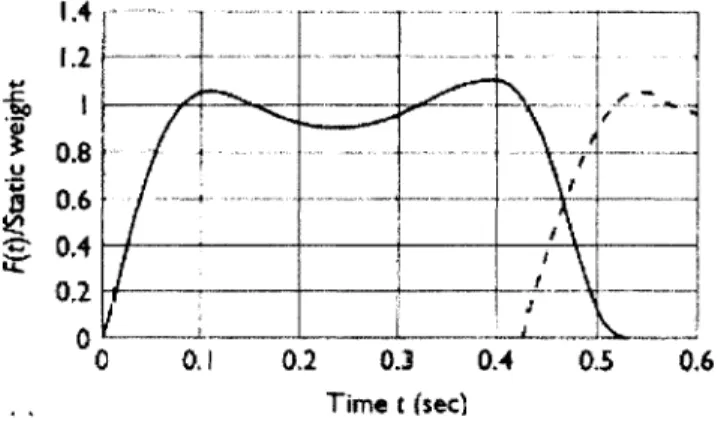
Figure 2-12: Force-Time Curves for Walking Body, Vertical Forces (Smith, 287)...21
Figure 2-13: Force-Time Curves for Walking Body, Combined Vertical Forces (Smith, 287)..21
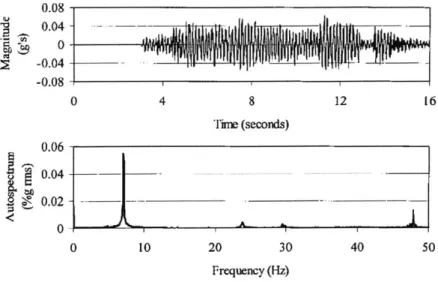
Figure 2-14: Sample Time History Plot and Frequency Spectrum (Hanagan et al., 128) ... 23
Figure 3-1: Modified Reiher-Meister Scale (Murray, 63)... 26
Figure 3-2: Comparison of Modified Reiher-Meister and Wiss-Parmelee scales (Murray, 83)... 28
Figure 3-3: Canadian Standards Association Scale developed by Allen and Rainer (Murray et. al, 6 9 )...2 9 Figure 3-4: ISO Scale (M urray et al., 69) ... 30
Figure 4-1: Acceleration Time-History and Frequency Spectrum (John walking)...35
Figure 4-2: Acceleration Time-History and Frequency Spectrum (Tony walking)... 36
Figure 4-3: Acceleration Time-History and Frequency Spectrum (Sheila walking) ... 37
Figure 4-4: Acceleration Time-History and Frequency Spectrum (30 lb. dropped 2 ft.) ... 38
Figure 4-5: Steel Joist and Metal Deck (Homem)... 39
Figure 4-6: Schematic Drawing of Preloaded Slender Rod and Concrete Slot Detail...42
Figure 4-7: Rod Connection with Bottom Flange of Steel Joist (Homem)... 42
Figure 4-8: Series of Preloaded Rods (Homem)... 43
Figure 4-9: Floor with Vibration Issue and Partitions Added (Homem) ... 44
Figure 4-10: a.) Low-g Accelerometer b.) LabPro Transfer Device... 45
Figure 4-11: Acceleration Time-History (above) and Frequency Spectrum (below) (Colin W alking H eavily)... 46
Figure 4-12: Acceleration Time-History (above) and Frequency Spectrum (below) (Tony W alk in g )...4 7 Figure 4-13: Acceleration Time-History (above) and Frequency Spectrum (below) (Tony Ju m p in g )... 4 8 Figure 4-14: System Response with Acceptable Acceleration Criteria (Colin Walking)... 52
Figure 4-15: System Response with Acceptable Acceleration Criteria (Tony Walking)...52
Figure 4-16: System Response with Acceptable Acceleration Criteria (Tony Jumping)...53
Figure 4-17: Undamped SDOF System Coupled with a Damped Tuned Mass Damper...56
Figure 4-18: H , versus p ... 58
Figure 4-19: Sample Optimal Plot; Mass Ratio = 0.03, Frequency = 0.985 Hz...59
Figure 4-20: H, versus p for optimal frequency and optimal damping ratio. (Altered from C onn or, 2 3 8)... ... ... .60
Figure 4-21 Figure 4-22: Figure 4-23 Figure 4-24: Figure 4-25: H , versus m ... 61 fe, versus m ... 61 4dopt versus m ... 62 4e versus m ... 62 Schematic of Single Joist with TMD attached, NTS (Portions from Connor, 233).65
1. Introduction and Scope
With the growing demand for open, column-free floor spaces and the advances in
material strength, floor vibration serviceability criterion has been of growing importance within
the past 20-30 years. This aspect of structural design could simply be overlooked in the past for
two specific reasons. The first reason is that the very small amplitude of these vibrations allows
them to be ignored as a detriment to structural integrity. Secondly, these small vibrations would
"die" out very quickly due to the larger damping and mass associated with the heavier structural
system and dead load within the structure. (Murray 1979, ACC) In office buildings, for
example, the floor-to-ceiling partitions, which provide additional support and damping to the
floor system, have been replaced with cubicles. Additionally, the higher strength lightweight
materials have significantly reduced the required cross-sections and, consequently, the stiffness
of the structural materials. (Hanagan 2003, 3)
All floor systems are flexible and when introduced to a dynamic loading respond in a
vibratory manner. The issues with floor serviceability arise when the floor vibrates in an
uncomfortable way when exposed to everyday loading, for example human footfall in an office
building. Although the very small vibrations do not affect the structural integrity or overall
safety of the building, a person experiencing uncomfortable and very noticeable vibrations may
not agree. Vibrating floors, therefore, have been divided into 4 categories: (a) vibration, though
present, is not perceived by the occupants; (b) vibration is perceived but it does not annoy the
occupant; (c) vibration annoys and disturbs; (d) vibration is so severe that it makes people sick.
A design is considered successful if the floor falls into categories (a) and (b). Numerous studies
have been conducted in order to quantify the acceptability criteria of the human response, the
This thesis is focused on the control of human induced floor vibrations. In order to
provide the reader with practical insight on the subject, a case study of an existing steel framed
office building that had experienced excessive and annoying floor vibrations will be discussed and analyzed. The study will explore the initial vibration issues that were experienced by the
composite concrete slab and steel joist floor system, the consequent retrofit that was installed, the
current status of the structure, an alternative retrofit solution, and future recommendations. Prior
to the case study, the thesis will provide the reader with information on the basic principles of
structural dynamics, the nature of the human induced loading, and, finally, an overview of the
2. The Nature of Human Induced Vibration
When a dynamic loading is applied to a structural system, the system responds depending
of the type of dynamic loading. The following sections, 2.1 Basic Principles of Structural
Dynamics and 2.2 Properties of Continuous Beams, will explain the basic principles of structural
dynamics to give an understanding of how structures react to arbitrary dynamic loadings. The
different types of dynamic loadings will be presented in 2.3 Dynamic Loading. An in-depth look
at the response to periodic excitation will be exhibited in 2.4 Response to Periodic Excitation
Following this, the dynamic loading of concern, human induced loading, and consequent
response will be discussed in 2.5 Human Induced Loading and the Consequent Response.
2. 1.Basic Principles of Structural Dynamics
When a structure is disturbed from its equilibrium position, it responds is a vibratory
manner. A single degree of freedom (SDOF), shown in Figure 2-1, can be used as a simple
model to explain the dynamic behavior of a structure.
k
R P
Figure 2-1: Single Degree of Freedom System (Connor, 9)
Using Newton's Laws of Motion the governing equation of motion for SDOF system is as
follows:
where m, c, and k are the mass, viscous damping and stiffness properties of the system,
respectively; u is the displacement; p is the periodic loading function; and t is the time. The dot
indicates a derivative of displacement with respect to time; the first derivative, u , being velocity
and the second derivative, u , being acceleration. (Connor, 9-10)
From the above equation of motion, certain dynamic properties can be calculated. The
natural frequency of a system is the measure of the frequency at which a body will vibrate during
a state of vibration termed free vibration. Free vibration occurs when the body is simply
displaced, released, and allowed to vibrate. The forcing function, p(t), is equal to 0 during free
vibration. The natural frequency of vibration of a system depends only on the mass and stiffness
of the structure. The natural cyclic frequency of vibration,
fn,
is a measure in hertz (Hz) of the number of vibrations, or cycles, that the structure experiences per second of free vibration. Thisis determined as follows:
1k
fn = - - [Hz] (2-2)
The natural circular frequency of vibration, co, is measured in radians per second and can be
calculated as follows:
06 = - = 2r X fn [Rad/sec] (2-3)
Both of these frequencies,
f,
and Con, are termed the fundamental/natural frequency of vibration. (Chopra, 41)Structures have many natural frequencies that are dependent upon the mode of vibration that is being experienced. As a structure is vibrating it moves with certain configurations which are termed mode shapes. The lowest frequency corresponds to the first mode of vibration. The
vibrating body has different modal properties which causes this change in frequency. In general,
higher mode shapes have greater frequencies of vibration. Examples of typical beam and floor
mode shapes can be seen in Figure 2-2 that follows. (Murray et al., 4)
a) Beam
b) Floor System
Figure 2-2: Typical a.) Beam and b.) Floor System Mode Shapes (Murray et al., 3)
The presence of damping in a system does have an effect on the overall response. Figure
2-3 represents a system experiencing free vibration, i.e. the forcing function p(t) is equal to 0,
which is free of damping. Notice the peak amplitude of displacement, indicated on the axis
T = 2nki P
U 0)
u(O) Amplitude, u,
a c e
d
Figure 2-3: Free Vibration of a System without Damping (Chopra, p. 40)
In Figure 2-4, the free vibration response with damping has been added to the free vibration
response without damping. It can be seen that the amplitude of displacement decays with the
presence of damping. (Chopra, 50)
U a() (' Undamped structure
u(O)n
U(0)T Damped structure
-pentT=
Figure 2-4: Effects of Damping on Free Vibration (Chopra, p. 50)
Also note from Figure 2-4 that the amount by which the amplitude decays over time is a
function of the critical damping ratio, 4. An example of this can be seen in Figure 2-5 below as
0 1 1
0 5 10 15 20 5 10 15 20
t /T t/ T,
Figure 2-5: Free Vibration Response with Different Levels of Damping (Chopra, 51)
The critical damping ratio is a ratio of the actual damping constant, c, and the critical
damping coefficient, ce,.:
C
- (2-4) Ccr
The critical damping coefficient is the smallest value of c that inhibits oscillation. Hence, as
4
is increased, the amount of time it takes for the free vibration to decay decreases. A structure isconsidered underdamped if the damping ratio is less than 1, critically damped if the damping
ratio is equal to 1, and overdamped if the damping ratio is greater than 1. An underdamped
structure will vibrate about its equilibrium position when excited with the amplitude of response
decreasing over time. A critically damped structure will not oscillate and will return to its
equilibrium position. Like the critically damped case, an overdamped structure will not oscillate,
but it will take an infinite amount of time for the structure to return to its equilibrium position.
An actual free vibration plot of an underdamped, critically damped, and overdamped system can
be seen in Figure 2-6 below. For most structures of interest, i.e. buildings, bridges, etc., the
critical damping ratio is typically below 0.1 and are, therefore, considered underdamped.
(Chopra, 48-49)
=2% =5%
C ritically damiped, ( = 1
/Ovcrdamped, ( = 2
Underdamped, (= 0. 1
Figure 2-6: Free Vibration of Underdamped, Critically Damped, and Overdamped Systems (Chopra, 49)
The critical damping ratio can now be related to the damping coefficient, c, from the equation of motion through the following:
c = = 2 Iknm (2-5)
2.2.Properties of Continuous Beams
The basic principles can now be applied to more complex systems. The system considered in this study is a uniform simply supported continuous beam with mass, m, modulus of elasticity, E, and moment of inertia, I. As stated previously, there are different frequencies associated with the different modes of a system. The frequencies and corresponding mode shapes can be seen in Figure 2-7.
i, EI L 5 1(x) = sin(nx/L) ('2(x) = sin(2xx/L) 0 3(x) = sin(3xx/L) L2 El (3 = T-I;
Figure 2-7: Natural Vibration Modes and Frequencies of Uniform Simply Supported Beams (Chopra, 635) Also associated with each mode are the different modal properties, i.e. modal mass and
modal stiffness. The modal mass and modal stiffness of a continuous uniform simply supported
beam can be calculated as follows
~1 Lpn
mi=2
(2-6)
kj = E I L 27
T ) 2f (2-7)
where L is the length of the beam, p. is the mass per unit length, and j the mode number. As
you can see from these equations, the modal mass is not dependent on the mode number.
(Connor, 267)
r
xL2 l
4L El
2.3.Dynamic Loading
In the previous sections there was no mention of the periodic loading, p(t). Dynamic
loadings can be categorized in 4 groups: harmonic, periodic, transient, or impulsive. Figure 2-8
displays some sample plots of the four loading functions versus time.
(c) transient load (d) Impulsive load
. t At
Figure 2-8: Types of Dynamic Loading (Murray et al., 2)
Harmonic loading varies according to a sine function and is generally caused by
machines with out of balance forces. Periodic loading occurs when an arbitrary loading function
is repeatedly applied over set intervals, or periods. This type of loading can be caused by
rhythmic human motion, e.g. walking, aerobics and dancing, or by machines with more than one
unbalanced mass, oscillating parts, or periodically impacting parts. Both harmonic and periodic
loading are applied to and affect the structure for a long enough period of time such that the
structure will respond in steady-state vibration. (Bachmann, 3)
Transient loading is a loading of arbitrary magnitude and time variation. There is no set
period to the loading. This type of loading can be caused by human motion, earthquakes, water
waves, and construction works. Impulsive loads, like transient loads, is of very short duration (a) harmonic load (b) periodic load
and act as an impact. This type of loading can be caused by single jumps, heel-drop impacts, or
any other impact with the load bearing surface. (Bachmann, 4)
All of the aforementioned types of loading have some effect on the structure that it is
being applied to, the people that inhabit the structure, and/or the machines that are installed in or
on the structure. Dynamic loading can affect both the structural integrity and the serviceability
of a structure. For instance, fatigue, local plastification, and alteration of material properties can
occur under certain loading conditions. Excessive motion can also damage nonstructural
elements of the structure such as gypsum board walls or glass cladding. As vibrations occur in a structure a major serviceability issue is how the vibrations affect the humans that occupy them.
Sensitive machinery, i.e. microscopes or other types of manufacturing machines, can also be
affected by the secondary vibrations that transfer through the structure. (Bachmann, 5-6)
2.4.Response to Periodic Excitation
Taking p(t), in equation as a sinusoidal forcing function with forcing frequency Q,
A
p(t) = p sin(92t) (2-8)
where p is the magnitude of the force applied, the corresponding vibration response is given by,
u(t) = u sin(Qt - 6) (2-9)
where u is the maximum amplitude of displacement and 6 is the phase angle shift of the
response. The value of the maximum displacement is related to the magnitude of force, the
p
u = H i (2-10) k
where the following equations define the transfer function H1:
Hi= (2-11) 1-p 2 ]2 +[ 2 p=-
0j
(2-12) (0= - (2-13) C -- (2-14) 26mWith equation (2-11) above, it can be noted that as the frequency ratio, p , approaches 1
the value of H1 approaches infinity, assuming no damping in the system. This indicates that
when the forcing frequency is equal to the natural frequency the amplitude of the response is
infinite. This is termed resonance. A plot of the H, function versus the frequency ratio can be
seen in Figure 2-9 below. It can be observed that when in the resonant frequency range damping
has a strong influence on the amplitude of H, as the damping ratio, 4, is the only remaining
variable in the denominator of equation (2-11) when the frequency ratio is equal to unity.
5 4.5 S=0.0 4 3.5 3 0.2 : 2.5 2 -1.5 0.4 - -- - --- - - ---- -- ---- - - -- -0.5 0 0 0.2 0.4 0.6 0.8 1 1.2 1.4 1.6 1.8 2
Figure 2-9: Plot of H1 versus Frequency Ratio, p, and Damping Ratio, , (Connor, 11)
A similar dynamic amplification factor, H2, can be developed for the system acceleration. H2 is the amplification of u in terms of the acceleration. Differentiating the response, u(t), with
respect to time the acceleration, a(t), is as follows:
a(t)= -a sin(Ot -8) (2-15) where, A A a= 2HI = -H2 (2-16) k m H 2 =P2 HI = [I P ] (2-17) [_-p2] 2+[2 p]
The corresponding plot for the H2 function can be seen in Figure 2-10. Notice the general similarities that exist between Figure 2-9 and Figure 2-10 with respect to the resonant excitation
and the region which can be controlled with damping. (Connor, 11)
5 4.5 -=0.0 4 -3.5 3 -~2.5 2 0.2 1.5 0.5 0I 0 0.2 0.4 0.6 0.8 1 1.2 1.4 1.6 1.8 2
Figure 2-10: Plot of H2 versus Frequency Ratio, p, and Damping Ratio, 4 (Connor, 13)
The figures shown above for HI and H2 can be used as design charts when given certain
system performance constraints (Design Example Adapted from Connor, 14-16). For instance, a
A
system of mass, m, is constrained to a maximum acceleration value, a*, for a specific loading, p ,
a design amplification factor, H2*, can then be defined by the following:
*=a*
H 2 H 2* A (2-18)
m
Say, for example, an acceleration criteria of a system has been defined and H2* = 2.
simply any value below the calculated H2* value. As seen in the figure, H2* for a particular
damping ratio, *, has two corresponding frequency ratio values, p, and p2. In order to
satisfy the given constraint the following must be true:
0< p! p[H 2*,4*] (2-19)
p > p2[H2*,4*] (2-20)
When H2* < 1 only equation (2-18) is applicable. For a given H2* and 4 * the values of P1,2 can be calculated with the following:
=1 -2{*2 -F[1-2(*2f -1+
,2 1[ V - -2 H2 (2-21)
When there is no damping present in the system, p1,2 can be determined with the following:
1
PI,2 = (2-22)
5 4.5 4 3.5 3 ~'2.5 2 1.5 0.5 0 0 0.2 0.4 0.6 0.8
Figure 2-11: Acceleration Controlled Design Example
The limiting stiffness parameters can now be determined with the following:
k = 2 (2-23) p2
Notice for H2*<1 there will only be one calculated value of k (corresponding to the one value
of p ) which will be the lower limit of the required stiffness. For H2*>1 there will be two values
of k, k, and k2, corresponding to p, and P2. The selected value of k must fall within one of the
following ranges in order to satisfy the design constraint:
0 < k < k2 (2-24)
ki < k < oo (2-25)
Finally, with the damping ratio of the system,
4
*, the mass of the system, m, and the stiffness parameter of the system, k, the damping parameter of the system, c, can now bedetermine from the following:
c = 24axn = 24Am (2-26) =0.0 112* Possible solutions | PI: | P2 | I 1 1.2 1.4 1.6 1.8 2
2.5.Human Induced Loading and the Consequent Response
Of primary importance in this study is the human-induced loading on floor systems and
the consequent response. The effect of this vibration on humans the acceptable limits based on
human comfort will be discussed in the section that follows. Human-induced loading can be
extremely complex when dealing with both the lateral and vertical loading with each step. Both
the lateral and vertical loadings are important considerations during design, for example, the
London Millennium footbridge swayed excessively due to the lateral loading applied when a
crowd walked across it. For the purposes of this study only the vertical loading of human
footfall will be discussed as they are primary importance when dealing with floor systems.
(Smith, 286)
Dynamic loading caused by humans generally occurs during motion such as walking, running, skipping or dancing. The forcing frequencies, typically denoted as f,, at which these
dynamic loads are applied to the structure vary from each case of motion. Typical forcing
frequencies, f,, forward speed, vs, and stride lengths, is, can be found in Table 2-1 below.
Table 2-1: Common Forcing Frequencies, Forward Speed, and Stride Lengths (Bachmann, 15)
f, [Hz] v, tm/si 1 [m]
slow walk - 1.7 1.1 0.60
normal walk ~2.0 1.5 0.75
fast walk ~2.3 2.2 1.00
slow running (jog) ~2.5 3.3 1.30
fast running (sprint) > 3.2 5.5 1.75
The actual nature of the human footfall loading can be seen graphically in Figure 2-12
below. The actual force-time curve tracks the loading cause by each step. The first step/foot is
indicated by the solid line and the second step/foot is indicated by the dashed line. The initial
leg stiffening and allowing the remainder of the body to pass across, indicated by the small dip in
the curve. Finally, there is the "toe-off' force as the toe pushes off, indicated by the second
increase in the solid line curve. The intersection of the two curves indicates that both feet are in
contact with the ground at once. Hence the two forces can be added together, the resulting curve
of which is depicted in Figure 2-13 below.
4.,
I
U LL Figure 2-12: 1.4 1.2 0.8 0.6 0,2 A 1~ 1, __ ____ I~. __I__ 0 0.1 0.2 0.3 0.4 05 0.6 Time t (sec)Force-Time Curves for Walking Body, Vertical Forces (S nith, 287)
1.4 1.4 I 0.6 ---0.4i L 0.2[-01 0 0,1 0.2 0.3 0.4 0.5 0.6 0.7 0.8 Time t (secd
Figure 2-13: Force-Time Curves for Walking Body, Combined Vertical Forces (Smith, 287)
In cases where the floor spans are long, the above Figure 2-13 can be represented by a
periodic forcing function. The forcing function can be represented as follows:
F = P[1+ Xai cos(27ifstept + O)] (2-27)
4
--1i
where P is the person's weight, ac is the dynamic coefficient for the harmonic force, i is the
harmonic multiple, fstep is the step frequency of the activity, t is the time, and q5 is the phase
angle for the given harmonic. Typical values of the above parameters for a person walking are
listed in Table 2-2 below. (Murray et al., 3)
Table 2-2: Common Forcing Frequencies and Dynamic Coefficients (Murray et al., 8)
Harmonic Person Walking
I f, Hz ai
1 1.6-2.2 0.5
2 3.2-4.4 0.2
3 4.8-6.6 0.1
4 6.4-8.8 0.05
As a floor is loaded by a walking person, there is a measurable response. A time-history
plot shows the magnitude of the parameter being measured, for example, acceleration, versus
time. A sample acceleration time-history plot taken from a study conducted by Hanagan et al. is
depicted in Figure 2-14 below. Also depicted is the frequency spectrum. There are many
observations that can be made from the plots. Firstly, the dominant frequency of the response
can be determined and compared to the calculated values. Secondly, the actual magnitudes of
the measured parameter, here acceleration, are depicted in the time history plot and can be
compared to the recommended values. Thirdly, the type of response experienced by the floor
a A2 -0.04 -0.08 0 4 8 12 Tim (seconds) 0.06 0.04 -0.02 - _ -< A -1 L-. 10 20 30 40 50 Frequency (Hz)
Figure 2-14: Sample Time History Plot and Frequency Spectrum (Hanagan et al., 128)
W
---16
0
-3. Design Aids and Suggestions
Studies concerning the acceptable human response criteria to vibratory motion have been
conduction since early portion of the 20' century. These studies, which date back to the early
1930s, vary with the parameters measured, i.e. acceleration versus amplitude of displacement,
and dynamic loading applied, i.e. steady state vibration versus vibration experienced due to
transient loading. (Murray 1979, 68)
Studying the human response to vibration is rather difficult as it deals with the actual
dynamic behavior of the human as a whole and it also deals with a non-physical aspect of the
human anatomy: the psychology of the human. Hence, along with measuring the acceleration of
the human body, it must also be documented how the human felt during the vibration experience.
For example, the human response can be classified in to the following four groups:
(a) Vibration, though present, is not perceived by the occupants.
(b) Vibration is perceived but it does not annoy the occupant.
(c) Vibration annoys and disturbs.
(d) Vibration is so severe that it makes people sick.
Floor systems that fall into the first 2 categories are considered acceptable as the humans
in the structure do not feel any discomfort. The last two categories may make the human feel
unsafe in the structure or even feel uneasy. "Annoying levels of vibration, due to people
walking, generally occur when a [harmonic] multiple of the walking pace is in resonance with
the fundamental natural frequency of the floor system" (Hanagan et al., 127). Floor systems
typically have fundamental natural frequencies of approximately 5-8 Hz. This is a rather
this range. Hence, the human walking load is exciting the floor at resonance, the floor, in turn, is
exciting the human body in resonance. (Hanagan et al., 127)
This chapter will outline the previous studies that have been conducted to determine
appropriate comfort levels for humans when exposed to vibration. The different studies
attempted to base the human comfort level on different parameters, the most widely used human
response scales of which will be discussed in 3.1 Human Response Criteria. A more
comprehensive list of the acceptance criteria developments in chronological order viewed in
Appendix A. The prominent design guide that deals with the forced vibration of steel beam and concrete slab floor systems will then be discussed in 3.2 Vibration Design Criteria for Steel
Beam-Concrete Slab Construction.
3.1.Human Response Criteria
3.1.1. Modified Reiher and Meister Scale
In 1931, Reiher and Meister developed human response criteria. These criteria were
developed by exposing a group of standing people to a steady-state vibration. The frequencies of
these vibrations ranged from 5 to 100 Hz with amplitudes ranging from 0.01 mm (0.0004 in.) to
10 mm (0.4 in.). As the people experienced these vibrations, the perceptibility level was then
noted in ranges from "barely perceptible" to "intolerable". (Murray et al., 67) Following this
development, Lenzen (1966) further applied the Reiher-Meister scale to steel joist-concrete slab
office floors. Rather than exposing test subjects to a steady-state vibration, Lenzen used a single
impact to excite the floor and then determined the human perceptibility. The ultimate conclusion
damping if the amplitude was increased by a factor of 10. A plot of the Modified Reiher-Meister
Scale can be seen in Figure 3-1 below.
In 1974 and 1975, McCormick and Murray, respectively, utilized this scale to develop
design criteria for office floors. Their contributions to the Modified Reiher-Meister Scale can
also be seen in Figure 3-1 below. McCormick suggested that floors with damping less than 3%
that plot below "Line B" in the figure below to be acceptable, although everyday human walking
excitation may be perceived by the occupants. Murray suggested that "systems with 4% to 10%
critical damping which 'plot above the upper one-half of the distinctly perceptible range will
result in complaints from occupants; and systems in the strongly perceptible range will be
unacceptable to both occupants and owners' " (Murray, 64). Murray's suggestion for heel-drop
loading can be seen marked as "Line A" in the figure below. (Murray, 64)
0.10 OflB 002-0.01 0.002 -0.001 1
1
2 5 10 20 30 Frequency, hz.3.1.2. Wiss and Parmelee
In 1974, Wiss and Parmelee exposed 40 humans to a vibratory force that was similar to
that caused by a human footfall. The parameters that were varied in the experiment included
frequency, amplitude, and damping. As a result of the testing and some statistical analysis of a
subjective numerical rating of the vibration experienced, the following human response criteria
formula was developed:
[fA -0.265
R = 5.08[ D0 . 7 (3-1)
where R is the mean response rating, which is based on a numerical scale with the following
numerical designations:
R=1 imperceptible vibration,
R=2 barely perceptible vibration,
R=3 distinctly perceptible,
R=4 strongly perceptible,
R=5 severe vibration,
f
is the frequency, AO the maximum amplitude, and D the damping ratio. (Murray, 83)The Wiss and Parmelee scale has been plotted in comparison with the Modified
I00 5p,. * 4A U0 1.5 0 20 50 10 Frequency, CPS
Figure 3-2: Comparison of Modified Reiher-Meister and Wiss-Parmelee scales (Murray, 83)
3.1.3. Canadian Standards Association Scale
Allen and Rainer developed these criteria in 1976 by testing a series of long-span floor
systems with a heel-drop load test. This type of test requires the measurement of the vibration
response due to a human dropping his/her foot on the floor of concern. The office floor scale
developed as a result of their study can be seen in Figure 3-3 below. The peak acceleration as a
percent of gravity is a function of the frequency and damping. In the figure below, the following
cases of vibration are plotted:
* Walking Vibration Continuous (10-30 Cycles)
* Walking Vibration Transient (3% Damping)
* Walking Vibration Transient (6% Damping)
Ellingwood notes of the Allen and Rainer scale, "If the motion essentially damps out
within approximately 5 to 10 cycles, the level of acceleration considered tolerable is higher by
approximately a factor of 10 than if the excitation is continuous" (Ellingwood, 403)
100 I I s77 25 -Walking Vibration (12% Damping) 10 -Walking Vibration (3% Damping) 0.5 -Walking Vibration (10 to 30 cycles) 0.2-0.1 -I I 1.0 2.0 3.0 5.0 10.0 20.0 30.0 Frequcncy (Hz)
Figure 3-3: Canadian Standards Association Scale developed by Allen and Rainer (Murray et. al, 69)
3.1.4. Murray Criterion
In 1981, Murray performed a similar study as Wiss and Parmelee, with a heel-drop
loading, and developed a design criterion. The criterion specified a damping requirement based
on the same parameters, maximum amplitude and frequency, as Wiss and Paremelee in section
3.1.2 Wiss and Parmelee (Ebrahimpour, 2489). The suggested criterion is as follows:
D > 35AOf +2.5 (3-2)
3.1.5. International Organization for Standardization Scale
The International Organization for Standardization's standard ISO 2631-2: 1989 contains
many different human response criteria for numerous loading conditions. The ISO plot can be
seen in Figure 3-4 below. A baseline curve of Peak Acceleration versus Frequency for transient
loading was developed and, depending on the use of the structure, the peak acceleration is
determined by an occupancy multiplier (Ebrahimpour, 2489). Hence, from the figure below it
can be seen that a "shopping mall" occupancy would have a larger multiplier resulting in a larger
acceptable acceleration limit.
U 25.00 15.00 10.00 7.50 4.50 2.50 1.50 1.00 0.75 0.45 0.25 0.15 0.10 0.07 0.04 1.0 1.5 2.5 4.5 7.510.0 15.0 25.0 40.0 FREQUENCY, Hz
Figure 3-4: ISO Scale (Murray et al., 69)
3.2. Vibration Design Criteria
for
Steel Beam-Concrete Slab Construction
The most recently published and comprehensive vibration design guideline is a joint
publication of the American and Canadian Institutes of Steel Construction entitled Floor Shopping Mall
Vibrations Due to Human Activity (Steel Design Guide 11). The guide provides design criteria
for walking excitation, rhythmic excitation and sensitive equipment. For walking excitation, the
guide references ISO 2631-2: 1989(Figure 3-4 above) as the acceptable acceleration limits. The
actual peak acceleration as a percent of gravity, which is not to exceed the aforementioned limits,
is determined by the following:
a, P exp(-0.35f,,)
-- = (3-3)
g 9W
where Po is a constant force representing the excitation, f, is the natural frequency of a beam or
joist panel, a girder panel, or a combined panel as applicable, , is the modal damping ratio, and
W the effective weight supported by the beam or joist panel, girder panel of combined panel, as
applicable. In Table 3-1 typical values for the parameters found in equation (3-3) above can be
found for varying occupancy types.
Table 3-1: Recommended Values of Parameters in Equation (3-3)
Constant Force Damping Ratio Acceleration Limit
PO p ao/gx 100%
Offices, Residences, Churches 0.29 kN (65 lb) 0.02-0.05' 0.5%
Shopping Malls 0.29 kN (65 lb) 0.02 1.5%
Footbridges-Indoor 0.41 kN (92 lb) 0.01 1.5%
Footbridges-Outdoor 0.41 kN (92 lb) 0.01 5.0%
* 0.02 for floors with few non-structural components (ceilings, ducts, partitions, etc.) as can occur in open work areas and churches,
0.03 for floors with non-structural components and furnishings, but with only small demountable partitions,
typical of many modular office areas, 1 0.05 for full height partitions between floors.
4. Floor Vibration Case Study: Bank in Massachusetts
In the sections that follow a case study of a two-storey building that experienced
excessive, uncomfortable floor vibration is presented. The structure is a bank in Massachusetts,
the name of which is to remain undisclosed at the branch manger's request and will hereinafter
be referred to as "Bank". Section 4.1 provides background information about the structure, a
general overview of the original vibration problem that was experienced, and a brief timeline of
the testing and changes that occurred in the structure. Section 4.2 will outline the original
structural assessment and retrofit scheme proposed and installed by a consultant structural
engineer. Section 4.3 will present the current status of the floor system as determined by recent
(2007) vibration testing. Section 4.4 will describe alternative methods that may be employed to
control the vibration issue. Section 4.6 will provide conclusions and offer recommendations as
suggested by the analytical results of this study.
4.1 .Background Information and Introduction to Vibration Problem
In 1988, customers and bank personnel were experiencing rather uncomfortable floor
vibrations in a recently added section of the building. These vibrations were so uncomfortable,
that customers actually left in fear of their safety or because of the "sea-sickness" that they felt
while sitting at a bank representative's desk. The branch manager, primarily concerned that the
vibrations were unsafe and presumably upset with how the vibrations were affecting the
operation of the Bank branch, contacted a structural engineer to assess the situation. An analysis
was first conducted to determine if the structural system of the floor was safe for the given dead
and live loads, which determined that the vibration was only a serviceability issue. Next, a
the analysis, suggestions to prevent the motion were presented to the client, eventually leading to
the installation of a retrofit scheme that alleviated the vibration issue. The floor vibrations were
much less noticeable after the retrofit installation. However, no vibration tests were conducted to
verify the actual dynamic properties of the "new" system.
Between 1988 and 2007, there were noticeable changes in the office arrangement. For
example, wall partitions, which are not connected to the second floor, were installed and file
cabinets and additional desks were moved to the area of concern. After a recent interview with
the branch manager, it was noted that the vibrations were, in fact, even less noticeable after the
installation of the wall partitions and relocation of the furniture than they were after the original
retrofit was installed. Testing was conducted on 23 April 2007 to determine the current dynamic
properties, specifically the frequency of the system and acceleration of the vibrations that
occurred when different types of human loading were applied.
4.2. Data Collection (1988 Testing), Analysis, and Consequent Retrofit
The following sections will discuss the previous study conducted by the consultant
engineering while adding input where necessary. Section 4.2.1 presents the data collected in
1988, a comparison of the data collected and the theoretical values, and suggests a reason for the
difference between the actual and theoretical values. Section 4.2.2 presents the retrofit scheme
that was chosen and provides insight as to why this scheme was chosen.
4.2.1. Data Collection and Analysis
At the request of the structural engineer, the floor was put under a series of tests to
determine the actual frequency of the floor system. In April of 1988, a vibration survey was
experiencing the annoying vibrations. Acceleration (vertical) time-histories were tape recorded
using highly sensitive accelerometers. The actual instrumentation used was as follows:
" Wilcoxon Research ModellOGA Seismic Accelerometers (10 volts/g output, resonant
frequencies= 925 Hz)
" Encore Electronics Model 502 Four Channel Instrumentation Amplifier
* TEAC Model R61-D Four Channel Analog Data Magnetic Tape Cassette Recorder (FM
recording frequency DC to 625 and 50dB signal to noise ratio)
* Verbatim T-300H Data Cassette Tapes
The actual loading of the floor varied in order to record a representative sample. The
tests tracked the response of the floor as 3 different sized people individually walked across the
floor. An impulse response of the floor was obtained by dropping a 30 lb. weight from differing
heights. The load cases are as follows:
* John (215 lbs) walking
* Tony (170 lbs) walking
* Sheila (120 lbs) walking
* 30 lb weight dropped from height of 2 ft.
The vibration amplitude data were then analyzed and plotted as acceleration amplitude
versus frequency, frequency spectrum, to determine the frequencies that are present during the
excitation. The following figures, Figure 4-1through Figure 4-3, display the acceleration
time-histories and the relative acceleration amplitude versus frequency spectra as recorded for the
AVG CPEK) ArC1 10 FNC CSUB) 2P H UNT <X. PekK CPM Ys EU) -0 /a M MASS-BASE I SNO RNG ;lOFF 4 Bi 1 U* 1 Lw 1 TRIC INT FRE -54 F. ON HANN 45 .4674+-2EU Xe 7. 10 Hz LIN 20 H=
Figure 4-1: Acceleration Time-History and Frequency Spectrum (John walking)
AVG CSUM) FNC <SUB) UNTCXaCPM Yo EU>
-MASS-AC 2 V 20 Hz INS 0 /15 M 0 2.0 ~-~]BASE
FO
F
TRIG SNG RNG -OFF INT W. EC 1.445 Y.. 1. ONE -2.02 LeI7 ~~~.~F F v ON45 . 5 VAVG (PEK> FNC (SUB> UNT (Xt CPM Ys EU> -MASS-AC I1V 20 Hz PEK 0 /8 M_ 0 .5 BASE 1 SNG RNG -O2 Us 1 L. 9 TRIG INT FrRE 0
01
I
~F.ON
0 _______________ HANN LIN 20 Hz 7. 10 Hz y, . 4070+2EUFigure 4-2: Acceleration Time-History and Frequency Spectrum (Tony walking)
AVG<UM> NC <SU NeT X CPU EU>
-MASS-AC 2 V 20 Fz INS 0 /115 M 0 2. o 0ASE SNG .2 ,
rvAwI~fLe
2 TRIG -64 -2.0 V.ON LINWae Xav 1.sAVGCSUM) FN AC 2 V
2
.j
A
0 -2. 0 I IC CSUB> UNT (Xs CPM Ys EU) cMASS 20 Hz INS 0 /1 M 0 BASE I SNC RNC hOFF TRIG INT FRE -84 F. ON HANN
LAN 3Lqo6 see
Figure 4-3: Acceleration Time-History and Frequency Spectrum (Sheila walking)
AVG (PEK) FNC <SUB) UNT (Xs CPM Ys EU)
-MASS-AC 1 V 20 Hz PEK O /8 M 0 - BASE SNC RNG -OFF -2
I
-1
1 Us 1 Le 2 TRIG INT FRE -54 F. ON 0 .HANN LIN 20 Hz Xv 7. 10 Hz 1.223!@+2EUFigure 4-4: Acceleration Time-History and Frequency Spectrum (30 lb. dropped 2 ft.)
From the above figures it can be deduced that the natural frequency is approximately 7.10
Hz. for all three cases. The maximum acceleration amplitude of 2 m/s2 was experienced when
the floor was excited by the larger loading (John walking). It was also noted that as John walked
across he floor, the vibrations were extremely uncomfortable to the people present during the
testing. A summary of the maximum acceleration and corresponding displacement can be found
in Table 4-1.
Table 4-1: Summary of Results from Past Testing
Past Data
John Walking Tony Walking Sheila Walking
Measured Frequency 7.1000 7.1000 7.1000 (Hz) Maximum Acceleration 2.0000 1.0000 0.7500 M/2) (m/s) Maximum Acceleration 20.4% 10.2% 7.6% (% g) Maximum Deflection 1.0050 0.5025 0.3769 (mm) Maximum Deflection (in) 0.0396 0.0198 0.0148
AVG (PEK) FNC I N2> UNT (Xv CPM Ys EU)
-MASS-AC 2 V 20 Hz INS 0 /B N 0 a. O BASE
4
SNG TRNG V -. OF F I -2I
-I LvIN2 NT .R. -64 0 0LN ' ' '~H F. ON J __ 1 1 1 1 -______________ HANN X2 7. 10 Hz .,1599"-2EUThe floor system is composed of an open-web steel joist supporting metal deck and
concrete. The overall span of the joists is 25.5 feet and they are spaced 2.5 feet on center. A
picture of an existing joist and steel deck of the floor system can be seen in Figure 4-5.
Figure 4-5: Steel Joist and Metal Deck (Homem)
The natural frequency of the simply supported composite joist was calculated to be 10.65
Hz. This value is approximately 4.5 Hz. greater than the measured frequency. The natural
frequency of the joist alone, including the mass of the concrete but neglecting the composite
action acting between the two, was calculated to be 6.3 Hz. A summary of the findings can be
found in Table 4-2 below.
Table 4-2: Calculated and Measured Frequencies Frequency [Hz] Calculated Frequency 10.65 (Composite) Calculated Frequency 6.3 (Non-Composite) Measured Frequency 7.1
Hence, from this observation, it can be deduced that the joist and slab are not acting as a
metal deck with only intermittent welds attaching the two. Ellingwood notes of previous studies
have shown that, "Shear friction between joists and slab was found to be sufficient to cause
composite action under small amplitude excitation" (Ellingwood, 407). This being the case,
there is limited shear friction between the joist and metal deck/concrete slab that would cause the
system to act compositely. It was later found out that the building was constructed during the
winter and it was suggested that moisture may have frozen between the joist and deck during the
concrete curing process.
4.2.2. Consequent Retrofit
There are different methods to solving dynamic problems that occur in structures. Since
damping is very effective for systems in resonance with the loading function, damping could be
added to the system. This can be done in numerous ways some examples of which include
adding damping devices, floor to ceiling partitions, drop ceilings, or thick carpeting. Another
method is to either adjust the frequency of the structural system or loading function such that the
two frequencies are not in resonance with each other, essentially changing the frequency ratio
from 1 to a value greater or less than 1. Since human walking is very similar from one person to
the next, i.e. similar walking frequencies and force, it is necessary to adjust the system
parameters. Revisiting equation (2-13) it can be seen that the natural frequency of a system is a
function of the system mass and stiffness. Therefore, in order to change the natural frequency of
the system, it is necessary to add either mass and/or stiffness to the system. Note it is possible to
reduce mass and stiffness but in the case of an as-built structure it is difficult to do so. In the
case were both mass and stiffness are added to the system, they must not be added in
proportional amounts as the frequency will not change if they are added proportionately.
The original suggestion made by the engineer was to increase damping by adding floor to
ceiling partitions and new, thicker carpeting. Also suggested was the installation of a series of
tuned masses, which were essentially assemblies consisting of a mass on a spring each tuned to
the natural frequency of the floor.
This fix would require construction in the Bank and therefore, further business disruption.
Another alternative to increase the stiffness of the system was sought by the engineer. The next
proposal was to include a series of round rods that would be connect to the bottom of the floor
joists and the concrete basement floor. The rods would be preloaded in compression to its
buckling load as this would allow for an easier connection with the concrete floor and it would
assure that the maximum amount of force the foundation would experience would be the
buckling load. Rather than pretension the rods and have to install a tension connection with the
concrete floor, the rods were preloaded in compression such that there was a slight "bow" or
initial crookedness in the rods. As a person walks across the floor, the rods compress further and
buckle elastically. As the floor vibrates, the rod goes through cycles of straightening out and
elastic buckling. When the rod straightens out it impedes the vibration until the floor system
returns to its static state, the dead load of which will bring the rods back to its buckled state.
A schematic depiction of this scheme can be found in Figure 4-6. This was achieved first by connecting the rods with the bottom of the steel joist as shown in Figure 4-7. The rods were
slender enough that they could be bent slightly. The other end of the rod was then placed in
small slot or circular groove that was drilled in the concrete, hence, the rod would be
compressing against the concrete and steel joist. A series of these rods as-built can be seen in
and actually bearable by the employees and customers. Under certain conditions however, the
vibrations were still felt.
Preloaded Rod
Bottom Flange of Steel Joist
Figure 4-6: Schematic Drawing of Preloaded Slender Rod and Concrete Slot Detail
Figure 4-7: Rod Connection with Bottom Flange of Steel Joist (Homem) Groovein
Figure 4-8: Series of Preloaded Rods (Homem)
4.3. Current Status of Floor System
Following the 1988 testing of the bank floor, no other testing was conducted to determine
vibration characteristics after the retrofit was installed. Between 1988 and 2007, there were
major modifications to the Bank. For example, there were permanent partitions installed, which
can be seen in Figure 4-9, along with the addition of heavy file cabinets and desks. It was noted
by the branch manager that following the addition of the partitions and desks the vibrations were
less uncomfortable, but still noticeable under certain conditions. For example, after interviewing
a current employer of the Bank, she said that she is still able tell who is coming to her desk by
Figure 4-9: Floor with Vibration Issue and Partitions Added (Homem)
On 23 April 2007, similar tests were conducted on the same Bank floor span that
experienced the vibration problems in the past. The actual testing apparatus used is as follows:
" Vernier Low-g Accelerometer (Figure 4-10 a.)
* Vernier LabPro Transfer Device (Figure 4-10 b.)
a. b.
Figure 4-10: a.) Low-g Accelerometer b.) LabPro Transfer Device
The accelerometer was mounted on a desk where the vibrations are known to have been
felt the most. The desk was located at the midpoint of the joist, essentially the center of the
rectangular floor. The accelerometer was then connected to the LabPro Transfer device which
then fed the readable data to the computer. Plots of the acceleration time-history were plotted in
real time as the floor was loaded.
Acceleration time-histories and the corresponding frequency spectra were collected for a
range of loading scenarios. Similar to the previous loading cases, the load cases were as follows:
" Colin walking heavily (200 lbs)
* Tony walking (170 lbs)
* Tony jumping/bouncing with a frequency close to the floor frequency (170 lbs)
The following figures, Figure 4-11 through Figure 4-13, exhibit the acceleration time-history and
0.1- - -0.0-1
-0.1
- ---0 (2.912, 0.1166) I I I I I 1 Time (s) 3FFT (Colin Walking)
0.0015 , FFT 4 j Acceleration - FFT Peak Freq: 5.25 - 5.37 0.0010-E 0.0005-0.0000 10 30 Frequency 50 70Figure 4-11: Acceleration Time-History (above) and Frequency Spectrum (below) (Colin Walking Heavily) LO)
E)
5
U.U- 0.1-~~~1
.
h
I
LO 0 0 _ 2.0 1.5 Time (s) 0.0 (1.860, -0.0589)0.0010-
FFT (Tony W alking)
FFT 4 1 Acceleration - FFT 0.0008- Peak Freq: 5.74 - 5.86 (> 0.0006-_0 E < 0.0004- 0.0002-0.0000 - 103 L7 FrequencyFigure 4-12: Acceleration Time-History (above) and Frequency Spectrum (below) (Tony Walking)