Publisher’s version / Version de l'éditeur:
Materials Research and Standards, 1, 5, pp. 360-367, 1961-08-01
READ THESE TERMS AND CONDITIONS CAREFULLY BEFORE USING THIS WEBSITE.
https://nrc-publications.canada.ca/eng/copyright
Vous avez des questions? Nous pouvons vous aider. Pour communiquer directement avec un auteur, consultez la première page de la revue dans laquelle son article a été publié afin de trouver ses coordonnées. Si vous n’arrivez pas à les repérer, communiquez avec nous à [email protected].
Questions? Contact the NRC Publications Archive team at
[email protected]. If you wish to email the authors directly, please see the first page of the publication for their contact information.
NRC Publications Archive
Archives des publications du CNRC
This publication could be one of several versions: author’s original, accepted manuscript or the publisher’s version. / La version de cette publication peut être l’une des suivantes : la version prépublication de l’auteur, la version acceptée du manuscrit ou la version de l’éditeur.
Access and use of this website and the material on it are subject to the Terms and Conditions set forth at
A small-panel method for investigating moisture penetration and bond
strength of brick masonry
Ritchie, T.
https://publications-cnrc.canada.ca/fra/droits
L’accès à ce site Web et l’utilisation de son contenu sont assujettis aux conditions présentées dans le site LISEZ CES CONDITIONS ATTENTIVEMENT AVANT D’UTILISER CE SITE WEB.
NRC Publications Record / Notice d'Archives des publications de CNRC:
https://nrc-publications.canada.ca/eng/view/object/?id=6e2beb1a-dbf9-41ea-bcdf-470951cfdb28
https://publications-cnrc.canada.ca/fra/voir/objet/?id=6e2beb1a-dbf9-41ea-bcdf-470951cfdb28
Ser
TH1
N21r
2
no.
128
c .
2
NATIONAL
RESEARCH
COUNCIL
ANAiL;;;'
a LC A N A D A
DIVISION OF BUILDING RESEARCH
A SMALL- PANEL METHOD FOR INVESTIGATING MOISTURE
PENETRATION AND BOND STRENGTH OF BRICK MASONRY
R E P R I N T E D FROM
MATERIALS. RESEARCH AND STANDARDS V O L . 1 , N O . 5. MAY 1 9 6 1 . P . 3 6 0
-
3 6 7R E S E A R C H P A P E R N O . 128 O F T H E
DIVISION OF BUILDING RESEARCH
OTTAWA
AUGUST
1961
This publication i s being distributed by the Division
of Building R e s e a r c h of the National R e s e a r c h Council. It
should not be reproduced in whole o r in p a r t , without p e r m i s -
sion of the o r i g i n a l publisher. . T h e Division would be glad to
be of a s s i s t a n c e in obtaining such p e r m i s s i o n .
Publications of the Division of Building R e s e a r c h m a y
be obtained by mailing the appropriate r e m i t t a n c e , ( a Bank,
E x p r e s s , o r P o s t Office Money O r d e r o r a cheque made pay-
able a t p a r in Ottawa, to the Receiver General of Canada,
c r e d i t National R e s e a r c h Council) to the National R e s e a r c h
Council, Ottawa. Stamps a r e not acceptable.
A coupon s y s t t
ltroduced to make pay-
ments for publications r e l -
' e . Cmpons a r e avail-
able in denominations
c $ 3 , .c e n t s , and m a y be ob-
tained by making a re
iicated above. T h e s e
coupons m a y be used fol
all National R e s e a r c h
Council publications
vations of the Canadian
Government Specificat.
A
Small-Panel Method for Investigating Moisture
Penetration and Bond Strength of
Brick
Masonry
R A I N penetration is a problem common to many unit masonry buildings in Canada and, for many years, has been studied by the Division of Building Research (DBR) of thc National Research Council. Some of thc factors involved in the problem have been investigated by DBR using a rain penetration apparatus similar to that developed by the
U.
S. National Bureau of Standards.' For these tests large masonry walls, about 3;ft
wide and 4ft
high, are constructed by a bricklayer and tested for rain resistance by spraying water on thc surface and applying an air-pressure difference across the wall to simulate heavy wind-driven rain. In studies at DBR using these l a g c walls, certain disadvantages have been recognized. In addition to the expense of constructing and storing the several walls necessary to study the many factors involved in the problem of rain pcnctmtion, there is a workmanship factor which may introduce a variable difficult to control. Although studies are continuiiig on large walls, sincc they represent the practical conditions of construction, a small-pancl method for investigating moistr~re pcnctration of masonry has bccn developcd. Thc method has bccn used to stucly tllc in- fluence of briclc and mortar properties on moisturc penetration, and also the influciice of some factors conncctcd ~vith the bricklaying opcr at'
ion.The small tcst pancl is subjectcd to a rain tcst in the sainc may :LS thc large
panels; an air-prcssurc cliffcrcncc is maintained across thc panc.1 to simu1:~tr nind force, ant1 at tlic. same time water is sprayed on tlic surface to form a con- tinuous film. Thc test conditions, therc- fore, represent licavy wind-driven rain. Thc length of time for moisture to pass through tlic pancl and the subsrquent rate of lralragc of moisture through it are mcasturccl during the test.
NOTE--DISCUSSION O F T H I S P A P E R IS I N V I T E D , either for publication or for the attention of the author or autho1.s. Ad- dress all communications t o ASTM IIead- quarters, l9lG Race St., Phiiaclelphia 3, I'a.
1 C. C. 'Fishburn, D . Watstein, and D . C.
Parsons, Water Permeability of Masonry Walls," U. S. Department of Cornmerce, Report B.1VI.S. 7, 1938.
'
C. C . Fishburn, inforrnatior~ presented t o ASTM Committee C-12 on Mortars for Unit Rfasonrv. Februarv. 1958.i\.~ethocls"of Sampling and Testing Brick, C G7-57, 1859 Book of ASTlM Standards, Part 5, p. 59.
A N A L Y Z E D
Large bricklayer-constructed wallettes have been used by many labora- tories in studies of the problem of moisture penetration of brick masonry. Although they reproduce actual conditions of construction of brick masonry, there are disadvantages to their use, such as cost, space requirements, a n d possible variation in workmanship or technique of bricklaying. A method for investigating factors in the problem of moisture penetration of brick masonry was developed which makes use of a small panel of bricks and mortar. The same panels used in moisture penetration tests can also be tested for strength of bond in direct tension between brick and mortar. The method of panel construction and the apparatus for tests of moisture penetration and bond strength are described.A incthod of determining thc strength of bond bct\veen brick ancl mortar has also bccn dcvclopcd, cinployiiig the same type of pancl used in the inositure pcnc- tration test. The bricks on either side of a nlortar joint are clan~pccl, ancl the clainps arc pulled apart by a force nor- mal to thc mortar bed, causing failure of the bond in clirect tension.
Test Panels
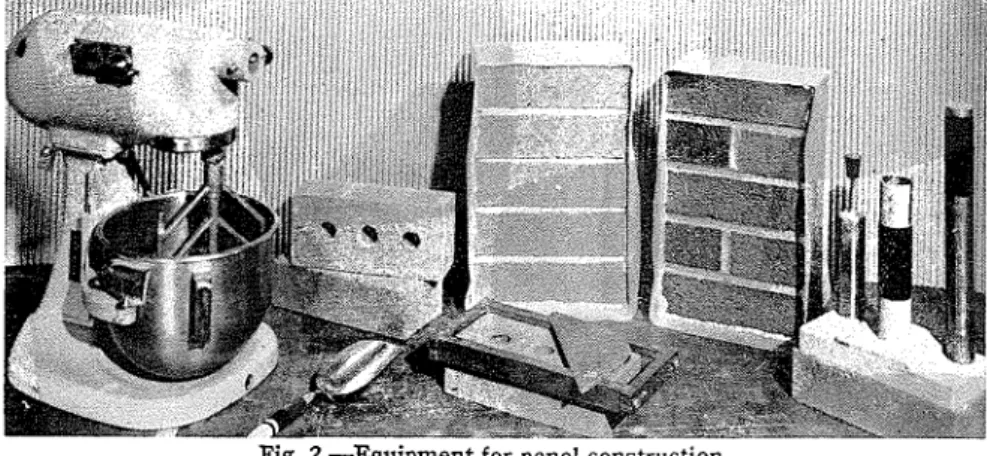
The procedure for assembling thc pancl was adapted from that developcd by C.
C.
Fishburn5n preparing crossed- brick couplcts for tests of bond strength between brick ancl mortar. In prepar- ing the specimens a mold is placed over thc bottoin briclc niid a becl of mortar cast in it. The second brick is placed on thc inortar and tapped by a dropping hammer. Thc tn-o bricks arc latcr pullcd apart to determine tlle strength of adherence of mortar to brick.Thc panels inaclc in the D13R labora- tory contain five bricks, laid one above thc other with four llorizontal mortar joints. Altl~ough pancls could bc made to containvcrtical joints, thismould con]- plicatc t l ~ c illctllod of building them. Bricks
Thc bricks to bc usccl ill the panels arc tcstccl for thc propcrty of initial rate of absorption%~ntl then dried thoroughly I~cforc they are built into the pancl.
Initial rate of absorption has a n impor- tant influence on thc bonding of mortar to bricks, ancl since this property may vary widely even within bricks from the same lot, those used in the construc- tion of tcst panels are sclcctecl to be within a narrow range of initial rate of absorption.
Mortar
An individual b:~tch of mortar is prc- parecl for each of thc four mortar joints in the panel. The water, cementing
materials, and sand are mixed in a small Hobart mixcr (type N-50) ; the amount of watcr is predetermined to produce a selected flow. Each mortar batch con- tains
&
cuft
of sand, which is the volume obtained from thc standard mold uscd in ASTRlI soil tests. The air-dried sand compactcd in thc ~nolcl is JX-eighed, and this amouilt of sand is proportioncd by weight for the mortar mixes. The volume of cemctiting material for the mix is calculatccl on thc basis of:D-
cuft
of sand, usually in thc ratio 1:3 by volunle of cementing material to sand. The volumc rcquirecl is converted to wight, a i ~ d thc ccnlentiilg material is proportioned by \wight for the mix.
In preparing the mortar, the water is placed in the borvl first and then the cementing materials arc added. The mixer is started s~multancously rvitli a stopwatch to record the time of mixing.
T. RITCHIE is an Associate Research Officer of the Division of Building Research of the National Research Council of Canada. He was graduated in ceramic engineering from the University of Toronto in 1949 and joined the Division of Building Research in 1950, where he has undertaken studies of 'problems relating to unit masonry construction. He is a member of ASTM Committee C-15 on Manufactured Masonry Units.
Maferials Research
&
SfandardsAuthorized Reprint from Published by
the Copyrighted Materials Research & Standards, Vof. 1, No. 5, May 1961
nuts seals the two parts together. The othcr ~vall of the pressure cllamber i s inadc of clear plastic material wliich :~llows observation of the netted surface of the pancl during the tcst. Figure 4 is a sectional drawing of the frame and pressure chamber.
The ~vatcr spray tubc is a length of brass pipe with llolcs drillccl along its length, spacecl
$
in. apart. Tlle size of the holes is that obtained frorn a No.'76 drill. 't'hc spray tubc is held in place near the facc of thc pancl by a piece of mctal attached to the tube which fits be-
tween
the ~ l a s t i c and the tor, brick ofFig. 2.-Equipment for panel construction.
sheet of 10-mil polyethylene plastic is placed ovcr the adhesive, extending about an inch frorn the pancl faces. At the bottom of the panel it acts as a de- flector for any moisture moving down the surfaces.
The moisture penetration test is usually made 14 days after construc- tion of the panel, and the tcst lasts for 24 hr. The pancl is dried in the labora- tory for two weeks or longer beforc the bond strength tcst is made, or com- panion panels for bond strength ancl leakagc may be prepared for testing at the same age.
Moisture Penetration Tests
The panel is placed in an apparatus that sprays nratcr on one surface of the panel to form a continuous film and at the same time applics air pressure against the wetted surfacc. A condi- tion of test simulating heavy wind- driven rain is thus produced.
The panel is mounted in a framc con- structed of steel channel members, 4 by 14 in. (Fig. 3). The panel is separated from the frame a t the sides and top by a sheet of foamed plastic,
$
in. thick, and a t the bottom by a thin sheet of sponge rubber, about#
in. thick. One of the side members can be moved laterally by two screws, to bring the sponge plastic snugly against the sidcs of the panel. This side member is then sccurcd to the base of the frame by a bolt. The top of the frame is connected by bolts to the side members and can thus be tightened against the sponge plastic laid on top of the panel. The panel is therefore firmly held in the frame and sealed a t the edges by the sponge plastic, which also takes up any slight unevenness in the edges of the panel.The test panel and frame form onc wall of an air-pressure chamber also constructed of steel channel members (4 by 1; in.). The edges of the chamber are fitted with sponge plastic which provides an effective seal when the frame is bolted to the chamber. When the air-pressure chamber and pancl frame are moved into position facing one another, bolts of the frame fit into slots in the chamber. Tightening the four
Fig. 3.-Frame
-
for test ane el. and air-~ressure - , chamber.Inlet far the panel. A constant-level mater Spray Water
supply is connected to the spray tube, and a flow of water of about 600 nd per mill is maintained through the tubc.
The spray watcr enters the top of the pressure chamber and passes through a rubber tube to thc spray tubc. The water passes clo\vn the facc of the wall and-- on reaching the plastic sllcct is clcflcctccl away from thc face and falls into the bottom of the pressure chamber.
A
tubc leading from the base of the chainber carries the water to t h c drain. An air block is fittecl in the drain tubc to maintain the pressure in the chamber. The wall of the pressure chamber is inade of clear plastic sheet about in. thick and has trvo access holes. Im- mediately after the water spray is started a small brush is inserted through the access holes to sprcad the streams of watcr over the cntirc surface of theFig. 4.-Section of air-pressure chamber and frame.
panel. Normally it takes considerable time for the small streams of water to establish a continuous film over the sur- face. When this had becn done, the holes arc sealed with rubber stoppers, a s shown in fig. 4, and the air pressure is applied.
Tlle constant-level water supply to
Fig. 5.-Apparatus for moisture penetra- tion tests.
the spray tubc is shown in Fig. 5. Water is brought from the tap to the inverted bottle. Two tubes lead from the stopper of thc bottle. Thc large one is a clrain tube to the sink ancl the other is the water supply tube to the pressure chamber. Water is supplied to the bottle a t a rate esccccling the flow in the spray tube, and thc csccss is drained through the large tubc.
A
con- stant level is therefore maintained above the spray tube.As sl~oxvn in Fig. 5, the water eiltcrs the top of the pressure chamber, passes by rubber tubc to the spray tubc (as indicated by the white cord), ancl then down the facc of the panel.
It
is clc- flcctccl by the plastic shcct a t the base of the panel into the clraiil a t thc bottom of the pressure chamber.The flow of air to the prcssurc cham- ber (from the laboratory supply) is regulated by a manual loadiilg prcssurc regulator attaclled to the sidc of thc chamber. 'l'hc air enters thc sidc wall of the chamber bcncath the regulator valve, ancl a n~anonlctcr ~~lountccl on top of the prcssurc cl~ambcr (sl~omn in Fig.
3) indicates the prcssurc in thc chambcr. During a tcst, the air prcssurc diffcr- ence across thc pailcl is maintained a t
2 in. of water, which is approsimatcly equivalent to the pressure of a 50-nlph wind blowing against a wall. A record is made of the tiillc taliell for clampncss to appear on the bacli of the panel, and of thc rate a t which leakage water conlcs off the back surface of the panel. Thc tcst is usually continued for 24 hr.
Bond Strength Test
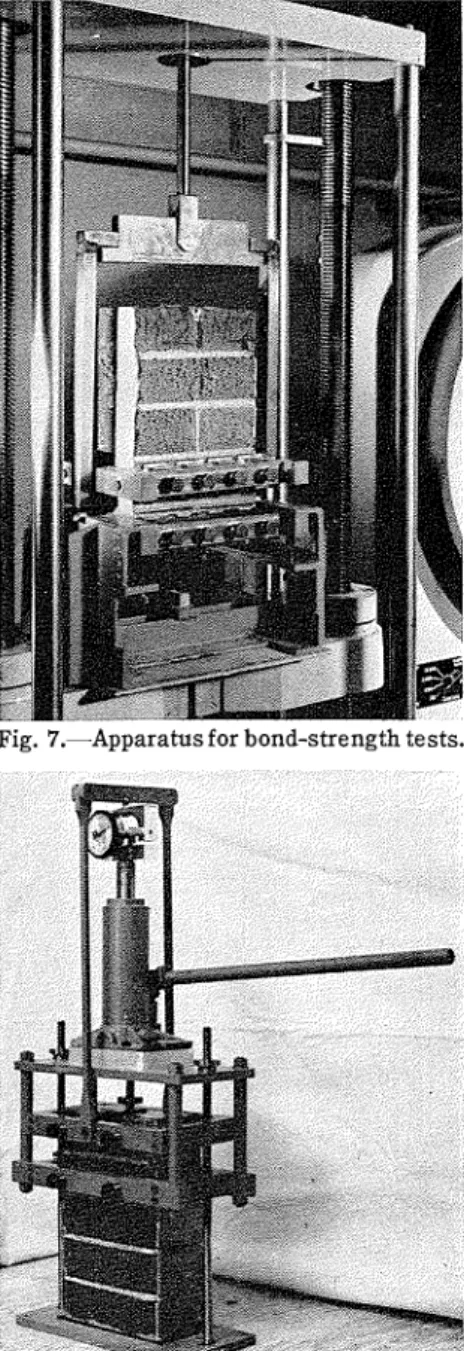
The apparatus consists cssc~~tially of two clamps ~vhich holcl the bricks on either sidc of a mortar joint ancl are pulled apart in a testing machinc to determine the strength of adhesion between brick and mortar. The clamp is a metal frame or collar which fits over the brick. Four bolts in cach sidc Inem- ber of the framc bear against the curved surface of half-disks within the frame
xvllich a r t as swivels to conform to irregularities in the sllapc of tllc bricli. Whcn thc bolts arc tightcncd, eight individual flat bc:~ring :n'c':~s arc nlolrcd against tllc sides of thc brick. Strips of $-in. birch ply~voocl or of leather arc placed bct~v'en thc brick wncl the disks to producc a sccurc grip.
Tllc procedure for clamping bricks is illustmtccl in Fig. 6. A clamping framc is p1:iccd ovcr the bottom brick of thc panel, supported a t the mid-height 01 the brick by tllc wooden blocking shown. The framc is ccntcred and the bolts are tightened uniformly. The panel with the clamp attached is then
. . . - .
i
1.*.
ITesting Machine Cross - Head
Fig. 6.-Procedure 1
Fig. 7.-Apparatus for bond-strength tests.
Fig. 8.-Manually operated apparatus for bond strength.
-Upper Clampir Frame
ior clamping bricks.
Bars
19
slid into a frame attached to the lower crosshead of the testing machine; the clamp rests on a flange, as shown in the scconcl sketch. The clamp for the ncst brick is placed ovcr the panel ancl rests on the upper part of the main frame where by design it is located a t thc mid-height of the brick. The bolts of the clamp are tightened to produce a secure grip to the bricli.
Four vertical bolts in the flange are turned to raise the bottom clamp until it bears tightly against the main frame. I n this way thc bottom brick of thc panel is attached to the crosshead of the testing machine, ancl it remains to at- tach the upper clalnp to the loading heacl of the machine in orclcr to pull the two bricks apart. Two hanger bars, shown in the third slietch, arc attached to the ends of thc upper clamp by means of ball-and-socket connec- tions, and are attached above to a pivoted cross-bar or yolie suspcndcd from the travel-arm of the testing ma- chine. The apparatus is shown i n Fig.
7.
I11 dctcrminillg bond strength, thc
machine is set for a travel ratc of 0.05 in. per min, corresponding to a loading ratc of 1200 lb per min, and the breaking load is rccordecl on the dial of the machine. When the bottom joint of the panel has been broken, the clamp is rcmovcd from tllc dctached brick and is fitted on the second bricli of the remain- ing four by the same procedure described before, and the test is macle on thc nest joint.
A
similar apparatus mas designed for usc a t the DBR Atlantic Regional Sta- tion in Ilalifas, which is not equipped with a universal testing machine. The apparatus therefore contained a small hydraulic jack to forcc the clamps apart and a load gage to record the breakingbetween brick and mortar occurred, which continued to grow for several years. This growth of rracking has resulted in leakage in illany buildings starting 1 to 5 yr after construction. Apparently, good initial bonds were usually produced in the test panels because in three of the laboratory in- vestigations age and exposure did not increase thc water pcnctration (3,4,7). Good initial bonds with high-cement mortars are not coiisisteiltly obtainccl in the ficld, ancl this differcricc bctwcen results obtained in buildings and in panels can be explaillecl only by a dif- ference in construction practices.
To obtain good initial bonds there must be good initial contact betwecn brick and mortar. I11 the field, this contact is provided by workability in the mortar. Low workability in the mortar reduces the completeness and intimacy of contact, and so does a low rate of absorption in the brick. This latter, apparently, permits a film of water to collect between brick and mor- tar which interferes with the intimacy of the contact and the bond. High suction in brick apparently destroys the initial colitact in many arcas before the bond can form, and there may be other interferences with initial contact.
If the brick is forced into contact with the mortar and the contact is not dis- turbed, good bonds will form. The better results in panel tests (1-5) indicate that the initial contacts and bonds between brick ancl mortar were
better in panels than in the field. Tlie hammer blow applied to each brick in the pancl, as suggested in Mr. Ritchie's proposed pancl tcst, mould, in most cases, force good initial contact between brick and mortar regardless of thcir properties. This would re- duce the formation and growth of sep- aration cracks between brick and mor- tar, which is the major cause of moisture pcnctration of masonry. The ad- vantages of good mortar ~vorkability woulcl vanish (apparcntly), and any water film between mortar and im- pervious bricks would be driven out. This good contact could be partially destroyed later by a high rate of ab- sorption in the bricks, but even so, the harmful effccts on bond would probably be reduced by the hammer blows. The hammer-blow technique would in- validate any attempt to reproduce ac- tual construction conditions.
One of the major problems of pancl testing is the lack of consistency in results, and thcir poor reproducibility. The hammer blows would undoubtcclly improve the consistency and reproduc- ibility of the test results, but the re- sults would not propcrly reflect what actually happens under field conditions. I t would seem that any procedure, not common to normal field practice, ~vhich
reduces the usual variability of tcst results ~voulcl, of necessity, have to inhibit the actioi~ of some forces that normally influcncc rcsults in actual construction.
Other laboratory investigators have used other devices to achieve reprocluci- bility. Palincr and Parsons (8) and Palmer and Ilall (9) produccd much the same cffcct as tlic hammer blow by having the bricklayer throw his full ~vcight on each brick :~nd maintain that pressurc for 1 min as thc bricks werc laid in couplcts and picrs. This pro- cedure enabled tlicnl to obtain the rcl- atively complete contact and extent of bond they needed t o make their com- parative bond studies. Palnler and Parsons built their wallettcs for moisture penetration tests (I) by spreading the mortar for one brick a t a time ancl laying the brick immediately. They had found in a previous study (8) that low-water- retention mortars could not bc spread out over four bricks without loss of bond. I undcrstoocl they followed the practice of thcir prcvious work ancl laid these bricks with heavy pressure, but this is not
mentioned
in their paper. Their method of laying bricks produced wallettes where the most rc- a ion were sistant to moisturc penetr t.those built with a combination of high- cement mortar and impervious bricks. Palmer ancl Parsons ~vcrc fully aware that this conlbination had not pro- duced good results in the field and pointcd this out in connection wit11 im- pervious bricks.
Other cleviccs used to achieve re- producibility in bond tests 1l:ive been the painting of each brick with grout from the mortar before laying; and the spreading of half of the joint thickness of mortar on each brick before laying in couplets.
Evidently the way the bricks are laic1 greatly affects the test results in pancls. Such artificially produced results can be misleading. The escellcnt results
--
obtained in the carly laboratory in- vestigations with high-ccment mortar and impervious bricks wcre widely cir- culated, and it took years before the building industry could free itself from this detrimental conlbination of brick and mortar with its hair-cracked mor- tar joints ancl wall leaks. I n my study of the moisture resistance of actual buildings (6), seven buildings had this combination of low-workability, high- cement mortar and low-suction brick. All seven leaked, and most of them severely.Thc evidence in this ficld study (6) of results a t 100 building units, where 46 lcakcd ancl 54 did not, contradicted
much of t h c evidence from the labora- tory investigations on panels and wallettes. The ficlcl study indicated that both poor workability in mortar and low suction in briclis wcre detri-
mental to the inoisture resistance of inasonry w:~lls. I n 27 buildings the high-cement, low-workability n1ort:~rs- 1 :3 mixes wit11 10 to 25 per ccnt of lime added-were usecl. Twenty-sixof thcsc buildings leaked; the single exception had grout poured into t h e center of each brick course as laid. Thirteen of the 26 buildings had good, moderate- suction brick, but the lowest joint cracking rccordccl was 26.0 pcr ccnt- 26
ft
of cracks per 100 f t of mortar joints-which is about twice the safe limit. The consistent failure of high- cement mortar in actual buildings is directly counter t o the record in panel tests of cscellent resistance to moisture pentration with low-suction bricks, and usually good or cscellent resistance with moderate-suction bricks (1-5). The failures in buildings could not be ascribed to poor workmanship. There always was competent and rigorous inspection, stal~darcls were high, and t h e contractors wcre carefully selected. As a result, workmanship was con- sistently much above tlie average.Evidence on tlie effects of lo~v-suction bricks in this same study (6) was less extensive, but t h c influence secined
definitely detrimental. All of tlie scvcn buildings with low-suction bricks and poor-workability mortars leaked, as did two of tlic four buildings with low- suction bricks and workable, high-lime mortars. The average cracking with t h e workable mortars was high-20.4 per cent. Many other ficld observations havc apparently confirmed these find- ings. Herc again, pancl tests showed a different trend, t h e low-suction bricks having a consisteiltly good record with all mortars (14).
The favorable laboratory record,of t h e combination of high-cement mortar and low-suction bricli seems incredible t o old-time construction men. That combination of brick and mortar bc- came so notorious for causing leaky, buildings and hair-cracked mortar joints t h a t competent builders stopped using it many years ago.
It
cost illy former company close t o a quarter of a mil- lion dollars to remedy one such con- dition. Measurements a t that bbuild- ing, taken five years after construction, showed 68ft
of joint cracks pcr 100 ft of mortar joints, although the worlr- manship was excellent. The entrance and resulting freezing of water caused many of the cored bricks to crack or split. Panel tests, howcver, would have indicated that the 3.0-g IRA brick and high-cement mortar was an escel- lent combin at'
ion.Demolition work supplies some per- tinent evidence. Where there is nluch joint cracking and wall leaks, the demo- lition shows a wide variation in thc extents of bond between brick and mortar-some good, some poor, and some with tentacular bonds. This
serves to explain the inconsistency of many panel tests. However, there have heen very few partially bonded bricks observed in walls where a good com- bination of moderate-suction brick and a workable 1: 1:5 or 6 high-lime mortar has produced a wall with a low percentage of joint cracking and no leaks. Contractors have learned to dread the demolition of such walls. There are no cleavage lines and no separation of individual bricks. The salvage of bricks gets down to chipping off the mortar bit by bit. The evidence from demolition suggests that incon- sistency in bond may well be the nor- mal condition of a poor combination of brick and mortar, as consistency may be evidence of a good combination. There is much we need to know about the causes of separation cracking be- tween brick and mortar.
The recital of the misleading indica- tions of past results in panel tcsting should not be taken to mean that panel tcsts are of little value in the study of masonry. Revisions can be madc that will make them much more valuable in the future than they have been in the past. Obviously, panel tests must be able to produce results comparable to those obtained in buildings under the same general conditions. In the past they have failed to do so in many par- ciculars. I submit for 1Mr. Ritchie's
consideration
some comments and re- commended changes I believe would help bring his proposed test into line with actual construction conditions:1. The pressure and thrust used in laying the bricks in the panel should match that used in the field. This will require a study of the pressure and thrust exerted by several skilled brick- layers and probably some mechanical mcans of laying the bricks with no more and no less than the determined prcs- sure. Also, it may be necessary to use a "backstop" at one end of the panel to take the thrust without disturbing other bricks in the pancl.
Determining the proper pressure will take some doing, because
I
suspect all masons use more pressure in laying bricks in panels-or in tests-than they do in their daily bricklaying. This may well be a major reason why panel results are usually bctter than those obtained in buildings.2.
I
believe the 45-sec timc lag be- tween the spreading of the mortar and the laying of the brick as proposed by Mr. Ritchie is too short. The proper period of waiting time would have to be determined to approsiinate that normally occurring in the field in the building of high-grade brickwork.I
suggest the time lapse be the time between the start of the spreading of the mortar over three bricks and the laying of the sccond brick in the top course.3. For the sake of consistency in results, the initial rate of absorption of the brick, the plasticity of the lime, and the grading of the sand, must be kept constant during a test program. Sand is likely to be a variable, which affects results. The proposed requirement that sand pass the proper ASTM specifica- tion is not enough. The grading should be specific, and percentages should be nlainhined within 2t2 per cent.
4. The mortar mixes in Mr. Ritchie's proposed panels would be proportioned with compacted dry sand. In field con- struction, damp sand is almost in- variably used. Numerous tests on damp sand from piles in the field showed shrinkages of from 22 to 24 per cent when the sand was inundated, as is the case in mortar. Dry rodded sand also shrinks when inundated, but only about two per cent; and loose dry sand shrinks about 12 per cent. I suggest that the weight of sand in the mixes be the weight of the sand only in equal volumes of dmlp sand, a reduction of about 21 per cent from the dry rodded weight. There are other acceptable methods of arriving a t the equivalent weights of damp sand, but for results comparable to those obtained in the field, the damp sand weights, less the watcr, should be used.
5. The mortar beds in the proposed panels are recessed in. a t the test face, and are not tooled. The mortar, when pushed out by the pressure of laying the top brick, would tend to slump away from the brick above, and would make poor contact with the brick below. This would provide water en- trances. If there are any brick ledges left exposed, they would guide the water in, as happens with raked joints. I n the proposed panels, the absence of a recess a t the brick cnds sc%rves as a stop to water penetration through pcrinlctcr srparation, but poor contact at the facc would bc an undesirable hazard.
Joint tooling has an important cffcct on the moisture resistance of fielcl masonry ( 6 ) . Joints filled to the
test-
ing face and concave-tooled are rec- ommended for the panels. This would be more comparable to field construction. Moreover, workable mor- tars that can be tooled easily and ef- fectively into good contact and bond with the bricks at the joint face would improve the moist resistance. Their superiority would be reflected in the test results.
6. The hammer-blow technique should be abandoned. It is a dcvia- tion from field practice and would tend to inhibit some of the forcrs acting on field masonry.
It
would obscure the beneficial influence of good mortar workability and the harmful effects of low mortar workability and low brick suction on the moisture resistance of masonry.It
might cover up the in-fluence of other factors. Data derived from tests on panels constructed ~vith the hammer-blow technique would not properly warn against the use of un- desirable mortars and bricks and ~vould certainly produce a distorted and mis- leading picture of the problem of water penetration of masonry and its solution.
MR. T . RITCHIE (author's closure).- The criticisms made by Mr. Connor are useful since they clearly draw at- tention to possible inadequacies of small- panel testing of brick masonry and to the possibility that misleading informa- tion may bc obtained from such tcsts. Comments should be made on certain parts of the discussion, however, since a different interpretation may be placed on some of the points raised.
Panel and wallette testing in the past are said t o have provided a poor guide t o performance in the field. The particular case is mentioned of the combination of lorn-suction bricks and high-cement mortar which has invari- ably given good results in laboratory tests but "complete failure" in the ficld. Mr. Connor believes that this situation is the result of differences in construc- tion practice, that laboratory-built brickwork has differed in the manner of construction from "ficld" brickwork, with the result that in the former case the initial bond bctween brick and mor- tar is better than that normally ob- tained in the field. Although it is agreed that low-suction bricks fre- quently have been involved in problems of leakage, I do not believe that lack of initial bond is the reason. On the contrary, I believe that low-suction bricks under conditions of both labora- tory and field construction bond well initially with mortar, and thc resistance to moisture penetration a t an carly age is high, as laboratory tests havc indica- ted. Low-suction bricks, howcver, es- pccia!!y rvhen used with a strong, high- cement mortar, are likely to procli~ce very rigid masonry which is sensitive to conditions of stress. IVllen sub- jected t o the stresses normally imposed on it in service the integrity of this ma- sonry and its rcsistance to moisture penetration may be lost. Mr. Connor's observations on the behavior of brick masonry in malls appcar t o confirm this, since he notes that in many cases le:~k- age started 1 to 5 yr after construction and there was n growth of cracking in the brickwork with age.
The results of exposure tests of panels of low-suction bricks, in which no change in leakage characteristics took place from the weathering of the panels, may well have been misleading, as Mr. Connor suggests, but probably not because of differences in initial bonding so much as differences in restraint and stress. The brickwork of a test panel is unrestrained, whereas that of a mall
is not, sincc i t is much larger in espanse, turns corners, and may bc tied into other parts of thc building, sucli as columns. The pcrforinance of similar brickwork under these t117o differcnt conditions of service may be expected t o be different, and the difference must remain a serious weakness in panel tests unless some method can be developed to build into test panels the same conditions of rcstraint t h a t inight occur in ~valls. I n a n y case studies such as Mr. Connor's on thc perforillancc of masonry in actual buildings will finally reveal t h e adequacy of a particular conlbination of unit and mortar.
Important differences between lab- oratory and field masonry nlay arise, as M r . Connor suggests, from diffcr- ences in the proportioning of the ma- terials used t o prepare mortar. I n laboratory mork, proportioning of ma- terials usually is very carefully con- trolled, and, in general, t h e proportion of cementing material t o sand is low. I n the field there is usually much less control of t h e proportioning, and i t is often governed t o a large extent by the working properties or "feel" of the mortar.
It
is suspected t h a t when a cementing material of low '"vorkability capacity" is to be used in the field its poor qualities in this respect are com- pensated for by making t h e mix richer. Greater rigidity and strength in t h e mortar mould result from this, along with greater dimensional instability, and therefore, a promotion of cracking in the wall and breakdown of the bond. Mr. Connor has noted t h a t i n labora- tory \vork sand is usually proportioned in a relatively dry condition, \\-hereas damp sand is used in the field. This also ~vould affect the richness of the mix, since a 1: 1:s mortar prepared with damp sand in t h r field n nuld 1x7 equivn- lent t o a 1 : 1 :3 2
rnis prc.1):~rcd in tllr laboratory from dry sand, assunning :Idiffcrencc of 25 I)cr cent, in volurncs of the sand because of its bulking from moisture. For two rcnsons thcrcfore, workability and sand bulking, i t is prob- able t h a t much richer mists arc used in the field than in tllr 1:iborator.v; obser- vations made in
DBR
studies of ma- sonry have indeed indir:~tcd t h a t ex- tremely rich mixes are often usecl in the field.Attention has been drawn in hlr. Connor's discussion t o thc problem of devising a standnrd lnhoratory method of laying bricks to duplicate the pressure and thrust uscd by t h c bricklaver under field conditions. Un- fortunately, for reasons discussed l:~tcr, there does not appear t o he a uniform, nonvarying bricklayer's tecllnique. A
mason's method of bricklaying is a var- iable t h a t changes as other factors change, and undoubtedly there is a variation from one bricklayer t o an- other. I n t h c laboratory nlcthod of constructing brick~vork, the use of a ham- mer t o t a p bricks into the mortar bed has been criticized a s a departure from normal practice t h a t produces bonding entirely different from t h a t obtained in the field. This does not appear t o be the case in this area (Ottawa, Ontario). On several occasions observatioiis have been made of bricklaying rncthods, and i t was noted t h a t the technique used was not t o shove the brick into the mortar b u t ratllcr t o sct i t on the mortar and then t o t a p i t down t o the line with the edge of the trowel. T h e tap- ping usually
consisted
of four or five sharp, rapid taps rather t h a n the single t a p used in the laboratory method. The brick was held in the hand while i t was tapped into place, b u t there did not appear t o be any pressure from the hand t h a t might be termed "shov- ing." The bricks used locally are, a s a rule, moderate t o high in suction, and i t is not known whether the same method applies t o low-suction briclrs. Differ- ences between t h e laboratory method and field methods may occur, b u t apparently not i n ~vhcther tapping is characteristic of one and not the other; tlle nature of t h e tapping, however, may be different.Bricklaying methods appear t o vary considerably with the type of brick and mortar; with moderate-suction bricks t h c bedding is done wit11 light tapping, b u t with higher-suction bricks heavier tapping is necessary t o bring tlle brick down t o tlle line. It seems clear also t h a t the consistcncy of the mortar is varied with the suction of the brick used if the bricklayer has any control over tlle tempering of the mor- tar.
A
particular mortar almost in- variably is used in a much wetter state with higli-suction bricks t h a n \\.it11 those of modcratc suction. Tlle length of time the mortar is in contart with the bricks beneath i t before a brick is sct on the mortar bed may be varied considerably by t h e bricklayer, and t o some extent i t varies with tlle type of brick and mortar used. If the bricklayer in building a mall spreads out a nlortar bed for three bricks, tlle result may be three different bonding conditions between brick and mortar, since the properties of t h e mortar continuously change due t o the absorp- tion of the bricks below. The poorcst- bonded brick nil1 be the last of the three placcd in the mortar. A situa- tion could therefore arise i n which one third of t h e bricks placed i n rt wall haveinadequate bonding in regard t o resist- ance t o moisture penetration, mllile t h e remaining bricks arc adequately bonded. 0bscrv:ltions of bricklaying i n the field indicated t h a t the tinle in- terval m a y vary froill a s little as 20 sce for the first brick laid t o as long as 1$ min for the third.
Mr. Connor's discussion has servecl well t o illustrate some of the com- plications that arise in making panel tests of brick masonry, ancl there is no doubt t h a t such tests may be inadequate. Panel tests are usecl because thcy pro- vide t h e only practical means of obtain- ing funclamciital information on brick- mortar bonding ancl the factors affect- ing it. It is necessary to resort t o such tests to elinlinate the variables inherent in field construction, and even with their inaclcquacics pancl tests ap- pear t o be extremely useful i11 revealing tlle influence of certain factors on t h e perfornlance of brick masonry.
REFERENCES
(1) L. A. Palmer and D. A. Parsons, "Permeability Tests of 8-in. Briclc Wallettes," Proceedings, Am. Soc. Testing Mats., Vol. 34, Part 11, p.
419 (1934).
( 2 ) C. C. Fishburn,
I).
Watstein, and D. E , Parsons, "Water Perli~eability of 1M:lsonry Walls," Nationnl Bureau of Stantlards, Building 1LIatcrials and Structures Report hTo. 7, Oct., 1938.( 3 ) J. IV. McBurncy, M. A. Copeland, and R. C. Brink, "Permeability of Brick- Mortar r\ssemblages," Proceedings, Am. Soc. Testing Mats., Vol. 46, 11. 1333 (1946).
(4) T. Ritchie and Mr. G.rPlemcs, "Mois- ture Penetration of Brick Masonry Panels," ASTM RULLETIN, NO. 240, Oct., 1960, p. 39 (TP1 83).
(5) C. C. Fishburn, "l\Tater l'ermeability of lT7alls Built of Masonry Units," Xational Burcau of Stancl:ncls, Bnild- ing M:~tcrials :inti Structures lieport KO. 82, Al~ril, 1942.
-- (6) C. C. Connor, "17actors in the Rcsistr ance of Bricli i\f:~sorlry llr\':~lls to Mois- ture Pcnct ration," PI oceedlngs, Am. Soc. Tcstina hlats.. Vol. 48, 11. 1020
(1948).
(7) C. C. Fishl)urn, "Effects of Outdoor Exposure on the Water Perinenbility of Rlasonry IValls," National Burcnu of Standards, Building Materials and Structures Report No. 7G, Aug., 1041.
(8) L. A. Paliner :ind D. A. Parsons, "A
Stutly of thc Propcrtics of Mortars ant1 Bricks, and Their Relations to Bond," National Bureau of Stantlards, IZe- searcl~ Paper N o . 638, May, 1934.
(9) L. A. l'aln~cr ancl J. W. Ilall, "Dura- bility and Strength of Bond Between Mortar and Brick," Xational Bureau of Standards, Researcl~ Paper K O . 290.
March, 1931.