HAL Id: hal-00447072
https://hal.archives-ouvertes.fr/hal-00447072
Submitted on 14 Jan 2010
HAL is a multi-disciplinary open access
archive for the deposit and dissemination of
sci-entific research documents, whether they are
pub-lished or not. The documents may come from
teaching and research institutions in France or
abroad, or from public or private research centers.
L’archive ouverte pluridisciplinaire HAL, est
destinée au dépôt et à la diffusion de documents
scientifiques de niveau recherche, publiés ou non,
émanant des établissements d’enseignement et de
recherche français ou étrangers, des laboratoires
publics ou privés.
Alternative speech communication based on cued speech
Panikos Heracleous, Noureddine Aboutabit, Denis Beautemps
To cite this version:
Panikos Heracleous, Noureddine Aboutabit, Denis Beautemps. Alternative speech communication
based on cued speech. EUSIPCO 2009 - 17th European Signal Processing Conference, Aug 2009,
Glasgow, United Kingdom. pp.SP4.5. �hal-00447072�
ALTERNATIVE SPEECH COMMUNICATION BASED ON CUED SPEECH
Panikos Heracleous, Noureddine Aboutabit, and Denis Beautemps
GIPSA-lab, Speech and Cognition Department, CNRS UMR 5216 / Stendhal University/UJF/INPG 961 rue de la Houille Blanche Domaine universitaire - BP 46 F - 38402 Saint Martin d’H`eres cedex.
E-mail:{Panikos.Heracleous, Noureddine.Aboutabit, Denis.Beautemps}@gipsa-lab.inpg.fr
ABSTRACT
This study focuses on alternative speech communication based on Cued Speech. Cued Speech is a visual mode of communication that uses hand shapes and placements in combination with the mouth movements of speech to make the phonemes of a spoken language look different from each other and clearly understandable to deaf and hearing-impaired people. Originally, the aim of Cued Speech was to overcome the problems of lip reading and thus enable deaf children and adults to wholly understand spoken lan-guage. In this study, however, we investigate the use of Cued Speech not only for perception, but also for speech produc-tion in the case of speech- or hearing-impaired individuals. The proposed method is based on hidden Markov model (HMM) automatic recognition. Automatic recognition of Cued Speech and conversion to text, audio, or synthesized Cued Speech can be served as an alternative speech commu-nication method for individuals with speech or hearing im-pairments. This article presents vowel and consonant, and also isolated word recognition experiments for Cued Speech for French. The results obtained are promising and compara-ble to the results obtained when using audio signal.
1. INTRODUCTION
Speech is often described as a uni-modal process. However, it is well known that speech is multi-modal in nature and includes modalities such as audio modality, visual modality, touch modality, signal of muscles, articulatory speech, and brain activity during speech production.
The audio modality describes the audible speech used for communication between individuals without disorders in speech perception and production. In addition, audio modality includes inaudible speech produced when vocal folds are not vibrating (i.e., whisper speech), and also tissue-conducted Non-Audible Murmur speech [1]. Messages can be also transferred using information produced by lips and mouth, and by facial information. Cued Speech, a system that uses hand shapes in different positions to complement lipreading, is a wholly visual speech system [2]. Speech can be perceived and interpreted by touching, as in the Tadoma technique. Tadoma is a technique that enables a person who is both blind and deaf to receive and interpret speech. In addi-tion, speech messages can be transferred through the activa-tion signal of muscles during speech producactiva-tion [3]. Invisible articulatory components i.e., tongue and velum is the motor which makes link between the different modalities. Move-ments of the invisible articulators during speech production also carry speech information [4, 5]. Also some studies in-vestigate the brain activity during speech production [6].
This work is supported by the French TELMA project (RNTS / ANR).
Figure 1: Hand position for vowels (top) and hand shapes for consonants (bottom) in Cued Speech for French.
Alternative speech communication makes possible for in-dividuals with impairments to communicate using their exist-ing abilities. A speech-impaired individual (i.e. after laryn-gectomy) can use gestures to transfer messages, and a blind and deaf individual can use touch speech modality to per-ceive speech. Alternative speech can be also used in educa-tion for pronunciaeduca-tion training for second language learners, and for perception and production rehabilitation of hearing impaired children. Since environmental noise does not affect alternative speech, it can be used when the communication occurs in noisy environments (e.g., airports, stations, etc.). In addition, it can be also used in situations when privacy in communication is preferable.
To date, visual information is widely used to improve speech perception, or automatic speech recognition (lipread-ing). With lipreading technique, speech can be understood by interpreting movements of lips, face and tongue. How-ever, even with high lipreading performance, speech without knowledge of the semantic context can not be completely perceived. To overcome the problems of lipreading and to improve the reading abilities of profoundly deaf children, in 1967 Cornett developed the Cued Speech system to comple-ment the lip information and make all phonemes of a spoken language clearly visible. As many sounds look identical on lips (e.g.,/p/ and /b/), using hand information those sounds
can be distinguished and thus make possible for deaf people to completely understand a spoken language using only vi-sual information.
po-Figure 2: Parameters used for lip shape modeling.
sitions near the face in combination with natural speech lipreading to enhance speech perception from visual input. A manual cue in this system contains two components: the hand shape and the hand position relative to the face. Hand shapes distinguish consonants whereas hand positions dis-tinguish vowels. A hand shape together with a hand posi-tion cue a syllable. The advantage of Cued Speech is that improves speech perception to a large extent for hearing-impaired people. Moreover, Cued Speech offers a com-plete representation of the phonological system for hearing-impaired people exposed to this method since their youth, and therefore has a positive impact on language development [7]. Fig. 1 describes the complete system for French. In Cued French, eight hand shapes in five positions are used.
The access to communication technologies has become essential for the handicapped people. The TELMA project (Phone for deaf people) aims to develop an automatic transla-tion system of acoustic speech into visual speech completed with CS and vice versa, i.e. from CS components into audi-tory speech [8]. This project would enable deaf users to com-municate between themselves and with normal-hearing peo-ple through the help of the autonomous terminal TELMA.
The Cued Speech paradigm requires accurate recognition of both lip shape and hand information. Fusion of lip shape and hand components is also necessary and very important. Fusion is the integration of available single modality streams to a combined one. Previously, several studies have been made in automatic audio-visual recognition and integration of visual and audio modalities [9]. The aim of audio-visual speech recognition is to improve the performance of a recog-nizer, especially under noisy environments.
In the first attempt for vowel recognition in Cued Speech for French, in [10] a method based on separate identifica-tion, i.e., indirect decision fusion was used by the authors, and 77.6% vowel accuracy was obtained. A similar study for digit recognition in English Cued language was also in-troduced in [11]. Previously, the authors presented a method for automatic vowel recognition in Cued Speech for French based on HMMs [12]. In the current study, vowel recog-nition is further investigated, and the proposed method was extended to deal with consonant and isolated word recogni-tion.
2. METHODS
The female native French speaker-employed for data record-ing was certified in transliteration speech into Cued Speech in the French language. She regularly cues in schools. The cuer wore a helmet to keep her head in a fixed position and
opaque glasses to protect her eyes against glare from the halogen floodlight. The speaker’s lips were painted blue, and blue marks were marked on her glasses as reference points. These constraints were applied in recordings in order to con-trol the data and facilitate the extraction of accurate features (see [13] for details).
The data were derived from a video recording of the speaker pronouncing and coding in Cued Speech a set of 262 French sentences. The sentences (composed of low pre-dicted multi-syllabic words) were derived from a corpus that was dedicated to Cued Speech synthesis. Each sentence was dictated by an experimenter, and was repeated two- or three times (to correct errors in pronunciation of words) by the cuer resulting in a set of 638 sentences.
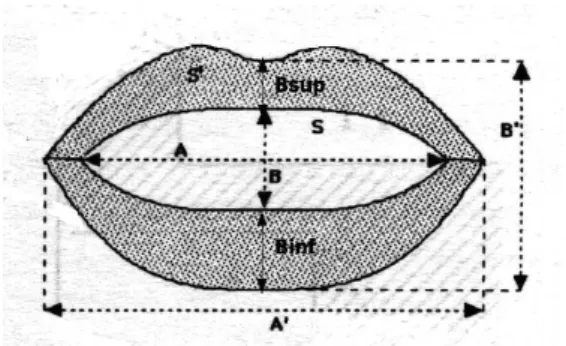
The audio part of the video recording was synchronized with the image. An automatic image processing method was applied to the video frames in the lip region to extract their inner- and outer contours and to derive the corresponding characteristic parameters: lip width (A), lip aperture (B), and lip area (S) (i.e., six parameters in all).
The process described here resulted in a set of temporally coherent signals: the 2-D hand information, the lip width (A), the lip aperture (B), and the lip area (S) values for both inner- and outer contours, and the corresponding acoustic signal. In addition, two supplementary parameters relative to the lip morphology were extracted: the pinching of the upper lip (Bsup) and lower (Binf) lip. As a result, a set of eight parameters in all was extracted for modeling lip shapes. For hand position modeling, the xy coordinates of two landmarks placed on the hand were used (i.e., 4 parameters). For hand shape modeling the xy coordinates of the landmarks placed on the fingers were used (i.e., 10 parameters). Fig. 2 shows the lip shape parameters used in the current study.
In the vowel and consonant recognition experiments, context-independent, 3-state, left-to-right with no skip HMMs were used. Each state was modeled with 32 Gaus-sian mixtures. In addition to the basic lip and hand parame-ters, the first (∆) and second derivatives (∆∆) were used, as well. For training and test 426 and 212 sentences were used, respectively. The training sentences contained 3838 vow-els and 4401 consonants, and the test sentences contained 1913 vowels and 2155 consonants, respectively. Vowels and consonants were extracted automatically from the data after forced alignment was performed (using the audio signal).
For isolated word recognition experiments, 1450 isolated words were recorded employing a different cuer than that employed in the previous recordings. The vocabulary in-cluded 50 words, and each one was repeated twenty-nine times. Twenty repetitions of each word were used to train fifty, 6-state, whole word HMMs, and 9 repetitions were used for test. For lip shape and hand shape modeling , the same kind of parameters as in vowel and consonant recognition experiments were used. In this data recording session, the recording constraints were eliminated by excluding the use of the helmet by the cuer.
In automatic speech recognition, a diagonal covariance matrix is often used because of the assumption that the pa-rameters are uncorrelated. In lipreading, however papa-rameters show a strong correlation. In this study, Principal Compo-nent Analysis (PCA) was applied to decorrelate the lip shape parameters and then a diagonal covariance matrix was used. All PCA lip shape components were used for HMM training. For training and recognition the HTK3.1 toolkit was used.
Table 1: Phoneme-to-viseme mapping in French language.
Consonants Vowels
Viseme Phonemes Viseme Phonemes
C1 /p/, /b/, /m/ V1 /˜O/, /y/, /o/
/ø/, /u/ C2 /f/, /v/ V2 /a/, /˜E/. /ı/ / ˜œ/, /e/, /E/ C3 /t/, /d/, /s/ V3 /˜A/, /O/, /œ/ /z/, /n/, /ñ/ C4 /S/, /Z/ C5 /k/ , /g/ /ö/, /l/
The French language includes 14 vowels and 17 conso-nants. Based on similarities on lips, the 31 phonemes can be grouped into 8 visemes. A viseme consists of phonemes that look similar on mouth/lips. Table 2 shows the mapping of French phonemes to visemes. Based on previous works, five consonant-visemes and three vowel-visemes reflect the most appropriate phoneme-to-viseme mapping [14].
Because of the nature of Cued Speech, for vowel recog-nition lip shape and hand position elements were integrated into a single component using concatenative feature fusion. For consonant recognition, lip shape and hand shape ele-ments were integrated. The feature concatenation uses the concatenation of the synchronous lip shape and hand features as the joint bimodal feature vector
OtLH= [O(L)t T, O (H)T
t ]T∈ RD (1)
where OtLH is the joint lip-hand feature vector, O(L)t the lip shape feature vector, O(H)t the hand feature vector, and D the dimensionality of the joint feature vector. In vowel recogni-tion experiments, the dimension of the lip shape stream was 24 (8 basic parameters, 8 ∆, and 8∆∆parameters) and the dimension of the hand position stream was 12 ( 4 basic pa-rameters, 4∆, and 4∆∆ parameters). The dimension D of the joint lip-hand position feature vectors was, therefore 36. In consonant recognition experiments, the dimension of the hand shape stream was 30 (10 basic parameters, 10∆, and 10
∆∆parameters). The dimension D of the joint lip-hand shape feature vectors was, therefore 54.
3. EXPERIMENTS
3.1 Vowel-viseme classification using lip shape informa-tion
An experiment was conducted for recognition of the three vowel-visemes in order to evaluate the proposed method for lip shape modeling and also the vowel-viseme mapping. For
Table 2: Confusion matrix of vowel-viseme recognition us-ing lip shape information only.
V1 V2 V3 %correct %error
V1 583 3 20 96.2 1.2
V2 33 1039 23 97.2 1.5
V3 11 11 209 90.5 1.2
Table 3: Accuracy for three vowel groups considering simi-larities on lips.
Element
Vowel group Lips Lips+Position Audio
Group1 60.2 94.0 96.7
Group2 58.6 85.9 90.9
Group3 74.3 93.7 93.8
Average 64.4 91.2 93.8
Table 4: Vowel and consonant overall accuracy. Element
Phonemes Lips Lips+Hand Audio
Vowels 59.4 85.1 91.5
Consonants 52.1 78.9 90.7
Average 55.8 82.0 91.1
each viseme, a 3-state HMM was trained using the previously described training data. The vowel labels in the phonetic transcription were translated to include only three viseme la-bels. Table 2 shows the confusion matrix of vowel-viseme recognition. As can be seen, the vowel-visemes were recog-nized with high accuracy. More specifically, 96.1% viseme classification accuracy was achieved (i.e., percentage of di-agonal elements). Table 2 also shows that the partial error corresponding to each viseme is uniform and almost equal.
3.2 Vowel recognition based on concatenative feature fu-sion
Based on concatenative feature fusion, experiments were conducted for vowel recognition considering the similari-ties on lips. The aim was to investigate how the integra-tion of hand posiintegra-tion element improves the recogniintegra-tion ac-curacy when vowels belonging to the same class were recog-nized. As previously described, vowels which show similar-ities on lips (visemes) cannot be recognized accurately using lip shape information alone.
Using the previously described phoneme-to-viseme map-ping, the 14 vowels were classified into three groups and three separate HMM sets were trained using the appropri-ate training data. In this way, each group included the most confusable vowels based on lip shape. Table 3 shows the obtained results. Using lip shape parameters only, the aver-age vowel accuracy was 64.4% because of the high number of confusions between similar vowels in each group. On the other hand, by integrating also hand position element with lip shape element, the average vowel accuracy was raised to 91.2%, showing a 75.3% relative improvement compared with using lip shape parameters alone. In this case, how-ever, vowels belonging to the same group -based on lips similarities- are distinguishable using hand position informa-tion. As a result the confusions between them drastically decreased, which increases the recognition accuracy. Ta-ble 3 shows also the results when auditory parameters were used. More specifically, the acoustic signal was parameter-ized using 12 Mel-Frequency Cepstral Coefficients (MFCC) and first and second derivatives, as well. As can be seen, in the case of Cued Speech the performance is very similar to the performance obtained when using the acoustic signal.
Table 5: Accuracy for five consonant groups considering similarities on lips.
Element
Consonant group Lips Lips+Shape Audio
Group1 66.2 88.1 98.2 Group2 83.1 96.3 98.7 Group3 50.5 81.1 97.2 Group4 82.9 93.0 98.6 Group5 59.1 86.6 96.7 Average 68.4 89.0 97.9
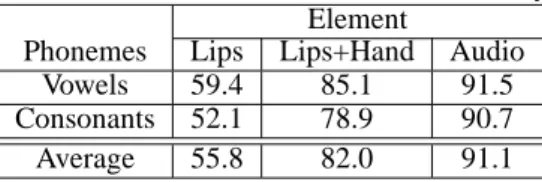
Table 4 shows the obtained results for the overall vowel recognition using a common HMM set. Compared with us-ing lip shape parameters alone, when fusion was applied a 63.3% relative improvement was obtained. It is also shown, that results of vowel recognition in Cued Speech and those obtained using the acoustic signal do not show significant differences.
3.3 Consonant recognition based on concatenative fea-ture fusion
In this section, experiments for consonant recognition in French Cued Speech are introduced. Using concatenative feature fusion, lip shape element was integrated with hand shape element, and consonant recognition was conducted. For hand shape modeling the xy coordinates of fingers were used along with the first and second derivatives. In total 30 parameters were used for hand shape modeling.
In a way similar to vowel recognition, the consonants were classified into groups based on lip shape similarities, and separate HMM sets were trained. Five HMM sets were trained corresponding to the five consonant groups. Table 5 shows the obtained results. It can be seen, that using lip shape and hand shape information, significant improvements in ac-curacy were obtained compared with using lip shape param-eters only. More specifically, a 65.2% relative improvement was obtained when hand shape element was also used. Table 5 also shows the results obtained when using the acoustic sig-nal. It can be seen, that accuracies obtained using the acous-tic signal are higher. A possible reason might be the errors occurred in hand shape recognition. However, results are still comparable and promising also in consonant recognition in Cued Speech for French.
Table 4 shows the obtained overall results for consonant recognition. It is shown, that compared with using lip shape parameters alone, when fusion was applied a 56% relative improvement was obtained.
3.4 Isolated word recognition based on concatenative feature fusion
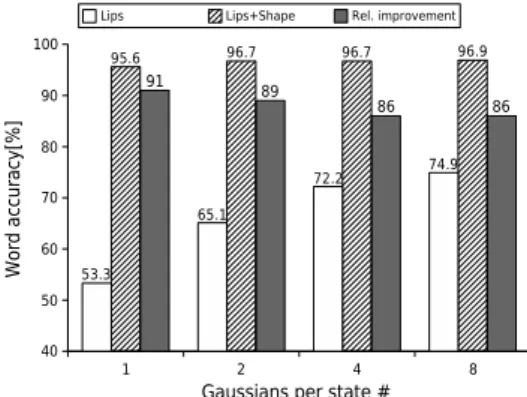
In this section, isolated word recognition experiments in Cued Speech for French are presented. Fig. 3 shows the results obtained in the function of several mixtures of Gaus-sians per state. In the case of a single Gaussian per state, using lip shape alone a 53.3% word accuracy was obtained. When, however, hand shape information was also used, a 95.6% word accuracy was obtained, showing a 91% rela-tive improvement. The highest word accuracy when using lip shape was 74.9%, obtained in the case of using 8
Gaus-Figure 3: Word accuracy for isolated word recognition.
Figure 4: Word accuracy for isolated word recognition in the function of acoustic noise.
sians per state. In that case, the Cued Speech word accuracy using also hand information was 96.9%.
Fig. 4 shows a comparison between audio recogni-tion and Cued Speech recognirecogni-tion in the funcrecogni-tion of sev-eral Signal-to-Noise (SNR) levels of acoustic noise. Office noise at different levels was superimposed onto clean test au-dio data and recognition experiments were conducted using clean HMMs. For the analysis of the audio signal, 12 MFCC along with the first and second derivatives were used. Each state was modeled with 8 Gaussian mixtures. It is shown, that up to 30 dB SNR, the Cued Speech recognition performs better compared with the audio recognition. The maximum word accuracy of audio recognition was 98% in the clean case, slightly higher compared with the 96.9% word accu-racy of the Cued Speech recognition.
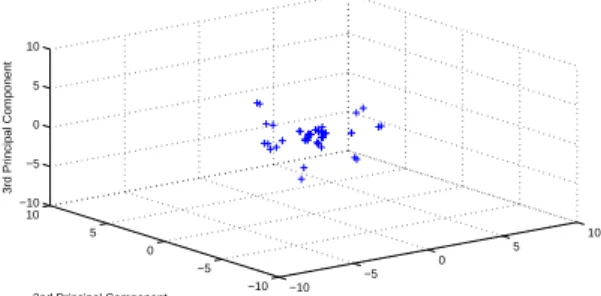
To show the effect of integrating hand information in iso-lated word recognition, PCA analysis was performed using the means of the fourth state of each word-HMM. Fig. 5 shows a visualization of the words in the 3-D PCA space us-ing lip shape alone, and Fig. 6 shows the visualization of the same words when hand shape was also integrated. It can be seen, that using also hand information the words are much better discriminated. As a result, the word accuracy was sig-nificantly increased.
−10 −5 0 5 10 −10 −5 0 5 10 −10 −5 0 5 10 1st Principal Component 2nd Principal Component 3rd Principal Component
Figure 5: Location of the words in the 3-D PCA space when using lip shape parameters
−10 −5 0 5 10 −10 −5 0 5 10 −10 −5 0 5 10 1st Principal Component 2nd Principal Component 3rd Principal Component
Figure 6: Location of the words in the 3-D PCA space when using fused lip shape and hand shape parameters
4. CONCLUSION
In this paper, vowel, consonant, and isolated word recogni-tion in Cued Speech for French was presented in order to investigate an alternative speech communication method for individuals with speech- or hearing impairments. Using con-catenative feature fusion, lip shape and hand information was integrated and automatic recognition experiments were con-ducted with very promising accuracies. The final aim of this study is to automatically recognize Cued Speech for French using visual information alone, and then convert it to a differ-ent modalities enabling human-human and human-machine interaction for people with disorders using their existing abil-ities. Currently, collection of additional data is in progress in order to realize automatic recognition for continuous Cued Speech recognition using larger vocabularies.
5. ACKNOWLEDGMENTS
The authors would like to thank Ch. Savariaux and C. Vilain for their help in the Cued Speech material recordings. Also many thanks to S. Chevalier and M. Dibui, our cuers, for having accepted the recording constraints.
REFERENCES
[1] P. Heracleous, Y. Nakajima, A. Lee, H. Saruwatari, and K. Shikano, “Non-audible murmur (nam) recognition using a stethoscopic nam microphone,” in Proceedings
of Interspeech2004-ICSLP, pp. 1469–1472, 2004.
[2] R. O. Cornett, “Cued speech,” American Annals of the
Deaf, vol. 112, pp. 3–13, 1967.
[3] S.C. Jou, T. Schultz, M. Walliczek, F. Kraft, and A. Waibel, “Towards continuous speech recognition using surface electromyography,” in Proceedings of
Interspeech2006-ICSLP, pp. 573–576, 2006.
[4] P. Badin, F. Elisei, G. Bailly, and Y. Tarabalka, “An audiovisual talking head for augmented speech genera-tion: models and animations based on a real speaker’s articulatory data,” In Vth Conference on Articulated
Motion and Deformable Objects (AMDO 2008, LNCS 5098) (F.J. Perales & R.B. Fisher, Eds.), Berlin, Heidel-berg, Germany: Springer Verlag, p. 132143, 2008.
[5] T. Hueber, G. Chollet, B. Denby, G. Dreyfus, and M. Stone, “Phone recognition from ultrasound and op-tical video sequences for a silent speech interface,” in
Proceedings of Interspeech, pp. 2032–2035, 2008.
[6] B. Blankertz, G. Dornhege, M. Krauledat, K.-R. Mull-ter, V. Kunzmann, F. Losch, and G. Curio, “The berlin brain-computer interface: Eeg-based communi-cation without subject training,” English IEEE
Tran-scactions on Neural Systems and Rehabilitation Engi-neering, 2006.
[7] J. Leybaert, “Phonology acquired through the eyes and spelling in deaf children,” Journal of Experimental Child Psychology, vol. 75, pp. 291–318, 2000.
[8] D. Beautemps, L. Girin, N. Aboutabit, G. Bailly, L. Be-sacier, G. Breton, T. Burger, A. Caplier, M. A. Cathiard, D. Chene, J. Clarke, F. Elisei, O. Govokhina, V. B. Le, M. Marthouret, S. Mancini, Y. Mathieu, P. Perret, B. Rivet, P. Sacher, C. Savariaux, S. Schmerber, J. F. Serignat, M. Tribout, and S. Vidal, “Telma: Telephony for the hearing-impaired people. from models to user tests,” in Proceedings of ASSISTH’2007, pp. 201–208, 2007.
[9] G. Potamianos, C. Neti, G. Gravier, A. Garg, and A.W. Senior, “Recent advances in the automatic recognition of audiovisual speech,” in Proceedings of the IEEE, vol. 91, Issue 9, pp. 1306–1326, 2003.
[10] N. Aboutabit, D. Beautemps, and L. Besacier, “Auto-matic identification of vowels in the cued speech con-text,” in Proceedings of AVSP’07, 2007.
[11] S. Argyropoulos, D. Tzovaras, and M. G. Strintzis, “Multimodal fusion for cued speech language recog-nition,” in Proceedings of EUSIPCO, pp. 1289–1293, 2007.
[12] P. Heracleous, N. Aboutabit, and D. Beautemps, “Lip shape and hand position fusion for automatic vowel recognition in cued speech for french,” IEEE Signal
Processing Letters, 2009 (in Press).
[13] N. Aboutabit, D. Beautemps, and L. Besacier, “Lips and hand modeling for recognition of the cued speech gestures: The french vowel case,” Speech
Communica-tion, 2009, (to appear).
[14] N. Aboutabit, D. Beautemps, J. Clarke, and L. Besacier, “A hmm recognition of consonant-vowel syllabes from lip contours: the cued speech case,” in Proceedings of