HAL Id: hal-00757001
https://hal.archives-ouvertes.fr/hal-00757001
Submitted on 26 Nov 2012HAL is a multi-disciplinary open access
archive for the deposit and dissemination of sci-entific research documents, whether they are pub-lished or not. The documents may come from teaching and research institutions in France or abroad, or from public or private research centers.
L’archive ouverte pluridisciplinaire HAL, est destinée au dépôt et à la diffusion de documents scientifiques de niveau recherche, publiés ou non, émanant des établissements d’enseignement et de recherche français ou étrangers, des laboratoires publics ou privés.
Exogenous input estimation in Electronic Power
Steering (EPS) systems
Valentina Ciarla, Carlos Canudas de Wit, Franck Quaine, Violaine Cahouet
To cite this version:
Valentina Ciarla, Carlos Canudas de Wit, Franck Quaine, Violaine Cahouet. Exogenous input estima-tion in Electronic Power Steering (EPS) systems. [Research Report] GIPSA-lab. 2011. �hal-00757001�
Exogenous input estimation in Electronic Power
Steering (EPS) systems
V. Ciarla, C. Canudas de Wit, F. Quaine, V. Cahouet
Laboratoire d’Automatique de Grenoble GIPSA-Lab, UMR 5216, France
Abstract
This document is a working report concerning the Task 5.1 of the project VolHand 09 VTT 14 and refers to the paper [1]. This task is competence of the GipsaLab.
This report presents several aspects of modelling, observation and control towards a new generation of Electrical Power Steering(EPS) systems. In particular authors design an observer to estimate the driver applied torque (steering wheel torque) and the load torque (tire/ground contact friction). Simulation of the proposed control and observer are shown at the end of the document.
Contents
1 Introduction 3
2 Extended state-space representation 3
1
Introduction
According to the document ANR 09 VTT VOLHAND Doc B, presented on October 2011, the re-search team in Gipsa-Lab is involved into the task 5.1 (T5.1) for the design of the control law to eliminate the high frequency oscillations of the steering column. To attempt to this job, the following steps have been done:
1. The study of a mechanical model of the Electronic Power Steering (EPS) system and design of an LQR regulator to reject the typical oscillations, due to the torsion of the steering wheel. 2. The design of an estimation of the full set of state variables as well as of the exogenous torques
is carried out (Paragraph2)
3. Modelling of the tyre/road contact friction, in order to test the mathematical model uder the most realistic conditions.
4. Study of the amplification curves, in order to provide the correct steering assistance to the driver.
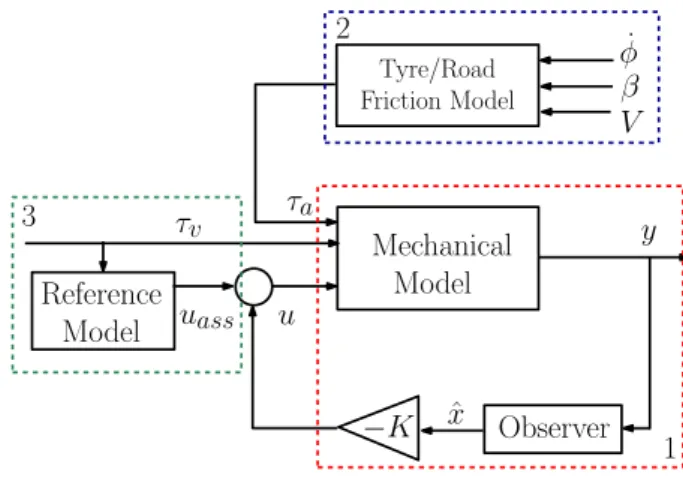
The general architecture that authors propose to study the EPS system is shown in Figure1. This report concerns the block 1 (observer/control) to estimate the driver’s and load torque.
Mechanical Model Tyre/Road Friction Model Reference Model ˙φ β V τv τa Observer −K xˆ y uass 3 2 1 u
Figure 1: General architecture of the EPS system: block 1 concerns the observer and the control; block 2 includes the tyre-friction model and block 3 includes the reference model.
2
Extended state-space representation
Let consider that both exogenous torques are slowly time-varying: ˙τa = ˙τv ≈ 0. The extended
state-space representation of the EPS system, shown in [1], with z is now defined as follows: ˜
z = ˙θv, ˙θs, θv− θs, τv, τaT (1)
in which both exogenous torques are added as state variables, is give by ˙
˜
z = ˜Ae˜z + ˜Beu (2)
The state matrices for this system are shown below:
˜ Ae= A G O 2×3 O2×2 ; B˜e= B 0 0 ; Ce= C 0 0 (3)
If only the motor velocity ˙θs is used as a available output, then the observability matrix for this new
extended system has rank 4 in spite of dealing with a system of dimension 5. To avoid this problem, it is possible to measure a second signal: the torsion force,
y2= k(θv− θs) = k x3 (4)
In this case, the output matrix Ceof the extended system becomes:
˜ Ce= 0 1 0 0 0 0 0 k 0 0 . (5)
Computing the new resulting observability matrix, it can be easily check that it has now full rank. The system is then observable and it is concluded that both exogenous torques can be correctly estimated. The poles of the observer’s dynamic (matrix ˜Ae− LeC˜e) should be fast enough compared
to those resulting from the linear controller.
The performances of the observer have been tested in simulations. The results obtained for the estimation of τv and τaare shown in Fig.2(a)and Fig.2(b). The maximum value reached by the observation error can be reduced at the price of increasing the observer gain. Measurement noise will limit at certain point the maximum possible value of the observer gain.
0 5 10 15 20 25 30 −1.5 −1 −0.5 0 0.5 1 1.5 Time (s) Driver’s torque (Nm)
Real driver’s torque Estimated driver’s torque
0 5 10 15 20 25 30 −50 −40 −30 −20 −10 0 10 20 30 40 50 Time (s) Load torque (Nm)
Real load torque Estimated load torque
Figure 2: (a) Real driver’s torque (solid) vs. estimated driver’s torque (dotted). (b) Real load torque (solid) vs. estimated load torque (dotted).
3
Conclusions
This document presented simulation results of a satisfactory estimator of the exogenous torques acting on the EPS system.
References
[1] J. Illàn, V. Ciarla, and C. Canudas de Wit, Oscillation annealing and driver/tire load torque
esti-mation in electric power steering systems, in Control Applications (CCA), 2011 IEEE International Conference on, pp. 1100â˘A¸S1105, Sept. 2011.
[2] C. Canudas de Wit, S. Guégan, and A. Richard "Control design for an electro power steering
system: part I The reference model", ECCŠ2001, European Control Conference, Porto(Portugal), septembre 2001 (invited)
[3] C. Canudas de Wit, S. Guégan, and A. Richard "Control design for an electro power steering
system: part II The control design", ECCŠ2001, European Control Conference, Porto(Portugal), septembre 2001 (invited)
[4] E. Velenis, P. Tsiotras, C. Canudas de Wit and M. Sorine "Dynamic Tire Friction Models for
Com-bined Longitudinal and Lateral Vehicle Motion", Vehicle System Dynamics, Volume 43, Issue 1 January 2005
[5] C. Canudas de Wit, P. Tsiotras, E. Velenis, M. Basset, and G. Gissinger, "Dynamic friction models
for road/tire longitudinal interaction", Vehicle System Dynamics, vol. 39, no. 3, pp. 189 to 226, 2003