Publisher’s version / Version de l'éditeur:
Vous avez des questions? Nous pouvons vous aider. Pour communiquer directement avec un auteur, consultez la première page de la revue dans laquelle son article a été publié afin de trouver ses coordonnées. Si vous n’arrivez pas à les repérer, communiquez avec nous à [email protected].
Questions? Contact the NRC Publications Archive team at
[email protected]. If you wish to email the authors directly, please see the first page of the publication for their contact information.
https://publications-cnrc.canada.ca/fra/droits
L’accès à ce site Web et l’utilisation de son contenu sont assujettis aux conditions présentées dans le site LISEZ CES CONDITIONS ATTENTIVEMENT AVANT D’UTILISER CE SITE WEB.
11th International Conference on the Durability of Building Materials and
Components [Proceedings], pp. 1-9, 2008-05-11
READ THESE TERMS AND CONDITIONS CAREFULLY BEFORE USING THIS WEBSITE.
https://nrc-publications.canada.ca/eng/copyright
NRC Publications Archive Record / Notice des Archives des publications du CNRC :
https://nrc-publications.canada.ca/eng/view/object/?id=98383290-8749-4d0a-8755-800128746c4c https://publications-cnrc.canada.ca/fra/voir/objet/?id=98383290-8749-4d0a-8755-800128746c4c
NRC Publications Archive
Archives des publications du CNRC
This publication could be one of several versions: author’s original, accepted manuscript or the publisher’s version. / La version de cette publication peut être l’une des suivantes : la version prépublication de l’auteur, la version acceptée du manuscrit ou la version de l’éditeur.
Access and use of this website and the material on it are subject to the Terms and Conditions set forth at
A GIS-based framework for the evaluation of building façade
performance and maintenance prioritization
http://irc.nrc-cnrc.gc.ca
A GI S-ba se d fra m e w ork for t he e va lua t ion of building fa ç a de
pe rform a nc e a nd m a int e na nc e priorit iza t ion
N R C C - 5 1 1 6 9
K y l e , B . ; L a c a s s e , M . A . ; C o r n i c k , S . M . ;
A b d u l g h a n i , K . ; H i l l y , T .
M a y 1 1 , 2 0 0 8
A version of this document is published in / Une version de ce document se trouve dans:
11th International Conference on the Durability of Building Materials and
Components, Istanbul, Turkey, May 11-14, 2008, pp. 1-9,
The material in this document is covered by the provisions of the Copyright Act, by Canadian laws, policies, regulations and international agreements. Such provisions serve to identify the information source and, in specific instances, to prohibit reproduction of materials without written permission. For more information visit http://laws.justice.gc.ca/en/showtdm/cs/C-42
Les renseignements dans ce document sont protégés par la Loi sur le droit d'auteur, par les lois, les politiques et les règlements du Canada et des accords internationaux. Ces dispositions permettent d'identifier la source de l'information et, dans certains cas, d'interdire la copie de documents sans permission écrite. Pour obtenir de plus amples renseignements : http://lois.justice.gc.ca/fr/showtdm/cs/C-42
11th International Conference on Durability of Building Materials and Components Istanbul Turkey May 11-14, 2008
A GIS-Based Framework for the Evaluation of
Building Façade Performance and Maintenance Prioritization
Brian Kyle
1,
Michael A. Lacasse
2and Steven M. Cornick
2,
Denis Richard
3,
Khaled Abdulghani
2and Thibaut Hilly
2 Theme Number: T72ABSTRACT
Maintenance of building façades should be an on-going process. However, maintenance prioritization issues are often neglected due to the lack of available tools to assess susceptibility to deterioration. Key components of the façade system most in need of maintenance interventions ought to be identified to prevent premature failure of façade components, to sustain the health and safety of the occupants, and to maintain the serviceability of the system over its service life. The effects of moisture and other climate effects on the deterioration of façade components are known. Likewise, water penetration of the façade from wind-driven rain to the interior causes damage, mould growth and degradation of thermal performance. Knowledge of the combined effects of wind, moisture and thermal loads permits determining the response of the wall, that in turn allows evaluating the hygrothermal performance, dilation at panel joints, susceptibility to water penetration, or the product of combined responses that act to deteriorate the façade system. The most severe combinations most likely to deteriorate the facade can then be determined and thus provide a basis for prioritizing maintenance programs for buildings. The process can be used to establish the risk of deterioration from climatic effects among different types of walls for a given building façade, between the level of risk among different buildings in a given climate, or for comparing the relative effects of similar facades located in different climate zones. This paper provides an overview of a project focused on developing a GIS-based framework for evaluating building façade performance and maintenance prioritization. Climate effects are discussed in relation to wall response and expected damage arising from the deterioration of façade components is given. Loss in functional performance of components is examined and the consequences of these losses are related to maintenance interventions.
KEYWORDS
building façades, building maintenance, component deterioration, GIS-based maintenance, maintenance prioritization
1. Public Works and Government Services Canada, Innovations and Solutions Directorate, Place du Portage Phase III, 11 Laurier, Gatineau, Canada K1A 0S5; Phone +1 819 956-3420; Fax +1 819 956-3400, [email protected] 2. National Research Council Canada, Institute for Research in Construction, 1200 Montreal Road, Building M20, Ottawa,
Canada K1A0R6, Phone +1 613 993 9715; Fax +1 613 954 5984; [email protected]
3. Intempco Controls, 2511 Guenette, Saint-Laurent, Canada, H4R 2E9, Phone +1 514 337 7471; Fax +1 514 337 7475; [email protected]
11DBMC International Conference on Durability of Building Materials and Components ISTANBUL, Turkey 11-14 May 2008
1 INTRODUCTION
Background
Maintenance of high and medium-rise building façades should be an on-going process. Maintenance prioritisation issues are often neglected due to the lack of available tools to assess vulnerability to climatic effects and susceptibility to deterioration. Key components of the façade system most in need of maintenance interventions ought to be identified to prevent premature catastrophic failure of any of the façade components, to sustain the health and safety of the occupants, and to maintain the serviceability of the system over its service life.
The effects of moisture and other climate parameters on the deterioration of façade components is well known; spalling of masonry caused by freeze-thaw action, spalling and degradation caused by salt migration, damage due to expansion of materials or components; loss of adhesion or rupture of jointing products from joint movement. Likewise, water penetration of the façade from wind-driven rain to the interior causes failure of interior finishes, damage to gypsum plasters, mould or mildew growth and degradation of the thermal performance of insulation.
Knowledge of the combined effects of wind, moisture and thermal loads on the façade system permits determining the response of the wall, be it metal-glass curtain walling, stone or brick masonry veneer, prefabricated concrete panel, or other types of wall assemblies. This in turn allows evaluating the response of the wall to climate loads, including the hygrothermal performance, dilation at the panel joints, susceptibility to water penetration or the product of combined responses that act to deteriorate the façade system. Hence evaluating climatic effects in combination with wall response permits establishing the most severe combinations most likely to deteriorate the facade and thus provides a basis for prioritising maintenance scenarios for high-rise buildings. It is proposed that this process can be used to establish risk of deterioration from climatic effects among the different walls for a given building façade, between the level of risk among different buildings in a given climate, or for comparing the relative effects of similar facades located in different climate zones.
Evaluating risks of deterioration of building components from climate effects on buildings in different geographical locations requires the integration of environmental loads to the location of the buildings; given the previous studies completed in this area, it was thought that this would best be achieved through the use of a Geographic Information System (GIS).
Related studies
An overview of the use of GIS in the building domain is provided in Haagenrud [2005] and in which a select number of studies are identified that served as a basis for the development of the current project. These include:
Wood-Assess [Haagenrud 1999a] and MMWood [Haagenrud 1999b; Haagenrud 2001] – These EU-projects combined European resources to develop methods and technologies for the assessment of the conservation state of wooden heritage buildings and mapping of environmental risk factors to these built assets. A condition assessment protocol was first developed and methods for continuous measurements of moisture and temperature in the microenvironment of buildings established in Wood
assess. Thereafter for the MMWood project, these methods were extended to whole buildings in which estimates of environmental exposure of wood components were determined; for example the effects driving rain were based on the European standard EN 13013-3 [pEN 1999]. A PC-based pilot version of the assessment protocol was implemented on a GIS platform that can store, integrate and further process text, pictures, maps and related data.
LIFECON [Haagenrud 2004, Hallberg 2005] – A Life cycle based Maintenance System (LMS) was developed as a generic software tool to aid the documentation, inspection and maintenance management of cultural buildings, infrastructures and the built environment. The GIS-based technology is open, object oriented and modular, can be extended to any type of built asset and includes management of component functionality during the life cycle of the asset. The LIFECON T 72 A GIS-Based Framework for the Evaluation of Building Façade Performance and Maintenance Prioritization; Brian Kyle, Michael A. Lacasse, Steven M. Cornick, Khaled Abdulghani, Thibaut Hilly
11DBMC International Conference on Durability of Building Materials and Components ISTANBUL, Turkey 11-14 May 2008
project is a specific implementation of the LMS for concrete infrastructure assets. Validation of LMS system was demonstrated by application for environmental characterisation of and performance analysis on a concrete bridge located in Fäeltskärsleden, Norway. The technology was also adapted to a municipality in Norway responsible for administering 8800 rental objects in which the system was used to document buildings information, building condition, maintenance costs, and maintenance planning and optimization information.
This paper provides an overview of a project to develop a GIS-based framework for the evaluation of façade performance and maintenance prioritisation, for high and medium-rise buildings with consideration of the likely environmental loads. A brief review of related studies and project methodology is provided, as is information on key project components, including: a Geographical Information System (GIS) based MMS interactive database for climate information, and building data; a Markovian-based, building façade maintenance management (BMM) model.
2 APPROACH
A schematic providing an overview of the approach adopted for the GIS-based assessment method as applied to building cladding systems is provided in Figure 1. Emphasis has been placed on characterising key climate variables such as moisture, thermal, wind and other loads for any given location in Canada. Evaluating climatic effects in combination with wall response provides a basis for setting maintenance priorities given that damage and deterioration can bring about loss in performance of the functional elements of the wall system. The process is used to establish risk of deterioration among the different walls for a given building façade, between the level of risk among different buildings in a given climate, or for comparing the relative effects of similar facades located in different climate zones.
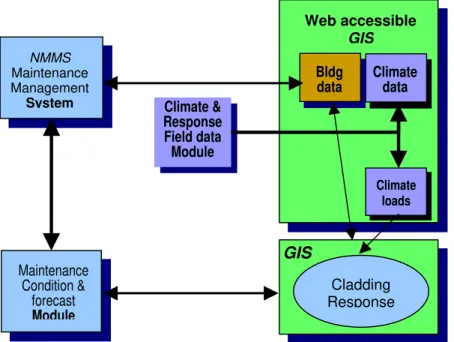
The schema for the proposed GIS-based implemenation of the building façade performance and maintenance prioritisation framework is given in Figure 2 and consists of a GIS-based interactive database for climate information and building data (described in following section), the climate response module, maintenance condition and forecast module, and the National Maintenance Management System (NMMS). The web accessible GIS provides access to building data, as derived from the NMMS, climate data, and climate loads that are derived from climate data, and the climate response and field data module. Additional information on the climate response module and the building façade maintenance condition and forecast module are provided in a subsequent section. The NMMS is administered by the Real Property Branch of Public Works and Government Services Canada and is responsible for managing over 300 buildings across Canada.
Development of the identified tools will permit building managers to rate the relative applicability of various façade systems to particular geographic locations. System and material selections that more closely tie to the expected climatic loadings will result in reduced deterioration rates and should produce heightened thermal efficiency and performance of envelope systems. The project will help designers avoid design choices that can cause adverse indoor environmental conditions by evaluating the likelihood of water penetration into facades and examining the potential for propagation of mould and mildew. The net result provides for location specific designs and selections of façade materials and insulation that result in reduced energy consumption and extend life expectations of the components and wall assemblies in service.
Façade types considered in the framework include: • Metal-glass curtain wall;
• Brick masonry veneer (stone and); and • Prefabricated masonry and concrete panel.
T 72 A GIS-Based Framework for the Evaluation of Building Façade Performance and Maintenance Prioritization; Brian Kyle, Michael A. Lacasse, Steven M. Cornick, Khaled Abdulghani, Thibaut Hilly
11DBMC International Conference on Durability of Building Materials and Components ISTANBUL, Turkey 11-14 May 2008
Figure 1 – Schematic showing sequence of cause and effects on a wall assembly and the process of risk assessment method, from: (1) characterisation of climate effects; (2) wall response; (3) damage and
deterioration; (4) performance reduction; (5) consequences; (6) risk assessment
Figure 2 - Schema of proposed GIS-based implemenation of framework for evaluation of building façade performance and maintenance prioritisation
3 DEVELOPMENT OF GIS-BASED MMS INTERACTIVE DATABASE FOR CLIMATE INFORMATION, AND BUILDING DATA
The GIS-based MMS contains performance, damage, and durability models to make probabilistic predictions of changes in the state of the cladding or estimates of the service life due to prevailing conditions or some actual or planned event, such as an extreme climate event or maintenance interventions. These performance, damage, and durability models require information. A GIS approach was selected as the means of obtaining the necessary integration of climate- and building-related information in a geographical context. The GIS system comprises a national geographic base of
Climate characterisation Wall response Damage and deterioration Loss in performance Consequence Risk assessment
• Define climate parameters relevant to specific cladding type
• Define climate loads:
• For different climate regions (macroclimate)
• In geographical context (mesoclimate)
• At building façade (microclimate)
• Hygrothermal response to ambient climatic conditions • Movement of cladding due to thermal effects
• Reduced thermal resistance
• Reduced longevity of cladding / wall components
• Incurred costs due to damage and subsequent loss in performance
• Likelihood of incurring repair costs given occurrence of damage from singular or recurring events
• Damage to cladding – spalling of concrete; freeze-thaw & efflorescence of brick masonry; expansion contraction of components; rupture or loss of adhesion to sealants
• Damage to interior from inadvertent water entry; damage to gypsum plasters; mold growth
Web accessible GIS Cladding Response NMMS Maintenance Management System Bldg data Climate data Climate & Response Field data Module Climate loads GIS Maintenance Condition & forecast Module
T 72 A GIS-Based Framework for the Evaluation of Building Façade Performance and Maintenance Prioritization; Brian Kyle, Michael A. Lacasse, Steven M. Cornick, Khaled Abdulghani, Thibaut Hilly
11DBMC International Conference on Durability of Building Materials and Components ISTANBUL, Turkey 11-14 May 2008
Canada and additional details for specific cities of interest. The system contains several databases including, but not limited to: a historical climate database, topographical data in the form of large scale topographic information for large parts of Canada and small scale data for urban areas, and database of built assets such as roads, bridges, and specifically buildings from real property databases. The web accessible GIS system integrates these several databases and provides the basic input to the cladding response models. These cladding response models feed input to the tools used for assessment and prioritization, discussed in subsequent sections. The basic architecture and relationship of the GIS portion to the rest of MMS system is illustrated in Figure 2.
The GIS data can be grouped under three general categories: climate-related data, building-related data, and physical data (e.g. topographic or hydrological data). These types of data are kept separately but the GIS is used to integrate the various databases. Only the climate-related data is discussed in this paper. The information incorporated into the GIS can be broadly categorized into two abstract types: gridded (mapped) data and point data. Point data can be essentially viewed as a tuple, the first two parts of the tuple locating the third part or element in two-dimensional space (and perhaps time). A latitude, longitude, and elevation can be considered to be a point whereas a table consisting of latitudes, longitudes, and elevations is a gridded data set. The distinction is arbitrary but useful since, for example, data regarding individual buildings or large amounts of historical weather data from a meteorological station can be considered as point data. Viewing the source of information as point data permits transforming, deriving, and exporting large of amounts of data to the cladding response models. Examples of gridded data, best viewed in a map form, are mean annual rainfall or mean wind speed.
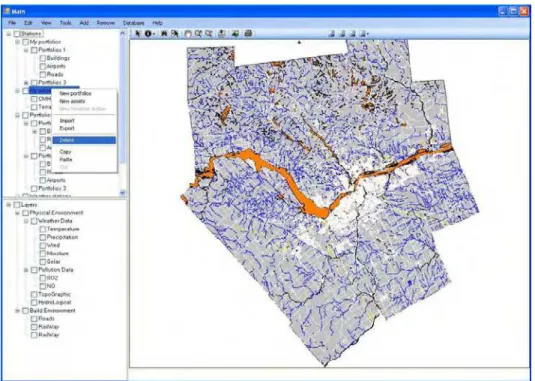
As conceived the GIS system, shown in Figure 3, has the following capabilities:
Display a map — The primary purpose of this mode is to display gridded data. In this mode, a rough appreciation of the climate loads or risks can be obtained and measures of performance, risk, or condition state can be assigned to assets within the portfolio.
Display charts/graphs/roses/reports — In map mode, specific points can be selected, for example, a single building. Additionally, specific climate data can be attached to a particular building, such as hourly weather data from nearby meteorological stations. At this level more detailed climate loads can be determined, wind-driven rain on a particular façade for example.
Export data files — This mode of interaction is similar to the “Display” mode except that in this mode data files can be created from the database and exported for use in the performance and damage assessment models described below. The GIS data can be transformed or derived from the original data or used directly.
GIS climate-related data
One of the objectives of this project is to render specific climate data in a form suitable for inclusion in either hygrothermal simulation models or damage index models. Hence, the climate is the primary information from which derivative climate parameters are developed. It also provides the basic information to determine the microclimate on a building façade. For example, given the geographical positioning of a site several scenarios are possible for determining the appropriate macro- or meso-scale data source or sources to obtain climate data that is most suited for the circumstances. i.e. use:
1. The nearest hourly meteorological station. 2. A nearby local weather station.
3. A very local station such as an instrumented building or a portable weather station. 4. A surrogate station with similar characteristics deemed appropriate.
5. Nearby stations extrapolating, interpolating or generating the required climatic information. 6. Long-term climate data (if the model can use long-term data) or interpolate, extrapolate from
long-term climate data
T 72 A GIS-Based Framework for the Evaluation of Building Façade Performance and Maintenance Prioritization; Brian Kyle, Michael A. Lacasse, Steven M. Cornick, Khaled Abdulghani, Thibaut Hilly
11DBMC International Conference on Durability of Building Materials and Components ISTANBUL, Turkey 11-14 May 2008
Figure 3 - Basic GIS-MMS interface, display in map mode.
Thus after determining the appropriate source of information for a particular building asset the weather loads can be estimated. Various types of climatic information can be generated depending on the specific cladding response model utilised. For example, hygrothermal simulation models generally equire hourly weather data spanning over several months or years; energy simulation models, hourly data from either typical years (e.g. Weather Year For Energy Calculations or Typical Meteorological Year) or weather records from meteorological or local weather observation stations; a freeze-thaw model may only require the mean number of freeze-thaw cycles per year. Other models require information such as yearly, monthly, or daily data such as daily range, monthly averages. In all cases however the type of climatic information needed is historical. The GIS-MMS system provides a seamless method for determining the required climatic data for the appropriate models.
The GIS system allows the climate data to be accessed on a variety of time-scales, annual means, for example, to hourly data at the finest useable time-scale. Finally the required local or meso-scale climate data can be reduced through ancillary or helper applications to a micro-scale. These applications, through theoretical, empirical or numerical (e.g. computational fluid dynamics) models, make use of the building-related and physical data to reduce the scale of the climate-related data to the micro-scale: i.e. to bring the weather to the façade.
4 DEVELOPMENT OF RISK-BASED ASSESSMENT AND PRIORITISATION FRAMEWORK FOR FACADE BMM
The risk-based assessment and prioritisation framework for the facade BMM is based on two modules; the:
• Cladding response module that imparts information on the effect of environmental loads (climate or interior loads) on wall assemblies or specific components of the assembly; may also provide information on deterioration or damage of specified components over time. • Building façade maintenance management (BMM) and forecast model.
Each of these is briefly described in turn.
T 72 A GIS-Based Framework for the Evaluation of Building Façade Performance and Maintenance Prioritization; Brian Kyle, Michael A. Lacasse, Steven M. Cornick, Khaled Abdulghani, Thibaut Hilly
11DBMC International Conference on Durability of Building Materials and Components ISTANBUL, Turkey 11-14 May 2008
Cladding response module
The cladding response module is comprised of several models that are either applications built on top of the GIS platform or stand-alone applications linked to the GIS. These models take input in the form of loads from the GIS and export the results to the maintenance management and forecast models. Some typical models that could be linked to the GIS include:
• Hygrothermal simulation (e.g. 1-D hygIRC [Cornick 2003])
• Energy simulation (e.g. DOE-2 Building energy analysis program [Mukhopadhyay 2006] • Masonry freeze-thaw index [Mukhopadhyaya 2005]
• Scheffer’s climate index for wood decay [Scheffer1971] • Atmospheric corrosion models for metals [Roberge et al 2002] • Masonry brick metal tie corrosion [Hegel and Lissel 2005] • Jointing product (sealant) durability model [Lacasse et al. 2002] Building façade maintenance management (BMM) and forecast model
The Markovian-based, building façade maintenance management (BMM) model permits the optimization of maintenance planning, and introduces software that permits a user to initiate building maintenance actions. The intent was to provide building managers who are faced with having to maintain their buildings assets more efficiently, with a tool that could reduce the short and long-term costs of maintenance and rehabilitation. In essence, the BMM software can either optimize maintenance planning actions based on an expected maintenance budget or determine the budget required to maintain the façade to a minimum acceptable level of performance.
A schematic of the primary components of the software is given in Figure 4; details in respect to the Markovian approach to façade maintenance management are given in Lacasse et al. [2008]. The façade was first considered in development of the BMM software given that it is a significant element of the building envelope and of the building itself.
Figure 4 - Schematic key project components of BMM model [Lacasse et al 2008]
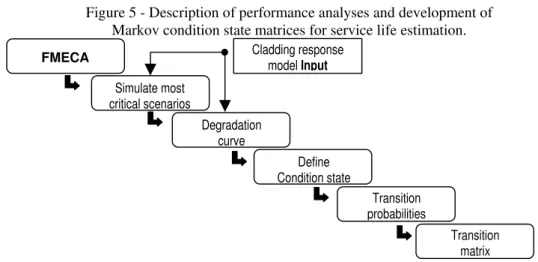
The BMM model is built on several parts, however one of the key components is Failure Mode Effects and Criticality Analysis (FMECA) and performance analysis of the façade and related components; the several steps of this process are provided in Figure 5 [Lacasse et al 2008]. The first step consists of developing a façade component criticality index that is based on outcomes of a FMECA. This permits determining the relative importance assigned amongst the different façade components, as proposed by [Talon 2006]. The basis for determining component criticality is described in more detail in Lacasse et al [2008].
Given that building managers do not necessarily dispose of unlimited budgets for maintenance actions, only the most critical set of components are further analyzed by simulation of the deterioration process. These simulations provide degradation curves of the change in condition state of façade components as a function of time. The different condition states are then defined ensuring that it is possible to observe these conditions during an inspection. The condition state matrix provides information on the likelihood of a component remaining or changing state at given inspection
Selection of façade type (of 3)
GIS data Local conditions
FMECA performance analysis
Maintenance analysis Cost matrix + maintenance actions Maintenance
Planning
Maintenance Optimisation
Markovian maintenance management
Cladding response model Input
T 72 A GIS-Based Framework for the Evaluation of Building Façade Performance and Maintenance Prioritization; Brian Kyle, Michael A. Lacasse, Steven M. Cornick, Khaled Abdulghani, Thibaut Hilly
11DBMC International Conference on Durability of Building Materials and Components ISTANBUL, Turkey 11-14 May 2008
T 72 A GIS-Based Framework for the Evaluation of Building Façade Performance and Maintenance Prioritization; Brian Kyle, Michael A. Lacasse, Steven M. Cornick, Khaled Abdulghani, Thibaut Hilly
intervals. Thereafter, the transition probabilities that correspond to the different sates are deduced that in turn permits obtaining the transition matrix. Such a matrix permits estimating the service life of components, or assembly of components, through an analysis using the Markovian model.
Figure 5 - Description of performance analyses and development of Markov condition state matrices for service life estimation.
Cladding response model Input FMECA
5 SUMMARY
An overview is provided of a project focused on developing a GIS-based framework for the evaluation of building façade performance and maintenance prioritization. Climate effects are discussed in relation to wall response and expected damage arising from the deterioration of façade components is given. Loss in functional performance of components is examined and the consequences of these losses are related to risk as measured in terms of potential cost of maintenance interventions.
ACKNOWLEDGEMENTS
The authors are indebted to the Program of Energy Research and Development (PERD), part of the Office of Energy Research and Development, together with their respective organisations for funding of this project. Additionally, the authors would like to thank other contributors to this effort in particular, Mr. Denis Richard, Principal, Intempco Controls, and those from the GIS directorate of PWGSC, CMHC and NRCan who supported this project.
REFERENCES
Haagenrud, S.E., Cole, I.S., Sjöström, C. & Esposito, M.A. (2005), 'CIB W106 Geographical Information Systems - final report', Proc. 10DBMC: Int. Conf. on Durability of Building Materials & Components, Lyon, France, 17-20 April 2005, Paper TT9-194
Haagenrud, S., Veit, J., Eriksson, B., Henriksen, J. F. and Krigsvoll, G., (1999), ‘System and Methods for Assessing Conservation State and Environmental Risks for Outer Wooden Parts of Cultural Buildings’ (acronym: Wood-Assess), Final Report, EU-project ENV4-CT95-0110
Haagenrud, S. E.; Eriksson, B.; Sjöström, C.; Skancke, T. (1999), “PC/GIS based system for maintenance management of wooden buildings – MMWOOD”, Eighth International Conference on Durability of Building Materials and Components, 8dbmc; Vancouver; Canada; 30 May-3 June 1999. pp. 1602-1614. 1999
Haagenrud, S., Stordahl, P., Eriksson, B., Riks, E., Krigsvoll, G. and Garofolo, I., (2001), ‘System for Maintenance Management of Historic (Wooden) Buildings’ (acronym: MMWood), Final report, EU-Project ENV4-CT98-0796
prEN 13013-3 'Calculation of driving rain index for vertical surfaces from hourly wind and rain data'
Haagenrud, S.E., Krigsvoll, G., Gussiås, A., Sjöström C. and Hallberg, D. (2004), “Life Cycle Management of built Environment-an ICT based concept and some cases, CIB world congress, Toronto, April 2004. Hallberg, D. (2005) Development and Adaptation of a Life Cycle Management System for Constructed Works,
Licentiate Thesis, Oct. 2005, KTH Research School – HIG, Centre for Built Environment, Univ. of Gävle, SE Transition matrix Transition probabilities Simulate most critical scenarios Degradation curve Define Condition state
11DBMC International Conference on Durability of Building Materials and Components ISTANBUL, Turkey 11-14 May 2008
T 72 A GIS-Based Framework for the Evaluation of Building Façade Performance and Maintenance Prioritization; Brian Kyle, Michael A. Lacasse, Steven M. Cornick, Khaled Abdulghani, Thibaut Hilly
Cornick, S.M.; Maref, W.; Abdulghani, K.; van Reenen, D. (2003), "1-D hygIRC: a simulation tool for
modeling heat, air and moisture movement in exterior walls", Building Science Insight 2003 Seminar Series (15 Cities across Canada, October 07, 2003), pp. 1-10, October 01, 2003 (NRCC-46896) Hegel, M.D. and Lissel S. L., (2005), “Empirical Vs. Theoretical Service Life for Wall Ties in Brick Veneer
Steel Stud Wall Systems”, 10th Canadian Masonry Symposium, Banff, Alberta, June 8 – 12, 2005 Lacasse, M.A.; Cornick, S.M.; Shephard, N. (2002), "Estimating the service life of jointing products and
systems - application of a crack growth model to different climates," 9th International Conference on Building Materials and Components (Brisbane, Australia, March 17, 2002), pp. 1-11, March 01, 2002 (NRCC-45362)
Lacasse, M. A., Kyle, B., Talon,A., Boissier, D., Hilly, T., Abdulghani, K. (2008), “Optimization of the Building Maintenance Management Process Using a Markovian Model”, in: Proceedings of the 11th International Conference on Durability of Building Material and Components, 11-14 May, Istanbul, Istanbul Technical University, Turkey.
Mukhopadhyay, J. and Haberl, J. S. (2006), “Performance of High-Performance Glazing in IECC Compliant Building Simulation Model (DOE-2)” Energy Systems Laboratory (Texas Engineering Experiment Station, Texas A&M University), Proceedings of the SimBuild 2006 Conference (MIT, Cambridge, MA, August 2-4, 2006)
Mukhopadhyaya, P.; Kumaran, M.K.; Nofal, M.; Tariku, F.; van Reenen, D. (2005), "Assessment of building retrofit options using hygrothermal analysis tool", 7th Symposium on Building Physics in the Nordic Countries (Reykjavik, Iceland, June 13, 2005), pp. 1139-1146, June 01, 2005 (NRCC-47742) Roberge P.R., Klassen, R. D., Haberecht, P.W. (2002), “Atmospheric corrosivity modeling - a review”,
Materials and Design Vol. 23: 321-330
Scheffer, T.C. (1971), “A climate index for estimating potential for decay in wood structures above ground”, Forest Products Journal Vol. 21(10): 25–31
![Figure 4 - Schematic key project components of BMM model [Lacasse et al 2008]](https://thumb-eu.123doks.com/thumbv2/123doknet/14164985.473728/9.892.149.726.655.856/figure-schematic-key-project-components-bmm-model-lacasse.webp)