MIT LIBRARIES
3 9080 02618 3548
ttto
*
/
\
*
LIBRARIES
Digitized
by
the
Internet
Archive
in
2011
with
funding
from
Boston
Library
Consortium
Member
Libraries
HB31
/j-..M415
i*^t%\
4-5
2.oo5>
Massachusetts
Institute
of
Technology
Department
of
Economics
Working
Paper
Series
ANNUITIES
AND
INDIVIDUAL
WELFARE
Thomas
Davidoff
Jeffrey
Brown
Peter
Diamond
Working
Paper
03-1
5
May
7,2003
Revised:
March
17,2005
Room
E52-251
50
Memorial
Drive
Cambridge,
MA
021
42
This
paper can
be
downloaded
without
charge from
the
Social
Science
Research Network Paper
Collection atMASSACHUSETTS
INSTITUTE OFTECHNOLOGY
APR
2 6AW5
Annuities
and
Individual
Welfare
March
17,2005
Abstract: Advancing annuity demandtheory,wepresentsufficientconditions forthe optimalityoffull
annuiti-zationundermarket completenessthat are substantiallylessrestrictivethanthoseusedbyYaari (1965).
We
examine demand withmarket incompleteness, finding that positive annuitization remains optimalwidely, but complete an-nuitization doesnot.How
uninsured medical expensesaffect demandfor illiquidannuitiesdepends critically onthe timingoftherisk.A
newset ofcalculationswith optimalconsumptiontrajectoriesverydifferent fromavailableannu-ity income streamsstillshowsa preferencefor considerable annuitization,suggesting that limited annuity purchases are plausiblydueto psychologicalor behavioralbiases. (JEL Dll,D91, E21, H55, J14, J26)
Since the seminal contribution ofYaari (1965)
on
the theory ofa life-cycleconsumer
with anunknown
date ofdeath, annuities have played a central role in economic theory. His widely citedresultisthatcertainconsumersshouldfullyannuitizealloftheirsavings. However, theseconsumers were
assumed
tosatisfy severalveryrestrictiveassumptions: theywerevon
Neumann-Morgenstern
expected utilitymaximizers withintertemporally separableutility, they faced no uncertainty other than time of death, they
had no
bequest motive,and
the annuities available for purchase were actuariallyfair. While thesubsequent literatureon annuitieshas occasionally relaxed one ortwo ofthese assumptions, the "industry standard" is to maintain
most
ofthese conditions. In particular,theliterature has universally retainedexpected utility and additive separability, the latter
dubbed
"not a very
happy
assumption" byYaari.While
Yaari (1965)and
Bernheim
(1987a,1987b) provideintuitive explanations of
why
the Yaari resultmay
notdepend on
these strict assumptions, thegenerality ofthisresult has not been formally
shown
in theliterature.The
first contribution of this paper isto present sufficient conditions substantiallyweaker thanthose imposed by Yaari under which full annuitization is optimal.
The
heart of theargument
can be seen by comparing a one- year
bank
certificate of deposit (CD), paying an interest rate rto a security that pays a higher interest rate at the end of the year conditional
on
living, but pays nothing if you die before year-end. If you attach no value to wealth after death, then the second, annuitized, alternative is a dominant asset. This simplecomparison ofotherwise matchingassets,
when
articulated in a setting that confirms its relevance, lies behind the Yaari result.The
dominance
comparison ofmatching assets is not sensitive to their financial details, but does relyon theidentical liquidity inthe annuitized and non-annuitized assets.
This paper explores the implications of this comparison forasset
demand
in different settings,including both
Arrow-Debreu
complete marketsand
incomplete market settings. In theArrow-Debreu
complete market setting, sufficient conditions for full annuitizationto be optimal are that consumers havenobequestmotiveand
thatannuitiespayarate ofreturntosurvivinginvestors, netofadministrative costs, that is greaterthanthe return
on
conventional assetsofmatchingfinancial risk. Thus,when
marketsarecomplete, fullannuitization isoptimalwithout assumingexponential discounting, the expected utility axioms, intertemporal separability, or actuarially fair annuities.We
also relate thesizeof the welfare gain tothe trajectory ofoptimal consumption.A
second contribution is toexamine
annuitydemand
insome
incomplete market settings. Ifsome
desired consumption paths are not availablewhen
all wealth is annuitized in an incomplete annuity market, full annuitizationmay
no longerbe optimal. For example, ifan individualdesiresasteeply
downward
slopingconsumptionpath, butonly constant real annuities are available, thenfull annuitization is no longer optimal. Thus,
we
explore conditions for theoptimum
to includepartial annuitization.
We
also consider partial annuitization with a bequest motive.Another example involves the relative liquidity of annuities
and bonds
inthe absence of insur-ance for medicalexpenditure shocks.The
effect on annuitydemand
depends on thetiming oftherisk.
An
uninsurablerisk early inlifemay
reduce the valueofannuities if itisnot possibletosellor borrowagainst futurepayments
ofthe fixed annuitystream but it is possible to do sowithbonds.Incontrast, loss of insurabilityofa shockoccurring later in life
may
increase annuitypurchases asa substitute for medical insurance that has an inherent annuity character. Thus, an annuity can be a bettersubstitute than a
bond
for long-termcare insurance.Most
practical questions about annuitization (e.g., the appropriate role ofannuities in public pension systems) are concerned with partial annuitization.The
general theory itselfis insufficient to answer questions about the optimal fraction of annuitized wealth, and thus a large simulationliteraturehas developed.
Our
third contribution is to extend the simulation literature by creating anew
"stresstest" ofannuityvaluation.We
dosoby
generatingoptimal consumption trajectoriesthat differ substantially from
what
is offered by a fixed real annuity contract, and showing that evenunder these highlyunfavorable conditions, themajorityofwealthis stilloptimallyannuitized.allowa person'sutility to
depend on
how
present consumption compares to astandardof livingto which the individual hasbecome
accustomed, which is itselfa function ofpast consumption.We
model
this "internal habit" as inDiamond
and Mirrlees (2000).1These results imply that annuities are quite valuable to utility maximizing consumers, even under conditions that result in a very unfavorable
mismatch
between available annuity income streamsand
one's desired consumption path. Thus, while incomplete markets,when
combined
with preferences for consumption paths that deviate substantially from those offered by current annuityproducts, can certainly explain the lack offull annuitization, it is difficult to explain the near universal lack of any annuitization outside of Social Security
and
defined benefit pensionsplans, at least at the higher end ofthe wealth distribution
where
SocialSecurity is a small part ofone'sportfolio
and
SSI is not relevant. This findingis strongly reminiscent oftheliterature on lifeinsurance, which is a closelyrelated product.2
The
literatureon
life insurance hasdocumented
asevere
mismatch
betweenlife insurance holdings ofmost
householdsand
their underlying financial vulnerabilities (see e.g. Bernheim, Forni, Gokhaleand
Kotlikoff (2003);Auerbach and
Kotlikoff(1987),
Auerbach and
Kotlikoff (1991)). Thesepapers, takentogether, are suggestiveofpsycholog-ical or behavioral considerations at play in the market for life-contingent products that have not
yet beenincorporated intostandard economicmodels.
The
focus of the paper is on the properties of annuitydemand
in different market settings.We
do not address themore
complex equilibrium question ofwhat
determines the set ofannuityproducts in the market. In light of the value of annuities to consumers in standard models,
we
think examination of equilibrium would have to include the supply response to
demand
behavior that is not consistent with standard utility maximization.We
do not develop such a behavioral theory ofannuitydemand,
but ratherclarifythemismatch between
observeddemand
behaviorand
the value ofannuitizationin astandard utility maximizationsetting.
The
paper proceeds as follows: In section I,we
provide a general set of sufficient conditions under which full annuitization is optimal under complete markets. Section II discusses ofwhy
1
DifTerent models ofintertemporaldependencein utility arcdiscussed in, forexample, Dusenberry (1949), Abel
(1990), Constantinides (1990), Deaton (1991), Campbell and Cochrane (1999), Campbell (2002) and Gomes and
Michaelides (2003).
"AsdiscussedbyYaari (1965) and Bernheim (1991), thepurchaseofapurelifeinsurance policycan be viewed as
full annuitization
may
no
longerbe optimal with incomplete markets, payingparticular attention to the role of illiquidity of annuities. Section III briefly discusses a bequest motive. In SectionIV
we
report simulation results reflecting the quantitative importance of market incompletenesswith habit formation, showing that even
when
the liquidity constraints on annuities are binding,individuals still prefer a high levelofannuitization. Section
V
concludes.I.
Complete Markets
Much
ofthe focus ofthe annuities literature has been an attempt to reconcileYaari's (1965) "fullannuitization" result with the empirical fact that few people voluntarily annuitize any of their private savings.3 This issue is of theoretical interest because it bears
upon
the issue ofhow
tomodel
consumer behavior in the presence of uncertainty. It is also of policy interest because ofthe shift in the
US
from
defined benefit plans, which typically pay out as an annuity, to defined contribution plans that rarely offer retirees directlythe opportunity to annuitize. Annuitization isalsoimportant in the debate about publiclyprovided defined contribution plans.
Thissection derivesa generalsetofconditionsunderwhichfullannuitizationisoptimal, relaxing
many
ofthe assumptions in the original Yaari formulation.We
begin with a simpletwo
periodmodel, and then
show
formally the generalization tomany
periods andmany
states.A. The Optimality ofFull Annuitization in a
Two
PeriodModel
withNo
Aggregate UncertaintyAnalysis ofintertemporal choiceis greatly simplifiedifresource allocationdecisions are
made
com-pletely and all at once, that is, without additional, later trades.
Consumers
will be willing tocommit
to a fixed plan of expenditures if, at thestart oftime, theyare able to trade goods acrossall time and allstates of nature, as is standard in the complete market
Arrow-Debreu
model. Yaari considered annuitizationina continuous time settingwhere consumers areuncertain only about the dateofdeath.Some
results, however, canbe seenmore
simplyby dividingtime intotwo discrete periods: the present, period 1,when
theconsumer
is definitely aliveand
period 2,when
3
This assertion is consistent with the large market forwhat are called variable annuities since these insurance
products do not include a commitment to annuitize accumulations, nor does there appear to be much voluntary annuitization. SeeforexampleBrown andWarshawsky (2001).
the
consumer
is alive with probability 1-
q.4By
wiltingU
=
U(ci,C2),we
allow for a very general formulation of utility in a two-periodsetting with the assumptions that there is no bequest motive
and
that only survival to period 2 isuncertain. Lifetimeutilityisdefined overfirstperiodconsumption, c\,
and
consumptioninthe eventthat the
consumer
is alive in period 2, C2-We
drop the requirement ofintertemporal separability,allowing for the possibility that the utility from second-period consumption
may
depend
on thelevel offirst period consumption. Additionally, thisformulation does not require that preferences
satisfy the axioms for
U
to be an expected value.The
optimal consumption decisionand
the welfare evaluation of annuities can be determinedusing a dual approach: minimizing expenditures subject to attaining at least a given level of
utility.
We
measure
expenditures in units offirst period consumption.Assume
that there aretwosecurities available.
The
first is abond
that returnsRb
units ofconsumption inperiod 2, whetherthe
consumer
is alive or not, in exchange for each unit ofthe consumptiongood
in period 1.The
secondis an annuity that returns
Ra
in period 2 iftheconsumer
is aliveand
nothingotherwise.An
actuariallyfair annuitywould
yieldRa
=
i?s/(l—
g). Adverseselectionand
highertransac-tion costs forpaying annuities thanforpaying
bonds
may
drive returns belowthis level. However, because anyconsumer
will haveapositiveprobability ofdyingbetweennow
and
anyfutureperiod,therebyrelieving borrowers' obligation,
we make
theweak
assumption thatRa >
Rb-
5If
we
denoteby
A
savings in theform ofannuitiesand by
B
savings in the formofbonds,and
if there is no other income in period 2 (e.g., the individual is retired), then C2= RaA +
RbB,
and expenditures for lifetime consumption are simply
E
=
ci+ A +
B. Thus, the expenditureminimization problem can be written as:
min
ci+A +
BsX.U(cx,R
A
A
+
R
B
B)>U.
(1) cx,A,BWe
further imposethe constraint thatB
>
0, i.e., that the individual not be permitted to dieindebt. Otherwise with
Ra >
Rb,
purchasing annuitiesand
sellingbonds
in equalnumbers
wouldA
two period model with asingleconsumergood ineach datedevent precludes tradeafter thefirst period, butin a complete marketsetting,thisis irrelevant.
5
That
Rb
< Ra <
Rb/(1 —<?) is supported empirically by Mitchell et al (1999). If the first inequality werecost nothing
and
yieldpositiveconsumptionwhen
alive inperiod2,but leavea debtifdead, leavinglenders with expected financial losses in total.
This setup leads immediately to the optimality of full annuitization. If
B
>
0, then one isable to reduceexpenditures, whileholding the consumption vector fixed,
by
sellingRa/Rb
ofthebond and
purchasing one unit ofthe annuity (noting thatR& >
Rb)- Thus, the solution to thisexpenditureminimizationproblemisto set
B
=
0,i.e.,toannuitize one'swealthfully.The
intuitionis that allowing individuals to substitute annuities for conventional assets yields an arbitrage-like
gain
when
the individual placesno
valueon
wealthwhen
not alive.Such
a gain enhances welfare independentofassumptions aboutpreferencesbeyond
thelackofutility froma bequest.Nor must
annuities beactuariallyfair. Indeed, all thatisrequiredis forconsumerstohave
no
bequestmotive and forthe payouts from theannuity to exceed that ofconventional assets forthe survivor.Equation (1) alsoindicates an approachtoevaluatingthe gainfrom
an
increasedopportunityto annuitize. Consider theminimization underthe further constraintofanupperbound
on purchasesof annuities,
A
<
A
.We
know
that utility-maximizing consumers will take advantage of anarbitrage-like opportunity to annuitize as long as
bond
holdings are positiveand
can therefore be used tofinancethe purchase.With
no annuitiesavailable,bond
holdingswill be positiveifsecond-period consumption is positive, as is ensured
by
the plausible condition that zero consumption isextremely bad:
ASSUMPTION
1:limCt-+o
dU/dct
—
oo : t—
1,2
Allowingconsumerspreviously unableto annuitize anywealth to place a small
amount
of theirsavings into annuities (increasing
A
fromzero) leaves secondperiodconsumptionunchanged
(sincethe cost of the marginal second-period consumption is unchanged, so too, is the optimal level of consumption in bothperiods).
Thus
a small increase inA
from zeroreduces the cost of achievinga givenlevel ofutility by 1
—
(Ra)/{Rb)
<
0. This isthe welfaregain fromincreasing thelimit on available annuities foran optimizingconsumer
with positivebond
holdings.6Iftheupper
bound
constrainton availableannuitiesislargeenough
thatbond
holdingsarezero,thenthepriceofmarginalsecond period consumption (uptoA) fallsfrom 1/(Rb) to \/{Ra).
With
a fallinthecost ofmarginalsecond-period consumption, its
compensated
level will rise.Thus
the welfare gain from unlimited annuity availability ismade
up
oftwo parts.One
part is the savings while financing thesame
consumption bundle aswhen
there is no annuitization,and
the secondis the savings from adapting the consumption bundle to the change in prices.
We
canmeasure
the welfare gainin going from
no
annuitiesto potentiallyunlimited annuities from theexpenditure function defined over the price vector (l,p2)and
the utility level U. Integrating the derivative ofthe expenditure function evaluated at the two prices
1/Ra
and
1/Rb'-rl/RB
E\A=0
-
E\A=00=
E(l,1/R
B
,U)
-
£7(1, 1/Ra,U)
=
-
c2(p2)dp2, (2)Jl/RA
wherec2(p2) is
compensated
demand
arisingfrom
minimization ofexpenditures equal to c\+
c2p
2subject to the utility constraint without a distinction between asset types.
Consumers
who
savemore
(havelargersecond-periodconsumption)benefitmore
fromtheabilitytoannuitize completely.B. The Optimality ofFull Annuitization with
Many
Periodsand
Many
StatesWhile
a two-periodmodel
with no uncertainty other than length of life has a clarity that derivesfromitssimplicity, realconsumersface a
more
complicated decision setting. Inparticular,theyfacemany
periods of potential consumptionand
each periodmay
haveseveralpossible states ofnature.For example, a 65 year-old
consumer
hassome
probability ofsurvivingto be a healthyand
active80 year-old,
some
chance offinding herself sickand
ina nursinghome
at age 80,and some
chance ofnotbeing alive at all at age 80. Moreover, returnson
some
assets are stochastic. Inthis section,we
show
that theoptimalityofcompleteannuitizationsurvivessubdivisionoftheaggregated futuredefined
by
c2 intomany
future periods and states, as long asmarkets are complete.A
simple subdivision would be toadd
a third period, while continuing with the assumption ofno
other uncertainty. In keeping with the complete market setting,we
havebonds and
annuitiesRa3-7
That
is, defining bondsand
annuities purchased in period 1 with the appropriatesubscript:E
=
a
+ A
2+
A
3+
B
2+
B
3 (3)C2
=
RB2B2
+
RxiM
(4)c3
=
RB3B3
+
R
A3A
3 (5)Ifourassumptionthatthe return
on
annuitiesexceeds thatofbonds
holdsperiodbyperiod, then ourfulloptimizationresultextendstrivially.Note
that thestandarddefinitionofanArrow
security distinguishes betweenstateswhen
an individualis alive andwhen
heor sheisnot alive.That
is, a standardArrow
security isan"Arrow
annuity."We
havesetup what
we
call "Arrow bonds" (hereB
2and
B3)by
combiningmatched
pairs ofevents that differinwhether theconsumer's death hasoccurred. This representative of a standard
bond
iswhat becomes
a dominated asset once one canseparate theArrow bond
into two separateArrow
securities,and
theconsumer
can choose to purchase only one ofthem. In a settingwith additional sources ofuncertainty, thecombination ofa
matched
pair of events todepict a non-annuitized asset is straightforwardwhen
thedeath oftheparticular
consumer
is independent of other events and unimportant in determining equilibrium. Insome
settings theremay
not be such a decomposition of abond
because the recognition of important differencesbetween different eventsis stronglyrelated to thesurvival oftheindividual.8To
take the next logical step,and
assumingwe
candecompose
Arrow
bonds,we
continue totreat c\ asa scalarand interpret c2,
B
2and
A
2 as vectorswith entriescorresponding to arbitrarilymany
future periods (t<
T), within arbitrarilymany
states ofnature {u><
Q). Rj\% {Rb2) isthena matrix with columns corresponding to annuities (bonds)
and
rows corresponding to payoutsby
period and state of nature. Thus, the assumption of no aggregate uncertainty can be dropped. Multiple states of nature might refer to uncertainty about aggregate issues such as output, or
individual specificissues
beyond
mortality such as health.To
extendthe analysis,we assume
that the consumer is sufficiently "small" (and with death uncorrected with other events) that for eachstate of nature where the
consumer
is alive, there exists a state where the consumer is dead and 7In keeping with the complete market setting, there is no arrival of asymmetric information about future life
expectancy.
8
Ifthe deathof aconsumer only occurs with otherlarge changes, then there is no waytoconstruct an Arrow bondthatdiffers from anArrowannuity onlyinthedeathofasingleconsumer, forexample,ifan individualwilldie insomefuture periodifand onlyifaninfluenzaepidemicoccurs.
the equilibrium relative prices are otherwise identical. Completeness of markets still has
Arrow
bonds
that represent the combination oftwoArrow
securities. Note, however, that the ability to construct suchbonds
isnot necessary fortheresultthataconsumer without abequest motivedoes not purchase consumptionwhen
not alive in the completemarket setting.Annuities paying in only one dated event are contrary to conventional life annuities that pay out in every yearuntildeath. However, with complete markets, separate annuities with payouts in
each year can be
combined
to create such conventional annuities.Itisclearthat theanalysis ofthetwo-period
model
extendsto this setting,providedwe
maintain the standardArrow-Debreu
market structureand
assumptions that do not allow an individual todie in debtsincethe consumer can purchaseacombinationofannuitieswith a structureof benefits across time
and
states as desired. In addition to the description of theoptimum,
the formula forthe gain from allowing
more
annuitization holds forstate-by-state increases in the level ofallowedlevel ofannuitization. Moreover, by choosing any particularprice path
from
theprices inherentin bonds to the prices inherent in annuities,we
canmeasure
the gain in goingfrom no annuitizationto full annuitization. This parallels the evaluation oftheprice changes brought about
by
alumpy
investment (see
Diamond
andMcFadden
(1974)). Hence, withcomplete markets, preferences only matter through optimal consumption; this factmay
clarify, for example, the unimportance of additive separability tothe result ofcomplete annuitization.Statingthe result
more
formally, the full annuitization result is acorollary ofthefollowing:THEOREM
1: //there is no future trade once portfolio decisions have been made, ifthere is nobequest motive and ifthere is a set of annuities with payouts per unit of investment that dominate the payouts of
some
subset of bonds that are held, then a welfare gain is available by selling the subset ofbonds and replacing the bonds with the annuities, so long as this transferdoes not lead to negative wealth in any state.COROLLARY
1: In a complete market Arrow-Debreu equilibrium, aconsumer
without a bequestmotive annuitizes all savings.
Thus, with completemarkets, theresult offull annuitization extends to
many
periods, thedependentutilitythatneed notsatisfy the expectedutility axioms. This generalizationofYaari holds
solongasmarkets arecomplete. Thus, ifthe puzzleof
why
sofew individuals voluntarily annuitizeis to be solved within a rational, life-cycle framework,
we
haveshown
that the answer does notlie in the specification of the utility function per se (beyond the issue ofa bequest motive).
We
briefly consider the role of annuitization with a bequest motive below. However, the results do demonstrate the importanceofmarket completeness, an issue that
we
turn to next.II.
Incomplete
Markets
With
complete markets, a higher yieldofanArrow
annuityover thematchingArrow
bond, datedevent
by
dated event, leads directly tothe result that aconsumer
without a bequest motive fully annuitizes.But
markets arenot complete. Therearetwo formsofincompleteness thatwe
consider.The
first is that thesetof annuities is highlylimited, relative totheset ofnon- annuitizedsecuritiesthat exist.9
The
second isthe incompleteness ofthe securitiesmarket.A. IncompleteAnnuity Markets
Most
realworld annuitymarketsrequirethataconsumer
purchaseaparticulartimepathofpayouts,thereby combining in a single security a particular
"compound"
combination ofArrow
annuities.Privately purchased immediate life annuities are usually fixed in nominal terms, or offer a prede-termined nominal slope such as a 5 percent increase per year. Variable annuities link the payout
to the performance ofa particular underlying portfolio of assets and combine
Arrow
securities inthat way.
CREF
annuities are also participating, whichmeans
that thepayout also varieswiththe actualmortality experience forthe class of investors.To
exploreissues raised by such restrictions,we
restrict our analysis to a single kind of annuity - a constant real annuity - althoughwe
statesome
ofourresults inamore
general vocabulary.We
examine
thedemand
forsuch anannuity,dis-tinguishingwhether alltrade
must
occur ata singletime orwhether it is possible to also purchasebonds
later.Trade Occurs All at
Once
Explainingwhy this isthe casewould take usintotheindustrialorganization of insurance supply, which would
necessarilymakeuseofconsumer understanding andperceptions of insurance. These'issuesarewellbeyondthescope
of this paper. Rather,we analyze rational annuitydemandin different marketsettingsthat aretaken as given.
For the caseofa conventional annuity,
we
must
revise the superior return conditionforArrow
annuities thatRauj
>
RBt^tu:.An
appropriate formulationforacompound
securityisthatitcost less than purchasing thesame
consumption vector using bonds. Defineby
£ arow
vector of ones withlength equal to thenumber
of states ofnature occurringin the annuityand
so distinguished bybonds. Let the set ofbonds
continue toberepresentedby
a vector with elements corresponding to thecolumns
ofthe matrix ofreturnsRb
and
letRa
be a vector ofannuity payouts multiplying the scalarA
to define state-by-state payouts.Then
the cost ofthebonds
exceeds the cost ofthe annuity under the assumption:ASSUMPTION
2: For anyannuitized assetA
and
any collection of conventional assetsB,RaA =
R
B
B
=»A
<
IB.For example, ifthereis an annuity that costs oneunit offirst period consumptionper unit
and
pays
Ra2
perunit ofannuity inthesecond periodand
Ra3
per unit ofannuity inthe third period, thenwe
would
have 1<
Ra2/Rb2
+
Ra3/Rb3-
10By
linearity of expenditures, this implies that any consumption vector thatmay
be purchased strictly through annuities is less expensivewhen
financed through annuities than
when
purchased by aset ofbonds
withmatchingpayoffs.Consider a three-period model, with complete
bonds
and
a single available annuity and no opportunity for trade after the initial contracting.The
minimizationproblem
isnow
min
:a
+
B
2+
B
3+ A
(6)cx,A,B
s.t. :
U(c
1,R
B2B2
+
Ra2AR
B3B
3
+
R
A3A)>U
(7)B
2>
0,B
3>
(8)Given our return assumption and positive consumption whenever alive, then,
we
have an arbitrage-likedominance
of the annuity over the matching combination ofbonds
as long as thistrade is feasible.
Thus
we
can conclude thatsome
annuitization is optimaland
that theoptimum
has zero
bonds
in at least one dated event.The
logic extends to a setting withmore
dates andstates.
However
we
would
not get complete annuitization if the consumption pattern with com-plete annuitizationis worth changing by purchasing a bond.That
is, purchasing abond would
beThe righthandside representsthe required investmentsintwo Arrowbondsthat costone uniteachin the first
period to replicatetheannuitypayout.
worthwhile if it raises utility
by more
than the decline from decreased first period consumption. Thus, denotingpartialderivativesoftheutilityfunction withsubscripts, there willbepositivebond
holdings if
we
satisfy either oftheconditions:U
1(c1,R
A2A,R
A3A)
<
R
B2U
2(Cl,R
A2A,R
A3A) (9) or Ui(Cl,R
A2 A,R
A3A)
<
R
B3U
3(Cl,R
A2 A,R
A3 A). (10)By
our return assumption,we
can not satisfy both ofthese conditions at thesame
time, butwe
might satisfy one ofthem.
Additional Trading Opportunities
The
previous analysis stayed withthe setting of asingle time to trade. Ifthere are additional trading opportunities, the incompleteness of annuity marketsmay
mean
that such opportunitiesare taken. Staying within thesettingofperfectlypredicted futureprices and assuming thatprices for the
same commodity
purchased at different dates are all consistent,we
can see that repeatedbond
purchasemay
increase thedegree ofannuitization. Ifdesired consumption occurs later thanwith
consuming
all ofthe annuitized benefit, then the abilityto save by purchasing bonds, rather thanconsuming
all ofthe annuitypayment,means
that annuitization ismade
more
attractive.Returning to the three-period
model
with only mortality uncertainty,we
can write thisby
denoting savingattheendofthesecondperiod
by
Z
(Z>
0).We
assumethatthe returnonsavings betweenthesecondand
thirdperiodsZ
isconsistentwiththe otherbond
returns(Rz
=
Rbz/Rb2)-The
minimization isnow:min
ci+
B
2+ B
3+A
(11)d,A,B,Z
s.t. :
U(
Ci,Rb2B
2+
R
A2A
-
Z,R
B3B
3+
R
A3A +
{R
B
z/Rb2}Z)
>
U. (12)The
restrictionofnot dyingindebtisthe non-negativityofwealth (includingthe value offuture payments) ifA
equals zero:R
B2B
2+
{R
B2/R
B3)R
B3B
3>
(13)R
B3B
3+
(R
B3/R
B2)Z
>
0. (14)Dissaving after full annuitization (ifpossible)
would
not be attractive if:R
B2U
2(cuRa2A,R
A3A)<
R
B3U
3(c1,Ra2A,R
A3A). (15)Under Assumption
2, (15) isnow
sufficientfor theresult offull annuitization ofinitial savings.To
see this, note thatAssumption
2 implies thatR
B3<
Ra2^z
+
R-A3- Thus, holdings ofB
3 are dominated by the annuity with the second period return fully saved. Positive holdings ofB
2 areruled out
by Assumption
2and
condition (15) sincethey imply:R
B2U
2<
R
A2U
2+
{RA
3/Rb3)Rb2U
2<
RA2U2
+
RazU
3, (16)whichis inconsistent withthe
FOC
forpositiveholdings ofbothA
and
B
2 (andsome
annuitizationispart ofthe
optimum)
. In thecommonly
usedmodel
ofintertemporally additive preferenceswithidentical period utility functions, a constant discount rate
and
a constant interest rate, a sufficientcondition for full initial annuitization in a constant real annuity is thus that 5(1
+
r)>
1. If theavailable annuity (a constant real benefit) provides consumption later than
an
individual wants, thentheassumed
illiquidityofan annuity limits its attraction.We
consider illiquiditybelow.B. Incomplete Securities
and
Annuity Markets: The Role ofLiquidityA
widely recognized basis for incomplete annuitization isthat theremay
be an expenditure needin the future which cannot be insured. This might be an individual need, like a medical expense that is not insurable, or an aggregate event such as unexpected inflation, which lowers the real
value of nominal annuity
payments
in the absence ofreal annuities.With
incomplete markets, the arbitrage-likedominance argument
used above willno
longer hold ifbonds
are liquid whileannuities are not.11
We
assume
total illiquidity ofannuities without exploring the possible arrival of asymmetric information about life expectancy which would naturally reduce the liquidity of annuities farmore
thanthe liquidity ofnon-tradedbonds
such as certificates of deposit.We
show, however, that the presence of uninsured risksmay
add
to or subtract from theoptimal fraction of savings annuitized, depending on the nature oftherisk.
We
illustrate the role ofilliquidityby examining twocases: uninsured medical expenditures,and
thearrivalofasymmetric information combined with inferior annuity returns.11
Moregenerally, it iswellknown thatlifecycle consumersmaybeunwillingto invest inilliquid assetswhen they
face stochastic cashneeds Huang (2003).
Annuities and Medical Expenditures
For concreteness, let us start with the two period
model
above,where
theonly uncertainty islength of life.
To
thismodel
let usadd
a risk of a necessary medical expense whichwe
consider separately for each period.Assume
that this expenditure enters into the budget constraint as a required expenditure, but does not enter into the utility function.Assume
further that the occurrence ofillness hasno effecton
lifeexpectancy.If it is possible to fully insure future medical expenses
on
an actuarially fair basis then the optimal plan is full medical insuranceand
full annuitization.Thus
removing the ability to insure medical expenses, while continuing toassume
that annuity benefits can be purchased separately period-by-period, can only raise thedemand
forbonds
andmay
do so if the medical risk occursin period 1, but not if it occurs in period 2.
That
is, the illiquidity of annuitiesmay
be relevantifthe risk occurs early in life, but not toward the end oflife. For example, contrast the cost ofa
hospitalization early in retirement with the need for a nursing
home
toward the end oflife.The
formercalls forshiftingexpenses toearlier and so increasesthe value ofan asset thatpermits such a change. Since medical expenses only occur for the living, annuities are a better substitute for
nonexistent insurance for medical expenses later in life than arebonds.
To
thetwo-period problem considered in (1),we
add
the risk ofafirst-period medical expenseofsize,
M,
withprobabilitym
and
insurance atcost 7,payingabenefit off3perdollarofinsurance.Ifthereis
no
additionaltrading after the initial purchases, theproblem
is:min
ci+A +
B
+
I (17)ci,A,B,I
s.t.
(l-m)U(c
1,R
AA
+
R
B
B)
+
mU{c
1-
M
+
/3I,RA
A + R
B
B)
>
U. (18)In the case of
no
trading after the initial date, annuities continue to dominate bonds. If the insurance is actuarially fair,there willbe completemedical insurance (and soc\, A, andB
arethesame
as ifthere were noriskand
expenditures were reducedby
mM)
.With
less favorable medicalinsurance, thepresence ofboth risk
and
insurance generally affects the level ofilliquid savings and sothe level of annuitization, but all savings are annuitized sincebonds
are still dominated.To
bring out the role ofliquidity,assume
thatbonds
can be sold in the first period with an earlyredemption penalty, but annuities cannot be sold.The
analysiswould
be similarwith liquid annuities thathad
alarger penalty for earlyredemption or theability toreduce spendingand
addto
bond
holdings (at a lower interest rate) after arealization ofno
health risk.Then
theproblem
becomes:
min
d+A
+
B +
I (19)a,A,B,l,z
s.t.
{1-m)
Ufa,
R
A
A
+
R
B
B)
+
mU{c
1-M
+
pi
+
aB
Z,R
A
A +
R
B
(B-Z))
>
17.(20)where
Z
is the value ofbonds withdrawn
earlyand
aB
(as<
1) is the fraction of value receivednetoftheearly withdrawalpenalty.
Since annuities still dominate any bonds that
would
never be cashed in, the level ofbond
holdings would not exceed the
amount
cashedin earlyand
we
canrewrite theproblem asmin
a+A
+
B
+
I (21)ci,A,B,I v '
s.t. {I
-m)
Ufa,
R
A
A +
R
B
B)+mU(ci-M
+
(31+
a
B
B,R
A
A)>
U. (22)Inthis case, it ispossible togenerate preferences that have an
optimum
withsome bonds
provided thereis a small differencebetween annuity andbond
returns, a small early withdrawalpenalty forbonds
and
sufficiently actuariallyunfair medical insurance pricing.We
turnnow
to a medical risk that occurs only in the secondperiod.With
medical insurancepurchased at the start of period one, expected utility can be written as (1
—
m)
Ufa,R
A
A +
R
B
B)
+
mU(ci,R
A
A + R
B
B
—
M
+
(31). Thus, medicalrisk in the secondperiod does not change thedominance
of annuitiesoverbonds
whateverthe pricingofmedicalinsurance. In theabsenceofthearrival ofinformation, there aretwoequivalent
ways
oforganizingmedicalinsurance.One
is to purchasemedical insuranceat thestartofperiodone(aswithlong-termcare insurance).The
otheris to purchase an annuity with a plan to purchase medical insurance at the start ofperiod two, if
alive.
With
bothformulations, a worsening ofthe pricing ofmedical insurancewill generally alter first-period consumptionand
so total savings. In the second formulation, this translates directly into thedemand
for annuities. In addition, therewould
generally be a change in theamount
ofmedical insurance purchased in the second period. In the first formulation, unlike the second, a change in the level of medical insurance would also change the level of annuity purchase even
if preferences were such that first-period consumption did not change. For example, going from
fair medical insurancetono medicalinsurance wouldincrease thespending on annuities bythe full
amount
previouslyspentonmedical insuranceifpreferencesweresuch that first-periodconsumptiondid not change.
That
is, removinginsurance that is effectively annuitizedcanincrease thedemand
for astandard annuity.
Thus,
we
can conclude that the timing ofthe risk ofmedical expenses is key to understanding the interaction between the availability of medical insuranceand
the purchase of annuities. In the absence of strong assumptions it is thus impossible to sign the effect of liquidity needs on annuitydemand.
In oneparameterization, Turraand
Mitchell (2004) findthattheoptimal fraction ofwealth annuitized remains large evenwhen
out-of-pocket (uninsured) medical expenditures are possibleand
are associated with truncated lifetimes. However, these simulations alsoshow
that these uninsured expenditurestend toreducedemand
for annuitiesbelow 100 percent of savings.We
haveassumed
an absence ofa relationship between medical expensesand
life expectancy.If a medical expense in period 1 implies a lower survival probability, then that
would
strengthen the value of liquid bonds.The
next subsectionbriefly considers aroleofthe arrival ofinformation about life expectancy12Since
we
examine
annuitydemand
in different settings, rather than amodel
ofequilibrium,we
do not explore the illiquidity of annuities (relative to bonds) that is present.
Even
if illiquidityof annuities were an explanation for lack of
demand
for illiquid annuities,Bernheim
(1987b) has pointed out that illiquidityis not a completeexplanation for thenear absence ofannuity markets.Bernheim
proposes the creation ofannuities that are subject tocancellation at any time. In termsofthenotation above,
bonds
would havea returnifheldtomaturity,Rg,
andareturniswithdrawn
early, as, with annuities characterized by
Ra
and
a
a-Even
with an early withdrawal option,we
might plausibly have
Rb <
Ra
and
as >
a
a- This could be theoutcome
since early withdrawal from an annuity has implications for the cost of providing the annuity, while this is less so of abond
(where withdrawalmay
just reflect available alternative investments).C. Inferior Returns to Annuities
Another route to limited annuitization is if annuity pricing
and
the arrival of asymmetricinfor-mation imply an advantage to delayed annuitization. For example, Milevsky
and
Young
(2002) 12Ifthemedicalcondition isobservabletothe provider, it maybethat bundlinginsuranceforthe cashneed with theannuity could improvepricing forboth forms ofinsuranceby eliminating adverse selectionthat would exist for
eitherproduct individually, ashasbeen proposedbyWarshawsky, Spillmanand Murtaugh (forthcoming).
consider a cost to annuitization associated with illiquidity that renders the return
on
annuitiesessentially inferior to the return on
some
bonds. In particular, theyshow
that itmay
be optimalto wait to annuitize wealth if returns
on
investment in the futuremay
exceed present returns. Similarly, ifannuities purchased later in life are pricedmore
favorably than those purchasedear-lier, deferral of annuitization
may
be optimal.13 If, however, there are utility gains to annuitizingat, say, age65,
and
yet it is optimal to delay annuitization, then this implies that there are even larger utility gains to annuitizing later inlife. Empirically, however,we
do not observe households choosing to annuitize at later ages, suggesting that such an explanation cannot fully explain the near absence ofdemand
for private market annuities.Of
course, if annuity returns, net ofadministrative costs, are inferior to those ofconventionalassets, annuity
demand
can go to zero. Mitchell et al (1999) show, however, that available pricing on annuities does notseem
to be sufficient to render annuitization unattractive. Recentwork by
Dushi
and
Webb
(2004), whichbuildsupon
previouswork by
Mitchellet al (1999)and
Brown
and
Poterba (2001) shows that a combination oflow annuity returns, within couple-risk sharing that
substitutes for a formal annuity market, and very high levels ofpre-existing annuities can render
additionally fixed annuities unattractive at any age. However, even these results suggest that
we
should observe frequent annuitization
by
surviving spouses, whichwe
do
not.III.
Bequests
Throughout
thepaperwe
havemaintainedtheassumptionthat therewas
no bequestmotive.While
a bequest motivereduces the
demand
forannuities, it does not eliminate it in general.To
see this,consider a
model
with two periodsand
uncertain survival to the second period as the sole risk.Ignoring the role of inter vivosgifts, there can be abequest at theend ofthefirst period or ofthe second.
We
model
thebequest motive asan additive term dependingon
the two levelsofbequests that mighthappen
at theend ofperiods one and two. In this case,we
canexpress utility interms ofown
consumption and thetwo possiblebequest levels.With
deathat the end ofperiod two, theDennis (2004) also finds a gaintodeferred annuitizationforsomepricepatterns.
bequest isreceived inperiod 3, involving additional interest. Using the dual formulation,
we
have:min
: ci+ A +
B
(23)c\,A,B,C2
s.t. :
U(c
1,c2)+ V(R
B
B,R
B (R
AA
+
R
B
B-c
2))>U.
(24)If the utility of bequest is the expectation of a concave value ofthe bequest, v, evaluated at the
start ofperiod three (whether given thenor earlier),
we
have:V
{R
B
B,R
b
(RaA
+
R
B
B
-
Q2))=
qv(R
B
R
B
B)
+
(1-
q)v{R
B
{RaA
+ R
B
B
-
c2)), (25)whereqisthe probability that the individualdiesbefore period 2. Forthere tobe no annuitization,
the value ofan annuity
must
be lessthanthe value ofabond, evaluated at zeroannuities:(1
-
q)R
B
RAv'
{Rb
{RbB
-
c2 ))<
R
b
Rb
{qv'{RbRbB)
+
(1-
q)v'(R
B
{R
B
B
-
c2 ))) (26)With
c2>
0, this isviolated for an actuariallyfair annuity (1—
q)RA
=
Rb, and
for annuities closeenough
to fair.Ifthe annuity is actuarially fair, then
v'
{RB
{RaA
+
R
B
B
-
c2 ))=
qv'{RB
R
B B)
+
(1-
q)v'{RB {R
B
B
-
c2 )) (27)This implies
RaA =
c2, a point implicit in Yaari (1965).That
is, annuitization equals secondperiod consumption.
Thus
with this approach to bequests, the case for significant annuitization survives the presence ofa bequest motive.14IV.
Simulations
The
theory shows that while full annuitization is not guaranteed unless everybond
is dominatedby some
annuity, an unrealistic assumption, it is also clear that partial annuitization is optimalin
many
settings.The
theory itselfis insufficient for answering practical policy questions that are1
Theuseofa "guarantee" withannuitiesiscommon. Thisoften involvesaminimumnumberofpayments,resulting
in a lowermonthly annuityfora givenpurchaseprice.
We
note that thisgeneratesarandombequest comparedwith purchasing the same lower annuity without the guarantee and bequeathing (or giving before death) the reduced purchaseprice. Inthe caseoffair annuities,theguaranteeisa pure gambleandimplausibly optimal. Withselectionissues,thedemanddepends onpricing andtheguarantee maybepartofaddressingselection issues.
often centered
on
what
fraction ofsavings is optimally annuitized in different market settingsand
withdifferent preferences. Thus, alargesimulation literaturehas arisento addressthis.
We
brieflyreview this literature,
and
then extend itby
conducting a "stress test" ofthe annuity valuationresults by considering cases that are intentionally designed to create a
more
extrememismatch
between desired consumption
and
the annuity income stream thanwe
would expect to see in practice.By
showingthat theoptimallevel ofannuitization remainshigh eveninwhat
we
consider to be extreme cases,we
conclude that the virtual absence of voluntary annuitization cannot be easily explained thestandard set ofreasons thatcome
from the life-cycleframework.Friedman
andWarshawsky
(1990)and
Mitchell, Poterba,Warshawsky and
Brown
(1999) are examples ofthe simulation literature that calculate utility gains from annuities under alternativeassumptions. These papers, like
many
others, consider an individual a retired individualwhose
preferences can be represented
by
a utility function that exhibits constant relative risk aversion,exponential discounting,
and
intertemporal separability.They
find that these consumerswould
accept a substantial reductioninwealthinexchangeforaccess to actuariallyfairannuity markets.15
Numerous
subsequent papers haveexplored the gains from annuitization under a wider rangeof assumptions, including: uncertainty about future asset returns (Milevsky
and
Young
(2002)),risk pooling within couples
(Brown
and Poterba (2003)), uninsured medical expenditures (Turraand
Mitchell (2004), Sinclairand
Smetters (2004)), actuarially unfair prices due to mortalityhet-erogeneity
(Brown
(2003),Palmon
and Spivak (2001)),and
higher levels of pre-existing annuities (Dushi andWebb
(2004)). In nearly every case, the annuity products considered in these papersare constrainedin
some
way
(i.e., annuitymarkets are incomplete), themost
common
assumption being that the annuity'spayment
stream is fixed in real terms. Consistent with our theoreticalfindings, these papersfind that thereare substantial gains to
some
annuitization, but that fullan-nuitizationis not always optimal.
Our
theoretical resultsprovide aframework inwhich such results can be interpreted:when
full annuitization issub-optimal, the settings weresuch that incomplete marketsled toamismatch
betweendesired consumption trajectoriesand
available annuity incomepaths.
Even
in these cases, however, the optimal level ofannuitization was generally high.15
Anotherstrand of the literature examines the "probability of ashortfall" when aconsumer tries to self-insure
ratherthan usingformal annuity markets. Milevsky (1998) isagood exampleof this approach.
A. Relaxing Additive Separability:
A
"Stress Test" ofAnnuity ValuationA
key practical message from our theoretical results is that the welfare gains from annuitizationdepend on
preferences mainly throughtheconsumptiontrajectory. Thus, ifone isseeking torecon-cilethe theory with the empirical smallness ofvoluntary annuity markets, one ought tobe looking
forsituations inwhich thereis a severe
mismatch
betweenthe desired consumption trajectoryand
the income path provided
by
a limited set ofannuities in an incomplete markets setting.Inthis section,
we
extendthe simulationliteratureby
modelingpreferencesthat leadtoaseveremismatch
withthe goal of seeingwhethersuchmismatches canplausiblyexplain thesmallsizeofthe market.We
dothisby
exploring a class ofmodelsthat havethe realisticproperty that preferencesare not intertemporally additive
and
have the feature that different parameterizations,meant
to reflect the heterogeneity ofhousehold financial positions at retirement, lead to very different time shapes ofoptimal consumption.We
consider a 65 year-oldmale
with survival probabilitiestaken fromthe U.S. Social SecurityAdministration for theyear 1999, modified (to ease computation) so that death occurs for sure
by
age 100. His utility function is:
100
tf=£(l
+
(r
4 (Ci/Si) 1-7/(i-7)
(28) t=65When
the parameter St is constant, this is the frequentlymodeled
case ofCRRA
preferences.Followingthis literature,
we
setthereal interestrateand
discountrate(S) equalto.03and
calculatetheutilitygains from annuitization.
We
set7
=
2and
findthe consumption vectorthat solvesthe expenditure minimization problem numerically using standard optimization techniques.16We
begin by simply verifying that ourmodel
matches the results ofthe previous literature inthe case in which St is fixed at a value of one, corresponding to the
CRRA
utility case. In this setting, whichwe
denoteas "Case 1" inTable 1,we
find thatit isoptimalfor an individualtofullyannuitizeall wealth. Moreover, with r
=
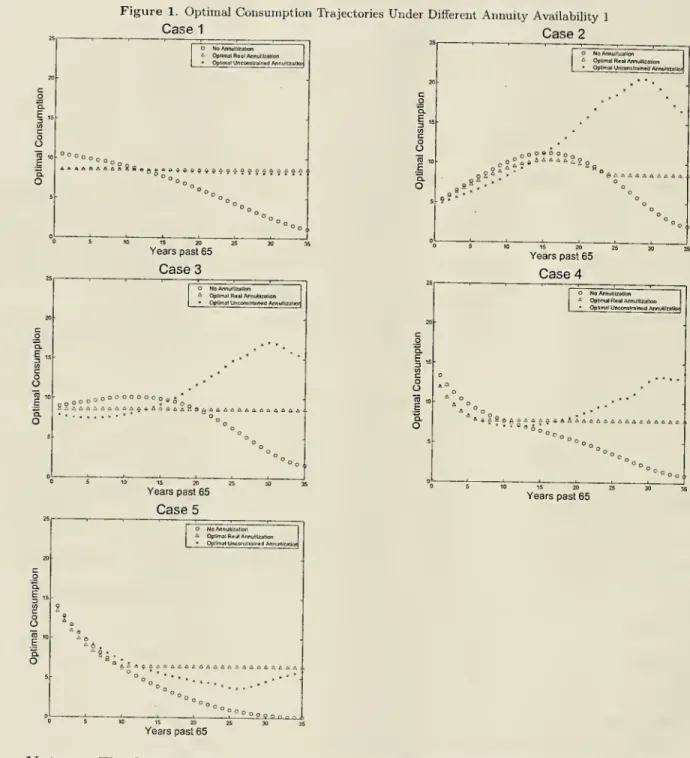
5, real annuitiesprovide the optimal annuity stream.A
rough estimate of themagnitude
ofEVs
can be obtainedby
observing the difference intrajectoriesbetween the unconstrained (circles
and
x's in figure 1, case 1) consumption plan andthe constrained real annuity (triangles in figure 1) consumption plan.
When
optimal consumptionis sharply decreasing, the constraints bind consumption
away
from the optimal path. In these16
Resultsforother levelsof riskaversion are available in someofthepapers listedabove.
cases, the benefit of annuitization is relatively small because the
sum
of future consumption isrelativelysmall
and
the gainis offset furtherby theconstraints.When
optimalunconstrained(zeroannuitization) consumption is
hump
shapedand
lesssteeply decreasing, there are greater benefitsand
the constraints impose lesscosts, so the net benefit to annuitizationis greater.What
differentiatesourmore
general set-up frompriorwork
is thatwe
can vary St inequation(1) so that the utility function exhibits an "internal habit," which
we
can then adjust to create optimal consumption trajectories that differ markedly from the usualCRRA
case.The
intuition behind our utilityfunction, taken fromDiamond
and
Mirrlees (2000), is that it is not the level ofpresent consumption, but rather the level relative to past consumption, that matters for utility.
For example, life in a studio apartment issurely
more
tolerable forsomeone
used to living in such circumstances than forsomeone
who
was
forcedby
a negative income shock toabandon
afour-bedroom
house. In choosinghow
to allocate resources across periods, "habit consumers" trade offimmediate gratification from consumption not only against a lifetime budget constraint, but also
against theeffects ofconsumptionearly in life on the standard-of-livinglater in life.
Following
Diamond
and
Mirrlees (2000),we
model
the evolutionofthe habit as follows:st
=
(st-i+
act-i)/(l'+a) (29)a
istheparameterthat governs thespeed ofadjustmentofthe habit level.When
a
is zero, the habitisconstantand we
arebackintheadditivelyseparablecase.As
a
approachesinfinity, present habit approaches last period's consumption.We
selectan
intermediate speedofhabit adjustment ofthe habit (q=1).Away
from zero,we
find that changes toa make
no substantive difference toour results,
and
thereforedo not reportresults fora rangeofa
values.17When
the habit evolves (a>
0), present consumption increases the future standard-of-living.Thisincrease in thestandard-of-living reduces the level ofutility
and
increases marginal utilityinthe future.
With
later consumption, there are fewer future periods that are adversely affectedby
an
increased standard-of-living.While
some
researchers have attempted to measure parameters of alternative habit formationmodels, largely involving "external habit" formation incalibration exercises, there istoour knowl-edge no empirical study that provides estimates ofthe initial standard S65
m
our model. This isAdditional resultsareavailablefrom theauthorsupon request.
not a major limitation, however, asour objective isnot to carefully calibrate arealistic
model
ofa representative lifetimeoptimizingconsumer, but rather to createoptimal consumptiontrajectoriesthat create an intentionally
more
severemismatch
with the available annuity structure thanwe
actually observe in available consumption data
and
to recognize the wide diversity in wealth atretirementrelative to lifetime income.
Doing
so allowsus to "stress test" the annuity valuations inorder toseeifone canplausibly explain the paucityofvoluntary annuity purchases within astrictly rationalmodel.
We
do
soby
consideringinitialstandards oflivingthat generateconsumption
paths thatare both extremely friendlyand
extremely unfriendly to annuitization.The
first four columns ofTable 1 indicate the casenumber
and
the relevant parameters thatare varied across cases.
Column
(5) reports the fraction of wealth that is optimally placed in a constant real annuity instead ofbonds. Incolumn
(6),we
report the equivalent variation ("EV")associated with this optimal
amount
of real annuitization. This is the increase in wealthrequiredtohold utilityconstant while
moving
from havingtheoptimalamount
annuitized in areal annuity,tohavingallofwealthinbonds.
Column
(7) reportsthe gainsfromannuitization (againas anEV)
for thecase in which the individualis permitted to choose an optimal payout trajectory, i.e., they
are no longer constrained to purchase a constant real annuity. For shorthand,
we
refer to this asthe "complete markets" result, although strictly speaking, all that is necessary is that the subset
of annuities that aredesired
by
this individualbe available.Because an internal habit introduces a
new
cost to early consumption, one might expect thatthe fixed real annuity will be even
more
desirable with an internal habit (a>
0) than without.However, the accuracy of this intuition hinges
on
the level of the initial habit S65 relative toresources at retirement. If the initial habit is small, then it is correct that the presence of a
potentiallyincreasing habit leads to deferred consumption and increased valuation ofthe annuity. However, if the initial habit is so large as to be unsustainable, so that the habit level
must
fallover time, then the presence ofthe habit will
push
optimal consumption earlier, because ofthedesire to
smooth
the ratio ofconsumption to habit across time. If the habit decreases with time, then smoothing likewise requires that consumption decrease with time.Hence
a very high initialhabit relative to resources provides a
mechanism beyond
heavy discountingwhereby
the deferred consumption requiredby
a constant real annuitymay
be very burdensome.To
calibrate the model,and
to buildsome
intuition,we
first consider an individualwho
hasreached retirementwithresourcesthat,
when
annuitized, aresufficientto exactlysatisfy theirhabitlevel of consumption for the rest of their lifetime. In this scenario, labeled "Case 2" in Table 1,
the individual entersretirement witha habit level S65 that ispreciselyequal tothe annual annuity value oftheirwealth.18
As
expected, the presence ofapotentiallyincreasinghabitleads todeferred consumption, i.e.,and upward
sloping consumption path inthe earlyyears (see Figure 1, Case 2).When
only real annuities are available, the optimal allocation is to fully annuitize, because doingsoprovides the individual withthe highest possible returnwithout imposing any bindingliquidity constraints.
While
the utilitygain iseven higher than inour base case, the utilitygains are higherstill if the individual is able to purchase annuities in a complete market,
and
thus exactlymatch
the desired consumption trajectory. In this latter case, the ability to choose an optimal annuity trajectoryis equivalent in utility terms to nearly doubling ofnon-annuitized wealth.
Reachingretirementwithpreciselythe resources requiredtomaintainone'spast livingstandard
is not the empirical norm, however. Indeed, given the wide range ofretirement resources across
thepopulation, it wouldnot
make
sense toconsider acommon
levelofpre-retirement consumption relative to retirement resource across the entire population.Hurd and Rohwedder
(2004) providenew
evidenceon
thedistribution ofthepercentagechangeinspendingfrompretopost retirement.They
find amean
consumption drop of 13 - 14 percent.At
the 20th percentile, they find a 30percent decline in consumption, whereas at the 95th percentile they find a 20 percent increase in
consumption.19
We
choose toexamine
evenmore
extreme points in the consumption distributionby
evaluatingthe case inwhichthe habit levelofconsumption is 50 percent and 200 percent oftheamount
that can be sustained by one's retirement wealth.In Case3ofTable 1 and Figure1, the individual hassufficient wealthtopurchaseareal annuity stream that is double the initial habit level in retirement.
As
in cases 1and
2, it is still optimalto fully annuitize all wealth.
Doing
so in a constant real annuity generates a utility gain that isequivalent to a 67 percentincrease innon-annuitized wealth.
The
abilitytomatch
annuities tothedesired
upward
sloping consumption trajectory is evenmore
valuable.More
interesting forpurposesofour "stress test" is toexamine the caseinwhich the individual onlyhashalf ofthelevel ofwealth thatwould
berequiredto sustain their initialhabit consumptionls
Givenour mortality assumptions, the annual annuityvalueof$100 of startingwealth is$8.59.
19
Hurdand Rohwedderdonot report pointsinthe distribution belowthe 20thpercentile.
level.
As
can be seen in Case 4, this leads the individual towant
to sharply reduce consumption early inretirement, inordertorapidlybringdown
thelevelofhabit toamore
sustainablelevel.As
such, the optimalfraction ofwealthheld ina real annuity declines to 90 percent, asthe individual uses the 10 percent ofnon-annuitized wealthtosupplement consumptionin the first 10 years,and
then
consumes
the annuity fortheremainder oflifeafterbring the habitdown
to a lowerlevel.Pushingthe "stress test" evenfurther, Case 5 adds a high discount rate to the low wealth-to-habit ratio.
By
holdingr fixed at .03and
raisingthe discountrateto .10, theoptimal consumption trajectory, asshown
in Case 5, is evenmore
heavily front-loaded,and
thus themismatch
with the real annuity income stream is particularly severe.Even
so, the individual would optimally annuitize three-quarters of their wealth. In results not reported,we
have found that evenwhen
the individual's habit is so high that retirement wealth can provide for
an
annuity that is only one-sixth ofthe initial habit level, the optimal fraction ofwealth invested in a real annuity is stillnearly two-thirds ofinitial retirement wealth.
Thesesimulationsindicatethatit isextremelydifficulttogenerateoptimalconsumptionprofiles
such that the optimal fraction ofwealth annuitized drops
much
below two-thirds ofinitial wealthat retirement without appealing to
many
additional factors. This suggests that the absence ofannuitization outside of Social Security
and
defined benefit pensions cannot be easily explained within a rational life-cycle model, even with preferences that lead to a severemismatch
between desired consumptionand
availableannuity paths.V.
Conclusions
and
Future
Directions
With
complete markets, the result of complete annuitization survives the relaxation of severalstandard, but restrictive assumptions. Utility need not satisfy the von
Neumann-Morgenstern
axioms
and
need not be additively separable. Further, annuities need not be actuarially fair, but onlymust
offer positivenet premiaover conventional assets.With
incomplete markets, thefull annuitizationresultcanbreakdown when
thereis asufficientmismatch
between the optimal consumption pathand
the income stream offeredby
the annuitymarket. In the much-studied case ofa worldwhere only individual mortality is uncertain,
we
findthat there