Automated feedback generation for
introductory programming assignments
The MIT Faculty has made this article openly available.
Please share
how this access benefits you. Your story matters.
Citation
Singh, Rishabh, Sumit Gulwani, and Armando Solar-Lezama.
“Automated Feedback Generation for Introductory Programming
Assignments.” 34th ACM SIGPLAN conference on Programming
language design and implementation, PLDI'13, June 16-19, 2013,
Seattle, WA, USA. p.15-26.
As Published
http://dx.doi.org/10.1145/2499370.2462195
Publisher
Association for Computing Machinery
Version
Author's final manuscript
Citable link
http://hdl.handle.net/1721.1/90851
Terms of Use
Creative Commons Attribution-Noncommercial-Share Alike
Automated Feedback Generation for
Introductory Programming Assignments
Rishabh Singh
MIT CSAIL, Cambridge, MA [email protected]
Sumit Gulwani
Microsoft Research, Redmond, WA [email protected]
Armando Solar-Lezama
MIT CSAIL, Cambridge, MA [email protected]
Abstract
We present a new method for automatically providing feedback for introductory programming problems. In order to use this method, we need a reference implementation of the assignment, and an er-ror model consisting of potential corrections to erer-rors that students might make. Using this information, the system automatically de-rives minimal corrections to student’s incorrect solutions, providing them with a measure of exactly how incorrect a given solution was, as well as feedback about what they did wrong.
We introduce a simple language for describing error models in terms of correction rules, and formally define a rule-directed translation strategy that reduces the problem of finding minimal corrections in an incorrect program to the problem of synthesizing a correct program from a sketch. We have evaluated our system on thousands of real student attempts obtained from the Introduction to Programming course at MIT (6.00) and MITx (6.00x). Our results show that relatively simple error models can correct on average 64% of all incorrect submissions in our benchmark set.
Categories and Subject Descriptors D.1.2 [Programming Tech-niques]: Automatic Programming; I.2.2 [Artificial Intelligence]: Program Synthesis
Keywords Automated Grading; Computer-Aided Education; Pro-gram Synthesis
1.
Introduction
There has been a lot of interest recently in making quality educa-tion more accessible to students worldwide using informaeduca-tion tech-nology. Several education initiatives such as EdX, Coursera, and Udacity are racing to provide online courses on various college-level subjects ranging from computer science to psychology. These courses, also called massive open online courses (MOOC), are typ-ically taken by thousands of students worldwide, and present many interesting scalability challenges. Specifically, this paper addresses the challenge of providing personalized feedback for programming assignments in introductory programming courses.
The two methods most commonly used by MOOCs to provide feedback on programming problems are: (i) test-case based feed-back and (ii) peer-feedfeed-back [12]. In test-case based feedfeed-back, the student program is run on a set of test cases and the failing test cases
Permission to make digital or hard copies of all or part of this work for personal or classroom use is granted without fee provided that copies are not made or distributed for profit or commercial advantage and that copies bear this notice and the full citation on the first page. To copy otherwise, to republish, to post on servers or to redistribute to lists, requires prior specific permission and/or a fee.
PLDI’13, June 16–19, 2013, Seattle, WA, USA.
Copyright c 2013 ACM 978-1-4503-2014-6/13/06. . . $15.00
are reported back to the student. This is also how the 6.00x course (Introduction to Computer Science and Programming) offered by MITx currently provides feedback for Python programming exer-cises. The feedback of failing test cases is however not ideal; es-pecially for beginner programmers who find it difficult to map the failing test cases to errors in their code. This is reflected by the num-ber of students who post their submissions on the discussion board to seek help from instructors and other students after struggling for hours to correct the mistakes themselves. In fact, for the classroom version of the Introduction to Programming course (6.00) taught at MIT, the teaching assistants are required to manually go through each student submission and provide qualitative feedback describ-ing exactly what is wrong with the submission and how to correct it. This manual feedback by teaching assistants is simply prohibitive for the number of students in the online class setting.
The second approach of peer-feedback is being suggested as a potential solution to this problem [43]. For example in 6.00x, stu-dents routinely answer each other’s questions on the discussion fo-rums. This kind of peer-feedback is helpful, but it is not without problems. For example, we observed several instances where stu-dents had to wait for hours to get any feedback, and in some cases the feedback provided was too general or incomplete, and even wrong. Some courses have experimented with more sophisticated peer evaluation techniques [28] and there is an emerging research area that builds on recent results in crowd-powered systems [7, 30] to provide more structure and better incentives for improving the feedback quality. However, peer-feedback has some inherent limi-tations, such as the time it takes to receive quality feedback and the potential for inaccuracies in feedback, especially when a majority of the students are themselves struggling to learn the material.
In this paper, we present an automated technique to provide feedback for introductory programming assignments. The approach leverages program synthesis technology to automatically determine minimal fixes to the student’s solution that will make it match the behavior of a reference solution written by the instructor. This tech-nology makes it possible to provide students with precise feedback about what they did wrong and how to correct their mistakes. The problem of providing automatic feedback appears to be related to the problem of automated bug fixing, but it differs from it in fol-lowing two significant respects:
• The complete specification is known. An important challenge
in automatic debugging is that there is no way to know whether a fix is addressing the root cause of a problem, or simply masking it and potentially introducing new errors. Usually the best one can do is check a candidate fix against a test suite or a partial specification [14]. While providing feedback on the other hand, the solution to the problem is known, and it is safe to assume that the instructor already wrote a correct reference implementation for the problem.
•Errors are predictable. In a homework assignment, everyone is solving the same problem after having attended the same lec-tures, so errors tend to follow predictable patterns. This makes it possible to use a model-based feedback approach, where the potential fixes are guided by a model of the kinds of errors stu-dents typically make for a given problem.
These simplifying assumptions, however, introduce their own set of challenges. For example, since the complete specification is known, the tool now needs to reason about the equivalence of the student solution with the reference implementation. Also, in order to take advantage of the predictability of errors, the tool needs to be parameterized with models that describe the classes of errors. And finally, these programs can be expected to have higher density of errors than production code, so techniques which attempts to correct bugs one path at a time [25] will not work for many of these problems that require coordinated fixes in multiple places.
Our feedback generation technique handles all of these chal-lenges. The tool can reason about the semantic equivalence of stu-dent programs with reference implementations written in a fairly large subset of Python, so the instructor does not need to learn a new formalism to write specifications. The tool also provides an er-ror modellanguage that can be used to write an error model: a very high level description of potential corrections to errors that students might make in the solution. When the system encounters an incor-rect solution by a student, it symbolically explores the space of all possible combinations of corrections allowed by the error model and finds a correct solution requiring a minimal set of corrections.
We have evaluated our approach on thousands of student solu-tions on programming problems obtained from the 6.00x submis-sions and discussion boards, and from the 6.00 class submissubmis-sions. These problems constitute a major portion of first month of assign-ment problems. Our tool can successfully provide feedback on over 64% of the incorrect solutions.
This paper makes the following key contributions:
•We show that the problem of providing automated feedback for introductory programming assignments can be framed as a syn-thesis problem. Our reduction uses a constraint-based mecha-nism to model Python’s dynamic typing and supports complex Python constructs such as closures, higher-order functions, and list comprehensions.
•We define a high-level error model language EMLthat can be used to provide correction rules to be used for providing feed-back. We also show that a small set of such rules is sufficient to correct thousands of incorrect solutions written by students.
•We report the successful evaluation of our technique on
thou-sands of real student attempts obtained from 6.00 and 6.00x classes, as well as from PEX4FUNwebsite. Our tool can pro-vide feedback on 64% of all submitted solutions that are incor-rect in about 10 seconds on average.
2.
Overview of the approach
In order to illustrate the key ideas behind our approach, consider the problem of computing the derivative of a polynomial whose coefficients are represented as a list of integers. This problem is taken from week 3 problem set of 6.00x (PS3: Derivatives). Given the input listpoly, the problem asks students to write the function computeDerivthat computes a listpoly’such that
poly’=
n {i×poly[i]| 0 <i<len(poly)} iflen(poly)> 1
[0] iflen(poly)= 1
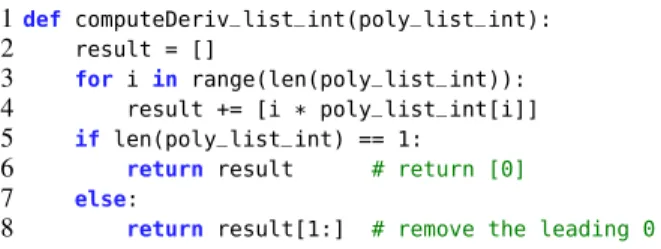
For example, if the input listpolyis [2, −3, 1, 4] (denoting f (x) = 4x3 + x2 − 3x + 2), thecomputeDerivfunction should return [−3, 2, 12] (denoting the derivative f0(x) = 12x2+ 2x − 3). The reference implementation for thecomputeDerivfunction is shown
1def computeDeriv_list_int(poly_list_int): 2 result = []
3 for i in range(len(poly_list_int)): 4 result += [i * poly_list_int[i]] 5 if len(poly_list_int) == 1:
6 return result # return [0]
7 else:
8 return result[1:] # remove the leading 0
Figure 1. The reference implementation forcomputeDeriv.
in Figure 1. This problem teaches concepts of conditionals and iteration over lists. For this problem, students struggled with many low-level Python semantics issues such as the list indexing and iteration bounds. In addition, they also struggled with conceptual issues such as missing the corner case of handling lists consisting of single element (denoting constant function).
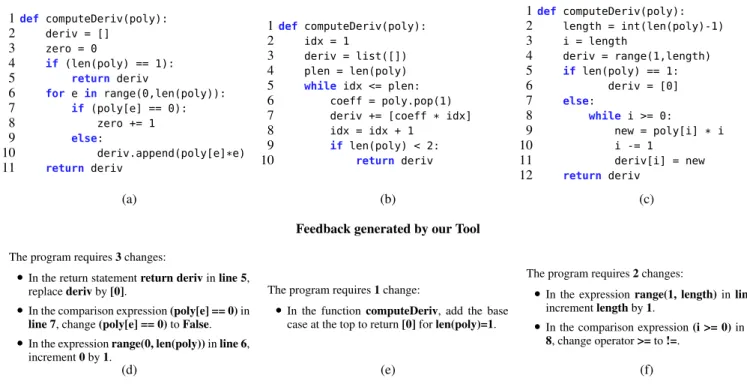
One challenge in providing feedback for student submissions is that a given problem can be solved by using many different algo-rithms. Figure 2 shows three very different student submissions for thecomputeDerivproblem, together with the feedback generated by our tool for each submission. The student submission shown in Figure 2(a) is taken from the 6.00x discussion forum1. The stu-dent posted the code in the forum seeking help and received two responses. The first response asked the student to look for the first if-block return value, and the second response said that the code should return [0] instead of empty list for the first if statement. There are many different ways to modify the code to return [0] for the caselen(poly)=1. The student chose to change the initializa-tion of thederivvariable from [ ] to the list [0]. The problem with this modification is that the result will now have an additional 0 in front of the output list for all input lists (which is undesirable for lists of length greater than 1). The student then posted the query again on the forum on how to remove the leading 0 from result, but unfortunately this time did not get any more response.
Our tool generates the feedback shown in Figure 2(d) for the student program in about 40 seconds. During these 40 seconds, the tool searches over more than 107candidate fixes and finds the fix that requires minimum number of corrections. There are three problems with the student code: first it should return [0] in line 5 as was suggested in the forum but wasn’t specified how to make the change, second the if block should be removed in line 7, and third that the loop iteration should start from index 1 instead of 0 in line 6. The generated feedback consists of four pieces of information (shown in bold in the figure for emphasis):
• the location of the error denoted by the line number. • the problematic expression in the line.
• the sub-expression which needs to be modified. • the new modified value of the sub-expression.
The feedback generator is parameterized with a feedback-level parameter to generate feedback consisting of different combina-tions of the four kinds of information, depending on how much information the instructor is willing to provide to the student. 2.1 Workflow
In order to provide the level of feedback described above, the tool needs some information from the instructor. First, the tool needs to know what the problem is that the students are supposed to solve. The instructor provides this information by writing a reference im-1https://www.edx.org/courses/MITx/6.00x/2012_Fall/discussion/ forum/600x_ps3_q2/threads/5085f3a27d1d422500000040
Three different student submissions forcomputeDeriv 1def computeDeriv(poly): 2 deriv = [] 3 zero = 0 4 if (len(poly) == 1): 5 return deriv 6 for e in range(0,len(poly)): 7 if (poly[e] == 0): 8 zero += 1 9 else: 10 deriv.append(poly[e]*e) 11 return deriv 1def computeDeriv(poly): 2 idx = 1 3 deriv = list([]) 4 plen = len(poly)
5 while idx <= plen:
6 coeff = poly.pop(1) 7 deriv += [coeff * idx] 8 idx = idx + 1 9 if len(poly) < 2: 10 return deriv 1def computeDeriv(poly): 2 length = int(len(poly)-1) 3 i = length 4 deriv = range(1,length) 5 if len(poly) == 1: 6 deriv = [0] 7 else: 8 while i >= 0: 9 new = poly[i] * i 10 i -= 1 11 deriv[i] = new 12 return deriv (a) (b) (c)
Feedback generated by our Tool
The program requires 3 changes:
• In the return statement return deriv in line 5, replace deriv by [0].
• In the comparison expression (poly[e] == 0) in line 7, change (poly[e] == 0) to False. • In the expression range(0, len(poly)) in line 6,
increment 0 by 1.
The program requires 1 change:
• In the function computeDeriv, add the base case at the top to return [0] for len(poly)=1.
The program requires 2 changes:
• In the expression range(1, length) in line 4, increment length by 1.
• In the comparison expression (i >= 0) in line 8, change operator >= to !=.
(d) (e) (f)
Figure 2. Three very different student submissions ((a), (b), and (c)) for the computeDerivproblem and the corresponding feedback generated by our tool ((d), (e), and (f)) for each one of them using the same reference implementation.
plementation such as the one in Figure 1. Since Python is dynam-ically typed, the instructor also provides the types of function ar-guments and return value. In Figure 1, the instructor specifies the type of input argument to be list of integers (poly_list_int) by appending the type to the name.
In addition to the reference implementation, the tool needs a description of the kinds of errors students might make. We have designed an error model language EML, which can describe a set of correction rules that denote the potential corrections to errors that students might make. For example, in the student attempt in Figure 2(a), we observe that corrections often involve modifying the return value and the range iteration values. We can specify this information with the following three correction rules:
returna → return[0] range(a1, a2) → range(a1+ 1, a2)
a0== a1 → False
The correction rulereturna →return[0] states that the expres-sion of areturnstatement can be optionally replaced by [0]. The error model for this problem that we use for our experiments is shown in Figure 8, but we will use this simple error model for sim-plifying the presentation in this section. In later experiments, we also show how only a few tens of incorrect solutions can provide enough information to create an error model that can automatically provide feedback for thousands of incorrect solutions.
The rules define a space of candidate programs which the tool needs to search in order to find one that is equivalent to the ref-erence implementation and that requires minimum number of cor-rections. We use constraint-based synthesis technology [16, 37, 40] to efficiently search over this large space of programs. Specifically, we use the SKETCHsynthesizer that uses a SAT-based algorithm to complete program sketches (programs with holes) so that they meet a given specification. We extend the SKETCHsynthesizer with
sup-port for minimize hole expressions whose values are computed effi-ciently by using incremental constraint solving. To simplify the pre-sentation, we use a simpler languageMPY(miniPython) in place of Python to explain the details of our algorithm. In practice, our tool supports a fairly large subset of Python including closures, higher order functions, and list comprehensions.
2.2 Solution Strategy FEEDBACK GENERATOR SKETCH SOLVER SKETCH TRANSLATOR PROGRAM REWRITER .out …..….. …..….. …..….. ….. .𝑚𝑃𝑦 .sk .py .eml
Figure 3. The architecture of our feedback generation tool. The architecture of our tool is shown in Figure 3. The solu-tion strategy to find minimal correcsolu-tions to a student’s solusolu-tion is based on a two-phase translation to the Sketch synthesis language. In the first phase, theProgram Rewriteruses the correction rules to translate the solution into a language we callMgPY; this language provides us with a concise notation to describe sets ofMPY candi-date programs, together with a cost model to reflect the number of corrections associated with each program in this set. In the second phase, thisMgPYprogram is translated into a sketch program by the
1def computeDeriv(poly): 2 deriv = []
3 zero = 0
4 if ({ len(poly) == 1 , False}):
5 return { deriv ,[0]}
6 for e in range ({ 0 ,1}, len(poly)): 7 if ({ poly[e] == 0 ,False}):
8 zero += 1
9 else:
10 deriv.append(poly[e]*e)
11 return { deriv ,[0]}
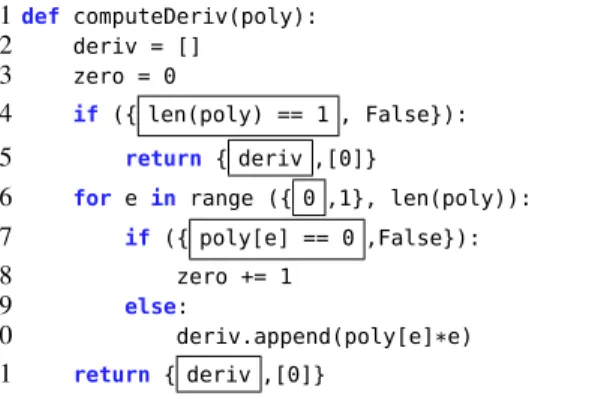
Figure 4. The resulting MgPY program after applying correction rules to program in Figure 2(a).
In the case of example in Figure 2(a), theProgram Rewriter produces theMgPYprogram shown in Figure 4 using the correc-tion rules from Seccorrec-tion 2.1. This program includes all the possi-ble corrections induced by the correction rules in the model. The
g
MPYlanguage extends the imperative languageMPYwith expres-sion choices, where the choices are denoted with squiggly brack-ets. Whenever there are multiple choices for an expression or a statement, the zero-cost choice, the one that will leave the ex-pression unchanged, is boxed. For example, the exex-pression choice { a0 , a1, · · · , an} denotes a choice between expressions a0, · · ·, anwhere a0denotes the zero-cost default choice.
For this simple program, the three correction rules induce a space of 32 different candidate programs. This candidate space is fairly small, but the number of candidate programs grow exponen-tially with the number of correction places in the program and with the number of correction choices in the rules. The error model that we use in our experiments induces a space of more than 1012 can-didate programs for some of the benchmark problems. In order to search this large space efficiently, the program is translated to a sketch by theSketch Translator.
2.3 Synthesizing Corrections with Sketch
The SKETCH[37] synthesis system allows programmers to write programs while leaving fragments of it unspecified as holes; the contents of these holes are filled up automatically by the synthe-sizer such that the program conforms to a specification provided in terms of a reference implementation. The synthesizer uses the CEGISalgorithm [38] to efficiently compute the values for holes and uses bounded symbolic verification techniques for performing equivalence check of the two implementations.
There are two key aspects in the translation of anMgPYprogram to a SKETCHprogram. The first aspect is specific to the Python language. SKETCHsupports high-level features such as closures and higher-order functions which simplifies the translation, but it is statically typed whereas MPY programs (like Python) are dynamically typed. The translation models the dynamically typed variables and operations over them using struct types in SKETCH in a way similar to the union types. The second aspect of the translation is the modeling of set-expressions in MgPY using ?? (holes) in SKETCH, which is language independent.
The dynamic variable types in theMPYlanguage are modeled using the MultiType struct defined in Figure 5. TheMultiType struct consists of a flag field that denotes the dynamic type of a variable and currently supports the following set of types: {INTEGER, BOOL, TYPE, LIST, TUPLE, STRING, DICTIONARY}. The val andbvalfields store the value of an integer and a Boolean
struct MultiType{
int val, flag; bit bval;
MTString str; MTTuple tup; MTDict dict; MTList lst; }
struct MTList{
int len;
MultiType[len] lVals; }
Figure 5. TheMultiTypestruct for encoding Python types.
variable respectively, whereas thestr,tup, dict, andlstfields store the value of string, tuple, dictionary, and list variables re-spectively. TheMTListstruct consists of a fieldlenthat denotes the length of the list and a fieldlValsof type array ofMultiType that stores the list elements. For example, the integer value5 is represented as the valueMultiType(val=5, flag=INTEGER) and the list [1,2] is represented as the value MultiType(lst=new MTList(len=2,lVals={new MultiType(val=1,flag=INTEGER), new MultiType(val=2,flag=INTEGER)}), flag=LIST).
The second key aspect of this translation is the translation of ex-pression choices inMgPY. The SKETCHconstruct??denotes an un-known integer hole that can be assigned any constant integer value by the synthesizer. The expression choices inMgPYare translated to functions in SKETCHthat based on the unknown hole values return either the default expression or one of the other expression choices. Each such function is associated with a unique Boolean choice variable, which is set by the function whenever it returns a non-default expression choice. For example, the set-statement return{deriv ,[0]}; (line 5 in Figure 4) is translated toreturn modRetVal0(deriv), where themodRetVal0function is defined as:
MultiType modRetVal0(MultiType a){
if(??) return a; // default choice
choiceRetVal0 = True; // non-default choice
MTList list = new MTList(lVals={new
MultiType(val=0, flag=INTEGER)}, len=1);
return new MultiType(lst=list, type = LIST);
}
The translation phase also generates a SKETCH harness that compares the outputs of the translated student and reference im-plementations on all inputs of a bounded size. For example in case of thecomputeDerivfunction, with bounds of n = 4 for both the number of integer bits and the maximum length of input list, the harness matches the output of the two implementations for more than 216different input values as opposed to 10 test-cases used in 6.00x. The harness also defines a variabletotalCostas a function of choice variables that computes the total number of corrections performed in the original program, and asserts that the value of totalCostshould be minimized. The synthesizer then solves this minimization problem efficiently using an incremental solving al-gorithmCEGISMINdescribed in Section 4.2.
After the synthesizer finds a solution, theFeedback Generator extracts the choices made by the synthesizer and uses them to generate the corresponding feedback in natural language. For this example, the tool generates the feedback shown in Figure 2(d) in less than 40 seconds.
3.
E
ML: Error Model Language
In this section, we describe the syntax and semantics of the error model language EML. An EML error model consists of a set of rewrite rules that captures the potential corrections for mistakes that students might make in their solutions. We define the rewrite rules over a simple Python-like imperative languageMPY. A rewrite rule transforms a program element inMPYto a set of weighted MPY program elements. This weighted set ofMPYprogram elements is
[[a]] = {(a, 0)}
[[{ ˜a0 , · · · , ˜an}]] = [[˜a0]] ∪ {(a, c + 1) | (a, c) ∈ [[˜ai]]0<i≤n} [[˜a0[˜a1]]] = {(a0[a1], c0+ c1) | (ai, ci) ∈ [[˜ai]]i∈{0,1}} [[while˜b : ˜s]] = {(whileb : s, cb+ cs) |
(b, cb) ∈ [[˜b]], (s, cs) ∈ [[˜s]]} Figure 7. The [[ ]] function (shown partially) that translates anMgPY program to a weighted set ofMPYprograms.
represented succinctly as anMgPYprogram element, where MgPY extends theMPYlanguage with set-exprs (sets of expressions) and set-stmts (sets of statements). The weight associated with a pro-gram element in this set denotes the cost of performing the corre-sponding correction. An error model transforms anMPYprogram to anMgPYprogram by recursively applying the rewrite rules. We show that this transformation is deterministic and is guaranteed to terminate on well-formed error models.
3.1 MPYandMgPYlanguages
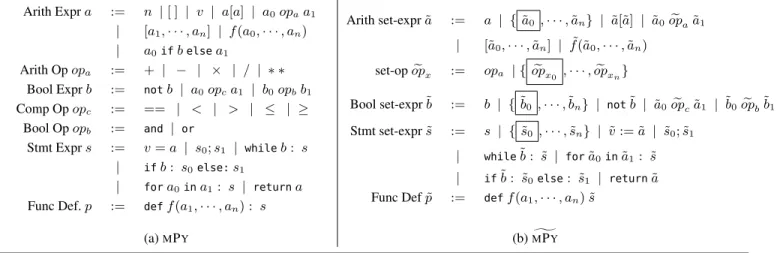
The syntax ofMPYandMgPYlanguages is shown in Figure 6(a) and Figure 6(b) respectively. The purpose ofMgPYlanguage is to represent a large collection ofMPYprograms succinctly. TheMgPY language consists of set-expressions (˜a and ˜b) and set-statements (˜s) that represent a weighted set of corresponding MPY sions and statements respectively. For example, the set expres-sion { n0 , · · · , nk} represents a weighted set of constant inte-gers where n0 denotes the default integer value associated with cost 0 and all other integer constants (n1, · · · , nk) are associated with cost 1. The sets of composite expressions are represented suc-cinctly in terms of sets of their constituent sub-expressions. For example, the composite expression { a0 , a0+ 1}{ < , ≤, >, ≥ , ==, 6=}{ a1 , a1+ 1, a1− 1} represents 36MPYexpressions.
EachMPY program in the set of programs represented by an g
MPYprogram is associated with a cost (weight) that denotes the number of modifications performed in the original program to obtain the transformed program. This cost allows the tool to search for corrections that require minimum number of modifications. The weighted set ofMPY programs is defined using the [[ ]] function shown partially in Figure 7, the complete function definition can be found in [36]. The [[ ]] function on MPY expressions such as a returns a singleton set {(a, 0)} consisting of the corresponding expression associated with cost 0. On set-expressions of the form { ˜a0 , · · · , ˜an}, the function returns the union of the weighted set of MPY expressions corresponding to the default set-expression ([[˜a0]]) and the weighted set of expressions corresponding to other set-expressions (˜a1, · · · , ˜an), where each expression in [[˜ai)]] is associated with an additional cost of 1. On composite expressions, the function computes the weighted set recursively by taking the cross-product of weighted sets of its constituent sub-expressions and adding their corresponding costs. For example, the weighted set for composite expression ˜x[˜y] consists of an expression xi[yj] associated with cost cxi + cyj for each (xi, cxi) ∈ [[˜x]] and
(yj, cyj) ∈ [[˜y]].
3.2 Syntax of EML
An EMLerror model consists of a set of correction rules that are used to transform anMPYprogram to anMgPYprogram. A correc-tion ruleC is written as a rewrite rule L → R, where L and R de-note a program element inMPYandMgPYrespectively. A program
element can either be a term, an expression, a statement, a method or the program itself. The left hand side (L) denotes anMPY pro-gram element that is pattern matched to be transformed to anMgPY program element denoted by the right hand side (R). The left hand side of the rule can use free variables whereas the right hand side can only refer to the variables present in the left hand side. The language also supports a special0(prime) operator that can be used to tag sub-expressions in R that are further transformed recursively using the error model. The rules use a shorthand notation ?a (in the right hand side) to denote the set of all variables that are of the same type as the type of expression a and are in scope at the corresponding program location. We assume each correction rule is associated with cost 1, but it can be easily extended to different costs to account for different severity of mistakes.
INDR: v[a] → v[{a + 1, a − 1, ?a}] INITR: v = n → v = {n + 1, n − 1, 0} RANR: range(a0, a1) → range({0, 1, a0− 1, a0+ 1}, {a1+ 1, a1− 1}) COMPR: a0opca1 → {{a 0 0− 1, ?a0}opec{a 0 1− 1, 0, 1, ?a1}, True,False} whereopec= {<, >, ≤, ≥, ==, 6=} RETR: returna → return{[0]if len(a) == 1elsea,
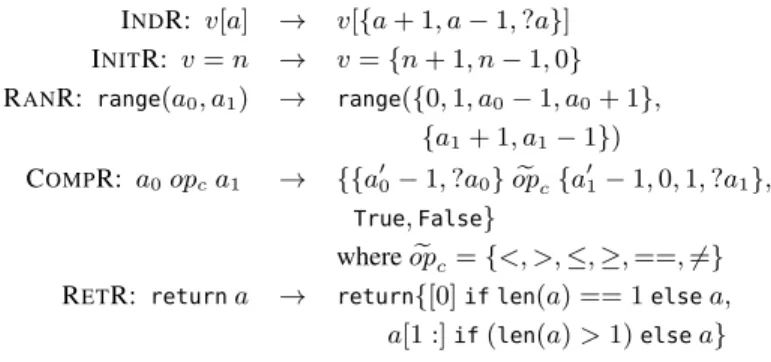
a[1 :]if(len(a) > 1)elsea} Figure 8. The error model E for thecomputeDerivproblem. Example 1. The error model for thecomputeDerivproblem is shown in Figure 8. TheINDR rewrite rule transforms the list access indices. TheINITR rule transforms the right hand side of constant initializations. TheRANR rule transforms the arguments for the
rangefunction; similar rules are defined in the model for other
rangefunctions that take one and three arguments. TheCOMPR
rule transforms the operands and operator of the comparisons. TheRETR rule adds the two common corner cases of returning [0] when the length of input list is1, and the case of deleting the first list element before returning the list. Note that these rewrite rules define the corrections that can be performed optionally; the zero cost (default) case of not correcting a program element is added automatically as described in Section 3.3.
Definition 1. Well-formed Rewrite Rule : A rewrite rule C : L → R is defined to be well-formed if all tagged sub-terms t0inR have a smaller size syntax tree than that ofL.
The rewrite rule C1: v[a] → {(v[a])0+ 1} is not a well-formed rewrite rule as the size of the tagged sub-term (v[a]) of R is the same as that of the left hand side L. On the other hand, the rewrite rule C2: v[a] → {v0[a0] + 1} is well-formed.
Definition 2. Well-formed Error Model : An error model E is defined to be well-formed if all of its constituent rewrite rules Ci∈ E are well-formed.
3.3 Transformation with EML
An error model E is syntactically translated to a function TE that transforms anMPYprogram to anMgPYprogram. The TEfunction first traverses the program element w in the default way, i.e. no transformation happens at this level of the syntax tree, and the function is called recursively on all of its top-level sub-terms t to obtain the transformed element w0 ∈ MgPY. For each correction rule Ci : Li → Riin the error model E, the function contains a
Arith Expr a := n | [ ] | v | a[a] | a0opaa1 | [a1, · · · , an] | f (a0, · · · , an) | a0ifbelsea1
Arith Op opa := + | − | × | / | ∗ ∗ Bool Expr b := notb | a0opca1 | b0opbb1 Comp Op opc := == | < | > | ≤ | ≥
Bool Op opb := and | or
Stmt Expr s := v = a | s0; s1 | whileb : s | ifb : s0else:s1
| fora0ina1: s | returna Func Def. p := deff (a1, · · · , an) : s
Arith set-expr ˜a := a | { ˜a0 , · · · , ˜an} | ˜a[˜a] | ˜a0opea˜a1 | [˜a0, · · · , ˜an] | ˜f (˜a0, · · · , ˜an)
set-opopex := opa | {opex0 , · · · ,opexn}
Bool set-expr ˜b := b | { ˜b0 , · · · , ˜bn} | not˜b | ˜a0opec˜a1 | ˜b0opeb˜b1 Stmt set-expr ˜s := s | { ˜s0 , · · · , ˜sn} | ˜v := ˜a | ˜s0; ˜s1
| while˜b : ˜s | for˜a0in˜a1: ˜s | if˜b : ˜s0else: ˜s1 | return˜a Func Def ˜p := deff (a1, · · · , an) ˜s
(a)MPY (b)MgPY
Figure 6. The syntax for (a)MPYand (b)MgPYlanguages.
Matchexpression that matches the term w with the left hand side of the rule Li(with appropriate unification of the free variables in Li). If the match succeeds, it is transformed to a term wi ∈MgPY as defined by the right hand side Ri of the rule after calling the TEfunction on each of its tagged sub-terms t0. Finally, the method returns the set of all transformed terms { w0 , · · · , wn}.
Example 2. Consider an error model E1consisting of the follow-ing three correction rules:
C1: v[a] → v[{a − 1, a + 1}] C2: a0opca1 → {a 0 0− 1, 0} opc{a 0 1− 1, 0} C3: v[a] → ?v[a]
The transformation functionTE1for the error modelE1is shown in Figure 9.
TE1(w :MPY) :MgPY =
let w0= w[t → TE1(t)] in (∗ t : a sub-term of w ∗)
let w1= Match w with
v[a] → v[{a + 1, a − 1}] in let w2= Match w with
a0opca1→ {TE1(a0) − 1, 0} opc {TE1(a1) − 1, 0} in
{ w0 , w1, w2}
Figure 9. The TE1method for error model E1.
The recursive steps of application of TE1function on expression
(x[i] < y[j]) are shown in Figure 10. This example illustrates two interesting features of the transformation function:
•Nested Transformations : Once a rewrite rule L → R is
ap-plied to transform a program element matching L to R, the in-structor may want to apply another rewrite rule on only a few sub-terms of R. For example, she may want to avoid trans-forming the sub-terms which have already been transformed by some other correction rule. The EML language facilitates making such distinction between the sub-terms for performing nested corrections using the0 (prime) operator. Only the sub-terms in R that are tagged with the prime operator are visited
for applying further transformations (using the TE function re-cursively on its tagged sub-terms t0), whereas the non-tagged sub-terms are not transformed any further. After applying the rewrite rule C2in the example, the sub-terms x[i] and y[j] are further transformed by applying rewrite rules C1and C3.
• Ambiguous Transformations : While transforming a program using an error model, it may happen that there are multiple rewrite rules that pattern match the program element w. After applying rewrite rule C2 in the example, there are two rewrite rules C1and C3that pattern match the terms x[i] and y[j]. After applying one of these rules (C1or C3) to an expression v[a], we cannot apply the other rule to the transformed expression. In such ambiguous cases, the TEfunction creates a separate copy of the transformed program element (wi) for each ambiguous choice and then performs the set union of all such elements to obtain the transformed program element. This semantics of handling ambiguity of rewrite rules also matches naturally with the intent of the instructor. If the instructor wanted to perform both transformations together on array accesses, she could have provided a combined rewrite rule such as v[a] → ?v[{a + 1, a − 1}].
Theorem 1. Given a well-formed error model E, the transforma-tion functransforma-tionTEalways terminates.
Proof.From the definition of well-formed error model, each of its constituent rewrite rule is also well-formed. Hence, each applica-tion of a rewrite rule reduces the size of the syntax tree of terms that are required to be visited further for transformation by TE. There-fore, the TEfunction terminates in a finite number of steps.
4.
Constraint-based Solving of
MgP
Yprograms
In the previous section, we saw the transformation of anMPY pro-gram to anMgPYprogram based on an error model. We now present the translation of anMgPYprogram into a SKETCHprogram [37]. 4.1 Translation ofMgPYprograms to SKETCHTheMgPYprograms are translated to SKETCHprograms for efficient constraint-based solving for minimal corrections to the student solutions. The two main aspects of the translation include : (i) the translation of Python-like constructs inMgPYto SKETCH, and (ii) the translation of set-expr choices inMgPYto SKETCHfunctions.
T (x[i] < y[j]) ≡ { T (x[i]) < T (y[j]) , {T (x[i]) − 1, 0} < {T (y[j]) − 1, 0}} T (x[i]) ≡ { T (x)[T (i)] , x[{i + 1, i − 1}], y[i]}
T (y[j]) ≡ { T (y)[T (j)] , y[{j + 1, j − 1}], x[j]}
T (x) ≡ { x } T (i) ≡ { i } T (y) ≡ { y } T (j) ≡ { j } Therefore, after substitution the result is:
T (x[i] < y[j]) ≡ { { x [ i ] , x[{i + 1, i − 1}], y[i]} < { y [ j ] , y[{j + 1, j − 1}], x[j]} ,
{{ x [ i ] , x[{i + 1, i − 1}], y[i]} − 1, 0} < {{ y [ j ] , y[{j + 1, j − 1}], x[j]} − 1, 0}} Figure 10. Application of TE1(abbreviated T ) on expression (x[i] < y[j]).
Handling dynamic typing ofMgPYvariables The dynamic typ-ing inMgPYis handled using aMultiTypevariable as described in Section 2.3. TheMgPYexpressions and statements are transformed to SKETCHfunctions that perform the corresponding transforma-tions overMultiType. For example, the Python statement(a = b) is translated toassignMT(a, b), where theassignMTfunction as-signsMultiTypeb to a. Similarly, the binary add expression(a + b)is translated tobinOpMT(a, b, ADD_OP)that in turn calls the functionaddMT(a,b)to addaandbas shown in Figure 11. 1MultiType addMT(MultiType a, MultiType b){
2 assert a.flag == b.flag; // same types can be added
3 if(a.flag == INTEGER) // add for integers
4 return new MultiType(val=a.val+b.val, flag =
INTEGER);
5 if(a.flag == LIST){ // add for lists
6 int newLen = a.lst.len + b.lst.len; 7 MultiType[newLen] newLVals = a.lst.lVals; 8 for(int i=0; i<b.lst.len; i++)
9 newLVals[i+a.lst.len] = b.lst.lVals[i];
10 return new MultiType(lst = new
MTList(lVals=newLVals, len=newLen), flag=LIST);}
11 · · · · 12}
Figure 11. TheaddMTfunction for adding twoMultiType aandb.
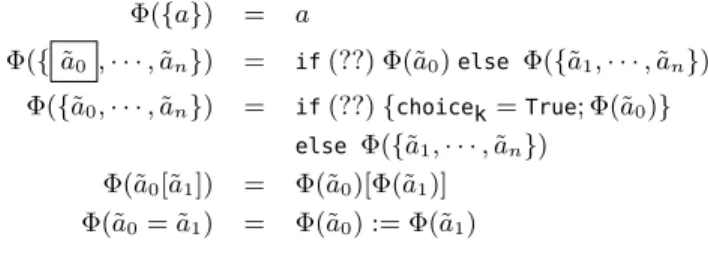
Translation ofMgPYset-expressions The set-expressions inMgPY are translated to functions in SKETCH. The function bodies ob-tained by the application of translation function (Φ) on some of the interestingMgPYconstructs are shown in Figure 12. The SKETCH construct ?? (called hole) is a placeholder for a constant value, which is filled up by the SKETCHsynthesizer while solving the constraints to satisfy the given specification.
The singleton sets consisting of an MPY expression such as {a} are translated simply to the corresponding expression itself. A set-expression of the form { ˜a0 , · · · , ˜an} is translated recur-sively to theifexpression :if(??) Φ(˜a0)else Φ({˜a1, · · · , ˜an}), which means that the synthesizer can optionally select the default set-expression Φ(˜a0) (by choosing ?? to be true) or select one of the other choices (˜a1, · · · , ˜an). The set-expressions of the form
Φ({a}) = a Φ({ ˜a0 , · · · , ˜an}) = if(??) Φ(˜a0)else Φ({˜a1, · · · , ˜an}) Φ({˜a0, · · · , ˜an}) = if(??) {choicek=True; Φ(˜a0)} else Φ({˜a1, · · · , ˜an}) Φ(˜a0[˜a1]) = Φ(˜a0)[Φ(˜a1)] Φ(˜a0= ˜a1) = Φ(˜a0) := Φ(˜a1)
Figure 12. The translation rules (shown partially) for converting g
MPYset-exprs to corresponding SKETCHfunction bodies.
{˜a0, · · · , ˜an} are similarly translated but with an additional state-ment for setting a fresh variablechoicekif the synthesizer selects the non-default choice ˜a0.
The translation rules for the assignment statements (˜a0 := ˜
a1) results inif expressions on both left and right sides of the assignment. Theif expression choices occurring on the left hand side are desugared to individual assignments. For example, the left hand side expressionif(??) xelse y := 10 is desugared to if(??) x := 10else y := 10. The infix operators inMgPYare first translated to function calls and are then translated to sketch using the translation for set-function expressions. The remainingMgPY expressions are similarly translated recursively and the translation can be found in more detail in [36].
Translating function calls The translation of function calls for recursive problems and for problems that require writing a function that uses other sub-functions is parmeterized by three options: 1) use the student’s implementation of sub-functions, 2) use the teacher’s implementation of functions, and 3) treat the sub-functions as uninterpreted sub-functions.
Generating the driver functions The SKETCHsynthesizer sup-ports the equivalence checking of functions whose input arguments and return values are over SKETCHprimitive types such asint, bitand arrays. Therefore, after the translation ofMgPYprograms to SKETCHprograms, we need additional driver functions to integrate the functions overMultiTypeinput arguments and return value to the corresponding functions over SKETCH primitive types. The driver functions first converts the input arguments over primitive types to correspondingMultiTypevariables using library functions
such ascomputeMTFromInt, and then calls the translatedMgPY func-tion with theMultiTypevariables. The returnedMultiTypevalue is translated back to primitive types using library functions such ascomputeIntFromMT. The driver function for student’s programs also consists of additional statements of the form if(choicek) totalCost++; and the statement minimize(totalCost), which tells the synthesizer to compute a solution to the Boolean variables choicekthat minimizes thetotalCostvariable.
4.2 CEGISMIN: Incremental Solving for the Minimize holes Algorithm 1CEGISMINAlgorithm for Minimize expression
1: σ0← σrandom, i ← 0, Φ0← Φ, φp←null
2: while (True)
3: i ← i + 1
4: Φi←Synth(σi−1, Φi−1) . Synthesis Phase
5: if (Φi=UNSAT) . Synthesis Fails
6: if (Φprev=null) returnUNSAT_SKETCH
7: else return PE(P,φp)
8: choose φ ∈ Φi
9: σi←Verify(φ) . Verification Phase
10: if (σi=null) . Verification Succeeds
11: (minHole, minHoleValue) ←getMinHoleValue(φ)
12: φp← φ
13: Φi← Φi∪ {encode(minHole<minHoleVal)} We extend theCEGISalgorithm in SKETCH[37] to obtain the CEGISMINalgorithm shown in Algorithm 1 for efficiently solving sketches that include aminimizehole expression. The input state of the sketch program is denoted by σ and the sketch constraint store is denoted by Φ. Initially, the input state σ0 is assigned a random input state value and the constraint store Φ0 is assigned the constraint set obtained from the sketch program. The variable φpstores the previous satisfiable hole values and is initialized to null. In each iteration of the loop, the synthesizer first performs the inductive synthesis phase where it shrinks the constraints set Φi−1to Φiby removing behaviors from Φi−1that do not conform to the input state σi−1. If the constraint set becomes unsatisfiable, it either returns the sketch completed with hole values from the previous solution if one exists, otherwise it returnsUNSAT. On the other hand, if the constraint set is satisfiable, then it first chooses a conforming assignment to the hole values and goes into the verification phase where it tries to verify the completed sketch. If the verifier fails, it returns a counter-example input state σi and the synthesis-verification loop is repeated. If the verification phase succeeds, instead of returning the result as is done in theCEGIS algorithm, theCEGISMINalgorithm computes the value ofminHole from the constraint set φ, stores the current satisfiable hole solution φ in φp, and adds an additional constraint {minHole<minHoleVal} to the constraint set Φi. The synthesis-verification loop is then repeated with this additional constraint to find a conforming value for theminHolevariable that is smaller than the current value in φ. 4.3 Mapping SKETCHsolution to generate feedback
Each correction rule in the error model is associated with a feed-back message, e.g. the correction rule for variable initialization v = n → v = {n + 1} in thecomputeDeriverror model is associated with the message “Increment the right hand side of the initialization by 1”. After the SKETCHsynthesizer finds a solution to the constraints, the tool maps back the values of unknown integer holes to their corresponding expression choices. These expression choices are then mapped to natural language feedback using the messages associated with the corresponding correction rules, to-gether with the line numbers. If the synthesizer returnsUNSAT, the tool reports that the student solution can not be fixed.
5.
Implementation and Experiments
We now briefly describe some of the implementation details of the tool, and then describe the experiments we performed to evaluate our tool over the benchmark problems.
5.1 Implementation
The tool’s frontend is implemented in Python itself and uses the Pythonast module to convert a Python program to a SKETCH program. The backend system that solves the sketch is imple-mented as a wrapper over the SKETCHsystem that is extended with theCEGISMINalgorithm. The feedback generator, implemented in Python, parses the output generated by the backend system and translates it to corresponding high level feedback in natural lan-guage. Error models in our tool are currently written in terms of rewrite rules over the Python AST. In addition to the Python tool, we also have a prototype for the C# language, which we built on top of the Microsoft Roslyn compiler framework. The C# prototype supports a smaller subset of the language relative to the Python tool but nevertheless it was useful in helping us evaluate the potential of our technique on a different language.
5.2 Benchmarks
We created our benchmark set with problems taken from the Intro-duction to Programming course at MIT (6.00) and the EdX version of the class (6.00x) offered in 2012. Our benchmark set includes most problems from the first four weeks of the course. We only ex-cluded (i) a problem that required more detailed floating point rea-soning than what we currently handle, (ii) a problem that required file i/o which we currently do not model, and (iii) a handful of triv-ial finger exercises. To evaluate the applicability to C#, we created a few programming exercises2on PEX4FUNthat were based on loop-over-arrays and dynamic programming from an AP level exam3. A brief description of each benchmark problem follows:
• prodBySum-6.00: Compute the product of two numbersmand nusing only thesumoperator.
• oddTuples-6.00: Given a tuplel, return a tuple consisting of every other element ofl.
• compDeriv-6.00 : Compute the derivative of a polynomial poly, where the coefficients ofpolyare represented as a list.
• evalPoly-6.00: Compute the value of a polynomial (repre-sented as a list) at a given valuex.
• compBal-stdin-6.00: Print the values of monthly installment necessary to purchase a car in one year, where the inputscar priceandinterest rate(compounded monthly) are provided fromstdin.
• compDeriv-6.00x:compDerivproblem from the EdX class.
• evalPoly-6.00x:evalPolyproblem from the EdX class.
• oddTuples-6.00x:oddTuplesproblem from the EdX class.
• iterPower-6.00x: Compute the valuemn using only the mul-tiplication operator, wheremandnare integers.
• recurPower-6.00x: Compute the valuemnusing recursion.
• iterGCD-6.00x: Compute the greatest common divisor (gcd) of two integersmandnusing an iterative algorithm.
• hangman1-str-6.00x: Given a stringsecretWordand a list of guessed letterslettersGuessed, returnTrueif all letters of secretWordare inlettersGuessed, andFalseotherwise. 2http://pexforfun.com/learnbeginningprogramming
•hangman2-str-6.00x: Given a stringsecretWordand a list of guessed letterslettersGuessed, return a string where all letters ofsecretWordthat have not been guessed yet (i.e. not present inlettersGuessed) are replaced by the letter ’_’.
•stock-market-I(C#): Given a list of stock prices, check if the stock is stable, i.e. if the price of stock has changed by more than$10in consecutive days on less than 3 occasions over the duration.
•stock-market-II(C#): Given a list of stock prices and a start and end day, check if the maximum and minimum stock prices over the duration from start and end day is less than$20.
•restaurant rush (C#) : A variant of maximum contiguous subset sum problem.
5.3 Experiments
We now present various experiments we performed to evaluate our tool on the benchmark problems.
Performance Table 1 shows the number of student attempts cor-rected for each benchmark problem as well as the time taken by the tool to provide the feedback. The experiments were performed on a 2.4GHz Intel Xeon CPU with 16 cores and 16GB RAM. The experiments were performed with bounds of 4 bits for input integer values and maximum length 4 for input lists. For each benchmark problem, we first removed the student attempts with syntax errors to get theTest Seton which we ran our tool. We then separated the attempts which were correct to measure the effectiveness of the tool on the incorrect attempts. The tool was able to provide appropriate corrections as feedback for 64% of all incorrect student attempts in around 10 seconds on average. The remaining 36% of incorrect student attempts on which the tool could not provide feedback fall in one of the following categories:
•Completely incorrect solutions: We observed many student attempts that were empty or performing trivial computations such as printing strings and variables.
•Big conceptual errors: A common error we found in the case ofeval-poly-6.00xwas that a large fraction of incorrect at-tempts (260/541) were using the list functionindexto get the index of a value in the list (e.g. see Figure 13(a)), whereas theindexfunction returns the index of first occurrence of the value in the list. Another example of this class of error for the hangman2-strproblem in shown in Figure 13(b), where the so-lution replaces the guessed letters in thesecretWordby ’_’ in-stead of replacing the letters that are not yet guessed. The cor-rection of some other errors in this class involves introducing new program statements or moving statements from one pro-gram location to another. These errors can not be corrected with the application of a set of local correction rules.
•Unimplemented features: Our implementation currently lacks a few of the complex Python features such as pattern matching on listenumeratefunction and lambda functions.
•Timeout: In our experiments, we found less than 5% of the student attempts timed out (set as 4 minutes).
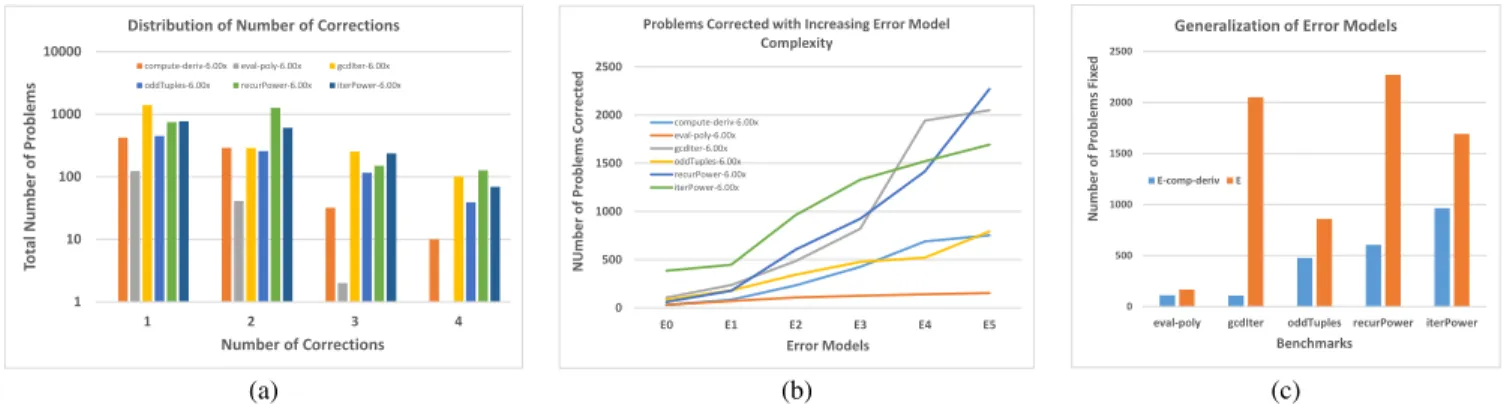
Number of Corrections The number of student submissions that require different number of corrections are shown in Figure 14(a) (on a logarithmic scale). We observe from the figure that a signif-icant fraction of the problems require 3 and 4 coordinated correc-tions, and to provide feedback on such attempts, we need a technol-ogy like ours that can symbolically encode the outcome of different corrections on all input values.
Repetitive Mistakes In this experiment, we check our hypothesis that students make similar mistakes while solving a given problem.
The graph in Figure 14(b) shows the number of student attempts corrected as more rules are added to the error models of the bench-mark problems. As can be seen from the figure, adding a single rule to the error model can lead to correction of hundreds of attempts. This validates our hypothesis that different students indeed make similar mistakes when solving a given problem.
Generalization of Error Models In this experiment, we check the hypothesis that the correction rules generalize across problems of similar kind. The result of running thecompute-deriv error model on other benchmark problems is shown in Figure 14(c). As expected, it does not perform as well as the problem-specific error models, but it still fixes a fraction of the incorrect attempts and can be useful as a good starting point to specialize the error model further by adding more problem-specific rules.
6.
Capabilities and Limitations
Our tool supports a fairly large subset of Python types and language features, and can currently provide feedback on a large fraction (64%) of student submissions in our benchmark set. In compari-son to the traditional test-cases based feedback techniques that test the programs over a few dozens of test-cases, our tool typically per-forms the equivalence check over more than 106inputs. Programs that print the output to console (e.g.compBal-stdin) pose an inter-esting challenge for test-cases based feedback tools. Since beginner students typically print some extra text and values in addition to the desired outputs, the traditional tools need to employ various heuris-tics to discard some of the output text to match the desired output. Our tool lets instructors provide correction rules that can optionally drop some of the print expressions in the program, and then the tool finds the required print expressions to eliminate so that a student is not penalized much for printing additional values.
Now we briefly describe some of the limitations of our tool. One limitation of the tool is in providing feedback on student attempts that have big conceptual errors (see Section 5.3), which can not be fixed by application of a set of local rewrite rules. Correcting such programs typically requires a large global rewrite of the student solution, and providing feedback in such cases is an open question. Another limitation of our tool is that it does not take into account structural requirements in the problem statement since it focuses only on functional equivalence. For example, some of the assignments explicitly ask students to use bisection search or recursion, but our tool can not distinguish between two functionally equivalent solutions, e.g. it can not distinguish between a bubble sort and a merge sort implementation of the sorting problem.
For some problems, the feedback generated by the tool is too low-level. For example, a suggestion provided by the tool in Fig-ure 2(d) is to replace the expressionpoly[e]==0byFalse, whereas a higher level feedback would be a suggestion to remove the cor-responding block inside the comparison. Deriving the high-level feedback from the low-level suggestions is mostly an engineering problem as it requires specializing the message based on the con-text of the correction.
The scalability of the technique also presents a limitation. For some problems that use large constant values, the tool currently replaces them with smaller teacher-provided constant values such that the correct program behavior is maintained. We also currently need to specify bounds for the input size, the number of loop un-rollings and recursion depth as well as manually provide special-ized error models for each problem. The problem of discovering these optimizations automatically by mining them from the large corpus of datasets is also an interesting research question. Our tool also currently does not support some of the Python language fea-tures, most notably classes and objects, which are required for pro-viding feedback on problems from later weeks of the class.
1def evaluatePoly(poly, x): 2 result = 0
3 for i in list(poly):
4 result += i*x**poly.index(i)
5 return result
1def getGuessedWord(secretWord, lettersGuessed): 2 for letter in lettersGuessed:
3 secretWord = secretWord.replace(letter, ’_’)
4 return secretWord
(a) anevalPolysolution (b) ahangman2-strsolution
Figure 13. An example of big conceptual error for a student’s attempt for (a)evalPolyand (b)hangman2-strproblems.
1 10 100 1000 10000 1 2 3 4 To tal Numb er o f Pr o blems Number of Corrections Distribution of Number of Corrections
compute-deriv-6.00x eval-poly-6.00x gcdIter-6.00x oddTuples-6.00x recurPower-6.00x iterPower-6.00x
0 500 1000 1500 2000 2500 E0 E1 E2 E3 E4 E5 NU mber of Pr oble ms Cor recte d Error Models Problems Corrected with Increasing Error Model
Complexity compute-deriv-6.00x eval-poly-6.00x gcdIter-6.00x oddTuples-6.00x recurPower-6.00x iterPower-6.00x 0 500 1000 1500 2000 2500
eval-poly gcdIter oddTuples recurPower iterPower
Nu mber of Pr ob le ms Fi xe d Benchmarks
Generalization of Error Models
E-comp-deriv E
(a) (b) (c)
Figure 14. (a) The number of incorrect problem that require different number of corrections (in log scale), (b) the number of problems corrected with adding rules to the error models, and (c) the performance of compute-deriv error model on other problems.
Benchmark Median Total Syntax Test Set Correct Incorrect Generated Average Median
(LOC) Attempts Errors Attempts Feedback Time(in s) Time(in s)
prodBySum-6.00 5 1056 16 1040 772 268 218 (81.3%) 2.49s 2.53s oddTuples-6.00 6 2386 1040 1346 1002 344 185 (53.8%) 2.65s 2.54s compDeriv-6.00 12 144 20 124 21 103 88 (85.4%) 12.95s 4.9s evalPoly-6.00 10 144 23 121 108 13 6 (46.1%) 3.35s 3.01s compBal-stdin-6.00 18 170 32 138 86 52 17 (32.7%) 29.57s 14.30s compDeriv-6.00x 13 4146 1134 3012 2094 918 753 (82.1%) 12.42s 6.32s evalPoly-6.00x 15 4698 1004 3694 3153 541 167 (30.9%) 4.78s 4.19s oddTuples-6.00x 10 10985 5047 5938 4182 1756 860 (48.9%) 4.14s 3.77s iterPower-6.00x 11 8982 3792 5190 2315 2875 1693 (58.9%) 3.58s 3.46s recurPower-6.00x 10 8879 3395 5484 2546 2938 2271 (77.3%) 10.59s 5.88s iterGCD-6.00x 12 6934 3732 3202 214 2988 2052 (68.7%) 17.13s 9.52s hangman1-str-6.00x 13 2148 942 1206 855 351 171 (48.7%) 9.08s 6.43s hangman2-str-6.00x 14 1746 410 1336 1118 218 98 (44.9%) 22.09s 18.98s stock-market-I(C#) 20 52 11 41 19 22 16 (72.3%) 7.54s 5.23s stock-market-II(C#) 24 51 8 43 19 24 14 (58.3%) 11.16s 10.28s restaurant rush (C#) 15 124 38 86 20 66 41 (62.1%) 8.78s 8.19s
Table 1. The percentage of student attempts corrected and the time taken for correction for the benchmark problems.
7.
Related Work
In this section, we describe several related work to our technique from the areas of automated programming tutors, automated pro-gram repair, fault localization, automated debugging, automated grading, and program synthesis.
7.1 AI based programming tutors
There has been a lot of work done in the AI community for building automated tutors for helping novice programmers learn program-ming by providing feedback about semantic errors. These tutoring systems can be categorized into the following two major classes:
Code-based matching approaches: LAURA [1] converts teacher’s and student’s program into a graph based representation
and compares them heuristically by applying program transforma-tions while reporting mismatches as potential bugs. TALUS [31] matches a student’s attempt with a collection of teacher’s algo-rithms. It first tries to recognize the algorithm used and then ten-tatively replaces the top-level expressions in the student’s attempt with the recognized algorithm for generating correction feedback. The problem with these approach is that the enumeration of all possible algorithms (with its variants) for covering all corrections is very large and tedious on part of the teacher.
Intention-based matching approaches: LISP tutor [13] cre-ates a model of the student goals and updcre-ates it dynamically as the student makes edits. The drawback of this approach is that it forces students to write code in a certain pre-defined structure and limits
their freedom. MENO-II [39] parses student programs into a deep syntax tree whose nodes are annotated with plan tags. This anno-tated tree is then matched with the plans obtained from teacher’s solution. PROUST [24], on the other hand, uses a knowledge base of goals and their corresponding plans for implementing them for each programming problem. It first tries to find correspondence of these plans in the student’s code and then performs matching to find discrepancies. CHIRON [32] is its improved version in which the goals and plans in the knowledge base are organized in a hierar-chical manner based on their generality and uses machine learning techniques for plan identification in the student code. These ap-proaches require teacher to provide all possible plans a student can use to solve the goals of a given problem and do not perform well if the student’s attempt uses a plan not present in the knowledge base. Our approach performs semantic equivalence of student’s at-tempt and teacher’s solution based on exhaustive bounded sym-bolic verification techniques and makes no assumptions on the al-gorithms or plans that students can use for solving the problem. Moreover, our approach is modular with respect to error models; the local correction rules are provided in a declarative manner and their complex interactions are handled by the solver itself. 7.2 Automated Program Repair
K¨onighofer et. al. [27] present an approach for automated error lo-calization and correction of imperative programs. They use model-based diagnosis to localize components that need to be replaced and then use a template-based approach for providing corrections using SMT reasoning. Their fault model only considers the right hand side (RHS) of assignment statements as replaceable compo-nents. The approaches in [23, 41] frame the problem of program repair as a game between an environment that provides the inputs and a system that provides correct values for the buggy expressions such that the specification is satisfied. These approaches only sup-port simple corrections (e.g. correcting RHS side of expressions) in the fault model as they aim to repair large programs with arbi-trary errors. In our setting, we exploit the fact that we have access to the dataset of previous student mistakes that we can use to con-struct a concise and precise error model. This enables us to model more sophisticated transformations such as introducing new pro-gram statements, replacing LHS of assignments etc. in our error model. Our approach also supports minimal cost changes to stu-dent’s programs where each error in the model is associated with a certain cost, unlike the earlier mentioned approaches.
Mutation-based program repair [10] performs mutations repeat-edly to statements in a buggy program in order of their suspi-ciousness until the program becomes correct. The large state space of mutants (1012) makes this approach infeasible. Our approach uses a symbolic search for exploring correct solutions over this large set. There are also some genetic programming approaches that exploit redundancy present in other parts of the code for fixing faults [5, 14]. These techniques are not applicable in our setting as such redundancy is not present in introductory programming prob-lems.
7.3 Automated Debugging and Fault localization
Techniques like Delta Debugging [44] and QuickXplain [26] aim to simplify a failing test case to a minimal test case that still exhibits the same failure. Our approach can be complemented with these techniques to restrict the application of rewrite rules to certain failing parts of the program only. There are many algorithms for fault localization [6, 15] that use the difference between faulty and successful executions of the system to identify potential faulty locations. Jose et. al. [25] recently suggested an approach that uses a MAX-SAT solver to satisfy maximum number of clauses in a formula obtained from a failing test case to compute potential error
locations. These approaches, however, only localize faults for a single failing test case and the suggested error location might not be the desired error location, since we are looking for common error locations that cause failure of multiple test cases. Moreover, these techniques provide only a limited set of suggestions (if any) for repairing these faults.
7.4 Computer-aided Education
We believe that formal methods technology can play a big role in revolutionizing education. Recently, it has been applied to multiple aspects of Education including problem generation [2, 4, 35] and solution generation [17]. In this paper, we push the frontier forward to cover another aspect namely automated grading. Recently [3] also applied automated grading to automata constructions and used syntactic edit distance like ours as one of the metrics. Our work differs from theirs in two regards: (a) our corrections for programs (which are much more sophisticated than automata) are teacher-defined, while [3] considers a small pre-defined set of corrections over graphs, and (b) we use the Sketch synthesizer to efficiently navigate the huge search space, while [3] uses brute-force search. 7.5 Automated Grading Approaches
The survey by Douce et al. [11] presents a nice overview of the systems developed for automated grading of programming assign-ments over the last forty years. Based on the age of these systems, they classify them into three generations. The first generation sys-tems [21] graded programs by comparing the stored data with the data obtained from program execution, and kept track of running times and grade books. The second generation systems [22] also checked for programming styles such as modularity, complexity, and efficiency in addition to checking for correctness. The third generation tools such as RoboProf [9] combine web technology with more sophisticated testing approaches. All of these approaches are a form of test-cases based grading approach and can produce feedback in terms of failing test inputs, whereas our technique uses program synthesis for generating tailored feedback about the changes required in the student submission to make it correct. 7.6 Program Synthesis
Program synthesis has been used recently for many applications such as synthesis of efficient low-level code [29, 38], data struc-ture manipulations [34], inference of efficient synchronization in concurrent programs [42], snippets of excel macros [18, 33], rela-tional data representations [19, 20] and angelic programming [8]. The SKETCHtool [37, 38] takes a partial program and a refer-ence implementation as input and uses constraint-based reasoning to synthesize a complete program that is equivalent to the reference implementation. In general cases, the template of the desired pro-gram as well as the reference specification is unknown and puts an additional burden on the users to provide them; in our case we use the student’s solution as the template program and teacher’s solu-tion as the reference implementasolu-tion. A recent work by Gulwani et al. [17] also uses program synthesis techniques for automatically synthesizing solutions to ruler/compass based geometry construc-tion problems. Their focus is primarily on finding a soluconstruc-tion to a given geometry problem whereas we aim to provide feedback on a given programming exercise solution.
8.
Conclusions
In this paper, we presented a new technique of automatically pro-viding feedback for introductory programming assignments that can complement manual and test-cases based techniques. The tech-nique uses an error model describing the potential corrections and constraint-based synthesis to compute minimal corrections to stu-dent’s incorrect solutions. We have evaluated our technique on a