
Pyow but not hack calls of the male putty-nosed
monkey (Cercopithcus nictitans) convey information
about caller identity
Tabitha Price1), Kate Arnold2), Klaus Zuberbühler2)
& Stuart Semple1,3)
(1School of Human and Life Sciences, Roehampton University, London SW15 4JD, UK; 2School of Psychology, University of St Andrews, St Andrews KY16 9JU, UK)
Summary
Individual differences within the acoustic structure of vocalisations have the potential to inform signal receivers about the identity of the caller. Such differences can often be explained by morphological differences of the signaller’s sound production apparatus. Natural selection may have favoured individual variation within call types, especially if identity cues enhance call function. In addition, animals may modify their vocalisations such that they sound more similar to, or more distinct from those of neighbouring conspecifics. We recorded pyow and hack vocalisations from five recognised male putty-nosed monkeys (Cercopithecus nictitans) in Gashaka Gumti National Park, Nigeria. We analysed the temporal and spectral features of both call types to investigate whether the calls contained identity cues, and whether calls of neighbouring males were less or more different in their acoustic structure than expected by chance. More parameters were found to vary significantly between individuals within pyows than hacks, and whilst pyows could be correctly assigned to individual callers more often than would have been expected by chance, hacks could not. We found no relation between geographic distance and acoustic similarity of pyows and hacks.
Keywords: Cercopithecus, vocalisations, individual differences, caller identity, acoustic
analysis.
Introduction
Variation between individuals in the acoustic structure of a single call type can convey important social information to signal receivers (Bradbury &
Vehrencamp, 1998). Studies across a wide range of species have investi-gated individual differences in signal structure within different call types and suggested that this variation has the potential to inform receivers about the signaller’s sex (Norcross & Newman, 1993; Blumstein & Munos, 2005), age class (Wanker & Fischer, 2001; Fischer et al., 2002), rank or fitness (Reby & McComb, 2003; Kitchen et al., 2003), kin group (Masters et al., 1995; Ren-dall et al., 1996), population or social group (Mitani et al., 1992; Castellano et al., 2002) and individual identity (Marler & Hobbett, 1975; Macedonia, 1986; Butynski et al., 1992; Jones et al., 1993; Hammerschmidt & Todt, 1995; Owren et al., 1997; Steenbeek & Assink, 1998; Teixidor & Byrne, 1999; Semple, 2001; Frommolt et al., 2003).
Some individual differences may result from restrictions imposed on signal structure by the signal production mechanism (Hauser, 1996). The source/filter theory of sound production describes how the larynx (source) and the supralaryngeal vocal tract (filter) function to produce sound, and appears to be relevant to all mammalian species studied so far (Fitch, 2000). Individual differences in the size and shape of the caller’s larynx and suprala-ryngeal vocal tract may result in differences in the acoustic structure of their calls, especially in the position of fundamental and formant frequen-cies (Fitch, 1997; Rendall et al., 2005).
Call function has also been implicated in the evolution of identity cues. For signallers to maximise the benefits of communication, it may be neces-sary to ensure that receivers distinguish the individual identity of the caller. Consequently, it has been suggested that selection for individually distinctive vocal cues will be stronger within calls whose function depends on the iden-tity of the caller being perceived (Bradbury & Vehrencamp, 1998). The com-munication of information related to caller identity is integral to the main-tenance of intra-group cohesion and inter-group spacing, and many studies looking for individual differences in call structure have, therefore, focused on contact calls (Symmes et al., 1979; Maurello et al., 2000; Rogers & Cato, 2002).
There is potentially less selection pressure for the inclusion of individ-ually distinctive acoustic cues within alarm calls (Blumstein et al., 2004, Blumstein & Munos, 2005), although selection on receivers to discriminate between individuals would allow them to respond in accordance with the re-liability of the caller (Cheney & Seyfarth, 1988), and in territorial species, the proximity of threat (Hare, 1998). Whilst individually distinctive alarm
calls have been reported for some species (particularly small rodents, Leger et al., 1984; McCowan & Hooper, 2002; Randall et al., 2005) individual dif-ferences in the alarm calls of non-human primate species have often been inferred from receiver responses rather than acoustic analyses of calls (Ch-eney & Seyfarth, 1988; Sproul et al., 2006) and very few studies have pro-vided evidence of such differences based on acoustic analyses (Fischer et al., 1995, 2001). Such analyses of call structure can be highly informative, as they shed light not only on whether calls are individually distinct, but also on which parameters are most relevant, or contain the necessary variability, to convey inter-individual differences.
In addition to individual differences, the geographical proximity of indi-viduals could have an impact on the acoustic structure of their calls. Within a few avian and mammalian species, individuals are capable of modifying the form of their own calls as a result of experiencing the calls of others; this process known as production learning may lead to the convergence or di-vergence of neighbouring individuals’ vocalisations (Janik & Slater, 1997). Whilst the occurrence of vocal production learning in primates is contro-versial (Egnor, 2004), regional variation in vocal communication between different populations and social groups has been identified in a few primate species (Maeda & Masataka, 1987; Elowson & Snowdon, 1994; Fischer et al., 1998; Marshall et al., 1999; Lemasson & Hausberger, 2004; Crockford et al., 2004).
Putty-nosed monkeys (Cercopithecus nictitans) live in groups, which typ-ically contain one adult male, several females, and their offspring. The vo-cal repertoire of adult males contains three acoustivo-cally distinct loud vo-calls, booms, pyows and hacks (Gautier & Gautier-Hion, 1977); booms are rare but pyow and hack calls are commonly produced. It has been proposed that pyows and hacks are given as part of a circadian rhythm and function to maintain intra-group cohesion and inter-group spacing (Gautier & Gautier-Hion, 1977), that they are produced in response to disturbances and function as general alarm calls (Struhsaker, 1970) and even as functionally referential alarm calls (Eckardt & Zuberbühler, 2004). Recent studies have suggested that pyows have multiple functions, including as general alarm and contact calls, whilst hacks function primarily as alarm calls (Arnold & Zuberbühler, 2006a; Arnold et al., 2008). A specific combination of the two call types la-belled a pyow–hack sequence appears to function in initiating group move-ment (Arnold & Zuberbühler, 2006b; Arnold & Zuberbühler, 2008). Thus,
selection for the capacity to produce individually distinctive calls is likely since the identity of the caller should influence listerners’ responses to those calls. These selection pressures should act predominantly on neighbouring males, whose calls are the most likely to be confused. It would be predicted, therefore, that there would be an inverse relationship between males’ geo-graphic proximity and the acoustic similarity of their calls.
Recent experiments suggest that female putty-nosed monkeys respond differently to their group male’s and other males’ pyow–hack sequences (Arnold & Zuberbühler, 2008). However, no studies have been carried out to investigate whether variation in individual pyow and/or hack calls of the male relate to the identity of the caller. This study aims firstly to investigate whether information about individual identity is encoded within pyow and hack calls recorded from recognised male putty-nosed monkeys, and sec-ondly to test whether the acoustic similarity of males’ calls is related to their geographical proximity.
Methods
Study site and species
Recordings were made of wild male putty-nosed monkeys within approx. 10 km2of the Kwano trail system, Gashaka Gumti National Park, Northeast
Nigeria. This area consists primarily of semi-deciduous lowland rainforest interspersed with patches of savannah woodland (Sommer et al., 2004). At this site, putty-nosed monkeys live in groups of 13–22 individuals consisting of a single adult male, 6–9 adult females, and their offspring (Arnold & Zuberbühler, 2006a). Home-range size is estimated at <1 km2 (Arnold & Zuberbühler, 2006a), and 3–4 groups are commonly found within 1 km2 (Dunn, 1993).
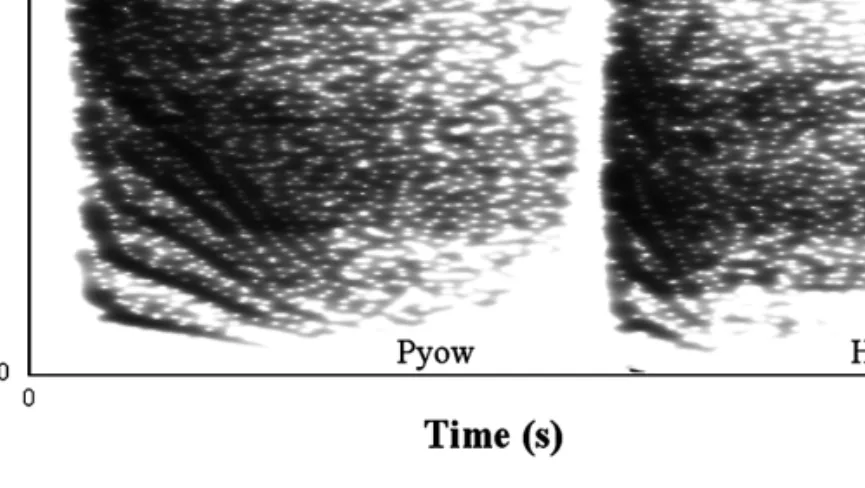
The male’s vocal repertoire contains three loud call types, but only two of these calls are commonly produced; these acoustically distinct call types have been labelled pyows and hacks. Both call types are tonal; pyows are a higher frequency call, and demonstrate a descending frequency sweep com-pared to the lower frequency and abrupt onset of hacks (Arnold & Zuberbüh-ler, 2006a, Figure 1). Pyow and hack calls produced by the sole adult male of five recognised groups were recorded. For the purpose of this study, indi-viduals were labelled 1–5.
Figure 1. Spectrographic representation of a male putty-nosed monkey’s pyow and hack call.
Individual identity analysis Recording of vocalisations
Recordings were made ad libitum between 0600–1930 h from February– June 2007. It was often difficult to identify the cause of call production; whilst some calls seemed to be given in response to another individual’s calls or to a disturbance, other calls appeared to be produced spontaneously. The calling bouts that were recorded for each male never occurred within an hour of each other, a maximum of three calling bouts were recorded per male on any given day, and the calls of each male were recorded over a period of 32 or more days (range of time between recordings; male 1, 73.6± 136.5 h; male 2, 28.9± 41.7 h; male 3, 68.3 ± 125 h; male 4, 70.0 ± 213.7 h; male 5, 51.2± 77.2 h) to ensure that call samples were independent of each other. Vocalisations were recorded using a Sennheiser MKH416 directional microphone and a Marantz PMD 671 recorder (sampling rate of 44.1 kHz, digitised at 16 bits).
Acoustic analysis
Recordings were excluded from further analysis if sound quality was too poor to extract reliable or accurate measures of acoustic parameters due to high levels of background noise (N = 5), equipment failure (N = 3) or if the male called at too great a distance from the microphone resulting in inad-equate recording quality and confidence of correct identification of the target
male (N = 12). Calling bouts were made up of pyows only, hacks only, or a combination of both call types. The first pyow and/or hack of adequate quality within each calling bout (number of bouts; male 1, N = 12, male 2,
N = 13, male 3, N = 16, male 4, N = 12, male 5, N = 16), was selected
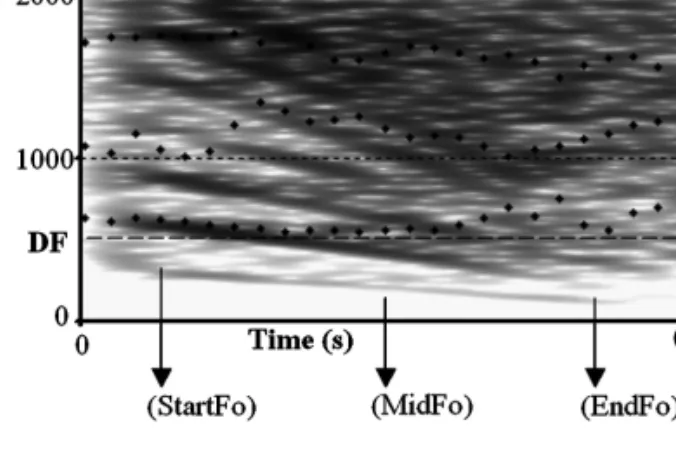
for analysis to minimise acoustic variation related to call position within the bout (Arnold & Zuberbühler, 2006a). This gave 10 samples of each call type per individual and an overall sample size of 50 pyows and 50 hacks. Praat version 4.5 (Boersma et al., 2006) was used to produce spectrograms of each call and to extract data on a range of parameters with the potential to encode information related to caller identity (Table 1, Figure 2). Whilst we refer to the pronounced frequency bands extracted by Praat formant tracker as for-mants, it should be noted that this study does not test whether these bands result from resonances in the vocal tract, or whether they are independent from F0and harmonic structures (Harris et al., 2006). In addition, pyows in
comparison to human speech have a relatively high F0 (around 300 Hz), so
that larger sections of these calls do not contain any laryngeally-generated energy. This may have affected the accuracy of Praat’s formant tracker in extracting formant frequencies.
Twenty-three measures were extracted from the spectrograms of pyows and hacks with a viewing range of 0–2500 Hz (Table 1). A narrow-band win-dow size of 0.05 s was used for extracting measures of F0and a broadband
window length set at 0.005 s was used for extracting measures of formant frequencies.
Statistical analysis
Statistical analyses of the ten pyows and ten hacks for each of the five males were carried out in SPSS 15.0 (SPSS, Chicago, IL, USA). For normally dis-tributed data, one-way ANOVAs with a significance level set at 0.05 were used to investigate the degree to which variation in extracted parameters could be explained by the identity of the caller. For the single parameter that was not normally distributed (LtasDfHz) a Kruskal–Wallis ANOVA was used instead. For significant results, parametric Tukey or non-parametric Mann–Whitney post-hoc tests were used to identify which individuals dif-fered significantly from one another. For Mann–Whitney tests the p-values of the 10 simultaneous tests (each individual compared against every other individual) were modified using a sequential Bonferroni correction to reduce
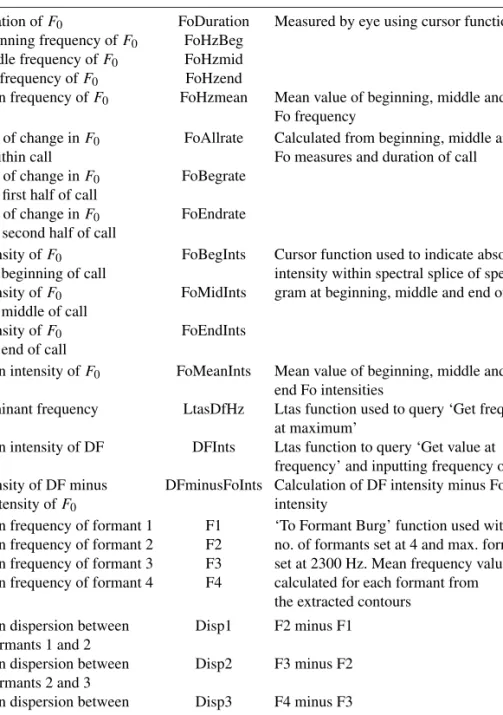
Table 1. Acoustic measurements extracted from pyow and hack calls, abbre-viations used for each parameter, and a description of how each parameter
was extracted from calls or calculated from other parameters.
Acoustic parameter Acoustic parameter Description of how acoustic parameter measured abreviation Hk/Py was measured or calculated Duration of F0 FoDuration Measured by eye using cursor function Beginning frequency of F0 FoHzBeg
Middle frequency of F0 FoHzmid End frequency of F0 FoHzend
Mean frequency of F0 FoHzmean Mean value of beginning, middle and end Fo frequency
Rate of change in F0 FoAllrate Calculated from beginning, middle and end within call Fo measures and duration of call
Rate of change in F0 FoBegrate in first half of call
Rate of change in F0 FoEndrate in second half of call
Intensity of F0 FoBegInts Cursor function used to indicate absolute at beginning of call intensity within spectral splice of spectro-Intensity of F0 FoMidInts gram at beginning, middle and end of call
at middle of call
Intensity of F0 FoEndInts at end of call
Mean intensity of F0 FoMeanInts Mean value of beginning, middle and end Fo intensities
Dominant frequency LtasDfHz Ltas function used to query ‘Get frequency at maximum’
Mean intensity of DF DFInts Ltas function to query ‘Get value at frequency’ and inputting frequency of DF Intensity of DF minus DFminusFoInts Calculation of DF intensity minus Fo mean
intensity of F0 intensity
Mean frequency of formant 1 F1 ‘To Formant Burg’ function used with max. Mean frequency of formant 2 F2 no. of formants set at 4 and max. formant Mean frequency of formant 3 F3 set at 2300 Hz. Mean frequency value was Mean frequency of formant 4 F4 calculated for each formant from
the extracted contours Mean dispersion between Disp1 F2 minus F1
formants 1 and 2
Mean dispersion between Disp2 F3 minus F2 formants 2 and 3
Mean dispersion between Disp3 F4 minus F3 formants 3 and 4
Mean dispersion between MeanDisp Mean value of Disp1, Disp2 and Disp3 all formants
Figure 2. Spectrogram of male pyow within a narrow-band window size of 0.05 s and viewing range of 0–2500 Hz. Acoustic features are annotated in reference to procedures of
acoustic analysis.
the effects of type-1 error (Rice, 1988). Within each call type, Spearman’s correlation was used to investigate the relationships between acoustic para-meters for which significant inter-individual variation was found.
All parameters were entered into separate stepwise discriminant function analyses for pyow and hack calls. If this analysis identified significant vari-ation between the calls of the different males, the individual scores for the first two discriminant functions were plotted to create an ordination diagram within which points were labelled by caller identity to show the grouping of calls within individuals. A cross-validation using the ‘leave-one-out’ method (Mundry & Sommer, 2007) was then performed to calculate predicted caller identity for each call, and the percentage of calls correctly assigned to caller was then calculated for each individual. A binomial test with a probability value set at 0.2 (given that there were 5 males in the study) was used to test whether calls were correctly assigned to caller more often than would be expected by chance.
Geographical analysis
Calculation of geographical distances between males
A GPS was used to record the geographical positions (with an accuracy of ±15 m) of each of the five males over the course of this study, using map datum WGS84 and the positions format ‘degrees and decimal mins’. These readings were put into GPS Utility (GPSU) software (GPS Utility,
Southampton, UK), and a co-ordinate was calculated for each individual from the mean values of all latitudinal and longitudinal readings. Each male was then plotted onto a map using this mean co-ordinate and the distance between each male was measured.
Calculation of acoustic differences between males
For each male, mean values were calculated for all twenty-three of the acoustic variables extracted from both his pyows and hacks. Three separate principal components analyses (PCA) were then carried out. The first in-cluded the mean values of all 46 variables (23 from pyows and the same 23 from hacks), the second included the mean values of all 23 pyow variables, and the third included the mean values of all 23 hack variables. This pro-duced three sets of 2-dimensional co-ordinates for each individual based on the acoustic values extracted from their calls. Pythagoras’ rule was then ap-plied to calculate the distances between individuals within this 2-dimensional space for each of the three data sets. This produced values of acoustic simi-larity for all pairs of individuals based on all their calls, all their pyows, and all their hacks.
Statistical analysis
Spearman’s correlation was carried out to investigate the relationship be-tween acoustic similarity and geographical distance bebe-tween males.
Results
Acoustic parameters
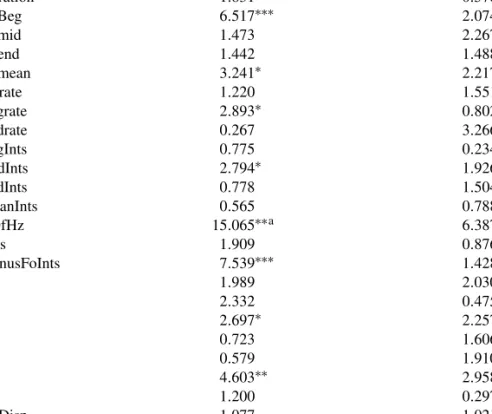
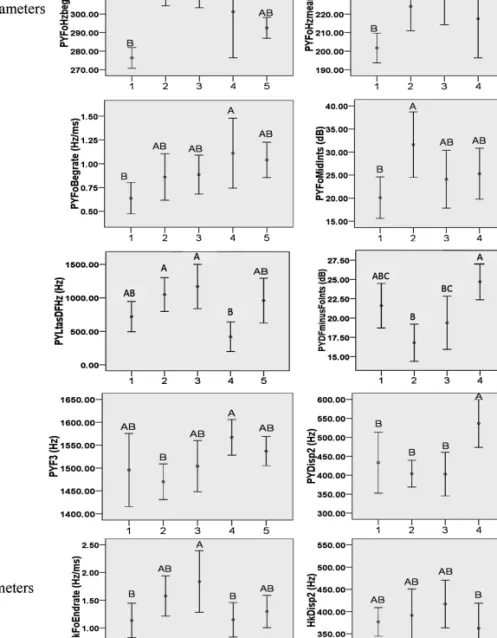
Eight of the parameters extracted from pyows showed a significant effect of caller identity; some of these eight parameters were significantly correlated with each other (Table 2). There was a significant effect of caller identity on two of the parameters extracted from hacks (Table 2); these two parameters were not correlated with each other. Post-hoc tests identified which indi-viduals differed significantly from one another within these 10 parameters (Figure 3).
Discriminant function analysis
No discrimination was made between hacks produced by different males. A significant difference was found between pyows produced by the different
Table 2. Effect of caller identity on extracted pyow and hack parameters (one-way ANOVA and Kruskal–Wallis test).
Variable Pyow F4,45or χ42 Hack F4,45or χ42
FoDuration 1.831 0.578 FoHzBeg 6.517∗∗∗ 2.074 FoHzmid 1.473 2.267 FoHzend 1.442 1.488 FoHzmean 3.241∗ 2.217 FoAllrate 1.220 1.551 FoBegrate 2.893∗ 0.802 FoEndrate 0.267 3.266∗ FoBegInts 0.775 0.234 FoMidInts 2.794∗ 1.926 FoEndInts 0.778 1.504 FoMeanInts 0.565 0.788 LtasDfHz 15.065∗∗a 6.387a DFInts 1.909 0.876 DFminusFoInts 7.539∗∗∗ 1.428 F1 1.989 2.030 F2 2.332 0.475 F3 2.697∗ 2.257 F4 0.723 1.606 Disp1 0.579 1.910 Disp2 4.603∗∗ 2.958∗ Disp3 1.200 0.297 MeanDisp 1.077 1.021 ∗p <0.05,∗∗p <0.01,∗∗∗p <0.001.
aData not normally distributed and tested with Kruskal–Wallis test. Of the parameters in py-ows that showed significant variation across individuals, the following were correlated; Fo-HzBeg and FoHzmean (rs= 0.608, p < 0.001), FoHzBeg and FoBegrate (rs= 0.334, p < 0.05), FoHzmean and LtasDFHz (rs = 0.319, p < 0.05), FoMidInts and LtasDFHz (rs = 0.375, p < 0.01), LtasDFHz and Disp2 (rs = −0.478, p < 0.001), DFminusFoInts and F3 (rs= 0.453, p < 0.01), DFminusFoInts and Disp2 (rs= 0.298, p < 0.05), F3 and Disp2 (rs= 0.632, p < 0.001).
males (Wilks’ Lambda= 0.27, p < 0.001) with PyFoHzBeg, PyDFminus-FoInts and PyDisp2 having significantly different means across the groups.
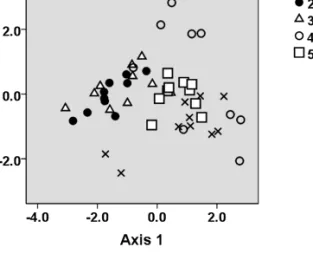
A scatter-plot using discriminant function scores for the first (explaining 75.1% of the variance; eigenvalue= 1.44) and second (explaining 19.9% of the variance; eigenvalue= 0.38) axes, and overlaid with identity information to illustrate the clustering of pyows in relation to caller identity is shown in Figure 4.
Figure 3. Variation in the ten call parameters that identified significant variation between individuals. The y-axis is an abbreviation of the parameter measured, the x-axis gives the caller’s identity, and the error bars show the mean value with 95% confidence intervals. Individuals with the same letter above their error bar are not significantly different (post-hoc Tukey tests p < 0.05, Mann–Whitney p-values modified for 10 simultaneous tests using
Figure 4. Scatter plot using the first two discriminant functions of the pyows of five adult male putty-nosed monkeys showing scores from 3 pyow parameters, overlaid with caller
identity.
Table 3. Percentage of pyow calls assigned correctly to caller through ‘leave-one-out’ cross-validation.
Individual Percentage of pyows allocated to the correct individual
1 70
2 60
3 30
4 10
5 70
A cross-validation correctly identified individual males’ pyows in 10– 70% of cases (Table 3). Pyows were correctly assigned to caller more of-ten than would be expected by chance (Binomial test, pyows N = 50, p < 0.001).
Comparing acoustic similarity with geographical distance
There was no correlation between the proximity of males and the acoustic similarity of their pooled pyow and hack calls (rs = −0.036, N = 10, p =
0.921), the acoustic similarity of their pyows (rs = 0.208, N = 10, p =
0.564), or the acoustic similarity of their hacks (rs = −0.049, N = 10, p =
Discussion
The results of this study suggest that male putty-nosed monkeys provide suf-ficient information within the acoustic structure of their pyows for receivers to differentiate between the calls of different individuals, but that hacks are not individually distinctive. There was no correlation between the geographi-cal distance between males and the acoustic similarity of their geographi-calls, suggest-ing that neighboursuggest-ing males’ calls were no more or less similar than expected by chance.
This study found that within both call types significant variation across individuals was found within measures related to the position of the F0
and spectral energy peaks (formant related measures within both call types, and within pyows, measures relating to the dominant frequency), indicating individual differences in the production and filtering of sound.
Within acoustic parameters found to vary significantly between individu-als, one or at most two individuals differed significantly from the other indi-viduals, making it unlikely that the identification of individuals’ calls would depend on perception of differences within a single parameter. A discrimi-nant function analysis, identifying patterns of call clustering based on a suite of parameters, suggested that information relating to caller identity might be encoded within more than one acoustic parameter. Playback experiments us-ing modified call exemplars would be required to test which parameters if any are relevant to receivers’ perception of individual differences (Ceugniet & Izumi, 2004; Miller & Hauser, 2004).
Stepwise discriminant function analyses found pyows but not hacks to be correctly assigned to caller significantly more often than would be expected by chance. Differences in larynx and vocal tract morphology will affect the acoustic structure of vocalizations to a greater extent within calls consisting of harmonically rich frequency spectra and broadband random noise (Owren et al., 2003). However, pyow and hack calls are similar in overall acoustic structure (Arnold & Zuberbühler, 2006a) suggesting that alternative expla-nations need to be sought for the difference between these call types in their degree of individuality.
One possible explanation is that pyows may be more individually dis-tinctive than hacks as a non-adaptive byproduct of call duration. Pyows are significantly longer than hacks (Arnold & Zuberbühler, 2006a), which may translate into more opportunities for individual differences to show.
Alterna-tively there may be stronger selection pressures for individuality within py-ows than within hacks. It has been suggested that pypy-ows are a multifunctional call, aiding intra- and inter-group communication, and alerting group mem-bers to potential danger (Arnold & Zuberbühler, 2006a; Arnold et al., 2008). Identity cues within these social contexts would be beneficial, as appropri-ate responses of signal receivers would depend on whether the caller was in their social group, belonged to a neighboring group or was an unfamiliar male. It has been suggested that hacks function as alarm signals (Arnold & Zuberbühler, 2006a; Arnold et al., 2008). Whilst some advantages have been proposed for signal receivers to recognize the individual identity of alarm callers (Hare, 1998), information about individual identity may be relatively less important in the case of alarm calls than socially functioning calls since receivers should respond to an alarm signal irrespective of the identity of the caller (Bradbury & Vehrencamp, 1998).
The idea that call function may have an effect on the degree to which call types are individually distinct is supported by a study of rhesus macaque (Macaca mulatta) vocalizations. Coo calls, which function in maintaining intra-group contact, were the most individually distinctive call type. Grunts, which function in mediating face-to-face social interactions, were less in-dividually distinctive. Screams, which are given in aggressive interactions and thought to function in recruiting aid, were least distinctive and could not reliably be assigned to caller (Rendall et al., 1998). These differences in in-dividuality may be related to the extent to which signalers need to encode identity in order for receivers to respond appropriately (Rendall et al., 1998). The finding that geographical proximity of males was not related to the acoustic similarity of their calls suggested that even though their territories could overlap, male putty-nosed monkeys did not modify their calls in re-sponse to the experience of hearing the calls of neighboring males. It is pos-sible that the strong individuality present in males’ pyows negates a need for further divergence between the calls of neighboring animals. In addition, natural selection may act on receivers to distinguish between existing dif-ferences, as opposed to on callers to increase the distinctiveness of identity cues. If male putty-nosed monkeys are incapable of learned modifications to their loud calls, then the former explanation seems more plausible.
Individual recognition plays an integral role within dominance hierar-chies, coalitions and reciprocal alliances (Bradbury & Vehrencamp, 1998), whilst known/unknown systems allow individuals to respond preferentially
to a single known individual. A previous study on this putty-nosed monkey population indicated that females responded to the pyow-hack sequences of their own group male by moving toward the caller, but did not respond simi-larly to the pyow–hack sequences of extra-group males (Arnold & Zuberbüh-ler, 2008). Playback experiments to evaluate the perception of both call types by conspecifics would be useful to investigate whether receivers perceive the inter-individual differences identified in this study, and if so to investigate whether perception resembles a system of individual recognition or a sys-tem whereby receivers differentiate between the vocal signals of known and unknown signalers.
Finally, as pyows and hacks are frequently emitted in sequences and stud-ies suggest that important information is conveyed within at least one call combination (Arnold & Zuberbühler, 2006b; Arnold & Zuberbühler, 2008), further studies should investigate the potential for individuality within call sequences in order to assess whether these, as well as the component calls within them, reveal information about the identity of the caller.
Acknowledgements
We are grateful to Volker Sommer for permitting us to carry out this research at the Kwano research station. We thank the Nigerian National Parks Service for granting a research per-mit, and the Nigerian Conservation Foundation for logistical support. Further thanks go to research assistant Buba Hammaselbe, without whom this study could not have been carried out, and Isaac Timothy who provided additional assistance in the field. Peter Shaw provided invaluable statistical advice. Ben Charlton and Karen McComb provided extremely helpful tuition and support in the use of PRAAT for acoustic analysis. Further thanks go to two anony-mous reviewers for their helpful comments on an earlier draft of this manuscript. Financial support for this project was provided by a Leakey Trust grant and Roehampton University. All protocols were noninvasive and comply with relevant Nigerian regulations.
References
Arnold, K., Pohlner, Y. & Zuberbühler, K. (2008). A forest monkey’s alarm call series to predator models. — Behav. Ecol. Sociobiol. 62: 549-559.
Arnold, K. & Zuberbühler, K. (2006a). The alarm calling behaviour of adult male putty-nosed monkeys Cercopithecus nictitans martini. — Anim. Behav. 72: 643-653.
Arnold, K. & Zuberbühler, K. (2006b). Semantic combinations in primate calls. — Nature 441: 303.
Arnold, K. & Zuberbühler, K. (2008). Meaningful call combinations in a non-human primate. — Curr. Biol. 18: 202-203.
Blumstein, D.T. & Munos, O. (2005). Individual, age and sex-specific information is con-tained in yellow-bellied marmot alarm calls. — Anim. Behav. 69: 353-361.
Blumstein, D.T., Verneyre, L. & Daniel, J.C. (2004). Reliability and the adaptive utility of discrimination among alarm callers. — Proc. Roy. Soc. Lond. B Biol. 271: 1851-1857. Boersma, P. & Weenink, D. (2006). Praat: doing phonetics by computer (Version 4.5.08) —
Retrieved December 20, 2006, from http://www.praat.org/
Bradbury, J.W. & Vehrencamp, S.L. (1998). Principles of animal communication. — Sinauer Associates, Sunderland, MA.
Butynski, T.M., Chapman, C.A., Chapman, L.J. & Weary, D.M. (1992). Use of male blue monkey pyow calls for long term individual identification. — Am. J. Primatol. 28: 183-189.
Castellano, S., Cuatto, B., Rinella, R., Rosso, A. & Giacoma, C. (2002). The advertisement call of the European treefrogs (Hyla arborea): a multilevel study of variation. — Ethol-ogy 108: 75-89.
Ceugniet, M. & Izumi, A. (2004). Vocal individual discrimination in Japanese monkeys. — Primates 45: 119-128.
Cheney, D.L. & Seyfarth, R.M. (1988). Assessment of meaning and the detection of unreli-able signals by vervet monkeys. — Anim. Behav. 36: 477-486.
Crockford, C., Herbinger, I., Vigilant, L. & Boesch, C. (2004). Wild chimpanzees produce group-specific calls: a case for vocal learning? — Ethology 110: 221-243.
Dunn, A. (1993). The large mammals of Gashaka Gumti National Park, Nigeria. — Unpub-lished report to NCF, WWW-UK.
Eckardt, W. & Zuberbühler, K. (2004). Cooperation and competition in two forest monkeys. — Behav. Ecol. 15: 400-411.
Egnor, S.E.R. & Hauser, M.D. (2004). A paradox in the evolution of primate vocal learning. — Trends Neurosci. 27: 11-17.
Elowson, A.M. & Snowdon, C.T. (1994). Pygmy marmosets, Cebuella pygmaea, modify vocal structure in response to changed social environment. — Anim. Behav. 47: 1267-1277.
Fischer, J., Hammerschmidt, K., Cheney, D.L. & Seyfarth, R.M. (2001). Acoustic features of female chacma baboon barks. — Ethology 107: 33-54.
Fischer, J., Hammerschmidt, K., Cheney, D.L. & Seyfarth, R.M. (2002). Acoustic features of male baboon loud Calls: influences of context, age, and individuality. — J. Acoust. Soc. Am. 111: 1465-1474.
Fisher, J., Hammerschmidt, K. & Todt, D. (1995). Factors affecting acoustic variation in Barbary macaque (Macaca sylvanus) disturbance calls. — Ethology 101: 51-66. Fisher, J., Hammerschmidt, K. & Todt, D. (1998). Local variation in Barbary macaque shrill
barks. — Anim. Behav. 56: 623-629.
Fitch, W.T. (1997). Vocal tract length and formant frequency dispersion correlate with body size in rhesus macaques. — J. Acoust. Soc. Am. 102: 1213-1222.
Fitch, W.T. (2000). The evolution of speech: a comparative review. — Trends Cogn. Sci. 4: 258-267.
Frommolt, K.H., Mikhail, E.G. & Macdonald, D.W. (2003). Barking foxes, Alopex lagopus: field experiments in individual recognition in a territorial mammal. — Anim. Behav. 65: 509-518.
Gautier, J.P. & Gautier-Hion, A. (1977). Communication in old world monkeys. — In: How Animals Communicate (Sebeok, T. ed.). Indiana University Press, Bloomington, IN, p. 890-964.
Hammerschmidt, K. & Todt, D. (1995). Individual differences in vocalizations of young Barbary macaques (Macaca sylvanus) — a multi-parametric analysis to identify critical cues in acoustic signalling. — Behaviour 132: 381-399.
Hare, J.F. (1998). Juvenile Richardson’s ground squirrels, Spermophilus richardsonii, dis-criminate among individual alarm callers. — Anim. Behav. 55: 451-460.
Harris, T.R., Fitch, W.T., Goldstein, L.M. & Fashing, P.J. (2006). Black and white colobus monkey (Colobus guereza) roars as a source of both honest and exaggerated information about body mass. — Ethology 112: 911-920.
Hauser, M.D. (1996). The evolution of communication. — MIT Press, Cambridge, MA. Janik, V.M. & Slater, P.J.B. (1997). Vocal learning in mammals. — Adv. Stud. Behav. 26,
59-99.
Jones, B.S., Harris, D.H.R. & Catchpole, C.K. (1993). The stability of the vocal signature in phee calls of the common marmoset, Callithrix jacchus. — Am. J. Primatol. 31: 67-75. Kitchen, D.M., Seyfarth, R.M., Fischer, J. & Cheney, D.L. (2003). Loud calls as an indicator of dominance in male baboons, Papio cynocephalus ursinus. — Behav. Ecol. Sociobiol. 53, 374-384.
Leger, D.W., Berney-Key, S.D. & Sherman, P.W. (1984). Vocalizations of Belding’s ground squirrels (Spermophilus beldingi). — Anim. Behav. 32: 753-764.
Lemasson, A. & Hausberger, M. (2004). Patterns of vocal sharing and social dynamics in a captive group of Campbell’s monkeys (Cercopithecus cambelli cambelli). — J. Comp. Psychol. 118: 347-359.
Macedonia, J.M. (1986). Individuality in a contact call of the ringtailed lemur (Lemur catta). — Am. J. Primatol. 11: 163-179.
Maeda, T. & Masataka, N. (1987). Locale-specific vocal behaviour of the tamarin (Saguinus
l. labiatus). — Ethology 75: 25-30.
Marler, P. & Hobbett, L. (1975). Individuality in a long-range vocalization of wild chim-panzees. — Z. Tierpsychol. 38: 97-109.
Marshall, A.J., Wrangham, R.W. & Arcadi, A.C. (1999). Does learning affect the structure of vocalizations in chimpanzees? — Anim. Behav. 58: 825-830.
Masters, W.M., Raver, K.A.S. & Kazial, K.A. (1995). Sonar signals of big brown bats.
Eptesi-cus fusEptesi-cus. Contain information about individual identity, age, and family affiliation. —
Anim. Behav. 50: 1243-1260.
Maurello, M.A., Clarke, J.A. & Ackley, R.S. (2000). Signature characteristics in contact calls of the white-nosed coati. — J. Mammal. 81: 415-421.
McCowan, B. & Hooper, S.L. (2002). Individual acoustic variation in Belding’s ground squirrel alarm chirps in the High Sierra Nevada (L). — J. Acoust. Soc. Am. 111: 1157-1160.
Miller, C.T. & Hauser, M.D. (2004). Multiple acoustic features underlie vocal signal recog-nition in tamarins: antiphonal calling experiments. — J. Comp. Physiol. 190: 7-19. Mitani, J., Hasegawa, T., Gros-Louis, J., Marler, P. & Byrne, R. (1992). Dialects in wild
chimpanzees? — Am. J. Primatol. 27: 233-243.
Mundry, R. & Sommer, C. (2007). Discriminant function analysis with nonindependent data: consequences and an alternative. — Anim. Behav. 74: 965-976.
Norcross, J.L. & Newman, J.D. (1993). Context and gender specific differences in the acoustic structure of common marmoset (Callithrix jacchus) Phee calls. — Am. J. Pri-matol. 30: 37-54.
Owren, M.J., Rendall, D. & Bachorowski, J. (2003). Nonverbal vocal communication. — In: Primate psychology: bridging the gap between the mind and behavior of human and nonhuman primates (Maestripieri, D., ed.). Harvard University Press, Cambridge, MA, p. 359-394.
Owren, M.J., Seyfarth, R.M. & Cheney, D.L. (1997). The acoustic features of vowel-like grunt calls in chacma baboons (Papio cyncephalus ursinus): implications for production processes and functions. — J. Acoust. Soc. Am. 101: 2951-2963.
Randall, J.A., McCowan, B., Collins, K.C., Hooper, S.L. & Rogovin, K. (2005). Alarm signals of the great gerbil: acoustic variation by predator context, sex, age, individual, and family group. — J. Acoust. Soc. Am. 118: 2706-2714.
Reby, D. & McComb, K. (2003). Vocal communication and reproduction in deer. — Adv. Stud. Behav. 33: 231-264.
Rendall, D., Kollias, S., Ney, C. & Lloyd, P. (2005). Pitch (Fo) and formant profiles of human vowels and vowel-like baboon grunts: the role of vocalizer body size and voice-acoustic allometry. — J. Acoust. Soc. Am. 117: 944-955.
Rendall, D., Owren, M.J. & Rodman, P.S. (1998). The role of vocal tract filtering in the identity cueing of monkey (Macaca mulatta) vocalizations. — J. Acoust. Soc. Am. 103: 602-614.
Rendall, D., Rodman, P.S. & Emond, R.E. (1996). Vocal recognition of individuals and kin in free ranging rhesus monkeys. — Anim. Behav. 51: 1007-1015.
Rice, W.R. (1988). Analyzing tables of statistical tests. — Evolution 43: 223-225.
Rogers, T.L. & Cato, D.H. (2002). Individual variation in the acoustic behaviour of the adult male leopard seal, Hydrurgaleptonyx. — Behaviour 139: 1267-1286.
Semple, S. (2001). Individuality and male discrimination of female copulation calls in the yellow baboon. — Anim. Behav. 61: 1023-1028.
Sommer, V., Adanu, J., Faucher, I. & Fowler, A. (2004). Nigerian chimpanzees (Pan
troglodytes vellerosus) at Gashaka: two years of habituation efforts. — Folia Primatol.
75: 295-316.
Sproul, C., Palleroni, A. & Hauser, M.D. (2006). Cottontop tamarin, Saguinus Oedipus alarm calls contain sufficient information for recognition of individuality. — Anim. Behav. 72: 1379-1385.
Steenbeek, R. & Assink, P. (1998). Individual differences in long-distance calls of male wild Thomas langurs (Presbytis thomasi). — Folia Primatol. 69: 77-80.
Struhsaker, T.T. (1970). Phylogenetic implications of some vocalisations of Cercopithecus Monkeys. — In: Old world monkeys: evolution, systematics and behaviour. (Napier, J.R. & Napier, P.H., eds). Academic Press, London, p. 365-407.
Symmes, J., Newman, J.D., Talmage-Riggs, G. & Lieblich, A.K. (1979). Individuality and stability of isolation peeps in squirrel monkeys. — Anim. Behav. 27: 1142-1152. Teixidor, P. & Byrne, R.W. (1999). The ‘whinny’ of spider monkeys: individual recognition
before situational meaning. — Behaviour 136: 279-308.
Wanker, R. & Fischer, J. (2001). Intra-and interindividual variation in the contact calls of spectacled parrotlets (Forpus conspicillatus). — Behaviour 138: 709-726.
![Exacerbation of the mild steel corrosion process by direct electron transfer between [Fe-Fe]-hydrogenase and material surface](data:image/gif;base64,R0lGODlhAQABAIAAAP///wAAACH5BAEAAAAALAAAAAABAAEAAAICRAEAOw==)