
HAL Id: hal-00429854
https://hal.archives-ouvertes.fr/hal-00429854
Submitted on 4 Nov 2009
HAL is a multi-disciplinary open access
archive for the deposit and dissemination of
sci-entific research documents, whether they are
pub-lished or not. The documents may come from
teaching and research institutions in France or
abroad, or from public or private research centers.
L’archive ouverte pluridisciplinaire HAL, est
destinée au dépôt et à la diffusion de documents
scientifiques de niveau recherche, publiés ou non,
émanant des établissements d’enseignement et de
recherche français ou étrangers, des laboratoires
publics ou privés.
Fractional path coloring on bounded degree trees
Ioannis Caragiannis, Afonso Ferreira, Christos Kaklamanis, Stéphane
Pérennes, Hervé Rivano
To cite this version:
Ioannis Caragiannis, Afonso Ferreira, Christos Kaklamanis, Stéphane Pérennes, Hervé Rivano.
Frac-tional path coloring on bounded degree trees. Proceedings of the 28th ICALP, Jul 2001, Greece.
pp.732–743. �hal-00429854�
Fractional Path Coloring with Applications to
WDM Networks
?Ioannis Caragiannis1, Afonso Ferreira2, Christos Kaklamanis1,
St´ephane P´erennes2, and Herv´e Rivano2
1
Computer Technology Institute and Department of Computer Engineering and Informatics
University of Patras, 26500 Rio, Greece E–mail: {caragian,kakl}@cti.gr
2
MASCOTTE Project I3S & INRIA Sophia Antipolis B.P. 93, 06902 Sophia Antipolis Cedex, France
E–mail: {Afonso.Ferreira,Stephane.Perennes,Herve.Rivano}@sophia.inria.fr
Abstract. This paper addresses the natural relaxation of the path col-oring problem, in which one needs to color directed paths on a sym-metric directed graph with a minimum number of colors, in such a way that paths using the same arc of the graph have different colors. This classic combinatorial problem finds applications in the minimization of the number of wavelengths in wavelength division multiplexing (wdm) all–optical networks.
1
Introduction
Graph coloring (or vertex coloring) is a fundamental problem of Computer Sci-ence. Given a graph, the graph coloring problem is to assign colors to vertices in such a way that adjacent vertices are assigned different colors and the number of colors used is minimized.
In general, graph coloring is very hard to solve to optimality or even to approximate. A related problem, the path coloring problem, consists in coloring a set P of paths on a graph G so that two paths sharing an edge of G have different colors. This problem is equivalent to coloring the corresponding conflict graph, i.e., the graph whose vertices represent the paths of P and where there is an edge between vertices representing conflicting paths. Notice, however, that this problem was proven to be the same as standard graph coloring in terms of complexity or difficulty to approximate, since any n-vertex graph is the conflict graph of a set of paths of an n × n grid [CGK92]. Furthermore, Tarjan proved it to be N P-hard even for trees [Tar85].
?This work was supported in part by the European Union under IST FET
Project ALCOM–FT and Improving RTN Project ARACNE. Afonso Ferreira and St´ephane P´erennes are researchers with the French CNRS.
Our work is motivated by applications in wavelength division multiplexing (wdm) optical networks and call scheduling, which has recently triggered a re-newed interest in path coloring on special classes of graphs. In such applications, one is given an optical network with n nodes and a multiset of point-to-point communication requests, and must assign to each request a lightpath and to each lightpath a color (wavelength) so that conflicting lightpaths (i.e., lightpaths using the same link) are assigned different colors. The goal is to minimize the number of colors used. This problem (known as the wavelength routing problem) has been widely studied in the literature [Tuc75,BGP+96,EJK+99,ACKP00] . It has been proved to be difficult (N P-hard even for rings); moreover one can show that there exist networks with O(n2) vertices and n requests on which it is hard to decide if the optimal number of colors is either 1 or n; thus, in general, the problem is also hard to approximate.
In this paper we study the case where the lightpaths have already been assigned to requests. It is then clear that the above problem is reduced to path coloring, with the only difference that the underlying graph is usually directed (since optical transmissions are one-way) and symmetric. Note that there are important differences between the directed and the undirected version of the problem; for instance, the problem can be solved in polynomial time in symmetric directed stars, but is in N P-hard for undirected stars [Bea00].
In the rest of the paper we shall focus on the directed version of the path coloring problem. Unless otherwise specified, we shall use the terms paths and graphs to denote directed paths and symmetric directed graphs, respectively.
1.1 Previous work
Recently, several papers studied path coloring on simple networks like meshes, rings and trees [BGP+96,GHP97,Kum98,EJK+99] . Most of the results study
the relationship between the load of the set of paths (i.e., the maximum number of paths crossing an arc) and the number of colors of an optimal coloring. Notice that the load is a lower bound for the optimal number of colors.
For rings (where the problem is indeed the classical circular arc coloring problem), a 32 approximation was proposed in [Kar80]; this approximation ratio was recently improved to a 1 +1e ≈ 1.37 by Kumar [Kum98]. This latter result exploits a reduction of the circular arc coloring problem to a special instance of integral multicommodity flow problem due to Tucker [Tuc75]. Indeed, the color-ing of [Kum98] is obtained by, first, solvcolor-ing the multicommodity flow problem with fractional numbers and then, by performing a randomized rounding of this solution.
For trees, Erlebach et al. [EJK+99] present a polynomial time deterministic
algorithm which colors any set of paths of load π using at most 5π/3 colors. This algorithm is greedy in the following sense: it proceeds in phases, one per each node v of the tree. The nodes are considered following their breadth–first numbering. The phase associated with node v, assumes that there is already a partial proper coloring where all paths that touch (i.e., start, end, or go through) nodes with numbers strictly smaller than v’s have been colored and no other path
has been colored. It has also been proved that this algorithm is optimal within the class of greedy deterministic algorithms [EJK+99].
Recently, Auletta et al. [ACKP00] used a different approach for binary trees. Instead of computing greedily a solution from top to bottom, the algorithm actually keeps a distribution of solutions (it computes from top to bottom one random element of the distribution). With high probability, an element of the distribution have the particularity to look locally random (i.e., in each 3-star). This implies some kind of “average case” of the greedy deterministic algorithm and, hence, an improvement of the approximation ratio. Finally, the algorithm colors any set of paths of load π on a binary tree using at most 7π/5 + o(π) colors, with high probability. The hidden constants in the low order term are huge and are due to the integrality constraints of the problem, and the random choices of the algorithm.
Note that these two results approximate the optimal number of colors within 5/3 and 7/5 + o(1), respectively.
1.2 Our results
Our approach is based on the fact that the graph coloring problem is equivalent to assigning unit cost to some of the independent sets of the graph such that all vertices are covered (i.e., are contained in an independent set of unit cost) and the total cost (i.e., the number of independent sets of unit cost) is minimized.
We then observe that Kumar’s fractional solution [Kum98] gives in fact an op-timal fractional coloring [GLS81], a natural relaxation of graph coloring, where the independent sets covering the vertices of the graph may have fractional weights. Notice, however, that this relaxation is generally also hard to approxi-mate.
The positive side of our observation is that it allows us to prove several results related to integral and fractional path coloring, as follows.
– In Section 3 we show that fractional path coloring in bounded degree trees is polynomial. This result is constructive, i.e., our algorithm inductively builds a polynomial size linear program whose final solution is such an optimal fractional coloring.
– This fractional path coloring algorithm for trees can be easily adapted to any bounded–degree and bounded–treewidth graph, as described in Section 4.1. Also, extending our techniques, we characterize polynomially solvable in-stances of the fractional path coloring problem in general graphs in Sec-tion 4.2.
– We show an upper bound of 7π/5 on the fractional path chromatic number in binary trees in terms of the load π of the set of paths (see Section 4.3). This is somewhat related to the results in [ACKP00] since, their random algorithm can be seen as an attempt to emulate a balanced fractional coloring and, on the other hand, a balanced fractional coloring can be interpreted as a perfect random sample. However, our fractional analysis is much simpler, our algorithm is deterministic, and our bound is tighter.
– With respect to integral path coloring, in Section 4.4 we provide a ran-domized approximation algorithm for path coloring in bounded–degree trees with approximation ratio 1.61 + o(1). This is done by applying randomized rounding to the fractional solution presented in Section 3.
In the next section we recall the formal definitions of (fractional) coloring and (fractional) path coloring.
2
Fractional coloring
The graph coloring problem can be considered as finding a minimum cost integral covering of the vertices of a graph by independent sets of unit cost. Given a graph G = (V, E), this means solving the following integer linear program:
minimize P
I∈Ix(I)
subject to P
I∈I:v∈Ix(I) ≥ 1 ∀ v ∈ V
x(I) ∈ {0, 1} ∀ I ∈ I where I denotes the set of the independent sets of G.
This formulation has a natural relaxation into the following linear program: minimize P
I∈Ix(I)¯
subject to P
I∈I:v∈Ix(I) ≥ 1¯ ∀ v ∈ V
0 ≤ ¯x(I) ≤ 1 ∀ I ∈ I
The corresponding combinatorial problem is called the fractional coloring problem (see [GLS81]), and the value of an optimal solution is called fractional chromatic number wf(G).
If ¯x is a valid cost function over the independent sets of the graph G, we call it a fractional coloring of G. We use the symbol ¯x(G) to denote the cost of the solution ¯x.
In general, the fractional chromatic number is as hard to approximate as the chromatic number since a classical result states that any ρ–approximation of the fractional chromatic number leads to a ρ log(n)–approximation of the chromatic number. Indeed the size of the above described linear problem is exponential (proportional to the number of independent sets of G).
It is well–known [GLS81] that the dual of the above linear program is the following: maximize P v∈V y(v) subject to P v∈Iy(v) ≤ 1 I ∈ I y(v) ≥ 0
In this problem, a non–trivial constraint is violated if and only if the weight of one independent set I, defined as the sum of the weights of its verticesP
v∈Iy(v),
is a separation oracle for this last problem. According to the separation and op-timization equivalence (see [GLS93], Th. 4.2.7, page 106, and [GLS81]), the dual of fractional coloring and the mwis are equivalent up to polynomial reduction. Thus, computing the fractional chromatic number is polynomially equivalent to solving mwis, which is polynomial for trees [Gar94]. However, this duality argu-ment does not provide any effective fractional coloring algorithm but rather a way to compute the fractional chromatic number.
We now extend some terms of graph coloring to path coloring. Given a set of paths P on a graph G, we define an independent set of paths as a set of pairwise arc–disjoint paths, i.e., a set of paths whose corresponding vertices form an independent set of the conflict graph. If Gc is the conflict graph of P on G, we
will denote by w(G, P) (wf(G, P)) the (fractional) chromatic number of Gc and
call them the (fractional) path chromatic number of P on G. We will also denote by π(G, P) the load of P on G. i.e. the maximum number of paths of P using any fixed edge of G.
As far as the relationship between w and wf is concerned, the following result
is implicit in the work of Kumar [Kum98] which addresses the case of the ring: w(Cn, P) ≤ wf(Cn, P) +
π(Cn, P)
e + o(π(Cn, P)).
In the very specific case where the conflict graph is a proper circular arc graph, Niessen and Kind proved that w = dwfe in [NK98].
In the next section we show that optimal fractional path colorings in bounded– degree trees can be computed by solving a small linear program. Our technique can be easily extended to networks of bounded degree and bounded treewidth. As an application (Section 4), we adapt the idea of producing path colorings by applying the randomized rounding technique to fractional path colorings and obtain 1.61– and 2.22–approximation algorithms for path coloring in bounded– degree trees, and trees of rings, respectively.
3
An algorithm for fractional path coloring in trees
In this section we study the fractional path coloring problem in trees. We assume that paths are labeled so that labels are unique, and given a set of paths we will denote P(p) the path of family P which has label p. The special label ∅ will be associated to a non-existent or void path.
3.1 Trace of a fractional coloring
Given a solution ¯x for path coloring that is a weight function ¯x on the indepen-dent sets of the tree T , we define the trace of the fractional coloring ¯x on an edge e as the following function Xe:
- For any label p, let I(p) be the set of independent sets containing P(p), and I(p, q) = I(p) ∩ I(q).
- For any pair of label p, q such that P(p) and P(q) use e in opposite directions, let Xe(p, q) =P
I∈I(p,q)¯x(I).
- For any label p such that P(p) uses e, let Ie(p, ∅) be the set of inde-pendent sets of I(p) using e in only one direction, and let Xe(p, ∅) = P
I∈Ie(p,∅),p∈Ix(I).¯
- Finally let Ie(∅, ∅) be the set of independent sets not using e.
Given an instance of fractional path coloring (T, P), we denote by Sol((T, P), c) the set of all the fractional coloring of (T, P) with cost less than c.
3.2 Split and merge
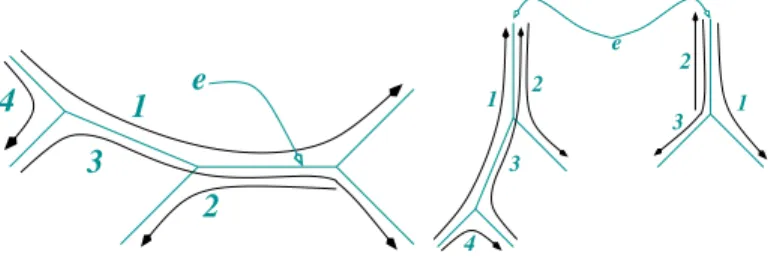
Our algorithm is constructing inductively a polynomial size linear program whose solution provides a fractional coloring. Our induction is based on merge and split operations which allow to build any instance of fractional path coloring starting from instances on stars (i.e. a tree of height 1) and merging them step by step. Consider a fractional path coloring of (T, P) where T is not a star and such that e = [u, v] is a non-terminal edge of T . The splitting of T on edge e is two smaller instances of fractional path coloring (T1, P1) and (T2, P2) defined as
follows (cf. Figure 1):
e
4
3
2
1
e 1 2 3 4 1 2 3Fig. 1. Splitting a tree on e.
- Let U1 and U2 be the two connected components of T \ {u, v}, and let
T1= U1∪ {[u, v]} , T2= U2∪ {[u, v]}.
- Let P1 = P ∩ T1, P2 = P ∩ T2 (i.e in each subtree each original path is
replaced by the path it induces with a label equal to the original one). Note that the split operation can be easily reverted by a merge one if one keeps track of the paths labels and of the edge where the split occurred. In what follow we will always assume that (T, P) can be split on the edge e into (T1, P1)
and (T2, P2).
Now, we prove that one can build Sol((T, P), c) from Sol((T1, P1), c) and
Proposition 1 The elements of Sol((T, P), c) are obtained by merging elements of Sol((T1, P1), c) and Sol((T2, P2), c) having the same trace on e.
Proof: First we remark that any fractional coloring of T with cost c induces fractional colorings on (T1, P1) and (T2, P2) with cost less than c. From
con-struction both have the same trace on e.
Conversely, given two fractional colorings ¯x1 ∈ Sol((T1, P1), c) and ¯x2 ∈
Sol((T2, P2), c) having the same trace X1e and X2e on e, we merge them into a
fractional coloring in Sol((T, P), c) by repeating the following procedure until Xe
1(p, q) = 0, ∀p, q:
- If for some pair of labels p and q (including the ∅ label) Xe
1(p, q) > 0, then
since Xe
1(p, q) = X2e(p, q) there exists I1 ∈ I1(p, q) and I2 ∈ I2(p, q) with
¯
x1(I1) > 0 and ¯x2(I2) > 0.
- Let ¯xmin= min(¯x1(I1), ¯x2(I2)).
- Let I = I1\ {P1(p), P1(q)} ∪ I2\ {P2(p), P2(q)} ∪ {P(p), P(q)}, and note
that I is an independent set of T
- Increase ¯x(I) by ¯xmin decrease ¯x1(I1) and ¯x2(I2) by ¯xmin.
To verify the claim, just note that the procedure preserves the following invariant:
- trace equality (Xe 1 = X2e)
- Paths are covered either by ¯x1, ¯x2 or ¯x
- ¯x(T, P) + ¯x1(T1, P1) = ¯x(T, P) + ¯x2(T2, P2) = c
It follows that, at the end, ¯x is a fractional coloring of (T, P) with cost c. Moreover, for i = 1, 2 the trace of ¯x on any edge of T equals the one of ¯xi in
Ti. ut
Corollary 2 We can compute a polynomial size linear program whose solutions are valid traces of elements of Sol((T, P), c)
Proof: We first assume that such a program does exist for bounded degree d stars, a naive way to get one is to use labeled independent set variables, that is one variable for any possible labeled independent set in a bounded degree star (as paths are labeled, we must distinguish between similar path having different labels). Hence, if the load is π, at most (π)2d different labeled independent sets can correspond to an unlabeled independent set. Hence a pessimistic estimate count about M (d)π2dvariables, where M (d) is the number of perfect matchings
in Kd,d. Fractional coloring is trivially described from these variables, then the
trace variables are simple sum of subsets of the labeled independent set variables. We then use an inductive algorithm to generate a linear program whose solutions are traces of Sol((T, P), c). Assume that T can be split on edge e into (T1, P1) and (T2, P2) and let Sibe the linear program for traces of Sol((Ti, Pi), c),
where we assume that the trace on e is associated to the variables Xe
i(p, q). Then
a system for (T, P) is:
S = S1∪ S2∪ {X1e(p, q) = X e
2(p, q) | ∀p, q}
u t Proposition 3 Fractional path coloring in bounded–degree d trees can be reduced to solving a polynomial size linear program.
Proof: We simply have to show how to compute an element of Sol((T, P), c) from a trace X = {Xe, ∀e ∈ T } of an element of Sol((T, P), c) (obtained from
corollary 2). Again we proceed inductively: we start from stars and find for each one a fractional coloring having the trace that X induces on it. Then if (T, P) can be split into (T1, P1) and (T2, P2), proposition 1 provides a way to merge
fractional colorings of (T1, P1) and (T2, P2) when their traces are equal, and this
is the case since they are subsets of X . ut
3.3 Reducing the problem size
Note that our first model induces very large systems since we could get O(nπ6)
variables for binary trees, and O(nπ8) for ternary ones. In this section we show
how to reduce the system size to O(dM (d)π2n), that is a size of order O(nπ2)
for bounded degree trees (with still a huge constant).
Proposition 4 Fractional path coloring in bounded-degree d trees can be reduced to solving a linear program of size O(dM (d)π2n).
Proof: First and without loss of generality we assume that the load is uniform. Corollary 2 shows that the size of the linear program of the fractional path coloring of (T, P) of cost less than c is O(nπ2) plus the sum of the sizes of the
linear programs for each star of the tree T , which is less than n times the size for a star of degree d.
We use a flow-like description for the fractional path coloring problem of a star which can be related to a well-known property: the matching polytope of a bipartite graph is encoded by simple flow equations (or, equivalently, probability matrices are convex combination of permutation matrices).
Let us consider a star S = {v0, v1, . . . , vd} ⊆ T where v0 is the center of S
and d its degree. Arcs of S are {(v0, vi), (vi, v0), ∀i ∈ [1, . . . , d]}. Let M be the
set of load 1 independent sets of S (i.e. subsets of paths in S loading each arc exactly once). For all M ∈ M, we build an auxiliary flow problem FM:
- For each path P(p) ∈ T including a path of M , we add a vertex V (p) . - For each pair of vertices V (p), V (q) such that ∃ i ∈ [1, . . . , d] | (v0, vi) ⊆ P(p)
- We define a flow function1f
M on the arcs which induces a flow function fM0
on the vertices.
- For each leaf vi of the star we add the constraint
X
p|(v0,vi)⊆P(p)
fM0 (V (p)) = cM
Any solution of the previous system induces a covering of the paths with weight f0(p) and a subpart of the trace equals to f (p, q).
The total system for a star is obtained as follows: - The FM, M ∈ M : considered all together.
- X(p, q) =P
M ∈MfM(p, q) : computation of the trace variables.
-P
M ∈Mf 0
M(p) ≥ 1 : covering of the paths.
-P
M ∈McM ≤ c : cost constraint.
Due to the above mentioned property of the matching polytope, this system describes the fractional coloring problem for a star with an encoding of the trace variables.
It follows the fractional coloring of each stars of T can be described with a system of size at most M (d)(= |M|) times π2d. Hence the system for T is of
size O(dM (d)π2n). ut
Notice that an optimal fractional coloring can be computed in polynomial time even if the degree of the tree is d = O(max{log π/ log log π, log n/ log log n}), since M (d) = O(d!).
4
Extensions and applications
In this section we extend the technique described in the previous section to graphs of bounded degree and bounded treewidth. We also characterize instances in arbitrary networks which can be solved in polynomial time. Furthermore, we obtain an algorithm for fractional path coloring on binary trees with cost at most 7π/5. Using the results for the fractional path coloring, we achieve improved approximation algorithms for the path coloring problem in (bounded–degree) trees and trees of rings and upper bounds for the path chromatic number in terms of the fractional path chromatic number and the load.
4.1 Graphs of bounded degree and bounded treewidth
In the case of graphs of bounded degree and bounded treewidth, we obtain the following:
1
By flow function we mean conservative for vertices. One can note that this function is a circulation since no sink and no source is present
Proposition 5 Fractional path coloring can be solved in polynomial time in graphs of bounded degree and bounded treewidth.
Proof sketch: The proof follows similar lines with the one for trees. Now, split and merge operations are applied to cuts of the graph. Since treewidth is bounded, we can consider cuts in which the number of edges is upper–bounded by a constant. The trace variables are defined for each edge of the cut, leading to O(π2k) trace variables, where k is bounded by the treewidth. ut
4.2 Some polynomial instances
Based on the technique described in Section 3, we can characterize instances of the path coloring problem in general graphs which can be solved in polynomial time.
Note that our approach in Section 3 can be considered as dynamic program-ming where one maintains a polynomial encoding of the valid traces. We express the result in terms of the number of non–isomorphic paths crossing any cut of a graph. Recall that two paths are called isomorphic if they share the same (directed) edges of the graph.
Proposition 6 If the number of non–isomorphic paths crossing any cut of a graph is bounded, the fractional path coloring problem can be solved in polynomial time.
Proof sketch: Assuming that the number of non–isomorphic paths crossing any cut of the graph is upper–bounded by a constant k, the trace for each cut we consider can be encoded with at most O(πk) trace variables. ut
Note that this result depends only on properties of the set of paths; not on the underlying graph.
4.3 Fractional path coloring on binary trees
Fractional coloring of binary trees can be performed using a particular coloring, called balanced coloring, where the traces depend only on the number of paths going trough an arc (in some sense it can be seen as a perfect random sample). Proposition 3 states that the paths of the tree can be colored independently (using fraction of colors) in each 3-star, so that one can find a global fractional coloring consistent with the local colorings.
A simple but exhaustive analysis shows that 3-stars can be colored in a balanced way with at most 7
5π colors. We then obtain that, given a set of paths
P on a binary tree T , the algorithm computes a fractional path coloring of P with cost at most 7π(T ,P)5 .
Proposition 7 For any set of paths P of load π(T, P) on a binary tree T , there exists a fractional coloring of cost 7π(T ,P)5 . Moreover, such a fractional coloring can be computed in polynomial time.
As a corollary, we obtain that given a set of paths P on a binary tree T , the maximum independent set of paths of P has size at least 7π(T ,P)5|P| .
4.4 Integral path coloring in trees
In this section we present an important application of our methods to the path coloring problem in trees.
Note that the result of [EJK+99] states that there exists a polynomial time
algorithm which colors any set of paths P of load π(T, P) on a tree T with at most 5π(T, P)/3 colors. Since the load π(T, P) is a lower bound for the optimal number of colors, this gives a 5/3–approximation algorithm. In the following we exploit the (optimal) solution for the fractional path coloring which can be obtained in polynomial time for bounded–degree trees to design a randomized algorithm with better approximation ratio.
Given a solution ¯x of the fractional path coloring of the set of paths P on a tree T , the idea is to perform a randomized rounding to ¯x and obtain an integral solution x. After rounding, x is not a feasible solution to the path coloring problem since some of the constraints of the form P
I∈I:p∈Ix(I) ≥ 1 may be
violated. However, this is a feasible solution to the path coloring problem on the set of paths P0 ⊆ P, defined as the set of paths contained in independent sets I such that x(I) = 1. This means that we have properly color some of the paths of P with wf(T , P) colors.
Following the analysis of [Kum98], we can show that if π(T, P) = Ω(log n), where n is the number of vertices in T , then after the rounding procedure the load of paths in P\P0, i.e., the load of the paths not colored, is
π(T, P\P0) ≤π(T, P)
e + o(π(T, P))
with high probability. Now, we can apply the algorithm of [EJK+99] to color
the paths in P\P0 with 5π(T ,P)
3e + o(π(T, P)) additional colors. In total, we use
at most
wf(T, P) +
5π(T, P)
3e + o(π(T, P))
colors. Since π(T, P) ≤ wf(T, P) ≤ w(T, P), we obtain the following results.
Proposition 8 There exist a randomized 1.61 + o(1)–approximation algorithm to the path coloring problem in bounded–degree trees.
Corollary 9 For any set of paths P on a tree T , it holds: w(T, P) ≤ wf(T, P) +
5π(T, P)
3e + o(π(T, P)).
We can also apply similar arguments to bounded–degree trees of rings to obtain a 2.22–approximation algorithm.
5
Conclusions
Our research in this paper was motivated by questions related to the design of wavelength division multiplexing optical networks.
We developed a new approximation tool for wdm networks by using the classical fractional coloring. Many applications of our techniques to wdm net-works can be foreseen, as in branch and bound methods, or even in the design of multifiber networks .
One intriguing open problem is to prove better bounds on the size of the gap between the cost of integral and fractional path coloring in trees. We conjecture that this gap is small.
References
[ACKP00] V. Auletta, I. Caragiannis, C. Kaklamanis, and P. Persiano. Randomized path coloring on binary trees. In Proc. of the 3rd International Workshop on Approximation Algorithms for Combinatorial Optimization Problems (AP-PROX’00), LNCS 1913, Springer, pp. 60–71, 2000.
[Bea00] B. Beauquier. Communications dans les r´eseaux optiques par multiplexage en longueur d’onde. PhD thesis, Universit´e de Nice-Sophia Antipolis, 2000. [BGP+96] J-C. Bermond, L. Gargano, S. P´erennes, A. A. Rescigno, and U.
Vac-caro. Efficient collective communication in optical networks. In Proc. of the 23rd International Colloquium on Automata, Languages and Programming (ICALP’96), LNCS 1099, Springer, pp. 574–585, 1996.
[CGK92] I. Chlamtac, A. Ganz, and G. Karmi. Lightpath communications: An ap-proach to high bandwidth optical WAN’s. IEEE Transactions on Communica-tions, 40(7):1171–1182, 1992.
[EJK+99] T. Erlebach, K. Jansen, C. Kaklamanis, M. Mihail, and P. Persiano. Opti-mal wavelength routing on directed fiber trees. Theoretical Computer Science, 221(1-2):119–137, 1999.
[Gar94] N. Garg. Multicommodity Flows and Approximation Algorithms. PhD thesis, Indian Institute of Technology, Delhi, April 1994.
[GHP97] L. Gargano, P. Hell, and S. P´erennes. Colouring paths in directed symmetric trees with applications to WDM routing. In Proc. of the 24th International Colloquium on Automata, Languages and Programming (ICALP’97), LNCS 1256, Springer, pp. 505–515, 1997.
[GLS81] M. Gr¨otschel, L.Lov´asz, and A. Schrijver. The ellipsoid method and its con-sequences in combinatorial optimization. Combinatorica, 1:169–197, 1981. [GLS93] M. Gr¨otschel, L. Lov´asz, and A. Schrijver. Geometric Algorithms and
Com-binatorial Optimization, volume 2. Springer, 2nd corrected edition, 1993. [Kar80] I. A. Karapetian. On coloring of arc graphs. Doklady Akad. Nauk Armianskoi
CCP, 70(5):306–311, 1980. (In Russian)
[Kum98] V. Kumar. Approximating circular arc colouring and bandwidth allocation in all-optical ring networks. In Proc. of the 1st International Workshop on Approx-imation Algorithms for Combinatorial Optimization Problems (APPROX’98), 1998.
[NK98] T. Niessen and J. Kind. The round-up property of the fractional chromatic number for proper circular arc graphs. Journal of Graph Theory, 1998. [Tar85] R. E. Tarjan. Decomposition by clique separators. Discrete Mathematics,
55(2):221–232, 1985.
[Tuc75] Alan Tucker. Coloring a family of circular arcs. SIAM Journal of Applied Mathematics, 29(3):493–502, November 1975.
![[PDF] Manuel complet du langage C++ pour les nuls | Cours informatique](data:image/gif;base64,R0lGODlhAQABAIAAAP///wAAACH5BAEAAAAALAAAAAABAAEAAAICRAEAOw==)