HAL Id: tel-00804893
https://tel.archives-ouvertes.fr/tel-00804893
Submitted on 26 Mar 2013
HAL is a multi-disciplinary open access
archive for the deposit and dissemination of
sci-entific research documents, whether they are
pub-lished or not. The documents may come from
teaching and research institutions in France or
abroad, or from public or private research centers.
L’archive ouverte pluridisciplinaire HAL, est
destinée au dépôt et à la diffusion de documents
scientifiques de niveau recherche, publiés ou non,
émanant des établissements d’enseignement et de
recherche français ou étrangers, des laboratoires
publics ou privés.
Services Lifecycle Management using Distributed
Computing Infrastructures in Neuroinformatics
Javier Rojas Balderrama
To cite this version:
Javier Rojas Balderrama. Services Lifecycle Management using Distributed Computing Infrastructures
in Neuroinformatics. Distributed, Parallel, and Cluster Computing [cs.DC]. Université Nice Sophia
Antipolis, 2012. English. �NNT : 2012NICE4053�. �tel-00804893�
UNIVERSITE NICE SOPHIA ANTIPOLIS
Ecole Doctorale de Sciences et Technologies
de l’Information et de la Communication
T H E S E
pour obtenir le titre de
Docteur en Sciences
de l’Université Nice Sophia Antipolis
Discipline : Informatique
présentée et soutenue par
Javier R
B
le 11 avril 2012
GESTION DU CYCLE DE VIE DE SERVICES DEPLOYES
SUR UNE INFRASTRUCTURE DE CALCUL DISTRIBUEE
EN NEUROINFORMATIQUE
Thése dirigée par Johan M
et Diane L
et préparée au sein du laboratoire I3S, équipe
Jury :
Bernard G
Inserm, Rennes
Rapporteur
Johan M
CNRS, Sophia Antipolis
Directeur
Christian P
Inria, Lyon
Rapporteur
Services Lifecycle Management
Using Distributed Computing Infrastructures
in Neuroinformatics
Contents
Abstract v
Abbreviations vii
Thesis statement ix
I Command–line interface applications as services
1
1 Services as building blocks of scienti c experiments 3
1.1 Interoperable applications . . . 4
1.2 Web services . . . 5
1.3 Metacomputing and global computing . . . 8
1.4 Survey of tools supporting command–line applications reuse . . . 12
1.5 Conclusion . . . 17
2 Models for e cient reuse of applications 19 2.1 Enabling in production Grid infrastructures . . . 19
2.2 E cient use of local resources . . . 22
2.3 Abstraction of command–line applications . . . 24
2.4 Discussion . . . 36
3 Reference implementation framework 37 3.1 Lifecycle of services. . . 38
3.2 Non–functional concerns integration . . . 47
3.3 Framework integration into third–party software . . . 50
3.4 Implementation outcomes . . . 52
3.5 Conclusion . . . 53
II Scienti c work ows in neuroimaging
55
4 Scienti c work ows 57 4.1 Elements of scienti c work ows . . . 574.2 G & M . . . 60
4.3 Summary . . . 63
5 Neuroimaging use–cases 65 5.1 neuroimaging at a glance . . . 65
5.2 Automatic brain segmentation . . . 68
5.3 Longitudinal atrophy detection in Alzheimer’s disease . . . 76
CONTENTS
6 Enactment of scienti c work ows on production s 81
6.1 Work ow design . . . 82
6.2 Materials and methods . . . 83
6.3 Results . . . 87
6.4 Discussion . . . 94
Conclusions and perspectives 101
Appendix Schema of the application description 109
Appendix Template–based source code generation 113
Abstract
There is an increasing interest among scienti c communities for sharing data and applications in order to support research and foster collaborations. Interdisciplinary domains like neurosciences are particularly eager of solutions providing computing power to achieve large–scale experimenta-tion. Despite all progresses made in this regard, several challenges related to interoperability, and scalability of Distributed Computing Infrastructures are not completely resolved though. They face permanent evolution of technologies, complexity associated to the adoption of production envi-ronments, and low reliability of these infrastructures at runtime.
This work proposes the modeling and implementation of a service–oriented framework for the execution of scienti c applications on Distributed Computing Infrastructures taking advantage of High Throughput Computing facilities. The model includes a speci cation for description of com-mand–line applications; a bridge to merge service–oriented architectures with Global computing; and the e cient use of local resources and scaling. A reference implementation is proposed to demonstrate the feasibility of the approach. It shows its relevance in the context of two applica-tion–driven research projects executing large experiment campaign on distributed resources. The framework is an alternative to existing solutions that are often limited to execution consideration only, as it enables the management of legacy codes as services and takes into account their com-plete lifecycle. Furthermore, the service–oriented approach helps designing scienti c work ows which are used as a exible and way of describing application composed with multiple services.
The approach proposed is evaluated both qualitatively and quantitatively using concrete appli-cations in the area of neuroimaging analysis. The qualitative experiments are based on the opti-mization of speci city and sensibility of the brain segmentation tools used in the analysis of Mag-netic Resonance Images of patient a ected by Multiple Sclerosis. On the other hand, quantitative experiments deal with speedup and latency measured during the execution of longitudinal brain atrophy detection in patients impaired by Alzheimer’s disease.
Abbreviations
Ajax Command De nitionThe Alzheimer’s Disease Neuroimaging Initiative Application Programming Interface
Business Process Execution Language Computing element
Command–lined Interface Central nervous system
Common Object Request Broker Architecture Cerebro–spinal uid
Computer tomography
Distributed Computing Infrastructure Distributed Interactive Engineering Toolbox
Distributed Infrastructure with Remote Agent Control European Grid Initiative
The European Molecular Biology Open Software Suite Fluid attenuated inversion recovery sequence
FMRIB Software Library
Generic Application Service Wrapper Grid Computing
Grid Execution Management for Legacy Code Applications Gray matter
GridFTP Grid File Transfer Protocol
g The Grid Remote Application Virtualisation Interface Graphical User Interface
Grid Work ow E cient Enactment for Data Intensive Applications High Throughput Computing
Interface Description Language Interquartile range
Java Architecture for Binding
- The Java for –based
ABBREVIATIONS
Job Description Language
Java implementation for the Simple for Grid Applications JavaScript Object Notation
Logging and Bookkeeping Local coe cient criteria
Legacy Code Interface Description Metacomputing
Median Absolute Deviation Montreal Neurological Institute Magnetic Resonance Imaging Nuclear Magnetic Resonance Open Grid Services Architecture Proton density–weighted Positron Emission Tomography Partial volume e ect
- REgular LAnguage for Next Generation Remote procedure call
Storage element
Simple Conceptual Uni ed Flow Language
SHaring Interoperable Work ows for large–scale scienti c simulations on Available s initiative
Service-oriented Architecture Simple Object Access Protocol Sum of squared di erence
Single Photon Emission Computed Tomography Uniform resource locator
Uniform resource identi er The Virtual Imaging Platform White matter
Workload management system Web service
Web service Description Language Web services Resource Framework Extensible Markup Language
Thesis Statement
Introduction
There is a high interest among scienti c communities for the creation and investigation of theoreti-cal models, and the acquisition and analysis of experimental data. These activities are fundamental in order to validate previous results, encourage new interpretations, foster collaborations, and en-able further ndings. However, many important challenges, ranging from infrastructure support to frameworks development passing through modeling, need to be faced to pursue experimental campaigns.
Distributed computing infrastructures ( ) have become a strong driver for scienti c innova-tion because they enable scientists to mutualize resources such as data, computing facilities, and data analysis procedures. These infrastructures pave the way to the emergence of cross–institutional scienti c communities. In addition, s deliver computing and data storage capability needed to address “big science” challenges. To support longstanding experimental campaigns, s provide experiment management frameworks with abstraction layers that shield the users from the com-plexity of the underlying technologies and tools. Large–scale experimentation on such infrastruc-tures remains di cult to setup and conduct though. Distributing computations related to an ex-perimental campaign, deploying application components over an infrastructure, and monitoring applications executions massively distributed are activities requiring skills that most scientists are not acquainted with. Therefore the amount of work that scientists put to make those infrastruc-tures suited for their speci c interest can be considerable and this work rarely addresses the need of a wide range of users in this context.
In practice, data analysis tools developed by scientists make intensive use of command–line interfaced ( ) applications. The tools are broadly adopted in scienti c computation both for practical and historical reasons. They frequently represent legacy validated implementations. The applications provide simple but versatile invocation interfaces, and they are commonly avail-able. However, these applications do not usually follow any standard speci cation to implement their invocation interfaces. They are not designed to interact with other applications in order to build complex data analysis procedures in the form of assembled processing pipelines, or work-ows. Additionally, the profusion of invocation speci cations and the lack of a uniform way to process data and generate results make their use limited in a distributed environment. These con-siderations restrict applications sharing across institutions, even if their users belong to the same scienti c community.
THESIS STATEMENT
Distributed infrastructures serve s through broadly–adopted batch systems. Batches were initially designed to exploit command–line interfaces in remote tools invocation on local or wide-area distributed infrastructures. An extended variety of batch systems and workload management systems have been developed to match the need of di erent infrastructure scales. Yet, these simple remote computing environments process computing tasks on–the– y and they do not address the problems of application tools deployment nor consider the structure of experiment work ows.
The tools deployment, and data to process in s involves to handle aspects bound to access and operation of infrastructures, and applications installation. Production infrastructures do not ensure systematically resilient and reliable services. These infrastructures face well–identi ed prob-lems such as high latency, unfair balance between execution tasks, and a non–negligible failure rate. Furthermore, the deployment is often managed at an administrative level, limiting the au-tonomy of scientists throughout experimentation.
E cient scienti c experimentation also requires strategies for tools execution and advanced data manipulation. Despite the progresses made in data–intensive application composition with the settlement of scienti c work ows, this approach stumbles on integration obstacles for the en-actment of applications. Control structures and iteration strategies, that scienti c work ows lan-guages provide to automate work ows execution, cannot be fully exploited whereas the parame-ters of applications are not properly described and the results conveniently handled.
The neuroimaging community, for instance, needs to analyze large brain image datasets. Sci-entists are interested in designing complex work ows combining image analysis tools from dif-ferent sources. Their activities are often focused on statistical analysis procedures which involve the processing of large population data. Besides, they deal with sensitive data geographically dis-tributed. The case studies of this community draw attention to the management of applications, their composition and enactment as scienti c work ows, and ful llment of external concerns.
In fact, the instrumentation of scienti c experiments is not only conditioned to the infrastruc-ture and the methods that scientists use to conduct their studies. They regularly have to contem-plate additional concerns during experimentation to ful ll institutional policies, protect informa-tion, or monitor the execution platform. Thus, the integration of external concerns such as data access control, users authentication, infrastructure load balancing, or processing validation is nec-essary all along the process in order to carry out a successful experimentation.
Nowadays, multiple barriers slow advances in applied research because of the lack of appro-priate working frameworks. Scientists usually have access to local computing resources that com-monly reach power calculation limits during large experimental campaigns. Although scientists may also count on distributed computing facilities, hence the combination of local and remote het-erogeneous platforms makes experimentation challenging. The existing platforms partially allow users to manage the deployment of applications on s, design work ows, and perform e cient executions in a comprehensive environment.
Objectives
Objectives
As a result of the analysis drafted in the previous section the following objectives motivate the work reported in this manuscript. They aim at improving grid computing experience, specially for neu-roimaging scientists, by simplifying experiments design, and by providing e cient enactment.
1. Specify an abstraction of applications supporting executions on s.
2. Implement an extensible framework enabling integration of non–functional concerns. 3. Adopt a deployment strategy ensuring scalable and exible experimentation.
4. Ensure reliable and resilient executions on heterogeneous infrastructures. 5. Design scienti c work ows instances of neuroimaging use–cases.
6. Enact scienti c work ows e ciently exploiting local and remote computing resources. Ful lling these objectives lead to a technical distributed–computing framework implementa-tion. Exploiting this framework, as part of an interdisciplinary collaboration, the applicative part of this work also focuses on two neuroimaging use–cases: the automatic brain segmentation, and the longitudinal atrophy detection in Alzheimer’s disease. These research e orts aim at helping in the treatment of brain conditions encompassing tools and techniques for analysis, modeling and simulation. The establishment of links between interdisciplinary domains encourages new sci-enti c insights, makes existing tools and data more valuable, and new studies more reliable and reproducible.
Contributions
This work is positioned in the eld of neuroinformatics, as it deals with the organization of neu-roscience applications and data with computational models and their implementations. However, it is not limited to that particular area since the contributions are valid for any domain interested in software interoperability or production s utilization. This work speci cally pays attention to the way users handle applications in order to perform large–scale experimentation.
The speci cation of a scheme to describe applications detailed in Chapter2eases their (re)use. The details of the interface invocation presented in a uniform manner becomes an expressive in-strument to work with the data structures and types associated to the application’s parameters. This abstraction enables the endorsement of applications descriptions to open and compliant im-plementations of like Web services by transforming instances of the application scheme into standard de nitions. Additionally, the introduction of the application’s characteristics related to the execution into the de nition of the application, such as system requisites or environment de-pendencies, leads to the adoption of heterogeneous infrastructures and multiple platforms. These characteristics identify clearly the requirement for each execution instance.
THESIS STATEMENT
The exhibition of applications as modular and interoperable components involves the in-strumentation of the logic concerning the interpretation of the arguments, dependencies con gu-ration, and the execution. This transformation is complex due to the need to respect the applica-tions nature, and the integration of non–functional concerns associated to platform of execution or data management. Chapter3presents a reference implementation of a approach detailing the lifecycle of applications as services.
The deployment of applications as Web services also brings together exibility and scala-bility. The software development involved in this work carries out the implementation of an end-to–end framework for applications wrapping, deployment and execution control. This strategy of deployment engages the manifest replication of services and load balancing of hosting servers in order to achieve large–scale experimentation. In addition, the extensive use of distributed com-puting infrastructures is granted seamlessly. The framework o ers a single interface to process services invocations by dynamic reallocation of resources. The execution resilience and reliabil-ity on such infrastructures is ensured by the implementation of resubmission mechanisms, data replication, integration of multilevel job scheduling, and control of remote computing sites.
Finally, applications in neuroimaging are proposed in the second part of this thesis. The rep-resentation of applications as Web services allows their composition as scienti c work ows. This approach describes the interactions and dependencies of applications using a highly expres-sive language that includes iteration strategies for advanced data manipulation. The design of sci-enti c work ows promotes e cient executions of data–intensive applications. A work ow enact-ment involves multiple levels of parallelism delegating at the same time data staging to execution endpoints. In addition, e ciency is enhanced introducing local resources for executions. This in-clusion, conceived as a modeling to dispatch execution request based on resources availability, be-comes a vehicle to overcome the latency caused by batch systems overheads. It is also a mechanism to reduce the failure rate associated to remote executions.
Context
This work was motivated by and applied to driver projects: NeuroLOG in the area of neurosinfor-matics, and concerning the improvement aspects of the large–scale experimentation. Both develop collaborative platforms and are grounded on a translational research view. They make extensive use of applications and scienti c work ows. The NeuroLOG project constitutes the base context in terms of the reference framework development and use–cases, whereas that the project provides elements to ensure enactment e ciency.
The NeuroLOG project
NeuroLOG¹is an applied research project that aims at integrating process, data, and knowledge in neuroimaging [Montagnat,2011]. The NeuroLOG project fosters the adoption of health–grids in a pre–clinical community for supporting multi–centric studies targeting the treatment of four pathologies: multiple sclerosis, brain tumors, cerebral strokes, and Alzheimer’s disease.
Context
The NeuroLOG project has developed a platform in a distributed environment. The platform interfaces existing neuroinformatics resources (databases and processing tools) without modi ca-tion of the legacy environment implemented at each participating site. The platform is grounded on a common domain ontology also developed within the project, which provides a reference for unifying the heterogeneous data representations adopted by the federation of partners. In addition to the federation of resources, NeuroLOG provides an interface to distributed computing infrastruc-tures. It enables the bundling of neuroimage processing and their relocation for remote execution when handling compute intensive tasks. The platform includes a work ow manager used to de-scribe complex image analysis pipelines, potentially involving large datasets. Federated datasets and processing tools are semantically annotated. This domain knowledge is used to validate the coherency of planed processing. The processing is enriched at runtime thanks to the inference of new facts through the application of semantic rules attached to data processing tool classes. The NeuroLOG platform is a prototype deployed over several sites (Grenoble, Paris, Rennes, Sophia An-tipolis) to demonstrate the validity of its federated approach.
NeuroLOG is guided by a prospective vision of biomedical research, where data is: • commonly available to large user communities,
• described and shared using reference domain ontologies,
• browsable through search engines exploiting knowledge represented in ontologies,
• exploitable in an interdisciplinary framework that facilitates the binding of experimental facts from di erent domains and contexts, and
• applied to heavy–processing tasks implying distributed infrastructures. Similarly, the processing tools are:
• exposed as Web services for easier dissemination and use,
• integrated in processing pipelines through semantic annotations for easier compatibility val-idation of their linked inputs and outputs, and
• outsourced to distributed infrastructures such as grids for fast and reliable execution. The NeuroLOG characteristics, specially those concerning the processing tools, become the re-quirement analysis of this work. They represent the guiding thread for reuse modeling and de-velopment. Additionally, the use–cases considered in this project are suitable examples of study and validation support. In fact, neuroimaging tools are typically computational intensive applica-tions with long execution timespans; work on large–size datasets; and the research teams working with them are specialized on speci c topics. Therefore the collaboration and tools sharing not only enhance the understanding of integrative aspects in neurosciences. The conducted studies also provide quantitative information that may be statistically analyzed, corroborated, and compared. The results may be a product of interdisciplinary e orts concentrated at the same time in involved methods and available resources.
THESIS STATEMENT
The VIP project
The Virtual Imaging Platform ( ) project²targets multi–modality, multi–organ and dynamic (4D) medical images simulation. Integrating proved simulation software of the four main imaging modal-ities, the platform copes with interoperability challenges among simulators, addresses compati-bility issues between organ models and provides transparent access to computing and storage re-sources.
To tackle interoperability issues, the semantics of models and simulation tools are made ex-plicit. This will be achieved using annotations referring to a set of consistent ontologies describing the organ models, the simulation data processing, the simulation tools and the simulated images. Associated repositories and software interfaces will ease experiment design, assisted simulator and model integration. To address the computational challenge, distributed computing infrastructure technologies are employed. Yet, to cope with reliability issues of large–scale production environ-ments, proposes to develop a multi–infrastructure execution environment able to use both local computing resources (multi–core servers and clusters) and large–scale grids. No heavy code paral-lelization is involved though: speedup is provided from data and code parallelism only, naturally expressed in simulations.
V includes a strong application aspect to guarantee the adequacy of the resulting environ-ment with the needs of imaging techniques developers, model designers and image processing re-searchers. Speci cally, includes four applicative objectives that are used to demonstrate this adequacy. These applications are (1) the validation CT simulator, (2) the development of a new US sequence for motion detection, (3) the modelling of in ammation process from simu-lation, and (4) the evaluation of cardiac segmentation algorithms from multi–modality images.
While the project covers a diversi ed range of simulations, this work focuses on the reuse and the execution interoperability aspects. Its working environment constitutes an example of the integrative e ort of software development, to provide a comprehensive framework to scientists, taking into account non–functional concerns and heterogeneous environments of execution.
Organization
The document is composed of seven chapters, organized in two parts. The rst part reports the proposed solution to the challenges identi ed during the work with applications on distributed computing infrastructures. The second part addresses the scienti c work ows as an e cient al-ternative raised by neuroimaging experimentation at large–scale. Each part may be read inde-pendently because it includes the context formulation and the results. However, cross–references throughout the document make a reading thread inviting to follow the sequence of chapters from the introduction to the conclusions.
The rst part “Command–line Interface Applications as Services” is organized as follows: Chapter1: Services as building blocks of scienti c experiments. It is a state–of–the–art in the eld of
services, distributed computing infrastructures, and tools to manage command–line applica-²V project:http://vip.creatis.insa-lyon.fr/
Organization
tions. This chapter is essential to understand the adopted approach in this work, and identify the technological challenges.
Chapter2: Models for reuse of command–line applications. It represents the theoretical contribution of this work. An encompassing model of service–oriented architecture and global comput-ing is presented. In the same way, a strategy is de ned for the e cient use of local resources during work ow enactment. Finally, a complete speci cation to describe command–line ap-plications is de ned. This chapter was partially published in [Rojas Balderrama et al.,2010]. Chapter3: Reference implementation framework. It represents the software development contribu-tion. A comprehensive working environment for wrapping, deployment, and execution of scienti c applications is detailed from the lifecycle perspective. This chapter was included in [Ferreira da Silva et al.,2011], and [Rojas Balderrama et al.,2011].
The second part “Scienti c Work ows in Neuroimaging” makes extensive use of the develop-ment e orts for application reuse, and software integration addressed in the rst part. It is orga-nized as follows:
Chapter4: Scienti c work ows. It is a comprehensive summary of concepts about data represen-tation, the adopted scienti c work ow environment and its underlying language speci ca-tion. This chapter represents the conceptual pointers required for work ows design and en-actment of use–cases introduced in the next chapter.
Chapter5: Neuroimaging use–cases. It reports on the neuroimaging examples adopted in this work: the automatic brain segmentation, and the longitudinal atrophy detection in Alzheimer’s disease. This chapter summarizes the interdisciplinary work performed in collaboration with the Asclepios team from . These use–cases were presented in [Rojas Balderrama et al., 2008], and [Gibaud et al.,2011].
Chapter6: Enactment and execution on production distributed computing infrastructures. It details the scienti c work ow instantiation of the neuroimaging use–cases; and the experimentation focused on qualitative results, and execution scalability on production environments. First part of this chapter was published in [Pernod et al.,2008] and the second one in [Rojas Balder-rama et al.,2012]
A nal chapter recapitulates the conclusions, and states the prospects.
Part I
Command–line Interface Applications
as Services
Chapter 1
Services as Building Blocks
of Scientific Experiments
Scienti c communities take advantage of principles, as such architectures have for long demon-strated their ability to handle interoperability emphasizing on concepts of reusable and autonomous software components (among others). However does not enable legacy applications reuse per se. Legacy applications, provided as command lines, are a fundamental part for processing and ana-lyzing scienti c data. There are also “new command–line applications” which are not legacy but developed as it for simplicity and the ability to use them though regular batch systems. These ap-plications represent a huge foregoing investment. They encapsulate algorithms that still respond to the expectations of users, and they are not re–implementable using modern techniques due to lack resources and time. In addition, the real need to access such applications from other com-puters, and the requirement of a programmatic way to invoke them, motivate the implementation of non–intrusive approaches to wrap them as services to enable their reuse. The impact of inten-sive use of legacy applications also pushed to look for new environments to obtain fast and reliable frameworks adopting distributed computing infrastructures and preserve those applications as the building blocks of scienti c experiments.
The command–line interface tools, conceived to be executed on console terminals, are consid-ered legacy applications because they have a simple interface to interact with users and they are not designed to interoperate with other applications or be executed remotely. These applications are executed using parameters to provide inputs, and describe outputs in a syntax that is not always uniform. They depend on system environment variables, and often require additional libraries to run. Web services can be a solution to reuse command–line applications providing a technology stack to deliver results over Internet without worrying on installation or con guration because they can run remotely exchanging information, and interoperating by means of standard mechanisms. This chapter summarizes the state–of–the–art for the reuse of legacy applications as services, the adoption of distributed computing infrastructures to overcome the increasing need of power computation, and a brief review of initiatives that take into account the principles in legacy application transformations. It introduces several technologies involved in reusability, interoper-ability, and scalability.
SERVICES AS BUILDING BLOCKS OF SCIENTIFIC EXPERIMENTS
1.1
Interoperable applications
There has been a long–standing desire in software engineering for a standard way of collecting and using software. Initially conventional middleware were developed at a time where the sys-tems were limited to local private networks or conditioned to the Internet using mere adaptions. They were conceived to resolve speci c problems in a well–de ned context. Later, the interactions between applications, specially when they are located in a distributed environment, were assured by communication models. Protocols of communication were de ned standing out expressive-ness, convenient combination, and semantic soundness. Technologies implementing such proto-cols enabled interoperability between programming languages, operative systems, and computer architectures. Two major examples are the Remote Procedure Call ( ) systems, and the object request brokers.
1.1.1 Remote procedure call
The original goal of remote procedure call ( ) [Birell and Nelson,1984] was to provide a transpar-ent way to call procedures in remote computers based on the clitranspar-ent/server architecture. In fact, the mechanism is the underlying principle of most of current middleware because it introduced the concept of Interface De nition Language ( ). An is an abstraction of the procedures rep-resentation specifying the input/output parameters. The represents the description of the ser-vice provided by the server. Once the is de ned, a compiler generates the client and server stubs. The stubs are a model of data representation and the references to their implementation. When a client performs a call, the client stubs are used to ask the execution of the remote procedure. Next, the server stubs call the procedure itself and send back the results to the client stub. Finally, the client stub returns the results of the application to the client.
1.1.2 Object request broker
An object request broker [CORBA,2008] is a middleware supporting the interoperability between remote objects. This is a natural evolution of the for adapting to the Object Oriented Paradigm. The goal of this brokers is close to the . They mask the complexity behind the remote invocation. The most famous implementation is of the Object Management Group.¹It is a speci cation and an architecture for the creation and management of distributed and object–oriented applica-tions over a network. The speci cation is independent to any implementation regarding the programming language or the operative system. C de nes the communication interfaces using – , a more powerful language compared to because it supports concepts of her-itage and polymorphism. Moreover, implements a dynamic invocation based on a discovery mechanism on the client side that is not possible with . Other types of object brokers are also available, such as and its descendant + of Microsoft,²and the Java Remote Method Invo-cation³( ). However and + are speci c to Microsoft operating systems, and is a
¹Object Management Group:http://www.omg.org/
²Microsoft Component Object Model Technologies:http://www.microsoft.com/com ³Java :http://download.oracle.com/javase/6/docs/technotes/guides/rmi
Web services
Java–based technology restricted to work from the Java Virtual Machine.
1.1.3 Discussion
The e ective reuse of application with or object request brokers is di cult to accomplish due to the code instrumentation. The protocol, for instance, despite its independence re-garding programming languages, requires to implement the objects of the communication inter-faces. In consequence, this is not practical for widespread use because working with source code is inevitable.
At the same time, and later the protocol were incapable to resolve completely inter-operability problems such as data interchange and execution autonomy in heterogeneous archi-tectures. Moreover, the consensus of such technologies was limited and alternatives based on formats emerged quickly because of their neutral approach. This initially promoted their cohabi-tation speaking the same vocabulary but later the industry identi ed Web services as a promising implementation to face interoperability.
1.2
Web services
The notion of service was introduced before the concept of Web service was coined by the Open Group (formerly Open Software Foundation) for the speci cation of the Distributed Computing En-vironment standard.⁴However, the acquired importance of the concept is associated to the emer-gence of Web services. The concept of service is de ned as an abstract resource representing the possibilities to perform a task in order to guarantee a given functionality coherent from the point of view of the provider and the client agent. This service must be implemented by a concrete provider. Using the base of the service concept, several de nitions tried to specify the concept of Web service (WS), for exampleCurbera et al.[2001] de ne it as follows:
A Web service is a networked application that is able to interact using standard applica-tion–to–application Web protocols over well de ned interfaces, and which is described using a standard functional description language.
Web services describe a distributed computing paradigm that di ers from other approaches such as in its focus on Internet–based standards to address heterogeneous distributed com-puting. The use of standard technologies reduces problems related to the heterogeneity, and it is the key to facilitate the integration of applications. Even more, Web services provide the necessary support for new architectures such as the Service Component Architecture [SCA,2007].
Web services may be used for the implementation of the Service–oriented Architecture, but they have to follow all its properties, so other components are needed to complement that architec-ture. Namely, is used for publishing the services, for the description of the service, and
for the protocol of communication.
⁴Distributed Computing Environment:http://www.opengroup.org/dce/
SERVICES AS BUILDING BLOCKS OF SCIENTIFIC EXPERIMENTS
Service–oriented Architecture
The Service–oriented Architecture ( ) is a set of design principles used during the phases of sys-tems development and integration [Erl,2005]. A system based on focuses on the requirements de ned at strategy level, and business process. S is also an architecture of distributed systems based on the concepts of services and characterized by the following properties:
• Standardized service contract. Services adhere to communication agreements, as de ned collectively by one or more service–description documents.
• Service loose coupling. Services maintain a relationship that minimizes dependencies and only requires that they maintain an awareness of each other.
• Service abstraction. Services hide logic from the outside world beyond descriptions in the service contract.
• Service reusability. Logic is divided into services with the intention of promoting reuse. • Service autonomy. Services have control over the logic they encapsulate.
• Service statelessness. Services minimize resource consumption by deferring the manage-ment of state information when necessary.
• Service discoverability. Services are supplemented with communicative meta data by which they can be e ectively discovered and interpreted.
• Service composability. Services are e ective composition participants, regardless of the size and complexity of the composition.
The services are described using metadata. The provider stores the information of services in a directory. A client agent can discover a service based on speci c criteria published on that directory. Then the client uses the stored metadata to exchange messages with the service.
1.2.1 Web Services Description Language
The Web Services Description Language ( ) [Christensen et al.,2001] provides a model for de-scribing Web services using an format. W splits the abstract functionality from the con-crete details of the service instantiation. Basically a is composed of de nitions. Every de -nition includes interfaces (ports), messages, bindings and services. An interface is de ned by as-sociating a network address with a reusable binding, and a collection of ports de nes a service. Messages are abstract descriptions of the data being exchanged, and port types are abstract collec-tions of supported operacollec-tions. The concrete protocol and data format speci cacollec-tions for a particular port type constitutes a reusable binding, where the operations and messages are then bound to a concrete network protocol and message format. In this way, describes the public interface to the Web service. Data types of messages are not always de ned inside the service description. An
Web services
additional schema actually may be attached to the service description listing types of opera-tion messages.
W is often used in combination with the Simple Object Access protocol ( ). In those cases, any client program connecting to a Web service can read the description to determine avail-able operations. The agents interacting with the Web services uses messages. The client can then use to actually call one of the operations listed in the le and exchange messages with the provider calling the operations declared in the .
1.2.2 Simple Object Access Protocol
The Simple Object Access Protocol ( ) [Gudgin et al.,2007] provides a de nition of information represented in format. It is used to exchange structured information and types in a distributed and decentralized environment. S is an independent protocol, that is not attached to any plat-form or programming language.
The speci cation of establishes a standard message format. It may be used in -like transactions or in document–centric message mechanisms. S facilitates the implementation of synchronous and asynchronous communication models. It de nes a structured communication protocol containing protocol headers, an envelope section, headers of the message and its body. The contents of the envelope, headers, and body are not de ned by the speci cation. They are dependent on the implementation. However, the speci cation de nes how to use those elements. S is not tied to any transfer protocol. It may be used with several protocols such as
or .
1.2.3 Universal Description Discovery and Integration
The Universal Description Discovery and Integration ( ) [UDDI,2004] is a platform–independent –based registry designed to be queried using messages. It also provides access to documents describing the protocol bindings and message formats required to interact with the Web services listed in its directory. U is conceptually a catalog server of names and addresses. The information stored by this registry is oriented to human interpretation. For this reason a dy-namic binding is not possible because an automated client is not capable to discover a service an build a communication message at execution time.
A business registration consists of three components (i) White Pages, giving information about the business supplying the service (ii) Yellow Pages, providing a classi cation of the service or business, based on standard taxonomies, and (iii) Green Pages used to describe how to access a WS, with information on the service bindings.
1.2.4 Summary
Web services were conceived to ease interoperability based on standard technologies, reducing the heterogeneity and providing support for the integration of applications. They are the result of the consensus of di erent speci cations, namely the 3 ⁵recommendations the and
⁵World Wide Web Consortium:http://www.w3c.org/
SERVICES AS BUILDING BLOCKS OF SCIENTIFIC EXPERIMENTS
[Christensen et al.,2001;Gudgin et al.,2007]. In principle, the reuse of scienti c applications is ef-fective embracing techniques like wrapping of the applications in WS interfaces. This non–intrusive approach exposes the applications as services hiding the implementations details, and exhibiting the functionality.
Although the Web community developed the to tackle the challenge raised by software reuse/distribution, it put a little e ort in improving performance of –based applications. Mean-while, the metacomputing and global computing models were developed revolutionizing the ac-cess to large–scale infrastructures for optimizing the execution and for promoting the sharing of storage an power calculation.
1.3
Metacomputing and global computing
Distributed Computing Infrastructures ( ) have become a strong driver for scienti c innovation. The increasing need for computing power and data federation arising in many international con-sortia pushed forward the development of unprecedented large–scale infrastructures. High Through-put ComThrough-puting ( ) environments obtained community attention because they deliver large amounts of processing capacity over long periods of time. The way to the development of [Thain et al., 2005] was already paved in the nineties, when the outstanding growth of the Internet in terms of size, reliability, and bandwidth enabled super–computing capability using large amount of regu-lar computing resources geographically distributed. At that time di erent architectures were de-ned proposing the base elements of the current implementations. From those architectures two models, metacomputing and global computing, encompass most of concepts related to e cient computation and distributed location.
Computing resources transparently available to the user through networks have been called a metacomputer [Smarr and Catlett,1992]. Metacomputers are network of heterogeneous, com-putational resources linked by software. Indeed, to achieve this level of organization e ciently, compute resources must be integrated into a seamless resource that can be easily managed within one framework.
Metacomputing adds another dimension to the con guration management over a potentially arbitrary collection of heterogeneous resources. The framework must be able to identify available resources, acquire any such resource, initialize the computation on it, and eventually terminate. A metacomputing framework must be able to manage resource e ectively not only exploiting di er-ent machines but supporting di erer-ent types of parallelism, managing both synchronous and achronous control ow among compute nodes, allowing control–oriented and data–oriented syn-chronization, and managing data locality in order to minimize communication and latency. Com-munication among compute nodes must be controllable by the application to manage the available bandwidth and tolerance. A metacomputing system allows applications to assemble and use col-lection of resources on demand, independently from their physical location.
Metacomputing has much in common with both distributed and parallel systems, yet also dif-fers from these architectures in important ways [Foster and Kesselman,1997]. Like distributed sys-tems, metacomputing must integrate resources of widely varying capabilities, connected by
po-Metacomputing and global computing
tentially unreliable networks and often located in di erent administrative domains. However, the need for high performance can require programming models and interfaces fundamentally di er-ent from those used in distributed systems. Metacomputing applications, as in parallel computing, often need to schedule communications carefully to meet performance requirements but the het-erogeneous and dynamic nature of metacomputing systems limits the applicability of some parallel computing tools.
The resource management for metacomputing is typically based on resource brokers [Czajkowski et al.,1998], involved in servicing single requests. They translate application requirements in more concrete resource requirements with the assistance of an information service. The information ser-vice is responsible for providing e cient and pervasive access to information about current avail-ability and capacity of resource. At low level the management enables remote monitoring and ex-ecution of processes or jobs created in response to a resource request, and periodically updates the information service with the current activity.
The metacomputing model was successfully implemented in production environments like the gLite⁶middleware providing access to batch systems. However this approach has some drawbacks. It is ine cient, wasting computational resources while waiting for requests, and it needs to inte-grate signi cant mechanisms, techniques and tools to assure allocation of resources, scheduling, authentication, and authorization.
Almost at the same time, the global computing model emerged as a simple and e ective ab-straction layer to shield the users from the complexity of underlying distributed systems [Foster, 2005b]. Global computing refers to computation over infrastructures available globally, provides uniform services with variable guarantees for security, reliability, scalability, and self–management with particular regard to the programmability of these services. In fact, the adoption of and the subsequent use of Web standards de ned a more speci c model based on services. The global computing vision requires protocols that are not only open and general–purpose but also standard. Standards allow institutions to establish resource–sharing arrangements dynamically. Those stan-dards are also important as a mean of enabling general–purpose services and tools.
Global computing provides the foundations for the development of large–scale general–purpose computer systems that have dependably predictable behavior for the needs of di erent organiza-tions. It might be designed to support resource sharing, or services transacorganiza-tions. In essence, global computing is not just middleware, but goes up to software engineering methods. Furthermore, it addresses a range of issues such as mobility, ubiquity, and interactivity.
1.3.1 Grid computing
The Grid computing term [Baker et al.,2002;Schwiegelshohn et al.,2010] was adopted to cover the technologies addressing high performance computing in an heterogeneous environment operated by cross–institutional and global–scale initiatives. Almost immediately, the need to interoperate ever more heterogeneous resources led to a paradigm shift.
⁶gLite:http://glite.cern.ch/
SERVICES AS BUILDING BLOCKS OF SCIENTIFIC EXPERIMENTS
Grid computing concerns essentially a range of middleware technologies intended to support resource sharing between groups of computers as virtual organizations (VO), a dynamic set of in-dividual and/or institutions de ned around a set of rules and conditions [Foster,2001]. Originally, the research associated to grids was meant to increase computing power by sharing tasks between computers. The essence of Grid computing can be summarized in a system that coordinates re-sources that are not subject to centralized control, delivering non–trivial qualities of service. The strengths of grids include the security architecture and resource management, conversely
identi-ed weaknesses are lack of fault–tolerance and self–management.
1.3.2 Grid services
Beyond harnessing computing power, Grid infrastructures provide a exible and adaptive sup-port compatible with modern application development methodologies. A convergence took place between Grid technologies and the Web technologies with the Open Grid Services Architecture ( ). This architecture represents an evolution towards a Grid system architecture based on concepts and technologies. Grid services are presented as an extended version of Web services that combines speci cness of the architecture such as security and decentralization. Their use resulted in the redesign of grids middleware as collections of collaborative services and the emergence of the standard [WSRF,2006]. On the practical side, after years of experience and re nement, the Globus Toolkit⁷(GT) produced a widely used de facto reference implementation.
The Grid services [Foster et al.,2002] are improved Web services that introduce statefulness, service data, noti cation mechanisms, groups of services, lifecycle management, and a more pow-erful addressing scheme called Grid Service Handle. The addressing scheme proposed by the Grid services implementation uses as reference format to provide the information about commu-nication. They are based on the Web Service Resource Framework ( ), a standardized archi-tecture to submit jobs to the Grid organized on virtual organizations for resource sharing. Grid services also represent the foundations of application reuse on a distributed environment be-cause many frameworks implement them to enable the execution of legacy application as services (see section1.4).
1.3.3 GridRPC
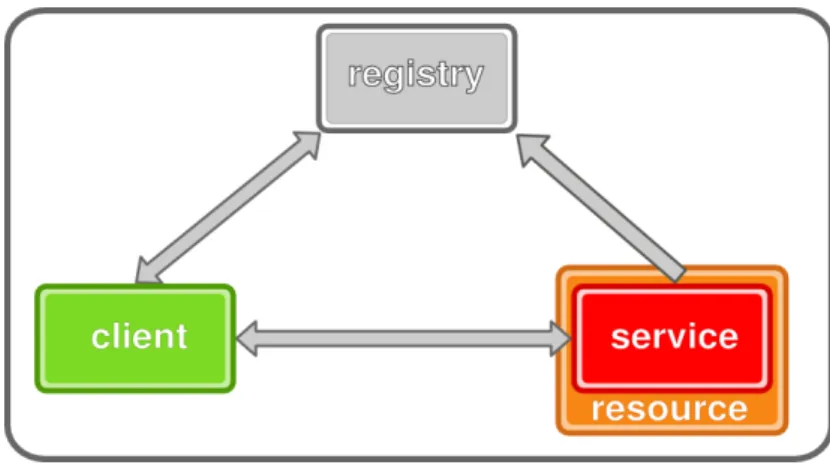
Among existing middleware and application programming approaches, the Remote Procedure Call over the Grid, or GridRPC model, was developed to ease Grid programming [Seymour et al.,2002]. GridRPC services enable the distributed execution of applications and serve as a communication layer and an invocation interface for high–level software components. It lls the gap between ser-vices provided on Grid infrastructures and the programming–level abstraction required to imple-ment a distributed middleware. This approach is also close to because it de nes a model where a service is registered in a registry and a client invokes the service on the server [Nakada et al., 2007].
Metacomputing and global computing
GridRPC focuses on the invocation of remote procedures across a network rather than on a stack of technologies. For instance, an environment based on independent services involves the setup of all technologies associated to each service (i.e., con guration, execution, monitoring). In some cases, those services share technologies such as a Web server, database management system, etc. However in other cases, the technologies should coexist in the same system independently. In contrast, GridRPC provides a common interface to perform all the invocations, such as le transfer or job submissions. GridRPC also preserves performance rather than adopting a protocol based on documents, promoting the direct use of an . In the same way, GridRPC avoids the reuse of object technologies like for several reasons, among witch expressiveness that does not specify non–functional requirements, to focus on a simple lightweight implementation that meets the needs of scienti c computing [Tanaka et al.,2004].
The adoption of GridRPC promotes interoperability on s without imposing an implemen-tation in contrast to the Globus Toolkit. However both approaches require the source code in-strumentation under a reference middleware. Such approaches are, most of the time, designed to access one type of infrastructure at a time, or they apply when components exclusively allow the execution of applications on distributed environments ignoring more complex scenarios like the integration of local resources and heterogeneous platforms.
XtreemOS: Integrated Support of Grid–based Services
In grid computing, physical devices, applications and datasets could all be seen as services. Yet, they are not considered as a technological commodity due to the complexity associated to the man-agement of resources. Initiatives as XtreemOS⁸aim at resolving transparency, scalability, inter-operability, and security issues from the user point of view. XtreemOS organizes the access to the available resources in Virtual Organizations as an integrated support on top of an operative system. The software architecture of the platform distinguishes two main layers the XtreemOS-F, and the XtreemOS-G one [Coppola et al.,2008]. They provide, respectively, local support and integration of di erent resources into a single computing platform.
While initiatives as Grid Services or GridRPC have been build to resolve the access to Grid en-vironments using intermediate middlewares, XtreemOS proposes an approach where an underly-ing operative system is extended for enablunderly-ing and facilitatunderly-ing Grid computunderly-ing. Middlewares like Globus toolkit have been adopted where institutions agree on a reference implementation to com-mission the operation of the infrastructure. In the same way, the principle of transparent access of XtreemOS is valid when the same operative system is available everywhere. Nevertheless, neither of these approaches can be adopted on infrastructures composed by heterogeneous service sources or operative systems like the European Grid Initiative. Most of the services (i.e., storage, exe-cution, monitoring) are based on common middleware components, and the resources share the same system con guration, however the autonomy of each organization imposes to harness ser-vices according to the provided interfaces independently.
⁸XtreemOS:http://www.xtreemos.org
SERVICES AS BUILDING BLOCKS OF SCIENTIFIC EXPERIMENTS
1.3.4 Summary
Grid computing, resulting from the evolution of metacomputing and global computing models, addresses the permanent need of computing power. To achieve that goal, institutions supply re-sources, develop middleware, de ne speci cations, charter rules of use, and foster the develop-ment of tools supporting the existing middleware. For instance, the utilization of batch systems in the execution of applications were commonly adopted on production grids by means of a uni-form job description language. Several projects implemented strategies on top of middlewares to improve the access to the distributed computing infrastructures. Those initiatives were interested in providing tools letting users execute their applications e ciently on the s. Speci cally, they have been paying attention to implement non–intrusive tools for reusing and executing applica-tions because technologies and services such as the Grid services do not pay attention in ne–level management of applications or they only resolve partially concerns going from interoperability to usability. Some of these e orts are detailed in next section.
1.4
Survey of tools supporting command–line applications reuse
The idea of software reuse is not new [Rich and Walters,1983]. Several approaches have been stud-ied such as the reuse at programming level to build applications directly from several pieces of code [Bigot et al.,2008] or approaches of reusing executable command–line applications directly [ Ma-teos et al.,2008]. The reuse of such applications still involves important e ort in the scienti c community because this facilitates the integration of a wide range of applications in current re-search. There are several toolkits and environments which use a non–invasive approaches to wrap the command–line applications as services. They do not create new binary executables or modify the existing applications. The concept of service in these environments, in most cases associ-ated with , creates an opportunity for reusing such applications under di erent circumstances depending on the target infrastructure, the protocols of communication or the domain of appli-cation, among others. In this section some relevant examples are presented. This work does not pretend to be exhaustive, focusing only on recognized initiatives that have proven to be useful and provide at the same time interesting concepts of service–oriented design.
1.4.1 LONI Pipeline
The Pipeline [Dinov et al.,2009] is a graphical environment for construction, validation, and execution of neuroimaging data analysis applications. It is a packaged solution to allow distributed infrastructures utilization, to facilitate data provenance, and to provide a signi cant library of com-putational tools including automated data format conversion. As part of its environment, one of the tools facilitates the integration of heterogeneous applications as modules. These modules rep-resents well–de ned standalone applications, comprising local or remote binary executables and services with well–de ned command–line syntax. The modules are created providing general in-formation like authors, version, name, description, and detailed inin-formation about the syntax of the parameters. The parameters may be directories, enumerations, les, numbers, strings or ow
Survey of tools supporting command–line applications reuse
controls that provide a sense of data typing support to the modules. The modules may also include dependencies to the applications. The Pipeline integrates the modules in pipelines involving large number of datasets and multiple processing tools.
Data in terms of databases, data services, and le systems, along side with the modules may be integrated in the environment. This exibility of integration permits e cient resource man-agement. The Pipeline environment is focused on neuroimaging data and analysis protocols. However, by design, it is domain agnostic and its architecture may be used where computationally intense tasks are performed. Unfortunately, Pipeline modules are not constructed on stan-dardized bases and the catalog of services is only useful within the environment. Although the integration to broader distributed infrastructures is supported with the adoption of its Distributed Pipeline Server ( ).
1.4.2 GASW
The Generic Application Service Wrapper ( ) [Glatard et al.,2006a] is a dynamic service which aims at enabling the execution of applications as services at runtime. This service is generic, wrapping an application behind its standard interface, and submitting a job instance to a . The service simpli es the embedding of applications into services interpreting a description of the application. Its Legacy Code Descriptor is an –based le which contains the name and lo-cation of the executable, the access method of the input data, the command–line options of the parameters, and the name and access method of the libraries or scripts that may be needed for the execution aside from the target binary executable. The service leverages external middle-ware submission methods for the execution. It also implements application grouping service calls to optimize the execution time.
G does not address the deployment of the applications though. The generic service is not data typed and does not have a high–level interface to create the descriptions. This later issue makes the wrapping of applications di cult because it requires in–depth knowledge of the ad–hoc structure and technical concepts associated to the distributed infrastructures. The service exposi-tion used on is based on a factory pattern. This process involves to use a generic interface to dynamically process the applications arguments. That kind of optimization can be considered harmful in a contract– rst approach because clients trying to execute the original service may be unable to nd it as well de ned service loosing qualitative information regarding the types or na-ture of parameters.
1.4.3 GEMLCA
The Grid Execution Management for Legacy Code Architecture ( ) [Delaitre et al.,2005] is a general architecture for deploying applications as Grid services without the need for code mod-i catmod-ion. G aims at providing an infrastructure to deploy applications as –compliant services. Its architecture is composed of four basic components:
1. The Compute Server represents hardware resources, such as a single computer or clusters, on 13
SERVICES AS BUILDING BLOCKS OF SCIENTIFIC EXPERIMENTS
which applications in form of binary executables are potentially available to make them ac-cessible through Grid services.
2. The Grid Host Environment implements a service–oriented Grid layer on top of a compliant middleware. This environment connects the Computer Server with a grid. Current distribu-tions of support –built Grid services based on the Globus Toolkit.
3. The Resourceprovides a set of Grid services (i.e., code factory and processor) which exposes applications as services. Along with the Grid Host Environment, the Re-source is installed on the Compute Server representing a Grid Resource.
4. The Clientcomprises the client–side software. There are two types of Clients: (1) a command–line interface, installed on any machine through which a user would like ac-cess to the resources, and (2) a Web portal based on GridSphere⁹to provide a graph-ical interface through which a user can access to the applications as Grid services.
The Resource is responsible for hiding the native nature of an application by wrapping it with a Grid service, and processing service requests coming from users. The deployment of such a service implies that the application may run in its native environment on a Compute Server. The Resource handles the application using an –based Legacy Code Interface Description ( ) le. This le provides metadata about the application, such as the executable path, the job manager, the execution environment, and information parameters including name, type, order, regular expressions for input validation, etc.
G does not require coding modi cation of applications and the e ort from clients is min-imized using the graphical interface. In spite of this, the deployment process of new Grid ser-vices involves administrative tasks on the server side. Since the current has GT2, GT4, and gLite submitters, applications can be executed/submitted to all machines with these middleware. G uses stateful services primary to support a multi–user environment, but not for the lifecy-cle management of applications though.
1.4.4 gRAVI
The Grid Remote Application Virtualisation Interface (g ) [Chard et al.,2009] is a plug–in ex-tension to the Introduce toolkit [Hastings et al.,2007]. This toolkit is designed to support the Grid service development through three identi ed steps:
1. The creation. The developer describes at highest level basic attributes about the service such as name and namespace. The implementation of the service is then created with these
con-guration properties using the Introduce engine.
2. The modi cation. The developer adds, removes or modi es service methods, properties, re-sources, and security con guration. In this step, strong typed service interfaces are created using pre–registered and well–de ned schemas. The Introduce toolkit includes the notion of data repositories that maps de ned types to application input parameters.
Survey of tools supporting command–line applications reuse
3. The deployment. The developer deploys the service to a Grid service container after the spec-i catspec-ion of deployment and securspec-ity con guratspec-ion. A deployment component gathers the libraries required for the service as well as those les which contain the actual runtime code of the service.
g allows users to wrap binary applications as secure –compliant services without re-quiring to write any implementation code, description les, or deployment scripts. This plug–in extends the Introduce toolkit creation and modi cation steps adding new backend code creation processes and complementary graphical interface within the Introduce Graphical Development En-vironment. This interface removes the need for users to run scripts or create/modify description les. g services o er synchronous and asynchronous invocation methods. They also include methods to stage data with several encoding formats including GridFTP and base 64 encoded bi-nary data. Each service also exposes interfaces to monitor the running application via polling or noti cations.
g provides a way to reduce the cost of creating Grid services by simplifying the develop-ment and deploydevelop-ment process. Nevertheless, the processing of parameters is based on existing service type schemas that are not trivial to create and requires the management of repositories. De-spite its interesting features, the design of g forces to use in each service all its dependencies increasing signi cantly the packaging size to detriment of library reuse so this method is not advis-able for a large number of services. Additionally, it supports exclusively execution on distributed infrastructure, banishing the potential of light or short–term executions on local servers.
1.4.5 Soaplab2
Soaplab2 [Senger et al.,2008] is a framework that allows service providers to make command–line applications accessible as Web services. It is based on metadata descriptions of the programs that includes information about the description, type, provider, names and types of input data or com-mand–line parameters, and names and types of resulting output. Soaplab2 uses , a format orig-inally created by the European Molecular Biology Open Software Suite¹⁰( ) to de ne in a uni-form way bioinuni-formatics tools, to create the descriptions, and to transuni-form them in a corresponding format le. The description is stored and used by the Soaplab2 server to execute the ap-plications processing the input data and to retrieve the results. The architecture of Soaplab2 server can optionally use local databases for keeping results persistently. On the client side, Soaplab2 pro-vides a rich Web–based interface, which allows users to select a service, specify its inputs, start the service, and display the results. Soaplab2 has a rich client library supporting an extensible protocol layer to assure interoperability with di erent Web service standards.
Soaplab2 can automatically generate and deploy Web services on top of existing command–line applications. It is especially suited for applications with well described input and output param-eters allowing integration of applications within a single programming interface. Nevertheless, Soaplab2 does not resolve the build/install/deploy cycle because it uses development tools such as
¹⁰ :http://www.emboss.org/
SERVICES AS BUILDING BLOCKS OF SCIENTIFIC EXPERIMENTS
Ant¹¹and Maven¹²to perform these tasks. Soaplab2 does not provide an interface to wrap the appli-cations as Web services. Thus the work directly with the format is a cumbersome requirement due to its technical characteristics. Furthermore, Soaplab2 is not oriented to execute the applica-tion on distributed infrastructures.
1.4.6 Comparison
The main goal of developing tools like Pipeline, , , g , or Soaplab2 is to pro-vide robust and extensible frameworks enabling e cient utilization of resources, and to propro-vide the means for dissemination and validation of research protocols and scienti c innovation. An important experience has been gained with their development [Krishnan and Bhatia,2009]. From this experience common elements are identi ed to underline their potentialities and remaining issues:
• Descriptions of applications. The characterization of applications is necessary for bind-ing the application to a service interface. The elements de ned in the de nition must ful ll
ne–grained details of arguments, including types, and the target infrastructures.
• Interoperability. Interoperability is assured by open protocols. Web services (and their Grid variants) mechanisms for describing, accessing, and securing services provide the shared vocabulary. The value of an exposed service is measured with regards to the capability to discover, and access it.
• Scalability. The data volumes and computational demands are often beyond the capacity of a centralized server. Distributed infrastructures, like clusters and grids, and the interconnec-tion with the services are suitable soluinterconnec-tions to respond this challenge.
• Usability. The control of the middleware hosting services and their lifecycle management play and important role in the use and dissemination of scienti c applications. This con-trol does not have to limit users throughout their experimentation by incorporating complex technological layers of administration.
From the interoperability point of view, most of the initiatives (with the exception of Pipe-line and ) have recognized the undisputed need of Web protocols. These protocols de nes data types and the interfaces of operations. G and g , work directly during creation of services to provide the –based services. This alternative manages security concerns in par-allel to the functional requirements. Although the implementation behind the resulting services depend on the installation of the adopted middleware (i.e., Globus Toolkit). On the other hand, Soaplab2 is focused only on basic standard protocol pro les.
Concerning the scalability, all approaches described but Soaplab2 take into account distributed infrastructures to delegate the execution of the applications. This adoption has natural advantages
¹¹Apache Ant:http://ant.apache.org/ ¹²Apache Maven:http://maven.apache.org/