Published in "International Journal of Strategic Communication" 11(1), 2017, 79-94
which should be cited to refer to this work
How Do Media Companies Gain Legitimacy? An
Experimental Study on the (Ir)Relevance of CSR
Communication
How Do Media Companies Gain Legitimacy? An Experimental
Study on the (Ir)Relevance of CSR Communication
Philipp Bachmanna and Diana Ingenhoffb
aIPMZ–Institute of Mass Communication and Media Research, University of Zurich, Zurich, Switzerland;bDCM Department of Communication and Media Research, University of Fribourg, Fribourg, Switzerland
ABSTRACT
Due to structural changes in the media industry, the topic of CSR has gained more and more attention among media companies. Our research question was whether media companies can gain legitimacy through CSR disclosures. There is reason to assume that CSR disclosures both directly increase and indirectly decrease a media company’s legitimacy. On one hand, CSR is regarded as a means of strengthening legitimacy; on the other hand, stakeholders might become skeptical and distrust disclosures about generous deeds. The experimental study detailed here considers both possibilities by using five CSR disclosures of a fictional media company as the stimuli, ranging from low- to high-communicated CSR engagement (single-factor between-groups design, 274 participants). According to the results of the Structural Equation Model (SEM), both assumptions are incor-rect: CSR is not the crucial factor in determining whether or not stake-holders perceive a media company as legitimate, but rather its corporate credibility.
Many media companies struggle for economic survival, leading to cost-cutting programs and market concentration. Although media companies strive to adapt new business models, they are accused by critics of increasingly neglecting their unique obligation to strengthen democratic processes through quality journalism (e.g., Kaye & Quinn, 2010; Levy & Nielson,2010; Russ-Mohl,2011). Hence, news media companies are in danger of losing legitimacy (Tolvanen, Olkkonen, & Luoma-aho, 2013). Strategic communication might prove useful as an antidote to this. In general, as Falkheimer (2014, p. 124) states,“the main driving force behind the increased interest in strategic communication is the organizational need of legitimacy to operate in the late modern society.” The body of strategic communications knowledge includes how organizations can present themselves “in society as a social actor” (Hallahan, Holtzhausen, van Ruler, Verčič, & Sriramesh,2007, p. 27).
It is striking that the topic of“corporate social responsibility” (CSR) has gained more and more attention among media companies (Altmeppen,2011; Bardoel & d’Haenens,2004; Trommershausen, 2011). Many media companies have adopted the practices of CSR communication (Hou & Reber, 2011; Ingenhoff & Koelling,2012). For example, although The Economist is notorious in campaign-ing against CSR, with the magazine publishcampaign-ing many critical articles about this issue (Guthey, Langer, & Morsing, 2006, pp. 42–45), The Economist Group makes extensive CSR claims on their corporate webpage:“As an international company, we conduct business in many different markets around the world. In the countries in which we operate, we abide by local laws and regulations. We make an active contribution to local charities by charitable giving” (The Economist Group, 2015). This raises the research question: Can media companies gain legitimacy through CSR disclosures?
The strategic communication and CSR literature offers two opposing answers to this question. On one hand, CSR is regarded as a means to increase a company’s legitimacy (Chen, Patten, & Roberts,2008; Dowling & Pfeffer,1975; Lee,2008). Podnar and Golob (2007) interpret their findings of an online survey that CSR is“a way for a company to gain the license to operate and goodwill in the public eye” (Podnar & Golob, 2007, p. 336). On the other hand, Ashforth and Gibbs (1990) warn companies with tarnished legitimacy about the“self-promoter’s paradox”: If they try too hard to regain legitimacy through good deeds, they run the risk of achieving the exact opposite (Ashforth & Gibbs,1990). Similarly, Morsing, Schultz, and Nielsen (2008) caution companies about the“‘Catch 22ʹ of communicating CSR”: Although stakeholders expect companies to engage in CSR they nevertheless distrust disclosures about it (Morsing et al.,2008).
Given that strategic actions are dominant in the world of corporations, stakeholders have sound reason to be skeptical towards CSR disclosures (Elving, Golob, Podnar, Ellerup-Nielsen, & Thomson,2015, p. 122). Bartlett (2011) puts the companies’ dilemma from a strategic communication perspective in a nutshell: Companies“are damned if they do [CSR communication] and damned if they don’t.” She thus recom-mends analysis of the “tension that nestles between the accusations of ‘spin’ and ‘greenwash’ around persuasion models, and a demand for transparency, disclosure and engagement” (Bartlett,2011, p. 81).
The purpose of this article is to resolve these opposing answers regarding media companies. Following Bartlett’s recommendation, we developed and tested a “CSR dilemma model,” which postulates that a direct positive impact of extensive CSR disclosures on perceived“corporate legitimacy” is indirectly suppressed and counteracted by“stakeholder skepticism” (Brønn,2011, p. 119; Pomering & Dolnicar,2009; Pomering & Johnson,2009; Pomering, Johnson, & Noble,2013). Stakeholder skepticism is understood as a generic term that encompasses the perceptions of“content credibility” and “persuasion intent,” which in turn evokes“reactance” as a socio-psychological defense mechanism (Brehm & Brehm,1981; Quick, Shen, & Dillard, 2013). There are as yet relatively few studies, as Bögel (2015) points out, “that use socio-psychological theory to examine socio-psychological variables that determine how CSR information is processed and evaluated” (Bögel,2015, p. 129). This main objective of this research was to better understand CSR message effects and to advance theory-building in strategic messaging by combining concepts from strategic communication and social psychology. Yet, as Werder (2015) points out, strategic communication researchers focus insufficient attention“on the message variable in the communication process, rather than source and receiver variables” (Werder,2015, p. 269).
Theoretical background: The CSR dilemma model
There is no common definition of what is meant by CSR (Carroll,2008; Crane, McWilliams, Matten, Moon, & Siegel,2008; Marrewijk,2003). In this article, we understand CSR as a specific form of responsibility, which is, from a social sciences perspective, a multi-relational ascription that embraces a subject, a time-reference, an object, an authority, and a criterion: Somebody has―in a retrospective or prospective manner, for something, towards somebody, based on certain normative standards―responsibility. Such ascriptions of responsibility take place in social interactions between human beings (Pincoffs,1988).
The most influential concepts of CSR in research and corporate practice are Elkington’s “triple bottom line,” Freeman’s “stakeholder approach,” and Carroll’s “CSR pyramid.” Referring to the preceding ‘five element relation of responsibility,’ we argue that these well-known concepts have in common that they are about companies’ (subject) present and future obligations (time-reference), but are complementary—rather than contradictory—regarding the remaining elements. Each particular concept is notably illuminating with regard to one of these elements (object, authority, and criterion). Our definition on the basis of this ‘complementary thesis’ is as follows: CSR ascriptions are specific responsibility-ascriptions, according to which companies (subjects) have present or future obligations (time-reference) to generate profits and revenues, accomplish social, political, and cultural benefits, or maintain or improve the quality of the environment (objects, Elkington,1998), towards affected stakeholders (authorities, Freeman,1984), on the basis of economic, legal, ethical, or philanthropic norms (criteria, Carroll,1991).
The conceptualization of CSR as multirelational ascription allows us to specify the‘extent of CSR,’ ranging from mandatory to discretionary. In line with Carroll’s pyramid (1991), we speak of mandatory CSR when the involved norms are scarcely negotiable, which is most notably the case with respect to the economic principle to make products and generate profits, the legal principle to obey the law, and the ethical principle to respect human rights. In contrast, we speak of discretionary CSR when the addressed norms are beyond standards and thus not compulsory, which is—for instance—the case with respect to philanthropic donations.
Direct positive effect
Tost (2011) expounds that there are two research strands on corporate legitimacy: From an institutional perspective, legitimacy is understood as a generalized perception or assumption that determines whether or not a company survives and prospers in society (e.g., Deephouse & Suchman,2008; Meyer & Rowan,1977; Suchman,1995). From a socio-psychological perspective, legitimacy is understood as an individual’s percep-tion or attitude with regards to how a company attempts to reach desirable goals or outcomes (instrumental dimension), how it treats others with dignity and respect (relational dimension), and how it acts consistent with moral and ethical standards (moral dimension) (Tost,2011; further Tyler,1997;2006). Although these two perspectives are complementary rather than contradictory, we focus on the socio-psychological perspective because this study analyzed how CSR disclosures are processed and evaluated by individual stakeholders.
By conceptualizing corporate legitimacy as an individual’s perception, we can justify the assump-tion that companies strengthen their legitimacy through ‘discretionary CSR.’ A company can express, by means of disclosures on discretionary CSR, that it induces to a large extent desirable outcomes for stakeholders (instrumental dimension), that it treats stakeholders with dignity and respect (relational dimension), and that its actions exceed moral and ethical standards by going beyond profitability and legal requirements (moral dimension). This perception leads individuals to an attitude regarding whether the company should be sanctioned positively or negatively in terms of survival and acquiring resources. In this respect, we propose that
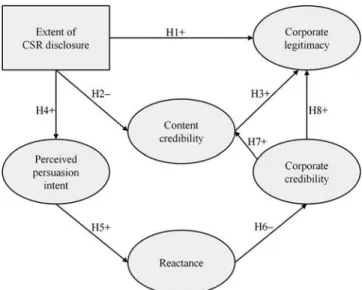
H1. The greater the extent of a media company’s CSR disclosure, the greater its corporate legitimacy is perceived by its stakeholders.
Indirect negative effects
We further assume that the extent of CSR disclosure has indirect negative effects on a company’s legitimacy. Among communication scholars in particular, “stakeholder skepticism” is used as a generic term to encompass a heterogeneous group of mediator effects that are suspected to suppress or even counteract the positive effects of CSR communication. In this article, we distinguish two kinds of mediating effect when it comes to stakeholder skepticism.
First, we assume that the perceived “content credibility” is a mediator variable that suppresses the positive effect of extensive CSR communication on a media company’s legitimacy. Stakeholders are seldom present when CSR engagement actually takes place; instead companies inform about CSR via corporate webpages, as Capriotti (2011) describes in detail. Stakeholders therefore might have the impression that CSR disclosures are “decoupled” from actual CSR actions (Christensen, Morsing, & Thyssen, 2013). Although stakeholders have no reason to doubt a media company’s communication about its mandatory CSR in terms of making profits and media products, it is more delicate for them to trust disclosures on discretionary CSR. In this respect, we propose that
H3. The overall content credibility of CSR disclosures is positively related to the media company’s legitimacy.
Second, we assume that stakeholders may have the impression that communication from companies is inherently persuasive. In this context, Holladay and Coombs (2013) coined the term“public relations literacy” (Holladay & Coombs,2013). When stakeholders perceive CSR as merely strategic and persuasive, they“develop negative feelings when they feel an organization is promoting its CSR efforts too vigorously” (Coombs & Holladay,2009, p. 99). This assumption is in line with empirical research about“persuasion knowledge” and “psychological reactance” (Quick et al.,2013). The“persuasion knowledge model” states that individuals learn to cope with strategic communication (Friestad & Wright,1994)—including CSR disclosures (Pomering & Dolnicar,2009; Pomering & Johnson,2009).
H4. The extent of CSR disclosure is positively related to the stakeholders’ perception of persuasion intent. In turn, a perceived persuasion intent evokes reactance, which is defined as a“motivational state that is hypothesized to occur when a freedom is eliminated or threatened with elimination” (Brehm & Brehm, 1981, p. 37). Reactance is a psychological reaction to everything that threatens personal freedoms, including persuasive communication (Brehm & Brehm, 1981, pp. 121–150; Koch & Zerback, 2013a, 2013b; Meirick & Nisbett,2011; Moyer-Gusé, Jain, & Chung, 2010; Quick et al., 2013). In line with reactance theory, we expect that
H5. The stakeholders’ degree of perceived persuasion intent is positively related to the stakeholders’ degree of reactance.
According to Brehm and Brehm (1981),“boomerang effects,” like the self-promoter’s paradox or the catch 22 in the case of CSR communication,“represent the best evidence for reactance theory” (Brehm & Brehm,1981, p. 38). Individuals that receive persuasive messages preserve their personal freedoms by derogating the communicator’s credibility (consistent with Koch & Zerback, 2013a, 2013b; Meirick & Nisbett,2011; Pomering & Johnson,2009, p. 425). We therefore assume that
H6. The stakeholders’ degree of reactance is negatively related to the media company’s credibility. According to Newell and Goldsmith (2001), corporate credibility is a specific variant of a communicator’s credibility with “trustworthiness” and “expertise” as subdimensions. A company needs to be perceived as trustworthy and skilled in order to be perceived as credible (Newell & Goldsmith,2001, p. 237; see also; Hovland & Weiss,1951). Consistent with credibility research (see, for instance, Koch & Zerback,2013a, 2013b), we formulate that
H7. The media company’s credibility has a positive effect on the overall content credibility of its CSR disclosures.
Furthermore, we assume that stakeholders who perceive a media company as trustworthy and skilled also perceive its actions as desirable, proper, and appropriate (Suchman,1995; Tost, 2011). Hence, we propose that
H8. The media company’s credibility has a positive effect on its legitimacy.
Summary of postulated relationships
Figure 1 provides a summary of all hypotheses. Accordingly, the direct positive impact of a media company’s extensive CSR disclosures on its legitimacy is suppressed by a decreased content credibility,
and counteracted by the activation of persuasion perception and reactance, which lowers the media company’s credibility. A lower corporate credibility—in terms of trustworthiness and expertise—leads to a lower content credibility of the CSR communication as well as to a lower legitimacy (Koch & Zerback, 2013a, p. 11, 2013b, p. 998, for a similar model).
Experimental study Participants
Students of social sciences from a Swiss university (274 in total, 169 women, 104 men, 1 unknown; Mage = 22.1 years, SD = 2.44, age range: 19–40 years) were asked to fill in a questionnaire. Although students have a relatively high educational level and may thus be expected to be important stakeholders of media companies that produce journalism (e.g., Elvestad & Blekesane, 2008, pp. 437–439; Jandura & Brosius,2011, p. 200), we cannot draw descriptive conclusions about different stakeholder groups from this sample (Falkheimer & Heide, 2016, p. 164). However, the purpose of this study is not to analyze real stakeholders of media companies. Our aim is to advance theory by testing general causal assumptions about how CSR communication is processed and evaluated. These processes are independent of specific groups (consistent with Falk & Heckmann,2009, p. 537).
Research design and stimulus
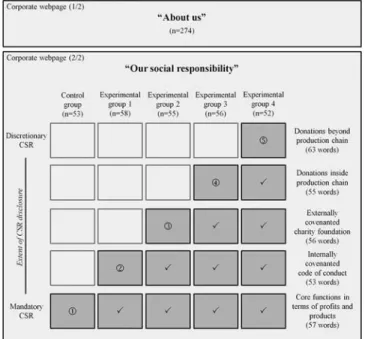
The research design is a single-factor between-groups design with five different CSR disclosures of a fictional media company named“Tell-Media Inc.” All texts of this company were presented in the layout of the corporate’s website. Participants were randomly assigned to one of five groups. All of the participants read a self-description of the company (corporate webpage 1/2;“about us”), which indicated that Tell-Media Inc. is a profit-oriented media company:
“With its daily and weekly newspapers, magazines, online platforms as well as printing facilities, Tell-Media Inc. is one of the leading media corporations in Switzerland. Tell-Media is an independent media company, which has its roots in the German- and French-speaking parts of Switzerland. We stand for freedom of speech, quality journalism and excellent entertainment. Tell-Media Inc. has been listed on the Swiss Stock Exchange since 2004.”
Afterwards, each participant read one of five versions of the media company’s self-ascribed CSR (corporate webpage 2/2;“our social responsibility”). These stimuli served as the independent variable and increased by degrees in terms of the extent of the company’s self-ascribed CSR (seeFigure 2).
The control group (CG) read solely the following text about the media company’s mandatory CSR, namely to make profits and media products:
“As a large Swiss media company we carry social responsibility. We make our contribution to democracy in shaping public opinion through fair, critical, and independent reporting. We also provide plenty of talking-points with entertaining stories from every area of life. The Tell-Media Inc. is a profit-orientated company. Only with the highest profitability and economic efficiency can we contribute to the formation of public opinion today and in future.”
The experimental groups read additional texts on Tell-Media’s discretionary CSR, which goes beyond the core functions of media companies. The first experimental group (EG1) read an additional text in which the media company self-imposes internally covenanted obligations:
“The ethical basis for our actions is written down in the Tell-Media ‘code of conduct’. The ethical guidelines of this‘code of conduct’ are binding for all employees―regardless of their ranking in the company or their area of business. With these guidelines, we ensure respect in interpersonal dealings within all of our journalistic and entrepreneurial activities. We have pledged to conduct ourselves ethically and responsibly.”
The second experimental group (EG2) read—besides the aforementioned texts—an additional text in which the media company self-imposes externally covenanted obligations:
“We take our social responsibility seriously with our charity program ‘Tell-Media: Culture & Education’. We are committed long-term to promote culture and education in Switzerland. We organize a number of concrete projects, such as dance festivals, theatre performances, exhibitions of young artists, language courses for teenagers and much more. Every six months we provide information on how the ‘Tell-Media: Culture & Education’ program keeps its promises.”
Besides the preceding texts, the third experimental group (EG3) read an additional text about the media company’s voluntary donations within its production chain:
“In addition, we assume social responsibility by supporting charitable organizations and foundations occasionally. They can ask us to waive media advertising costs or printing costs for publications. Our internal committee— comprised of members of the management as well as chief editors—decides on the approval of applications.” The fourth experimental group (EG4) read, in addition, a text about the media company’s voluntary donations beyond its production chain:
“We know about tragic events such as wars, natural disasters and famines through our reports and stories. We want to do more than merely informing about the harsh realities of people from all over the world. As a media company, we know first-hand where help is most needed worldwide. That’s why we give project-related funds to recognized charities when people are in distress and need quick and professional help.”
The extent of CSR disclosure is thereby increased by degrees, from mandatory CSR, with the media company’s undeniable core functions in terms of making products and profits (CG), to self-imposed internally (EG1) and externally covenanted (EG2) obligations in terms of a code of conduct and a charity foundation, to voluntary donations inside (EG3) and outside (EG4) the production chain. To increase the external validity, all texts are based on real website texts from Swiss media companies (e.g., NZZ-Mediengruppe, Ringier Inc., Tamedia Inc.).
This experimental design has two advantages. First, the text-building block concept makes a manipulation check of the independent variable unnecessary because it is certain that the extent of CSR disclosure increased (O’Keefe,2003, p. 257). The manipulation is twofold: in terms of form (text length) and content (from mandatory to discretionary CSR). Second, in most social science experi-ments, stimulus variables have merely nominal level. Possibilities for statistical data analysis are thus restricted. Although we do not wish to deny that there are reasonable doubts about the permissibility of“treating ordinal variables as if they were continuous” in general (Winship & Mare,1984, p. 522), this study’s text-building block concept allows us to understand the experiment’s stimulus variable at ordinal level because it clearly scales the“extent of CSR disclosure” from low to high (Hayes,2005, pp. 20–23). Moreover, for practical reasons we can grasp it at quasi metric level in order to run regression based analyses. We come back to this point in the findings.
Measures
In line with the paths of our ‘CSR dilemma model,’ we first measured the constructs “content credibility,” “perceived persuasion intent” and “reactance” on one page, and then “corporate legitimacy” and “corporate credibility,” with its subdimensions “expertise” and “trustworthiness,” on another. All items were judged on 7-point Likert scales (1 =“strongly disagree” and 7 = “strongly agree”). The order of items was randomized to control for possible side effects. We avoided items that were supposed to measure the same construct appearing immediately after each other.
Content credibility of the CSR communication
We measured this construct with one item derived from Koch and Zerback (2013a,2013b) and two items derived from Kohring (2004; see also Rössler,2011, p. 355):“I consider the statements from the Tell-Media Inc. about their social responsibility as credible” (cre1), “The statements made by the Tell-Media Inc. about taking on social responsibility would withstand a verification” (cre2), and “The website of the Tell-Media Inc. about its social responsibility provides the facts as they are” (cre3) (Cronbach’s α = .703; M = 4.05).
Perceived persuasion intent
In order to measure this construct, we adapted three items from Koch and Zerback (2011, 2013a, 2013b):“I have the feeling that the Tell-Media Inc. wants to convince the reader of their leading role with respect to social responsibility” (per1), “The Tell-Media Inc. deliberately tries to convince me that they are socially responsible” (per2), and “The Tell-Media Inc. wants to convince me of their social responsibility” (per3) (Cronbach’s α = .772; M = 5.50).
Reactance
Like Koch and Zerback (2013a,2013b), we relied on items developed by Herzberg (2002) in order to measure reactance as a one-dimensional construct. We used the following three items: “It bothers me very much that the Tell-Media Inc. presents itself as a role model” (rea1), “I would like to object to the Media Inc. with regard to its social responsibility” (rea2), and “I strongly resist the Tell-Media Inc.’s attempts at manipulation” (rea3) (Cronbach’s α = .726; M = 3.50).
Corporate credibility (trustworthiness and expertise)
We used Newell and Goldsmith’s (2001) measurement scale in order to measure corporate cred-ibility as a two-dimensional construct of trustworthiness and expertise. Trustworthiness was mea-sured by four items:“I trust the Tell-Media Inc.” (tru1), “The Tell-Media Inc. makes truthful claims” (tru2),“The Tell-Media Inc. is honest” (tru3), and “I do not believe what the Tell-Media Inc. tells me” (tru4) (Cronbach’s α = .875; M = 4.01). To measure expertise, we used the following items: “The Tell-Media Inc. is skilled in what they do” (exp1), and “The Tell-Media Inc. has great expertise” (exp2) (Newell & Goldsmith, 2001, p. 237). Additionally, we relied on two items developed by Ingenhoff and Sommer (2010, p. 352) to measure expertise: “The Tell-Media Inc. stands for high product quality” (exp3), and “The Tell-Media Inc. works with comprehensive attention to detail” (exp4) (with regard to all four expertise-items, Cronbach’s α = .782; M = 4.27).
Corporate legitimacy
As noted previously, there is no established measurement scale for this construct as a perception yet (Hudson, 2008; Vergne, 2011). To measure corporate legitimacy, we derived the following three items from our definition of legitimacy (Deephouse & Suchman,2008; Suchman,1995; Tost,2011): “The Tell-Media Inc. makes an important contribution to the general public” (leg1), “It would be a great pity if the Tell-Media Inc. were to go bankrupt” (leg2), and “The Tell-Media Inc. should be retained in Switzerland” (leg3) (Cronbach’s α = .776; M = 4.31).
Statistical analyses
To test the hypotheses we applied structural equation modeling (SEM). With regard to our experi-mental data, the main advantages of this statistical method are that it allows us to determine the effect of the stimulus (the independent variable:“extent of CSR disclosure”) on the output measure (the dependent variable:“corporate legitimacy”) and—at the same time—to take mediating variables (“content credibility,” “perceived persuasion intent,” “reactance,” and “corporate credibility”) into account (Bollen & Pearl,2013, pp. 316–318; Pearl,2014).
We chose Maximum Likelihood (ML) and Bootstrapping (5,000 samples) as the estimate. These settings allow the testing of SEM even if distributions are not normal (Preacher & Hayes,2008, p. 880). All calculations were run using Mplus 7.3.
Findings
Two full Structural Equation Models: Trustworthiness and expertise
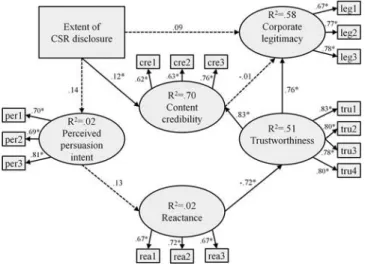
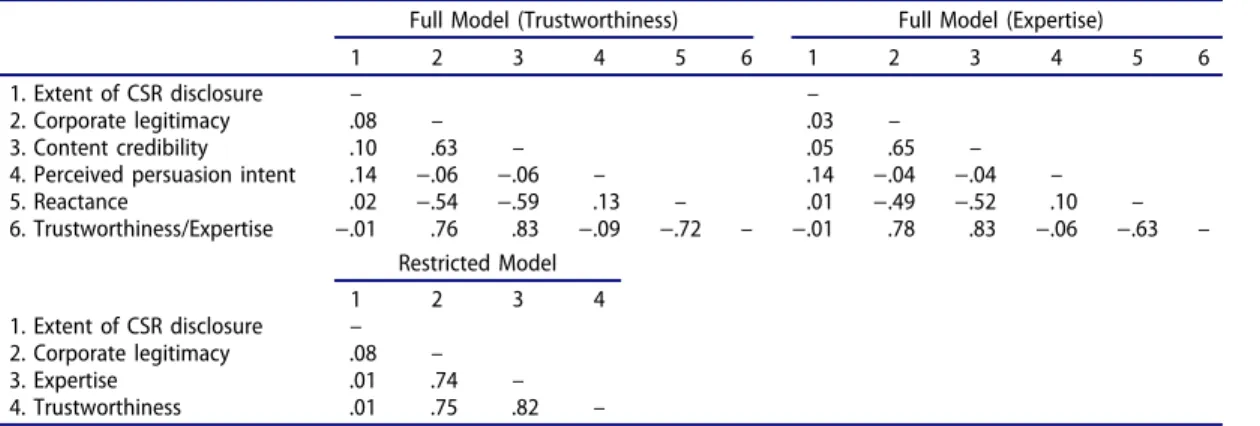
Given that corporate credibility is a two-dimensional construct, we ran two full SEMs (seeFigures 3a and3bas well asTable 1), one with“trustworthiness” and the other with “expertise” as a mediator variable (consistent with Newell & Goldsmith,2001, p. 245). The upside of this approach, where each subdimension is calculated independently, is that it makes the models more parsimonious.
The two models adequately describe the empirical data as the global fit indices reveal (Byrne, 2012, p. 64). Each of the models has an acceptable overall model fit, namely with regard to the trustworthiness-modelχ2 = 203.20, df = 112, p = .01; RMSEA = .06 with 90% C.I. between .04 and .07, p = .26; CFI = .95; TLI = .94; SRMR = .04 (seeFigure 3a) and with regard to the expertise-model χ2 = 176.68, df = 112, p = .01; RMSEA = .05 with 90% C.I. between .03 and .06, p = .69; CFI = .96;
TLI = .95; SRMR = .05 (seeFigure 3b). However, even though the overall model fits are acceptable (Hooper, Coughlan, & Mullen, 2008; Hu & Bentler, 1999, pp. 27–28), most hypotheses are not statistically significant. To put it another way, although the“measurement models” are satisfactory in both cases, the“structural models” are not (Byrne, 2012, p. 15).
Extent of CSR disclosure has no direct effect on legitimacy
Both SEMs reveal that the media company’s extent of CSR disclosure has no direct effect on the perceived corporate legitimacy―which leads to a rejection of H1. The standardized path coeffi-cients are small (β = .09 and β = .04, respectively) and nonsignificant (p = .14 and p = .84, respectively). We did not expect this result and thus ran an additional analysis of variance (ANOVA, Bootstrapping with 2,000 samples) with the extent of CSR disclosure as the indepen-dent and the perceived legitimacy as the depenindepen-dent variable. This additional test also counteracts possible criticism around the statistical permissibility of treating the independent variable as if it were metric.
Figure 3a.Observed full SEM (Trustworthiness).
The ANOVA confirms the rejection of H1. The five groups do not differ with regard to the perceived legitimacy, F(4,269) = .201, p = .94, with MCG = 4.36, MEG1 = 4.18, MEG2 = 4.29; MEG3 = 4.38, MEG4 = 4.39 (Hayes, 2005, p. 373). Post hoc analyses were performed using the Scheffé test—again, no differences were found (p = .96). This means that a media company that limits its social responsibilities to the making of profits and media products (CG) is perceived to be as legitimate as a media company that additionally signs a code of conduct, runs a charitable foundation, waives advertisement costs for nonprofit organizations, and donates money to people in need (EG4).
Content credibility has no suppressing effect
H2 assumed a negative effect from the extent of CSR communication on the content credibility. Although there is a significant relation in the trustworthiness-model (p = .02), there is none in the expertise-model (p = .28). However, regardless of the significance, the path coefficients are positive in both models (β = .12 and β = .06, respectively), meaning that—contrary to expectation—the extent of CSR communication is not negatively related to its content credibility, which leads to the rejection of H2. Furthermore, H3 must also be rejected: The content credibility of the CSR disclosure has no effect on legitimacy (β = ‒.01, p = .98 and β = .01, p = .98, respectively). The rejections of H2 and H3 imply that the content credibility of the CSR communication has no mediating effect. Hence, content credibility is not a suppressor variable—it cannot explain the preceding result that the extent of CSR communication has no effect on legitimacy.
Persuasion intent and reactance have no boomerang effects
There is neither a significant effect of the extent of CSR disclosure on persuasion intent (H4:β = .14, p = .06 in both models) nor on reactance (H5:β = .13, p = .11 and β = .10, p = .23, respectively). Therefore, H4 and H5 need to be rejected as well. Perceived persuasion intent and reactance are not counteracting variables—they also cannot explain the preceding result that the extent of CSR disclosure has no effect on legitimacy. H6 can be confirmed because there is a strong effect from reactance on corporate credibility in both models: Reactance decreases the media company’s perceived trustworthiness (β = ‒.72, p = .01) as well as expertise (β = ‒.63, p = .01). However, it is not the extent of CSR communication which triggers perceived persuasion intent and reactance. Hence, we do not know what triggers reactance.
The importance of corporate credibility
Corporate credibility has a strong effect on the overall content credibility of the CSR disclosure (in both modelsβ = .83, p = .01). Moreover, there is also a strong effect of trustworthiness on corporate legitimacy (β = .76, p = .01) as well as of expertise on corporate legitimacy (β = .78, p = .01). Hence, H7 and H8 are confirmed.
In summary, the extent of CSR disclosure has no effect on corporate legitimacy. This absence of a direct effect can neither be explained by the mediator variable“content credibility of CSR disclosure” nor the mediator variables “perceived persuasion intent” and reactance.” The results indicate no suppressing effects. However, the full models reveal that the“corporate’s credibility,” with its two dimensions of trustworthiness and expertise, explains a corporate is perceived as legitimate.
One restricted Structural Equation Models
To get a clearer picture of the effects of trustworthiness and expertise on the perceived corporate legitimacy, we ran a restricted model without the mediator variables“content credibility,” “perceived persuasion intent,” and “reactance” (seeFigure 4andTable 1).
The global fit indices of this restricted model show that the model fits the empirical data (χ2 = 92.95, df = 51, p = .01; RMSEA = .06 with 90% C.I. between .04 and .07, p = .31; CFI = .97; TLI = .96; SRMR = .04). It confirms the previous result that the extent of CSR communication does
not effect corporate legitimacy (β = .08, p = .14). In contrast, the two subdimensions of corporate credibility—trustworthiness and expertise—have direct effects on legitimacy (β = .45, p = .01 and β = .36, p = .03 respectively) and explain about 61% of its variance. The results of this restricted SEM underline the unimportance of extensive CSR communication and the importance of corporate credibility—with its two subdimensions trustworthiness and expertise—to explain a media com-pany’s legitimacy as perceived by its stakeholders.
Discussion
The surprising result of our experimental study and answer to our RQ is that the extent of CSR communication has neither a direct positive effect nor indirect negative effects on a media com-pany’s legitimacy. Instead, the perceived corporate credibility—with its two subdimensions trust-worthiness and expertise—is the crucial factor, which explains best whether a media company is perceived as legitimate by its stakeholders.
Do we then still have a CSR dilemma? At least with regard to the media industry, our findings challenge two widespread beliefs among CSR scholars and practitioners: Namely the“business case” argument that discretionary CSR is in the interest of a firm because it strengthens its legitimacy (e.g., Carroll & Shabana, 2010, pp. 99–100; Dowling & Pfeffer, 1975, p. 133; Lee, 2008), as well as the “catch 22” argument that extensive CSR communication triggers stakeholder skepticism, which in
Figure 4.Observed restricted SEM (Trustworthiness and Expertise).
Table 1.Correlation matrices.
Full Model (Trustworthiness) Full Model (Expertise)
1 2 3 4 5 6 1 2 3 4 5 6
1. Extent of CSR disclosure – –
2. Corporate legitimacy .08 – .03 –
3. Content credibility .10 .63 – .05 .65 –
4. Perceived persuasion intent .14 −.06 −.06 – .14 −.04 −.04 –
5. Reactance .02 −.54 −.59 .13 – .01 −.49 −.52 .10 – 6. Trustworthiness/Expertise −.01 .76 .83 −.09 −.72 – −.01 .78 .83 −.06 −.63 – Restricted Model 1 2 3 4 1. Extent of CSR disclosure – 2. Corporate legitimacy .08 – 3. Expertise .01 .74 – 4. Trustworthiness .01 .75 .82 –
turn decreases a firm’s legitimacy (Morsing et al., 2008; further Brønn, 2011; Morsing & Schultz, 2006; Pomering & Dolnicar,2009; Pomering & Johnson,2009; Pomering et al.,2013).
We assumed that media companies are rewarded for discretionary CSR in terms of a higher legitimacy. However, according to our results, a media company that limits its CSR disclosure to mandatory obligations, in terms of providing good media products and making a profit, is perceived to be as legitimate as a media company that additionally communicates about its discretionary CSR activities. We further assumed that stakeholder skepticism suppresses or even counteracts the positive effects of extensive CSR communication on legitimacy.
However, according to our results, a media company’s CSR communication that goes beyond its core obligations in terms of making profits and products has neither a lower content credibility nor increases the perceived persuasion intent, which in turn might activate reactance. We could not identify mediator variables that have significant suppressing or counteracting effects. Adapting the quote from Bartlett (2011, p. 81), we can sum up the first main finding as follows: Media companies are neither damned if they communicate about discretionary CSR nor if they don’t. The analyses of the experimental data also reveal that the perceptions of a media company’s credibility, with the two subdimensions trustworthiness and expertise, have strong and significant effects on the perceived legitimacy. The second main finding is that a media company’s credibility is the main driver for its legitimacy.
Most hypotheses are not supported by the data. Accordingly, our‘CSR dilemma model’ can be considered empirically inadequate. What are the possible explanations for the null results? We assume that news media companies, such as the fictional “Tell-Media Inc.,” are already perceived as legitimate, regardless of their CSR efforts. Although this assumption is reinforced by the results of a more recent experimental study we have conducted, where we used a company from the raw material sector as the stimulus (Bachmann & Ingenhoff,2016), we must address several limitations.
Limitations
We ran three SEM models, which all showed acceptable overall fit indices. Our results therefore have robust statistical evidence. However, the validity of this experimental study is limited for several reasons. One limitation relates to the stimulus material: We relied on a fictional media company, the “Tell-Media Inc.” The participants probably perceived the materials as artificial, which lowers the external validity of our experimental study. There is reason to assume that psychological reactance and legitimacy could not be evoked, because participants were too indifferent to nonexistent organizations (Brehm & Brehm, 1981, pp. 59–61). In this case, the data would be inadequate to test the ‘CSR dilemma model’. In other words: “Absence of evidence is not evidence of absence” (Altman & Bland,1995, p. 485).
Other limitations are related to the measurements. The participants were aware of the survey situation, which means that they were probably more aware of persuasive attempts than in everyday situations. The level of perceived persuasion intent was high in the control group as well as in the four experimental groups (MTotal = 5.5 on a 7-point Likert scale). Reactance is also difficult to measure via questionnaire items (Brehm & Brehm, 1981, p. 37; Koch & Zerback, 2013a, 2013b, p. 1004; Quick et al., 2013, p. 171). Moreover, we operationalized the construct of corporate legitimacy based on the relevant literature. Although the items were reliable, we must take into consideration that the results rely on a nonvalidated scale.
Finally, our experimental study might not be fully applicable to other industries, although we believe that its results are particularly valuable with regards to the media industry. Considering that media companies face difficult market conditions and react with cost-cutting programs these days (Kaye & Quinn, 2010; Levy & Nielson,2010; Russ-Mohl,2011), we found that it might be reasonable for them— in order to be perceived as legitimate by key stakeholders—to stick to their core obligations in terms of strengthening democratic processes through economically viable quality journalism instead of scattering their resources on discretionary CSR. Stakeholders may appreciate companies’ extensive CSR in general,
but according to our results, media companies are better off in terms of legitimacy when doing their core business in a credible manner. However, a replication of this study with a representative stake-holder sample would be necessary to draw this conclusion. The primary purpose of this article is to advance theory in strategic communication by analyzing CSR message effects.
Outlook
The proposed“CSR dilemma model” is about how corporate messages are processed and analyzed by individual stakeholders. This experimental study thus contributes to the body of strategic communication knowledge by laying a foundation for replication and extension in this area of strategic communication. We hope that our experimental study will stimulate further research where researchers might concentrate on companies from other industries. Furthermore, future research might also focus on optimizing the measurement constructs of perceived corporate legitimacy and validate the scale of perceived persuasion intent and reactance with regard to companies. A replication study could refer to Ham, Nelson, and Das (2015), who made an overview study on the measurement of “Persuasion Knowledge,” which has been published since our experimental study was conducted.
We emphasize that we do not argue that media companies should not engage in and commu-nicate about CSR beyond their core obligations of making profits and media products. From a normative point of view, we raise no objection to discretionary CSR. However, from an instrumental point of view, the findings of our experimental study may indicate that decision makers—at least from the private media sector—should be aware of the unimportance of extensive CSR disclosures and the importance of corporate credibility, with subdimensions trustworthiness and expertise, to gain corporate legitimacy.
References
Altman, D. G., & Bland, M. (1995). Absence of evidence is not evidence of absence. BMJ: British Medical Journal, 311 (7003), 485. doi:10.1136/bmj.311.7003.485
Altmeppen, K.-D. (2011). Journalistische Berichterstattung und Media Social Responsibility: Über die doppelte Verantwortung von Medienunternehmen. In J. Raupp, S. Jarolimek, & F. Schultz (Eds.), Handbuch CSR. Kommunikationswissenschaftliche Grundlagen, disziplinäre Zugänge und methodische Herausforderungen. Mit Glossar (pp. 247–266). Wiesbaden, Germany: VS Verlag für Sozialwissenschaften.
Ashforth, B. E., & Gibbs, B. W. (1990). The double-edge of organizational legitimation. Organization Science, 1(2), 177–194. doi:10.1287/orsc.1.2.177
Bachmann, P., & Ingenhoff, D. (2016). Legitimacy through CSR disclosures? The advantage outweighs the disadvan-tages. Public Relations Review, 42, 386–394.
Bardoel, J., & d’Haenens, L. (2004). Media responsibility and accountability: New conceptualizations and practices. Communications, 29, 5–25. doi:10.1515/comm.2004.007
Bartlett, J. L. (2011). Public relations and corporate social responsibility. In Ø. Ihlen, J. L. Bartlett, & S. May (Eds.), The handbook of communication and corporate social responsibility (pp. 67–86). Boston, MA: Wiley-Blackwell. Bögel, P. M. (2015). Processing of CSR communication: Insights from the ELM. Corporate Communications: An
International Journal, 20(2), 128–143.
Bollen, K. A., & Pearl, J. (2013). Eight myths about causality and structural equation models. In S. L. Morgan (Ed.), Handbook of causal analysis for social research (pp. 301–328). Dordrecht, The Netherlands: Springer.
Brehm, S. S., & Brehm, J. W. (1981). Psychological reactance: A theory of freedom and control. San Diego, CA: Academic Press.
Brønn, P. S. (2011). Marketing and corporate social responsibility. In Ø. Ihlen, J. L. Bartlett, & S. May (Eds.), The handbook of communication and corporate social responsibility (pp. 110–127). Boston, MA: Wiley-Blackwell. Byrne, B. M. (2012). Structural equation modeling with Mplus. Basic concepts, applications, and programming. New
York, NY and London, UK: Routledge.
Capriotti, P. (2011). Communicating corporate social responsibility through Internet and Social Media. In Ø. Ihlen, J. L. Bartlett, & S. May (Eds.), The handbook of communication and corporate social responsibility (pp. 358–378). Boston, MA: Wiley-Blackwell.
Carroll, A. B. (1991, July–August). The pyramid of corporate social responsibility: Toward the moral management of organizational stakeholders. Business Horizons, 34, 39–48. doi:10.1016/0007-6813(91)90005-G
Carroll, A. B. (2008). A history of corporate social responsibility. Concepts and practices. In A. Crane, A. McWilliams, D. Matten, J. Moon, & D. S. Siegel (Eds.), The oxford handbook of corporate social responsibility (pp. 19–46). Oxford, UK and New York, NY: Oxford University Press.
Carroll, A. B., & Shabana, K. M. (2010). The business case for corporate social responsibility: A review of concepts, research and practice. International Journal of Management Reviews, 12(1), 85–105. doi:10.1111/ijmr.2010.12.issue-1
Chen, J. C., Patten, D. M., & Roberts, R. W. (2008). Corporate charitable contributions: A corporate social perfor-mance or legitimacy strategy? Journal of Business Ethics, 82, 131–144. doi:10.1007/s10551-007-9567-1
Christensen, L. T., Morsing, M., & Thyssen, O. (2013). CSR as aspirational talk. Organization, 20(3), 372–393. doi:10.1177/1350508413478310
Coombs, W. T., & Holladay, S. J. (2009). Corporate social responsibility: Missed opportunity for institutionalizing communication practice? International Journal of Strategic Communication, 3, 93–101. doi:10.1080/ 15531180902805445
Crane, A., McWilliams, A., Matten, D., Moon, J., & Siegel, D. (2008). The corporate social responsibility Agenda. In A. Crane, A. McWilliams, D. Matten, J. Moon, & D. Siegel (Eds.), The oxford handbook of corporate social responsi-bility (pp. 3–15). Oxford, UK: Oxford University Press.
Deephouse, D. L., & Suchman, M. (2008). Legitimacy in organizational institutionalism. In R. Greenwood, C. Oliver, R. Suddaby, & K. Sahlin-Andersson (Eds.), The SAGE handbook of organizational institutionalism (pp. 49–77). Thousand Oaks, CA: SAGE.
Dowling, J., & Pfeffer, J. (1975). Organizational legitimacy: Social values and organizational behavior. The Pacific Sociological Review, 18(1), 122–136. doi:10.2307/1388226
Elkington, J. (1998). Cannibals with forks: The triple bottom line of the 21st century business. Oxford, UK: Capstone. Elvestad, E., & Blekesane, A. (2008). Newspaper readers in Europe: A multilevel study of individual and national
differences. European Journal of Communication, 23, 425–447. doi:10.1177/0267323108096993
Elving, W. J. L., Golob, U., Podnar, K., Ellerup-Nielsen, A., & Thomson, C. (2015). The bad, the ugly and the good: New challenges for CSR communication. Corporate Communications: An International Journal, 20(2), 118–127. doi:10.1108/CCIJ-02-2015-0006
Falk, A., & Heckmann, J. J. (2009). Lab experiments are a major source of knowledge in the social sciences. Science, 326, 535–538. doi:10.1126/science.1168244
Falkheimer, J. (2014). The power of strategic communication in organizational development. International Journal of Quality and Service Sciences, 6(2/3), 124–133.
Falkheimer, J., & Heide, M. (2016). A reflexive perspective on public relations. On leaving traditional thinking and uncovering the taken-for-granted. In J. L’Etang, D. McKie, N. Snow & J. Xifra (Eds.), The Routledge Handbook of Critical Public Relations (pp. 162–172). New York, NY: Routledge.
Freeman, R. E. (1984). Strategic management: A stakeholder approach. Boston, MA: Pitman.
Friestad, M., & Wright, P. (1994). the persuasion knowledge model: How people cope with persuasive attempts. Journal of Consumer Research, 21, 1–31. doi:10.1086/209380
Guthey, E., Langer, R., & Morsing, M. (2006). Corporate social responsibility is a management fashion. So what? In M. Morsing, & S. C. Beckmann (Eds.), Strategic CSR communication (pp. 39–60). Copenhagen, Denmark: DJØF Publishing.
Hallahan, K., Holtzhausen, D., van Ruler, B., Verčič, D., & Sriramesh, K. (2007). Defining strategic communication. International Journal of Strategic Communication, 1(1), 3–35.
Ham, C.-D., Nelson, M. R., & Das, S. (2015). How to measure persuasion knowledge. International Journal of Marketing, 34(1), 17–53.
Hayes, A. F. (2005). Statistical methods for communication sciences. New York, NY: Routledge.
Herzberg, P. Y. (2002). Zur psychometrischen Optimierung einer Reaktanzskala mittels klassischer und IRT-basierter Analysemethoden. Diagnostica, 48(4), 163–171. doi:10.1026//0012-1924.48.4.163
Holladay, S., & Coombs, W. T. (2013). Public relations literacy: Developing critical consumers of public relations. Public Relations Inquiry, 2(2), 125–146. doi:10.1177/2046147X13483673
Hooper, D., Coughlan, J., & Mullen, M. (2008). Structural equation modeling: Guidelines for determining model fit. Electronic Journal of Business Research Methods, 6(1), 53–60.
Hou, J., & Reber, B. H. (2011). Dimensions of disclosures: Corporate social responsibility (CSR) reporting by media companies. Public Relations Review, 37, 166–168. doi:10.1016/j.pubrev.2011.01.005
Hovland, C. I., & Weiss, W. (1951). The influence of source credibility on communication effectiveness. Public Opinion Quarterly, 15(4), 635–650. doi:10.1086/266350
Hu, L., & Bentler, P. M. (1999). Cutoff criteria for fit indexes in covariance structure analysis: conventional criteria versus new alternatives. Structural Equation Modeling, 6(1), 1–55. doi:10.1080/10705519909540118
Hudson, B. A. (2008). Against all odds: A consideration of core-stigmatized organizations. Academy of Management Review, 33(1), 252–266. doi:10.5465/AMR.2008.27752775
Ingenhoff, D., & Koelling, A. M. (2012). Media governance and corporate social responsibility of media organizations: An international comparison. Business Ethics: A European Review, 21(2), 154–167. doi:10.1111/beer.2012.21.issue-2
Ingenhoff, D., & Sommer, K. (2010). Trust in companies and in CEOs: A comparative study of the main influences. Journal of Business Ethics, 95(3), 339–355. doi:10.1007/s10551-010-0363-y
Jandura, O., & Brosius, H.-B. (2011). Wer liest sie (noch)? Das Publikum der Qualitätszeitungen. In R. Blum, H. Bonfadelli, K. Imhof, & O. Jarren (Eds.), Krise der Leuchttürme öffentlicher Kommunikation. Vergangenheit und Zukunft der Qualitätsmedien (pp. 195–206). Wiesbaden, Germany: VS Verlag für Sozialwissenschaften.
Kaye, J., & Quinn, S. (2010). Funding journalism in the digital age: Business models, strategies, issues and trends. New York, NY: Peter Lang.
Koch, T., & Zerback, T. (2011). Wiederholung und Wahrheit. Wie die mehrmalige Präsentation politischer Slogans die Einschätzung ihrer Glaubwürdigkeit beeinflusst. Medien & Kommunikationswissenschaft, 59(4), 487–504. doi:10.5771/1615-634X-2011-4
Koch, T., & Zerback, T. (2013a). Das Wiederholungsparadoxon. Warum die Wiederholung einer Aussage ihre Glaubwürdigkeit zugleich erhöht und senkt. Publizistik, 58, 5–21. doi:10.1007/s11616-012-0164-7
Koch, T., & Zerback, T. (2013b). Helpful or harmful. How frequent repetition affects perceived statement credibility. Journal of Communication, 63(6), 993–1010. doi:10.1111/jcom.12063
Kohring, M. (2004). Vertrauen in Journalismus. Theorie und Empirie. Konstanz, Germany: UVK.
Lee, M.-D. P. (2008). A review of the theories of corporate social responsibility: Its evolutionary path and the road ahead. International Journal of Management Reviews, 10(1), 53–73. doi:10.1111/j.1468-2370.2007.00226.x
Levy, D. A., & Nielson, R. K. (Eds.). (2010). The changing business of journalism and its implications for democracy. Oxford, UK: Reuters Institute for the Study of Journalism.
Marrewijk, M. v (2003). Concepts and definitions of CSR and corporate sustainability: Between agency and commu-nication. Journal of Business Ethics, 44, 95–105. doi:10.1023/A:1023331212247
Meirick, P. C., & Nisbett, G. S. (2011). I approve this message: Effects of sponsorship, ad tone, and reactance in 2008 presidential advertising. Mass Communication and Society, 14, 666–689. doi:10.1080/15205436.2010.530381
Meyer, J. W., & Rowan, B. (1977). Institutionalized organizations: Formal structure as myth and ceremony. American Journal of Sociology, 83(2), 340–363. doi:10.1086/226550
Morsing, M., & Schultz, M. (2006). Corporate social responsibility communication: Stakeholder information, response and involvement strategies. Business Ethics: A European Review, 15(4), 323–338. doi:10.1111/beer.2006.15.issue-4
Morsing, M., Schultz, M., & Nielsen, K. U. (2008). The‘Catch 22’ of communicating CSR: Findings from a Danish study. Journal of Marketing Communications, 14(2), 97–111. doi:10.1080/13527260701856608
Moyer-Gusé, E., Jain, P., & Chung, A. H. (2010). Reinforcement or reactance? Examining the effect of an explicit persuasive appeal following an entertainment-education narrative. Journal of Communication, 62, 1010–1027. doi:10.1111/j.1460-2466.2012.01680.x
Newell, S. J., & Goldsmith, R. E. (2001). The development of a scale to measure perceived corporate credibility. Journal of Business Research, 52, 235–247. doi:10.1016/S0148-2963(99)00104-6
O’Keefe, D. J. (2003, August). Message properties, mediating states, and manipulation checks: claims, evidence, and data analysis in experimental persuasive message effects research. Communication Theory, Thirtheen: Three, 13, 251–274. doi:10.1111/comt.2003.13.issue-3
Pearl, J. (2014). The causal foundations of structural equation modeling. In R. H. Hoyle (Ed.), Handbook of structural equation modeling (pp. 68–91). New York, NY: Guilford Press.
Pincoffs, E. L. (1988). The practices of responsibility-ascription. Proceedings and Addresses of the American Philosophical Association, 61(5), 823–839. doi:10.2307/3130290
Podnar, K., & Golob, U. (2007). CSR expectations: The focus of corporate marketing. Corporate Communications: An International Journal, 12(4), 326–340. doi:10.1108/13563280710832498
Pomering, A., & Dolnicar, S. (2009). Assessing the prerequisite of successful CSR implementation: Are consumers aware of CSR initiatives? Journal of Business Ethics, 85, 285–301. doi:10.1007/s10551-008-9729-9
Pomering, A., & Johnson, L. W. (2009). Advertising corporate social responsibility initiatives to communicate corporate image. Inhibiting scepticism to enhance persuasion. Corporate Communications: An International Journal, 14(4), 420–439. doi:10.1108/13563280910998763
Pomering, A., Johnson, L. W., & Noble, G. (2013). Advertising corporate social responsibility. Results from an experimental manipulation of key message variables. Corporate Communications: An International Journal, 18(2), 249–263. doi:10.1108/13563281311319517
Preacher, K. J., & Hayes, A. F. (2008). Asymptotic and resampling strategies for assessing and comparing indirect effects in multiple mediator models. Behavior Research Methods, 40(3), 879–891. doi:10.3758/BRM.40.3.879
Quick, B. L., Shen, L., & Dillard, J. P. (2013). Reactance theory and persuasion. In J. P. Dillard, & L. Shen (Eds.), The SAGE handbook of persuasion. Developments in theory and practice (2nd ed., pp. 167–183). Los Angeles, CA: SAGE. Rössler, P. (2011). Skalenhandbuch Kommunikationswissenschaft. Wiesbaden, Germany: VS Verlag für
Sozialwissenschaften.
Russ-Mohl, S. (2011). Newspaper death watch. Der amerikanische Journalismus als existenzgefährdetes Ökosystem. In R. Blum, H. Bonfadelli, K. Imhof, & O. Jarren (Eds.), Krise der Leuchttürme öffentlicher Kommunikation.
Vergangenheit und Zukunft der Qualitätsmedien (pp. 81–95). Wiesbaden, Germany: VS Verlag für Sozialwissenschaften.
Suchman, M. C. (1995). Managing legitimacy: Strategic and institutional approaches. Academy of Management Review, 20(3), 571–619.
The Economist Group. (2015). Guiding principles. Retrieved fromhttp://www.economistgroup.com/results_and_gov ernance/governance/guiding_principles.html
Tolvanen, K., Olkkonen, L., & Luoma-aho, V. (2013). The legitimacy of the media industry– What do advertisers expect? Journal of Media Business Studies, 10(2), 17–34.
Tost, L. P. (2011). An integrative model of legitimacy judgments. Academy of Management Review, 36(4), 686–710. Trommershausen, A. (2011). Corporate Responsibility in Medienunternehmen. Köln, Germany: Herbert von Halem. Tyler, T. R. (1997). The psychology of legitimacy: A relational perspective on voluntary deference to authorities.
Personality and Social Psychology Review, 1(4), 323–345. doi:10.1207/pspr.1997.1.issue-4
Tyler, T. R. (2006). Psychological perspectives on legitimacy and legitimation. Annual Review of Psychology, 57, 375– 400. doi:10.1146/annurev.psych.57.102904.190038
Vergne, J.-P. (2011). Toward a new measure of organizational legitimacy: Method, validation, and illustration. Organizational Research Methods, 14(3), 484–502. doi:10.1177/1094428109359811
Werder, K. P. (2015). A theoretical framework for strategic communication messaging. In D. Holtzhausen, & A. Zerfass (Eds.), The Routledge handbook of strategic communication (pp. 269–284). New York, NY and London, UK: Routledge.
Winship, C., & Mare, R. D. (1984). Regression models with ordinal variables. American Sociological Review, 49(4), 512–525. doi:10.2307/2095465