
HAL Id: hal-00301474
https://hal.archives-ouvertes.fr/hal-00301474
Submitted on 21 Oct 2004HAL is a multi-disciplinary open access
archive for the deposit and dissemination of sci-entific research documents, whether they are pub-lished or not. The documents may come from teaching and research institutions in France or abroad, or from public or private research centers.
L’archive ouverte pluridisciplinaire HAL, est destinée au dépôt et à la diffusion de documents scientifiques de niveau recherche, publiés ou non, émanant des établissements d’enseignement et de recherche français ou étrangers, des laboratoires publics ou privés.
Heterogeneous conversion of NO2 and NO on HNO3
treated soot surfaces
J. Kleffmann, P. Wiesen
To cite this version:
J. Kleffmann, P. Wiesen. Heterogeneous conversion of NO2 and NO on HNO3 treated soot surfaces. Atmospheric Chemistry and Physics Discussions, European Geosciences Union, 2004, 4 (5), pp.6747-6767. �hal-00301474�
ACPD
4, 6747–6767, 2004
Heterogeneous conversion of NO2
and NO on HNO3 treated soot surfaces
J. Kleffmann and P. Wiesen Title Page Abstract Introduction Conclusions References Tables Figures J I J I Back Close
Full Screen / Esc
Print Version
Interactive Discussion Atmos. Chem. Phys. Discuss., 4, 6747–6767, 2004
www.atmos-chem-phys.org/acpd/4/6747/ SRef-ID: 1680-7375/acpd/2004-4-6747 © European Geosciences Union 2004
Atmospheric Chemistry and Physics Discussions
Heterogeneous conversion of NO
2
and NO
on HNO
3
treated soot surfaces
J. Kleffmann and P. Wiesen
Physikalische Chemie/FB C, Bergische Universit ¨at Wuppertal, D-42097 Wuppertal, Germany Received: 14 July 2004 – Accepted: 20 September 2004 – Published: 21 October 2004 Correspondence to: J. Kleffmann ([email protected])
ACPD
4, 6747–6767, 2004
Heterogeneous conversion of NO2
and NO on HNO3 treated soot surfaces
J. Kleffmann and P. Wiesen Title Page Abstract Introduction Conclusions References Tables Figures J I J I Back Close
Full Screen / Esc
Print Version
Interactive Discussion
Abstract
In the present study, the heterogeneous conversion of nitrogen oxide (NO) and nitrogen dioxide (NO2) was studied at atmospheric humidity levels on flame soot surfaces, which were treated with gaseous nitric acid (HNO3). In addition, the heterogeneous reaction of HNO3on soot was investigated at atmospheric humidity.
5
For the treatment of soot by pure HNO3 only reversible uptake with a surface cov-erage of ∼1–2×10¹⁴ HNO3cm−2 was observed for HNO3 mixing ratios in the range 250–800 ppbv. Only for higher HNO3 mixing ratios of >800 ppbv the formation of NO and NO2was observed. The results were not affected by the addition of NO. In none of the experiments with HNO3 the formation of nitrous acid (HONO) was observed. 10
For HNO3mixing ratios <600 ppbv the upper limit yields for HONO, NO2and NO were found to be <0.2%, <0.5% and <1%, respectively. Compared to untreated soot, the product formation of the reaction of NO2 with soot was not significantly affected when the soot surface was treated with gaseous HNO3prior to the experiment. Only for high surface coverage of HNO3the formation of HONO was suppressed in the initial phase 15
of the reaction, probably caused by the blocking of active sites by adsorbed HNO3. Under the assumption that the experimental findings for the used model flame soot can be extrapolated to atmospheric soot particles, the results show that the reactions of HNO3 and HNO3+NO on soot surfaces are unimportant for a “renoxification” of the atmosphere and do not represent an atmospheric HONO source. In addition, the inte-20
grated HONO yield of ca. 1014cm−2in the reaction of NO2with soot is not significantly influenced by simulated atmospheric processing of the soot surface by HNO3, and is still too small to explain HONO formation in the atmosphere.
1. Introduction
Soot, which is formed during incomplete combustion processes, represents an ubiq-25
ACPD
4, 6747–6767, 2004
Heterogeneous conversion of NO2
and NO on HNO3 treated soot surfaces
J. Kleffmann and P. Wiesen Title Page Abstract Introduction Conclusions References Tables Figures J I J I Back Close
Full Screen / Esc
Print Version
Interactive Discussion radiative balance of the Earth’s atmosphere. In addition, caused by the fractal
struc-ture of soot and by the ability to act as a reducing agent, heterogeneous reactions on soot aerosols might be of importance for the transformation of atmospheric pollu-tants. In particular, heterogeneous reactions of nitrogen oxides on soot surfaces have attracted considerable attention during the last years since they may have an influ-5
ence on the NOx/HNO3ratio and on the HOxbalance of the atmosphere (Bekki, 1997; Hauglustaine et al., 1996; Kotamarthi et al., 2001; Lary et al., 1997, 1999). Unfortu-nately, these model studies were based either on laboratory data determined under experimental conditions not prevailing in the atmosphere, i.e. very high reactant con-centrations, or these studies did not take into consideration deactivation processes of 10
the soot surface, which have been observed in laboratory studies, leading to unrealistic conclusions (Aumont et al., 1999).
The following three reactions of NOyon soot were proposed to be of importance for the atmosphere (simplified reaction mechanisms):
NO2+soot→HONO (1)
15
HNO3+soot→NO+NO2 (2)
HNO3+NO+soot→HONO+NO2. (3)
Reaction (1) was first identified by Ammann et al. (1998) and Gerecke et al. (1998) and was proposed to be a significant source of HONO in the atmosphere. Since HONO is a very important OH radical precursor during the day (e.g. Alicke et al., 2002, 2003; 20
Aumont et al., 2003; Ren et al., 2003; Vogel et al., 2003; Zhou et al., 2002, 2003) and since the formation mechanism of HONO in the atmosphere is not well established, formation by Reaction (1) would represent an attractive formation pathway. However, more recent laboratory studies (Arens et al., 2001; Kleffmann et al., 1999) demon-strated that the integrated HONO yield of the non-catalytic Reaction (1) of ∼1014cm−2 25
is too small to explain HONO formation in the atmosphere. Furthermore, in all studies in which the ageing of soot in the atmosphere was simulated by processing of the soot
ACPD
4, 6747–6767, 2004
Heterogeneous conversion of NO2
and NO on HNO3 treated soot surfaces
J. Kleffmann and P. Wiesen Title Page Abstract Introduction Conclusions References Tables Figures J I J I Back Close
Full Screen / Esc
Print Version
Interactive Discussion surface with H2SO4(Kleffmann et al., 1999, Longfellow et al., 1999) or by O3(Kalberer
et al., 1999), even a decrease (Kalberer et al., 1999; Kleffmann et al., 1999) or at least no change (Longfellow et al., 1999) of the HONO yield was observed. However, the influence of adsorbed HNO3on Reaction (1) is still unclear. The conclusion, that Re-action (1) cannot account for atmospheric HONO formation is in good agreement with 5
a model study in which the deactivation of the soot surface was taken into considera-tion (Aumont et al., 1999). Only in the case that a fast reactivaconsidera-tion of the soot surface was proposed (Aumont et al., 1999), yet not observed in the laboratory, or when the well documented deactivation was ignored (Kotamarthi et al., 2001; Lary et al., 1999) a significant influence on the atmosphere was calculated.
10
In model studies, Reaction (2) was considered to explain the unexpected high NOx/HNO3ratio observed in the atmosphere (Bekki, 1997; Hauglustaine et al., 1996; Lary et al., 1997). These calculations were based on the first study of Reaction (2) by Rogaski et al. (1997), who investigated the reaction at high concentrations of HNO3 and reported large uptake coefficients and the formation of NO and NO2. However, in 15
more recent studies, performed at reactant concentrations more closer to atmospheric conditions, only a reversible uptake of HNO3 (Aubin and Abbatt, 2003; Choi and Leu, 1998; Longfellow et al., 2000) or the absence of any product formation (Saathoff et al., 2001; Seisel et al., 2000) was observed. The difference was explained by a surface reaction which takes place only at high HNO3 concentrations for multilayer coverage 20
of adsorbed HNO3(Choi and Leu, 1998). This is in accordance with other studies of Reaction (2) in which the formation of NOx was observed for very high HNO3 concen-trations (Disselkamp et al., 2000; Prince et al., 2002; Rogaski et al., 1997). However, in a very recent study of Salgado Mu ˜noz and Rossi (2002) an irreversible reaction of HNO3with soot was observed also for low reactant concentrations. These authors ob-25
served the formation of HONO on flame soot produced in a fuel rich flame, whereas NO and NO2were formed on soot generated in a lean flame. The formation of HONO in the reaction of HNO3on soot surfaces was also proposed in a model study by Lary et al. (1999) and was observed in the reaction of soot with liquid HNO3solutions
(Louis-ACPD
4, 6747–6767, 2004
Heterogeneous conversion of NO2
and NO on HNO3 treated soot surfaces
J. Kleffmann and P. Wiesen Title Page Abstract Introduction Conclusions References Tables Figures J I J I Back Close
Full Screen / Esc
Print Version
Interactive Discussion nard et al., 1995). However, in the more recent study of Aubin and Abbatt (2003) no
formation of HONO was observed, although the authors could not determine the upper limit for the HONO yield, because of the missing calibration of their mass spectrometer. Although more recent studies point to the fact that the discrepancies of the modelled and measured NOx/HNO3 ratio cannot be explained by Reaction (2) (e.g. Osterman 5
et al., 1999) and most probably result from incorrect gas phase rate constants (e.g. Brown et al., 1999; Gao et al., 1999), it is still under discussion whether or not HNO3 irreversibly reacts with soot under atmospheric conditions. In addition, it is still an open question, whether the reaction might be a source of HONO in the atmosphere.
Based on laboratory studies on silica surfaces, the heterogeneous reaction of NO 10
with adsorbed HNO3, Reaction (3), was postulated to be a source of HONO and a “renoxification” process in the atmosphere (Mochida and Finlayson-Pitts, 2000; Rivera-Figueroa et al., 2003; Saliba et al., 2000, 2001). However, a very recent study indicates that the reaction is too slow to be of importance in the atmosphere (Kleffmann et al., 2004). On soot surfaces, Reaction (3) was only studied by Salgado Mu ˜noz and Rossi 15
(2002), who observed the formation of NO2. However, it is still unclear to what extent Reaction (3) influences the NOx/HNO3ratio in the atmosphere.
Accordingly, in the present study the reactions of HNO3 and HNO3+NO, Reac-tions (2) and (3), were studied on soot surfaces at atmospheric humidity levels. In addition, the influence of treating the soot with gaseous HNO3 on the reaction of NO2 20
with soot, Reaction (1), was investigated.
2. Experimental
Reactions of nitrogen oxides with soot surfaces were studied in filter experiments simi-lar to those explained in the study of Kleffmann et al. (1999). For the experiments only commercial flame soot (Degussa: Lamp Black 101, BET: 20 m2g−1) was used. The 25
chemical behaviour of Lamp Black 101 concerning Reaction (1), i.e. integrated HONO yield, was found to be similar compared to flame and diesel soot samples used in other
ACPD
4, 6747–6767, 2004
Heterogeneous conversion of NO2
and NO on HNO3 treated soot surfaces
J. Kleffmann and P. Wiesen Title Page Abstract Introduction Conclusions References Tables Figures J I J I Back Close
Full Screen / Esc
Print Version
Interactive Discussion studies (compare Kleffmann et al., 1999 with e.g. Arens et al., 2001 and Gerecke et al.,
1998). It is worth mentioning that no experiments were performed with Degussa FW 2 soot, which has been often used in other studies, since this type of soot is already oxidised by the manufacturer. The soot samples (10–30 mg) were exposed to the re-actants on Teflon membrane filters (Schleicher & Schuell TE 37, 1 µm) in a special 5
filter holder made by pure PFA (see Fig. 1). Commercial filter holders were not used, caused by the strong adsorption of gaseous HNO3, affecting the results of experiments with HNO3and the soot. Wall effects in the transfer lines (PFA, 4 mm i.d.) and on the filter holder were corrected for by using a similar filter holder without the soot sample (see Fig. 1, “blank”).
10
NO2 and NO mixtures (500–600 ppbv and 500 ppbv, respectively) were generated by dilution of calibrated mixtures of NO2 and NO (Messer Griesheim, 10 ppmv NO2 or 10 ppmv NO in N2) with synthetic air, which was humidified by bubbling through ultra pure water. The humidity (50±5% r.h.) was calculated under the assumption that the gas phase was saturated at the measured water temperature. Nitric acid (HNO3) 15
was generated by bubbling a small flow of synthetic air through a mixture containing 1%vol HNO3 (65%) in H2SO4 (70%). The impurities NO2 and HONO were found to be <0.1% after the HNO3source was allowed to run for a day. The HNO3was mixed with the other gases in a PFA T-piece directly in front of the filter holder to reduce the adsorption in the transfer lines, leading to final HNO3mixing ratios of 200–1400 ppbv. 20
All gas flows were adjusted by calibrated flow controllers (Brooks). The total standard gas flow rate was in the range 350–400 ml min1(298.15 K, 1 atm).
The filter holders were connected with a short PFA line (4 mm i.d., 10 cm) to a strip-ping coil in which soluble compounds, i.e. HONO and HNO3, were removed by ultra-pure water (see Fig. 1). The sampling efficiencies of the stripping coil for HONO and 25
HNO3, measured by an additional stripping coil, were found to be >98% and >99.9%, respectively, under the experimental conditions applied. All liquid flows within the strip-ping coil were adjusted by a peristaltic pump (Ismatec, Reglo 4). The nitrite and nitrate concentrations in the effluent of the stripping coil were measured by ion
chromatog-ACPD
4, 6747–6767, 2004
Heterogeneous conversion of NO2
and NO on HNO3 treated soot surfaces
J. Kleffmann and P. Wiesen Title Page Abstract Introduction Conclusions References Tables Figures J I J I Back Close
Full Screen / Esc
Print Version
Interactive Discussion raphy (Shimadzu, Model 6a) using UV detection at λ=209 nm after pre-concentration
on a Dionex TAC LP1 column. The mixing ratios of HONO and HNO3 were calcu-lated from the measured nitrite and nitrate concentrations and the measured liquid and gas flow rates. The errors of the HONO and HNO3 mixing ratios of ±(10%+0.2 ppbv) and ±(10%+1 ppbv), respectively were determined from the accuracy of the nitrite and 5
nitrate measurements and the errors of the liquid and gas flow rate determination. In contrast to HONO and HNO3, the mixing ratios of NO and NO2 were found to be almost unaffected by the stripping coil, due to the much lower solubilities and low reactivities of these compounds. Accordingly, the NO and NO2mixing ratios were mea-sured downstream of the stripping coil by a Luminol NOxmonitor (Unisearch, LMA-4). 10
The errors of the NO and NO2 mixing ratios of ±(7%+1 ppbv) and ±(10%+0.5 ppbv), respectively were calculated from the accuracy of the calibration mixtures, specified by Messer Griesheim, and the statistical errors of the calibration curves.
For studying the reactions of HNO3and HNO3+NO with soot, the gas mixtures were first flushed through the blank filter holder. After determining the uptake of HNO3by re-15
versible adsorption on the filter holder, the final reactant mixing ratio and the impurities of HONO and NOx, the mixture was directed to the filter holder with the soot sample. After the soot sample was saturated with HNO3, the HNO3 source was disconnected and the desorption of HNO3was monitored.
For the study of the reaction of NO2 with HNO3 treated soot, the samples were 20
first exposed over night to pure HNO3 at mixing ratios in the range 420–800 ppbv to completely saturate the surfaces. After isolating the soot from the gas flow and shutting down the HNO3 source, NO2 mixtures were flushed through the blank filter holder, to determine the initial NO2 mixing ratio and the impurities of HONO and NO. Finally, the NO2 mixture was directed to the soot sample and the product formation and the 25
ACPD
4, 6747–6767, 2004
Heterogeneous conversion of NO2
and NO on HNO3 treated soot surfaces
J. Kleffmann and P. Wiesen Title Page Abstract Introduction Conclusions References Tables Figures J I J I Back Close
Full Screen / Esc
Print Version
Interactive Discussion
3. Results and discussion
3.1. Reaction of HNO3with soot surfaces
In the reaction of HNO3 with soot, Reaction (2), a strong initial uptake was moni-tored, which continuously decreased to non measurable values after several hours (see Fig. 2). No formation of HONO, NO2 and NO was observed for HNO3 mixing 5
ratios <600 ppbv, even for reaction times of up to 2 days (cf. Fig. 2). The upper limits for the yields of HONO, NO2and NO were calculated to be <0.2%, <0.5% and <1%, respectively. Only, for HNO3 mixing ratios >800 ppbv NO and NO2 were formed as products. However, even for these conditions no formation of HONO was detected (cf. Fig. 2).
10
In contrast to the filter experiments with NO2 and soot, described by Kleffmann et al. (1999), no uptake coefficients were determined for HNO3 on soot surfaces in the present paper, since the surface area is not defined for a “sticky” molecule such as HNO3. HNO3is initially only taken up by the upper surface of the soot and is diffusing into the pores of the soot later. Instead of the kinetic evaluation, only the integrated 15
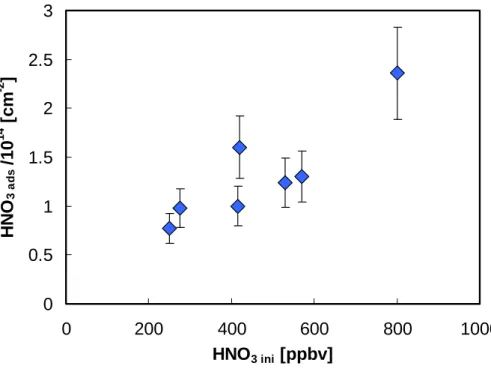
adsorbed amount of HNO3was determined in different experiments. For HNO3mixing ratios in the range 250–800 ppbv a surface coverage of 0.8–2.4×10¹⁴ HNO3cm−2was derived (cf. Fig. 3) by using the BET surface of 20 m2g−1, given by the manufacturer. After the HNO3source was stopped, HNO3desorption was observed (cf. Fig. 4) leading to a HNO3recover of ∼(80±10)% within 24 h.
20
Based on the results of Choi and Leu (1998), who reported the formation of products only for multilayer adsorption, it is concluded that a monolayer coverage of HNO3 on Lamp Black 101 of ∼2×10¹⁴HNO3cm−2is reached for mixing ratios of ∼800 ppbv. This value is slightly lower than the value of 3.8×1014cm−2 determined for n-hexane flame soot by Choi and Leu (1998), but is in excellent agreement with the values of 2×10¹⁴ 25
HNO3cm−2 reported by Aubin and Abbatt (2003) also for n-hexane flame soot. In addition, this value is also in excellent agreement with the maximum number of active
ACPD
4, 6747–6767, 2004
Heterogeneous conversion of NO2
and NO on HNO3 treated soot surfaces
J. Kleffmann and P. Wiesen Title Page Abstract Introduction Conclusions References Tables Figures J I J I Back Close
Full Screen / Esc
Print Version
Interactive Discussion sites of 2.2×1014cm−2determined by Kirchner et al. (2000) for spark generator soot.
The observed product formation of Reaction (2), i.e. formation of NO and NO2only for high HNO3 concentrations, is in excellent agreement with nearly all studies of this reaction. In these studies no product formation was observed for low reactant concen-trations (Aubin and Abbatt, 2003; Choi and Leu, 1998; Longfellow et al., 2000; Saathoff 5
et al., 2001; Seisel et al., 2000), whereas the formation of NOx was observed for high reactant concentrations (Choi and Leu, 1998; Disselkamp et al., 2000; Prince et al., 2002; Rogaski et al., 1996). In addition, the absence of any HONO formation for Reac-tion (2) is in good agreement with the study of Aubin and Abbatt (2003), although the authors could not determine the upper limit of the product yield. The missing HONO for-10
mation, even for high HNO3concentrations when the HONO precursor NO2is formed (cf. Fig. 2), can be explained by the blocking of active sites for Reaction (1) by adsorbed HNO3(see Sect. 3.3).
In contrast to other studies, the formation of products as NO, NO2and HONO was very recently observed for Reaction (2) by Salgado Mu ˜noz and Rossi (2002) also for 15
low HNO3concentrations. The authors observed the formation of HONO on flame soot produced in a fuel rich flame, whereas NO and NO2were formed on soot generated in a lean flame. The reason for this discrepancy to other studies is unclear. It could be speculated that different properties of the soot might be responsible for the differences. However, the authors reported a reaction for both types of soot investigated, which 20
were produced under very different conditions. It should be pointed out that the use of very different types of soot, i.e. graphite (Choi and Leu, 1998), spark generator soot (Saathoff et al., 2001), Degussa FW2 (Choi and Leu, 1998), Degussa Lamp Black 101 (this study) and flame soot produced from the combustion of methane (Longfellow et al., 2000), propane (Longfellow et al., 2000), n-hexane (Aubin and Abbatt, 2003; Choi 25
and Leu, 1998) and kerosene (Choi and Leu, 1998; Longfellow et al., 2000; Seisel et al., 2000), did not lead to the formation of products at low HNO3concentrations. Fur-thermore, the reactivity of the soot produced in a fuel rich flame by Salgado Mu ˜noz and Rossi (2002) showed a very similar behaviour for Reaction (1) compared to Lamp
ACPD
4, 6747–6767, 2004
Heterogeneous conversion of NO2
and NO on HNO3 treated soot surfaces
J. Kleffmann and P. Wiesen Title Page Abstract Introduction Conclusions References Tables Figures J I J I Back Close
Full Screen / Esc
Print Version
Interactive Discussion Black 101 which was used in the present study (compare Stadler and Rossi, 2000
with Kleffmann et al., 1999). In agreement with the results of most studies, it is con-cluded that HNO3is not reacting with soot under HNO3concentrations prevailing in the atmosphere and hence is not a “renoxification” pathway or a source of HONO in the atmosphere.
5
3.2. Reaction of HNO3and NO with soot surfaces
When soot was exposed to a humid mixture of HNO3 and NO at mixing ratios of 280 and 500 ppbv, respectively, a similar behaviour was observed compared to pure HNO3 mixtures (see Sect. 3.1 and Figs. 2 and 4). Again, a HNO3adsorption of ∼1014cm−2, a desorption of HNO3 after stopping the HNO3 source and no formation of NO2 and 10
HONO was observed. In addition, no NO uptake on the soot was monitored. The upper limits for the HONO and NO2yields, with respect to the uptake of HNO3, were <0.1% and <0.5%, respectively. Under the assumption that the whole BET surface of the soot is exposed to NO, which was shown to be the case for the uptake of NO2on the same type of soot and under similar experimental conditions (Kleffmann et al., 1999), 15
upper limits for the reactive uptake coefficients of NO for HONO and NO2formation of
γNO→HONO<1×10⁻¹⁰and γNO→NO
2<5×10
−10
were calculated for HNO3saturated soot surfaces.
The reaction of HNO3+NO on soot surfaces, Reaction (3), was investigated previ-ously by Salgado Mu ˜noz and Rossi (2002), who reported the formation of NO2. The 20
reason for the discrepancy between both studies is unclear. It could be speculated, similar to the discussion of the HNO3+soot reaction (see Sect. 3.1), that different sur-face properties might be responsible for the observed difference. Furthermore, in both studies the humidity was quite different. Whereas the humidity was extremely low in the Knudsen flow reactor of Salgado Mu ˜noz and Rossi (2002), a relative humidity of 25
∼50% was used in the present study.
ACPD
4, 6747–6767, 2004
Heterogeneous conversion of NO2
and NO on HNO3 treated soot surfaces
J. Kleffmann and P. Wiesen Title Page Abstract Introduction Conclusions References Tables Figures J I J I Back Close
Full Screen / Esc
Print Version
Interactive Discussion and NO on soot surfaces is unimportant for the atmosphere, in good agreement with a
recent study on silica surfaces (Kleffmann et al., 2004). 3.3. Reaction of NO2with HNO3treated soot surfaces
For the simulated ageing of the soot surface by treatment with HNO3, mixing ratios of up to 800 ppbv were used, in order to exclude the formation of NO2 (see Sect. 3.1), 5
which would result immediately in a deactivation of active sites on the soot surface for the non-catalytic reaction of NO2and soot (Kleffmann et al., 1999). After the samples were saturated with HNO3 over night, the soot was exposed to humid NO2 mixtures at mixing ratios of 500–600 ppbv. A strong uptake of NO2and the formation of HONO and NO with yields of ∼60% and 10–25%, respectively, was observed. For the initial 10
phase of the reaction, the yield of HONO was affected by the amount of HNO3 ad-sorbed. This means that the initial HONO yield decreased with increasing amount of adsorbed HNO3, however, get well back to the values for untreated soot somewhat later (see Fig. 5). The time period for the increase of the HONO yield up to the values for untreated soot was rising with increasing amount of adsorbed HNO3. This behaviour 15
can be explained by the adsorption of HNO3and the blocking of active sites for Reac-tion (1). For HNO3concentrations of 800 ppbv a HNO3monolayer coverage of the soot surface was estimated, leading to very small initial yields of HONO (see Fig. 5). How-ever, since HNO3desorbes from the soot when the HNO3source is stopped, the active sites become accessible for NO2later, leading to the observed rising HONO yields (see 20
Fig. 5). However, since the decrease in the HONO yield was only pronounced for at-mospheric non-relevant high HNO3 concentrations, it is concluded that the ageing of the soot surface has no significant effect on the HONO formation by Reaction (1). For Reaction (1) an integrated HONO yield of (0.8±0.2)×1014cm−2 was observed for un-treated soot, which is in excellent agreement with the study of Kleffmann et al. (1999). 25
In the study of Kleffmann et al. (1999) it was concluded that this value is too small to explain HONO formation in the atmosphere.
ACPD
4, 6747–6767, 2004
Heterogeneous conversion of NO2
and NO on HNO3 treated soot surfaces
J. Kleffmann and P. Wiesen Title Page Abstract Introduction Conclusions References Tables Figures J I J I Back Close
Full Screen / Esc
Print Version
Interactive Discussion
4. Conclusions
For the reaction of flame soot surfaces with HNO3(Reaction 2) at atmospheric humid-ity levels only reversible adsorption was observed for HNO3 mixing ratios <600 ppbv, in excellent agreement with almost all studies of this reaction at low reactant concen-trations. The upper limits for the yields of HONO, NO2 and NO were calculated to 5
be <0.2%, <0.5% and <1%, respectively. Only, for HNO3 mixing ratios >800 ppbv NO and NO2 were formed as products. A monolayer coverage of HNO3 on soot of ∼2×1014cm−2was estimated, in good agreement with previous studies. The behaviour of the HNO3+soot system remained unaffected when 500 ppbv of NO were added. Up-per limits for the reactive uptake coefficients of NO for HONO and NO2 formation of 10
γNO→HONO<1×10⁻¹⁰and γNO→NO
2<5×10
−10
were calculated for HNO3saturated soot surfaces. From the results of the present study it is concluded that heterogeneous re-actions of HNO3 on soot surfaces are unimportant for the “renoxification” and for the formation of HONO in the atmosphere.
Treating the soot surfaces with gaseous HNO3 had no significant impact on the het-15
erogeneous reaction of NO2 for atmospheric humidity levels. Only for high surface coverage of the soot with HNO3, the HONO yield was reduced. The results show, that ageing of the soot surfaces by HNO3 had no significant influence on the integrated HONO yield of ∼1014cm−2, which is too small to explain atmospheric HONO concen-trations.
20
Acknowledgements. This work was supported by the European Commission within the
NITRO-CAT project (Contract no. EVK2-1999-00025). The authors are indebted to A. Volz-Thomas and J. Wildt, Forschungszentrum J ¨ulich GmbH, for providing the LMA-4 NOxmonitor.
References
Alicke, B., Platt, U., and Stutz, J.: Impact of Nitrous Acid Photolysis on the Total Hydroxy 25
ACPD
4, 6747–6767, 2004
Heterogeneous conversion of NO2
and NO on HNO3 treated soot surfaces
J. Kleffmann and P. Wiesen Title Page Abstract Introduction Conclusions References Tables Figures J I J I Back Close
Full Screen / Esc
Print Version
Interactive Discussion Ozono Study in Milan, J. Geophys. Res., 107, 8196, doi:10.1029/2000JD000075, 2002.
Alicke, B., Geyer, A., Hofzumahaus, A., Holland, F., Konrad, S., P ¨atz., H. W., Sch ¨afer, J., Stutz, J., Volz-Thomas, A., and Platt, U.: OH Formation by HONO Photolysis During the BERLIOZ Experiment, J. Geophys. Res., 108, 8247, doi:10.1029/2001 JD000579, 2003.
Ammann, M., Kalberer, M., Jost, D. T., Tobler, L., R ¨ossler, E., Piguet, D., G ¨aggeler, H. W., 5
and Baltensperger, U.: Heterogeneous Production of Nitrous Acid on Soot in Polluted Air Masses, Nature, 395, 157–160, 1998.
Arens, F., Gutzwiller, L., Baltensperger, U., G ¨aggeler, H. W., and Ammann, M.: Heterogeneous Reaction of NO2on Diesel Soot Particles, Environ. Sci. Technol., 35, 2191–2199, 2001. Aubin, D. G., and Abbatt, J. P.: Adsorption of Gas-Phase Nitric Acid to n-Hexane Soot: Thermo-10
dynamics and Mechanism, J. Phys. Chem. A, 107, 11030-11037, doi: 10.1021/jp036105g, 2003.
Aumont, B., Madronich, S., Ammann, M., Kalberer, M., Baltensperger, U., Hauglustaine, D., and Brocheton, F.: On the NO2+ Soot Reaction in the Atmosphere, J. Geophys. Res., 104, 1729–1736, 1999.
15
Aumont, B., Chervier, F., and Laval, S.: Contribution of HONO Sources to the NOx/HOx/O3 Chemistry in the Polluted Boundary Layer, Atmos. Environ., 37, 487–498, 2003.
Bekki, S.: On the Possible Role of Aircraft-Generated Soot in the Middle Latitude Ozone De-pletion, J. Geophys. Res., 102, 10 751–10 758, 1997.
Brown, S. S., Talukdar, R. K., and Ravishankara, A. R.: Reconsideration of the Rate Constant 20
for the Reaction of Hydroxyl Radicals with Nitric Acid, J. Phys. Chem. A, 103, 3031–3037, 1999.
Choi, W. and Leu, M.-T.: Nitric Acid Uptake and Decomposition on Black Carbon (Soot) Sur-faces: Its Implications for the Upper Troposphere and Lower Stratosphere, J. Phys. Chem. A, 102, 7618–7630, 1998.
25
Disselkamp, R. S., Carpenter, M. A., and Cowin, J. P.: A Chamber Investigation of the Nitric Acid-Soot Aerosol Chemistry at 298 K, J. Atmos. Chem., 37, 113-123, 2000.
Gao, R. S., Fahey, D. W., Del Negro, L. A., Donnelly, S. G., Keim, E. R., Neuman, J. A., Teverovskaia, E., Wennberg, P. O., Hanisco, T. F., Lanzendorf, E. J., Poffitt, M. H., Margitan, J. J., Wilson, J. C., Elkins, J. W., Stimpfle, R. M., Cohen, R. C., McElroy, C. T., Bui, T. P., 30
Salawitch, R. J., Brown, S. S., Ravishankara, A. R., Portmann, R. W., Ko, M. K. W., Weisen-stein, D. K., and Newman, P. A.: A Comparison of Observations and Model Simulations of NOx/NOyin the Lower Stratosphere, Geophys. Res. Lett., 26, 1153–1156, 1999.
ACPD
4, 6747–6767, 2004
Heterogeneous conversion of NO2
and NO on HNO3 treated soot surfaces
J. Kleffmann and P. Wiesen Title Page Abstract Introduction Conclusions References Tables Figures J I J I Back Close
Full Screen / Esc
Print Version
Interactive Discussion Gerecke, A., Thielmann, A., Gutzwiller, L., and Rossi, M. J.: The Chemical Kinetics of HONO
Formation Resulting from Heterogeneous Interaction of NO2 with Flame Soot, Geophys. Res. Lett., 25, 2453–2456, 1998.
Hauglustaine, D. A., Ridley, B. A., Solomon, S., Hess, P. G., and Madronich, S.: HNO3/NOx Ratio in the Remote Troposphere during MLOPEX 2: Evidence for Nitric Acid Reduction on 5
Carbonaceous Aerosols? Geophys. Res. Lett., 23, 2609–2612, 1996.
Kalberer, M., Ammann, M., Arens, F., G ¨aggeler, H. W., and Baltensperger, U.: Heterogeneous Formation of Nitrous Acid (HONO) on Soot Aerosol Particles, J. Geophys. Res., 104, 13 825– 13 832, 1999.
Kirchner, U., Scheer, V., and Vogt, R.: FTIR Spectroscopic Investigation of the Mechanism and 10
Kinetics of the Heterogeneous Reactions of NO2 and HNO3 with Soot, J. Phys. Chem. A, 104, 8908–8915, 2000.
Kleffmann, J., Becker, K. H., Lackhoff, M., and Wiesen, P.: Heterogeneous Conversion of NO2
on Carbonaceous Surfaces, Phys. Chem. Chem. Phys., 1, 5443–5450, 1999.
Kleffmann, J., Benter, T., and Wiesen, P.: The Heterogeneous Reaction of Nitric Acid with Nitric 15
Oxide on Glass Surfaces under Simulated Atmospheric Conditions, J. Phys. Chem. A, 27, 5793–5799, 2004.
Kotamarthi, V. R., Gaffney, J. S., Marley, N. A., Doskey, P. V.: Heterogeneous NOx Chemistry
in the Polluted PBL, Atmos. Environ., 35, 4489–4498, 2001.
Lary, D. J., Lee, A. M., Toumi, R., Newchurch, M. J., Pirre, M., and Renard, J. B.: Carbon 20
Aerosols and Atmospheric Photochemistry, J. Geophys. Res., 102, 3671–3682, 1997. Lary, D. J., Shallcross, D. E., and Toumi, R.: Carbonaceous Aerosols and their Potential Role
in the Atmospheric Chemistry, J. Geophys. Res., 104, 15 929–15 940, 1999.
Longfellow, C. A., Ravishankara, A. R., and Hanson, D. R.: Reactive Uptake on Hydrocarbon Soot: Focus on NO2, J. Geophys. Res., 104, 13 833–13 840, 1999.
25
Longfellow, C. A., Ravishankara, A. R., and Hanson, D. R.: Reactive and Nonreactive Uptake on Hydrocarbon Soot: HNO3, O3, and N2O5, J. Geophys. Res., 105, 24 345–24 350, 2000. Louisnard, M., Baudoin, C., Billet, G., Garnier, F., Hills, D., Mentel, T., Mirabel, P., Petit, J. C.,
Schultz, J. L., Taleb, D., Thlibi, J., Wahner, A., and Woods, P.: Physics and Chemistry in the Aircraft Wake, in: AERONOX - The Impact of NOx Emissions from Aircraft Upon the 30
Atmosphere at Flight Altitudes 8 - 15 km, ed.: U. Schumann, Report EUR 16209 EN, ISBN-92-826-8281-1, 195–309, 1995.
ACPD
4, 6747–6767, 2004
Heterogeneous conversion of NO2
and NO on HNO3 treated soot surfaces
J. Kleffmann and P. Wiesen Title Page Abstract Introduction Conclusions References Tables Figures J I J I Back Close
Full Screen / Esc
Print Version
Interactive Discussion HNO3on Porous Glass: Implications for Conversion of HNO3to Photochemically Active NOx
in the Atmosphere, J. Phys. Chem. A, 104, 9705–9711, 2000.
Osterman, G. B., Sen, B., Toon, G. C., Salawitch, R. J., Margitan, J. J., Blavier, J.-F., Fahey, D. W., and Gao, R.S.: Partitioning of NOySpecies in the Summer Arctic Stratosphere, Geophys. Res. Lett., 26, 1157–1160, 1999.
5
Prince, A. P., Wade, J. L., Grassian, V. H., Kleiber, P. D., and Young, M. A.: Heterogeneous Reactions of Soot Aerosols with Nitrogen Dioxide and Nitric Acid: Atmospheric Chamber and Knudsen Cell Studies, Atmos. Environ., 36, 5729–5740, 2002.
Ren, X., Harder, H., Martinez, M., Lesher, R. L., Oliger, A., Simpas, J. B., Brune, W. H., Schwab, J. J., Demerjian, K. L., He, Y., Zhou, X., and H. Gao: OH and HO2 Chemistry in Urban 10
Atmosphere of New York City, Atmos. Environ, 37, 3639–3651, 2003.
Rivera-Figueroa, A. M., Sumner, A. L., and Finlayson-Pitts, B. J.: Laboratory Studies of Po-tential Mechanisms of Renoxification of Tropospheric Nitric Acid, Environ. Sci. Technol., 37, 548-554, 2003.
Rogaski, C. A., Golden, D. M., and Williams, L. R.: Reactive Uptake and Hydration Experiments 15
on Amorphous Carbon Treated with NO2, SO2, O3, HNO3and H2SO4, Geophys. Res. Lett., 24, 381–384, 1997.
Saathoff, H., Naumann, K.-H., Riemer, N., Kamm, S., M¨ohler, O., Schurath, U., Vogel, H., and Vogel, B.: The Loss of NO2, HNO3, NO3/N2O5, and HO2/HOONO2on Soot Aerosol: A Chamber and Modeling Study, Geophys. Res. Lett., 28, 1957–1960, 2001.
20
Salgado Mu ˜noz, M. S., and Rossi, M. J.: Heterogeneous Reactions of HNO3 with Flame Soot Generated under Different Combustion Conditions. Reaction Mechanism and Kinetics, Phys. Chem. Chem. Phys., 4, 5110–5118, doi:10.1039/b203912p, 2002.
Saliba, N. A., Mochida, M., and Finlayson-Pitts, B. J.: Laboratory Studies of Sources of HONO in Polluted Urban Atmosphere, Geophys. Res. Lett., 27, 3229–3232, 2000.
25
Saliba, N. A., Yang, H., and Finlayson-Pitts, B. J.: Reaction of Gaseous Nitric Oxide with Nitric Acid on Silica Surfaces in the Presence of Water at Room Temperature, J. Phys. Chem. A, 105, 10 339–10 346, 2001.
Seisel, S., Keil, Th., and Zellner, R.: Laboratory Studies of the Interaction of HNO3 and H2O with Soot Surfaces, in: EC/EUROTRAC-2 Joint Workshop, EC Cluster 4: “Chemical 30
Processes and Mechanisms”, EUROTRAC-2: ,,Chemical Mechanism Development (CMD)“ (Proc.), edited by Rossi, M. J. and Rossi, E.-M., Lausanne, 229–232, 2000.
Ambi-ACPD
4, 6747–6767, 2004
Heterogeneous conversion of NO2
and NO on HNO3 treated soot surfaces
J. Kleffmann and P. Wiesen Title Page Abstract Introduction Conclusions References Tables Figures J I J I Back Close
Full Screen / Esc
Print Version
Interactive Discussion ent Temperatures: The Influence of Combustion Conditions, Phys. Chem. Chem. Phys., 2,
5420—5429, 2000.
Vogel, B., Vogel, H., Kleffmann, J., and Kurtenbach, R.: Measured and Simulated Vertical Profiles of Nitrous Acid, Part II – Model Simulations and Indications for a Photolytic Source, Atmos. Environ, 37, 2957–2966, 2003.
5
Zhou, X., Civerolo, K., Dai, H., Huang, G., Schwab, J., and Demerjian, K.: Summertime Nitrous Acid Chemistry in the Atmospheric Boundary Layer at a Rural Site in New York State, J. Geophys. Res., 107(D21), 4590, doi:10.1029/2001JD001539, 2002.
Zhou, X., Gao, H., He, Y., Huang, G., Bertman, S., Civerolo, K., and Schwab, J.: Nitric Acid Pho-tolysis on Surfaces in Low-NOx Environments: Significant Atmospheric Implications, Geo-10
ACPD
4, 6747–6767, 2004
Heterogeneous conversion of NO2
and NO on HNO3 treated soot surfaces
J. Kleffmann and P. Wiesen Title Page Abstract Introduction Conclusions References Tables Figures J I J I Back Close
Full Screen / Esc
Print Version Interactive Discussion s y n t h . a i r ( h u m i d i f i e d ) N O 2 o r N O H N O 3 f i l t e r h o l d e r ( P F A ) " b l a n k " f i l t e r h o l d e r ( P F A ) s o o t s a m p l e T e f l o n f i l t e r s s t r i p p i n g c o i l i o n c h r o m a t o g r a p h N O x- m o n i t o r ( L M A 4 )
ACPD
4, 6747–6767, 2004
Heterogeneous conversion of NO2
and NO on HNO3 treated soot surfaces
J. Kleffmann and P. Wiesen Title Page Abstract Introduction Conclusions References Tables Figures J I J I Back Close
Full Screen / Esc
Print Version Interactive Discussion 0 400 800 1200 1600 -500 0 500 1000 1500 2000 2500 3000 3500 4000 t [min] H NO 3 [ ppbv ] 0 100 200 300 400 H ON O, N O2 , N O [ ppbv ] NO HONO HNO3 adsorption: 8x1013 cm-2 start: HNO3 + soot change in [HNO3] HNO3 NO2
Fig. 2. Reaction of pure gaseous HNO3with Lamp Black 101 at different HNO3mixing ratios (14 mg, 55% r.h.).
ACPD
4, 6747–6767, 2004
Heterogeneous conversion of NO2
and NO on HNO3 treated soot surfaces
J. Kleffmann and P. Wiesen Title Page Abstract Introduction Conclusions References Tables Figures J I J I Back Close
Full Screen / Esc
Print Version Interactive Discussion 0 0.5 1 1.5 2 2.5 3 0 200 400 600 800 1000 HNO3 ini [ppbv] H NO 3 a d s /1 0 14 [c m -2 ]
Fig. 3. Adsorption of HNO3on Lamp Black 101 as a function of the initial HNO3mixing ratio (10–30 mg, 50±5% r.h.).
ACPD
4, 6747–6767, 2004
Heterogeneous conversion of NO2
and NO on HNO3 treated soot surfaces
J. Kleffmann and P. Wiesen Title Page Abstract Introduction Conclusions References Tables Figures J I J I Back Close
Full Screen / Esc
Print Version
Interactive Discussion Fig. 4. Reaction of HNO3+NO with Degussa Lamp Black 101 (13 mg, 48% r.h.).
ACPD
4, 6747–6767, 2004
Heterogeneous conversion of NO2
and NO on HNO3 treated soot surfaces
J. Kleffmann and P. Wiesen Title Page Abstract Introduction Conclusions References Tables Figures J I J I Back Close
Full Screen / Esc
Print Version Interactive Discussion
0
20
40
60
80
100
0
50
100
150
200
250
300
t [min]
H
ON
O y
ie
ld
[%
]
untreated soot
treated soot (420 ppbv)
treated soot (570 ppbv)
treated soot (800 ppbv)
Fig. 5. HONO yield in the reaction of NO2with Degussa Lamp Black 101 treated with different amounts of gaseous HNO3prior to the experiment ([NO2]0=500–600 ppbv, ∼50% r.h.).


![Fig. 5. HONO yield in the reaction of NO 2 with Degussa Lamp Black 101 treated with di ff erent amounts of gaseous HNO 3 prior to the experiment ([NO 2 ] 0 = 500–600 ppbv, ∼50% r.h.).](https://thumb-eu.123doks.com/thumbv2/123doknet/14785708.598705/22.918.96.608.116.488/hono-reaction-degussa-black-treated-amounts-gaseous-experiment.webp)
