Publisher’s version / Version de l'éditeur:
Journal of the Acoustical Society of America, 38, 6, pp. 1035-1039, 1965-05-01
READ THESE TERMS AND CONDITIONS CAREFULLY BEFORE USING THIS WEBSITE.
https://nrc-publications.canada.ca/eng/copyright
Vous avez des questions? Nous pouvons vous aider. Pour communiquer directement avec un auteur, consultez la première page de la revue dans laquelle son article a été publié afin de trouver ses coordonnées. Si vous n’arrivez pas à les repérer, communiquez avec nous à [email protected].
Questions? Contact the NRC Publications Archive team at
[email protected]. If you wish to email the authors directly, please see the first page of the publication for their contact information.
NRC Publications Archive
Archives des publications du CNRC
This publication could be one of several versions: author’s original, accepted manuscript or the publisher’s version. / La version de cette publication peut être l’une des suivantes : la version prépublication de l’auteur, la version acceptée du manuscrit ou la version de l’éditeur.
For the publisher’s version, please access the DOI link below./ Pour consulter la version de l’éditeur, utilisez le lien DOI ci-dessous.
https://doi.org/10.1121/1.1939453
Access and use of this website and the material on it are subject to the Terms and Conditions set forth at
Subjective judgements of footstep-noise transmission through floors
Olynyk, D.; Northwood, T. D.
https://publications-cnrc.canada.ca/fra/droits
L’accès à ce site Web et l’utilisation de son contenu sont assujettis aux conditions présentées dans le site LISEZ CES CONDITIONS ATTENTIVEMENT AVANT D’UTILISER CE SITE WEB.
NRC Publications Record / Notice d'Archives des publications de CNRC:
https://nrc-publications.canada.ca/eng/view/object/?id=9d10d987-7b4d-4fd2-9813-035c4d92b536 https://publications-cnrc.canada.ca/fra/voir/objet/?id=9d10d987-7b4d-4fd2-9813-035c4d92b536
Reprinted from T E E JOURNAL OF ACOUSTICAL SOCIETY OF AMERICA, Vo1. 38, No. 6, 1035-1039, December 1965
Copyright. 1965 by the Acoustical Society of America. Printed in U. S. A.
Subjective Judgments of Footstep-Noise
Transmission through Floors*
DXsion of Bziilding Research, National Research Cozmcil, Ottawa, Ontario, Canada
The current procedure for assessing impact transmission through floors involves comparing the spectra of transmitted noise produced by a standard tapping machine. An obvious weakness in the method is that it does not really simulate footsteps. One is more interested, however, in how well the method rank-orders floor structures as compared with the impressions of an apartment dweller listening to his upstairs neighbor. This project was intended to provide a partial answer to this complex question. Subjective comparisons were made of the "loudnesses" of footsteps on a concrete slab floor with various added structures. Comparison with FHA ratings indicates that the ratings exaggerate the differences between floorsin themostunacceptable range, but that there is a reasonable degree of correlation among the important range of floors. A variation of the FHA procedure that improves the correlation is also reported.
INTRODUCTION uring it. This is a particularly difficult task when, as
T
H E current procedure for rating the impact-sound in this case, the property in question involves subjective insulation provided by a floor is a two-stage proc- reactions that cannot be defined precisely. Thus, there ess. The first stage is to measure the spectrum of noise are numerous reasons why the rating achieved by the transmitted through the floor from a standard impact above method might not correlate well with the rank- machine. The second stage is to compare the spectrum ordering of floors by tenants living under them. Unfor- of transmitted machine noise with a standard reference tunately, a direct and conclusive experiment is imprac- spectrum; thus, following certain rules (described later), ticable and we are driven to limited fra,mentary studies one arrives a t a single-figure impact-noise rating for of the process.the floor. It is usually assumed that footsteps constitute the This basic system has been used for some years by only very important impact noise. Other more severe noises will occur from time to time, but not often several European countries and is soon to become an enough to constitute a significant annoyance. An ob- international standard. The impact machine is already vious approach, therefore, is to machine im- standardized1 and the reference spectrum is in the proc- pacts with footsteps. A direct comparison of the tran- ess of being approved. Essentially the same system was sient forces has been made3 as well as subsidiary studies recently adopted by the U. S. Federal Housing Admini- of floor damage by footstep^.^ It seems clear that the stration2 for determining the "Impact Noise Rating" two types of impact are quite different, and that the of floors for apartment dwellings. elastic limit is sometimes exceeded for both types of The objective of any standard test is to define, in impact. Thus, one might not expect a one-to-one cor- unambiguous physical terms, the property that is to be respondence in results from the two rather different measured and to prescribe an exact procedure for meas- processes.
A related line of attack is to compare the noise spec-
*
This pa er is a contribution from the Division of Buildin tra produced by machine and by footsteps. Studies byResearch, Jational Research Council, Canada, and is publishei with the approval of the Director of the Division.
'
"Field and Laboratory Measurements of Air-Borne and Im- B. G. Watters, "Impact Noise Characteristics of Female Hard-pact Sound Transmission," Intern. Org. Standardization, I S 0 Heeled Foot Traffic," J. Acoust. Soc. Am. 37, 619-630 (1965).
Recommendation R I40 (1969). F. C. Harper, W. J. Warlow, and B. L. Clarke, "The Forces
"Impact Noise Control in Multifamily Dwellings," Federal Applied to the Floor by the Foot in Walking," Natl. Bldg. Studies
Housing Admin., Washington, D. C., Bull. No. 750 (1963). Res. Paper 32, Bldg. Res. Sta. London (1961).
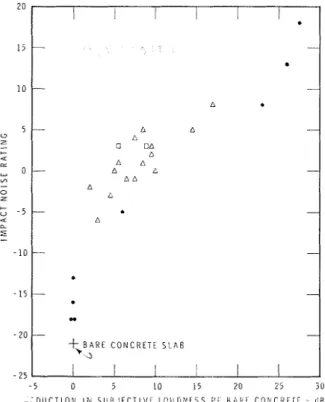
1036 O L Y N Y K A N D N O R T H W O O D - " - + B A R E C O N C R E T E S \ A 6 '3 - 25 - 5 0 5 1 10 15 20 2 5 30 . , ; D U C T I O N I N S U B J E C T I V ! ! O U D , V L S S i!i B i l l ' E C O I ' ! C R L I E - d B FIG. 1. Relation between subjective judgments of loudness and machine-derived ratings, using FHA reference spectrum. Female
footsteps (hard heels). Additions to bare concrete slab: furred
structure; l continuous surface; A sandwich surface.
Mariners and by Fasold6 along these lines have adopted as their criterion the loudness of transmitted impacts, calculated by the methods of Stevens and Zwicker, re- spectively. Such calculations are of iirnited absolute reliability when applied to isolated impacts such as foot- steps. Moreover, it is difficult in this case to take proper account of receiving-room properties, since the room boundaries are involved in a con~plex way in forming the received transient sounds. Nevertheless, compari- sons within one controlled study should have reasonable validity.
The two loudness studies do not agree in their main conclusions. Mariner's study of thin floor coverings showed some scatter, and it was concluded that the correlation between machine impacts and footsteps was poor. The recent work by Fasold on a wide range of floor structures indicated that calculated loudness of footsteps correlated generally very well with the ma- chine-derived ratings. The study went further, however, to show that the correlation could be made still better by a change in the shape of reference spectrum used in the second stage of the rating procedure.
In the present project, the doubts concerning the cal- culation of footstep loudness were avoided by making
T. Mariner, "Technical Problems in Impact Noise Testing,"
Bldg. Res. 1, 53-60 (1964).
6 W. Fasold, "Untersuchungen uber den Verlauf der Sollkurve
fur den Trittschallschutz im Wohnungsbau," Acustica 15,249-305 (1965).
actual subjective assessments of footstep noise trans- mitted through a series of floors. The aim was to ap- proach as closely as is possible in the laboratory to the sort of assessments that might be made by occupants of buildings employing such floors. The subjective rat- ings were then compared to machine-derived impact- noise ratings.
I. SUBJECTIVE LOUDNESS METHOD
The basic procedure for obtaining subjective loudness comparisons was to make pairs of tape recordings of footsteps on two floors, on a two-channel tape recorder. With the same gain settings, a calibrating signal was recorded on each channel. A number of observers (usually 10) listened to tape loops on which the two sets of footsteps were presented alternately, and ad- justed gain settings until the footsteps sounded equally loud; then a loop formed from the calibration signals was used to deternine the difference in gain introduced in equalizing the two sets of footsteps. This difference in gain was used as a measure of the difference in per- formance of the two floors.
For most of the comparisons, a bare concrete slab floor was used as the reference, and all other floor types were rated in terms of their improvement over bare concrete. I n the more extreme comparisons, several ob- servers conmented on the difliculty of comparing such dissimilar sounds, but nevertheless the scatter among subjective judgments was very low in all cases. The
4-
"1-
L B A R E C O N C R E T E\
I 2 5 I I I I I - 5 O , 5 1 0 1 5 20 2 5 30 R E D U C T I O N I N S U B J E C T I V E L O U D N E S S Rt F E R l A L t F O O T S T E P S O N B A R E C O N C R E T E - tlBFIG. 2. Comparison of subjective judgments of men's (e)
J U D G M E N T S O F F O O T S T E P N O I S E T H R O U G H F L O O R S 1037 F L A T S P E C T R U M O I N R G O V E R N E D ;Y 8 6 0
*
I
- o,
LIB ,,l~Ix D E F l c l ~ c y3
-1
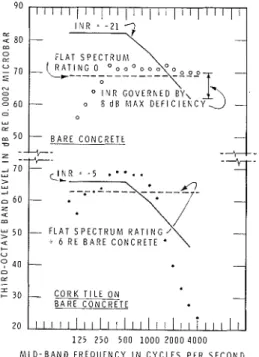
C O R K T l L E O N B A R E C O N C R E T E 2 0 l l l l l l l l l l l l l l l l l l l l l l l l l l 1 2 5 2 5 0 5 0 0 1 0 0 0 2 0 0 0 4 0 0 0 M I D - B A N D F R E Q U E N C Y I N C Y C L E S P E R S E C O N DFIG. 3. Impact-machine spectra and adjusted reference contours
for two types of floor. (Levels normalized t o 0.5-sec reverberation time in receiving room.)
mean values appear to be reliable to between 1 and 2 dB (90% confidence limit). The validity of the subjective rating scale was further tested by making triangular comparisons (i.e., A vs B, B vs C, and C vs A). I t was found that the sequence of measurements was consistent. So far, the investigation has been confined to a stone- aggregate concrete slab, 8 ft square by 4 in. thick, with some 25 different surface additions. These may be con- sidered in three categories: sandwich structures, con- sisting of a resilient layer over the basic slab and an upper concrete or wood layer in continuous contact; furred structures, consisting of a lightweight wood floor on furring, with or without resilient pads; and contin- uous surfaces such as tile, linoleum, or carpet. The re- ceiving room was a small reverberation room with rever- beration times ranging from 3.5 to 1.5 sec for the frequency range 125-4000 cps. Impact-machine spectra are normalized to correspond to a reverberation time of 0.5 sec.
11. RESULTS
Figure 1 shows the correlation between impact- noise ratings and subjective loudness comparisons with women's footsteps. I t will be seen that the correlation is iairly good for most of the range, although there is some scatter a t the ends. The less acceptable floors, espe- cially those involving thin surface layers, have better impact-noise ratings than would be expected from the subjective comparisons. There is an 8-dB spread in the ratings of floors that subjectively are no better than concrete. At the other extreme, a wide range of carpets gave a 5-dB spread in subjective rating as compared
with a 10-dB spread in impact ratings. I t must be ad- mitted that the subjective results for carpet, which were complicated by low signal-to-noise ratios, are the least reliable, but essentially the same results were obtained by other techniques, discussed in a later section.
Most of the measurements were obtained with women's stiletto-heeled shoes, but men's rubber-heeled shoes were used also on a selection of floors. The differ- ence in results is shown in Fig. 2. I t will be seen that the women's footsteps are subjectively louder over most of the range, although men's footsteps become impor- tant in the case of carpets and others of the better floors. This is to be expected, in view of the difference in frequency content of the two liinds of footsteps, as iSdiscussed in the next section.
A. Frequency Considerations
I t is pertinent at this point to consider how machine- noise spectra are used in arriving a t an impact-noise rating. This will be done in detail for two floors of bare concrete, with and without &-in. cork tiles bonded to it. Impact-machine spectra are shown in Fig. 3. Super- imposed (solid lines) are the adjusted FHA reference contours. The adjustments are made according to the FHA/ISO rules, which permit the machine spectrum to exceed the contour by a total of 32 dB (in all bands), but no more than 8 dB in any one band. I t will be seen that the perfonnance of the bare concrete floor is deter- mined solely by the high-frequency end of the contour, whereas the cork-tile floor is judged by its perfonnance over a broad middle-frequency range.
For comparison, the spectra of men's and women's footsteps on the same two floors are shown in Fig. 4. The spectra are peak levels, obtained by means of a peali-retaining meter on the output of the filter system. The stiletto heels used throughout this study were of an early type with a steel tip. Since the work began there has been a general trend to a hard plastic tip on
FIG. 4. Footstep spectra (peak levels) for the two types of floor
considered in Fig. 3. 0 C . & ? n l l l l i ~ l l ~ l l ~ l l ~ ~ ~ ~ ~ ~ ~ ~ I l l
._...
-.';.-.-
o-o! /\tTEEL H E E L - T I P O - a$-/.'\
* , , - p L A s T l c w F - 1 0 - ',* H E E L - T I P C C O R K T I L E I'3'
1 ? 5 2 5 6 5 0 0 1 3 0 0 2 0 0 0 4 0 0 0 1 0 0 0 0 t ? i ' : I ! i ' : C ? I:< C Y C L E ! . P E R S E C G N Q1038 O L Y N Y K A N D N O R T H W O O D
+,_BARE C O N C R E T E
- 5
L
I 1 I I I II
0 5 1 0 1 5 2 0 25 3 0
Z E D U C T I O N I N S U B J E C T I V E L O U D N E S S R E B A R E C O N C R E T E - d B
FIG. 5. Relation between subjective judgments of loudness and
machine-derived ratings, using a flat reference spectrum. Female
footsteps (hard heels). Additions to bare concrete slab: furred
structure; continuous surface; A sandwich structure.
this type of heel. This produces a reduced high-fre- quency spectrum, as indicated by the broken line in Fig. 4, but extended tests were not done with this type of heel.
The difference between floors is more striking for women's than for men's footsteps, but in both cases the differences extend across the whole frequency range. I t would be expected that the subjective loudness would be determined largely by the midirequencies. This leads one to consider alternative shapes of reference contour that would reduce the overemphasis on the high fre- quencies introduced by the machine.
An obvious choice is a flat contour. The broken lines in Fig. 3 represent such a contour, fitted by the same rules as before, except that the rating numbers are sim- ply the band spectrum levels (constant for all bands). now I t will be seen that, for both floors, the ratin, depends on a fairly wide middle-frequency band of ma- chine noise. A comparison with subjective ratings also supports the flat contour. The cork tile is rated 16 dB better than bare concrete by the FHA contour, but only 6 dB better by the flat contour; the latter agrees exactly with the subjective comparison.
The flat reference contour was tried on the 25 floors under study, with the results shown in Fig. 5. Com- paring these results with those in Fig. 1, i t will be seen that the group of floors that were indistinguishable sub- jectively from bare concrete are now rated accordingly. Thus the correlation a t the "unacceptable" end of the range of floors is improved. There remains some scatter among the various constructions, but the correlation is reasonably good over the range investigated. This is consistent with the conclusions of Fasold,= who found
good correlation between calculated loudnesses of var- ious noises and the I S 0 rating, but a still better cor- relation when a flat contour was used.
The flat contour is only the first obvious approach to a better correlation. Since both this work and that of Fasold were limited to variations of the concrete slab floor, it would be premature to offer this as a substitute for the present standard. Further studies on other types of floors will be pursued in a similar way.
111. MASKING TECHNIQUES
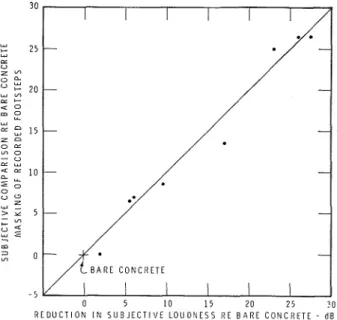
I t may be argued that the apartment dweller is con- cerned not about relative loudness but about whether he hears footsteps a t all. Two other subjective methods that approach this condition were tried. The first was to superimpose a constant level of masking noise on the playback system and to adjust gains until the two sets of footsteps just disappeared in the masking noise. Ran- dom noise, tailored to the shape of a NC-40 contour, was used as the masking noise. This technique was found somewhat easier for the obeservers and the results were substantially the same as with the loudness comparison (Fig. 6). This was so, even for the best floors tested, for which the original loudness determination was very difficult because of the low level of footstep noise; it had been suspected that the jud,ments were biased by the masking effect of receiving-room noise.
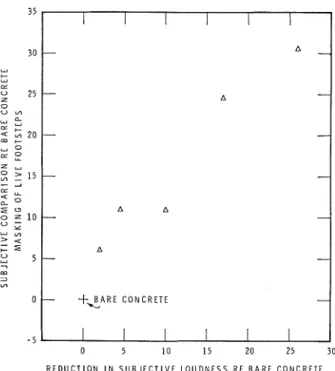
A second method was a live comparison below the test floors in the presence of a controlled level of mask- ing noise. Several observers were asked to listen to foot- steps in the room below the test floor and to determine which of five levels of masking noise presented in the room mould make the footsteps just inaudible. The test levels were spaced 2 dB apart, and this limits the pre-
LT U z in fi u t; 2 0 - LT Y u 0 m 0 u LC.
m z
1 5 - z 0 m in 0 - U m u 2.. 1 0 - 5 LC. 0 0 U " z W _ > Y 5. - 5 0 5 1 0 1 5 20 2 5 ?O R E D U C T I O N I N S U B J E C T I V E L O U D N E S S R E B A R E C O N C R E T E - d BFIG. 6. Relation between two subjective ratings: loudness vs
level of noise required to mask recorded footsteps. Female foot- steps (hard heels).
J U D G M E N T S O F F O O T S T E P N O I S E T H R O U G H F L O O R S 1039
- + C A R E C O N C R E T E
- 5
0 5 1 0 1 5 20 25 30
R E D U C T I O N I N S U B J E C T I V E L O U D N E S S R E B A R E C O N C R E T E
FIG. 7. Relation between two subjective ratings: loudness vs
level of noise required in receiving room to mask direct sound of footsteps. Female footsteps (hard heels).
cision of the judgments. Using as a reference the level required to mask footsteps on bare concrete, the im- provement over bare concrete for a few of the floors
is compared with the subjective loudness comparisons in Fig. 7. I t is seen that the live-nlasking technique also is consistent with the loudness comparison, although there is an absolute shift of a few decibels relative to either of the tape-loop methods. Possibly the discrep- ancy is related to the difference in location of the loud- speaker and footsteps relative to the listeners, although there were no obvious level gradients in the listening area.
Either of the masking procedures appears to be a good experimental approach for subjective tests, and has somewhat more flexibility than the loudness com- parison. Perhaps the principal advantage is that i t elim- inates the necessity of a direct comparison to a reference floor, since the footsteps are compared with a control- lable or measurable level of masking noise. The method is, therefore, readily applicable to field tests.
IV. CONCLUSIONS
The conclusion to be drawn from these studies is that, for these categories of floors, the impact-machine method is a valid one for rating reasonably acceptable floors, although some unacceptable floors, equivalent in performance to bare concrete, are overrated. I t ap- pears that the range of validity of the rating system could be extended downward by a modification of the present method of interpreting impact-machine data. This tentative observation needs confirmation, however, with tests on other floor structures.