Publisher’s version / Version de l'éditeur:
Technical Note (National Research Council of Canada. Division of Building Research), 1970-08-01
READ THESE TERMS AND CONDITIONS CAREFULLY BEFORE USING THIS WEBSITE.
https://nrc-publications.canada.ca/eng/copyright
Vous avez des questions? Nous pouvons vous aider. Pour communiquer directement avec un auteur, consultez la première page de la revue dans laquelle son article a été publié afin de trouver ses coordonnées. Si vous n’arrivez pas à les repérer, communiquez avec nous à [email protected].
Questions? Contact the NRC Publications Archive team at
[email protected]. If you wish to email the authors directly, please see the first page of the publication for their contact information.
NRC Publications Archive
Archives des publications du CNRC
For the publisher’s version, please access the DOI link below./ Pour consulter la version de l’éditeur, utilisez le lien DOI ci-dessous.
https://doi.org/10.4224/20338393
Access and use of this website and the material on it are subject to the Terms and Conditions set forth at
Statistical Evaluation of Joint Movements
Karpati, K. K.
https://publications-cnrc.canada.ca/fra/droits
L’accès à ce site Web et l’utilisation de son contenu sont assujettis aux conditions présentées dans le site LISEZ CES CONDITIONS ATTENTIVEMENT AVANT D’UTILISER CE SITE WEB.
NRC Publications Record / Notice d'Archives des publications de CNRC:
https://nrc-publications.canada.ca/eng/view/object/?id=322d87d6-9a20-4be2-85b6-2bf6924d5cf2 https://publications-cnrc.canada.ca/fra/voir/objet/?id=322d87d6-9a20-4be2-85b6-2bf6924d5cf2
DIVISION OF BUILDING RESEARCH
No.
NATIONAL RESEARCH COUNCIL OF CANADA
541
NOTlE
TEClHIN lICAlL
PREPARED BY K. Karpati CHECKED BY P.J.S. APPROVED By N. B. H. DATE August 1970
PREPARED FOR Inquiry and Record Purposes
SUBJECT STATISTICAL EVALUATION OF JOINT MOVEMENTS
This report describes the steps taken in the statistical evaluation of daily joint movements vs. temperature changes. It is therefore supplementary to a previous paper':C which gives only the results of the statistical treatment. This present report is
intended to show how statistics were used as a tool for the evaluation and should be read together with the previous publication.
The aim of the statistical evaluation was to give a numerical expression to the accuracy of the degree of correlation between var-ious sets of data or to prediction of results. The accuracy is
expressed in per cent and is called "confidence level" in the language of statistics. This is the guideline that enables the investigator to make decisions "in the face of incomplete evidence" as E. B. Mode puts it (ref. 1, p. 106).
The prerequisite of such an evaluation should be a normal distribution of the data for which the confidence level is given. In the experiment at DBR/NRC, however, it was unnecessary to test the normality of distribution because experience has shown that in
such cases one is usually confronted with a normal distribution, or with a distribution not significantly different from the normal.
*
Karpati, K.K. and E. V. Gibbons. joint movements in buildings.Experimental prediction of In process
2 -SETTING CONFIDENCE LIMITS
Although the test of normality is unnecessary in this case. the properties of a normal distribution will be discus sed briefly in order to summarize the meaning of confidence limits.
Continuous data follow a セッイュ。ャ distribution, i. e •• if a
measurement is repeated an infinite number of times, the frequency of the readings will follow a bell-shaped curve (Figure 1) with unit area under it. This is the normal frequency distribution that can be described by the following equation (ref. 2, p. 388):
f{x) =--==--1
o/!ff
(I )where j..L, the meaning of the population. is defined (ref. 2, p. 358) as:
j..L
=
+
x 2+ •••
n x n(2)
and 0 standard deviation of the population is defined (ref. 2, p. 362) as:
a
=/
'i'.(Xi: x )2(A list of symbols is included in this Note as Appendix A. )
(3 )
From Eq. (I) it can be seen that the normal distribution is determined by j..Land o. These can take up any values producing an infinite number of curves. If, however, j..Lis shifted to zero and 0 is used as the unit of measurement, then the curve has a general applicability. As the area under the curve is given as unity,
therefore a chosen section of the area expresses the probability of occurrence of the corresponding frequency values. These figures have been tabulated for the half tail of the curve (see Figure 2 and ref. 2, p. 390 -1) to eliminate complicated calculations. If one wants to know the probability of values occurring between I-L
+
10 and/or j..L - 10", one reads for the half tail from the table (in ref. 2): O. 159, which gives the probability of 1 - 2 x O. 159==
0.682. In other words, readings will occur in 68.2 per cent of the cases within the limits j..L ± 10" as illustrated in Figure 3. In the same way. one obtains 95.4 per cent for IJ. ± 20 and 99. 7 per cent for IJ. ± 30. This is the way various confidence limits can be set.t -DISTRIB UTION
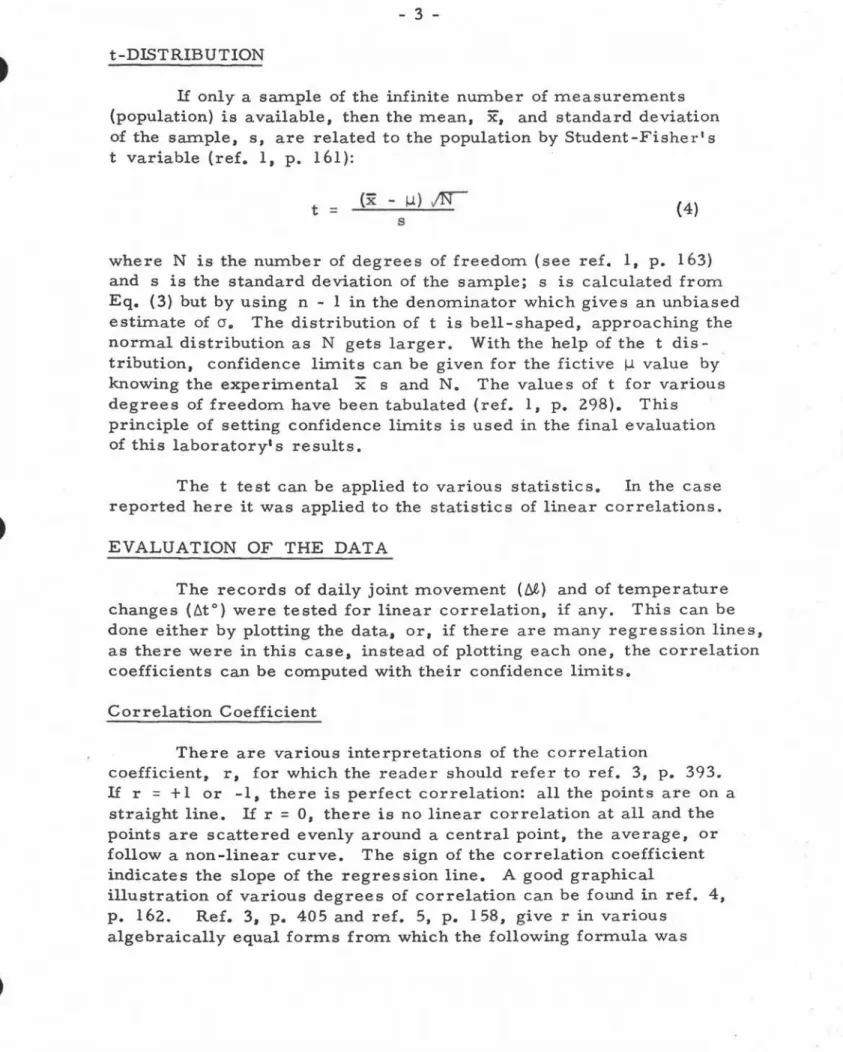
If only a sample of the infinite number of measurements (population) is available, then the mean, X, and standard deviation of the sample, s, are related to the population by Student-Fisherls
t variable (ref. 1, p. 161):
t
=
(x - I-l) ,.t1'.rs (4)
where N is the number of degrees of freedom (see ref. 1, p. 163) and s is the standard deviation of the sample; s is calculated from Eq. (3) but by using n - 1 in the denominator which gives an unbiased estimate of G. The distribution of t is bell-shaped, approaching the normal distribution as N gets larger. With the help of the t dis-tribution' confidence limits can be given for the fictive I-l value by knowing the experimental
x
sand N. The value s of t for various degrees of freedom have been tabulated (ref. I, p. 298). This principle of setting confidence limits is used in the final evaluation of this laboratory's results.The t test can be applied to various statistics. In the case reported here it was applied to the statistics of linear correlations. EVALUATION OF THE DATA
The records of daily joint movement (bt) and of temperature changes (6tO) were tested for linear correlation, if any. This can be done either by plotting the data, or, if there are many regression lines, as there were in this case, instead of plotting each one. the correlation coefficients can be computed with their confidence limits.
Correlation Coefficient
There are various interpretations of the correlation
coefficient, r, for which the reader should refer to ref. 3. p. 393.
If r
=
+
1 or -1, there is perfect correlation: all the points are on a straight line. If r = 0, there is no linear correlation at all and the points are scattered evenly around a central point, the average, or follow a non-linear curve. The sign of the correlation coefficient indicates the slope of the regression line. A good graphicalillustration of various degrees of correlation can be found in ref. 4, p. 162. Ref. 3, p. 405 and ref. 5, p. 158, give r in various
4
-derived* and used in our calculations for reasons of convenience of computation:
r
=
n 2: xy - 2:x2:y(n2 - n) s s x y
(5 )
The found correlation coefficient is relevant only to the sample. What one has to know are the limits within which the correlation
coefficient of the population, p, will fall, from which the sample was taken. This is done by making use of Fisherl s z-transformation
following the formula (ref. 6, p. 198 or ref. 1, p. 246):
1
z =
'2
loge 11+
- rr ' and,C
= 2 loge1 11 _+ PP ( 6) The transformation is necessary because r does not have anormal distribution while z has, and therefore confidence limits can be set on the latter only. These are for p(ref. 1, p. 247; see Example 2 on the same page):z ± z'Gz , where z'
= - -
z -c
and GzGz
1 =
In -
3
(7)
The confidence limits can be given by using Fisher1s tables for z' (ref. 1, p. 297). The results have to be retransformed into r using the same transform, Eq. (6), or its tabulated version (ref. 1, p. 306). Regre s sion Line
The correlation coefficients and their limits found for the data were high in most cases, therefore further analysis was undertaken. The regression lines were calculated to attempt prediction of yearly movements from the daily movements. The calculation of the regression line is based on the least squares principle (ref. 2, p. 459) and one
obtains:
(8)
where ax=
y -
bx=
2:y - bx 2: x n (see ref. 4, p. 152) ( 9) * by W. A. Dalgliesh, Building Structures Section, DBR/NRC.and
o
b
=
r -Y....- (see ref. 4, p. 158)x Ox (10)
Prediction Interval for the Yearly Movement
The values predicted for yearly joint movement were obtained by substituting in Eq. (8) the measured yearly temperature difference and the values for ax and b x calculated from daily readings. Confidence limits were set on the calculated yearly movement, y, by using the following equation (ref. 5, p. 163):
I
1 (x -x
)2Y
=
Y ± t • se 1 + n + MZMMBZBBBGZBセ(n - 1)si ( 11 )
where se is the standard error of estimate calculated as follows (ref. 5, p. 156):
s
J
fin -_ 21 2s
=
(1 - r )e ( 12)
The third member under the square root in Eq. (11) takes care of the increasing uncertainty of prediction as one gets further away from X, the average of the sample.
The calculated yearly movement and its confidence limits were compared with the measured yearly movement.
Analysis of the Hypothesis of ax
=
0Confidence limits can be set for the value of y at a given value of x with the help of Eq. (11). 1£ we substitute x
=
0 and y=
0, the obtained values give the scatter of ax within the chosen confidence limits (95 per cent was chosen in this case). 1£ the value obtained for the intercept is within the above limits, one can say with 95 per cent confidence that ax = 0, i. e., that the intercept goes through the origin.Analysis of the Slope
Different slopes were obtained for the regression lines of the winter and summer periods. Confidence limits have been set on the slopes to establish if this difference was genuine. The standard
6
-error of the slope (ref. 7, p. 5 to 10) is:52
X
(12)
t • sb gives the confidence limits of the slope at a chosen level. Where1:he confidence liInits of the slopes did not overlap for winter and summer, the difference of slopes was genuine, not included in the errors. The possible reasons for the difference has been discussed in the original paper.
SUMMARY
Statistical analysis has been applied to explore the pos sibility of predicting yearly joint movement from measurements of daily joint movement and temperature changes. This report complements a previous report on the conclusions drawn from the work and sums up the details of the statistical method chosen.
Statistical analysis has been used as a tool with the aim of
expressing numerically the accuracy of the evaluation. As the analysis is only a tool, it may be applicable to other problems occurring in the investigation of properties of building materials. The procedure as described, however, may not suit the individual needs of other investi-gators.
REFERENCES
1. Mode, E. B. Hall.
Elements of Statistics, 3rd Ed., Prentice-1961.
2. Cuming, H. G. and C. J. Anson. Mathematics and Statistics for Technologists. Heywood Books, London, England.
1966.
3. Waugh, A. E. Elements of Statistical Method. McGraw-Hill Book Company. 1943.
4. Snedecor, G. W. Statistical Methods, 5th Ed., Iowa State College Press. 1956.
6. Fisher, Sir R. A. Statistical Methods for Research Workers. 13th Ed., Oliver and Boyd. 1958.
7. Gibbons, Natrella M. Experi.m.ental Statistics. Handbook 91, U.S. National Bureau of Standards. 1963.
•
f(x)cr, cr , cr
x y I.l n N s, s J S X Y X r pe
a x b x zC
y se sb x APPENDIX A SYMBOLSfrequency with which reading x occurs standard deviation of the population mean of the population
number of observations (or pairs of observations) number of degrees of freedom
standard deviations of the sample mean of the sample
correlation coefficient of the sample correlation coefficient of the population constant of the linear regression line slope of the linear regression line defined by Eq. (6)
defined by Eq. (6)
prediction interval for individual value of y standard error of estimate of the sample standard error of the slope for the sample
o
エッM]ZZZZ[NNNMMMMMMMセMx
FIGURE 1
NORMAL FREQUENCY DISTRIBUTION
o
AREA
TABULATED
FIGURE 2
AREA OF SEGMENT UNDER THE STANDARD NORMAL DISTRIBUTION
AREA-0·1587 (APPROX. ONE-SIXTH)