HAL Id: hal-01091344
https://hal.archives-ouvertes.fr/hal-01091344
Submitted on 21 Jan 2016
HAL is a multi-disciplinary open access
archive for the deposit and dissemination of
sci-entific research documents, whether they are
pub-lished or not. The documents may come from
teaching and research institutions in France or
abroad, or from public or private research centers.
L’archive ouverte pluridisciplinaire HAL, est
destinée au dépôt et à la diffusion de documents
scientifiques de niveau recherche, publiés ou non,
émanant des établissements d’enseignement et de
recherche français ou étrangers, des laboratoires
publics ou privés.
Self-mixing sensing system based on uncooled
vertical-cavity surface-emitting laser array: linking
multichannel operation and enhanced performance
John R. Tucker, Alireza Mowla, Jeremy Herbert, Miguel A. Fuentes, Craig S.
Freakley, Karl Bertling, Yah Leng Lim, Ranveer S. Matharu, Julien Perchoux,
Thomas Taimre, et al.
To cite this version:
John R. Tucker, Alireza Mowla, Jeremy Herbert, Miguel A. Fuentes, Craig S. Freakley, et al..
Self-mixing sensing system based on uncooled vertical-cavity surface-emitting laser array: linking
mul-tichannel operation and enhanced performance. Optics Letters, Optical Society of America - OSA
Publishing, 2014, 39 (2), pp.394-397. �10.1364/OL.39.000394�. �hal-01091344�
linking multichannel operation and enhanced performance
John R. Tucker,
1Alireza Mowla,
1Jeremy Herbert,
1Miguel A. Fuentes,
1Craig
S. Freakley,
1Karl Bertling,
1Yah Leng Lim,
1Ranveer S. Matharu,
1Julien
Perchoux,
2, 3Thomas Taimre,
4Stephen J. Wilson,
1and Aleksandar D. Raki´
c
1, ∗1
School of Information Technology and Electrical Engineering, The University of Queensland, Brisbane, QLD 4072, Australia
2CNRS, LAAS, 7 avenue du colonel Roche, F-31400 Toulouse, France 3
Univ de Toulouse, INPT, LAAS, F-31400 Toulouse, France
4School of Mathematics and Physics, The University of Queensland, Brisbane, QLD 4072, Australia
compiled: October 25, 2013
We compare the performance of a self-mixing sensing system based on an uncooled monolithic array of 24×1 Vertical-Cavity Surface-Emitting Lasers (VCSELs) in two modes of operation: single active channel and the concurrent multichannel operation. We find that the signal-to-noise ratio (SNR) of individual self-mixing sen-sors in a VCSEL array is markedly improved by multichannel operation, as a consequence of the increased operational temperature of the sensors. The performance improvement can be further increased by manu-facturing VCSEL arrays with smaller pitch. This has the potential to produce an imaging system with high spatial and temporal resolutions that can be operated without temperature stabilization.
OCIS codes: (280.4788) Optical sensing and sensors; (280.3420) Laser sensors; (140.7260) Vertical cavity surface emitting lasers.
Many systems utilise a monolithic array of semicon-ductor lasers to increase the capability and functionality of single channel systems [1–4]. Such systems are able to dramatically increase the amount of data that can be acquired within a certain time frame or the amount of time it takes to obtain a certain amount of data. This is particularly important in the context of biomedical and industrial applications that have unstable or dynami-cally changing flow velocities.
In recent times, there has also been increasing inter-est in acquiring images with a monolithic array of lasers using the self-mixing (SM) effect [3, 4]. This sensing technique is based on the interference of light reflected from an external target with the light inside the laser cavity, which leads to measurable changes in the output power and the laser junction voltage. This is an attrac-tive setup as the laser is used as both the source and detector, which greatly reduces the complexity of the optical alignment and makes the system more compact. Initially, it may seem that simultaneous multichannel operation of SM sensors may lead to problems common in other systems based on a monolithic array of lasers such as optical, electrical and thermal crosstalk (XT). A
∗Corresponding author: [email protected]
fraction of light emitted from a vertical-cavity surface-emitting laser (VCSEL) in a dense monolithic array will, upon reflection from the external target, inevitably fall on the neighbouring elements in the array[5]. In a SM system based on such geometries optical XT may occur through the injection locking between different channels (VCSELs) of the array [6, 7]. However, this is extremely unlikely to occur in most applications as injection lock-ing requires a number of conditions to be met includ-ing mutual coherence and mode matchinclud-ing. This may be further avoided by a small change in the operating temperature or injection current of the laser [8]. Electri-cal XT may also arise through electriElectri-cal connections to the laser array but other systems have been developed where this form of XT is insignificant at frequencies be-low 1 GHz [1, 9, 10]. Electrical XT may also be caused by the sharing of carriers via resistive paths in the laser array itself although this can be circumvented with ap-propriate semiconductor isolation structures [11].
Based on the results from other laser array based sys-tems [2], it may also be expected that the heat generated by multiple lasers may decrease the performance of indi-vidual SM sensors. Surprisingly, we find that the signal-to-noise ratio (SNR) of a monolithically integrated SM VCSEL sensor arrays is actually enhanced rather than reduced with multichannel operation. This is a conse-quence of the following phenomenon: maximum SNR
2
24x1 VCSEL Array
24-channel Laser Driver
Receiver 24 Lester A. Dine
105mm, f/2.8 24 16-bit DAQ Driver-Receiver control SM signal
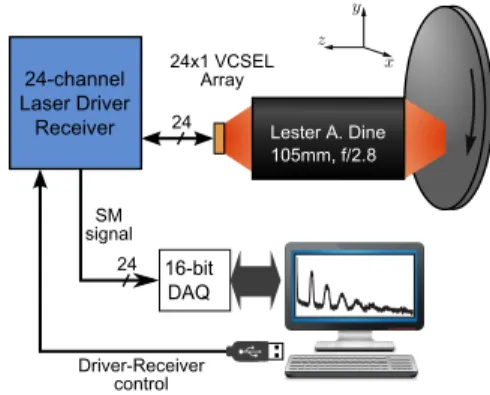
Fig. 1. Experimental setup for measuring velocity on a ro-tating disc. The disc is tilted around the vertical axis by 5◦ to produce a small velocity component in the direction of the laser beam.
achievable (over a range of operating injection currents) is increasing with the laser temperature, a result akin to that observed by Matharu et al. in a single channel system [12]. The remainder of this letter is therefore focused on describing an experiment that proves this phenomenon and discussing how the performance may be further enhanced through the array design.
The effect of multichannel operation in SM sensors was investigated in an uncooled 24×1 VCSEL array cus-tom manufactured by Litrax Technology Co., Ltd with
the system shown in Fig. 1. The VCSEL array was
mounted in a surface mount ceramic package and indi-vidual VCSELs were wire-bonded to pins of the package. The VCSELs are based on proton implanted technology and have a pitch of 220µm. A FLIR i7 thermal imaging camera was used to examine the temperature profile of the array for different operational settings.
A single macro lens (f =105 mm) was employed to fo-cus all 24 laser beams onto a rotating disk. The target was placed 35 cm from the laser array, which resulted in a beam spacing of 220µm and a magnification factor of 1. The laser array was oriented vertically. The alu-minium disk, 10 cm in diameter, was sandblasted to pro-vide a rotating diffusive target. The disk was driven by a DC servo motor with a 43:1 gear reduction controlled by an Elmo Whistle motor controller. The stability of the disk’s angular velocity for the duration of the experi-ments was better than 1%, as established by monitoring the frequency of the motor’s rotary encoder. A custom built 24-channel laser driver—receiver was used to indi-vidually bias each laser with a constant injection current. The SM signals were obtained through terminal voltage variations across individual VCSELs. The terminal volt-age fluctuations were then individually amplified using 24 ac-coupled, single stage, low noise preamplifiers with gain G = 100. Additional stages of amplification with variable gain (G = 64 to 6400) were used to bring the signal to a level suitable for processing by a 16-bit data acquisition card.
Each channel had a sampling rate of 62.5 kHz. The
Fig. 2. SNR of central laser (Channel 12) versus injection current with different levels of current in neighbouring lasers. The current in the neighbouring lasers are all biased at the same current while the current of the central laser is varied.( circles - Single Channel, squares - Multichannel 2 mA, up triangles - Multichannel 5 mA, down triangles - Multichannel 8 mA, diamonds - Multichannel 10 mA).
power spectral density of the time domain signal was calculated in the LabVIEW programming environment to obtain the SM signal spectrum and 32 consecutive spectra were averaged. The Doppler frequency was ex-tracted by fitting the power spectral density spectrum to a Gaussian distribution of Doppler components [13].
In this work, we are interested in uncooled opera-tion of the laser array as Peltier devices consume high amounts of power and make a sensing system less com-pact and portable. For uncooled operation, the tem-perature of a single laser device may be increased by increasing the injection current or the amount of power dissipated as heat [14]. In array based operation, the heat generated by a single laser spreads to other lasers in the array. The resulting temperature rise from a neigh-bouring laser is inversely proportional to the pitch [15], which leads to the central lasers showing the highest rise in temperature when all lasers are operating simultane-ously. To examine the effect of multichannel operation on the performance of a SM sensor we first measured the SNR of one of the central lasers (Channel 12) for a wide range of bias currents from threshold to 10 mA. We then remeasured the SNR for the same bias currents while turning on other lasers in the array. To maximise the temperature rise we simultaneously turned on the remaining 23 lasers in the array. These lasers, which we will subsequently referred to as the neighbouring lasers, were biased at the same injection current while the bias current of the VCSEL under investigation was changed. Figure 2 shows the SNR of the central (sensing) VCSEL over a range of bias currents.
Each curve corresponds to a different operating cur-rent in all neighbouring VCSELs. The well-known in-crease and subsequent dein-crease of SNR with bias cur-rent can be observed for all operating conditions [16, 17]. For single channel operation (neighbouring VCSELs not operating), the SNR increases rapidly above threshold before reaching a maximum. The SNR then gradually decreases as the injection current is increased beyond the current for the maximum SNR.
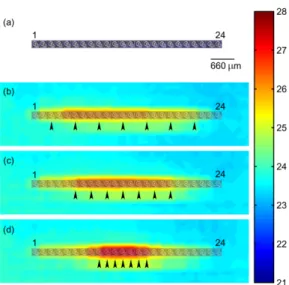
Fig. 3. Close up photo of the array and thermal images for the different separation distances used for the experiments in Fig. 4. a) Photo, b) 660µm spacing, c) 440 µm spacing, d) 660µm spacing. Channel 1 is located at the left hand side of the images.
When the currents in the neighbouring lasers were in-creased to 2 mA, which is below the threshold current of each laser, the SNR in the sensing VCSEL increased significantly. This indicates that the increase in SNR is not due to optical XT as the lasers have no observ-able signal level below the threshold current. Subse-quent measurements on a probing station showed that the electrical isolation between adjacent elements was of the order of 5 MΩ, which suggests that the increase in SNR was due solely to the temperature rise in the sens-ing laser. The injection current for the optimum SNR also slightly increases when the neighbouring lasers are turned on, which suggests that the initial temperature of the laser array is on the hot side of the parabolic thresh-old current temperature profile [12, 18]. Further increase in operating current of the neighbouring VCSELs leads to a monotonic increase in maximum achievable SNR.
To investigate this further, we measured the SNR of the central laser (Channel 12) while simultaneously op-erating six other lasers on the array. In each experiment, all seven lasers were equally spaced. Three different sets of equal spacing were investigated. The injection current in all of the neighbouring lasers was set to 10 mA. There-fore, in each experiment, the same electrical power was delivered to the laser chip. To examine this issue in more detail, we used a thermal IR camera to obtain the tem-perature profile of the array. Figure 3 shows a close-up photo of the array as well as the thermal images for the different separation distances used in the experiment.
Figure 4 shows the SNR of the central VCSEL as a function of injection current. Three curves correspond to three different separation configurations, with cor-responding temperature distributions shown in Fig. 3. Clearly, the SNR increases as the separation distance
Fig. 4. SNR of central laser (Channel 12) versus injection cur-rent with simultaneous operation of six neighbouring lasers biased at 10 mA. There is an equal separation distance be-tween lasers with the separation distance varying for differ-ent experimdiffer-ents. (circles - 660µm spacing, squares- 440 µm spacing, triangles - 220µm spacing).
between lasers decreases, which can be attributed to the higher temperature of the central (sensing) VCSEL due to the heating sources being concentrated nearer the sensing VCSEL.
A consequence of this result is that the SNR may be further improved by manufacturing an array with ele-ments spaced more closely together. This would not only increase the spatial resolution of an imaging sys-tem based on this array, but also allow for a smaller lens to be used due to the smaller array size, making the whole optical system more compact.The tempera-ture rise in the array may also be increased by increasing the element diameter as suggested by Osinski et al [15]. However, larger diameter VCSELs may exhibit multi-ple transverse modes, which can affect the accuracy and performance of SM sensors [19].
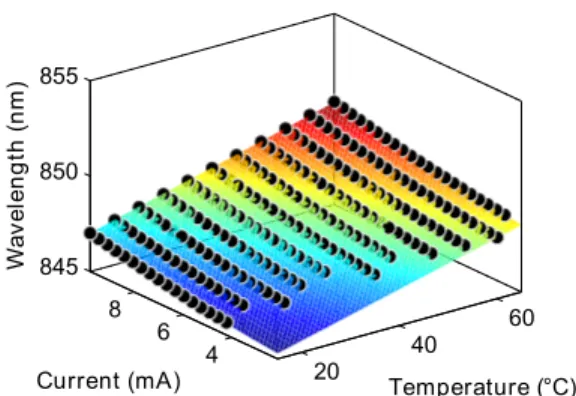
While a change in operating current and temperature strongly affects the SNR of the system it also affects the emission wavelength of the lasers. We show here that this substantial change in lasing wavelength has predictable, and almost negligible effect, on the Doppler frequency and calculated target velocity. The depen-dence of the lasing wavelength on current and heatsink temperature was measured by placing the laser chip in a temperature-controlled mount. Figure 5 shows the VC-SEL wavelength dependence on current and temperature measured on a stand-alone VCSEL of the same design as the VCSEL array used in this work. Measurements were executed for a range of temperatures between 10 and 60◦C and currents up to 10 mA. Polynomial fit to these experiments can be conveniently represented by the following function:
λ(T, I) = 844.1+0.063T +0.066I +0.00029T I +0.0128I2, (1) where T is the heatsink temperature in◦C, and I is the laser current in mA, and λ is wavelength in nm. The change in lasing wavelength with current is mainly caused by heating of the laser cavity [20].
4
Fig. 5. Surface fit of the variation in wavelength with cur-rent and temperature to experimental data from stand-alone Litrax VCSEL.
black dots in Fig. 5) a SM Doppler spectrum was ac-quired and the Doppler frequency was extracted. The total shift in Doppler frequency caused by changes in current and temperature was 16 Hz (from 2.784 kHz to 2.768 kHz) which corresponds to a fractional change of approximately 0.6%. This systematic error may be re-moved by calculating the wavelength at any given point in the current—temperature space using (1).
Figure 3 shows that temperature variation under dif-ferent operating regimes of our array is much smaller than the current—temperature range used in this ex-periment. Therefore, we can safely conclude that the effect of current and temperature change in an uncooled VCSEL array will not only be predictable and easily re-movable but shows negligible effect on the performance of such arrays. This means that there is no significant reduction in the accuracy of the velocity determination with multichannel operation of a SM array based sensor, which allows it to be used for a wide range of sensing applications.
In summary, we have compared the performance of single channel and multichannel operation of an un-cooled single mode monolithic 24×1 VCSEL array in a SM sensing system. We found that the SNR of monolith-ically integrated SM sensor arrays is inherently enhanced through multichannel operation, as a result of the in-creased operational temperature of the sensor. This ef-fect can be augmented by reducing the spacing between VCSELs on the array or increasing the diameter of each laser. Finally, the temperature rise due to multichan-nel operation had no significant effect on the measured Doppler frequency, which corresponds to no significant change in the accuracy of the measured velocity. These findings suggest that SM imaging systems based on VC-SEL arrays have the potential to produce images with
high spatial resolutions at high frame rates. These fea-tures make parallel SM sensing systems especially at-tractive for biomedical and industrial applications where there are unstable or dynamically changing flow veloci-ties.
This research was supported under the Australian Research Councils Discovery Projects funding scheme (DP 120 103703). Y.L.L. acknowledges support under the Queensland Governments Smart Futures Fellowships programme.
References
[1] M. Maeda, C. Chang-Hasnain, A. Von Lehmen, H. Izad-panah, C. Lin, M. Iqbal, L. Florez, and J. Harbison, IEEE Photon. Tech. Lett. 3, 863 (1991).
[2] T. C. Banwell, A. C. Von Lehmen, and R. R. Cordell, IEEE J. Quantum Electron. 29, 635 (1993).
[3] Y. Lim, M. Nikolic, K. Bertling, R. Kliese, and A. Rakic, Opt. Express 17, 5517 (2009).
[4] Y. Lim, R. Kliese, K. Bertling, K. Tanimizu, P. Jacobs, and A. Rakic, Opt. Express 18, 11720 (2010).
[5] F. . F. Tsai, C. J. O’Brien, N. S. Petrovic, and A. D. Rakic, Applied Optics 46, 2434 (2007).
[6] E. K. Lau, X. Zhao, H.-K. Sung, D. Parekh, C. Chang-Hasnain, and M. C. Wu, Opt. Express 16, 6609 (2008). [7] W. Yang, P. Guo, D. Parekh, and C. J. Chang-Hasnain,
Opt. Express 18, 20887 (2010).
[8] R. Lang, IEEE J. Quantum Electron. 18, 976 (1982). [9] G. Heise, IEEE Photon. Tech. Lett. 2, 97 (1990). [10] S. Nakagawa, S.-Y. Hu, D. Louderback, and L. A.
Col-dren, IEEE Photon. Tech. Lett. 12, 612 (2000). [11] M. Chˆateauneuf, A. G. Kirk, D. V. Plant, T. Yamamoto,
and J. D. Ahearn, Appl. Opt. 41, 5552 (2002).
[12] R. Matharu, J. Perchoux, R. Kliese, Y. L. Lim, and A. D. Rakic, Opt. Lett. 36, 3690 (2011).
[13] M. Nikoli´c, D. P. Jovanovi´c, Y. L. Lim, K. Bertling, T. Taimre, and A. D. Raki´c, Appl. Opt. 52, 3345 (2013). [14] K. Sato and M. Murakami, IEEE Photon. Tech. Lett. 3,
501 (1991).
[15] M. Osinski and W. Nakwaski, IEEE J. Sel. Top. Quant. Electron. 1, 681 (1995).
[16] P. Dean, Y. L. Lim, A. Valavanis, R. Kliese, M. Nikoli´c, S. P. Khanna, M. Lachab, D. Indjin, Z. Ikoni´c, P. Har-rison, A. D. Raki´c, E. H. Linfield, and A. G. Davies, Opt. Lett. 36, 2587 (2011).
[17] K. Rochford and A. Rose, Opt. Lett. 20, 2105 (1995). [18] C. Chen, P. O. Leisher, A. A. Allerman, K. M. Geib,
and K. D. Choquette, IEEE J. Quantum Electron. 42, 1078 (2006).
[19] J. R. Tucker, A. D. Rakic, C. J. O’Brien, and A. V. Zvyagin, Appl. Opt. 46, 611 (2007).
[20] G. Hasnain, K. Tai, L. Yang, Y. Wang, R. Fischer, J. D. Wynn, B. Weir, N. Dutta, and A. Cho, IEEE J. Quan-tum Electron. 27, 1377 (1991).