Leading Millennials: What motivates and retains
a labeled generation?
Bachelor Project submitted for the degree of
Bachelor of Science HES in International Business Management
by
Jude SUKARIYEH
Bachelor Project Mentor:
Dr. Timothy CONNERTON, HEG Adjunct Professor
Geneva, 21st of August 2020
Haute école de gestion de Genève (HEG-GE) International Business Management
Disclaimer
This report is submitted as part of the final examination requirements of the Haute école de gestion de Genève, for the Bachelor of Science HES-SO in International Business Management.
The use of any conclusions or recommendations made in or based upon this report, with no prejudice to their value, engages the responsibility neither of the author, nor the author’s mentor, nor the jury members nor the HEG or any of its employees.
21st of August 2020
Acknowledgements
I am thankful and grateful to Dr. Timothy Connerton, the Bachelor Project Mentor, who was not only present and supportive throughout my research, but who also provided me invaluable advice and recommendations to push me to go over and above my own expectations. His support empowered me in times when I felt confused and lost, especially when my first methodology fell-apart due to the fact that companies and students identified for the research declined to participate due to the work/studies environment linked to the Coronavirus. Dr. Connerton understood the struggle I was going through and kindly accepted the new methodology proposed.
I am also very thankful to Audrey, Annette, Jonathan, Dana and Brigitte; professionals who participated to the research. I thank them for their time, their insights. Without them, the research would not have been accomplished. I also thank Ilyes, Fanny, Alexandra, Noémie, Dylan, Fiona, Jehan, Eric, Thibauld, Matthieu, Emiline, Nicolas C., Sabrina, Nicolas P., Loane and Nicolas M., for their participation, their time and their valuable insights.
My gratitude goes also to all the instructors who put all their efforts to teach us International Business Management. I thank them for having adapted the studies through online video conferencing, during the particular period of Coronavirus that has totally changed our studying methods.
While I am deeply sad by the damages, the deaths, the loss of dear persons (which I think about every day), I am thankful to the Coronavirus that has taught us a great lesson of humility, a lesson of modesty, a lesson to learn on the need to adapt to unexpected external factor.
I have to also thank my beloved mother, my family, my friends for their patience, support and love throughout the research period.
Executive Summary
This research aims at understanding why are Millennials’ a labeled generation, what are their characteristics and how can Leaders motivate as well as retain them. To do so, theories and studies are explored to see to which extend theory confirms what is observed in practice.
The literature review attempts to share a storyline with the readers. The research covers various topics, from the field of Organizational Behavior (OB), employee retention, motivation, to Millennials’ identified characteristics funnelling down to the core concepts of Leadership.
One pillar of this research is the Millennial generation in terms of its characteristics and attributes. How are they perceived and why? It allows the readers to have a global understating of the main concepts of the literature as well as identifying the gaps to be clarified by this research.
A qualitative method is used to collect on the field data and includes in-depth interviews and focus groups. First, In-Depth Interviews (IDI) are organized with 5 professionals. The objective is to have a professional perception of Millennials: How do professionals distinguish this generation? Secondly, focus groups with various sessions and 16 participants in total are conducted. The aim of these discussions with Millennials are to highlight this generation’s priorities & aspirations, their motivations and insights on their perception of the work environment.
The participants were selected by choosing as diverged as possible backgrounds and profiles in order to avoid biases.
Findings and charts present the final field results. They show contrasts in millennials’ profiles but are mainly aligned with professionals’ point of views and with the literature review. Millennials are qualified as a digital generation with its qualities and downfalls. Interestingly enough, the findings allowed new contributions to the study. Should companies adapt to this so-called volatile generation? A series of recommendations are elaborated in the conclusion of this research aiming at advising organizations on motivation and retention of Millennials.
Contents
Disclaimer ... i
Acknowledgements ... ii
Executive Summary ... iii
Contents... iv
List of Tables ... vi
List of Figures ... vi
List of charts ... vi
List of graphs ... vii
1. Introduction ... 1
2. Objectives of the study ... 4
2.1 Aim of the study ... 4
2.2 Objectives of the research ... 4
2.3 Research question ... 5
3. Literature review ... 6
3.1 Organizational behavior ... 6
3.1.1 Organizational structure ... 7
3.1.2 The Individual vs the group ... 10
3.1.3 Values, emotions and attitudes ... 11
3.2 Employee retention... 12
3.2.1 Employees satisfaction ... 12
3.2.2 Organizational climate ... 13
3.3 Motivation ... 14
3.3.1 What is motivation ? ... 14
3.3.2 Maslow’s needs hierarchy ... 15
3.3.3 McClelland model ... 16
3.4 Millennials ... 17
3.4.1 Who are the Millennials ? ... 17
3.4.2 A labelled generation ... 18
3.4.3 Millennials aspirations ... 19
3.4.4 Millennials’ at the workplace ... 20
3.5 Leading millennials... 22
3.5.1 Defining Leadership ... 22
3.5.2 Role of a leader ... 23
3.5.3 Servant Leadership ... 24
3.5.4 Trending/Popular leadership practices ... 25
3.6 Conclusion of the literature review ... 26
4. Analysis ... 28
4.1 Research Methodology ... 28
4.2.1 In Depth Interviews Results ... 33
4.2.2 Focus groups results ... 44
5. Discussion ... 53
5.2 Biases and limitations ... 55
6. Conclusion ... 57
6.1 Validation of the theory ... 58
6.1.1 Organizational Behavior : from theory to practice ... 58
6.1.2 Motivation : from pyramids to matrixes ... 58
6.1.3 Millennials : expectations vs reality ... 59
6.1.4 The Leader ... 60
6.2 New contributions ... 61
6.2.1 The Self-Fi generation ... 61
6.2.2 Loyalty and retention ... 62
6.3 Recommendations ... 63
6.4 Limitations and direction for future research ... 65
Bibliography ... 66
Appendix 1: In depth interviews questions ... 80
Appendix 2 - Questionnaire Professionnels - Français ... 81
Appendix 2: Discussion guide – Focus groups ... 83
Appendix 3 - Focus groups – Français ... 85
Appendix 4 – IDI results ... 87
List of Tables
Table 1- Focus group 1 ... 31
Table 2- Focus group 2 ... 31
List of Figures
Figure 1 – Towards an OB discipline ... 7Figure 2 – Functional structure ... 8
Figure 3 – Divisional structure ... 8
Figure 4 – Matrix structure ... 9
Figure 5 – Horizontal structure ... 9
Figure 6 – Schwartz’s Motivational types of values ... 11
Figure 7 - Maslow’s Pyramid of needs ... 15
Figure 8 – Intrinsic vs Extrinsic motivation ... 16
Figure 9 - Millennials priorities and aspirations ... 19
Figure 10 - Millennials pain points ... 20
Figure 11 - Expectations vs Reality of Businesses ... 21
Figure 12 – Millennials’ reasons for quitting ... 22
Figure 13 – Five components of Emotional Intelligence ... 23
Figure 14 – Professionals’ profiles ... 29
Figure 15 – Focus groups demographics ... 31
Figure 16 – Drawing motivation ... 57
List of charts
Chart 1 – Millennials’; why such a trend? ... 33Chart 2 – How Professionals’ define Millennials’ ... 35
Chart 4 – Millennial’s own perception ... 44
Chart 5 – Components of loyalty ... 50
Chart 6 – What is a leader? ... 51
Chart 7 – Millennials’ in 2020 ... 60
Chart 8 – Millennial’s framework ... 64
List of graphs
Graph 1 – Millennials attitude in a professional context ... 38Graph 2 – Attracting and retaining Millennials ... 39
Graph 3 – Factors of influence and motivation ... 41
Graph 4 - Millennials preferences: blending or balance? ... 42
Graph 5 – Factors of influence ... 46
Graph 6 – Money vs Values ... 46
Graph 7 – Millennials, blending or balance? ... 54
1. Introduction
The present research aims at exploring and analyzing organizational behaviors enhancing or hindering the retention of millennials in today’s work environment. The present era is characterized by rapid change, new challenges, advanced technology, open borders. Managers have therefore a paramount role in adapting to change, to continuously implement new practices to stay attractive to employees.
We have recently witnessed an unprecedented and unexpected crisis, the Coronavirus, requiring immediate change and adaptation to the new work environment with the need of working from home due to general lockdowns in many countries. Agile companies were able to organize their work practices to fit with the crisis. Organizational behavior and leadership seemed to be an essential factor in adapting to the crisis and retaining employees. To a question on the possibility to retain employees in such difficult economic times, Jeffrey, Pfeffer answered “
Of course it is. Because layoffs are in part, a choice.
They are also a consequence of how leaders run their business
” (Pfeffer, 2020).Organizational behavior (OB) is the analysis and application of knowledge about how people, individuals, and groups act within an organization. It is done by taking a holistic approach. That is, it interprets relationships between individuals and organizations in terms of the whole person, a whole community, whole organization, and whole social structure. This area of study investigates human behavior in a workplace and evaluates its effect on job structure, efficiency, communication, motivation, leadership, etc. The aim is to create better relationships by attaining human goals, organizational goals, and social goals. (Hiriyappa, 2009, p.5).
The foundation of the company rests on the ideology, principles, vision, and goals of the management. Additionally, this influences the organizational culture that involves formal organization, informal organization, and social environments. The culture defines the form of organizational leadership, communication, and group dynamics. It is viewed by the employees as the quality of work-life that drives their degree of motivation. The result is success, individual satisfaction, and personal development and growth. All these components combine to form the model or structure from which the company works (Pranit, 2010).
Therefore, organizational behavior study offers insight into how workers function and act in the workplace. The understanding and application of organizational behavior systems allow leaders to gain an understanding of the factors that can inspire, increase the
performance, and help organizations establish a positive and trusting relationship with their employees. Examining the organizational structure that can act in the interests of their employees is crucial for leaders. (Wong, 2018)
Successful companies aim not only at finding the most talented employees but also and foremost at retaining them. Companies are faced with high competition, a rapidly changing business environment, and continuous attractive work settings promoting “work-life balance” (Russo, Morandin, 2019). Employees want to be part of successful companies that appreciate a great culture of the business and offer opportunities for potential development. Recognizing ways to enhance behaviors in organizations will help address structural problems among employees and encourage an attractive workplace atmosphere (Wong, 2018).
According to Deloitte 2019 Millennials Survey, the Swiss Corporate world needs to adapt to millennials. Millennial employees are generally defined as people born between the mid-1970s and early 2000s (Dimock, 2018). Millennials are somewhat disillusioned with traditional institutions in the face of ongoing technological and societal change, suspicious of business motives, and not hopeful about economic and social progress (Deloitte, 2019). Generational differences in the workforce is an important focus point for businesses. Today, most of the workforce includes four generations: Traditionalists (prior 1946), Baby Boomers (1946-1964), Generation X (1965-1976), Generation Y, or Millennials (1977-2000), and Generation Z (born after 2000) (Grensing-Pophal, 2018). As stated by Greg Hammill in 2005, Traditionalists and Baby Boomers’ qualities incorporate strong adherence to standards/orders and high respect to power. They are said to be persevering and faithful to their organization, accepting that obligation and duty outweighs personal interests. Conversely, Generation Y and Millennials look more for “what’s in it for me?”, the seek for work-life balance and they favor a casual, fun work environment. Their preferred work environment is characterized by independence, more personal projects, and less supervision. Millennials are not keen on spending long hours in meetings, they would rather look for high performance, rapid achievements and prefer to finish assignments as fast as possible to enjoy personal quality time (Myers, Sadaghiani, 2010).
Understanding Millennials in an organization is an added value in finding the best work environment adapted to their needs. Understanding individual values can help leaders to have keen insight into the decisions and actions of their actual and future employees (Gentry & Co, 2008). In order to develop an attractive work environment for Millennials,
leaders must understand how to approach this generation by adapting organizational behaviors (Fries, 2018)
Once Millennials' needs have been identified, motivating them to retain them becomes the core of organizational behavior. The business dictionary defines motivation as “
Internal and external factors that stimulate desire and energy in people to be continually
interested and committed to a job, role or subject, or to make an effort to attain a goal.
Motivation results from the interaction of both conscious and unconscious factors such
as the (1) intensity of desire or need, (2) incentive or reward value of the goal, and (3)
expectations of the individual and of his or her peers
.” (WebFinance Inc., n.d).Brett, the digital marketing director at Crimcheck.net, claims that Millennials are motivated by purpose, flexibility, and opportunities for growth (McIntyre, 2015).
2. Objectives of the study
Throughout the project, answers to the following question are analyzed: How can organizational leaders influence millennials’ motivation and increase their retention? There are both positive and negative stereotypes assigned to young workers (Myers, Sadaghiani, 2010). This paper should uncover the sources of satisfaction and dissatisfaction among Millennial employees. The paper focuses on Millennials’ without ignoring other generations. It then proposes a general retention strategy that organizations can use to retain talented young workers.
2.1 Aim of the study
This paper should expose the major motivations of the Millennials at their workplace to focus on the main factors of retention and attempt to propose recommendations. To answer the research question, the concepts used for the literature review include (1) Organization behavior (2) employee retention, (3) motivation, (4) the millennials, and (5) leadership.
Leadership plays a central role in generating a spirit of involvement among organizational stakeholders. According to Hamel (2006), today’s work environment is marked by rapid change, “leadership” and “strategy” have become similar in the sense that both of them have common agendas: the definition of objectives, missions, and visions as well as the choice of decisions on the best practices to retain employees (Hamel, 2006).
The aim of the paper is also to examine the current studies on Millennials and to analyze the interactions and dynamics between Millennials and senior management. The author is interested in identifying the factors that enhance or hinder work relationships between Millennials and senior management. For example, do Millennials and senior management share the same objectives? Are the organizational structures and policies adapted to Millennials workforce? Are there lessons to learn?
2.2 Objectives of the research
The main research objectives of this bachelor thesis are to identify Millennials' motivational factors, their needs and values at their workplace and to focus on the best retention practices to put in place by organizational leaders. As mentioned above, it is paramount to determine the major aspects that foster the motivation of the future workforce to retain talented employees and to enhance, as a result, the overall performance within companies.
To answer the research question, data and academic research are analyzed. A thorough literature review is presented tackling the topics of Organizational Behavior, Employee retention, Motivation, Millennials, and Leadership. Deriving from the literature, questionnaires and a discussion guide will be drawn up to collect on the field data. Interviews and focus groups will be conducted to answer to how leaders can influence motivation and retention upon Millennials. Interviews will be carried out with professionals to compare their perceptions with Millennials' viewpoints. On the other hand, focus groups will be organized with Millennials' to try to understand this generation's motivational factors, their professional needs, and their perceptions of the ideal workplace. A focus on the effects of practices such as “work-life balance” versus “work-life blending” will also be studied.
2.3 Research question
The main research question is “How can organizational leaders influence millennials’ motivation and increase their retention?”. To answer this question, four sub-questions are explored. These are:
• What are the attributes of Millennials and why are they a labeled generation? • What are the factors that enhance or hinder work relationships between
Millennials and leaders?
• How effective are actual practices, such as work-life balance and work-life blending?
• What are the recommendations that can be put in place by organizations to retain talented Millennials employees and enhance performance?
The following chapters present the literature review of the concepts of organizational behavior, employee retention, motivation, millennials, and leadership.
3. Literature review
The third chapter presents a review of the current literature on theoretical foundations supporting this research. Namely Motivation, Millennials’ characteristics, employee retention, and leadership approaches. Concepts are defined and provided at the beginning of each section.
3.1 Organizational behavior
Stephen P. Robbins defines Organizational Behavior (OB) as a field of study that explores the impact of individuals, groups, and structure on the overall behavior within an organization. The purpose of OB is to understand and analyze how to apply such knowledge in order to improve the effectiveness of an organization. Moreover, Organization Behavior aims at shifting from intuition to systematic study, meaning replacing a gut feeling by a study investigating relationships, attempting to attribute causes and effects, and drawing conclusions based on scientific evidence. (Robbins, 2005). OB is also an applied science built on contributions from several behavioral disciplines such as:
• Psychology: “
The science that seeks to measure, explain, and sometimes change
the behavior of humans and other animals
” (Robbins, 2005)• Sociology: the study of people relationships within groups (Cambridge Dictionary, 2020)
• Social psychology: An area of psychology studies that seek to understand the nature and causes of individual behavior in social situations (Baron, Byrne & Suls, 1989). “
Social psychology is the scientific study of how people's thoughts, feelings,
beliefs, intentions, and goals are constructed within a social context by the actual
or imagined interactions with others
” (McLeod, 2007)• Anthropology: the study of societies with the intent to learn about the human being, their activities and development (Robbins, 2005, p.12)
• Political science: the investigation of individual and groups behaviors within a political system/environment (Robbins, 2005, p.12)
The mix between individualistic analysis such as psychology with wider fields of study leads to a better understanding of group processes and organizational dynamics
(Robbins, 2005). Better visualization of the various contributions to OB studies and their impact are presented in the figure below:
Figure 1- Towards an OB discipline
Source: Robbins, 2005, p.11 Organizational Behavior takes into consideration various variables to offer challenges and opportunities for managers within organizations. It offers insights to improve managerial skills but most importantly their people skills. Finally, OB is a study that offers guidance to managers/leaders in forming a healthy work climate (Robbins, 2005).
3.1.1 Organizational structure
The overall organizational structure is considered to have a significant impact on attitudes and behaviors for people within organizations (James & Jones 1976). An organizational structure is defined as a framework that outlines how job tasks are divided, grouped, and coordinated to achieve organizational goals (Robbins, 2005). The organization's framework also dictates how knowledge moves within the organization across levels (Bach, 2019).
Organizational structure is known to be either centralized or decentralized. Historically, organizations have been systematized with centralized leadership and a specified chain
of command. Such structure is best illustrated with the military as it is an organization renowned for its highly centralized structure, with high and specific superior and subordinate hierarchies. Decentralized companies have seen an increase, as is the case with technology startups, who favor flatter hierarchies. This allows businesses to stay fast, agile, and adaptable, with almost every employee receiving a high personal agency level (Kenton, 2020). There are four most popular organizational structure types: (1) Functional Top-Down structure, (2) Divisional structure, (3) Matrix structure, and (4) Horizontal structure.
• Functional Top-Down structure: As its name states, functional structure groups employees with regards to their function and skill set. The structure is divided into traditional departments such as IT, marketing, finance, human resources, and operations based on the functional role that everyone plays within the organization as presented in Figure 2 (Daft, Murphy, Willmot, 2010).
Figure 2 - Functional Structure
Source: Daft, Murphy, Willmot, 2010 p106 • Divisional structure: A divisional organizational structure represents a company
that is structured around a particular region or line of product. Such a framework implies that each product line or region will have its functional grouping. Meaning that a product line will have its marketing, manufacturing, and sales employees working under an executive as drawn in the Figure below (Daft, Murphy, Willmot, 2010):
Figure 3 - Divisional structure
• Matrix structure: To give equal emphasis and attention to product and function, or product and geography, a matrix structure can be used in organizations. A matrix is a strong form of horizontal linkage, as it allows two goals to be pursued simultaneously as shown in Figure 4 (Daft, Murphy, Willmot, 2010).
Figure 4 - Matrix structure
Source: Daft, Murphy, Willmot, 2010, p.113
• Horizontal structure: Structure is flatter and built around core cross-functional processes instead of tasks, functions, or geography as shown in Figure 5. Therefore, department boundaries disappear giving process owners more responsibility and team members have larger decision-making power (Daft, Murphy, Willmot, 2010).
Figure 5 - Horizontal structure
3.1.2 The Individual vs the group
In the basic Organizational Behavior (OB) Model, there are three levels of analysis: (1) Individual-level, (2) Group level, and (3) Organization systems level. It is important to highlight that dependent and independent variables affect the understanding of behavior within organizations (Robbins, Judge & Campbell, 2017).
Robbins, Judge, and Campbell present dependent and independent variables as follows: • Dependent variables: productivity (effectiveness & efficiency), absenteeism,
turnover, job satisfaction, deviant workplace behavior (antisocial behavior or workplace incivility), organizational citizenship behavior (Robbins, Judge & Campbell, 2017).
• Independent variables:
o individual-level variables –values and attitudes, personality and emotions, individual decision-making and learning, motivation, perception, ability, biological characteristics
o group-level variables – conflicts, communication, group decision making, leadership and trust, group structure, power and politics, work teams (Robbins, Judge & Campbell, 2017).
o organization system-level variables – organizational culture, organization structure and design, policies, and practices (Robbins, Judge & Campbell, 2017).
Individual characteristics such as perceptions, personality, emotions, and even genetics can have an impact on the behavior of employees within an organization. On the other hand, groups consist of two or more people communicating and relying on each other and trying to accomplish goals and objectives together. Groups can be formal, as well as informal. Formal groups are groups that belong to organizations and follow organizational objectives. Informal groups are groupings in society and have varying degrees. A very strong in-group is a group that has a good sense of unity/cohesion and a feeling of security. There's a feeling of "we versus them." Groupthink is a phenomenon in which consensus norms override the realistic assessment of alternative courses of action. By keeping an eye on group size, managers can prevent group thinking. They may also appoint members to ensure that every single member is heard (Robbins, Judge & Campbell, 2017).
3.1.3 Values, emotions, and attitudes
The literature on values, attitudes, and emotions is more recent and is not characterized by the same research traditions as personality, ability, and style research. Firstly, personal and work beliefs and their effect on action and success in organizations are investigated. Second, attitudes are analyzed. Finally, the concept of emotions is presented, which is a very new research source that broadens the scope of conventional research skills (Sinding, Waldstrom, 2014).
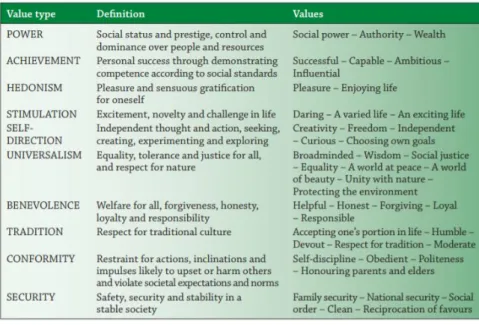
• Values – A research specialist, Shalom Schwartz elaborated on a theory focused on two components on basic human values. He distinguished 10 types of values that most societies identify. He also underlines the motivation behind each value, as presented in the Figure below:
Figure 6 - Schwartz's Motivational types of values
Source: Sinding, Waldstrom, 2014 p.93
• Attitudes: Attitudes are beliefs and feelings that people have about specific concepts, circumstances, and individuals that affect their behavior. Attitudes are often confused with principles because both are abstractions of culture. Yet behaviors impact actions at a degree different from beliefs. (Sinding, Waldstrom, 2014). While values reflect universal beliefs affecting actions in all contexts, attitudes refer only to action directed at particular objects, persons, or circumstances. Attitudes are more oriented towards specific goals or situations. Values and behaviors are usually in agreement, but not always. An employee who values supportive actions highly may have a pessimistic approach in helping an unethical coworker. With a definition of the three components of attitudes the
distinction between attitudes and values can be further clarified: (1) One cognitive (cognition), (2) the affective (affect) and (3) the behavioral (intention) (Sinding, Waldstrom, 2014).
• Emotions: According to the “Affective Event Theory”, there are six main workplace emotions that can affect individuals: anger, fear, joy, love, sadness and surprise. This theory suggests that similar workplace incidents trigger different types of people to feel different emotions (Weiss & Cropanzano, 1996).
3.2 Employee retention
For many decades employee retention strategies were at the core of research. To address the causes of employee turnover, many related studies have tackled the factors related to job satisfaction and dissatisfaction, sources of employee motivation and performance management. The human resources departments have often addressed the turnover question and have experimented with different approaches to solve the problem with similarly varying rates of success (K. Ramya Sri, B. Ramya Krishna, A. Md. Farmanulla, 2016).
However, it is more imperative that different industries pursue diverse strategies to tackle the problem of employee retention. Employee retention is related to several factors. One most critical aspect is work satisfaction. It is the most accurate factor predicting the turnover of workers (Cotton & Tuttle, 1986). Job satisfaction again is dependent on several factors that can be classified as extrinsic or intrinsic (Goetz, Katja & Campbell, S.M. & Broge, Björn & Dörfer, Christof & Brodowski, M & Szecsenyi, J. 2012).
3.2.1 Employees satisfaction
Cardy and Lengnick-Hall (2011) introduced a model entitled “Will they stay or Will they go”, relating to employee turnover, which also deals with employee satisfaction. Employees should be viewed as clients of a company to consider their satisfaction. That comparison will help companies’ underline motivational factors that lead to job satisfaction and make workers stick to their organizations in the same way happy customers are loyal to a company (Cardy & Lengnick-Hall, 2011).
Job satisfaction is:
“
a sense of inner fulfillment and pride achieved when doing a particular job. Job
satisfaction occurs when an employee feels he has accomplished something having
importance and value worth recognition; sense of job
” (Wicker, 2011, p.3)For employees reaching job satisfaction carries a pleasurable emotional state which leads to a positive work attitude and increased performance. Therefore, a satisfied employee is more likely to creative, innovative, flexible and loyal (Wicker, 2011).
3.2.2 Organizational climate
Organizational policies and their environment also have an impact on a person’s decision to stay or quit. Some argue that providing promotion and career advancement opportunities to individuals can make them stick to the organization (Kellough and Osuna, 1995) (Coetzee, Stoltz,2015).
Employee efficiency is crucial for productivity and organizational results. Several factors affect employee efficiency; and factors in the workplace climate stand out as primary efficiency determinants. This is the main multi-character element intended to produce results and has a direct relation with the organization's targeted goals (Diamantidis, Chatzoglou, 2019). A favorable working climate ensures workers ' well-being and encourages them to exercise all the strength they can turn into better results in their positions (Taiwo, 2010).
Focusing on a positive work environment increases efficiency and can decrease costs related to absenteeism, turnover and medical claims. Following are elements to develop an organizational climate:
• Define a workplace culture: Prachi Juneja emphasizes that
“
Work culture plays an important role in extracting the best out of employees and
making them stick to the organization for a longer duration. The organization
must offer a positive ambiance to the employees for them to concentrate on their
work rather than interfering in each other’s work”(Juneja, 2020).
Work culture is a term that deals with values, thought processes, employee attitudes. The organization’s values and beliefs. It is the culture of work that determines how workers communicate with each other and how a company functions. Work culture refers to the employees' mindset which further determines the organization's ambiance. Implementing a positive culture can motivate and retain employees within an organization (Juneja, 2020).
• Physical environment and job-related health & safety: A balanced working climate often involves the office physical setting, and the workers' occupational
health & safety. A company should reduce employees' fears by looking at workplace safety (Vischer, 2004).
• Health and lifestyle activity: Employees are the greatest asset to any company and improved cooperation, enhanced efficiency and decreased sick leave and workplace injuries can be promoted by putting effort into employee health. The workplace is a significant environment in which workers are motivated to raise their activity levels to improve their health and protect against the most common health problems. Physical activity is important to good health and leads to healthy well-being (Balty, 2015).
• Friendly workplace atmosphere: Creating a friendly working environment is inexpensive and straight forward; it requires the managerial and leadership positions to lead their team based on a set of values or beliefs and to support them through direct communication, treating them with respect and putting them first (AimSpirit, 2017).
The quality of the organizational environment influences the morale of employees and affects their performance. How well employees interact with their workplace environment significantly affects the rate of errors, degree of creativity as well as cooperation with team members, absenteeism rate and, how long they remain within the organization (Heath, 2006).
3.3 Motivation
3.3.1 What is motivation ?
Motivation can be defined as;“
Motivation involves the biological, emotional, social, and cognitive forces that activate
behavior. In everyday usage, the term "motivation" is frequently used to describe why a
person does something. It is the driving force behind human actions
” (Cherry, 2020)Consequently, motivation is a psychological phenomenon which means individual needs and desires must be addressed by framing an incentive program. Human action is goal-driven. Goal-driven action generates motivation. It is by inspiration that needs can be dealt with and answered purposefully (Kanfer, Frese & Johnson, 2017).
It is important to differentiate between the theories of content and process motivation. “What” is the subject of content theories while process theories concentrate on “how”
human behavior is motivated. Content theories are the earliest concepts of motivation. They had the largest effect on management practice and policies within the work environment. The theories of content are also called the theories of needs: they seek to define what our needs are and attribute motivation to satisfying these needs. The theories of contents cannot fully clarify what motivates or demotivates us (McClelland, 1961). Process theories concentrate on "how" motivation happens and what kind of mechanism can impact our motivation. There are four prevalent theories of processes which include reinforcement, expectation, equity, and setting goals. The process theories mainly suggest that individual decisions are based on desires, considerations of reward and a sense of achievement. Hence leaders should understand the motivation process (Skinner, 1938).
This study mainly focuses on the content theories of Maslow’s needs hierarchy and McClelland’s model.
3.3.2
Maslow’s needs hierarchy
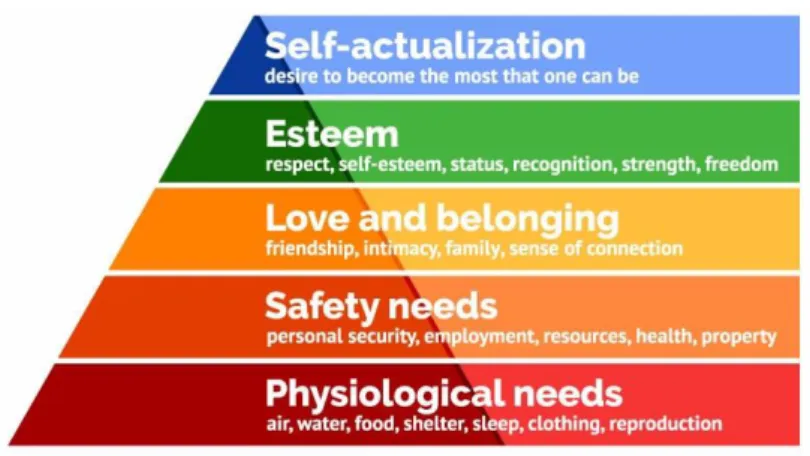
The needs of individuals serve as a driving force in human behavior. Therefore, leaders must understand the “hierarchy of needs”(Tanner, 2020). Maslow has proposed “The Need Hierarchy Model”:
Figure 7 - Maslow's Hierarchy of Needs
Source: McLeod, 2020
This theory indicates that humans are driven by needs that range from basic to higher-order needs in hierarchical higher-order; humans address these needs sequentially beginning with physiological, security, affiliation, esteem, and top self-actualization (Rollinson 2008).
French et al (2011, p.163) state that, “
a person’s frame of reference will determine the
order of importance of their needs and societal culture influences that frame of
reference
.” Thus French et al (2011) challenge the universal application of Maslow’sneeds hierarchy and claim that people from different ethnicities and cultures are not motivated by the same needs.
3.3.3 McClelland model
McClelland – based on the work of Maslow-defined three human motivators in the early 1960s. McClelland believed that people develop and improve their motivators over time, which is why this hypothesis is often referred to as the ' Learned Need Theory. ' He says we all have three motivating engines, and this is not based on our gender or age. In our actions, either of these forces or needs will dominate (Robbins., 2005).
McClelland's philosophy focuses on three motivators:
• achievement: a need to accomplish and demonstrate competence or mastery • affiliation: a need for love, belonging and relatedness
• power: a need for control over one’s work or the work of others
Achievement/ motivation – A desire to achieve and demonstrate skill or mastery. This
refers to a person's need for meaningful achievement, skills learning, power, or high expectations. Several behaviors are correlated: the individual desire for success, the success of goals, and school or work progression (McClelland, 1961).
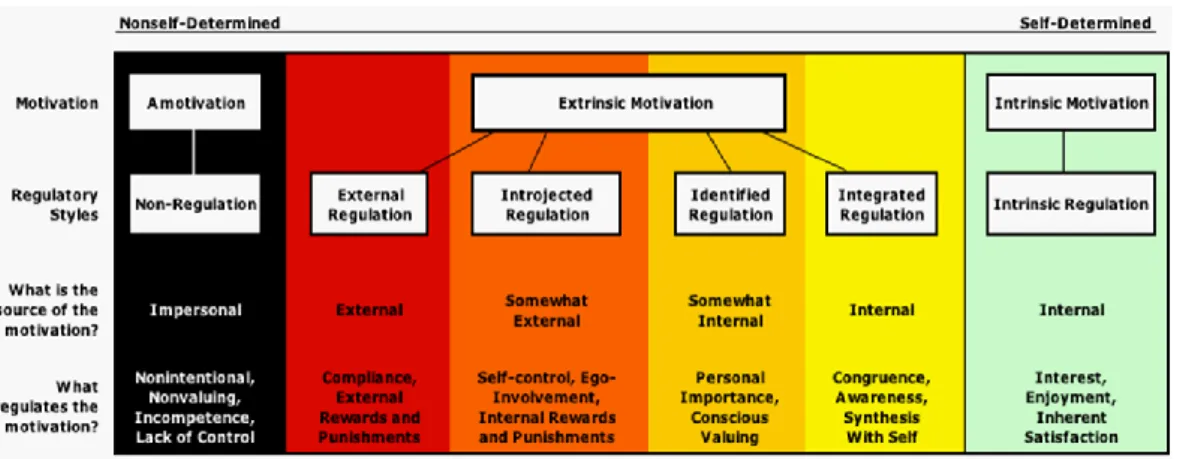
This need is driven by internal action drivers (intrinsic motivation), and the stimulus generated by others’ prospects (extrinsic motivation). As illustrated in Figure 8, extrinsic motivation is an incentive to act based on external factors which also results in external rewards (Deci & Ryan, 1985):
Figure 8 - Intrinsic vs. Extrinsic motivation
Individuals with a strong desire for accomplishment like to get continuous feedback on their success and achievements; and also prefer to work alone; pursue challenges and want a strong degree of freedom. Sources of high need for achievement may include recognition for success, goal-setting abilities, one's own willingness and commitment to achieve something, optimistic emotions, and childhood freedom. McClelland claimed training, teaching, can increase the need for accomplishment for a person. Others have suggested, for that reason, that the need for achievement is not a need but a value (McClelland, 1961).
Affiliation motivation – a need for love, belonging and relatedness
Some individuals have a strong need for friendships and want to belong within a social group, which need to be liked and held in popular regard. They are team players, and they may be less effective in leadership positions. High-need-for-affiliation persons have support from those with whom they have regular contact and mostly are involved in warm interpersonal relationships. After or during a stressful situation individuals need much more affiliation. In such situations, people come together and find security in one another. There are times when individuals want to be with others and at other times to be alone – affiliation motivation can increase or decrease (Collins, Hanges & Locke 2004)
Authority/power motivation – a constant need to command one's own work or others
' work. These are motivated by authority. Their ideas have a clear need to lead and to succeed. Increasing personal status and reputation is also required. This person wants to dominate others and influence them. McClelland analyzed male managers with high power needs and high affiliation needs and found that managers with high power needs appeared to operate more efficient divisions in a sales company than managers with high affiliation needs (McClelland, 1961).
3.4 Millennials
3.4.1 Who are the Millennials ?
Although there is a lot of variance in the different years that characterize the Millennial demographic, researchers agree on this group's key distinguishing characteristic: they are the first generational segment to grow in the digital age. This reality alone suggests a distinct mentality and way to communicate with the world around them but is exacerbated by the complex social, historical, and cultural background surrounding their adult journey. This category is unquestionably distinct from the preceding segments of Generation X and Boomer, and following Generation Z. For the purpose of this paper,
Millennials are defined as people born between the mid-1970s and early 2000s (Dimock Michael, 2018).
Given that millennials have contradictory preferences and quite opposing profiles, understanding their core DNA is very difficult (King, Finkelstein, Thomas and Corrington, 2019). However, with regards to employment expectations, researchers agree on the following statement:
“
A review of the popular literature suggests that the millennials ‘‘want it all’’ and ‘‘want
it now,’’ in terms of good pay and benefits, rapid advancement, work/life balance,
interesting and challenging work, and making a contribution to society
” (Ng, Schweitzer& Lyons 2010 p.281)
3.4.2 A labeled generation
Millennials have become the subject of many research and surveys for the past decade. Whether focusing on Millennials' consumption behaviors or career aspirations. A survey conducted by Deloitte Switzerland, in 2019 entitled Millennials as a “Disrupted generation”.
“
Why does this young generation feel filled with mistrust rather than optimism?”
(Deloitte, 2019).
It may be because they are caught in the interminable crossfire of social, political, and economic unrest. The global crisis of the late 2000s is undoubtedly chief among the driving factors. There are older millennials at the one end of the continuum who joined the labor market as the crisis unfolded. At the other end, there are Gen Zs, all of whom lived half their lives in a world of post-crash. Academic research shows that entry into the labor market during a recession has long-term adverse effects on the employment and career paths that follow (Kahn, 2010). Throughout the United States, millennials who entered the labor market after the recession, or in the years of ensuing low growth, saw less economic growth than any other generation in their first decade of employment (Deloitte, 2019). Millennials have lower real incomes and fewer assets at equivalent ages than previous generations, and higher debt rates (Annie Lowrey, The Atlantic, 2019). The full effect would go deeper than economics. Unlike the post-war 1950s — which was portrayed by international collaboration, a baby boom, and a beneficial economic growth — the past decade was marked by a dramatic rise in economic disparity, a decline in social security networks, unstable states, increased social media-fuelled tribalism, drastic contract changes between employers and employees, Industry 4.0 innovations
that redefine the workplace, and personal devices that connect yet separate people (Deloitte, 2019).
The effect of everyday life's progressive changes has hit younger generations hard— economically, socially, and maybe psychologically. Through the 2019 Millennial Survey by Deloitte, this "disrupted generation" underlines that constant change and upheaval have consequently changed this generation’s core DNA. However, they also provide useful guidance, on how organizations should react to those differences in mutually beneficial ways that can increase trust, create positive social impact and meet millennials’ expectations (Deloitte, 2019).
3.4.3 Millennials aspirations
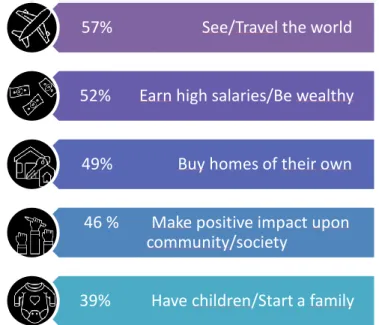
Each generation is shaped by its context, and millennials are not an exception. In 2019, Deloitte conducted a study upon millennials by questioning 13,416 millennials across 42 countries and territories. In their study, included Millennials are individuals born between January 1983 and December 1994. The study demonstrates that millennials have evolving priorities and aspirations. Below is a summary of the results conducted by Deloitte:
Figure 9 - Millennials priorities and aspirations
Source: The Deloitte Global Millennial Survey 2019
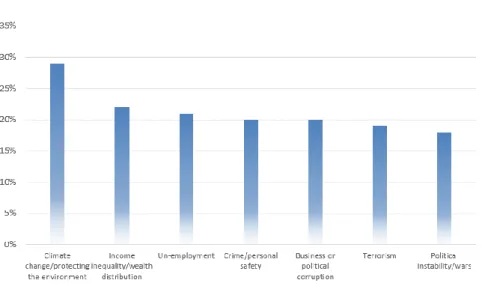
Referring to Figure 9, Millennials’ priorities seem to have shifted. Traditional success markers such as having children, buying homes do not top Millennials’ list of ambitions anymore. As a substitute, travel and seeing the world is at the top of their list, whereas slightly fewer than half said they wanted to be house owners. They are also more drawn
57% See/Travel the world
52% Earn high salaries/Be wealthy
49% Buy homes of their own
46 % Make positive impact upon
community/society
to making a positive impact in their communities or society than having children or starting families (Deloitte, 2019).
Interestingly, Deloitte’s study shows that “
millennials believe their ambitions are within
reach
”. Two-thirds who would like to reach executive career levels believe it is achievable. Seven out of 10 who want to see the world believe it is possible. Three-quarters who want to purchase homes are confident they will be able to someday. 83% of those desiring families don’t believe that any obstacle might prevent them from starting their family. However, the study demonstrated that millennials do have the following pain points (Deloitte, 2019):Figure 10 - Millennials pain points
Source: The Deloitte Global Millennial Survey 2019
3.4.4
Millennials’ at the workplace
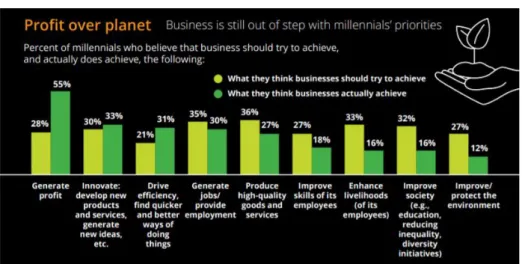
Moreover, this study emphasizes on millennials’ opinion about businesses. The percentage of respondents saying that business has a positive impact on wider society capped 55%. Following is a summary of Millennials perceptions of business and Leaders (Deloitte, 2019):
Figure 11 - Expectations vs Reality of Businesses
Source: The Deloitte Global Millennial Survey 2019 p.11 Millennials most commonly believe businesses should prioritize the production of high-quality goods and services in addition to generating jobs. Nevertheless, the majority see generating profit as a business’s main achievement. They also believe business is underdelivering on enhancing employees’ livelihoods, improving society, and improving as well as protecting the environment These results show that business leaders have an image problem. Just 37 percent of millennials agree that business leaders have a positive effect on the world and more than a quarter has said that they do not trust business leaders as being reliable. Leaders’ commitments to helping improve society and behaving ethically also divide opinions (Deloitte, 2019).
Moreover, when describing Millennials at their workplace Jeff Martin CEO Tribal Brands stated that “
Young people need to be asked what matters, not be told what matters”
(Kiger, 2016). As a matter of fact, according to an article published by PEOPLEGOAL, the main work characteristics of Millennials are (Garvey, Joseph, 2014):
• Educated • Collaborative • Tech-savvy • Curious • Family first
Nevertheless, according to Forbes.com, Millennials seem to be willing to change jobs every two years. The top reasons cited by Millennials to leave their current job are (Friedman, 2019):
• unhappiness with compensation, • lack of career advancement
• lack of opportunities for professional development
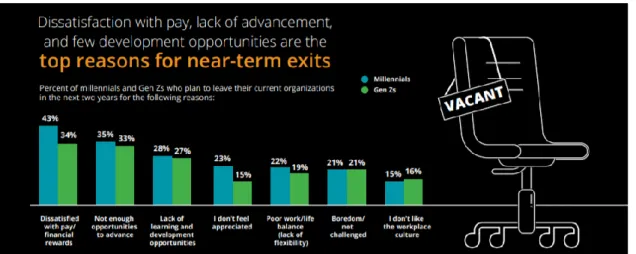
As matter of fact, according to a survey conducted by Upwork, Millennials are resigning from their jobs earlier than any other generation. The survey found that 58% of millennials born between the early 1980s and the early 2000s expect to stay in a position for less than three years. Controversially according to the survey, Gen Xers (born between 1965 and 1981) reported leaving a company after five years followed by baby boomers (born between 1946 and 1964) at seven years (Thottam, 2019). Why are Millennials’ quitting their jobs? Deloitte Global survey supports that Millennials’ would quit their jobs for the following reasons:
Figure 12 - Millennials reasons for quitting
Source: The Deloitte Global Millennial Survey 2019, p.14
3.5 Leading millennials
3.5.1 Defining Leadership
The understanding of leadership is not straightforward to define leadership as it is a complex concept. According to Stogdill (1974), “
there are as many different definitions
of leadership as there are people who have tried to define it
” (Stodgill, 1974, p.7). Billempower others
” (Wallace, 2019). Looking ahead into millennials' behaviors andexpectations is paramount in applying practices adapted to their needs, their motivation, their aspirations, to retain them within companies.
Yukl (2010) defines leadership as
“…a process whereby intentional influence is exerted
over other people to guide, structure and facilitate activities and relationships in a group
or organization
” (Iszatt-White, Graham, Randall, Rouncefield, 2011, p. 21).Leadership styles are numerous and range from democratic to autocratic, including laissez-faire, coach-style leadership, transformational or participative leadership. Leadership styles used to answer the research question focuses on a participative one. The characteristics of millennials stated in the previous part (educated, collaborative, tech-savvy, curious, demonstrate fellowship at work, family-first) are more adapted to democratic/servant leadership styles (Garvey, 2014). More specifically, millennials tend to demonstrate high levels of participation and appreciate social aspects within their work environment. Moreover, the same source highlights the importance for millennials to communicate frequently with their colleagues and senior management. They tend to communicate their views and opinions openly, are open to receive feedback continuously (Garvey, 2014).
The different leadership styles will be identified and analyzed in order to identify the key factors enhancing or conversely hindering the motivation of millennials within workplaces.
3.5.2 Role of a leader
Behind good leadership is a good leader. It is paramount not only to identify the best leadership style but also to determine the best leader traits in line with participative/collaborative leadership. In order to be in-line with millennials characteristics, leaders must understand the importance of creating a work environment adapted to this workforce category (Barbuto & Gottfredson, 2016) claim that if companies want to be competitive and retain talented millennials, they must be attractive. It requires efforts from leaders to put in place leadership practices promoting communication, flat organization, such as servant leadership.
Robin Sharma goes beyond and suggests that a leader should have no title. In this book, he states Giraudoux Jean, who claims that
“great leaders are always improving and
raising their bar on how superbly they can perform and how quickly they can move
”Moreover, Emotional Intelligence, a psychological theory introduced in 1997 by Mayer and Salovey adds elements to leadership.
"
Emotional intelligence is the ability to perceive emotions, to access and generate
emotions so as to assist thought, to understand emotions and emotional knowledge, and
to reflectively regulate emotions so as to promote emotional and intellectual growth."
(
Mayer & Salovey, 1997).This concept is developed later by Daniel Goleman who introduces the five components of Emotional Intelligence, presented hereby:
Figure 13 - Five components of Emotional Intelligence
Source: HBR, 2004 In his essay, Greenleaf, Robert K. states that a servant-leader promotes the well-being of people and the communities to which they belong, by sharing powers, putting people first developing as a result of their performance (Greenleaf Robert K., 1970).
3.5.3 Servant Leadership
Robert K. Greenleaf defined the term "servant leadership" in The Servant as a Leader, an essay he first published in 1970. Greenleaf said in that article:
“The servant-leader is servant first… It begins with the natural feeling that one
wants to serve, to serve first. Then conscious choice brings one to aspire to lead.
That person is sharply different from one who is leader first, perhaps because of
the need to assuage an unusual power drive or to acquire material
possessions…The leader-first and the servant-first are two extreme types.
Between them there are shadings and blends that are part of the infinite variety
of human nature.”
(Greenleaf, 1975, p.27)A servant leader concentrates on other people's needs, particularly team members, before himself. He considers the viewpoints of other people, give them the resources they need to achieve their work and personal goals, include them in decisions where necessary and create a sense of community within the team. It results in greater commitment, greater trust and better relationships with team leaders and other stakeholders (Greenleaf, 1975).
According to Larry C. Spears, a servant-leader has the following 10 most important characteristics, (1) Listening, (2) Empathy, (3) Healing, (4) Awareness, (5)Persuasion, (6) Conceptualization, (7) Foresight, (8) Stewardship, (9) Commitment to the growth of people, (10) Building community (Spears, L.C., 2010, p27-29)
3.5.4 Trending/Popular leadership practices
Today, companies operate in a world characterized by technological changes, which in turn affect job opportunities, skill requirements, management practices, tactics and style, employee preferences and ambitions, and physical working conditions. Organizations' and leaders' focus has shifted; people's concerns are coming to the forefront and technological issues are taking on a supporting role (Dodson, 1991). Therefore, organizations emphasize on the following practices to offer a quality work environment to their employees (Gaurav, 2012):
• Fair compensation -The balance between effort and reward should be fair and equitable. The salary would help the employee maintain a socially acceptable standard of living and be competitive with the pay for similar employment elsewhere.
• Career Growth – The job includes ongoing learning opportunities to learn new skills and improve existing skills.
• Social Integration in the organization - It will make the worker feel an identification with the company and develop a sense of self-esteem. Openness, confidence, sense of group feeling, room for upward mobility are important to this end.
• Worklife Balance – Worklife balance is believed to be a very important factor for employee happiness at work (MBA Skool Team,2020). Ibec defines this concept as
“
Work-life balance policies are workplace policies that assist employees in
combining personal and work responsibilities. They consist predominantly of
flexible work arrangements, voluntary employment breaks, and a range of
information and referral services.
”(IBEC, 2020)• Worklife Blending – Alistair Roque argues that work-life blending is a more efficient practice
“
Work-life blend, instead of balance, may be a better solution. Instead of creating
individual zones for the activities we do, this concept focuses on mixing together
the different facets of our lives
.” (Roque, 2016)Such practice includes; allowing employees full access to social media, provide flexibility, focus on quality, creating a work-life community, and enhancing communication. (Roque, 2016)
3.6 Conclusion of the literature review
This section of the paper presented a review of the literature on theoretical foundations supporting this research. To answer the research question on “Leading Millennials: How can organizational leaders influence Millennials’ motivation and increase retention?”, the author explores concepts of organizational behavior, employee retention, motivation, Millennials traits and characteristics and leadership.
For this purpose, the author analyzed academic articles, online business reviews, journals, tv programs and books. In a rapid changing environment characterized by continuous change, high competition and open-borders, organizations must have a global vision on the internal as well as the external factors that enhance or hinders employment retention and performance.
To answer the research question, it is paramount to understand who are the Millennials, what are their main features, what would make them stay or leave the organization? Once the features are defined, it is important to explore the different leadership styles/practices and determine those that are the most adapted to the Millennials’ spirit. According to the literature, motivation can help leaders retain their employees and increase organizational success. A leader can influence employees’ motivation by enhancing their skills and supporting their growth within the organization (Sandhya and Kumar, 2011). The past studies discuss diverse retention practices that can be implemented by leaders, such as workplace satisfaction, career advancement, monetary and non-monetary incentives, learning and growth opportunities, working environment, and work-life balance
To answer the research question, the author relies on a theoretical foundation and explores the situation in practice in today’s business environment.
4. Analysis
4.1 Research Methodology
There is a huge amount of research conducted by specialists and business leaders on the Millennials workforce (KPMG, 2017).
The paper aims at giving an outline of the generational contrasts present in the current workforce and highlighting the significance of understanding Millennial motivations. The author’s objective is to identify the factors used by organizational leaders to increase millennials' motivation and to retain them.
Initially, the methodology chosen by the author was based on collecting data and gathering multiple sources of evidence within a population of students at HEG and Universities from the French-speaking part of Switzerland, and senior management perspectives in multinationals. The researcher aimed to build three case studies involving the identification of key factors impacting Millennials, within different types of organizations. Surveys were supposed to be conducted among companies as well as students. Analysis of the survey outcomes would have allowed identifying motivational and retention factors (Oslen, 2011). The outcomes would have been stored comprehensively and systematically in a format that could have been referenced and sorted easily so that converging lines of inquiry and patterns can be revealed.
Due to the crisis linked to the Coronavirus, companies declined the author’s invitation to participate in the research. Most of them were implementing new working methods (home-office, video conferencing…). Moreover, most students at HEG and other universities were busy and preoccupied with the unprecedented crisis. New studying tools were implemented by universities to enable students to connect online to follow the studying programs. As a result, the author decided to adapt to the situation and find a plan B.
Alternative methodology used
The new methodology aims at conducting two distinct types of interviews, individual in-depth interviews (IDI) and focus groups in order to collect qualitative data. Individual interviews are focused on professionals’ insights, their experience with Millennials’ and perceptions of efficient leadership traits.
“
In-depth interviewing is a qualitative research technique that involves conducting
intensive individual interviews with a small number of respondents to explore their
perspectives on a particular idea, program, or situation
” (Boyce, Neale, 2006).The first round of interviews is conducted with professionals specialized in human resources, leadership and management, having worked with Millennials (directly or indirectly). The author chooses 5 professionals from diverse backgrounds, one of them is interestingly part of the late millennial generation. Interviews are done individually either face to face or through video conference. Professionals are interviewed individually about the main sections of this paper: (1) millennials as a generation, (2) their perceptions about millennials, (3) Millennials’ in their working environment, (4) key motivators for Millennials, (5) Leadership styles and retention at work. The interview questions are available in English and French, under Appendix 1&2. The purpose of these interviews is to investigate and/or validate certain concepts listed in the literature review and, more importantly, to build a professional perception of Millennials. The chosen professionals are the author’s acquaintances and their profiles are presented hereby:
The second phase of data collection is conducted in focus groups.
“
Focus group discussions fall within the qualitative research tradition. The name of the
method defines its key characteristics, in that it involves a focus on specific issue, with a
predetermined group of people, participating in an interactive discussion – thereby a
focus group discussion
” (Hennink, 2013).Focus groups intend to investigate Millennials' priorities, their needs, aspirations, what can influence their motivation and their perception of the perfect workplace. There will be about 1-2 hours of discussion with groups of 8 people. The aim is to evaluate and examine the responses, opinions, actual debates and attitudes of the participants during the discussions.
The millennials profiles are presented in Tables 1& 2 and are chosen with the following criteria: age, personalities, professional background, educational background and culture:
Table 1 - Focus group 1
Table 2 - Focus group 2
Figure 15 - Focus groups demographics
The two focus group sessions aim to collect data but also analyze if participants are influenced by others, if there are any biases, and see which topics are subject to debate. A discussion guide, available in Appendix 3, is prepared prior to the focus group session and has the purpose of a storyline. However, some questions will derive from debates and discussions and are not mentioned in the discussion guide.
The structure of both the IDI questionnaire and the Discussion guide aims at covering the main topics of the research being (1) Millennials, (2) Leadership, (3) Motivation and (4) Retention. The questions are open-ended questions to allow sharing insights,
perceptions and thoughts on the topic. Prior to all interviews and discussion, the author exposed the objectives and process of the debates as well as covered privacy terms. Once the data collection process is over, a presentation of the results is exposed in the following section. The results are presented in tables, graphs, or charts and the discussions will not be fully transcript. The presentation of the results will be followed by an analysis, a discussion, and should enable the author to try and build valid recommendations.
4.2 Presentation of the research results
This section aims to present and analyze the results of the In-Depth-Interviews with professionals as well as the outputs from both focus groups.
4.2.1 In-Depth Interviews Results
The results of the In-depth interviews are presented with a specific methodology. Due to the richness and density of the responses, the author has established analytical sheets and tables that are available in Appendix 4. However, in reference to the analytical sheets, the author presents the results with visual charts, graphs and tables.
4.2.1.1 Millennials’- such a trend
Chart 1 – Millennials’: why such a trend?
Source: the Author, 2020
Hereabove, are the theme answers to question 2 from the IDI questionnaire. The chart presents the answers in categories, the bigger circle is the most mentioned theme going to the less mentioned topic reflected in the smallest and center circle. Chart 1 is an explanation of rather the context and Millennial’s topic as a whole and why is it a trendy subject according to the interviewed professionals.