
READ THESE TERMS AND CONDITIONS CAREFULLY BEFORE USING THIS WEBSITE. https://nrc-publications.canada.ca/eng/copyright
Vous avez des questions? Nous pouvons vous aider. Pour communiquer directement avec un auteur, consultez la première page de la revue dans laquelle son article a été publié afin de trouver ses coordonnées. Si vous n’arrivez pas à les repérer, communiquez avec nous à [email protected].
Questions? Contact the NRC Publications Archive team at
[email protected]. If you wish to email the authors directly, please see the first page of the publication for their contact information.
NRC Publications Archive
Archives des publications du CNRC
This publication could be one of several versions: author’s original, accepted manuscript or the publisher’s version. / La version de cette publication peut être l’une des suivantes : la version prépublication de l’auteur, la version acceptée du manuscrit ou la version de l’éditeur.
Access and use of this website and the material on it are subject to the Terms and Conditions set forth at
Frost action and foundations
Penner, E.; Crawford, C. B.
https://publications-cnrc.canada.ca/fra/droits
L’accès à ce site Web et l’utilisation de son contenu sont assujettis aux conditions présentées dans le site LISEZ CES CONDITIONS ATTENTIVEMENT AVANT D’UTILISER CE SITE WEB.
NRC Publications Record / Notice d'Archives des publications de CNRC:
https://nrc-publications.canada.ca/eng/view/object/?id=72a0db40-5304-473d-848e-a0f831b43c2e https://publications-cnrc.canada.ca/fra/voir/objet/?id=72a0db40-5304-473d-848e-a0f831b43c2eNATIONAL RESEARCH COUNCIL OF CANADA DIVISION OF BUILDING RESEARCH
FROST ACTION AND FOUNDATIONS
by .
E. Penner and C.B. Crawford
Presented at the 27th Annual University of Minnesota Soil Mechanics
and Foundation Engineering Conference February 1979
and published as DBR Paper No. 1090 of the Division of Building Research
Ottawa March 1983
FROST ACTION
AND
FOUNDATIONS by E. Penner and C.B. Crawford
ABSTRACT
The relationship between climate, seasonal frost penetration and
permafrost is discussed in relation to construction activities. The
nature of the ground thermal regime, the mechanism of frost heaving, and
the criteria for frost susceptibility of earth materials are outlined.
Practical examples related to the design and construction of
building foundations, roads, runways and ice rinks are described and
problems of freezing during construction activities and thaw settlement
of the ground are reviewed.
Les auteurs 6tudient les relations entre le climat, la p6n6tration
du gel saisonnier et le pergglisol en fonction des activitge de
construction. 11s examinent la nature du rkgime thermique du sol, la
mgcanique du soul2vement di3 au gel et les critsres de giSlivit6 de
diffgrents sols.
Les auteurs prgsentent des exemples pratiques relatifs 2 la
conception et 3
la construction de fondations, de routes, de pistes
d'atterrissage et de patinoires. 11s passent aussi en revue les
problsmes du gel en cours de construction et du tassement du sol par le
d6gel.
I n s o u t h e r n Canada and t h e n o r t h e r n United S t a t e s t h e ground f r e e z e s every w i n t e r and thaws i n t h e s p r i n g . F a r t h e r n o r t h t h e ground i s
p e r e n n i a l l y f r o z e n i n a c o n d i t i o n c a l l e d permafrost. The r a t e and d e p t h of f r e e z i n g o r thawing i s of s p e c i a l i n t e r e s t t o t h o s e i n v o l v e d w i t h t h e c o n s t r u c t i o n of b u i l d i n g s , r o a d s , a i r p o r t s apd o t h e r modern s t r u c t u r e s o r s e r v i c e f a c i l i t i e s .
There a r e s o many f a c t o r s i n f l u e n c i n g t h e f r e e z i n g and thawing of t h e ground t h a t p r e c i s e computations of t h e change i n phase a r e d i f f i c u l t i f not impossible. N e v e r t h e l e s s , a g e n e r a l a p p r e c i a t i o n of t h e f a c t o r s o f t e n p e r m i t s r e a e o n a b l e p r e d i c t a b i l i t y . T h i s paper d i e c u s e e s t h e
r e l a t i o n s h i p between c l i m a t e and ground temperatures and t h e mechanism of f r o s t heaving i n r e l a t i o n t o a v a r i e t y of e n g i n e e r i n g problems.
Although t h e temperature of t h e ground t e n d s t o r e f l e c t t h e temperature of t h e a i r , t h e Mean Annual Ground Temperature (MAGT) i s always h i g h e r ( a t l e a s t i n n o r t h e r n l a t i t u d e s ) t h a n t h e Mean Annual Air Temperature (MAAT). The primary r e a s o n f o r t h i s i s t h e i n f l u e n c e of snow cover on t h e s u r f a c e h e a t exchange. Summer v e g e t a t i o n h a s a more complex i n f l u e n c e i n v o l v i n g b o t h e v a p o t r a n s p i r a t i o n and shading. Other e x t e r n a l f a c t o r s i n c l u d e s u n s h i n e , r a i n f a l l , r e l a t i v e humidity, wind speed,
p r e c i p i t a t i o n and s l o p e of t h e s u r f a c e .
Average ground temperatures a r e determined by e x t e r n a l f a c t o r s , b u t v a r i a t i o n s ( d a i l y and s e a s o n a l ) a r e c o n t r o l l e d by t h r e e i n t r i n s i c thermal p r o p e r t i e s : v o l u m e t r i c h e a t c a p a c i t y Cv, thermal c o n d u c t i v i t y K, and t h e l a t e n t h e a t of water. The w a t e r c o n t e n t of t h e ground obviously h a s a g r e a t i n f l u e n c e on t h e s e t h r e e v a r i a b l e s and because water c o n t e n t v a r i e s w i t h c l i m a t e , s o i l t y p e and d r a i n a g e c o n d i t i o n s , t h i s i s f u r t h e r evidence of t h e d i f f i c u l t i e s a s s o c i a t e d w i t h t h e computation of ground
temperatures. Volumetric h e a t c a p a c i t y , thermal c o n d u c t i v i t y , and t h e l a t e n t h e a t c a p a c i t y a l l i n c r e a s e w i t h i n c r e a s i n g water c o n t e n t .
The r a t i o K/Cv, c a l l e d thermal d i f f u s i v i t y , is a measure of t h e e a s e w i t h which unfrozen s o i l w i l l change temperature. It i s u s u a l l y a
maximum a t f a i r l y low water c o n t e n t s . A s t h e s o i l water f r e e z e s , t h e changes i n t h e i c e l w a t e r r a t i o and t h e l a t e n t h e a t of f u s i o n become important f a c t o r s i n ground temperature c a l c u l a t i o n s . I n a d d i t i o n , i n f r o s t - s u s c e p t i b l e s o i l s t h e amount of w a t e r moved t o t h e f r e e z i n g p l a n e must be e s t i m a t e d ; t h i s i n t r o d u c e s f u r t h e r e r r o r s .
F i g u r e 1 shows monthly average ground temperatures i n c l a y s o i l w i t h a n a t u r a l s u r f a c e cover ( g r a s s and u n d i s t u r b e d snow). Note t h a t a t a depth of 4.5 m (15 f t ) t h e minimum temperature o c c u r s i n J u l y and t h e maximum i n December, i n each c a s e about 6 months o u t of phase w i t h t h e a i r temperatures. It may a l s o be noted t h a t t h e r e was l i t t l e i f any f r e e z i n g of t h e ground under n a t u r a l snow cover, a l t h o u g h f r o s t p e n e t r a t e d about 0.9 m (3 f t ) under a d j a c e n t snow-cleared c o n d i t i o n s
(Crawford and Legget, 1957).
Figure
2 shows the Mean Annual Ground
Temperature profile for sites with natural snow cover (curve A) and snow
cleared (curve B) at Ottawa, Ontario and for a snow-cleared area (curve
C) at Knob Lake (Schefferville, Quebec).
The MAGT varies imperceptibly
with depth under natural snow cover (A), but under an adjacent snow-
cleared roadway the MAGT near the surface is substantially lower (B).
Figure
3 illustrates differences between the MAGT and MAAT for several
locations in Canada. These differences vary from about 1 3 " ~
at Vancouver
to 7OC at Kapuskasing in northern Ontario (Williams and Gold, 1976).
FROST P x m T u T I O H
From an engineering point of view, one of the most important
interests in ground temperatures concerns the depth of frost penetration.
This value is needed for locating water and sewer services and the design
of roads, runways, and many types of foundations. The prediction of
frost penetration by computation is difficult because of the multitude
and complexity of variables. The best way to establish the maximum,
minimum and average depth of frost penetration is to ask the people who
make excavations the year round, the city water department. An
alternative is to refer to a reasonably well-established relationship
between air temperatures and frost penetration and modify the result to
account for major variations in surface or soil conditions.
The general relationship between air temperatures and frost
penetration was established by an extensive investigation of frost
penetration through granular base courses under snow-cleared airport
pavements in the northern United States (U.S
.
Corps of Engineers, 1949).
The results of these studies showed a general relationship between the
maximum depth of freezing and the Freezing Index (F.I.)
-
the cumulative
total of degree days of air temperature below freezing during the entire
winter. The F.I. is calculated using the mean daily temperatures with
subtractions for days above freezing. The relationship between frost
penetration and F.I. is commonly called the "Design Curve."
The Design Curve has, of course, some limitations. It applies to
snow-free surfaces and granular soils. It is intended to give an
estimate of the maximum frost penetration during the entire winter - its
use for estimating penetration some time during the winter is less
reliable. It does not take into account the water content of the soil
-
the most important intrinsic factor.
W.G. Brown (1964) calculated frost penetrations for a variety of
soils with a range of water contents and for dry sand and rock using the
modified Neumann solution and the Kersten (1949) values for thermal
properties. He found that the results varied by a factor of less than
2
to
1,and they bracketed the Design Curve. Although Brown does not
recommend calculating frost penetration, he did use his calculations and
additional field data to recommend a slight change in slope of the
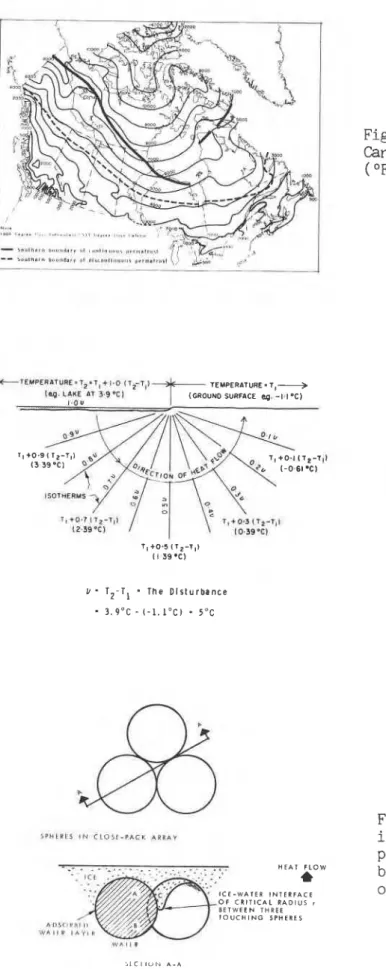
The average F.I. can be computed from m e t e o r o l o g i c a l r e c o r d s o r e s t i m a t e d from a F r e e z i n g Index map such a s i s i l l u s t r a t e d i n F i g u r e 5
(Boyd, 1973; Burn, 1976). Once a v a l u e f o r f r o s t p e n e t r a t i o n i s o b t a i n e d from t h e Design Curve, judgment must be a p p l i e d t o account f o r l o c a l c o n d i t i o n s . Experience has shown, f o r example, t h a t 0.3 m ( 1 f t ) of n a t u r a l snow cover w i l l reduce f r o s t p e n e t r a t i o n by a t l e a s t 0.3 m and up t o 0.6 m (1-2 f t ) . Compact snow o r i c e w i l l reduce p e n e t r a t i o n by an amount approximately e q u a l t o i t s t h i c k n e s s . F r o s t w i l l p e n e t r a t e l e s s i n t o wet c l a y t h a n i n t o g r a n u l a r s o i l s , but t h e p e n e t r a t i o n i n t o almost d r y g r a n u l a r s o i l s may be g r e a t e r t h a n t h a t e s t i m a t e d by t h e Design Curve.
The d i f f i c u l t i e s i n computing ground temperatures have l e d t o t h e development of g r a p h i c a l methods f o r s o l v i n g f i e l d problems d e a l i n g w i t h n a t u r a l o r e n g i n e e r i n g s t r u c t u r e s l y i n g d i r e c t l y on t h e ground s u r f a c e (Brown, W.G., 1963). These include:
1 ) Shallow l a k e s and r i v e r s on unfrozen o r f r o z e n s o i l ( p e r m a f r o s t ) ;
2 ) Basementless b u i l d i n g s , e i t h e r h e a t e d o r cooled; 3) I c e r i n k s ;
4 ) S t r e e t s and s t r e e t s bordered by b u i l d i n g s ; and 5) Roads and runways.
The method determines t h e long-term ( s t e a d y - s t a t e ) t e m p e r a t u r e changes i n t h e ground caused by changes imposed on t h e s u r f a c e . It i s only necessary t o know t h e s i z e and shape of t h e s u r f a c e a r e a a f f e c t e d , t h e new and o r i g i n a l s u r f a c e t e m p e r a t u r e s , and t h e geothermal g r a d i e n t of t h e region. The example shown i n F i g u r e 6 could be a p p l i e d t o a s u r f a c e d i s c o n t i n u i t y such a s a lake. Temperatures a d j a c e n t t o a r i v e r , road, e t c . , can be o b t a i n e d by s u p e r p o s i t i o n of isotherms r a d i a t i n g from each s i d e of t h e t e m p e r a t u r e d i s c o n t i n u i t y .
FROST HBhVIMG
MECUHISN
F r o s t heaving r e s u l t s from t h e f r e e z i n g of water i n f i n e - g r a i n e d s o i l s . T h i s p r o c e s s i n c r e a s e s t h e s o i l volume n o t only by f r e e z i n g of i n s i t u pore water ( = 9 p e r c e n t expansion) but a l s o by drawing water t o t h e f r e e z i n g plane from below. Examination shows t h a t s o i l s t h a t have
undergone s u b s t a n t i a l heaving u s u a l l y c o n s i s t of a l t e r n a t e l a y e r s of i c e - s a t u r a t e d s o i l and r e l a t i v e l y c l e a r i c e l e n s e s . T h i s i s commonly
r e f e r r e d t o a s rhythmic i c e l e n s i n g (Martin, 1959). The e x p l a n a t i o n i s t h a t i t i s caused by a s u c c e s s i o n of p e r i o d s of b a l a n c e and imbalance between h e a t and m o i s t u r e flow i n t h e f r e e z i n g zone.
The w a t e r l i c e phase change t h a t r e s u l t s i n i c e l e n s growth (and f r o s t heave) i n f i n e - g r a i n e d porous media i n c r e a s e s t h e m o i s t u r e s u c t i o n a t t h e f r e e z i n g plane (Penner, 1968). This induces a m o i s t u r e s u c t i o n g r a d i e n t i n t h e unfrozen s o i l which c a u s e s t h e flow of w a t e r t o t h e f r e e z i n g plane e i t h e r from a shallow w a t e r t a b l e o r by e x t r a c t i n g w a t e r from t h e unfrozen s o i l below t h e f r e e z i n g plane. The flow p a t h of t h e water i s through w a t e r - f i l l e d p o r e s and t h e adsorbed w a t e r f i l m s around t h e p a r t i c l e s .
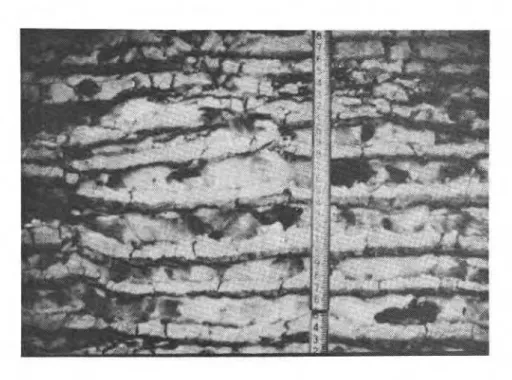
I c e l e n s e s a r e formed normal t o t h e d i r e c t i o n of h e a t flow and when f r e e z i n g p e n e t r a t e s from t h e ground s u r f a c e , t h e l e n s e s form p a r a l l e l t o t h e s u r f a c e . Many d i f f e r e n t h e a t flow p a t t e r n s e x i s t , e.g., i n d i t c h e s , behind r e t a i n i n g w a l l s , and on t h e s i d e s of road embankments, b u t t h e d i r e c t i o n of heave and i c e l e n s f o r m a t i o n w i l l s t i l l be p r e d i c t a b l e from t h e d i r e c t i o n of h e a t flow.
There i s g e n e r a l agreement on t h e i d e n t i f i c a t i o n of t h e i m p o r t a n t f r o s t a c t i o n f a c t o r s , b u t t h e r e i s s t i l l c o n t r o v e r s y about t h e e x a c t n a t u r e of t h e i r i n t e r a c t i o n . The s c h o o l of thought t h a t seems t o have g r e a t e s t s u p p o r t i n t h e l i t e r a t u r e i s based on t h e s i z e and arrangement of t h e i n d i v i d u a l p a r t i c l e s t h a t make up t h e s o i l f a b r i c . This l e n d s credence t o t h e view t h a t f r o s t a c t i o n c r i t e r i a s h o u l d be based on g r a i n s i z e and g r a i n - s i z e d i s t r i b u t i o n (Penner, 1 9 7 6 ( a ) ) . C r i t e r i a t h a t a r e s o l e l y based on g r a i n s i z e have been used i n s o i l e n g i n e e r i n g f o r many y e a r s but n o t w i t h complete s u c c e s s s i n c e t h i s n e g l e c t s t h e importance o f t h e a v a i l a b l e w a t e r supply and t h e imposed f r e e z i n g c o n d i t i o n s . These two f a c t o r s i n f l u e n c e t h e s e v e r i t y of heaving a s much a s does g r a i n s i z e b u t they remain poorly d e f i n e d i n c u r r e n t l y used f r o s t a c t i o n c r i t e r i a .
The t h e o r y t h a t s u p p o r t s g r a i n s i z e and g r a i n - s i z e d i s t r i b u t i o n a s b a s i c t o t h e n a t u r e of t h e heaving p r o c e s s w a s r e s t a t e d by E v e r e t t (1961) and by E v e r e t t and Haynes (1965). Aspects of t h e same approach t o t h e thermodynamics of f r e e z i n g porous systems had been developed i n some d e t a i l e a r l i e r by Penner (1957), Gold (1957) and o t h e r s . E v e r e t t ' s major c o n t r i b u t i o n was t o develop a r e l a t i v e l y simple, s e l f - c o n s i s t e n t and a l l - i n c l u s i v e thermodynamic s t a t e m e n t which was l a c k i n g i n e a r l i e r s t u d i e s . The d i f f i c u l t y w i t h i t s a p p l i c a t i o n i s t h a t i n n a t u r e s o i l s normally have a g r a i n - s i z e d i s t r i b u t i o n w h i l e t h e Everett-Haynes t h e o r y d e a l s only w i t h a n arrangement of uniform-size s p h e r i c a l p a r t i c l e s ( F i g u r e 7). It
n e v e r t h e l e s s i s based on a p h y s i c a l model t h a t can be s t u d i e d
e x p e r i m e n t a l l y . Penner (1968) u s i n g uniform-size g l a s s beads was a b l e t o show t h e Everett-Haynes (1965) model w a s i n f a c t e x p e r i m e n t a l l y c o r r e c t . Such s t u d i e s were extended t o f i n d t h e r e l a t i o n s h i p between heaving p r e s s u r e s and p a r t i c l e s i z e by measuring t h e maximum heaving p r e s s u r e developed i n n a t u r a l l y o c c u r r i n g f r a g m e n t a l p a r t i c l e s o v e r a s m a l l s i z e range.
The Everett-Haynes e q u a t i o n g i v e s t h e heaving p r e s s u r e developed by i c e l e n s growth i n a close-packed a r r a y of s p h e r e s of uniform s i z e of r a d i u s r a s f o l l o w s :
6
2uiwcos0 ( 1-B
'
) AP =r
when bp = heaving p r e s s u r e by i c e l e n s growth
O i w = i c e l w a t e r i n t e r f a c e energy term (0.035 ~ * m - ~ )
O
= c o n t a c t a n g l eB' = r a t i o of s p h e r e l p o r e r a d i u s
Equation 1 i s given by t h e s o l i d l i n e i n F i g u r e 8. It was checked by measuring t h e heaving p r e s s u r e of i c e l e n s growth a t f u l l s a t u r a t i o n w i t h compacts of s p h e r i c a l g l a s s beads of uniform s i z e . The measured p o i n t s ( f o r two d i f f e r e n t s i z e s ) a r e g i v e n by c l o s e d s q u a r e s . The remainder of t h e p o i n t s were o b t a i n e d u s i n g non-uniform f r a c t i o n s of n a t u r a l s o i l s and P o t t e r ' s f l i n t , b u t i n each c a s e t h e r a d i u s used f o r p l o t t i n g was t h e s m a l l e s t f o r t h a t p a r t i c u l a r sample.
The c o n c l u s i o n s t h a t f o l l o w from t h e s e r e s u l t s a r e t h a t t h e E v e r e t t - Haynes model a p p e a r s v a l i d and t h a t some r a t h e r i m p o r t a n t elements of t h e i c e l e n s i n g mechanism a r e understood. For fragmental p a r t i c l e s over a s i z e range t h e heaving p r e s s u r e corresponds t o t h a t of t h e s m a l l e s t p a r t i c l e s but t h e r e a l s i g n i f i c a n c e of t h i s f i n d i n g needs t o be f u r t h e r explored.
MOISTIJBE
STATUS
AMDSOIL TYPg
It should be r e c a l l e d t h a t t h e main cause of heaving i s t h e
f o r m a t i o n of i c e l e n s e s from w a t e r t h a t h a s migrated t o t h e f r e e z i n g zone e i t h e r from a high water t a b l e o r from t h e unfrozen s o i l by reducing i t s
m o i s t u r e content. T h i s movement of w a t e r
i s
i n response t o t h e moisture s u c t i o n-
t h e d r i v i n g f o r c e-
developed i n t h e f r e e z i n g zone.I n c r e a s i n g t h e s u c t i o n of n o n - p l a s t i c , f r o s t - s u s c e p t i b l e s o i l s u s u a l l y i n c r e a s e s t h e volume of a i r - f i l l e d p o r e s and t h e s t a t e of u n s a t u r a t i o n . Clay type s o i l s tend t o s h r i n k i n response t o s u c t i o n i n c r e a s e s ; t h e r a t e of heaving d e c r e a s e s b u t does n o t s t o p u n t i l very h i g h v a l u e s of s u c t i o n a r e reached (Penner, 1963). This e x p l a i n s why simple g r a v i t y d r a i n a g e of f r o s t - s u s c e p t i b l e s o i l s does n o t e l i m i n a t e heaving although good d r a i n a g e g r e a t l y reduces i t s s e v e r i t y and is d e s i r a b l e where f r o s t a c t i o n i s a n t i c i p a t e d . According t o Penner (1957, 1959) s u c t i o n develops more slowly and t o a lower maximum i n c o a r s e s o i l s t h a n i n f i n e r t e x t u r e d s o i l s a s heaving p r o g r e s s e s (Fig. 9 ) and sub- drainage i s t h e r e f o r e more e f f e c t i v e f o r coarse-grained s o i l s .
I n l a b o r a t o r y experiments w i t h s i x s o i l s ranging i n c l a y c o n t e n t from 6 t o 55 p e r c e n t , t h e induced pF ( l o g of s u c t i o n i n c e n t i m e t r e s of w a t e r ) ranged from 2.6 f o r a s o i l c o n t a i n i n g 6 p e r c e n t c l a y s i z e t o 3.7 f o r 55 p e r c e n t c l a y s i z e ( i . e . , by a f a c t o r of 1 2 ) . These t e s t s were done by determining t h e maximum s u c t i o n induced a t d i f f e r e n t f r e e z i n g r a t e s .
Highly f r o s t - s u s c e p t i b l e s o i l s a r e r e a d i l y i d e n t i f i e d , e.g., c l a y s , s i l t y c l a y s and s i l t s , a s a r e completely n o n - f r o s t s u s c e p t i b l e m a t e r i a l s e.g., c l e a n sands and g r a v e l s . It i s d i f f i c u l t t o e v a l u a t e b o r d e r l i n e s o i l s w i t h r e s p e c t t o heaving p o t e n t i a l and much r e s e a r c h e f f o r t h a s t h e r e f o r e been devoted t o t h e development of c r i t e r i a f o r s u c h
assessments.
FROST
ACTION CRITERIA
Many f r o s t a c t i o n c r i t e r i a have been suggested but none i s
completely s a t i s f a c t o r y under a l l c o n d i t i o n s . C r i t e r i a a v a i l a b l e i n t h e l i t e r a t u r e have r e c e n t l y been l i s t e d and d i v i d e d i n t o two groups
a c c o r d i n g t o t h e t y p e of f r o s t damage t h a t w i l l e n s u e ( T a b l e I )
(Anderson e t a l . , 1978). The second of t h e groups h a s been subdivided on t h e b a s i s of whether t h e e v a l u a t i o n was c a r r i e d o u t i n t h e f i e l d o r i n t h e l a b o r a t o r y .
Because of t h e u n s a t i s f a c t o r y n a t u r e of a v a i l a b l e f r o s t a c t i o n c r i t e r i a , numerous s t u d i e s have been c a r r i e d o u t a t t h e D i v i s i o n of Building Research (DBR) i n t h e l a s t two decades t o c h a r a c t e r i z e t h e s o i l heaving p r o c e s s w i t h r e s p e c t t o f r e e z i n g r a t e , overburden p r e s s u r e and f r e e z i n g temperature. These f a c t o r s a r e p a r t i c u l a r l y i m p o r t a n t where s p e c i a l emphasis i n t h e c r i t e r i a i s p l a c e d on s o i l type.
EFFECT
OF FREEZING
RATE ANDOVERBURDEM PRESSURE
011 HEAVELaboratory experiments designed t o p r e d i c t heaving c h a r a c t e r i s t i c s i n t h e f i e l d a r e shown t o be s t r o n g l y i n f l u e n c e d by t h e r a t e of h e a t removal (Penner, 1972). It can be concluded t h a t , f o r a p p l i c a t i o n i n t h e f i e l d , t h e r a t e of f r e e z i n g i n l a b o r a t o r y f r o s t heave experiments should be based on r a t e of h e a t removal, n o t f r o s t p e n e t r a t i o n r a t e .
The combined i n f l u e n c e of f r e e z i n g r a t e and overburden p r e s s u r e can be s t u d i e d i n t h e one-step f r e e z i n g t e s t (Ueda and Penner, 1977; Penner and Ueda, 1977, 1978; and Penner and Walton, 1978). The changes i n r e s p o n s e t o i n c r e a s e s i n overburden p r e s s u r e i n open systems are shown by comparing F i g u r e 10 w i t h F i g u r e 11. A t low overburden p r e s s u r e s , water i n t a k e i s i n i t i a t e d a s soon a s f r e e z i n g b e g i n s ; a t h i g h e r p r e s s u r e s w a t e r i n t a k e follows only a f t e r a p e r i o d of w a t e r e x p u l s i o n from t h e sample. S i m i l a r l y , changes can a l s o be induced i n w a t e r flow a t c o n s t a n t p r e s s u r e by t h e v a r i a t i o n s i n t h e i n i t i a l f r e e z i n g temperature. I n such
experiments i t was observed t h a t t h e i n i t i a l heave r a t e i s
c h a r a c t e r i s t i c a l l y maintained f o r some c o n s i d e r a b l e p e r i o d . It had a l s o been observed t h a t t h e heave r a t e remains c o n s t a n t f o r a l o n g e r p e r i o d when t h e overburden p r e s s u r e i s h i g h ; i n time t h e heave r a t e d e c r e a s e s
f o r any overburden p r e s s u r e used.
The responses i n heave r a t e t o overburden p r e s s u r e agreed w i t h r e s u l t s from o t h e r s (Line11 and Kaplar, 1959) b u t , more i m p o r t a n t , a r a t h e r simple r e l a t i o n s h i p emerged a l s o between i n i t i a l heave r a t e and f r e e z i n g t e m p e r a t u r e a t c o n s t a n t overburden p r e s s u r e . F i g u r e 12 shows
t h e s e combined e f f e c t s . The r e l a t i o n s h i p i s e x p r e s s e d by t h e f o l l o w i n g e q u a t i o n : dh = t o t a l heave r a t e where
-
d t P = overburden p r e s s u r e T = cold s i d e t e m p e r a t u r e and a and b a r e c o n s t a n t s depending on s o i l t y p eF u r t h e r v e r i f i c a t i o n of Equation 2 i s needed, but i f proven c o r r e c t , i t does o f f e r a r e l a t i v e l y e a s y method of r e d u c i n g l a b o r a t o r y f r o s t heave d a t a and comparing tests t h a t have been c a r r i e d o u t a t v a r i o u s
t e m p e r a t u r e s and p r e s s u r e s .
The concept of o p e r a t i n g a b u r i e d gas p i p e l i n e i n permafrost i n a " c h i l l e d " mode h a s g r e a t l y s t i m u l a t e d t h e one-step f r e e z i n g t e s t t o a s s e s s t h e i n f l u e n c e of s o i l t y p e on heaving. One of t h e main r e a s o n s t h e " c h i l l e d " mode was s u g g e s t e d was t o p r e s e r v e t h e f r o z e n c o n d i t i o n of t h e permafrost and hence avoid s e r i o u s s e t t l e m e n t s and p i p e l i n e f a i l u r e s i n a r e a s of h i g h i c e c o n t e n t . On t h e o t h e r hand, f a i l u r e by heaving i s a n t i c i p a t e d when c r o s s i n g unfrozen a r e a s p a r t i c u l a r l y under r i v e r
c r o s s i n g s o r o t h e r h i g h l y f r o s t - s u s c e p t i b l e s i t u a t i o n s .
The one-step f r e e z i n g temperature method is a s i m p l e s i m u l a t i o n of t h e thermal o p e r a t i n g c o n d i t i o n s of t h e p i p e l i n e . The i n t e r e s t h a s been t o develop an u n d e r s t a n d i n g of t h e heaving p r o c e s s i n r e s p o n s e t o t h e magnitude of t h e f r e e z i n g t e m p e r a t u r e and t h e overburden p r e s s u r e r e s u l t i n g from p i p e l i n e b u r i a l . It may be s e e n , however, t h a t t h e one- s t e p approach h a s much wider i m p l i c a t i o n s . It forms t h e b a s i s of a f r o s t s u s c e p t i b i l i t y t e s t t o e v a l u a t e v a r i o u s s o i l t y p e s f o r any s o i l
e n g i n e e r i n g problem.
FBOST
HEAVE
FORCES
F r o s t heaving f o r c e s t h a t cause damaging displacement t o b u i l d i n g s a r e t r a n s m i t t e d from t h e s o i l t o t h e s t r u c t u r e i n two ways. When
f r e e z i n g below f o o t i n g s r e s u l t s i n u p l i f t , i t is r e f e r r e d t o a s " b a s a l heaving." I n such c a s e s , heaving may be avoided by simply p r e v e n t i n g f r e e z i n g under f o o t i n g s by t h e use of i n s u l a t i o n o r p l a c i n g t h e f o o t i n g s w e l l below t h e maximum d e p t h of s e a s o n a l f r o s t p e n e t r a t i o n .
U p l i f t f o r c e s t h a t r e s u l t when f r o s t - h e a v i n g s o i l s a r e i n c o n t a c t w i t h f o u n d a t i o n w a l l s o r f o o t i n g columns a r e l e s s w e l l known and a l s o more d i f f i c u l t t o avoid. I n t h i s c a s e t h e f o r c e s due t o i c e l e n s growth i n t h e s o i l a d j a c e n t t o t h e f o u n d a t i o n a r e t r a n s m i t t e d by " a d f r e e z i n g " o r " f r o s t g r i p . " Such f o r c e s depend n o t o n l y on t h e c o n t a c t a r e a between
t h e s o i l and t h e s t r u c t u r e , but a l s o on t h e type, s i z e , and geometry of t h e f o u n d a t i o n ( w a l l s o r columns) and on t h e heaving c h a r a c t e r i s t i c s of t h e s o i l .
A b e t t e r understanding of t h e u p l i f t problem i n r e l a t i o n t o s p e c i f i c s t r u c t u r e s was o b t a i n e d from f i e l d s t u d i e s r a n g i n g o v e r s e v e r a l w i n t e r p e r i o d s i n an a r e a of s e a s o n a l f r o s t . The o b j e c t i v e was t o c o n f i n e t h e o r i g i n of t h e heaving f o r c e t o one s o u r c e
-
e i t h e r b a s a l o r a d f r e e z e-
and hence determine by measurement t h e p a t t e r n and magnitude of f o r c e s developed a s t h e w i n t e r progressed and t h e t h i c k n e s s of t h e f r o z e n l a y e r i n c r e a s e d .Basal f o r c e s (Penner, 1970) developed a g a i n s t a rock-anchored r e a c t i o n frame (Fig. 13) by f r o s t heaving i n Leda c l a y under a c i r c u l a r s t e e l p l a t e 0.3
m
(12 i n . ) i n diameter and 25.4mm
( 1 i n . ) t h i c k a r e shown i n F i g u r e 14. The magnitude of t h e f o r c e s due t o i c e l e n s growth c l e a r l y demonstrates t h a t f r o s t p e n e t r a t i o n cannot be t o l e r a t e d beneath f o o t i n g s i n f r o s t - s u s c e p t i b l e s o i l . Using t h e Boussinesq e l a s t i c t h e o r y of s t r e s s d i s t r i b u t i o n w i t h v a l u e s of 1 and 5 f o r t h e r a t i o E /EU(E
i s t h e e l a s t i c modulus of t h e f r o z e n l a y e r and E t h e e l a s t i c modulus o unfrozen s o i l ) and 0.5 f o r P o i s s o n ' s r a t i o , t#e maximum v e r t i c a l s t r e s s was c a l c u l a t e d t o range from 62 t o 83 kPa (9 t o 12 p s i ) a t t h e f r e e z i n g plane when i t was a t a depth of 0.84 m (2.7 f t ) . A t t h i s p o i n t t h e measured s t r e s s a t t h e p l a t e was about 1.8 MPa (270 p s i ) . S t r e s s e s a t t h e f r e e z i n g plane a s s o c i a t e d w i t h b a s a l u p l i f t of t h e f o o t i n g l o c a t e d a t t h e s u r f a c e were shown t o d e c r e a s e t o z e r o a t a r a d i a l d i s t a n c e of 1.83 m( 6 f t ) . I n normal e n g i n e e r i n g p r a c t i c e i t i s n o t p r a c t i c a l t o r e s i s t
such high p r e s s u r e s by loading.
Maximum measured ad£ r e e z e u p l i f t f o r c e s (Penner and I r w i n , 1969 ; Penner and Gold, 1971; Penner, 1974) of 75
kN
(8.5 t o n s ) on a 1.22 m(4 f t ) long c o n c r e t e block w a l l gave a c a l c u l a t e d a d f r e e z e v a l u e of about 25 kPa (4 p s i ) . O f s p e c i a l i n t e r e s t was t h e heave p a t t e r n of t h e ground s u r f a c e t h a t developed around f o u n d a t i o n s s u b j e c t e d t o a d f r e e z i n g a s shown i n F i g u r e 15. It should be noted t h a t a t t h e ends of t h e w a l l more s o i l creep occurred next t o t h e f o u n d a t i o n t h a n a t r i g h t a n g l e s t o t h e l o n g dimension of t h e wall. Such s u r f a c e p a t t e r n s a r e c h a r a c t e r i s t i c around p i l e s i n t h e ground and of i c e covers i n t h e v i c i n i t y of
s t r u c t u r e s s u b j e c t e d t o r a p i d change i n w a t e r l e v e l .
F r o s t u p l i f t (Penner, 1974) was measured f o r s e v e r a l c o n s e c u t i v e y e a r s on 152 and 305 mm (6 i n . and 12 i n . ) diameter s t e e l , c o n c r e t e and wood p i l e s i n s t a l l e d i n Leda c l a y . I n d i v i d u a l rock-anchored r e a c t i o n frames were used f o r each p i l e . T y p i c a l monthly averages a r e g i v e n i n Table 11. The a d f r e e z e values measured i n t h e f i e l d were n e a r l y t h e same f o r a l l p i l e t y p e s , although they were a l i t t l e h i g h e r f o r s t e e l t h a n c o n c r e t e , followed by wood.
Frost Heaving of Foundations
The g e n e r a l l a c k of a p p r e c i a t i o n of t h e magnitude of ground s u r f a c e movements due t o f r e e z i n g and thawing of t h e s o i l o f t e n l e a d s t o s e r i o u s b u i l d i n g problems.
( a ) Cottages and Garages
One of t h e b e s t examples of f r o s t heaving of f o u n d a t i o n s occurred a t a low-lying c o t t a g e s i t e b e s i d e t h e Rideau R i v e r n e a r Ottawa, Canada
(Crawford, 1968). The small c o t t a g e was simply supported on c o n c r e t e
b l o c k s a t t h e c o r n e r s , a t t h e mid-point of each w a l l , and under t h e i n t e r i o r beams. Every year t h e c o t t a g e was d i s t o r t e d s o much t h a t doors and windows jammed and o c c a s i o n a l l y t h e d r a i n s were broken. On t h e b a s i s of some s k e t c h e s and a v e r b a l d e s c r i p t i o n of t h e s i t u a t i o n , t h e owner was a d v i s e d t h a t t h e problem was caused by f r o s t heaving of t h e ground and t h a t t h e s i m p l e s t s o l u t i o n would be t o r e p l a c e t h e c o n c r e t e block
f o o t i n g s w i t h v e r t i c a l s t e e l p i p e s embedded i n c o n c r e t e below t h e f r o s t l i n e . S t e e l p i p e s were suggested because t h e i r small diameter would reduce t h e p o s s i b i l i t y of heaving by a d f r e e z i n g t o t h e a d j a c e n t s o i l .
The owner r e t u r n e d t h e f o l l o w i n g s p r i n g t o complain t h a t t h e c o t t a g e
had never been i n such bad shape. T h i s d i s t u r b i n g news was followed by a
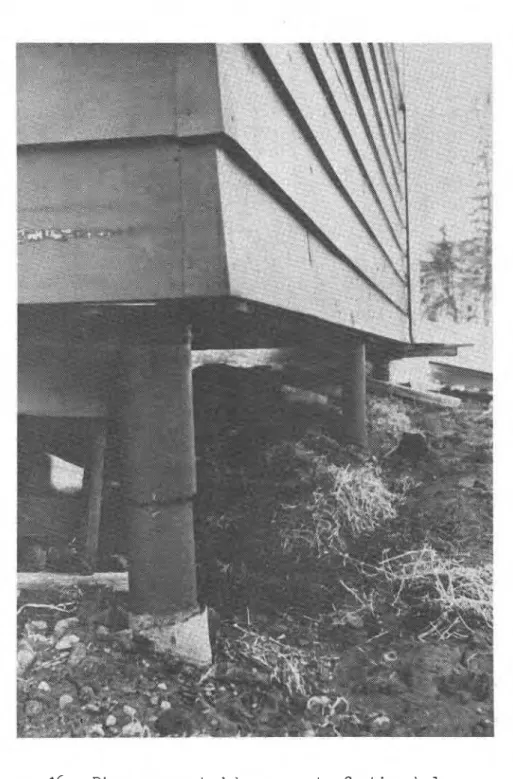
s i t e v i s i t which r e v e a l e d t h a t t h e owner had r e p l a c e d only t h e p e r i m e t e r f o o t i n g s , and a l t h o u g h t h e p e r i m e t e r of t h e c o t t a g e had remained i n p l a c e t h e c e n t r e had been heaved more t h a n 15 cm ( 6 i n . ) . F i g u r e 16 shows t h e l e v e l e x t e r i o r w a l l ; F i g u r e 17 s h m s t h e upward d e f l e c t i o n of t h e c e n t r e beam s t i l l r e s t i n g on c o n c r e t e blocks. Since t h i s major o v e r s i g h t w a s
c o r r e c t e d t h e performance of t h e b u i l d i n g h a s been s a t i s f a c t o r y . It should be noted t h a t t h e s i t e i s only a few f e e t above r i v e r l e v e l and t h e s o i l , a s i l t y c l a y , i s extremely f r o s t s u s c e p t i b l e . The high water t a b l e made excavation s o d i f f i c u l t t h a t t h e owner was not a b l e t o embed t h e p i p e s i n c o n c r e t e ; they were simply r e s t e d on small p r e c a s t c o n c r e t e s l a b s a t a depth of about 1.1 m (3.5 f t ) . Although t h i s was only s l i g h t l y deeper t h a n t h e d e p t h of f r o s t p e n e t r a t i o n , t h e weight of t h e c o t t a g e w a s s u f f i c i e n t t o r e s i s t t h e tendency of t h e 100 mm ( 4 i n . ) diameter p i p e s t o heave by a d f r e e z i n g t o t h e s o i l .
S t e e l p i p e s o r c o n c r e t e p i l e s a r e commonly used w i t h s u c c e s s a s o u t e r s u p p o r t s f o r c a r p o r t s where s u r f a c e f r o s t heaving may occur. Figure 18 i l l u s t r a t e s a problem w i t h a garage connected t o a house by a breezeway. The garage, founded on a s u r f a c e s l a b , has heaved s e v e r a l i n c h e s causing d i s t r e s s i n t h e r a t h e r i n f l e x i b l e r o o f . F i g u r e 19 shows a n unheated garage b u i l t i n t o a house w i t h f u l l d e p t h f o o t i n g s under t h e garage. I n t h i s c a s e f r e e z i n g was allowed t o occur on b o t h s i d e s of t h e f o u n d a t i o n w a l l c a u s i n g i t t o heave r e l a t i v e t o t h e w a l l around t h e heated basement. This has r e s u l t e d i n d i s t o r t i o n c r a c k s i n t h e brickwork and f l o o r heave t h a t p r e v e n t s f u l l c l o s u r e of t h e door.
( b ) Entrances
Heaving of e n t r a n c e s t e p s is common where f r o s t - s u s c e p t i b l e s o i l i s
used f o r b a c k f i l l i n g . Such damage can occur by a d f r e e z i n g even when f o o t i n g s a r e c a r r i e d t o f u l l depth, but i t can be avoided by b a c k f i l l i n g w i t h crushed s t o n e o r c l e a n g r a v e l . Only a t h i n l a y e r of s e l e c t m a t e r i a l next t o t h e w a l l and c a r r i e d down t o t h e f o o t i n g d r a i n s i s necessary. A t h i n s u r f a c e l a y e r of c l a y s l o p i n g away from t h e w a l l w i l l p r e v e n t t h e porous b a c k f i l l from a c t i n g a s a d r a i n f o r s u r f a c e water.
( c ) Cold S t o r a g e Warehouses
The f a i l u r e of cold s t o r a g e warehouses due t o f r o s t a c t i o n i n t h e u n d e r l y i n g s o i l i s n o t unusual. A number of f a i l u r e s have been
i n v e s t i g a t e d (Crawford, 1953; Hamilton e t a l . , 1959). The one d e s c r i b e d h e r e i s one of t h e w o r s t c a s e s ~ f ~ s t r u c t u r a l damage due t o f r o s t heaving e v e r observed. The damage t o t h e b u i l d i n g was s o e x t e n s i v e t h a t s e r i o u s c o n s i d e r a t i o n was g i v e n t o abandoning i t . The remedial measures
undertaken, however, turned o u t t o be h i g h l y s u c c e s s f u l . The thermal d e s i g n c o n s i d e r a t i o n s f o r s t r u c t u r e s of t h i s t y p e have been p u b l i s h e d by Pearce and Hutcheon (1958) and Pearce (1959).
The 15 by 15 m (50 by 50 f t ) b u i l d i n g was a s i n g l e - s t o r e y r e i n f o r c e d c o n c r e t e s t r u c t u r e founded on shallow s p r e a d f o o t i n g s . The s l a b o n - g r a d e f l o o r was of sandwich c o n s t r u c t i o n w i t h two 76 mm ( 3 i n . ) r e i n f o r c e d c o n c r e t e l a y e r s s e p a r a t e d by 150 mm (6 i n . ) of cork i n s u l a t i o n . T h i s was l o c a t e d d i r e c t l y on a s u b f l o o r t i l e v e n t i l a t i n g system which was
subsequently shown t o be i n e f f e c t i v e . The o p e r a t i o n of t h e p l a n t proved s a t i s f a c t o r y f o r t h e f i r s t f i v e y e a r s , b u t t h i s was followed by two y e a r s of very r a p i d f r o s t heaving. F i g u r e 20 i s a n i n t e r i o r view of t h e
r e f r i g e r a t e d l o c k e r room showing t h e e x t e n t of heave.
Heaving s t a r t e d when t h e f r o s t l i n e i n t e r c e p t e d t h e f r o s t - s u s c e p t i b l e s o i l l o c a t e d a t t h e f o o t i n g l e v e l . The remedial work involved shuttFng down t h e p l a n t , opening up t h e t i l e e u b f l o o r v e n t i l a t i n g system and improving t h e warm a i r c i r c u l a t i o n . F i g u r e 21 shows t h e d e p t h of f r o z e n s o i l and f l o o r e l e v a t i o n measurements a t one l o c a t i o n beneath t h e f l o o r from t h e time t h e s t r u c t u r e was instrumented u n t i l f l o o r subsidence stopped. Heaving continued f o r s i x months a f t e r o b s e r v a t i o n s s t a r t e d
-
from January t o June 1957-
u n t i l thawing was e f f e c t e d by improved a i r c i r c u l a t i o n of t h e duct system below t h e f l o o r . This s t u d y i l l u s t r a t e s t h e s e r i o u s d i f f i c u l t i e s t h a t can occur i f p o t e n t i a l f r o s t a c t i o n beneath an a r t i f i c i a l l y cooled b u i l d i n g i s not considered.FROST
ACTIOH DURING
COEISTBUGTIOllThe heavy demand f o r c o n s t r u c t i o n f o l l o w i n g World War I1 encouraged more wintertime b u i l d i n g a c t i v i t y . C o n t r a c t o r s l e a r n e d t o cope w i t h low temperatures and, today, c o n s t r u c t i o n i n Canada i s a continuous, year- round a c t i v i t y . Some of t h e most s e r i o u s w i n t e r c o n s t r u c t i o n problems a r e caused by ground f r e e z i n g but they can be avoided through
Case 1
F i g u r e 22 shows a small, owner-built house t h a t was l e f t u n p r o t e c t e d over t h e w i n t e r . F r o s t was allowed t o p e n e t r a t e t h e f i n e - g r a i n s o i l under t h e f o o t i n g s and t h e r e s u l t i n g f r o s t heaving d e s t r o y e d t h e
foundation w a l l s (Crawford, 1968). T h i s would n o t have o c c u r r e d i f t h e basement had been h e a t e d , but it could a l s o have been prevented by p r o t e c t i n g t h e f o o t i n g s w i t h snow, straw o r o t h e r i n s u l a t i n g m a t e r i a l s . S i m i l a r problems have been observed where f r o s t has p e n e t r a t e d through t h e basement w a l l s i n t o t h e b a c k f i l l c a u s i n g l a t e r a l p r e s s u r e s and c r a c k i n g of t h e w a l l s . Once t h e damage is done, r e p a i r s a r e d i f f i c u l t , c o s t l y and o f t e n u n s a t i s f a c t o r y .
Case 2
A s i m i l a r problem occurred d u r i n g c o n s t r u c t i o n of a f o u r - s t o r e y a d d i t i o n t o a major b u i l d i n g . It w a s n o t i c e d , when c o n s t r u c t i o n resumed a f t e r a shutdown caused by e s p e c i a l l y c o l d t e m p e r a t u r e s , t h a t t h e
f o m o r k f o r t h e basement w a l l s was 50 mm (2 i n . ) t o o h i g h where i t joined t h e e x i s t i n g b u i l d i n g (Crawford, 1968). It was q u i c k l y
e s t a b l i s h e d t h a t a l l of t h e fornawork was o u t of p o s i t i o n and f u r t h e r i n v e s t i g a t i o n r e v e a l e d t h a t t h e p e r i m e t e r f o o t i n g s 2.1 m (7 f t ) wide had heaved about 50 mm (2 i n . ) although they were p r o t e c t e d by a l a y e r of straw. The s t e e l f o r m o r k had e x t r a c t e d s o much h e a t a t t h e c e n t r e of t h e f o o t i n g t h a t l o c a l i c e l e n s i n g had heaved t h e e n t i r e f o o t i n g , l e a v i n g a void of 50 mm (2 i n . ) between t h e c o n c r e t e and t h e unfrozen s o i l a l o n g t h e edge (Fig. 23). The e n t i r e aseembly was brought back t o i t s proper p o s i t i o n by draping t h e f o r m o r k w i t h canvas and a p p l y i n g a r t i f i c i a l h e a t , C o n s t r u c t i o n of t h e c o n c r e t e w a l l was t h e n a b l e t o proceed w i t h o u t any d e t r i m e n t a l e f f e c t s .
Case 3
A much more s p e c t a c u l a r case of f r o s t heaving o c c u r r e d d u r i n g t h e c o n s t r u c t i o n of a seven-storey p u b l i c b u i l d i n g founded on a 380 mm (15 i n . ) r e i n f o r c e d c o n c r e t e mat (Crawford, 1968). The b a s i c s t r u c t u r e was a l r e a d y i n p l a c e when t h e mat f o u n d a t i o n began t o heave d u r i n g a p a r t i c u l a r l y cold period. Movement was f i r s t n o t i c e d where t h e s t r u c t u r e was j o i n e d t o an underground s e r v i c e t u n n e l . It was e s t i m a t e d t h a t an average upward movement of about 50 m ( 2 i n . ) had occurred and s t e p s were taken immediately t o confirm t h e s u s p i c i o n t h a t f r o s t heaving was occurring.
Four b o r i n g s 150 mm ( 6 i n . ) i n diameter made through t h e f o u n d a t i o n s l a b r e v e a l e d 200 t o 225 mm (8 t o 9 i n . ) of f r o z e n c l a y beneath t h e s l a b . The c l a y samples contained numerous i c e l e n s e s (Fig. 24) and t h e average f r o z e n w a t e r c o n t e n t was about 91 p e r c e n t compared w i t h a n i n i t i a l average n a t u r a l water c o n t e n t of about 56 p e r c e n t . Specimens of f r o z e n c l a y were machined t o f i t a s p e c i a l c o n s o l i d a t i o n r i n g i n o r d e r t o measure t h e s e t t l e m e n t while t h e m a t e r i a l thawed under a v e r t i c a l
f o u r specimens a f t e r thawing and compression was 55 p e r c e n t , approximately e q u a l t o t h e n a t u r a l w a t e r c o n t e n t of t h e c l a y .
The magnitude of heaving was accounted f o r by t h e i n c r e a s e i n w a t e r c o n t e n t caused by i c e l e n s i n g and t h e r e was no evidence of d r y i n g i n t h e n a t u r a l s o i l below t h e f r o z e n zone. A s soon a s t h e cause was determined, h e a t e r s and f a n s were i n s t a l l e d i n t h e crawlspace above t h e f o u n d a t i o n s l a b and t h e b u i l d i n g was allowed t o s e t t l e slowly t o i t s f i n a l p o s i t i o n , more o r l e s s a t t h e o r i g i n a l e l e v a t i o n . There w a s concern t h a t very high water p r e s s u r e s might have developed and caused l o c a l e r o s i o n of t h e
s u b s o i l , b u t no evidence of t h i s was observed d u r i n g t h e three-week period of thawing.
Case 4
Another example of f r o s t heaving and damage t o a b u i l d i n g has been d e s c r i b e d i n some d e t a i l by Burn and Beach (1978). I n t h i s c a s e t h e c o n s t r u c t i o n had f a l l e n behind schedule and t h e b u i l d i n g was s t i l l unheated when a i r t e m p e r a t u r e s f e l l t o u n u s u a l l y l o w l e v e l s d u r i n g
December. The b u i l d i n g , ranging from two s t o r e y s t o f i v e s t o r e y s , has a r e i n f o r c e d c o n c r e t e frame w i t h deep p e r i m e t e r f o o t i n g s and shallow
i n t e r i o r f o o t i n g s , and t h e basement f l o o r s l a b r e s t s on a l a y e r of crushed s t o n e o v e r n a t u r a l c l a y . F r o s t p e n e t r a t e d below t h e i n t e r i o r f o o t i n g s causing upward movement of s e v e r a l columns. The maximum
measured heave of 1 5 mm (0.6 i n . ) was n o t considered t o have caused any s t r u c t u r a l damage, but g r e a t e r movements of t h e f l o o r s l a b caused
c r a c k i n g of t h e s l a b (Fig. 25), c r u s h i n g of some of t h e non-loadbearing i n t e r i o r p a r t i t i o n s , and d i s t o r t i o n of s t e e l door frames.
Borings r e v e a l e d t h a t f r o s t had p e n e t r a t e d about 60 cm (24 i n . ) below t h e t o p of t h e basement f l o o r s l a b . The maximum d i f f e r e n c e i n measured e l e v a t i o n from t h e edge t o t h e middle of a basement room w a s about 8.5 cm (3.3 i n . ) and t h i s d i f f e r e n c e was reduced t o h a l f d u r i n g a r t i f i c i a l h e a t i n g and thaw s e t t l e m e n t . Coring r e v e a l e d t h a t a void remained beneath t h e s l a b a t t h e c e n t r e of t h e room a f t e r thawing. A f t e r s e v e r a l weeks of h e a t i n g t h e b u i l d i n g reached e q u i l i b r i u m and t h e
necessary r e p a i r s were c a r r i e d o u t . Case 5
An i n t e r e s t i n g f r o s t a c t i o n problem occurred d u r i n g t h e c o n s t r u c t i o n of a deep pumping s t a t i o n f o r a sewage t r e a t m e n t p l a n t i n Ottawa (Pappas and Sexsmith, 1968). Excavation w a s c a r r i e d out t o a d e p t h of 22 m
(72 f t ) w i t h i n a temporary s h e e t p i l e s t r u c t u r e i n t h e shape of two i n t e r s e c t i n g c i r c l e s supported by c i r c u l a r r i n g wales and c e n t r e s t r u t s a t t h e i n t e r s e c t i o n a s shown i n F i g u r e 26. The e x c a v a t i o n was c a r r i e d out during December and January and i t was q u i c k l y r e a l i z e d t h a t t h e s t r u t l o a d s were h i g h e r t h a n would be expected from e a r t h p r e s s u r e s alone. It was a l s o noted t h a t t h e l o a d s i n c r e a s e d d u r i n g t h e day and decreased a t n i g h t , w i t h t h e t o t a l l o a d i n c r e a s i n g s u b s t a n t i a l l y each day. This was a t t r i b u t e d t o t h e l a t e r a l p e n e t r a t i o n of f r e e z i n g
heaving p r e s s u r e s . A s t h e s t r u t s cooled and c o n t r a c t e d a t n i g h t t h e s o i l heaved t o f i l l t h e void. When t h e sun warmed t h e s t r u t s d u r i n g t h e day they expanded and i n c r e a s e d t h e i r i n t e r n a l s t r e s s e s w h i l e r e s i s t i n g t h e heaving p r e s s u r e s .
On one s t r u t t h e s t r e s s e s i n c r e a s e d from 136 521 kPa (19 800 p s i ) on 26 December t o 165 480 kPa (24 000 p s i ) on 2 January and t o 220 640 kPa (32 000 p s i ) on 5 January. To reduce t h e s e p r e s s u r e s a continuous s h e e t of p o l y e t h y l e n e was hung from t o p t o bottom of t h e s h e e t p i l i n g and h e a t
. was a p p l i e d under t h e s h e e t beginning 5 January. By 03:OO h on 6 January
t h e s t r e s s had d e c r e a s e d t o 178 580 kPa (25 900 p s i ) ; n i n e hours l a t e r t h e s t r e s s was 109 630 kPa (15 900 p s i ) . Heating and s t r e s s monitoring were continued u n t i l t h e weather moderated and f i n a l l y t h e c l a y s o i l had d r i e d out s o much t h a t i n many a r e a s t h e r e was a void between t h e s o i l and t h e s h e e t p i l i n g .
Most damage t o roads is due t o f r o s t heaving i n t h e w i n t e r followed by thaw-weakening i n t h e s p r i n g . The m e l t i n g i c e r e l e a s e s w a t e r , u s u a l l y under c o n d i t i o n s of impeded d r a i n a g e , and t h e l o s s of load-bearing
c a p a c i t y (Nordal, 1973) o f t e n c u l m i n a t e s i n e x c e s s i v e s u r f a c e d e f l e c t i o n and sometimes i n r u t t i n g i f t r a f f i c r e s t r i c t i o n s a r e n o t imposed
(Fig. 27). C r i t e r i a now used t o prevent heaving of f i r s t - c l a s s highways and a i r p o r t runways a r e s o s t r i n g e n t t h a t such c a t a s t r o p h i c f a i l u r e s r a r e l y occur.
Even when f r o s t heaving does n o t o c c u r , t h e r e may be a s u b t l e l o s s of s t r e n g t h d u r i n g t h e s p r i n g thaw even i n s o - c a l l e d f i r s t - c l a s s
highways. Although n o t c a t a s t r o p h i c , i t i s c h a r a c t e r i z e d by s u r f a c e d e f l e c t i o n s i n t h e s p r i n g t h a t r e s u l t i n more r a p i d d e t e r i o r a t i o n of t h e pavement a f t e r s e a s o n a l f r e e z i n g . The problem i s n o t w e l l understood and hence t h e necessary d e s i g n c r i t e r i a t o p r e v e n t i t a r e n o t known a t
p r e s e n t . It i s becoming more s e r i o u s , however, a s l o a d s i n c r e a s e , and i s being given g r e a t e r a t t e n t i o n b o t h i n Canada and t h e United S t a t e s .
Although major urban s t r e e t s a r e designed w i t h s e l e c t , non-frost- s u s c e p t i b l e m a t e r i a l s t o d e p t h s e q u a l t o o r approaching t h e normal d e p t h of f r o s t p e n e t r a t i o n , l e s s important s t r e e t s a r e o f t e n under-designed and sometimes they f a i l s e r i o u s l y d u r i n g t h e s p r i n g thaw. The s t r e e t shown i n Figure 28, f o r example, had t o be r e b u i l t a f t e r o n l y two y e a r s
(Crawf ord, 1968)
.
When a pavement heaves, f a i l u r e o c c u r s between t h e s u r f a c e and s t r u c t u r e s such a s manholes and c a t c h b a s i n s t h a t a r e founded w e l l below t h e f r o s t l i n e . F i g u r e 29 shows a manhole cover 5 cm (2 i n . ) below t h e
pavement s u r f a c e . The d i s c o n t i n u i t y a g g r a v a t e s s u r f a c e d e t e r i o r a t i o n and may l e a d t o s u b s u r f a c e e r o s i o n and dangerous p o t h o l e s . T h i s can be
avoided by p r o v i d i n g a cone of s e l e c t m a t e r i a l s around t h e s t r u c t u r e t o s t a b i l i z e t h e s o i l l o c a l l y and reduce a b r u p t d i f f e r e n c e s i n s u r f a c e e l e v a t i o n .
Observations of f r o s t heave were made a t a depressed f r e i g h t e n t r a n c e t o t h e D i v i s i o n of B u i l d i n g Research i n Ottawa (Burn, 1963) where t h e upper 30 cm ( 1 f t ) is composed of an a s p h a l t s u r f a c e over non- f r o s t - s u s c e p t i b l e m a t e r i a l . T h i s i s u n d e r l a i n by n a t u r a l c l a y . A ground movement gauge a t a depth of 30 cm ( 1 f t ) heaved about 10 cm (4 i n . ) d u r i n g t h e month of December, a f u r t h e r 8 cm ( 3 i n . ) d u r i n g January and February, followed by very s l i g h t heave d u r i n g March. By t h e end of February a gauge a t 60 cm (2 f t ) had heaved about 6 cm (2.5 i n . ) and a 90 cm ( 3 f t ) gauge had n o t moved. The observed thaw-settlement d u r i n g A p r i l i s shown i n Fig. 30. The accumulation of snow a t t h e edge of t h e roadway had a n o t i c e a b l e i n f l u e n c e on t h e s u r f a c e movements and r e s u l t e d i n a l a r g e l o n g i t u d i n a l crack i n t h e a s p h a l t . The t o t a l maximum heave of about 20 cm (8 i n . ) i s c o n s i d e r a b l y g r e a t e r than t h e heave of a d j a c e n t r o a d s , probably because t h e depressed ramp h a s t h e groundwater t a b l e c l o s e r t o i t s s u r f ace.
THERMAL INSULATION -1ES
Thermal i n s u l a t i o n has been s u c c e s s f u l l y used i n c o n s t r u c t i o n t o a t t e n u a t e f r e e z i n g and thawing of t h e ground. I n t h e F a r North i t h a s been used t o p r e s e r v e permafrost and prevent thaw s e t t l e m e n t ; i n a r e a s of s e a s o n a l f r o s t i t s main u s e h a s been t o reduce o r p r e v e n t f r o s t
p e n e t r a t i o n and f r o s t heaving. I n s u l a t i o n h a s a l s o been used t o m i t i g a t e f r e e z i n g and thawing imposed on t h e ground by mechanical r e f r i g e r a t i o n f o r i c e r i n k s and cold s t o r a g e b u i l d i n g s . The use of i n s u l a t i o n and t h e i n t r o d u c t i o n of h e a t i n t o t h e ground e i t h e r s e p a r a t e l y o r i n combination o f f e r s a wide range of p o s s i b i l i t i e s .
( a ) Areas of Seasonal Freezing
-
Roads, S t r e e t s , Driveways and Building FoundationsSince base course m a t e r i a l s a r e becoming s c a r c e i n many a r e a s t h e u s e of i n s u l a t i o n o f f e r s a v i a b l e a l t e r n a t i v e a s i t reduces t h e t o t a l pavement t h i c k n e s s r e q u i r e d ; i t may even reduce t h e t o t a l c o s t of c o n s t r u c t i o n . Numerous i n s u l a t e d road t e s t s e c t i o n s have been
c o n s t r u c t e d i n Canada and t h e n o r t h e r n r e g i o n s of t h e United S t a t e s s i n c e t h e e a r l y s i x t i e s . The u s e of thermal i n s u l a t i o n h a s a n a t u r a l advantage i n some r e g i o n s such a s i n n o r t h e r n O n t a r i o where t h e w i n t e r s a r e long and cold and s o i l c o n d i t i o n s poor f o r highway c o n s t r u c t i o n . There t h e i n s u l a t i o n t e c h n i q u e i s a f a s t and e f f i c i e n t method f o r r e p a i r i n g busy but badly frost-damaged highway s e c t i o n s . This method n e g a t e s c o s t l y d e t o u r s and deep e x c a v a t i o n s t h a t would o t h e r w i s e be r e q u i r e d .
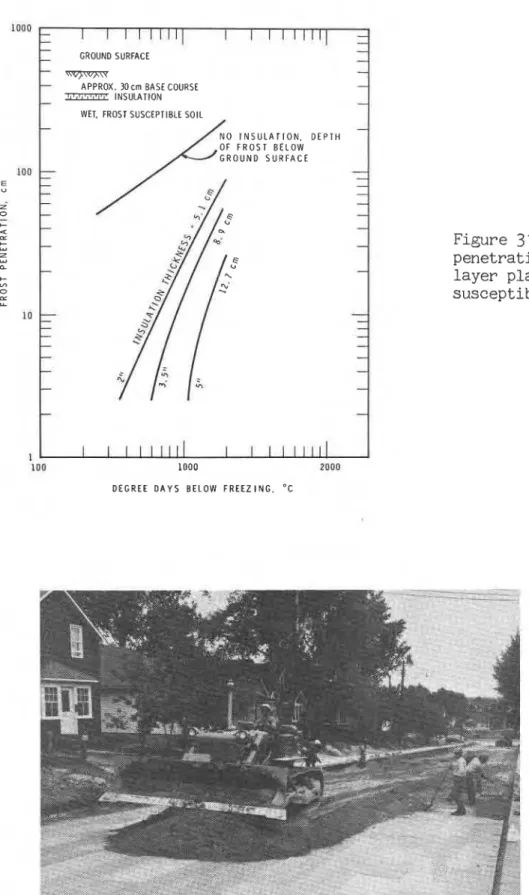
I n s u l a t e d road s t u d i e s have been c a r r i e d out a t Ottawa and Sudbury, l o c a t i o n s w i t h very d i f f e r e n t f r e e z i n g i n d i c e s (Penner, 1967, 1976(b); Penner e t a l . , 1966). The r e s u l t s were used a s a b a s i s f o r developing t h e i n f o r m a t i o n g i v e n i n F i g u r e 31 which r e l a t e s t h e f r e e z i n g i n d e x t o t h e depth of f r o s t p e n e t r a t i o n below v a r i o u s t h i c k n e s s e s of i n s u l a t i o n . The thermal p r o t e c t i o n t h i s technique p r o v i d e s i s c o n s i d e r a b l e . A s an example, a 5 cm (2 i n . ) t h i c k n e s s of expanded p o l y s t y r e n e i n s u l a t i o n reduced t h e f r o s t p e n e t r a t i o n a t Sudbury by 0.9 m ( 3 f t ) d u r i n g a w i n t e r
when t h e f r o s t p e n e t r a t i o n was 1.6 m (5.3 f t ) ( f r e e z i n g index 1450 C e l s i u s degree days).
The c o n s t r u c t i o n technique u s i n g i n s u l a t i o n is n o t d i f f i c u l t
although i t i n v o l v e s a good d e a l of hand labour. Normally t h e subbase i s
fine-bladed b e f o r e hand p l a c i n g t h e i n s u l a t i o n boards. Crushing of t h e i n s u l a t i o n i s t o be avoided, hence t h e b a s e c o u r s e i s u s u a l l y end dumped and spread by a t r a c k e d v e h i c l e (Fig. 32). The boards a r e pegged w i t h wooden skewers t o prevent s h i f t i n g d u r i n g t h e s p r e a d i n g o p e r a t i o n . B u t t i n g t h e j o i n t s of a d j a c e n t boards meets both p r a c t i c a l and thermal c o n s i d e r a t i o n s .
I n s u l a t i n g m a t e r i a l s such
as
foamed-in-place s u l p h u r andpolyurethane a r e a l s o b e i n g i n v e s t i g a t e d b u t t h e commonly used t y p e i s s t i l l expanded p o l y s t y r e n e . The a p p a r e n t advantages of in-place foaming t e c h n i q u e s a r e s t i l l on a t r i a l b a s i s i n t h e f i e l d .
I n s u l a t i o n has been employed s u c c e s s f u l l y around f o o t i n g s (Penner
,
1969) and h a s had numerous o t h e r a p p l i c a t i o n s such a s under f l o o r s of unheated b u i l d i n g s and under pathways and driveways. E n t r a n c e s t o basement g a r a g e s (Penner and Burn, 1970) a r e p a r t i c u l a r l y s e n s i t i v e t o f r o s t a c t i o n (Fig. 33). When proper d e s i g n s (Fig. 34) a r e n o t used t h e e a s i e s t remedial s o l u t i o n h a s been t o i n s t a l l i n s u l a t i o n i n c r i t i c a l l o c a t i o n s . Today, when heavingis
a n t i c i p a t e d , t h e d e s i g n approach f o r f o u n d a t i o n s i s t h e u s e ofa
numerical s o l u t i o n t o t h e thermal problem (Rubinsky and Bespflug, 1973). This t a k e s i n t o account t h e thermal c o n d u c t i v i t y of t h e i n s u l a t i o n , t h e placement p a t t e r n of t h e board, t h e geometry of t h e f o o t i n g , t h e magnitude and d u r a t i o n of f r e e z i n g and t h e thermal c o n d u c t i v i t y of t h e s o i l and o t h e r m a t e r i a l s involved.( b ) A r t i f i c i a l I c e Rinks
The main problems t o be a n t i c i p a t e d from t h e f r e e z i n g of t h e ground under and a d j a c e n t t o i c e r i n k s a r e t h o s e caused by heaving. A t t e n t i o n t o t h e p o s s i b i l i t i e s of heaving w i l l always be j u s t i f i e d a t t h e d e s i g n s t a g e f o r a l l r i n k s where t h e r e i s a requirement f o r a t r u e i c e s u r f a c e and i n r i n k s t h a t have s u b s t a n t i a l a s s o c i a t e d b u i l d i n g s . Rinks t h a t a r e t o be o p e r a t e d throughout t h e y e a r r e q u i r e s p e c i a l a t t e n t i o n .
A p r a c t i c a l approach t o prevent heaving i n a s e a s o n a l l y o p e r a t e d r i n k i s t o r e p l a c e f r o s t - s u s c e p t i b l e s o i l s dawn t o t h e p r e d i c t e d d e p t h of f r o s t p e n e t r a t i o n w i t h coarse-grained m a t e r i a l . The d e p t h of replacement under a r i n k t h a t employs a r t i f i c i a l r e f r i g e r a t i o n p r o v i d e s a ground h e a t t r a n s f e r s i t u a t i o n t h a t is reasonably amenable t o c a l c u l a t i o n .
The maximum d e p t h of f r o s t w i l l depend on i c e t e m p e r a t u r e s , t h e d u r a t i o n of t h e i c e season, t h e average a i r temperature i n t h e b u i l d i n g d u r i n g t h e summer off-season and t o a l e s s e r e x t e n t t h e thermal
p r o p e r t i e s of t h e s o i l (Brown, W.G., 1965) (Fig. 35). Assuming a n
average a r e n a temperature i n t h e summer of 15.6OC (60°F) t h e f r o s t d e p t h w i t h a n i c e temperature of -5.6"C (22°F) i s about 2.1 m (7 f t ) f o r a s i x - month season and about 3.0




![Aza Diels-Alder Reactions of Nitriles, N, N-Dimethylhydrazones, and Oximino Ethers. Application in Formal [2 + 2 + 2] Cycloadditions for the Synthesis of Pyridines](data:image/gif;base64,R0lGODlhAQABAIAAAP///wAAACH5BAEAAAAALAAAAAABAAEAAAICRAEAOw==)