HAL Id: halshs-00589134
https://halshs.archives-ouvertes.fr/halshs-00589134
Preprint submitted on 27 Apr 2011
HAL is a multi-disciplinary open access archive for the deposit and dissemination of sci-entific research documents, whether they are pub-lished or not. The documents may come from teaching and research institutions in France or abroad, or from public or private research centers.
L’archive ouverte pluridisciplinaire HAL, est destinée au dépôt et à la diffusion de documents scientifiques de niveau recherche, publiés ou non, émanant des établissements d’enseignement et de recherche français ou étrangers, des laboratoires publics ou privés.
Incomplete markets and the output-inflation tradeoff
Yann Algan, Edouard Challe, Xavier Ragot
To cite this version:
Yann Algan, Edouard Challe, Xavier Ragot. Incomplete markets and the output-inflation tradeoff. 2008. �halshs-00589134�
P
ARIS
-J
OURDAN
S
CIENCES
E
CONOMIQUES
48,BD JOURDAN –E.N.S.–75014PARISTEL. :33(0)143136300 – FAX :33(0)143136310 www.pse.ens.fr
WORKING PAPER N° 2006 - 45
Incomplete markets and the output-inflation tradeoff
Yann Algan Edouard Challe
Xavier Ragot
JEL Codes : E24, E31, E32
Keywords : Incomplete market,borrowing constraints, short-run nonneutrality
CENTRE NATIONAL DE LA RECHERCHE SCIENTIFIQUE –ÉCOLE DES HAUTES ÉTUDES EN SCIENCES SOCIALES
Incomplete Markets and the Output-In‡ation Tradeo¤
Yann Algan
yEdouard Challe
zXavier Ragot
xMarch 2008 (First version: December 2006)
Abstract
This paper analyses the e¤ects of money shocks on macroeconomic aggregates in a ‡exible-price, incomplete-markets environment that generates persistent wealth in-equalities amongst agents. In this framework, unexpected money shocks redistribute wealth from the cash-rich employed to the cash-poor unemployed, and induce the for-mer to increase their labour supply in order to maintain their desired levels of consump-tion and precauconsump-tionary savings. The reduced-form dynamics of the model is a textbook ‘output-in‡ation tradeo¤’equation whereby in‡ation shocks raise current output. The attenuating role of mean in‡ation and money growth persistence on this non-neutrality tradeo¤, as well as some of the welfare implications of wealth redistribution, are also examined.
Keywords: Incomplete markets; borrowing constraints; short-run non-neutrality. JEL codes: E24; E31; E32.
We are particularly grateful to Chris Carroll, Jean-Michel Grandmont, Guy Laroque, Etienne Lehman and Victor Rios-Rull for their suggestions on an earlier version of this paper. We also received helpful comments from seminar participants at CREST-INSEE and participants at the 2007 T2M Conference (Paris) and the 2007 EEA-ESEM meeting (Budapest). Financial support from the French National Research Agency (ANR) is gratefully acknowledged. All remaining errors are ours.
yParis East University and Paris School of Economics, 48 Boulevard Jourdan, 75014 Paris, France;
zCNRS-DRM and Université Paris-Dauphine, F-75016 Paris, France; [email protected]. xParis School of Economics, 48 Boulevard Jourdan, 75014 Paris, France; [email protected].
1
Introduction
This paper analyses the e¤ects of money shocks on macroeconomic variables within a ‡exible-price, incomplete-markets environment that generates persistent wealth inequalities amongst agents. More speci…cally, we explore the aggregate and welfare e¤ects of unexpected mon-etary injections in a Bewley-type model where money serves as a short-run store of value allowing agents to self-insure against idiosyncratic income ‡uctuations. As was …rst shown by Bewley (1980, 1983), and further analysed in a number of contributions including Kehoe et al. (1992), Imrohoroglu (1992), and Akyol (2004), this role for money arises naturally in environments where insurance markets are missing and agents cannot borrow against future income. We draw on this literature by emphasising the role of money as a bu¤er stock against labour-income ‡uctuations, where money partly substitutes for the lack of insurance and credit markets. Unlike the existing literature, however, we analyse the short-run impact of in‡ation shocks on output, rather than focusing on the long-run e¤ect of steady-state in‡ation.
A distinguishing feature of Bewley models (relative to complete markets models) is that cash holdings are heterogenous across agents in equilibrium, because the money wealth accumulated by every single agent depends on the sequence of idiosyncratic shocks that each agent has faced. With such unequal cash holdings, lump-sum money injections that raise the price level lower the value of previously-accumulated balances and redistribute money wealth from relatively cash-rich agents, who pay the in‡ation tax, towards poorer agents, who bene…t from the corresponding in‡ation subsidy. Without aggregate shocks, the redistributive e¤ect of (fully anticipated) in‡ation can help households to self-insure against idiosyncratic shocks and thereby justi…es mean in‡ation rates strictly higher than those prescribed by the so-called ‘Friedman rule’ (e.g., Kehoe et al, 1992; Akyol, 2004).1 In the present paper, we explore the aggregate implications of unexpected, but possibly persistent, monetary injections. Thus, our paper explores the non-neutrality of money implied by wealth redistribution within a framework combining both idiosyncratic and aggregate uncertainty about agents’incomes.
1The Friedman rule states that the in‡ation rate should be set so as to bring the nominal interest rate
on bonds down to zero (Friedman, 1969). It has been shown to hold in a variety of monetary models with representative agents (see Woodford, 1990, for a survey).
In our model, idiosyncratic income risk is rooted in the transitions of individual house-holds between ‘employment’, a status where they can freely choose the labour supply they rent out to competitive …rms, and ‘unemployment’, where households receive a …xed subsidy lower than equilibrium wage income. One central implication of our analysis is that aggregate monetary shocks generate a traditional ‘output-in‡ation tradeo¤’, whereby in‡ation shocks contemporaneously raise employed households’labour supply and thus output. In our econ-omy, the in‡ation tax redistributes real wealth from the employed, who are unconstrained and hold positive cash holdings at the beginning of the period, towards the unemployed, who are borrowing-constrained at the start of the period and thus initially hold no cash. This redistribution from unconstrained to constrained households forces the former to in-crease their labour supply to replete their money wealth and maintain their desired levels of consumption and money holdings. The implied increase in hours then raises current output, generating an output-in‡ation tradeo¤ whose underlying mechanism di¤ers from traditional ones such as those based on sticky prices (e.g., Ball et al., 1988) or imperfect information (see Lucas, 1973).
What does the size of this monetary non-neutrality depend on? In our model, the redis-tributive e¤ect of an in‡ation shock is positively related to the gap between the real balances of cash-rich and cash-poor agents, i.e., the degree of inequality in the distribution of money holdings. Higher in‡ation, inasmuch as it reduces the attractiveness of real balances as a means of self insurance, deters employed households from accumulating these balances and thus diminishes both money wealth inequalities and the implied impact of in‡ation shocks. Highly-persistent money growth shocks, to the extent that they forecast greater in‡ation taxes on future real balances, transitorily lower real money demand and induce a negative e¤ect of money growth shocks on labour supply and output. The output e¤ects of mone-tary shocks are thus larger when both the mean and the persistence of money growth are low. In the extreme opposite situation where both are very large, the intertemporal e¤ects on future in‡ation taxes may even dominate the intratemporal, redistributive e¤ect of the current in‡ation tax, and lead to a reversal in the sign of the tradeo¤.
Our analysis follows the route opened by Bewley (1980), Scheinkman and Weiss (1986) and Kehoe et al. (1992). Bewley and Kehoe et al. focused on the optimal long-run in‡ation rate and did not analyse the short-run non-neutrality of money under incomplete markets.
Scheinkman and Weiss were the …rst to identify the non-neutrality of money shocks when borrowing constraints make cash holdings heterogenous; however, the in…nite-dimensional wealth distribution of their model did not allow them to derive the output-in‡ation tradeo¤, let alone relate its size to the underlying deep parameters of the model such as mean in‡ation, money growth persistence, or the number of borrowing-constrained agents in the economy. Given the lack of tractability of heterogenous-agent models with in…nite-state wealth dis-tributions, an alternative approach to the one we follow is to solve them computationally. However, computational limitations have thus far limited the applicability of these models to the study of optimal steady-state in‡ation, again leaving aside the analysis of the short-run e¤ects of in‡ation shocks (e.g., Imrohoroglu, 1992, and Akyol, 2004). We circumvent this di¢ culty by deriving a closed-form solution to our incomplete-markets model that generates a …nite-state wealth distribution and a …nite number of agent types.
Finally, the non-neutrality of in‡ation shocks working through wealth redistribution has recently been explored in frameworks di¤erent from Bewley models but which also generate heterogenous wealth levels across agents in equilibrium. Within the overlapping generations tradition, Doepke and Schneider (2006) look at the aggregate e¤ects of inter-cohort redistri-bution from old retirees to young workers, and …nd a negative e¤ect of in‡ation shocks on output in the short and medium run; in contrast, our model can generate a positive short-run relation between in‡ation and output due to intra-cohort wealth redistribution. Berentsen et al. (2005) study the e¤ects of non-persistent money supply shocks in a search-theoretic monetary model; besides being based on a very di¤erent set of assumptions, our framework can handle auto-correlated shocks and thus assess the joint e¤ects of current and expected in‡ation taxes on aggregate outcomes.
The remainder of the paper is organised as follows. Section 2 introduces the model and spells out its optimality and market-clearing conditions. Section 3 derives a closed-form equilibrium with two possible levels of real money holdings and four types of agents. Section 4 analyses the properties of the short-run output-in‡ation tradeo¤ generated by the model, paying particular attention to the role of mean in‡ation and the persistence of shocks in a¤ecting the slope of the tradeo¤. Section 5 concludes.
2
The model
The economy is populated by a large number of …rms, as well as a unit mass of in…nitely-lived households i 2 [0; 1], all interacting in perfectly-competitive labour and goods markets. Firms produce output, yt, from labour input, lt, using the CRS technology yt = lt; they
thus adjust labour demand up to the point where the real wage is equal to 1. Households’ behaviour, on the other hand is potentially a¤ected by both the (uninsurable) idiosyncratic income uncertainty that they face and the aggregate shock.
2.1
Uncertainty
Individual states. In every period, each household can be either employed or unemployed. We denote by itthe status of household i at date t, where it = 1if the household is employed
and i
t= 0 if the household is unemployed. Households switch randomly between these two
states, with = Pr( it+1 = 1 it = 1) and = Pr( it+1= 0 it = 0); ( ; )2 (0; 1)2; being the probabilities of staying employed and unemployed, respectively. Given this Markov chain for individual states, the asymptotic unemployment rate is:
U = (1 ) = (2 ) : (1)
The history of individual shocks up to date t is denoted et
i, where eti = f i0; ::; itg:
Et=
f0; 1g ::f0; 1g is the set of all possible histories up to date t, and i
t: Et ! [0; 1]; t =
0; 1; ::: denotes the probability measure of individual histories (for example, i
t(eit) is the
probability of individual history ei
t for agent i at date t). Following convention, we use the
notation ei
t+1 eit to indicate that eit+1 is a possible continuation of eit. Finally, we limit the
ability of households to diversify this idiosyncratic unemployment risk away by assuming that it is uninsurable and that agents cannot borrow against future labour income.
Aggregate states. Money growth shocks are the only source of economy-wide uncertainty that we consider. The history of these shocks up to date t is denoted ht, while Ht is the set of all
possible histories for these shocks up to date t. Let denote the probability measure over histories up to date t: t : Ht ! [0; 1]; t = 0; 1; ::: As before, t(ht) denotes the probability
of history ht and ht+1 ht indicates that ht+1 is a possible continuation of ht.
In every period, a real amount t(ht) > 0 of newly-issued …at money is given
related to money growth, t(ht)).2 Moreover, in equilibrium the price level and the
in‡a-tion rate are funcin‡a-tions of the history of aggregate states. These are denoted Pt(ht) and t(ht) Pt(ht) =Pt 1(ht 1) 1;respectively.
2.2
Households’behaviour
The household’s instantaneous utility function is u (c) l, where c is consumption, l is labour supply, > 0 a scale parameter, and where u is a C2 function satisfying u0(c) > 0,
u00(c) < 0and (c) cu00(c) =u0(c) 18c 0(i.e. consumption and leisure are not gross complements). Fiat money is the only outside asset available and, since private borrowing is prohibited, the only asset that households can use to smooth consumption. Employed households (i.e. those for whom i
t = 1) choose their labour supply, lit, at the current wage
rate (= 1), while unemployed households (i.e., for whom it= 0) earn no labour income but
a …xed amount of ‘home production’, > 0.3 Let Mi
t denote the nominal money holdings of
household i at the end of date t; and mit Mti=Ptthe corresponding real money holdings (by
convention, we denote by Mi
1 the nominal money holdings of household i at the beginning
of date 0). Household i’s problem is to choose the sequences of functions ci t : Ht Et! R+ li t : Ht Et! R+ mi t : Ht Et! R+ 9 > > > = > > > ; t = 0; 1; :::; to maximise 1 X t=0 t X ht2Ht t(ht) X ei t2Et i t e i t u c i t ht; eit l i t ht; eit ;
2Our assumption that tranfers are symmetric and lump sum follows much of the litereature on Bewley
models (e.g., Scheinkman and Weiss, 1986; Kehoe et al., 1992; Imrohoroglu, 1992). It can be justi…ed on the grounds that monetary authorities are not su¢ ciently well informed to treat individual agents di¤erently, as is discussed in Kehoe et al. (1992) and Levine (1991).
3Alternatively, can be interpreted as an unemployment subsidy …nanced through a compulsory
lump-sum contribution, e = U = (1 U ), paid by all employed households and ensuring the equilibrium of the unemployment insurance scheme in the steady state. In this case, steady-state labour supply and output are higher than under the home production interpretation (as working households attempt to o¤set the wealth e¤ect of the unemployment contribution), but the dynamic behaviour of the economy faced with aggregate uncertainty is unchanged.
where 2 (0; 1) is the discount factor, subject to
Ptcit ht; eit + Mti ht; eit = Mt 1i ht 1; eit 1 + Pt itlit ht; eit + 1 it + t(ht) ; (2)
cit ht; eit ; lti ht; eit ; Mti ht; eit 0: (3)
Equation (2) is the nominal budget constraint of household i at date t, while the last inequality in (3) indicates that agents cannot have negative asset holdings. The Lagrangian function associated with household i’s problem, formulated in real terms, is:4
L = 1 X t=0 t X ht2Ht t(ht) X ei t2Et t eit 2 6 4 u (ci t(ht; eit)) lti(ht; eit) + 'it(ht; eit) mit(ht; eit) + it(ht; eit) mi t 1(ht 1;eit 1) 1+ t(ht) + i tlti(ht; eti) + (1 it) + t(ht) cit(ht; eit) mit(ht; eit) 3 7 5 ; where the Lagrange multipliers i
tand 'itare positive functions de…ned over Ht Et(we check
below that the non-negativity constraints on ci
t and lti are always satis…ed in the equilibrium
under consideration). From the Kuhn-Tucker theorem, the optimality conditions are, for t = 0; 1; ::: and for all (ht; eit)2 Ht Et;
u0 cit ht; eit = i t ht; eit ; (4) i t ht; eit = if i t = 1 and l i t ht; eit = 0 if i t = 0; (5) i t ht; eit ' i t ht; eit = X ht+1 ht t+1(ht+1) X ei t+1 eit i t+1 e i t+1 i t+1 ht+1; eit+1 1 + t+1(ht+1) ; (6) 't ht; eit m i t ht; eit = 0; (7) lim t!1 tu0 c t ht; eit m i t ht; eit = 0: (8)
Equation (4) de…nes household i’s marginal utility, while (5) and (6) are the intratemporal and intertemporal optimality conditions, respectively. Equation (7) states that either the borrowing constraint is binding for household i ('it > 0), implying that cash holdings are
zero (mi
t = 0), or the constraint is slack ('it = 0) and the household uses real balances to
smooth consumption over time (mit 0). Finally, condition (8) is a transversality condition
4As will become clear below, our choice of the Lagrangian function, rather than the Bellman equation,
that will always hold along the equilibria that we will consider. Note that (6) can be written more compactly as:
u0 cit ht; eit = Et u0 ci t+1 ht+1; eit+1 1 + t+1(ht+1) ! + 'it ht; eit : (9)
2.3
Market clearing
Goods market. Equilibrium in the market for goods requires that, at each date and for all histories of aggregate states ht2 Ht; the sum of each type of agent’s consumption be equal
to total production. Given the assumed production function, total production is simply the sum of individual labour supplies and home production, so that we have:
Z 1 0 i tl i t ht; eit + 1 i t di = Z 1 0 cit ht; eit di;
where the summation operatorR is over individual households.
Money market. Let Mt(ht) denote the nominal quantity of money at date t; then
money-market clearing may equally be written as: Mt(ht) =
Z 1 0
Mti ht; eit di:
Denote real money supply by mt(ht) Mt(ht) =Pt(ht) and the (gross) rate of money
growth by t(ht) Mt(ht) =Mt 1(ht 1). Then, symmetric real money injections can be
written as: t(ht) = Mt(ht) Mt 1(ht 1) Pt(ht) = mt 1(ht 1) ( t(ht) 1) 1 + t(ht) ; (10)
while the law of motion for the real quantity of money is: mt(ht) =
mt 1(ht 1) t(ht)
1 + t(ht)
: (11)
An equilibrium is de…ned as sequences of individual consumption levels, fcit(ht; eit)g 1 t=0,
individual real money holdings, fmi
t(ht; eit)g 1
t=0, individual labour supplies, flti(ht; eit)g 1 t=0,
i 2 [0; 1], and aggregate variables, fyt(ht) ; mt(ht) ; t(ht)g1t=0, such that the optimality
conditions (4)-(8) hold for every household i and the goods and money markets clear, given the forcing sequence f t(ht)g1t=0.
3
Equilibria with two-state wealth distributions
In general, heterogenous-agent models such as that described above generate an in…nite-state distribution of agent types, as all individual characteristics (i.e., agents’wealth and implied optimal choices) depend on the personal history of each agent. In this paper, we derive a closed-form solution of the model with a …nite number of household types by considering a class of equilibria where the cross-sectional distribution of money holdings is two-state. The derivation involves three steps. First, we conjecture the general shape of the solution; second, we identify the conditions under which the hypothesised solution results; and third, we set the relevant parameters (the productivity of home production, here) in such a way that these conditions are always ful…lled along the equilibrium under consideration.
3.1
Conjectured equilibrium
We conjecture the existence of an equilibrium along which 't ht; eit = 0 if i t= 1 and m i t ht; eit = 0 if i t= 0; (12)
that is, one where no employed household is borrowing-constrained (so that they all store cash to smooth consumption), while all unemployed households are borrowing-constrained (and thus hold no cash). From here on, we simplify notation by simply using the i-index for variables that depend on individual histories and the t-index for those that depend on the aggregate history.
Consider …rst the consumption level of an unemployed household. If this household was employed in the previous period, then from (2) and (12) their current consumption is:
cit= mit 1= (1 + t) + + t (> 0) ; (13)
On the other hand, from (2) the consumption level of unemployed households who were already unemployed in the previous period is identical across such households and given by: cuut = t+ (> 0) : (14) We now turn to employed households. From (4) and (5), their consumption level is identical across employed households and independent of aggregate history, i.e.,
From equations (9) and (12), the intertemporal optimality condition for an employed household is = Et it+1= (1 + t+1) . If this household is employed in the following
period, which occurs with probability , then i
t+1 = (see (5)). If the household moves
into unemployment in the next period, then from (4) i
t+1 = u0 cit+1 , where by construction
ci
t+1 is given by (13). The Euler equation for employed households is thus:
= Et 1 + t+1 + (1 ) Et u0 mit 1 + t+1 + + t+1 1 1 + t+1 ; (16) which in turns implies that all employed households wish to hold the same quantity of real balances, denoted by met (i.e., 8i 2 [0; 1], it = 1 ) mit = met). We may thus rewrite
equation (13), giving the consumption level of unemployed households which were previously employed, as follows:
ceut = met 1= (1 + t) + + t: (17)
The labour supplies of employed households depend on whether they were employed or not in the previous period. Using Eqs. (2) and (15) these are given by, respectively,
leet = ce+ met met 1= (1 + t) t; (18)
ltue = ce+ met t: (19) In other words, when all unemployed households are borrowing-constrained and no em-ployed household is, households can be of four di¤erent types, depending only on their current and past employment status, with their personal history before t 1 being irrelevant. This distributional simpli…cation is essentially the outcome of the joint assumption that all unem-ployed households liquidate their asset holdings (i.e., it= 0) mit= 0), while all employed
households choose the same levels of consumption and asset holdings thanks to linear labour disutility (i.e., it = 1 ) mit = met). We denote these four households types ee, eu, ue and
uu, where the …rst and second letters refer to date t 1 and date t employment states, respectively. Since our focus is on the way in which idiosyncratic unemployment risk a¤ects self-insurance by the employed, we consider the e¤ect of variations in taking U in (1) as given (the implied probability of leaving unemployment is thus = 1 (1 ) (1 U ) =U). We then write the asymptotic shares of households as:
and we abstract from transitional issues regarding the distribution of household types by assuming that the economy starts at this invariant distribution.
Given the consumption and labour supply levels of each type of household, goods-market clearing now implies that:
!eeleet + !ueltue+ U = (1 U )ce+ !euceut + !uucuut : (21) In the equilibrium under consideration, which we assume to prevail from date 0 onwards, unemployed households hold no money while all employed households hold the real quantity met. Money-market clearing thus requires that
(1 U ) met = mt: (22)
3.2
Existence conditions
The condition for the distribution just derived to be an equilibrium is that the borrowing constraint never be binding for ee and ue households but always be binding for both uu and eu households. The constraint is not binding for employed households if the latter never wish to borrow. Thus, interior solutions to (16) must always be such that:
met 0: (23)
On the other hand, the Lagrange multiplier 'i
t must be positive when households are
unemployed, so that from (4)-(6) we must have i
t > Et it+1= (1 + t+1). First consider
uu households, whose current consumption is just + t (see (14)), and thus for whom
i
t = u0( + t). These households remain unemployed with probability , in which case
they will also consume + t in the following period and thus i
t+1 = u0 + t+1 : They
leave unemployment with probability 1 and will then consume u0 1( ) in the following period, so that i
t+1 = u0(u0 1( )) = . Thus, uu households are borrowing-constrained
whenever: u0( + t) > Et u0 + t+1 1 + t+1 ! + (1 ) Et 1 + t+1 : (24)
We now turn to eu households. Their current consumption is given by Eq. (17), so that
i
or ue households in the following period. Thus, eu households are borrowing-constrained whenever: u0 m e t 1 1 + t + + t > Et u0 + t+1 1 + t+1 ! + (1 ) Et 1 + t+1 : (25)
If (23) holds then (25) is more stringent than (24), so (25) is a su¢ cient condition for both uu and eu households to be borrowing-constrained. We show in the Appendix that when lies within the range ( ; +), where 0 < +, then both (23) and (25) hold for
all t 0, provided that aggregate shocks have su¢ ciently small support. Intuitively, for our equilibrium to exist home production must be su¢ ciently productive to deter unemployed households from saving, whilst at the same time being su¢ ciently unproductive to induce positive precautionary savings by employed households.
4
Intratemporal vs. intertemporal e¤ects of monetary
shocks and in‡ation taxes
We are now in a position to derive the solution dynamics of our equilibrium with limited wealth heterogeneity. Using (10), (11), (16) and (22), we can summarise the dynamic behav-iour of the economy by a single forward-looking equation, namely,
met = Et me t+1 t+1 + (1 ) Et me t+1 t+1 u0 + m e t+1 t+1 (U + (1 U ) t+1) : (26)
Equation (26) determines the equilibrium dynamics of the real money balances held by employed households, fme
tg1t=0, as a function of the money growth sequence f tg1t=0. From
now on, we take tas the exogenous state variables, with the transfer tbeing endogenously
determined by Eq. (10) in equilibrium. Then, our assumption that t > 0implies that t> 1
for all t, and we further assume that t has small bounded support [ ; +], with > 1.
All equilibrium variables at date t can be expressed as functions of me
t and t only. For
example, substituting (10)–(11) and (22) into (18)–(19), we derive the following expressions for the labour supplies of employed households, depending on their speci…c type:
leet = ce+ U met t 1
t
; luet = ce+ met 1 + U ( t 1)
t
where lee
t ; ltue > 0. Similarly, substituting (10)–(11) and (22) into (14) and (17), the
con-sumption levels of unemployed households can be expressed as: ceut = + met U + (1 U ) t
t
; cuut = + (1 U ) met t 1
t
: (28)
It is apparent from equations (27)–(28) that money growth shocks can a¤ect real variables either directly through changes in t (inside each bracketed term), or indirectly through
their potential e¤ect on current real money demand, met (as determined by equation (26)).
For reasons that will become clear shortly, we refer to the former and the latter as the ‘intratemporal’and ‘intertemporal’e¤ects of monetary shocks, respectively.
4.1
Intratemporal e¤ects
The intratemporal e¤ects of monetary shocks are isolated when money growth is i.i.d., in which case the current shock does not alter households’expectations about future in‡ation taxes. With i.i.d. aggregate shocks, the …rst-order approximation to equation (26) yields the following constant path for met:5
met = me= 1 +
1 + (1 U ) u
0 1 (1 + )
(1 ) ; (29)
where unindexed variables denote steady-state values (all of these are summarised in the Appendix). Two properties of me are worth mentioning at this stage. First, me falls with
, as lower idiosyncratic unemployment risk reduces employed households’ incentives to self-insure against this risk. Second, under our maintained assumption that (c) 1; me
falls with (this claim is established in the Appendix): as in‡ation increases, the return to holding real balances decreases and money becomes less valuable as a self-insurance device against idiosyncratic unemployment shocks.
We can now turn to the e¤ects of i.i.d. aggregate shocks on labour supply and output. Equations (11) and (29) imply that t= t 1. Thus, individual labour supplies are:
leet = ce+ me U t 1 + t
; ltue = ce+ me 1 + U t 1 + t
: (30)
5This can be checked by linearising (26) around steady-state real balances and money growth, (me; ) ;
and solving the resulting equation forwards. That (c) 1 implies that the equilibrium is unique and non-cyclical, while i.i.d shocks preclude time-variations in real balances.
The latter equations summarise the redistributive e¤ects of the current in‡ation tax on labour supplies. Note that leet rises while luet falls as t increases, following households’
adjustments to the intratemporal wealth redistribution generated by in‡ation. After an in‡ation shock, the households who pay the in‡ation tax in period t are those who hold money at the beginning of period t (ee and eu households), while the households who bene…t from the corresponding in‡ation subsidy are those who do not hold money at the beginning of period t (ue and uu households). Consequently, ee households are hurt by the shock and increase their labour supply to maintain their desired levels of consumption and money wealth, while ue households can a¤ord to work less than they would have done had the shock not occurred. From equations (20) and (30), market output, !eelee
t + !ueltue, is given by:
yt = (1 U ) ce+ (1 U ) me
U t+ 1
1 + t
: (31)
Market output increases with current in‡ation (i.e. greater labour supply by ee house-holds dominates the lower supply of ue househouse-holds) provided that U + > 1, or, equivalently from (1), that + > 1 (that is, the average persistence in employment status must be su¢ ciently high, as we discuss further below). For small shocks, equation (31) can be ap-proximated by the following linear ‘ouput-in‡ation tradeo¤’relation:
yt = y + ( t ) ; (32) where = U + 1 (1 + ) (1 + (1 U ) ) u 0 1 (1 + ) (1 ) : (33)
This tradeo¤ equation is reminiscent of those derived by Lucas (1973) or Ball et al. (1988); the underlying mechanism that we emphasise here works very di¤erently, however. In Lucas, agents raise production after an in‡ationary money shock because they cannot fully disentangle changes in relative prices from variations in the general price level; in Ball et al., the output-in‡ation tradeo¤ arises naturally from nominal rigidities. In contrast, our model features perfect information, fully-‡exible prices, but heterogenous cash balances. Consequently, lump-sum monetary injections redistribute wealth from rich to cash-poor households, thereby inducing employed households to alter their labour supplies in order to o¤set the implied wealth e¤ects. Interestingly, the model predicts that higher trend in‡ation lowers the impact of in‡ation shocks on output (i.e., @ =@ < 0), because it lowers
money holdings by employed households and thus mitigates the redistributive e¤ects of these shocks. We may thus conclude that this negative relation is perfectly compatible with price ‡exibility, contrary to the claim in Ball et al. (1988) that it supports the hypothesis of nominal rigidities.
We summarise the results obtained so far in the following proposition:
Proposition 1. Steady-state real money holdings by employed households, me, increase with idiosyncratic unemployment risk, 1 , and decrease with mean in‡ation, . With i.i.d. money-growth shocks, a necessary and su¢ cient condition for shocks to raise current output is U + > 1 (or, equivalently, + > 1), while the e¤ect of the shock on output is stronger the lower is mean in‡ation.
Should we expect the NSC stated in the proposition to hold empirically? Estimating tran-sition rates between employment and unemployment from the U.S. Panel Study of Income Dynamics over the period 1984-1987, Engen and Gruber (2001, Appendix A) …nd = 0:97 and = 0:35at quarterly frequency (so that + = 1:32 > 1). Constructing annual job-loss probabilities from the Current Population Survey, Carrol et al. (2003) …nd a value for the average household of 0:02 (that is, = 0:98). Given the unemployment rates at these dates, this unambiguously gives + > 1 at an annual frequency, and by implication at quarterly frequency. Finally, although we literally refered to U and as the unemployment rate and the probability of staying employed, respectively, in the context of our equilibrium these are also the share of borrowing-constrained households in the economy and the probability of becoming constrained. The conventional estimate for the share of borrowing-constrained households in the U.S. population is 0:2 (e.g., Jappelli, 1990). Although there is no available estimate for the probability of becoming borrowing constrained (conditional on not being so), the unconditional probability of being constrained is strongly negatively correlated with both income and wealth (see Jappelli, 1990, Figures I and II). Thus, should be related to the conditional probability distribution of falls in income or wealth (1 is, strictly speaking, the probability that the income or wealth of an unconstrained household will fall so much in the next period that it will render this household constrained). Here again, a value of below 0:8 does not seem realistic at a quarterly frequency, suggesting that the condition U + > 1 also holds under this interpretation.
4.2
Intertemporal e¤ects
Central to the transmission of monetary shocks here is the rôle, and determinants, of the real money holdings held by the employed as a bu¤er against idiosyncratic unemployment risk. Under i.i.d money growth shocks, these holdings are constant over time as they are imme-diately and entirely repleted by employed households (through variations in labour supply) following a shock that redistributes current wealth. Obviously, this simple adjustment to exogenous disturbances is complicated if real money demand is itself a¤ected by the current shock, which is precisely what occurs when money growth shocks display persistence. To further examine the e¤ect of auto-correlated aggregate shocks, assume that money growth obeys the following AR(1) process:
t= (1 ) + t 1+ t; (34)
where 2 (0; 1) and f tg1t=0 is a white-noise process with zero mean and small bounded
support. Linearising (26) around the steady state, we obtain: ^
met = AEt m^et+1 BEt(^t+1) ; (35)
where the hatted values denote proportional deviations from steady state (e.g., ^met = (me
t me) =me) and A and B are the following constants:
A = 1 (1 + ) (1 =c eu) (ceu) 1 + 2 (0; 1) ; B = 1 (1 + ) (1 =c eu) (ceu) 1 + U 1 + (1 U ) 2 (A; 1) :
Then, iterating (35) forwards under the transversality condition (8), and using (34), gives: ^
met = B
1 A ^t; (36)
where B = (1 A ) > 0. Equation (36) summarises the e¤ect of current money growth on current real balances working through changes in future money growth (both relative to the steady state). With autocorrelated shocks, a relatively high current in‡ation tax on employed households forecasts high future in‡ation taxes, thereby lowering the desirability of money as a means of self-insurance and reducing households’incentives to supply labour to acquire it. To see how such money demand adjustments alter the response of market
output to monetary shocks, use equations (10), (22) and (18)–(19) again to write (31) in the following slightly more general form:
yt = (1 U ) ce+ (1 U ) met
U ( t 1) + 1 t
: (37)
Persistent money growth shocks lower me
t (because of the future in‡ation taxes on real
money), but raise (U ( t 1) + 1 ) = t provided that U + > 1 (through
contemporane-ous wealth redistribution). In other words, the e¤ect of future, expected in‡ation taxes on real money demand runs counter the e¤ect induced by intratemporal wealth redistribution. Linearising equation (37) and using (36), we obtain the following results.
Proposition 2. Assume that money growth, t, follows an AR(1) process with
autocorrela-tion parameter 2 (0; 1). Then, the higher is , the lower is the impact of monetary shocks on output, while a necessary and su¢ cient condition for these shocks to raise output is:
U + 1 U + 1 >
B 1 A
Whether the latter condition holds or not ultimately depends on the deep parameters that enter both sides of the inequality. When ! 0, the analysis of the previous Section applies and monetary shocks raise current output if and only if U + > 1. As rises, the intertemporal e¤ect becomes more important and reduces the impact of shocks, possibly (but not necessarily) leading to a reversal in the sign of the tradeo¤ for large values of . Finally, it is straightfoward to show that su¢ ciently high values of mean in‡ation always lead to the violation of this condition (and thus to a reversal in the tradeo¤ slope), as they tend to mitigate the current in‡ation tax (relative to future in‡ation taxes) following a persistent monetary shock.
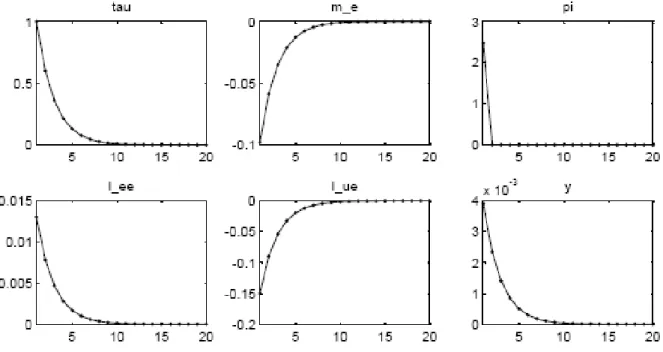
Figure 1 illustrates the dynamic e¤ects of a persistent money growth shock on monetary and aggregate supply variables (…rst and second row, respectively). We set = 0:99, = 0:6, and = 1:005(the time period is to be interpreted as a quarter). We interpret U as the share of borrowing-constrained households in the economy and set it to 0.2 (see the discussion in the previous Section). The probability of becoming borrowing constrained in the next quarter is set to 5%, so that = 0:95. The instantaneous utility function is ln c l and the home production parameter = 0:9ceu (these parameters ensure that the existence conditions
Following a persistent money growth shock, real money demand falls (due to the future in‡ation taxes expected by employed households), and in‡ation jumps up. ee-households persistently raise their labour supply to o¤set the in‡ation tax, while ue-households lower their labour supply in response to the in‡ation subsidy. Overall, the responses of labour supplies to the shock imply that the latter persistently raises output; this is because the labour supply response of ue households, although relatively large at the individual level, is actually small in the aggregate (with = 0:95, equation (20) implies that there are about 20 times as many ee households as ue households.)
Figure 1: Level-deviations from steady state of money growth, real money demand, in‡ation, labour supplies and output, following a normalised, unexpected money growth innovation.
4.3
Welfare considerations
Since the non-neutrality mechanism described in this paper relies on wealth redistribution (both at the time of the shock and in the future), it directly a¤ects the welfare of every single agent. Obviously, there are potential losers and winners resulting from wealth redistribution, meaning that we should not in general expect monetary shocks to unambiguously lead to better or worse dynamic equilibria in the Pareto sense.
can be expressed as functions of the only state variable of the model, current money growth
t, and that t+1 only depends on t. We focus on the dynamic and welfare e¤ects of an
once-o¤, unexpected aggregate shock, and call Wi(
t)the maximum value function of agent
i when current money growth is t:
Wi( t) = E X1 k=0 k u(ci( t+k)) li( t+k) it; t = u(ci( t)) li( t) + E Wi( t+1) it; t Denote by Wi = @Wi(
t) =@ tj t= the …rst derivatives of this value function, evaluated
at the steady state, and recall from (34) that @ t+1=@ t = . Then, in the vicinity of the
steady state (i.e., where @Wi(
t+1) =@ t+1 ' @Wi( t) =@ t ' Wi), and given the
transi-tion probabilities across employment status, the …rst derivatives of the Bellman equatransi-tions associated with each agent type are related as follows:
Wee = @l ee( t) @ t t= + Wee+ (1 ) Weu; Wue = @l ue( t) @ t t= + Wee+ (1 ) Weu; Weu = @u (c eu( t)) @ t t= + Wuu+ (1 ) Wue; Wuu = @u (c uu( t)) @ t t= + Wuu+ (1 ) Wue:
The solution to this system expresses the …rst derivatives of the four value functions as (cumbersome) functions of the deep parameters of the model.6 The e¤ects of money growth shocks on the intertemporal utility of individual households can easily be computed when ! 0 (the i.i.d. case in the limit). Then, the above system and equations (27)–(29) give:
lim !0Wee = me U= 2 < 0;
lim !0Wue = me (1 U ) = 2 > 0;
lim !0Weu = meU u0(ceu) = 2 < 0;
lim !0Wuu = me(1 U ) u0(cuu) = 2 > 0:
These latter equations state that the households who bene…t from the in‡ation subsidy at the time of the shock (uu and ue households, i.e., those who hold no cash at the beginning
6More speci…cally, the solution to this system expresses the Wi as functions of the @(:)=@
tj t= terms,
of the period) always see their utility increase, while those who pay for the in‡ation tax (ee and eu households, who are cash-rich at the beginning of the period) necessarily experience a welfare loss. We cannot derive such clear-cut results on individuals’ welfare, however, out of this limiting case, due to the combined e¤ect of future expected redistribution and the transition of households between employment states. For example, a households which currently su¤ers from the in‡ation tax (say, a ee-household) may expect to bene…t from it in the future (if, for example, is low relative to ), making the overall welfare of this household a priori ambiguous. (Conversely, a household which currently bene…ts from the redistributive e¤ect of in‡ation may su¤er from it in the future if the probability of being being cash-rich for su¢ ciently many periods in the future is high).
5
Concluding remarks
This paper has uncovered some dynamic and welfare e¤ects of aggregate monetary shocks in a Bewley-type monetary model with idiosyncratic labour income risk. We have shown that money-growth shocks that contemporary redistribute real money wealth across agents tend to raise output, unless this direct e¤ect is counterbalanced by the (indirect) e¤ect of expected future redistribution on the real demand for cash. Finally, the fact that wealth is redistributed both at the time of the shock and in the future (provided that money growth variations are persistent), combined with the perpetual transitions of households across employment status and cash-holding levels, implies that the welfare e¤ects of monetary shocks are in general ambiguous (in the Pareto sense).
The inherent complexity of Bewley-type models with both indiosyncratic and aggregate uncertainty, which is a consequence of the very large number of agent types that these models usually generate, is notorious and may have hindered their use (see the discussion in Kehoe and Levine, 2001). Our response to this challenge has been to construct, and then to focus on, a closed-form equilibrium with a small number of wealth states and thus limited household heterogeneity. The resulting simplicity of our framework may make it useful for the better understanding of the e¤ects of other macroeconomic shocks (e.g., …scal policy shocks) in incomplete-market, heterogenous-agent economies.
Appendix: Steady state of the model
We use variables without time indices here to indicate steady-state values. From Eqs. (10)-(11), steady state in‡ation and real transfers are 1+ = and = m = (1 + ), respectively (and since t > 0 8t by assumption, we have that ; > 0 and > 1.) Substituting these
values into (16) and using (22), we …nd that steady-state real money holdings by employed households, me, are:
me = 1 +
1 + (1 U ) u
0 1 (1 + )
(1 ) :
The values of cuu, ceu, lee, lue and y can then be derived straightforwardly. For example,
ceu = u0 1 (1 + )
(1 ) : (A1)
Since we are considering ‡uctuations occurring arbitrarily close to the steady state, a su¢ cient condition for our closed-form solution to be an equilibrium is that both (23) and (25) hold with strict inequalities in the steady state. From (29), the …rst condition is simply:
< u0 1 (1 + )
(1 ) +:
In the steady state, the left-hand side of (25) is ceu. Using (A1), inequality (25) becomes:
(1 + ) (1 + )
(1 ) (1 ) > u
0( + ) : (A2)
In the steady state, = (1 U ) me = (1 + ) (see Eqs. (10) and (22)). Substituting
into (A2), using Eq. (29) and rearranging, we may rewrite the latter inequality as: (1 + ) (1 + ) (1 ) (1 ) > u0 1 + (1 U ) + (1 U ) 1 + (1 U ) u 0 1 (1 + ) (1 ) : (A3)
The left-hand side of (A3) is positive at = 0and thus for all > 0. The right-hand side of (A3) is decreasing and continuous in over [0; 1). Thus, if (A3) holds when evaluated at = +, then by continuity there exists < + such that (A3) holds for all > . Setting
= + in (A3) and rearranging, we …nd:
which is always true when > 0 because the left-hand side increases with and is positive at = 0.
In Section 4.1 we referred to the comparative-static property that steady-state in‡a-tion decreases with mean in‡ain‡a-tion. To establish this, note that a su¢ cient condiin‡a-tion for @me=@ < 0 is that
@ (1 + ) u0 1((1 + ) = (1 ) ) @ (1 + ) < 0:
Since from A1 u0 1((1 + ) = (1 ) ) = ceu, this condition may be written as:
ceu+ (1 + ) = (1 ) u00(ceu) < 0;
or, after rearranging, (ceu) < (1 + ) = (1 + ). This is always true since (c) 1
8c by assumption.
References
Akyol, A. (2004), ‘Optimal monetary policy in an economy with incomplete markets and idiosyncratic risk’, Journal of Monetary Economics, 51, pp. 1245-1269.
Ball, L., Mankiw, N.G. and Romer D. (1988), ‘The New Keynesian economics and the output-in‡ation trade-o¤’, Brookings Papers on Economic Activity, 1988(1), pp. 1-82. Berentsen, A., Camera, G. and Waller, C. (2005), ‘The distribution of money balances and the nonneutrality of money’, International Economic Review, 46(2), pp. 465-487.
Bewley, T. (1980), ‘The optimum quantity of money’. In: Kareken, J.H., Wallace, N. (Eds.), Models of Monetary Economies. Federal Reserve Bankof Minneapolis, Minneapolis, MN. Bewley, T.F. (1983), ‘A di¢ culty with the optimum quantity of money’, Econometrica, 51(5), pp. 1485-1504.
Carroll, C.D., Dynan, K.E. and Krane, S.D. (2003), ‘Unemployment risk and precautionary wealth’, Review of Economics and Statistics, 85, pp. 586-605.
Doepke, M. and Schneider, M. (2006), ‘Aggregate implications of wealth redistribution: the case of in‡ation’, Journal of the European Economic Association, 4(2-3), pp. 493-502. Engen, I.M. and Gruber, J. (2001), ‘Unemployment insurance and precautionary savings’, Journal of Monetary Economics, 47, pp. 545-579.
Friedman, M. (1969), ‘The optimum quantity of money’. In: The Optimum Quantity of Money and Other Essays. Chicago: Aldine.
Imrohoroglu, A. (1992), ‘The welfare cost of in‡ation under imperfect insurance’, Journal of Economic Dynamics and Control, 16, pp.79-91.
Jappelli, T. (1990), ‘Who is credit constrained in the U.S. economy?’, Quarterly Journal of Economics, 105(1), pp. 219-234.
Kehoe, T.J. and Levine, D. (2001), ‘Liquidity constrained markets versus debt constrained markets’, Econometrica, 69(3), pp. 575-598.
Kehoe, T.J. and Levine, D. K. and Woodford, M. (1992). ‘The optimum quantity of money revisited’. In: Dasgupta, P., Gale, D., Hart, O., Maskin, E. (Eds.), Economic Analysis of Markets and Games. MIT Press, Cambridge, MA.
Levine, D.K. (1991), ‘Asset trading mechanisms and expansionary policy’, Journal of Eco-nomic Theory, 54(1), pp. 148-164.
Lucas, Jr., R.E. (1973), ‘Some international evidence on output-in‡ation tradeo¤s’, Amer-ican Economic Review Vol. 63, No. 3, pp. 326-334.
Scheinkman, J.A. and Weiss, L. (1986), ‘Borrowing constraints and aggregate economic activity’, Econometrica, 54(1), pp. 23-45.
Woodford, M. (1990), ‘The optimum quantity of money’. In: Friedman, B.M. and Woodford, M. (Eds.), Handbook of Monetary Economics, vol. II. Elsevier Science Publishers, North-Holland, Amsterdam.