
HAL Id: hal-03179025
https://hal.archives-ouvertes.fr/hal-03179025v2
Submitted on 10 May 2021
HAL is a multi-disciplinary open access
archive for the deposit and dissemination of
sci-entific research documents, whether they are
pub-lished or not. The documents may come from
teaching and research institutions in France or
abroad, or from public or private research centers.
L’archive ouverte pluridisciplinaire HAL, est
destinée au dépôt et à la diffusion de documents
scientifiques de niveau recherche, publiés ou non,
émanant des établissements d’enseignement et de
recherche français ou étrangers, des laboratoires
publics ou privés.
Thiosemicarbazone Complex
Tatiana Straistari, Adina Morozan, Sergiu Shova, Marius Réglier, Maylis Orio,
Vincent Artero
To cite this version:
Tatiana Straistari, Adina Morozan, Sergiu Shova, Marius Réglier, Maylis Orio, et al.. Catalytic
Reduc-tion of Oxygen by a Copper Thiosemicarbazone Complex. European Journal of Inorganic Chemistry,
Wiley-VCH Verlag, 2020, 2020 (48), pp.4549-4555. �10.1002/ejic.202000869�. �hal-03179025v2�
1
Catalytic reduction of oxygen by copper thiosemicarbazone
complex
Tatiana Straistari,
[a,b,c]Adina Morozan,*
[a]Sergiu Shova,
[d]Marius Réglier,
[b]Maylis Orio*
[b]and Vincent
Artero
[a][a] Dr. T. Straistari, Dr, A. Morozan*, Dr. V. Artero Laboratoire de Chimie et Biologie des Métaux Université Grenoble Alpes, CNRS, CEA/IRIG
17 rue des Martyrs, F-38054 Grenoble cedex 9, France E-mail: [email protected]
[b] Dr. T. Straistari, Dr. M. Réglier, Dr. M. Orio*
Aix Marseille Univ, CNRS, Centrale Marseille, iSm2, Marseille, France. E-mail: [email protected]
[c] Dr. T. Straistari Institute of Chemistry
Academy of Sciences of Moldova
3, Academiei street, Chisinau MD 2028, Republic of Moldova [d] Dr. S. Shova
Institute of Macromolecular Chemistry "Petru Poni" 41A Grigore Ghica Voda Alley, Iasi 700487, Romania
Supporting information for this article is given via a link at the end of the document.
Abstract: The new copper(II) thiosemicarbazone complex CuL (H2L
= 4-{bis(4-(p-methoxyphenyl)-thiosemicarbazone)}-2,3-butane) was synthesized and structurally characterized. Its electrochemical behavior in N,N-dimethylformamide (DMF) was examined. This complex proved active for homogeneous oxygen reduction reaction (ORR) in DMF in the presence of organic acids. The activity and selectivity for ORR was found to be dependent on the nature of the proton source (phenol or acetic acid). This study both confirmed the previously reported free energy linear correlation between selectivity and overpotential requirement [Passard et al., J. Am. Chem. Soc. 2016, 138, 2925-2928] and suggests that additional descriptors are required for a full understanding of the catalytic ORR behavior.
Introduction
Developing efficient and selective catalysts for the oxygen reduction reaction (ORR) is key for the development of fuel cell technologies. Current proton-exchange membrane fuel cells (PEMFCs) contain platinum as the cathode ORR catalyst, despite their quite large (400 mV) overpotential requirement for
ORR. Yet, a global economy based on H2/air PEMFCs cannot
be sustained by the worldwide mining of noble metals.[1] In Nature, ORR is known to occur at competitive overpotentials.[2] Two groups of Cu-based enzymes exhibit good performances as catalysts for the selective reduction process of oxygen to water: (i) cytochrome c oxidases (CcOs) exhibit a bimetallic active site consisting of an iron porphyrin heme a3 and a tris-histidine-coordinated Cu (Fea3/CB);[2-3] (ii) multicopper oxidases (MCOs)
such as laccase and bilirubin oxidase, contain at least one
mono-nuclear site containing one type-1 (T1) CuI or blue copper,
a trinuclear site containing one type-2 (T2) CuI or normal copper,
and two type-3 (T3) CuI or coupled binuclear copper.[4-5] These actives sites are inspirations for the design of alternative homogeneous and heterogeneous cooper-based ORR catalysts. A number of cooper-based molecular structures have already
been reported for proton-assisted catalytic reduction of oxygen.[6-16]
We describe here the synthesis of a new copper(II) thiosemicarbazone complex (CuL, Scheme 1) and report on its homogeneous catalytic ORR activity in N,N-dimethylformamide (DMF) in the presence of various acids of different strength (phenol – PhOH, acetic acid – AcOH and trifluoroacetic acid – TFA) used as proton source.
Results and Discussion
Synthesis and characterization
The red copper(II) thiosemicarbazone complex CuL (Figure 1) was obtained from the reaction of 4-{bis(4-(p-methoxyphenyl)-thiosemicarbazone)}-2,3-butane (H2L) ligand[17] and copper(II)
nitrate in methanol with a yield of 70 %. Complexation of the L2–
ligand is indicated in the IR spectrum by a shift of the C=N band
from 1593 cm1 in H
2L[17] to 1598 cm1 in CuL. In addition,
thione-thiol tautomerism[18-19] follows complexation as indicated by the disappearance of theC=S band at829 cm1 which is
replaced by a newC–S band at 821 cm1 in the spectra of CuL
complex.[17]
The crystal structure (Figure 1) reveals that the ligand adopts an s-cis (synperiplanar) conformation of the substituents within the butane unity upon complexation. The Cu ion is four-coordinated
and sits by 0.039 Å out of N2S2 plane. The three five-membered
chelate rings Cu1N3C9C11N4, Cu1N3N2C8S1 and
Cu1N4N5C13S2 are also essentially planar with mean plane deviation of Cu coordination center of 0.006(2), 0.027(1) and 0.036(1) Å, respectively. The angles between the coordinate plane and the two phenyl rings C2C3C4C5C6C7 and
C14C15C16C17C18C19 are of 27.1(1) and 4.8(1),
respectively.
The ligand is in the thiolate form which is evidenced by the increase of the C1-S8 and C13-S2 bond distances (1.762(4) Å and 1.751(5) Å, respectively) compared to those observed for
2
the neutral ligand H2L (1.674 Å and 1.673 Å, respectively).[17]Electronic absorption spectrum recorded in DMF for the CuL neutral complex exhibits two intense bands at λmax = 405 and
483 nm (Figure 2b, black line).
Figure 1. Molecular and X-ray crystal structures of [CuL]•THF with atom labelling scheme and ellipsoids parameters at 50 % probability level. Selected bond lengths: Cu(1)−S(1) 2.2170(14) Å, Cu(1)−S(2) 2.2145(12) Å, Cu(1)−N(3) 1.950(3) Å, Cu(1)−N (4) 1.944(4) Å. Selected bond angles: S(2)–Cu(1)–S(1) 107.77(5)°, N(3)–Cu(1)–S(1) 85.91(13)°, N(3)–Cu(1)–S(2) 165.70(13)°, N(4)– Cu(1)–S(1) 167.09(10)°, N(4)–Cu (1)–S(2) 85.07(10)° and N(4)–Cu(1)–N(3) 81.19(15)°.
Electrochemical characterization
The cyclic voltammograms of CuL complex (Figure 2a and Figure S1-a) recorded in DMF over the potential range from –1.5 V to 0.7 V vs NHE exhibit only one electrochemically reversible
process observed at E1/2 = –0.48 V vs NHE (where E1/2 = [Epc +
Epa]/2) corresponding to the CuII/CuI redox couple. The peak
current (ip) varies linearly with the square root of the scan rate
(1/2), indicating a diffusion-controlled process (Figure S1-b).
Spectro-electrochemical measurements performed at = –0.55 V
vs NHE show a uniform decrease of the absorption profile with
the concomitant formation of a new absorption band at 361 nm when CuL is reduced. The reduction process proceeds smoothly with an isosbestic point at 396 nm. Reoxidation at +0.01 V leads to an UV-vis spectrum (Figure 2b, red line) similar to the initial one (Figure 2b, black line), confirming the full reversibility of the
one-electron electrochemical process observed at –0.48 V vs
NHE.
Theoretical calculations
In an effort to understand the redox behavior of CuL, DFT calculations were undertaken and the structure of the complex was subjected to geometry optimization. DFT calculations show that the Cu–S and Cu–N bond lengths for the computed structure are comparable to those determined by X-ray crystallography which confirms the presence of a CuII center in
CuL ([CuIIL]0, S = ½, Table S2 and Figure S2). Geometry optimization was also conducted on the one-electron reduced
CuL– species. The resulting structure shows an elongation of both the Cu–N and Cu–S bond lengths consistently with a metal-based reduction process and the formation of a Cu(I) diamagnetic species ([CuIL]–, S = 0). These theoretical results support that the observed redox process is assigned to the CuII/CuI couple.
Figure 2. a). Cyclic voltammogram of CuL (1 mM) recorded under
Ar-saturated DMF (0.1 M n
Bu4NPF6), on GC electrode (ø 1.6 mm), scan rate 100 mV·s-1; b). Electronic absorption spectra for the neutral CuL (black line), one-electron-reduced species CuL– (blue line) and electrochemically re-oxidized
CuL (red line).
Figure 3. DFT-calculated redox-active orbitals for CuL and CuL–.
The DFT-calculated electronic structure of CuL leads to a Single Occupied Molecular Orbital (SOMO) for the neutral species that is mainly distributed on the metal center (44 %) with non-negligible contributions from the coordinating atoms (30 %, S-atoms and 25 %, N-S-atoms) which is typical for a mononuclear CuII complex in a square planar geometry (Figure S3). In the one-electron reduced species, the Highest Occupied Molecular Orbital (HOMO) is also distributed over the metal and the first
3
coordination sphere, which is the proof of a metal-centred reduction process (Figure 3). Redox potential calculations were also conducted to assign the electrochemical event in CuL (Table S3). The computed values for the one-electron reductionprocess leading to CuL– is of –0.55 vs NHE. The computed
potential value is in fair agreement with the experimental data and thus support the assignment of the reduction loci in the complex.
Catalytic O2 reduction activity
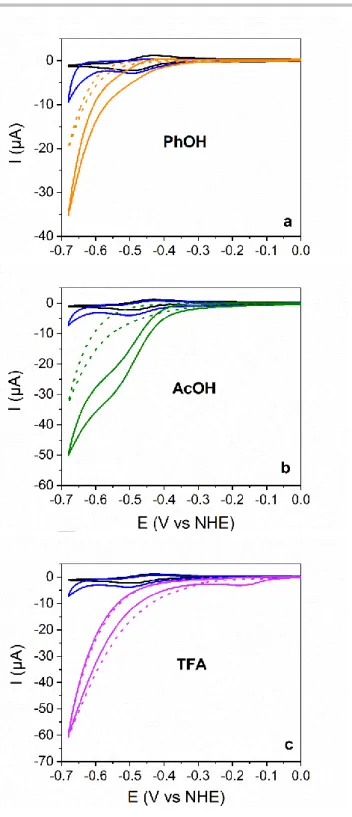
The cyclic voltammogram of CuL (black traces, Figures 4, a-c)
was significantly modified when O2 is bubbled into the DMF
solution (blue traces, Figure 4, a-c): A slight increase in the cathodic current is observed while the backward anodic peak is disappeared. This behavior indicates that the CuL complex react
with O2 following one-electron reduction of the copper core.
Addition of phenol (PhOH, pKa = 1.8)[20] or acetic acid (AcOH, pKa = 13.3)[21] to the O2-saturated solutions triggers the
appearance of catalytic waves with mid-wave potentials similar to that of the CuII/CuI couple (Figures 4, a and b). Such a catalytic wave likely corresponds to ORR and was not observed in the absence of the CuL complex (Figure 4, a and b, dashed curves). The catalytic response depends on the strength and the concentration (Figure S4 and Figure S5) of the acid, the catalytic wave appears better defined when AcOH was added as a proton
source. The addition of trifluoroacetic acid (TFA, pKa = 6)[21] as
proton source leads to a different behavior. An irreversible reduction peak appears at –0.16 V (Figure 4c, Figure S6). The identical presence of this peak, both in the absence and presence of oxygen, indicates protonation of the CuL complex (Figure S7). In the presence of TFA, the same ORR signal is observed both in the presence and absence of CuL (Figure 4c), suggesting that CuL does not act as a catalyst for the ORR in the presence of TFA.
As specific for electrochemical processes, the energy-efficiency of the ORR depends on the driving force required for the reaction to proceed at a significant rate. This driving force is quantified as the overpotential, defined as the difference between the applied potential to drive the ORR and the thermodynamic equilibrium potential of the ORR. The standard
potential of ORR to form H2O in DMF and in the presence of an
acid as proton source (denoted as HA), expressed by equation (2) according to previous calculations,[22-23] was reported in Table 1 for the conditions considered in this study.
(2)
An accurate benchmarking of the performances of the homogeneous ORR catalysts should involve the construction of
a catalytic Tafel plot.[24-25] However, the required methodology to
collect accurate kinetic data for such 4-electron O2 reduction
process to H2O involving two distinct reactants is still incomplete.
Instead, the overpotential requirement (denoted Table 1)
to drive ORR can provide the basis for a relevant analysis of the
homogeneous ORR catalysts. is expressed as the
difference between the standard potential of ORR
( ) and the half-wave potential of the ORR catalytic
wave (denoted , equation (3)) under the conditions used for the measurement.
(3)
Figure 4. Cyclic voltammograms for CuL (1 M) in DMF (0.1 M nBu4NPF6) on
GC electrode (ø 5 mm), scan rate 100 mVs1, under Ar-saturated atmosphere (black curves), O2-saturated atmosphere (blue curves) and O2-saturated atmosphere with the addition of: a). PhOH (50 mM, orange curves), b). AcOH (50 mM, green curves), c). TFA (50 mM, purple curves). The CVs of acids recorded under O2-saturated atmosphere in the absence of CuL are shown in dashed lines with the same color for comparison.
Table 1 summarizes the experimental values for CuL in
DMF as function of the strength (pKa) of acids.
4
Table 1. pKa of different acids and main parameters for the ORR with CuL in DMF Acid pKa, HA (V vs NHE) (V vs NHE) (V vs NHE) PhOH 18.8[20] 0.329 0.495 0.166 AcOH 13.3[21] 0.010 0.480 0.490
Rotating ring-disk electrode (RRDE) voltammograms were recorded in DFM with CuL in solution for quantifying the production of H2O2 in the presence of PhOH and AcOH under
electrochemical conditions and estimating CuL selectivity for
2-electron vs 4-2-electron O2 reduction. The potential at the GC disk
was scanned through the catalytic region (from 0.2 V to 0.6 V
vs NHE) and the potential at the Pt ring was fixed at 1.07 V vs
NHE in order to detect the oxidation of the ORR-generated
hydrogen peroxide. Figure 5 presents typical RRDE
voltammograms showing the ring and disk currents obtained from ORR. ORR catalytic currents were observed at the disk, in accordance with previously discussed CVs measurements (Figure 4). The ring currents, which follow the shape of the disk currents (Figure 5), can be attributed to the oxidation of the species generated in the reduction processes at the disk, which can be either reduced forms of CuL and H2O2. In the control
experiments performed in the presence of CuL without acid, the ring currents correspond only to the reoxidation of reduced forms of CuL. Thus, for a proper evaluation of the ORR process, Iring measured in the presence of acid has been corrected by
substracting Iring measured without acid. Another series of
control experiments was performed in the absence of CuL (Figure 5, dashed curves) and revealed that the O2-reduction
process occurring directly at the GC disk is only observed in the presence of acids and at more negative potentials. Figure 5c
shows the corresponding Faradaic efficiencies for H2O2
production mediated by CuL in DMF in the presence of acids in the explored potential window, obtained by application of equation (1) at 500 rpm. The Faradaic efficiencies for H2O2
production vary from 20 % to 41 % (PhOH) or from 37 % to 59
% (AcOH) in the potential window from 0.45 V to 0.6 V (Figure
5c). Data are summarized in Table S4. Nevertheless, CuL
catalyzes the O2 reduction by a predominant 4H+/4e− and
2H+/2e−
combined process in the presence of PhOH or AcOH. A slight improved selectivity of CuL toward H2O production was
observed with the weakest acid, PhOH.
The selectivity for H2O production has been shown to depend on
the thermodynamic standard potential, being controled by the
pKa of the proton donor.[22] Nocera and co-workers indeed
showed for several molecular catalysts a correlation between
the selectivity of catalyst for H2O production and the
overpotential requirement for ORR. They showed that the ORR
pathway to H2O production is favoured in the presence of
stronger acid where there is a higher overpotential requirement
for ORR. As a consequence, selectivity for H2O production was
also found better for the same overpotential requirement when DMF is used as a solvent instead of acetonitrile because of greater activity of the proton in DMF. Our data are plotted in
Figure 6, therefore modified from ref.[22] When PhOH is used as
the proton source, CuL behaves as other catalysts tested in DMF and displays selectivity closes to the one reported for the
dicobalt [Co2(OH)2DPEN(µ-1,3-OC(NH)CH3)]3+ (DPEN =
dipyridylethane naphthyridine) complex. The higher selectivity
for H2Oproduction is likely due to direct O2 reduction at the GC
disk in the presence of PhOH for the determined overpotential
Figure 5. (a, b). Rotating ring-disk electrodes (RRDE) voltamogramms under O2-saturated atmosphere in DMF (0.1 M
n
Bu4NPF6) on GC electrode (ø 5 mm), scan rate 10 mVs1, 500 rpm, ring current recorded with Pt ring held at 1.07 V vs NHE. All blue curves are for CuL (1 M), a). CuL (1 M) + PhOH (50 mM, orange trace) and b). CuL (1 M) + AcOH (50 mM, green trace). The RRDE voltamograms of acids in the absence of CuL are shown as dashed line for comparison. In the orange and green plain curves, Iring has been corrected by substracting of the value measured without acid. (c). The RRDE-determined % of produced H2O2 for reduction of one molecule of O2 vs applied potential for the two different acids (same color code).
requirement (73 % H2O for of 0.166 V), but a more
5
data point (CuL/PhOH) confirm the trend already observed by Nocera and co-workers. However, the selectivity measured forCuL when AcOH is used as proton source, do not follow the
same correlation, with less H2O produced (59 % H2O for
of 0.490 V). This behavior indicates that the overpotential
requirement cannot be used as the only descriptor of the selectivity of ORR.
Figure 6. Faradaic efficiency for H2O production vs for CuL (black) in the presence of PhOH, AcOH and TFA in DMF (0.1 M n
Bu4NPF6) and comparison with other catalysts: (1) [Co2(OH)2DPEN(µ-1,3-OC(NH)CH3)]3+ (DPEN = dipyridylethane naphthyridine) in MeCN (blue) with (1a) PhOH, (1b) AcOH, (1c) ClCH2COOH, (1d) TFA;
[22]
(1) in DMF with (purple) (1e) AcOH, (1f) TFA; (2) [Co2(OH)2DPEN(µ-1,3-OAc)]
3+
in MeCN (red) with (2a) PhOH, (2b) AcOH;[22] (3) Fe tetraphenylporphyrin in DMF with HClO4 (pink);
[26] (4) Fe meso-tetra(2-carboxyphenyl)porphirine in MeCN with (HDMF)+ (yellow);[27] (5) Fe meso-tetra(4-carboxyphenyl)porphirine in MeCN with (HDMF)+
(green).[27] (6) CoIII
2(trpy)2(μ-bpp)(μ-1,2-O2)]3+ (bpp = bis-(pyridyl)-pyrazolate, trpy = terpyridine) in MeCN with TFA (gray);[28]
(7) [FeII
2(LS)(LSH)] (LS2− = 2,2′-(2,2′-bipyridine-6,6′-diyl)bis-(1,1-diphenylethanethiolate) in MeCN with lutidinium.[29] Data measured in CH3CN are indicated as dots while data obtained in DMF are shown as squares. Dotted lines are just guides for the eye to indicate the free energy linear correclations in both solvents [Adapted with permission from ref. 22 Copyright (2016) American Chemical Society].
Conclusion
Despite their relevance as bioinspired O2-reduction catalysts,
quite few studies are available for homogeneous coper-based molecular complex as ORR catalysts. We provide here one example of such an active mononuclear copper catalyst, copper(II) thiosemicarbazone complex (CuL) that displays interesting selectivity for the 4-electron reduction of oxygen to water. Our data partially confirm the previously established free energy linear correlation between selectivity and overpotential requirement. Interestingly, under certain conditions, the correlation was not observed, indicating that other descriptors have to be taken into account to design selective catalyst for the
4-electron reduction of O2. Future work will aim at understanding
the catalytic mechanism and establishing structure-function relationships able to rationalize such a design.
Experimental Section
Materials and Reagents
Synthetic starting precursors, solvents, tetrabutylammonium hexafluorophosphate (nBu4NPF6) supporting electrolyte and all other
chemicals agents were purchased from Sigma Aldrich. All chemical reagents were of analytical grade and were used as received without further purification. The synthesis of the H2L ligand was performed
according to previously described procedures.[17] Oxygen gas (Air
Products ultrapure quality) was 99.995 % purity.
Physical and chemical characterization
Elemental analysis was performed on a Thermo Finnigan EA 1112 instrument. The results were validated by at least two sets of measurements. IR spectra were recorded with a Bruker TENSOR 27 spectrometer equipped with a single-reflection DuraSamplIR diamond. Electronic absorption spectra were recorded with Hitachi U3310 and Perkin Elmer's LAMBDA 25 UV-Vis systems instruments controlled with UV Solutions or UV WinLab utilities, respectively.
Synthesis of CuL complex
A solution of Cu(NO3)24H2O (0.058g, 0.225 mmol) in methanol (2 mL)
was added dropwise to a suspension of the 4-{bis(4-(p-methoxyphenyl)-thiosemicarbazone)}-2,3-butane (H2L) ligand (0.1 g, 0.225 mmol) in
methanol (5 mL). The mixture was stirred at reflux for 2 h. The resulting red precipitate was collected by filtration, washed with methanol and dried in the air (80 mg, yield: 70 %). elemental analysis calc. (%) for C20H24N6O2S2Cu (506.11 gmol–1): C 47.43, H 4.34, N 16.58, S 12.64;
found: C 47.36, H 4.07, N 16.59, S 12.27. FT-IR (ATR): = 3292 (N−H), 1598 (C═N imine), 1508 (N−C), 1240 and 1029 (O−C), 1176 and 821 (C−S) cm−1
.
Crystallographic characterization
Diffraction data were collected using an Oxford Diffraction XCallibur S Kappa area detector four-circle diffractometer (Mo-Kα radiation λ = 0.71073 Å, graphite monochromator), controlled by the Oxford Diffraction CrysAlis CCD software. Unique intensities with I > 10σ (I) detected on all frames using the Oxford Diffraction RED were used to refine the values of the cell parameters. The substantial redundancy in data allows analytical absorption corrections to be applied using crystal shape determination for CuL complex. The space group was determined from systematic absences, and it was confirmed by the successful resolution of the structure. The structure was solved by charge flipping method using ShelXS in Olex1.2 environment. All the atoms were found by difference Fourier syntheses. All non-hydrogen atoms were anisotropically refined on F2 using ShelXL program. Hydrogen atoms were fixed in ideal positions for complex and found by fourier transformation and refined isotropically.
Crystals of CuL suitable for X-ray diffraction analysis were obtained by slow evaporation of a THF solution. The CuL complex crystallizes in the monoclinic system with P21/n space group (Table S1). The crystal
consists of a neutral mononuclear [CuL] unit and THF as solvent molecules in 1:1 ratio. The asymmetric unit consists of a neutral mononuclear CuL unit and 1 THF solvent molecule in general positions. Crystallographic data for [CuL]THF (CCDC-1548059) can be obtained free of charge from The Cambridge Crystallographic Data Centre via: www.ccdc.cam.ac.uk/data_request/cif.
Electrochemical measurements
Electrochemical measurements were carried out with a SP-300 Bio-Logic bipotentiostat in a conventional three-electrode cell, using a stationary glassy carbon (GC) disk (ø 1.6 mm) working electrode, a platinum wire as counter electrode and a Ag/AgCl, KCl (3 M) (denoted below Ag/AgCl) as the reference electrode. This Ag/AgCl reference electrode was calibrated with the internal Fc+/0 reference system after each experiment, which was found at +0.55 V vs Ag/AgCl. The Fc+/0 couple (E0 for Fc+/0= 0.57 V vs NHE, taking into account interliquid junction potential)[30-32] was
6
further used to convert potentials vs. NHE. The working electrode was polished before each measurement on a MD-Nap polishing pad with a 1 µm monocrystalline diamond paste, rinsed with ethanol and dried under air.Cyclic voltammograms were recorded at a scan rate of 100 mVs1 in N,N-dimethylformamide (DMF) with nBu4NPF6 (0.1 M) supporting
electrolyte at room temperature, under argon or oxygen atmosphere. The 1M solutions of phenol (PhOH), acetic acid (AcOH) and trifluoroacetic acid (TFA) in DMF were added with a microsyringe. Spectroelectrochemical experiments were performed in Thin Layer Quartz Glass Spectroelectrochemical cell Kit (Bio-Logic) using a platinum grid as working electrode, a platinum wire as counter electrode and a Ag/AgCl reference electrode.
The catalytic activity of the CuL complex towards the ORR was investigated using the rotating ring-disk electrode (RRDE) technique. Pine RRDE setup with a glassy carbon disk (ø 5 mm, 0.196 cm2) and a
Pt ring (0.110 cm2) was used as working electrode. RRDE experiments were carried out under O2-saturated solution. Polarization curves were
recorded at 10 mVs1, with different rotation speeds. The potential of the Pt ring was set at 1.07 V vs NHE. The faradaic efficiency for H2O2
production as a function of potential applied at the disk is obtained according with equation (1):[33]
(1) where Ir(E) and Id(E) are the absolute values of ring and disk current at
potential E and N is the collection efficiency of the electrode. The value of N was determined to be 0.221 using the one-electron [Fe(CN)6]3/4redox
couple.
Theoretical calculations
Density-functional theory (DFT) calculations were performed with the ORCA program package.[34] Full geometry optimizations were undertaken for all complexes using the GGA functional BP86[35-37] in
combination with the TZV/P basis[38] set for all atoms, and by taking advantage of the resolution of the identity (RI) approximation in the Split-RI-J variant[39] with the appropriate Coulomb fitting sets.[40] Increased
integration grids (Grid4 in ORCA convention) and tight SCF convergence criteria were used. Electronic structures and Molecular Orbital diagrams were obtained from single-point calculations using the hybrid functional B3LYP[41-42] together with the TZV/P basis set. Increased integration grids (Grid4 and GridX4 in ORCA convention) and tight SCF convergence criteria were used in the calculations. For according to the experimental conditions solvent effects were accounted and we used the DMF solvent (ε = 37) within the framework of the conductor-like screening (COSMO) dielectric continuum approach.[43] The relative energies were computed from the gas-phase optimized structures as a sum of electronic energy, solvation and thermal corrections to the free energy. Redox potentials were evaluated by employing a Born-Haber thermodynamic cycle following the same procedure that was previously employed for the characterization of our cobalt analogue (see Supplementary Information for details). Spin density plots as well as molecular orbitals were generated using the orca plot utility program and were visualized with the Chemcraft program.[44]
Acknowledgements
This work was supported by the Agence Nationale de la Recherche (Labex ARCANE, CBH-EUR-GS, ANR-17-EURE-0003).
Keywords: bioinspired chemistry • oxygen reduction reaction •
electrocatalysis • hydrogen peroxide • free energy linear correlation
References
[1] R. B. Gordon, M. Bertram, T. E. Graedel, Proc. Natl. Acad. Sci. U. S. A.
2006, 103, 1209-1214.
[2] S. Ferguson-Miller, G. T. Babcock, Chem. Rev. 1996, 96, 2889-2908. [3] M. M. Pereira, M. Santana, M. Teixeira, Biochim. Biophys. Acta 2001,
1505, 185-208.
[4] E. Vayner, H. Schweiger, A. B. Anderson, J. Electroanal. Chem. 2007, 607, 90-100.
[5] E. I. Solomon, U. M. Sundaram, T. E. Machonkin, Chem. Rev. 1996, 96, 2563-2606.
[6] Z. Halime, H. Kotani, Y. Li, S. Fukuzumi, K. D. Karlin, Proc. Natl. Acad. Sci. U. S. A. 2011, 108, 13990-13994.
[7] J. P. Collman, R. Boulatov, Angew. Chem. Int. Ed. 2002, 41, 3487-3489.
[8] S. Kakuda, R. L. Peterson, K. Ohkubo, K. D. Karlin, S. Fukuzumi, J. Am. Chem. Soc. 2013, 135, 6513-6522.
[9] J. Zhang, F. C. Anson, J. Electroanal. Chem. 1992, 341, 323-341. [10] Yabin Lei, F. C. Anson, Inorg. Chem. 1994, 33, 5003-5009.
[11] M. S. Thorum, J. Yadav, A. A. Gewirth, Angew. Chem. Int. Ed. 2009, 48, 165-167.
[12] C. C. McCrory, A. Devadoss, X. Ottenwaelder, R. D. Lowe, T. D. Stack, C. E. Chidsey, J. Am. Chem. Soc. 2011, 133, 3696-3699.
[13] S. Gentil, D. Serre, C. Philouze, M. Holzinger, F. Thomas, A. Le Goff, Angew. Chem. Int. Ed. 2016, 55, 2517-2520.
[14] F. R. Brushett, M. S. Thorum, N. S. Lioutas, M. S. Naughton, C. Tornow, H. R. Jhong, A. A. Gewirth, P. J. A. Kenis, J. Am. Chem. Soc.
2010, 132, 12185-12187.
[15] M. A. Thorseth, C. E. Tornow, E. C. M. Tse, A. A. Gewirth, Coord. Chem. Rev. 2013, 257, 130-139.
[16] M. A. Thorseth, C. S. Letko, T. B. Rauchfuss, A. A. Gewirth, Inorg. Chem. 2011, 50, 6158-6162.
[17] T. Straistari, J. Fize, S. Shova, M. Réglier, V. Artero, M. Orio, ChemCatChem 2017, 9, 2262-2268.
[18] A. A. Abou-Hussen, N. M. El-Metwally, E. M. Saad, A. A. El-Asmy, J. Coord. Chem. 2005, 58, 1735-1749.
[19] M. B. Ferrari, G.G. Fava, C. Pelizzi, G. Pelosi, P. Tarasconi, Inorg. Chem. Acta 1998, 269, 297-301.
[20] K. Izutsu, Wiley-Blackwell, 1990.
[21] C. P. Andrieux, J. Gamby, P. Hapiot, J.-M. Saveant, J. Am. Chem. Soc.
2003, 125, 10119-10124.
[22] G. Passard, A. M. Ullman, C. N. Brodsky, D. G. Nocera, J. Am. Chem. Soc. 2016, 138, 2925-2928.
[23] C. Costentin, T. R. Porter, J. M. Saveant, J. Am. Chem. Soc. 2016, 138, 5615-5622.
[24] C. Costentin, S. Drouet, M. Robert, J. M. Saveant, J. Am. Chem. Soc.
2012, 134, 11235-11242.
[25] V. Artero, J. M. Saveant, Energy Environ. Sci. 2014, 7, 3808-3814. [26] D. J. Wasylenko, C. Rodriguez, M. L. Pegis, J. M. Mayer, J. Am. Chem.
Soc. 2014, 136, 12544-12547.
[27] C. T. Carver, B. D. Matson, J. M. Mayer, J. Am. Chem. Soc. 2012, 134, 5444-5447.
[28] S. Fukuzumi, S. Mandal, K. Mase, K. Ohkubo, H. Park, J. Benet-Buchholz, W. Nam, A. Llobet, J. Am. Chem. Soc. 2012, 134, 9906-9909.
[29] L. Wang, M. Gennari, F. G. Cantu Reinhard, J. Gutierrez, A. Morozan, C. Philouze, S. Demeshko, V. Artero, F. Meyer, S. P. de Visser, C. Duboc, J. Am. Chem. Soc. 2019, 141, 8244-8253.
[30] S. D. Cyrille Costentin, Marc Robert, Jean-Michel Savéant, Science
2012, 338, 90-94.
[31] T. N. Huan, E. S. Andreiadis, J. Heidkamp, P. Simon, E. Derat, S. Cobo, G. Royal, A. Bergmann, P. Strasser, H. Dau, V. Artero, M. Fontecave, J. Mater. Chem. A 2015, 3, 3901-3907.
[32] T. N. Huan, P. Simon, G. Rousse, I. Genois, V. Artero, M. Fontecave, Chem. Sci. 2017, 8, 742-747.
[33] X. Wei, Y. Geping, Z. Jiujun, Rotating Electrode Methods and Oxygen Reduction Electrocatalysts, 2014.
[34] F. Neese, Rev. Comput. Mol. Sci. 2012, 2, 73-78. [35] J. P. Perdew, Phys. Rev. B 1986, 33, 8822-8824. [36] J. P. Perdew, Phys. Rev. B 1986, 34, 7406-7406. [37] A. D. Becke, Phys. Rev. A 1988, 3098-3100.
[38] A. Schafer, C. Huber, R. Ahlrichs, J. Chem. Phys. 1994, 100, 5829-5835.
7
[39] F. Neese, J. Comput. Chem. 2003, 24, 1740-1747.[40] F. Weigend, Phys. Chem. Chem. Phys. 2006, 8, 1057-1068. [41] A. D. Becke, J. Chem. Phys. 1993, 98, 1372-1377.
[42] C. Lee, W. Yang, R. G. Parr, Phys. Rev. B 1988, 37, 785-789. [43] A. Klamt, G. Schuurmann, J. Chem. Soc., Perkin Trans. 2 1993,
799-805.
8
Entry for the Table of Contents
The mononuclear, copper(II) thiosemicarbazone complex (CuL) catalyzes the homogeneous oxygen reduction reaction (ORR) via a
![Figure 1. Molecular and X-ray crystal structures of [CuL]•THF with atom labelling scheme and ellipsoids parameters at 50 % probability level](https://thumb-eu.123doks.com/thumbv2/123doknet/13094635.385593/3.892.460.814.89.613/figure-molecular-crystal-structures-labelling-ellipsoids-parameters-probability.webp)
![Table 1. pK a of different acids and main parameters for the ORR with CuL in DMF Acid pK a, HA (V vs NHE) (V vs NHE) (V vs NHE) PhOH 18.8 [20] 0.329 0.495 0.166 AcOH 13.3 [21] 0.010 0.480 0.490](https://thumb-eu.123doks.com/thumbv2/123doknet/13094635.385593/5.892.455.812.85.929/table-different-acids-main-parameters-acid-phoh-acoh.webp)
![Figure 6. Faradaic efficiency for H 2 O production vs for CuL (black) in the presence of PhOH, AcOH and TFA in DMF (0.1 M n Bu 4 NPF 6 ) and comparison with other catalysts: (1) [Co 2 (OH) 2 DPEN(µ-1,3-OC(NH)CH 3 )] 3+](https://thumb-eu.123doks.com/thumbv2/123doknet/13094635.385593/6.892.73.422.232.497/figure-faradaic-efficiency-production-black-presence-comparison-catalysts.webp)
