Publisher’s version / Version de l'éditeur:
Macromolecules, 23, 1, pp. 338-345, 1990-01-01
READ THESE TERMS AND CONDITIONS CAREFULLY BEFORE USING THIS WEBSITE.
https://nrc-publications.canada.ca/eng/copyright
Vous avez des questions? Nous pouvons vous aider. Pour communiquer directement avec un auteur, consultez la première page de la revue dans laquelle son article a été publié afin de trouver ses coordonnées. Si vous n’arrivez pas à les repérer, communiquez avec nous à [email protected].
Questions? Contact the NRC Publications Archive team at
[email protected]. If you wish to email the authors directly, please see the first page of the publication for their contact information.
NRC Publications Archive
Archives des publications du CNRC
This publication could be one of several versions: author’s original, accepted manuscript or the publisher’s version. / La version de cette publication peut être l’une des suivantes : la version prépublication de l’auteur, la version acceptée du manuscrit ou la version de l’éditeur.
For the publisher’s version, please access the DOI link below./ Pour consulter la version de l’éditeur, utilisez le lien DOI ci-dessous.
https://doi.org/10.1021/ma00203a058
Access and use of this website and the material on it are subject to the Terms and Conditions set forth at
Spherulitic growth rates and coalescence phenomena in
polypropylene/polyethylene-based ionomer blends
Caldas, V.; Brown, G. Ronald; Willis, J. M.
https://publications-cnrc.canada.ca/fra/droits
L’accès à ce site Web et l’utilisation de son contenu sont assujettis aux conditions présentées dans le site
LISEZ CES CONDITIONS ATTENTIVEMENT AVANT D’UTILISER CE SITE WEB.
NRC Publications Record / Notice d'Archives des publications de CNRC:
https://nrc-publications.canada.ca/eng/view/object/?id=4a4d2bca-abe7-4d15-ace1-79392b78484e https://publications-cnrc.canada.ca/fra/voir/objet/?id=4a4d2bca-abe7-4d15-ace1-79392b78484e
1990, 23,
Spherulitic Growth
Rates
and
Coalescence
Phenomena
in
Polypropylene/Polyethylene-Based Ionomer
Blends
V. Caldas and G.R.Brown*
Department ofChemistry,Polymer McGill,McGill University,801 SherbrookeStreet West, Montreal, Quebec,CanadaH3A-2K6
J, M. Willis
Industrial Materials ResearchInstitute, NationalResearch Council ofCanada, Boucherville, Quebec, CanadaJ4B-6Y4. ReceivedDecember19,1988;
RevisedManuscriptReceivedMay23, 1989
ABSTRACT: Theisothermalradialgrowth ratesofspherulitesofpolypropyleneinblendswithan essen-tiallynoncrystallizable ionomer havebeendetermined by photomicroscopy. Blendscontaining 5and 10
wt % ionomer, crystallizedfromthe melt,havea grainyappearance duetoionomerentrapmentandshow
an increasednucleationdensityas compared topure polypropylene. At large supercooling,theseblends
also show depressedradialgrowth rates, whichare attributedtoa significant dissipation ofenergy by the
crystallizingfrontto affect the rejectionoftheionomer domains. Upon repeatedcrystallization ofagiven
sample,an increasein theradialgrowth ratewith melt timeisobservedinitiallygiving rise toa maximum,
withgeneral behaviorthatisdependent upon the blendcomposition and thecrystallizationtemperature. Beyondthis maximum thespherulitic growth rate decreasesuponfurther crystallization. Theobserved effectson thespherulitic radialgrowth rateswithrespect to repeatedcrystallization are attributedtothe
coalescenceofthe ionomer dispersedphase. Thisisconsistentwith aconcomitantincreaseintheaverage
domainsize.
Introduction
The blending ofpolymerstoproduce alloyswith prop-ertiesselected for given applicationsis an area of poly-mer sciencethatispresentlyreceivinggreatattention.1"3 Blending is not only economically viable but is also a
versatile wayofmakingnew materialshavingawide range
ofproperties.
For polymerblendsin whichone ofthe componentsis
crystallizable, thepresenceofthe secondcomponentcan strongly affect the crystallizationprocess. Both the
crys-tallizationkineticsandthe finalcrystal morphologycan
beverydifferentfromthat ofthepurecrystallizing
com-ponent. As reviewedrecently by Martuscelli,4such changes have been found not onlyin blendsofcompatible
poly-mers butalsoinblendsofimmiscibleor partially misci-ble polymers.
Inarecentstudy, Willisetal.5demonstrated the
abil-ity
ofapolyethylene-based ionomer toenhancethecom-patibility
of polyolefin/polyamideblends. Themorphol-ogyoftheternary polyolefin /ionomer /polyamideblends
was significantly dependent upon ionomer concentra-tion. Infact, for fixedprocessingconditions, the size of thedispersedphasewas reducedbyasmuchasfour times
dueto theadditionofaslittleas0.5% ionomer byweight.
From the physicochemicalstudiesofthebinary blend of
the ionomerwith polyamide,6specific interactions in the form of hydrogen bonding between the blend compo-nentswere demonstrated. Suchinteractionswere absent in the polypropylene or polyethylene/ionomer blends. Moreover, the ionomerseverely impedesthe
crystalliza-tion ofthepolyamidebutenhancesthenucleationofthe
polyolefins,particularly in thecase of polypropylene. Thepresentinvestigationconcerns the effectofa
poly-ethylene-based ionomeron theradialgrowth ratesof
spher-ulitesofpolypropylene. In the lastfew years many
stu-dies7"14 have been done on the effect ofelastomers on
the crystallization kinetics ofpolypropylene. However,
*Authorto whom correspondence shouldbeaddressed.
0024-9297/90/2223-0338$02.50/0
to theknowledgeofthe authors, thereare no reportsof
studies ofthe effect ofan essentially noncrystallizable ionomer on the radial growth rates of spherulites of a crystallizable polymer.
The main goal of this work is to study the effect of
composition,crystallization temperature,and melt resi-dencetimeon the spherulitic growthratesof
polypropy-lene in binary polypropylene/ionomer blends. A study
ofthecrystallizationofblendscan ultimatelyyield
infor-mationconcerning the interactionsatthe interface between
the polymers in the blend. The effectofcrystallization
on the rate ofcoalescenceofdispersedionomerphaseis alsoconsidered. Thus, theresults presentedin thispaper
willcontribute to the understandingoftheeffectiveness
of the ionomer at enhancing the
compatibility
ofpolyolefin/polyamideblends.
Experimental
SectionMaterials. The polymers used were polypropylene
(Pro-Fax6501)originallyobtainedinpowderform from Himontand
Surlyn9020from DuPont. The polypropylene (PP) resinwith 0.1% of Irganox 1076 antioxidant was subsequently
com-pounded with a Werner and Pfleiderer (ZSK30) twin-screw
extruderand converted toapelletform. The ionomeric resin
(Du Pont, Surlyn 9020) is a randomterpolymerconsisting of approximately80% ofpolyethylene, 10% of methacrylicacid, approximately70% neutralized withzinc, and10% of isobutyl acrylate. Somepropertiesoftheseresinsare giveninTable I. Priorto blending, the resinswere dried undervacuum at95°C for 24h.
Preparation of the Polypropylene/Ionomer Blends. Blends having 5%, 10%, 20%, and50% byweightofionomer
were prepared according to thefollowingprocedure: The
res-inswere meltblendedina Brabender chamber,initiallysetat 250°C, usingrollerbladesthatare recommendedforhighshear applications. The resinswere allowed to mixat 50rpm under
a constant nitrogenflowfor5min. Themeltwas thenrapidly
transferredtoa mold and placedinahydraulicpressunder2.5
MPa ofpressureuntilthe samplecooledtoroom temperature.
Theresultantmolded sampleswere cutinto specimenshaving dimensionsofroughly1 X0.5X0.5cm. Thin films(5-10Mm)
©1990American Chemical Society
Macromolecules, Vol. 23, No. 1, 1990 Polypropylene/Polyethylene-Based Ionomer Blends 339 0.40
I
o at o 0.35 0.30TIMEINTHE MELT (min)
Figure 1. Reproducibility oftheradialgrowth ratesfor
poly-propylene at 124 °C.
TableI
GeneralProperties of PolypropyleneandSurlyn
meltindex, density, torque(250°C), melting
resin g/10 min g/mL N/m point,°C
PP 4.0 0.905 8.6 165
Surlyn 1.0 0.965 14.3 62
were then cut fromthese specimensusingaReichert Jung
Super-cut2050microtome.
Isothermal CrystallizationProcedure. ALeitz Wetzlar optical polarizing microscope fitted with a MettlerFP52 hot
stage was used to observe isothermal crystallization at 100x
magnification. The hotstagecouldbeheldataconstant tem-perature to ±0.3 °C byaMettlerFP5temperature control unit. For the microscope study, microtomedfilmswere placed on amicroscope slideglassand meltedon ahotplate while
apply-ing pressureon the cover glass. The thicknessofthemelted
filmwas fixedbya 12-#mialuminumspacerbetween thecover
glassand the microscope slide. Filmthicknessofthe orderof
12-15 nm were obtained andused in the microscope study. The followingprocedurewas usedto view isothermal crys-tallization: Thesampleswere meltedon thehotstageat200°C for 10minto remove crystallinity. Different distributions of
spheruliteswere observedinsuccessivecrystallizations, indicat-ingthat the melt residencetime as well as melt temperature was sufficientto remove residualcrystallinity. Thehot stage
was thensettoan intermediatetemperatureof135°C, and the samplewas allowed tocome totemperatureequilibrium,which
took approximately2min. Whentemperatureequilibriumwas
achieved, the hot-stagecontrolwas settothe desired crystalli-zation temperature, andequilibriumwas achievedrapidly(<30 s). Photomicrographswere takenofthe growing spherulites at
appropriate timeintervals, depending on the rateof crystalli-zation.
Radial GrowthRateMeasurements. The isothermalradial growthrates,G= dr/dt(r= radiusofthe
spherulites, t= time),
were determined by measuring the sizesofthe spherulitesas seen in the photomicrographsas afunction oftime. Theradii
ofthesespheruliteswere measuredwithasemiautomatic
digi-tizer, describedelsewhere.15
The radius ofeach spherulite was taken as the average of 15-20 individual radii. From the average radii, plotted as a
function of time, theradial growth rateofthespherulitewas
determinedastheslopeoftheresultingstraightline. Foreach composition andcrystallizationtemperature, theaverageradial growth rate was determined from at leastfour radial growth rate measurements. The experimental error in these growth
rates was determinedto be lessthan 5%.
Results and Discussion
Crystallization
of Polypropylene. When polypro-pylene is crystallized from themelt in the temperaturerangeof118-126 °C,the predominant spherulitic
appear-ance observedmicroscopically istype I, as classified by
Padden and Keith.16 The various results presented in
this investigation will mainly concern this morphology.
CRYSTALLIZATIONTEMPERATURE(°C)
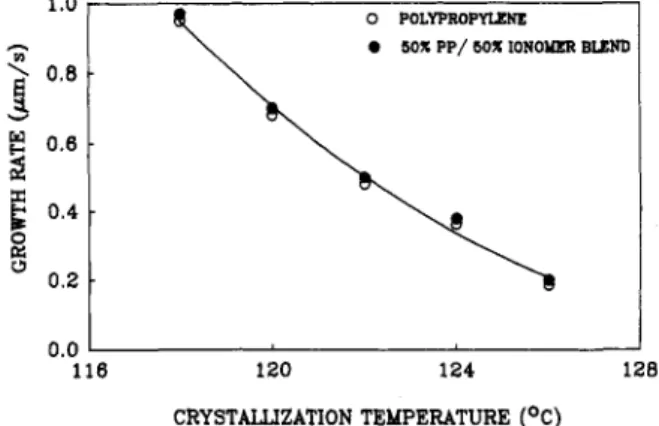
Figure2. Radial growth rate dependenceofpolypropylene and the 50% PP/50% ionomer blend on crystallization
tempera-ture,for amelt time of10min.
Asecondtypeofspheruliticappearance(type
III),
intro-duced later in the paper, is shown tobehave somewhat
differentlyfrom thefirst.
Intheregionof15-60 ^m, theradii ofthe
polypropy-lene spherulites crystallized from the melt increase
lin-earlywithtime. To verify the reproducibilityoftheradial growthrates,a sample ofpolypropylene was repeatedly
melted, for 10 min, and crystallized. As shown in Fig-ure 1, at 124 °C theradial growth rates fluctuate about 0.335/um/s andare withinapproximately±0.02^m/sof
eachother.
Thedependence ofthe radial growth rateof
polypro-pylenespheruliteson the crystallization temperatureshown
in Figure2 is inaccordance with that predicted by the
Fischer-Turnbullequation17
G =
G0expj-A£D*/kT]
expj-A$*//jTj
(1)where, the term exp(-AED*/kT\isreferredtoasthe
trans-portterm andexp{-A$*/&Tj, as the nucleation term, G isthe growthrate ofpolymers, Gais the preexponential
term, AEB* is the free energy of activation for move-ment across theembryo-meltinterface, A$* is the min-imumfree energyrequiredfortheformationofanucleus
of criticalsize, k isthe Boltzmann constant,andTisthe crystallization temperature. For crystallizationabovethe
optimum crystallization temperature, the growth rate is
controlled by the nucleation process so that the activa-tionfree energy isnegative and theexpectedinverse depen-dence ofthe radial growth rate on the temperature is observed.
Crystallization
ofPolypropylene/Ionomer
Blends.The effectofcomposition on theradial growth
rates of the polypropylene spherulites obtained for the blendsthathave beenheldinthemelt at200 °Cfor 10
minisshowninFigure3. Asmall depressionofthegrowth rate is seen at low ionomer content and low
tempera-tures. Athighertemperatures,consequently much slower
crystallization, the growth rate is essentially
indepen-dentoftheionomerconcentration.
As shownin Figure 2,theradial growthratesobtained
for the polypropylene (PP) spherulites in the50% PP/ 50% ionomer blend are identical, within experimental
error, to those obtained for pure polypropylene. This
generalpatternhasalso been observed byMartuscelliet
al.14,18 forthe spherulitic growthofpolypropylene with ethylene/propylene/diene terpolymer (EPDM).
How-ever,the growthratesofisotacticpolypropylene inblends
with othertypes ofrubbersshoweda significant
depen-denceon compositionandcrystallizationtemperature,18 whichwas attributed to partial miscibility.
23, ° 118"C • 120*C i °_ • 0 10 10 20 30 40 50 50 PERCENT IONOMER
Figure3. Composition andcrystallizationtemperature
depen-denceoftheradial growthratesin polypropylene/ionomerblends.
It hasbeendemonstrated thatthepresenceof foreign
inclusionsinthemelt,asin thecase ofimmiscibleblends, can disturb the crystallizingfront.4,14,18 Ifthereare
inter-facial interactions between the blend components, the growing crystal front must do work against the
dis-persedphasein the melt. Inthecase ofaone-phasemelt, some energyisrequired to effect the rejection ofthe sec-ond component from the crystallizing polymer. In the
case ofa two-phase melt,where thesecond component
hastaken theform of droplikedomains, energymustalso bedissipated for therejection, engulfment,and/or defor-mationofthe secondcomponent.
These energy dissipations constitute energy barriers
which influence the growth rateofthe spherulites in the
melt. Bartczak,Galeski, andMartuscelli19 modified the
classical Fischer-Turnbull equation to account for the
energy dissipations which result during the
crystalliza-tion of a polymer in the presence ofnoncrystallizable, sphericaldomains. The modified equation is
G =
G0exp|-AED*/kT) exp{-A$*/fcT) X
expHEj
+E2 + E3+ E4+ E5)/kT) (2) whereE1 istheenergydissipated by the crystal to effect the rejection ofthe second component into interlamel-larregions,E2 istheenergydissipated by thespherulitefront to effect the rejection ofdroplike domains inthe
melt,E3 is the kineticenergy required to overcome the
inertia of the drops, £4 is the energy required to form
new interfaces between the spherulite and drop when
engulfmentoccurs, and£5istheenergydissipatedwhen the engulfed dropsare deformed by thecrystallizing front. The equationsthatdescribethe growth rate, takinginto
account these energy dissipations, derived byBartczak
et al.,19are summarized inTable II.
The crystallization of polymer blends whose compo-nents havephaseseparatedinthe meltisinfluencedboth
by thesizeofthe dispersed phase and theinterfacial
ener-gies. The drivingforcefor therejection,engulfment,and/ or deformationprocessesliesin thedifferenceofthe
inter-facial free energy betweenthe crystallizingfrontand
inclu-sions, 7„s, and the interfacial free energy between the meltana inclusions, 7pl:20-22
AE=
7ps
-TPi (3)
ForAF< 0,the dispersed domainsinthemeltare more
likelyto beengulfed than rejected by the growingfront.
However, when AE > 0, the situation is more
compli-cated. At slowrates of crystallization, the domains are
TableII
Growth RateExpressions for Spherulites in an
IncompatiblePolymer-PolymerSystem
description expression11 rejection ofthe ^ G1 G: dispersedphase G= i+EJRT,~
3p^y^R'
1+ 2Pmr*RTcengulfment ofthe G= Gj exp{E3/i?Tc|
dispersedphase = Gjexp|-(3c^mAF/(pmrRTc)j deformationofthe G= Gtexp\EJRTc\ dispersed phase = G[ exp{-C/(*)(3cMm7pa/(p„rRTc)\ a
Gj istheundisturbed growthrate;pmisthemolecularweight
ofthe repetitive unit;c isthevolumeconcentrationof the second
componentinthe blend;ymisthe viscosity ofthematrix; R'isthe
temporary radius ofthespherulite;pmisthedensity of the matrix;
ristheradiusoftheionomer domains; U(k)isadeformation
func-tion;R isthegas constant; and Tc isthecrystallization tempera-ture.
pushed alongby the growingfront,while at higherrates
theyare simplyengulfed.
At
some intermediaterate,the domains maybepushedfor shortdistances before being engulfedby the crystallizing front. Engulfment occurswhentheviscoushindrancecausedby the motion ofthe
domainsoverwhelmsthe forcesofrepulsion. This implies
a critical rate at which the pushing of the domains no
longeroccurs and engulfment takes precedence. Using
these arguments,foragiven AE,there must beacritical
domainsizesuchthat, ataconstant growth rate,domains
ofthis size or larger are simply engulfed and no longer
pushedby the growingfront. Engulfmentoccurs above
thiscriticalsize because the hydrodynamicforceis
pro-portionalto the domain size while the repulsive forces
are determined by factorssuchas the shapeofthe
inter-facebehindtheparticle.19 Thecriticalsizeitselfis
depen-denton thesystem, i.e., on the interfacial energies,
vis-cosities, and heatconductivities.
In this study, only marginal differences in the radial growthrates of polypropylene spherulites resulted from
theadditionofionomer. This is asexpected for immis-cible blendswithminimal interfacialinteractions. Indeed, the freeze-fractured surfaceofacompression-molded sam-pleof80%PP/20%.ionomer blend(Figure4),asobserved
by scanning electron microscopy,6 showsthe ionomeric
phaseas sphericaldomains embeddedin the
polypropy-lene matrix with very little adhesion between the two phases. Onthis basis,it isunlikely thatthereis
signifi-cant adhesion between the phases in the melt, indicat-ing that AEis approximately equal to zero or positive.
Thus, the relative extent of rejectionandengulfment of
the ionomer domainswill be determined by the rate of crystallization andthe sizeofthedispersedphase.
At lowionomerconcentrationsandlowcrystallization temperatures, significant energy dissipation must be involvedinrejectionofthedomainsasthe spherulitegrows. This energy loss retardsthe radial growthofthe spher-ulites, as seen in Figure 3. Therefore, the radial growth rate is depressed as compared to that ofpure
polypro-pylene.
The binaryblends alsoconsistentlyshowagreater
pri-mary nucleation density than pure polypropylene at all compositions andcrystallization temperatures(Figure5).
poly-Macromolecules, Vol. 23, No. 1, 1990 Polypropylene/Polyethylene-Based Ionomer Blends 341
Figure 4. SEM photomicrographofthe freeze-fractured
sur-face of the compression-molded sample ofthe 80% PP/20% ionomerblend6as obtained from the Brabendermixing cham-ber, The ionomericphaseisseen asthe spherical entities.
40
min
50
min
60
min
70
min
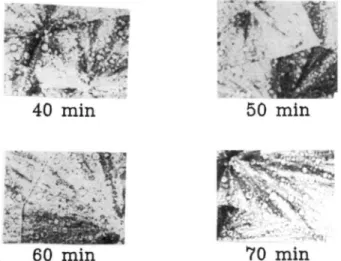
Figure6. Photomicrographsillustratingthecoalescenceof the ionomer domainsas aresultofrepeatedmelting(10-min period)
and crystallization for the 95% PP/5% ionomer blend, at a
crystallizationtemperatureof124°C.
Figure5. Nucleation density, after10min melttime,as a
func-tion ofthe percent ionomer in the blend,atdifferent crystalli-zation temperatures.
propylene spherulites,as suggestedpreviouslyby Willis
et al.6 based on DSC observations. This effect is most pronounced for the 95% PP/5% ionomer blend,
possi-bly reflecting thesmallerionomerdomain size and con-comitantly larger surface area available for nucleation.
Asimilarsynergistic effect uponnucleationwas observed
by Martuscelliet al.18for
iPP/PIB
blends. The effect,as wellasthe observed reductioninthegrowthrate,was attributedto thepreferentialdissolutionofimperfect
crys-tals (molecular fractionation). It is possible that these processesare alsoresponsibleforthe observations shown
in Figure5 for the polypropylene/ionomerblends.
Effect of Coalescence on the Growth Rate. The overall morphology of the blends containing 5% iono-mer,as viewedwithoutcross polarizers atatemperature of124 °C, is illustrated in Figure6. It shows the
pres-ence ofthe ionomer phase as approximately spherical
domains embeddedinthepolypropylenespherulites. Ini-tially, a linear increase in the average domain size with
melting timeisobserved,forthosedomainsof sufficient
sizeto bedetected microscopically,withachangeinslope
at approximately45 min as seen in Figure 7. By
com-parison,forthe50% PP/50% ionomer blend, the domains
are much larger andasimplelinearincreaseinthe
aver-agesizewith melting timeisobserved,as seen in Figure
8. It should be noted that, in the 50% PP/50%
iono-Figure 7. Increase in the size ofthe ionomer domains with repeated melting (10-min period) and crystallization, for the 95% PP/5% ionomer blend, at a crystallization temperature
of124°C. Thetimeindicatesthe cumulativemelttime.
Figure 8. Increase in thesize of the ionomer domains with repeated melting (10-min period) and crystallization, for the 50% PP/50% ionomer blend,ata crystallizationtemperature
of124 °C.
mer blend, the measured diametershaveextended beyond the thicknessofthefilm. Thus, the domainsare no longer sphericalas inthe 95% PP/5% ionomerblend buthave
takentheform ofdisks. If volumes,rather than diame-ters, are plotted as a function of melt time, calculated forspheresin Figure7 and disksin Figure8, then
iden-tical trends are observed. The important point is that
thesizeincreaseswithmelt time,regardlessoftheshape
DOMAIN SIZE (pm)
Figure 9. Ionomer domainsize distribution inthe 95% PP/
5%ionomer blend and 80% PP/20% ionomerblend obtained fromcryogenicallyfracturedsurfaces.
is much greater for thisblend than for that containing
5% ionomer.
The increase in ionomer domainsize could be due to either or both oftwo factors, namely, phase separation during the time spent in the melt and/or rejection (or
pushingofthe domains)duringrepeatedcrystallization.
AsshowninFigure7,for the95%PP/5% ionomerblend, the average size of the ionomer domains increases
rap-idly until thefourthcrystallization. Uponfurther
crys-tallization,therate ofincreasein theaveragesizeofthe
domains isdiminished. Thissuggeststhat,at the point
wherethechange in slope occurs,thereis adepletion in
thenumberofdomainsofradiuslessthan acriticalsize.
Ionomerdomainsofradiuslessthan the criticalsize are
beingrejected bythe crystallizing
front
andas a conse-quence are coalescing. Therefore, coalescencenot only isoccurring while thepolypropyleneisin the meltphasebutalsoisinducedbycrystallization. Inthecase ofthe
50% PP/50% ionomer blend, wheredomains are larger than thecritical size,coalescence occurs predominantly
in the melt. This was confirmed by separate
experi-ments that showed increases in domain size with melt
time when the crystallization steps were omitted, also shown in Figure8 (filledsquare).
The
initial
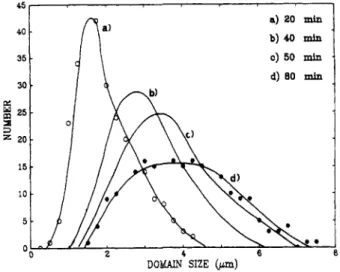
size distribution in the ionomer phase in theblendswas determined from cryogenically fracturedsurfacesobserved using scanning electron microscopy and isshowninFigure9.6 Thesizedistributions afterrepeated
crystallizations at124°C as determinedusing
photomi-croscopyare shownin Figure 10. Thesharpdrop-offin thenumberofdomainsforthefirst crystallization
(Fig-ure 10) probably reflectslimitations in detection at the magnificationlevelused. It isevidentthat
initially
it ispredominantly the smaller domains(lessthan1pm)that are beingrejectedby the crystallizingfrontand
coalesc-ing into the larger ones. In the case of the 50% PP/ 50% ionomer blend (Figure 8), the size ofthe domains iswell abovethat critical size. Even though some iono-mer maybepresentwithin interlamellarregions, which may give rise to some rejection, domain size increase is
occurringpredominantly as a resultofcoalescence dur-ing the timethat the polypropyleneis in the melt.
As mentioned before, it is predicted that the radial growthrates of spherulites in phase-separated polymer
blendscan beinfluenced by thesizeofthe dispersed
par-ticles. Estimateswere madeoftheeffectofdomainsize
on energy terms Ely Z?3, and E4, using the equations of
Bartczakand co-workers19 shownin TableII, forthePP/ ionomerblends. Theresults, assuming AF= 1
erg/cm2
and
7^
= 1erg/cm2,forthe95% PP/5% ionomerblend
at aspheruliticradialsizeof30 pm anda growthrate of
Macromolecules, 23,
Figure 10. Ionomer domainsizedistributionin the95% PP/ 5% ionomer blend attotal melttimesof(a) 20min, (b)40min,
(c) 50min, and (d)80minandacrystallizationtemperatureof
124 °C. The melt times correspondto repeated melting and crystallizationat 10-minintervals.
0 2 4 6 8 10
RADIUS (pm)
Figure 11. Estimated energies ofrejection, engulfment, and deformationforthe 95% PP/5% ionomerblendas a function
ofionomer domainsizeatacrystallizationtemperatureof118 °C.
0.92pm/s,are shownin Figure 11for the crystallization
temperatureof118°C. Itshouldbenotedthatthe inter-facialfree energieswere choseninaccordancewithresults
previouslyreported for polypropylene/polyethylene23 at
140°C. The viscosityofthe blend at the crystallization
temperaturewas estimatedfrommeasuredviscositiesat higher temperatures (~200°C)24andlowshearrate (17 s-1) assuming Newtonianflow andusing the conceptof
activation energyfrom the Arrhenius equation. These
equationspredict that, at small domainsize,theenergy
of rejectionhasa considerable influenceon the
spheru-litic
growth rate. Theenergies due to deformation and occlusion make much smallercontributions to thetotalenergydissipation. Increasing the interfacialfree energy betweenthe polymersinthe blendhasthe effectof
increas-ing the energy of deformation and engulfment.
How-ever, for reasonable changes (AFand7p8 from0.1 to 10
erg/cm2), these energies remain much smallerthan the
energyofrejection. As the ionomerdomainsize increases,
thetotal ofthese energiesdecreasesin magnitudeuntil,
for domain size greater than4 pm, they are essentially negligible.
Theinclusionofthese energy terms ineq2allowsthe predictionofthegrowth rate atacertainionomerdomain
size. As shown in Figure 12for the crystallization
tem-perature of118°C,an increaseintheradial growthrate
Macromolecules, Vol. 23, No. 1,1990
RADIUS(Atm)
Figure 12. Theoretical growthrate dependenceon the
iono-mer domainsizeasestimatedforthe95%PP/5%ionomer blend ata crystallization temperature of118°C.
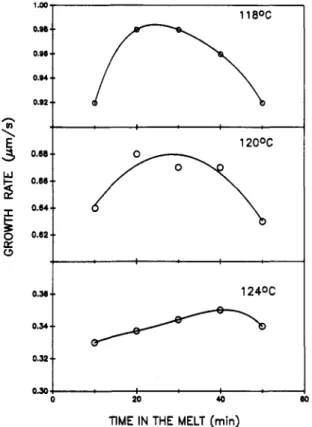
Figure13. Growthrate dependenceof the95% PP/5%
ion-omer blendwithrepeatedmelting(10-min period) and crystal-lization atvariouscrystallizationtemperatures.
sizeleading toward thegrowth rateofthe pure polymer
at the same temperature. Abovea certain domain size (4 Mm), where theenergy ofrejectionis essentially
neg-ligible, the growth rateofthe crystallizing polymerisno
longer affected by the presence of the second
compo-nent.
The effect of domain size on the growth rate ofthe
polypropylene spherulites can be observed
experimen-tallywhen blends containing5% and 10% ionomer are repeatedly meltedfor10minandcrystallized. Asshown
inFigures13and14, an initialincreasein the radial growth
rate is observed,followed bya decrease when the
sam-ple has been crystallized several times. This gives rise toa maximum growthrate whichisdependentupon the blend composition and the crystallization temperature.
It isinterestingto notethatif themaximumradial growth
rates, ratherthan the values for 10 min, are plotted in Figure3,the growthratesare essentiallyindependentof ionomer concentration at all temperatures. When the
50% PP/50% ionomer blend is repeatedly crystallized,
Polypropylene/Polyethylene-Based Ionomer Blends 343
TIME IN THE MELT (min)
Figure14. Growthrate dependenceofthe 90%PP/10%
ion-omer blendwithrepeatedmelting(10-min period) and crystal-lizationat variouscrystallizationtemperatures.
Figure15. Growthrate dependenceofthe 50% PP/50%
ion-omer blendwithrepeatedmelting(10-min period) and
crystal-lizationata crystallization temperature of124°C.
onlyadecrease in the radial growth rate is observed,as
shownin Figure 15.
The
initial
increaseinthe growth rate (Figures13and 14) ismainlyduetothe rejectionofthe smaller ionomer domains(lessthan thecriticalsize)into interspherulitic regions. Since thesizeofthe domains in the95%PP/
5% ionomerblendisinitially
muchsmallerthanthat ofthe90%PP/10% ionomer blendasdemonstratedin
Fig-ure 9, the growing front requires more energy to effect
theirrejection. Consequently, the initial growth rate is reduced by a greater extent than in the 90% PP/10%
ionomer blend.
Through coalescenceduring crystallization and melt-ing, thedomains increase insizesuch thata significant
fraction is above that critical size. During subsequent
crystallization, the growing front dissipatesless energy
in rejecting these domains, due to their largersize, and
a radialgrowth rate increase is observed leadingto the
maximum. As mentioned previously, themaximumgrowth rate corresponds closely to theradial growthrateobtained
for pure polypropylene at the same temperature. Fur-thermore, atatemperatureof124°C, themaximumgrowth
rate for the95% PP/5% ionomer blend occurs at
rela-tivelythesame timeas thechangein slope observedfor the domain size increase with meltingtime (Figure 7).
Macromolecules, 23,
This strongly supportsthe ideathatrejectionofthe
ion-omer domains affects thecoalescencemechanism,which inturn directlyaffectstheradial growthrateofthe
poly-propylenespherulites.
The speed of the crystallizing front, at any constant small domain size, also influences the perturbation
observed inthe growth rate of the spherulites. At high crystallizationtemperatures, where thegrowthrateis
rel-ativelyslow, lessenergyisdissipated to effectthe
rejec-tionoftheionomer domains. Asaresult, theinitialgrowth
rate is not decreased, with respect to pure
polypropy-lene, tothe extent that it isfor a samplethatis crystal-lized at lower temperatures.
Althoughthe increasesintheradial growthrateswith
melt time, observed at short timesforthesamples con-taining 5% and 10% ionomer, are in accordance with
the equationsderived byBartczak,the maximum inthe
growth rates and subsequent decreases are not consis-tent withthetheoretical predictions. Two explanations
can be offered: (1) Viscosity increases with melt time.
Since the transportterm in the classical Fischer-Turn-bullequationcan bedescribedin terms oftheWLF
equa-tion, increases in viscosity after several crystallizations would be expected to decrease the radial growth rate. However,an increasein viscosity aftercoalescenceof ion-omericdomainsseems rather unlikely. Furthermore,the direct verificationofsuchan effectisverydifficult,since
it requiresameasurement oftheviscosity ofthe matrix
polymer in the blend, andthis is not a trivial task. (2)
Limited miscibility oflowmolecular weight fractions of
ionomer inthe polypropylene wouldseem tooffera
bet-ter explanation. Increasingquantitiesofthisfraction of
ionomerduringrepeatedmelting would result ina
dimin-ished radial growth rate. Oncethe effects ofrejection/
engulfment/deformationbecomenegligible and thegrowth ratehasreacheditsmaximum,thisionomer, presentwithin
thepolypropylene, wouldberesponsiblefor theobserved
hindranceto crystallization. Therefore, throughout the
crystallization study, there is competition between the influencesofphase sizeandtheinfluenceoflimited
sol-ubilityon thegrowthrate. Theprocess isnotofa
sequen-tial nature but a direct competition until such time as
the domainsare large enough thattheyno longerplaya
role in thecrystallizationprocess (Figure 15).
Crystallization
Behavior of the TypeIIISpheru-lite. The complex crystalline structure of
polypropy-lenemanifestsitself not only at the crystal lattice level
butalso at the level ofthe polarizingmicroscope where
avariety of spherulitetypes havebeenclassified bytheir
appearance incrossed polarizedfields.16
Inthetemperaturerangeof118-126°C,asecond
spher-ulitic morphology, appearing highly luminous amidst darker spherulites,was noted andcan beseen in Figure 16. The grainystructure observedin this photographis due to the ionomer trapped within the polypropylene spherulites. This spheruliticappearance was classified astypeIII byPaddenand Keith.16 It was latershown25"26
thatthis spheruliticmorphology crystallizeswiththe hex-agonal,fJ,crystal structure whilethe predominant form (type I,inthis study) crystallizeswiththemonoclinic, a, structure. It has also been found16,25,27 that once type
III spherulitesnucleate,theirrate ofradial growthis
20-70% fasterthan that oftype I.
During this study,thetype III spheruliteswere found
to behavesimilarlyto thepredominantspherulitic form
with respect to physical interactions with the ionomer domains. In Figure 17, a plot ofthe growth rate as a function oftime in the melt shows a very rapid initial
100 pm
Figure 16. Type III spherulitic morphology (bright) amidst the muchdarker typeIas observedforthe90% PP/10%
ion-omer blend atacrystallizationtemperature of120°C.
Figure 17. Growth rate dependenceofthe typeIII spherulite
withrepeatedmelting (10-min period) andcrystallizationin the 90% PP/10% ionomerblend ata crystallization temperature
of120°C.
radial growthrate increase,followedbyadecreasetoward
longertotalmelttimes. However, whenthis plotis
com-pared tothatoftypeIatthesame compositionand tem-perature (Figure 13), the depression of the growth rate atashort melting time isfoundto bemuch larger. The radial growth rateofthetypeIII spherulitesis30%greater
thanthat ofthe typeI spheruliteat the same
crystalli-zationtemperature(120°C)andisconsistentwith obser-vations previously reported byNortonandKeller.27 There-fore, themore significantdepressionoftheinitial growth
rate is due to the larger quantity ofenergy required to
effectthe rejectionofthe ionomerdomains.
Conclusion
The spherulitic growth of polypropylene in binary
polypropylene/ionomerblends isdisturbed to a certain
extent by the presence of the ionomer component inthe
melt. Infact, for the blendthat contains5% ionomer, a smalldepressionoftheradial growthrate is observedat
a temperature where the crystallization proceeds rap-idly. Thisdepressionis dueto energydissipated by the growingpolypropylenespherulitic front in rejecting the ionomerdomains. The dispersed ionomeris alsofound
to actas a nucleation site forthe polypropylene spheru-lites. Thenucleation effectismore pronounced at lower ionomer contents possibly due to the smaller ionomer domains beingmore efficient nucleationsites due to the
Macromolecules 1990, 23, 345-348 345 Coalescenceoftheionomer domainsoccurs duringthe
time spent in the viscous melt. However, the coarsen-ing ofthe dispersed ionomer appears to be accelerated when the sample is repeatedly melted and crystallized.
This suggeststhat acrystallization-induced type of
coa-lescence is also occurring. A combination ofthese two effectsresultsinalinearincreaseofthedomainsizewith
time as a sample is repeatedly melted for 10 min and
crystallized. Thiscoalescencephenomenonaswellasthe
“speed”ofthecrystallizingfrontisshowntohavean effect
on the radial growth rate ofthe polypropylene
spheru-lites. A radial growthrate depressionoccurs as the
spher-ulite is rejecting the second component, the effective-ness ofwhichisdependenton the crystallization
temper-ature. Maximum growth ratesare observed atthepoint
wherethe rejectionofthe dispersed domainsisata min-imum or the size ofthe dispersed phase is well above
that criticalsizerequired for rejection. Oncethe domain
size is greater than the critical size, coalescence occurs predominantly in the melt. Afterthis point, the radial growth rate decreases as the ionomer domain size is increased. This radial growth ratedecreasebeyondthat
maximum cannot be explained using the equations for rejection, engulfment, and deformation.
Future workwillinvolvestudiesoftheinfluenceofthe
chemical characteristics ofthe ionomer (such as func-tionalities, neutralization,etc.)on the crystallizationand coalescence phenomenaof
polypropylene/polyethylene-basedionomerblends. Bymodifying thechemical struc-ture ofthe ionomer, the interfacial free energy between
the matrix polymer and the dispersed phase will be changed, which would yieldmore informationaboutthe
importance of interfacial energieson the crystallization kinetics ofan immiscible blend.
Acknowledgment. Wesincerely appreciate the assis-tance ofF. Hamelin preparation oftheblends and Dr.
B. D. Favis,
IMRI,
andProf. A. Eisenberg, DepartmentofChemistry,McGillUniversity, forseveralfruitful dis-cussions. Financial support from the Natural Sciences
andEngineeringResearch CouncilofCanada(NSERC)
and the Quebec Government (Fonds FCAR) is
grate-fully
acknowledged.RegistryNo. Pro-Fax6501, 25085-53-4;Surlyn 9020,61843-71-8.
References and Notes
(1) Utracki, L. A. Polyblends-87\ NRC/IMRI Symposium
Pro-ceedings,1987.
(2) Robeson,L. M. Polym.Eng. Sci. 1984,24, 587.
(3) Shaw,M.T. Polym.Eng. Sci. 1982,22, 115.
(4) Martuscelli,E.Polym.Eng. Sci. 1984,24, 563.
(5) Willis,J.M.;Favis B. D.Polym.Eng. Sci. 1988,28,1416.
(6) Willis,J.M.;Caldas,V.;Favis, B. D.4th Annual Polymer
Pro-cessingSocietyMeeting, Orlando, FL, May 1988,submitted toPolymer.
(7) Martuscelli,E.;Silvestre,C.;Abate,G.Polymer1982,23, 23. (8) Kumbhoni, K. Polym.Prog. 1974,3.
(9) Spenadel,L. J. Appl. Polym.Sci. 1972,16,2375.
(10) Karger-Kocsis, J.; Kallo, A.;Szufner, A.; Bordor,G.; Senyei,
Zs.Polymer1979,20, 37.
(11) Danesi,S.;Porter,R. S.Polymer1978,19,448.
(12) Ermilowa, G. A.; Ragozina, I. A.; Leont'eva, N. M. Plast.
Massy1969, 5, 52.
(13) Friedrich, K.Prog.Colloid Polym.Sci.1949,64, 103. (14) Martuscelli,E.Polym.Eng. Sci. 1984,24, 563.
(15) Favis, B.D.;ChalifouxJ. P.; Van Gheluwe P. Tech.Pap.-Soc.
Plast.Eng. 1987, 33, 1326.
(16) Padden,F. J.;Keith, H.D.J.Appl.Phys. 1959,30, 1479.
(17) Turnbull,D.; Fischer, J.C.J. Chem. Phys. 1949,17,71. (18) Martuscelli, E.; Silvestre, C.;Bianchi, L. Polymer 1983, 24,
1458.
(19) Bartczak, Z.; Galeski, A.; Martuscelli, E. Polym. Eng. Sci.
1984, 24, 1155.
(20) Omenyi,S.N.;Neumann, A. W.;Lespinard,G.M.; Smith,R.
P.J. Appl.Phys. 1981,52, 789.
(21) Smith,R. P.J. Appl.Phys. 1981,52, 796.
(22) Omenyi,S.N.;Neumann, A. W.J. Appl.Phys. 1976,47,3956.
(23) Oda,Y.;Hata T. Prepr. Annu. Meeting HighPolym.Soc.Jpn.
1968,May,267.
(24) Kamal, M.R.;LePoutre,P.PersonalCommunication,
Depart-mentofChemical Engineering,McGillUniversity.
(25) Keith, H. D.;Padden, F.D.;Walter,N. M.; Wyckoff, M.W. J.Appl.Phys. 1959,30, 1485.
(26) Padden,F.D.;Keith,H. D. J.Appl.Phys.1973,44, 1217.
(27) Norton,D. R.;Keller,A.Polymer 1985,26, 704.
Notes
Variable-Temperature
FT-IR Studies of Organic CarbonateSolutions
J.A.KINGJR.*AND PETERJ. CODELLA
GeneralElectric Corporate Research and Development, P.O. Box8, Schenectady, New York12301.
ReceivedFebruary 15, 1989;
RevisedManuscriptReceivedJune15, 1989
Introduction
Although the intermolecular structure ofamorphous BisphenolApolycarbonate(BPAPC)isill-defined,a
num-berofsmaller, well-characterized BPA-based carbonate
systems have been examined extensively.1 These past effortshave beenoriented towardunderstanding how
vari-ationsinfundamental conformationandstructural
pack-ingat the molecular level are manifested in the
macro-scopicpropertiesofthesematerials. Suchintra-and inter-molecular interactions in BPAPC analogues have been
studied by a variety oftechniques (principally, NMR,
X-ray spectroscopy, and quantum mechanical
calcula-tions). Todate,no experimental workhasbeenreported on BPAPC usinglow-temperature solutionIR methods. Thispaper summarizesour observationsofboth
mono-meric and polycarbonate solutions using
variable-temperature infrared spectral analysis (VT-IR). These